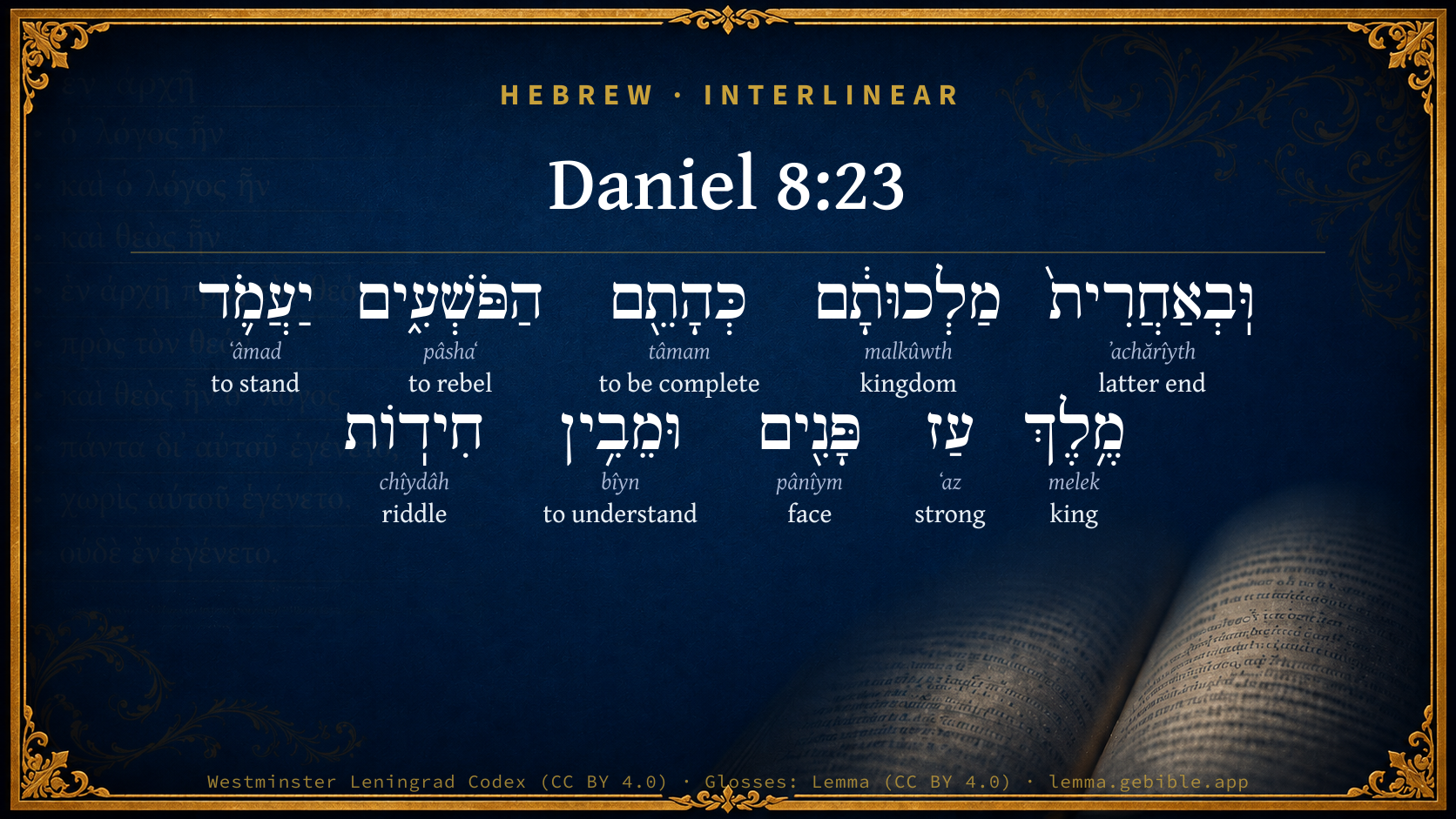
Daniel 8:23

Hebrew (Westminster Leningrad Codex) Daniel 8:23 appears in the Hebrew Old Testament. The text above is from the Westminster Leningrad Codex. Each word links to its Strong’s number, a concise gloss, and parsing drawn from the Open Scriptures Hebrew Bible morphology. Click any word for its full Brown-Driver-Briggs (BDB) entry.
Download image
Cite this verse

Daniel 8:23 (World English Bible). Public Domain. Lemma interlinear Bible study tool, https://lemma.gebible.app/v/daniel/8/23.

Show BibTeX & RIS
BibTeX
RIS
English Translation
In the latter time of their kingdom, when the transgressors are come to the full, a king of fierce face, and understanding dark sentences, shall stand up.
World English Bible · Public Domain
Download a study sheet

One document with this verse’s original text, its word-by-word gloss line, the meaning frame, cross-references with their text, attributed commentary, and full source and license credits — printable, and it pastes into notes with its structure intact.

This verse Autodidact and up

Study sheet (.html) Plain text (.txt)

A passage Seminary Student

Up to 50 verses in one chapter. A passage sheet keeps up to 6 commentary sources and 12 cross-references per verse, in the order this page ranks them, and says so on the sheet whenever that leaves anything out. Ask for a single verse and you get the Autodidact verse sheet above.

Everything on this page stays free to read, with no account — the sheet is a download of what is already on screen, not access to it.

Want to remove ads? Support Godless Engineer
Compare translations 3

The same verse in 3 English versions, stacked beneath the original-language interlinear above. Click any original word for its lexicon entry.

Each is an independent rendering of the whole verse — the interlinear is not word-aligned to these translations.

Highlighted words mark where these versions differ — a whole-verse word diff, not a word-by-word alignment.

  • World English Bible Public Domain
    In the latter time of their kingdom, when the transgressors are come to the full, a king of fierce face, and understanding dark sentences, shall stand up.
  • King James Version Public Domain
    And in the latter time of their kingdom, when the transgressors are come to the full, a king of fierce countenance, and understanding dark sentences, shall stand up.
  • unfoldingWord Literal Text CC BY-SA 4.0
    At the latter end of their rule, when the transgressors have reached their limit, a king of bold face, one who understands riddles, will arise.

unfoldingWord Literal Text — © unfoldingWord, licensed CC BY-SA 4.0. Word-aligned USFM3 via Door43 (git.door43.org/unfoldingWord/en_ult).

Versions to compare (up to 4)

3 of 4 selected

Show all 18 translations

Every available English version of this verse, each an independent rendering of the whole verse.

  • World English Bible Public Domain
    In the latter time of their kingdom, when the transgressors are come to the full, a king of fierce face, and understanding dark sentences, shall stand up.
  • Berean Standard Bible Public Domain
    In the latter part of their reign, when the rebellion has reached its full measure, an insolent king, skilled in intrigue, will come to the throne.
  • Majority Standard Bible Public Domain
    In the latter part of their reign, when the rebellion has reached its full measure, an insolent king, skilled in intrigue, will come to the throne.
  • King James Version Public Domain
    And in the latter time of their kingdom, when the transgressors are come to the full, a king of fierce countenance, and understanding dark sentences, shall stand up.
  • American Standard Version (1901) Public Domain
    And in the latter time of their kingdom, when the transgressors are come to the full, a king of fierce countenance, and understanding dark sentences, shall stand up.
  • Revised Version (1885) Public Domain
    And in the latter time of their kingdom, when the transgressors are come to the full, a king of fierce countenance, and understanding dark sentences, shall stand up.
  • Geneva Bible (1599) Public Domain
    And in the end of their kingdome, when the rebellious shalbe consumed, a King of fierce countenance, and vnderstanding darke sentences, shall stand vp.
  • Douay-Rheims (1899) Public Domain
    And after their reign, when iniquities shall be grown up, there shall arise a king of a shameless face, and understanding dark sentences.
  • Young's Literal Translation Public Domain
    `And in the latter end of their kingdom, about the perfecting of the transgressors, stand up doth a king, fierce of face, and understanding hidden things;
  • Literal Standard Version CC BY-SA 4.0
    And in the latter end of their kingdom, about the perfecting of the transgressors, a king stands up, fierce of face, and understanding hidden things;
  • Unlocked Literal Bible CC BY-SA 4.0
    At the latter time of those kingdoms, when the transgressors shall have reached their limit, a grim-faced king, one who is very intelligent, will arise.
  • unfoldingWord Literal Text CC BY-SA 4.0
    At the latter end of their rule, when the transgressors have reached their limit, a king of bold face, one who understands riddles, will arise.
  • Darby Bible Public Domain
    And at the latter time of their kingdom, when the transgressors shall have come to the full, a king of bold countenance, and understanding riddles, shall stand up.
  • World Messianic Bible Public Domain
    “In the latter time of their kingdom, when the transgressors have come to the full, a king of fierce face, and understanding riddles, will stand up.
  • Webster's Bible Public Domain
    And in the latter time of their kingdom, when the transgressors are come to the full, a king of fierce countenance, and understanding dark sentences, shall stand up.
  • Free Bible Version CC BY-SA 4.0
    When those kingdoms come to an end, when their sins have reached their fullest extent, a ferocious and treacherous kingdom will rise to power.
  • Bible in Basic English Public Domain
    And in the later years of their kingdom, when their evil doings have become complete, there will come up a king full of pride and expert in dark sayings.
  • JPS Tanakh (1917) Public Domain
    And in the latter time of their kingdom, when the transgressors have completed their transgression, there shall stand up a king of fierce countenance, and understanding stratagems.

Literal Standard Version (2020), Covenant Press — licensed CC BY-SA 4.0. Text via the HelloAO Bible API (eBible.org). Unlocked Literal Bible (unfoldingWord) — licensed CC BY-SA 4.0. Text via the HelloAO Bible API (eBible.org). unfoldingWord Literal Text — © unfoldingWord, licensed CC BY-SA 4.0. Word-aligned USFM3 via Door43 (git.door43.org/unfoldingWord/en_ult). Free Bible Version, Dr. Jonathan Gallagher — licensed CC BY-SA 4.0. Text via the HelloAO Bible API (eBible.org).

Word by word

More ways to search: Search by grammar → Find every occurrence → Compare this word →

Practice this passage: Drill this verse → Learn its vocabulary →

חִידֽוֹת
chîydâh
H2420
“riddles”
Noun, Common, Feminine, Plural, Absolute
Part of Speech
Noun
Type
Common
Gender
Feminine
Number
Plural
State
Absolute
Full BDB Definition

Origin: from H2330

TWOT: 616a

riddle, difficult question, parable, enigmatic saying or question, perplexing saying or question - riddle (dark obscure utterance) - riddle, enigma (to be guessed) - perplexing questions (difficult) - double dealing (with 'havin')
  1. וּֽבְאַחֲרִית֙ ʼachărîyth H319 “and · in/at · latter end of” Conjunction + Preposition + Noun, Common, Feminine, Singular, Construct
  2. מַלְכוּתָ֔ם malkûwth H4438 “kingdom · their” Noun, Common, Feminine, Singular, Construct + Suffix, Personal, 3rd Person, Masculine, Plural
  3. כְּהָתֵ֖ם tâmam H8552 “like/as · to be complete” Preposition + Verb, Hiphil, Infinitive Construct
  4. הַפֹּשְׁעִ֑ים pâshaʻ H6586 “the · rebelling” Particle, Definite Article + Verb, Qal, Participle Active, Masculine, Plural, Absolute
  5. יַעֲמֹ֛ד ʻâmad H5975 “to stand” Verb, Qal, Imperfect, 3rd Person, Masculine, Singular
  6. מֶ֥לֶךְ melek H4428 “king” Noun, Common, Masculine, Singular, Absolute
  7. עַז ʻaz H5794 “strong of” Adjective, Adjective, Masculine, Singular, Construct
  8. פָּנִ֖ים pânîym H6440 “face(s)” Noun, Common, Both, Plural, Absolute
  9. וּמֵבִ֥ין bîyn H995 “and · understanding” Conjunction + Verb, Hiphil, Participle Active, Masculine, Singular, Absolute

About this verse

These counts appear in no published source. They are computed here, from the morphology-tagged text and Lemma’s own curated glosses. What Lemma adds →

10
words
10
distinct lemmas
Prophets
section

Notable vocabulary

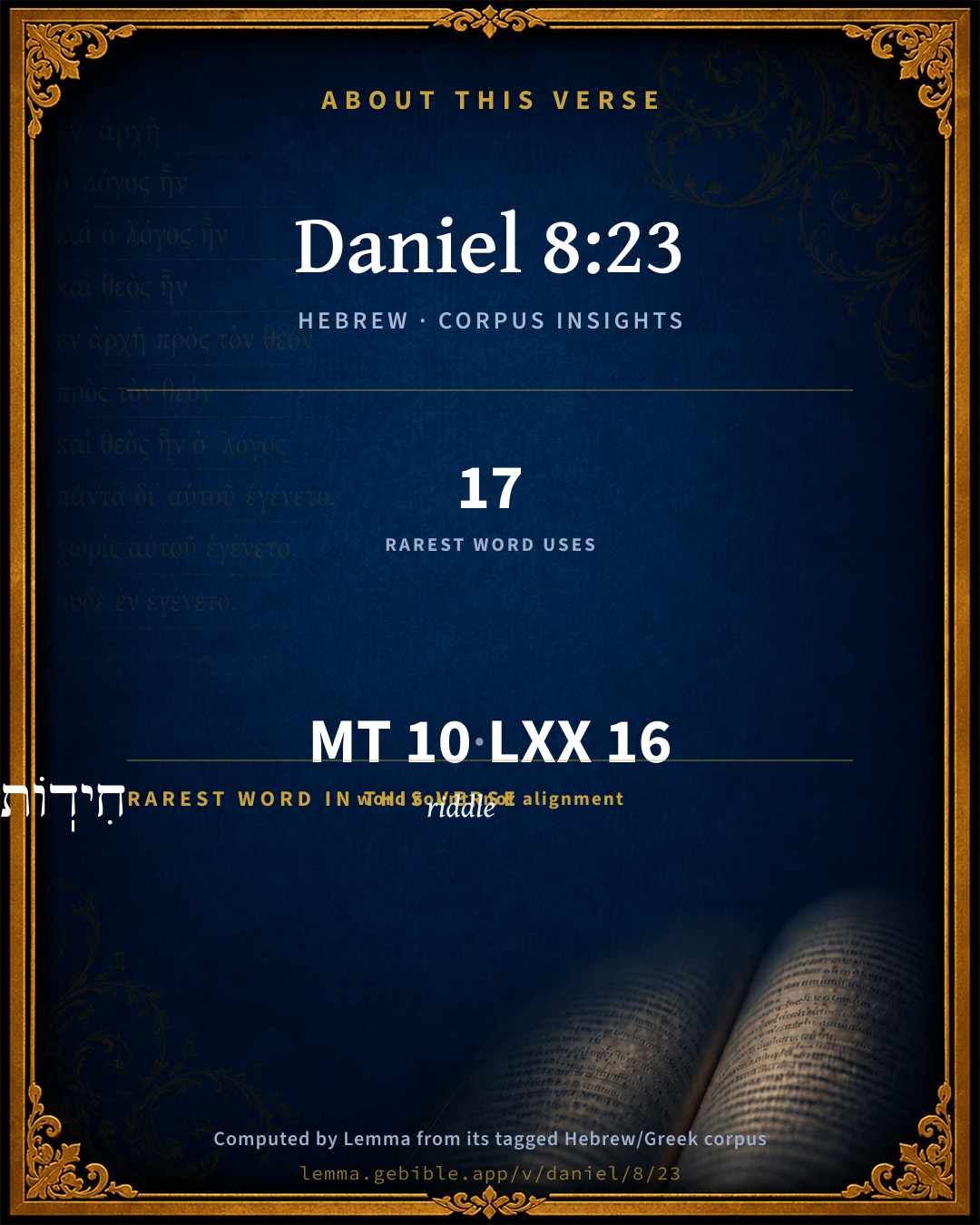
The rarest word here is חִידֽוֹת riddle H2420 — appearing just 17 times in the whole Hebrew Bible.

Shared distinctive vocabulary

חִידֽוֹת riddle H2420 occurs in 17 verses of the Hebrew Bible. Also found in:

Grammatical profile

  • 4 verbs
  • 5 nouns
  • 1 adjective

Verb forms

  • כְּהָתֵ֖ם Hiphil · Infinitive Construct
  • הַפֹּשְׁעִ֑ים Qal · Participle Active
  • יַעֲמֹ֛ד Qal · Imperfect
  • וּמֵבִ֥ין Hiphil · Participle Active

Hebrew & Septuagint length

In English translation the verse runs 27 words from the Hebrew and 27 from the Septuagint (LXX English) — the same length.

A rough comparison of the two English renderings, which tokenize alike — not a word-level alignment.

Word counts can differ between the Hebrew and the Greek without any difference in meaning — e.g. the Hebrew direct-object marker אֵת has no separate Greek word, and Greek often adds the article ὁ.

In the original languages it is 10 Hebrew tokens and 16 Greek tokens — but the two are counted differently (Hebrew bundles its prefixes and suffixes into one token; the Greek is in lemma form), so that isn’t a like-for-like length.

Cross-references

20

Topical passages linked to Daniel 8:23 in the Treasury of Scripture Knowledge — connected by theme and wording, ordered by reader-vote popularity; previews shown in the World English Bible.

  • 2 Thessalonians 2:9–11 even he whose coming is according to the working of Satan with all power and signs and lying wonders,
  • Revelation 13:11–14 I saw another beast coming up out of the earth. He had two horns like a lamb, and he spoke like a dragon.
  • Revelation 19:20 The beast was taken, and with him the false prophet who worked the signs in his sight, with which he deceived those who had received the mark of the beast and those who worshiped his image. These two were thrown alive into the lake of fire that burns with sulfur.
  • Daniel 8:9–12 Out of one of them came forth a little horn, which grew exceeding great, toward the south, and toward the east, and toward the glorious [land].
  • 1 Timothy 4:1 But the Spirit says expressly that in later times some will fall away from the faith, paying attention to seducing spirits and doctrines of demons,
  • Daniel 7:8 I considered the horns, and, behold, there came up among them another horn, a little one, before which three of the first horns were plucked up by the roots: and, behold, in this horn were eyes like the eyes of a man, and a mouth speaking great things.
  • Daniel 7:11 I saw at that time because of the voice of the great words which the horn spoke; I saw even until the animal was slain, and its body destroyed, and it was given to be burned with fire.
  • Daniel 7:20 and concerning the ten horns that were on its head, and the other [horn] which came up, and before which three fell, even that horn that had eyes, and a mouth that spoke great things, whose look was more stout than its fellows.
  • Daniel 7:25 He shall speak words against the Most High, and shall wear out the saints of the Most High; and he shall think to change the times and the law; and they shall be given into his hand until a time and times and half a time.
  • Ezekiel 38:8 After many days you shall be visited: in the latter years you shall come into the land that is brought back from the sword, that is gathered out of many peoples, on the mountains of Israel, which have been a continual waste; but it is brought forth out of the peoples, and they shall dwell securely, all of them.
  • Ezekiel 38:16 and you shall come up against my people Israel, as a cloud to cover the land: it shall happen in the latter days, that I will bring you against my land, that the nations may know me, when I shall be sanctified in you, Gog, before their eyes.
  • Daniel 8:25 Through his policy he shall cause craft to prosper in his hand; and he shall magnify himself in his heart, and in [their] security shall he destroy many: he shall also stand up against the prince of princes; but he shall be broken without hand.
  • Genesis 15:16 In the fourth generation they will come here again, for the iniquity of the Amorite is not yet full."
  • Deuteronomy 28:50 a nation of fierce facial expressions, that shall not regard the person of the old, nor show favor to the young,
  • Daniel 10:14 Now I have come to make you understand what shall happen to your people in the latter days; for the vision is yet for [many] days:
  • Daniel 11:21 In his place shall stand up a contemptible person, to whom they had not given the honor of the kingdom: but he shall come in time of security, and shall obtain the kingdom by flatteries.
  • Daniel 11:24 In time of security shall he come even on the fattest places of the province; and he shall do that which his fathers have not done, nor his fathers' fathers; he shall scatter among them prey, and spoil, and substance: yes, he shall devise his devices against the strongholds, even for a time.
  • Numbers 24:24 But ships [shall come] from the coast of Kittim, They shall afflict Asshur, and shall afflict Eber; He also shall come to destruction.
  • Matthew 23:32 Fill up, then, the measure of your fathers.
  • 1 Thessalonians 2:16 forbidding us to speak to the Gentiles that they may be saved; to fill up their sins always. But wrath has come on them to the uttermost.

Cross-references courtesy of OpenBible.info (CC BY 4.0).

Hebrew and Greek witnesses Masoretic Hebrew ↔ Greek Septuagint

The same verse in the two great witnesses to the Old Testament, shown verse-for-verse.

These are two independent witnesses, not word-aligned to each other, and the Septuagint is shown in lemma (dictionary) form.

Hebrew Daniel 8:23 Masoretic · Westminster Leningrad Codex

וּֽבְאַחֲרִית֙ מַלְכוּתָ֔ם כְּהָתֵ֖ם הַפֹּשְׁעִ֑ים יַעֲמֹ֛ד מֶ֥לֶךְ עַז פָּנִ֖ים וּמֵבִ֥ין חִידֽוֹת

In the latter time of their kingdom, when the transgressors are come to the full, a king of fierce face, and understanding dark sentences, shall stand up.

World English Bible · Public Domain

Greek LXX Daniel 8:23 Septuagint · lemma form

καί ἐπί ἔσχατος ὁ βασιλεία αὐτός πληρόω ὁ ἁμαρτία αὐτός ἀναἵστημι βασιλεύς ἀναιδής πρόσωπον διανοέομαι αἴνιγμα

And at the latter time of their kingdom, when their sins are coming to the full, there shall arise a king bold in countenance, and understanding riddles.

LXX2012 (modern English Septuagint) · Public Domain

Hebrew: Westminster Leningrad Codex (CC BY 4.0). Greek: Septuagint (public domain); English from LXX2012 (modern English Septuagint) (Public Domain). How the Septuagint differs from the Hebrew →

Commentary

Notes on Daniel 8:23 from classic Christian and Jewish commentators (each source and its license shown beneath its notes). The classic Christian expositions comment on the surrounding passage and are grouped to its opening verse, so a note may address several verses; the Jewish commentaries on the Tanakh (Rashi and others) are per-verse, so they appear only where the commentator wrote on this verse.

Lemma curates 59 commentaries, every one of them public domain or Creative Commons licensed, each selected and text-cleaned for this edition rather than reprinted as found. About our sources →

Trapp's Complete Commentary

John Trapp

Dan 8:23 And in the latter time of their kingdom, when the transgressors are come to the full, a king of fierce countenance, and understanding dark sentences, shall stand up.

Ver. 23. And in the latter time of their kingdom.] In the one hundred and thirty-seventh year of the Greek monarchy.

When the transgressors are come to the full.] Heb., Are accomplished; when the Jews are grown stark naught. This was the reason why God set over them such a breathing devil, as was Antiochus, for a punishment of their open impiety and formal apostasy. When Phocas the traitor had slain Mauritius the emperor, there was an honest poor man, saith Cedrenus, who was earnest with God in prayer to know why that wicked man so prospered in his design; to whom answer was returned by a voice, that there could not be a worse man found and that the sins of Christians and of Constantinople did require it.

A king of fierce countenanoe.] Heb., Hard of face - that is, brazen faced, impudent, and withal acute, subtle ( acutus et astutus), and of a deep reach. Antiochus, Julian, the Duke of Alva, were such.

John Trapp, A Commentary or Exposition upon All the Books of the Old and New Testament (1647–1656) — public domain. Text from a community e-Sword module.

Joseph Benson's Commentary

Dan 8:23. And in the latter end of their kingdom — When their power was diminishing, and the Roman empire beginning to be established in Greece, from whence the Grecian kingdoms in Asia had their origin: for the bringing of Greece into subjection to the Roman power was a manifest indication of the declension of the Macedonian, or third monarchy, with its four heads, and the advancement of the fourth monarchy. Now this was remarkably brought to pass when Æmilius, the Roman consul, vanquished Perseus, king of Macedonia, and thereby brought all Greece under the power of the Romans, which happened one hundred and sixty-six years before Christ, and about the time when Antiochus profaned the temple, and set up therein the abomination of desolation. It must be observed likewise, that, before that time, the four horns, or kingdoms, had been reduced to two principal ones, Syria and Egypt. Antiochus had attempted to gain the latter, and had marched toward Alexandria to besiege that city, the conquest of which would have made him absolute master of the whole kingdom; but in order to prevent his success, Ptolemy Euergetes and his sister Cleopatra had sent ambassadors to the Romans, to beg their relief; and when Popilius was deputed by the senate to go into Egypt, he proposed terms to Antiochus which he was obliged to accept, and obey the commands of the senate. Thus both Syria and Egypt became, in some sort, vassals to Rome. When the transgressors are come to the full — Here the reason is assigned why God permitted these calamities to fall on his people, namely, their wickedness had risen to a very great height: of which Bishop Newton gives the following account. “The high-priesthood was exposed to sale. Good Onias was ejected for a sum of money, to make room for wicked Jason; and Jason again was supplanted for a greater sum of money, by a worse man, if possible, than himself, his brother Menelaus; and the golden vessels of the temple were sold, to pay for the sacrilegious purchase. At the same time, the customs of the heathen nations were introduced among the Jews; the youth were trained up and exercised after the manner of the Greeks; the people, apostatized from the true religion, and even the priests, (2Ma 4:14,) despising the temple, and neglecting the sacrifices, hastened to be partakers of unlawful diversions. Nay, the temple was profaned under the conduct of the high-priest Menelaus, was defiled with swine’s blood, and plundered of every thing valuable; and in the same year that Paulus Æmilius vanquished Perseus, the last king of Macedonia, and thereby put an end to that kingdom, the Jewish religion was put down, and the heathen worship was set up in the cities of Judea, and in Jerusalem; and the temple itself was consecrated to Jupiter Olympus, and his image was erected upon the very altar.” So evident it is that the transgressors were come to the full, and that it was in the latter time of the Macedonian empire, when what follows took place. A king of fierce countenance shall stand up — This is a very just character of Antiochus, according to Diodorus, Polybius, and all the historians. And such a character may be presumed to belong to antichrist, who would be acquainted with all the depths of Satan, Rev 2:24. “I must confess,” says Mr. Wintle, “that this part of the interpretation appears to me to agree better with Antiochus than with the Romans: when interpreted of the latter, it is understood to mean a warlike and politic state.” Understanding dark sentences — One practised in craft and policy, particularly in the arts of seducing men from their religion. In this Antiochus was too successful with the Jews. Michaelis renders the clause, rex omnis doli peritus, a king skilled in every kind of deceit. Mr. Wintle reads, penetrating in mysterious craft.

Joseph Benson's Commentary on the Old and New Testaments (1811–1818) — public domain. Text from a community e-Sword module.

Tyndale Open Study Notes

Tyndale Open Resources

8:23-25 The small horn (8:9) was a fierce king. The description matches Antiochus IV (175–163 BC), one of the Seleucids (cp. 11:21-45). He bore the name “Epiphanes” (“The Manifest Presence [of God]”), but many, including Jews, mockingly called him “Epimanes” (“Mad Man”). By desecrating the Temple and Jewish worship (8:11-12), Antiochus tried to destroy Judaism and unify his kingdom under the cult of Hellenistic culture. Some Jews were swept up in the program of Hellenism and adopted Greek ways.

Tyndale Open Study Notes — © Tyndale Open Resources, licensed CC BY-SA 4.0. Text via the HelloAO Bible API.

Geneva Bible (1599)

Geneva Bible translators

Noting that this Antiochus was impudent and cruel, and also crafty that he could not be deceived.

Geneva Bible (1599) marginal notes — public domain. Text via Bolls.life.

Jamieson, Fausset & Brown

Robert Jamieson, A. R. Fausset & David Brown

transgressors are come to the full--This does not hold good of the times of Antiochus, but of the closing times of the Christian era. Compare Luk 18:8, and Ti2 3:1-9, as to the wickedness of the world in general just before Christ's second coming. Israel's guilt, too, shall then be at the full, when they who rejected Christ shall receive Antichrist; fulfilling Jesus words, "I am come in My Father's name, and ye receive Me not; if another shall come in his own name, him ye will receive" (compare Gen 15:16; Mat 23:32; Th1 2:16).

of fierce countenance-- (Deu 28:50); one who will spare neither old nor young.

understanding dark sentences--rather, "artifices" [GESENIUS]. Antiochus made himself master of Egypt and Jerusalem successively by craft (1 Maccabees 1:30, &c.; 2 Maccabees 5:24, &c.).

Jamieson, Fausset & Brown — Commentary Critical and Explanatory on the Whole Bible (1871) — public domain (CC PDM 1.0). Text via the HelloAO Bible API.

Adam Clarke's Commentary

Verse 23. When the transgressors are come to the full] When the utmost degradation has taken place, by the buying and selling of the high priesthood; for Onias was ejected for a sum of money, to make room for wicked Jason; and Jason again was supplanted for a greater sum by a worse man, if possible, than himself, Menelaus; and the golden vessels of the temple were sold to pay for this sacrilegious purchase. Thus transgressions were come to the full, before the Romans had commission to destroy Jerusalem and its temple, c.

A king of fierce countenance] The Roman government, as before for king is often taken for kingdom or empire.

Understanding dark sentences] Very learned and skilful in all things relating to government and its intrigues. The learning of Rome is proverbial to the present time.

Adam Clarke's Commentary on the Bible (1810–1826) — public domain. Text from a community e-Sword/MySword module.

John Calvin's Commentaries

And at the end of their reign, when the wicked shall be at their height, one king shall stand By saying at the end of their kingdom, he does not mean to imply the destruction of the four kingdoms had ceased. The successors of Antiochus were not directly cast down from their sway, and Syria was not reduced into a province till about eighty or a hundred years after Antiochus the Great had been completely conquered. He again left heirs, who, without doubt, succeeded to the throne, as we shall see more clearly in the eleventh chapter. But this point is certain — Perseus was the last king of Macedon, and the Ptolemies continued to the times of Julius Caesar and Augustus, and we are well aware how completely Cleopatra was conquered and ruined by Antony. As women succeeded to the throne, we could not place the destruction of the Macedonian empire under Antiochus Epiphanes. But the angel means, at the end of their kingdom, when they had really come to the close of their reigns, and their final ruin was at hand. For when Antiochus Epiphanes returned to his country, he seemed to have re-established his power though it very soon afterwards began to die away. Similar circumstances also happened to Egypt and to Macedon, for the reign of all their kings was precarious, and although not directly overthrown, yet they depended on the Romans, and thus their royal majesty was but fleeting. At the end, therefore, of their kingdom, that is, when they arrived at the height, and their fall led them on to ruin, then, says he, when the wicked were consummated or perfected. Some apply this to the professed and outward enemies of the Church, but I rather approve of another opinion, which supposes the angel to be speaking of the impious, who provoked God’s wrath, till it became necessary for grievous and severe penalties to be inflicted on the people, to whom God had so magnificently promised a happy and a tranquil state. This, however, was no common temptation, after the prophets had treated so fully of the happy and prosperous state of the people after their return from captivity, to behold the horrible dispersion, and to witness these tyrants making their assault not only upon men, but upon the temple of God itself. Wherefore the angel, as before, fortifies the Prophet and all the rest of the pious against this kind of trial, and shews how God had not changed his counsels in afflicting his Church, to which he had promised tranquillity, but had been grievously provoked by the sins of the people. He then shews the urgent necessity which had compelled God to exercise this severity. When, therefore, the impious had come to their height, that is, when they had arrived at the highest pitch, and their intolerable obstinacy had become desperate. We perceive how the angel here meets the trial, and instructs the pious beforehand, unfolding to them the inviolability of God’s word, while the people’s impiety compelled him to treat, them severely, although he had determined to display liberality in every way. Then, he says, a king shall stand with a fierce countenance But the rest tomorrow.

John Calvin's Commentaries (1540-1563) — public domain. Text from the Calvin Translation Society English edition (1840s-50s) via the Christian Classics Ethereal Library (ccel.org). Calvin's coverage is partial (roughly two-thirds of the Bible); uncommented books and verses are honest gaps, never fabricated. The 19th-century editor's footnotes and remarks are omitted so the notes are faithfully Calvin's own voice.

Ellicott's Commentary for English Readers

(23) Transgressors . . .—When transgressors have filled up the measure of their guilt so as to exceed the limits of God’s mercy, then this event shall take place. The transgressors are the apostate Jews. Here, as in the other visions, the particulars respecting the most prominent objects of the vision are given more fully in the interpretation than in the early part of the chapter. The king is represented as being “of a fierce countenance,” he is shameless, he has no reluctance in pursuing the cruelties which he has designed. He “understands dark sayings,” or uses falsehood and dissimulation to carry out his purposes.

A Bible Commentary for English Readers, edited by Charles John Ellicott (1878–1897) — public domain. Text from a community e-Sword module.

The Cambridge Bible for Schools and Colleges

gen. ed. J. J. S. Perowne

23. in the latter time of their kingdom] in the closing period of the rule of the Diadochi (which the author pictures as brought altogether to an end at the death of Antiochus).

when the transgressors have completed (their guilt)] i.e. filled up the measure of their transgressions (cf., though the Heb. word is not the same, Gen_15:16). Or, with ‘transgressions’ for ‘transgressors’ (Sept., Theod., Pesh., Ew., Meinh.: the difference affects only the vocalization), when they (or men) have completed transgressions. It is disputed whether the reference is to the Israelites (Keil, Behrm.) or their heathen oppressors (Hitz., Meinh., Bevan). In the former case, the meaning will be that when the measure of Israel’s guilt is full, this final and severest of persecutions will fall upon them: in the latter case, Antiochus will be viewed as the climax of heathen impiety.

a king of hard countenance] i.e. unyielding, unmoved, deflant: lit. ‘strong of countenance,’ i.e. hard, firm (in a bad sense). The expression is borrowed from Deu_28:50 : cf., with the corresponding verb, Pro_7:13 (of the harlot), ‘she made her face strong,’ i.e. hard, impudent, Pro_21:29; ‘a wicked man hardeneth his face,’ Ecc_8:1.

and understanding riddles (Dan_5:12)] a master of dissimulation, able to conceal his meaning under ambiguous words, and so disguising his real purposes. Cf. Dan_8:25, ‘deceit,’ Dan_11:27, ‘obtain the kingdom by smooth sayings.’ Examples are afforded by his treatment of his nephew, Ptolemy Philometor, and the manner in which he completely misled the legates who were sent by the Romans for the purpose of ascertaining his feelings towards them (see on Dan_11:27; Dan_11:40). Antiochus was habitually successful in concealing his real motives and intentions when his interests required it.

23–25. A fuller description of the character and policy of Antiochus Epiphanes.

The Cambridge Bible for Schools and Colleges (gen. ed. J. J. S. Perowne; Cambridge University Press, 1878–1918) — public domain. Text from a community e-Sword module.

John Gill's Exposition

And in the latter time of their kingdom,.... Toward the close of the kingdom of the four kings that divided Alexander's kingdom; for though they were four distinct kings, and had four separate kingdoms, yet these all belonged to one kingdom or monarchy, the Grecian empire; and when that was decreasing, and coming into the hands of the Romans, there rose up, stood, and flourished awhile, King Antiochus, afterwards described, who began to reign in the hundred and thirty seventh year of the Seleucidae,

"And there came out of them a wicked root Antiochus surnamed Epiphanes, son of Antiochus the king, who had been an hostage at Rome, and he reigned in the hundred and thirty and seventh year of the kingdom of the Greeks.'' (1 Maccabees 1:10)

and 166 B.C., and the same year that he set up the abomination of desolation in the temple at Jerusalem, as Mr. Mede (p) has observed, Aemilius the Roman consul conquered Perseus king of Macedon, whereby all Greece came into the hands of the Romans; so that this king may be truly said to arise and stand in the latter part of the Grecian empire, when that was declining, and the Roman empire was taking place:

when the transgressors are come to the full; many among the Jews, who apostatized from their religion, turned Heathens, even some of the priests, when their number was completed, and they had filled up the measure of their iniquities; in the Apocrypha:

"In those days went there out of Israel wicked men, who persuaded many, saying, Let us go and make a covenant with the heathen that are round about us: for since we departed from them we have had much sorrow. &c.'' (1 Maccabees 1:11)

a king of fierce countenance, and understanding dark sentences, shall stand up; meaning Antiochus; as is generally agreed, both by Jewish and Christian interpreters, and to whom these characters agree: he was "hard of face" (q), as it may be rendered; an impudent brasen faced man, who had no shame nor fear in him; regarded neither God nor man; committed the most atrocious crimes in the most public manner; and particularly was daring and impudent in his blasphemy against God and the true religion; and it may also signify that he was cruel, barbarous, and inhuman, especially to the Jews, as his persecution of them abundantly proves: and his "understanding dark sentences", or "riddles" (r), which he could both propose and answer, shows him to be sagacious and cunning, well versed in wicked craft and policy; he had the art of inveigling and deceiving men; it was by deceit and cunning he got the kingdom from his nephew; and, by the wicked art of persuasion he was master of, he seduced many of the Jews to relinquish their religion, and embrace Heathenism; and so well skilled he was in wicked politics, that he could cover his own designs, and penetrate into the secrets of others; according to Jacchiades, he was skilful in the art of magic and astrology. This is the little horn that was to rise out of one of the four horns or kingdoms; as Antiochus did from that of Seleucus, and stood and reigned more than twelve years.

(p) Works, B. 3. c. 11. p. 654. (q) "durus facie", Calvin, Piscator; "validus facie", Michaelis. (r) "aenigmata", Pagninus, Montanus, Munster, Calvin, Piscator, Polanus.

John Gill's Exposition of the Whole Bible (1746–1763) — public domain (CC PDM 1.0). Text via the HelloAO Bible API.

Albert Barnes' Notes on the Bible

And in the latter time of their kingdom - When it shall be drawing to an end. All these powers were ultimately absorbed in the Roman power; and the meaning here is, that taking the time from the period of their formation - the division of the empire after the battle of Ipsus (see the notes at Dan 8:8), until the time when all would be swallowed up in the Roman dominion, what is here stated - to wit, the rise of Antiochus - would be in the latter portion of that period. The battle of Ipsus was fought 301 b.c., and the Roman power was extended over all those regions gradually from 168 b.c. - the battle of Pydna, when Perseus was defeated, and Macedonia was reduced to a Roman province, to 30 b.c., when Egypt was subjected - the last of these kingdoms that submitted to the Roman arms. Antiochus began to reign, 175 b.c. - so that it was in the latter part of this period.

When the transgressors are come to the full - Margin, accomplished. That is, when the state of things - the prevalence of wickedness and irreligion in Judea - shall have been allowed to continue as long as it can be - or so that the cup shall be full - then shall appear this formidable power to inflict deserved punishment on the guilty nation. The sacred writers often speak of iniquity as being full - of the cup of iniquity as being full - as if there was a certain limit or capacity beyond which it could not be allowed to go. When that arrives, God interposes, and cuts off the guilty by some heavy judgment. Compare Gen 15:16 : “The iniquity of the Amorites is not yet full.” Mat 23:32 : “fill ye up then the measure of your fathers.” 1Th 2:16 : “to fill up their sins alway.” The idea is, that there is a certain measure or amount of sin which can be tolerated, but beyond that the Divine compassion cannot go with safety to the universe, or consistently with the honor of God, and then the punishment may be expected; then punishment must come. This is true, doubtless, of individuals and nations, and this period had arrived in regard to the Jews when Antiochus was permitted to lay their temple, city, and country waste.

A king of fierce countenance - Stern and severe. This expression would be applicable to many who have held the kingly office, and no one can doubt that it may be applied with strict propriety to Antiochus.

And understanding dark sentences - Gesenius (Lexicon) explains the word here rendered “dark sentences” to mean artifice, trick, stratagem. This will better agree with the character of Antiochus, who was more distinguished for craft and policy than he was for wisdom, or for explaining enigmas. The meaning seems to be that he would be politic and crafty, seeking to make his way, and to accomplish his purpose, not only by the terror that he inspired, but by deceit and cunning. That this was his character is well known. Compare the notes at Dan 8:25.

Shall stand up - Shall succeed, or there shall be such a king.

Albert Barnes' Notes on the Bible (1834–1885) — public domain. Text from a community e-Sword/MySword module.

Haydock's Catholic Bible Commentary

Shameless. Hebrew: "hard," cruel, and impudent, as Epiphanes was. (1 Machabees i. 2.) Marcellinus styles him "wrathful and savage." --- Sentences, making use of artifice to seize the estates of his nephew Philometor, and to oppress the Jews. (2 Machabees v. 24.) (Calmet) --- The history speaks of Antiochus: antichrist is also meant, as Chap. xii. and Matthew xxiv. (Worthington)

George Leo Haydock (1774–1849), Haydock's Catholic Family Bible and Commentary, 1859 edition — public domain. Excludes Psalms (Douay-Rheims chapter numbering differs from Protestant) and Deuterocanonical books (Catholic canon only).

Matthew Poole's English Annotations

In the latter time of their kingdom, i.e. when they were come to the height, and beginning to decline. It notes that time when the Romans began to seize part of the Grecian kingdom, by Emilius Probus, who subdued Perseus king of Macedonia, and thereby brought all Greece under the Roman jurisdiction; which was one hundred and sixty-six years before Christ was born, that very year Antiochus set up the abomination of desolation.

When the transgressors are come to the full; when the Jews were grown to an excess of wickedness, and called for punishment, then God suffered Antiochus to persecute them.

Of fierce countenance; such was he: the word is translated impudent, inhuman, for the countenance is the discoverer of the mind and manners oftentimes.

Understanding dark sentences; full of all subtlety, another Julian, to lay snares, and fetch over the inconstant and backsliding Jews: such a one all histories declare this Antiochus to be.

Matthew Poole's English Annotations on the Holy Bible (1683–1685) — public domain. Text from a community e-Sword/MySword module.

Whedon's Commentary on the Bible

Daniel D. Whedon

23. The Alexandrine empire has been broken into four kingdoms (Dan_8:8; Dan_8:22) which in this vision are said to have ultimately become changed into a kingdom — the fourth kingdom of Daniel (Dan_7:7-8; Dan_7:23-25; notes Dan_2:39-41). At the latter end of this kingdom appears a fierce and shrewd king who is undoubtedly Antiochus Epiphanes. He is said to come when the transgressors are come to the full, perhaps referring to the sins of the people of Israel, which according to Scripture, were always the cause of their troubles (see, for example, Ezekiel 4-7) or else to the fact that all the iniquity of the previous beast empires seemed to come to a head in the days of this worst king.

Understanding dark sentences — That is, skilled in double dealing (Bevan). He was a skillful diplomatist, and the intrigues of state would be the “riddles” in which Antiochus would be the most interested (Dan_8:25; Dan_11:21; Dan_11:32; 1Ma_1:30).

Daniel D. Whedon (gen. ed.), Commentary on the Old and New Testaments (1874–1909) — public domain. Text from a community e-Sword module.

The Pulpit Commentary

And in the latter time of their kingdom, when the transgressors are come to the full, a king of fierce countenance, and understanding dark sentences, shall stand up. The versions here are, on the whole, in agreement with the Massoretic. The Greek versions read, "their sins," as if it were the iniquities of the successors of Alexander that had become full, and thus afforded the occasion of the appearance of Epiphanes. The Peshitta and Jerome have "iniquities" generally, without reference to the kings, but with probable reference to the Jewish people. The probability is decidedly in favour of the Massoretic reading; it was an easy suggestion that the iniquities to be punished were those of the heathen kings. The whole analogy of Scripture leads us to look at the iniquity of the people of God being the cause of evil befalling them. Certainly immediately before the persecution inflicted on the Jews by Antiochus, the progress of the unbelieving Hellenizing party had been very great, as we see by RAPC 1Ma 1:13-16. It was "like people, like priest;" the people devoted themselves to Grecian games with all their heathen associations, and strove to hide their Hebrew origin and the covenant of their faith, and high priests were ready to abet their practices. A king of fierce countenance; strong of countenance." This refers to courage and success in war. Thus Amaziah, (2Ki_14:8) when he wishes to challenge Joash King of Israel, desires to "look in his face." Epiphanes" countenance was one that could successfully stand a hostile meeting. The Greek versions render x (az) by ajnaidhv, "reckless." Understanding dark sentences. There may be some reference to incantations and superstitious observances; it may mean that he was well acquainted with omens, and how to benefit by them. Regardlessness in the matter of religion was a prominent characteristic of Antiochus; but it is quite a possible thing that, like most irreligious men, he was superstitious. He certainly was very keen-sighted in observing the political signs of the times, and very adroit at availing himself of what made for his own advantage. This last is the interpretation of Ewald. Zockler and Hitzig think it means that the king here pictured "will be cunning to hide his own designs from friend and foe." Yet more common is the view of Keil, Behrmann, Stuart, and Bevan, that it refers generally to his mastery in the use of artifice. The main difficulty in regard to this view is that usage, does not support assigning such a meaning to heedoth. On the other hand, when we bear in mind that here we have the language of symbol and prophecy, so tricks of strategy and chicane of policy may all be symbolized by "dark sayings," without necessary reference to sentences such as those with which the Queen of Sheba tested the wisdom of Solomon.

Vers. 23-25.

Subtle sin.

We have here a description of a terrible evil power which, in manner and appearance, is deceptively harmless, and yet which is really most destructive and wicked and destined to detection and overthrow.

I EVIL WORKS MOST EFFECTIVELY WHEN IT HIDES ITS TRUE CHARACTER.

1. It works under a fair show. The king has "an insolent countenance" and "magnifies himself in his heart." There is a bold self-assertion and an apparent frankness which sometimes blind men to the falsehood beneath.

2. It works by craft, as much as by force. The king "understands dark stratagems" and "craft prospers under his band." The tempter is more successful when he appears as the subtle serpent than when he comes as a raging lion. Transformed into an angel of light, he persuades by deceit. Intellect is a more dangerous weapon in the hands of a bad man than mere brute force.

3. It turns peaceful prosperity into a means of harm. Warfare and persecution are less dangerous than the insidious temptations of luxurious vices and flattering indolence.

II THOUGH EVIL MAY BE OBSCURE TO US, ITS CHARACTER AND DESTINY ARE NOT CHANGED.

1. It is still destructive. This crafty and peace-loving king is really as destructive as the old warlike monarch. Sin is not the less fated because it wears a fair mask.

2. It is still only the abuse of Divine gifts. The king is mighty, "but not by his own power." All sin is only possible by the abuse of talents lent us by God. The boldness of self-assertion is no proof of independence and liberty to pursue our own course.

3. It is still defiance of the will of God. "He shall stand up against the Prince of princes." We may rebel against God with a smile as much as with a frown. Guilt is not measured by manners, but by motives. Crafty treachery is not less guilty than open rebellion.

4. It is still destined to judgment and overthrow. We may deceive men; we cannot deceive God. (Rom_2:16) God also "understands the dark stratagems" of subtle wickedness. They will be detected and defeated. The punishment of sins of subtlety and craft is as certain as that of sins of open and confessed guilt.

The Pulpit Commentary (1880–1919), ed. H.D.M. Spence-Jones & Joseph S. Exell — public domain. Text from a community e-Sword module.

John Wesley's Explanatory Notes

In the latter time - When they were come to the height, and beginning to decline. When the transgressors - When the Jews were grown to an excess of wickedness, then God suffered Antiochus to persecute them. Dark sentences - Full of subtilty: such all histories declare Antiochus to be.

John Wesley, Explanatory Notes Upon the Whole Bible (1754–1765) — public domain. Text via the GEBible commentary corpus.

Scofield Reference Notes

C. I. Scofield

king of fierce countenance

i.e. Antiochus Epiphanes who arose out of Syria, one of the "four kingdoms," B.C. 170.

The Scofield Reference Bible (1917 edition), notes by C. I. Scofield — public domain. Text from a community e-Sword module.

Rashi

Rabbi Shlomo Yitzchaki (Rashi)

And at the end of their kingdom, when the transgressors have been destroyed When the end arrives, and the wicked of Israel in the Second Temple will be finished.

a brazen-faced person will rise he is Titus.

Rashi on the Tanakh — English translations: “The Judaica Press complete Tanach with Rashi, translated by A. J. Rosenberg” (CC BY 4.0); “Pentateuch with Rashi's commentary by M. Rosenbaum and A.M. Silbermann, 1929-1934” (public domain); “The Metsudah Tanach series, Lakewood, N.J” (CC BY 4.0); and “The Book of Joshua, Metsudah Publications, 1997” (CC BY 4.0). Text via Sefaria.

Lesson kit

Teaching starters — assembled from the data on this page, not authored interpretation. Every prompt links to the verse data it draws on. Edit before teaching.

Daniel, in the Prophets, opens this verse with 10 words (10 distinct Hebrew lemmas). Its most distinctive word is chîydâh (“riddle”). A historical commentator’s framing appears above. Read the whole chapter for the surrounding context.

Discussion questions

  1. What does “riddle” (chîydâh) contribute to the verse as a whole?
  2. Numbers 12:8 shares the word «riddle» with this verse. How do the two illuminate each other?
  3. The translations on this page render this verse differently — a whole-verse word diff, not a word-by-word alignment. What might account for the different wordings?
  4. The verb «כְּהָתֵ֖ם» is Hiphil Infinitive Construct. How does its form color the action?
  5. Reading how Trapp's Complete Commentary and Joseph Benson's Commentary read this verse, where do the two commentators agree and where do they part?

Things to notice

Reading settings

Reading text

Shown beneath each verse's original-language words.

Old Testament
Old Testament edition

Read the OT as the Masoretic Hebrew (MT) or the Greek Septuagint (LXX).

English shown for the Greek Septuagint (in the Hebrew ↔ Greek comparison).

Comparing translations? Open the Compare panel on any verse page to stack up to four side by side.