
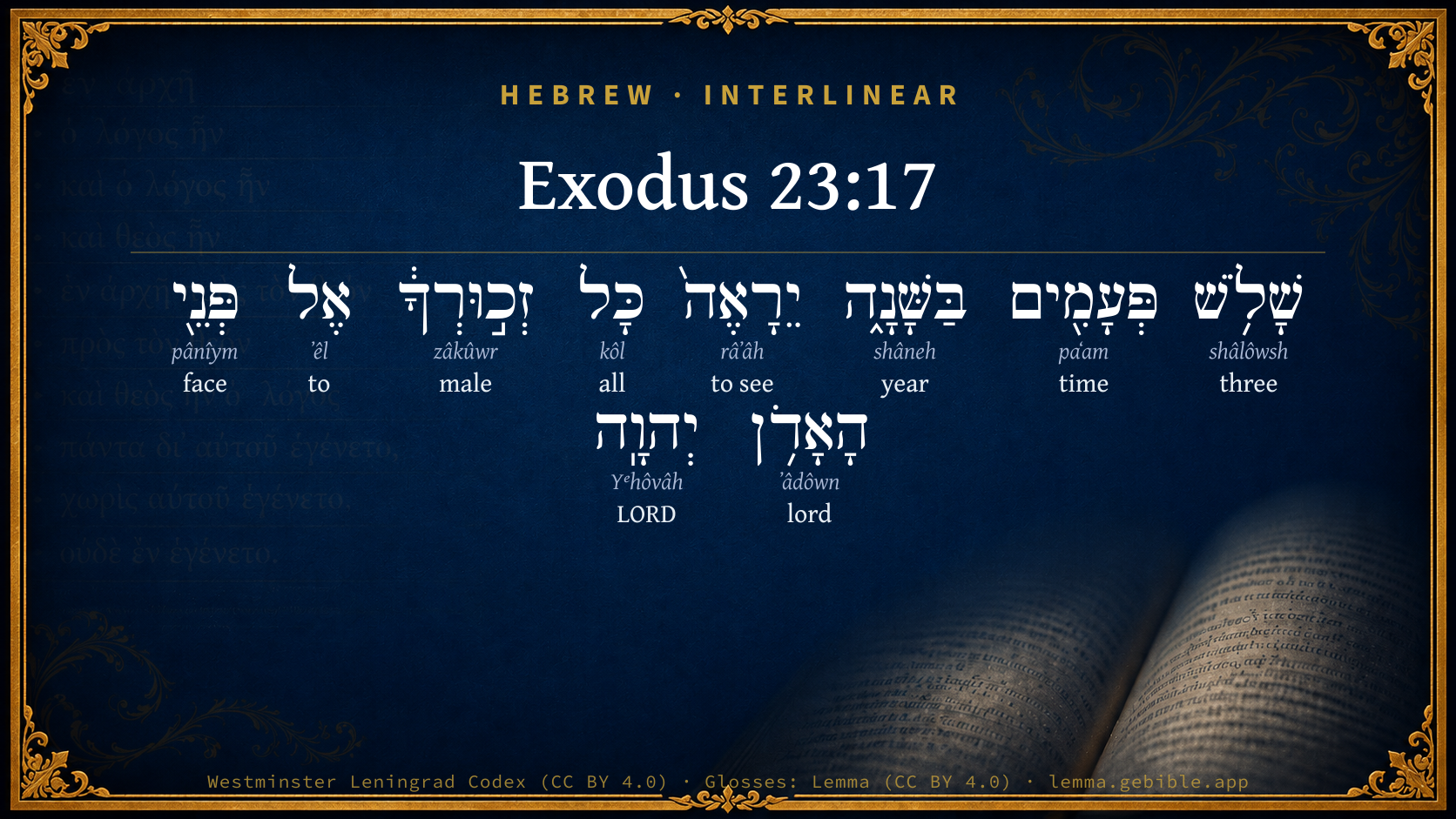
Exodus 23:17

Hebrew (Westminster Leningrad Codex) Exodus 23:17 appears in the Hebrew Old Testament. The text above is from the Westminster Leningrad Codex. Each word links to its Strong’s number, a concise gloss, and parsing drawn from the Open Scriptures Hebrew Bible morphology. Click any word for its full Brown-Driver-Briggs (BDB) entry.
Download image
Cite this verse

Exodus 23:17 (World English Bible). Public Domain. Lemma interlinear Bible study tool, https://lemma.gebible.app/v/exodus/23/17.

Show BibTeX & RIS
BibTeX
RIS
English Translation
Three times in the year all your males shall appear before the Lord Yahweh.
World English Bible · Public Domain
Highlights
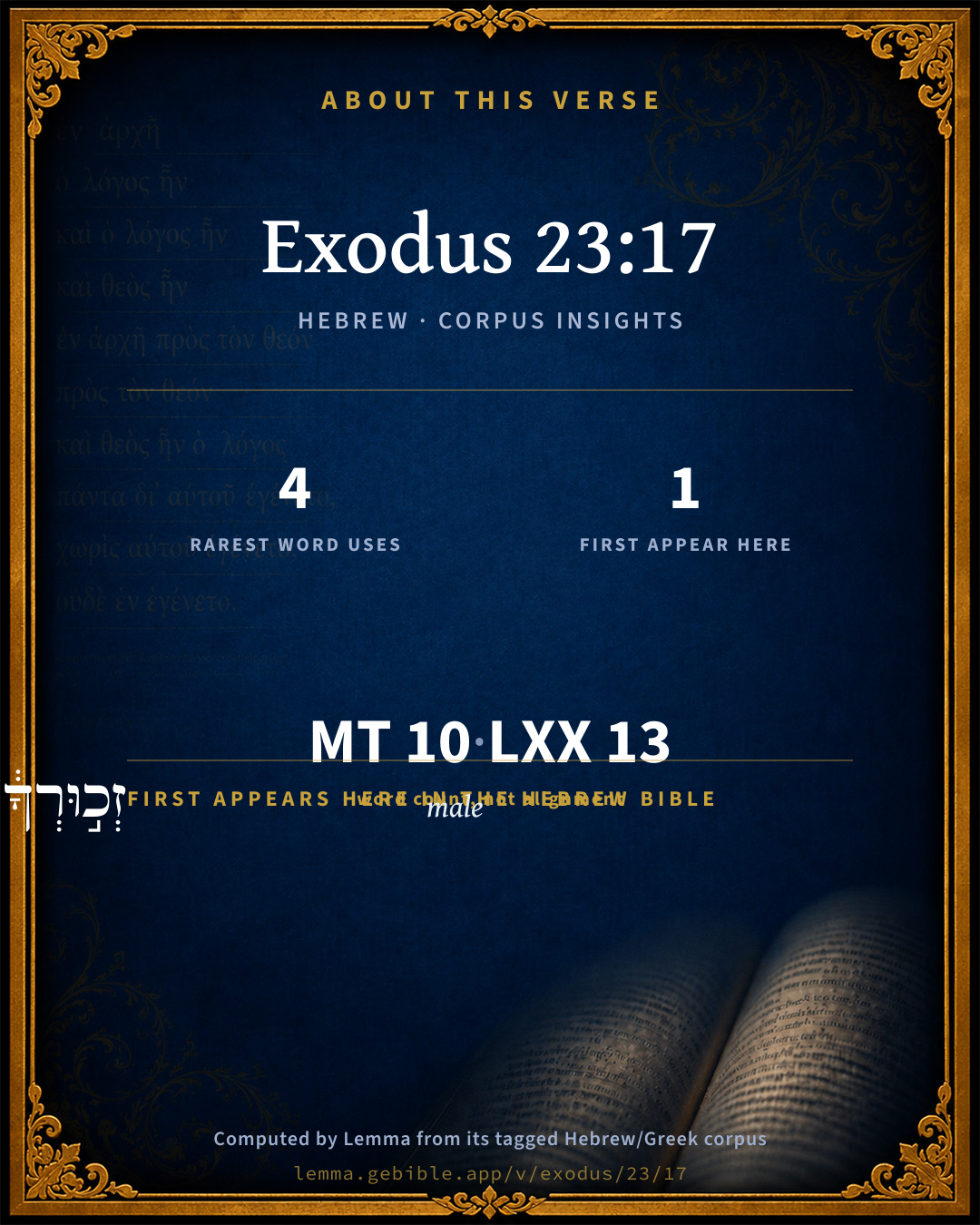
  • 1 first appearance in the Hebrew Bible
Full analysis ↓
Download a study sheet

One document with this verse’s original text, its word-by-word gloss line, the meaning frame, cross-references with their text, attributed commentary, and full source and license credits — printable, and it pastes into notes with its structure intact.

This verse Autodidact and up

Study sheet (.html) Plain text (.txt)

A passage Seminary Student

Up to 50 verses in one chapter. A passage sheet keeps up to 6 commentary sources and 12 cross-references per verse, in the order this page ranks them, and says so on the sheet whenever that leaves anything out. Ask for a single verse and you get the Autodidact verse sheet above.

Everything on this page stays free to read, with no account — the sheet is a download of what is already on screen, not access to it.

Want to remove ads? Support Godless Engineer
Compare translations 3

The same verse in 3 English versions, stacked beneath the original-language interlinear above. Click any original word for its lexicon entry.

Each is an independent rendering of the whole verse — the interlinear is not word-aligned to these translations.

Highlighted words mark where these versions differ — a whole-verse word diff, not a word-by-word alignment.

  • World English Bible Public Domain
    Three times in the year all your males shall appear before the Lord Yahweh.
  • King James Version Public Domain
    Three items in the year all thy males shall appear before the LORD God.
  • unfoldingWord Literal Text CC BY-SA 4.0
    Three times in a year, all your males shall appear to the face of the Lord Yahweh.

unfoldingWord Literal Text — © unfoldingWord, licensed CC BY-SA 4.0. Word-aligned USFM3 via Door43 (git.door43.org/unfoldingWord/en_ult).

Versions to compare (up to 4)

3 of 4 selected

Show all 18 translations

Every available English version of this verse, each an independent rendering of the whole verse.

  • World English Bible Public Domain
    Three times in the year all your males shall appear before the Lord Yahweh.
  • Berean Standard Bible Public Domain
    Three times a year all your males are to appear before the Lord GOD.
  • Majority Standard Bible Public Domain
    Three times a year all your males are to appear before the Lord GOD.
  • King James Version Public Domain
    Three items in the year all thy males shall appear before the LORD God.
  • American Standard Version (1901) Public Domain
    Three times in the year all thy males shall appear before the Lord Jehovah.
  • Revised Version (1885) Public Domain
    Three times in the year all thy males shall appear before the Lord GOD.
  • Geneva Bible (1599) Public Domain
    These three times in the yeere shall all thy men children appeare before the Lord Iehouah.
  • Douay-Rheims (1899) Public Domain
    Thrice a year shall all thy males appear before the Lord thy God.
  • Young's Literal Translation Public Domain
    `Three times in a year do all thy males appear before the face of the Lord Jehovah.
  • Literal Standard Version CC BY-SA 4.0
    Three times in a year all your males appear before [the] face of the Lord YHWH.
  • Unlocked Literal Bible CC BY-SA 4.0
    All your males must appear before the Lord Yahweh three times every year.
  • unfoldingWord Literal Text CC BY-SA 4.0
    Three times in a year, all your males shall appear to the face of the Lord Yahweh.
  • Darby Bible Public Domain
    Three times in the year all thy males shall appear in the presence of the Lord Jehovah.
  • World Messianic Bible Public Domain
    Three times in the year all your males shall appear before the Lord GOD.
  • Webster's Bible Public Domain
    Three times in the year all thy males shall appear before the Lord GOD.
  • Free Bible Version CC BY-SA 4.0
    Every Israelite male is to come before the Lord God at these three times every year.
  • Bible in Basic English Public Domain
    Three times in the year let all your males come before the Lord God.
  • JPS Tanakh (1917) Public Domain
    Three times in the year all thy males shall appear before the Lord GOD.

Literal Standard Version (2020), Covenant Press — licensed CC BY-SA 4.0. Text via the HelloAO Bible API (eBible.org). Unlocked Literal Bible (unfoldingWord) — licensed CC BY-SA 4.0. Text via the HelloAO Bible API (eBible.org). unfoldingWord Literal Text — © unfoldingWord, licensed CC BY-SA 4.0. Word-aligned USFM3 via Door43 (git.door43.org/unfoldingWord/en_ult). Free Bible Version, Dr. Jonathan Gallagher — licensed CC BY-SA 4.0. Text via the HelloAO Bible API (eBible.org).

Word by word

More ways to search: Search by grammar → Find every occurrence → Compare this word →

Practice this passage: Drill this verse → Learn its vocabulary →

זְכ֣וּרְךָ֔
zâkûwr
H2138
“male · your”
Noun, Common, Masculine, Singular, Construct + Suffix, Personal, 2nd Person, Masculine, Singular
Part of Speech
Noun
Type
Common
Gender
Masculine
Number
Singular
State
Construct
Full BDB Definition

Origin: properly, pass. participle of H2142 , but used for H2145

TWOT: 551f

male
  1. שָׁלֹ֥שׁ shâlôwsh H7969 “three” Adjective, Cardinal number, Feminine, Singular, Absolute
  2. פְּעָמִ֖ים paʻam H6471 “times” Noun, Common, Feminine, Plural, Absolute
  3. בַּשָּׁנָ֑ה shâneh H8141 “in/at the · year” Preposition, Determined + Noun, Common, Feminine, Singular, Absolute
  4. יֵרָאֶה֙ râʼâh H7200 “to see” Verb, Niphal, Imperfect, 3rd Person, Masculine, Singular
  5. כָּל kôl H3605 “all of” Noun, Common, Masculine, Singular, Construct
  6. אֶל ʼêl H413 “to” Preposition
  7. פְּנֵ֖י pânîym H6440 “face(s) of” Noun, Common, Both, Plural, Construct
  8. הָאָדֹ֥ן ʼâdôwn H113 “the · lord” Particle, Definite Article + Noun, Common, Masculine, Singular, Absolute
  9. יְהוָֽה Yᵉhôvâh H3068 “LORD” Noun, Proper

About this verse

These counts appear in no published source. They are computed here, from the morphology-tagged text and Lemma’s own curated glosses. What Lemma adds →

10
words
10
distinct lemmas
Pentateuch
section

Notable vocabulary

The rarest word here is זְכ֣וּרְךָ֔ male H2138 — appearing just 4 times in the whole Hebrew Bible.

First appearance in Scripture

This word makes its first canonical appearance in the Hebrew Bible here:

  • זְכ֣וּרְךָ֔ male H2138

Shared distinctive vocabulary

זְכ֣וּרְךָ֔ male H2138 occurs in 4 verses of the Hebrew Bible. Also found in:

Grammatical profile

  • 1 verb
  • 7 nouns
  • 1 adjective
  • 1 preposition

Verb forms

  • יֵרָאֶה֙ Niphal · Imperfect

Hebrew & Septuagint length

In English translation the verse runs 14 words from the Hebrew and 15 from the Septuagint (LXX English) — closely comparable.

A rough comparison of the two English renderings, which tokenize alike — not a word-level alignment.

Word counts can differ between the Hebrew and the Greek without any difference in meaning — e.g. the Hebrew direct-object marker אֵת has no separate Greek word, and Greek often adds the article ὁ.

In the original languages it is 10 Hebrew tokens and 13 Greek tokens — but the two are counted differently (Hebrew bundles its prefixes and suffixes into one token; the Greek is in lemma form), so that isn’t a like-for-like length.

Cross-references

7

Topical passages linked to Exodus 23:17 in the Treasury of Scripture Knowledge — connected by theme and wording, ordered by reader-vote popularity; previews shown in the World English Bible.

  • Deuteronomy 16:16 Three times in a year shall all your males appear before Yahweh your God in the place which he shall choose: in the feast of unleavened bread, and in the feast of weeks, and in the feast of tents; and they shall not appear before Yahweh empty:
  • Exodus 34:23 Three times in the year all your males shall appear before the Lord Yahweh, the God of Israel.
  • Exodus 23:14 "You shall observe a feast to me three times a year.
  • Deuteronomy 12:5 But to the place which Yahweh your God shall choose out of all your tribes, to put his name there, even to his habitation shall you seek, and there you shall come;
  • Deuteronomy 31:11 when all Israel is come to appear before Yahweh your God in the place which he shall choose, you shall read this law before all Israel in their hearing.
  • Luke 2:42 When he was twelve years old, they went up to Jerusalem according to the custom of the feast,
  • Psalms 84:7 They go from strength to strength. Everyone of them appears before God in Zion.

Cross-references courtesy of OpenBible.info (CC BY 4.0).

Hebrew and Greek witnesses Masoretic Hebrew ↔ Greek Septuagint

The same verse in the two great witnesses to the Old Testament, shown verse-for-verse.

These are two independent witnesses, not word-aligned to each other, and the Septuagint is shown in lemma (dictionary) form.

Hebrew Exodus 23:17 Masoretic · Westminster Leningrad Codex

שָׁלֹ֥שׁ פְּעָמִ֖ים בַּשָּׁנָ֑ה יֵרָאֶה֙ כָּל זְכ֣וּרְךָ֔ אֶל פְּנֵ֖י הָאָדֹ֥ן יְהוָֽה

Three times in the year all your males shall appear before the Lord Yahweh.

World English Bible · Public Domain

Greek LXX Exodus 23:17 Septuagint · lemma form

τρεῖς καιρός ὁ ἐνιαυτός ὁράω πᾶς ἀρσενικός σύ ἐνώπιον κύριος ὁ θεός σύ

Three times in the year shall all your males appear before the Lord your God.

LXX2012 (modern English Septuagint) · Public Domain

Hebrew: Westminster Leningrad Codex (CC BY 4.0). Greek: Septuagint (public domain); English from LXX2012 (modern English Septuagint) (Public Domain). How the Septuagint differs from the Hebrew →

Targum (Aramaic paraphrase)

2

The Targum is the ancient Jewish Aramaic paraphrase of the Hebrew Scriptures — an interpretive translation, not the Hebrew text itself. Onkelos (literal) and Pseudo-Jonathan (expansive) render the Torah, and Jonathan the Prophets. Coverage is partial: where no permissively-licensed English translation exists for a verse, only the Aramaic is shown. This is verse-level text, not a word-by-word alignment to the Hebrew.

  1. Targum Onkelos Torah (Genesis–Deuteronomy)
    תְּלַת זִמְנִין בְּשַׁתָּא יִתְחֲזוּן כָּל דְכוּרָךְ קֳדָם רִבּוֹן עָלְמָא יְיָ:

    (no public-domain English translation for this verse)

    Targum Onkelos — Aramaic: “Onkelos Genesis” (public domain); “Onkelos Exodus” (public domain); “Onkelos Leviticus” (public domain); “Onkelos Numbers” (public domain); “Onkelos Deuteronomy” (public domain). English: “Sefaria Community Translation” (CC0 1.0 (public-domain dedication)); “J.W. Etheridge. The Targums of Onkelos and Jonathan Ben Uzziel on the Pentateuch. London: Longmans, Green, 1862” (public domain). Text via Sefaria.

  2. Targum Pseudo-Jonathan Torah (Genesis–Deuteronomy)
    תְּלָתָא זִמְנִין בְּשַׁתָּא יִתְחַמּוּן כָּל דְּכוּרָךְ קֳדָם רִבּוֹן עַלְמָא יְיָ

    Three times in the year shall all thy males appear before the Lord the Ruler of the world.

    Targum Pseudo-Jonathan — Aramaic: “Targum Jonathan on Genesis” (public domain); “Targum Jonathan on Exodus” (public domain); “Targum Jonathan on Leviticus” (public domain); “Targum Jonathan on Numbers” (public domain); “Targum Jonathan on Deuteronomy” (public domain). English: “The Targum of Jonathan ben Uzziel, trans. J. W. Etheridge, London, 1862” (public domain). Text via Sefaria.

Commentary

Notes on Exodus 23:17 from classic Christian and Jewish commentators (each source and its license shown beneath its notes). The classic Christian expositions comment on the surrounding passage and are grouped to its opening verse, so a note may address several verses; the Jewish commentaries on the Tanakh (Rashi and others) are per-verse, so they appear only where the commentator wrote on this verse.

Lemma curates 59 commentaries, every one of them public domain or Creative Commons licensed, each selected and text-cleaned for this edition rather than reprinted as found. About our sources →

Trapp's Complete Commentary

John Trapp

Exo 23:17 Three times in the year all thy males shall appear before the Lord GOD.

Ver. 17. All thy males.] The females are not required to appear, because they were weak, and not so fit for travel. They were also the housekeepers, and sanctified in their husbands. Howbeit many of them came up to these feasts, as Hannah, {1Sa 2:19} and the Virgin Mary. {Luk 2:41} And this was well accepted as a freewill offering.

John Trapp, A Commentary or Exposition upon All the Books of the Old and New Testament (1647–1656) — public domain. Text from a community e-Sword module.

Joseph Benson's Commentary

Exo 23:17. All thy males — All that were of competent years, and health, and strength, and at their own disposal. It is probable, servants were exempt: for none was to appear without an offering: but most of these had nothing to offer.

Joseph Benson's Commentary on the Old and New Testaments (1811–1818) — public domain. Text from a community e-Sword module.

Adam Clarke's Commentary

Verse 17. All thy males] Old men, sick men, male idiots, and male children under thirteen years of age, excepted; for so the Jewish doctors understand this command.

Adam Clarke's Commentary on the Bible (1810–1826) — public domain. Text from a community e-Sword/MySword module.

Ellicott's Commentary for English Readers

(17) Three times in the year.—The terms of this verse, as compared with Exo_23:14, limit the observance of the three festivals to the males, but add the important requirement of personal attendance at a given place. By “all thy males” we must understand all of full age and not incapacitated by infirmity or illness.

A Bible Commentary for English Readers, edited by Charles John Ellicott (1878–1897) — public domain. Text from a community e-Sword module.

The Cambridge Bible for Schools and Colleges

gen. ed. J. J. S. Perowne

17. Every male to appear before (see on v. 15) Jehovah three times in the year. The substantial identity with v. 14, coupled with the different word for ‘times,’ makes it probable that the verse has been introduced here from Exo_34:23

the Lord God] i.e. the Lord, Jehovah. The title ‘Lord’ is an indication that these pilgrimages are to be observed as marks of homage and respect to Jehovah, as Sovereign of the land (Di., Bä.).

The Cambridge Bible for Schools and Colleges (gen. ed. J. J. S. Perowne; Cambridge University Press, 1878–1918) — public domain. Text from a community e-Sword module.

John Gill's Exposition

The first of the first fruits of thy land,.... Both of the barley and wheat harvest, and of the wine and oil; yea, Jarchi says, the seventh year was obliged to first fruits; and Josephus (d) relates, that the Jews were so tenacious of this law, that even in the famine in the time of Claudius Caesar, the first fruits were brought to the temple, and were not meddled with:

thou shall bring into the house of the Lord thy God; to the tabernacle, during the standing of that, and the temple when that was built; which were the perquisites of the priests who officiated in the house and service of God: so Pliny says (e) of the ancient Romans, that they tasted not of the new fruits or wines before the first fruits were offered to the priests, which seems to have been borrowed from hence:

thou shalt not seethe a kid in his mother's milk: and so a calf, or a lamb (f), as Jarchi interprets it; which some understand of slaying a young kid and its dam together, and so is a law against cruelty, like that law of not taking the dam with the young, on finding a bird's nest, Deu 22:6 others, of killing, dressing, and eating a kid, while it sucks the milk of its mother, before it is eight days old, and so a law against luxury; but the Jews generally understand it of boiling, or eating the flesh of any creature and milk together (g): so the Targum of Onkelos paraphrases it,"ye shall not eat flesh with milk;''and the Targum of Jonathan is,"ye shall neither boil nor eat the flesh and the milk mixed together:''hence, according to the rules they give, the flesh of any beast, or of a fowl, is not to be set upon a table on which cheese is (being made of milk), lest they should be eaten together; nor may cheese be eaten after flesh until some considerable time, and then, if there is any flesh sticks between a man's teeth, he must remove it, and wash and cleanse his mouth; nor may cheese be eaten on a table cloth on which meat is, nor be cut with a knife that flesh is cut with (h): so careful are they of breaking this law, as they understand it: but the words are, doubtless, to be taken literally, of not boiling a kid in its mother's milk; and is thought by many to refer to some custom of this kind, either among the Israelites, which they had somewhere learnt, or among the idolatrous Heathens, and therefore cautioned against; Maimonides and Abarbinel both suppose it was an idolatrous rite, but are not able to produce an instance of it out of any writer of theirs or others: but Dr. Cudworth has produced a passage out of a Karaite author (i), who affirms,"it was a custom of the Heathens at the ingathering of their fruits to take a kid and seethe it in the milk of the dam, and then, in a magical way, go about and besprinkle all their trees, fields, gardens, and orchards, thinking by this means they should make them fructify, and bring forth fruit again more abundantly the next year:''and the Targum of Jonathan on Exo 34:26 seems to have respect to this, where, having paraphrased the words as here quoted above, adds,"lest I should destroy the fruit of your trees with the unripe grape, the shoots and leaves together:''and if this may be depended upon, the law comes in here very aptly, after the feast of ingathering, and the bringing in the first fruits of the land into the Lord's house.

(d) Antiqu. l. 3. c. 15. sect. 3. (e) Nat. Hist. l. 18. c. 2. (f) Vid. T. Bab. Cholin. fol. 114. 1. (g) Tikkune Zohar, Correct. 14. fol. 26. 1. (h) Schulchan Aruch, par. 2. Yore Deah, Hilchot Bashar Bechaleb, c. 88. sect. 1. & 89. sect. 1. 4. (i) Apud Gregory's Notes & Observ. c. 19. p. 97, 98.

John Gill's Exposition of the Whole Bible (1746–1763) — public domain (CC PDM 1.0). Text via the HelloAO Bible API.

Matthew Poole's English Annotations

To wit, such as are of competent years, and health, and strength, and such as were at their own dispose; for that servants were not bound to this may seem probable, because none of these concerned were to appear before the Lord empty, or without an offering, but the generality of servants had not any thing to offer. And the care and management of their domestic affairs did require the presence and care of many of their males.

Before the Lord God, i.e. in that place where God shall record his name, Exo 20:24, as the tabernacle or temple.

Matthew Poole's English Annotations on the Holy Bible (1683–1685) — public domain. Text from a community e-Sword/MySword module.

Whedon's Commentary on the Bible

Daniel D. Whedon

17. Three times in the year — That is, at the three festivals just mentioned in Exo_23:14-16.

Daniel D. Whedon (gen. ed.), Commentary on the Old and New Testaments (1874–1909) — public domain. Text from a community e-Sword module.

The Pulpit Commentary

Three times in the year all thy males shall appear before the Lord God. This seems to moderns a very burthensome enactment. But we must remember that Palestine is not bigger than Wales, and that great gatherings had great attractions for many in the ancient world, when they were the only means by which information was spread, and almost the only occasions on which friends and relations who lived far apart could expect to see each other. The European Greeks had, in their Olympian and other games, similar great gatherings, which occurred once or twice in each year, and, though under no obligation to do so, attended them in enormous numbers. It may be doubted if the religious Hebrews felt the obligation of attendance to be a burthen. It was assuredly a matter of great importance, as tending to unity, and to the quickening of the national life, that they should be drawn so continually to one centre, and be so frequently united in one common worship. Most students of antiquity regard the Greek games as having exerted a strong unifying influence over the scattered members of the Grecian family. The Hebrew festivals, occurring so much more frequently, and required to be attended by all, must have had a similar, but much greater, effect of the same kind.

The Pulpit Commentary (1880–1919), ed. H.D.M. Spence-Jones & Joseph S. Exell — public domain. Text from a community e-Sword module.

John Wesley's Explanatory Notes

All thy males - All that were of competent years, and health and strength, and at their own disposal. 'Tis probable, servants were exempt: for none was to appear without an offering: but most of these had nothing to offer.

John Wesley, Explanatory Notes Upon the Whole Bible (1754–1765) — public domain. Text via the GEBible commentary corpus.

Keil & Delitzsch

C. F. Keil & F. Delitzsch

"Three times in the year" (i.e., according to Exo 23:14 and Deu 16:16, at the three feasts just mentioned) "all thy males shall appear before the face of the Lord Jehovah." The command to appear, i.e., to make a pilgrimage to the sanctuary, was restricted to the male members of the nation, probably to those above 20 years of age, who had been included in the census (Num 1:3). But this did not prohibit the inclusion of women and boys (cf. Sa1 1:3., and Luk 2:31.).

Keil & Delitzsch — Biblical Commentary on the Old Testament (1861–1891) — public domain (CC PDM 1.0). Text via the HelloAO Bible API. (Old Testament only.)

Rashi

Rabbi Shlomo Yitzchaki (Rashi)

שלש פעמים וגו׳ THREE TIMES etc. — Because this section speaks mainly of the Sabbatical year, it was necessary to state that the sequence of the festivals should not be disturbed even in this year of agricultural rest (Mekhilta; cf. Rashi on v. 12).

כל זכורך means all the male population among you.

Rashi on the Tanakh — English translations: “The Judaica Press complete Tanach with Rashi, translated by A. J. Rosenberg” (CC BY 4.0); “Pentateuch with Rashi's commentary by M. Rosenbaum and A.M. Silbermann, 1929-1934” (public domain); “The Metsudah Tanach series, Lakewood, N.J” (CC BY 4.0); and “The Book of Joshua, Metsudah Publications, 1997” (CC BY 4.0). Text via Sefaria.

Lesson kit

Teaching starters — assembled from the data on this page, not authored interpretation. Every prompt links to the verse data it draws on. Edit before teaching.

Exodus, in the Pentateuch, opens this verse with 10 words (10 distinct Hebrew lemmas). Its most distinctive word is zâkûwr (“male”). A historical commentator’s framing appears above. Read the whole chapter for the surrounding context.

Discussion questions

  1. How does “male” (zâkûwr) shape what this verse is saying?
  2. This is the first place “male” appears in Scripture (first appears here). What does its debut here establish?
  3. How does Exodus 34:23, which shares the word «male», read alongside this verse?
  4. The translations on this page render this verse differently — a whole-verse word diff, not a word-by-word alignment. What might account for the different wordings?
  5. «יֵרָאֶה֙» is a Niphal Imperfect verb. How does that grammatical form shape the action described?
  6. Compare how Trapp's Complete Commentary and Joseph Benson's Commentary read this verse. Where do they agree or differ?

Things to notice

Reading settings

Reading text

Shown beneath each verse's original-language words.

Old Testament
Old Testament edition

Read the OT as the Masoretic Hebrew (MT) or the Greek Septuagint (LXX).

English shown for the Greek Septuagint (in the Hebrew ↔ Greek comparison).

Comparing translations? Open the Compare panel on any verse page to stack up to four side by side.