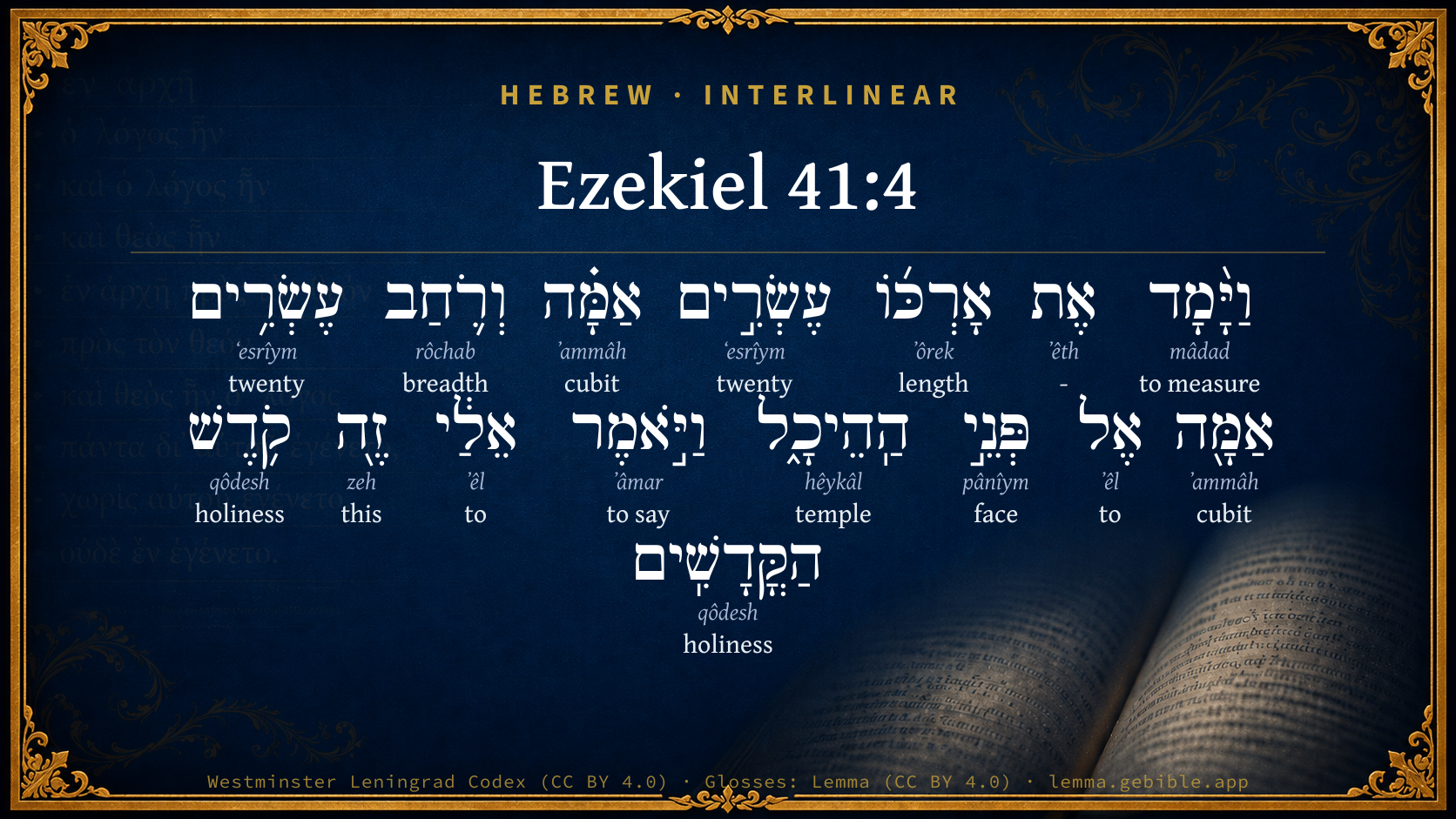
Ezekiel 41:4

Hebrew (Westminster Leningrad Codex) Ezekiel 41:4 appears in the Hebrew Old Testament. The text above is from the Westminster Leningrad Codex. Each word links to its Strong’s number, a concise gloss, and parsing drawn from the Open Scriptures Hebrew Bible morphology. Click any word for its full Brown-Driver-Briggs (BDB) entry.
Download image
Cite this verse

Ezekiel 41:4 (World English Bible). Public Domain. Lemma interlinear Bible study tool, https://lemma.gebible.app/v/ezekiel/41/4.

Show BibTeX & RIS
BibTeX
RIS
English Translation
He measured the length of it, twenty cubits, and the breadth, twenty cubits, before the temple: and he said to me, This is the most holy place.
World English Bible · Public Domain
Download a study sheet

One document with this verse’s original text, its word-by-word gloss line, the meaning frame, cross-references with their text, attributed commentary, and full source and license credits — printable, and it pastes into notes with its structure intact.

This verse Autodidact and up

Study sheet (.html) Plain text (.txt)

A passage Seminary Student

Up to 50 verses in one chapter. A passage sheet keeps up to 6 commentary sources and 12 cross-references per verse, in the order this page ranks them, and says so on the sheet whenever that leaves anything out. Ask for a single verse and you get the Autodidact verse sheet above.

Everything on this page stays free to read, with no account — the sheet is a download of what is already on screen, not access to it.

Want to remove ads? Support Godless Engineer
Compare translations 3

The same verse in 3 English versions, stacked beneath the original-language interlinear above. Click any original word for its lexicon entry.

Each is an independent rendering of the whole verse — the interlinear is not word-aligned to these translations.

Highlighted words mark where these versions differ — a whole-verse word diff, not a word-by-word alignment.

  • World English Bible Public Domain
    He measured the length of it, twenty cubits, and the breadth, twenty cubits, before the temple: and he said to me, This is the most holy place.
  • King James Version Public Domain
    So he measured the length thereof, twenty cubits; and the breadth, twenty cubits, before the temple: and he said unto me, This is the most holy place.
  • unfoldingWord Literal Text CC BY-SA 4.0
    Then he measured the room’s length—twenty cubits. Its width—twenty cubits to the front of the temple hall. Then he said to me, “This is the most holy place.”

unfoldingWord Literal Text — © unfoldingWord, licensed CC BY-SA 4.0. Word-aligned USFM3 via Door43 (git.door43.org/unfoldingWord/en_ult).

Versions to compare (up to 4)

3 of 4 selected

Show all 18 translations

Every available English version of this verse, each an independent rendering of the whole verse.

  • World English Bible Public Domain
    He measured the length of it, twenty cubits, and the breadth, twenty cubits, before the temple: and he said to me, This is the most holy place.
  • Berean Standard Bible Public Domain
    Then he measured the room adjacent to the inner sanctuary to be twenty cubits long and twenty cubits wide. And he said to me, “This is the Most Holy Place.”
  • Majority Standard Bible Public Domain
    Then he measured the room adjacent to the inner sanctuary to be twenty cubits long and twenty cubits wide. And he said to me, “This is the Most Holy Place.”
  • King James Version Public Domain
    So he measured the length thereof, twenty cubits; and the breadth, twenty cubits, before the temple: and he said unto me, This is the most holy place.
  • American Standard Version (1901) Public Domain
    And he measured the length thereof, twenty cubits, and the breadth, twenty cubits, before the temple: and he said unto me, This is the most holy place.
  • Revised Version (1885) Public Domain
    And he measured the length thereof twenty cubits, and the breadth, twenty cubits, before the temple: and he said unto me, This is the most holy place.
  • Geneva Bible (1599) Public Domain
    So he measured the length thereof twentie cubites, and the breadth twentie cubites before the Temple. And he sayde vnto mee, This is the most holy place.
  • Douay-Rheims (1899) Public Domain
    And he measured the length thereof twenty cubits, and the breadth twenty cubits, before the face of the temple: and he said to me: This is the holy of holies.
  • Young's Literal Translation Public Domain
    And he measureth its length twenty cubits, and the breadth twenty cubits, unto the front of the temple, and he saith unto me, `This `is' the holy of holies.'
  • Literal Standard Version CC BY-SA 4.0
    And he measures its length—twenty cubits, and the breadth—twenty cubits, to the front of the temple, and he says to me, “This [is] the Holy of Holies.”
  • Unlocked Literal Bible CC BY-SA 4.0
    Then he measured the room's length—twenty cubits. Its width—twenty cubits to the front of the temple hall. Then he said to me, “This is the most holy place.”
  • unfoldingWord Literal Text CC BY-SA 4.0
    Then he measured the room’s length—twenty cubits. Its width—twenty cubits to the front of the temple hall. Then he said to me, “This is the most holy place.”
  • Darby Bible Public Domain
    And he measured its length, twenty cubits; and the breadth, twenty cubits, before the temple: and he said unto me, This is the most holy [place].
  • World Messianic Bible Public Domain
    He measured its length, twenty cubits, and the width, twenty cubits, before the nave. He said to me, “This is the most holy place.”
  • Webster's Bible Public Domain
    So he measured the length of it twenty cubits; and the breadth, twenty cubits, before the temple: and he said to me, This is the most holy place.
  • Free Bible Version CC BY-SA 4.0
    He measured the room beside the inner sanctuary as twenty cubits long and twenty cubits wide. He told me, “This is the Most Holy Place.”
  • Bible in Basic English Public Domain
    And by his measure it was twenty cubits long and twenty cubits wide in front of the Temple: and he said to me, This is the most holy place.
  • JPS Tanakh (1917) Public Domain
    And he measured the length thereof, twenty cubits, and the breadth, twenty cubits, before the temple; and he said unto me: 'This is the most holy place.'

Literal Standard Version (2020), Covenant Press — licensed CC BY-SA 4.0. Text via the HelloAO Bible API (eBible.org). Unlocked Literal Bible (unfoldingWord) — licensed CC BY-SA 4.0. Text via the HelloAO Bible API (eBible.org). unfoldingWord Literal Text — © unfoldingWord, licensed CC BY-SA 4.0. Word-aligned USFM3 via Door43 (git.door43.org/unfoldingWord/en_ult). Free Bible Version, Dr. Jonathan Gallagher — licensed CC BY-SA 4.0. Text via the HelloAO Bible API (eBible.org).

Word by word

More ways to search: Search by grammar → Find every occurrence → Compare this word →

Practice this passage: Drill this verse → Learn its vocabulary →

וַיָּ֨מָד
mâdad
H4058
“and · to measure”
Conjunction + Verb, Qal, Sequential Imperfect, 3rd Person, Masculine, Singular
Part of Speech
Conjunction + Verb
Stem
Qal
Form
Sequential Imperfect
Person
3rd Person
Gender
Masculine
Number
Singular
Full BDB Definition

Origin: a primitive root

TWOT: 1146

to measure, stretch - (Qal) to measure - (Niphal) to be measured - (Piel) - to extend, continue - to measure, measure off - (Po) measured - (Hithpolel) to extend oneself, stretch oneself
  1. אֶת ʼêth H853 “-” Particle, Direct Object
  2. אָרְכּ֜וֹ ʼôrek H753 “length · his” Noun, Common, Masculine, Singular, Construct + Suffix, Personal, 3rd Person, Masculine, Singular
  3. עֶשְׂרִ֣ים ʻesrîym H6242 “twenty” Adjective, Cardinal number, Both, Plural, Absolute
  4. אַמָּ֗ה ʼammâh H520 “cubit” Noun, Common, Feminine, Singular, Absolute
  5. וְרֹ֛חַב rôchab H7341 “and · breadth” Conjunction + Noun, Common, Masculine, Singular, Absolute
  6. עֶשְׂרִ֥ים ʻesrîym H6242 “twenty” Adjective, Cardinal number, Both, Plural, Absolute
  7. אַמָּ֖ה ʼammâh H520 “cubit” Noun, Common, Feminine, Singular, Absolute
  8. אֶל ʼêl H413 “to” Preposition
  9. פְּנֵ֣י pânîym H6440 “face(s) of” Noun, Common, Both, Plural, Construct
  10. הַֽהֵיכָ֑ל hêykâl H1964 “the · temple” Particle, Definite Article + Noun, Common, Masculine, Singular, Absolute
  11. וַיֹּ֣אמֶר ʼâmar H559 “and · to say” Conjunction + Verb, Qal, Sequential Imperfect, 3rd Person, Masculine, Singular
  12. אֵלַ֔י ʼêl H413 “to · me” Preposition + Suffix, Personal, 1st Person, Common, Singular
  13. זֶ֖ה zeh H2088 “this” Pronoun, Demonstrative, Masculine, Singular
  14. קֹ֥דֶשׁ qôdesh H6944 “holiness of” Noun, Common, Masculine, Singular, Construct
  15. הַקֳּדָשִֽׁים qôdesh H6944 “the · holy things” Particle, Definite Article + Noun, Common, Masculine, Plural, Absolute

About this verse

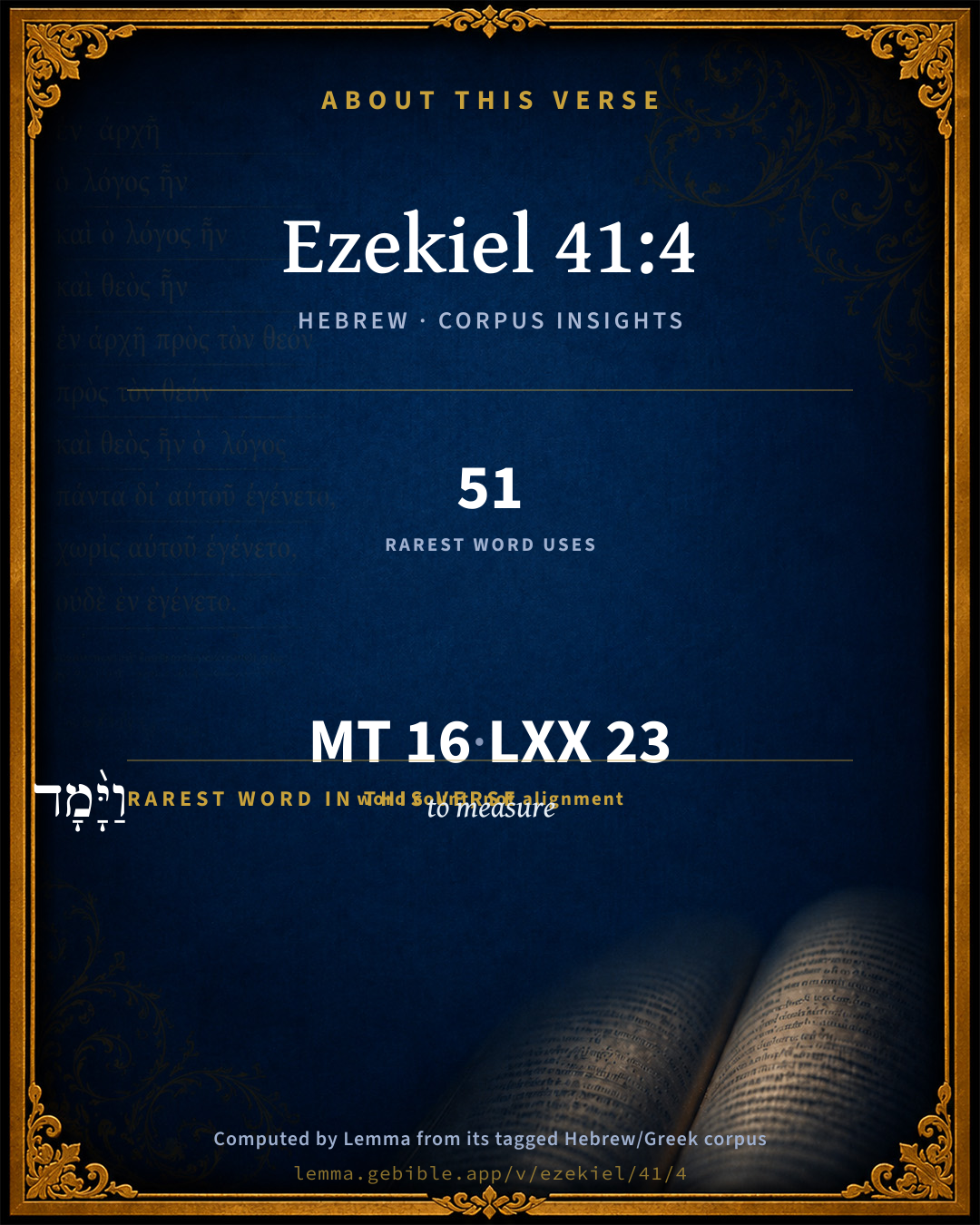
These counts appear in no published source. They are computed here, from the morphology-tagged text and Lemma’s own curated glosses. What Lemma adds →

16
words
12
distinct lemmas
Prophets
section

Shared distinctive vocabulary

וַיָּ֨מָד to measure H4058 occurs in 49 verses of the Hebrew Bible. Also found in:

Grammatical profile

  • 2 verbs
  • 8 nouns
  • 2 adjectives
  • 1 pronoun
  • 2 prepositions
  • 1 particle

Verb forms

  • וַיָּ֨מָד Qal · Sequential Imperfect
  • וַיֹּ֣אמֶר Qal · Sequential Imperfect

Repetition

Words recur within this verse — often emphatic in Hebrew:

  • עֶשְׂרִ֣ים twenty H6242 ×2
  • אַמָּ֗ה cubit H520 ×2
  • קֹ֥דֶשׁ holiness H6944 ×2
  • אֶל to H413 ×2

Hebrew & Septuagint length

In English translation the verse runs 27 words from the Hebrew and 29 from the Septuagint (LXX English) — closely comparable.

A rough comparison of the two English renderings, which tokenize alike — not a word-level alignment.

Word counts can differ between the Hebrew and the Greek without any difference in meaning — e.g. the Hebrew direct-object marker אֵת has no separate Greek word, and Greek often adds the article ὁ.

In the original languages it is 16 Hebrew tokens and 23 Greek tokens — but the two are counted differently (Hebrew bundles its prefixes and suffixes into one token; the Greek is in lemma form), so that isn’t a like-for-like length.

Cross-references

7

Topical passages linked to Ezekiel 41:4 in the Treasury of Scripture Knowledge — connected by theme and wording, ordered by reader-vote popularity; previews shown in the World English Bible.

  • 1 Kings 6:20 Within the oracle was [a space of] twenty cubits in length, and twenty cubits in breadth, and twenty cubits in the height of it; and he overlaid it with pure gold: and he covered the altar with cedar.
  • Hebrews 9:3–8 After the second veil was the tabernacle which is called the Holy of Holies,
  • Exodus 26:33–34 You shall hang up the veil under the clasps, and shall bring the ark of the testimony in there within the veil: and the veil shall separate the holy place from the most holy for you.
  • 2 Chronicles 3:8 He made the most holy house: the length of it, according to the breadth of the house, was twenty cubits, and the breadth of it twenty cubits; and he overlaid it with fine gold, amounting to six hundred talents.
  • 1 Kings 6:5 Against the wall of the house he built stories round about, against the walls of the house round about, both of the temple and of the oracle; and he made side-chambers round about.
  • 1 Kings 6:16 He built twenty cubits on the hinder part of the house with boards of cedar from the floor to the walls [of the ceiling]: he built [them] for it within, for an oracle, even for the most holy place.
  • Revelation 21:16 The city lies foursquare, and its length is as great as its breadth. He measured the city with the reed, Twelve thousand twelve stadia. Its length, breadth, and height are equal.

Cross-references courtesy of OpenBible.info (CC BY 4.0).

Hebrew and Greek witnesses Masoretic Hebrew ↔ Greek Septuagint

The same verse in the two great witnesses to the Old Testament, shown verse-for-verse.

These are two independent witnesses, not word-aligned to each other, and the Septuagint is shown in lemma (dictionary) form.

Hebrew Ezekiel 41:4 Masoretic · Westminster Leningrad Codex

וַיָּ֨מָד אֶת אָרְכּ֜וֹ עֶשְׂרִ֣ים אַמָּ֗ה וְרֹ֛חַב עֶשְׂרִ֥ים אַמָּ֖ה אֶל פְּנֵ֣י הַֽהֵיכָ֑ל וַיֹּ֣אמֶר אֵלַ֔י זֶ֖ה קֹ֥דֶשׁ הַקֳּדָשִֽׁים

He measured the length of it, twenty cubits, and the breadth, twenty cubits, before the temple: and he said to me, This is the most holy place.

World English Bible · Public Domain

Greek LXX Ezekiel 41:4 Septuagint · lemma form

καί διαμετρέω ὁ μῆκος ὁ θύρα πηχύς τεσσαράκοντα καί εὖρος πηχύς εἴκοσι κατά πρόσωπον ὁ ναός καί εἶπον οὗτος ὁ ἅγιος ὁ ἅγιος

And he measured the length of the doors, forty cubits; and the breadth, twenty cubits, in front of the temple: and he said, This is the holy of holies.

LXX2012 (modern English Septuagint) · Public Domain

Hebrew: Westminster Leningrad Codex (CC BY 4.0). Greek: Septuagint (public domain); English from LXX2012 (modern English Septuagint) (Public Domain). How the Septuagint differs from the Hebrew →

Targum (Aramaic paraphrase)

1

The Targum is the ancient Jewish Aramaic paraphrase of the Hebrew Scriptures — an interpretive translation, not the Hebrew text itself. Onkelos (literal) and Pseudo-Jonathan (expansive) render the Torah, and Jonathan the Prophets. Coverage is partial: where no permissively-licensed English translation exists for a verse, only the Aramaic is shown. This is verse-level text, not a word-by-word alignment to the Hebrew.

  1. Targum Jonathan Prophets (Joshua–Malachi)
    וּמְשַׁח יַת אוּרְכֵּיהּ עַסְרִין אַמִין וּפוּתְיָא עַסְרִין אַמִין דִי קֳדָם הֵיכָלָא וַאֲמַר לִי דֵין בֵּית קוֹדֶשׁ קוּדְשַׁיָא:

    (no public-domain English translation for this verse)

    Targum Jonathan — Aramaic: “Mikraot Gedolot” (public domain). English: “Sefaria Community Translation” (CC0 1.0 (public-domain dedication)); “London "Chaldee Paraphrase," 1871” (public domain). Text via Sefaria.

Commentary

Notes on Ezekiel 41:4 from classic Christian and Jewish commentators (each source and its license shown beneath its notes). The classic Christian expositions comment on the surrounding passage and are grouped to its opening verse, so a note may address several verses; the Jewish commentaries on the Tanakh (Rashi and others) are per-verse, so they appear only where the commentator wrote on this verse.

Lemma curates 59 commentaries, every one of them public domain or Creative Commons licensed, each selected and text-cleaned for this edition rather than reprinted as found. About our sources →

Trapp's Complete Commentary

John Trapp

Eze 41:4 So he measured the length thereof, twenty cubits; and the breadth, twenty cubits, before the temple: and he said unto me, This [is] the most holy [place].

Ver. 4. And the breadth thereof twenty cubits.] So it was a just square, intimating the stability of the kingdom of heaven, a kingdom that cannot be shaken, {Heb 12:28}

This is the most holy place.] The Holy of holies, the Oracle, the house of the soul, wherein the only firm hope of Israel resteth - so the Jews called it - the Adytum, or inaccessible place, whither none might come but the high priest only, and that but once a year. Pompey and Heliodorus, for presuming to press into it, were heavily plagued.

John Trapp, A Commentary or Exposition upon All the Books of the Old and New Testament (1647–1656) — public domain. Text from a community e-Sword module.

Jamieson, Fausset & Brown

Robert Jamieson, A. R. Fausset & David Brown

thereof--of the holy of holies.

before the temple--that is, before, or in front of the most holy place (so "temple" is used in Kg1 6:3). The angel went in and measured it, while Ezekiel stood in front, in the only part of the temple accessible to him. The dimensions of the two apartments are the same as in Solomon's temple, since being fixed originally by God, they are regarded as finally determined.

Jamieson, Fausset & Brown — Commentary Critical and Explanatory on the Whole Bible (1871) — public domain (CC PDM 1.0). Text via the HelloAO Bible API.

Adam Clarke's Commentary

Verse 4. The length thereof, twenty cubits] This is the measurement of the sanctuary, or holy of holies. See G in the plan. See Clarke on Eze 48:35. This also was the exact measurement of Solomon's temple, see 1Kg 6:20. This, and the other resemblances here, sufficiently prove that Ezekiel's temple and that of Solomon were on the same plan; and that the latter temple was intended to be an exact resemblance of the former.

Adam Clarke's Commentary on the Bible (1810–1826) — public domain. Text from a community e-Sword/MySword module.

Ellicott's Commentary for English Readers

(4) Before the temple.—Temple is here, as in Eze_41:1, used of the Holy Place, and before, or west of this, was the Holy of Holies, an exact cube, of the same size as in Solomon’s Temple. The thickness of the dividing wall between the Holy Place and the Holy of Holies is nowhere mentioned, nor is it taken into account in the measurements. It was merely a division, either a vail, or perhaps a screen of wood, and occupied little room.

A Bible Commentary for English Readers, edited by Charles John Ellicott (1878–1897) — public domain. Text from a community e-Sword module.

The Cambridge Bible for Schools and Colleges

gen. ed. J. J. S. Perowne

4. The most holy place was a square of 20 cubits.

before the temple] in front of. The “temple” is the holy place, 1Ki_6:3; 1Ki_6:5.

The Cambridge Bible for Schools and Colleges (gen. ed. J. J. S. Perowne; Cambridge University Press, 1878–1918) — public domain. Text from a community e-Sword module.

John Gill's Exposition

So he measured the length thereof twenty cubits,.... That is, of the most holy place, from east to west; which was the measure of it in Solomon's temple, Kg1 6:20,

and the breadth twenty cubits before the temple: that is answerable or according to the breadth of the temple or holy place; which was also twenty cubits in breadth: this stood at the west end of it, and was equal in breadth to it; see Kg1 6:2,

and he said unto me, this is the most holy place; the divine Person in human form said to the prophet, take notice of this building; this answers to the most holy place in the temple. This was an emblem of the most holy and perfect state of the church on earth; it represents the New Jerusalem church state, that holy city, and into which nothing shall enter that defiles; and, as in the most holy place, the divine Shechaniah or majesty of God dwelt; so here will dwell in person the God-man and Mediator, the head of the church, our Lord Jesus; whose tabernacle will now be with men, in this perfect state, raised from the dead, and he will dwell among them: and as this most holy place in its dimensions is a foursquare, so is the holy city described; denoting its stability and perfection; see Rev 21:2.

John Gill's Exposition of the Whole Bible (1746–1763) — public domain (CC PDM 1.0). Text via the HelloAO Bible API.

Albert Barnes' Notes on the Bible

The Temple - here is the holy place as distinguished from the most holy, “the Oracle,” which is “before” the holy place, inwards.

Albert Barnes' Notes on the Bible (1834–1885) — public domain. Text from a community e-Sword/MySword module.

Matthew Poole's English Annotations

The length thereof; of the oracle, or holy of holies. It was an exact square, as was Solomon’s, 1Ki 6:20.

Before the temple; parallel with the breadth of the temple.

He said unto me; the prophet was commanded to hear, and now he shows us his attention.

This is the most holy place, as having the tokens of God’s more especial presence, in that the mercy-seat and propitiatory were there, so called Num 7:89; it was called also the oracle, 1Ki 6:16, and

the inner house, Eze 41:15,17.

Matthew Poole's English Annotations on the Holy Bible (1683–1685) — public domain. Text from a community e-Sword/MySword module.

The Pulpit Commentary

The holy of holies was an exact square of twenty cubits, as in the temple of Solomon, (1Ki_6:20) and to the measuring-man, who had turned himself round, lay along the whole breadth of the temple or holy place.

HOMILIES BY J.R. THOMSON Ver. 4. The most holy place.

Holiness is an idea which admits of gradual precision and elevation. There is a very simple and primitive meaning of the term, which it would ill become us to despise and ridicule, inasmuch as it was preliminary and preparatory to a more spiritual conception. At the same time, we should do discredit to our Christian training did we not strive to rise to a higher and nobler conception of holiness than that which obtained among, and was sufficient for, a people in an early. stage of spiritual culture. In the temple at Jerusalem there was a holy place, and a holy of holies, or, in the language of Ezekiel, the most holy place. An effort may be made to reach and to explain the several ideas which together made up the peculiar sanctity of the adytum of the Jewish temple.

I THE PRIMITIVE SIGNIFICATION OF HOLINESS IS SEPARATION, AND THE MOST HOLY PLACE WAS ONE MARKED OFF AND SET APART FROM ALL AROUND. A purpose was served by the distinction between the sacred and the profane a distinction which may, in the highest stage of spiritual culture, be transcended. Men have to be taught by their senses; and the separation of a certain spot, a certain building, a certain portion of a building, from all around, contributes to the formation of the idea of sanctity. This might not be necessary in a world where no sin exists; but in this world, where sin has reigned, and where sin still so largely prevails, the evil has impressed itself on men"s minds as normal, and the pure and Divine as exceptional. Hence the consecration of sites, and temples, oracles, and holy places.

II THE MOST HOLY PLACE SERVED TO EDUCATE THE JEWISH PEOPLE IN MORALITY AND IN TRUE RELIGION. The whole ceremonial and sacrificial dispensation established by Moses, with all the observances of the Levitical Law, may justly be regarded as instructive and disciplinary, in the first place for Israel, and then for all mankind. Those who looked upon the temple and its sanctuary could not but be reminded that here was the peculiar dwelling-place of a holy God. The degrees of holiness attaching to the several parts of the sacred edifice, culminating in the sanctity of the most holy place, were fitted to elicit the spiritual apprehensions, the reverence, the devotion, the penitence, of those who felt themselves in the presence and under the training of the all-holy God. To a certain extent every Israelite not specially disqualified might draw near to Jehovah; the priests were suffered and required to approach still nearer to the shrine; but the high priest alone was permitted, and that only upon a special occasion, to enter the most holy place. Such arrangements and provisions were admirably adapted to educate the Jewish people in the idea and in the practice of holiness.

III RECONCILIATION BETWEEN A SINFUL NATION AND A JUST AND PURE GOD WAS EFFECTED THROUGH THE MEDIUM OF THE MOST HOLY PLACE. In the holy of holies was performed the especially solemn and sacred service in which, upon the Day of Atonement, the high priest alone was suffered to take part as the representative of the people of the covenant. On that occasion the federal relation of Israel was conspicuously set forth. To the pious Jew the contents of the holy of holies, the vestments of the officiating high priest, the blood of atonement, must all have possessed a very special and very sacred interest. And that interest centered in the idea of reconciliation between Jehovah and the chosen nation reconciliation rendered necessary by the sins of the people, and by the perfectly holy character, the perfectly righteous government, of God. Consecrated to this use, the inmost sanctuary was naturally invested with a sacredness altogether unique.

IV THE MOST HOLY PLACE BECAME ASSOCIATED WITH COMMUNION BETWEEN ISRAEL AND ISRAEL"S GOD.

Reconciliation naturally led to fellowship. The enlightened Jews doubtless took a spiritual view of the Divine presence, and sympathized with the sublime language of Solomon at the dedication of the temple: "Will God in very deed dwell with men on the earth? Behold, heaven and the heaven of heavens cannot contain thee; how much less this house which I have built!" Still, it was by means of this temple, its priesthood and its services, that the Jewish nation generally were, by Divine appointment and intention, made familiar with the possibility and privilege of fellowship with the Eternal. It was inculcated upon them that such communion was only possible in virtue of the condescension and compassion of the Most High, and that there was needed on their part, in order to the enjoyment of the privilege, a peculiar preparation, a spiritual cleansing. The thoughtful and devout Jew learned, by means of the temple services, to form such an idea of God as led him to seek a spiritual discipline. He knew that the sacrifices in themselves were insufficient, and that the sacrifices required by the Searcher of hearts were spiritual, consisting in humility, penitence, faith, and obedience. Those thus prepared might draw near unto God, and God would draw near unto them.

V THE MOST HOLY PLACE, AS THE SCENE OF HIGH PRIESTLY MEDIATION, SYMBOLIZES THE MEDIATORIAL WORK OF CHRIST. In order to understand the symbolical, and indeed typical, character of the holy of holies, and of the ministration therein performed by the Jewish high priest, it is important to study the ninth chapter of the Epistle to the Hebrews. In that portion of Scripture is as authoritative and lucid explanation of the spiritual meaning of the central scenes and observances of the Jewish economy. It is shown that the shadow was in Christ superseded by the substance, and that in the new and spiritual dispensation we have the fulfillment of ancient promise. The transactions which, on the great Day of Atonement, took place within the holy of holies prefigured and adumbrated the great events by which, not Israel only, but humanity as a whole, was reconciled to God. For when Christ expired upon the cross the veil of the temple was rent in twain; and thenceforth, through the rent veil of Christ"s humanity, the way into the holiest of all was opened up; the alienation of the human race from God was abolished; and perpetual communion was provided between a gracious Father and his restored and accepted children. The most holy place into which through Christ we have access is nothing else than the favor, the fellowship, the love of God. T.

HOMILIES BY W. CLARKSON Ver. 4. Sacred places.

is the most holy place." There has always dwelt in the minds of men a feeling that some places are peculiarly sacred. Unfortunately, there has been no small amount of superstition connected with this feeling, which should be discouraged in others and should be resisted in our own ease. We should strongly insist upon the truth, and carefully cultivate the conviction, that if some places have a peculiar sanctity, it is that "ever, place may be holy ground to us; that we may find God everywhere and in everything; that we may worship and serve him in every sphere and on all occasions whatsoever. Still, the feeling rests on a basis of truth. We know that there was a "most holy place

I IN THE ANCIENT TEMPLE. Within the veil was "the holy of holies," into which none but the high priest might enter, and he only once a year, and then only with the blood of the slain goat. God might only be approached by men as they were purified from sin; and this the careful graduation of access to him clearly symbolized. That inner chamber of the temple was the most sacred spot on earth, because there God manifested his presence as nowhere else. But there were very holy places indeed

II IN THE LIFE OF OUR LORD. He was the living Temple when he was with us; for was not God manifest in him far more truly and importantly than he was present "between the cherubim" in the luminous cloud? There were three places which, in the experience of Jesus Christ, may be said to be "most holy the upper room in Jerusalem, where he "sat down with the twelve" to that sacred meal, and delivered that discourse of priceless value to mankind; (Joh 14) the garden of Gethsemane, where he passed through the great agony; and the "place which is called Calvary," where the great sacrifice was offered for the sins of the world.

III IN OUR OWN BUILDINGS NOW. We find such in those sanctuaries or in those chambers which are closely associated with our converse with the Most High. Apart from and independent of any act of formal "consecration," the place where we gather together to worship God, the place where we hold holy and happy fellowship with Christ, the place where we listen with eager mind and fervent spirit to his Divine truth, this is hallowed ground to us; these are sacred spots which we treadreverently, where we feel near to God, which will always be peculiarly dear to our hearts.

IV IN OUR PERSONAL EXPERIENCE. There are certain very solemn and sacred experiences through which the God of our life "makes us to pass, of which we may truly say that they are "most holy." Of these we have instances in:

1. The time of separation, of loneliness, when we first find ourselves cast upon God for guidance and for fellowship.

2. The day of desperate grief, of overwhelming sorrow, when men can do nothing for us, but God everything.

3. The hour of very special privilege, when we feel the nearness of Christ, the excellency of his salvation, the power of the world to come, the influence of the Holy Spirit; when we feel that we stand before the open gate of the kingdom of God.

4. The occasion of great opportunity, when it is in our power to make some great sacrifice for others or to render some valuable service to them or to speak faithfully and effectively for Jesus Christ. C.

The Pulpit Commentary (1880–1919), ed. H.D.M. Spence-Jones & Joseph S. Exell — public domain. Text from a community e-Sword module.

John Wesley's Explanatory Notes

Thereof - Of the holy of holies, which was an exact square. Before - Parallel with the breadth of the temple.

John Wesley, Explanatory Notes Upon the Whole Bible (1754–1765) — public domain. Text via the GEBible commentary corpus.

Rashi

Rabbi Shlomo Yitzchaki (Rashi)

to the face of the Temple on the face of the width of the Temple.

Rashi on the Tanakh — English translations: “The Judaica Press complete Tanach with Rashi, translated by A. J. Rosenberg” (CC BY 4.0); “Pentateuch with Rashi's commentary by M. Rosenbaum and A.M. Silbermann, 1929-1934” (public domain); “The Metsudah Tanach series, Lakewood, N.J” (CC BY 4.0); and “The Book of Joshua, Metsudah Publications, 1997” (CC BY 4.0). Text via Sefaria.

Lesson kit

Teaching starters — assembled from the data on this page, not authored interpretation. Every prompt links to the verse data it draws on. Edit before teaching.

Ezekiel, in the Prophets, opens this verse with 16 words (12 distinct Hebrew lemmas). Its most distinctive word is mâdad (“to measure”). A historical commentator’s framing appears above. Read the whole chapter for the surrounding context.

Discussion questions

  1. How does “to measure” (mâdad) shape what this verse is saying?
  2. Exodus 16:18 shares the word «to measure» with this verse. How do the two illuminate each other?
  3. “twenty” occurs 2× in this one verse. What is the effect of the repetition?
  4. The translations on this page render this verse differently — a whole-verse word diff, not a word-by-word alignment. What might account for the different wordings?
  5. The verb «וַיָּ֨מָד» is Qal Sequential Imperfect. How does its form color the action?
  6. Reading how Trapp's Complete Commentary and Jamieson, Fausset & Brown read this verse, where do the two commentators agree and where do they part?

Things to notice

Reading settings

Reading text

Shown beneath each verse's original-language words.

Old Testament
Old Testament edition

Read the OT as the Masoretic Hebrew (MT) or the Greek Septuagint (LXX).

English shown for the Greek Septuagint (in the Hebrew ↔ Greek comparison).

Comparing translations? Open the Compare panel on any verse page to stack up to four side by side.