Exodus 23:28

Hebrew (Westminster Leningrad Codex) Exodus 23:28 appears in the Hebrew Old Testament. The text above is from the Westminster Leningrad Codex. Each word links to its Strong’s number, a concise gloss, and parsing drawn from the Open Scriptures Hebrew Bible morphology. Click any word for its full Brown-Driver-Briggs (BDB) entry.
Download image
Cite this verse

Exodus 23:28 (World English Bible). Public Domain. Lemma interlinear Bible study tool, https://lemma.gebible.app/v/exodus/23/28.

Show BibTeX & RIS
BibTeX
RIS
English Translation
I will send the hornet before you, which will drive out the Hivite, the Canaanite, and the Hittite, from before you.
World English Bible · Public Domain
Highlights
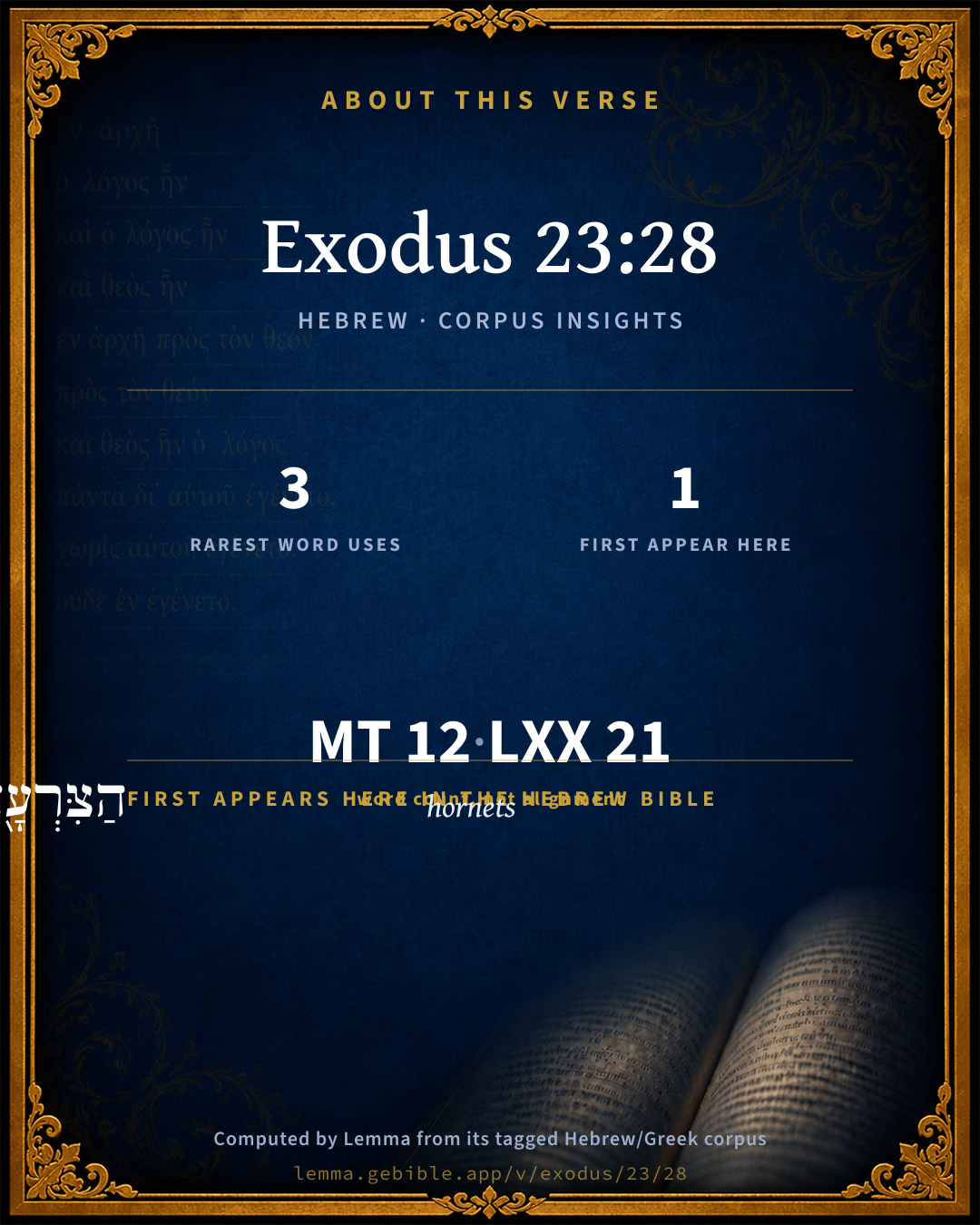
  • 1 first appearance in the Hebrew Bible
Full analysis ↓
Download a study sheet

One document with this verse’s original text, its word-by-word gloss line, the meaning frame, cross-references with their text, attributed commentary, and full source and license credits — printable, and it pastes into notes with its structure intact.

This verse Autodidact and up

Study sheet (.html) Plain text (.txt)

A passage Seminary Student

Up to 50 verses in one chapter. A passage sheet keeps up to 6 commentary sources and 12 cross-references per verse, in the order this page ranks them, and says so on the sheet whenever that leaves anything out. Ask for a single verse and you get the Autodidact verse sheet above.

Everything on this page stays free to read, with no account — the sheet is a download of what is already on screen, not access to it.

Want to remove ads? Support Godless Engineer
Compare translations 3

The same verse in 3 English versions, stacked beneath the original-language interlinear above. Click any original word for its lexicon entry.

Each is an independent rendering of the whole verse — the interlinear is not word-aligned to these translations.

Highlighted words mark where these versions differ — a whole-verse word diff, not a word-by-word alignment.

  • World English Bible Public Domain
    I will send the hornet before you, which will drive out the Hivite, the Canaanite, and the Hittite, from before you.
  • King James Version Public Domain
    And I will send hornets before thee, which shall drive out the Hivite, the Canaanite, and the Hittite, from before thee.
  • unfoldingWord Literal Text CC BY-SA 4.0
    And I will send the hornet before your face, and it will drive out the Hivites, Canaanites, and the Hittites from before your face.

unfoldingWord Literal Text — © unfoldingWord, licensed CC BY-SA 4.0. Word-aligned USFM3 via Door43 (git.door43.org/unfoldingWord/en_ult).

Versions to compare (up to 4)

3 of 4 selected

Show all 18 translations

Every available English version of this verse, each an independent rendering of the whole verse.

  • World English Bible Public Domain
    I will send the hornet before you, which will drive out the Hivite, the Canaanite, and the Hittite, from before you.
  • Berean Standard Bible Public Domain
    I will send the hornet before you to drive the Hivites and Canaanites and Hittites out of your way.
  • Majority Standard Bible Public Domain
    I will send the hornet before you to drive the Hivites and Canaanites and Hittites out of your way.
  • King James Version Public Domain
    And I will send hornets before thee, which shall drive out the Hivite, the Canaanite, and the Hittite, from before thee.
  • American Standard Version (1901) Public Domain
    And I will send the hornet before thee, which shall drive out the Hivite, the Canaanite, and the Hittite, from before thee.
  • Revised Version (1885) Public Domain
    And I will send the hornet before thee, which shall drive out the Hivite, the Canaanite, and the Hittite, from before thee.
  • Geneva Bible (1599) Public Domain
    And I will sende hornets before thee, which shall driue out the Hiuites, the Canaanites, and the Hittites from thy face.
  • Douay-Rheims (1899) Public Domain
    Sending out hornets before, that shall drive away the Hevite, and the Chanaanite, and the Hethite, before thou come in.
  • Young's Literal Translation Public Domain
    `And I have sent the hornet before thee, and it hath cast out the Hivite, the Canaanite, and the Hittite, from before thee;
  • Literal Standard Version CC BY-SA 4.0
    And I have sent the hornet before you, and it has cast out the Hivite, the Canaanite, and the Hittite from before you;
  • Unlocked Literal Bible CC BY-SA 4.0
    I will send hornets before you that will drive out the Hivites, Canaanites, and the Hittites from before you.
  • unfoldingWord Literal Text CC BY-SA 4.0
    And I will send the hornet before your face, and it will drive out the Hivites, Canaanites, and the Hittites from before your face.
  • Darby Bible Public Domain
    And I will send hornets before thee, which shall drive out the Hivite, the Canaanite, and the Hittite, from before thee.
  • World Messianic Bible Public Domain
    I will send the hornet before you, which will drive out the Hivite, the Canaanite, and the Hittite, from before you.
  • Webster's Bible Public Domain
    And I will send hornets before thee, which shall drive out the Hivite, the Canaanite, and the Hittite from before thee.
  • Free Bible Version CC BY-SA 4.0
    I will send hornets ahead of you to drive out before you the Hivites and Canaanites and Hittites.
  • Bible in Basic English Public Domain
    I will send hornets before you, driving out the Hivite and the Canaanite and the Hittite before your face.
  • JPS Tanakh (1917) Public Domain
    And I will send the hornet before thee, which shall drive out the Hivite, the Canaanite, and the Hittite, from before thee.

Literal Standard Version (2020), Covenant Press — licensed CC BY-SA 4.0. Text via the HelloAO Bible API (eBible.org). Unlocked Literal Bible (unfoldingWord) — licensed CC BY-SA 4.0. Text via the HelloAO Bible API (eBible.org). unfoldingWord Literal Text — © unfoldingWord, licensed CC BY-SA 4.0. Word-aligned USFM3 via Door43 (git.door43.org/unfoldingWord/en_ult). Free Bible Version, Dr. Jonathan Gallagher — licensed CC BY-SA 4.0. Text via the HelloAO Bible API (eBible.org).

Word by word

More ways to search: Search by grammar → Find every occurrence → Compare this word →

Practice this passage: Drill this verse → Learn its vocabulary →

הַצִּרְעָ֖ה
tsirʻâh
H6880
“the · hornets”
Particle, Definite Article + Noun, Common, Feminine, Singular, Absolute
Part of Speech
Particle + Noun
Type
Common
Gender
Feminine
Number
Singular
State
Absolute
Full BDB Definition

Origin: from H6879

TWOT: 1971b

hornets
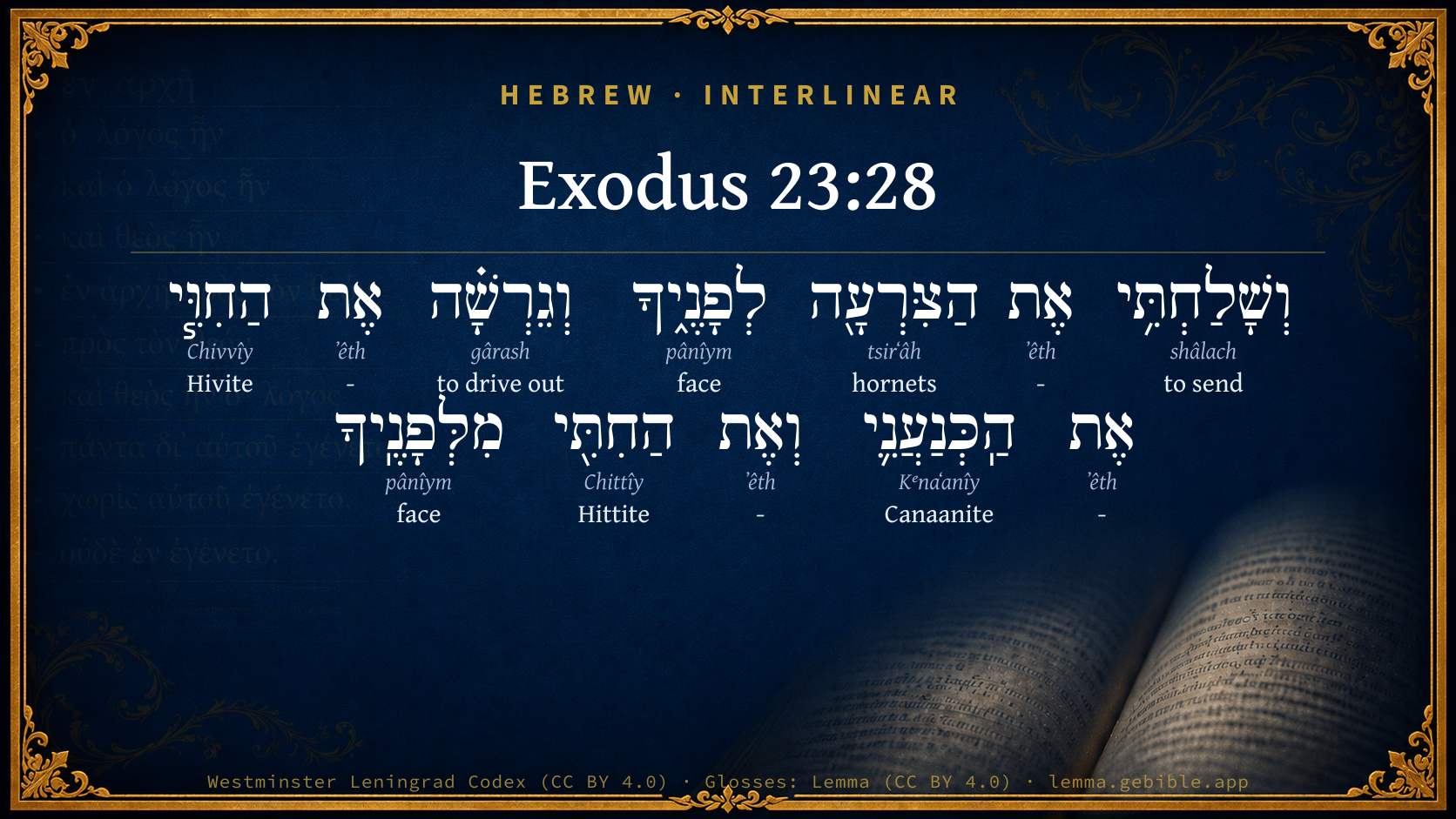
  1. וְשָׁלַחְתִּ֥י shâlach H7971 “and · to send” Conjunction + Verb, Qal, Sequential Perfect, 1st Person, Common, Singular
  2. אֶת ʼêth H853 “-” Particle, Direct Object
  3. לְפָנֶ֑יךָ pânîym H6440 “to/for · face(s) · your” Preposition + Noun, Common, Both, Plural, Construct + Suffix, Personal, 2nd Person, Masculine, Singular
  4. וְגֵרְשָׁ֗ה gârash H1644 “and · to drive out” Conjunction + Verb, Piel, Sequential Perfect, 3rd Person, Feminine, Singular
  5. אֶת ʼêth H853 “-” Particle, Direct Object
  6. הַחִוִּ֧י Chivvîy H2340 “the · Hivite” Particle, Definite Article + Noun, Gentilic, Masculine, Singular, Absolute
  7. אֶת ʼêth H853 “-” Particle, Direct Object
  8. הַֽכְּנַעֲנִ֛י Kᵉnaʻanîy H3669 “the · Canaanite” Particle, Definite Article + Noun, Gentilic, Masculine, Singular, Absolute
  9. וְאֶת ʼêth H853 “and · -” Conjunction + Particle, Direct Object
  10. הַחִתִּ֖י Chittîy H2850 “the · Hittite” Particle, Definite Article + Noun, Gentilic, Masculine, Singular, Absolute
  11. מִלְּפָנֶֽיךָ pânîym H6440 “from · to/for · face(s) · your” Preposition + Preposition + Noun, Common, Both, Plural, Construct + Suffix, Personal, 2nd Person, Masculine, Singular

About this verse

These counts appear in no published source. They are computed here, from the morphology-tagged text and Lemma’s own curated glosses. What Lemma adds →

12
words
8
distinct lemmas
Pentateuch
section

Notable vocabulary

The rarest word here is הַצִּרְעָ֖ה hornets H6880 — appearing just 3 times in the whole Hebrew Bible.

First appearance in Scripture

This word makes its first canonical appearance in the Hebrew Bible here:

  • הַצִּרְעָ֖ה hornets H6880

Shared distinctive vocabulary

הַצִּרְעָ֖ה hornets H6880 occurs in 3 verses of the Hebrew Bible. Also found in:

Grammatical profile

  • 2 verbs
  • 6 nouns
  • 4 particles

Verb forms

  • וְשָׁלַחְתִּ֥י Qal · Sequential Perfect
  • וְגֵרְשָׁ֗ה Piel · Sequential Perfect

Repetition

A word recurs within this verse — often emphatic in Hebrew:

  • לְפָנֶ֑יךָ face H6440 ×2

Hebrew & Septuagint length

In English translation the verse runs 21 words from the Hebrew and 25 from the Septuagint (LXX English) — closely comparable.

A rough comparison of the two English renderings, which tokenize alike — not a word-level alignment.

Word counts can differ between the Hebrew and the Greek without any difference in meaning — e.g. the Hebrew direct-object marker אֵת has no separate Greek word, and Greek often adds the article ὁ.

In the original languages it is 12 Hebrew tokens and 21 Greek tokens — but the two are counted differently (Hebrew bundles its prefixes and suffixes into one token; the Greek is in lemma form), so that isn’t a like-for-like length.

Cross-references

2

Topical passages linked to Exodus 23:28 in the Treasury of Scripture Knowledge — connected by theme and wording, ordered by reader-vote popularity; previews shown in the World English Bible.

  • Deuteronomy 7:20 Moreover Yahweh your God will send the hornet among them, until those who are left, and hide themselves, perish from before you.
  • Joshua 24:11–12 You went over the Jordan, and came to Jericho: and the men of Jericho fought against you, the Amorite, and the Perizzite, and the Canaanite, and the Hittite, and the Girgashite, the Hivite, and the Jebusite; and I delivered them into your hand.

Cross-references courtesy of OpenBible.info (CC BY 4.0).

Hebrew and Greek witnesses Masoretic Hebrew ↔ Greek Septuagint

The same verse in the two great witnesses to the Old Testament, shown verse-for-verse.

These are two independent witnesses, not word-aligned to each other, and the Septuagint is shown in lemma (dictionary) form.

Hebrew Exodus 23:28 Masoretic · Westminster Leningrad Codex

וְשָׁלַחְתִּ֥י אֶת הַצִּרְעָ֖ה לְפָנֶ֑יךָ וְגֵרְשָׁ֗ה אֶת הַחִוִּ֧י אֶת הַֽכְּנַעֲנִ֛י וְאֶת הַחִתִּ֖י מִלְּפָנֶֽיךָ

I will send the hornet before you, which will drive out the Hivite, the Canaanite, and the Hittite, from before you.

World English Bible · Public Domain

Greek LXX Exodus 23:28 Septuagint · lemma form

καί ἀποστέλλω ὁ σφηκία πρότερος σύ καί ἐκβάλλω ὁ ἀμορραῖος καί ὁ ευαῖος καί ὁ χαναναῖος καί ὁ χετταῖος ἀπό σύ

And I will send hornets before you, and you shall cast out the Amorites and the Evites, and the Chananites and the Chettites from you.

LXX2012 (modern English Septuagint) · Public Domain

Hebrew: Westminster Leningrad Codex (CC BY 4.0). Greek: Septuagint (public domain); English from LXX2012 (modern English Septuagint) (Public Domain). How the Septuagint differs from the Hebrew →

Targum (Aramaic paraphrase)

2

The Targum is the ancient Jewish Aramaic paraphrase of the Hebrew Scriptures — an interpretive translation, not the Hebrew text itself. Onkelos (literal) and Pseudo-Jonathan (expansive) render the Torah, and Jonathan the Prophets. Coverage is partial: where no permissively-licensed English translation exists for a verse, only the Aramaic is shown. This is verse-level text, not a word-by-word alignment to the Hebrew.

  1. Targum Onkelos Torah (Genesis–Deuteronomy)
    וְאֶשְׁלַח יָת עֲרָעִיתָא קֳדָמָךְ וּתְתָרֵךְ יָת חִוָאֵי יָת כְּנַעֲנָאֵי וְיָת חִתָּאֵי מִן קֳדָמָךְ:

    (no public-domain English translation for this verse)

    Targum Onkelos — Aramaic: “Onkelos Genesis” (public domain); “Onkelos Exodus” (public domain); “Onkelos Leviticus” (public domain); “Onkelos Numbers” (public domain); “Onkelos Deuteronomy” (public domain). English: “Sefaria Community Translation” (CC0 1.0 (public-domain dedication)); “J.W. Etheridge. The Targums of Onkelos and Jonathan Ben Uzziel on the Pentateuch. London: Longmans, Green, 1862” (public domain). Text via Sefaria.

  2. Targum Pseudo-Jonathan Torah (Genesis–Deuteronomy)
    וְאֵשַׁדַּר יַת אוּרְעִיתָא קֳדָמָךְ וּתְתָרֵךְ יַת חִיוָאֵי וְיַת כְּנַעֲנָאֵי וְיַת חִיתָּאֵי מִן קֳדָמָךְ

    And I will send the hornet before thee to drive out the Hivaee, and Kenaanaee, and Hitaee, from before thee.

    Targum Pseudo-Jonathan — Aramaic: “Targum Jonathan on Genesis” (public domain); “Targum Jonathan on Exodus” (public domain); “Targum Jonathan on Leviticus” (public domain); “Targum Jonathan on Numbers” (public domain); “Targum Jonathan on Deuteronomy” (public domain). English: “The Targum of Jonathan ben Uzziel, trans. J. W. Etheridge, London, 1862” (public domain). Text via Sefaria.

Commentary

Notes on Exodus 23:28 from classic Christian and Jewish commentators (each source and its license shown beneath its notes). The classic Christian expositions comment on the surrounding passage and are grouped to its opening verse, so a note may address several verses; the Jewish commentaries on the Tanakh (Rashi and others) are per-verse, so they appear only where the commentator wrote on this verse.

Lemma curates 59 commentaries, every one of them public domain or Creative Commons licensed, each selected and text-cleaned for this edition rather than reprinted as found. About our sources →

Trapp's Complete Commentary

John Trapp

Exo 23:28 And I will send hornets before thee, which shall drive out the Hivite, the Canaanite, and the Hittite, from before thee.

Ver. 28. Hornets before thee.] Understand it either literally, as in Jos 24:12; or figuratively, of the stinging terrors of their self-condemning consciences.

John Trapp, A Commentary or Exposition upon All the Books of the Old and New Testament (1647–1656) — public domain. Text from a community e-Sword module.

Jamieson, Fausset & Brown

Robert Jamieson, A. R. Fausset & David Brown

I will send hornets before thee, &c. (See on Jos 24:12) --Some instrument of divine judgment, but variously interpreted: as hornets in a literal sense [BOCHART]; as a pestilential disease [ROSENMULLER]; as a terror of the Lord, an extraordinary dejection [JUNIUS].

Jamieson, Fausset & Brown — Commentary Critical and Explanatory on the Whole Bible (1871) — public domain (CC PDM 1.0). Text via the HelloAO Bible API.

Adam Clarke's Commentary

Verse 28. I will send hornets before thee] הצרעה hatstsirah. The root is not found in Hebrew, but it may be the same with the Arabic [Arabic] saraa, to lay prostrate, to strike down; the hornet, probably so called from the destruction occasioned by the violence of its sting. The hornet, in natural history, belongs to the species crabro, of the genus vespa or wasp; it is a most voracious insect, and is exceedingly strong for its size, which is generally an inch in length, though I have seen some an inch and a half long, and so strong that, having caught one in a small pair of forceps, it repeatedly escaped by using violent contortions, so that at last I was obliged to abandon all hopes of securing it alive, which I wished to have done. How distressing and destructive a multitude of these might be, any person may conjecture; even the bees of one hive would be sufficient to sting a thousand men to madness, but how much worse must wasps and hornets be! No armour, no weapons, could avail against these. A few thousands of them would be quite sufficient to throw the best disciplined army into confusion and rout. From Jos 24:12, we find that two kings of the Amorites were actually driven out of the land by these hornets, so that the Israelites were not obliged to use either sword or bow in the conquest.

Adam Clarke's Commentary on the Bible (1810–1826) — public domain. Text from a community e-Sword/MySword module.

Ellicott's Commentary for English Readers

(28) I will send hornets.—Heb., the hornet. Comp. Jos_24:12, where “the hornet” is said to have been sent. No doubt hornets might be so numerous as to become an intolerable plague, and induce a nation to quit its country and seek another (see Bochart, Hierozoic. iv. 13). But as we have no historical account of the kind in connection with the Canaanite races, the expression here used is scarcely to be taken literally. Probably the Egyptians are the hornets intended. It was they who, under Rameses III., broke the power of the Hittites and other nations of Palestine, while the Israelites were sojourners in the wilderness. Possibly the term was chosen in reference to the hieroglyphic sign for “king” in Egypt, which was the figure of a bee or wasp. The author of the Book of Wisdom seems, however, to have understood the expression literally (Wis_12:8-9).

A Bible Commentary for English Readers, edited by Charles John Ellicott (1878–1897) — public domain. Text from a community e-Sword module.

The Cambridge Bible for Schools and Colleges

gen. ed. J. J. S. Perowne

28. the hornet] so Deu_7:20; Jos_24:12 (E). The writer imagines swarms of this terrible insect employed to clear the Canaanites away before Israel, and expel them even from their hiding-places (see Dt. l.c.).

the Hivite, &c.] see on Exo_3:8.

The Cambridge Bible for Schools and Colleges (gen. ed. J. J. S. Perowne; Cambridge University Press, 1878–1918) — public domain. Text from a community e-Sword module.

John Gill's Exposition

By little and little I will drive them out from before thee,.... Not the beasts of the field, but the inhabitants of Canaan, who were left partly to keep up the cities and towns, that they might not fall to ruin, and to till the land, that it might not be desolate; and partly to be trials and exercises to the people of Israel, and to prove whether they would serve the Lord or not. Just as the corruptions of human nature remain with the people of God when converted, for the trial and exercise of their graces, and that they may have their dependence not on themselves, but on the grace of God to keep them in his ways, and to preserve them safe to eternal glory; and by completing the work of grace, which is gradually done, they might be made meet for it:

until thou be increased, and inherit the land; for as their enemies were driven out gradually, by little and little, so they multiplied gradually, until at length they became a sufficient number to fill all the cities and towns in all the nations of Canaan, and take an entire possession of it, as their inheritance given unto them by God.

John Gill's Exposition of the Whole Bible (1746–1763) — public domain (CC PDM 1.0). Text via the HelloAO Bible API.

Albert Barnes' Notes on the Bible

Hornets - Compare the marginal references. The word is used figuratively for a cause of terror and discouragement. Bees are spoken of in the like sense, Deu 1:44; Psa 118:12.

Albert Barnes' Notes on the Bible (1834–1885) — public domain. Text from a community e-Sword/MySword module.

Haydock's Catholic Bible Commentary

Hornets, or wasps, Wisdom xii. 8. Josue (xxiv. 12) assures us this was verified. Thus scorpions forced the Ethiopians to abandon their country, and flies and wasps drove away the Mysians and Phaselides. See Bochart, iv. 13. The latter people were of Phœnician extraction, and probably fled before Josue. Most of the Chanaanites withdrew into Africa; some perhaps into America. (Calmet)

George Leo Haydock (1774–1849), Haydock's Catholic Family Bible and Commentary, 1859 edition — public domain. Excludes Psalms (Douay-Rheims chapter numbering differs from Protestant) and Deuterocanonical books (Catholic canon only).

Matthew Poole's English Annotations

Hornets, properly so called, as may be gathered from Jos 24:12; Deu 7:20. Hornets are of themselves very troublesome and mischievous; but these it is very probable were like those Egyptian flies, Exo 8:21, of an extraordinary bigness and perniciousness. Nor is it strange that such creatures did drive many of these people from their habitations; for many heathen writers give us instances of some people driven from their seats by frogs, others by mice, others by bees and wasps; of which see Herodotus, Diodorus, Pliny, Elian, Justin, &c. He names these three people, either for all the rest, because they were the most potent about the time of Israel’s first entrance into Canaan, and gave them most trouble; or because these three were more infested with hornets than the other nations, as being more numerous and dangerous.

Matthew Poole's English Annotations on the Holy Bible (1683–1685) — public domain. Text from a community e-Sword/MySword module.

Whedon's Commentary on the Bible

Daniel D. Whedon

28. I will send hornets before thee — There is no necessity to explain this literally, and there is no evidence that any such miracle as the driving out of the Canaanites by swarms of hornets occurred during the entire history of the conquest of Palestine. There are, indeed, divers accounts of certain ancient tribes being driven out of their lands by armies of wasps and other noxious creatures; and the armies of locusts which occasionally sweep through those countries are a most destructive plague. But a comparison of Deu_1:44, Jos_24:12, Psa_118:12, and Isa_7:18-19, will show that this expression was employed metaphorically to denote any marked interposition of God to discomfit the enemies of his people.

Daniel D. Whedon (gen. ed.), Commentary on the Old and New Testaments (1874–1909) — public domain. Text from a community e-Sword module.

The Pulpit Commentary

And I will send hornets before thee. This is scarcely to be taken literally, since no actual plague of hornets is mentioned in the historical narrative. "Hornets" here, and in Deu_7:20; Jos_24:12, are probably plagues or troubles of any kind, divinely sent to break the power of the heathen nations, and render them an easier prey to the Israelites, when they made their invasion. Possibly, the main "hornets" were the Egyptians, who, under Rameses III, successfully invaded Palestine about the time of Israel"s sojourn in the wilderness, and weakened the power of the Hittites (Khita) The Hivite, the Canaanite, and the Hittite. By a common figure of speech, a part is put or the whole three nations for seven. The three names seem to be taken at random,but include the two nations of most power the Canaanites and the Hittites.

The Pulpit Commentary (1880–1919), ed. H.D.M. Spence-Jones & Joseph S. Exell — public domain. Text from a community e-Sword module.

Rashi

Rabbi Shlomo Yitzchaki (Rashi)

הצרעה THE HORNETS — This is a kind of insect which wounded their eyes and injected poison in them, so that they died. The hornets did not cross the Jordan and the Hittite and the Canaanite whom Scripture mentions here as being driven out by them were the inhabitants of the land of Sichon and Og (on the east side of the Jordan). It is for this reason that Scripture enumerates here of all the seven nations that Israel fought against when entering Palestine only these two (cf. Joshua 24:12, where the text expressly states that the peoples driven out by the hornets were those of שני מלכי האמרי, “of the two kings of the Amorites” who are identical with Sihon and Og). But the Hivites lived on the other bank of the Jordan and somewhat beyond it and yet it states here that the hornets would drive them out! They were indeed driven out by the hornets, for our Rabbis have explained in Treatise Sotah 36a that the hornets placed themselves on the east bank of the Jordan and from there cast the poison against them.

Rashi on the Tanakh — English translations: “The Judaica Press complete Tanach with Rashi, translated by A. J. Rosenberg” (CC BY 4.0); “Pentateuch with Rashi's commentary by M. Rosenbaum and A.M. Silbermann, 1929-1934” (public domain); “The Metsudah Tanach series, Lakewood, N.J” (CC BY 4.0); and “The Book of Joshua, Metsudah Publications, 1997” (CC BY 4.0). Text via Sefaria.

Lesson kit

Teaching starters — assembled from the data on this page, not authored interpretation. Every prompt links to the verse data it draws on. Edit before teaching.

Exodus, in the Pentateuch, opens this verse with 12 words (8 distinct Hebrew lemmas). Its most distinctive word is tsirʻâh (“hornets”). A historical commentator’s framing appears above. Read the whole chapter for the surrounding context.

Discussion questions

  1. What does “hornets” (tsirʻâh) contribute to the verse as a whole?
  2. This is the first place “hornets” appears in Scripture (first appears here). What does its debut here establish?
  3. How does Deuteronomy 7:20, which shares the word «hornets», read alongside this verse?
  4. What does the repetition of “face” (2× in this one verse) do in this verse?
  5. These translations render this verse differently. What is at stake in choosing one wording over another?
  6. «וְשָׁלַחְתִּ֥י» is a Qal Sequential Perfect verb. How does that grammatical form shape the action described?
  7. Compare how Trapp's Complete Commentary and Jamieson, Fausset & Brown read this verse. Where do they agree or differ?

Things to notice

Reading settings

Reading text

Shown beneath each verse's original-language words.

Old Testament
Old Testament edition

Read the OT as the Masoretic Hebrew (MT) or the Greek Septuagint (LXX).

English shown for the Greek Septuagint (in the Hebrew ↔ Greek comparison).

Comparing translations? Open the Compare panel on any verse page to stack up to four side by side.