
Exodus 34:20

Hebrew (Westminster Leningrad Codex) Exodus 34:20 appears in the Hebrew Old Testament. The text above is from the Westminster Leningrad Codex. Each word links to its Strong’s number, a concise gloss, and parsing drawn from the Open Scriptures Hebrew Bible morphology. Click any word for its full Brown-Driver-Briggs (BDB) entry.
Download image
Cite this verse

Exodus 34:20 (World English Bible). Public Domain. Lemma interlinear Bible study tool, https://lemma.gebible.app/v/exodus/34/20.

Show BibTeX & RIS
BibTeX
RIS
English Translation
The firstborn of a donkey you shall redeem with a lamb: and if you will not redeem it, then you shall break its neck. All the firstborn of your sons you shall redeem. No one shall appear before me empty.
World English Bible · Public Domain
Download a study sheet

One document with this verse’s original text, its word-by-word gloss line, the meaning frame, cross-references with their text, attributed commentary, and full source and license credits — printable, and it pastes into notes with its structure intact.

This verse Autodidact and up

Study sheet (.html) Plain text (.txt)

A passage Seminary Student

Up to 50 verses in one chapter. A passage sheet keeps up to 6 commentary sources and 12 cross-references per verse, in the order this page ranks them, and says so on the sheet whenever that leaves anything out. Ask for a single verse and you get the Autodidact verse sheet above.

Everything on this page stays free to read, with no account — the sheet is a download of what is already on screen, not access to it.

Want to remove ads? Support Godless Engineer
Compare translations 3

The same verse in 3 English versions, stacked beneath the original-language interlinear above. Click any original word for its lexicon entry.

Each is an independent rendering of the whole verse — the interlinear is not word-aligned to these translations.

Highlighted words mark where these versions differ — a whole-verse word diff, not a word-by-word alignment.

  • World English Bible Public Domain
    The firstborn of a donkey you shall redeem with a lamb: and if you will not redeem it, then you shall break its neck. All the firstborn of your sons you shall redeem. No one shall appear before me empty.
  • King James Version Public Domain
    But the firstling of an ass thou shalt redeem with a lamb: and if thou redeem him not, then shalt thou break his neck. All the firstborn of thy sons thou shalt redeem. And none shall appear before me empty.
  • unfoldingWord Literal Text CC BY-SA 4.0
    And the opener of a donkey you shall ransom with a lamb. And if you do not ransom it, then you shall break his neck. You shall ransom all the firstborn of your sons. And you shall not appear at my face empty-handed.

unfoldingWord Literal Text — © unfoldingWord, licensed CC BY-SA 4.0. Word-aligned USFM3 via Door43 (git.door43.org/unfoldingWord/en_ult).

Versions to compare (up to 4)

3 of 4 selected

Show all 18 translations

Every available English version of this verse, each an independent rendering of the whole verse.

  • World English Bible Public Domain
    The firstborn of a donkey you shall redeem with a lamb: and if you will not redeem it, then you shall break its neck. All the firstborn of your sons you shall redeem. No one shall appear before me empty.
  • Berean Standard Bible Public Domain
    You must redeem the firstborn of a donkey with a lamb; but if you do not redeem it, you are to break its neck. You must redeem all the firstborn of your sons. No one shall appear before Me empty-handed.
  • Majority Standard Bible Public Domain
    You must redeem the firstborn of a donkey with a lamb; but if you do not redeem it, you are to break its neck. You must redeem all the firstborn of your sons. No one shall appear before Me empty-handed.
  • King James Version Public Domain
    But the firstling of an ass thou shalt redeem with a lamb: and if thou redeem him not, then shalt thou break his neck. All the firstborn of thy sons thou shalt redeem. And none shall appear before me empty.
  • American Standard Version (1901) Public Domain
    And the firstling of an ass thou shalt redeem with a lamb: and if thou wilt not redeem it, then thou shalt break its neck. All the first-born of thy sons thou shalt redeem. And none shall appear before me empty.
  • Revised Version (1885) Public Domain
    And the firstling of an ass thou shalt redeem with a lamb: and if thou wilt not redeem it, then thou shalt break its neck. All the firstborn of thy sons thou shalt redeem. And none shall appear before me empty.
  • Geneva Bible (1599) Public Domain
    But ye first of ye asse thou shalt bie out with a lambe: and if thou redeeme him not, then thou shalt breake his necke: all the first borne of thy sonnes shalt thou redeeme, and none shall appeare before me emptie.
  • Douay-Rheims (1899) Public Domain
    The firstling of an ass thou shalt redeem with a sheep: but if thou wilt not give a price for it, it shall be slain. The firstborn of thy sons thou shalt redeem: neither shalt thou appear before me empty.
  • Young's Literal Translation Public Domain
    and the firstling of an ass thou dost ransom with a lamb; and if thou dost not ransom, then thou hast beheaded it; every first-born of thy sons thou dost ransom, and they do not appear before Me empty.
  • Literal Standard Version CC BY-SA 4.0
    and you ransom the firstling of a donkey with a lamb; and if you do not ransom, then you have beheaded it; you ransom every firstborn of your sons, and they do not appear before Me empty.
  • Unlocked Literal Bible CC BY-SA 4.0
    You must buy back the firstborn of a donkey with a lamb, but if you do not buy it back, then you must break its neck. You must buy back all the firstborn of your sons. No one may appear before me empty-handed.
  • unfoldingWord Literal Text CC BY-SA 4.0
    And the opener of a donkey you shall ransom with a lamb. And if you do not ransom it, then you shall break his neck. You shall ransom all the firstborn of your sons. And you shall not appear at my face empty-handed.
  • Darby Bible Public Domain
    But the firstling of an ass thou shalt ransom with a lamb; and if thou ransom [it] not, then shalt thou break its neck. All the first-born of thy sons thou shalt ransom; and none shall appear before me empty.
  • World Messianic Bible Public Domain
    You shall redeem the firstborn of a donkey with a lamb. If you will not redeem it, then you shall break its neck. You shall redeem all the firstborn of your sons. No one shall appear before me empty.
  • Webster's Bible Public Domain
    But the firstling of an ass thou shalt redeem with a lamb: and if thou shalt not redeem him, then shalt thou break his neck. All the first-born of thy sons thou shalt redeem. And none shall appear before me empty.
  • Free Bible Version CC BY-SA 4.0
    You can redeem the firstborn of a donkey with a lamb, but if you don't, you must break its neck. All your firstborn sons must be redeemed. No one is to come before me without an offering.
  • Bible in Basic English Public Domain
    A lamb may be given in payment for the young of an ass, but if you will not make payment for it, its neck will have to be broken. For all the first of your sons you are to make payment. No one is to come before me without an offering.
  • JPS Tanakh (1917) Public Domain
    And the firstling of an ass thou shalt redeem with a lamb; and if thou wilt not redeem it, then thou shalt break its neck. All the first-born of thy sons thou shalt redeem. And none shall appear before Me empty.

Literal Standard Version (2020), Covenant Press — licensed CC BY-SA 4.0. Text via the HelloAO Bible API (eBible.org). Unlocked Literal Bible (unfoldingWord) — licensed CC BY-SA 4.0. Text via the HelloAO Bible API (eBible.org). unfoldingWord Literal Text — © unfoldingWord, licensed CC BY-SA 4.0. Word-aligned USFM3 via Door43 (git.door43.org/unfoldingWord/en_ult). Free Bible Version, Dr. Jonathan Gallagher — licensed CC BY-SA 4.0. Text via the HelloAO Bible API (eBible.org).

Word by word

More ways to search: Search by grammar → Find every occurrence → Compare this word →

Practice this passage: Drill this verse → Learn its vocabulary →

וַעֲרַפְתּ֑וֹ
ʻâraph
H6202
“and · to break neck · him”
Conjunction + Verb, Qal, Sequential Perfect, 2nd Person, Masculine, Singular + Suffix, Personal, 3rd Person, Masculine, Singular
Part of Speech
Conjunction + Verb
Stem
Qal
Form
Sequential Perfect
Person
2nd Person
Gender
Masculine
Number
Singular
Full BDB Definition

Origin: a primitive root [identical with H6201 through the idea of sloping]

TWOT: 1700

(Qal) to break the neck (of an animal)
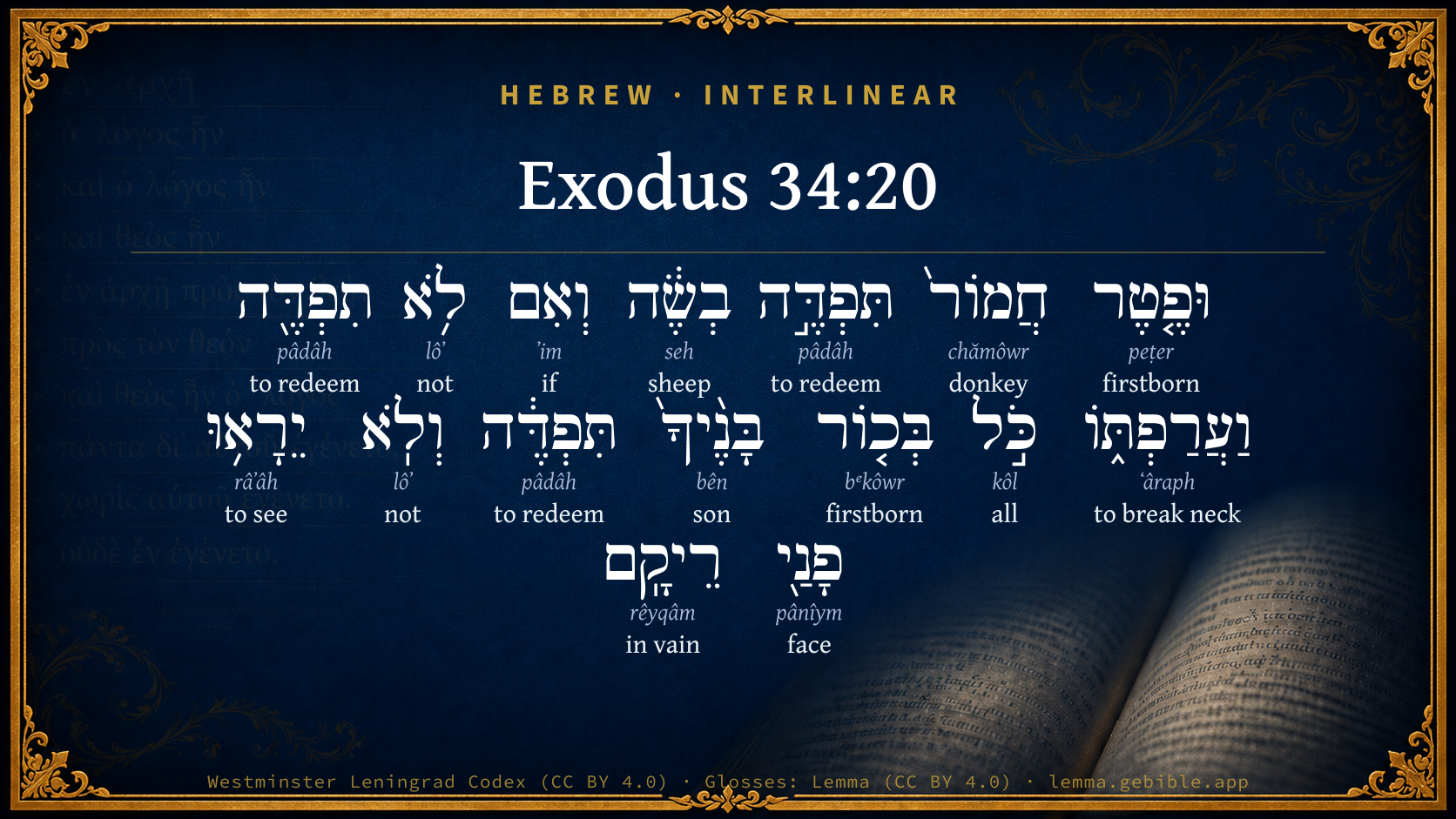
  1. וּפֶ֤טֶר peṭer H6363 “and · firstborn of” Conjunction + Noun, Common, Masculine, Singular, Construct
  2. חֲמוֹר֙ chămôwr H2543 “donkey” Noun, Common, Both, Singular, Absolute
  3. תִּפְדֶּ֣ה pâdâh H6299 “to redeem” Verb, Qal, Imperfect, 2nd Person, Masculine, Singular
  4. בְשֶׂ֔ה seh H7716 “in/at · sheep” Preposition + Noun, Common, Both, Singular, Absolute
  5. וְאִם ʼim H518 “and · if” Conjunction + Conjunction
  6. לֹ֥א lôʼ H3808 “not” Particle, Negative
  7. תִפְדֶּ֖ה pâdâh H6299 “to redeem” Verb, Qal, Imperfect, 2nd Person, Masculine, Singular
  8. כֹּ֣ל kôl H3605 “all of” Noun, Common, Masculine, Singular, Construct
  9. בְּכ֤וֹר bᵉkôwr H1060 “firstborn of” Noun, Common, Masculine, Singular, Construct
  10. בָּנֶ֨יךָ֙ bên H1121 “sons · your” Noun, Common, Masculine, Plural, Construct + Suffix, Personal, 2nd Person, Masculine, Singular
  11. תִּפְדֶּ֔ה pâdâh H6299 “to redeem” Verb, Qal, Imperfect, 2nd Person, Masculine, Singular
  12. וְלֹֽא lôʼ H3808 “and · not” Conjunction + Particle, Negative
  13. יֵרָא֥וּ râʼâh H7200 “to see” Verb, Niphal, Imperfect, 3rd Person, Masculine, Plural
  14. פָנַ֖י pânîym H6440 “face(s) · my” Noun, Common, Both, Plural, Construct + Suffix, Personal, 1st Person, Common, Singular
  15. רֵיקָֽם rêyqâm H7387 “in vain” Adverb

About this verse

These counts appear in no published source. They are computed here, from the morphology-tagged text and Lemma’s own curated glosses. What Lemma adds →

16
words
13
distinct lemmas
Pentateuch
section

Notable vocabulary

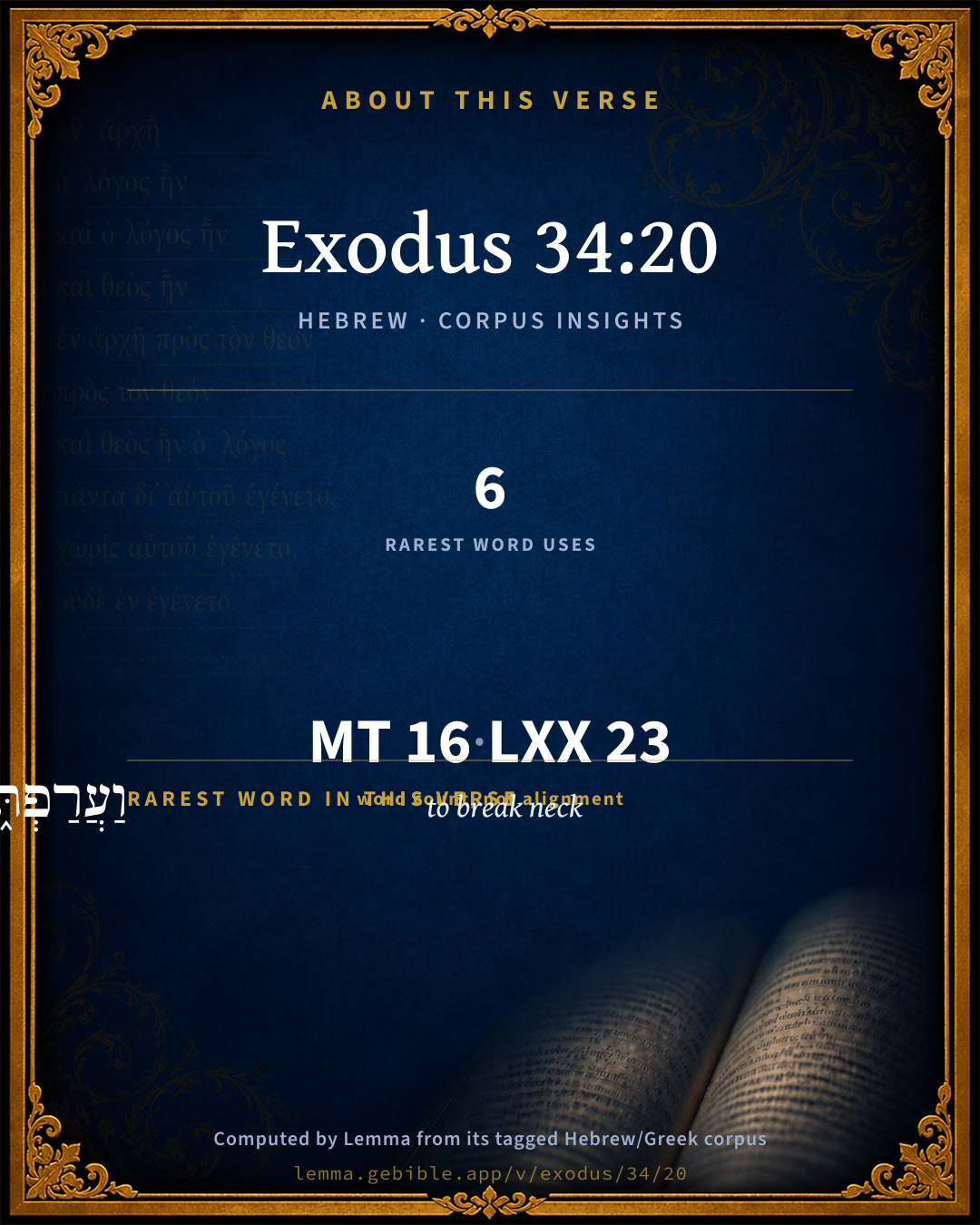
The rarest word here is וַעֲרַפְתּ֑וֹ to break neck H6202 — appearing just 6 times in the whole Hebrew Bible.

Shared distinctive vocabulary

וַעֲרַפְתּ֑וֹ to break neck H6202 occurs in 6 verses of the Hebrew Bible. Also found in:

Grammatical profile

  • 5 verbs
  • 7 nouns
  • 1 conjunction
  • 1 adverb
  • 2 particles

Verb forms

  • תִּפְדֶּ֣ה Qal · Imperfect
  • תִפְדֶּ֖ה Qal · Imperfect
  • וַעֲרַפְתּ֑וֹ Qal · Sequential Perfect
  • תִּפְדֶּ֔ה Qal · Imperfect
  • יֵרָא֥וּ Niphal · Imperfect

Repetition

Words recur within this verse — often emphatic in Hebrew:

  • תִּפְדֶּ֣ה to redeem H6299 ×3
  • לֹ֥א not H3808 ×2

Hebrew & Septuagint length

In English translation the verse runs 40 words from the Hebrew and 39 from the Septuagint (LXX English) — closely comparable.

A rough comparison of the two English renderings, which tokenize alike — not a word-level alignment.

Word counts can differ between the Hebrew and the Greek without any difference in meaning — e.g. the Hebrew direct-object marker אֵת has no separate Greek word, and Greek often adds the article ὁ.

In the original languages it is 16 Hebrew tokens and 23 Greek tokens — but the two are counted differently (Hebrew bundles its prefixes and suffixes into one token; the Greek is in lemma form), so that isn’t a like-for-like length.

Cross-references

9

Topical passages linked to Exodus 34:20 in the Treasury of Scripture Knowledge — connected by theme and wording, ordered by reader-vote popularity; previews shown in the World English Bible.

  • Exodus 13:13 Every firstborn of a donkey you shall redeem with a lamb; and if you will not redeem it, then you shall break its neck; and you shall redeem all the firstborn of man among your sons.
  • Exodus 23:15 You shall observe the feast of unleavened bread. Seven days you shall eat unleavened bread, as I commanded you, at the time appointed in the month Abib (for in it you came out from Egypt), and no one shall appear before me empty.
  • Deuteronomy 16:16 Three times in a year shall all your males appear before Yahweh your God in the place which he shall choose: in the feast of unleavened bread, and in the feast of weeks, and in the feast of tents; and they shall not appear before Yahweh empty:
  • Exodus 13:15 and it happened, when Pharaoh would hardly let us go, that Yahweh killed all the firstborn in the land of Egypt, both the firstborn of man, and the firstborn of animal. Therefore I sacrifice to Yahweh all that opens the womb, being males; but all the firstborn of my sons I redeem.'
  • Numbers 18:15 Everything that opens the womb, of all flesh which they offer to Yahweh, both of man and animal shall be yours: nevertheless the firstborn of man shall you surely redeem, and the firstborn of unclean animals shall you redeem.
  • 1 Samuel 9:7–8 Then said Saul to his servant, But, behold, if we go, what shall we bring the man? for the bread is spent in our vessels, and there is not a present to bring to the man of God: what have we?
  • Exodus 13:10 You shall therefore keep this ordinance in its season from year to year.
  • Numbers 3:45–51 "Take the Levites instead of all the firstborn among the children of Israel, and the cattle of the Levites instead of their cattle; and the Levites shall be mine. I am Yahweh.
  • 2 Samuel 24:24 The king said to Araunah, No; but I will most assuredly buy it of you at a price. Neither will I offer burnt-offerings to Yahweh my God which cost me nothing. So David bought the threshing floor and the oxen for fifty shekels of silver.

Cross-references courtesy of OpenBible.info (CC BY 4.0).

Hebrew and Greek witnesses Masoretic Hebrew ↔ Greek Septuagint

The same verse in the two great witnesses to the Old Testament, shown verse-for-verse.

These are two independent witnesses, not word-aligned to each other, and the Septuagint is shown in lemma (dictionary) form.

Hebrew Exodus 34:20 Masoretic · Westminster Leningrad Codex

וּפֶ֤טֶר חֲמוֹר֙ תִּפְדֶּ֣ה בְשֶׂ֔ה וְאִם לֹ֥א תִפְדֶּ֖ה וַעֲרַפְתּ֑וֹ כֹּ֣ל בְּכ֤וֹר בָּנֶ֨יךָ֙ תִּפְדֶּ֔ה וְלֹֽא יֵרָא֥וּ פָנַ֖י רֵיקָֽם

The firstborn of a donkey you shall redeem with a lamb: and if you will not redeem it, then you shall break its neck. All the firstborn of your sons you shall redeem. No one shall appear before me empty.

World English Bible · Public Domain

Greek LXX Exodus 34:20 Septuagint · lemma form

καί πρωτότοκος ὑποζύγιον λυτρόω πρόβατον ἐάν δέ μή λυτρόω αὐτός τιμή δίδωμι πᾶς πρωτότοκος ὁ υἱός σύ λυτρόω οὐ ὁράω ἐνώπιον ἐγώ κενός

And the firstborn of an ass you shall redeem with a sheep, and if you will not redeem it you shall pay a price: every firstborn of your sons shall you redeem: you shall not appear before me empty.

LXX2012 (modern English Septuagint) · Public Domain

Hebrew: Westminster Leningrad Codex (CC BY 4.0). Greek: Septuagint (public domain); English from LXX2012 (modern English Septuagint) (Public Domain). How the Septuagint differs from the Hebrew →

Targum (Aramaic paraphrase)

2

The Targum is the ancient Jewish Aramaic paraphrase of the Hebrew Scriptures — an interpretive translation, not the Hebrew text itself. Onkelos (literal) and Pseudo-Jonathan (expansive) render the Torah, and Jonathan the Prophets. Coverage is partial: where no permissively-licensed English translation exists for a verse, only the Aramaic is shown. This is verse-level text, not a word-by-word alignment to the Hebrew.

  1. Targum Onkelos Torah (Genesis–Deuteronomy)
    וּבוּכְרָא דַחֲמָרָא תִּפְרוֹק בְּאִימְרָא וְאִם לָא תִפְרוֹק וְתַנְקְפֵהּ כָּל בּוּכְרָא דִבְנָיךְ תִּפְרוֹק וְלָא יִתְחֲזוּן קֳדָמַי רֵיקָנִין:

    (no public-domain English translation for this verse)

    Targum Onkelos — Aramaic: “Onkelos Genesis” (public domain); “Onkelos Exodus” (public domain); “Onkelos Leviticus” (public domain); “Onkelos Numbers” (public domain); “Onkelos Deuteronomy” (public domain). English: “Sefaria Community Translation” (CC0 1.0 (public-domain dedication)); “J.W. Etheridge. The Targums of Onkelos and Jonathan Ben Uzziel on the Pentateuch. London: Longmans, Green, 1862” (public domain). Text via Sefaria.

  2. Targum Pseudo-Jonathan Torah (Genesis–Deuteronomy)
    וּבוּכְרָא דְחַמְרָא תִּפְרוֹק בְּאִימְרָא וְאִין לָא תִפְרוֹק וְתִנְקְפֵיהּ בְּקוּפִּיץ וְכָל בּוּכְרָא דִבְרָךְ תִּפְרוֹק וְלָא יִתְחֲמוּן קֳדָמַי רֵיקָנִין

    But the firstling of an ass thou mayest redeem with a lamb; but if thou redeem him not, thou shalt cut him off with the blade. And each firstborn of thy sons thou must redeem; and they shall not appear before Me empty.

    Targum Pseudo-Jonathan — Aramaic: “Targum Jonathan on Genesis” (public domain); “Targum Jonathan on Exodus” (public domain); “Targum Jonathan on Leviticus” (public domain); “Targum Jonathan on Numbers” (public domain); “Targum Jonathan on Deuteronomy” (public domain). English: “The Targum of Jonathan ben Uzziel, trans. J. W. Etheridge, London, 1862” (public domain). Text via Sefaria.

Commentary

Notes on Exodus 34:20 from classic Christian and Jewish commentators (each source and its license shown beneath its notes). The classic Christian expositions comment on the surrounding passage and are grouped to its opening verse, so a note may address several verses; the Jewish commentaries on the Tanakh (Rashi and others) are per-verse, so they appear only where the commentator wrote on this verse.

Lemma curates 59 commentaries, every one of them public domain or Creative Commons licensed, each selected and text-cleaned for this edition rather than reprinted as found. About our sources →

Trapp's Complete Commentary

John Trapp

Exo 34:20 But the firstling of an ass thou shalt redeem with a lamb: and if thou redeem [him] not, then shalt thou break his neck. All the firstborn of thy sons thou shalt redeem. And none shall appear before me empty.

Ver. 20. {See Trapp on "Exo 34:19"}

John Trapp, A Commentary or Exposition upon All the Books of the Old and New Testament (1647–1656) — public domain. Text from a community e-Sword module.

Geneva Bible (1599)

Geneva Bible translators

Without offering something.

Geneva Bible (1599) marginal notes — public domain. Text via Bolls.life.

Ellicott's Commentary for English Readers

(20) The firstling of an ass.—See Notes 1-3 on Exo_13:13.

A Bible Commentary for English Readers, edited by Charles John Ellicott (1878–1897) — public domain. Text from a community e-Sword module.

John Gill's Exposition

And thou shalt observe the feast of weeks,.... The feast of Pentecost, called the feast of weeks, because seven sabbaths or weeks, or fifty days, were to be reckoned from the day in the passover feast, on which the sheaf of the wave offering was brought, Lev 23:15 and which was also called the feast

of the first fruits of wheat harvest, to distinguish it from the barley harvest, at the time of the passover, when a sheaf of barley was the wave offering to the Lord; but at this two loaves or cakes of fine wheaten flour were brought as the first fruits of the wheat harvest, see Lev 23:17.

and the feast of ingathering at the year's end; which was the feast of tabernacles, called the feast of ingathering, because at this time all the fruits of the earth, the corn, wine, and oil, and all others were gathered in; and this was at the close of the old year, and at the beginning of the new, according to the ancient account, which made Tisri or September the first month in the year; See Gill on Exo 23:16.

John Gill's Exposition of the Whole Bible (1746–1763) — public domain (CC PDM 1.0). Text via the HelloAO Bible API.

Matthew Poole's English Annotations

Either without a gift to me, so it is a precept; or without benefit to himself, so it is a promise. See Exo 23:15.

Matthew Poole's English Annotations on the Holy Bible (1683–1685) — public domain. Text from a community e-Sword/MySword module.

Rashi

Rabbi Shlomo Yitzchaki (Rashi)

ופטר חמור AND THE FIRST OFFSPRING OF AN ASS [THOU SHALT REDEEM] — but not that of any other unclean animal (Bekhorot 5b).

תפדה בשה THOU SHALT REDEEM WITH A LAMB — one gives a lamb to the priest and it remains in his possession with the character of a non-holy object (חולין — an ordinary animal). The firstborn ass is then permitted to the owner to be used for work (Bekhorot 9b).

וערפתו THEN THOU SHALT BREAK ITS NECK — one breaks its neck with a hatchet and so slays it (Bekhorot 10b). The reason is: he (the owner of the ass) has caused loss to the possessions of the priest (by not giving him the lamb) therefore must he suffer loss in his possessions (Mekhilta).

כל בכור בניך תפדה ALL THE FIRSTBORN OF THY SONS THOU SHALT REDEEM — Five Sela’im are the ransom fixed for him, as it is said (Numbers 18:16) “And those that are to be redeemed, from a month old shalt thou redeem [according to thy valuation, for the money of five shekels]”. (For the whole of this verse cf. Rashi on 13:13).

ולא יראו פני ריקם AND NONE SHALL APEAR BEFORE ME EMPTY — According to the plain sense of the verse this is an independent statement and does not refer to the firstborn just mentioned — because in connection with the command concerning the firstborn there is no duty of appearing before the Lord; but it is another (a separate) prohibition merely connected by a conjunctive ו with the former statement and means: when you go up to the festival gathering to Jerusalem to appear before the Lord, none shall appear before Me empty; it is your duty to bring the burnt offering prescribed for the appearance before My face (Chagigah 7a). According to the Halachic explanation of the Boraitha this portion of the verse is redundant (since the same commandment already appears Exodus 23:15) and is consequently “free” (מופנה) to be used for a גז"ש (an analogy based on verbal similarity in two texts, viz., the word ריקם here and in the text Deuteronomy 15:13 לא תשלחנו ריקם “thou shalt not let him go away ריקם”) — it is repeated here after the law about the first born to teach you that the outfit given to a Hebrew slave when he leaves your service should consist of five Sela’im-worth of each of the things (mentioned Deuteronomy 15:14: thy sheep, thy threshing floor, and vinepress) just as the ransom of the firstborn is five Sela’im. Thus are we taught in Treatise Kiddushin 17a.

Rashi on the Tanakh — English translations: “The Judaica Press complete Tanach with Rashi, translated by A. J. Rosenberg” (CC BY 4.0); “Pentateuch with Rashi's commentary by M. Rosenbaum and A.M. Silbermann, 1929-1934” (public domain); “The Metsudah Tanach series, Lakewood, N.J” (CC BY 4.0); and “The Book of Joshua, Metsudah Publications, 1997” (CC BY 4.0). Text via Sefaria.

Lesson kit

Teaching starters — assembled from the data on this page, not authored interpretation. Every prompt links to the verse data it draws on. Edit before teaching.

Exodus, in the Pentateuch, opens this verse with 16 words (13 distinct Hebrew lemmas). Its most distinctive word is ʻâraph (“to break neck”). A historical commentator’s framing appears above. Read the whole chapter for the surrounding context.

Discussion questions

  1. What does “to break neck” (ʻâraph) contribute to the verse as a whole?
  2. How does Exodus 13:13, which shares the word «to break neck», read alongside this verse?
  3. What does the repetition of “to redeem” (3× in this one verse) do in this verse?
  4. The translations on this page render this verse differently — a whole-verse word diff, not a word-by-word alignment. What might account for the different wordings?
  5. «תִּפְדֶּ֣ה» is a Qal Imperfect verb. How does that grammatical form shape the action described?
  6. Compare how Trapp's Complete Commentary and Geneva Bible (1599) read this verse. Where do they agree or differ?

Things to notice

Reading settings

Reading text

Shown beneath each verse's original-language words.

Old Testament
Old Testament edition

Read the OT as the Masoretic Hebrew (MT) or the Greek Septuagint (LXX).

English shown for the Greek Septuagint (in the Hebrew ↔ Greek comparison).

Comparing translations? Open the Compare panel on any verse page to stack up to four side by side.