Exodus 29:26

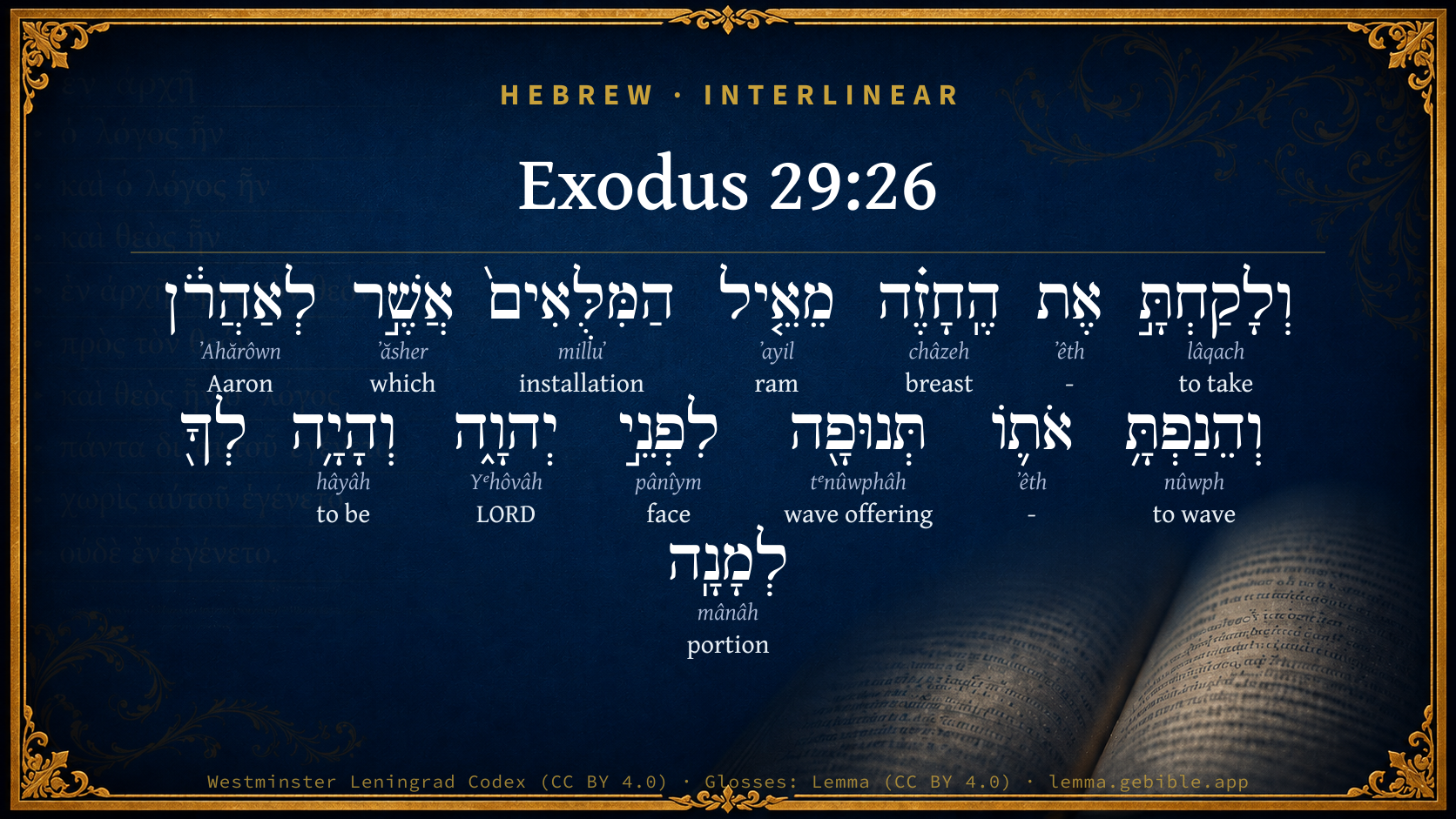
Hebrew (Westminster Leningrad Codex) Exodus 29:26 appears in the Hebrew Old Testament. The text above is from the Westminster Leningrad Codex. Each word links to its Strong’s number, a concise gloss, and parsing drawn from the Open Scriptures Hebrew Bible morphology. Click any word for its full Brown-Driver-Briggs (BDB) entry.
Download image
Cite this verse

Exodus 29:26 (World English Bible). Public Domain. Lemma interlinear Bible study tool, https://lemma.gebible.app/v/exodus/29/26.

Show BibTeX & RIS
BibTeX
RIS
English Translation
"You shall take the breast of Aaron's ram of consecration, and wave it for a wave-offering before Yahweh: and it shall be your portion.
World English Bible · Public Domain
Highlights Full analysis ↓
Download a study sheet

One document with this verse’s original text, its word-by-word gloss line, the meaning frame, cross-references with their text, attributed commentary, and full source and license credits — printable, and it pastes into notes with its structure intact.

This verse Autodidact and up

Study sheet (.html) Plain text (.txt)

A passage Seminary Student

Up to 50 verses in one chapter. A passage sheet keeps up to 6 commentary sources and 12 cross-references per verse, in the order this page ranks them, and says so on the sheet whenever that leaves anything out. Ask for a single verse and you get the Autodidact verse sheet above.

Everything on this page stays free to read, with no account — the sheet is a download of what is already on screen, not access to it.

Want to remove ads? Support Godless Engineer
Compare translations 3

The same verse in 3 English versions, stacked beneath the original-language interlinear above. Click any original word for its lexicon entry.

Each is an independent rendering of the whole verse — the interlinear is not word-aligned to these translations.

Highlighted words mark where these versions differ — a whole-verse word diff, not a word-by-word alignment.

  • World English Bible Public Domain
    "You shall take the breast of Aaron's ram of consecration, and wave it for a wave-offering before Yahweh: and it shall be your portion.
  • King James Version Public Domain
    And thou shalt take the breast of the ram of Aaron's consecration, and wave it for a wave offering before the LORD: and it shall be thy part.
  • unfoldingWord Literal Text CC BY-SA 4.0
    And you shall take the breast from the ram of consecration that is for Aaron and raise it for a raised offering before the face of Yahweh, and it will be your share.

unfoldingWord Literal Text — © unfoldingWord, licensed CC BY-SA 4.0. Word-aligned USFM3 via Door43 (git.door43.org/unfoldingWord/en_ult).

Versions to compare (up to 4)

3 of 4 selected

Show all 18 translations

Every available English version of this verse, each an independent rendering of the whole verse.

  • World English Bible Public Domain
    "You shall take the breast of Aaron's ram of consecration, and wave it for a wave-offering before Yahweh: and it shall be your portion.
  • Berean Standard Bible Public Domain
    Take the breast of the ram of Aaron’s ordination and wave it before the LORD as a wave offering, and it will be your portion.
  • Majority Standard Bible Public Domain
    Take the breast of the ram of Aaron’s ordination and wave it before the LORD as a wave offering, and it will be your portion.
  • King James Version Public Domain
    And thou shalt take the breast of the ram of Aaron's consecration, and wave it for a wave offering before the LORD: and it shall be thy part.
  • American Standard Version (1901) Public Domain
    And thou shalt take the breast of Aaron's ram of consecration, and wave it for a wave-offering before Jehovah: and it shall be thy portion.
  • Revised Version (1885) Public Domain
    And thou shalt take the breast of Aaron’s ram of consecration, and wave it for a wave offering before the LORD: and it shall be thy portion.
  • Geneva Bible (1599) Public Domain
    Likewise thou shalt take the brest of the ram of the consecration, which is for Aaron, and shalt shake it to and from before the Lord and it shalbe thy part.
  • Douay-Rheims (1899) Public Domain
    Thou shalt take also the breast of the ram, wherewith Aaron was consecrated, and elevating it thou shalt sanctify it before the Lord, and it shall fall to thy share.
  • Young's Literal Translation Public Domain
    `And thou hast taken the breast from the ram of the consecration which `is' for Aaron, and hast waved it -- a wave-offering before Jehovah, and it hath become thy portion;
  • Literal Standard Version CC BY-SA 4.0
    And you have taken the breast from the ram of the consecration which [is] for Aaron, and have waved it [for] a wave-offering before YHWH, and it has become your portion;
  • Unlocked Literal Bible CC BY-SA 4.0
    You must take the breast of Aaron's ram of dedication and wave it for a wave offering before Yahweh, and it will be your share.
  • unfoldingWord Literal Text CC BY-SA 4.0
    And you shall take the breast from the ram of consecration that is for Aaron and raise it for a raised offering before the face of Yahweh, and it will be your share.
  • Darby Bible Public Domain
    And thou shalt take the breast of the ram of consecration which is for Aaron, and wave it as a wave-offering before Jehovah; and it shall be thy part.
  • World Messianic Bible Public Domain
    “You shall take the breast of Aaron’s ram of consecration, and wave it for a wave offering before the LORD. It shall be your portion.
  • Webster's Bible Public Domain
    And thou shalt take the breast of the ram of Aaron's consecration, and wave it for a wave-offering before the LORD: and it shall be thy part.
  • Free Bible Version CC BY-SA 4.0
    Take the breast of the ram of Aaron's ordination and wave it before the Lord as a wave offering. This is the part you can keep.
  • Bible in Basic English Public Domain
    Then take the breast of Aaron's sheep, waving it before the Lord; and it is to be your part of the offering.
  • JPS Tanakh (1917) Public Domain
    And thou shalt take the breast of Aaron's ram of consecration, and wave it for a wave-offering before the LORD; and it shall be thy portion.

Literal Standard Version (2020), Covenant Press — licensed CC BY-SA 4.0. Text via the HelloAO Bible API (eBible.org). Unlocked Literal Bible (unfoldingWord) — licensed CC BY-SA 4.0. Text via the HelloAO Bible API (eBible.org). unfoldingWord Literal Text — © unfoldingWord, licensed CC BY-SA 4.0. Word-aligned USFM3 via Door43 (git.door43.org/unfoldingWord/en_ult). Free Bible Version, Dr. Jonathan Gallagher — licensed CC BY-SA 4.0. Text via the HelloAO Bible API (eBible.org).

Word by word

More ways to search: Search by grammar → Find every occurrence → Compare this word →

Practice this passage: Drill this verse → Learn its vocabulary →

הֶֽחָזֶ֗ה
châzeh
H2373
“the · breast”
Particle, Definite Article + Noun, Common, Masculine, Singular, Absolute
Part of Speech
Particle + Noun
Type
Common
Gender
Masculine
Number
Singular
State
Absolute
Full BDB Definition

Origin: from H2372

TWOT: 634a

breast (of animals), breast of an animal sacrifice
  1. וְלָקַחְתָּ֣ lâqach H3947 “and · to take” Conjunction + Verb, Qal, Sequential Perfect, 2nd Person, Masculine, Singular
  2. אֶת ʼêth H853 “-” Particle, Direct Object
  3. מֵאֵ֤יל ʼayil H352 “from · ram of” Preposition + Noun, Common, Masculine, Singular, Construct
  4. הַמִּלֻּאִים֙ milluʼ H4394 “the · installations” Particle, Definite Article + Noun, Common, Masculine, Plural, Absolute
  5. אֲשֶׁ֣ר ʼăsher H834 “which” Particle, Relative
  6. לְאַהֲרֹ֔ן ʼAhărôwn H175 “to/for · Aaron” Preposition + Noun, Proper
  7. וְהֵנַפְתָּ֥ nûwph H5130 “and · to wave” Conjunction + Verb, Hiphil, Sequential Perfect, 2nd Person, Masculine, Singular
  8. אֹת֛וֹ ʼêth H853 “- · him” Particle, Direct Object + Suffix, Personal, 3rd Person, Masculine, Singular
  9. תְּנוּפָ֖ה tᵉnûwphâh H8573 “wave offering” Noun, Common, Feminine, Singular, Absolute
  10. לִפְנֵ֣י pânîym H6440 “to/for · face(s) of” Preposition + Noun, Common, Both, Plural, Construct
  11. יְהוָ֑ה Yᵉhôvâh H3068 “LORD” Noun, Proper
  12. וְהָיָ֥ה hâyâh H1961 “and · to be” Conjunction + Verb, Qal, Sequential Perfect, 3rd Person, Masculine, Singular
  13. לְמָנָֽה mânâh H4490 “to/for · portion” Preposition + Noun, Common, Feminine, Singular, Absolute

About this verse

These counts appear in no published source. They are computed here, from the morphology-tagged text and Lemma’s own curated glosses. What Lemma adds →

15
words
13
distinct lemmas
Pentateuch
section

Notable vocabulary

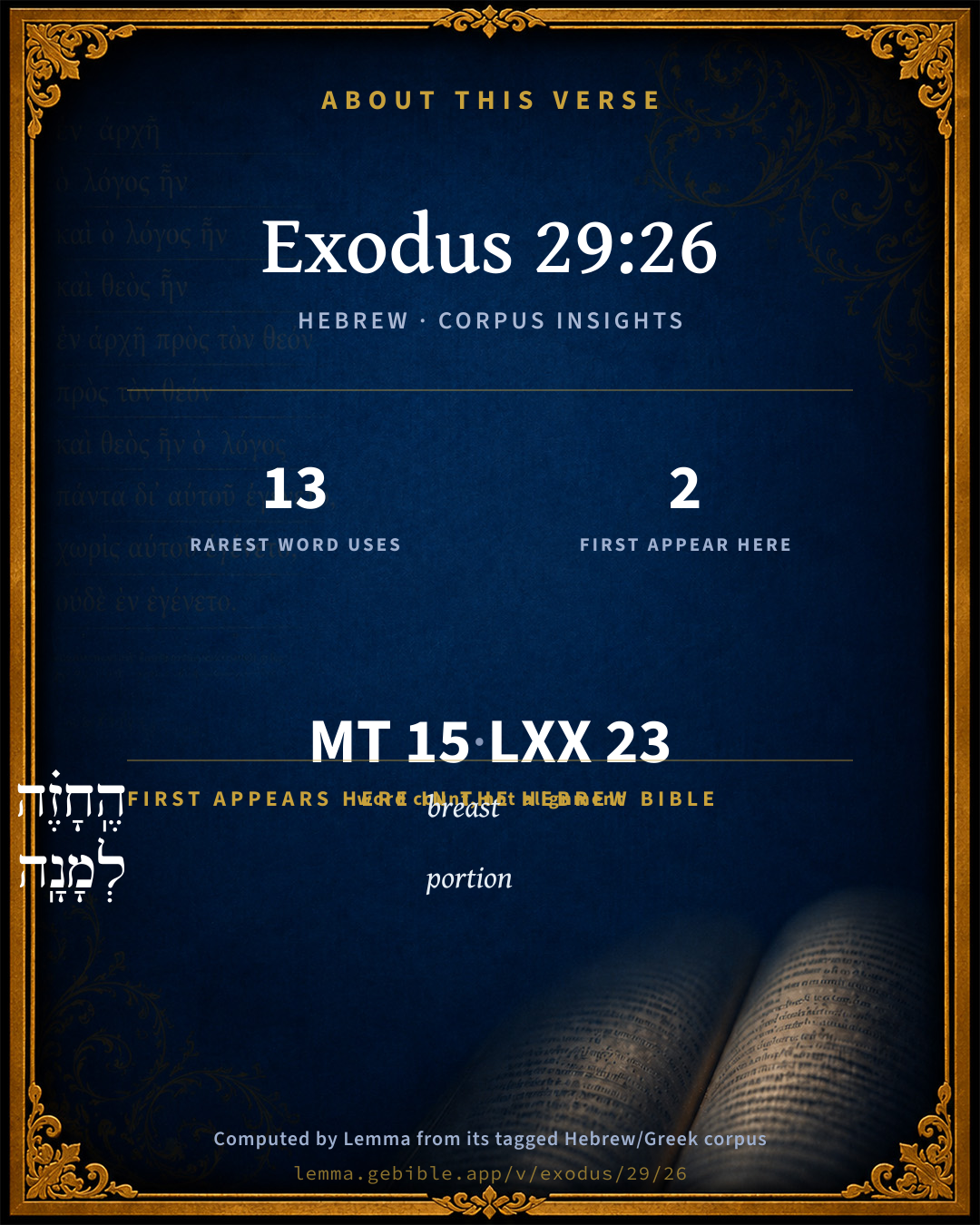
The rarest word here is הֶֽחָזֶ֗ה breast H2373 — appearing just 13 times in the whole Hebrew Bible.

First appearance in Scripture

These words make their first canonical appearance in the Hebrew Bible here:

  • הֶֽחָזֶ֗ה breast H2373
  • לְמָנָֽה portion H4490

Shared distinctive vocabulary

הֶֽחָזֶ֗ה breast H2373 occurs in 12 verses of the Hebrew Bible. Also found in:

Grammatical profile

  • 3 verbs
  • 8 nouns
  • 1 preposition
  • 3 particles

Verb forms

  • וְלָקַחְתָּ֣ Qal · Sequential Perfect
  • וְהֵנַפְתָּ֥ Hiphil · Sequential Perfect
  • וְהָיָ֥ה Qal · Sequential Perfect

Hebrew & Septuagint length

In English translation the verse runs 24 words from the Hebrew and 35 from the Septuagint (LXX English) — the Septuagint runs noticeably longer here. See the side-by-side →

A rough comparison of the two English renderings, which tokenize alike — not a word-level alignment.

Word counts can differ between the Hebrew and the Greek without any difference in meaning — e.g. the Hebrew direct-object marker אֵת has no separate Greek word, and Greek often adds the article ὁ.

In the original languages it is 15 Hebrew tokens and 23 Greek tokens — but the two are counted differently (Hebrew bundles its prefixes and suffixes into one token; the Greek is in lemma form), so that isn’t a like-for-like length.

Cross-references

4

Topical passages linked to Exodus 29:26 in the Treasury of Scripture Knowledge — connected by theme and wording, ordered by reader-vote popularity; previews shown in the World English Bible.

  • Leviticus 8:29 Moses took the breast, and waved it for a wave offering before Yahweh. It was Moses' portion of the ram of consecration, as Yahweh commanded Moses.
  • Leviticus 7:31 The priest shall burn the fat on the altar, but the breast shall be Aaron's and his sons'.
  • Leviticus 7:34 For the waved breast and the heaved thigh I have taken from the children of Israel out of the sacrifices of their peace offerings, and have given them to Aaron the priest and to his sons as their portion forever from the children of Israel.'"
  • Psalms 99:6 Moses and Aaron were among his priests, Samuel among those who call on his name; They called on Yahweh, and he answered them.

Cross-references courtesy of OpenBible.info (CC BY 4.0).

Hebrew and Greek witnesses Masoretic Hebrew ↔ Greek Septuagint

The same verse in the two great witnesses to the Old Testament, shown verse-for-verse.

Here the Septuagint runs noticeably longer than the Hebrew — LXX2012 (modern English Septuagint) 35 words vs World English Bible 24. A rough length comparison of the two English translations, not a word-level alignment — read both below.

These are two independent witnesses, not word-aligned to each other, and the Septuagint is shown in lemma (dictionary) form.

Hebrew Exodus 29:26 Masoretic · Westminster Leningrad Codex

וְלָקַחְתָּ֣ אֶת הֶֽחָזֶ֗ה מֵאֵ֤יל הַמִּלֻּאִים֙ אֲשֶׁ֣ר לְאַהֲרֹ֔ן וְהֵנַפְתָּ֥ אֹת֛וֹ תְּנוּפָ֖ה לִפְנֵ֣י יְהוָ֑ה וְהָיָ֥ה לְךָ֖ לְמָנָֽה

"You shall take the breast of Aaron's ram of consecration, and wave it for a wave-offering before Yahweh: and it shall be your portion.

World English Bible · Public Domain

Greek LXX Exodus 29:26 Septuagint · lemma form

καί λαμβάνω ὁ στηθύνιον ἀπό ὁ κριός ὁ τελείωσις ὅς εἰμί ααρων καί ἀποὁρίζω αὐτός ἀφόρισμα ἔναντι κύριος καί εἰμί σύ ἐν μερίς

And you shall take the breast from the ram of consecration which is Aaron's, and you shall separate it as a separate offering before the Lord, and it shall be to you for a portion.

LXX2012 (modern English Septuagint) · Public Domain

Hebrew: Westminster Leningrad Codex (CC BY 4.0). Greek: Septuagint (public domain); English from LXX2012 (modern English Septuagint) (Public Domain). How the Septuagint differs from the Hebrew →

Targum (Aramaic paraphrase)

2

The Targum is the ancient Jewish Aramaic paraphrase of the Hebrew Scriptures — an interpretive translation, not the Hebrew text itself. Onkelos (literal) and Pseudo-Jonathan (expansive) render the Torah, and Jonathan the Prophets. Coverage is partial: where no permissively-licensed English translation exists for a verse, only the Aramaic is shown. This is verse-level text, not a word-by-word alignment to the Hebrew.

  1. Targum Onkelos Torah (Genesis–Deuteronomy)
    וְתִסַב יָת חֶדְיָא מִדְכַר קֻרְבָּנַיָא דִי לְאַהֲרֹן וּתְרִים יָתֵהּ אֲרָמוּתָא קֳדָם יְיָ וִיהֵי לָךְ לָחֳלָק:

    (no public-domain English translation for this verse)

    Targum Onkelos — Aramaic: “Onkelos Genesis” (public domain); “Onkelos Exodus” (public domain); “Onkelos Leviticus” (public domain); “Onkelos Numbers” (public domain); “Onkelos Deuteronomy” (public domain). English: “Sefaria Community Translation” (CC0 1.0 (public-domain dedication)); “J.W. Etheridge. The Targums of Onkelos and Jonathan Ben Uzziel on the Pentateuch. London: Longmans, Green, 1862” (public domain). Text via Sefaria.

  2. Targum Pseudo-Jonathan Torah (Genesis–Deuteronomy)
    וְתִיסַב יַת חַדְיָא מִדְכַר קוּרְבָּנַיָא דִלְאַהֲרן וְתָרֵים יָתָהּ אֲרָמָא קֳדָם יְיָ וִיהֵי לָךְ לְחוּלָק

    And thou shalt take the breast of the ram of Aharon's oblation, and uplift it, an elevation before the Lord, and it shall be thy portion.

    Targum Pseudo-Jonathan — Aramaic: “Targum Jonathan on Genesis” (public domain); “Targum Jonathan on Exodus” (public domain); “Targum Jonathan on Leviticus” (public domain); “Targum Jonathan on Numbers” (public domain); “Targum Jonathan on Deuteronomy” (public domain). English: “The Targum of Jonathan ben Uzziel, trans. J. W. Etheridge, London, 1862” (public domain). Text via Sefaria.

Commentary

Notes on Exodus 29:26 from classic Christian and Jewish commentators (each source and its license shown beneath its notes). The classic Christian expositions comment on the surrounding passage and are grouped to its opening verse, so a note may address several verses; the Jewish commentaries on the Tanakh (Rashi and others) are per-verse, so they appear only where the commentator wrote on this verse.

Lemma curates 59 commentaries, every one of them public domain or Creative Commons licensed, each selected and text-cleaned for this edition rather than reprinted as found. About our sources →

Trapp's Complete Commentary

John Trapp

Exo 29:26 And thou shalt take the breast of the ram of Aaron’s consecration, and wave it [for] a wave offering before the LORD: and it shall be thy part.

Ver. 26. It shall be thy part.] Because he did for this time extraordinarily execute the priest’s of office.

John Trapp, A Commentary or Exposition upon All the Books of the Old and New Testament (1647–1656) — public domain. Text from a community e-Sword module.

The Biblical Illustrator

Joseph S. Exell

Exo_29:26-28

Which is waved, and which is heaved up.

The wave-offerings and heave-offerings

1. As illustrating the state of the heart in those who truly offer themselves up to God, there is something impressive and beautiful in the ancient wave-offerings and heave-offerings. Waving is one of natures universal laws. The whole creation, with its myriads of planets, suns and heavens, lives because it waves to and fro the central life. The life of God waves to and fro between our spirits and Him.

2. In prayer our souls are heaved up towards the eternal Soul of our souls. Nothing heaves up the soul like a perfect love. Our daily heave-offering is a labour that has a great reward. Our aspirations, our inner hearings and upliftings, are the works which will follow us into the eternal world. They will follow us by being actually constituent elements of our future body.

3. Some persons think it strange that we should be exhorted to hasten the coming of the kingdom of God. But all who have a thrilling expectation of it may be sure that the vital element of the new coming is waving in upon them, and that as they heave up their souls and expand with desire to draw down the heavenly fire they are unconsciously hastening the coming of the day of God. (J. Pulsford, D. D.)

The peace-offering

This was the most important sacrifice of all. It consisted of a ram, called The Ram of Consecration, or more literally, the Ram of the Fillings, because the hands of the consecrated persons were filled by portions of it being placed upon them. Of this ram of consecration, after Aaron and his sons had imposed hands upon it, and it had been slain, some of the blood was placed upon the tip of Aarons right ear, and upon the thumb of his right hand, and upon the great toe of his right foot, and similarly upon the same three members of his sons, the remainder of the blood being sprinkled upon the altar round about (Exo_29:19-20; Lev_8:22-24). This represented the consecration to God of such members of the body as would be more especially called into exercise by the duties of the priestly vocation. The ear was consecrated to listen to the voice of God, the hand to do His will, the foot to walk in His ways. Secondly, those parts of the peace-offering, which hereafter, in the exercise of their priestly office, it would be their duty to receive of the offerer and burn upon the altar, were laid upon the hands of Aaron and his sons, together with a meat-offering, and waved as a wave-offering before the Lord (Exo_29:22-24; Lev_8:25-27), and then burnt upon the altar (Exo_29:25; Lev_8:28). This ceremony was called the filling of the hands, and so essential a part of the consecration ceremony was it, that the expression to fill the hand became equivalent to consecrate to the priesthood. The sacrifice itself was called the ram of consecration, or the ram of fillings. The intention of this action was to deliver to the ordained persons the sacrifices which they were in future to offer to God; it was a formal initiation into the sacrificial duties of their office. It indicated that from that time forward, the right and duty of officiating at the altar, and of superintending the burning of the sacrifices, would be theirs. Similarly, in the early ordinals of the Greek Church, a portion of the sacrifice, i.e., of the consecrated elements, was placed in the hands of the person who was ordained priest: a tradition still observed in the Eastern Church, and which, in a remarkable manner, links together the priesthoods of the Jewish and Christian Churches. The next part of the ceremony connected with the ram of consecration, was the sprinkling of Aaron and his sons and their vestments with its blood, mingled with anointing oil (Lev_8:30). Hence it could be said that the sons of Aaron were anointed as their father was anointed (Exo_40:15); they, like him, were sprinkled with oil, but he alone, as high priest, had the oil poured upon his head, and could thus be called, in contradistinction to the other priests, preeminently the anointed priest. In this secondary anointing, it is to be observed, that the clothes were sprinkled and consecrated upon and with the persons. The clothes represented the office filled by the person. The person and the clothes together represented the priest; therefore the consecration was performed on both together. Lastly came the sacrificial meal: the solemn eating of the body of the consecrating peace-offering by Aaron and his sons within the precincts of the Tabernacle (Lev_8:3). It is interesting to observe that the apostles were consecrated to their priestly office by a like filling of the hands, and by a like sacrificial meal, when our Lord placed in their hands the broken bread with the words, Take, eat, this is My body. (E. F. Willis, M. A.)

The Biblical Illustrator, edited by Joseph S. Exell (c. 1880s–1900s) — public domain. Text from a community e-Sword module.

Geneva Bible (1599)

Geneva Bible translators

This sacrifice the Priest did move toward the East, West, North, and South.

Geneva Bible (1599) marginal notes — public domain. Text via Bolls.life.

Ellicott's Commentary for English Readers

(26) Thou shalt take the breast.—It was the general law that in “wave offerings” the breast should be the officiating priest’s (Lev_7:29-31); hence, on this occasion, it was assigned to Moses.

A Bible Commentary for English Readers, edited by Charles John Ellicott (1878–1897) — public domain. Text from a community e-Sword module.

The Cambridge Bible for Schools and Colleges

gen. ed. J. J. S. Perowne

26. The breast of the ram to be ‘waved’ before Jehovah, and then ven to Moses (cf. Lev_8:29). The breast of the ordinary peace offering, after being ‘waved’ before Jehovah, was the perquisite of the priests (Lev_7:30 f.); here it is given analogously to Moses (who throughout the present ceremony acts the part of priest).

wave] used here in the strict sense explained on v. 24.

The Cambridge Bible for Schools and Colleges (gen. ed. J. J. S. Perowne; Cambridge University Press, 1878–1918) — public domain. Text from a community e-Sword module.

John Gill's Exposition

And thou shalt take the breast of the ram of Aaron's consecrations,.... The ram being slain and cut to pieces, this part is particularly disposed of:

and wave it for a wave offering before the Lord; in the manner before described:

and it shall be thy part: the part of Moses, he officiating now as a priest; and we find accordingly in later times that this part of the sacrifice belonged to the priest, Lev 7:31.

John Gill's Exposition of the Whole Bible (1746–1763) — public domain (CC PDM 1.0). Text via the HelloAO Bible API.

Matthew Poole's English Annotations

To wit, the breast alone, whereas both shoulder and breast were given to Aaron afterwards; the reason whereof might be, either because Moses was not a proper and complete priest, as Aaron afterward was, but only appointed by God for this time to do that work; or because now there were in a manner two priests, the one consecrating, to wit, Moses; the other consecrated, to wit, Aaron; therefore these parts were divided, the breast went to the former to be eaten, the shoulder offered unto God for the latter, Exo 29:22; he being not yet a perfect priest, and therefore not in a capacity of eating it.

Matthew Poole's English Annotations on the Holy Bible (1683–1685) — public domain. Text from a community e-Sword/MySword module.

Whedon's Commentary on the Bible

Daniel D. Whedon

26-28. Be thy part — As the officiating minister on this extraordinary occasion, Moses was to receive the breast of the ram of Aaron’s consecration. And here it is enunciated as a statute for ever, that the breast of the wave offering and the shoulder of the heave offering shall belong to the priests as their lawful portion of the peace offerings. These were evidently regarded as choice portions of the animal. The distinction between the wave offering (תנופה) and the heave offering (תרומה) is indicated by the Hebrew names, the former signifying horizontal motion to and fro, the latter vertical motion, perpendicular to the horizon. These constituted a double form of symbolical consecration, in adoration to Him who rules in all and over all.

Daniel D. Whedon (gen. ed.), Commentary on the Old and New Testaments (1874–1909) — public domain. Text from a community e-Sword module.

The Pulpit Commentary

Thou shalt take the breast. Henceforth Aaron and his sons were to have the breast of all wave-offerings; (Lev_7:31-34) but on this occasion, as Moses officiated, the breast was to be his.

The Pulpit Commentary (1880–1919), ed. H.D.M. Spence-Jones & Joseph S. Exell — public domain. Text from a community e-Sword module.

unfoldingWord translationNotes

Door43 World Missions Community

General Information:

Yahweh continues speaking to Moses.

ram of dedication

"ram that you dedicated" or "ram that you killed"

Aaron's ram of dedication

"the ram that you used to dedicate Aaron"

a perpetual ordinance

"a permanent law"

translationWords

Aaron

ewe

set apart

sacrifice

Yahweh

Israel

eternity

descend

fellowship offering

priest

unfoldingWord translationNotes — © Distant Shores Media and the Door43 World Missions Community, licensed CC BY-SA 4.0. Source: git.door43.org/Door43/en_tn.

Ramban (Nachmanides)

Rabbi Moshe ben Nachman (Ramban / Nachmanides)

OF THE RAM OF CONSECRATION WHICH IS AARON’S. He did not mention here Aaron’s sons, although the ram was for the consecration of all of them. The reason for this is that Scripture commanded [in the first part of the verse before us], And thou [i.e., Moses] shalt take the breast of the wave-offering of the ram of consecration because it is Aaron’s, since the breast of the offering is by right not Aaron’s, for it does not belong to the owner of the animal [but to the priest, 7:31. and since on this occasion Aaron and his sons were the owners of the ram of consecration, and Moses the officiating priest, the breast in this instance belonged to Moses]. Now having stated the reason why it does not belong of right to Aaron, there was no need any more to declare that it does not belong to his sons, for they follow him in their rights [and where it does not belong to him, it likewise does not belong to them]. Further, however, He does say, And thou shalt sanctify the breast of the wave-offering… of the ram of consecration, even of that which is Aaron’s, and of that which is his sons’, for the intent is to state: “just as he [Moses] takes of the offering which belongs to them all, the breast and the shoulder, so shall they — the father and the sons [High Priest and common priests] — take of the future [peace-] offerings which they [the children of Israel] will offer up.”

Ramban (Nachmanides) on the Tanakh — English translation: “Commentary on the Torah by Ramban (Nachmanides). Translated and annotated by Charles B. Chavel. New York, Shilo Pub. House, 1971-1976” (CC BY 4.0). Text via Sefaria.

Lesson kit

Teaching starters — assembled from the data on this page, not authored interpretation. Every prompt links to the verse data it draws on. Edit before teaching.

Exodus, in the Pentateuch, opens this verse with 15 words (13 distinct Hebrew lemmas). Its most distinctive word is châzeh (“breast”). The Greek Septuagint runs longer here. A historical commentator’s framing appears above. Read the whole chapter for the surrounding context.

Discussion questions

  1. How does “breast” (châzeh) shape what this verse is saying?
  2. 2 words make their first appearance in Scripture here. What does this debut establish?
  3. How does Exodus 29:27, which shares the word «breast», read alongside this verse?
  4. The Septuagint runs longer here than the Hebrew. What might account for the difference?
  5. These translations render this verse differently. What is at stake in choosing one wording over another?
  6. «וְלָקַחְתָּ֣» is a Qal Sequential Perfect verb. How does that grammatical form shape the action described?
  7. Compare how Trapp's Complete Commentary and The Biblical Illustrator read this verse. Where do they agree or differ?

Things to notice

Reading settings

Reading text

Shown beneath each verse's original-language words.

Old Testament
Old Testament edition

Read the OT as the Masoretic Hebrew (MT) or the Greek Septuagint (LXX).

English shown for the Greek Septuagint (in the Hebrew ↔ Greek comparison).

Comparing translations? Open the Compare panel on any verse page to stack up to four side by side.