Daniel 8:18

Hebrew (Westminster Leningrad Codex) Daniel 8:18 appears in the Hebrew Old Testament. The text above is from the Westminster Leningrad Codex. Each word links to its Strong’s number, a concise gloss, and parsing drawn from the Open Scriptures Hebrew Bible morphology. Click any word for its full Brown-Driver-Briggs (BDB) entry.
Download image
Cite this verse

Daniel 8:18 (World English Bible). Public Domain. Lemma interlinear Bible study tool, https://lemma.gebible.app/v/daniel/8/18.

Show BibTeX & RIS
BibTeX
RIS
English Translation
Now as he was speaking with me, I fell into a deep sleep with my face toward the ground; but he touched me, and set me upright.
World English Bible · Public Domain
Download a study sheet

One document with this verse’s original text, its word-by-word gloss line, the meaning frame, cross-references with their text, attributed commentary, and full source and license credits — printable, and it pastes into notes with its structure intact.

This verse Autodidact and up

Study sheet (.html) Plain text (.txt)

A passage Seminary Student

Up to 50 verses in one chapter. A passage sheet keeps up to 6 commentary sources and 12 cross-references per verse, in the order this page ranks them, and says so on the sheet whenever that leaves anything out. Ask for a single verse and you get the Autodidact verse sheet above.

Everything on this page stays free to read, with no account — the sheet is a download of what is already on screen, not access to it.

Want to remove ads? Support Godless Engineer
Compare translations 3

The same verse in 3 English versions, stacked beneath the original-language interlinear above. Click any original word for its lexicon entry.

Each is an independent rendering of the whole verse — the interlinear is not word-aligned to these translations.

Highlighted words mark where these versions differ — a whole-verse word diff, not a word-by-word alignment.

  • World English Bible Public Domain
    Now as he was speaking with me, I fell into a deep sleep with my face toward the ground; but he touched me, and set me upright.
  • King James Version Public Domain
    Now as he was speaking with me, I was in a deep sleep on my face toward the ground: but he touched me, and set me upright.
  • unfoldingWord Literal Text CC BY-SA 4.0
    Now while he was speaking with me, I fell into a deep sleep with my face to the ground. Then he touched me and made me stand on my feet.

unfoldingWord Literal Text — © unfoldingWord, licensed CC BY-SA 4.0. Word-aligned USFM3 via Door43 (git.door43.org/unfoldingWord/en_ult).

Versions to compare (up to 4)

3 of 4 selected

Show all 18 translations

Every available English version of this verse, each an independent rendering of the whole verse.

  • World English Bible Public Domain
    Now as he was speaking with me, I fell into a deep sleep with my face toward the ground; but he touched me, and set me upright.
  • Berean Standard Bible Public Domain
    While he was speaking with me, I fell into a deep sleep, with my face to the ground. Then he touched me, helped me to my feet,
  • Majority Standard Bible Public Domain
    While he was speaking with me, I fell into a deep sleep, with my face to the ground. Then he touched me, helped me to my feet,
  • King James Version Public Domain
    Now as he was speaking with me, I was in a deep sleep on my face toward the ground: but he touched me, and set me upright.
  • American Standard Version (1901) Public Domain
    Now as he was speaking with me, I fell into a deep sleep with my face toward the ground; but he touched me, and set me upright.
  • Revised Version (1885) Public Domain
    Now as he was speaking with me, I fell into a deep sleep, with my face toward the ground: but he touched me, and set me upright.
  • Geneva Bible (1599) Public Domain
    Nowe as he was speaking vnto me, I being a sleepe fell on my face to the ground: but he touched me, and set me vp in my place.
  • Douay-Rheims (1899) Public Domain
    And when he spoke to me I fell flat on the ground: and he touched me, and set me upright,
  • Young's Literal Translation Public Domain
    And in his speaking with me, I have been in a trance on my face, on the earth; and he cometh against me, and causeth me to stand on my station,
  • Literal Standard Version CC BY-SA 4.0
    And in his speaking with me, I have been in a trance on my face, on the earth; and he comes against me, and causes me to stand on my station,
  • Unlocked Literal Bible CC BY-SA 4.0
    When he spoke to me, I fell into a deep sleep with my face to the ground. Then he touched me and made me stand up.
  • unfoldingWord Literal Text CC BY-SA 4.0
    Now while he was speaking with me, I fell into a deep sleep with my face to the ground. Then he touched me and made me stand on my feet.
  • Darby Bible Public Domain
    Now, as he was speaking with me, I was in a deep stupor, with my face toward the ground. And he touched me, and set me up where I had stood.
  • World Messianic Bible Public Domain
    Now as he was speaking with me, I fell into a deep sleep with my face toward the ground; but he touched me and set me upright.
  • Webster's Bible Public Domain
    Now as he was speaking with me, I was in a deep sleep on my face towards the ground: but he touched me, and set me upright.
  • Free Bible Version CC BY-SA 4.0
    As he spoke to me I lost consciousness as I laid facedown on the ground. But he took hold of me and helped me to my feet.
  • Bible in Basic English Public Domain
    Now while he was talking to me, I went into a deep sleep with my face to the earth: but touching me, he put me on my feet where I had been.
  • JPS Tanakh (1917) Public Domain
    Now as he was speaking with me, I fell into a deep sleep with my face toward the ground; but he touched me, and set me upright.

Literal Standard Version (2020), Covenant Press — licensed CC BY-SA 4.0. Text via the HelloAO Bible API (eBible.org). Unlocked Literal Bible (unfoldingWord) — licensed CC BY-SA 4.0. Text via the HelloAO Bible API (eBible.org). unfoldingWord Literal Text — © unfoldingWord, licensed CC BY-SA 4.0. Word-aligned USFM3 via Door43 (git.door43.org/unfoldingWord/en_ult). Free Bible Version, Dr. Jonathan Gallagher — licensed CC BY-SA 4.0. Text via the HelloAO Bible API (eBible.org).

Word by word

More ways to search: Search by grammar → Find every occurrence → Compare this word →

Practice this passage: Drill this verse → Learn its vocabulary →

נִרְדַּ֥מְתִּי
râdam
H7290
“to sleep”
Verb, Niphal, Perfect, 1st Person, Common, Singular
Part of Speech
Verb
Stem
Niphal
Form
Perfect
Person
1st Person
Gender
Common
Number
Singular
Full BDB Definition

Origin: a primitive root

TWOT: 2123

(Niphal) to be asleep, be unconscious, be in heavy sleep, fall into heavy sleep, be fast asleep
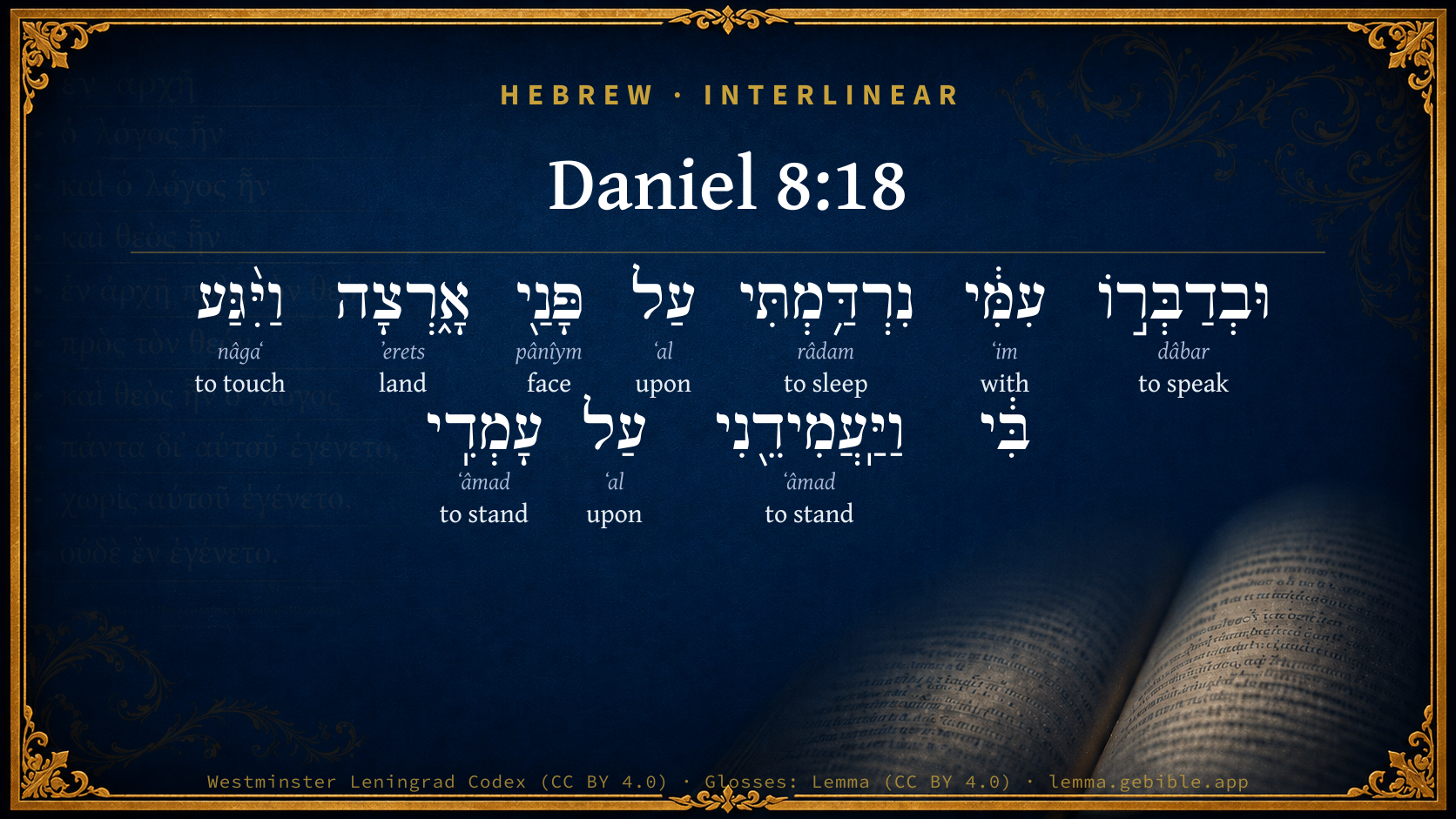
  1. וּבְדַבְּר֣וֹ dâbar H1696 “and · in/at · to speak · him” Conjunction + Preposition + Verb, Piel, Infinitive Construct + Suffix, Personal, 3rd Person, Masculine, Singular
  2. עִמִּ֔י ʻim H5973 “with · me” Preposition + Suffix, Personal, 1st Person, Common, Singular
  3. עַל ʻal H5921 “upon” Preposition
  4. פָּנַ֖י pânîym H6440 “face(s) · my” Noun, Common, Both, Plural, Construct + Suffix, Personal, 1st Person, Common, Singular
  5. אָ֑רְצָה ʼerets H776 “land · toward” Noun, Common, Both, Singular, Absolute + Suffix, Demonstrative
  6. וַיִּ֨גַּע nâgaʻ H5060 “and · to touch” Conjunction + Verb, Qal, Sequential Imperfect, 3rd Person, Masculine, Singular
  7. וַיַּֽעֲמִידֵ֖נִי ʻâmad H5975 “and · to stand · me” Conjunction + Verb, Hiphil, Sequential Imperfect, 3rd Person, Masculine, Singular + Suffix, Personal, 1st Person, Common, Singular
  8. עַל ʻal H5921 “upon” Preposition
  9. עָמְדִֽי ʻâmad H5975 “standing · my” Noun, Common, Masculine, Singular, Construct + Suffix, Personal, 1st Person, Common, Singular

About this verse

These counts appear in no published source. They are computed here, from the morphology-tagged text and Lemma’s own curated glosses. What Lemma adds →

11
words
8
distinct lemmas
Prophets
section

Notable vocabulary

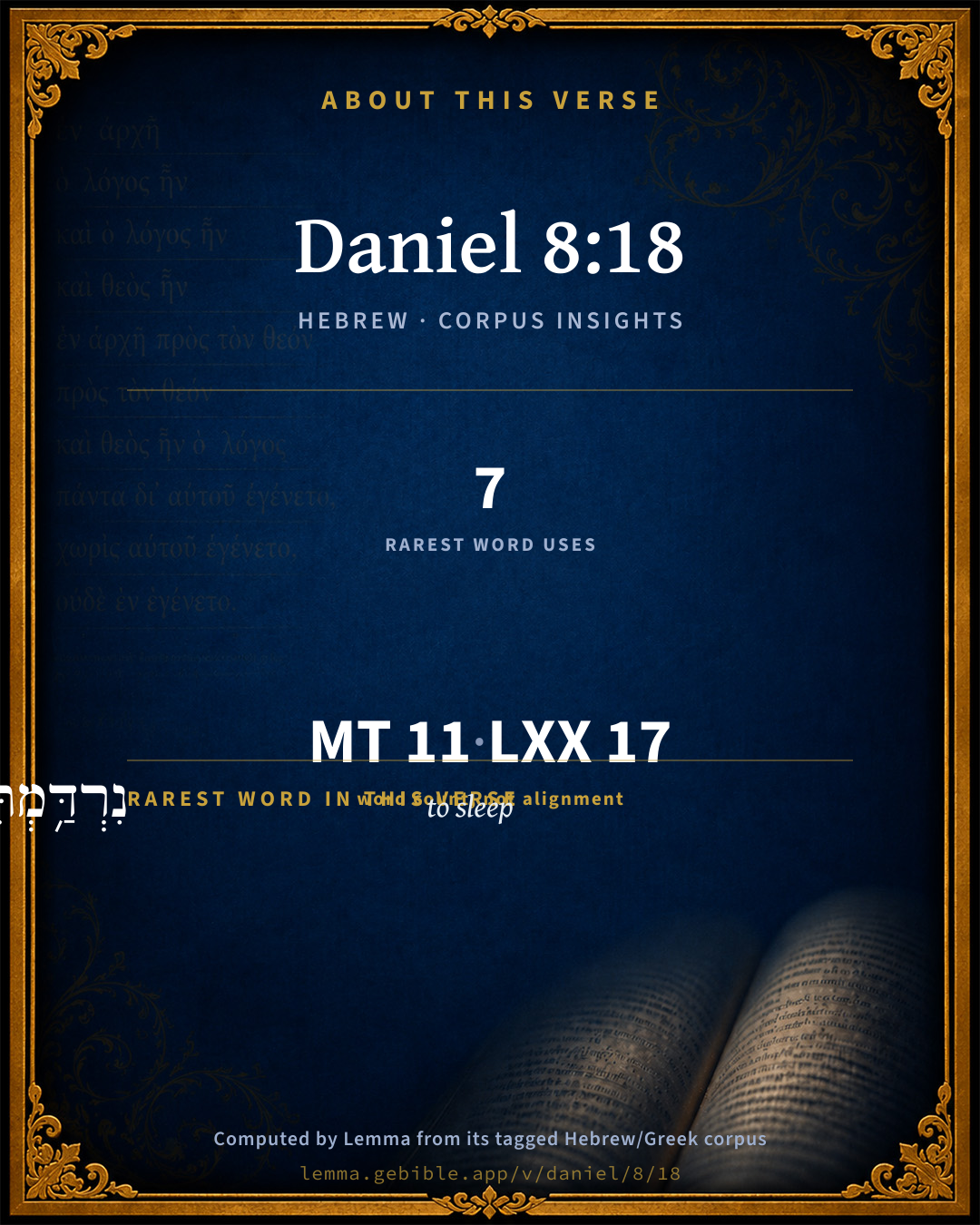
The rarest word here is נִרְדַּ֥מְתִּי to sleep H7290 — appearing just 7 times in the whole Hebrew Bible.

Shared distinctive vocabulary

נִרְדַּ֥מְתִּי to sleep H7290 occurs in 7 verses of the Hebrew Bible. Also found in:

Grammatical profile

  • 4 verbs
  • 3 nouns
  • 4 prepositions

Verb forms

  • וּבְדַבְּר֣וֹ Piel · Infinitive Construct
  • נִרְדַּ֥מְתִּי Niphal · Perfect
  • וַיִּ֨גַּע Qal · Sequential Imperfect
  • וַיַּֽעֲמִידֵ֖נִי Hiphil · Sequential Imperfect

Repetition

Words recur within this verse — often emphatic in Hebrew:

  • עַל upon H5921 ×2
  • וַיַּֽעֲמִידֵ֖נִי to stand H5975 ×2

Hebrew & Septuagint length

In English translation the verse runs 27 words from the Hebrew and 24 from the Septuagint (LXX English) — closely comparable.

A rough comparison of the two English renderings, which tokenize alike — not a word-level alignment.

Word counts can differ between the Hebrew and the Greek without any difference in meaning — e.g. the Hebrew direct-object marker אֵת has no separate Greek word, and Greek often adds the article ὁ.

In the original languages it is 11 Hebrew tokens and 17 Greek tokens — but the two are counted differently (Hebrew bundles its prefixes and suffixes into one token; the Greek is in lemma form), so that isn’t a like-for-like length.

Cross-references

12

Topical passages linked to Daniel 8:18 in the Treasury of Scripture Knowledge — connected by theme and wording, ordered by reader-vote popularity; previews shown in the World English Bible.

  • Daniel 10:18 Then there touched me again one like the appearance of a man, and he strengthened me.
  • Ezekiel 2:2 The Spirit entered into me when he spoke to me, and set me on my feet; and I heard him who spoke to me.
  • Daniel 10:16 Behold, one in the likeness of the sons of men touched my lips: then I opened my mouth, and spoke and said to him who stood before me, my lord, by reason of the vision my sorrows are turned on me, and I retain no strength.
  • Luke 9:32 Now Peter and those who were with him were heavy with sleep, but when they were fully awake, they saw his glory, and the two men who stood with him.
  • Daniel 10:8–10 So I was left alone, and saw this great vision, and there remained no strength in me; for my comeliness was turned in me into corruption, and I retained no strength.
  • Genesis 15:12 When the sun was going down, a deep sleep fell on Abram. Now terror and great darkness fell on him.
  • Job 4:13 In thoughts from the visions of the night, When deep sleep falls on men,
  • Daniel 8:17 So he came near where I stood; and when he came, I was frightened, and fell on my face: but he said to me, Understand, son of man; for the vision belongs to the time of the end.
  • Daniel 8:27 I, Daniel, fainted, and was sick certain days; then I rose up, and did the king's business: and I wondered at the vision, but none understood it.
  • Zechariah 4:1 The angel who talked with me came again, and wakened me, as a man who is wakened out of his sleep.
  • Luke 22:45 When he rose up from his prayer, he came to the disciples, and found them sleeping because of grief,
  • Acts 26:6 Now I stand here to be judged for the hope of the promise made by God to our fathers,

Cross-references courtesy of OpenBible.info (CC BY 4.0).

Hebrew and Greek witnesses Masoretic Hebrew ↔ Greek Septuagint

The same verse in the two great witnesses to the Old Testament, shown verse-for-verse.

These are two independent witnesses, not word-aligned to each other, and the Septuagint is shown in lemma (dictionary) form.

Hebrew Daniel 8:18 Masoretic · Westminster Leningrad Codex

וּבְדַבְּר֣וֹ עִמִּ֔י נִרְדַּ֥מְתִּי עַל פָּנַ֖י אָ֑רְצָה וַיִּ֨גַּע בִּ֔י וַיַּֽעֲמִידֵ֖נִי עַל עָמְדִֽי

Now as he was speaking with me, I fell into a deep sleep with my face toward the ground; but he touched me, and set me upright.

World English Bible · Public Domain

Greek LXX Daniel 8:18 Septuagint · lemma form

καί λαλέω αὐτός μετά ἐγώ κοιμάω ἐπί πρόσωπον χαμαί καί ἅπτομαι ἐγώ ἀγείρω ἐγώ ἐπί ὁ τόπος

And while he spoke with me, I fell upon my face to the earth: and he touched me, and set me on my feet.

LXX2012 (modern English Septuagint) · Public Domain

On this verse, The Pulpit Commentary discusses the Septuagint’s reading. Read the note in Commentary ↓

Hebrew: Westminster Leningrad Codex (CC BY 4.0). Greek: Septuagint (public domain); English from LXX2012 (modern English Septuagint) (Public Domain). How the Septuagint differs from the Hebrew →

Commentary

Notes on Daniel 8:18 from classic Christian and Jewish commentators (each source and its license shown beneath its notes). The classic Christian expositions comment on the surrounding passage and are grouped to its opening verse, so a note may address several verses; the Jewish commentaries on the Tanakh (Rashi and others) are per-verse, so they appear only where the commentator wrote on this verse.

Lemma curates 59 commentaries, every one of them public domain or Creative Commons licensed, each selected and text-cleaned for this edition rather than reprinted as found. About our sources →

Trapp's Complete Commentary

John Trapp

Dan 8:18 Now as he was speaking with me, I was in a deep sleep on my face toward the ground: but he touched me, and set me upright.

Ver. 18. I was in a deep sleep.] In a prophetic ecstasy or trance, wherein I was laid up fast, losing for the time all manner of action and motion, that my soul might be more free to receive divine revelations.

But he touched me, and set me upright.] Heb., Made me stand upon my standing, who was yet all the while in a deep sleep. The touch of the angel kept him from reeling to and fro, and made him stand firmly.

John Trapp, A Commentary or Exposition upon All the Books of the Old and New Testament (1647–1656) — public domain. Text from a community e-Sword module.

Joseph Benson's Commentary

Dan 8:18-19. Now as he was speaking, I was in a deep sleep — I was as one that faints away, and falls into a swoon through fear and astonishment. But he touched me, and set me upright — By only a touch of him my strength revived, and I came to myself. And he said, Behold, I will make thee know — I will inform thee, and give thee to understand, what shall be in the last end, or, to the last end, of the indignation — I will acquaint thee with the whole series of God’s judgments upon his people, to the end and conclusion of them. “The prophet had doubtless a regard to the captivity in the first place; and therefore, beginning from this, the angel hints at a sort of epitome of the evils which would fall upon the posterity of God’s chosen people, till their iniquity was taken away, and their sin purged, when the indignation would be overpast, Isa 26:20.” — Wintle.

Joseph Benson's Commentary on the Old and New Testaments (1811–1818) — public domain. Text from a community e-Sword module.

John Calvin's Commentaries

The Prophet repeats what he had said, namely, how he had been frightened by the magnitude of this vision; meanwhile, he was raised up by the angel, lest he should remain in that state of stupor. Yet these two clauses must be noticed: Daniel was astonished at the outset, for he could not otherwise be sufficiently composed to listen to the angel’s voice; but at the same time another clause is added, stating, the angel set him upright in his place. Whenever God addresses us, we must necessarily be subject to fear and dread, to produce humility, and to render us docile and obedient. Fears the true preparation for obedience; but, as we formerly said, another feeling ought to follow; namely, as God has previously prostrated and cast us down, he will also raise us up, thereby preparing us for listening; and this disposition cannot arise except our minds are sedate and composed. The Prophet then expresses both these states of mind here. This, as I have said, is common to all the pious; but a peculiarity is noticed here, lest the readers of the vision should become torpid, and receive it carelessly; for they ought to collect all their senses, conscious of their inability to understand it, unless the fear of God should precede, and thus form the mind for obedience. While he was speaking with me, therefore, I fell into a swoon with my face upon the ground; that is, I lay astonished, and he touched me. I have already stated the opinion of others, that the angel approached him, but it is only tolerable. He now adds: —

John Calvin's Commentaries (1540-1563) — public domain. Text from the Calvin Translation Society English edition (1840s-50s) via the Christian Classics Ethereal Library (ccel.org). Calvin's coverage is partial (roughly two-thirds of the Bible); uncommented books and verses are honest gaps, never fabricated. The 19th-century editor's footnotes and remarks are omitted so the notes are faithfully Calvin's own voice.

Ellicott's Commentary for English Readers

(18) A deep sleep.—On the effects of heavenly visions upon those who beheld them, see Gen_16:13, Exo_33:20, &c.

A Bible Commentary for English Readers, edited by Charles John Ellicott (1878–1897) — public domain. Text from a community e-Sword module.

The Cambridge Bible for Schools and Colleges

gen. ed. J. J. S. Perowne

18. I fell into a dead sleep] Daniel was alarmed when the angel approached (Dan_8:17): when he spoke to him, he fell paralysed and motionless—or, as we might say (in a figurative sense), stunned—upon his face (cf. the similar passage, Dan_10:9). The word is used of a deep sleep, Jdg_4:21; Psa_76:6 (here of the sleep of death): cf. the corresponding subst., Gen_2:21; Gen_15:12; 1Sa_26:12; Isa_29:10 (here fig. of insensibility).

set me upright] lit. made me stand upon my standing (cf. Dan_8:17 Heb.), a late Heb. idiom for in my place, where I had stood (R.V. marg.), 2Ch_30:16; 2Ch_34:31, Neh_13:11, al.: in the same application as here, Dan_10:11. For the fear occasioned by a vision, and the restoration by an angelic touch, cf. Dan_10:8; Dan_10:10; Dan_10:16; Dan_10:18; Enoch lx. 3, 4; 2Es_5:14-15.

The Cambridge Bible for Schools and Colleges (gen. ed. J. J. S. Perowne; Cambridge University Press, 1878–1918) — public domain. Text from a community e-Sword module.

John Gill's Exposition

Now as he was speaking with me,.... Addressing him in the above manner:

I was in a deep sleep on my face toward the ground; through fear he fell prostrate to the ground, and swooned away, which issued in a deep sleep; and so was unfit to attend to the explanation of the vision the angel was sent to give him; and which was not through indifference to it, or neglect of it; but through human weakness, his nature not being able to bear up under such circumstances, which struck him with such fear and dread:

but he touched me, and set me upright; he jogged him out of his sleep, and took him, and raised him up, and set him on his feet; or, "on his standing" (m); which Ben Melech explains, as he "was standing at first"; and so in a better posture to attend to what was about to be revealed unto him.

(m) "super stare meum", Montanus, Gejerus; "super stationem meam", Michaelis.

John Gill's Exposition of the Whole Bible (1746–1763) — public domain (CC PDM 1.0). Text via the HelloAO Bible API.

Albert Barnes' Notes on the Bible

Now, as he was speaking with me, I was in a deep sleep on my face toward the ground - Overcome and prostrate with the vision. That is, he had sunk down stupified or senseless. See Dan 10:9. His strength had been entirely taken away by the vision. There is nothing improbable in this, that the sudden appearance of a celestial vision, or a heavenly being, should take away the strength. Compare Gen 15:12; Job 4:13, following; Jdg 6:22; Jdg 13:20, Jdg 13:22; Isa 6:5; Luk 1:12, Luk 1:29; Luk 2:9; Act 9:3, Act 9:8. “But he touched me, and set me upright.” Margin, as in Hebrew, “made me stand upon my standing.” He raised me up on my feet. So the Saviour addressed Saul of Tarsus, when he had been suddenly smitten to the earth, by his appearing to him on the way to Damascus: “Rise, and stand upon thy feet,” etc., Act 26:16.

Albert Barnes' Notes on the Bible (1834–1885) — public domain. Text from a community e-Sword/MySword module.

Matthew Poole's English Annotations

In a deep sleep on my face toward the ground; being terrified and astonished with the splendour and grandeur both of the messenger and message; by the sight and by the voice. Set me upright, by one touch only. The power of spirits is incomparably greater than the strongest of men. Carnal, and flesh and blood, in Scripture signifies weak, 2Co 10:3,4.

Matthew Poole's English Annotations on the Holy Bible (1683–1685) — public domain. Text from a community e-Sword/MySword module.

Whedon's Commentary on the Bible

Daniel D. Whedon

18. The seer is overcome with the awful nearness of God and the strange character of the revelations received (Dan_8:17; Dan_8:27; Dan_10:9; compare Luk_9:32).

In a deep sleep — Rather, in a faint, or trance.

Daniel D. Whedon (gen. ed.), Commentary on the Old and New Testaments (1874–1909) — public domain. Text from a community e-Sword module.

The Pulpit Commentary

Now as he was speaking with me, I was in a deep sleep on my face toward the ground; but he touched me, and set me upright. The LXX joins the opening words of the next verse to this. I was in a deep sleep suggests the case of the three apostles, Peter, James, and John, on the Mount of Transfiguration. (Lu 9) The numbing effect of the presence of the supernatural produces a state analogous to sleep, yet "the eyes are open" (Num_24:4) the senses are ready to convey impressions to the mind. The angel, however, touched Daniel, and set him upright.

The Pulpit Commentary (1880–1919), ed. H.D.M. Spence-Jones & Joseph S. Exell — public domain. Text from a community e-Sword module.

John Wesley's Explanatory Notes

Toward the ground - Being terrified with the splendour and grandeur both of the messenger and message. Set me upright - By one touch only. The power of spirits is incomparably greater than that of the strongest of men.

John Wesley, Explanatory Notes Upon the Whole Bible (1754–1765) — public domain. Text via the GEBible commentary corpus.

unfoldingWord translationNotes

Door43 World Missions Community

a deep sleep

This is a type of sleep when someone is sleeping heavily and does not wake up easily.

the time of wrath

This refers to the time when God will judge. This can be made explicit. AT: "the time when God judges in anger" (See: Assumed Knowledge and Implicit Information)

the appointed time for the end

"the time when the world will end"

translationWords

time

wrath

vision

unfoldingWord translationNotes — © Distant Shores Media and the Door43 World Missions Community, licensed CC BY-SA 4.0. Source: git.door43.org/Door43/en_tn.

Rashi

Rabbi Shlomo Yitzchaki (Rashi)

I fell into a sound sleep An expression of slumber and bewilderment.

and stood me up where I had been standing Where my feet were standing.

Rashi on the Tanakh — English translations: “The Judaica Press complete Tanach with Rashi, translated by A. J. Rosenberg” (CC BY 4.0); “Pentateuch with Rashi's commentary by M. Rosenbaum and A.M. Silbermann, 1929-1934” (public domain); “The Metsudah Tanach series, Lakewood, N.J” (CC BY 4.0); and “The Book of Joshua, Metsudah Publications, 1997” (CC BY 4.0). Text via Sefaria.

Lesson kit

Teaching starters — assembled from the data on this page, not authored interpretation. Every prompt links to the verse data it draws on. Edit before teaching.

Daniel, in the Prophets, opens this verse with 11 words (8 distinct Hebrew lemmas). Its most distinctive word is râdam (“to sleep”). A historical commentator’s framing appears above. Read the whole chapter for the surrounding context.

Discussion questions

  1. What does “to sleep” (râdam) contribute to the verse as a whole?
  2. Judges 4:21 shares the word «to sleep» with this verse. How do the two illuminate each other?
  3. “upon” occurs 2× in this one verse. What is the effect of the repetition?
  4. These translations render this verse differently. What is at stake in choosing one wording over another?
  5. The verb «וּבְדַבְּר֣וֹ» is Piel Infinitive Construct. How does its form color the action?
  6. Reading how Trapp's Complete Commentary and Joseph Benson's Commentary read this verse, where do the two commentators agree and where do they part?

Things to notice

Reading settings

Reading text

Shown beneath each verse's original-language words.

Old Testament
Old Testament edition

Read the OT as the Masoretic Hebrew (MT) or the Greek Septuagint (LXX).

English shown for the Greek Septuagint (in the Hebrew ↔ Greek comparison).

Comparing translations? Open the Compare panel on any verse page to stack up to four side by side.