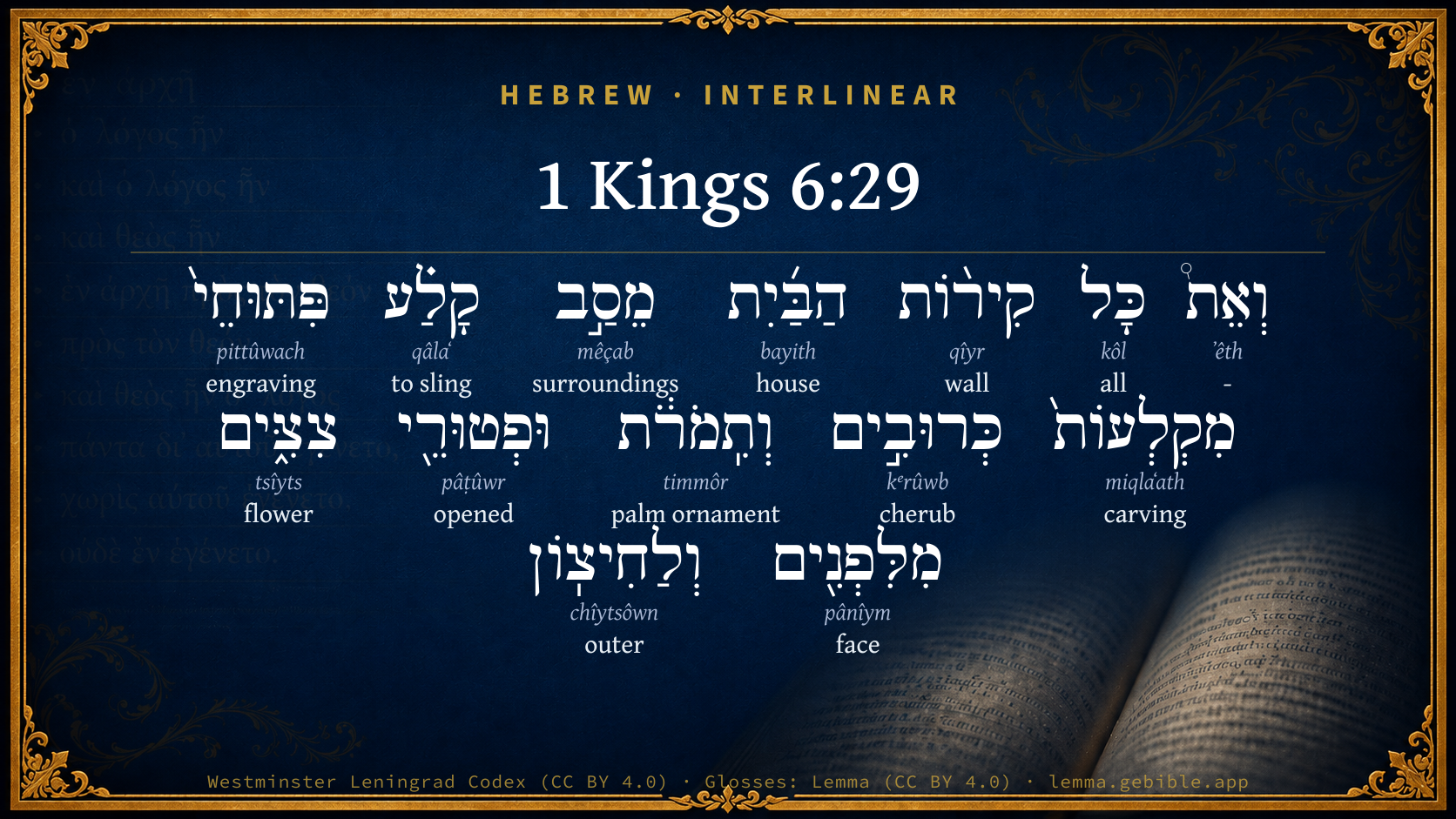
1 Kings 6:29

Hebrew (Westminster Leningrad Codex) 1 Kings 6:29 appears in the Hebrew Old Testament. The text above is from the Westminster Leningrad Codex. Each word links to its Strong’s number, a concise gloss, and parsing drawn from the Open Scriptures Hebrew Bible morphology. Click any word for its full Brown-Driver-Briggs (BDB) entry.
Download image
Cite this verse

1 Kings 6:29 (World English Bible). Public Domain. Lemma interlinear Bible study tool, https://lemma.gebible.app/v/1-kings/6/29.

Show BibTeX & RIS
BibTeX
RIS
English Translation
He carved all the walls of the house round about with carved figures of cherubim and palm trees and open flowers, inside and outside.
World English Bible · Public Domain
Highlights
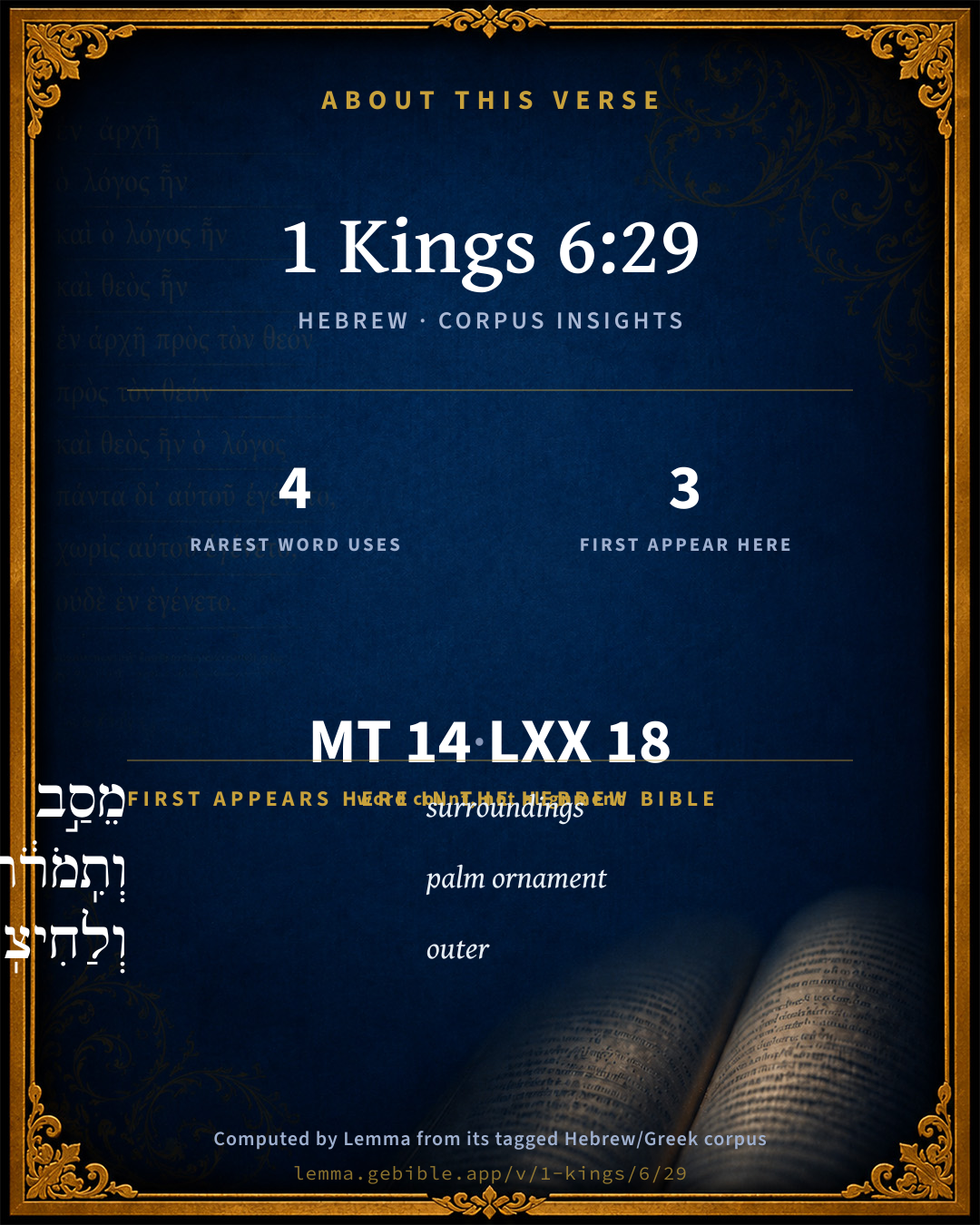
  • 3 first appearances in the Hebrew Bible
Full analysis ↓
Download a study sheet

One document with this verse’s original text, its word-by-word gloss line, the meaning frame, cross-references with their text, attributed commentary, and full source and license credits — printable, and it pastes into notes with its structure intact.

This verse Autodidact and up

Study sheet (.html) Plain text (.txt)

A passage Seminary Student

Up to 50 verses in one chapter. A passage sheet keeps up to 6 commentary sources and 12 cross-references per verse, in the order this page ranks them, and says so on the sheet whenever that leaves anything out. Ask for a single verse and you get the Autodidact verse sheet above.

Everything on this page stays free to read, with no account — the sheet is a download of what is already on screen, not access to it.

Want to remove ads? Support Godless Engineer
Compare translations 3

The same verse in 3 English versions, stacked beneath the original-language interlinear above. Click any original word for its lexicon entry.

Each is an independent rendering of the whole verse — the interlinear is not word-aligned to these translations.

Highlighted words mark where these versions differ — a whole-verse word diff, not a word-by-word alignment.

  • World English Bible Public Domain
    He carved all the walls of the house round about with carved figures of cherubim and palm trees and open flowers, inside and outside.
  • King James Version Public Domain
    And he carved all the walls of the house round about with carved figures of cherubim and palm trees and open flowers, within and without.
  • unfoldingWord Literal Text CC BY-SA 4.0
    And all of the walls of the house round about, he carved engravings of carvings of cherubs and palm trees and opened ones of flowers, from the inside and to the outside.

unfoldingWord Literal Text — © unfoldingWord, licensed CC BY-SA 4.0. Word-aligned USFM3 via Door43 (git.door43.org/unfoldingWord/en_ult).

Versions to compare (up to 4)

3 of 4 selected

Show all 18 translations

Every available English version of this verse, each an independent rendering of the whole verse.

  • World English Bible Public Domain
    He carved all the walls of the house round about with carved figures of cherubim and palm trees and open flowers, inside and outside.
  • Berean Standard Bible Public Domain
    Then he carved the walls all around the temple, in both the inner and outer sanctuaries, with carved engravings of cherubim, palm trees, and open flowers.
  • Majority Standard Bible Public Domain
    Then he carved the walls all around the temple, in both the inner and outer sanctuaries, with carved engravings of cherubim, palm trees, and open flowers.
  • King James Version Public Domain
    And he carved all the walls of the house round about with carved figures of cherubim and palm trees and open flowers, within and without.
  • American Standard Version (1901) Public Domain
    And he carved all the walls of the house round about with carved figures of cherubim and palm-trees and open flowers, within and without.
  • Revised Version (1885) Public Domain
    And he carved all the walls of the house round about with carved figures of cherubim and palm trees and open flowers, within and without.
  • Geneva Bible (1599) Public Domain
    And he carued all the walles of the house round about with grauen figures of Cherubims and of Palmetrees, and grauen flowres within and without.
  • Douay-Rheims (1899) Public Domain
    And he set the cherubims in the midst of the inner temple: and the cherubims stretched forth their wings, and the wing of the one touched one wall, and the wing of the other cherub touched the other wall: and the other wings in the midst of the temple touched one another.
  • Young's Literal Translation Public Domain
    and all the walls of the house round about he hath carved with openings of carvings, cherubs, and palm trees, and openings of flowers, within and without.
  • Literal Standard Version CC BY-SA 4.0
    and he has carved all around the walls of the house with engravings of carvings, cherubim, and palm trees, and openings of flowers, inside and outside.
  • Unlocked Literal Bible CC BY-SA 4.0
    He carved all the walls of the house around about with figures of cherubim, palm trees, and open flowers, in the outer and inner rooms.
  • unfoldingWord Literal Text CC BY-SA 4.0
    And all of the walls of the house round about, he carved engravings of carvings of cherubs and palm trees and opened ones of flowers, from the inside and to the outside.
  • Darby Bible Public Domain
    And he carved all the walls of the house round about with carved sculptures of cherubim, and palm-trees, and half-open flowers, within and without.
  • World Messianic Bible Public Domain
    He carved all the walls of the house around with carved figures of cherubim, palm trees, and open flowers, inside and outside.
  • Webster's Bible Public Domain
    And he carved all the walls of the house around with carved figures of cherubim, and palm trees, and open flowers, within and without.
  • Free Bible Version CC BY-SA 4.0
    He had all the Temple walls, both the inner and outer sanctuaries, carved with designs of cherubim, palm trees, and open flowers.
  • Bible in Basic English Public Domain
    And all the walls of the house inside and out were ornamented with forms of winged ones and palm-trees and open flowers.
  • JPS Tanakh (1917) Public Domain
    And he carved all the walls of the house round about with carved figures of cherubim and palm-trees and open flowers, within and without.

Literal Standard Version (2020), Covenant Press — licensed CC BY-SA 4.0. Text via the HelloAO Bible API (eBible.org). Unlocked Literal Bible (unfoldingWord) — licensed CC BY-SA 4.0. Text via the HelloAO Bible API (eBible.org). unfoldingWord Literal Text — © unfoldingWord, licensed CC BY-SA 4.0. Word-aligned USFM3 via Door43 (git.door43.org/unfoldingWord/en_ult). Free Bible Version, Dr. Jonathan Gallagher — licensed CC BY-SA 4.0. Text via the HelloAO Bible API (eBible.org).

Word by word

More ways to search: Search by grammar → Find every occurrence → Compare this word →

Practice this passage: Drill this verse → Learn its vocabulary →

מִקְלְעוֹת֙
miqlaʻath
H4734
“carvings of”
Noun, Common, Feminine, Plural, Construct
Part of Speech
Noun
Type
Common
Gender
Feminine
Number
Plural
State
Construct
Full BDB Definition

Origin: from H7049

TWOT: 2031a

carving
  1. וְאֵת֩ ʼêth H853 “and · -” Conjunction + Particle, Direct Object
  2. כָּל kôl H3605 “all of” Noun, Common, Masculine, Singular, Construct
  3. קִיר֨וֹת qîyr H7023 “walls of” Noun, Common, Masculine, Plural, Construct
  4. הַבַּ֜יִת bayith H1004 “the · house” Particle, Definite Article + Noun, Common, Masculine, Singular, Absolute
  5. מֵסַ֣ב mêçab H4524 “surroundings” Noun, Common, Both, Singular, Absolute
  6. קָלַ֗ע qâlaʻ H7049 “to sling” Verb, Qal, Perfect, 3rd Person, Masculine, Singular
  7. פִּתּוּחֵי֙ pittûwach H6603 “engravings of” Noun, Common, Masculine, Plural, Construct
  8. כְּרוּבִ֣ים kᵉrûwb H3742 “cherubim” Noun, Common, Masculine, Plural, Absolute
  9. וְתִֽמֹרֹ֔ת timmôr H8561 “and · palm ornaments” Conjunction + Noun, Common, Feminine, Plural, Absolute
  10. וּפְטוּרֵ֖י pâṭûwr H6358 “and · opened” Conjunction + Verb, Qal, Participle Passive, Masculine, Plural, Construct
  11. צִצִּ֑ים tsîyts H6731 “flowers” Noun, Common, Masculine, Plural, Absolute
  12. מִלִּפְנִ֖ים pânîym H6440 “from · to/for · face(s)” Preposition + Preposition + Noun, Common, Both, Plural, Absolute
  13. וְלַחִיצֽוֹן chîytsôwn H2435 “and · to/for the · outer” Conjunction + Preposition, Determined + Adjective, Adjective, Masculine, Singular, Absolute

About this verse

These counts appear in no published source. They are computed here, from the morphology-tagged text and Lemma’s own curated glosses. What Lemma adds →

14
words
14
distinct lemmas
Historical
section

Notable vocabulary

The rarest word here is מִקְלְעוֹת֙ carving H4734 — appearing just 4 times in the whole Hebrew Bible.

First appearance in Scripture

These words make their first canonical appearance in the Hebrew Bible here:

  • מֵסַ֣ב surroundings H4524
  • וְתִֽמֹרֹ֔ת palm ornament H8561
  • וְלַחִיצֽוֹן outer H2435

Shared distinctive vocabulary

מִקְלְעוֹת֙ carving H4734 occurs in 4 verses of the Hebrew Bible. Also found in:

Grammatical profile

  • 2 verbs
  • 10 nouns
  • 1 adjective
  • 1 particle

Verb forms

  • קָלַ֗ע Qal · Perfect
  • וּפְטוּרֵ֖י Qal · Participle Passive

Hebrew & Septuagint length

In English translation the verse runs 24 words from the Hebrew and 25 from the Septuagint (LXX English) — closely comparable.

A rough comparison of the two English renderings, which tokenize alike — not a word-level alignment.

Word counts can differ between the Hebrew and the Greek without any difference in meaning — e.g. the Hebrew direct-object marker אֵת has no separate Greek word, and Greek often adds the article ὁ.

In the original languages it is 14 Hebrew tokens and 18 Greek tokens — but the two are counted differently (Hebrew bundles its prefixes and suffixes into one token; the Greek is in lemma form), so that isn’t a like-for-like length.

Cross-references

12

Topical passages linked to 1 Kings 6:29 in the Treasury of Scripture Knowledge — connected by theme and wording, ordered by reader-vote popularity; previews shown in the World English Bible.

  • 1 Kings 6:32 So [he made] two doors of olive-wood; and he carved on them carvings of cherubim and palm trees and open flowers, and overlaid them with gold; and he spread the gold on the cherubim, and on the palm trees.
  • Exodus 36:8 All the wise-hearted men among those who did the work made the tent with ten curtains; of fine twined linen, blue, purple, and scarlet, with cherubim, the work of the skillful workman, they made them.
  • 1 Kings 6:18 There was cedar on the house within, carved with buds and open flowers: all was cedar; there was no stone seen.
  • 2 Chronicles 3:14 He made the veil of blue, and purple, and crimson, and fine linen, and worked cherubim thereon.
  • 2 Chronicles 4:2–5 Also he made the molten sea of ten cubits from brim to brim, round in compass; and the height of it was five cubits; and a line of thirty cubits compassed it round about.
  • Psalms 92:12–15 The righteous shall flourish like the palm tree. He will grow like a cedar in Lebanon.
  • Psalms 103:20 Praise Yahweh, you angels of his, Who are mighty in strength, who fulfill his word, Obeying the voice of his word.
  • Psalms 148:2 Praise him, all his angels! Praise him, all his host!
  • Luke 2:13–14 Suddenly, there was with the angel a multitude of the heavenly host praising God, and saying,
  • Ephesians 3:10 to the intent that now through the assembly the manifold wisdom of God might be made known to the principalities and the powers in the heavenly places,
  • Revelation 5:11–14 I saw, and I heard something like a voice of many angels around the throne, the living creatures, and the elders; and the number of them was ten thousands of ten thousands, and thousands of thousands;
  • Revelation 7:9 After these things I looked, and behold, a great multitude, which no man could number, out of every nation and of all tribes, peoples, and languages, standing before the throne and before the Lamb, dressed in white robes, with palm branches in their hands.

Cross-references courtesy of OpenBible.info (CC BY 4.0).

Hebrew and Greek witnesses Masoretic Hebrew ↔ Greek Septuagint

The same verse in the two great witnesses to the Old Testament, shown verse-for-verse.

These are two independent witnesses, not word-aligned to each other, and the Septuagint is shown in lemma (dictionary) form.

Hebrew 1 Kings 6:29 Masoretic · Westminster Leningrad Codex

וְאֵת֩ כָּל קִיר֨וֹת הַבַּ֜יִת מֵסַ֣ב קָלַ֗ע פִּתּוּחֵי֙ מִקְלְעוֹת֙ כְּרוּבִ֣ים וְתִֽמֹרֹ֔ת וּפְטוּרֵ֖י צִצִּ֑ים מִלִּפְנִ֖ים וְלַחִיצֽוֹן

He carved all the walls of the house round about with carved figures of cherubim and palm trees and open flowers, inside and outside.

World English Bible · Public Domain

Greek LXX 1 Kings 6:29 Septuagint · lemma form

καί πᾶς ὁ τοῖχος ὁ οἶκος κύκλος ἐνκολάπτω γράφω γραφίς χερουβιν καί φοῖνιξ ὁ ἐσώτερος καί ὁ ἐξώτερος

He graved all the walls of the house round about with the graving of cherubs, and he sculptured palm trees within and without the house.

LXX2012 (modern English Septuagint) · Public Domain

Hebrew: Westminster Leningrad Codex (CC BY 4.0). Greek: Septuagint (public domain); English from LXX2012 (modern English Septuagint) (Public Domain). How the Septuagint differs from the Hebrew →

Targum (Aramaic paraphrase)

1

The Targum is the ancient Jewish Aramaic paraphrase of the Hebrew Scriptures — an interpretive translation, not the Hebrew text itself. Onkelos (literal) and Pseudo-Jonathan (expansive) render the Torah, and Jonathan the Prophets. Coverage is partial: where no permissively-licensed English translation exists for a verse, only the Aramaic is shown. This is verse-level text, not a word-by-word alignment to the Hebrew.

  1. Targum Jonathan Prophets (Joshua–Malachi)
    וְיַת כָּל כּוֹתְלֵי בֵיתָא אַקִיף צִיוּרִין וּגְלַף קְלִיעַן כְּרוּבִין וְצוּרַת דִקְלִין וְאָטוּנִין שׁוֹשַׁנִין מִלְגָיו וּלְבָרָא:

    (no public-domain English translation for this verse)

    Targum Jonathan — Aramaic: “Mikraot Gedolot” (public domain). English: “Sefaria Community Translation” (CC0 1.0 (public-domain dedication)); “London "Chaldee Paraphrase," 1871” (public domain). Text via Sefaria.

Commentary

Notes on 1 Kings 6:29 from classic Christian and Jewish commentators (each source and its license shown beneath its notes). The classic Christian expositions comment on the surrounding passage and are grouped to its opening verse, so a note may address several verses; the Jewish commentaries on the Tanakh (Rashi and others) are per-verse, so they appear only where the commentator wrote on this verse.

Lemma curates 59 commentaries, every one of them public domain or Creative Commons licensed, each selected and text-cleaned for this edition rather than reprinted as found. About our sources →

Trapp's Complete Commentary

John Trapp

1Ki 6:29 And he carved all the walls of the house round about with carved figures of cherubims and palm trees and open flowers, within and without.

Ver. 29. And he carved all the walls.] See on 1Ki 6:25.

Of cherubims and palm trees and open flowers.] To note, saith one, the protection of the Church of Christ by the ministry of angels - though outwardly unseen - and the peaceable victorious flourishing under the same. {Heb 1:14}

John Trapp, A Commentary or Exposition upon All the Books of the Old and New Testament (1647–1656) — public domain. Text from a community e-Sword module.

The Biblical Illustrator

Joseph S. Exell

1Ki_6:29

Carved figures of cherubim and palm trees, and open flowers.

Cherubim, palm trees, and open flowers

The question cannot but occur, Why this peculiar carving exclusively? Everywhere they looked they were met by this threefold ornamentation, everywhere cherubim, palm trees and open flowers; these and nothing but these. If only beauty had been the object, if simply ornament had been studied, greater variety would have been introduced; but the perpetual recurrence of these three, amid all the visible forms that convey ideas of beauty, could not fail to strike and to raise inquiry.

I. The union of the earthly and heavenly, the natural and the spiritual, in worship and religion. The highest spiritual creatures and two of the most prominent natural objects were portrayed together in the house of God. The cherubim representing heaven, the highest grade of spiritual creation, and the palm tree and the open flower representatives of earth and nature in their finest and noblest shapes, were brought together on the walls of the house of God. And there was nothing else to be seen. The highest creature in the spiritual realm was here set alongside of natural objects known to all. Teaching that heavens service, though higher, is of the same sort with the service on earth. Representatives from the temple of nature were there, and representatives from the heavenly temple. In the house of God and in worship heaven and earth are brought together. We represent in our worship all creatures that cannot worship. We are the priests of the whole visible creation, and our worship unites us with the highest intelligences. We link together the seraph and the flower. Both are represented and contained in us. In worship, space and time vanish. We are in the same company with those who are worshipping around the throne the unveiled glory.

II. Life the grand source, material, reality. There were three kinds of life portrayed on these walls. Of all the beautiful objects in nature they were living and only living things that were pictured there. Life was here in three stages: life rooted and growing, like the palm tree; life expanded, like the open flower; and life in its highest state, the life of the cherub. How plainly did the voice come from the innermost sanctuary: Life is all. It is life that is the grand desideratum in the worship of God. It is life that gives value to all things. Nothing is valuable without life. The true life of the soul, then, what is it? The temple explains this. The worshippers were incessantly brought to this question: What is life which is thus so prominent? And they were evermore thrown back on the temple for the answer. In the temple was the answer found. What is life? Life is that which has fellowship with God, life is that which loves God, and longs after Him; life is that which feeds upon Gods truth. We are no nearer answering the question precisely and definitely in words than they were. It is still the grand secret. One great lesson taught by this threefold exhibition of life in the temple was undoubtedly this, that all life has the same grand, general laws. How widely apart these different forms of life were--vegetable life and highest seraphic life; and yet widely apart as they are they have the same laws. God does all His work from the humblest to the highest according to the same principles. The life of the plant is sustained by the same laws as the spiritual life of the cherub. The seraph burns and sings by the same simple laws of being as the plant grows and the flower expands.

III. The union of these three things in spiritual life--worship, fruitfulness, and beauty. Worship represented by the cherub, fruitfulness by the palm tree, and beauty by the open flower. True spiritual life shows itself not in one of these but in all. Worship is the foundation and the nutriment of life. It is by the perception of the glory of God and by the adoration of it that the soul is sustained; and it is by fruitfulness that this food finds scope for its energy; for food that is taken into the spiritual nature, and that does not find outlet and space for its energy ceases to be food. Wherever there is true worship of God there is also the fruitfulness of the palm tree, and wherever there is true fruitfulness arising from the worship of God, there is beauty as the result of these. True spiritual beauty is the outcome of the union of these two things--worship and practical fruitfulness.

IV. The union of these three things in the worship of God--aspiration, growth, and receptivity. Aspiration was taught by the cherub. The highest form of spiritual life was presented continually before the worshipper in order that he might know what he had to aspire to; and the palm tree, the emblem of steady, straight, upward growth, was a constant lesson and reminder. Did the question rise, How shall I become like the cherub? Were there no hearts that could read the answer in the open flower? The open flower is the way to the cherub. One of the finest pictures of reception among all the objects that God has made is a flower that lies open to catch the sunshine, and to drink the rain and the dew, shuts up when the sun departs, but expands itself again when the suns rays touch it. By reception the plant and the flower live; and by reception the soul of man lives and grows. Our life is that of a flower. Man cometh forth like a flower and is cut down. It is by aspiring to the cherub life that we gain the victory over that. We are no longer distressed with the thought of the brevity of the life when that of immortal beauty has dawned upon us, and when we firmly grasp the record that God hath given to us eternal life, and that this life is in His Son. (T. Leckie, D. D.)

.

The Biblical Illustrator, edited by Joseph S. Exell (c. 1880s–1900s) — public domain. Text from a community e-Sword module.

Ellicott's Commentary for English Readers

(29) And he carved.—If we take this literally, we must suppose that this carving of the cherubim and the palm-trees, in addition to the general decoration of the “gourds and open flowers,” was spread over all the “walls of the house.” Otherwise we might have supposed it confined to the Oracle “within,” and to the partition “without,” which would seem more appropriate, as the cherubim belonged especially to the Oracle.

A Bible Commentary for English Readers, edited by Charles John Ellicott (1878–1897) — public domain. Text from a community e-Sword module.

The Cambridge Bible for Schools and Colleges

gen. ed. J. J. S. Perowne

29. within and without] Both here and in the next verse these words can only refer to the inner and outer rooms, the most holy place and the holy place.

The Cambridge Bible for Schools and Colleges (gen. ed. J. J. S. Perowne; Cambridge University Press, 1878–1918) — public domain. Text from a community e-Sword module.

John Gill's Exposition

So also made he for the door of the temple,.... The holy place:

posts of olive tree, a fourth part of the wall; which was five cubits, its breadth being twenty, Kg1 6:20; this door was a cubit wider than that into the most holy place, Kg1 6:31, more entering into the one than into the other; as more go into the church on earth than into the heavenly glory.

John Gill's Exposition of the Whole Bible (1746–1763) — public domain (CC PDM 1.0). Text via the HelloAO Bible API.

Albert Barnes' Notes on the Bible

Palms, cherubs, and flowers - the main decorations of Solomon’s temple - bear considerable resemblance to the ornamentation of the Assyrians, a circumstance which can scarcely be accidental.

Within and without - i. e., both in the inner chamber, or holy of holies, and in the outer one.

Albert Barnes' Notes on the Bible (1834–1885) — public domain. Text from a community e-Sword/MySword module.

Haydock's Catholic Bible Commentary

And divers, &c. Hebrew, "and open (full-blown) flowers within and without" the sanctuary. We read also of chains of gold connected together, 2 Paralipomenon iii. 5. The palm-trees might resemble pillars of the Corinthian order. (Calmet) --- It is clear that sacred pictures wer authorized to be set up in the temple, for God’s honour, (Worthington) though the Jews were so prone to idolatry. (Haydock)

George Leo Haydock (1774–1849), Haydock's Catholic Family Bible and Commentary, 1859 edition — public domain. Excludes Psalms (Douay-Rheims chapter numbering differs from Protestant) and Deuterocanonical books (Catholic canon only).

Matthew Poole's English Annotations

Carved figures of cherubims, as signs of the presence and protection of the angels vouchsafed by God to that place.

Palm trees; emblems of that peace and victory over their enemies which the Israelites duly serving God in that place might expect.

Within and without; within the oracle and without it, in the holy place.

Matthew Poole's English Annotations on the Holy Bible (1683–1685) — public domain. Text from a community e-Sword/MySword module.

Whedon's Commentary on the Bible

Daniel D. Whedon

29. Cherubim and palm trees and open flowers — Similar ornamentation abounds on Assyrian and Persian monuments. It was not without its symbolical meaning. As the cherub represented the fulness of Divine life and power in the animal creation, so the palms and flowers represented the vegetable kingdom. Palms and flowers are ever suggestive of the richest fulness of life, prosperity, and joy. And so the worshippers that were permitted to enter the temple, and gaze upon the walls all covered with these figurative carvings, might ever be reminded that the God who had his special dwelling-place and worship there was not confined to temples, but filled the universe with his creative life and energy. The heaven and heaven of heavens could not contain him, and the whole earth was but his footstool; how, then, could Solomon’s temple hold him? His hand had made in actual creation all forms of life and being that were represented on the walls.

Daniel D. Whedon (gen. ed.), Commentary on the Old and New Testaments (1874–1909) — public domain. Text from a community e-Sword module.

The Pulpit Commentary

And he carved all the walls of the house round about with carved figures of cherubims lit. openings, i.e., gravings or indentations of cherubim, is used of gravings in stone, Exo_28:11 Exo_39:6: in metal, Exo_28:36 Exo_39:30 and palm trees and open flowers The open flowers may well have been lilies. (1Ki_7:19, 1Ki_7:22, 1Ki_7:26) It is uncertain whether there were one or more rows of cherubim and palms. Keil, arguing from the analogy of Egyptian temples, contends for two or three rows, but it is doubtful how far the Israelites, notwithstanding their new and intimate relations with the country, would take Egypt and its idolatrous shrines for a model. Eze_41:18 tends to show that the palm trees alternated with the cherubs. The cherubim may have had two faces, such as he describes (ver. 19), the face of a man on the one side, and the face of a young lion on the other side; but if so, they must have differed in form from those of the oracle. Possibly the open flowers formed a border, or were sculptured in festoons, above, and the gourds (or buds) formed a border below (as in the Kouyunjik slab). But as to this the text is silent.

But while we are ignorant of the precise form and of the arrangement of these ornamental carvings, we are not wholly in the dark as to their symbolism. For everything in the temple, we may be sure, had a meaning. Let us inquire, then, into the significance of the cherubim, the palms and the flowers.

1. The Cherubim have been regarded by some as symbols of the invisible Godhead, by others as "representations of the heavenly spirits which surround the Lord of glory and set forth psychical life at its highest stage" (Keil); but it seems best to view them as symbols of all animal life, including the highest and perhaps not excluding the thought of Him who is the source and spring of life, the Anima animantium (cf. ch. 12:28). Hence they are spoken of as twYjh (Eze_1:5, Eze_1:13, Eze_1:15, etc.) "the living things" (compare ta zwa, Rev_4:6, Rev_4:8, Rev_4:9) and even as hYjh "the life" (Eze_10:14, Eze_10:15, etc.) The cherubim consequently speak of the great animal kingdom before its Creator. "Creaturely being reaches its highest degree in those which have an anima, and among these, the lion, the bull, the eagle, and the man are the highest and most complete" (Bahr). These shapes, accordingly, were not inappropriate or unmeaning in a temple raised by the creature to the glory of the Creator.

1. Just as the cherubim speak of animal, so do the Palms of vegetable life. They are "the princes of the vegetable kingdom" (Linnaeus) "Amongst trees there is none so lofty and towering, none which has such a fair majestic growth, which is so evergreen, and which affords so grateful a shade and such noble fruits fruits which are said to be the food of the blessed in paradise as the palm" (Bahr), who also adds that it is said to have as many excellent properties as there are days in the year, and cites Humboldt as designating it the "noblest of plants forms to which the nations have always accorded the meed of beauty." Judaea, he further remarks, is the fatherland of the palm, so much so that the palm in later days became the symbol of Palestine (as on the well known coin with the legend Judaea capta). The palms, therefore, tell of the vegetable world, and of Him who fashioned its noble and graceful forms.

2. And very similar was the testimony of the Flowers. "Flowers and bloom have been, from ancient times to our own, the usual symbols of lifefulness.... So then by the flower work, as well as by the cherubim and the palm trees, was the dwelling of Jehovah, which was adorned therewith, designated as an abode of life (Bahr). On the earthly dwelling place of the Eternal, that is to say, were everywhere pourtrayed the various tokens of His Almighty power and goodness. And the significance of each is the same. "Thou hast created all things, and for thy pleasure they are, and were created." They were graved within and without. These words, here and in ver. 30, are generally taken to mean "in the oracle and in the house." But it is worthy of consideration whether they do not rather signify, "in the house and in the porch." The latter was overlaid with gold. (2Ch_3:4) It is doubtful whether wOxyjil on the outside, can be applied to any part of the interior, and here its application would be to the oracle (Thenius).

The Pulpit Commentary (1880–1919), ed. H.D.M. Spence-Jones & Joseph S. Exell — public domain. Text from a community e-Sword module.

John Wesley's Explanatory Notes

Cherubim - As signs of the presence and protection of the angels vouch-safed by God to that place. Palm-trees - Emblems of that peace and victory over their enemies, which the Israelites duly serving God in that place might expect. Within and without - Within the oracle and without it, in the holy place.

John Wesley, Explanatory Notes Upon the Whole Bible (1754–1765) — public domain. Text via the GEBible commentary corpus.

unfoldingWord translationNotes

Door43 World Missions Community

He carved ... Solomon overlaid

Solomon would have commanded his workers to do this work. AT: "He commanded them to carve ... He had them overlay" (See: Metonymy)

overlaid

covered

translationWords

cherub

palm

Solomon

gold

unfoldingWord translationNotes — © Distant Shores Media and the Door43 World Missions Community, licensed CC BY-SA 4.0. Source: git.door43.org/Door43/en_tn.

Rashi

Rabbi Shlomo Yitzchaki (Rashi)

And all the walls of the Beis Hamikdosh. The wooden walls.

He encircled with figures. Surrounded with drawings.

Carved figures of cherubim. Engraved forms of cherubim, and [palm] trees, cords, and flowers.

From within and without. [I.e.,] for the inner room of the Ark cover [i.e., the Holy of Holies], and for the Sanctuary, the “one without.”

Rashi on the Tanakh — English translations: “The Judaica Press complete Tanach with Rashi, translated by A. J. Rosenberg” (CC BY 4.0); “Pentateuch with Rashi's commentary by M. Rosenbaum and A.M. Silbermann, 1929-1934” (public domain); “The Metsudah Tanach series, Lakewood, N.J” (CC BY 4.0); and “The Book of Joshua, Metsudah Publications, 1997” (CC BY 4.0). Text via Sefaria.

Lesson kit

Teaching starters — assembled from the data on this page, not authored interpretation. Every prompt links to the verse data it draws on. Edit before teaching.

1 Kings, in the Historical, opens this verse with 14 words (14 distinct Hebrew lemmas). Its most distinctive word is miqlaʻath (“carving”). A historical commentator’s framing appears above. Read the whole chapter for the surrounding context.

Discussion questions

  1. The word miqlaʻath carries the sense “carving.” How does it shape the verse?
  2. 3 words here appear for the first time in Scripture. What is being introduced at this debut?
  3. 1 Kings 6:18 shares the word «carving» with this verse. How do the two illuminate each other?
  4. The translations on this page render this verse differently — a whole-verse word diff, not a word-by-word alignment. What might account for the different wordings?
  5. The verb «קָלַ֗ע» is Qal Perfect. How does its form color the action?
  6. Reading how Trapp's Complete Commentary and The Biblical Illustrator read this verse, where do the two commentators agree and where do they part?

Things to notice

Reading settings

Reading text

Shown beneath each verse's original-language words.

Old Testament
Old Testament edition

Read the OT as the Masoretic Hebrew (MT) or the Greek Septuagint (LXX).

English shown for the Greek Septuagint (in the Hebrew ↔ Greek comparison).

Comparing translations? Open the Compare panel on any verse page to stack up to four side by side.