Exodus 4:3

Hebrew (Westminster Leningrad Codex) Exodus 4:3 appears in the Hebrew Old Testament. The text above is from the Westminster Leningrad Codex. Each word links to its Strong’s number, a concise gloss, and parsing drawn from the Open Scriptures Hebrew Bible morphology. Click any word for its full Brown-Driver-Briggs (BDB) entry.
Download image
Cite this verse

Exodus 4:3 (World English Bible). Public Domain. Lemma interlinear Bible study tool, https://lemma.gebible.app/v/exodus/4/3.

Show BibTeX & RIS
BibTeX
RIS
English Translation
He said, "Throw it on the ground." He threw it on the ground, and it became a snake; and Moses ran away from it.
World English Bible · Public Domain
Download a study sheet

One document with this verse’s original text, its word-by-word gloss line, the meaning frame, cross-references with their text, attributed commentary, and full source and license credits — printable, and it pastes into notes with its structure intact.

This verse Autodidact and up

Study sheet (.html) Plain text (.txt)

A passage Seminary Student

Up to 50 verses in one chapter. A passage sheet keeps up to 6 commentary sources and 12 cross-references per verse, in the order this page ranks them, and says so on the sheet whenever that leaves anything out. Ask for a single verse and you get the Autodidact verse sheet above.

Everything on this page stays free to read, with no account — the sheet is a download of what is already on screen, not access to it.

Want to remove ads? Support Godless Engineer
Compare translations 3

The same verse in 3 English versions, stacked beneath the original-language interlinear above. Click any original word for its lexicon entry.

Each is an independent rendering of the whole verse — the interlinear is not word-aligned to these translations.

Highlighted words mark where these versions differ — a whole-verse word diff, not a word-by-word alignment.

  • World English Bible Public Domain
    He said, "Throw it on the ground." He threw it on the ground, and it became a snake; and Moses ran away from it.
  • King James Version Public Domain
    And he said, Cast it on the ground. And he cast it on the ground, and it became a serpent; and Moses fled from before it.
  • unfoldingWord Literal Text CC BY-SA 4.0
    And he said, “Throw it to the ground.” And he threw it to the ground, and it became a snake. And Moses fled from its face.

unfoldingWord Literal Text — © unfoldingWord, licensed CC BY-SA 4.0. Word-aligned USFM3 via Door43 (git.door43.org/unfoldingWord/en_ult).

Versions to compare (up to 4)

3 of 4 selected

Show all 18 translations

Every available English version of this verse, each an independent rendering of the whole verse.

  • World English Bible Public Domain
    He said, "Throw it on the ground." He threw it on the ground, and it became a snake; and Moses ran away from it.
  • Berean Standard Bible Public Domain
    “Throw it on the ground,” said the LORD. So Moses threw it on the ground, and it became a snake, and he ran from it.
  • Majority Standard Bible Public Domain
    “Throw it on the ground,” said the LORD. So Moses threw it on the ground, and it became a snake, and he ran from it.
  • King James Version Public Domain
    And he said, Cast it on the ground. And he cast it on the ground, and it became a serpent; and Moses fled from before it.
  • American Standard Version (1901) Public Domain
    And he said, Cast in on the ground. And he cast it on the ground, and it became a serpent; and Moses fled from before it.
  • Revised Version (1885) Public Domain
    And he said, Cast it on the ground. And he cast it on the ground, and it became a serpent; and Moses fled from before it.
  • Geneva Bible (1599) Public Domain
    Then said he, Cast it on the ground. So he cast it on the grounde, and it was turned into a serpent: and Moses fled from it.
  • Douay-Rheims (1899) Public Domain
    And the Lord said: Cast it down upon the ground. He cast it down, and it was turned into a serpent: so that Moses fled from it.
  • Young's Literal Translation Public Domain
    and He saith, `Cast it to the earth;' and he casteth it to the earth, and it becometh a serpent -- and Moses fleeth from its presence.
  • Literal Standard Version CC BY-SA 4.0
    and He says, “Cast it to the earth”; and he casts it to the earth, and it becomes a serpent—and Moses flees from its presence.
  • Unlocked Literal Bible CC BY-SA 4.0
    Yahweh said, “Throw it on the ground.” Moses threw it on the ground, and it became a snake. Moses ran back from it.
  • unfoldingWord Literal Text CC BY-SA 4.0
    And he said, “Throw it to the ground.” And he threw it to the ground, and it became a snake. And Moses fled from its face.
  • Darby Bible Public Domain
    And he said, Cast it on the ground. And he cast it on the ground, and it became a serpent; and Moses fled from before it.
  • World Messianic Bible Public Domain
    He said, “Throw it on the ground.” He threw it on the ground, and it became a snake; and Moses ran away from it.
  • Webster's Bible Public Domain
    And he said, Cast it on the ground. And he cast it on the ground, and it became a serpent: and Moses fled from before it.
  • Free Bible Version CC BY-SA 4.0
    “Throw it on the ground,” he told Moses. So Moses did. It turned into a snake and Moses ran away from it.
  • Bible in Basic English Public Domain
    And he said, Put it down on the earth. And he put it down on the earth and it became a snake; and Moses went running from it.
  • JPS Tanakh (1917) Public Domain
    And He said: 'Cast it on the ground.' And he cast it on the ground, and it became a serpent; and Moses fled from before it.

Literal Standard Version (2020), Covenant Press — licensed CC BY-SA 4.0. Text via the HelloAO Bible API (eBible.org). Unlocked Literal Bible (unfoldingWord) — licensed CC BY-SA 4.0. Text via the HelloAO Bible API (eBible.org). unfoldingWord Literal Text — © unfoldingWord, licensed CC BY-SA 4.0. Word-aligned USFM3 via Door43 (git.door43.org/unfoldingWord/en_ult). Free Bible Version, Dr. Jonathan Gallagher — licensed CC BY-SA 4.0. Text via the HelloAO Bible API (eBible.org).

Word by word

More ways to search: Search by grammar → Find every occurrence → Compare this word →

Practice this passage: Drill this verse → Learn its vocabulary →

לְנָחָ֑שׁ
nâchâsh
H5175
“to/for · serpent”
Preposition + Noun, Common, Masculine, Singular, Absolute
Part of Speech
Preposition + Noun
Type
Common
Gender
Masculine
Number
Singular
State
Absolute
Full BDB Definition

Origin: from H5172

TWOT: 1347a

serpent, snake - serpent - image (of serpent) - fleeing serpent (mythological)
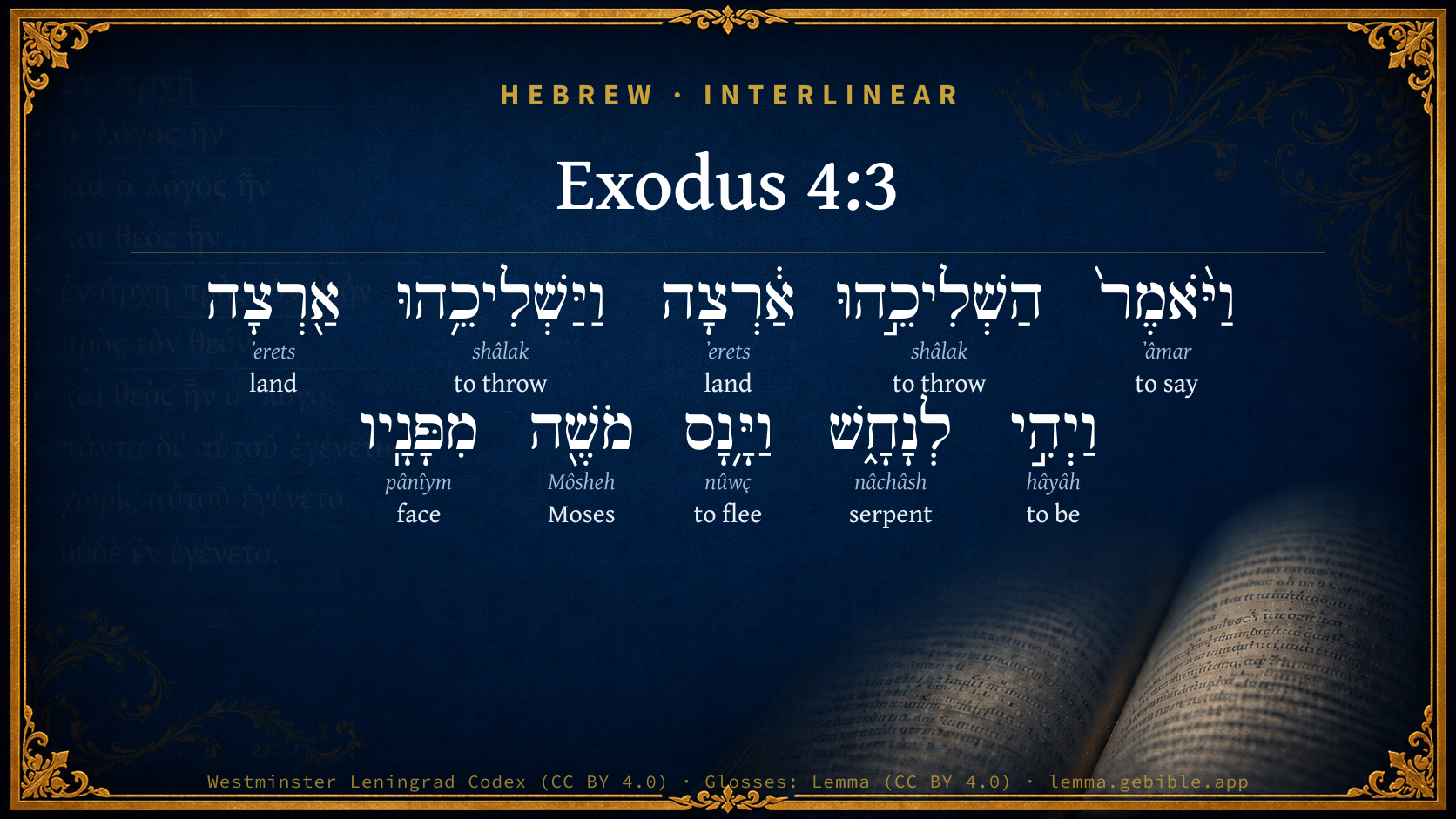
  1. וַיֹּ֨אמֶר֙ ʼâmar H559 “and · to say” Conjunction + Verb, Qal, Sequential Imperfect, 3rd Person, Masculine, Singular
  2. הַשְׁלִיכֵ֣הוּ shâlak H7993 “throw · him” Verb, Hiphil, Imperative, 2nd Person, Masculine, Singular + Suffix, Personal, 3rd Person, Masculine, Singular
  3. אַ֔רְצָה ʼerets H776 “land · toward” Noun, Common, Both, Singular, Absolute + Suffix, Demonstrative
  4. וַיַּשְׁלִיכֵ֥הוּ shâlak H7993 “and · to throw · him” Conjunction + Verb, Hiphil, Sequential Imperfect, 3rd Person, Masculine, Singular + Suffix, Personal, 3rd Person, Masculine, Singular
  5. אַ֖רְצָה ʼerets H776 “land · toward” Noun, Common, Both, Singular, Absolute + Suffix, Demonstrative
  6. וַיְהִ֣י hâyâh H1961 “and · to be” Conjunction + Verb, Qal, Sequential Imperfect, 3rd Person, Masculine, Singular
  7. וַיָּ֥נָס nûwç H5127 “and · to flee” Conjunction + Verb, Qal, Sequential Imperfect, 3rd Person, Masculine, Singular
  8. מֹשֶׁ֖ה Môsheh H4872 “Moses” Noun, Proper
  9. מִפָּנָֽיו pânîym H6440 “from · face(s) · his” Preposition + Noun, Common, Both, Plural, Construct + Suffix, Personal, 3rd Person, Masculine, Singular

About this verse

These counts appear in no published source. They are computed here, from the morphology-tagged text and Lemma’s own curated glosses. What Lemma adds →

10
words
8
distinct lemmas
Pentateuch
section

Shared distinctive vocabulary

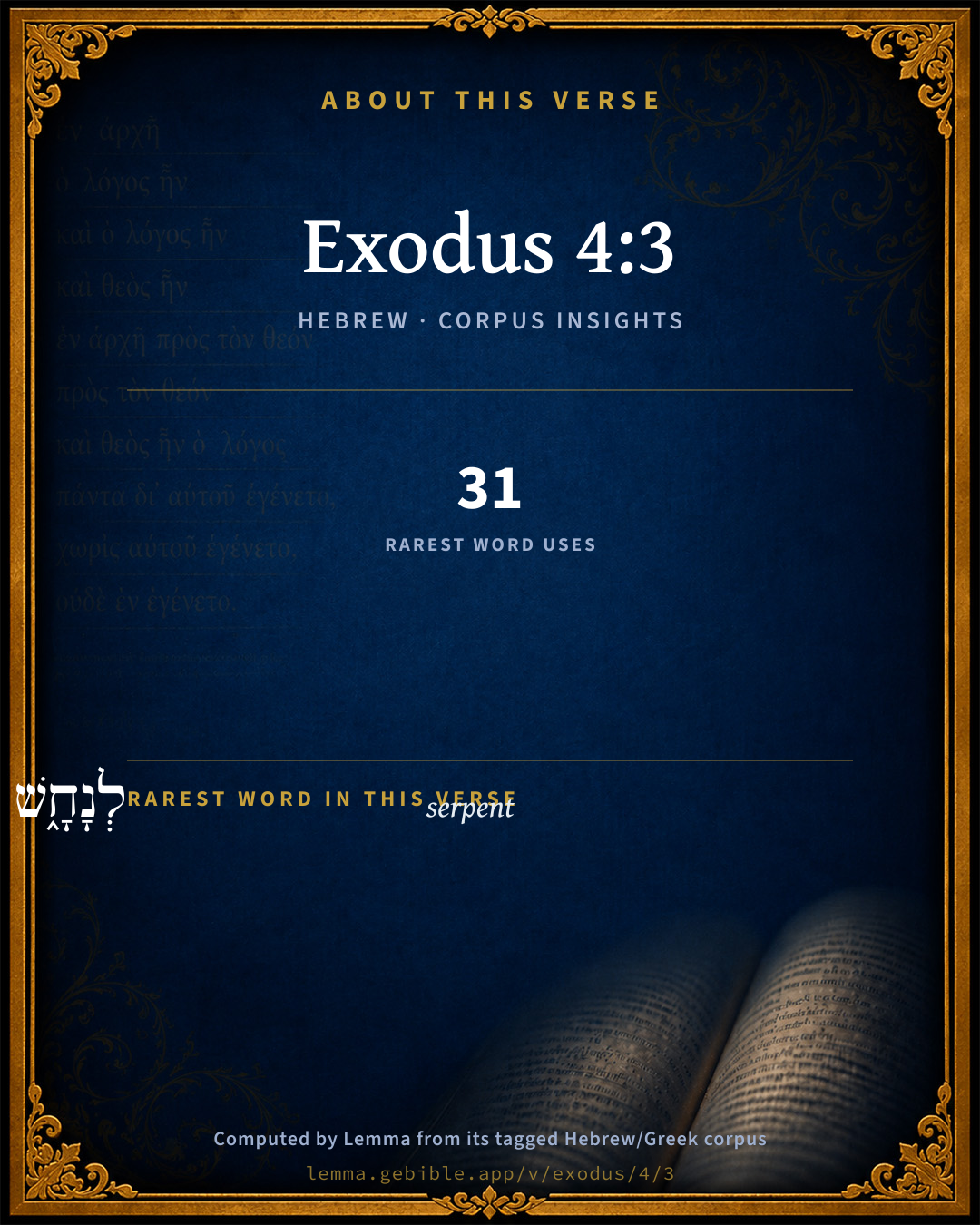
לְנָחָ֑שׁ serpent H5175 occurs in 28 verses of the Hebrew Bible. Also found in:

Grammatical profile

  • 5 verbs
  • 5 nouns

Verb forms

  • וַיֹּ֨אמֶר֙ Qal · Sequential Imperfect
  • הַשְׁלִיכֵ֣הוּ Hiphil · Imperative
  • וַיַּשְׁלִיכֵ֥הוּ Hiphil · Sequential Imperfect
  • וַיְהִ֣י Qal · Sequential Imperfect
  • וַיָּ֥נָס Qal · Sequential Imperfect

Repetition

Words recur within this verse — often emphatic in Hebrew:

  • הַשְׁלִיכֵ֣הוּ to throw H7993 ×2
  • אַ֔רְצָה land H776 ×2

Hebrew & Septuagint length

In English translation the verse runs 24 words from the Hebrew and 25 from the Septuagint (LXX English) — closely comparable.

A rough comparison of the two English renderings, which tokenize alike — not a word-level alignment.

Word counts can differ between the Hebrew and the Greek without any difference in meaning — e.g. the Hebrew direct-object marker אֵת has no separate Greek word, and Greek often adds the article ὁ.

Cross-references

3

Topical passages linked to Exodus 4:3 in the Treasury of Scripture Knowledge — connected by theme and wording, ordered by reader-vote popularity; previews shown in the World English Bible.

  • Exodus 4:17 You shall take this rod in your hand, with which you shall do the signs."
  • Exodus 7:10–15 Moses and Aaron went in to Pharaoh, and they did so, as Yahweh had commanded: and Aaron cast down his rod before Pharaoh and before his servants, and it became a serpent.
  • Amos 5:19 As if a man fled from a lion, And a bear met him; Or he went into the house and leaned his hand on the wall, And a snake bit him.

Cross-references courtesy of OpenBible.info (CC BY 4.0).

Hebrew and Greek witnesses Masoretic Hebrew ↔ Greek Septuagint

The same verse in the two great witnesses to the Old Testament, shown verse-for-verse.

These are two independent witnesses, not word-aligned to each other, and the Septuagint is shown in lemma (dictionary) form.

Hebrew Exodus 4:3 Masoretic · Westminster Leningrad Codex

וַיֹּ֨אמֶר֙ הַשְׁלִיכֵ֣הוּ אַ֔רְצָה וַיַּשְׁלִיכֵ֥הוּ אַ֖רְצָה וַיְהִ֣י לְנָחָ֑שׁ וַיָּ֥נָס מֹשֶׁ֖ה מִפָּנָֽיו

He said, "Throw it on the ground." He threw it on the ground, and it became a snake; and Moses ran away from it.

World English Bible · Public Domain

Greek LXX Exodus 4:3 Septuagint · lemma form

καί εἶπον ῥίπτω αὐτός ἐπί ὁ γῆ καί ῥίπτω αὐτός ἐπί ὁ γῆ καί γίγνομαι ὄφις καί φεύγω μωυσῆς ἀπό αὐτός

And he said, Cast it on the ground: and he cast it on the ground, and it became a serpent, and Moses fled from it.

LXX2012 (modern English Septuagint) · Public Domain

Hebrew: Westminster Leningrad Codex (CC BY 4.0). Greek: Septuagint (public domain); English from LXX2012 (modern English Septuagint) (Public Domain). How the Septuagint differs from the Hebrew →

Targum (Aramaic paraphrase)

2

The Targum is the ancient Jewish Aramaic paraphrase of the Hebrew Scriptures — an interpretive translation, not the Hebrew text itself. Onkelos (literal) and Pseudo-Jonathan (expansive) render the Torah, and Jonathan the Prophets. Coverage is partial: where no permissively-licensed English translation exists for a verse, only the Aramaic is shown. This is verse-level text, not a word-by-word alignment to the Hebrew.

  1. Targum Onkelos Torah (Genesis–Deuteronomy)
    וַאֲמַר רְמִיהִי לְאַרְעָא וּרְמָהִי לְאַרְעָא וַהֲוָה לְחִוֵי וַעֲרַק משֶׁה מִן קֳדָמוֹהִי:

    (no public-domain English translation for this verse)

    Targum Onkelos — Aramaic: “Onkelos Genesis” (public domain); “Onkelos Exodus” (public domain); “Onkelos Leviticus” (public domain); “Onkelos Numbers” (public domain); “Onkelos Deuteronomy” (public domain). English: “Sefaria Community Translation” (CC0 1.0 (public-domain dedication)); “J.W. Etheridge. The Targums of Onkelos and Jonathan Ben Uzziel on the Pentateuch. London: Longmans, Green, 1862” (public domain). Text via Sefaria.

  2. Targum Pseudo-Jonathan Torah (Genesis–Deuteronomy)
    וַאֲמַר טְלוֹק יָתֵיהּ לְאַרְעָא וְטַלְקֵיהּ לְאַרְעָא וַהֲוָה לְחִוְיָא וַעֲרַק משֶׁה מִן קֳדָמוֹי

    And He said, Cast it on the ground; and he cast it to the ground, and it became a serpent; and Mosheh fled from before it.

    Targum Pseudo-Jonathan — Aramaic: “Targum Jonathan on Genesis” (public domain); “Targum Jonathan on Exodus” (public domain); “Targum Jonathan on Leviticus” (public domain); “Targum Jonathan on Numbers” (public domain); “Targum Jonathan on Deuteronomy” (public domain). English: “The Targum of Jonathan ben Uzziel, trans. J. W. Etheridge, London, 1862” (public domain). Text via Sefaria.

Commentary

Notes on Exodus 4:3 from classic Christian and Jewish commentators (each source and its license shown beneath its notes). The classic Christian expositions comment on the surrounding passage and are grouped to its opening verse, so a note may address several verses; the Jewish commentaries on the Tanakh (Rashi and others) are per-verse, so they appear only where the commentator wrote on this verse.

Lemma curates 59 commentaries, every one of them public domain or Creative Commons licensed, each selected and text-cleaned for this edition rather than reprinted as found. About our sources →

Trapp's Complete Commentary

John Trapp

Exo 4:3 And he said, Cast it on the ground. And he cast it on the ground, and it became a serpent; and Moses fled from before it.

Ver. 3. And it became a serpent.] So doth the word to those that cast away the care of it; it stings them with unquestionable conviction and horror. With this rod Moses should guide the Israelites, sting the Egyptians. {Isa 14:29 Jer 8:17}

And Moses fled from before it,] First fly from sin as from a serpent, saith one. But if thou hast taken this serpent into thy hand, rest not, till, like Moses’s serpent, it be turned into a rod again to scourge thy soul. Be either innocent or penitent.

John Trapp, A Commentary or Exposition upon All the Books of the Old and New Testament (1647–1656) — public domain. Text from a community e-Sword module.

Joseph Benson's Commentary

Exo 4:3-4. It became a serpent — Was really changed into a serpent. There was a significancy in this sign: it intimated what and how pernicious his rod would be to the Egyptians. It became a rod in his hand — When stretched forth by the hand of Moses or Aaron, it became a token to Israel of guidance, encouragement, and protection; but to Egypt, like the bite of the most poisonous serpent, it betokened desolating judgments.

Joseph Benson's Commentary on the Old and New Testaments (1811–1818) — public domain. Text from a community e-Sword module.

Tyndale Open Study Notes

Tyndale Open Resources

4:3 Across the ancient Near East, the snake was a symbol of both death and healing. The person who demonstrated power in these areas was powerful indeed.

Tyndale Open Study Notes — © Tyndale Open Resources, licensed CC BY-SA 4.0. Text via the HelloAO Bible API.

Adam Clarke's Commentary

Verse 3. A serpent] Of what sort we know not, as the word נחש nachash is a general name for serpents, and also means several other things, see Ge 3:1: but it was either of a kind that he had not seen before, or one that he knew to be dangerous; for it is said, he fled from before it. Some suppose the staff was changed into a crocodile; See Clarke on Ex 7:10.

Adam Clarke's Commentary on the Bible (1810–1826) — public domain. Text from a community e-Sword/MySword module.

Ellicott's Commentary for English Readers

(3) A serpent.—The word here used (nakhash) is a generic one for a snake of any kind, and tells us nothing as to the species. A different word (tannin) is used in Exo_7:10, while nakhash recurs in Exo_7:15. Tannin is, like nakhash, a generic term.

And Moses fled from before it—It was natural for Moses to remember his alarm, and record it. Any-later writer would have passed over so small a circumstance. (See the Introduction, p. 3.)

A Bible Commentary for English Readers, edited by Charles John Ellicott (1878–1897) — public domain. Text from a community e-Sword module.

The Cambridge Bible for Schools and Colleges

gen. ed. J. J. S. Perowne

3. a serpent] The marg. ‘Heb. nâḥâsh’ is added for the purpose of shewing that the Heb. word used here is different from the one used in Exo_7:10-12 (P); see the marg. there.

The Cambridge Bible for Schools and Colleges (gen. ed. J. J. S. Perowne; Cambridge University Press, 1878–1918) — public domain. Text from a community e-Sword module.

John Gill's Exposition

And he said, cast it on the ground,.... That is, the rod or staff:

and he cast it on the ground, and it became a serpent; not in appearance only, but in reality, it was changed into a real living serpent; for God, who is the author of nature, can change the nature of things as he pleases; nor is it to be supposed that he would only make it look to the sight as if it was one, by working upon the fancy and imagination to think it was one, when it was not; no doubt but it was as really turned into a true serpent, as the water was turned really and truly into wine by our Lord; this was the first miracle that ever was wrought, that we know of. Dr. Lightfoot (h) observes, that as a serpent was the fittest emblem of the devil, Gen 3:1 so was it a sign that Moses did not these miracles by the power of the devil, but had a power over and beyond him, when he could thus deal with the serpent at his pleasure, as to make his rod a serpent, and the serpent a rod, as he saw good:

and Moses fled from before it; the Jews say (i) it was a fiery serpent, but for this they have no warrant: however, without supposing that it might be terrible and frightful, inasmuch as a common serpent is very disagreeable to men, and such an uncommon and extraordinary one must be very surprising, to see a staff become a serpent, a living one, crawling and leaping about, and perhaps turning itself towards Moses, whose staff it had been. Philo the Jew (k) says, it was a dragon, an exceeding large one.

(h) Works, vol. 1. p. 702. (i) Pirke Eliezer, c. 40. (k) De Vita Mosls, l. 1. 614.

John Gill's Exposition of the Whole Bible (1746–1763) — public domain (CC PDM 1.0). Text via the HelloAO Bible API.

Albert Barnes' Notes on the Bible

A serpent - This miracle had a meaning which Moses could not mistake. The serpent was probably the basilisk or Uraeus, the Cobra. This was the symbol of royal and divine power on the diadem of every Pharaoh. The conversion of the rod was not merely a portent, it was a sign, at once a pledge and representation of victory over the king and gods of Egypt!

Albert Barnes' Notes on the Bible (1834–1885) — public domain. Text from a community e-Sword/MySword module.

Matthew Poole's English Annotations

It became a serpent, i.e. was really changed into a serpent; whereby it was intimated what and how pernicious his rod should be to the Egyptians.

Matthew Poole's English Annotations on the Holy Bible (1683–1685) — public domain. Text from a community e-Sword/MySword module.

The Pulpit Commentary

It became a serpent. The word here used for "serpent," nakhash, is a generic word applicable to any species of snake. We cannot assume that the cobra is the serpent meant, though no doubt Moses, when he fled from before it, believed it to be a venomous serpent. Various reasons for God"s choice of this particular sign have been given. Perhaps the best is, that a trick of the kind was known to the Egyptian conjurors, who would be tempted to exhibit it in order to discredit Moses, and would then be discredited themselves by his stick swallowing theirs. (see Exo_7:10-12) It is fanciful to suppose a reference either to the serpent of Ge 3. (Keil and Delitzsch) or to the uraeus (cobra), which the Egyptian kings bore in their headdress as a mark of sovereignty (Canon Cook).

The Pulpit Commentary (1880–1919), ed. H.D.M. Spence-Jones & Joseph S. Exell — public domain. Text from a community e-Sword module.

Rashi

Rabbi Shlomo Yitzchaki (Rashi)

ויהי לנחש AND IT BECAME A SERPENT — This was an indication to him, that he had slandered the Israelites by saying (v. 1) “But, behold they will not believe me etc.”, and that he had made the serpent’s occupation (slander) his own (cf. Genesis 3:5) (Exodus Rabbah 3:12).

Rashi on the Tanakh — English translations: “The Judaica Press complete Tanach with Rashi, translated by A. J. Rosenberg” (CC BY 4.0); “Pentateuch with Rashi's commentary by M. Rosenbaum and A.M. Silbermann, 1929-1934” (public domain); “The Metsudah Tanach series, Lakewood, N.J” (CC BY 4.0); and “The Book of Joshua, Metsudah Publications, 1997” (CC BY 4.0). Text via Sefaria.

Ramban (Nachmanides)

Rabbi Moshe ben Nachman (Ramban / Nachmanides)

AND HE SAID: CAST IT ON THE GROUND. AND HE CAST IT ON THE GROUND. I do not understand why G-d performed the signs before Moses. Moses believed that it is the Holy One, blessed be He, Who speaks with him, and it would have been fitting for Him to say, “The staff that is in your hand you shall cast on the ground before them, and it shall become a serpent,” and the same also with respect to the second sign, [i.e., his hand becoming leprous], just as He said at the third sign, and thou shalt take of the water of the river, and pour it upon the dry land, etc. It is for this reason that the words of our Rabbis can be relied upon, namely, that the first sign, [i.e., the staff turning into a serpent], was a hint to Moses that he had slandered the Israelites [when he said that they would not believe him],. Thus it suggested to her that it was not because it may bring about her death that G-d forbade it, but out of a sense of jealousy. As Rashi puts it: “Every artisan detests his fellow-artisans.” and the second sign was for the purpose of punishing him. And this is the sense of the expression, and Moses fled from before it [the serpent]. He feared lest he would be punished and the serpent would bite him, since every person naturally avoids danger, even though Moses knew that if it was indeed G-d’s desire [to punish him], there was no one that could deliver him out of His hand. Perhaps even though He informed Moses of the Great Name with which the world was created and everything came into existence, He wished to show him that with this Name signs and wonders would be done, changing the natural order of things, so that the matter would be firmly established in Moses’ heart and that he should in truth know that with the Great Name he will perform new things in the world. The first two signs were sufficient for Moses, and therefore the third miracle of the water [turning into blood] was not done here. Instead, G-d commanded him to do the third sign in the sight of the people.

Ramban (Nachmanides) on the Tanakh — English translation: “Commentary on the Torah by Ramban (Nachmanides). Translated and annotated by Charles B. Chavel. New York, Shilo Pub. House, 1971-1976” (CC BY 4.0). Text via Sefaria.

Lesson kit

Teaching starters — assembled from the data on this page, not authored interpretation. Every prompt links to the verse data it draws on. Edit before teaching.

Exodus, in the Pentateuch, opens this verse with 10 words (8 distinct Hebrew lemmas). Its most distinctive word is nâchâsh (“serpent”). A historical commentator’s framing appears above. Read the whole chapter for the surrounding context.

Discussion questions

  1. The word nâchâsh carries the sense “serpent.” How does it shape the verse?
  2. How does Genesis 3:1, which shares the word «serpent», read alongside this verse?
  3. What does the repetition of “to throw” (2× in this one verse) do in this verse?
  4. These translations render this verse differently. What is at stake in choosing one wording over another?
  5. «וַיֹּ֨אמֶר֙» is a Qal Sequential Imperfect verb. How does that grammatical form shape the action described?
  6. Compare how Trapp's Complete Commentary and Joseph Benson's Commentary read this verse. Where do they agree or differ?

Things to notice

  • These translations choose different wording for 10 words in this verse.
  • “to throw” occurs 2× in this single verse.
  • 8 distinct Hebrew lemmas span 10 words in this verse.

Reading settings

Reading text

Shown beneath each verse's original-language words.

Old Testament
Old Testament edition

Read the OT as the Masoretic Hebrew (MT) or the Greek Septuagint (LXX).

English shown for the Greek Septuagint (in the Hebrew ↔ Greek comparison).

Comparing translations? Open the Compare panel on any verse page to stack up to four side by side.