
Deuteronomy 2:25

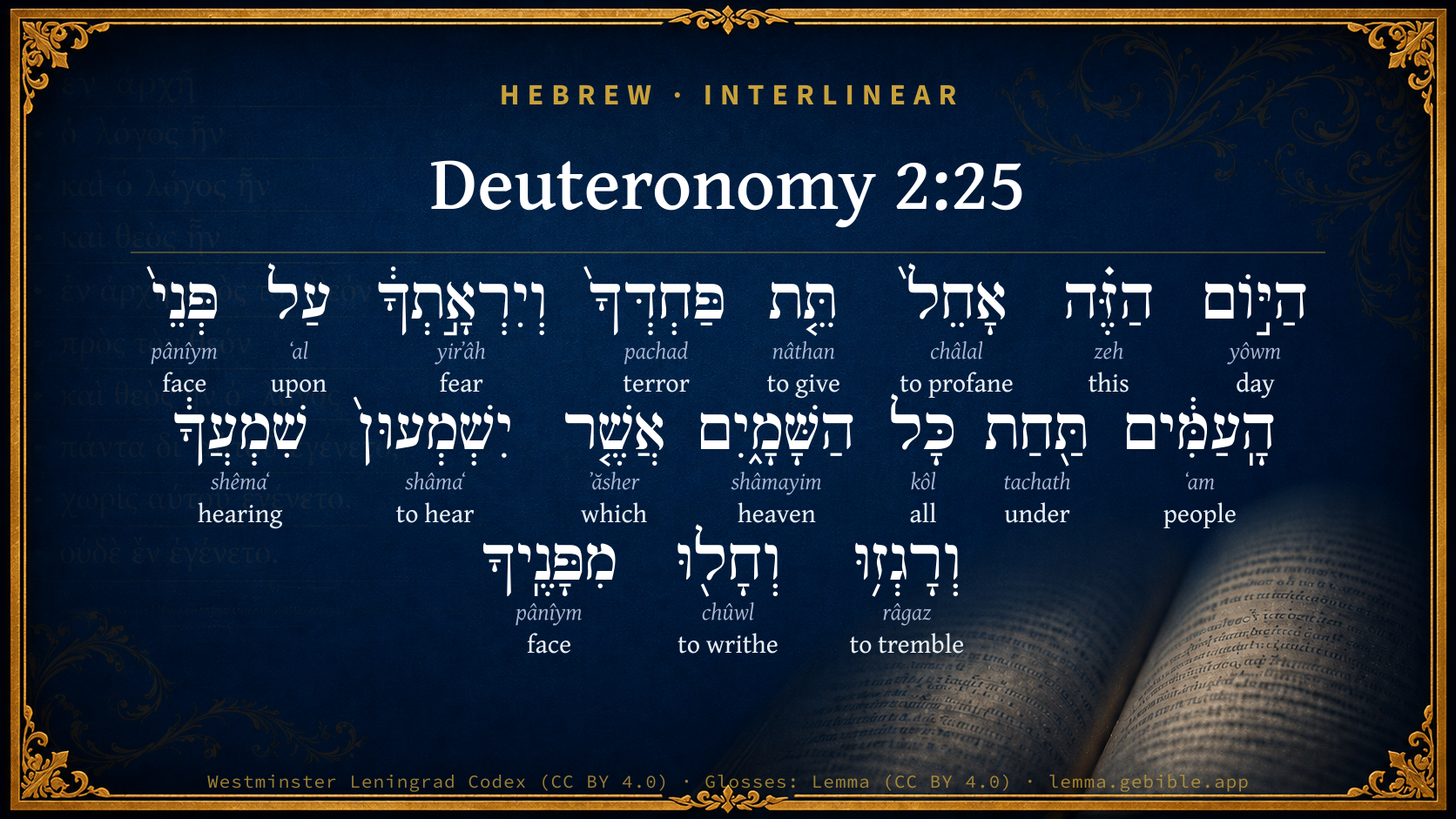
Hebrew (Westminster Leningrad Codex) Deuteronomy 2:25 appears in the Hebrew Old Testament. The text above is from the Westminster Leningrad Codex. Each word links to its Strong’s number, a concise gloss, and parsing drawn from the Open Scriptures Hebrew Bible morphology. Click any word for its full Brown-Driver-Briggs (BDB) entry.
Download image
Cite this verse

Deuteronomy 2:25 (World English Bible). Public Domain. Lemma interlinear Bible study tool, https://lemma.gebible.app/v/deuteronomy/2/25.

Show BibTeX & RIS
BibTeX
RIS
English Translation
This day will I begin to put the dread of you and the fear of you on the peoples who are under the whole sky, who shall hear the report of you, and shall tremble, and be in anguish because of you.
World English Bible · Public Domain
Download a study sheet

One document with this verse’s original text, its word-by-word gloss line, the meaning frame, cross-references with their text, attributed commentary, and full source and license credits — printable, and it pastes into notes with its structure intact.

This verse Autodidact and up

Study sheet (.html) Plain text (.txt)

A passage Seminary Student

Up to 50 verses in one chapter. A passage sheet keeps up to 6 commentary sources and 12 cross-references per verse, in the order this page ranks them, and says so on the sheet whenever that leaves anything out. Ask for a single verse and you get the Autodidact verse sheet above.

Everything on this page stays free to read, with no account — the sheet is a download of what is already on screen, not access to it.

Want to remove ads? Support Godless Engineer
Compare translations 3

The same verse in 3 English versions, stacked beneath the original-language interlinear above. Click any original word for its lexicon entry.

Each is an independent rendering of the whole verse — the interlinear is not word-aligned to these translations.

Highlighted words mark where these versions differ — a whole-verse word diff, not a word-by-word alignment.

  • World English Bible Public Domain
    This day will I begin to put the dread of you and the fear of you on the peoples who are under the whole sky, who shall hear the report of you, and shall tremble, and be in anguish because of you.
  • King James Version Public Domain
    This day will I begin to put the dread of thee and the fear of thee upon the nations that are under the whole heaven, who shall hear report of thee, and shall tremble, and be in anguish because of thee.
  • unfoldingWord Literal Text CC BY-SA 4.0
    This day I will begin to put the fear of you and the terror of you on the faces of the peoples under all the heavens, that they might hear a report of you and might quake and tremble from your face.’

unfoldingWord Literal Text — © unfoldingWord, licensed CC BY-SA 4.0. Word-aligned USFM3 via Door43 (git.door43.org/unfoldingWord/en_ult).

Versions to compare (up to 4)

3 of 4 selected

Show all 18 translations

Every available English version of this verse, each an independent rendering of the whole verse.

  • World English Bible Public Domain
    This day will I begin to put the dread of you and the fear of you on the peoples who are under the whole sky, who shall hear the report of you, and shall tremble, and be in anguish because of you.
  • Berean Standard Bible Public Domain
    This very day I will begin to put the dread and fear of you upon all the nations under heaven. They will hear the reports of you and tremble in anguish because of you.”
  • Majority Standard Bible Public Domain
    This very day I will begin to put the dread and fear of you upon all the nations under heaven. They will hear the reports of you and tremble in anguish because of you.”
  • King James Version Public Domain
    This day will I begin to put the dread of thee and the fear of thee upon the nations that are under the whole heaven, who shall hear report of thee, and shall tremble, and be in anguish because of thee.
  • American Standard Version (1901) Public Domain
    This day will I begin to put the dread of thee and the fear of thee upon the peoples that are under the whole heaven, who shall hear the report of thee, and shall tremble, and be in anguish because of thee.
  • Revised Version (1885) Public Domain
    This day will I begin to put the dread of thee and the fear of thee upon the peoples that are under the whole heaven, who shall hear the report of thee, and shall tremble, and be in anguish because of thee.
  • Geneva Bible (1599) Public Domain
    This day wil I begin to send thy feare and thy dread, vpon all people vnder the whole heauen, which shall heare thy fame, and shall tremble and quake before thee.
  • Douay-Rheims (1899) Public Domain
    This day will I begin to send the dread and fear of thee upon the nations that dwell under the whole heaven: that when they hear thy name they may fear and tremble, and be in pain like women in travail.
  • Young's Literal Translation Public Domain
    This day I begin to put thy dread and thy fear on the face of the peoples under the whole heavens, who hear thy fame, and have trembled and been pained because of thee.
  • Literal Standard Version CC BY-SA 4.0
    This [is] the day I begin to put your dread and your fear on the face of the peoples under the whole heavens, who hear your fame, and have trembled and been pained because of you.
  • Unlocked Literal Bible CC BY-SA 4.0
    Today I will begin to put the fear and terror of you on the peoples that are under the whole sky; they will hear news about you and will tremble and be in anguish because of you.'
  • unfoldingWord Literal Text CC BY-SA 4.0
    This day I will begin to put the fear of you and the terror of you on the faces of the peoples under all the heavens, that they might hear a report of you and might quake and tremble from your face.’
  • Darby Bible Public Domain
    This day will I begin to put the dread of thee and the fear of thee upon the peoples under the whole heaven; who will hear report of thee, and will tremble, and quake because of thee.
  • World Messianic Bible Public Domain
    Today I will begin to put the dread of you and the fear of you on the peoples who are under the whole sky, who shall hear the report of you, and shall tremble and be in anguish because of you.”
  • Webster's Bible Public Domain
    This day will I begin to put the dread of thee and the fear of thee upon the nations that are under the whole heaven, who shall hear report of thee, and shall tremble, and be in anguish because of thee.
  • Free Bible Version CC BY-SA 4.0
    From this day on, I'm going to make all nations on earth dread you—they will be terrified of you. Because of the news they hear about you they will tremble in terror when you appear.”
  • Bible in Basic English Public Domain
    From now on I will put the fear of you in all peoples under heaven, who, hearing of you, will be shaking with fear and grief of heart because of you.
  • JPS Tanakh (1917) Public Domain
    This day will I begin to put the dread of thee and the fear of thee upon the peoples that are under the whole heaven, who, when they hear the report of thee, shall tremble, and be in anguish because of thee.'

Literal Standard Version (2020), Covenant Press — licensed CC BY-SA 4.0. Text via the HelloAO Bible API (eBible.org). Unlocked Literal Bible (unfoldingWord) — licensed CC BY-SA 4.0. Text via the HelloAO Bible API (eBible.org). unfoldingWord Literal Text — © unfoldingWord, licensed CC BY-SA 4.0. Word-aligned USFM3 via Door43 (git.door43.org/unfoldingWord/en_ult). Free Bible Version, Dr. Jonathan Gallagher — licensed CC BY-SA 4.0. Text via the HelloAO Bible API (eBible.org).

Word by word

More ways to search: Search by grammar → Find every occurrence → Compare this word →

Practice this passage: Drill this verse → Learn its vocabulary →

שִׁמְעֲךָ֔
shêmaʻ
H8088
“hearing · your”
Noun, Common, Masculine, Singular, Construct + Suffix, Personal, 2nd Person, Masculine, Singular
Part of Speech
Noun
Type
Common
Gender
Masculine
Number
Singular
State
Construct
Full BDB Definition

Origin: from H8085

TWOT: 2412b

report, a hearing
  1. הַיּ֣וֹם yôwm H3117 “the · day” Particle, Definite Article + Noun, Common, Masculine, Singular, Absolute
  2. הַזֶּ֗ה zeh H2088 “the · this” Particle, Definite Article + Pronoun, Demonstrative, Masculine, Singular
  3. אָחֵל֙ châlal H2490 “to profane” Verb, Hiphil, Imperfect, 1st Person, Common, Singular
  4. תֵּ֤ת nâthan H5414 “to give” Verb, Qal, Infinitive Construct
  5. פַּחְדְּךָ֙ pachad H6343 “terror · your” Noun, Common, Masculine, Singular, Construct + Suffix, Personal, 2nd Person, Masculine, Singular
  6. וְיִרְאָ֣תְךָ֔ yirʼâh H3374 “and · fear · your” Conjunction + Noun, Common, Feminine, Singular, Construct + Suffix, Personal, 2nd Person, Masculine, Singular
  7. עַל ʻal H5921 “upon” Preposition
  8. פְּנֵי֙ pânîym H6440 “face(s) of” Noun, Common, Both, Plural, Construct
  9. הָֽעַמִּ֔ים ʻam H5971 “the · peoples” Particle, Definite Article + Noun, Common, Masculine, Plural, Absolute
  10. תַּ֖חַת tachath H8478 “under” Preposition
  11. כָּל kôl H3605 “all of” Noun, Common, Masculine, Singular, Construct
  12. הַשָּׁמָ֑יִם shâmayim H8064 “the · heaven(s)” Particle, Definite Article + Noun, Common, Masculine, Plural, Absolute
  13. אֲשֶׁ֤ר ʼăsher H834 “which” Particle, Relative
  14. יִשְׁמְעוּן֙ shâmaʻ H8085 “to hear” Verb, Qal, Imperfect, 3rd Person, Masculine, Plural + Suffix, n
  15. וְרָגְז֥וּ râgaz H7264 “and · to tremble” Conjunction + Verb, Qal, Sequential Perfect, 3rd Person, Common, Plural
  16. וְחָל֖וּ chûwl H2342 “and · to writhe” Conjunction + Verb, Qal, Sequential Perfect, 3rd Person, Common, Plural
  17. מִפָּנֶֽיךָ pânîym H6440 “from · face(s) · your” Preposition + Noun, Common, Both, Plural, Construct + Suffix, Personal, 2nd Person, Masculine, Singular

About this verse

These counts appear in no published source. They are computed here, from the morphology-tagged text and Lemma’s own curated glosses. What Lemma adds →

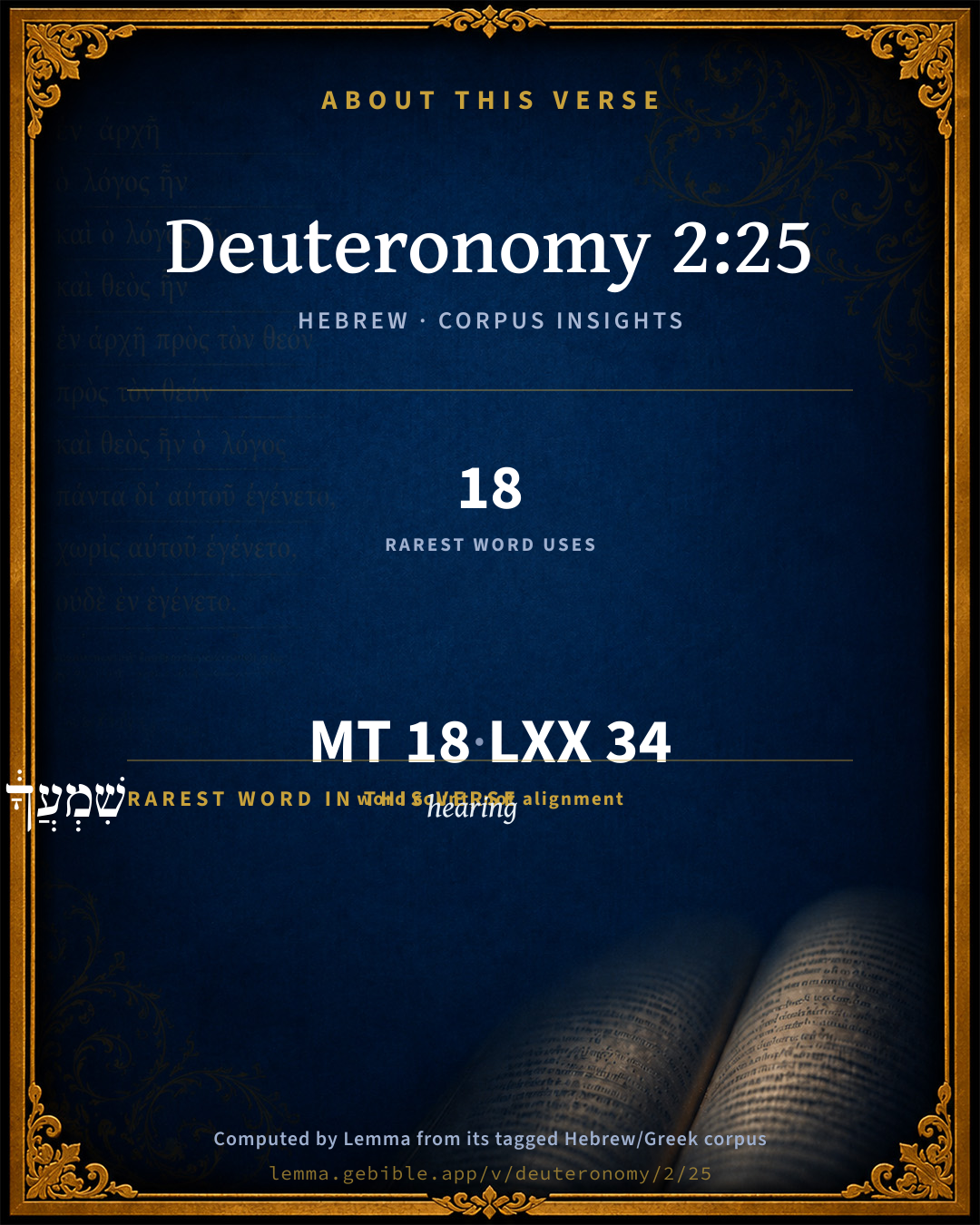
18
words
17
distinct lemmas
Pentateuch
section

Notable vocabulary

The rarest word here is שִׁמְעֲךָ֔ hearing H8088 — appearing just 18 times in the whole Hebrew Bible.

Shared distinctive vocabulary

שִׁמְעֲךָ֔ hearing H8088 occurs in 17 verses of the Hebrew Bible. Also found in:

Grammatical profile

  • 5 verbs
  • 9 nouns
  • 1 pronoun
  • 2 prepositions
  • 1 particle

Verb forms

  • אָחֵל֙ Hiphil · Imperfect
  • תֵּ֤ת Qal · Infinitive Construct
  • יִשְׁמְעוּן֙ Qal · Imperfect
  • וְרָגְז֥וּ Qal · Sequential Perfect
  • וְחָל֖וּ Qal · Sequential Perfect

Repetition

A word recurs within this verse — often emphatic in Hebrew:

  • פְּנֵי֙ face H6440 ×2

Hebrew & Septuagint length

In English translation the verse runs 42 words from the Hebrew and 34 from the Septuagint (LXX English) — closely comparable.

A rough comparison of the two English renderings, which tokenize alike — not a word-level alignment.

Word counts can differ between the Hebrew and the Greek without any difference in meaning — e.g. the Hebrew direct-object marker אֵת has no separate Greek word, and Greek often adds the article ὁ.

In the original languages it is 18 Hebrew tokens and 34 Greek tokens — but the two are counted differently (Hebrew bundles its prefixes and suffixes into one token; the Greek is in lemma form), so that isn’t a like-for-like length.

Cross-references

10

Topical passages linked to Deuteronomy 2:25 in the Treasury of Scripture Knowledge — connected by theme and wording, ordered by reader-vote popularity; previews shown in the World English Bible.

  • Deuteronomy 11:25 There shall no man be able to stand before you: Yahweh your God shall lay the fear of you and the dread of you on all the land that you shall tread on, as he has spoken to you.
  • Exodus 15:14–16 The peoples have heard. They tremble. Pangs have taken hold on the inhabitants of Philistia.
  • Deuteronomy 28:10 All the peoples of the earth shall see that you are called by the name of Yahweh; and they shall be afraid of you.
  • Exodus 23:27 I will send my terror before you, and will confuse all the people to whom you come, and I will make all your enemies turn their backs to you.
  • Joshua 2:9–12 and she said to the men, I know that Yahweh has given you the land, and that the fear of you is fallen on us, and that all the inhabitants of the land melt away before you.
  • Joshua 9:24 They answered Joshua, and said, Because it was certainly told your servants, how that Yahweh your God commanded his servant Moses to give you all the land, and to destroy all the inhabitants of the land from before you; therefore we were sore afraid for our lives because of you, and have done this thing.
  • 2 Kings 7:6–7 For the Lord had made the host of the Syrians to hear a noise of chariots, and a noise of horses, even the noise of a great host: and they said one to another, Behold, the king of Israel has hired against us the kings of the Hittites, and the kings of the Egyptians, to come on us.
  • Psalms 105:38 Egypt was glad when they departed, For the fear of them had fallen on them.
  • Revelation 3:9 Behold, I give of the synagogue of Satan, of those who say they are Jews, and they are not, but lie. Behold, I will make them to come and worship before your feet, and to know that I have loved you.
  • Jeremiah 33:9 [This city] shall be to me for a name of joy, for a praise and for a glory, before all the nations of the earth, which shall hear all the good that I do to them, and shall fear and tremble for all the good and for all the peace that I procure to it.

Cross-references courtesy of OpenBible.info (CC BY 4.0).

Hebrew and Greek witnesses Masoretic Hebrew ↔ Greek Septuagint

The same verse in the two great witnesses to the Old Testament, shown verse-for-verse.

These are two independent witnesses, not word-aligned to each other, and the Septuagint is shown in lemma (dictionary) form.

Hebrew Deuteronomy 2:25 Masoretic · Westminster Leningrad Codex

הַיּ֣וֹם הַזֶּ֗ה אָחֵל֙ תֵּ֤ת פַּחְדְּךָ֙ וְיִרְאָ֣תְךָ֔ עַל פְּנֵי֙ הָֽעַמִּ֔ים תַּ֖חַת כָּל הַשָּׁמָ֑יִם אֲשֶׁ֤ר יִשְׁמְעוּן֙ שִׁמְעֲךָ֔ וְרָגְז֥וּ וְחָל֖וּ מִפָּנֶֽיךָ

This day will I begin to put the dread of you and the fear of you on the peoples who are under the whole sky, who shall hear the report of you, and shall tremble, and be in anguish because of you.

World English Bible · Public Domain

Greek LXX Deuteronomy 2:25 Septuagint · lemma form

ἐν ὁ ἡμέρα οὗτος ἐνἄρχω δίδωμι ὁ τρόμος σύ καί ὁ φόβος σύ ἐπί πρόσωπον πᾶς ὁ ἔθνος ὁ ὑποκάτω ὁ οὐρανός ὅστις ἀκούω ὁ ὄνομα σύ ταράσσω καί ὠδίν ἔχω ἀπό πρόσωπον σύ

Begin to put your terror and your fear on the face of all the nations under heaven, who shall be troubled when they have heard your name, and shall be in anguish before you.

LXX2012 (modern English Septuagint) · Public Domain

Hebrew: Westminster Leningrad Codex (CC BY 4.0). Greek: Septuagint (public domain); English from LXX2012 (modern English Septuagint) (Public Domain). How the Septuagint differs from the Hebrew →

Targum (Aramaic paraphrase)

2

The Targum is the ancient Jewish Aramaic paraphrase of the Hebrew Scriptures — an interpretive translation, not the Hebrew text itself. Onkelos (literal) and Pseudo-Jonathan (expansive) render the Torah, and Jonathan the Prophets. Coverage is partial: where no permissively-licensed English translation exists for a verse, only the Aramaic is shown. This is verse-level text, not a word-by-word alignment to the Hebrew.

  1. Targum Onkelos Torah (Genesis–Deuteronomy)
    יוֹמָא הָדֵין אֱשָׁרֵי לְמִתַּן זְעֻתָּךְ וְדַחַלְתָּךְ עַל אַפֵּי עַמְמַיָא דִי תְחוֹת כָּל שְׁמַיָא דִי יִשְׁמְעוּן שִׁמְעָךְ וִיזוּעוּן וְיִדְחֲלוּן מִן קֳדָמָךְ

    (no public-domain English translation for this verse)

    Targum Onkelos — Aramaic: “Onkelos Genesis” (public domain); “Onkelos Exodus” (public domain); “Onkelos Leviticus” (public domain); “Onkelos Numbers” (public domain); “Onkelos Deuteronomy” (public domain). English: “Sefaria Community Translation” (CC0 1.0 (public-domain dedication)); “J.W. Etheridge. The Targums of Onkelos and Jonathan Ben Uzziel on the Pentateuch. London: Longmans, Green, 1862” (public domain). Text via Sefaria.

  2. Targum Pseudo-Jonathan Torah (Genesis–Deuteronomy)
    יוֹמָא דֵין שַׁרְיַית לְמִתַּן זַעֲוָותָךְ וְדַחֲלָתָךְ עַל אַנְפֵּי כָּל עַמְמַיָא דִתְחוֹת כָּל שְׁמַיָא דְיִשְׁמְעוּן שְׁמַע זַכְוָותָךְ הֵיךְ קָמוּן שִׁמְשָׁא וְסִיהֲרָא אַמְטוּלְתִּיךְ וּפַסְקִין מִן לְמֵימָר שִׁירָתָא כְּמֵיסַת יוֹמָא וּפַלְגָא קָמוּ בִּמְדוֹרְהוֹן עַד דְּאַגְחַת קְרָבָא בְּסִיחוֹן וִיזָעוּן וִירַתְתוּן מִן קֳדָמָךְ

    Today I will begin to put thy terror and fear upon the faces of all the peoples which are under the whole heavens who shall hear the report of thy virtue, that the sun and moon have stood still, and have ceased from speaking (their) song for the space of a day and a half, standing still in their habitation until thou hadst done battle with Sihon; and they will shiver and tremble before thee.

    Targum Pseudo-Jonathan — Aramaic: “Targum Jonathan on Genesis” (public domain); “Targum Jonathan on Exodus” (public domain); “Targum Jonathan on Leviticus” (public domain); “Targum Jonathan on Numbers” (public domain); “Targum Jonathan on Deuteronomy” (public domain). English: “The Targum of Jonathan ben Uzziel, trans. J. W. Etheridge, London, 1862” (public domain). Text via Sefaria.

Commentary

Notes on Deuteronomy 2:25 from classic Christian and Jewish commentators (each source and its license shown beneath its notes). The classic Christian expositions comment on the surrounding passage and are grouped to its opening verse, so a note may address several verses; the Jewish commentaries on the Tanakh (Rashi and others) are per-verse, so they appear only where the commentator wrote on this verse.

Lemma curates 59 commentaries, every one of them public domain or Creative Commons licensed, each selected and text-cleaned for this edition rather than reprinted as found. About our sources →

The Cambridge Bible for Schools and Colleges

gen. ed. J. J. S. Perowne

25. This day will I begin to put the dread of thee] Nor is this verse in harmony with Deu_2:29. The trembling and anguish which it predicts on all people at the mere report of Israel is the opposite effect from that produced in Sîḥôn, Deu_2:29, by Israel’s request to cross his land, for this simply provoked him to armed resistance. Is it more reasonable to suppose that the author of the discourse inconsistently penned both verses so near to each other; or that a compiler, with different documents before him and wishing to use all his materials, put them together? Here then we have an instance in which the difference in the form of address coincides with a difference of attitude to the same event. The triumphant tone of Deu_2:25 is characteristic of the Sg. passages; note, too, the hyperbole peoples under the whole heaven.

The Cambridge Bible for Schools and Colleges (gen. ed. J. J. S. Perowne; Cambridge University Press, 1878–1918) — public domain. Text from a community e-Sword module.

Joseph Benson's Commentary

Deu 2:25. Upon the nations that are under the whole heaven — That is, upon as many as shall hear of these conquests, for to such the following words restrain the sentence; especially upon the Canaanites, whose courage would droop at the news of such an absolute victory gained so near them, Jos 2:10-11.

Joseph Benson's Commentary on the Old and New Testaments (1811–1818) — public domain. Text from a community e-Sword module.

Geneva Bible (1599)

Geneva Bible translators

This declareth that the hearts of men are in God’s hands either to be made faint, or bold.

Geneva Bible (1599) marginal notes — public domain. Text via Bolls.life.

Ellicott's Commentary for English Readers

(25) The fear of thee.—Compare Exo_15:15-16 : “All the inhabitants of Canaan shall melt away, fear and dread shall fall upon them.”

A Bible Commentary for English Readers, edited by Charles John Ellicott (1878–1897) — public domain. Text from a community e-Sword module.

John Gill's Exposition

This day will I begin to put the dread of thee,.... And so fulfil the prophecies delivered by Moses in Exo 15:14.

and the fear of thee upon the nations that are under the whole heaven; not only the neighbouring nations, the Edomites, Moabites, Ammonites, Philistines, and Canaanites, but nations more remote even throughout the whole world:

who shall report of thee; of what was done for Israel in Egypt, and at the Red sea, and in the wilderness; and particularly of the delivery of Sihon and Og, kings of the Amorites, and of their kingdoms into their hands:

and shall tremble, and be in anguish because of thee; lest they should proceed on, and make conquests of their lands also; see Jos 2:9.

John Gill's Exposition of the Whole Bible (1746–1763) — public domain (CC PDM 1.0). Text via the HelloAO Bible API.

Haydock's Catholic Bible Commentary

Heaven. All who hear of thy exploits, will have cause to fear. (Haydock)

George Leo Haydock (1774–1849), Haydock's Catholic Family Bible and Commentary, 1859 edition — public domain. Excludes Psalms (Douay-Rheims chapter numbering differs from Protestant) and Deuterocanonical books (Catholic canon only).

Matthew Poole's English Annotations

Under the whole heaven; which is a synecdoche and an hyperbole, but is explained by the following words, which restrain the sentence to those nations that heard of them.

Matthew Poole's English Annotations on the Holy Bible (1683–1685) — public domain. Text from a community e-Sword/MySword module.

John Wesley's Explanatory Notes

Under heaven - The following words rest rain the sentence to those nations that heard of them.

John Wesley, Explanatory Notes Upon the Whole Bible (1754–1765) — public domain. Text via the GEBible commentary corpus.

Rashi

Rabbi Shlomo Yitzchaki (Rashi)

תחת כל השמים [THIS DAY I BEGIN TO PUT THE DREAD OF THEE … UPON THE NATIONS THAT ARE] UNDER THE WHOLE HEAVEN — This (the statement that the nations under the entire heaven will dread the Israelites) teaches that the sun stood still for Moses on the day of the battle with Og, and the matter was consequently known under the whole heaven (Avodah Zarah 25a).

Rashi on the Tanakh — English translations: “The Judaica Press complete Tanach with Rashi, translated by A. J. Rosenberg” (CC BY 4.0); “Pentateuch with Rashi's commentary by M. Rosenbaum and A.M. Silbermann, 1929-1934” (public domain); “The Metsudah Tanach series, Lakewood, N.J” (CC BY 4.0); and “The Book of Joshua, Metsudah Publications, 1997” (CC BY 4.0). Text via Sefaria.

Ramban (Nachmanides)

Rabbi Moshe ben Nachman (Ramban / Nachmanides)

THIS DAY WILL I BEGIN TO PUT THE DREAD OF THEE. This refers to Israel, meaning that all the peoples should fear them, and that the men of Canaan should go out [in battle] against them with melted hearts. G-d hardened their spirits, however, and they said, “Our death through their sword is preferable to being slaves to them.” For what sense is there to say of Moses, This day will I begin to put the dread of thee and the fear of thee upon the peoples that are under the whole heaven, [meaning that the nations would fear Moses personally] when Moses would fight only with these two kings [Sihon and Og]? Rather, this is a promise to Israel and Joshua, as he said to Joshua, Thine eyes have seen. This then is the purport of the expression ‘Begin’ to possess his land [meaning that Moses was to make the beginning of the conquest — but the task is to be finished by Joshua and Israel].

Ramban (Nachmanides) on the Tanakh — English translation: “Commentary on the Torah by Ramban (Nachmanides). Translated and annotated by Charles B. Chavel. New York, Shilo Pub. House, 1971-1976” (CC BY 4.0). Text via Sefaria.

Lesson kit

Teaching starters — assembled from the data on this page, not authored interpretation. Every prompt links to the verse data it draws on. Edit before teaching.

Deuteronomy, in the Pentateuch, opens this verse with 18 words (17 distinct Hebrew lemmas). Its most distinctive word is shêmaʻ (“hearing”). A historical commentator’s framing appears above. Read the whole chapter for the surrounding context.

Discussion questions

  1. The word shêmaʻ carries the sense “hearing.” How does it shape the verse?
  2. Genesis 29:13 shares the word «hearing» with this verse. How do the two illuminate each other?
  3. “face” occurs 2× in this one verse. What is the effect of the repetition?
  4. These translations render this verse differently; the difference is in the English rendering, not the original. What questions does that raise?
  5. The verb «אָחֵל֙» is Hiphil Imperfect. How does its form color the action?
  6. Reading how The Cambridge Bible for Schools and Colleges and Joseph Benson's Commentary read this verse, where do the two commentators agree and where do they part?

Things to notice

Reading settings

Reading text

Shown beneath each verse's original-language words.

Old Testament
Old Testament edition

Read the OT as the Masoretic Hebrew (MT) or the Greek Septuagint (LXX).

English shown for the Greek Septuagint (in the Hebrew ↔ Greek comparison).

Comparing translations? Open the Compare panel on any verse page to stack up to four side by side.