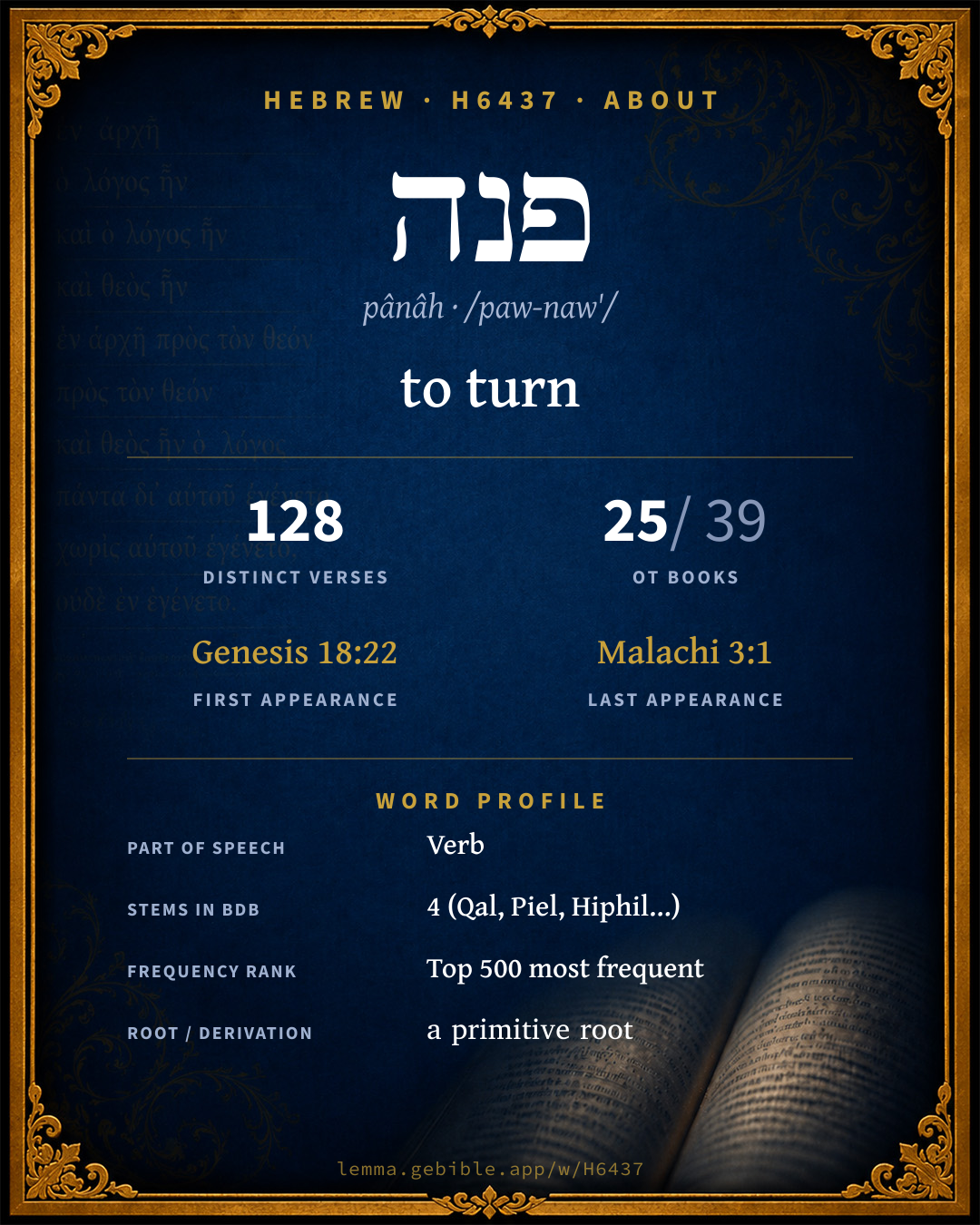
פָּנָה
to turn
‘to turn’ is one of 3 main senses fuller range ↓
Full lexicon entry — Brown-Driver-Briggs (BDB)
From Brown-Driver-Briggs (BDB)
Where this word appears
See every Qal verb in the Hebrew Bible →
Grammar key — what these labels mean
Part of speech
- Verb
- An action or state-of-being word.
Stem
- Qal
- The basic, simple active stem — the plain form of the verb (“he wrote”). Here: ‘turn toward’
- Hiphil
- The causative active stem (“he caused / brought about”). Here: ‘turn’
- Piel
- An intensive or resultative active stem.
- Hophal
- The passive counterpart of the Hiphil (“he was caused to…”).
Form
- Sequential Imperfect
- An imperfect with prefixed waw — the standard past-narrative form (waw-consecutive imperfect).
- Participle Active
- A verbal adjective expressing ongoing or characteristic action (“writing / one who writes”).
- Imperfect
- An incomplete, ongoing, or future action (“he will / would write”).
- Imperative
- A direct command (“write!”).
- Infinitive Construct
- A bound verbal noun, frequently with prepositions (“to write / in writing”).
- Perfect
- A completed action or state — Hebrew marks aspect (completeness) more than strict tense (“he wrote”).
- Sequential Perfect
- A perfect with prefixed waw continuing a preceding imperfect or command (waw-consecutive perfect).
- Jussive
- A third- or second-person volitional form expressing wish or command (“let him write”).
- Participle Passive
- A verbal adjective expressing action received (“written”).
- Infinitive Absolute
- An unbound verbal noun, often intensifying or standing in for a finite verb.
State
- Absolute
- The independent form of a noun, not bound to a following word.
Person
- 3rd Person
- The one spoken about (“he / she / it / they”).
- 2nd Person
- The one addressed (“you”).
- 1st Person
- The speaker (“I / we”).
Gender
- Masculine
- Grammatically masculine.
- Common
- Either gender — not distinguished for this form.
- Feminine
- Grammatically feminine.
Number
- Singular
- One.
- Plural
- More than one (in Hebrew, generally three or more).
Grammatical forms 41 distinct
- Verb, Qal, Sequential Imperfect, 3rd Person, Masculine, Singular 15 times (11%)
- Verb, Qal, Sequential Imperfect, 3rd Person, Masculine, Plural 13 times (10%)
- Verb, Qal, Participle Active, Masculine, Singular, Absolute 11 times (8%)
- Verb, Qal, Participle Active, Masculine, Plural, Absolute 9 times (7%)
- Verb, Qal, Infinitive Construct 9 times (7%)
- Verb, Qal, Imperfect, 3rd Person, Masculine, Singular 8 times (6%)
- Verb, Qal, Imperative, 2nd Person, Masculine, Plural 8 times (6%)
- Verb, Qal, Perfect, 3rd Person, Masculine, Singular 5 times (4%)
+33 more forms (57 occurrences)
Parsed forms decoded from the imported morphology (morphhb / Westminster Leningrad Codex — WLC text public domain, morphhb tagging CC BY 4.0), counted across 135 parsed occurrences — not distinct verses.
Every verse where H6437 appears — 128 distinct verses across 25 books. Click any verse to open its interlinear word-by-word view. Verse text shown in the World English Bible for context — . Each verse’s Hebrew form is shown with its reference; the English is not keyword-highlighted, since the data carries no word-level English alignment. Use “Compare translations” on any verse to read it across multiple English versions. This concordance covers the Hebrew Bible; Septuagint (Greek Old Testament) occurrences are not indexed here.
Genesis 4 verses
- Genesis 18:22 וַ/יִּפְנ֤וּ conj + Qal wimpf 3mp The men turned from there, and went toward Sodom, but Abraham stood yet before Yahweh.
- Genesis 24:31 פִּנִּ֣יתִי Piel pf 1cs He said, "Come in, you blessed of Yahweh. Why do you stand outside? For I have prepared the house, and room for the camels."
- Genesis 24:49 וְ/אֶפְנֶ֥ה conj + Qal impf 1cs Now if you will deal kindly and truly with my master, tell me. If not, tell me. That I may turn to the right hand, or to the left."
- Genesis 24:63 לִ/פְנ֣וֹת prep + Qal inf.cs Isaac went out to meditate in the field at the evening. He lifted up his eyes, and saw, and, behold, there were camels coming.
Exodus 6 verses
- Exodus 2:12 וַ/יִּ֤פֶן conj + Qal wimpf 3ms He looked this way and that way, and when he saw that there was no one, he killed the Egyptian, and hid him in the sand.
- Exodus 7:23 וַ/יִּ֣פֶן conj + Qal wimpf 3ms Pharaoh turned and went into his house, neither did he lay even this to heart.
- Exodus 10:6 וַ/יִּ֥פֶן conj + Qal wimpf 3ms Your houses shall be filled, and the houses of all your servants, and the houses of all the Egyptians; as neither your fathers nor your fathers' fathers have seen, since the day that they were on the earth to this day.'" He turned, and went out from Pharaoh.
- Exodus 14:27 לִ/פְנ֥וֹת prep + Qal inf.cs Moses stretched out his hand over the sea, and the sea returned to its strength when the morning appeared; and the Egyptians fled against it. Yahweh overthrew the Egyptians in the midst of the sea.
- Exodus 16:10 וַ/יִּפְנ֖וּ conj + Qal wimpf 3mp It happened, as Aaron spoke to the whole congregation of the children of Israel, that they looked toward the wilderness, and, behold, the glory of Yahweh appeared in the cloud.
- Exodus 32:15 וַ/יִּ֜פֶן conj + Qal wimpf 3ms Moses turned, and went down from the mountain, with the two tablets of the testimony in his hand; tablets that were written on both their sides; on the one side and on the other they were written.
Leviticus 5 verses
- Leviticus 14:36 וּ/פִנּ֣וּ conj + Piel wpf 3cp The priest shall command that they empty the house, before the priest goes in to examine the plague, that all that is in the house not be made unclean: and afterward the priest shall go in to inspect the house.
- Leviticus 19:4 תִּפְנוּ֙ Qal juss 2mp "'Don't turn to idols, nor make molten gods for yourselves. I am Yahweh your God.
- Leviticus 19:31 תִּפְנ֤וּ Qal juss 2mp "'Don't turn to those who are mediums, nor to the wizards. Don't seek them out, to be defiled by them. I am Yahweh your God.
- Leviticus 20:6 תִּפְנֶ֤ה Qal impf 3fs "'The person that turns to those who are mediums, and to the wizards, to play the prostitute after them, I will even set my face against that person, and will cut him off from among his people.
- Leviticus 26:9 וּ/פָנִ֣יתִי conj + Qal wpf 1cs "'I will have respect for you, and make you fruitful, and multiply you, and will establish my covenant with you.
Numbers 5 verses
- Numbers 12:10 וַ/יִּ֧פֶן conj + Qal wimpf 3ms The cloud removed from over the Tent; and, behold, Miriam was leprous, as [white as] snow: and Aaron looked at Miriam, and, behold, she was leprous.
- Numbers 14:25 פְּנ֨וּ Qal impv 2mp Now the Amalekite and the Canaanite dwell in the valley: tomorrow turn you, and get you into the wilderness by the way to the Red Sea.
- Numbers 16:15 תֵּ֖פֶן Qal juss 2ms Moses was very angry, and said to Yahweh, "Don't respect their offering: I have not taken one donkey from them, neither have I hurt one of them."
- Numbers 16:42 וַ/יִּפְנוּ֙ conj + Qal wimpf 3mp It happened, when the congregation was assembled against Moses and against Aaron, that they looked toward the tent of meeting: and, behold, the cloud covered it, and the glory of Yahweh appeared.
- Numbers 21:33 וַ/יִּפְנוּ֙ conj + Qal wimpf 3mp They turned and went up by the way of Bashan: and Og the king of Bashan went out against them, he and all his people, to battle at Edrei.
Deuteronomy 16 verses
- Deuteronomy 1:7 פְּנ֣וּ Qal impv 2mp turn you, and take your journey, and go to the hill-country of the Amorites, and to all [the places] near thereunto, in the Arabah, in the hill-country, and in the lowland, and in the South, and by the sea-shore, the land of the Canaanites, and Lebanon, as far as the great river, the river Euphrates.
- Deuteronomy 1:24 וַ/יִּפְנוּ֙ conj + Qal wimpf 3mp and they turned and went up into the hill-country, and came to the valley of Eshcol, and spied it out.
- Deuteronomy 1:40 פְּנ֣וּ Qal impv 2mp But as for you, turn you, and take your journey into the wilderness by the way to the Red Sea.
- Deuteronomy 2:1 וַ/נֵּ֜פֶן conj + Qal wimpf 1cp Then we turned, and took our journey into the wilderness by the way to the Red Sea, as Yahweh spoke to me; and we compassed Mount Seir many days.
- Deuteronomy 2:3 פְּנ֥וּ Qal impv 2mp You have compassed this mountain long enough: turn you northward.
- Deuteronomy 2:8 וַ/נֵּ֨פֶן֙ conj + Qal wimpf 1cp So we passed by from our brothers the children of Esau, who dwell in Seir, from the way of the Arabah from Elath and from Ezion Geber. We turned and passed by the way of the wilderness of Moab.
- Deuteronomy 3:1 וַ/נֵּ֣פֶן conj + Qal wimpf 1cp Then we turned, and went up the way to Bashan: and Og the king of Bashan came out against us, he and all his people, to battle at Edrei.
- Deuteronomy 9:15 וָ/אֵ֗פֶן conj + Qal wimpf 1cs So I turned and came down from the mountain, and the mountain was burning with fire: and the two tables of the covenant were in my two hands.
- Deuteronomy 9:27 תֵּ֗פֶן Qal juss 2ms Remember your servants, Abraham, Isaac, and Jacob; don't look to the stubbornness of this people, nor to their wickedness, nor to their sin,
- Deuteronomy 10:5 וָ/אֵ֗פֶן conj + Qal wimpf 1cs I turned and came down from the mountain, and put the tables in the ark which I had made; and there they are as Yahweh commanded me.
- Deuteronomy 16:7 וּ/פָנִ֣יתָ conj + Qal wpf 2ms You shall roast and eat it in the place which Yahweh your God shall choose: and you shall turn in the morning, and go to your tents.
- Deuteronomy 23:11 לִ/פְנֽוֹת prep + Qal inf.cs but it shall be, when evening comes on, he shall bathe himself in water; and when the sun is down, he shall come within the camp.
- Deuteronomy 29:18 פֹנֶ֤ה Qal ptcp.act ms lest there should be among you man, or woman, or family, or tribe, whose heart turns away this day from Yahweh our God, to go to serve the gods of those nations; lest there should be among you a root that bears gall and wormwood;
- Deuteronomy 30:17 יִפְנֶ֥ה Qal impf 3ms But if your heart turn away, and you will not hear, but shall be drawn away, and worship other gods, and serve them;
- Deuteronomy 31:18 פָנָ֔ה Qal pf 3ms I will surely hide my face in that day for all the evil which they shall have worked, in that they are turned to other gods.
- Deuteronomy 31:20 וּ/פָנָ֞ה conj + Qal wpf 3ms For when I shall have brought them into the land which I swore to their fathers, flowing with milk and honey, and they shall have eaten and filled themselves, and grown fat; then will they turn to other gods, and serve them, and despise me, and break my covenant.
Joshua 5 verses
- Joshua 7:12 יִפְנוּ֙ Qal impf 3mp Therefore the children of Israel can't stand before their enemies; they turn their backs before their enemies, because they are become accursed: I will not be with you any more, except you destroy the devoted thing from among you.
- Joshua 8:20 וַ/יִּפְנ֣וּ conj + Qal wimpf 3mp When the men of Ai looked behind them, they saw, and, behold, the smoke of the city ascended up to heaven, and they had no power to flee this way or that way: and the people who fled to the wilderness turned back on the pursuers.
- Joshua 15:2 הַ/פֹּנֶ֥ה ptcl def.art + Qal ptcp.act ms Their south border was from the uttermost part of the Salt Sea, from the bay that looks southward;
- Joshua 15:7 פֹּנֶ֣ה Qal ptcp.act ms and the border went up to Debir from the valley of Achor, and so northward, looking toward Gilgal, that is over against the ascent of Adummim, which is on the south side of the river; and the border passed along to the waters of En Shemesh, and the goings out of it were at En Rogel;
- Joshua 22:4 פְּנוּ֩ Qal impv 2mp Now Yahweh your God has given rest to your brothers, as he spoke to them: therefore now turn you, and get you to your tents, to the land of your possession, which Moses the servant of Yahweh gave you beyond the Jordan.
Judges 9 verses
- Judges 6:14 וַ/יִּ֤פֶן conj + Qal wimpf 3ms Yahweh looked at him, and said, Go in this your might, and save Israel from the hand of Midian: have not I sent you?
- Judges 15:4 וַ/יֶּ֤פֶן conj + Hiphil wimpf 3ms Samson went and caught three hundred foxes, and took firebrands, and turned tail to tail, and put a firebrand in the midst between every two tails.
- Judges 18:21 וַ/יִּפְנ֖וּ conj + Qal wimpf 3mp So they turned and departed, and put the little ones and the cattle and the goods before them.
- Judges 18:26 וַ/יִּ֖פֶן conj + Qal wimpf 3ms The children of Dan went their way: and when Micah saw that they were too strong for him, he turned and went back to his house.
- Judges 19:26 לִ/פְנ֣וֹת prep + Qal inf.cs Then came the woman in the dawning of the day, and fell down at the door of the man's house where her lord was, until it was light.
- Judges 20:40 וַ/יִּ֤פֶן conj + Qal wimpf 3ms But when the cloud began to arise up out of the city in a pillar of smoke, the Benjamites looked behind them; and, behold, the whole of the city went up in smoke to the sky.
- Judges 20:42 וַ/יִּפְנ֞וּ conj + Qal wimpf 3mp Therefore they turned their backs before the men of Israel to the way of the wilderness; but the battle followed hard after them; and those who came out of the cities destroyed them in the midst of it.
- Judges 20:45 וַ/יִּפְנ֞וּ conj + Qal wimpf 3mp They turned and fled toward the wilderness to the rock of Rimmon: and they gleaned of them in the highways five thousand men, and followed hard after them to Gidom, and struck of them two thousand men.
- Judges 20:47 וַ/יִּפְנ֞וּ conj + Qal wimpf 3mp But six hundred men turned and fled toward the wilderness to the rock of Rimmon, and abode in the rock of Rimmon four months.
1 Samuel 4 verses
- 1 Samuel 10:9 כְּ/הַפְנֹת֤/וֹ prep + Hiphil inf.cs + sfx pers 3ms It was so, that when he had turned his back to go from Samuel, God gave him another heart: and all those signs happened that day.
- 1 Samuel 13:17 יִפְנֶ֛ה Qal impf 3ms The spoilers came out of the camp of the Philistines in three companies: one company turned to the way that leads to Ophrah, to the land of Shual;
- 1 Samuel 13:18 יִפְנֶ֔ה יִפְנֶה֙ Qal impf 3ms Qal impf 3ms and another company turned the way to Beth Horon; and another company turned the way of the border that looks down on the valley of Zeboim toward the wilderness.
- 1 Samuel 14:47 יִפְנֶ֖ה Qal impf 3ms Now when Saul had taken the kingdom over Israel, he fought against all his enemies on every side, against Moab, and against the children of Ammon, and against Edom, and against the kings of Zobah, and against the Philistines: and wherever he turned himself, he put [them] to the worse.
2 Samuel 3 verses
- 2 Samuel 1:7 וַ/יִּ֥פֶן conj + Qal wimpf 3ms When he looked behind him, he saw me, and called to me. I answered, Here am I.
- 2 Samuel 2:20 וַ/יִּ֤פֶן conj + Qal wimpf 3ms Then Abner looked behind him, and said, Is it you, Asahel? He answered, It is I.
- 2 Samuel 9:8 פָנִ֔יתָ Qal pf 2ms He did obeisance, and said, "What is your servant, that you should look on such a dead dog as I am?"
1 Kings 5 verses
- 1 Kings 2:3 תִּפְנֶ֖ה Qal impf 2ms and keep the charge of Yahweh your God, to walk in his ways, to keep his statutes, [and] his commandments, and his ordinances, and his testimonies, according to that which is written in the law of Moses, that you may prosper in all that you do, and wherever you turn yourself.
- 1 Kings 7:25 פֹנִ֣ים פֹנִ֨ים פֹּנִ֣ים פֹּנִ֣ים Qal ptcp.act mp Qal ptcp.act mp Qal ptcp.act mp Qal ptcp.act mp It stood on twelve oxen, three looking toward the north, and three looking toward the west, and three looking toward the south, and three looking toward the east; and the sea was set on them above, and all their hinder parts were inward.
- 1 Kings 8:28 וּ/פָנִ֜יתָ conj + Qal wpf 2ms Yet have respect for the prayer of your servant, and for his supplication, Yahweh my God, to listen to the cry and to the prayer which your servant prays before you this day;
- 1 Kings 10:13 וַ/תֵּ֛פֶן conj + Qal wimpf 3fs King Solomon gave to the queen of Sheba all her desire, whatever she asked, besides that which Solomon gave her of his royal bounty. So she turned, and went to her own land, she and her servants.
- 1 Kings 17:3 וּ/פָנִ֥יתָ conj + Qal wpf 2ms Get you hence, and turn you eastward, and hide yourself by the brook Cherith, that is before the Jordan.
2 Kings 4 verses
- 2 Kings 2:24 וַ/יִּ֤פֶן conj + Qal wimpf 3ms He looked behind him and saw them, and cursed them in the name of Yahweh. There came forth two she-bears out of the wood, and mauled forty-two lads of them.
- 2 Kings 5:12 וַ/יִּ֖פֶן conj + Qal wimpf 3ms Aren't Abanah and Pharpar, the rivers of Damascus, better than all the waters of Israel? may I not wash in them, and be clean? So he turned and went away in a rage.
- 2 Kings 13:23 וַ/יִּ֣פֶן conj + Qal wimpf 3ms But Yahweh was gracious to them, and had compassion on them, and had respect to them, because of his covenant with Abraham, Isaac, and Jacob, and would not destroy them, neither cast he them from his presence as yet.
- 2 Kings 23:16 וַ/יִּ֣פֶן conj + Qal wimpf 3ms As Josiah turned himself, he spied the tombs that were there in the mountain; and he sent, and took the bones out of the tombs, and burned them on the altar, and defiled it, according to the word of Yahweh which the man of God proclaimed, who proclaimed these things.
2 Chronicles 6 verses
- 2 Chronicles 4:4 פֹנִ֣ים פֹנִ֨ים פֹּנִ֣ים פֹּנִ֣ים Qal ptcp.act mp Qal ptcp.act mp Qal ptcp.act mp Qal ptcp.act mp It stood on twelve oxen, three looking toward the north, and three looking toward the west, and three looking toward the south, and three looking toward the east: and the sea was set on them above, and all their hinder parts were inward.
- 2 Chronicles 6:19 וּ/פָנִ֜יתָ conj + Qal wpf 2ms Yet have you respect to the prayer of your servant, and to his supplication, Yahweh my God, to listen to the cry and to the prayer which your servant prays before you;
- 2 Chronicles 13:14 וַ/יִּפְנ֣וּ conj + Qal wimpf 3mp When Judah looked back, behold, the battle was before and behind them; and they cried to Yahweh, and the priests sounded with the trumpets.
- 2 Chronicles 20:24 וַ/יִּפְנוּ֙ conj + Qal wimpf 3mp When Judah came to the watch-tower of the wilderness, they looked at the multitude; and, behold, they were dead bodies fallen to the earth, and there were none who escaped.
- 2 Chronicles 25:23 הַ/פּוֹנֶ֔ה ptcl def.art + Qal ptcp.act ms Joash king of Israel took Amaziah king of Judah, the son of Joash the son of Jehoahaz, at Beth-shemesh, and brought him to Jerusalem, and broke down the wall of Jerusalem from the gate of Ephraim to the corner gate, four hundred cubits.
- 2 Chronicles 26:20 וַ/יִּ֣פֶן conj + Qal wimpf 3ms Azariah the chief priest, and all the priests, looked on him, and, behold, he was leprous in his forehead, and they thrust him out quickly from there; yes, himself hurried also to go out, because Yahweh had struck him.
Job 5 verses
- Job 5:1 תִּפְנֶֽה Qal impf 2ms "Call now; is there any who will answer you? To which of the holy ones will you turn?
- Job 6:28 פְנוּ Qal impv 2mp Now therefore be pleased to look at me, For surely I shall not lie to your face.
- Job 21:5 פְּנוּ Qal impv 2mp Look at me, and be astonished. Lay your hand on your mouth.
- Job 24:18 יִ֝פְנֶה Qal impf 3ms "They are foam on the surface of the waters. Their portion is cursed in the earth: They don't turn into the way of the vineyards.
- Job 36:21 תֵּ֣פֶן Qal juss 2ms Take heed, don't regard iniquity; For this you have chosen rather than affliction.
Psalms 9 verses
- Psalms 25:16 פְּנֵה Qal impv 2ms Turn to me, and have mercy on me, For I am desolate and afflicted.
- Psalms 40:4 פָנָ֥ה Qal pf 3ms Blessed is the man who makes Yahweh his trust, And doesn't respect the proud, nor such as turn aside to lies.
- Psalms 46:5 לִ/פְנ֥וֹת prep + Qal inf.cs God is in her midst. She shall not be moved. God will help her at dawn.
- Psalms 69:16 פְּנֵ֣ה Qal impv 2ms Answer me, Yahweh, for your loving kindness is good. According to the multitude of your tender mercies, turn to me.
- Psalms 80:9 פִּנִּ֥יתָ Piel pf 2ms You cleared the ground for it. It took deep root, and filled the land.
- Psalms 86:16 פְּנֵ֥ה Qal impv 2ms Turn to me, and have mercy on me! Give your strength to your servant. Save the son of your handmaid.
- Psalms 90:9 פָּנ֣וּ Qal pf 3cp For all our days have passed away in your wrath. We bring our years to an end as a sigh.
- Psalms 102:17 פָּ֭נָה Qal pf 3ms He has responded to the prayer of the destitute, And has not despised their prayer.
- Psalms 119:132 פְּנֵה Qal impv 2ms Turn to me, and have mercy on me, As you always do to those who love your name.
Proverbs 1 verse
Ecclesiastes 2 verses
- Ecclesiastes 2:11 וּ/פָנִ֣יתִֽי conj + Qal pf 1cs Then I looked at all the works that my hands had worked, and at the labor that I had labored to do; and, behold, all was vanity and a chasing after wind, and there was no profit under the sun.
- Ecclesiastes 2:12 וּ/פָנִ֤יתִֽי conj + Qal pf 1cs I turned myself to consider wisdom, madness, and folly: for what can the king's successor do? Just that which has been done long ago.
Song of Solomon 1 verse
Isaiah 8 verses
- Isaiah 8:21 וּ/פָנָ֥ה conj + Qal wpf 3ms They shall pass through it, sore distressed and hungry; and it shall happen that when they shall be hungry, they shall fret themselves, and curse by their king and by their God, and turn their faces upward:
- Isaiah 13:14 יִפְנ֔וּ Qal impf 3mp It shall happen, that as the chased roe, and as sheep that no man gathers, they shall turn every man to his own people, and shall flee every man to his own land.
- Isaiah 40:3 פַּנּ֖וּ Piel impv 2mp The voice of one who cries, Prepare you in the wilderness the way of Yahweh; make level in the desert a highway for our God.
- Isaiah 45:22 פְּנוּ Qal impv 2mp Look to me, and be you saved, all the ends of the earth; for I am God, and there is none else.
- Isaiah 53:6 פָּנִ֑ינוּ Qal pf 1cp All we like sheep have gone astray; everyone has turned to his own way; and Yahweh has laid on him the iniquity of us all.
- Isaiah 56:11 פָּנ֔וּ Qal pf 3cp Yes, the dogs are greedy, they can never have enough; and these are shepherds who can't understand: they have all turned to their own way, each one to his gain, from every quarter.
- Isaiah 57:14 פַּנּוּ Piel impv 2mp He will say, Cast up, cast up, prepare the way, take up the stumbling-block out of the way of my people.
- Isaiah 62:10 פַּנּ֖וּ Piel impv 2mp Go through, go through the gates; prepare you the way of the people; cast up, cast up the highway; gather out the stones; lift up an ensign for the peoples.
Jeremiah 10 verses
- Jeremiah 2:27 פָנ֥וּ Qal pf 3cp who tell a stock, You are my father; and to a stone, You have brought me forth: for they have turned their back to me, and not their face; but in the time of their trouble they will say, Arise, and save us.
- Jeremiah 6:4 פָנָ֣ה Qal pf 3ms Prepare you war against her; arise, and let us go up at noon. Woe to us! for the day declines, for the shadows of the evening are stretched out.
- Jeremiah 32:33 וַ/יִּפְנ֥וּ conj + Qal wimpf 3mp They have turned to me the back, and not the face: and though I taught them, rising up early and teaching them, yet they have not listened to receive instruction.
- Jeremiah 46:5 הִפְנ֑וּ Hiphil pf 3cp Why have I seen it? they are dismayed and are turned backward; and their mighty ones are beaten down, and have fled apace, and don't look back: terror is on every side, says Yahweh.
- Jeremiah 46:21 הִפְנ֛וּ Hiphil pf 3cp Also her hired men in the midst of her are like calves of the stall; for they also are turned back, they are fled away together, they didn't stand: for the day of their calamity is come on them, the time of their visitation.
- Jeremiah 47:3 הִפְנ֤וּ Hiphil pf 3cp At the noise of the stamping of the hoofs of his strong ones, at the rushing of his chariots, at the rumbling of his wheels, the fathers don't look back to their children for feebleness of hands;
- Jeremiah 48:39 הִפְנָה Hiphil pf 3ms How is it broken down! [how] do they wail! how has Moab turned the back with shame! so shall Moab become a derision and a terror to all who are round about him.
- Jeremiah 49:8 הָפְנוּ֙ Hophal impv 2mp Flee you, turn back, dwell in the depths, inhabitants of Dedan; for I will bring the calamity of Esau on him, the time that I shall visit him.
- Jeremiah 49:24 הִפְנְתָ֥ה Hiphil pf 3fs Damascus has grown feeble, she turns herself to flee, and trembling has seized on her: anguish and sorrows have taken hold of her, as of a woman in travail.
- Jeremiah 50:16 יִפְנ֔וּ Qal impf 3mp Cut off the sower from Babylon, and him who handles the sickle in the time of harvest: for fear of the oppressing sword they shall turn everyone to his people, and they shall flee everyone to his own land.
Ezekiel 14 verses
- Ezekiel 8:3 הַ/פּוֹנֶ֣ה ptcl def.art + Qal ptcp.act ms He put forth the form of a hand, and took me by a lock of my head; and the Spirit lifted me up between earth and the sky, and brought me in the visions of God to Jerusalem, to the door of the gate of the inner [court] that looks toward the north; where was the seat of the image of jealousy, which provokes to jealousy.
- Ezekiel 9:2 מָפְנֶ֣ה Hophal ptcp.pass ms Behold, six men came from the way of the upper gate, which lies toward the north, every man with his slaughter weapon in his hand; and one man in the midst of them clothed in linen, with a writer's inkhorn by his side. They went in, and stood beside the brazen altar.
- Ezekiel 10:11 יִפְנֶ֤ה Qal impf 3ms When they went, they went in their four directions: they didn't turn as they went, but to the place where the head looked they followed it; they didn't turn as they went.
- Ezekiel 11:1 הַ/פּוֹנֶ֣ה ptcl def.art + Qal ptcp.act ms Moreover the Spirit lifted me up, and brought me to the east gate of Yahweh's house, which looks eastward: and see, at the door of the gate twenty-five men; and I saw in the midst of them Jaazaniah the son of Azzur, and Pelatiah the son of Benaiah, princes of the people.
- Ezekiel 17:6 לִ/פְנ֤וֹת prep + Qal inf.cs It grew, and became a spreading vine of low stature, whose branches turned toward him, and the roots of it were under him: so it became a vine, and brought forth branches, and shot forth sprigs.
- Ezekiel 29:16 בִּ/פְנוֹתָ֖/ם prep + Qal inf.cs + sfx pers 3mp It shall be no more the confidence of the house of Israel, bringing iniquity to memory, when they turn to look after them: and they shall know that I am the Lord Yahweh.
- Ezekiel 36:9 וּ/פָנִ֣יתִי conj + Qal wpf 1cs For, behold, I am for you, and I will turn into you, and you shall be tilled and sown;
- Ezekiel 43:1 פֹּנֶ֖ה Qal ptcp.act ms Afterward he brought me to the gate, even the gate that looks toward the east.
- Ezekiel 43:17 פְּנ֥וֹת Qal inf.cs The ledge shall be fourteen [cubits] long by fourteen broad in the four sides of it; and the border about it shall be half a cubit; and the bottom of it shall be a cubit round about; and the steps of it shall look toward the east.
- Ezekiel 44:1 הַ/פֹּנֶ֖ה ptcl def.art + Qal ptcp.act ms Then he brought me back by the way of the outer gate of the sanctuary, which looks toward the east; and it was shut.
- Ezekiel 46:1 הַ/פֹּנֶ֣ה ptcl def.art + Qal ptcp.act ms Thus says the Lord Yahweh: The gate of the inner court that looks toward the east shall be shut the six working days; but on the Sabbath day it shall be opened, and on the day of the new moon it shall be opened.
- Ezekiel 46:12 הַ/פֹּנֶ֣ה ptcl def.art + Qal ptcp.act ms When the prince shall prepare a freewill-offering, a burnt offering or peace-offerings as a freewill-offering to Yahweh, one shall open for him the gate that looks toward the east; and he shall prepare his burnt offering and his peace-offerings, as he does on the Sabbath day: then he shall go forth; and after his going forth one shall shut the gate.
- Ezekiel 46:19 הַ/פֹּנ֖וֹת ptcl def.art + Qal ptcp.act fp Then he brought me through the entry, which was at the side of the gate, into the holy chambers for the priests, which looked toward the north: and, behold, there was a place on the hinder part westward.
- Ezekiel 47:2 הַ/פּוֹנֶ֣ה ptcl def.art + Qal ptcp.act ms Then he brought me out by the way of the gate northward, and led me round by the way outside to the outer gate, by the way of [the gate] that looks toward the east; and, behold, there ran out waters on the right side.
Hosea 1 verse
Nahum 1 verse
Zephaniah 1 verse
Haggai 1 verse
Malachi 2 verses
- Malachi 2:13 פְּנוֹת֙ Qal inf.cs This again you do: you cover the altar of Yahweh with tears, with weeping, and with sighing, because he doesn't regard the offering any more, neither receives it with good will at your hand.
- Malachi 3:1 וּ/פִנָּה conj + Piel wpf 3ms "Behold, I send my messenger, and he will prepare the way before me; and the Lord, whom you seek, will suddenly come to his temple; and the messenger of the covenant, whom you desire, behold, he comes!" says Yahweh of hosts.
About this entry
At a glance — auto-summarized from this page’s data, not written by a person. Every figure links to its source below. This summary describes the numbers; it doesn’t interpret them.
פנה — transliterated pânâh — is a Hebrew verb carrying the sense “to turn.” Its English rendering has broadened — “turned” classically, “turn” (unfoldingWord Literal Text) in modern versions; see the renderings breakdown. Spanning 128 verses in 25 books, it ranks among the common words of the Hebrew Bible. Its earliest occurrence is Genesis 18:22. As a verb its force shifts by stem, across 4 stems (Qal, Piel, and more). See the sense tree, 128-verse concordance, and the renderings breakdown below.
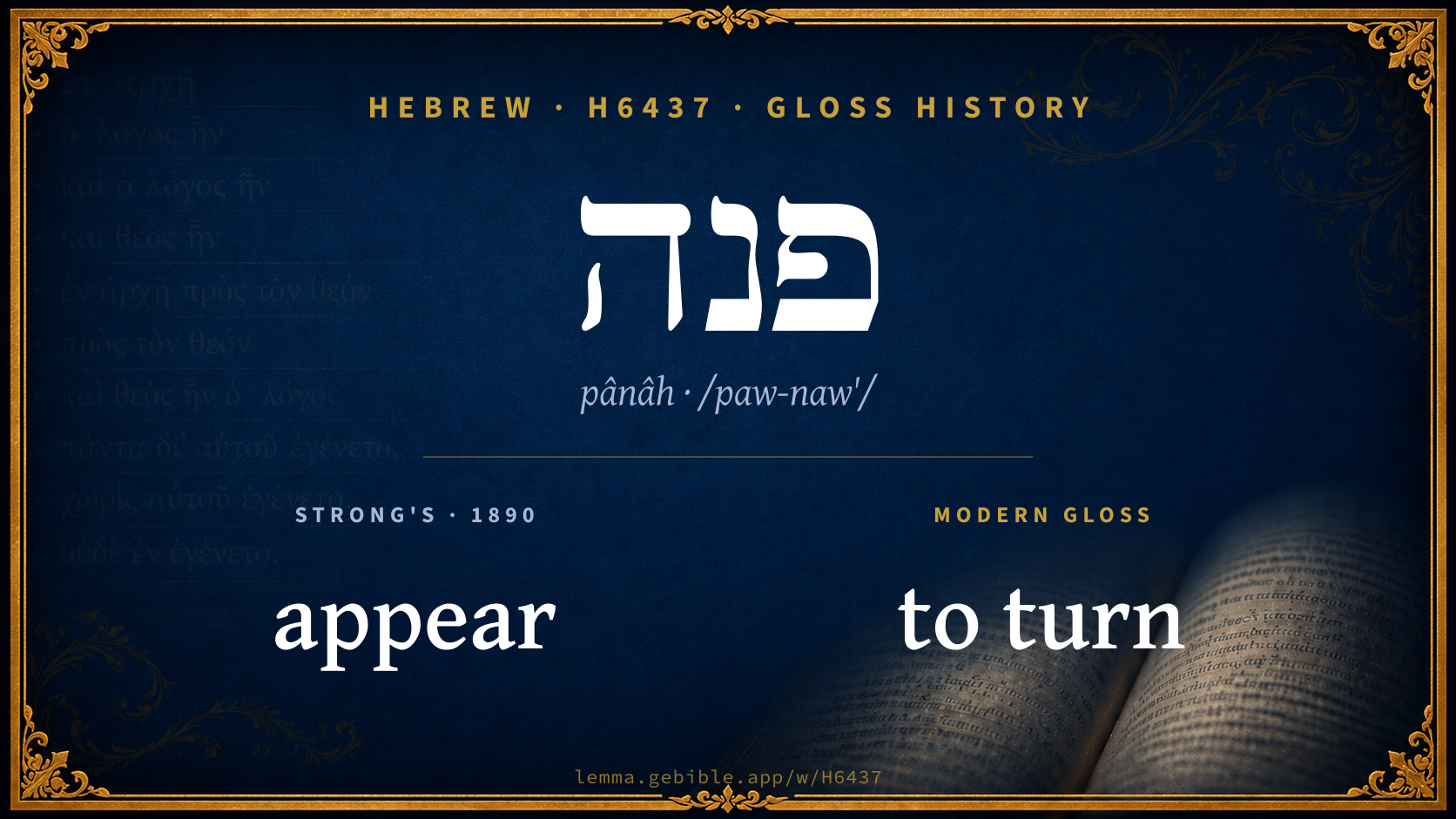
Gloss history
Strong's 1890 vs modern scholarship
About this word
Strong's H6437 catalogs a Hebrew word from the Hebrew Old Testament.
These counts are not copied from any lexicon or concordance. They are computed here, from the morphology-tagged Hebrew Old Testament. What Lemma adds →
- 128
- distinct verses
- The word appears in 128 distinct verses.
- 25 / 39
- OT books
- The word appears in 25 of 39 Old Testament books.
- #329
- by frequency
- Top 500 most frequent Hebrew words (rank 329 of 8,640 Hebrew words by occurrence).
View all 128 occurrences in the concordance →
Most concentrated in
- Deuteronomy 16 verses 13%
- Ezekiel 14 verses 11%
- Jeremiah 10 verses 8%
By section of the Old Testament
By traditional corpus
Conventional, traditional groupings — biblical authorship is debated, so this is a traditional corpus grouping, not an authorship claim. Each share is this word’s portion of its verses in that division of the Hebrew canon. Each figure is a share of the word’s 128 distinct verses.
- Prophets (Nevi'im) 68 verses · 53%
- Torah (Pentateuch) 36 verses · 28%
- Writings (Ketuvim) 24 verses · 19%
How translations render this word
Counts come from each version’s own published word-to-Strong’s tagging or interlinear alignment — an approximate guide to how each version renders this word, not a word-level alignment the data otherwise carries. Because each total is that version’s own tagged count, the per-version totals vary from one another and need not match the appearance or distinct-verse counts above. These counts may also differ from a printed concordance because Lemma counts each distinctly tagged rendering and does not collapse phrase taggings into a single head-word total. This is a fixed set of word-tagged versions (KJV, ASV, BSB, ULT) and does not change with the reading translation you choose elsewhere. Each version’s license is shown beside its name below (and on Sources).
- King James Version: Turned 11×, Looking 9×, Looked 8×
- American Standard Version: Turned 12×, Looking 9×, Looked 8×
- Berean Standard Bible: Turned 16×, Turn 13×, Facing 11×
- unfoldingWord Literal Text: Turn 19×, Turned 18×, And 10×
King James Version Public Domain
Renders H6437 across 135 tagged occurrences — most commonly:
Plus other, less common renderings. Plus 57 renderings that appear only once — usually multi-word phrases or single function words the recovered tagging swept in, not distinct renderings.
American Standard Version Public Domain
Renders H6437 across 133 tagged occurrences — most commonly:
Plus other, less common renderings. Plus 57 renderings that appear only once — usually multi-word phrases or single function words the recovered tagging swept in, not distinct renderings. Not rendered by a distinct English word in 1 further occurrence.
Berean Standard Bible Public Domain
Renders H6437 across 128 tagged occurrences — most commonly:
Plus other, less common renderings. Plus 47 renderings that appear only once — usually multi-word phrases or single function words the recovered tagging swept in, not distinct renderings. Not rendered by a distinct English word in 6 further occurrences.
unfoldingWord Literal Text CC BY-SA 4.0
Renders H6437 across 148 tagged occurrences — most commonly:
Plus other, less common renderings. Plus 41 renderings that appear only once — usually multi-word phrases or single function words the recovered tagging swept in, not distinct renderings.
16 senses and sub-senses in the full BDB
Hebrew verbs can shift meaning by stem (binyan): Qal is the basic action, Niphal is often passive or reflexive, Piel often intensifies or makes it factitive, and Hiphil is typically causative. The senses below are grouped under the stem BDB assigns to each. This entry also uses Hophal (the passive of Hiphil).
What do BDB’s symbols mean?
BDB uses these scholarly abbreviations:
| Symbol | Meaning |
|---|---|
| 𝔊 | the Septuagint (the ancient Greek translation, LXX) |
| 𝔙 | the Vulgate (the Latin translation) |
| 𝔖 | the Syriac version (the Peshitta) |
| 𝔗 | the Targum (the Aramaic translation) |
| ψ | the Psalms |
| √ | root (the underlying root or stem) |
| ‖ | parallel passage (a synonymous or contrasted parallel) |
| † | the dagger: every passage where the word occurs is cited |
The 16 senses and sub-senses the full Brown-Driver-Briggs lexicon distinguishes for this word, in lexicon order (not ranked by frequency), with BDB’s own verbatim wording and sub-sense lettering. Shown in Hebrew script with BDB’s own scholarly abbreviations. The condensed entry is in the Lexicon Entry tab. See also the Forms in the corpus table below.
Qal
- Pf. 3 ms. פ׳ Je 6:4 +, 2 ms. פָּנִיתָ 2 S 9:8, etc.; Impf. 3 ms. יִפְנֶה 1 S 13:17 +, וַיִּ֫פֶן Ex 2:12 +, 3 fs. וַתֵּ֫פֶן 1 K 10:13, 1 s. וָאֵ֫פֶן Dt 9:15; 10:5, 1 pl. וַנֵּ֫פֶן 2:1 +, etc.; Imv. ms. פְּנֵה ψ 25:16 +, etc.; Inf. abs. פָּנֹה Hg 1:9; cstr. לִפְנוֹת Gn 24:63 +, etc.; Pt. פֹּנֶה Dt 29:17 +, etc.;— e.g. Jeremiah 6:4
- 1.
- a. turn toward, אֶל pers., lit., Ju 6:14; Is 13:14 = Je 50:16; Jb 21:5 (i.e. attentively); cf. of branches Ez 17:6 (in allegory); c. עַל of direction Gn 24:49; fig. c.> אֶל־י׳ (in worship), Is 45:22, other gods Ho 3:1; Dt 31:18, 20; Lv 19:4; for help Lv 19:31; 20:6; Jb 5:1; אֶל־אָוֶן 36:21; c. acc. הַמָּקוֹם אֲשֶׁר יִפְנֶה Ez 10:11; c. ה loc. 1 K 17:3; Dt 2:3 (+ לָכֶם dat. eth.), Ct 6:1; c. דֶּרֶךְ 1 S 13:18;(×2) Jb 24:18, אֶל־ד׳ Ju 20:42; 1 S 13:17; fig. לְדֶרֶךְ Is 53:6; 56:11; c. acc. כֹּל אֲשֶׁר־יִפְנֶה 1 S 14:47, so, + שָׁם, fig. 1 K 2:3, i.e. whatever thou undertakest, אֶל־כָּל־אֲשֶׁר יִפְנֶה Pr 17:8. e.g. Judges 6:14
- b. turn from, מִן loc. Gn 18:22, fig., of heart, c.מֵעִם י׳ Dt 29:17, abs. = turn away 30:17; in phr. פ׳ עֹרֶף turn (with the back (cf. ראה עֹרֶף Je 18:17), + לִפְנֵי, Jos 7:12 (of flight), fig., + אֶל־י׳, Je 2:27; 32:33. e.g. Genesis 18:22
- c. turn and do a thing, Ex 7:23; 32:15; Nu 14:25 (E) 21:33 (JE) Dt 1:7, 24; Ju 18:21;s 1 K 10:13 + 17 times; to do a thing (inf.) †Ec 2:12. e.g. Exodus 7:23
- d. turn, decline, of day Je 6:4, days of life ψ 90:9. e.g. Jeremiah 6:4
- e. turn toward, approach, of evening, לִפְנוֹת עָ֑רֶב Gn 24:63; Dt 23:12; of morning, לִפ׳ (הַ)בֹּקֶר Ex 14:27; Ju 19:26 ψ 46:6 (fig.). e.g. Genesis 24:63
- 2.
- a. turn and look, look, lit., אֶל pers. Nu 12:10; 2 Ch 20:24; 26:20, וַיִּפֶן כֹּה וָכֹה Ex 2:12; c. לְמָ֑עְלָה Is 8:21; abs. look (back) 2 Ch 13:14; c. אַחֲרֵי look behind one (and see, or say), Jos 8:20; Ju 20:40; 2 S 1:7; 2:20; 2 K 2:24, look after another Ez 29:16 (fig. for seek alliance with); c. אֶל of direction Ex 16:10; Nu 17:7. e.g. Numbers 12:10
- b. of inanimate things, face, c. אֶל loc. Jos 15:7, usually of facing points of compass, c. ה loc. 1 K 7:25(×4) = 2 Ch 4:4;(×4), Jos 15:2; Ez 8:3; 46:19, but also c. קָדִים 43:17; 44:1; 46:1, 2; 47:9, cf. 43:1. e.g. Joshua 15:7
- c. especially fig. look at, אֶל־ pers., regard, (1) graciously 2 S 9:8; of י׳ Ez 36:9; Lv 26:9; 2 K 13:23 ψ 40:5, + חָנַן 25:16; 69:17; 86:16; 119:132; c. אֶל־תְּפִלָּה 1 K 8:28 = 2 Ch 6:19, ψ 102:18, אֶל־מִנְחָה Nu 16:15; Mal 2:13; (2) sternly, אֶל־קְשִׁי הָעָם Dt 9:27. e.g. 2 Samuel 9:8
- d. look for (אֶל rei) = except Hg 1:9. e.g. Haggai 1:9
- e. fig. look at, consider (+ ב) Jb 6:28; Ec 2:11.—2 Ch 25:23 v. פִּנָּה. e.g. Job 6:28
Piel
- Pf. 3 ms. פִּנָּה Zp 3:15, etc.; Imv. mpl. פַּנּוּ Is 40:3 + 2 times;—turn away, put out of the way, c. acc. pers. Zp 3:15 (‖ הֵסִיר); hence make clear, c. acc. הַבַּיִת, i.e. clear away things scattered about, make orderly, Germ. ‘aufräumen,’ Gn 24:31; empty it Lv 14:36; fig., c. acc. דֶּרֶךְ make clear, free from obstacles, Is 40:3; 57:14; 62:10 Mal 3:1; acc. om. clear away (ground) before it, i.e. to plant it ψ 80:10 (fig.). e.g. Zephaniah 3:15
Hiphil
- (especially Je) Pf. 3 ms. הִפְנָה Je 48:39, 3 fs. הִפְנְתָה 49:24, etc.; Impf. וַיֶּ֫פֶן Ju 15:4; Inf. cstr. sf. הַפְנֹתוֹ 1 S 10:9; Pt. מַפְנֶה Na 2:9;— e.g. Jeremiah 48:39
- 1. turn, c. acc. וַיֶּפֶן זָנָב אֶל־זָנָב Ju 15:4, עֹרֶף Je 48:39 (cf.> הפך Jos 7:8), שִׁכְמוֹ לָלֶכֶת 1 S 10:9. e.g. Judges 15:4
- 2. make a turn, shew (signs of) turning, + נָסוּ Je 46:21, לָנוּס 49:24; opp. נָסוּ 46:5, cf. Na 2:9; + אֶל pers. 47:3. e.g. Jeremiah 46:21
Hophal
- Imv. mpl. הָפְנוּ Je 49:8 (Ges§ 46 a, N.) be ye turned back! (in flight, + נֻסוּ); Pt. מָפְנֶה צָפ֫וֹנָה Ez 9:2 the gate … which is faced northward (cf. Qal 2 b). e.g. Jeremiah 49:8
Senses from the full Brown-Driver-Briggs lexicon (Brown, Driver, Briggs; Oxford 1906 — public domain), digitized via Sefaria, supplemented by the OpenScriptures HebrewLexicon (CC BY 4.0). Full attribution on Sources.
Word origin
vb. turn (NH id.; Syriac ܦܢܳܐ, 𝔗 פְּנָא; Ethiopic ፈነወ: Arabic فَنِى pass away, banish; cf.Sab. פנה (variously) e.g. CIS iv. Nos. 1, 37, 40; Assyrian pânu, face, Ph. פנם, MI 13, 18 לפני, sf. מפני l 19);—
— Brown-Driver-Briggs (Oxford 1906, public domain), digitized via Sefaria, supplemented by the OpenScriptures HebrewLexicon (CC BY 4.0). See Sources.
Origin: a primitive root
Jastrow Dictionary
A second Hebrew/Aramaic lexicon for comparison, covering Aramaic and post-biblical (Talmudic, Targumic, Midrashic) usage that the biblical-Hebrew BDB does not. Matched by lemma rather than by Strong’s number, so a lemma may carry more than one Jastrow headword (shown separately below), and the entries cover usage well beyond the Bible.
פָּנָה
- , v. פני
פָּנֶה
- , v. פָּנִים
פִּנָּה
- , v. פִּינָּה
פני
- (b. h.)
- 1. to turn (one’s face). Yoma 17ᵇ, a. e. שאתה פוֹנֶה, v. פִּינָּה. Y. Ab. Zar. III, 42ᵇ sq. (ref. to Lev. XIX, 4) אל תִּפְנֶה לעובדן do not turn thy face to them to worship them; אל תפנה לראותן ממש it is meant literally, do not turn thy face to look at them; Sifra K’dosh. beg. אל תפנה לראותם וַדַּיי. Ib. תחלתם אלילים הם אם פּוֹנֶה את אחריהן וכ׳ at first they are ‘nothings’, but if thou turnest after them, thou wilt make them (thy) gods; Yalk. Lev. 604. Ib.; Sabb. 149ᵃ (ref. to Lev. l. c.) אל תִּפְנוּ אֶל מדעתכם turn not to the creation of your fancy (Rashi; anoth. interpret., v. infra); a. v. fr. e.g. Leviticus 19:4
- 2. to turn around, go away. Lam. R. to I, 1 כיון ששתה ופ׳ לילך (מעשה) רבתי when he had drunk and turned to go away. Gen. R. s. 68 יצא משם פ׳ זיוה פ׳ הדרה when he (the righteous) goes away from a place, its splendor is gone, its glory is gone; Ruth R. to I, 7. Sifra K’dosh., ch. VIII, Par. 4, a. e. (ref. to ונתתי את פני, Lev. XX, 6; cmp. פְּנַאי) פּוֹנֶה אני מכל וכ׳, v. עֵסֶק. Midr. Prov. to XVI, 11 לִפְנוֹת היום when the day was going away (towards evening); a. v. fr. e.g. Leviticus 20:6
- 3. (act. verb) to turn, pervert. Cant. R. to VII, 9 (play on אח̇ש̇ד̇רפ̇נ̇יא, Dan. III, 2) אלו ארכונות שהן נש̇ח̇ד̇ין ופ̇וני̇ן דין וכ׳ (not נחשדין) those are the officers that are bribed and turn justice in any direction; ib. שמה̇ד̇ר̇ין פ̇נ̇ים ופ̇ונ̇ין דין who respect persons and pervert justice; a. fr. e.g. Daniel 3:2
- 4. to turn aside, go out, (euphem.) to ease one’s self. Y. Sot. I, 16ᵈ אם יִפְנֶה אחד מהן לצורכו if one of them goes out for a human need. Toh. X, 2 ופוֹנִים (Ber. 62ᵃ ונִפְנִין, Nif.).
- 5. to vacate (v. infra); to free, release. Pesik. R. s. 42 הספינה … ולא תטריח עליה לִפְנוֹתָהּ (not הטריח) thy friend’s ship has been seized (for public service), and wilt thou not take pains to release it? ועכשיו של אחרים הוא פוֹנֶה ושלו אינה נפנית and now he releases other men’s ships, and shall not his be released.?—Part. pass. פָּנוּי; f. פְּנוּיָה vacant, empty, free. Ber. 43ᵃ אין בית הבליעה פ׳ his œsophagus is not free (which makes speaking dangerous). Y. Kil. III, beg. 28ᶜ אי אפשר … נקב אחד פ׳ וכ׳ it is not possible that there should not be one cavity free for planting &c.; Y. Sabb. IX, 11ᵈ bot. אפשר … פניי (corr. acc.). Num. R. s. 14 והיה הבית פ׳ and the house was empty (none at home); a. fr.—V. פָּנוּי.
- 1. to empty, remove, transfer. Sabb. III, 5 המיחם שפִּינָּהוּ וכ׳ in the kettle which one has emptied (or: which one has removed from the oven) &c.; ib. 41ᵃ המיחם שפ׳ ממנו מים וכ׳ in the kettle out of which one has removed the hot water. Ib. XVIII, 1 מְפַנִּין אפי׳ וכ׳ you may clear away (on the Sabbath) even four or five piles … to make room for guests. Y. Gitt. VIII, 49ᵈ top אם … איש מְפַנֶּה if the court belongs to the wife, the husband (after divorce) must vacate it, ושל איש אשה מְפַנָּה and if it belongs to the husband, the wife must vacate it; מי מפנה מפני מי which of them must vacate it for the other? Taan. 21ᵃ בקשו תלמידיו לפַנּוֹת את וכ׳ his disciples wanted to move his bed first and then his furniture; פַּנּוּ את הכלים וכ׳ move the furniture first. Ab. III, 4 מפנה לבו לבטלה empties his heart (of serious thoughts to make room) for frivolous subjects. Sabb. 149ᵃ (ref. to Lev. XIX, 4, v. supra) אל תְּפַנוּ אֵל מדעתכם do not remove God from your minds (to make room for idols). B. Kam. 81ᵇ מְפַנֵּיהוּ לשדה וכ׳ he must remove the corpse to &c. Y. Maasr. II, 49ᵈ רוצה אדם לפנות עסקיו וכ׳ (ed. Krot. רוצה הוא אדם לפנע; ed. Zyt. לפלה, corr. acc.) a man is anxious to dispose of his goods in the first place he strikes &c.; a. fr. e.g. Leviticus 19:4
- 2. to free, acquit. Tanḥ. Vayikra 6 פ׳ לקרתני ולבן פלטרין וכ׳ he acquitted the commoner, but convicted the courtier. Ib. לקרתני פִּנִּיתִי וכ׳ I acquitted the commoner, because he knows not the royal customs; a. fr.
- 1. to turn. Midr. Till. to Ps. XVIII, 5 נִפְנֵיתִי לכאן וכ׳ I turned in all directions, and there is no redeemer but thee; Yalk. Sam. 157; a. e.
- 2. to be removed, to die. Gen. R. s. 98 שהיה נ׳ מן העולם who was going to die. Tosef. Par. III (II), 8 נ׳ בני my son is dead (v. infra); a. e.
- 3. to be free, at leisure. Ib. לכשאֶפָּנֶה לך when I shall have leisure for thee, i.e. I shall take revenge on thee, when opportunity offers; אמר לו כשתִּפָּנֶה said he to him, when thou shalt be at leisure (or when thou shalt be dead, v. supra); ib. (Vers. of R. S. to Par. III, 8) לא נ׳ בני שהעריב שמשו my son has found no leisure (to take revenge), for his sun has set (he is dead). Ab. II, 4 אל תאמר לכשאפנה אשנה שמא לא תפנה say not, when I shall be at leisure, I will study; may be thou wilt never find leisure; a. fr.
- 4. to ease one’s self. Sabb. 82ᵃ הנצרך לִפָּנוֹת ואינו נפנה (Alf. להִפָּנוֹת) he who feels the want of easing himself, and is not relieved; ib. הנצרך ליפנות ואינו יכול ליפנות. Ber. 62ᵃ ונִפְנִין, v. supra; a. fr.
- 5. to be released. Pesik. R. l. c., v. supra.
- to vacate. —Part. pass. מוּפְנֶה a) free, disengaged, single. Yeb. III, 5 שלשה אחין … ואחד מ׳ three brothers two of whom were married to two sisters, and one is free (unmarried or married to one who is a stranger to his brothers’ wives); Y. ib. III, 4ᵈ top; a. e.—b) (dialectical exegesis) free for interpretation, unnecessary for the plain sense or context. Nidd. 22ᵇ וייצר מ׳ משני צדדין מ׳ … ומ׳ גבי בהמה vayitser is free for interpretation on both sides, it is free with regard to man (Gen. II, 7, because man’s creation is mentioned in ויברא, ib. I, 27), and free with regard to beasts (ib. II, 19, their creation being stated in ויעש, ib. I, 25). Ib. כל גזירה שוה שאינה מוּפְנָה כל עיקר וכ׳ analogous words which are not entirely free (in both texts) cannot be made the basis for interpretation as g’zerah shavah (v. גְּזֵרָה). Ib. מ׳ מצד אחד free in one of the texts; Sabb. 64ᵃ; a. fr. e.g. Genesis 2:7
- 1. to be vacated, cleared, removed. Y. Naz. IX, 57ᵈ bot. כל הקברות מִתְפַּנִּין וכ׳ all graves may be vacated (transferred), except &c.; Treat. S’maḥ. ch. XIV.
- 2. to be released. Pesik. R. l. c. כדי הוא (ש)תִּיתְפִּנֶּה he deserves it to have his ship released (ed. Prag כדי הוא שיִתְפַּנֶּה he deserves to be released).
A Dictionary of the Targumim, the Talmud Babli and Yerushalmi, and the Midrashic Literature (Marcus Jastrow; London, Luzac, 1903) — Public Domain. Digitized via Sefaria. Digitized via Sefaria. Full attribution on Sources.
Forms in the corpus
The 101 distinct written forms H6437 takes in the Hebrew Bible, most frequent first — each parse links to that stem’s occurrences in the concordance. Hebrew forms include their vowel points and cantillation, so a single lemma takes many written forms.
The 60 most common forms are shown; 41 rarer forms follow in the full concordance.
Same root — word family
Other BDB entries built from the same root as H6437, grouped by Strong’s listed origin. These share a root / origin per the lexicon — not necessarily a shared meaning. Each links to that word’s own entry.
Derived from this word
Proper names from this root
People and places named from this root — a name, not an additional meaning of the word.
Compare all same-root words → Showing 4 of 5 — not the complete family. 2 of the same-root words are proper names (people or places). They share a root, not necessarily a meaning.
Septuagint verse parallels
This word appears in 118 verses that also exist in the Greek Old Testament (Septuagint), out of the 128 Hebrew verses it occurs in. You can read those verses in Greek by switching the Old Testament edition to the Septuagint.
Read these verses in the Septuagint
- Genesis 18:22
- Exodus 2:12
- Leviticus 14:36
- Numbers 12:10
- Deuteronomy 1:7
- Joshua 7:12
- Judges 6:14
- 1 Samuel 10:9
- 2 Samuel 1:7
- 1 Kings 2:3
- 2 Kings 2:24
- 2 Chronicles 4:4
This is a verse-level parallel only — the same verses exist in both the Hebrew and Greek Old Testaments. No word-level Hebrew↔Greek correspondence is claimed: the data carries no such alignment, so no Greek word is shown as this Hebrew word’s translation. Coverage is not total — the Septuagint omits the deuterocanon and renumbers the Psalms, so some Hebrew verses have no direct Greek parallel.