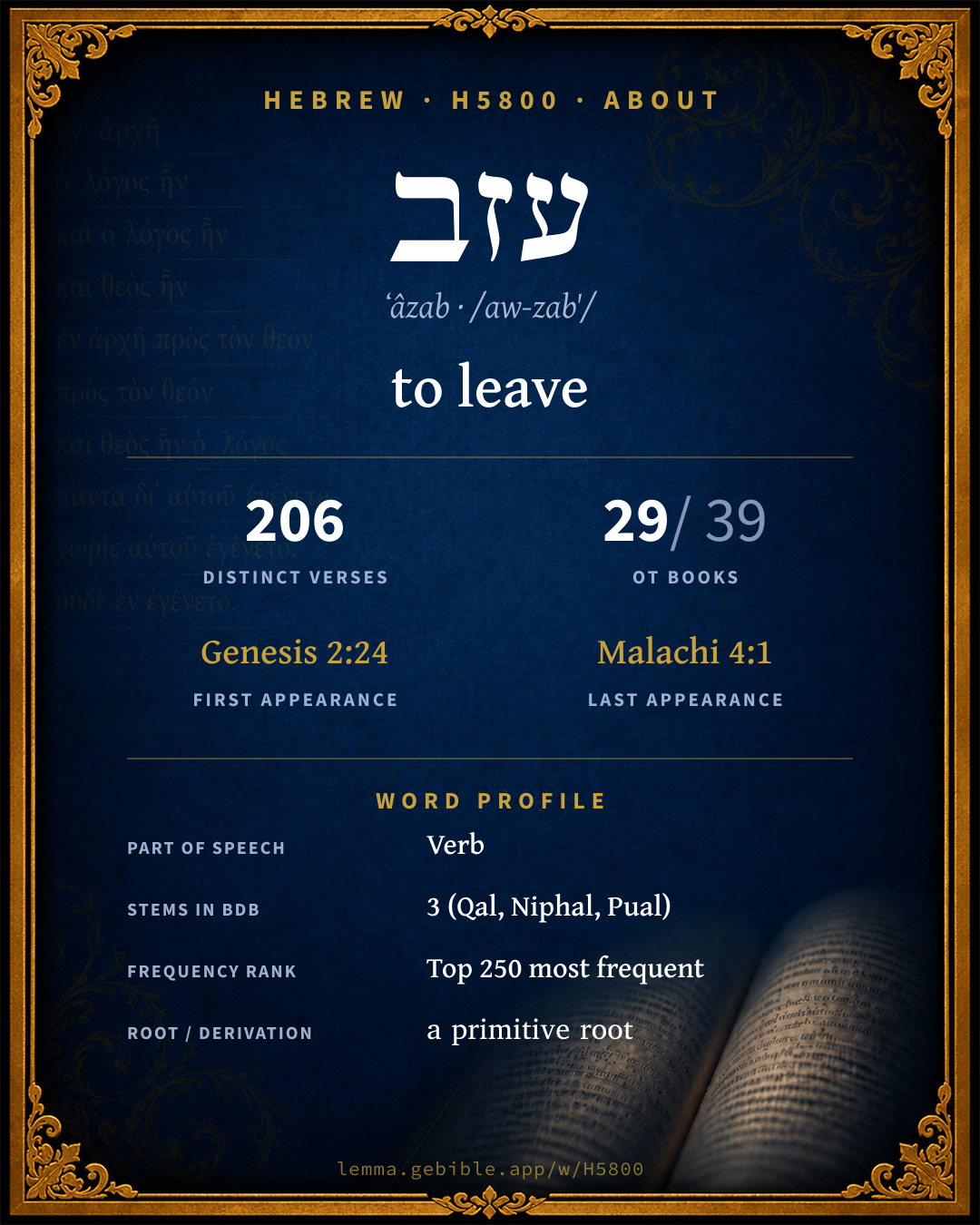
עָזַב
to leave
also: loose, forsake fuller range ↓
Full lexicon entry — Brown-Driver-Briggs (BDB)
From Brown-Driver-Briggs (BDB)
Where this word appears
See every Qal verb in the Hebrew Bible →
Grammar key — what these labels mean
Part of speech
- Verb
- An action or state-of-being word.
Stem
- Qal
- The basic, simple active stem — the plain form of the verb (“he wrote”). Here: ‘leave’
- Niphal
- Usually the simple passive or reflexive of the Qal (“he was written”). Here: ‘be left to’
- Pual
- The passive counterpart of the Piel.
- Qal Passive
- An archaic passive of the Qal, preserved in a few forms.
Form
- Perfect
- A completed action or state — Hebrew marks aspect (completeness) more than strict tense (“he wrote”).
- Sequential Imperfect
- An imperfect with prefixed waw — the standard past-narrative form (waw-consecutive imperfect).
- Imperfect
- An incomplete, ongoing, or future action (“he will / would write”).
- Jussive
- A third- or second-person volitional form expressing wish or command (“let him write”).
- Participle Passive
- A verbal adjective expressing action received (“written”).
- Participle Active
- A verbal adjective expressing ongoing or characteristic action (“writing / one who writes”).
- Infinitive Construct
- A bound verbal noun, frequently with prepositions (“to write / in writing”).
- Sequential Perfect
- A perfect with prefixed waw continuing a preceding imperfect or command (waw-consecutive perfect).
- Cohortative
- A first-person volitional form expressing wish or resolve (“let me / let us write”).
- Imperative
- A direct command (“write!”).
- Infinitive Absolute
- An unbound verbal noun, often intensifying or standing in for a finite verb.
State
- Absolute
- The independent form of a noun, not bound to a following word.
- Construct
- A noun bound to a following noun in a possessive / “of” relationship (the construct chain).
Person
- 3rd Person
- The one spoken about (“he / she / it / they”).
- 2nd Person
- The one addressed (“you”).
- 1st Person
- The speaker (“I / we”).
Gender
- Common
- Either gender — not distinguished for this form.
- Masculine
- Grammatically masculine.
- Feminine
- Grammatically feminine.
Number
- Plural
- More than one (in Hebrew, generally three or more).
- Singular
- One.
Grammatical forms 50 distinct
- Verb, Qal, Perfect, 3rd Person, Common, Plural 25 times (12%)
- Verb, Qal, Perfect, 3rd Person, Masculine, Singular 17 times (8%)
- Verb, Qal, Sequential Imperfect, 3rd Person, Masculine, Singular 16 times (7%)
- Verb, Qal, Imperfect, 3rd Person, Masculine, Singular 15 times (7%)
- Verb, Qal, Sequential Imperfect, 3rd Person, Masculine, Plural 14 times (7%)
- Verb, Qal, Imperfect, 2nd Person, Masculine, Singular 9 times (4%)
- Verb, Qal, Infinitive Construct 9 times (4%)
- Verb, Qal, Imperfect, 1st Person, Common, Singular 8 times (4%)
+42 more forms (102 occurrences)
Parsed forms decoded from the imported morphology (morphhb / Westminster Leningrad Codex — WLC text public domain, morphhb tagging CC BY 4.0), counted across 215 parsed occurrences — not distinct verses.
Page 1 of 2 — showing verses 1–200 of 206 distinct verses where H5800 appears, across 29 books. Click any verse to open its interlinear word-by-word view. Verse text shown in the World English Bible for context — . Each verse’s Hebrew form is shown with its reference; the English is not keyword-highlighted, since the data carries no word-level English alignment. Use “Compare translations” on any verse to read it across multiple English versions. This concordance covers the Hebrew Bible; Septuagint (Greek Old Testament) occurrences are not indexed here.
Genesis 10 verses
- Genesis 2:24 יַֽעֲזָב Qal impf 3ms Therefore a man will leave his father and his mother, and will join with his wife, and they will be one flesh.
- Genesis 24:27 עָזַ֥ב Qal pf 3ms He said, "Blessed be Yahweh, the God of my master Abraham, who has not forsaken his loving kindness and his truth toward my master. As for me, Yahweh has led me in the way to the house of my master's relatives."
- Genesis 28:15 אֶֽעֱזָבְ/ךָ֔ Qal impf 1cs + sfx pers 2ms Behold, I am with you, and will keep you, wherever you go, and will bring you again into this land. For I will not leave you, until I have done that which I have spoken of to you."
- Genesis 39:6 וַ/יַּעֲזֹ֣ב conj + Qal wimpf 3ms He left all that he had in Joseph's hand. He didn't concern himself with anything, except for the food which he ate. Joseph was well-built and handsome.
- Genesis 39:12 וַ/יַּעֲזֹ֤ב conj + Qal wimpf 3ms She caught him by his garment, saying, "Lie with me!" He left his garment in her hand, and ran outside.
- Genesis 39:13 עָזַ֥ב Qal pf 3ms It happened, when she saw that he had left his garment in her hand, and had run outside,
- Genesis 39:15 וַ/יַּעֲזֹ֤ב conj + Qal wimpf 3ms It happened, when he heard that I lifted up my voice and cried, that he left his garment by me, and ran outside."
- Genesis 39:18 וַ/יַּעֲזֹ֥ב conj + Qal wimpf 3ms and it happened, as I lifted up my voice and cried, that he left his garment by me, and ran outside."
- Genesis 44:22 לַ/עֲזֹ֣ב וְ/עָזַ֥ב prep + Qal inf.cs conj + Qal wpf 3ms We said to my lord, 'The boy can't leave his father: for if he should leave his father, his father would die.'
- Genesis 50:8 עָזְב֖וּ Qal pf 3cp all the house of Joseph, his brothers, and his father's house. Only their little ones, their flocks, and their herds, they left in the land of Goshen.
Exodus 3 verses
- Exodus 2:20 עֲזַבְתֶּ֣ן Qal pf 2fp He said to his daughters, "Where is he? Why is it that you have left the man? Call him, that he may eat bread."
- Exodus 9:21 וַֽ/יַּעֲזֹ֛ב conj + Qal wimpf 3ms Whoever didn't regard the word of Yahweh left his servants and his cattle in the field.
- Exodus 23:5 מֵ/עֲזֹ֣ב עָזֹ֥ב תַּעֲזֹ֖ב prep + Qal inf.cs Qal inf.abs Qal impf 2ms If you see the donkey of him who hates you fallen down under his burden, don't leave him, you shall surely help him with it.
Leviticus 3 verses
- Leviticus 19:10 תַּעֲזֹ֣ב Qal impf 2ms You shall not glean your vineyard, neither shall you gather the fallen grapes of your vineyard; you shall leave them for the poor and for the foreigner. I am Yahweh your God.
- Leviticus 23:22 תַּעֲזֹ֣ב Qal impf 2ms "'When you reap the harvest of your land, you shall not wholly reap into the corners of your field, neither shall you gather the gleanings of your harvest: you shall leave them for the poor, and for the foreigner. I am Yahweh your God.'"
- Leviticus 26:43 תֵּעָזֵ֨ב Niphal impf 3fs The land also will be left by them, and will enjoy its sabbaths while it lies desolate without them: and they will accept the punishment of their iniquity; because, even because they rejected my ordinances, and their soul abhorred my statutes.
Numbers 1 verse
Deuteronomy 9 verses
- Deuteronomy 12:19 תַּעֲזֹ֖ב Qal impf 2ms Take heed to yourself that you don't forsake the Levite as long as you live in your land.
- Deuteronomy 14:27 תַֽעַזְבֶ֑/נּוּ Qal impf 2ms + sfx pers 3ms The Levite who is within your gates, you shall not forsake him; for he has no portion nor inheritance with you.
- Deuteronomy 28:20 עֲזַבְתָּֽ/נִי Qal pf 2ms + sfx pers 1cs Yahweh will send on you cursing, confusion, and rebuke, in all that you put your hand to do, until you are destroyed, and until you perish quickly; because of the evil of your doings, by which you have forsaken me.
- Deuteronomy 29:25 עָֽזְב֔וּ Qal pf 3cp Then men shall say, Because they forsook the covenant of Yahweh, the God of their fathers, which he made with them when he brought them forth out of the land of Egypt,
- Deuteronomy 31:6 יַעַזְבֶֽ/ךָּ Qal impf 3ms + sfx pers 2ms Be strong and of good courage, don't be afraid, nor be scared of them: for Yahweh your God, he it is who does go with you; he will not fail you, nor forsake you.
- Deuteronomy 31:8 יַֽעַזְבֶ֑/ךָּ Qal impf 3ms + sfx pers 2ms Yahweh, he it is who does go before you; he will be with you, he will not fail you, neither forsake you: don't be afraid, neither be dismayed.
- Deuteronomy 31:16 וַ/עֲזָבַ֕/נִי conj + Qal wpf 3ms + sfx pers 1cs Yahweh said to Moses, Behold, you shall sleep with your fathers; and this people will rise up, and play the prostitute after the strange gods of the land, where they go to be among them, and will forsake me, and break my covenant which I have made with them.
- Deuteronomy 31:17 וַ/עֲזַבְתִּ֞י/ם conj + Qal wpf 1cs + sfx pers 3mp Then my anger shall be kindled against them in that day, and I will forsake them, and I will hide my face from them, and they shall be devoured, and many evils and troubles shall come on them; so that they will say in that day, Haven't these evils come on us because our God is not among us?
- Deuteronomy 32:36 וְ/עָזֽוּב conj + Qal ptcp.pass ms For Yahweh will judge his people, Repent himself for his servants; When he sees that [their] power is gone, There is none [remaining], shut up or left at large.
Joshua 5 verses
- Joshua 1:5 אֶעֶזְבֶֽ/ךָּ Qal impf 1cs + sfx pers 2ms There shall not any man be able to stand before you all the days of your life. As I was with Moses, so I will be with you; I will not fail you, nor forsake you.
- Joshua 8:17 וַ/יַּעַזְב֤וּ conj + Qal wimpf 3mp There was not a man left in Ai or Beth El, who didn't go out after Israel: and they left the city open, and pursued after Israel.
- Joshua 22:3 עֲזַבְתֶּ֣ם Qal pf 2mp you have not left your brothers these many days to this day, but have kept the charge of the commandment of Yahweh your God.
- Joshua 24:16 מֵ/עֲזֹ֖ב prep + Qal inf.cs The people answered, Far be it from us that we should forsake Yahweh, to serve other gods;
- Joshua 24:20 תַֽעַזְבוּ֙ Qal impf 2mp If you forsake Yahweh, and serve foreign gods, then he will turn and do you evil, and consume you, after that he has done you good.
Judges 6 verses
- Judges 2:12 וַ/יַּעַזְב֞וּ conj + Qal wimpf 3mp and they forsook Yahweh, the God of their fathers, who brought them out of the land of Egypt, and followed other gods, of the gods of the peoples who were round about them, and bowed themselves down to them: and they provoked Yahweh to anger.
- Judges 2:13 וַ/יַּעַזְב֖וּ conj + Qal wimpf 3mp They forsook Yahweh, and served Baal and the Ashtaroth.
- Judges 2:21 עָזַ֥ב Qal pf 3ms I also will not henceforth drive out any from before them of the nations that Joshua left when he died;
- Judges 10:6 וַ/יַּעַזְב֥וּ conj + Qal wimpf 3mp The children of Israel again did that which was evil in the sight of Yahweh, and served the Baals, and the Ashtaroth, and the gods of Syria, and the gods of Sidon, and the gods of Moab, and the gods of the children of Ammon, and the gods of the Philistines; and they forsook Yahweh, and didn't serve him.
- Judges 10:10 עָזַ֨בְנוּ֙ Qal pf 1cp The children of Israel cried to Yahweh, saying, We have sinned against you, even because we have forsaken our God, and have served the Baals.
- Judges 10:13 עֲזַבְתֶּ֣ם Qal pf 2mp Yet you have forsaken me, and served other gods: therefore I will save you no more.
Ruth 4 verses
- Ruth 1:16 לְ/עָזְבֵ֖/ךְ prep + Qal inf.cs + sfx pers 2fs Ruth said, "Don't entreat me to leave you, and to return from following after you, for where you go, I will go; and where you lodge, I will lodge; your people shall be my people, and your God my God;
- Ruth 2:11 וַ/תַּֽעַזְבִ֞י conj + Qal wimpf 2fs Boaz answered her, It has fully been shown me, all that you have done to your mother-in-law since the death of your husband; and how you have left your father and your mother, and the land of your birth, and have come to a people that you didn't know before.
- Ruth 2:16 וַ/עֲזַבְתֶּ֥ם conj + Qal wpf 2mp Also pull out some for her from the bundles, and leave it, and let her glean, and don't rebuke her.
- Ruth 2:20 עָזַ֣ב Qal pf 3ms Naomi said to her daughter-in-law, Blessed be he of Yahweh, who has not left off his kindness to the living and to the dead. Naomi said to her, The man is a close relative to us, one of our near kinsmen.
1 Samuel 4 verses
- 1 Samuel 8:8 וַ/יַּ֣עַזְבֻ֔/נִי conj + Qal wimpf 3mp + sfx pers 1cs According to all the works which they have done since the day that I brought them up out of Egypt even to this day, in that they have forsaken me, and served other gods, so do they also to you.
- 1 Samuel 12:10 עָזַ֨בְנוּ֙ Qal pf 1cp They cried to Yahweh, and said, We have sinned, because we have forsaken Yahweh, and have served the Baals and the Ashtaroth: but now deliver us out of the hand of our enemies, and we will serve you.
- 1 Samuel 30:13 וַ/יַּעַזְבֵ֧/נִי conj + Qal wimpf 3ms + sfx pers 1cs David said to him, To whom belong you? and whence are you? He said, I am a young man of Egypt, servant to an Amalekite; and my master left me, because three days ago I fell sick.
- 1 Samuel 31:7 וַ/יַּעַזְב֤וּ conj + Qal wimpf 3mp When the men of Israel who were on the other side of the valley, and those who were beyond the Jordan, saw that the men of Israel fled, and that Saul and his sons were dead, they forsook the cities, and fled; and the Philistines came and lived in them.
2 Samuel 2 verses
1 Kings 12 verses
- 1 Kings 6:13 אֶעֱזֹ֖ב Qal impf 1cs I will dwell among the children of Israel, and will not forsake my people Israel.
- 1 Kings 8:57 יַעַזְבֵ֖/נוּ Qal juss 3ms + sfx pers 1cp Yahweh our God be with us, as he was with our fathers: let him not leave us, nor forsake us;
- 1 Kings 9:9 עָזְב֜וּ Qal pf 3cp and they shall answer, Because they forsook Yahweh their God, who brought forth their fathers out of the land of Egypt, and laid hold on other gods, and worshiped them, and served them: therefore has Yahweh brought all this evil on them.
- 1 Kings 11:33 עֲזָב֗וּ/נִי Qal pf 3cp + sfx pers 1cs because that they have forsaken me, and have worshiped Ashtoreth the goddess of the Sidonians, Chemosh the god of Moab, and Milcom the god of the children of Ammon; and they have not walked in my ways, to do that which is right in my eyes, and [to keep] my statutes and my ordinances, as did David his father.
- 1 Kings 12:8 וַֽ/יַּעֲזֹ֛ב conj + Qal wimpf 3ms But he forsook the counsel of the old men which they had given him, and took counsel with the young men who had grown up with him, who stood before him.
- 1 Kings 12:13 וַֽ/יַּעֲזֹ֛ב conj + Qal wimpf 3ms The king answered the people roughly, and forsook the counsel of the old men which they had given him,
- 1 Kings 14:10 וְ/עָז֖וּב conj + Qal ptcp.pass ms therefore, behold, I will bring evil on the house of Jeroboam, and will cut off from Jeroboam every man-child, him who is shut up and him who is left at large in Israel, and will utterly sweep away the house of Jeroboam, as a man sweeps away dung, until it be all gone.
- 1 Kings 18:18 בַּֽ/עֲזָבְ/כֶם֙ prep + Qal inf.cs + sfx pers 2mp He answered, I have not troubled Israel; but you, and your father's house, in that you have forsaken the commandments of Yahweh, and you have followed the Baals.
- 1 Kings 19:10 עָזְב֤וּ Qal pf 3cp He said, I have been very jealous for Yahweh, the God of hosts; for the children of Israel have forsaken your covenant, thrown down your altars, and slain your prophets with the sword: and I, even I only, am left; and they seek my life, to take it away.
- 1 Kings 19:14 עָזְב֤וּ Qal pf 3cp He said, I have been very jealous for Yahweh, the God of hosts; for the children of Israel have forsaken your covenant, thrown down your altars, and slain your prophets with the sword; and I, even I only, am left; and they seek my life, to take it away.
- 1 Kings 19:20 וַ/יַּעֲזֹ֣ב conj + Qal wimpf 3ms He left the oxen, and ran after Elijah, and said, Let me, I pray you, kiss my father and my mother, and then I will follow you. He said to him, Go back again; for what have I done to you?
- 1 Kings 21:21 וְ/עָז֖וּב conj + Qal ptcp.pass ms Behold, I will bring evil on you, and will utterly sweep you away and will cut off from Ahab every man-child, and him who is shut up and him who is left at large in Israel:
2 Kings 11 verses
- 2 Kings 2:2 אֶעֶזְבֶ֑/ךָּ Qal impf 1cs + sfx pers 2ms Elijah said to Elisha, Please wait here, for Yahweh has sent me as far as Bethel. Elisha said, As Yahweh lives, and as your soul lives, I will not leave you. So they went down to Bethel.
- 2 Kings 2:4 אֶעֶזְבֶ֑/ךָּ Qal impf 1cs + sfx pers 2ms Elijah said to him, Elisha, please wait here, for Yahweh has sent me to Jericho. He said, As Yahweh lives, and as your soul lives, I will not leave you. So they came to Jericho.
- 2 Kings 2:6 אֶעֶזְבֶ֑/ךָּ Qal impf 1cs + sfx pers 2ms Elijah said to him, "Please wait here, for Yahweh has sent me to the Jordan." He said, "As Yahweh lives, and as your soul lives, I will not leave you." They two went on.
- 2 Kings 4:30 אֶעֶזְבֶ֑/ךָּ Qal impf 1cs + sfx pers 2ms The mother of the child said, As Yahweh lives, and as your soul lives, I will not leave you. He arose, and followed her.
- 2 Kings 7:7 וַ/יַּעַזְב֣וּ conj + Qal wimpf 3mp Therefore they arose and fled in the twilight, and left their tents, and their horses, and their donkeys, even the camp as it was, and fled for their life.
- 2 Kings 8:6 עָזְבָ֥ה Qal pf 3fs When the king asked the woman, she told him. So the king appointed to her a certain officer, saying, Restore all that was hers, and all the fruits of the field since the day that she left the land, even until now.
- 2 Kings 9:8 וְ/עָז֖וּב conj + Qal ptcp.pass ms For the whole house of Ahab shall perish; and I will cut off from Ahab every man-child, and him who is shut up and him who is left at large in Israel.
- 2 Kings 14:26 עָז֔וּב Qal ptcp.pass ms For Yahweh saw the affliction of Israel, that it was very bitter; for there was none shut up nor left at large, neither was there any helper for Israel.
- 2 Kings 17:16 וַ/יַּעַזְב֗וּ conj + Qal wimpf 3mp They forsook all the commandments of Yahweh their God, and made them molten images, even two calves, and made an Asherah, and worshiped all the host of the sky, and served Baal.
- 2 Kings 21:22 וַ/יַּעֲזֹ֕ב conj + Qal wimpf 3ms and he forsook Yahweh, the God of his fathers, and didn't walk in the way of Yahweh.
- 2 Kings 22:17 עֲזָב֗וּ/נִי Qal pf 3cp + sfx pers 1cs Because they have forsaken me, and have burned incense to other gods, that they might provoke me to anger with all the work of their hands, therefore my wrath shall be kindled against this place, and it shall not be quenched.
1 Chronicles 5 verses
- 1 Chronicles 10:7 וַ/יַּעַזְב֤וּ conj + Qal wimpf 3mp When all the men of Israel who were in the valley saw that they fled, and that Saul and his sons were dead, they forsook their cities, and fled; and the Philistines came and lived in them.
- 1 Chronicles 14:12 וַ/יַּעַזְבוּ conj + Qal wimpf 3mp They left their gods there; and David gave commandment, and they were burned with fire.
- 1 Chronicles 16:37 וַ/יַּֽעֲזָב conj + Qal wimpf 3ms So he left there, before the ark of the covenant of Yahweh, Asaph and his brothers, to minister before the ark continually, as every day's work required;
- 1 Chronicles 28:9 תַּֽעַזְבֶ֖/נּוּ Qal impf 2ms + sfx pers 3ms You, Solomon my son, know the God of your father, and serve him with a perfect heart and with a willing mind; for Yahweh searches all hearts, and understands all the imaginations of the thoughts: if you seek him, he will be found of you; but if you forsake him, he will cast you off forever.
- 1 Chronicles 28:20 יַֽעַזְבֶ֔/ךָּ Qal impf 3ms + sfx pers 2ms David said to Solomon his son, Be strong and of good courage, and do it: don't be afraid, nor be dismayed; for Yahweh God, even my God, is with you; he will not fail you, nor forsake you, until all the work for the service of the house of Yahweh is finished.
2 Chronicles 20 verses
- 2 Chronicles 7:19 וַ/עֲזַבְתֶּם֙ conj + Qal wpf 2mp But if you turn away, and forsake my statutes and my commandments which I have set before you, and shall go and serve other gods, and worship them;
- 2 Chronicles 7:22 עָֽזְב֜וּ Qal pf 3cp They shall answer, Because they forsook Yahweh, the God of their fathers, who brought them forth out of the land of Egypt, and laid hold on other gods, and worshiped them, and served them: therefore has he brought all this evil on them.
- 2 Chronicles 10:8 וַֽ/יַּעֲזֹ֛ב conj + Qal wimpf 3ms But he forsook the counsel of the old men which they had given him, and took counsel with the young men who had grown up with him, who stood before him.
- 2 Chronicles 10:13 וַֽ/יַּעֲזֹב֙ conj + Qal wimpf 3ms The king answered them roughly; and king Rehoboam forsook the counsel of the old men,
- 2 Chronicles 11:14 עָזְב֣וּ Qal pf 3cp For the Levites left their suburbs and their possession, and came to Judah and Jerusalem: for Jeroboam and his sons cast them off, that they should not execute the priest's office to Yahweh;
- 2 Chronicles 12:1 עָזַ֖ב Qal pf 3ms It happened, when the kingdom of Rehoboam was established, and he was strong, that he forsook the law of Yahweh, and all Israel with him.
- 2 Chronicles 12:5 עֲזַבְתֶּ֣ם עָזַ֥בְתִּי Qal pf 2mp Qal pf 1cs Now Shemaiah the prophet came to Rehoboam, and to the princes of Judah, who were gathered together to Jerusalem because of Shishak, and said to them, Thus says Yahweh, You have forsaken me, therefore have I also left you in the hand of Shishak.
- 2 Chronicles 13:10 עֲזַבְנֻ֑/הוּ Qal pf 1cp + sfx pers 3ms But as for us, Yahweh is our God, and we have not forsaken him; and [we have] priests ministering to Yahweh, the sons of Aaron, and the Levites in their work:
- 2 Chronicles 13:11 עֲזַבְתֶּ֥ם Qal pf 2mp and they burn to Yahweh every morning and every evening burnt offerings and sweet incense: the show bread also [set they] in order on the pure table; and the lampstand of gold with the lamps of it, to burn every evening: for we keep the charge of Yahweh our God; but you have forsaken him.
- 2 Chronicles 15:2 תַּעַזְבֻ֖/הוּ יַעֲזֹ֥ב Qal impf 2mp + sfx pers 3ms Qal impf 3ms and he went out to meet Asa, and said to him, Hear you me, Asa, and all Judah and Benjamin: Yahweh is with you, while you are with him; and if you seek him, he will be found of you; but if you forsake him, he will forsake you.
- 2 Chronicles 21:10 עָזַ֔ב Qal pf 3ms So Edom revolted from under the hand of Judah to this day: then did Libnah revolt at the same time from under his hand, because he had forsaken Yahweh, the God of his fathers.
- 2 Chronicles 24:18 וַ/יַּֽעַזְב֗וּ conj + Qal wimpf 3mp They forsook the house of Yahweh, the God of their fathers, and served the Asherim and the idols: and wrath came on Judah and Jerusalem for this their guiltiness.
- 2 Chronicles 24:20 עֲזַבְתֶּ֥ם וַ/יַּֽעֲזֹ֥ב Qal pf 2mp conj + Qal wimpf 3ms The Spirit of God came on Zechariah the son of Jehoiada the priest; and he stood above the people, and said to them, Thus says God, Why disobey you the commandments of Yahweh, so that you can't prosper? because you have forsaken Yahweh, he has also forsaken you.
- 2 Chronicles 24:24 עָֽזְב֔וּ Qal pf 3cp For the army of the Syrians came with a small company of men; and Yahweh delivered a very great host into their hand, because they had forsaken Yahweh, the God of their fathers. So they executed judgment on Joash.
- 2 Chronicles 24:25 עָזְב֣וּ Qal pf 3cp When they were departed for him (for they left him very sick), his own servants conspired against him for the blood of the sons of Jehoiada the priest, and killed him on his bed, and he died; and they buried him in the city of David, but they didn't bury him in the tombs of the kings.
- 2 Chronicles 28:6 בְּ/עָזְבָ֕/ם prep + Qal inf.cs + sfx pers 3mp For Pekah the son of Remaliah killed in Judah one hundred twenty thousand in one day, all of them valiant men; because they had forsaken Yahweh, the God of their fathers.
- 2 Chronicles 28:14 וַ/יַּעֲזֹ֣ב conj + Qal wimpf 3ms So the armed men left the captives and the spoil before the princes and all the assembly.
- 2 Chronicles 29:6 וַ/יַּֽעַזְבֻ֑/הוּ conj + Qal wimpf 3mp + sfx pers 3ms For our fathers have trespassed, and done that which was evil in the sight of Yahweh our God, and have forsaken him, and have turned away their faces from the habitation of Yahweh, and turned their backs.
- 2 Chronicles 32:31 עֲזָב֖/וֹ Qal pf 3ms + sfx pers 3ms However in [the business of] the ambassadors of the princes of Babylon, who sent to him to inquire of the wonder that was done in the land, God left him, to try him, that he might know all that was in his heart.
- 2 Chronicles 34:25 עֲזָב֗וּ/נִי Qal pf 3cp + sfx pers 1cs Because they have forsaken me, and have burned incense to other gods, that they might provoke me to anger with all the works of their hands; therefore is my wrath poured out on this place, and it shall not be quenched.
Ezra 3 verses
- Ezra 8:22 עֹזְבָֽי/ו Qal ptcp.act mp cs + sfx pers 3ms For I was ashamed to ask of the king a band of soldiers and horsemen to help us against the enemy in the way, because we had spoken to the king, saying, The hand of our God is on all those who seek him, for good; but his power and his wrath is against all those who forsake him.
- Ezra 9:9 עֲזָבָ֖/נוּ Qal pf 3ms + sfx pers 1cp For we are bondservants; yet our God has not forsaken us in our bondage, but has extended loving kindness to us in the sight of the kings of Persia, to give us a reviving, to set up the house of our God, and to repair the ruins of it, and to give us a wall in Judah and in Jerusalem.
- Ezra 9:10 עָזַ֖בְנוּ Qal pf 1cp Now, our God, what shall we say after this? for we have forsaken your commandments,
Nehemiah 9 verses
- Nehemiah 3:8 וַ/יַּֽעַזְבוּ֙ conj + Qal wimpf 3mp Next to him repaired Uzziel the son of Harhaiah, goldsmiths. Next to him repaired Hananiah one of the perfumers, and they fortified Jerusalem even to the broad wall.
- Nehemiah 4:2 הֲ/יַעַזְב֨וּ ptcl inter + Qal impf 3mp He spoke before his brothers and the army of Samaria, and said, What are these feeble Jews doing? will they fortify themselves? will they sacrifice? will they make an end in a day? will they revive the stones out of the heaps of rubbish, seeing they are burned?
- Nehemiah 5:10 נַֽעַזְבָה Qal coh 1cp I likewise, my brothers and my servants, do lend them money and grain. Please let us leave off this usury.
- Nehemiah 9:17 עֲזַבְתָּֽ/ם Qal pf 2ms + sfx pers 3mp and refused to obey, neither were mindful of your wonders that you did among them, but hardened their neck, and in their rebellion appointed a captain to return to their bondage. But you are a God ready to pardon, gracious and merciful, slow to anger, and abundant in loving kindness, and didn't forsake them.
- Nehemiah 9:19 עֲזַבְתָּ֖/ם Qal pf 2ms + sfx pers 3mp yet you in your manifold mercies didn't forsake them in the wilderness: the pillar of cloud didn't depart from over them by day, to lead them in the way; neither the pillar of fire by night, to show them light, and the way in which they should go.
- Nehemiah 9:28 וַ/תַּֽעַזְבֵ֞/ם conj + Qal wimpf 2ms + sfx pers 3mp But after they had rest, they did evil again before you; therefore left you them in the hand of their enemies, so that they had the dominion over them: yet when they returned, and cried to you, you heard from heaven; and many times did you deliver them according to your mercies,
- Nehemiah 9:31 עֲזַבְתָּ֑/ם Qal pf 2ms + sfx pers 3mp Nevertheless in your manifold mercies you did not make a full end of them, nor forsake them; for you are a gracious and merciful God.
- Nehemiah 10:39 נַעֲזֹ֖ב Qal impf 1cp For the children of Israel and the children of Levi shall bring the heave-offering of the grain, of the new wine, and of the oil, to the chambers, where are the vessels of the sanctuary, and the priests who minister, and the porters, and the singers: and we will not forsake the house of our God.
- Nehemiah 13:11 נֶעֱזַ֣ב Niphal pf 3ms Then contended I with the rulers, and said, Why is the house of God forsaken? I gathered them together, and set them in their place.
Job 8 verses
- Job 6:14 יַעֲזֽוֹב Qal impf 3ms "To him who is ready to faint, kindness should be shown from his friend; Even to him who forsakes the fear of the Almighty.
- Job 9:27 אֶעֶזְבָ֖ה Qal coh 1cs If I say, 'I will forget my complaint, I will put off my sad face, and cheer up;'
- Job 10:1 אֶֽעֶזְבָ֣ה Qal coh 1cs "My soul is weary of my life; I will give free course to my complaint. I will speak in the bitterness of my soul.
- Job 18:4 תֵּעָ֣זַב Niphal impf 3fs You who tear yourself in your anger, Shall the earth be forsaken for you? Or shall the rock be removed out of its place?
- Job 20:13 יַֽעַזְבֶ֑/נָּה Qal impf 3ms + sfx pers 3fs Though he spare it, and will not let it go, But keep it still within his mouth;
- Job 20:19 עָזַ֣ב Qal pf 3ms For he has oppressed and forsaken the poor. He has violently taken away a house, and he shall not build it up.
- Job 39:11 וְ/תַעֲזֹ֖ב conj + Qal impf 2ms Will you trust him, because his strength is great? Or will you leave to him your labor?
- Job 39:14 תַעֲזֹ֣ב Qal impf 3fs For she leaves her eggs on the earth, Warms them in the dust,
Psalms 22 verses
- Psalms 9:10 עָזַ֖בְתָּ Qal pf 2ms Those who know your name will put their trust in you, For you, Yahweh, have not forsaken those who seek you.
- Psalms 10:14 יַעֲזֹ֣ב Qal impf 3ms But you do see trouble and grief; You consider it to take it into your hand. You help the victim and the fatherless.
- Psalms 16:10 תַעֲזֹ֣ב Qal impf 2ms For you will not leave my soul in Sheol, Neither will you allow your holy one to see corruption.
- Psalms 22:1 עֲזַבְתָּ֑/נִי Qal pf 2ms + sfx pers 1cs My God, my God, why have you forsaken me? Why are you so far from helping me, and from the words of my groaning?
- Psalms 27:9 תַּֽ֝עַזְבֵ֗/נִי Qal juss 2ms + sfx pers 1cs Don't hide your face from me. Don't put your servant away in anger. You have been my help. Don't abandon me, Neither forsake me, God of my salvation.
- Psalms 27:10 עֲזָב֑וּ/נִי Qal pf 3cp + sfx pers 1cs When my father and my mother forsake me, Then Yahweh will take me up.
- Psalms 37:8 וַ/עֲזֹ֣ב conj + Qal impv 2ms Cease from anger, and forsake wrath. Don't fret, it leads only to evildoing.
- Psalms 37:25 נֶעֱזָ֑ב Niphal ptcp.act ms I have been young, and now am old, Yet I have not seen the righteous forsaken, Nor his children begging for bread.
- Psalms 37:28 יַעֲזֹ֣ב Qal impf 3ms For Yahweh loves justice, And doesn't forsake his saints. They are preserved forever, But the children of the wicked shall be cut off.
- Psalms 37:33 יַעַזְבֶ֣/נּוּ Qal impf 3ms + sfx pers 3ms Yahweh will not leave him in his hand, Nor condemn him when he is judged.
- Psalms 38:10 עֲזָבַ֣/נִי Qal pf 3ms + sfx pers 1cs My heart throbs. My strength fails me. As for the light of my eyes, it has also left me.
- Psalms 38:21 תַּֽעַזְבֵ֥/נִי Qal juss 2ms + sfx pers 1cs Don't forsake me, Yahweh. My God, don't be far from me.
- Psalms 40:12 עֲזָבָֽ/נִי Qal pf 3ms + sfx pers 1cs For innumerable evils have surrounded me. My iniquities have overtaken me, so that I am not able to look up. They are more than the hairs of my head. My heart has failed me.
- Psalms 49:10 וְ/עָזְב֖וּ conj + Qal wpf 3cp For he sees that wise men die; Likewise the fool and the senseless perish, And leave their wealth to others.
- Psalms 71:9 תַּעַזְבֵֽ/נִי Qal juss 2ms + sfx pers 1cs Don't reject me in my old age. Don't forsake me when my strength fails.
- Psalms 71:11 עֲזָב֑/וֹ Qal pf 3ms + sfx pers 3ms Saying, "God has forsaken him. Pursue and take him, for no one will rescue him."
- Psalms 71:18 תַּעַ֫זְבֵ֥/נִי Qal juss 2ms + sfx pers 1cs Yes, even when I am old and gray-haired, God, don't forsake me, Until I have declared your strength to the next generation, Your might to everyone who is to come.
- Psalms 89:30 יַֽעַזְב֣וּ Qal impf 3mp If his children forsake my law, And don't walk in my ordinances;
- Psalms 94:14 יַעֲזֹֽב Qal impf 3ms For Yahweh won't reject his people, Neither will he forsake his inheritance.
- Psalms 119:8 תַּעַזְבֵ֥/נִי Qal juss 2ms + sfx pers 1cs I will observe your statutes. Don't utterly forsake me.
- Psalms 119:53 עֹ֝זְבֵ֗י Qal ptcp.act mp cs Indignation has taken hold on me, Because of the wicked who forsake your law.
- Psalms 119:87 עָזַ֥בְתִּי Qal pf 1cs They had almost wiped me from the earth, But I didn't forsake your precepts.
Proverbs 11 verses
- Proverbs 2:13 הַ֭/עֹ֣זְבִים ptcl def.art + Qal ptcp.act mp Who forsake the paths of uprightness, To walk in the ways of darkness;
- Proverbs 2:17 הַ֭/עֹזֶבֶת ptcl def.art + Qal ptcp.act fs Who forsakes the friend of her youth, And forgets the covenant of her God:
- Proverbs 3:3 יַעַ֫זְבֻ֥/ךָ Qal juss 3mp + sfx pers 2ms Don't let kindness and truth forsake you. Bind them around your neck. Write them on the tablet of your heart.
- Proverbs 4:2 תַּעֲזֹֽבוּ Qal juss 2mp For I give you sound learning. Don't forsake my law.
- Proverbs 4:6 תַּעַזְבֶ֥/הָ Qal juss 2ms + sfx pers 3fs Don't forsake her, and she will preserve you. Love her, and she will keep you.
- Proverbs 9:6 עִזְב֣וּ Qal impv 2mp Leave your simple ways, and live. Walk in the way of understanding."
- Proverbs 10:17 וְ/עוֹזֵ֖ב conj + Qal ptcp.act ms He is in the way of life who heeds correction, But he who forsakes reproof leads others astray.
- Proverbs 15:10 לְ/עֹזֵ֣ב prep + Qal ptcp.act ms cs There is stern discipline for one who forsakes the way: Whoever hates reproof shall die.
- Proverbs 27:10 תַּעֲזֹ֗ב Qal juss 2ms Don't forsake your friend and your father's friend. Don't go to your brother's house in the day of your disaster: Better is a neighbor who is near than a distant brother.
- Proverbs 28:4 עֹזְבֵ֣י Qal ptcp.act mp cs Those who forsake the law praise the wicked; But those who keep the law contend with them.
- Proverbs 28:13 וְ/עֹזֵ֣ב conj + Qal ptcp.act ms He who conceals his sins doesn't prosper, But whoever confesses and renounces them finds mercy.
Isaiah 21 verses
- Isaiah 1:4 עָזְב֣וּ Qal pf 3cp Ah sinful nation, A people loaded with iniquity, A seed of evil-doers, Children who deal corruptly! They have forsaken Yahweh. They have despised the Holy One of Israel. They are estranged and backward.
- Isaiah 1:28 וְ/עֹזְבֵ֥י conj + Qal ptcp.act mp cs But the destruction of transgressors and sinners shall be together, And those who forsake Yahweh shall be consumed.
- Isaiah 7:16 תֵּעָזֵ֤ב Niphal impf 3fs For before the child knows to refuse the evil, and choose the good, the land whose two kings you abhor shall be forsaken.
- Isaiah 10:3 תַעַזְב֖וּ Qal impf 2mp What will you do in the day of visitation, and in the desolation which shall come from far? to whom will you flee for help? and where will you leave your glory?
- Isaiah 10:14 עֲזֻב֔וֹת Qal ptcp.pass fp and my hand has found as a nest the riches of the peoples; and as one gathers eggs that are forsaken, have I gathered all the earth: and there was none that moved the wing, or that opened the mouth, or chirped.
- Isaiah 17:2 עֲזֻב֖וֹת Qal ptcp.pass fp The cities of Aroer are forsaken; they shall be for flocks, which shall lie down, and none shall make them afraid.
- Isaiah 17:9 כַּ/עֲזוּבַ֤ת עָזְב֔וּ prep + Qal ptcp.pass fs cs Qal pf 3cp In that day shall their strong cities be as the forsaken places in the wood and on the mountain top, which were forsaken from before the children of Israel; and it shall be a desolation.
- Isaiah 18:6 יֵעָזְב֤וּ Niphal impf 3mp They shall be left together to the ravenous birds of the mountains, and to the animals of the earth; and the ravenous birds shall summer on them, and all the animals of the earth shall winter on them.
- Isaiah 27:10 וְ/נֶעֱזָ֖ב conj + Niphal ptcp.act ms For the fortified city is solitary, a habitation deserted and forsaken, like the wilderness: there shall the calf feed, and there shall he lie down, and consume the branches of it.
- Isaiah 32:14 עֻזָּ֑ב Pual pf 3ms For the palace shall be forsaken; the populous city shall be deserted; the hill and the watch-tower shall be for dens forever, a joy of wild donkeys, a pasture of flocks;
- Isaiah 41:17 אֶעֶזְבֵֽ/ם Qal impf 1cs + sfx pers 3mp The poor and needy seek water, and there is none, and their tongue fails for thirst; I, Yahweh, will answer them, I, the God of Israel, will not forsake them.
- Isaiah 42:16 עֲזַבְתִּֽי/ם Qal pf 1cs + sfx pers 3mp I will bring the blind by a way that they don't know; in paths that they don't know will I lead them; I will make darkness light before them, and crooked places straight. These things will I do, and I will not forsake them.
- Isaiah 49:14 עֲזָבַ֣/נִי Qal pf 3ms + sfx pers 1cs But Zion said, Yahweh has forsaken me, and the Lord has forgotten me.
- Isaiah 54:6 עֲזוּבָ֛ה Qal ptcp.pass fs For Yahweh has called you as a wife forsaken and grieved in spirit, even a wife of youth, when she is cast off, says your God.
- Isaiah 54:7 עֲזַבְתִּ֑י/ךְ Qal pf 1cs + sfx pers 2fs For a small moment have I forsaken you; but with great mercies will I gather you.
- Isaiah 55:7 יַעֲזֹ֤ב Qal impf 3ms let the wicked forsake his way, and the unrighteous man his thoughts; and let him return to Yahweh, and he will have mercy on him; and to our God, for he will abundantly pardon.
- Isaiah 58:2 עָזָ֔ב Qal pf 3ms Yet they seek me daily, and delight to know my ways: as a nation that did righteousness, and didn't forsake the ordinance of their God, they ask of me righteous judgments; they delight to draw near to God.
- Isaiah 60:15 עֲזוּבָ֥ה Qal ptcp.pass fs Whereas you have been forsaken and hated, so that no man passed through you, I will make you an eternal excellency, a joy of many generations.
- Isaiah 62:4 עֲזוּבָ֗ה Qal ptcp.pass fs You shall no more be termed Forsaken; neither shall your land any more be termed Desolate: but you shall be called Hephzibah, and your land Beulah; for Yahweh delights in you, and your land shall be married.
- Isaiah 62:12 נֶעֱזָֽבָה Niphal pf 3fs They shall call them The holy people, The redeemed of Yahweh: and you shall be called Sought out, A city not forsaken.
- Isaiah 65:11 עֹזְבֵ֣י Qal ptcp.act mp cs But you who forsake Yahweh, who forget my holy mountain, who prepare a table for Fortune, and who fill up mixed wine to Destiny;
Jeremiah 23 verses
- Jeremiah 1:16 עֲזָב֗וּ/נִי Qal pf 3cp + sfx pers 1cs I will utter my judgments against them touching all their wickedness, in that they have forsaken me, and have burned incense to other gods, and worshiped the works of their own hands.
- Jeremiah 2:13 עָזְב֜וּ Qal pf 3cp For my people have committed two evils: they have forsaken me, the spring of living waters, and hewed them out cisterns, broken cisterns, that can hold no water.
- Jeremiah 2:17 עָזְבֵ/ךְ֙ Qal inf.cs + sfx pers 2fs Haven't you procured this to yourself, in that you have forsaken Yahweh your God, when he led you by the way?
- Jeremiah 2:19 עָזְבֵ֖/ךְ Qal inf.cs + sfx pers 2fs Your own wickedness shall correct you, and your backsliding shall reprove you: know therefore and see that it is an evil thing and a bitter, that you have forsaken Yahweh your God, and that my fear is not in you, says the Lord, Yahweh of Hosts.
- Jeremiah 4:29 עֲזוּבָ֔ה Qal ptcp.pass fs Every city flees for the noise of the horsemen and archers; they go into the thickets, and climb up on the rocks: every city is forsaken, and not a man dwells therein.
- Jeremiah 5:7 עֲזָב֔וּ/נִי Qal pf 3cp + sfx pers 1cs How can I pardon you? your children have forsaken me, and sworn by them that are no gods: when I had fed them to the full, they committed adultery, and assembled themselves in troops at the prostitutes' houses.
- Jeremiah 5:19 עֲזַבְתֶּ֤ם Qal pf 2mp It shall happen, when you shall say, Why has Yahweh our God done all these things to us? then shall you say to them, Like as you have forsaken me, and served foreign gods in your land, so shall you serve strangers in a land that is not yours.
- Jeremiah 9:2 וְ/אֶֽעֶזְבָה֙ conj + Qal coh 1cs Oh that I had in the wilderness a lodging-place of wayfaring men; that I might leave my people, and go from them! for they are all adulterers, an assembly of treacherous men.
- Jeremiah 9:13 עָזְבָ/ם֙ Qal inf.cs + sfx pers 3mp Yahweh says, Because they have forsaken my law which I set before them, and have not obeyed my voice, neither walked therein,
- Jeremiah 9:19 עָזַ֣בְנוּ Qal pf 1cp For a voice of wailing is heard out of Zion, How are we ruined! we are greatly confounded, because we have forsaken the land, because they have cast down our dwellings.
- Jeremiah 12:7 עָזַ֨בְתִּי֙ Qal pf 1cs I have forsaken my house, I have cast off my heritage; I have given the dearly beloved of my soul into the hand of her enemies.
- Jeremiah 14:5 וְ/עָז֑וֹב conj + Qal inf.abs Yes, the hind also in the field calves, and forsakes [her young], because there is no grass.
- Jeremiah 16:11 עָזְב֨וּ עָזָ֔בוּ Qal pf 3cp Qal pf 3cp Then shall you tell them, Because your fathers have forsaken me, says Yahweh, and have walked after other gods, and have served them, and have worshiped them, and have forsaken me, and have not kept my law;
- Jeremiah 17:11 יַעַזְבֶ֔/נּוּ Qal impf 3ms + sfx pers 3ms As the partridge that sits on [eggs] which she has not laid, so is he who gets riches, and not by right; in the midst of his days they shall leave him, and at his end he shall be a fool.
- Jeremiah 17:13 עֹזְבֶ֖י/ךָ עָזְב֛וּ Qal ptcp.act mp cs + sfx pers 2ms Qal pf 3cp Yahweh, the hope of Israel, all who forsake you shall be disappointed. Those who depart from me shall be written in the earth, because they have forsaken Yahweh, the spring of living waters.
- Jeremiah 18:14 הֲ/יַעֲזֹ֥ב ptcl inter + Qal impf 3ms Shall the snow of Lebanon fail from the rock of the field? [or] shall the cold waters that flow down from afar be dried up?
- Jeremiah 19:4 עֲזָבֻ֗/נִי Qal pf 3cp + sfx pers 1cs Because they have forsaken me, and have estranged this place, and have burned incense in it to other gods, that they didn't know, they and their fathers and the kings of Judah; and have filled this place with the blood of innocents,
- Jeremiah 22:9 עָֽזְב֔וּ Qal pf 3cp Then they shall answer, Because they forsook the covenant of Yahweh their God, and worshiped other gods, and served them.
- Jeremiah 25:38 עָזַ֥ב Qal pf 3ms He has left his covert, as the lion; for their land is become an astonishment because of the fierceness of the oppressing [sword], and because of his fierce anger.
- Jeremiah 48:28 עִזְב֤וּ Qal impv 2mp You inhabitants of Moab, leave the cities, and dwell in the rock; and be like the dove that makes her nest over the mouth of the abyss.
- Jeremiah 49:11 עָזְבָ֥/ה Qal impv 2ms + sfx h Leave your fatherless children, I will preserve them alive; and let your widows trust in me.
- Jeremiah 49:25 עֻזְּבָ֖ה Qal Passive pf 3fs How is the city of praise not forsaken, the city of my joy?
- Jeremiah 51:9 עִזְב֕וּ/הָ Qal impv 2mp + sfx pers 3fs We would have healed Babylon, but she is not healed: forsake her, and let us go everyone into his own country; for her judgment reaches to heaven, and is lifted up even to the skies.
Lamentations 1 verse
Ezekiel 7 verses
- Ezekiel 8:12 עָזַ֥ב Qal pf 3ms Then said he to me, Son of man, have you seen what the elders of the house of Israel do in the dark, every man in his chambers of imagery? for they say, Yahweh doesn't see us; Yahweh has forsaken the land.
- Ezekiel 9:9 עָזַ֤ב Qal pf 3ms Then said he to me, The iniquity of the house of Israel and Judah is exceeding great, and the land is full of blood, and the city full of wrestling [of judgment]: for they say, Yahweh has forsaken the land, and Yahweh doesn't see.
- Ezekiel 20:8 עָזָ֑בוּ Qal pf 3cp But they rebelled against me, and would not listen to me; they did not every man cast away the abominations of their eyes, neither did they forsake the idols of Egypt. Then I said I would pour out my wrath on them, to accomplish my anger against them in the midst of the land of Egypt.
- Ezekiel 23:8 עָזָ֔בָה Qal pf 3fs Neither has she left her prostitution since [the days of] Egypt; for in her youth they lay with her, and they handled the bosom of her virginity; and they poured out their prostitution on her.
- Ezekiel 23:29 וַ/עֲזָב֖וּ/ךְ conj + Qal wpf 3cp + sfx pers 2fs and they shall deal with you in hatred, and shall take away all your labor, and shall leave you naked and bare; and the nakedness of your prostitution shall be uncovered, both your lewdness and your prostitution.
- Ezekiel 24:21 עֲזַבְתֶּ֖ם Qal pf 2mp Speak to the house of Israel, Thus says the Lord Yahweh: Behold, I will profane my sanctuary, the pride of your power, the desire of your eyes, and that which your soul pities; and your sons and your daughters whom you have left behind shall fall by the sword.
- Ezekiel 36:4 הַ/נֶּעֱזָב֔וֹת ptcl def.art + Niphal ptcp.pass fp therefore, you mountains of Israel, hear the word of the Lord Yahweh: Thus says the Lord Yahweh to the mountains and to the hills, to the watercourses and to the valleys, to the desolate wastes and to the cities that are forsaken, which are become a prey and derision to the residue of the nations that are round about;
About this entry
At a glance — auto-summarized from this page’s data, not written by a person. Every figure links to its source below. This summary describes the numbers; it doesn’t interpret them.
“to leave” is the headline sense of the Hebrew verb עזב (ʻâzab). Older and newer Bibles part ways — “forsake” in the King James Version, “abandoned” (unfoldingWord Literal Text) in modern versions. See the renderings breakdown. It turns up in 206 verses across 29 books, a common footprint. Its earliest occurrence is Genesis 2:24. The verb spans 3 stems, from Qal to Niphal. See the sense tree, 206-verse concordance, and the renderings breakdown below.
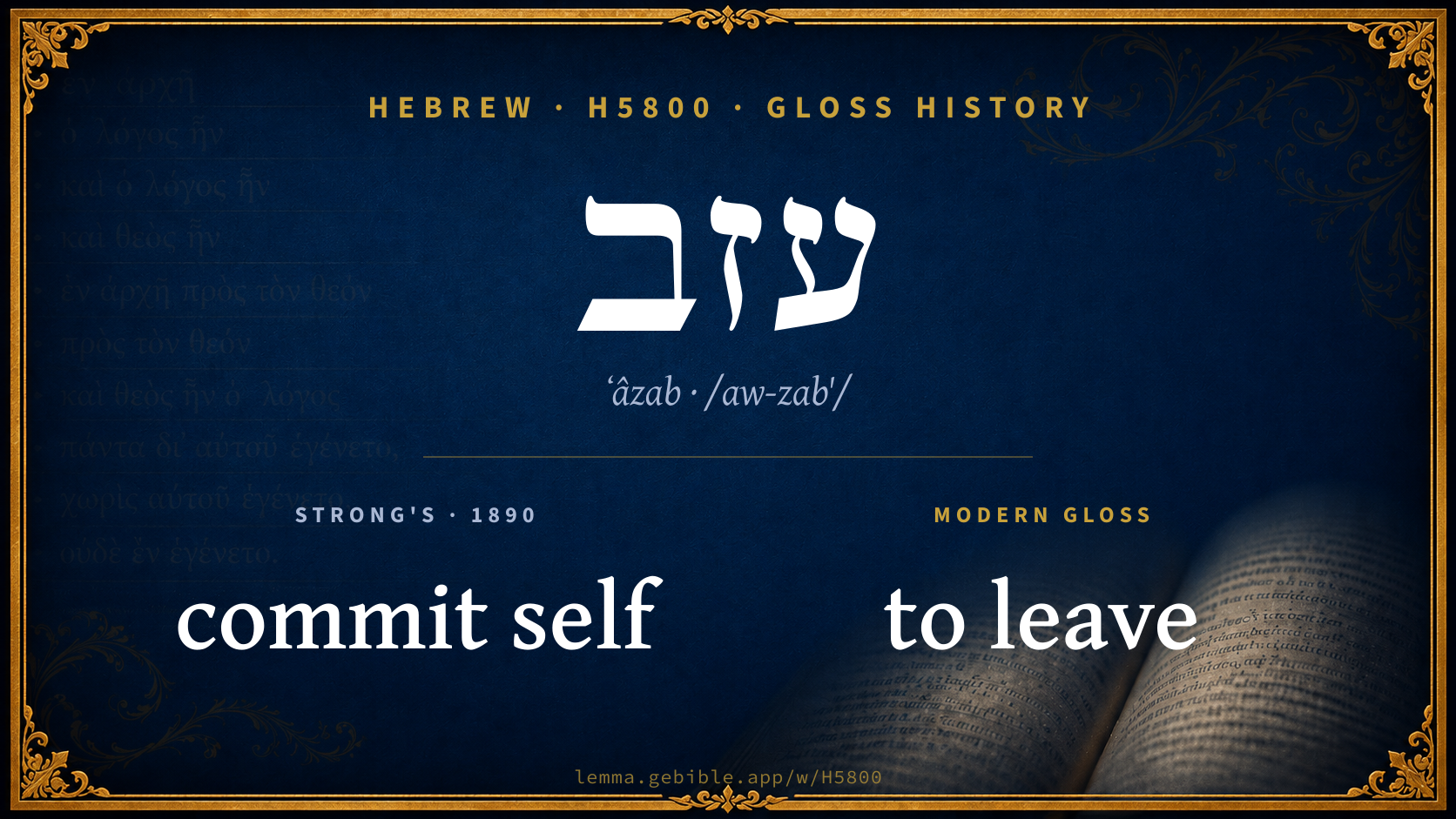
Gloss history
Strong's 1890 vs modern scholarship
About this word
Strong's H5800 catalogs a Hebrew word from the Hebrew Old Testament.
These counts are not copied from any lexicon or concordance. They are computed here, from the morphology-tagged Hebrew Old Testament. What Lemma adds →
- 206
- distinct verses
- The word appears in 206 distinct verses.
- 29 / 39
- OT books
- The word appears in 29 of 39 Old Testament books.
- #223
- by frequency
- Top 250 most frequent Hebrew words (rank 223 of 8,640 Hebrew words by occurrence).
View all 206 occurrences in the concordance →
By section of the Old Testament
By traditional corpus
Conventional, traditional groupings — biblical authorship is debated, so this is a traditional corpus grouping, not an authorship claim. Each share is this word’s portion of its verses in that division of the Hebrew canon. Each figure is a share of the word’s 206 distinct verses.
- Prophets (Nevi'im) 96 verses · 47%
- Writings (Ketuvim) 84 verses · 41%
- Torah (Pentateuch) 26 verses · 13%
How translations render this word
Counts come from each version’s own published word-to-Strong’s tagging or interlinear alignment — an approximate guide to how each version renders this word, not a word-level alignment the data otherwise carries. Because each total is that version’s own tagged count, the per-version totals vary from one another and need not match the appearance or distinct-verse counts above. These counts may also differ from a printed concordance because Lemma counts each distinctly tagged rendering and does not collapse phrase taggings into a single head-word total. This is a fixed set of word-tagged versions (KJV, ASV, BSB, ULT) and does not change with the reading translation you choose elsewhere. Each version’s license is shown beside its name below (and on Sources).
BDB lists this Strong’s number as 2 distinct words (homographs). Each count above pools all of them and is not split by sense — see the Senses section below. A low-frequency rendering may belong to a different one of those words, not the primary meaning.
- King James Version†: Forsake 23×, Left 15×, They have forsaken 10×
- American Standard Version†: Forsake 17×, Leave 10×, They forsook 10×
- Berean Standard Bible†: Forsake 14×, Forsaken 10×, Abandon 7×
- unfoldingWord Literal Text†: Abandoned 13×, They abandoned 11×, Do 9×
King James Version Public Domain
Renders H5800 across 215† tagged occurrences — most commonly:
Plus other, less common renderings. Plus 68 renderings that appear only once — usually multi-word phrases or single function words the recovered tagging swept in, not distinct renderings.
American Standard Version Public Domain
Renders H5800 across 214† tagged occurrences — most commonly:
Plus other, less common renderings. Plus 91 renderings that appear only once — usually multi-word phrases or single function words the recovered tagging swept in, not distinct renderings.
Berean Standard Bible Public Domain
Renders H5800 across 214† tagged occurrences — most commonly:
Plus other, less common renderings. Plus 80 renderings that appear only once — usually multi-word phrases or single function words the recovered tagging swept in, not distinct renderings. Not rendered by a distinct English word in 1 further occurrence.
unfoldingWord Literal Text CC BY-SA 4.0
Renders H5800 across 263† tagged occurrences — most commonly:
Plus other, less common renderings. Plus 86 renderings that appear only once — usually multi-word phrases or single function words the recovered tagging swept in, not distinct renderings.
26 senses and sub-senses in the full BDB
Hebrew verbs can shift meaning by stem (binyan): Qal is the basic action, Niphal is often passive or reflexive, Piel often intensifies or makes it factitive, and Hiphil is typically causative. The senses below are grouped under the stem BDB assigns to each. This entry also uses Pual (the passive of Piel).
What do BDB’s symbols mean?
BDB uses these scholarly abbreviations:
| Symbol | Meaning |
|---|---|
| 𝔊 | the Septuagint (the ancient Greek translation, LXX) |
| 𝔙 | the Vulgate (the Latin translation) |
| 𝔖 | the Syriac version (the Peshitta) |
| 𝔗 | the Targum (the Aramaic translation) |
| ψ | the Psalms |
| √ | root (the underlying root or stem) |
| ‖ | parallel passage (a synonymous or contrasted parallel) |
| † | the dagger: every passage where the word occurs is cited |
The 26 senses and sub-senses the full Brown-Driver-Briggs lexicon distinguishes for this word, in lexicon order (not ranked by frequency), with BDB’s own verbatim wording and sub-sense lettering. Shown in Hebrew script with BDB’s own scholarly abbreviations. The condensed entry is in the Lexicon Entry tab. See also the Forms in the corpus table below.
עזב I leave, forsake, loose (NH id. (rare)
Qal
- Pf. 3 ms. ע׳ Gn 24:27 +, sf. עֲזָבַנִי Is 49:14 ψ 38:11; 3 fs. עָזָבָ֑ה Ez 23:8; 1 s. sf. עֲזַבְתִּיךְ Is 54:7; 2 fpl. עֲזַבְתֶּן Ex 2:20, etc.; Impf. 3 ms. יַעֲזֹב Is 55:7 +, יַעֲזָב־ Gn 2:24, sf. 1 s. וַיַּעַזְבֵנִי 1 S 30:13, etc.; Imv. עֲזֹב ψ 37:8, עָזְבָה Je 49:11, עִזְבוּ Je 48:28; Pr 9:6, etc.; Inf. abs. עָזוֹב Je 14:5, עָזֹב Ex 23:5; cstr. עֲזֹב Gn 44:22 +, sf. עָזְבֵךְ Je 2:17 +, etc.; Pt. act. עֹזֵב Pr 10:17 +, cstr. עֹזְבִי (Ges§ 90 l); f. cstr. עֹזֶבֶת Pr 2:17 etc.; pass. עָזוּב Dt 32:26 +, etc.;— e.g. Genesis 24:27
- 1. leave, c. acc. (on order of meanings cf. NöZMG xl (1886), 726);
- a. = depart from, acc. pers. Gn 44:22(×2) (J), 2 K 2:2, 4, 6; 4:30; Nu 10:31 (P), Ru 1:16 Je 9:1 (‖ הָלַךְ מֵאֵת); acc. loc. 1 K 8:6 Je 25:28 (י׳ as lion leaving lair); c. מִן loc. intrans. (strangely) Je 18:14 (of snow). e.g. Genesis 44:22
- b. leave behind, acc. pers. Ex 2:20 (J), 2 S 15:16 (+ inf.), Ez 24:21; acc. rei + בְּיַד Gn 39:12, 13, + אֶצְלִי v 15, 18 (all J); + ב loc. 50:8 (J); acc. pers. et rei Ex 9:21 (J). e.g. Exodus 2:20
- c. leave in the presence of (לִפְנֵי) 1 Ch 16:37 (ל of accus., cf. ל 3 b supr.), 2 Ch 28:14. e.g. 1 Chronicles 16:37
- d. leave in safety, וְאָ֫נָה תַעַזְבוּ כְּבוֹדְכֶם Is 10:3. e.g. Isaiah 10:3
- e. leave in a given condition, situation, ע׳ אֹתוֹ בְמַחֲלֻיִים 2 Ch 24:25 they left him in great suffering; c. adv. acc. Ez 23:29; a city פְּתוּחָה Jos 8:17. e.g. 2 Chronicles 24:25
- f. leave undisturbed, let alone Ru 2:16. e.g. Ruth 2:16
- g. leave unexercised, Gn 24:27 pregn. he hath not left his kindness and his faithfulness from (being) with (מֵעִם) my master; so ע׳ חַסְדּוֹ אֶת־ Ru 2:20 (both of י׳); ע׳ חֵמָה ψ 37:8 (‖ הֶרֶף מֵאַף). e.g. Genesis 24:27
- h. leave in the hand of, entrust to, acc. rei + בְּיַד Gn 39:6 (J), + אֶל־ Jb 39:11 (‖ בָּטַח בְּ), + עַל־ ψ 10:14 (acc. om., his cause).—So also poss. (c. לְ) Ne 3:34 (reading לֵאלֹהִים for MT לָהֶם), but text prob. otherwise corrupt. e.g. Genesis 39:6
- i. leave to (ל) one (unaided), וְחָדַלְתָּ֫ מֵעֲזֹב לוֹ Ex 23:5a (E) thou shalt refrain from leaving it (sc. the affair) to him; cf. תַּעֲזֹב לָאָרֶץ בֵּיצֶיהָ Jb 39:14 (of ostrich). e.g. Exodus 23:5
- j. leave over, remaining, acc. pers. Ju 2:21 (JE); acc. rei + לְ pers. Lv 19:10; 23:22 (H), Mal 3:19. k. leave = have nothing to do with Pr 9:6. e.g. Judges 2:21
- 2. leave, abandon, forsake:
- a. abandon, acc. rei: (1) land, house, city, tent, etc., 1 S 31:7 = 1 Ch 10:7; 2 K 7:7; Je 9:18; 48:28; 51:9; 2 Ch 11:14; Is 17:9 (+ מִפְּנֵי of enemy); pt. pass. of cities v 2 Je 4:29; Zp 2:4, cf. עֲזוּבָה Is 17:9 pt. = subst. = deserted region. (2) oxen 1 K 19:20; idol-images (+ שָׁם) 2 S 5:21 = 1 Ch 14:12; flock Zc 11:17; pt. pass. of eggs Is 10:14. e.g. 1 Samuel 31:7
- b. forsake, (1) human subj. and obj.: Gn 2:24 (J; a man his + parents), 1 S 30:13; Jos 22:3 (D), Je 49:11 ψ 27:10 (parent a child), Pr 2:17 (wife her husband, אַלּוּף), cf. אִשָּׁה עֲזוּבָה Is 54:6, and ע׳ of personif. Zion Is 60:15; 62:4. (2) an animal its young Je 14:5 (obj. om.). e.g. Genesis 2:24
- c. = neglect, Levite Dt 12:19; 14:27, poor Jb 20:19. e.g. Deuteronomy 12:19
- d. especially (1) fig. of forsaking God (י׳), apostatizing, Ju 10:10; Dt 28:20; 31:16 Je 1:16 + 38 times (often Je and later); + Jon 2:9 (obj. חַסְדָּם, i.e. God, v. חֶסֶד II); c. ל + inf. only אֶת־י׳ עָֽזְבוּ לִשְׁמֹר Ho 4:10 (Oort We Now doubt לִשְׁמֹר). (2) obj. י׳’s law, commands, covenant, etc., Dt 29:24; 1 K 19:10, 14 + 14 times; house of י׳ 2 Ch 24:18; Ne 10:40. †(3) forsake, fail to follow, obey advice, instruction, wisdom, reproof: 1 K 12:8, 13 = 2 Ch 10:8, 13; Pr 2:13; 4:2, 6; 10:17; 15:10; 27:10. †(4) but also of forsaking idols Ez 20:8, sins of various kinds 23:8 Is 55:7; Pr 28:13 (obj. om.; + מוֹדֶה confess); הַמַּשָּׁא usury Ne 5:10. e.g. Judges 10:10
- e. of God’s forsaking, abandoning men: Dt 31:17; Is 41:17; 49:14; 54:7; 2 Ch 12:5; Ezr 9:9 ψ 9:11; 22:2 + 8 times ψψ; + בְּיַד Ne 9:28; ψ 37:33; ψ 16:10 thou wilt not abandon my soul לִשְׁאוֹל; of temporary abandonment 2 Ch 32:31 (+ inf. of purpose); etc. (34 times in all); + Je 12:7 (י׳ abandoning his house). e.g. Deuteronomy 31:17
- f. of God’s leaving, i.e. ceasing to regard, the earth, thus giving impunity to crime, Ez 8:12; 9:9. e.g. Ezekiel 8:12
- g. of strength (כֹּחַ) forsaking one ψ 38:11, courage (לֵב) 40:13, kindness and faithfulness (חֶסֶד וֶאֱמֶת) Pr 3:3. e.g. Psalms 38:11
- 3. let loose, set free, let go עָזֹב תַּעֲזֹב עִמּוֹ Ex 23:5b (E) thou shalt by all means free it (sc. the beast) with him, (aid him to set it free; on sense, cf. Dt 22:4; DHM sub ii. עזב); עָצוּר וְעָזוּב shut up and freed, proverb. phr., = all classes of people Dt 32:36; 1 K 14:10; 21:21; 2 K 9:8; 14:26 (exact meaning dub.; prob. either = bond and free, or [v. RSSem i. 437, 2nd ed. 456] under taboo and free from it); let go Jb 20:13 (c. acc. of wickedness as morsel in mouth); let loose my complaint Jb 10:1 (עָלַי apud me, cf. עַל II 1 d); אֶעֶזְבָה פָנַי Jb 9:27 I will loosen, relax, my face, (cf. Thes De Me Stu Di BuhlLex Bu; > abandon my [gloomy] countenance AV RV SS BaeKau Du). e.g. Exodus 23:5
Niphal
- Pf. 3 ms. נֶעֱזַב Ne 13:11; 3 fs. נֶעֱזָבָ֑ה Is 62:12; Impf. 3 fs. תֵּעָזֵב Is 7:16; Lv 26:43, תֵּעָ֣זַב Jb 18:4; 3 mpl. יֵעָֽזְבוּ Is 18:6; Pt. נֶעֱזָב Is 27:10 ψ 37:25; fpl. נֶעֱזָבוֹת Ez 36:4;— e.g. Nehemiah 13:11
- 1. be left to (לְ), i.e. to the possession of, Is 18:6. e.g. Isaiah 18:6
- 2. be forsaken, of house of God Ne 13:11, a city Ez 36:4; Is 27:10 (‖ מְשֻׁלָּח), 62:12; the earth Jb 18:4, land Is 7:16; Lv 26:43 (+ מִן of exiles); of man ψ 37:25. e.g. Nehemiah 13:11
Pual
- (or Qal pass., v. Ges§ 52 e) be deserted, of city: Pf. 3 ms. הֲמוֹן עִיר עֻזָּ֑ב Is 32:14 (‖ נֻטָ֔שׁ); 3 fs. עֻזְּבָה Je 49:25. e.g. Isaiah 32:14
עזב II restore, repair (?) (cf. perhaps Sab. עדֿב restore, Sab Denkm90 DHMÖster. Monatsschr. f. d. Orient 1885, 226
Qal
- Impf. 3 mpl. וַּיַּעַזְבוּ Ne 3:8 and they repaired (?) Jerus. as far as the broad wall; > paved GuZPV viii (1885), 282 f., or from √ I. עזב (see views in Be Ryle). e.g. Nehemiah 3:8
Senses from the full Brown-Driver-Briggs lexicon (Brown, Driver, Briggs; Oxford 1906 — public domain), digitized via Sefaria, supplemented by the OpenScriptures HebrewLexicon (CC BY 4.0). Full attribution on Sources.
Word origin
I. vb. leave, forsake, loose (NH id. (rare); Arabic عَرَبَ be remote, absent, depart, Assyrian ezêbu, leave, Shaph. ušezib, rescue, cf. Biblical Aramaic שֵׁיזֵב;—Ethiopic ማዕሰብ widowed Di 973);—
II. vb. restore, repair (?) (cf. perhaps Sab. עדֿב restore, Sab Denkm90 DHMÖster. Monatsschr. f. d. Orient 1885, 226; also NH מַעֲזִיבָה restoration, erection LevyNHWB iii. 186, Arabic معزب building-stone KremerBeitr. ii. 18);—
— Brown-Driver-Briggs (Oxford 1906, public domain), digitized via Sefaria, supplemented by the OpenScriptures HebrewLexicon (CC BY 4.0). See Sources.
Origin: a primitive root
Jastrow Dictionary
A second Hebrew/Aramaic lexicon for comparison, covering Aramaic and post-biblical (Talmudic, Targumic, Midrashic) usage that the biblical-Hebrew BDB does not. Matched by lemma rather than by Strong’s number, so a lemma may carry more than one Jastrow headword (shown separately below), and the entries cover usage well beyond the Bible.
עָזַב
- (b. h.) [to cut off,]
- 1. to relieve an animal broken down under its load (v. פָּרַק), help to unload. Mekh. Mishp. s. 20 (ref. to Ex. XXIII, 5) פעמים שאתה חדל ופעמים שאתה עוֹזֵב at times you may abstain, at times you must help. Ib. פריקה מנין ת"ל עָזוֹב וכ׳ whence do we derive the duty of unloading? It says (Ex. l. c.), thou must release with him; B. Mets. 32ᵃ. Tanḥ. Mishp. 1 עֲזוֹב קימעה מכאן וכ׳ loosen (the load) here a little, raise there &c. e.g. Exodus 23:5
- 2. to leave, abandon. Sot. 12ᵃ; Ex. R. s. 1 (ref. to עזובה, I Chr. II, 18) עזובה … שהכל עֲזָבוּהָ Azubah is Miriam … for all (young men) left her alone (ignored her on account of her sickliness). Midr. Till. to Ps. X וציון אמרה עֶזָבַנִי וכ׳ and Zion said, he has forsaken and forgotten me. Midr. Till. to Ps. XCII מי שמורה … ועוֹזֵב וכ׳ he who confesses his sins and forsakes (them, Prov. XXVIII, 13); a. fr. e.g. 1 Chronicles 2:18
- to untie, release; to effect a divorce. Gitt. 32ᵇ גט זה … לא יַעֲזִיב this letter shall have no effect, shall not untie, shall not release, contrad. to אינו מַעֲזִיב does not release, v. יָעַל.
- to make worth abandoning, make abominable. Yalk. Hos. 527 (ref. to Is. I, 4) אל תיקרי עזבו אלא עִיזְּבוּ read not, ‘they have forsaken’, but, ‘they have made (me) worth abandoning (caused me to be cruel); Tanḥ. B’huck. 2 עוזבו אתי (read עיזבו אותי). Pesik. R. s. 31 (ref. to עזבני, Is. XLIX, 14) עִיזְּבַנִי he has made me contemptible. e.g. Isaiah 1:4
- to be forsaken. Lev. R. s. 35 (ref. to Ps. XXXVII, 25) נ׳ מיראתו וכ׳ forsaken of his fear of the Lord. e.g. Psalms 37:25
- to be abandoned, neglected, hated. Gen. R. s. 45 ומִתְעַזֶּבֶת, v. כָּעַר; Cant. R. to II, 14 ומתעבת, ed. Wil. מתעובת (corr. acc., or read: מְתוֹעֶבֶת, v. תָּעַב). Pesik. R. l. c. והיו … ומִתְעַזְּבוֹת בפניהם and they became abominable and hateful in their sight.
עֲזַב
- , to forsake.—Part. pass. עָזֵיב. Y. Kidd. I, 61ᵃ מצורע ע׳ ‘leper’ (II Sam. III, 29) means abandoned (lonely).—V. שְׁזֵיב. e.g. 2 Samuel 3:29
A Dictionary of the Targumim, the Talmud Babli and Yerushalmi, and the Midrashic Literature (Marcus Jastrow; London, Luzac, 1903) — Public Domain. Digitized via Sefaria. Digitized via Sefaria. Full attribution on Sources.
Forms in the corpus
The 172 distinct written forms H5800 takes in the Hebrew Bible, most frequent first — each parse links to that stem’s occurrences in the concordance. Hebrew forms include their vowel points and cantillation, so a single lemma takes many written forms.
The 60 most common forms are shown; 112 rarer forms follow in the full concordance.
Same root — word family
Other BDB entries built from the same root as H5800, grouped by Strong’s listed origin. These share a root / origin per the lexicon — not necessarily a shared meaning. Each links to that word’s own entry.
Derived from this word
Compare all same-root words → They share a root, not necessarily a meaning.
Septuagint verse parallels
This word appears in 181 verses that also exist in the Greek Old Testament (Septuagint), out of the 206 Hebrew verses it occurs in. You can read those verses in Greek by switching the Old Testament edition to the Septuagint.
Read these verses in the Septuagint
- Genesis 2:24
- Exodus 2:20
- Leviticus 19:10
- Numbers 10:31
- Deuteronomy 12:19
- Joshua 1:5
- Judges 2:12
- Ruth 1:16
- 1 Samuel 8:8
- 2 Samuel 5:21
- 1 Kings 8:57
- 2 Kings 2:2
This is a verse-level parallel only — the same verses exist in both the Hebrew and Greek Old Testaments. No word-level Hebrew↔Greek correspondence is claimed: the data carries no such alignment, so no Greek word is shown as this Hebrew word’s translation. Coverage is not total — the Septuagint omits the deuterocanon and renumbers the Psalms, so some Hebrew verses have no direct Greek parallel.