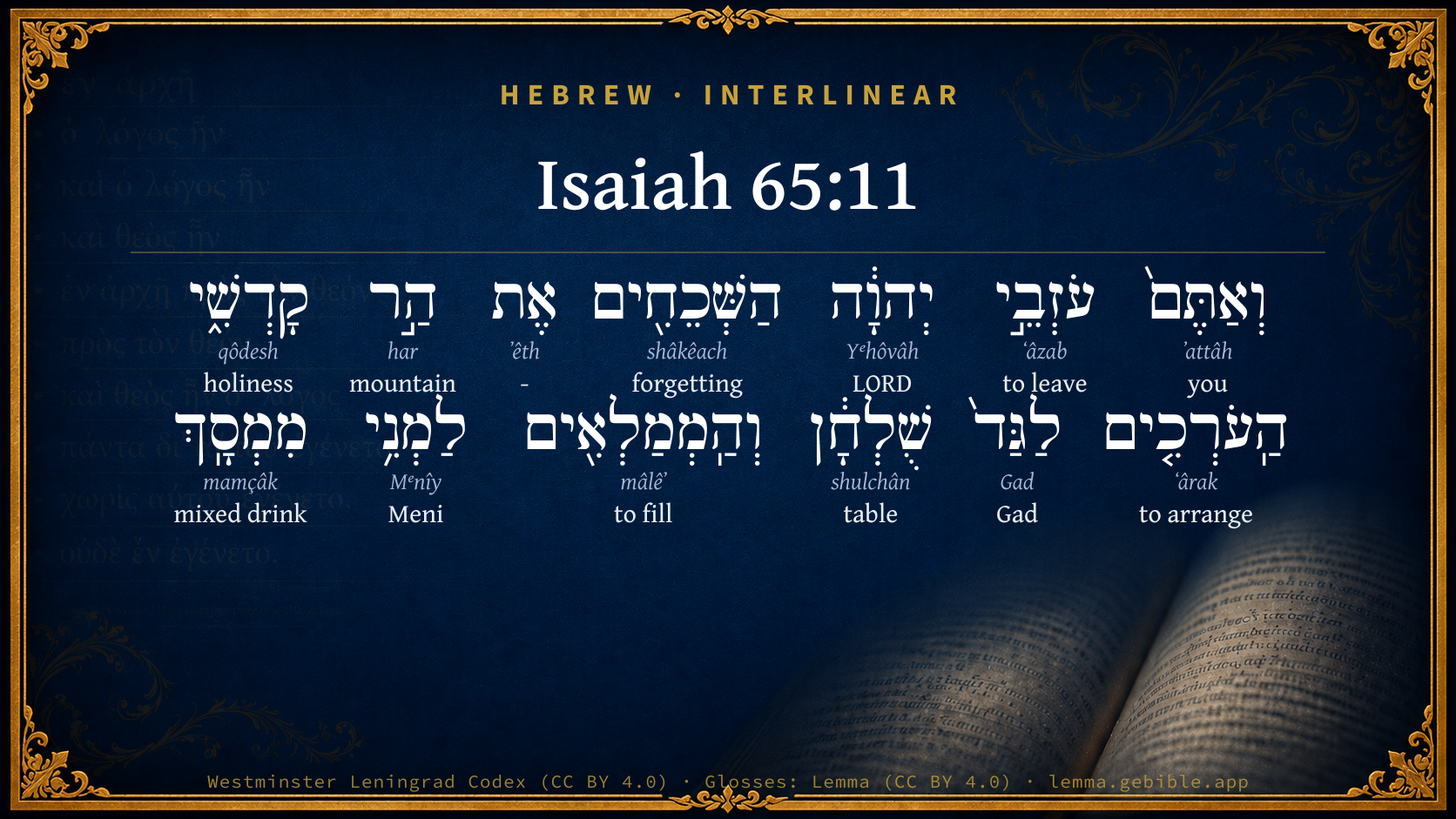
Isaiah 65:11

Hebrew (Westminster Leningrad Codex) Isaiah 65:11 appears in the Hebrew Old Testament. The text above is from the Westminster Leningrad Codex. Each word links to its Strong’s number, a concise gloss, and parsing drawn from the Open Scriptures Hebrew Bible morphology. Click any word for its full Brown-Driver-Briggs (BDB) entry.
Download image
Cite this verse

Isaiah 65:11 (World English Bible). Public Domain. Lemma interlinear Bible study tool, https://lemma.gebible.app/v/isaiah/65/11.

Show BibTeX & RIS
BibTeX
RIS
English Translation
But you who forsake Yahweh, who forget my holy mountain, who prepare a table for Fortune, and who fill up mixed wine to Destiny;
World English Bible · Public Domain
Highlights
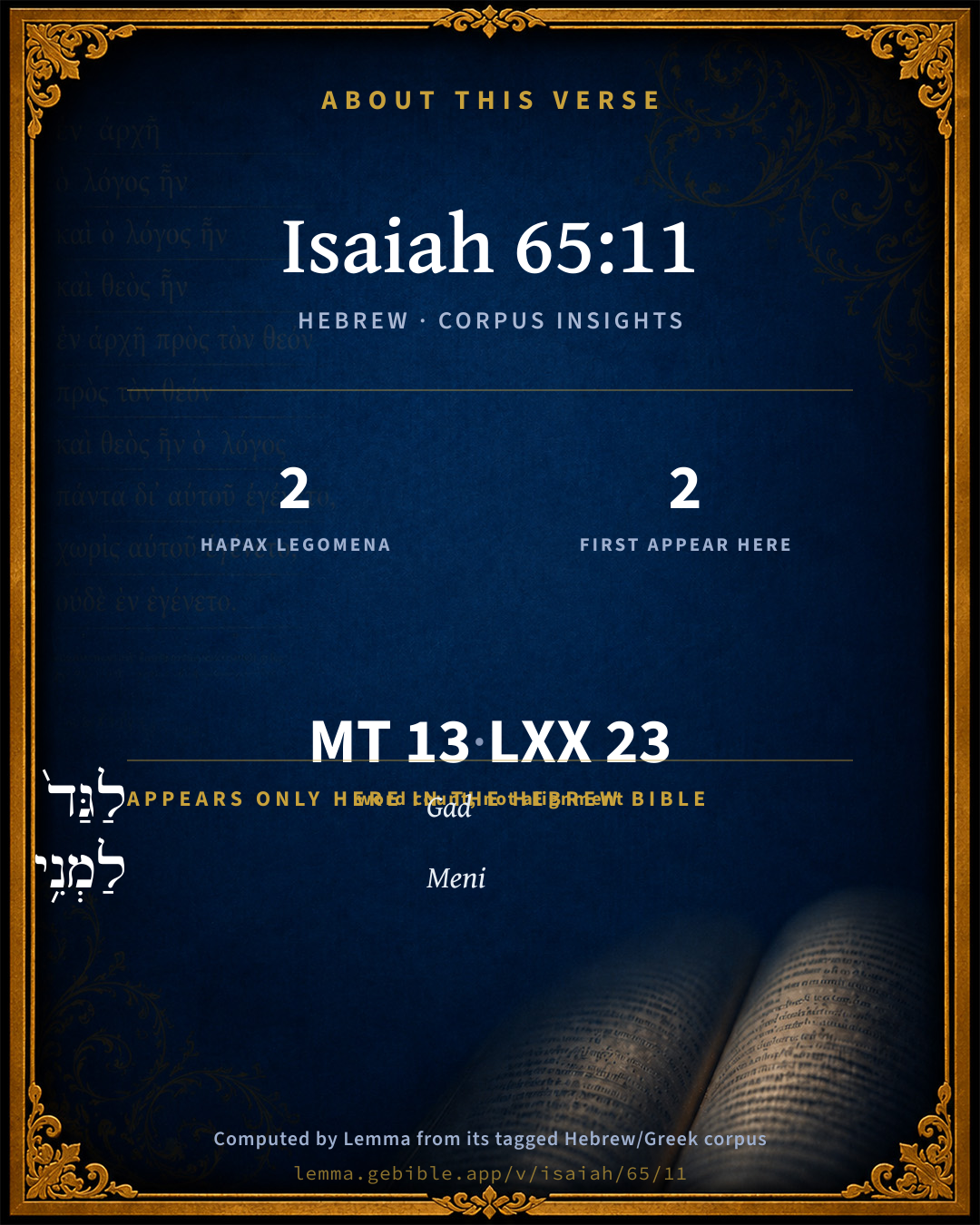
  • 2 hapax legomena — only here in the Hebrew Bible
  • 2 first appearances in the Hebrew Bible
Full analysis ↓
Download a study sheet

One document with this verse’s original text, its word-by-word gloss line, the meaning frame, cross-references with their text, attributed commentary, and full source and license credits — printable, and it pastes into notes with its structure intact.

This verse Autodidact and up

Study sheet (.html) Plain text (.txt)

A passage Seminary Student

Up to 50 verses in one chapter. A passage sheet keeps up to 6 commentary sources and 12 cross-references per verse, in the order this page ranks them, and says so on the sheet whenever that leaves anything out. Ask for a single verse and you get the Autodidact verse sheet above.

Everything on this page stays free to read, with no account — the sheet is a download of what is already on screen, not access to it.

Want to remove ads? Support Godless Engineer
Compare translations 3

The same verse in 3 English versions, stacked beneath the original-language interlinear above. Click any original word for its lexicon entry.

Each is an independent rendering of the whole verse — the interlinear is not word-aligned to these translations.

Highlighted words mark where these versions differ — a whole-verse word diff, not a word-by-word alignment.

  • World English Bible Public Domain
    But you who forsake Yahweh, who forget my holy mountain, who prepare a table for Fortune, and who fill up mixed wine to Destiny;
  • King James Version Public Domain
    But ye are they that forsake the LORD, that forget my holy mountain, that prepare a table for that troop, and that furnish the drink offering unto that number.
  • unfoldingWord Literal Text CC BY-SA 4.0
    But you ones abandoning Yahweh, forgetting the mountain of my holiness, arranging a table for Fortune and filling mixed wine for Destiny,

unfoldingWord Literal Text — © unfoldingWord, licensed CC BY-SA 4.0. Word-aligned USFM3 via Door43 (git.door43.org/unfoldingWord/en_ult).

Versions to compare (up to 4)

3 of 4 selected

Show all 18 translations

Every available English version of this verse, each an independent rendering of the whole verse.

  • World English Bible Public Domain
    But you who forsake Yahweh, who forget my holy mountain, who prepare a table for Fortune, and who fill up mixed wine to Destiny;
  • Berean Standard Bible Public Domain
    But you who forsake the LORD, who forget My holy mountain, who set a table for Fortune and fill bowls of mixed wine for Destiny,
  • Majority Standard Bible Public Domain
    But you who forsake the LORD, who forget My holy mountain, who set a table for Fortune and fill bowls of mixed wine for Destiny,
  • King James Version Public Domain
    But ye are they that forsake the LORD, that forget my holy mountain, that prepare a table for that troop, and that furnish the drink offering unto that number.
  • American Standard Version (1901) Public Domain
    But ye that forsake Jehovah, that forget my holy mountain, that prepare a table for Fortune, and that fill up mingled wine unto Destiny;
  • Revised Version (1885) Public Domain
    But ye that forsake the LORD, that forget my holy mountain, that prepare a table for Fortune, and that fill up mingled wine unto Destiny;
  • Geneva Bible (1599) Public Domain
    But ye are they that haue forsaken the Lord and forgotten mine holy Mountaine, and haue prepared a table for the multitude, and furnish the drinke offerings vnto the number.
  • Douay-Rheims (1899) Public Domain
    And you, that have forsaken the Lord, that have forgotten my holy mount, that set a table for fortune, and offer libations upon it,
  • Young's Literal Translation Public Domain
    And ye `are' those forsaking Jehovah, Who are forgetting My holy mountain, Who are setting in array for Gad a table, And who are filling for Meni a mixture.
  • Literal Standard Version CC BY-SA 4.0
    And you [are] those forsaking YHWH, || Who are forgetting My holy mountain, || Who are setting a table in array for Gad, || And who are filling a mixture for Meni.
  • Unlocked Literal Bible CC BY-SA 4.0
    But you who abandon Yahweh, who forget my holy mountain, who prepare a table for Fortune, and fill wine glasses of mixed wine for Destiny.
  • unfoldingWord Literal Text CC BY-SA 4.0
    But you ones abandoning Yahweh, forgetting the mountain of my holiness, arranging a table for Fortune and filling mixed wine for Destiny,
  • Darby Bible Public Domain
    But ye who forsake Jehovah, who forget my holy mountain, who prepare a table for Gad, and fill up mixed wine unto Meni:
  • World Messianic Bible Public Domain
    “But you who forsake the LORD, who forget my holy mountain, who prepare a table for Fortune, and who fill up mixed wine to Destiny;
  • Webster's Bible Public Domain
    But ye are they that forsake the LORD, that forget my holy mountain, that prepare a table for that troop, and that furnish the drink-offering to that number.
  • Free Bible Version CC BY-SA 4.0
    But those of you who desert the Lord and forget about my holy mountain, who prepare feasts for the god of good luck, who fill jugs of mixed wine for the god of destiny,
  • Bible in Basic English Public Domain
    But as for you who have given up the Lord, who have no care for my holy mountain, who get ready a table for Chance, and make offerings of mixed wine to Fate;
  • JPS Tanakh (1917) Public Domain
    But ye that forsake the LORD, that forget My holy mountain, that prepare a table for Fortune, and that offer mingled wine in full measure unto Destiny,

Literal Standard Version (2020), Covenant Press — licensed CC BY-SA 4.0. Text via the HelloAO Bible API (eBible.org). Unlocked Literal Bible (unfoldingWord) — licensed CC BY-SA 4.0. Text via the HelloAO Bible API (eBible.org). unfoldingWord Literal Text — © unfoldingWord, licensed CC BY-SA 4.0. Word-aligned USFM3 via Door43 (git.door43.org/unfoldingWord/en_ult). Free Bible Version, Dr. Jonathan Gallagher — licensed CC BY-SA 4.0. Text via the HelloAO Bible API (eBible.org).

Word by word

More ways to search: Search by grammar → Find every occurrence → Compare this word →

Practice this passage: Drill this verse → Learn its vocabulary →

לַגַּד֙
Gad
H1408
“to/for the · Gad”
Preposition, Determined + Noun, Proper
Part of Speech
Preposition + Noun
Type
Proper
Full BDB Definition

Origin: a variation of H1409

TWOT: 313e

Gad = "god of fortune" - a Babylonian deity
  1. וְאַתֶּם֙ ʼattâh H859 “and · you” Conjunction + Pronoun, Personal, 2nd Person, Masculine, Plural
  2. עֹזְבֵ֣י ʻâzab H5800 “leaving” Verb, Qal, Participle Active, Masculine, Plural, Construct
  3. יְהוָ֔ה Yᵉhôvâh H3068 “LORD” Noun, Proper
  4. הַשְּׁכֵחִ֖ים shâkêach H7913 “the · forgetting” Particle, Definite Article + Adjective, Adjective, Masculine, Plural, Absolute
  5. אֶת ʼêth H853 “-” Particle, Direct Object
  6. הַ֣ר har H2022 “mountain of” Noun, Common, Masculine, Singular, Construct
  7. קָדְשִׁ֑י qôdesh H6944 “holiness · my” Noun, Common, Masculine, Singular, Construct + Suffix, Personal, 1st Person, Common, Singular
  8. הַֽעֹרְכִ֤ים ʻârak H6186 “the · arranging” Particle, Definite Article + Verb, Qal, Participle Active, Masculine, Plural, Absolute
  9. שֻׁלְחָ֔ן shulchân H7979 “table” Noun, Common, Masculine, Singular, Absolute
  10. וְהַֽמְמַלְאִ֖ים mâlêʼ H4390 “and · the · filling” Conjunction + Particle, Definite Article + Verb, Piel, Participle Active, Masculine, Plural, Absolute
  11. לַמְנִ֥י Mᵉnîy H4507 “to/for the · Meni” Preposition, Determined + Noun, Proper
  12. מִמְסָֽךְ mamçâk H4469 “mixed drink” Noun, Common, Masculine, Singular, Absolute

About this verse

These counts appear in no published source. They are computed here, from the morphology-tagged text and Lemma’s own curated glosses. What Lemma adds →

13
words
13
distinct lemmas
Prophets
section

Notable vocabulary

2 hapax legomena — words that appear only here in the entire Hebrew Bible:

  • לַגַּד֙ Gad H1408
  • לַמְנִ֥י Meni H4507

First appearance in Scripture

These words make their first canonical appearance in the Hebrew Bible here:

  • לַגַּד֙ Gad H1408
  • לַמְנִ֥י Meni H4507

Shared distinctive vocabulary

הַשְּׁכֵחִ֖ים forgetting H7913 occurs in 2 verses of the Hebrew Bible. Also found in:

Grammatical profile

  • 3 verbs
  • 7 nouns
  • 1 adjective
  • 1 pronoun
  • 1 particle

Verb forms

  • עֹזְבֵ֣י Qal · Participle Active
  • הַֽעֹרְכִ֤ים Qal · Participle Active
  • וְהַֽמְמַלְאִ֖ים Piel · Participle Active

Hebrew & Septuagint length

In English translation the verse runs 24 words from the Hebrew and 27 from the Septuagint (LXX English) — closely comparable.

A rough comparison of the two English renderings, which tokenize alike — not a word-level alignment.

Word counts can differ between the Hebrew and the Greek without any difference in meaning — e.g. the Hebrew direct-object marker אֵת has no separate Greek word, and Greek often adds the article ὁ.

In the original languages it is 13 Hebrew tokens and 23 Greek tokens — but the two are counted differently (Hebrew bundles its prefixes and suffixes into one token; the Greek is in lemma form), so that isn’t a like-for-like length.

Cross-references

17

Topical passages linked to Isaiah 65:11 in the Treasury of Scripture Knowledge — connected by theme and wording, ordered by reader-vote popularity; previews shown in the World English Bible.

  • Deuteronomy 32:17 They sacrificed to demons, [which were] no God, To gods that they didn't know, To new [gods] that came up of late, Which your fathers didn't dread.
  • Isaiah 1:28 But the destruction of transgressors and sinners shall be together, And those who forsake Yahweh shall be consumed.
  • Isaiah 2:2 It shall happen in the latter days, that the mountain of Yahweh's house shall be established on the top of the mountains, And shall be raised above the hills; And all nations shall flow to it.
  • 1 Corinthians 10:20–21 But I say that the things which the Gentiles sacrifice, they sacrifice to demons, and not to God, and I don't desire that you would have communion with demons.
  • Deuteronomy 29:24–25 even all the nations shall say, Why has Yahweh done thus to this land? what means the heat of this great anger?
  • 1 Chronicles 28:9 You, Solomon my son, know the God of your father, and serve him with a perfect heart and with a willing mind; for Yahweh searches all hearts, and understands all the imaginations of the thoughts: if you seek him, he will be found of you; but if you forsake him, he will cast you off forever.
  • Psalms 132:13 For Yahweh has chosen Zion. He has desired it for his habitation.
  • Isaiah 11:9 They shall not hurt nor destroy in all my holy mountain; for the earth shall be full of the knowledge of Yahweh, as the waters cover the sea.
  • Isaiah 56:7 even them will I bring to my holy mountain, and make them joyful in my house of prayer: their burnt offerings and their sacrifices shall be accepted on my altar; for my house shall be called a house of prayer for all peoples.
  • Isaiah 57:5–10 you who inflame yourselves among the oaks, under every green tree; who kill the children in the valleys, under the clefts of the rocks?
  • Isaiah 57:13 When you cry, let those who you have gathered deliver you; but the wind shall take them, a breath shall carry them all away: but he who takes refuge in me shall possess the land, and shall inherit my holy mountain.
  • Isaiah 65:25 The wolf and the lamb shall feed together, and the lion shall eat straw like the ox; and dust shall be the serpent's food. They shall not hurt nor destroy in all my holy mountain, says Yahweh.
  • Jeremiah 2:28 But where are your gods that you have made you? let them arise, if they can save you in the time of your trouble: for according to the number of your cities are your gods, Judah.
  • Jeremiah 17:13 Yahweh, the hope of Israel, all who forsake you shall be disappointed. Those who depart from me shall be written in the earth, because they have forsaken Yahweh, the spring of living waters.
  • Ezekiel 23:41–42 and sit on a stately bed, with a table prepared before it, whereupon you did set my incense and my oil.
  • Hebrews 12:22 But you have come to Mount Zion, and to the city of the living God, the heavenly Jerusalem, and to innumerable hosts of angels,
  • Revelation 21:2–3 I saw the holy city, New Jerusalem, coming down out of heaven from God, made ready like a bride adorned for her husband.

Cross-references courtesy of OpenBible.info (CC BY 4.0).

Hebrew and Greek witnesses Masoretic Hebrew ↔ Greek Septuagint

The same verse in the two great witnesses to the Old Testament, shown verse-for-verse.

These are two independent witnesses, not word-aligned to each other, and the Septuagint is shown in lemma (dictionary) form.

Hebrew Isaiah 65:11 Masoretic · Westminster Leningrad Codex

וְאַתֶּם֙ עֹזְבֵ֣י יְהוָ֔ה הַשְּׁכֵחִ֖ים אֶת הַ֣ר קָדְשִׁ֑י הַֽעֹרְכִ֤ים לַגַּד֙ שֻׁלְחָ֔ן וְהַֽמְמַלְאִ֖ים לַמְנִ֥י מִמְסָֽךְ

But you who forsake Yahweh, who forget my holy mountain, who prepare a table for Fortune, and who fill up mixed wine to Destiny;

World English Bible · Public Domain

Greek LXX Isaiah 65:11 Septuagint · lemma form

σύ δέ ὁ ἐν καταλείπω ἐγώ καί ἐπιλανθάνω ὁ ὄρος ὁ ἅγιος ἐγώ καί ἑτοιμάζω ὁ δαίμων τράπεζα καί πληρόω ὁ τύχη κέρασμα

But you⌃ are they that have left me, and forget my holy mountain, and prepare a table for the devil, and fill up the drink-offering to Fortune.

LXX2012 (modern English Septuagint) · Public Domain

On this verse, Trapp's Complete Commentary discusses the Septuagint’s reading. Read the note in Commentary ↓

Hebrew: Westminster Leningrad Codex (CC BY 4.0). Greek: Septuagint (public domain); English from LXX2012 (modern English Septuagint) (Public Domain). How the Septuagint differs from the Hebrew →

Targum (Aramaic paraphrase)

1

The Targum is the ancient Jewish Aramaic paraphrase of the Hebrew Scriptures — an interpretive translation, not the Hebrew text itself. Onkelos (literal) and Pseudo-Jonathan (expansive) render the Torah, and Jonathan the Prophets. Coverage is partial: where no permissively-licensed English translation exists for a verse, only the Aramaic is shown. This is verse-level text, not a word-by-word alignment to the Hebrew.

  1. Targum Jonathan Prophets (Joshua–Malachi)
    וְאַתּוּן בֵּית יִשְׂרָאֵל שְׁבַקְתּוּן פּוּלְחָנָא דַייָ אִתְנְשֵׁיתוּן יַת פּוּלְחַן טוּרָא דְקוּדְשִׁי דִמְסַדְרִין לְטַעֲוָן פְּתוֹרִין וּמְמַזְגִין לִדְחַלְתְּהוֹן אֲגָנִין:

    But ye, O house of Israel, ye have forsaken the worship of the Lord, ye have forgotten the worship of my holy mountain, that prepare tables for the idols, and mix goblets for their gods.

    Targum Jonathan — Aramaic: “Mikraot Gedolot” (public domain). English: “Sefaria Community Translation” (CC0 1.0 (public-domain dedication)); “London "Chaldee Paraphrase," 1871” (public domain). Text via Sefaria.

Commentary

Notes on Isaiah 65:11 from classic Christian and Jewish commentators (each source and its license shown beneath its notes). The classic Christian expositions comment on the surrounding passage and are grouped to its opening verse, so a note may address several verses; the Jewish commentaries on the Tanakh (Rashi and others) are per-verse, so they appear only where the commentator wrote on this verse.

Lemma curates 59 commentaries, every one of them public domain or Creative Commons licensed, each selected and text-cleaned for this edition rather than reprinted as found. About our sources →

Matthew Henry's Commentary

Here the different states of the godly and wicked, of the Jews that believed and of those that still persisted in unbelief, are set the one over - against the other, as life and death, good and evil, the blessing and the curse.

I. Here is the fearful doom of those that persisted in their idolatry after the deliverance out of Babylon, and in infidelity after the preaching of the gospel of Christ. Observe,

1. What the doom is that is here threatened: "I will number you to the sword as sheep for the slaughter, and there shall be no escaping, no standing out; you shall all bow down to it," Isa 65:12. God's judgments come, (1.) Regularly, and are executed according to the commission. Those fall by the sword that are numbered or counted out to it, and none besides. Though the sword seems to devour promiscuously one as well as another, yet it is made to know its number and shall not exceed. (2.) Irresistibly. The strongest and most stout-hearted sinners shall be forced to bow before them; for none ever hardened their hearts against God and prospered.

2. What the sins are that number them to the sword. (1.) Idolatry was the ancient sin (Isa 65:11): "You are those who, instead of seeking me and serving me as my people, forsake the Lord, disown him, and cast him off to embrace other gods, who forget my holy mountain (the privileges it confers and the obligations it lays you under) to burn incense upon the mountains of your idols (Isa 65:7), and have deserted the one only living and true God." They prepared a table for that troop of deities which the heathen worship and poured out drink-offerings to that numberless number of them; for those that thought one God too little never thought scores and hundreds sufficient, but were still adding to the number of them, till they had as many gods as cities and their altars were as thick as heaps in the furrows of the field, Hos 12:11. Some take Gad and Meni, which we translate a troop and a number, to be the proper names of two of their idols, answering to Jupiter and Mercury. Whatever they were, their worshippers spared no cost to do them honour; they prepared a table for them, and filled out mixed wine for drink-offerings to them; they would pinch their families rather than stint their devotions, which should shame the worshippers of the true God out of their niggardliness. (2.) Infidelity was the sin of the later Jews (Isa 65:12): When I called, you did not answer, which refers to the same that Isa 65:2 did (I have stretched out my hands to a rebellious people), and that is applied to those who rejected the gospel. Our Lord Jesus himself called (he stood and cried, Joh 7:37), but they did not hear, they would not answer; they were not convinced by his reasonings nor moved by his expostulations; both the fair warnings he gave them of death and ruin and the fair offers he made them of life and happiness were slighted and made no impression upon them. Yet this was not all: You did evil before my eyes, not by surprise, or through inadvertency, but with deliberation: You did choose that wherein I delighted not; he means that which he utterly detested and abhorred. It is not strange that those who will not be persuaded to choose that which is good persist in their choice and pursuit of that which is evil. See the malignity of sin; it is evil in God's eyes, highly offensive to him, and yet it is committed before his eyes, in his sight and presence, and in contempt of him; it is likewise a contradiction to the will of God; it is doing that, of choice, which we know will displease him.

II. The aggravation of this doom, from the consideration of the happy state of those that were brought to repentance and faith.

1. The blessedness of those that serve God, and the woeful condition of those that rebel against him, are here set the one over - against the other, that they may serve as a foil to each other, Isa 65:13-16. (1.) God's servants may well think themselves happy, and for ever indebted to that free grace which made them so, when they see how miserable some of their neighbours are for want of that grace, who are hardened, and likely to perish for ever in unbelief, and what a narrow escape they had of being among them. See Isa 66:24. (2.) It will add to the grief of those that perish to see the happiness of God's servants (whom they had hated, and vilified, and looked upon with the utmost disdain), and especially to think that they might have shared in their bliss if it had not been their own fault. It made the torment of the rich man in hell the more grievous that he saw Abraham afar off and Lazarus in his bosom, Luk 16:23. See Luk 13:28. Sometimes the providence of God makes such a difference as this between good and bad in this world, and the prosperity of the righteous becomes a grievous eye-sore and vexation of heart to the wicked (Psa 112:10), and it will certainly be so in the great day. We fools counted his life madness and his end without honour; but now how is he numbered with the saints and his lot is among the chosen. Now,

2. The difference of their states lies in two things: -

(1.) In point of comfort and satisfaction. [1.] God's servants shall eat and drink; they shall have the bread of life to feed, to feast upon, continually, shall be abundantly replenished with the goodness of his house, and shall want nothing that is good for them. Heaven's happiness will be to them an everlasting feast; they shall be filled with that which now they hunger and thirst after. But those who set their hearts upon the world, and place their happiness in that, shall be hungry and thirsty, always empty, always craving; for it is not bread; it surfeits, but it satisfies not. In communion with God, and dependence upon him, there is full satisfaction; but in sinful pursuits there is nothing but disappointment. [2.] God's servants shall rejoice and sing for joy of heart. They have constant cause for joy, and there is nothing that may be an occasion of grief to them but they have an allay sufficient for it; and, as far as faith is in act and exercise, they have a heart to rejoice, and their joy is their strength. They shall rejoice in their hope, because it shall not make them ashamed. Heaven will be a world of everlasting joy to all that are now sowing in tears. But, on the other hand, those that forsake the Lord shut themselves out from all true joy, for they shall be ashamed of their vain confidence in themselves, and their own righteousness, and the hopes they had built thereon. When the expectations of bliss wherewith they had flattered themselves are frustrated, O what confusion will fill their faces! Then shall they cry for sorrow of heart, and howl for vexation of spirit, perhaps in this world, when their laughter shall be turned into mourning and their joy into heaviness, and certainly in that world where the torment will be endless, easeless, and remediless - nothing but weeping, and wailing, and gnashing of teeth, to eternity. Let these two be compared, Now he is comforted and thou art tormented, and which of the two will we choose to take our lot with?

(2.) In point of honour and reputation, Isa 65:15, Isa 65:16. The memory of the just is, and shall be, blessed, but the name of the wicked shall rot. [1.] The name of the idolaters and unbelievers shall be left for a curse, shall be loaded with ignominy and made for ever infamous. It shall be used in giving bad characters - Thou art as cruel as a Jew; and in imprecation - God make thee as miserable as a Jew. It shall be for a curse to God's chosen, that is, for a warning to them; they shall be afraid of falling under the curse upon the Jewish nation, of perishing after the same example of unbelief. The curse of those whom God rejects should make his chosen stand in awe. The Lord God shall slay thee; he shall quite extirpate the Jews and cut them off from being a people; they shall no longer live as a nation, nor ever be incorporated again. [2.] The name of God's chosen shall become a blessing: He shall call his servants by another name. The children of the covenant shall no longer be called Jews, but Christians; and to them, under that name, all the promises and privileges of the new covenant shall be secured. This other name shall be an honourable name; it shall not be confined to one nation, but with it men shall bless themselves in the earth, all the world over. God shall have servants out of all nations who shall all be dignified with this new name. They shall bless themselves in the God of truth. First, They shall give honour to God both in their prayers and in their solemn oaths, in their addresses for his favour as their felicity and their appeals to his justice as their Judge. This is a part of the homage we owe to God; we must bless ourselves in him, that is, we must reckon that we have enough to make us happy, that we need no more, and can desire no more, if we have him for our God. It is of great consequence what we bless ourselves in, what we most please ourselves with and value ourselves by our interest in. Worldly people bless themselves in the abundance they have of this world's goods (Psa 49:18; Luk 12:19); but God's servants bless themselves in him, as a God all-sufficient for them. He is their crown of glory and diadem of beauty, their strength and portion. By him also they shall swear, and not by any creature or any false god. To his judgment they shall refer their cause, from whom every man's judgment doth proceed. Secondly, They shall give honour to him as the God of truth, the God of the Amen (so the word is); some understand it of Christ who is himself the Amen, the faithful witness (Rev 3:14), and in whom all the promises are yea and amen, Co2 1:20. In him we must bless ourselves, and by him we must swear unto the Lord and covenant with him. He that is blessed in the earth (so some read it) shall be blessed in the true God, for Christ is the true God and eternal life, Jo1 5:20. And it was promised of old that in him all the families of the earth should be blessed, Gen 12:3. Some read it, He shall bless himself in the God of the faithful people, in God as the God of all believers, desiring no more than to share in the blessings wherewith they are blessed, to be dealt with as he deals with them. Thirdly, They shall give him honour as the author of this blessed change which they have the experience of; they shall think themselves happy in having him for their God who has made them to forget their former troubles, the remembrance of them being swallowed up in their present comforts: Because they are hidden from God's eyes, that is, they are quite taken away; for, if there were any remainder of their troubles, God would be sure to have his eye upon it, in compassion to them and concern for them. They shall no longer feel them; for God will no longer see them. He is pleased to speak as if he would make himself easy by making them easy; and therefore they shall with a great deal of satisfaction bless themselves in him.

Matthew Henry's Commentary on the Whole Bible (1708–1710) — public domain (CC PDM 1.0). Text via the HelloAO Bible API.

Trapp's Complete Commentary

John Trapp

Isa 65:11 But ye [are] they that forsake the LORD, that forget my holy mountain, that prepare a table for that troop, and that furnish the drink offering unto that number.

Ver. 11. But ye are they that forsake the Lord.] Or, As for you, that have forsaken the Lord to observe lying vanities, and so are miserable by your own election, {Joh 12:8} you shall be yet more miserable at the great day of judgment especially, of which some take this following part of the chapter to be meant and intended. Then these improbi et reprobi shall be sure to smoke for it; then they shall return and discern between the righteous and the wicked; yea, the judge himself shall show them a manifest difference. {Isa 65:13-16}

That forget my holy mountain,] i.e., My temple and pure worship, which ye slight and neglect, q.d., There is no new wine in your cluster, but rather gall and deadly poison; therefore it shall be otherwise with you.

That prepare a table for that troop.] As the Israelites feasted before the Lord; {Deu 16:14-15} so in an apish imitation did the heathens before their idols; {Jdg 9:27 Eze 18:6-7 1Co 8:10} and of them these superstitious Jews had learned to do the like, in the days of Ahaz and Manasseh, who degenerated into his grandfather Ahaz, as if there had been no intervention of a Hezekiah.

For that troop.] So the prophet speaketh, as pointing to their idols, whereof they had great store. Gad (here used) and Menni (rendered number here likewise), some interpret fortune and fate; others, Jupiter and Mercury. The Septuagint, for "to that number," hath "to the devil." Oecolampadius thinks the prophet alludeth to the Pythagorean numbers, and especially to the number of four (τετρακτος), which they superstitiously observed. Others say, the Jews symbolised with the heathens in drinking to their idols by number. To such an idol they would drink so many cups, and that was called a drink offering to that number. Hence Antiphanes in Athenaeus {a} saith,

“ Adusque tria pocula venerandos esse deos. ”

{a} Lib. x.

John Trapp, A Commentary or Exposition upon All the Books of the Old and New Testament (1647–1656) — public domain. Text from a community e-Sword module.

The Biblical Illustrator

Joseph S. Exell

Isa_65:11-12

That prepare a table for that troop

Luck and Fortune

Among Orientals the planets Jupiter and Venus were worshipped as the Larger and the Lesser Luck.

They were worshipped as Merodach and Istar among the Babylonians. Merodach was worshipped for prosperity. It may be Merodach and Istar to whom are here given the names Gad (or Luck) and Meni, or Fate, Fortune. There was in the Babylonian Pantheon a Manu the Great, who presided over fate. (Prof. G. A. Smith, D. D.)

The lectisternia:

The rites described are the lectisternia, well known throughout the ancient world, in which a table was spread, furnished with meats and drinks as a meal for the gods. (Prof. J. Skinner, D. D.)

God or chance?

Let us give the passage its true rendering, and it may convey to us a very solemn lesson. It is, That as for you that forsake His service, that prepare a table for fortune, and pour out the wine for destiny, I have destined you for the slaughter. Behold, My servants shall eat; but ye who prepare a table for fortune shall be hungry. Behold, My servants shall drink; but ye who pour out libations to destiny shall be thirsty. Behold, My servants shall rejoice; but ye who believe in luck shall be ashamed. Ye shall leave your name for a curse. My servants shall bless themselves, and shall swear by the God of Amen--that is, the God of verity and of faithfulness. The apostate Jews were beginning to trust in the gods of the nations, to make banquets to the planet Jupiter, which they regarded as the star of fortune, and to pour libations to the planet Venus, which they regarded as the star of luck. Therefore God tells them that not these stars, not these idols, not these imaginary entities; but that He would be their destiny, and that He would deliver them, because fortune and destiny which they worshipped could guide them only to hunger and thirst, and ruin; but His servants, they who trusted in Him, should never be ashamed; they should find Him to be their God, a God of blessing, a God of amen--yea, a faithful witness. (F. W. Farrar, D. D.)

The temptation to ignore God

Have we no similar temptation? The passage is full of the deepest lessons. It touches upon the very first commandment - Thou shalt have none other gods but Me. It emphasizes the very first chapter o Genesis - It is God that hath mad us, and not we ourselves. It is nothing short of a whole philosophy of history and a whole philosophy of life. The terms, accident, fortune, luck, play a vast part in the customs and literature of the world, but no part at all in Scripture. The very word chance, properly speaking, is entirely absent alike from the Old and New Testament. It is, I suppose, belief in chance that gives its terrible fascination to that pestilent folly of gambling which has ruined so many thousands of Englishmen. But let us look at this subject of the supposed government of life by chance from far wider points of view than these.

1. For instance, it very closely affects our human history. The ancient nations believed in chance. They called it chance, or fortune, if one man got a crown as the prize of his wickedness and the other got a gibblet; they called it chance if a battle lost, which raised one ruler from a dungeon to a throne, cut down another form the throne to a dungeon. In this way they, as the prophet says, raised a table to fortune. Do you look at the history of mankind in this way or not? What is history to you? Is it a mere ghastly phantasmagoria of human passions struggling together, or is it the unfolding of a great Divine drama to a merciful issue? Neither in national life nor individual life can we pretend to understand the dealings of God. We cannot tell why the career of a great man is cut short just when he might seem to have been most able to save his country, and why the life of a villain is not cut short before he has done thousands into misery and ruin. We are like a deaf man watching the angers of the harpist as they dance over the strings.

2. But now, turning from history in general to the individual lives of each of us, I can hardly exaggerate the difference which it will make to us whether we regard our lives as being guided by God or as being guided by accident. Nominally, I suppose, we all profess that it is God who is weaving the pattern of our little clay; but do we truly believe it, and do we behave as if we did? Take, for instance, the events of which we habitually speak as the accidents of life. If we can think that these things happen simply by chance, what misery it may cause us! How do men and women thus painfully stricken sometimes curse the day of their life I But what a difference when they have the grace to recognize that this may be in their own life but bitter aloes from the gentle hand of God! As this thought, that it is God and not chance who shapes our ends, touches even the most imperfect characters with the glory of resignation, how may it give to the whole course of our daily, life the grace of contentment! (F. W.Farrar, D. D.)

I wish to emphasize the prophets warning against the counter sin of pouring out spiced wine for destiny--in other words, of regarding all life as though we were the helpless victims of blind necessity, of irreversible laws, of passionless and adamantine forces, which we can neither modify nor resist. The forms taken by this view of destiny are sometimes religious and sometimes irreligious.

1. One of them pro-Ceases to be very religious indeed--it is Calvinism.

2. Another form of this worship of destiny is fatalism--the notion that as God has decreed everything in this life, nothing will happen except what He has decreed, and therefore that it is quite useless for men to stir. When, in the conquest of Mexico, the unhappy emperor, Montezuma, was crushed with blow after blow of disaster, he made use of this proverb, We are born; let that come which must come. Fatalism, like Calvinism, is founded on misapprehended truths, and issues in deplorable results; and it, too, must be flung away as being, for all practical purposes, absurd and false.

3. But there is one more form of preparing a table for fortune, and pouring out spiced wine for destiny. It is materialism, which denies the existence of God altogether, or treats Him, at the best, as an unproved hypothesis. It makes its God of science, of nature, of material laws, of man himself. It makes man a mere machine. It destroys at a touch all responsibility. It makes suicide a perfectly permissible resource. It says, to quote its own votaries, that nothing is worthy our efforts, our struggles, or our energies--that the world is a bankrupt in all quarters, and life a business which does not pay its expenses, and annihilation preferable to existence, and the world fundamentally something which ought not to exist. Well, as long as there is such a thing as Christianity, we must brand the insolent, aspiring brow of these spurious notions. (F. W.Farrar, D. D.)

The Biblical Illustrator, edited by Joseph S. Exell (c. 1880s–1900s) — public domain. Text from a community e-Sword module.

Joseph Benson's Commentary

Isa 65:11. But, &c. — The prophet now returns to address his discourse to the sinners and apostates, whom he had reproved and threatened, (Isa 65:2-3,) and renews his charge against them for forsaking the Lord, separating themselves from his worship, and polluting themselves with idolatry, the most shameful and abominable in his sight. Ye are they that forsake the Lord — Let not any of you that are idolaters and covenant- breakers think that these promises belong to you: you are apostates from God’s fear and love, his worship and service, and have neither part nor lot in this matter; that forget my holy mountain — My temple and worship, a figure of the Christian Church. That prepare a table, &c. — As God had altars, which are sometimes called tables, (see Eze 41:22,) so they prepared altars for their idols. By preparing a table here, however, seems rather to be meant the feasts they made upon their sacrifices, in imitation of what the true God had commanded his people, Deu 16:14-15; for that troop — A troop of idols, worshipped by the heathen; and furnish the drink-offerings unto their number — God had appointed drink- offerings, as a sort of homage to be paid to him; and these people paid this homage to their idols. The words gad and meni, the former of which is rendered troop here, and the latter number, are thought by many commentators to be the names of certain idols. The LXX. render the former word τω δαιμονιω, the demon, or devil, and the latter τη τυχη, fortune. Or, according to the copy St. Jerome seems to have used, they have translated gad, fortune, and meni, demon. Not to mention the opinion of other learned men, Dr. Waterland and Bishop Lowth suppose that gad means the sun, and meni, the moon. And it seems very probable that the moon, at least, is meant by one of these names, being generally worshipped throughout all the East, and termed the queen of heaven, and afterward by the Greeks under the name of Hecate. The idolatrous Jews erected altars to this fancied goddess on the tops of their houses, or near their doors, and in the corners of their streets, or in groves, and offered to her incense, cakes baked with oil and honey, and drink-offerings of wine, and other liquors. And it appears to have been usual among the Greeks from the most ancient times, to spread in the evening a table covered with dainties, in the highways, in honour to her. But it is of no consequence to us what these objects of idolatrous worship were; nor have we any cause to regret, that the inspired penmen have not deigned to inform us, but have “chosen rather that the memory of the knowledge of them should be utterly abolished. And God be praised, that they are so totally abolished that we are quite at a loss to know what, and what sort of things they were.” — Schmidius, quoted by Bishop Lowth.

Joseph Benson's Commentary on the Old and New Testaments (1811–1818) — public domain. Text from a community e-Sword module.

Keil & Delitzsch

C. F. Keil & F. Delitzsch

The prophecy now turns again to those already indicated and threatened in Isa 65:1-7. "And ye, who are enemies to Jehovah, O ye that are unmindful of my holy mountain, who prepare a table for Gad, and fill up mixed drink for the goddess of destiny - I have destined you to the sword, and ye will all bow down to the slaughter, because I have called and ye have not replied, I have spoken and ye have not heard; and ye did evil in mine eyes, and ye chose that which I did not like." It may be taken for granted as a thing generally admitted, that Isa 65:11 refers to two deities, and to the lectisternia (meals of the gods, cf., Jer 7:18; Jer 51:44) held in their honour. שׁלחן ערך is the other side of the lectum sternere, i.e., the spreading of the cushions upon which the images of the gods were placed during such meals of the gods as these. In the passage before us, at any rate, the lectus answering to the shulchân (like the sella used in the case of the goddesses) is to be taken as a couch for eating, not for sleeping on. In the second clause, therefore, ממסך למני והממלאים (which is falsely accentuated in our editions with tifchah mercha silluk, instead of mercha tifchah silluk), ממסך מלּא signifies to fill with mixed drink, i.e., with wine mixed with spices, probably oil of spikenard. מלּא may be connected not only with the accusative of the vessel filled, but also with that of the thing with which it is filled (e.g., Exo 28:17). Both names have the article, like הבּעל. הגּד is perfectly clear; if used as an appellative, it would mean "good fortune." The word has this meaning in all the three leading Semitic dialects, and it also occurs in this sense in Gen 30:11, where the chethib is to be read בּגד (lxx ἐν τύχῃ). The Aramaean definitive is גּדּא (not גּדא), as the Arabic 'gadd evidently shows. The primary word is גּדד (Arab. 'gadda), to cut off, to apportion; so that Arab. jaddun, like the synonymous ḥaḍḍun, signifies that which is appointed, more especially the good fortune appointed. There can be no doubt, therefore, that Gad, the god of good fortune, more especially if the name of the place Baal-Gad is to be explained in the same way as Baal-hammn, is Baal (Bel) as the god of good fortune. Gecatilia (Mose ha-Cohen) observes, that this is the deified planet Jupiter. This star is called by the Arabs "the greater luck" as being the star of good fortune; and in all probability it is also the rabb-el-bacht (lord of good fortune) worshipped by the Ssabians (Chwolsohn, ii. 30, 32). It is true that it is only from the passage before us that we learn that it was worshipped by the Babylonians; for although H. Rawlinson once thought that he had found the names Gad and Menni in certain Babylonian inscriptions (Journal of the Royal Asiatic Society, xii. p. 478), the Babylonian Pantheon in G. Rawlinson's Monarchies contains neither of these names. With this want of corroborative testimony, the fact is worthy of notice, that a Rabbi named 'Ulla, who sprang from Babylon, explains the דרגשׁ of the Mishna by דגדא ערסא (a sofa dedicated to the god of prosperity, and often left unused) (b. Nedarim 56a; cf., Sanhedrin 20a).

(Note: The foreign formula of incantation given in b. Sabbath 67a, ובושכי עושדי ל וסינוק ידג דג (according to the glosses, "O Fortune, give good fortune, and be not tardy day and night"), also belongs here; whereas the name of a place not far from Siloah, called Gad-yavan (Gad of Greece), contains some allusion to the mythology of Greece, which we are unable to trace. In the later usage of the language Gad appears to have acquired the general meaning of numen (e.g., b. Chullin 40a; דהר גד, the mountain-spirit); and this helps to explain the fact that in Pehlewi גדמן signifies majesty in a royal, titular sense (see Vuller's Lex.; and Spiegel in the Indische Studien, 3, 412).)

But if Gad is Jupiter, nothing is more probable than that Meni is Venus; for the planet Venus is also regarded as a star of prosperity, and is called by the Arabs "the lesser luck." The name Meni in itself, indeed, does not necessarily point to a female deity; for meni from mânâh, if taken as a passive participial noun (like גּרי בּריה, a creature), signifies "that which is apportioned;" or if taken as a modification of the primary form many, like גּדי, טלי, צבי, and many others, allotment, destination, fate. We have synonyms in the Arabic mana-n and meniye, and the Persian bacht (adopted into the Arabic), which signify the general fate, and from which bago-bacht is distinguished as signifying that which is exceptionally allotted by the gods. The existence of a deity of this name meni is also probably confirmed by the occurrence of the personal name עבדמני on certain Aramaeo-Persian coins of the Achaemenides,

(Note: See Rdiger in the concluding part of the thes. p. 97.)

with which Frst associates the personal name Achiman (see his Lex.), combining מן with Μήν, and מני with Μήνη, as Movers (Phnizier, i. 650) and Knobel have also done. מן and מני would then be Semitic forms of these Indo-Germanic names of deities; for Μήν is Deus Lunus, the worship of which in Carrae (Charran) is mentioned by Spartian in chapter vi. of the Life of Caracalla, whilst Strabo (xii. 3, 31, 32) speaks of it as being worshipped in Pontus, Phrygia, and other places; and Μήνη is Dea Luna (cf., Γενείτη Μάνη in Plut. quaest. rom. 52, Genita Mana in Plin. h. n. 29, 4, and Dea Mena in Augustine, Civ. 4, 11), which was worshipped, according to Diodorus (iii. 56) and Nonnus (Dionys. v. 70 ss.), in Phoenicia and Africa. The rendering of the lxx may be quoted in favour of the identity of the latter with מני (ἑτοιμάζοντες τῷ δαιμονίῳ (another reading δαίμονι τράπεζαν καὶ πληροῦντες τῇ τύχῃ κέρασμα), especially if we compare with this what Macrobius says in Saturn. i. 19, viz., that "according to the Egyptians there are four of the gods which preside over the birth of men, Δαίμων Τύχη ̓́Ερωσ ̓Ανάγκη. Of these Daimōn is the sun, the author of spirit, of warmth, and of light. Tychē is the moon, as the goddess through whom all bodies below the moon grow and disappear, and whose ever changing course accompanies the multiform changes of this mortal life."

(Note: See Ge. Zoega's Abhandlungen, edited by Welcker (1817), pp. 39, 40.)

In perfect harmony with this is the following passage of Vettius Valens, the astrologer of Antioch, which has been brought to light by Selden in his Syntagma de Diis Syris: Κλῆροι τῆς τύχης καὶ τοῦ δαίμονος σημαίνουσιν (viz., by the signs of nativity) ἣλιον τε καὶ σελήνην. Rosenmller very properly traces back the Sept. rendering to this Egyptian view, according to which Gad is the sun-god, and Meni the lunar goddess as the power of fate. Now it is quite true that the passage before us refers to Babylonian deities, and not to Egyptian; at the same time there might be some relation between the two views, just as in other instances ancient Babylonia and Egypt coincide.

But there are many objections that may be offered to the combination of מני (Meni) and Μήνη: (1.) The Babylonian moon-deity was either called Sı̄n, as among the ancient Shemites generally, or else by other names connected with ירח (ירח) and châmar. (2.) The moon is called mâs is Sanscrit, Zendic mâo, Neo-Pers. mâh (mah); but in the Arian languages we meet with no such names as could be traced to a root mân as the expansion of mâ (to measure), like μήν μήνη), Goth. mena; for the ancient proper names which Movers cites, viz., ̓Αριαμένησ ̓Αρταμένης, etc., are traceable rather to the Arian manas = μένος, mens, with which Minerva (Menerva, endowed with mind) is connected. (3.) If meni were the Semitic form of the name for the moon, we should expect a closer reciprocal relation in the meanings of the words. We therefore subscribe to the view propounded by Gesenius, who adopts the pairing of Jupiter and Venus common among the Arabs, as the two heavenly bodies that preside over the fortunes of men; and understands by Meni Venus, and by Gad Jupiter. There is nothing at variance with this in the fact that 'Ashtoreth (Ishtar, with 'Ashērâh) is the name of Venus (the morning star), as we have shown at Isa 14:12. Meni is her special name as the bestower of good fortune and the distributor of fate generally; probably identical with Mant, one of the three leading deities of the prae-Islamitish Arabs.

(Note: See Krehl, Religion der vorislamischen Araber, p. 78. Sprenger in his Life of Mohammad, 1862, compares the Arabic Manât with מני.)

The address proceeds with umânı̄thı̄ (and I have measured), which forms an apodosis and contains a play upon the name of Meni, Isa 65:11 being as it were a protasis indicating the principal reason of their approaching fate. Because they sued for the favour of the two gods of fortune (the Arabs call them es-sa'dâni, "the two fortunes") and put Jehovah into the shade, Jehovah would assign them to the sword, and they would all have to bow down (כּרע as in Isa 10:4). Another reason is now assigned for this, the address thus completing the circle, viz., because when I called ye did not reply, when I spake ye did not hear (this is expressed in the same paratactic manner as in Isa 5:4; Isa 12:1; Isa 50:2), and ye have done, etc.: an explanatory clause, consisting of four members, which is repeated almost word for word in Isa 66:4 (cf., Isa 56:4).

Keil & Delitzsch — Biblical Commentary on the Old Testament (1861–1891) — public domain (CC PDM 1.0). Text via the HelloAO Bible API. (Old Testament only.)

Tyndale Open Study Notes

Tyndale Open Resources

65:11 Fate and Destiny are names of pagan gods (Gad, Meni) that were thought to bring fortune and determine one’s destiny.

Tyndale Open Study Notes — © Tyndale Open Resources, licensed CC BY-SA 4.0. Text via the HelloAO Bible API.

Geneva Bible (1599)

Geneva Bible translators

By the multitude and number he meaneth their innumerable idols of whom they thought they could never have enough.

Geneva Bible (1599) marginal notes — public domain. Text via Bolls.life.

Jamieson, Fausset & Brown

Robert Jamieson, A. R. Fausset & David Brown

holy mountain--Moriah, on which the temple was.

troop--rather "Gad," the Babylonian god of fortune, the planet Jupiter, answering to Baal or Bel; the Arabs called it "the Greater Good Fortune"; and the planet Venus answering to Meni, "the Lesser Good Fortune" [GESENIUS, KIMCHI, &c.]. Tables were laid out for their idols with all kinds of viands, and a cup containing a mixture of wine and honey, in Egypt especially, on the last day of the year [JEROME].

drink offering--rather, "mixed drink."

number--rather, "Meni"; as goddess of fortune she was thought to number the fates of men. VITRINGA understands Gad to be the sun; Meni the moon, or Ashtaroth or Astarte (Kg1 11:33).

Jamieson, Fausset & Brown — Commentary Critical and Explanatory on the Whole Bible (1871) — public domain (CC PDM 1.0). Text via the HelloAO Bible API.

Adam Clarke's Commentary

Verse 11. That prepare a table for that troop - "Who set in order a table for Gad"] The disquisitions and conjectures of the learned concerning Gad and Meni are infinite and uncertain: perhaps the most probable may be, that Gad means good fortune, and Meni the moon. "But why should we be solicitous about it?" says Schmidius. "It appears sufficiently, from the circumstances, that they were false gods; either stars, or some natural objects; or a mere fiction. The Holy Scriptures did not deign to explain more clearly what these objects of idolatrous worship were; but chose rather, that the memory of the knowledge of them should be utterly abolished. And God be praised, that they are so totally abolished, that we are now quite at a loss to know what and what sort of things they were." Schmidius on the place, and on Jdg 2:13, Bibl. Hallensia.

Jerome, on the place, gives an account of this idolatrous practice of the apostate Jews, of making a feast, or a lectisternium, as the Romans called it, for these pretended deities. Est in cunctis urbibus, et maxime in AEgypto, et in Alexandria, idololatriae vetus consuetudo, ut ultimo die anni, et mensis ejus qui extremus est, ponant mensam refertam varii generis epulis, et poculum mulso mixtum; vel praeteriti anni vel futuri fertilitatem auspicantes. Hoc autem faciebant et Israelitae, omnium simulachrorum portenta venerantes; et nequaquam altari victimas, sed hujusmodi mensae liba fundebant. "In all cities, and especially in Egypt and Alexandria, it was an ancient idolatrous custom on the last day of the year, to spread a table covered with various kinds of viands, and a goblet mixed with new wine, referring to the fertility either of the past or coming year. The Israelites did the same, worshipping all kinds of images, and pouring out libations on such tables," c. See also Le Clerc on the place and on lxvi. 17, and Dav. Millii Dissert. v.

The allusion to Meni, which signifies number, is obvious. If there had been the like allusion to Gad, which might have been expected, it might perhaps have helped to let us into the meaning of that word. It appears from Jerome's version of this place, that the words τῳ δαιμονιω, to a demon, (or δαιμονι, as some copies have it,) and τῃ τυχῃ, to fortune, stood in his time in the Greek version in an inverted order from that which they have in the present copies; the latter then answering to גד gad, the former to מני meni: by which some difficulty would be avoided; for it is commonly supposed that גד gad signifies τυχη, fortune. See Ge 30:11, apud Sept. This matter is so far well cleared up by MSS. Pachom. and I. D. II., which agree in placing these two words in that order, which Jerome's version supposes. - L.

My Old MS. Bible translates: That putten the borde of fortune; and offreden licours upon it; and so the Vulgate.

Ἑτοιμαζοντες τῳ δαιμονιῳ τραπεζαν, και πληρουντες τῃ τυχῃ κερασμα Preparing a table for the demon, and filling up, or pouring out, a libation to fortune." - Septuagint.

Ye have set up an aulter unto fortune

And geven rich drink offeringes unto treasure.

COVERDALE.

Adam Clarke's Commentary on the Bible (1810–1826) — public domain. Text from a community e-Sword/MySword module.

Ellicott's Commentary for English Readers

(11) That forget my holy mountain . . .—The words imply, like Isa_65:3-5, the abandonment of the worship of the Temple for a heathen ritual, but those that follow point, it will be seen, to Canaanite rather than Babylonian idolatry, and, so far, are in favour of the earlier date of the chapter. The same phrase occurs, however, as connected with the exiles in Psa_137:5.

That prepare a table for that troop.—Hebrew, “for the Gad,” probably the planet Jupiter, worshipped as the “greater fortune,” the giver of good luck. The LXX. renders “for the demon” or “Genius.” The name of Baal-Gad (Jos_11:17; Jos_12:17) indicates the early prevalence of the worship in Syria. Phœnician inscriptions have been found with the names Gad-Ashtoreth and Gad-Moloch. The “table” points to the lectisternium (or “feast”), which was a prominent feature in Assyrian and other forms of polytheism.

Unto that number.- Here, again, we have in the proper name of a Syrian deity, probably of the planet Venus as the “lesser fortune.” Some scholars have found a name Manu in Babylonian inscriptions; and Manât, one of the three deities invoked by the Arabs in the time of Mahomet, is probably connected with Mëni the it (Cheyne). See Sayce, as in Note on Isa_65:4.

A Bible Commentary for English Readers, edited by Charles John Ellicott (1878–1897) — public domain. Text from a community e-Sword module.

The Cambridge Bible for Schools and Colleges

gen. ed. J. J. S. Perowne

11, 12. A renewed threat against the apostates, with a further allusion to their idolatry.

But ye are they that forsake &c.] Render: But as for you that forsake Jehovah (ch. Isa_1:4) &c. The whole verse is a descriptive anticipation of the object of the verb “destine” in Isa_65:12 (see R.V.).

that forget my holy mountain] The phrase may denote either simple indifference to the welfare of Zion (cf. Psa_137:5), or deliberate abstention from the Temple ritual. The second view implies residence in Palestine at a time when the Temple services were in full operation; hence the other is necessarily adopted by all who hold the prophecy to have been written in Babylon. It is perhaps impossible to decide which is right, although those who recognise a Palestinian colouring throughout the chapter will naturally prefer the second as the more forcible interpretation, and find in it some confirmation of their theory.

that prepare a table &c.] Better: that spread a table for Gad, and fill up mixed wine (see ch. Isa_5:22) to Meni. The rites described are the lectisternia, well known throughout the ancient world, in which a table was spread, furnished with meats and drinks as a meal for the gods (Liv. Isa_5:13; Herodot. 1:183; Ep. of Jeremiah , vv. 27 f.; Bel and the Dragon, v. 11; cf. Jer_7:18; Jer_19:13; Jer_44:17, 1Co_10:21). A parallel in the O.T. religion is the Shewbread in the Temple (or Tabernacle), Exo_25:30 &c. Gesenius remarks that the description of the complete lectisternium extends over both members of the parallelism, and infers that the two deities were worshipped together. This is probable, being in accordance with ancient custom (Liv. Isa_5:13), but the laws of Hebrew parallelism hardly permit us to say that this must be the meaning.

That Gad and Meni are divine proper names is universally acknowledged, although neither has quite lost its appellative signification and both are here pointed with the article. Gad means “good fortune”; he is personified luck. [The rendering “troop” in A.V. is a mistake. Cf. Gen_30:11, where “A troop cometh” should be “With fortune!” as R.V. marg. In Gen_49:19, where a different etymology is supposed, the word for “troop” is not gad but gĕdûd.] The existence of a Syrian god of this name (or the Greek equivalent Τύχη) is well established, and his worship is proved to have extended over a very wide area (see Baethgen, Beiträge zur Sem. Rel.-Gesch. pp. 76–80). It appears that the evidence is most copious amongst the Greek inscriptions of the Hauran (note the proximity to the Hebrew tribe of Gad) where there must have been numerous temples in his honour. But the name occurs also in Phœnician and Palmyrene inscriptions, and on coins of several cities, including Ashkelon, while a temple to the “Fortune” of Gaza is known to have existed in that city (Baethgen, p. 66). The place-names Baal-Gad (at the foot of Hermon, Jos_11:17; Jos_12:7; Jos_13:5) and Migdal-Gad (in Judah, Jos_15:37) seem to shew that his worship was practised in Palestine proper. There are besides frequent references in Syriac and later Jewish literature; a Syriac writer of the 5th century mentions that lectisternia were still prepared for Gad in his time. The Jewish interpreters identified Gad with the planet Jupiter, called by the Arabs “the greater Luck,” but this association may be more recent than our passage (Baethgen). Meni (Mìnî) has left fewer traces. He is possibly identical with the goddess Manât, one of the three chief divinities of the pre-Mohammedan Arabs (Koran, Sura 53:19–23). A personal name ‘Abdmenî (= Servant of Meni?) has been found on coins of the Achæmenidæ, but the accuracy of this is doubted by some (Delitzsch, Schrader in Riehm’s Handwörterbuch). The meaning of the word is “Destiny,” and the god has been identified with the planet Venus, “the lesser Luck” of the Arabs. It is quite as likely, however, that Meni is the antithesis of Gad,—the god of evil destiny. [Observe that in the LXX. Gad is Δαιμόνιον and Meni Τύχη.] Nothing has yet been discovered to connect these deities with the Babylonian pantheon. Some think they may be Hebrew equivalents of Babylonian names (Dillmann), others that their worship was transported from Syria to Babylon (Baethgen). These are speculations, but the actual evidence points to Western Asia as the natural environment of this cult.

The Cambridge Bible for Schools and Colleges (gen. ed. J. J. S. Perowne; Cambridge University Press, 1878–1918) — public domain. Text from a community e-Sword module.

John Gill's Exposition

But ye are they that forsake the Lord,.... Here the Lord returns to the body of the people again, the unbelievers and rejecters of the Messiah, who turned away from him, would not hear his doctrine, nor submit to his ordinances; they forsook the worship of the Lord, as the Targum; yea, some that professed to be his disciples, and followed him for a while, left him, and walked no more with him, Joh 6:60,

that forget my holy mountain; Mount Zion, the city of the living God, the heavenly Jerusalem, the Gospel church, to which the seed or heirs, the chosen of God, and the servants of the Lord among the Jews, came, and enjoyed the immunities of it, and worshipped the Lord there; but these men forgot it, and either never came, or, if any of them did, they soon forsook the assembling of themselves together, as the manner of some was, Heb 12:22,

that prepare a table for that troop; or, "for a troop"; a troop of idols worshipped; or, "for Gad", which some take to be the name of a star; and R. Moses the priest says it is the name of the star Jupiter, in the Arabic language, a lucky star. The Vulgate Latin version renders it, "for fortune": and the word is used by the Jewish writers (y) for the goddess Fortune, or good luck, and who make mention of "the bed of fortune" (z); a bed, which, they say, is prepared for a star, and no man may sleep on it; and a table also, which they might not use but for that star, the same with the table here; for they used beds or couches at their tables, or at eating. And Jerom on the place says, it was an old custom in Egypt, particularly in Alexandria and other cities, on the last day of the year, to prepares table, with all kind of provisions for eating and drinking, by way of thankfulness for the fertility of the last year, and in order to obtain it in the year following; and this the Israelites did. "Table" seems to be put for an altar, on which sacrifice was offered to idols. Mention is made by Herodotus (a) of the table of the sun among the Ethiopians.

And that furnish the drink offering unto that number: or, "to a number"; to a number of deities, which were as numerous as their cities, Jer 2:28 and according to the number of them they provided drink offerings, or a mixture of wine and water; and also according to the number of the priests that sacrificed they filled cups of wine, as Jarchi observes; or according to the number of letters in a person's name they wished well to, as many cups they drank, to which Sanctius thinks the allusion is; or to "Meni", which R. Moses takes to be the name of a star; some interpret it of a number of stars or planets, the seven planets particularly; and others of the planet Mercury. Some think it is the name of an idol, either, of an idol of the Arabians, as Pocock (b); or of the Armenians, as others, Armenia being called Minni, Jer 51:27. The Targum interprets both clauses of idol deities; and so, in the gloss on the Talmud (c), they are both said to be the names of idols. Bynaeus (d) seems to me to have advanced the best notion of Gad and Meni, translated "that troop", and "that number", which is, that the one signifies the sun, and the other the moon, which he supports with many reasons; so Vitringa; and yet there is a difficulty in the words, how they are to be applied to the Jews in the times of Christ and the apostles, when they were not guilty of such idolatrous practices; unless this is to be understood of the sins of their forefathers visited on them, as in Isa 65:3, though this is said of the same persons that forsook the Lord, and forgot his mountain; wherefore I am inclined to think that some thing like this is the sense of the words; that the evil charged upon this people, and of which they were guilty, was, that they regarded the stars, and attributed their case and circumstances to the influences of them, or to fate and fortune, rather than to the providence of God; or trusted in their troops and numbers, and so defied and despised the Roman army that besieged them, which was their ruin.

(y) Bereshit Rabba, sect. 65. fol. 58. 2. T. Bab. Cholin, fol. 40. 1. (z) T. Bab. Nedarim, fol. 56. 1. & Gloss. in ib, & Sanhedrin, fol. 20, 1. Gloss. in ib. (a) Thalia, sive I. 3. c. 18. (b) Specimen Hist. Arab, p. 92, 93. (c) T. Bab. Sanhedrin, fol. 92. 1. & Gloss. in ib. T. Bab. Sabbat, fol. 67. 2. (d) De Caleeis Hebraeor. I. 1. c. 9. sect. 7, &c.

John Gill's Exposition of the Whole Bible (1746–1763) — public domain (CC PDM 1.0). Text via the HelloAO Bible API.

Albert Barnes' Notes on the Bible

But ye are they that forsake the Lord - Or rather, ‘Ye who forsake Yahweh, and who forget my holy mountain, I will number to the sword.’ The design of this verse is to remind them of their idolatries, and to assure them that they should not escape unpunished.

That forget my holy mountain - Mount Moriah, the sacred mountain on which the temple was built.

That prepare a table - It was usual to set food and drink before idols - with the belief that the gods consumed what was thus placed before them (see the notes at Isa 65:4). The meaning here is, that the Jews had united with the pagan in thus ‘preparing a table;’ that is, setting it before the idols referred to, and placing food on it for them.

For that troop - Margin, ‘Gad.’ Perhaps there is nowhere a more unhappy translation than this. It has been made evidently because our translators were not aware of the true meaning of the word, and did not seem to understand that it referred to idolatry. The translation seems to have been adopted with some reference to the paronomasia occurring in Gen 49:19; ‘Gad, a troop shall overcome him’ - יגוּדנוּ גדוּד גד gâd gedûd yegûdenû - where the word Gad has some resemblance to the word rendered troop. The word Gad itself, however, never means troop, and evidently should not be so rendered here. Much has been written on this place, and the views of the learned concerning Gad and Meni are very various and uncertain. Those who are disposed to examine the subject at length, may consult Rosenmuller, Vitringa, and Gesenius on the passage; and also the following works.

On this passage the reader may consult the Dissertation el David Mills, De Gad et Meni, and also the Dissertation of Jo. Goth. Lakemacher, De Gad et Meni, both of which are to be found in Ugolin’s Thesaurus, xxiii. pp. 671-718, where the subject is examined at length. Mills supposes that the names Gad and Meni are two names for the moon - sidus bonum, and μηνη mēnē. He remarks that ‘on account of the power which the moon is supposed to exert over sublunary things, it was often called the goddess Fortune. It is certain that the Egyptians by Τύχη Tuchē (Fortune), which they numbered among the gods who were present at the birth of man, understood the moon.’ Among the Arabians and Persians the moon is said to have been denominated Sidus felix et faustum - ‘The happy and propitious star.’ See Rosenmuller in loc. Lakemather supposes that two idols are meant - Hecate and Mann Vitringa and Rosenmuller suppose that the sun and moon are intended. Grotius supposes that the name Gad means the same as the goddess Fortune, which was worshipped by the Hebrews, Chaldeans, and Arabians; and that Meni means a divinity of that name, which Strabo says was worshipped in Armenia and Phrygia. Other opinions may be seen in Vitringa. That two idols are intended here, there can be no doubt. For,

1. The circumstance mentioned of their preparing a table for them, and pouring out a drink-offering, is expressive of idolatry.

2. The connection implies this, as the reproof in this chapter is to a considerable extent for their idolatry.

3. The universal opinion of expositors, though they have varied in regard to the idols intended, proves this.

Aben Ezra, Kimchi, and the rabbis generally suppose that by Gad the planet Jupiter was intended, which they say was worshipped throughout the East as the god of fortune, and this is now the prevalent opinion. The word גד gad, says Gesenius, means fortune, especially the god Fortune, which was worshipped in Babylon. He supposes that it was the same idol which was also called Baal or Bel (compare the notes at Isa 46:1), and that by this name the planet Jupiter - Stella Jovis - was intended, which was regarded throughout the East as the genius and giver of good fortune, hence called by the Arabians bona fortuna major - ‘the greater good fortune.’ The word ‘Meni,’ on the other hand, Gesenius supposes to denote the planet Venus, called in the East bolla fortuna minor - ‘the lesser good fortune.’ The Vulgate renders this, Fortunae - ‘To Fortune.’ The Septuagint, Τῷ δαιμονίῳ tō daimoniō - ‘To a demon;’ though, in the corresponding member, Meni is rendered by τῇ τύχῃ tē tuchē - ‘To Fortune,’ and it is possible that the order of the words has been inverted, and that they meant to render the word Gad by Fortune. The Chaldee renders it simply, לטעון leṭa‛evân - ‘To idols.’ It is agreed on all hands that some idol is here referred to that was extensively worshipped in the East; and the general impression is, that it was an idol representing Fortune. But whether it was the Sun, or the planet Jupiter, is not easy to determine.

That it was customary to place a table before the idol has been already remarked, and is expressly affirmed by Jerome. ‘In all cities,’ says he, ‘and especially in Egypt, and in Alexandria, it was an ancient custom of idolatry, that on the last day of the year, and of the last month, they placed a table filled with food of various kinds, and a cup containing wine and honey mixed together - poculum mulso mistum - either as an expression of thankfulness for the fertility of the past year, or invoking fertility for the coming year.’ Thus Herodotus (iii. 18) also describes the celebrated table of the sun in Ethiopia. ‘What they call the table of the sun was this: A plain in the vicinity of the city was filled, to the height of four feet, with roasted flesh of all kinds of animals, which was carried there in the night under the inspection of magistrates; during the day, whoever pleased was at liberty to go and satisfy his hunger. The natives of the place affirm that the earth spontaneously produces all these viands; this, however, is what they call the table of the sun.’

And that furnish the drink-offering - In all ancient worship, it was customary to pour out a libation, or a drink-offering. This was done among idolaters, to complete the idea of a repast. As they placed food before the idols, so they also poured out wine before them, with the idea of propitiating them (see the notes at Isa 57:6).

To that number - Margin, ‘Meni.’ The phrase, ‘to that number’ evidently conveys no idea, and it would have been much better to have retained the name Meni, without any attempt to translate it. The rendering, ‘to that number’ was adopted because the word מני menı̂y is derived from מנה mânâh, to allot, to appoint, to number. Various opinions also have been entertained in regard to this. Rosenmuller and many others suppose that the moon is intended, and it has been supposed that the name Meni was given to that luminary because it numbered the months, or divided the time. Bynaeus and David Mills have endeavored to demonstrate that this was the moon, and that this was extensively worshipped in Eastern nations. Vitringa supposes that it was the same deity which was worshipped by the Syrians and Philistines by the name of Astarte, or Ashtaroth, as it is called in the Scripture; or as οὐρανίης ouraniēs, the queen of heaven; and if the name Gad be supposed to represent the sun, the name Meni will doubtless represent the moon.

The goddess Ashtaroth or Astarte, was a goddess of the Sidonians, and was much worshipped in Syria and Phenicia. Solomon introduced her worship in Jerusalem 1Ki 11:33. Three hundred priests were constantly employed in her service at Hierapolis in Syria. She was called ‘the queen of heaven;’ and is usually mentioned in connection with Baal. Gesenius supposes that the planet Venus is intended, regarded as the source of good fortune, and worshipped extensively in connection with the planet Jupiter, especially in the regions of Babylonia. It seems to be agreed that the word refers to the worship of either the moon or the planet Venus, regarded as the goddess of good fortune. It is not very material which is intended, nor is it easy to determine. The works referred to above may be consulted for a more full examination of the subject than is consistent with the design of these notes. The leading idea of the prophet is, that they were deeply sunken and debased in thus forsaking Yahweh, and endeavoring to propitiate the favor of idol-gods.

Albert Barnes' Notes on the Bible (1834–1885) — public domain. Text from a community e-Sword/MySword module.

Haydock's Catholic Bible Commentary

Fortune. Hebrew, "Gad," the sun, Genesis xxx. 11. --- Upon it. Symmachus, "without me." Septuagint, "to fortune." Hebrew, "to Meni," the moon, or Queen of heaven, Jeremias vii. 18., and xliv. 17. (Calmet)

George Leo Haydock (1774–1849), Haydock's Catholic Family Bible and Commentary, 1859 edition — public domain. Excludes Psalms (Douay-Rheims chapter numbering differs from Protestant) and Deuterocanonical books (Catholic canon only).

Matthew Poole's English Annotations

Do not you that are idolaters think that these promises belong to you,

ye are they that forsake the Lord, that is, the way of the Lord; it is a phrase opposed to a walking with God. Our walking with God is in the way of his statutes, forsaking of him signifieth a declining or turning aside from that way.

To forget God’s holy mountain, signifies not to regard the true worship of God, or not to mind it. God calleth Zion his holy mountain, Joe 3:17, and Jerusalem is called God’s holy mountain. The hill of Zion is called the mountain of God’s holiness, Psa 48:1; as the temple is called the beauty of holiness, Psa 29:2; 96:9; their not regarding the worship of God there, but worshipping God or idols in gardens, amongst the graves and monuments, is what is here called a forgetting his holy mountain. Isaiah prophesied in the time of Ahaz, Isa 1:1; of whom it is said, 2Ch 28:23-25, that he sacrificed to the gods of Damascus, that he cut in pieces the vessels of the Lord’s house, shut the doors of the house of the Lord, and made him altars in every corner of Jerusalem; and in every several city of Judah he made high places to burn incense to other gods. See also more of his practices 2Ch 28:2-4, and 2Ki 16:3,10-12. And there were certainly many of his people that joined with him in his worship, who are all here said to forget God’s holy mountain, and to prepare a table for that troop; the idols of the ten tribes, 2Ki 16:3, and of the Assyrians, 2Ch 28:23, which were a troop, whereas the God of Israel was one God. And as God had altars, which are sometimes called a table, as in Eze 41:22; so they prepared altars for the idols, as may be read in the aforementioned story of Ahaz; though by preparing a table here seems rather to be meant the feasts they made upon their sacrifices in their festival days, which was in imitation of what the true God had commanded his people, Deu 16:14,15. Idolaters also made feasts in honour to their idols, as appears from Jdg 9:27; Eze 18:6,11; Am 2:8; 1Co 8:10. Nor did they only feast in honour to the idols, but they

furnished drink-offerings unto their number. God had appointed drink-offerings for his honour, and as a piece of homage to him, Exo 29:40,41; Le 23:18,37; these people had paid this homage to idols. See Jer 7:18; 19:13; 32:29. What we translate number in the Hebrew is la Meni, to Meni. Avenarius translates it Mercury, an idol whom merchants worshipped for good success in trading; others understand it of the host of heaven; others of the multitude of their idols; our translation reads it their number. The word coming from a Hebrew root, which signifieth to number, is no where else found in Scripture, which makes it hard too positively to assert the true meaning of it.

Matthew Poole's English Annotations on the Holy Bible (1683–1685) — public domain. Text from a community e-Sword/MySword module.

Whedon's Commentary on the Bible

Daniel D. Whedon

11, 12. Ye are they that forsake the Lord — Freely paraphrased, the passage is thus: “But as for you, ye forsakers of God, ye men who forget my holy mountain, (Isa_2:1-5,) ye who set (or lay out) viands upon tables for a troop, (Gad, supposed by Gesenius, Delitzsch, and many others to signify fortune of varying degrees, the difference occurring like that of the metric system, for example, according to popular estimate among nations,) and ye men who pour libations to Meni, (or, destiny, the goddess who numbers the fates of men; so deemed by the authorities named above;) so will I number you as destined to the sword, and ye all shall to slaughter bow, because ye paid me no heed when I called you (away from sun and planet worship, in the interest of this superstition about fortune,) and ye heard me not when I spake to you,” (by way of rebuke for the same.) Further space cannot here be given to Gad, rendered troop, and to Meni, rendered number; but a common opinion obtains among investigators, with only slightly varying shades, that they refer to the superstition bearing meanings as above stated, chiefly involving sun and star or planet worship, which is supposed to have been of wide extent — at least as far as from Assyria and Babylon to Egypt. But allusions to it in the Bible are few indeed, and very obscure. See Gen_30:1; Job_31:26.

Daniel D. Whedon (gen. ed.), Commentary on the Old and New Testaments (1874–1909) — public domain. Text from a community e-Sword module.

The Pulpit Commentary

Vers. 11-16. A MIXTURE OF THREATS WITH PROMISES. The prophet returns, in the main, to his former attitude, and resumes his denunciations (vers. 11, 12); but, with ver. 13, he begins to intermingle promises of favour to God"s servants with threats against the rebellious, and finally (in ver. 16) turns wholly towards the side of grace and favour, announcing the coming of a time when "the former troubles" will be altogether "forgotten," and the kingdom of truth and right will be established.

But ye are they that forsake the Lord; rather, but as for you who forsake the Lord. And forget my holy mountain; i.e. either, literally, forget Zion. being absent from it so long, (Psa_137:5) or, possibly, neglect Zion, though you might worship there if you pleased. That prepare a table for that troop; rather, that prepare a table for Gad. There is ground for believing that "Gad" was a Phoenician deity, perhaps "the god of good fortune" (Cheyne), though this is not clearly ascertained; sometimes worshipped as an aspect of Baal, whence the name, Baal-Gad; (Jos_11:17 Jos_12:7) sometimes connected with other deities, as Moloch and Ashtoreth. The practice of "preparing tables" for the heathen gods was a common one, and appears in Herod., 1:181; in RAPC Bar 6:30; in Bel and the Dragon, ver. 11; and in the Roman lectisternia. The tables prepared for the dead in Egyptian tombs were not very different, and implied a qualified worship of ancestors (Rawlinson, "History of Ancient Egypt," vol. 1. pp. 423, 424; vol. 2 p. 39). And that furnish the drink offering unto that number; rather, and that fill up mixed drink for M"ni. M"ni appears, like Gad, to have been a Syrian deity, the name Ebed-M"ni, "servant of M"ni," occurring on Aramaeo-Persian coins of the Achaemenian period (Rodiger, in "Addenda to Gesenius" Thesaurus," p. 97). The word may be suspected to be cognate to the Arabic "Manat," a god recognized in the Koran as a mediator with Allah; but can scarcely have any connection with the Aryan names for the moon deity, Mhn Mhnh , Mena, and the like. Its root is probably the Semitic manah, "to number" or" apportion," the word designating a deity who" apportions" men"s fortunes to them (tuch , LXX).

Vers. 11-16. The doom of the idolaters.

I THE SINS. On the one hand it is the forsaking of Jehovah, the forgetting of his holy mountain. It is the keeping aloof from the true worship celebrated on Mount Moriah. But the heart of man knows no deeper need than that of worship; and the setting of the tables before the images of heathen deities (lectisternia) witnesses, even as an aberration and a caricature, to that yearning for communion with the Divine which true religion and revelation recognize and offer to satisfy. Here Gad, a Canaanitish god, is named; and M"ni, a Syrian deity. Similar rites prevailed among the Greeks and Romans, and other peoples of antiquity. In the first " Iliad," at the sacrificial feast, the god is supposed to be present, himself a partaker, and a listener to the people"s song of praise. Between such worship and that of the Eternal, the sole and incomparable Holy One of Israel, there could be no compromise.

II THE CAUSE. The sword. There may be an extreme of human obstinacy and perversity for which there is no cure but the sword. And thus we may even see in war a Divine purgative, and allow some truth in the stern saying of one of our poets, "Yea! carnage is thy daughter." So the invasion of the Chaldeans was recognized as a scourge sent to chastise the abominations of the priests and the people. (2Ch_36:14, 2Ch_36:16, 2Ch_36:17) Want and poverty, and all the associated sufferings. And here again it must be admitted the "curse does not causeless come." There is a general connection at least between poverty, famine, and some neglect of Divine commands; and it may be seen in the lore of ancient nations in general. The time of drought was ever recognized as a time for special prayers and sacrifices. The name of the unfaithful ones shall become as a byword in formulas of imprecation.

III THE FAITHFUL AND TRUE GOD. Ever, against the background of human infidelity and fickleness, he shines out in the splendour of self-consistency, the "God of the Amen," the "Faithful and True Witness." The "Amen" seems to refer to the solemn associations of the oath and the covenant. (Deu_27:15) He stands in a sacramental mutual relation to his people. "They my people, I their God." If they be true to him, he will be certain to bless them. Religion has a deep mystical root a conscience toward God, which in purity is the fount of all blessing, the defilement of which is the origin of all curse. J.

The Pulpit Commentary (1880–1919), ed. H.D.M. Spence-Jones & Joseph S. Exell — public domain. Text from a community e-Sword module.

John Wesley's Explanatory Notes

Forget - To forget God's holy mountains, signifies not to regard the true worship of God. God calls Zion his holy mountain. That troop - The idols of the ten tribes, and of the Assyrians, were a troop, where as the God of Israel was one God. By preparing a table, here seems to be meant, the feasts they made upon their sacrifices in imitation of what the true God had commanded his people. Furnish - God had appointed drink offerings for his honour, but the people had paid their homage to idols. Number - The multitude of their idols.

John Wesley, Explanatory Notes Upon the Whole Bible (1754–1765) — public domain. Text via the GEBible commentary corpus.

J. A. Alexander on Isaiah

Joseph Addison Alexander

“And (as for) you, forsakers of Jehovah, the (men) forgetting my holy mountain, the (men) setting for Fortune a table, and the (men) filling for Fate a mingled draught.” This is only a description of the object of address; the address itself is contained in the next verse. The class of persons meant are first described as ‘forsakers of Jehovah’ and ‘forgetters of His holy mountain’. The description of the same persons in the last clause is much more obscure, and has occasioned a vast amount of learned disquisition and discussion. Many interpreters have understood the two most important words as common nouns denoting troop and number (the former being the sense put upon the name Gad, in Gen 30:11), and referred the whole clause either to convivial assemblies, perhaps connected with idolatrous worship, or to the troop of planets and the multitude of stars, as objects of such worship. But as the most essential words in this case are supplied, the later writers, while they still suppose the objects worshipped to be here described, explain the descriptive terms in a different manner. Luther retains the Hebrew names Gad and Meni, which are also given in the margin of the English Bible; but most interpreters explain them by equivalents. One opinion is that Gad is the planet Jupiter (identical with Bel or Baal), and Meni the planet Venus (identical with Ashtoreth), which are called in the old Arabian mythology the Greater and Lesser Fortune or Good Luck, while Saturn and Mars were known as the Greater and Lesser Evil Fortune or Ill Luck. Others understand the planets here intended to be Jupiter and Saturn; others still the Sun and Moon. Amidst this diversity of theories and explanations it is satisfactory to find that there is perfect unanimity upon the only point of exegetical importance, namely, that the passage is descriptive of idolatrous worship. This being settled, the details still doubtful can be interesting only to the philologist and antiquarian. The kind of offering described is supposed to be identical with the lectisternia of the Roman writers, which consisted in the spreading of a feast for the consumption of the gods. Herodotus mentions a trapeza heliou (table of the sun) as known in Egypt; and Jeremiah twice connects this usage with the worship of the queen of heaven (Jer 7:18; Jer 44:17). The last word in Hebrew denotes mixture, and may either mean spiced wine, or a compound of different liquors, or a mere preparation or infusion of one kind. (See above, on Isa 5:22) As to the application of the passage, there is the usual division of opinion among the adherents of the different hypotheses. The true sense of the passage seems to be the same as in vs. 3-7, where the Prophet contemplates his description of the wickedness of Israel, by circumstances drawn from different periods of his history, such as the idolatrous period, the pharisaical period, etc.

Joseph Addison Alexander, The Prophecies of Isaiah (1846–1847; New York: Scribner, 1870–1878) — public domain. Text from a community e-Sword module.

unfoldingWord translationNotes

Door43 World Missions Community

General Information:

Yahweh continues speaking.

holy mountain

See how you translated this in Isaiah 11:9.

who prepare a table ... and fill wine glasses of mixed wine

People would bring food and drink and place it in front of the idol as part of their worship.

mixed wine

wine mixed with spices

Fortune ... Destiny

These are names of false gods. They are also called "Gad" and "Meni."

translationWords

Yahweh

holy

false god

wine

unfoldingWord translationNotes — © Distant Shores Media and the Door43 World Missions Community, licensed CC BY-SA 4.0. Source: git.door43.org/Door43/en_tn.

Rashi

Rabbi Shlomo Yitzchaki (Rashi)

who forsake the Lord The wicked of Israel who adopted paganism and died in their wickedness.

who set a table for Gad The name of a pagan deity on the name of the zodiac, and in the language of the mishnah, (Shabbath 67b) “May my fate be lucky (גָד גַּדִּי) and not fatigued.”

for a number Heb. לַמְנִי. According to the number of the computation of the priests, they would fill basins of mingled wine.

mingled wine Heb. מִמְסָךְ, wine mingled with water as was customary. Comp. (Prov. 23:30) “To search for mingled wine (מִמְסָךְ).” Also (ibid. 9:2), “She mingled (מָסְכָה) her wine.” Some interpret לַמְנִי, to the pagan deities that you appointed (מִנִּיתֶם) over yourselves, but וּמָנִיתִי אֶתְכֶם, which is not punctuated וּמִנִּיתִי with a ‘dagesh,’ indicates that it is an expression of counting.

Rashi on the Tanakh — English translations: “The Judaica Press complete Tanach with Rashi, translated by A. J. Rosenberg” (CC BY 4.0); “Pentateuch with Rashi's commentary by M. Rosenbaum and A.M. Silbermann, 1929-1934” (public domain); “The Metsudah Tanach series, Lakewood, N.J” (CC BY 4.0); and “The Book of Joshua, Metsudah Publications, 1997” (CC BY 4.0). Text via Sefaria.

Ibn Ezra

Rabbi Abraham ibn Ezra

הַשְׁכֵחִים That forget, (lit., that are forgetful). It is an adjective, similar in form to יְרֵאִים afraid (1 Sam. 23:3).

לגד For the host of the heavens. R. Moses Hakkohen says, that גד means the planet Jupiter which forebodes only good things; that in Arabic the word has the same meaning; but that בגל (Gen. 30:11) is different from it.

למני For Meni. According to some מני (lit., number) is the name of the Zodiac, because each of its constellations has a certain number of stars. R. Moses Hakkohen says that מני is the name of one star. the moon.

ממסך Drink offering. Comp., מסכה she hath mingled (Prov. 9:2)

Ibn Ezra on the Tanakh — English translations: “Sefaria Community Translation” (CC0 1.0 (public-domain dedication)); “Yalkut, Sifsei Chachomim Chumash, Metsudah Publications, 2009” (CC BY 4.0); and “Commentary of Ibn Ezra on Isaiah - trans. by M. Friedlander, 1873” (public domain). Text via Sefaria.

Lesson kit

Teaching starters — assembled from the data on this page, not authored interpretation. Every prompt links to the verse data it draws on. Edit before teaching.

Isaiah, in the Prophets, opens this verse with 13 words (13 distinct Hebrew lemmas). Its most distinctive word is Gad (“Gad”). A historical commentator’s framing appears above. Read the whole chapter for the surrounding context.

Discussion questions

  1. What does “Gad” (Gad) contribute to the verse as a whole?
  2. This verse holds 2 words here found nowhere else in the Hebrew Bible. What might the rare words draw attention to?
  3. 2 words here appear for the first time in Scripture. What is being introduced at this debut?
  4. Psalms 9:17 shares the word «forgetting» with this verse. How do the two illuminate each other?
  5. The translations on this page render this verse differently — a whole-verse word diff, not a word-by-word alignment. What might account for the different wordings?
  6. The verb «עֹזְבֵ֣י» is Qal Participle Active. How does its form color the action?
  7. Reading how Matthew Henry's Commentary and Trapp's Complete Commentary read this verse, where do the two commentators agree and where do they part?

Things to notice

Reading settings

Reading text

Shown beneath each verse's original-language words.

Old Testament
Old Testament edition

Read the OT as the Masoretic Hebrew (MT) or the Greek Septuagint (LXX).

English shown for the Greek Septuagint (in the Hebrew ↔ Greek comparison).

Comparing translations? Open the Compare panel on any verse page to stack up to four side by side.