
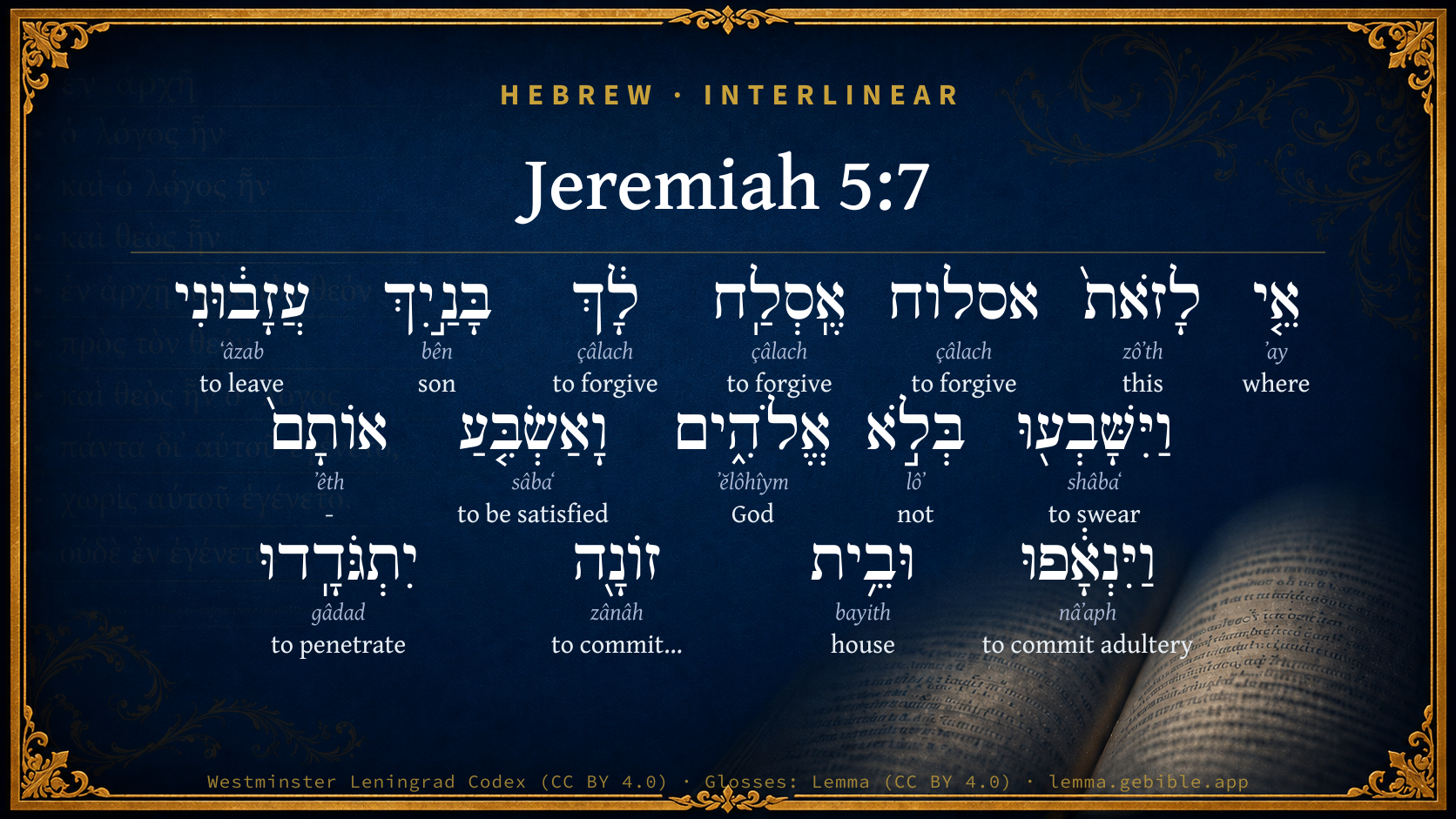
Jeremiah 5:7

Hebrew (Westminster Leningrad Codex) Jeremiah 5:7 appears in the Hebrew Old Testament. The text above is from the Westminster Leningrad Codex. Each word links to its Strong’s number, a concise gloss, and parsing drawn from the Open Scriptures Hebrew Bible morphology. Click any word for its full Brown-Driver-Briggs (BDB) entry.
Download image
Cite this verse

Jeremiah 5:7 (World English Bible). Public Domain. Lemma interlinear Bible study tool, https://lemma.gebible.app/v/jeremiah/5/7.

Show BibTeX & RIS
BibTeX
RIS
English Translation
How can I pardon you? your children have forsaken me, and sworn by them that are no gods: when I had fed them to the full, they committed adultery, and assembled themselves in troops at the prostitutes' houses.
World English Bible · Public Domain
Download a study sheet

One document with this verse’s original text, its word-by-word gloss line, the meaning frame, cross-references with their text, attributed commentary, and full source and license credits — printable, and it pastes into notes with its structure intact.

This verse Autodidact and up

Study sheet (.html) Plain text (.txt)

A passage Seminary Student

Up to 50 verses in one chapter. A passage sheet keeps up to 6 commentary sources and 12 cross-references per verse, in the order this page ranks them, and says so on the sheet whenever that leaves anything out. Ask for a single verse and you get the Autodidact verse sheet above.

Everything on this page stays free to read, with no account — the sheet is a download of what is already on screen, not access to it.

Want to remove ads? Support Godless Engineer
Compare translations 3

The same verse in 3 English versions, stacked beneath the original-language interlinear above. Click any original word for its lexicon entry.

Each is an independent rendering of the whole verse — the interlinear is not word-aligned to these translations.

Highlighted words mark where these versions differ — a whole-verse word diff, not a word-by-word alignment.

  • World English Bible Public Domain
    How can I pardon you? your children have forsaken me, and sworn by them that are no gods: when I had fed them to the full, they committed adultery, and assembled themselves in troops at the prostitutes' houses.
  • King James Version Public Domain
    How shall I pardon thee for this? thy children have forsaken me, and sworn by them that are no gods: when I had fed them to the full, they then committed adultery, and assembled themselves by troops in the harlots' houses.
  • unfoldingWord Literal Text CC BY-SA 4.0
    How, for this, could I forgive you? Your sons have abandoned me and have sworn by not-gods. When I satisfied them, they committed adultery and assembled themselves the house of the prostitute.

unfoldingWord Literal Text — © unfoldingWord, licensed CC BY-SA 4.0. Word-aligned USFM3 via Door43 (git.door43.org/unfoldingWord/en_ult).

Versions to compare (up to 4)

3 of 4 selected

Show all 18 translations

Every available English version of this verse, each an independent rendering of the whole verse.

  • World English Bible Public Domain
    How can I pardon you? your children have forsaken me, and sworn by them that are no gods: when I had fed them to the full, they committed adultery, and assembled themselves in troops at the prostitutes' houses.
  • Berean Standard Bible Public Domain
    “Why should I forgive you? Your children have forsaken Me and sworn by gods that are not gods. I satisfied their needs, yet they committed adultery and assembled at the houses of prostitutes.
  • Majority Standard Bible Public Domain
    “Why should I forgive you? Your children have forsaken Me and sworn by gods that are not gods. I satisfied their needs, yet they committed adultery and assembled at the houses of prostitutes.
  • King James Version Public Domain
    How shall I pardon thee for this? thy children have forsaken me, and sworn by them that are no gods: when I had fed them to the full, they then committed adultery, and assembled themselves by troops in the harlots' houses.
  • American Standard Version (1901) Public Domain
    How can I pardon thee? thy children have forsaken me, and sworn by them that are no gods: when I had fed them to the full, they committed adultery, and assembled themselves in troops at the harlots' houses.
  • Revised Version (1885) Public Domain
    How can I pardon thee? thy children have forsaken me, and sworn by them that are no gods: when I had fed them to the full, they committed adultery, and assembled themselves in troops at the harlots’ houses.
  • Geneva Bible (1599) Public Domain
    Howe should I spare thee for this? thy children haue forsaken me, and sworne by them that are no gods: though I fed them to the full, yet they committed adulterie, and assembled them selues by companies in the harlots houses.
  • Douay-Rheims (1899) Public Domain
    How can I be merciful to thee? thy children have forsaken me, and swear by them that are not gods: I fed them to the full, and they committed adultery, and rioted in the harlot's house.
  • Young's Literal Translation Public Domain
    For this I am not propitious to thee, Thy sons have forsaken Me, And are satisfied by that which is not god, I satisfy them, and they commit adultery, And at the house of a harlot They gather themselves together.
  • Literal Standard Version CC BY-SA 4.0
    “I am not propitious to you for this, || Your sons have forsaken Me, || And are satisfied by [those who are] not gods, || I satisfy them, and they commit adultery, || And at the house of a harlot || They gather themselves together.
  • Unlocked Literal Bible CC BY-SA 4.0
    Why should I pardon these people? Your sons have abandoned me and have made oaths by what are not gods. I fed them fully, but they committed adultery and walked in great numbers to the houses of prostitutes.
  • unfoldingWord Literal Text CC BY-SA 4.0
    How, for this, could I forgive you? Your sons have abandoned me and have sworn by not-gods. When I satisfied them, they committed adultery and assembled themselves the house of the prostitute.
  • Darby Bible Public Domain
    Wherefore should I pardon thee? Thy children have forsaken me, and swear by them that are not God. I have satiated them, and they have committed adultery, and they troop to the harlots' house.
  • World Messianic Bible Public Domain
    “How can I pardon you? Your children have forsaken me, and sworn by what are no gods. When I had fed them to the full, they committed adultery, and assembled themselves in troops at the prostitutes’ houses.
  • Webster's Bible Public Domain
    How shall I pardon thee for this? thy children have forsaken me, and sworn by them that are no gods: when I had fed them to the full, then they committed adultery, and assembled themselves by troops in the harlots' houses.
  • Free Bible Version CC BY-SA 4.0
    Why should I forgive you? Your children have abandoned me and believe in gods that are not gods. I gave them everything they need, yet they went and committed adultery, gathering together at prostitutes' houses.
  • Bible in Basic English Public Domain
    How is it possible for you to have my forgiveness for this? your children have given me up, taking their oaths by those who are no gods: when I had given them food in full measure, they were false to their wives, taking their pleasure in the houses of loose women.
  • JPS Tanakh (1917) Public Domain
    Wherefore should I pardon thee? The children have forsaken Me, and sworn by no-gods; and when I had fed them to the full, they committed adultery, and assembled themselves in troops at the harlots' houses.

Literal Standard Version (2020), Covenant Press — licensed CC BY-SA 4.0. Text via the HelloAO Bible API (eBible.org). Unlocked Literal Bible (unfoldingWord) — licensed CC BY-SA 4.0. Text via the HelloAO Bible API (eBible.org). unfoldingWord Literal Text — © unfoldingWord, licensed CC BY-SA 4.0. Word-aligned USFM3 via Door43 (git.door43.org/unfoldingWord/en_ult). Free Bible Version, Dr. Jonathan Gallagher — licensed CC BY-SA 4.0. Text via the HelloAO Bible API (eBible.org).

Word by word

More ways to search: Search by grammar → Find every occurrence → Compare this word →

Practice this passage: Drill this verse → Learn its vocabulary →

יִתְגֹּדָֽדוּ
gâdad
H1413
“to penetrate”
Verb, Hithpolel, Imperfect, 3rd Person, Masculine, Plural
Part of Speech
Verb
Stem
Hithpolel
Form
Imperfect
Person
3rd Person
Gender
Masculine
Number
Plural
Full BDB Definition

Origin: a primitive root [compare H1464 ]

TWOT: 313

to penetrate, cut, attack, invade - (Qal) to penetrate, cut into - (Hithpoel) - to cut oneself - to gather in troops or crowds
  1. אֵ֤י ʼay H335 “where” Particle, Interrogative
  2. לָזֹאת֙ zôʼth H2063 “to/for · this” Preposition + Pronoun, Demonstrative, Feminine, Singular
  3. אסלוח çâlach H5545 “to forgive” Verb, Qal, Imperfect, 1st Person, Common, Singular
  4. אֶֽסְלַֽח çâlach H5545 “to forgive” Verb, Qal, Imperfect, 1st Person, Common, Singular
  5. לָ֔ךְ çâlach H5545 “to/for · you” Preposition + Suffix, Personal, 2nd Person, Feminine, Singular
  6. בָּנַ֣יִךְ bên H1121 “sons · your” Noun, Common, Masculine, Plural, Construct + Suffix, Personal, 2nd Person, Feminine, Singular
  7. עֲזָב֔וּנִי ʻâzab H5800 “to leave · me” Verb, Qal, Perfect, 3rd Person, Common, Plural + Suffix, Personal, 1st Person, Common, Singular
  8. וַיִּשָּׁבְע֖וּ shâbaʻ H7650 “and · to swear” Conjunction + Verb, Niphal, Sequential Imperfect, 3rd Person, Masculine, Plural
  9. בְּלֹ֣א lôʼ H3808 “in/at · not” Preposition + Particle, Negative
  10. אֱלֹהִ֑ים ʼĕlôhîym H430 “God(s)” Noun, Common, Masculine, Plural, Absolute
  11. וָאַשְׂבִּ֤עַ sâbaʻ H7646 “and · to be satisfied” Conjunction + Verb, Hiphil, Sequential Imperfect, 1st Person, Common, Singular
  12. אוֹתָם֙ ʼêth H853 “- · them” Particle, Direct Object + Suffix, Personal, 3rd Person, Masculine, Plural
  13. וַיִּנְאָ֔פוּ nâʼaph H5003 “and · to commit adultery” Conjunction + Verb, Qal, Sequential Imperfect, 3rd Person, Masculine, Plural
  14. וּבֵ֥ית bayith H1004 “and · house of” Conjunction + Noun, Common, Masculine, Singular, Construct
  15. זוֹנָ֖ה zânâh H2181 “committing fornication” Verb, Qal, Participle Active, Feminine, Singular, Absolute

About this verse

These counts appear in no published source. They are computed here, from the morphology-tagged text and Lemma’s own curated glosses. What Lemma adds →

16
words
14
distinct lemmas
Prophets
section

Notable vocabulary

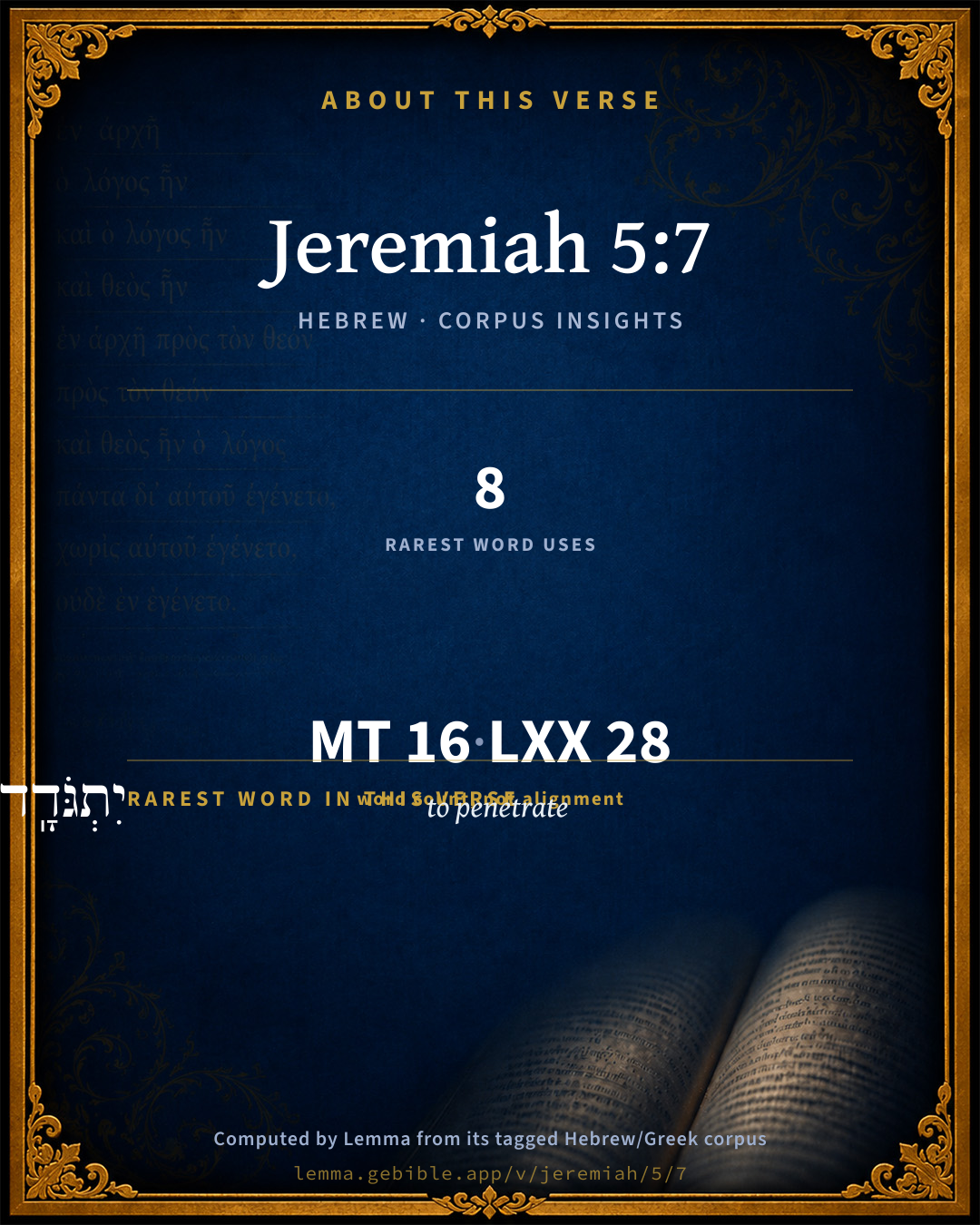
The rarest word here is יִתְגֹּדָֽדוּ to penetrate H1413 — appearing just 8 times in the whole Hebrew Bible.

Shared distinctive vocabulary

יִתְגֹּדָֽדוּ to penetrate H1413 occurs in 8 verses of the Hebrew Bible. Also found in:

Grammatical profile

  • 8 verbs
  • 3 nouns
  • 1 pronoun
  • 1 preposition
  • 3 particles

Verb forms

  • אסלוח Qal · Imperfect
  • אֶֽסְלַֽח Qal · Imperfect
  • עֲזָב֔וּנִי Qal · Perfect
  • וַיִּשָּׁבְע֖וּ Niphal · Sequential Imperfect
  • וָאַשְׂבִּ֤עַ Hiphil · Sequential Imperfect
  • וַיִּנְאָ֔פוּ Qal · Sequential Imperfect
  • זוֹנָ֖ה Qal · Participle Active
  • יִתְגֹּדָֽדוּ Hithpolel · Imperfect

Repetition

A word recurs within this verse — often emphatic in Hebrew:

  • אסלוח to forgive H5545 ×3

Hebrew & Septuagint length

In the original languages it is 16 Hebrew tokens and 28 Greek tokens — but the two are counted differently (Hebrew bundles its prefixes and suffixes into one token; the Greek is in lemma form), so that isn’t a like-for-like length.

Cross-references

31

Topical passages linked to Jeremiah 5:7 in the Treasury of Scripture Knowledge — connected by theme and wording, ordered by reader-vote popularity; previews shown in the World English Bible.

  • Joshua 23:7 that you not come among these nations, these that remain among you; neither make mention of the name of their gods, nor cause to swear [by them], neither serve them, nor bow down yourselves to them;
  • Galatians 4:8 However at that time, not knowing God, you were in bondage to those who by nature are not gods.
  • Deuteronomy 32:21 They have moved me to jealousy with that which is not God; They have provoked me to anger with their vanities: I will move them to jealousy with those who are not a people; I will provoke them to anger with a foolish nation.
  • Jeremiah 2:11 Has a nation changed [its] gods, which yet are no gods? but my people have changed their glory for that which does not profit.
  • Zephaniah 1:5 those who worship the host of the sky on the housetops, those who worship and swear by Yahweh and also swear by Malcam,
  • 1 Corinthians 8:4 Therefore concerning the eating of things sacrificed to idols, we know that no idol is anything in the world, and that there is no other God but one.
  • Deuteronomy 32:15 But Jeshurun grew fat, and kicked: You have grown fat, you are grown thick, you are become sleek; Then he forsook God who made him, Lightly esteemed the Rock of his salvation.
  • Jeremiah 23:10 For the land is full of adulterers; for because of swearing the land mourns; the pastures of the wilderness are dried up. Their course is evil, and their might is not right;
  • James 4:4 You adulterers and adulteresses, don't you know that friendship with the world is enmity with God? Whoever therefore wants to be a friend of the world makes himself an enemy of God.
  • Jeremiah 12:16 It shall happen, if they will diligently learn the ways of my people, to swear by my name, As Yahweh lives; even as they taught my people to swear by Baal; then shall they be built up in the midst of my people.
  • Jeremiah 13:27 I have seen your abominations, even your adulteries, and your neighing, the lewdness of your prostitution, on the hills in the field. Woe to you, Jerusalem! you will not be made clean; how long shall it yet be?
  • Ezekiel 22:11 One has committed abomination with his neighbor's wife; and another has lewdly defiled his daughter-in-law; and another in you has humbled his sister, his father's daughter.
  • Hosea 4:2 There is cursing, lying, murder, stealing, and committing adultery; They break boundaries, and bloodshed causes bloodshed.
  • Leviticus 20:10 "'The man who commits adultery with another man's wife, even he who commits adultery with his neighbor's wife, the adulterer and the adulteress shall surely be put to death.
  • Numbers 25:1–3 Israel abode in Shittim; and the people began to play the prostitute with the daughters of Moab:
  • Psalms 50:18 When you saw a thief, you consented with him, And have participated with adulterers.
  • Jeremiah 2:31 Generation, see the word of Yahweh. Have I been a wilderness to Israel? or a land of thick darkness? why say my people, We are broken loose; we will come no more to you?
  • Jeremiah 3:19 But I said, How I will put you among the children, and give you a pleasant land, a goodly heritage of the hosts of the nations! and I said, You shall call me My Father, and shall not turn away from following me.
  • Jeremiah 9:2 Oh that I had in the wilderness a lodging-place of wayfaring men; that I might leave my people, and go from them! for they are all adulterers, an assembly of treacherous men.
  • Jeremiah 29:22–23 and of them shall be taken up a curse by all the captives of Judah who are in Babylon, saying, Yahweh make you like Zedekiah and like Ahab, whom the king of Babylon roasted in the fire;
  • Ezekiel 16:49–50 Behold, this was the iniquity of your sister Sodom: pride, fullness of bread, and prosperous ease was in her and in her daughters; neither did she strengthen the hand of the poor and needy.
  • Hosea 4:13–15 They sacrifice on the tops of the mountains, And burn incense on the hills, under oaks and poplars and terebinths, Because its shade is good. Therefore your daughters play the prostitute, And your brides commit adultery.
  • Hosea 7:4 They are all adulterers. They are burning like an oven that the baker stops stirring, From the kneading of the dough, until it is leavened.
  • Hosea 11:8 "How can I give you up, Ephraim? How can I hand you over, Israel? How can I make you like Admah? How can I make you like Zeboiim? My heart is turned within me, My compassion is aroused.
  • Hosea 13:6 According to their pasture, so were they filled; They were filled, and their heart was exalted. Therefore they have forgotten me.
  • Amos 8:14 Those who swear by the sin of Samaria, And say, 'As your god, Dan, lives;' And, 'As the way of Beersheba lives;' They will fall, and never rise up again."
  • Malachi 3:5 I will come near to you to judgment; and I will be a swift witness against the sorcerers, and against the adulterers, and against the perjurers, and against those who oppress the hireling in his wages, the widow, and the fatherless, and who deprive the foreigner of justice, and don't fear me," says Yahweh of Hosts.
  • Matthew 23:37–38 "Jerusalem, Jerusalem, who kills the prophets, and stones those who are sent to her! How often would I have gathered your children together, even as a hen gathers her chickens under her wings, and you would not!
  • 1 Corinthians 6:9 Or don't you know that the unrighteous will not inherit the Kingdom of God? Don't be deceived. Neither the sexually immoral, nor idolaters, nor adulterers, nor male prostitutes, nor homosexuals,
  • James 5:1–5 Come now, you rich, weep and howl for your miseries that are coming on you.
  • Hebrews 13:4 Let marriage be held in honor among all, and let the bed be undefiled: but God will judge the sexually immoral and adulterers.

Cross-references courtesy of OpenBible.info (CC BY 4.0).

Hebrew and Greek witnesses Masoretic Hebrew ↔ Greek Septuagint

The same verse in the two great witnesses to the Old Testament, shown verse-for-verse.

These are two independent witnesses, not word-aligned to each other, and the Septuagint is shown in lemma (dictionary) form.

Hebrew Jeremiah 5:7 Masoretic · Westminster Leningrad Codex

אֵ֤י לָזֹאת֙ אסלוח אֶֽסְלַֽח לָ֔ךְ בָּנַ֣יִךְ עֲזָב֔וּנִי וַיִּשָּׁבְע֖וּ בְּלֹ֣א אֱלֹהִ֑ים וָאַשְׂבִּ֤עַ אוֹתָם֙ וַיִּנְאָ֔פוּ וּבֵ֥ית זוֹנָ֖ה יִתְגֹּדָֽדוּ

How can I pardon you? your children have forsaken me, and sworn by them that are no gods: when I had fed them to the full, they committed adultery, and assembled themselves in troops at the prostitutes' houses.

World English Bible · Public Domain

Greek LXX Structure differs

In the Septuagint, Jeremiah is about an eighth shorter than the Hebrew and arranges its material differently — the Oracles Against the Nations (Hebrew chapters 46–51) appear in the middle of the Greek book, after 25:13. Because the chapter and verse boundaries do not line up, a verse-for-verse comparison with the Hebrew is not shown.

A verse-for-verse comparison isn’t shown here because the chapters and verses don’t line up. Switch to the LXX edition with the MT / LXX toggle above to read the Greek directly.

On this verse, The Cambridge Bible for Schools and Colleges discusses the Septuagint’s reading. Read the note in Commentary ↓

Hebrew: Westminster Leningrad Codex (CC BY 4.0). Greek: Septuagint (public domain); English from a public-domain English Septuagint. How the Septuagint differs from the Hebrew →

Targum (Aramaic paraphrase)

1

The Targum is the ancient Jewish Aramaic paraphrase of the Hebrew Scriptures — an interpretive translation, not the Hebrew text itself. Onkelos (literal) and Pseudo-Jonathan (expansive) render the Torah, and Jonathan the Prophets. Coverage is partial: where no permissively-licensed English translation exists for a verse, only the Aramaic is shown. This is verse-level text, not a word-by-word alignment to the Hebrew.

  1. Targum Jonathan Prophets (Joshua–Malachi)
    נְבִיָא אֲמַר לֵיהּ כְּנִשְׁתָּא דְיִשְׂרָאֵל עַל אֵידָא אֶשְׁבּוֹק לְכוֹן אֲנָא קָרִיתִי לְכוֹן בְּגִין וְאִינוּן שְׁבָקוּ פוּלְחָנִי וּמְקַיְמִין בְּשׁוּם טַעֲוָתָא עוֹד שְׂבַעֵית יַתְהוֹן טוּבָא וְאִינוּן תָּבוּ לְמֶהֱוֵי זַנָאִין וּבֵית נַפְקַת בְּרָא מִסְתַּיְעִין:

    (no public-domain English translation for this verse)

    Targum Jonathan — Aramaic: “Mikraot Gedolot” (public domain). English: “Sefaria Community Translation” (CC0 1.0 (public-domain dedication)); “London "Chaldee Paraphrase," 1871” (public domain). Text via Sefaria.

Commentary

Notes on Jeremiah 5:7 from classic Christian and Jewish commentators (each source and its license shown beneath its notes). The classic Christian expositions comment on the surrounding passage and are grouped to its opening verse, so a note may address several verses; the Jewish commentaries on the Tanakh (Rashi and others) are per-verse, so they appear only where the commentator wrote on this verse.

Lemma curates 59 commentaries, every one of them public domain or Creative Commons licensed, each selected and text-cleaned for this edition rather than reprinted as found. About our sources →

Trapp's Complete Commentary

John Trapp

Jer 5:7 How shall I pardon thee for this? thy children have forsaken me, and sworn by [them that are] no gods: when I had fed them to the full, they then committed adultery, and assembled themselves by troops in the harlots’ houses.

Ver. 7. How shall I pardon thee for this?] How with the safety of mine honour and justice? Swearing then by creatures (us by our Lady, by St Anne, by this light, &c.), or by idols, (as by the mass, by the rood, &c.), or by qualities (as by faith, troth, &c.), is not so small a sin as many deem it, since God maketh here a great question how he can pardon it. For why? it is a forsaking of him, a giving away his honour to another, a disgrace done to a man’s self - since we always "swear by the greater," {Heb 6:16} and a means to procure his utter ruin, without God’s greater mercy. {Amo 6:14 Zep 1:3-5} Men sport themselves with oaths, as the Philistines did with Samson, which will at last pull the house about their ears. {Zec 5:4}

When I fed them to the full, they then committed adultery.] Fulness in good men oft breeds forgetfulness, and in bad men, filthiness. Gula vestibulum luxuriae; gluttony is the gallery that incontinence walketh through. The Israelites ate and drank, and rose up to play - scil., with their Midianitish mistresses - to the provoking of God’s fierce wrath. Fulness of bread made way to Sodom’s sin. Lunatics, when the moon is declining and in the wane are sober enough; but when full, more wild and exorbitant. Ceres and Bacchus are great friends to Venus, &c. Watch therefore, and feed with fear.

And assembled themselves by troops.] Heb., They trooped themselves; such was their impudence.

John Trapp, A Commentary or Exposition upon All the Books of the Old and New Testament (1647–1656) — public domain. Text from a community e-Sword module.

Joseph Benson's Commentary

Jer 5:7-9. How shall I pardon thee for this? — How canst thou expect that the holy God, the righteous Governor and Judge of the world, should connive at, or bear with, such iniquitous conduct in his intelligent and accountable creatures. He appeals to themselves, whether they can think it consistent with his justice to let such enormous offences as he mentions go unpunished. Thy children — Thy people, both in city and country; have forsaken me — Have apostatized from my worship and service; and have sworn by them that are no gods — Have made their appeals to them, as if they were omniscient and their proper judges. This is here put for all acts of religious worship which are due to God only, but with which they honoured their idols, thereby robbing God of his essential attributes, and ascribing them to creatures of their own fancy. When I fed them to the full — Gave them temporal blessings in abundance; then they committed adultery — Such is the natural effect of unsanctified prosperity. Shall I not visit for these things? — Do not such crimes as these call for some remarkable judgments as their chastisement? Can you yourselves suppose that Jehovah, whose name is Holy and Jealous, will let them go unpunished? Shall not my soul be avenged? &c. — God’s anger and vengeance signify, in Scripture, the execution of his justice, the effects of which are as terrible against obstinate sinners as if they proceeded from the highest resentment.

Joseph Benson's Commentary on the Old and New Testaments (1811–1818) — public domain. Text from a community e-Sword module.

Tyndale Open Study Notes

Tyndale Open Resources

5:7-8 These verses list the evidence of sins the people had committed, including rejection of the Lord, submission to pagan deities, and sexual misconduct (7:9; 12:16; Num 25:1-3; Deut 32:21; Josh 23:7; Zeph 1:5; Gal 4:8). Idolatry and adultery were closely connected in Israel because both represented the breach of an exclusive covenant.

Tyndale Open Study Notes — © Tyndale Open Resources, licensed CC BY-SA 4.0. Text via the HelloAO Bible API.

Geneva Bible (1599)

Geneva Bible translators

He showeth that to swear by anything than by God, is to forsake him.

Geneva Bible (1599) marginal notes — public domain. Text via Bolls.life.

Jamieson, Fausset & Brown

Robert Jamieson, A. R. Fausset & David Brown

It would not be consistent with God's holiness to let such wickedness pass unpunished.

sworn by-- (Jer 5:2; Jer 4:2); that is, worshipped.

no gods-- (Deu 32:21).

fed . . . to the full--so the Keri (Hebrew Margin) reads, God's bountifulness is contrasted with their apostasy (Deu 32:15). Prosperity, the gift of God, designed to lead men to Him, often produces the opposite effect. The Hebrew Chetib (text), reads: "I bound them (to Me) by oath," namely, in the marriage covenant, sealed at Sinai between God and Israel; in contrast to which stands their "adultery"; the antithesis favors this.

adultery . . . harlots' houses--spiritually: idolatry in temples of idols; but literal prostitution is also included, being frequently part of idol-worship: for example, in the worship of the Babylonian Mylitta.

Jamieson, Fausset & Brown — Commentary Critical and Explanatory on the Whole Bible (1871) — public domain (CC PDM 1.0). Text via the HelloAO Bible API.

Adam Clarke's Commentary

Verse 7. In the harlots' houses.] In places consecrated to idolatry. In the language of the prophets, adultery generally signifies idolatry. This we have often seen.

Adam Clarke's Commentary on the Bible (1810–1826) — public domain. Text from a community e-Sword/MySword module.

John Calvin's Commentaries

There is here what rhetoricians call a conference: for God seems here to seek the judgment of the adverse party, with whom he contends, on the cause between them, though it was sufficiently clear; and this is a proof of confidence. When advocates wish to shew that there is nothing doubtful or obscure, they thus deliberate with the opposite party, — “Why, I will propose the matter privately to yourself; have you anything to say? Even if you were at liberty to determine the question, would not reason compel you to pronounce such a judgment as this?” So now God shews that he was constrained, as it were, by necessity to inflict on the Jews a most severe punishment, and intimates that he was not, as it were, at liberty to do otherwise. “If I am, “he says, “the judge of the world, is it possible that they can escape unpunished, who thus openly provoke me? Should I not expose to ridicule my glory? and should I not also divest myself of my own power? I should cease to be what I am, and in a manner deny myself, were I not to punish a people so wicked and irreclaimable.” We now perceive the Prophet’s meaning.

Some consider ו, vau, to be understood, and take אי, ai, for אין, ain, and read thus, “I will not spare thee for this.” But as there is no reason to make any change, and many agree in the view that has been given, I prefer to follow what has been most commonly received. The meaning of אי, ai, in Hebrew is “where;” but it also means “how: “and here it is to be understood, not of place, but of manner, “How could I for this be propitious to you?”

We see how God, as it were, deliberates with the opposite party, and even appeals to them for judgment, “Say now, were I to allow you so much liberty and power as to decide the question, could I, who am the judge of the world, spare you who are guilty of such vices?”

Thy sons have forsaken me This was the first sin: and when God complained that he was forsaken, he intimated that the people had willfully, and from deliberate wickedness, cast off the yoke; for the same thing could not have been said of heathens. It is indeed true, if we have regard to the beginning, that all may be charged with defection, for God had revealed himself to the sons of Adam and of Noah; and when they fell away into superstitions, they became apostates. But the defection of the Jewish people was much more recent, and less to be borne: nay, when they boasted that they were God’s people, who could have alleged the pretense of ignorance? We now then see what the Prophet means when he says, that God had been forsaken by the people.

He then adds, They have sworn by a no- god He means, by stating a part for the whole, that the worship of God was become corrupt and vitiated: for swearing, as it was stated yesterday, is a part of God’s worship. Whenever we swear by God’s name, we profess that we are under his power, and that we cannot escape if we swear falsely: we also ascribe to him his glory as the God of truth; and we further testify that nothing escapes him, or is hid from his view. Hence, by saying here that the Israelites swore by a no- god, he means that God was deprived of his own right. They were indeed guilty of other sins; but, as it has been stated, the Prophet includes under one kind all the superstitions which then prevailed among the people. It was then the same as though he had said, that they worshipped idols and gods, whom they had devised for themselves.

He adds a circumstance which enhanced their guilt, I have filled them, he says, and they have committed adultery There is here a striking alliteration, which must not be omitted, he had said, ישבען, ishbon, “they have sworn;” and now he says, אשבע, ashbo, “I have filled them.” The only difference is in a point; when placed on the left side of ש, shin, the word means to fill, and when on the right, to swear. The Prophet then says, that they had sworn to another God, and yet had been filled God shews here how base and disgraceful had been the ingratitude of the people; for they had been filled to the full with all blessings, and yet they did not acknowledge their own God, who had been to them a Father, so kind and bountiful: I have filled them, he says, and they have committed adultery

Now this passage teaches us, that they who go astray, when allured by God’s paternal kindness and bounty, are on that account the more unworthy of pardon. When men grow wanton against God, while he is kindly indulging them, they no doubt treasure up for themselves wrath against the day of wrath, as Paul tells us in Romans 2:5. Let us then take heed, lest we indulge ourselves, while God is, as it were, indulging us; and lest prosperity should lead us to wantonness: but let us learn to submit ourselves willingly to him, even because he thus kindly and sweetly invites us to himself; and when he shews himself so loving, let us learn to love him.

He says, that they committed adultery This may be taken metaphorically: but as in the next verse he inveighs against their vagrant lusts and adulteries, this phrase may be taken in its literal sense. I yet think that adultery here is to be understood figuratively, as meaning that they had no spiritual chastity, inasmuch as they did not give God his own glory. He further says, And at the house of the harlot have they assembled together The word “house” may be taken in the nominative case, as the Jews might have been called the house of the harlot; as though the Prophet had said, that all Jerusalem and Judea were like brothels. But some consider ב, beth, to be understood, so that they assembled themselves, as it were, at the house of a harlot; and that he thus alludes to the temple. And it is a mark of great shamelessness, when many adulterers or wanton men assemble in one house; for most are ashamed of their adulteries, so that they endeavor to hide their baseness: but when they come together in troops, as though under an uplifted banner, it is a proof that there is no shame, but that they thus disregard all decency, like brute beasts. The most suitable meaning then is, that they are said to have assembled together in brothels, because they gloried in their own superstitions and sacrileges. It follows —

John Calvin's Commentaries (1540-1563) — public domain. Text from the Calvin Translation Society English edition (1840s-50s) via the Christian Classics Ethereal Library (ccel.org). Calvin's coverage is partial (roughly two-thirds of the Bible); uncommented books and verses are honest gaps, never fabricated. The 19th-century editor's footnotes and remarks are omitted so the notes are faithfully Calvin's own voice.

Ellicott's Commentary for English Readers

(7) When I had fed them to the full.—The reading of the Hebrew text gives, though I had bound them by oath, sc., by the covenant, as of marriage; and this, as heightening the enormity of the sin that follows, gives a better sense than the English version, which follows the marginal reading of the Hebrew. The latter finds its parallel in Deu_32:15; Hos_13:6. There is probably an implied reference to the covenant to which the people had sworn in the time of Josiah.

Houses.—Literally, house. The singular is, perhaps, used because the prophet thinks primarily of the idol’s temple as the scene of the adulteress’s guilt, which here, as elsewhere, is the symbol of national apostasy.

A Bible Commentary for English Readers, edited by Charles John Ellicott (1878–1897) — public domain. Text from a community e-Sword module.

The Cambridge Bible for Schools and Colleges

gen. ed. J. J. S. Perowne

7. If the MT. be right, the transition to Jehovah’s words is an abrupt one. Du., however, considers that an abbreviation of the common formula “Thus saith Jehovah” was misunderstood and so brought about a corruption of the text. He would accordingly restore thus: How can I pardon them, saith the Lord; they have, etc.

I had fed them to the full] not as mg. made them swear, meaning, had bound them to me by oath. They had made use of their prosperity only as facilitating and inciting to sin. Cp. Deu_32:15.

The last part of the verse may be understood to include the sense of faithlessness to their Divine Spouse, but Jer_5:8 seems clearly to indicate a reference to the impure rites which accompanied idolatry.

assembled themselves in troops] The verb in MT. suggests bands of marauders (cp. e.g. 2Ki_5:2). As this is an unsuitable sense here, it is better (with LXX) to read by a slight alteration in the Hebrew (where d and r are very similar letters), made themselves sojourners (yithgorâru for yithgodâdu).

The Cambridge Bible for Schools and Colleges (gen. ed. J. J. S. Perowne; Cambridge University Press, 1878–1918) — public domain. Text from a community e-Sword module.

John Gill's Exposition

How shall I pardon thee for this?.... Because of their manifold transgressions, and multiplied backslidings; or "wherefore, or for what, shall I pardon thee?" (r) as the Targum; can any reason be given why I should? what goodness is there in thee, or done by thee, that I should do this unto thee? The particle according to Kimchi, is a word of exclamation; and, according to Jarchi, of admiration; and may be rendered, "oh! for this shall I pardon?" how can it be? R. Menachem; in Jarchi, takes it to be the same with "not"; and to be rendered, not for this will I pardon; and so is an affirmation, and fixed resolution not to pardon, and that for the following reasons:

thy children have forsaken me; my worship, as the Targum interprets it; that is, the children of Jerusalem, the inhabitants of it, the common people, as distinguished from their fathers, the civil and ecclesiastical rulers; see Mat 23:37, though not to the exclusion of them; for they were guilty of the same sin in forsaking the word, worship, and ordinances of God:

and sworn by them that are no gods; by the name of idols, as the Targum; or, "by those things which are not god", as Noldius (s) renders the words; who rightly observes, that there were other things besides idols that they swore by, as the heaven and earth, temple, altar, &c. with which the Arabic version agrees; when an oath ought only to be taken in the name of the living God; or, "swore without God"; without making mention of the name of the true God:

when I had fed them to the full; with the good things of life; gave them all things richly to enjoy; the best provisions, and fulness of them; so that they had all that heart could wish for. There is in the Hebrew text a beautiful play on words (t), between the word used for swearing in the former clause, and this for feeding here:

they then committed adultery; either idolatry, which is spiritual adultery; or adultery literally taken; as it seems from the following verse. This is the consequence of their being fullly fed; and that is an aggravation of this their sin against God and their neighbour; see Deu 32:13,

and assembled themselves by troops in the harlots' houses; either in the temples of idols, or in the stews or brothel houses, where harlots prostituted themselves; their going thither in troops, or in great numbers, shows both how universal and how public this sin was, and how impudent and barefaced they were in the commission of it.

(r) "ad quid, vel ob quid, vel quare parcam tibi?" De Dieu. (s) Ebr. Concord. Part. p. 199. No. 911. (t) "et juraverunt", "cum saturarem".

John Gill's Exposition of the Whole Bible (1746–1763) — public domain (CC PDM 1.0). Text via the HelloAO Bible API.

Albert Barnes' Notes on the Bible

Rather, Why, “for what reason” should “I pardon thee?”

When ... - Or, “though I bound them to me by oath, yet they committed adultery.”

The harlots’ houses - The harlot’s house, i. e., the temple of an idol; the prophet had also in view (see Jer 5:8) the unchastity which accompanied most forms of nature-worship.

Albert Barnes' Notes on the Bible (1834–1885) — public domain. Text from a community e-Sword/MySword module.

Haydock's Catholic Bible Commentary

How can. I have only the character of judge left. (Calmet)

George Leo Haydock (1774–1849), Haydock's Catholic Family Bible and Commentary, 1859 edition — public domain. Excludes Psalms (Douay-Rheims chapter numbering differs from Protestant) and Deuterocanonical books (Catholic canon only).

Matthew Poole's English Annotations

How shall I pardon? how canst thou expect that I shall bear such affronts? I shall expose myself, and seem to lay aside my power; I shall be looked upon as one that either regard not such injuries, or cannot avenge them, as Jer 5:9.

Thy children; thy inhabitants, both in city and country.

Sworn by them that are no gods, but by idols: swearing is here put, not for one part of worship, as sometimes it is, but for a religious worship and service of them, Jer 4:2.

When I had fed them to the full, they then committed adultery: here is noted the abuse of God’s bounty, or the natural effect of our unsanctified prosperity, Deu 32:15; Jer 2:7; Jude 4. That which in good men doth oft breed forgetfulness, in bad men generally breeds filthiness: rising up to play the wanton was the effect of Israel’s eating and drinking, Exo 32:6, and of Sodom’s sin, Eze 16:49. Adultery; either,

1. Metaphorically to be understood of their going a whoring after their idols; or,

2. Properly, for corporal uncleanness, they usually going both together, Num 25:1,2; Ho 4:12,14.

Assembled themselves by troops in the harlots’ houses; it may be read in the nominative case, the house of the harlot assembled themselves: q.d. The whole house of Israel, Jerusalem and Judea, are but one stew. If it refers to their idolatry, then it alludes to their making the temple a common house of spiritual harlotry; but rather, as it refers to their corporal uncleanness, it seems to intimate that they did not act their adulteries clandestinely or by stealth, but laying aside all modesty, they went to harlots’ houses, like brute beasts, in company, as ashamed of nothing.

Matthew Poole's English Annotations on the Holy Bible (1683–1685) — public domain. Text from a community e-Sword/MySword module.

Whedon's Commentary on the Bible

Daniel D. Whedon

7. How — Rather, why.

Shall I pardon thee — The form of the word translated “pardon” is difficult to account for. The Masoretes evidently considered it a future, and so have given as a Keri the usual form for the Kal future of the lamedh guttural. The form in the text may be a future after the type of the perfect verb, of which there are also other instances among the lamedh guttural verbs; or it may be, as suggested by Furst, Keil, and others, that aleph in the text has become substituted for lamedh, the two being very much alike in the MSS. If this is so, the verb is an infinitive, and the meaning given above is more clearly brought out, How could one pardon thee?

Thy children have… sworn — There is doubt and disagreement as to the original text in this place. Most of the Versions and about forty MSS., together with the Keri, give the reading, I had sworn them; that is, had bound them by an oath to fidelity. But the reading which is the basis of the Authorized Version is easier, and agrees in sentiment with many other passages. The rule, however, is, in disputed readings, that the more difficult is likely to be genuine, as its substitution for an easier one cannot readily be accounted for, while the reverse process is the natural one. Besides, the thought in the reading “I have sworn them,” is even more perfectly suited to the remainder of the verse. The sense, then, is, I bound them by the marriage covenant, but they committed adultery.

Harlots’ houses — Literally, house of the harlot; an expression doubtless intended to cover both carnal uncleanness and spiritual adultery.

Daniel D. Whedon (gen. ed.), Commentary on the Old and New Testaments (1874–1909) — public domain. Text from a community e-Sword module.

The Pulpit Commentary

How... for this? rather, Why should I pardon thee? Thy children; i.e. (since "the daughter of Zion" is equivalent to Zion regarded as an ideal entity) the members of the Jewish people. (comp. Lev_19:18, "the children of thy people When I had fed them to the full. So Ewald, following the versions and many manuscripts (there is no marginal reading in the Hebrew Bible). This gives a good sense, and may be supported by ver. 28; Deu_32:15 Hos_13:6. But the reading of the received Hebrew text, though somewhat more difficult, is yet perfectly capable of explanation; and, slight as the difference is in the reading adopted by Ewald (it involves a mere shade of pronunciation), it is not to be preferred to the received reading. Read, therefore, though I made them to swear (allegiance), let they committed adultery. The oath may be that of Sinai, (Ex 24) or such au oath as had been recently taken by Josiah and the people. (1Ki 23:3 2Ch_34:31, 2Ch_34:32) The "adultery" may be taken both in a literal and in a figurative sense, and so also the "harlots" houses" in the next clause. It is also well worthy of consideration whether the prophet may not be referring to certain matrimonial customs handed down from remote antiquity and arising from the ancient system of kinship through women. (comp. Eze_22:11)

How men curse their blessings, "When I had fed them to the full," etc.

I GOD DOES THIS AT TIMES. Cf. Gen_3:17, "Cursed is the ground for thy sake," etc.; Hag_1:11, etc. And whenever he makes our good and pleasant things the means of our punishment. Hezekiah"s riches and prosperity were the lure which drew upon him the oppressing Assyrians. And so the body which, when possessed of all its faculties and in health, ministers so much good to man, God, in judgment upon the man"s sin, may for the sake of the sinful soul cause that disease, pain, impotence, may curse it. And the mind also that may become a den of malignant, impure, profane thoughts.

II BUT MEN DO THIS FAR MORE FREQUENTLY. The noblest physical gifts may be shattered, wrecked, by sins against the body. The mind capable of such high service and a channel of such vast blessing men may, do, pollute, corrupt, and pervert and so curse their blessings. The moral nature this a great gift of God, the power to judge, choose, resolve; but see how soon man cursed that and turned his blessing into a curse. The gifts of providence are also abused in the same way (cf. text). The home. Oh, what joy comes to men through the blessings that were designed to be forever associated with that word! But how often men, by self-indulgence, neglect, evil example, utter failure in parental duty, turn the blessing of home into a curse! And even the gospel of Christ itself God"s unspeakable gift-men may make the knowledge of it to be "a savor of death unto death" for themselves. "This Child is set for the fall of many in Israel," said Simeon of our Lord.

III BUT IT IS A CRIME WHICH GOD CANNOT AWAY WITH. "How shall I pardon thee for this?" etc. "Shall I not visit," etc.? (ver. 9). Cf. parable of fruitless fig tree" Cut it down," etc.; the talents from him the talent," etc. And the human conscience everywhere assents to this judgment of God. We judge in like manner ourselves. We feel that such are without excuse. Let us, then, consider our blessings, and ask ourselves, "What are we doing with them? how are we using them?" Let it be our daily prayer and endeavor that we fall not into this great sin.

IV GOD"S WAY IS TO TURN OUR CURSES INTO BLESSINGS, (Cf. Neh_13:2)

1. He has done so even with sin. What curse could be greater? Yet, by the redemption there is in Christ, even that is so made subject that now We may rise on stepping-stones Of our dead selves to higher things.

2. And he has done so with sorrow. Grief had been for ages going about the world, a sad-robed, somber, and ever-tearful guest in whatever house she took up her temporary abode: and there was no house she did not visit. But since the Lord Jesus became the "Man of sorrows, and acquainted with grief," she, in virtue of that acquaintance, has changed her very nature, and the curse is turned into a blessing. She ministers help to the soul, in releasing it from the bonds of this evil world and in uplifting it towards its true Father and home in heaven.

3. And so with death. Its sting-is taken away. To them who are in Christ he is rather a friend than a foe, for he it is who opens the door of our prison-house and lets the soul go free and rise to that place Where loyal hearts and true Stand ever in the light, All rapture through and through, In God"s most holy sight. C.

The Pulpit Commentary (1880–1919), ed. H.D.M. Spence-Jones & Joseph S. Exell — public domain. Text from a community e-Sword module.

John Wesley's Explanatory Notes

They then - Such is the natural effect of unsanctified prosperity.

John Wesley, Explanatory Notes Upon the Whole Bible (1754–1765) — public domain. Text via the GEBible commentary corpus.

Kretzmann's Popular Commentary

Paul E. Kretzmann

Faithlessness and Treachery

v. 7. How shall I pardon thee for this? It would obviously be inconsistent with God’s holiness to overlook the transgressions of Israel, to let their wickedness go unpunished. Thy children have forsaken Me and sworn by them that are no gods, or, more emphatic, "by that which is no god," worshiping a creature of their own imagination. When I had fed them to the full, in distributing the blessings of His bounty, or, "I bound them by the oath of allegiance and loyalty," but they then committed adultery, transgressing the Sixth Commandment in the most flagrant manner, probably in connection with the idolatrous customs which they accepted, and assembled themselves by troops in the harlots’ houses, rushing forward in companies in their eagerness to commit this beastly sin.

v. 8. They were as fed horses in the morning, fat and dissolute stallions; every one neighed after his neighbor’s wife, inflamed with sinful lust.

v. 9. Shall I not visit for these things, punishing the guilty ones to the limit, saith the Lord, and shall not my soul be avenged on such a nation as this? How could His anger be withheld under such circumstances? The Lord therefore turns to the Chaldeans, calling upon them to carry out His punishment upon Israel.

v. 10. Go ye up upon her walls and destroy, scaling them in a successful attack upon them; but make not a full end, so that Judah’s existence would forever be at an end; take away her battlements, or, "hew off her branches," remove her tendrils, namely, the chief men of the nation, for they are not the Lord’s, and therefore are altogether unprofitable.

v. 11. For the house of Israel and the house of Judah, the entire nation of God’s chosen people, have dealt very treacherously against Me, saith the Lord, their faithlessness being the Lord’s chief reason for complaint.

v. 12. They have belied the Lord, denying Jehovah, the God of the covenant, and said, It is not He, insisting that He was not the true and only God, neither shall evil come upon us, neither shall we see sword nor famine, thus both denying and challenging the threat of the Lord regarding the punishment which He had threatened for apostasy of every kind;

v. 13. and the prophets shall become wind, their warnings, in the estimation of the scoffers, being nothing but idle threats, and the Word is not in them, the unbelieving rebels declaring that God did not speak through those prophets who rebuked their wickedness; thus shall it be done unto them, that is, their evil predictions would be fulfilled in no one but themselves. This attitude called for a most emphatic declaration on the part of Jehovah.

v. 14. Wherefore, thus saith the Lord God of hosts, the mighty Captain of the heavenly armies, Because ye speak this word, behold, I will make My words in thy mouth fire, Jeremiah being given a sharp and scathing message to the rebellious people whom the Lord here puts far from Him, and this people wood, fuel which is easily kindled, and it shall devour them, they would be consumed as a consequence of the denunciation which Jeremiah would make by God’s command.

v. 15. Lo, I will bring a nation upon you from far, O house of Israel, saith the Lord, this being the specific manner in which His punishment of destruction would be carried out. It is a mighty nation, it is an ancient nation, one of great antiquity in history, a nation whose language thou knowest not, a factor which made the enemies all the more formidable, neither understandest what they say. The language spoken by the Chaldeans at that time was totally unlike that derived from any Semitic stem, but very much like ancient Persic.

v. 16. Their quiver is as an open sepulcher, on account of the death-dealing arrows which it contained, they are all mighty men, distinguished for their strength and bravery.

v. 17. And they shall eat up thine harvest, the standing grain, and thy bread, which thy sons and thy daughters should eat, which was intended for their food; they shall eat up thy flocks and thine herds; they shall eat up thy vines and thy fig-trees, everything that in any manner yielded food; they shall impoverish thy fenced cities, destroying all of Israel’s proud fortresses, wherein thou trustedst, with the sword.

v. 18. Nevertheless, in those days, when this severe punishment strikes the nation, saith the Lord, I will not make a full end with you, He would not yet bring total annihilation upon them. Thus the Lord is gracious and merciful and long-suffering, and abundant in goodness and truth, ever more ready to show kindness than to bring His punishment upon the guilty. It is a most powerful appeal to all men to heed the voice of His admonitions.

Paul E. Kretzmann, Popular Commentary of the Bible (1921–1924) — public domain. Text from a community e-Sword module.

unfoldingWord translationNotes

Door43 World Missions Community

Why should I pardon these people?

Yahweh uses this question to emphasize that he has no reason to pardon these people. AT: "Because of the things that they do, I cannot pardon these people." (See: Rhetorical Question)

these people

the people of Jerusalem

Your sons

Yahweh is speaking to Jerusalem as though she were a woman who had children. Jerusalem's "sons" represent the people of Jerusalem. AT: "The people of Jerusalem" (See: Personification)

I fed them fully

Providing all they needed is spoken of as feeding them. AT: "I gave them everything they needed" (See: Metaphor)

they committed adultery and walked in great numbers to the houses of prostitutes

This may be a metaphor for being unfaithful to God and worshiping idols, but idol worship also included prostitution. AT: "they were unfaithful to me and went in large numbers to the houses of prostitutes" (See: Metaphor)

walked in great numbers to the houses of prostitutes

"went in large groups to the houses of prostitutes" or "large groups of them went to the houses of prostitutes"

They were horses in heat ... neighed to his neighbor's wife

Because the God speaks of them as if they were horses that wanted to mate with other horses. AT: "They were like horses in heat ... neighed to his neighbor's wife" (See: Metaphor)

in heat

ready to mate

mate

when animals breed to reproduce

Each man neighed to his neighbor's wife

Male horses neigh loudly to female horses when they want to mate with them. AT: "Like horses who mate with more than one horse, these men wanted to sleep with other men's wives" (See: Metaphor)

So should I not punish them ... and should I not avenge myself on a nation that is like this?

Yahweh uses this question to emphasize that the things that they are doing are so bad that he will no have mercy but will punish them. AT: "Because they do these things, I will punish them ... I will certainly get revenge for myself against them." (See: Rhetorical Question)

this is Yahweh's declaration

Yahweh speaks of himself by name to express the certainty of what he is declaring. See how you translated this in Jeremiah 1:8. AT: "this is what Yahweh has declared" or "this is what I, Yahweh, have declared" (See: First, Second, or Third Person)

translationWords

forgive

oath

false god

adultery

prostitute

horse

neighbor

punish

declare

avenge

nation

unfoldingWord translationNotes — © Distant Shores Media and the Door43 World Missions Community, licensed CC BY-SA 4.0. Source: git.door43.org/Door43/en_tn.

Rashi

Rabbi Shlomo Yitzchaki (Rashi)

Shall I forgive you for this? This is the rhetorical question, Shall I forgive you for this? And Menahem (p. 22) explains אי like אין, not. For this I will not forgive you, because your children have forsaken Me, when I sated them with all good.

they banded together They gather in troops.

Rashi on the Tanakh — English translations: “The Judaica Press complete Tanach with Rashi, translated by A. J. Rosenberg” (CC BY 4.0); “Pentateuch with Rashi's commentary by M. Rosenbaum and A.M. Silbermann, 1929-1934” (public domain); “The Metsudah Tanach series, Lakewood, N.J” (CC BY 4.0); and “The Book of Joshua, Metsudah Publications, 1997” (CC BY 4.0). Text via Sefaria.

Lesson kit

Teaching starters — assembled from the data on this page, not authored interpretation. Every prompt links to the verse data it draws on. Edit before teaching.

Jeremiah, in the Prophets, opens this verse with 16 words (14 distinct Hebrew lemmas). Its most distinctive word is gâdad (“to penetrate”). A historical commentator’s framing appears above. Read the whole chapter for the surrounding context.

Discussion questions

  1. The word gâdad carries the sense “to penetrate.” How does it shape the verse?
  2. How does Deuteronomy 14:1, which shares the word «to penetrate», read alongside this verse?
  3. What does the repetition of “to forgive” (3× in this one verse) do in this verse?
  4. These translations render this verse differently; the difference is in the English rendering, not the original. What questions does that raise?
  5. «אסלוח» is a Qal Imperfect verb. How does that grammatical form shape the action described?
  6. Compare how Trapp's Complete Commentary and Joseph Benson's Commentary read this verse. Where do they agree or differ?

Things to notice

Reading settings

Reading text

Shown beneath each verse's original-language words.

Old Testament
Old Testament edition

Read the OT as the Masoretic Hebrew (MT) or the Greek Septuagint (LXX).

English shown for the Greek Septuagint (in the Hebrew ↔ Greek comparison).

Comparing translations? Open the Compare panel on any verse page to stack up to four side by side.