
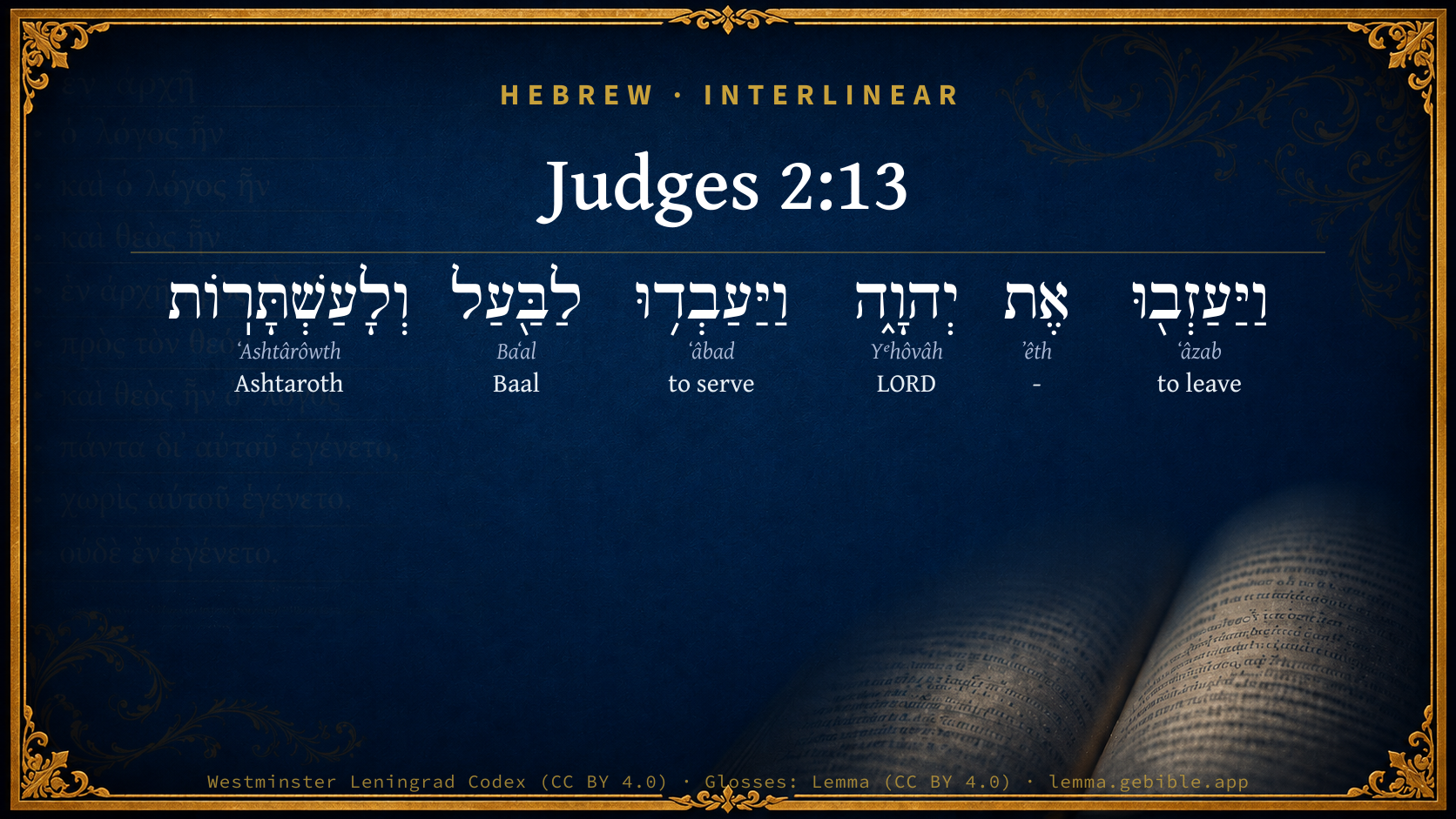
Judges 2:13

Hebrew (Westminster Leningrad Codex) Judges 2:13 appears in the Hebrew Old Testament. The text above is from the Westminster Leningrad Codex. Each word links to its Strong’s number, a concise gloss, and parsing drawn from the Open Scriptures Hebrew Bible morphology. Click any word for its full Brown-Driver-Briggs (BDB) entry.
Download image
Cite this verse

Judges 2:13 (World English Bible). Public Domain. Lemma interlinear Bible study tool, https://lemma.gebible.app/v/judges/2/13.

Show BibTeX & RIS
BibTeX
RIS
English Translation
They forsook Yahweh, and served Baal and the Ashtaroth.
World English Bible · Public Domain
Download a study sheet

One document with this verse’s original text, its word-by-word gloss line, the meaning frame, cross-references with their text, attributed commentary, and full source and license credits — printable, and it pastes into notes with its structure intact.

This verse Autodidact and up

Study sheet (.html) Plain text (.txt)

A passage Seminary Student

Up to 50 verses in one chapter. A passage sheet keeps up to 6 commentary sources and 12 cross-references per verse, in the order this page ranks them, and says so on the sheet whenever that leaves anything out. Ask for a single verse and you get the Autodidact verse sheet above.

Everything on this page stays free to read, with no account — the sheet is a download of what is already on screen, not access to it.

Want to remove ads? Support Godless Engineer
Compare translations 3

The same verse in 3 English versions, stacked beneath the original-language interlinear above. Click any original word for its lexicon entry.

Each is an independent rendering of the whole verse — the interlinear is not word-aligned to these translations.

Highlighted words mark where these versions differ — a whole-verse word diff, not a word-by-word alignment.

  • World English Bible Public Domain
    They forsook Yahweh, and served Baal and the Ashtaroth.
  • King James Version Public Domain
    And they forsook the LORD, and served Baal and Ashtaroth.
  • unfoldingWord Literal Text CC BY-SA 4.0
    And they forsook Yahweh and they served Baal and the Ashtoreths.

unfoldingWord Literal Text — © unfoldingWord, licensed CC BY-SA 4.0. Word-aligned USFM3 via Door43 (git.door43.org/unfoldingWord/en_ult).

Versions to compare (up to 4)

3 of 4 selected

Show all 18 translations

Every available English version of this verse, each an independent rendering of the whole verse.

  • World English Bible Public Domain
    They forsook Yahweh, and served Baal and the Ashtaroth.
  • Berean Standard Bible Public Domain
    for they forsook Him and served Baal and the Ashtoreths.
  • Majority Standard Bible Public Domain
    for they forsook Him and served Baal and the Ashtoreths.
  • King James Version Public Domain
    And they forsook the LORD, and served Baal and Ashtaroth.
  • American Standard Version (1901) Public Domain
    And they forsook Jehovah, and served Baal and the Ashtaroth.
  • Revised Version (1885) Public Domain
    And they forsook the LORD, and served Baal and the Ashtaroth.
  • Geneva Bible (1599) Public Domain
    So they forsooke the Lord, and serued Baal, and Ashtaroth.
  • Douay-Rheims (1899) Public Domain
    Forsaking him, and serving Baal and Astaroth.
  • Young's Literal Translation Public Domain
    yea, they forsake Jehovah, and do service to Baal and to Ashtaroth.
  • Literal Standard Version CC BY-SA 4.0
    indeed, they forsake YHWH, and do service to Ba‘al and to Ashtaroth.
  • Unlocked Literal Bible CC BY-SA 4.0
    they broke away from Yahweh and worshiped Baal and the Ashtoreths.
  • unfoldingWord Literal Text CC BY-SA 4.0
    And they forsook Yahweh and they served Baal and the Ashtoreths.
  • Darby Bible Public Domain
    They forsook the LORD, and served the Ba'als and the Ash'taroth.
  • World Messianic Bible Public Domain
    They abandoned the LORD, and served Baal and the Ashtaroth.
  • Webster's Bible Public Domain
    And they forsook the LORD, and served Baal and Ashtaroth.
  • Free Bible Version CC BY-SA 4.0
    They deserted the Lord and worshiped Baal and Ashtaroth idols.
  • Bible in Basic English Public Domain
    And they gave up the Lord, and became the servants of Baal and the Astartes.
  • JPS Tanakh (1917) Public Domain
    And they forsook the LORD, and served Baal and the Ashtaroth.

Literal Standard Version (2020), Covenant Press — licensed CC BY-SA 4.0. Text via the HelloAO Bible API (eBible.org). Unlocked Literal Bible (unfoldingWord) — licensed CC BY-SA 4.0. Text via the HelloAO Bible API (eBible.org). unfoldingWord Literal Text — © unfoldingWord, licensed CC BY-SA 4.0. Word-aligned USFM3 via Door43 (git.door43.org/unfoldingWord/en_ult). Free Bible Version, Dr. Jonathan Gallagher — licensed CC BY-SA 4.0. Text via the HelloAO Bible API (eBible.org).

Word by word

More ways to search: Search by grammar → Find every occurrence → Compare this word →

Practice this passage: Drill this verse → Learn its vocabulary →

About this verse

These counts appear in no published source. They are computed here, from the morphology-tagged text and Lemma’s own curated glosses. What Lemma adds →

6
words
6
distinct lemmas
Historical
section

Notable vocabulary

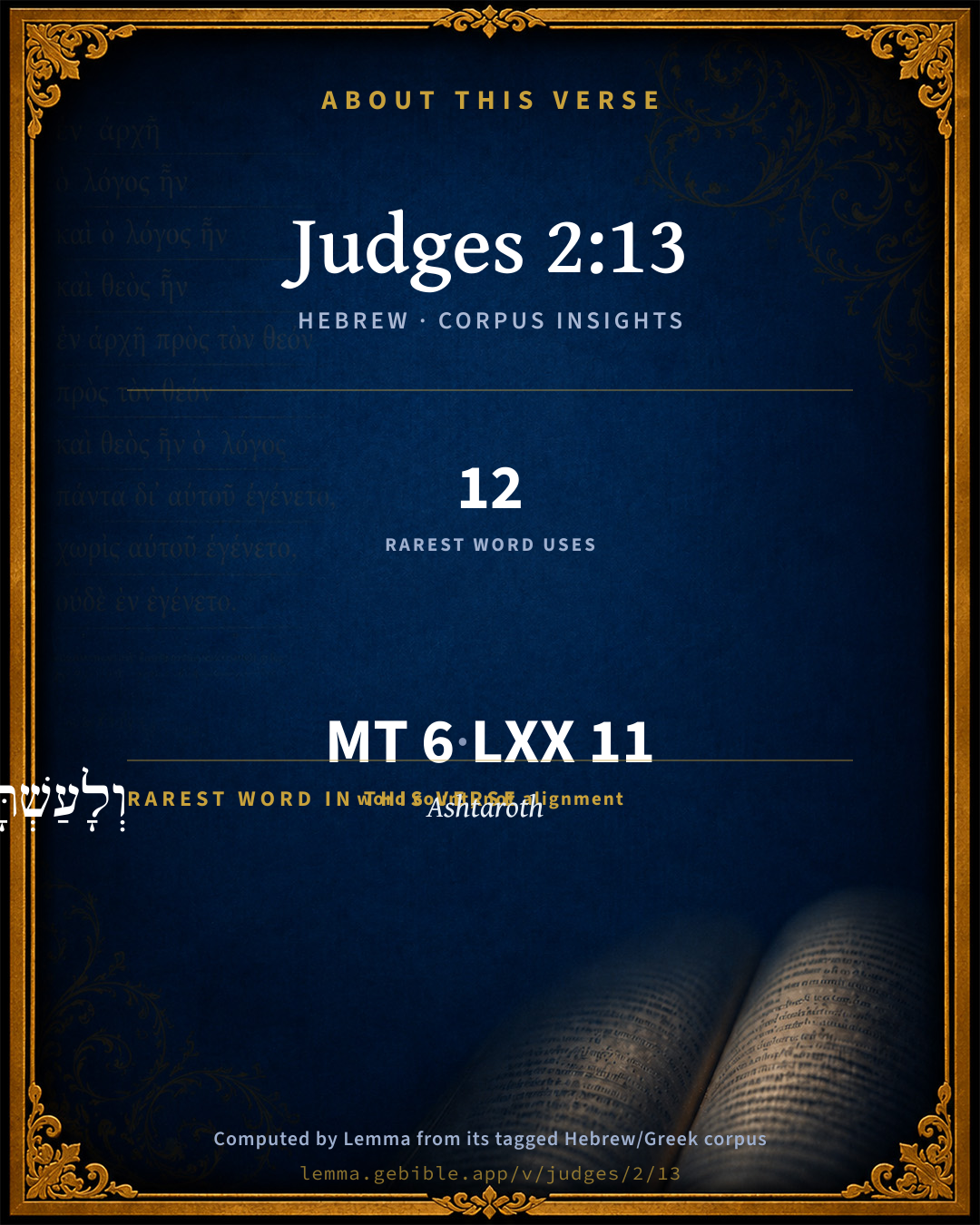
The rarest word here is וְלָעַשְׁתָּרֽוֹת Ashtaroth H6252 — appearing just 12 times in the whole Hebrew Bible.

Shared distinctive vocabulary

וְלָעַשְׁתָּרֽוֹת Ashtaroth H6252 occurs in 12 verses of the Hebrew Bible. Also found in:

Grammatical profile

  • 2 verbs
  • 3 nouns
  • 1 particle

Verb forms

  • וַיַּעַזְב֖וּ Qal · Sequential Imperfect
  • וַיַּעַבְד֥וּ Qal · Sequential Imperfect

Hebrew & Septuagint length

In English translation the verse runs 9 words from the Hebrew and 14 from the Septuagint (LXX English) — the Septuagint runs noticeably longer here. See the side-by-side →

A rough comparison of the two English renderings, which tokenize alike — not a word-level alignment.

Word counts can differ between the Hebrew and the Greek without any difference in meaning — e.g. the Hebrew direct-object marker אֵת has no separate Greek word, and Greek often adds the article ὁ.

In the original languages it is 6 Hebrew tokens and 11 Greek tokens — but the two are counted differently (Hebrew bundles its prefixes and suffixes into one token; the Greek is in lemma form), so that isn’t a like-for-like length.

Cross-references

10

Topical passages linked to Judges 2:13 in the Treasury of Scripture Knowledge — connected by theme and wording, ordered by reader-vote popularity; previews shown in the World English Bible.

  • Judges 10:6 The children of Israel again did that which was evil in the sight of Yahweh, and served the Baals, and the Ashtaroth, and the gods of Syria, and the gods of Sidon, and the gods of Moab, and the gods of the children of Ammon, and the gods of the Philistines; and they forsook Yahweh, and didn't serve him.
  • Psalms 106:36 They served their idols, Which became a snare to them.
  • Judges 3:7 The children of Israel did that which was evil in the sight of Yahweh, and forgot Yahweh their God, and served the Baals and the Asheroth.
  • 1 Corinthians 10:20–22 But I say that the things which the Gentiles sacrifice, they sacrifice to demons, and not to God, and I don't desire that you would have communion with demons.
  • Judges 2:11 The children of Israel did that which was evil in the sight of Yahweh, and served the Baals;
  • 1 Samuel 31:10 They put his armor in the house of the Ashtaroth; and they fastened his body to the wall of Beth-shan.
  • 1 Kings 11:5 For Solomon went after Ashtoreth the goddess of the Sidonians, and after Milcom the abomination of the Ammonites.
  • 1 Kings 11:33 because that they have forsaken me, and have worshiped Ashtoreth the goddess of the Sidonians, Chemosh the god of Moab, and Milcom the god of the children of Ammon; and they have not walked in my ways, to do that which is right in my eyes, and [to keep] my statutes and my ordinances, as did David his father.
  • 2 Kings 23:13 The high places that were before Jerusalem, which were on the right hand of the mountain of corruption, which Solomon the king of Israel had built for Ashtoreth the abomination of the Sidonians, and for Chemosh the abomination of Moab, and for Milcom the abomination of the children of Ammon, did the king defile.
  • 1 Corinthians 8:5 For though there are things that are called "gods," whether in the heavens or on earth; as there are many "gods" and many "lords;"

Cross-references courtesy of OpenBible.info (CC BY 4.0).

Hebrew and Greek witnesses Masoretic Hebrew ↔ Greek Septuagint

The same verse in the two great witnesses to the Old Testament, shown verse-for-verse.

Here the Septuagint runs noticeably longer than the Hebrew — LXX2012 (modern English Septuagint) 14 words vs World English Bible 9. A rough length comparison of the two English translations, not a word-level alignment — read both below.

These are two independent witnesses, not word-aligned to each other, and the Septuagint is shown in lemma (dictionary) form.

Hebrew Judges 2:13 Masoretic · Westminster Leningrad Codex

וַיַּעַזְב֖וּ אֶת יְהוָ֑ה וַיַּעַבְד֥וּ לַבַּ֖עַל וְלָעַשְׁתָּרֽוֹת

They forsook Yahweh, and served Baal and the Ashtaroth.

World English Bible · Public Domain

Greek LXX Judges 2:13 Septuagint · lemma form

καί ἐν καταλείπω αὐτός καί λατρεύω ὁ βααλ καί ὁ ἀστάρτη

And they provoked the Lord, and forsook him, and served Baal and the Astartes.

LXX2012 (modern English Septuagint) · Public Domain

On this verse, The Cambridge Bible for Schools and Colleges discusses the Septuagint’s reading. Read the note in Commentary ↓

Hebrew: Westminster Leningrad Codex (CC BY 4.0). Greek: Septuagint (public domain); English from LXX2012 (modern English Septuagint) (Public Domain). How the Septuagint differs from the Hebrew →

Targum (Aramaic paraphrase)

1

The Targum is the ancient Jewish Aramaic paraphrase of the Hebrew Scriptures — an interpretive translation, not the Hebrew text itself. Onkelos (literal) and Pseudo-Jonathan (expansive) render the Torah, and Jonathan the Prophets. Coverage is partial: where no permissively-licensed English translation exists for a verse, only the Aramaic is shown. This is verse-level text, not a word-by-word alignment to the Hebrew.

  1. Targum Jonathan Prophets (Joshua–Malachi)
    וּשְׁבַקוּ יַת פּוּלְחָנָא דַייָ וּפְלַחוּ לְבַעֲלָא וּלְעַשְׁתָּרָתָא:

    (no public-domain English translation for this verse)

    Targum Jonathan — Aramaic: “Mikraot Gedolot” (public domain). English: “Sefaria Community Translation” (CC0 1.0 (public-domain dedication)); “London "Chaldee Paraphrase," 1871” (public domain). Text via Sefaria.

Commentary

Notes on Judges 2:13 from classic Christian and Jewish commentators (each source and its license shown beneath its notes). The classic Christian expositions comment on the surrounding passage and are grouped to its opening verse, so a note may address several verses; the Jewish commentaries on the Tanakh (Rashi and others) are per-verse, so they appear only where the commentator wrote on this verse.

Lemma curates 59 commentaries, every one of them public domain or Creative Commons licensed, each selected and text-cleaned for this edition rather than reprinted as found. About our sources →

Trapp's Complete Commentary

John Trapp

Jdg 2:13 And they forsook the LORD, and served Baal and Ashtaroth.

Ver. 13. And served Baal and Ashtaroth,] i.e., He-gods and she-gods of all sorts, closing up their orisons with, Diique, deaque, omnes, as Servius telleth us. {a} From this word Ashtaroth seemeth to come the Greek word αστηρ, and the Latin astrum, a star: as Saturn, Jupiter, Luna, Pallas, &c., came from the Hebrew.

{a} In Georg, lib. i.

John Trapp, A Commentary or Exposition upon All the Books of the Old and New Testament (1647–1656) — public domain. Text from a community e-Sword module.

Joseph Benson's Commentary

Jdg 2:13. They served Baal and Ashtaroth — By Baal or lord here, it is probable, we are to understand the sun, and by Ashtaroth, the same, it seems, with Astarte, the moon, worshipped in different countries under the names Juno and Venus. So that they had he-gods and she-gods, and gods of all kinds, as many as a luxuriant fancy pleased to make and multiply them. It may not be improper to observe here, that “the reason why the Israelites so often lapsed into idolatry, may easily be deduced from the common notion of tutelary deities, which they had imbibed during their residence in Egypt, which was the fruitful parent of science and idolatry. One generally-received consequence of this opinion was, that the peculiar or tutelary deity of any country could not be neglected, even by the conquerors of that country, without impiety, and that their impiety would certainly meet with punishment from the deity whom they thus neglected. The Israelites, therefore, unwilling to expose themselves to the resentment which the tutelary deity was supposed to take on those who, inhabiting his land, yet slighted his worship; unwilling likewise to leave their paternal God, they incorporated the worship of both; and served not only the God of Abraham, Isaac, and Jacob, but likewise the Baalim, or local tutelary deities of the countries wherein they were settled. In process of time this weakness increased to such a degree, that the rights of the tutelary deity of the country were acknowledged to be superior to those of the Gentilitial God of the conquerors. This might arise from the common opinion, that the favours of the local deity were particularly attached and confined to one certain spot; or from an apprehension of the strength of the inhabitants among whom they were settled, who would not have endured to have their god slighted, without vindicating his honour, and endeavouring to extirpate the offenders. This piece of complaisance and condescension the Israelites seem to have been guilty of, when they are said to have forsaken the Lord God of their fathers, and to have followed other gods, the gods of the people that were round about them. Their defection from the God of Israel did not, however, consist in rejecting him as a false god, or in renouncing the law of Moses as a false religion: but only in joining foreign worship and idolatrous ceremonies to the ritual of the true God.” Div. Leg., vol. 4. p. 44.

Joseph Benson's Commentary on the Old and New Testaments (1811–1818) — public domain. Text from a community e-Sword module.

Geneva Bible (1599)

Geneva Bible translators

These were Idols, which had the form of an ewe or sheep among the Sidonians.

Geneva Bible (1599) marginal notes — public domain. Text via Bolls.life.

Jamieson, Fausset & Brown

Robert Jamieson, A. R. Fausset & David Brown

Ashtaroth--Also a plural word, denoting all the female divinities, whose rites were celebrated by the most gross and revolting impurities.

Jamieson, Fausset & Brown — Commentary Critical and Explanatory on the Whole Bible (1871) — public domain (CC PDM 1.0). Text via the HelloAO Bible API.

Adam Clarke's Commentary

Verse 13. Served Baal and Ashtaroth.] In a general way, probably, Baal and Ashtaroth mean the sun and moon; but in many cases Ashtaroth seems to have been the same among the Canaanites as Venus was among the Greeks and Romans, and to have been worshipped with the same obscene rites.

Adam Clarke's Commentary on the Bible (1810–1826) — public domain. Text from a community e-Sword/MySword module.

Ellicott's Commentary for English Readers

(13) Baal and Ashtaroth.—Literally, “the Baals and the Ashtareths.”

Ashtaroth.—The plural of the feminine word Ash-tareth, or Astarte, “the goddess of the Sidonians” (1Ki_11:5), the Phœnician Venus—identified sometimes with the moon (e.g., in the name Ashtaroth Karnaim, “the city of the two-horned moon,” the name of Og’s capital, Deu_1:4), and sometimes with the planet Venus (2Ki_23:4; Cic. De Nat. Deor. 3:23; Euseb. Praep. Evang. i. 10). She is called the “queen of heaven,” in Jer_7:10; Jer_44:17, and was called Baalti (“my lady”) by the Phœnicians. The plural form may be, as Ewald thinks, the plural of excellence, or like Baalim an allusion to the different forms and attributes under which the goddess was worshipped. The worship of Baalim and Ashtaroth naturally went hand in hand. (See Jdg_10:6; 1Sa_7:4; 1Sa_12:10.) Ashtaroth is not to be confused with the Asheroth (rendered “groves” in the E. V.) mentioned in Jdg_3:7. The words resemble each other less in Hebrew, as Ashtaroth begins with ע, not with א. Mil. ton’s allusions to these deities are not only exquisitely beautiful but also very correct, as he derived his information from Selden’s learned Syntagma de Dis Syrüs:

“With these in troop

Came Ashtoreth, whom the Phoenicians call’d

Astarte, queen of heaven, with crescent horns,

To whose bright image nightly by the moon

Sidonian virgins paid their vows and songs;

In Zion also not unsung, where stood

Her temple.”

Par. Lost, i. 439.

The derivation of the word is very uncertain. It probably has no connection with the Greek Aster, or the Persian Esther.

A Bible Commentary for English Readers, edited by Charles John Ellicott (1878–1897) — public domain. Text from a community e-Sword module.

The Cambridge Bible for Schools and Colleges

gen. ed. J. J. S. Perowne

13. This verse repeats the substance of Jdg_2:12; it continues Jdg_2:10 and leads on to Jdg_2:20. The repetition is explained if the verse belongs to E; for the expression forsook the Lord in E cf. Jos_24:20, Deu_31:16.

served Baal and the Ashtaroth] Once settled in Canaan, the Israelites could not resist the temptation to adopt the worship of the native deities, on whom the prosperity of flocks and fields was supposed to depend. The God of Israel came from the desert; in the early days of the settlement His home was believed to be in Sinai rather than in Canaan (Jdg_5:4 f.); hence the popular religion, without ceasing to regard Jehovah as the God of Israel, felt it necessary to pay homage at the same time to the gods of the country. No doubt also the popular mind tended to identify Jehovah with the local Baals and Astartes, whose sanctuaries were scattered over the land. Such confusions gravely imperilled the distinctive character of Israel’s religion; they produced a degradation of faith and morals which led the prophets, and writers of the schools of E and D, stirred by the painful evidence of a later age, to charge Israel with having fallen into Baal-worship from the very day they entered into Canaan; the popular religion could only be described as a ‘forsaking’ of Jehovah.

Baal] means lit. owner, possessor, e.g. of a house Jdg_19:22, of a town (‘citizens’) Jdg_9:2, of a wife (‘husband’) Exo_21:3 etc.; applied to divine beings it is a title conveying the idea of ownership, or, less probably, of domination. There was no one god called Baal; each considerable town or district had its deity, the lord of that particular place. Hence the O.T. speaks of Baal (sing.) in a collective sense, as here and Hos_13:1, Jer_11:13 etc., or of Baâlim (plur.) Jdg_2:11, Jdg_3:7, Jdg_8:33 etc., meaning the aggregate of local or special Baals. The local Baal is often designated by the name of his town or sanctuary, e.g. B. of Hermon Jdg_3:3, B. of Tamar Jdg_20:33, B. of Meon Num_32:38 and Moab. Stone ll. 9, 30; or of some special aspect under which he was worshipped, e.g. B. of the covenant Jdg_8:33, Jdg_9:4, B. of flies 2Ki_1:2 ff.; at Baal-Gad under Mt Hermon he was worshipped as Gad, the god of fortune. These usages are abundantly illustrated by the Phoenician and Aramaic inscriptions; e.g. we hear of the B. of Zidon, of Tyre, of Lebanon, of Tarsus; occasionally the actual name of the Baal is known—the B. of Tyre was Melḳarth, the Baalath (fem.) of Gebal was ‘Ashtart, the B. of Ḥarran was Sin; we meet with Baal under various aspects, e.g. ‘glowing’ (?ḥammân), ‘healing’ (marpç), ‘dancing’ (marḳôd), ‘of the heavens’ (shâmçm). Baal was a title of the deity who owned the land, the god of the cultivated field and its produce (see Hos_2:5), of fertilizing warmth, perhaps, but not a sun-god. As denoting owner, lord, the title could be applied in a harmless sense to Jehovah Himself; this is seen in the proper names Jerubbaal Jdg_6:32 (note) Baal-yah 1Ch_12:5, one of David’s mighty men, and, in the families of Saul and David, Esh-baal, Merib-baal, Beel-yada, 1Ch_8:33-34; 1Ch_14:7, altered to Ish-bosheth, Mephi-bosheth, El-yada in 2Sa_2:8; 2Sa_4:4; 2Sa_5:16. But the associations of the name were felt to be dangerous, as appears from the substitution of bôsheth ‘shame’ in the latter names; and the time arrived when Baal could no longer be used safely of the God of Israel, Hos_2:16 ff.

Ashtaroth] plur. of ‘Ashtôreth, i.e. ‘Ashtart (LXX Ἀστάρτη) pronounced with the vowels of bôsheth—the goddess worshipped throughout the Semitic world, not only by the Phoenicians (1Ki_11:5; 1Ki_11:33), but all over Palestine and on the E. of the Jordan, by the Philistines (1Sa_31:10), by the Moabites (Moab. St. l. 17 Ashtar), in Bashan (Deu_1:4) etc. In Babylonia and Assyria she was called Ishtar, in Syria ‘Attar, in S. Arabia ‘Athtar (a male deity); by the Greeks she was identified with Aphrodite. The meaning of the name is obscure; with regard to the form it will be noticed that the fem. ending in t is distinctively Canaanite. ‘Ashtart was the goddess of fertility and generation. In the O.T. Baal and ‘Ashtôreth together stand for the false gods and goddesses native to Palestine; and as Hebrew has no word for goddess, ‘Ashtôreth is practically used instead. Here the combination of Baal (sing.) with ‘Ashtârôth (plur., i.e. the many local forms of the goddess) is unusual, and we should probably read (‘Ashtôreth, the sing., in a collective sense.

The Cambridge Bible for Schools and Colleges (gen. ed. J. J. S. Perowne; Cambridge University Press, 1878–1918) — public domain. Text from a community e-Sword module.

John Gill's Exposition

And they forsook the Lord,.... The worship of the Lord, as the Targum; this is repeated to observe the heinous sin they were guilty of, and how displeasing it was to God:

and served Baal and Ashtaroth; two images, as the Arabic version adds; Baal, from whence Baalim, may signify the he deities of the Gentiles, as Jupiter, Hercules, &c. and Ashtaroth their female deities, as Juno, Venus, Diana, &c. the word is plural, and used for flocks of sheep, so called because they make the owners of them rich; and Kimchi and Ben Melech say these were images in the form of female sheep. Perhaps, as Baal may signify the sun, so Ashtaroth the moon, and the stars like flocks of sheep about her. Ashtaroth was the goddess of the Zidonians, Kg1 11:5; the same with Astarte, the wife of Cronus or Ham, said to be the Phoenician or Syrian Venus. So Lucian says (r) there was a temple in Phoenicia, belonging to the Sidonians, which they say is the temple of Astarte; and, says he, I think that Astarte is the moon; and Astarte is both by the Phoenicians (s) and Grecians (t) said to be Venus, and was worshipped by the Syrians also, as Minutius Felix (u) and Tertullian (w) affirm; the same with Eostre, or Aestar, the Saxon goddess; hence to this day we call the passover Easter (x), being in Eoster-month; and with Andraste, a goddess of the ancient Britains (y). There were four of them, and therefore the Septuagint here uses the plural number Astartes; so called either from Asher, being reckoned "blessed" ones, or from Asheroth, the groves they were worshipped in; or from "Ash", and "Tor", the constellation Taurus or the bull; so Astarte by Sanchoniatho is said to put upon her head the head of a bull, as the token of her sovereignty; See Gill on Gen 14:5.

(r) De Dea Syria. (s) Sanchoniatho apud Euseb. Evangel. Praepar. l. 1. p. 38. (t) Suidas in voce (u) In Octavio, p. 6. (w) Apolog. c. 24. (x) Vid. Owen. Theologoumen, l. 3. c. 4. p. 192. (y) lb. c. 11. p. 244.

John Gill's Exposition of the Whole Bible (1746–1763) — public domain (CC PDM 1.0). Text via the HelloAO Bible API.

Haydock's Catholic Bible Commentary

Baal, "Lord," a title given to many of the idols, (Haydock) both male and female. (Menochius) --- They are often distinguished by some additional name, as Beelzebub, "fly," and berith, "covenant," gods adored at Accaron and Sichem. Under this name the pagans adored heaven or the sun, (Calmet) as Astaroth denoted some female deity, the moon, Venus, &c. (Menochius)

George Leo Haydock (1774–1849), Haydock's Catholic Family Bible and Commentary, 1859 edition — public domain. Excludes Psalms (Douay-Rheims chapter numbering differs from Protestant) and Deuterocanonical books (Catholic canon only).

Matthew Poole's English Annotations

i.e. The sun and the moon, whom many heathens worshipped, though under divers names; and so they ran into that error which God had so expressly warned them against, Deu 4:19.

Matthew Poole's English Annotations on the Holy Bible (1683–1685) — public domain. Text from a community e-Sword/MySword module.

Whedon's Commentary on the Bible

Daniel D. Whedon

13. Ashtaroth — This is the plural form of Ashtoreth, the Venus of Syria, whose rites were more filthy and abominable than even those of the Grecian Venus, whose temple, with its thousand female votaries, polluted Corinth, and on a smaller scale defiled every Grecian city. Ashtoreth was the female, as Baal was the male, divinity of the Zidonians. Her worship was very ancient and widespread. Another name was Asherah, rendered groves in our English version; though this name seems rather to have designated the idol images of the goddess than the goddess herself. See Jdg_3:7, note.

As God originally created man male and female, so Canaanitish mythology seems to have embodied these conceptions in its system of worship. The masculine life-giving force of nature was worshipped under the names of Baal, Lord; Chemosh, governor; Hadad, the only one; Moloch, king; or simply El, god; the feminine receptive faculty was adored as Ashtoreth, Baalith, or Atar-gath. Thus the chief deities consisted of an apotheosis of the generative forces and laws of nature; an adoration of the objects in which those forces were seen, and where they appeared most active. Such an origin was, it may easily be seen, the source of the grossest sensuality. Debauchery was consecrated by religion. Thus, too, Baal was lord of the sun and god of fire; and as the sun calls into being and growth things evil as well as good, he was also called god of flies, (Baal-zebub.) And many a State gave a local name of its own to the deity. Hence Baal-gad, Baal-peor, Baal-hermon.

Side by side with these varying conceptions of Baal were corresponding ones of his consort Ashtoreth. Where he is sun-god, she is goddess of the moon; where he is Priapus, she is Venus; where he is Zeus, she is his royal partner Hera. And from these multiform representations of the two chief deities they came to be spoken of often in the plural, and instead of Baal and Ashtoreth we have Baalim and Ashtaroth.

Daniel D. Whedon (gen. ed.), Commentary on the Old and New Testaments (1874–1909) — public domain. Text from a community e-Sword module.

The Pulpit Commentary

Baal and Ashtaroth. Ashtaroth is the plural of Ashtoreth, the goddess of the Zidonians, (1Ki_11:5, 1Ki_11:33) just as Baalim (ver. 11) is the plural of Baal. The many images of Baal and Ashtoreth are, in the opinion of some, indicated by the plural; but others think that different modifications or impersonations of the god and goddess are indicated. Thus we read of Baal-berith, the god who presides over covenants; Baalzebul, or Zebub, the god who presides over flies, who could either send or remove a plague of flies, and so on. "Baal (lord or master) was the supreme male divinity of the Phoenician and Canaanitish nations, as Ashtoreth (perhaps the star, the planet Venus) was their supreme female divinity. Baal and Ashtoreth are frequently coupled together. Many Phoenician names Hannibal, Asdrubal, Adherbal, Belus, etc. are derived from Baal."

The Pulpit Commentary (1880–1919), ed. H.D.M. Spence-Jones & Joseph S. Exell — public domain. Text from a community e-Sword module.

John Wesley's Explanatory Notes

Baal and Ashtaroth - That is, the sun and moon, whom many Heathens worshipped, tho' under divers names; and so they ran into that error which God had so expressly warned them against, Deut. iv, 19. Baalim signifies lords, and Ashtaroth, blessed ones, he-gods and she-gods. When they forsook Jehovah, they had gods many and lords many, as a luxuriant fancy pleased to multiply them.

John Wesley, Explanatory Notes Upon the Whole Bible (1754–1765) — public domain. Text via the GEBible commentary corpus.

Keil & Delitzsch

C. F. Keil & F. Delitzsch

Thus they forsook Jehovah, and served Baal and the Asthartes. In this case the singular Baal is connected with the plural Ashtaroth, because the male deities of all the Canaanitish nations, and those that bordered upon Canaan, were in their nature one and the same deity, viz., Baal, a sun-god, and as such the vehicle and source of physical life, and of the generative and reproductive power of nature, which was regarded as an effluence from its own being (see Movers, Relig. der Phnizier, pp. 184ff., and J. G. Mller in Herzog's Cyclopaedia). "Ashtaroth, from the singular Ashtoreth, which only occurs again in Kg1 11:5, Kg1 11:33, and Kg2 23:13, in connection with the Sidonian Astharte, was the general name used to denote the leading female deity of the Canaanitish tribes, a moon-goddess, who was worshipped as the feminine principle of nature embodied in the pure moon-light, and its influence upon terrestrial life. It corresponded to the Greek Aphrodite, whose celebrated temple at Askalon is described in Herod. i. 105. In Jdg 3:7, Asheroth is used as equivalent to Ashtaroth, which is used here, Jdg 10:6; Sa1 7:4; Sa1 12:10. The name Asheroth

(Note: Rendered groves in the English version. - Tr.)

was transferred to the deity itself from the idols of this goddess, which generally consisted of wooden columns, and are called Asherim in Exo 34:13; Deu 7:5; Deu 12:3; Deu 16:21. On the other hand, the word Ashtoreth is without any traceable etymology in the Semitic dialects, and was probably derived from Upper Asia, being connected with a Persian word signifying a star, and synonymous with Ἀστροάρχη, the star-queen of Sabaeism (see Ges. Thes. pp. 1083-4; Movers, p. 606; and Mller, ut sup.).

With regard to the nature of the Baal and Astharte worship, into which the Israelites fell not long after the death of Joshua, and in which they continued henceforth to sink deeper and deeper, it is evident form the more precise allusions contained in the history of Gideon, that it did not consist of direct opposition to the worship of Jehovah, or involve any formal rejection of Jehovah, but that it was simply an admixture of the worship of Jehovah with the heathen or Canaanitish nature-worship. Not only was the ephod which Gideon caused to be made in his native town of Ophrah, and after which all Israel went a whoring (Jdg 8:27), an imitation of the high priest's ephod in the worship of Jehovah; but the worship of Baal-berith at Shechem, after which the Israelites went a whoring again when Gideon was dead (Jdg 8:33), was simply a corruption of the worship of Jehovah, in which Baal was put in the place of Jehovah and worshipped in a similar way, as we may clearly see from Jdg 9:27. The worship of Jehovah could even be outwardly continued in connection with this idolatrous worship. Just as in the case of these nations in the midst of which the Israelites lived, the mutual recognition of their different deities and religions was manifested in the fact that they all called their supreme deity by the same name, Baal, and simply adopted some other epithet by which to define the distinctive peculiarities of each; so the Israelites also imagined that they could worship the Baals of the powerful nations round about them along with Jehovah their covenant God, especially if they worshipped them in the same manner as their covenant God. This will serve to explain the rapid and constantly repeated falling away of the Israelites from Jehovah into Baal-worship, at the very time when the worship of Jehovah was stedfastly continued at the tabernacle in accordance with the commands of the law. The Israelites simply followed the lead and example of their heathen neighbours. Just as the heathen were tolerant with regard to the recognition of the deities of other nations, and did not refuse to extend this recognition even to Jehovah the God of Israel, so the Israelites were also tolerant towards the Baals of the neighbouring nations, whose sensuous nature-worship was more grateful to the corrupt heart of man than the spiritual Jehovah-religion, with its solemn demands for sanctification of life. But this syncretism, which was not only reconcilable with polytheism, but actually rooted in its very nature, was altogether irreconcilable with the nature of true religion. For if Jehovah is the only true God, and there are no other gods besides or beside Him, then the purity and holiness of His nature is not only disturbed, but altogether distorted, by any admixture of His worship with the worship of idols or of the objects of nature, the true God being turned into an idol, and Jehovah degraded into Baal. Looking closely into the matter, therefore, the mixture of the Canaanitish worship of Baal with the worship of Jehovah was actually forsaking Jehovah and serving other gods, as the prophetic author of this book pronounces it. It was just the same with the worship of Baal in the kingdom of the ten tribes, which was condemned by the prophets Hosea and Amos (see Hengstenberg, Christology, i. pp. 168ff., Eng. trans.).

Keil & Delitzsch — Biblical Commentary on the Old Testament (1861–1891) — public domain (CC PDM 1.0). Text via the HelloAO Bible API. (Old Testament only.)

Scofield Reference Notes

C. I. Scofield

Ashtaroth

Ashtaroth, plural of Ashtoreth 1Ki 11:5 were figures of Ashtoreth the Phoenician goddess (the Astarte of the Greeks), which were worshipped as idols during times of spiritual declension in Israel.; Jdg 10:6; 1Sa 7:3; 1Sa 7:4; 1Sa 12:10; 1Sa 31:10; 1Ki 11:5; 1Ki 11:33; 2Ki 23:13. Jeremiah refers Jer 44:18; Jer 44:19 to Ashtoreth as the "queen of heaven."

The Scofield Reference Bible (1917 edition), notes by C. I. Scofield — public domain. Text from a community e-Sword module.

Lesson kit

Teaching starters — assembled from the data on this page, not authored interpretation. Every prompt links to the verse data it draws on. Edit before teaching.

Judges, in the Historical, opens this verse with 6 words (6 distinct Hebrew lemmas). Its most distinctive word is ʻAshtârôwth (“Ashtaroth”). The Greek Septuagint runs longer here. A historical commentator’s framing appears above. Read the whole chapter for the surrounding context.

Discussion questions

  1. How does “Ashtaroth” (ʻAshtârôwth) shape what this verse is saying?
  2. Deuteronomy 1:4 shares the word «Ashtaroth» with this verse. How do the two illuminate each other?
  3. Compared with the Hebrew, the Septuagint runs longer here. What questions does that raise?
  4. These translations render this verse differently; the difference is in the English rendering, not the original. What questions does that raise?
  5. The verb «וַיַּעַזְב֖וּ» is Qal Sequential Imperfect. How does its form color the action?
  6. Reading how Trapp's Complete Commentary and Joseph Benson's Commentary read this verse, where do the two commentators agree and where do they part?

Things to notice

Reading settings

Reading text

Shown beneath each verse's original-language words.

Old Testament
Old Testament edition

Read the OT as the Masoretic Hebrew (MT) or the Greek Septuagint (LXX).

English shown for the Greek Septuagint (in the Hebrew ↔ Greek comparison).

Comparing translations? Open the Compare panel on any verse page to stack up to four side by side.