
Psalms 38:11

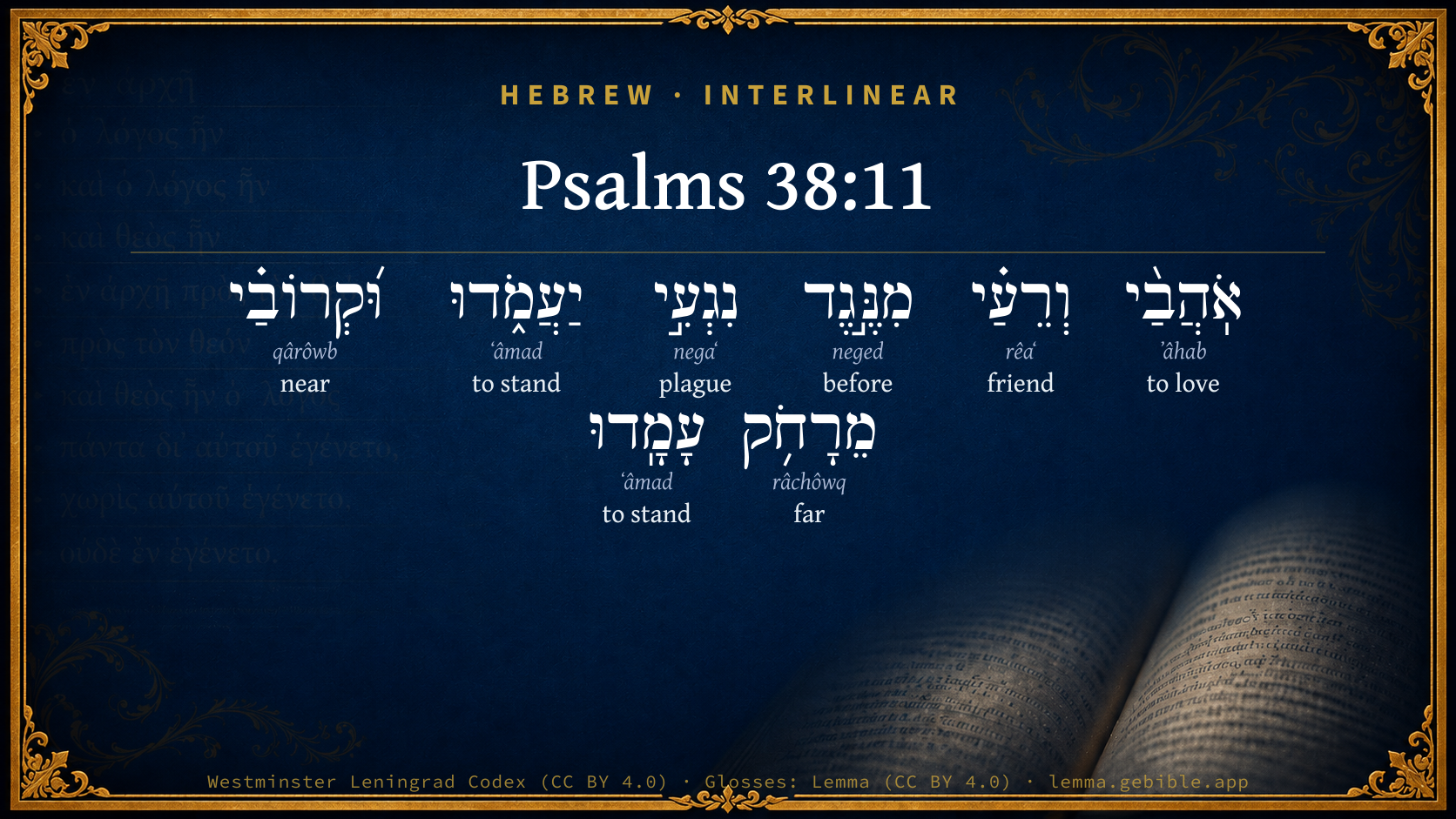
Hebrew (Westminster Leningrad Codex) Psalms 38:11 appears in the Hebrew Old Testament. The text above is from the Westminster Leningrad Codex. Each word links to its Strong’s number, a concise gloss, and parsing drawn from the Open Scriptures Hebrew Bible morphology. Click any word for its full Brown-Driver-Briggs (BDB) entry.
Download image
Cite this verse

Psalms 38:11 (World English Bible). Public Domain. Lemma interlinear Bible study tool, https://lemma.gebible.app/v/psalms/38/11.

Show BibTeX & RIS
BibTeX
RIS
English Translation
My lovers and my friends stand aloof from my plague. My kinsmen stand far away.
World English Bible · Public Domain
Download a study sheet

One document with this verse’s original text, its word-by-word gloss line, the meaning frame, cross-references with their text, attributed commentary, and full source and license credits — printable, and it pastes into notes with its structure intact.

This verse Autodidact and up

Study sheet (.html) Plain text (.txt)

A passage Seminary Student

Up to 50 verses in one chapter. A passage sheet keeps up to 6 commentary sources and 12 cross-references per verse, in the order this page ranks them, and says so on the sheet whenever that leaves anything out. Ask for a single verse and you get the Autodidact verse sheet above.

Everything on this page stays free to read, with no account — the sheet is a download of what is already on screen, not access to it.

Want to remove ads? Support Godless Engineer
Compare translations 3

The same verse in 3 English versions, stacked beneath the original-language interlinear above. Click any original word for its lexicon entry.

Each is an independent rendering of the whole verse — the interlinear is not word-aligned to these translations.

Highlighted words mark where these versions differ — a whole-verse word diff, not a word-by-word alignment.

  • World English Bible Public Domain
    My lovers and my friends stand aloof from my plague. My kinsmen stand far away.
  • King James Version Public Domain
    My lovers and my friends stand aloof from my sore; and my kinsmen stand afar off.
  • unfoldingWord Literal Text CC BY-SA 4.0
    My loved ones and my friends stand from before my plague, and my relatives stand from afar.

unfoldingWord Literal Text — © unfoldingWord, licensed CC BY-SA 4.0. Word-aligned USFM3 via Door43 (git.door43.org/unfoldingWord/en_ult).

Versions to compare (up to 4)

3 of 4 selected

Show all 18 translations

Every available English version of this verse, each an independent rendering of the whole verse.

  • World English Bible Public Domain
    My lovers and my friends stand aloof from my plague. My kinsmen stand far away.
  • Berean Standard Bible Public Domain
    My beloved and friends shun my disease, and my kinsmen stand at a distance.
  • Majority Standard Bible Public Domain
    My beloved and friends shun my disease, and my kinsmen stand at a distance.
  • King James Version Public Domain
    My lovers and my friends stand aloof from my sore; and my kinsmen stand afar off.
  • American Standard Version (1901) Public Domain
    My lovers and my friends stand aloof from my plague; And my kinsmen stand afar off.
  • Revised Version (1885) Public Domain
    My lovers and my friends stand aloof from my plague; and my kinsmen stand afar off.
  • Geneva Bible (1599) Public Domain
    My louers and my friends stand aside from my plague, and my kinsmen stand a farre off.
  • Douay-Rheims (1899) Public Domain
    My heart is troubled, my strength hath left me, and the light of my eyes itself is not with me.
  • Young's Literal Translation Public Domain
    My lovers and my friends over-against my plague stand. And my neighbours afar off have stood.
  • Literal Standard Version CC BY-SA 4.0
    My lovers and my friends stand aloof from before my plague. And my neighbors have stood far off.
  • Unlocked Literal Bible CC BY-SA 4.0
    My friends and companions shun me because of my condition; my neighbors stand far off.
  • unfoldingWord Literal Text CC BY-SA 4.0
    My loved ones and my friends stand from before my plague, and my relatives stand from afar.
  • Darby Bible Public Domain
    My lovers and mine associates stand aloof from my stroke; and my kinsmen stand afar off.
  • World Messianic Bible Public Domain
    My lovers and my friends stand aloof from my plague. My kinsmen stand far away.
  • Webster's Bible Public Domain
    \\38:10\\My heart panteth, my strength faileth me: as for the light of my eyes, that also is gone from me.
  • Free Bible Version CC BY-SA 4.0
    My loved ones and my friends don't come near me because they're afraid of what I've got. Even my family keeps me at a distance.
  • Bible in Basic English Public Domain
    My lovers and my friends keep away from my disease; my relations keep far away.
  • JPS Tanakh (1917) Public Domain
    (38-12) My friends and my companions stand aloof from my plague; and my kinsmen stand afar off.

Literal Standard Version (2020), Covenant Press — licensed CC BY-SA 4.0. Text via the HelloAO Bible API (eBible.org). Unlocked Literal Bible (unfoldingWord) — licensed CC BY-SA 4.0. Text via the HelloAO Bible API (eBible.org). unfoldingWord Literal Text — © unfoldingWord, licensed CC BY-SA 4.0. Word-aligned USFM3 via Door43 (git.door43.org/unfoldingWord/en_ult). Free Bible Version, Dr. Jonathan Gallagher — licensed CC BY-SA 4.0. Text via the HelloAO Bible API (eBible.org).

Word by word

More ways to search: Search by grammar → Find every occurrence → Compare this word →

Practice this passage: Drill this verse → Learn its vocabulary →

נִגְעִ֣י
negaʻ
H5061
“plague · my”
Noun, Common, Masculine, Singular, Construct + Suffix, Personal, 1st Person, Common, Singular
Part of Speech
Noun
Type
Common
Gender
Masculine
Number
Singular
State
Construct
Full BDB Definition

Origin: from H5060

TWOT: 1293a

stroke, plague, disease, mark, plague spot - stroke, wound - stroke (metaphorical of disease) - mark (of leprosy)
  1. אֹֽהֲבַ֨י ʼâhab H157 “loving · me” Verb, Qal, Participle Active, Masculine, Plural, Construct + Suffix, Personal, 1st Person, Common, Singular
  2. וְרֵעַ֗י rêaʻ H7453 “and · friends · my” Conjunction + Noun, Common, Masculine, Plural, Construct + Suffix, Personal, 1st Person, Common, Singular
  3. מִנֶּ֣גֶד neged H5048 “from · before” Preposition + Preposition
  4. יַעֲמֹ֑דוּ ʻâmad H5975 “to stand” Verb, Qal, Imperfect, 3rd Person, Masculine, Plural
  5. וּ֝קְרוֹבַ֗י qârôwb H7138 “and · near · my” Conjunction + Adjective, Adjective, Masculine, Plural, Construct + Suffix, Personal, 1st Person, Common, Singular
  6. מֵרָחֹ֥ק râchôwq H7350 “from · far” Preposition + Adjective, Adjective, Masculine, Singular, Absolute
  7. עָמָֽדוּ ʻâmad H5975 “to stand” Verb, Qal, Perfect, 3rd Person, Common, Plural

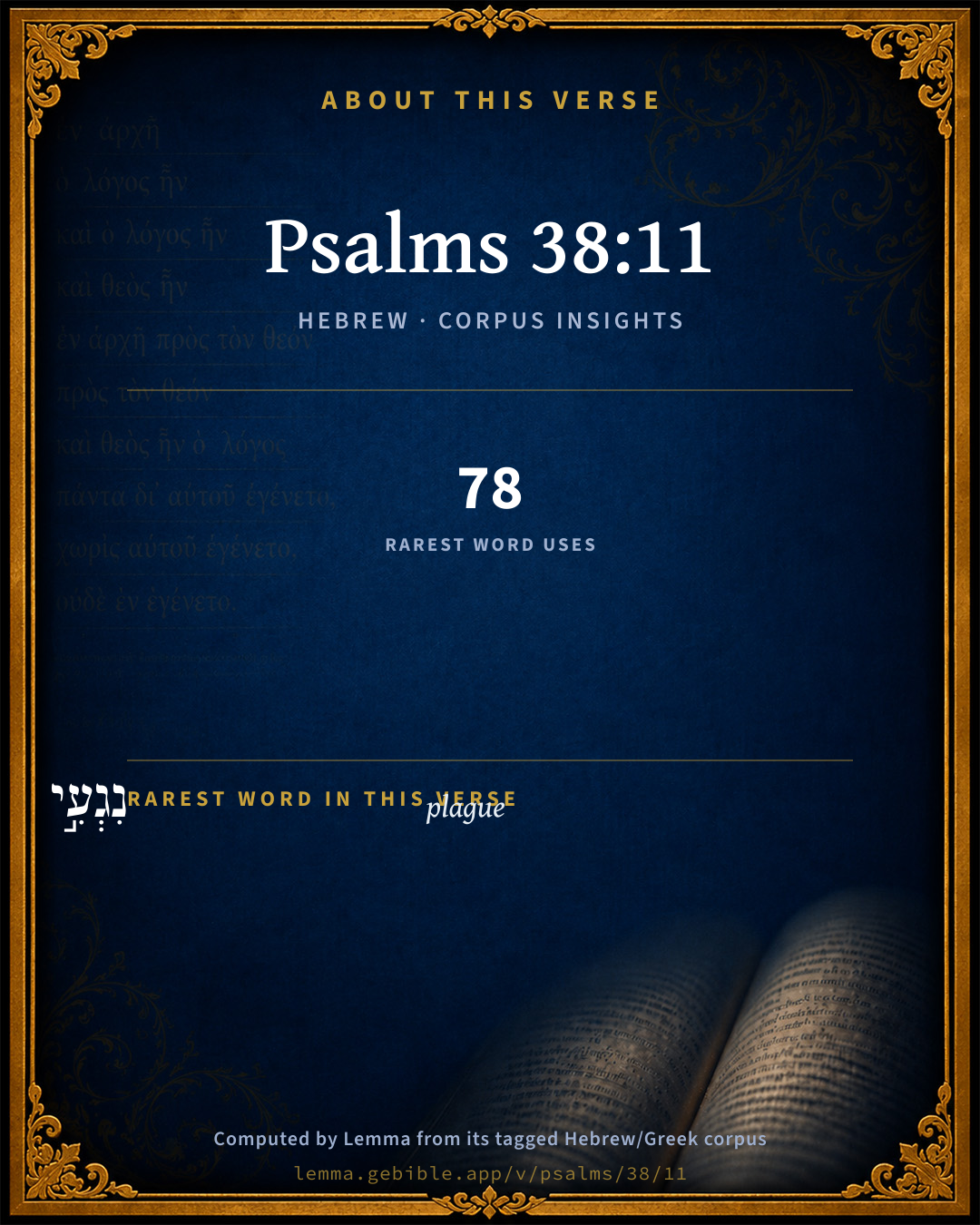
About this verse

These counts appear in no published source. They are computed here, from the morphology-tagged text and Lemma’s own curated glosses. What Lemma adds →

8
words
7
distinct lemmas
Wisdom
section

Grammatical profile

  • 3 verbs
  • 2 nouns
  • 2 adjectives
  • 1 preposition

Verb forms

  • אֹֽהֲבַ֨י Qal · Participle Active
  • יַעֲמֹ֑דוּ Qal · Imperfect
  • עָמָֽדוּ Qal · Perfect

Repetition

A word recurs within this verse — often emphatic in Hebrew:

  • יַעֲמֹ֑דוּ to stand H5975 ×2

Hebrew & Septuagint length

In English translation the verse runs 15 words from the Hebrew and 20 from the Septuagint (LXX English) — closely comparable.

A rough comparison of the two English renderings, which tokenize alike — not a word-level alignment.

Word counts can differ between the Hebrew and the Greek without any difference in meaning — e.g. the Hebrew direct-object marker אֵת has no separate Greek word, and Greek often adds the article ὁ.

Cross-references

11

Topical passages linked to Psalms 38:11 in the Treasury of Scripture Knowledge — connected by theme and wording, ordered by reader-vote popularity; previews shown in the World English Bible.

  • Psalms 31:11 Because of all my adversaries I have become utterly contemptible to my neighbors, A fear to my acquaintances. Those who saw me on the street fled from me.
  • Luke 23:49 All his acquaintances, and the women who followed with him from Galilee, stood at a distance, watching these things.
  • Job 19:13–17 "He has put my brothers far from me. My acquaintances are wholly estranged from me.
  • Psalms 88:18 You have put lover and friend far from me, And my friends into darkness.
  • Luke 10:31–32 By chance a certain priest was going down that way. When he saw him, he passed by on the other side.
  • Luke 22:54 They seized him, and led him away, and brought him into the high priest's house. But Peter followed from a distance.
  • John 16:32 Behold, the time is coming, yes, and has now come, that you will be scattered, everyone to his own place, and you will leave me alone. Yet I am not alone, because the Father is with me.
  • Job 6:21–23 For now you are nothing. You see a terror, and are afraid.
  • Matthew 26:56 But all this has happened, that the Scriptures of the prophets might be fulfilled." Then all the disciples left him, and fled.
  • Isaiah 53:4 Surely he has borne our sickness, and carried our suffering; yet we considered him plagued, struck by God, and afflicted.
  • Isaiah 53:8 By oppression and judgment he was taken away; and as for his generation, who [among them] considered that he was cut off out of the land of the living for the disobedience of my people to whom the stroke [was due]?

Cross-references courtesy of OpenBible.info (CC BY 4.0).

Hebrew and Greek witnesses Masoretic Hebrew ↔ Greek Septuagint

The same verse in the two great witnesses to the Old Testament, shown verse-for-verse.

You’re reading Greek Psalm 37 (Hebrew Psalm 38). The Septuagint counts the superscription, so verse numbers can differ from the Hebrew — chapter-level alignment, not verse-by-verse. Numbering follows Rahlfs.

These are two independent witnesses, not word-aligned to each other, and the Septuagint is shown in lemma (dictionary) form.

Hebrew Psalms 38:11 Masoretic · Westminster Leningrad Codex

אֹֽהֲבַ֨י וְרֵעַ֗י מִנֶּ֣גֶד נִגְעִ֣י יַעֲמֹ֑דוּ וּ֝קְרוֹבַ֗י מֵרָחֹ֥ק עָמָֽדוּ

My lovers and my friends stand aloof from my plague. My kinsmen stand far away.

World English Bible · Public Domain

Greek LXX Greek Psalm 37:11 Septuagint · lemma form

ὁ καρδία ἐγώ ταράσσω ἐν καταλείπω ἐγώ ὁ ἰσχύς ἐγώ καί ὁ φῶς ὁ ὀφθαλμός ἐγώ καί αὐτός οὐ εἰμί μετά ἐγώ

My friends and my neighbors drew near before me, and stood still; and my nearest of kin stood afar off.

LXX2012 (modern English Septuagint) · Public Domain

On this verse, The Cambridge Bible for Schools and Colleges discusses the Septuagint’s reading. Read the note in Commentary ↓

Hebrew: Westminster Leningrad Codex (CC BY 4.0). Greek: Septuagint (public domain); English from LXX2012 (modern English Septuagint) (Public Domain). How the Septuagint differs from the Hebrew →

Commentary

Notes on Psalms 38:11 from classic Christian and Jewish commentators (each source and its license shown beneath its notes). The classic Christian expositions comment on the surrounding passage and are grouped to its opening verse, so a note may address several verses; the Jewish commentaries on the Tanakh (Rashi and others) are per-verse, so they appear only where the commentator wrote on this verse.

Lemma curates 59 commentaries, every one of them public domain or Creative Commons licensed, each selected and text-cleaned for this edition rather than reprinted as found. About our sources →

Trapp's Complete Commentary

John Trapp

Psa 38:11 My lovers and my friends stand aloof from my sore; and my kinsmen stand afar off.

Ver. 11. My lovers and my friends stand aloof from my sore] Heb. my stroke, which, therefore, some Jewish doctors will have to be the leprosy, which was noisome and contagious; and, therefore, by the law of God, none were to come near such, Prae horrore detrectantes accedere (Trem.). So among the Persians none might come near a Pisaga (so they called a leper), and therefore Megabyzus, having offended Artaxerxes, kept himself five years from court, pretending himself a leper, and in that space made his peace with the king (Ctes. Pers.). But in David’s friends, who dealt thus with him, it was not so much fear of danger as pride and perfidy that made them deny him all duty and friendship, Psa 31:11. Job was so used, Job 6:15; and our Saviour, when he hung naked on the cross, Luk 23:49; and St Paul, when he made his defence before Nero, 2Ti 4:16. So was not Orestes by his friend Pylades, nor Damon by his Pythias, nor Achilles by Patroclus, which made Alexander cry out, O felicem iuvenem! O faithful youth, Trouble trieth who are friends, who traitors (Sophoc.; Val. Max.; Plutarch in Alex.).

John Trapp, A Commentary or Exposition upon All the Books of the Old and New Testament (1647–1656) — public domain. Text from a community e-Sword module.

Joseph Benson's Commentary

Psa 38:11-13. My lovers and friends stand aloof — Either through neglect and contempt, or disdain of me. They that seek my life lay snares for me — That if my affliction or trouble do not kill me, they may destroy me some other way; and imagine deceits all the day long — They design mischief, but cover it with fair pretences. But I, as a deaf man, heard it not — I carried myself toward them as if I had no ears to hear what they said, either to me or of me, nor a tongue to answer or reprove them for their reproaches and calumnies. And he was thus silent, not for want of just answers to them, but to testify his humiliation for his sins, and his acceptation of the punishment which he had brought upon himself.

Joseph Benson's Commentary on the Old and New Testaments (1811–1818) — public domain. Text from a community e-Sword module.

J. A. Alexander on Psalms

Joseph Addison Alexander

12. (Psa 38:11). My lovers and my friends away from my stroke will stand, and my neighbours afar off have stood. He now gives expression to the anguish caused by human unkindness, and first, by that of such as he believed to be his friends. These are represented as standing aloof, literally from before, i.e. out of sight, as in Gen 21:16, and Isa 1:16, not over against, as im flying opposition or hostility. What he here complains of is indifference and neglect, as appears from the parallel expression, far off, literally from afar, according to a common Hebrew idiom which expresses the position of an object in terms strictly denoting in motion or direction. See for example Gen 2:8, where eastward is in Hebrew from, the east, and the familiar phrase from the right or left hand, where we say at or on it. This usage renders it unnecessary, although not inadmissible, in the case before us, to supply a word, "they stand (looking) from afar." The word translated neighhours means those near one, either in local habitation or affinity, and may therefore be considered as including the idea expressed in the English Version, kinsmen. Unless the variation of the tenses in this sentence is entirely unmeaning, which is highly improbable, both in itself and from analogy, the last clause may be understood to state as an actual reality, what is only apprehended in the first as probable or certain but still future. As if he had said, "My friends will no doubt stand aloof from this affliction; nay, they are already afar off."—Stroke is here put for a providential or divine infliction in general, not for sickness exclusively, much less for a particular disease, such as the leprosy, which Jerome actually introduces into his translation. See below, on Psa 39:11 (10), and compare Job 19:21, Isa 53:4. Some suppose that there is an allusion to this verse in the statement made by one of the evangelists, that the women who had followed Christ from Galilee, and all his acquaintances, stood afar off, gazing at his crucifixion. See Luk 23:49, and compare Mar 15:40-41.

Joseph Addison Alexander, The Psalms Translated and Explained (1850) — public domain. Text from a community e-Sword module.

Geneva Bible (1599)

Geneva Bible translators

Partly for fear and partly for pride, they denied all duty and friendship.

Geneva Bible (1599) marginal notes — public domain. Text via Bolls.life.

Jamieson, Fausset & Brown

Robert Jamieson, A. R. Fausset & David Brown

Friends desert, but foes increase in malignity.

Jamieson, Fausset & Brown — Commentary Critical and Explanatory on the Whole Bible (1871) — public domain (CC PDM 1.0). Text via the HelloAO Bible API.

Adam Clarke's Commentary

Verse 11. My lovers] Those who professed much affection for me; my friends, רעי reai, my companions, who never before left my company, stand aloof.

My kinsmen] קרובי kerobai, my neighbours, stand afar off. I am deserted by all, and they stand off because of נגעי nigi, my plague. They considered me as suffering under a Divine judgment; and, thinking me an accursed being, they avoided me lest they should be infected by my disease.

Adam Clarke's Commentary on the Bible (1810–1826) — public domain. Text from a community e-Sword/MySword module.

John Calvin's Commentaries

11 My friends and my companions stand away from my sore Here David enumerates other circumstances to show the aggravated character of his misery, that he might excite the compassion of God. One of these is, that he finds no help or solace among men. In saying that his friends stand away from him, he means, that they cease from performing any of the offices of humanity towards him. This might happen either from pride or fear. If they withdrew from this poor afflicted man because they despised him, they were cruel and proud; and if they refused him their assistance for fear of being brought into odium, it was most unpardonable cowardice. But in the meantime, it augmented not a little the calamity of David, that even his friends and kinsfolk dared not to show any token of compassion towards him. It is, indeed, a very sore trial, when a man, who has had a great number of friends, comes to be abandoned by them all.

John Calvin's Commentaries (1540-1563) — public domain. Text from the Calvin Translation Society English edition (1840s-50s) via the Christian Classics Ethereal Library (ccel.org). Calvin's coverage is partial (roughly two-thirds of the Bible); uncommented books and verses are honest gaps, never fabricated. The 19th-century editor's footnotes and remarks are omitted so the notes are faithfully Calvin's own voice.

Ellicott's Commentary for English Readers

(11) Sore is rather stroke, as in margin, or plague. His friends, looking on him as “one smitten of God,” and thinking “he must be wicked to deserve such pain,” abandon him as too vile for their society.

Kinsmen.—Render rather, as in margin, neighbours, or near ones.

Those who should have been near me stand aloof.

A Bible Commentary for English Readers, edited by Charles John Ellicott (1878–1897) — public domain. Text from a community e-Sword module.

The Cambridge Bible for Schools and Colleges

gen. ed. J. J. S. Perowne

11. from my sore] R.V. from my plague. The word is specially used of the plague of leprosy (Lev_13:3, &c.). His friends treat him as a leper, standing over against him, within sight but at a distance. Even his near kinsmen falsify their name by standing afar off. (LXX. οἱ ἔγγιστά μου μακρόθεν ἔστησαν.)

Comp. Psa_31:11-13; Psa_69:8; Psa_88:18; Job_19:13 ff.; Isa_53:4.

The Cambridge Bible for Schools and Colleges (gen. ed. J. J. S. Perowne; Cambridge University Press, 1878–1918) — public domain. Text from a community e-Sword module.

John Gill's Exposition

They also that seek after my life,.... His avowed and implacable enemies, whom nothing would satisfy but the taking away of his life: these came too near him; for these, he says,

lay snares for me, as Satan does for the souls of men, as the Jews did for Christ, and as wicked men do for the saints, Psa 124:7;

and they that seek my hurt speak mischievous things; to the injury of his character and reputation:

and imagine deceits all the day long; contrive artful schemes to deceive; see Psa 35:20.

John Gill's Exposition of the Whole Bible (1746–1763) — public domain (CC PDM 1.0). Text via the HelloAO Bible API.

Albert Barnes' Notes on the Bible

My lovers - See the notes at Psa 31:11. The reference here is to those who professed to be his friends.

And my friends - The word used here means properly an acquaintance, a companion, a friend, Job 2:11; Job 19:21; then, a lover, a friend, a neighbor. The phrase here would be synonymous with our word “kinsmen.”

Stand aloof - They are unwilling to come near me; they leave me to suffer alone.

From my sore - Margin: “stroke.” The Hebrew word means properly a stroke, a blow, Deu 17:8; Deu 21:5; then a stroke in the sense of calamities or judgments, such as God brings upon men: Gen 12:17; Exo 11:1. The meaning here is, that they stand aloof from him, or refuse to come near him, as if he were afflicted with some contagious disease.

And my kinsmen - Margin: “neighbors.” The Hebrew word used here - קרוב qârôb - means properly near, nigh; spoken of a place, Gen 19:20; then of time, Isa 13:6; then of kindred or affinity, Num 27:11; and then of friendship, meaning our intimate acquaintance - as we should say, those who are “near” to us, Job 19:14. The word would be applicable to neighbors or to warm personal friends.

Albert Barnes' Notes on the Bible (1834–1885) — public domain. Text from a community e-Sword/MySword module.

Matthew Poole's English Annotations

Either through neglect, and contempt, or disdain of me; or through delicacy and abhorrency from loathsome and sadding spectacles; or through fear of infection, or some other inconveniences.

Matthew Poole's English Annotations on the Holy Bible (1683–1685) — public domain. Text from a community e-Sword/MySword module.

The Treasury of David

Charles H. Spurgeon

Ver. 11. My lovers and my friends stand aloof from my sore. Whatever affection they might pretend to, they kept out of his company, lest as a sinking vessel often draws down boats with it, they might be made to suffer through his calamities. It is very hard when those who should be the first to come to the rescue, are the first to desert us. In times of deep soul trouble, even the most affectionate friends cannot enter into the sufferer's case; let them be as anxious as they may, the sores of a tender conscience they cannot bind up. Oh, the loneliness of a soul passing under the convincing power of the Holy Ghost! And my kinsmen stand afar off. As the women and others of our Lord's acquaintances from afar gazed on his cross, so a soul wounded for sin sees all mankind as distant spectators, and in the whole crowd finds none to aid. Often relatives hinder seekers after Jesus, oftener still they look on with unconcern, seldom enough do they endeavour to lead the penitent to Jesus.

Ver. 11. My lovers and my friends stand aloof from my sore; and my kinsmen stand afar off. So miserable am I, that I am left alone as one utterly forsaken; they are all pieces that recoil and fly back at the first voice of the powder. Yet it is not so much me they stand aloof from as my sore; for if it were not for my sore, I should have enough of their company easily enough; but they cannot abide sores, their eyes are too tender to endure to see them, and yet hard enough not to relieve them. Or is it they stand aloof, that is, so near as to show they are willing enough to see them; but yet so far off as to show they have no meaning to come and help them! ...My lovers and my friends stand aloof from my sore, as fearing more my sore than me; but my kinsmen stand afar off, as fearing me no less than my sore; and where my lovers and friends by standing aloof do but violate the law of a contracted friendship, my kinsmen by standing afar off violate even the law of natural affection; and is not this a grievous thing, that the law of reason, the law of friendship, the law of nature, shall all be broken rather than I shall be relieved or find assistance? Sir Richard Baker.

Ver. 11. My lovers and my friends stand afar off. Deserted by false friends, but conqueror through thee, to thee I speed, who though seeming to act the part of an enemy, yet never changest thy love; but lovest for ever him whom thou once hast loved. When you seem afar off, you are near. I conceive this sorrow on account of the treachery of false friends, and the cowardliness of my kinsfolk, who are to me as piercing thorns rather than sweet smelling roses. The proof of affection is seen by deeds. I hear the name of kinsman and friend; I see no deed. To thee, therefore, I flee, whose word is deed; for I need thy help. From the Latin of A. Rivetus.

None.

Psalms 38:12*

Charles H. Spurgeon's The Treasury of David (1869–1885) — public domain. Psalms only. Text from a community e-Sword/MySword module.

Whedon's Commentary on the Bible

Daniel D. Whedon

11. Lovers… friends… kinsmen—The enumeration covers close friends, companions; neighbours or associates; and kinsmen. These did not come near him, but stood “from before him,” “far off and round about.” See Psa_31:11; Job_19:13-14

Daniel D. Whedon (gen. ed.), Commentary on the Old and New Testaments (1874–1909) — public domain. Text from a community e-Sword module.

The Pulpit Commentary

My lovers and my friends stand aloof from my sore; or, from my stroke. (comp. Psa_39:10, where the same word is used) The psalmist feels himself to be "stricken, smitten of God". (Isa_53:4) He looks for comfort and sympathy to his friends, but they, with a selfishness that is only too common, hold aloof, draw away item him, and desert him. (comp. Job_19:13, Job_19:14) And my kinsmen stand afar off; or, my neighbours. The stricken deer is forsaken by the rest of the herd. (comp. Mat_26:56, Mat_26:58)

The Pulpit Commentary (1880–1919), ed. H.D.M. Spence-Jones & Joseph S. Exell — public domain. Text from a community e-Sword module.

unfoldingWord translationNotes

Door43 World Missions Community

lay snares for me

The plots of the writer's enemies are spoken of as if they were traps that they had set to catch him like an animal. AT: "set traps to catch me" (See: Metaphor)

speak destructive words and say deceitful words

These two phrases mean basically the same thing and emphasize the hurtful nature of what these people say. (See: Parallelism)

translationWords

companion

neighbor

life

snare

word

deceive

unfoldingWord translationNotes — © Distant Shores Media and the Door43 World Missions Community, licensed CC BY-SA 4.0. Source: git.door43.org/Door43/en_tn.

Rashi

Rabbi Shlomo Yitzchaki (Rashi)

engulfed Heb. סחרחר, surrounded by grief. This is one of the double words, like (Lev. 13: 49), “dark green (ירקרק), dark red (אדמדם),” (Ned. 66b) “round (סגלגל)” (Lam. 1:20), “my spirits are troubled (חמר מרו).”

Rashi on the Tanakh — English translations: “The Judaica Press complete Tanach with Rashi, translated by A. J. Rosenberg” (CC BY 4.0); “Pentateuch with Rashi's commentary by M. Rosenbaum and A.M. Silbermann, 1929-1934” (public domain); “The Metsudah Tanach series, Lakewood, N.J” (CC BY 4.0); and “The Book of Joshua, Metsudah Publications, 1997” (CC BY 4.0). Text via Sefaria.

Lesson kit

Teaching starters — assembled from the data on this page, not authored interpretation. Every prompt links to the verse data it draws on. Edit before teaching.

Psalms, in the Wisdom, opens this verse with 8 words (7 distinct Hebrew lemmas). Its most distinctive word is negaʻ (“plague”). A historical commentator’s framing appears above. Read the whole chapter for the surrounding context.

Discussion questions

  1. How does “plague” (negaʻ) shape what this verse is saying?
  2. How does Psalms 31:11, which shares this passage’s theme, read alongside this verse?
  3. What does the repetition of “to stand” (2× in this one verse) do in this verse?
  4. The translations on this page render this verse differently — a whole-verse word diff, not a word-by-word alignment. What might account for the different wordings?
  5. «אֹֽהֲבַ֨י» is a Qal Participle Active verb. How does that grammatical form shape the action described?
  6. Compare how Trapp's Complete Commentary and Joseph Benson's Commentary read this verse. Where do they agree or differ?

Things to notice

Reading settings

Reading text

Shown beneath each verse's original-language words.

Old Testament
Old Testament edition

Read the OT as the Masoretic Hebrew (MT) or the Greek Septuagint (LXX).

English shown for the Greek Septuagint (in the Hebrew ↔ Greek comparison).

Comparing translations? Open the Compare panel on any verse page to stack up to four side by side.