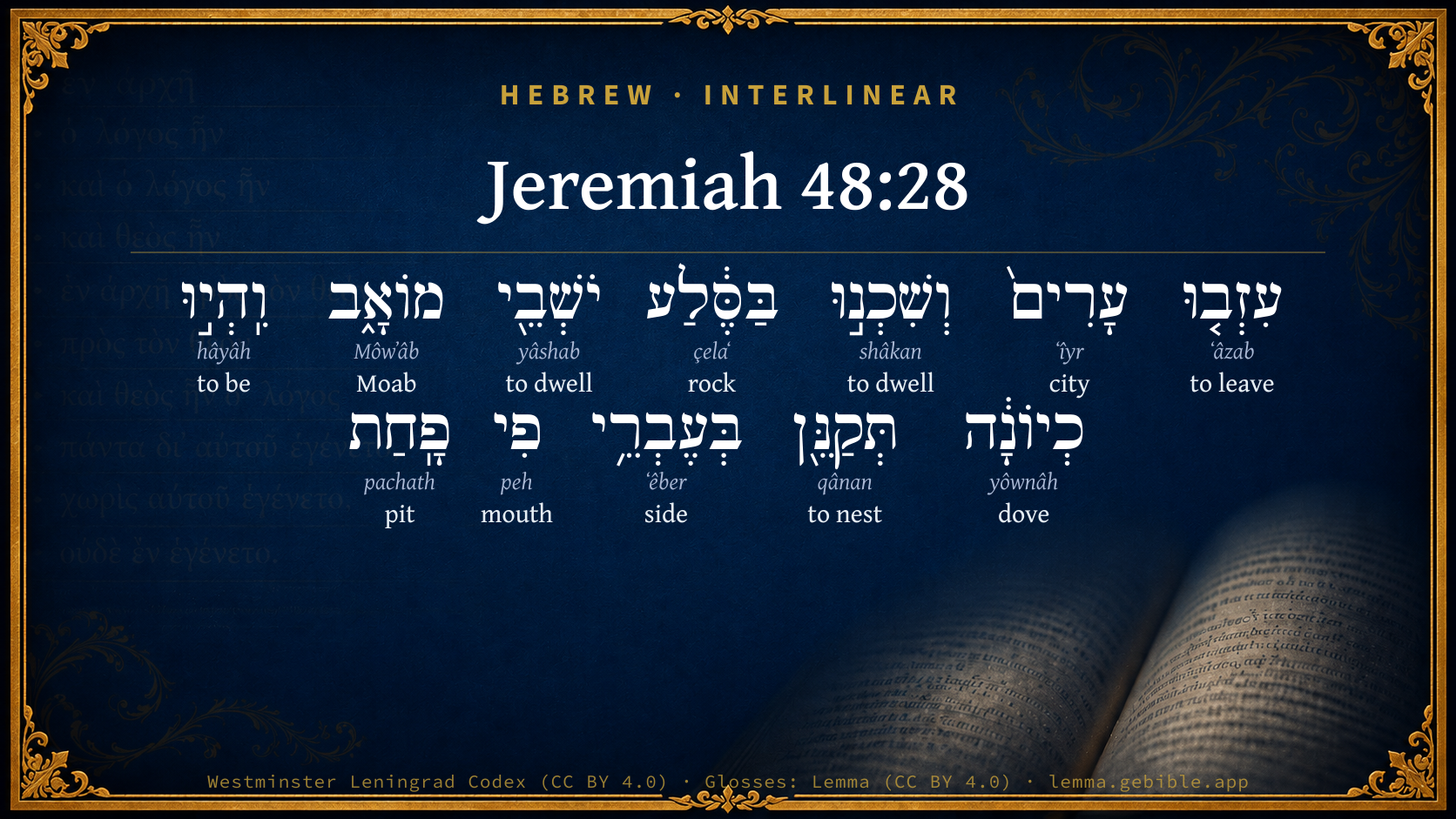
Jeremiah 48:28

Hebrew (Westminster Leningrad Codex) Jeremiah 48:28 appears in the Hebrew Old Testament. The text above is from the Westminster Leningrad Codex. Each word links to its Strong’s number, a concise gloss, and parsing drawn from the Open Scriptures Hebrew Bible morphology. Click any word for its full Brown-Driver-Briggs (BDB) entry.
Download image
Cite this verse

Jeremiah 48:28 (World English Bible). Public Domain. Lemma interlinear Bible study tool, https://lemma.gebible.app/v/jeremiah/48/28.

Show BibTeX & RIS
BibTeX
RIS
English Translation
You inhabitants of Moab, leave the cities, and dwell in the rock; and be like the dove that makes her nest over the mouth of the abyss.
World English Bible · Public Domain
Download a study sheet

One document with this verse’s original text, its word-by-word gloss line, the meaning frame, cross-references with their text, attributed commentary, and full source and license credits — printable, and it pastes into notes with its structure intact.

This verse Autodidact and up

Study sheet (.html) Plain text (.txt)

A passage Seminary Student

Up to 50 verses in one chapter. A passage sheet keeps up to 6 commentary sources and 12 cross-references per verse, in the order this page ranks them, and says so on the sheet whenever that leaves anything out. Ask for a single verse and you get the Autodidact verse sheet above.

Everything on this page stays free to read, with no account — the sheet is a download of what is already on screen, not access to it.

Want to remove ads? Support Godless Engineer
Compare translations 3

The same verse in 3 English versions, stacked beneath the original-language interlinear above. Click any original word for its lexicon entry.

Each is an independent rendering of the whole verse — the interlinear is not word-aligned to these translations.

Highlighted words mark where these versions differ — a whole-verse word diff, not a word-by-word alignment.

  • World English Bible Public Domain
    You inhabitants of Moab, leave the cities, and dwell in the rock; and be like the dove that makes her nest over the mouth of the abyss.
  • King James Version Public Domain
    O ye that dwell in Moab, leave the cities, and dwell in the rock, and be like the dove that maketh her nest in the sides of the hole's mouth.
  • unfoldingWord Literal Text CC BY-SA 4.0
    Abandon the cities and camp on the cliffs, inhabitants of Moab. Become like a dove that is nesting over the mouth of a hole in the rocks.

unfoldingWord Literal Text — © unfoldingWord, licensed CC BY-SA 4.0. Word-aligned USFM3 via Door43 (git.door43.org/unfoldingWord/en_ult).

Versions to compare (up to 4)

3 of 4 selected

Show all 18 translations

Every available English version of this verse, each an independent rendering of the whole verse.

  • World English Bible Public Domain
    You inhabitants of Moab, leave the cities, and dwell in the rock; and be like the dove that makes her nest over the mouth of the abyss.
  • Berean Standard Bible Public Domain
    Abandon the towns and settle among the rocks, O dwellers of Moab! Be like a dove that nests at the mouth of a cave.
  • Majority Standard Bible Public Domain
    Abandon the towns and settle among the rocks, O dwellers of Moab! Be like a dove that nests at the mouth of a cave.
  • King James Version Public Domain
    O ye that dwell in Moab, leave the cities, and dwell in the rock, and be like the dove that maketh her nest in the sides of the hole's mouth.
  • American Standard Version (1901) Public Domain
    O ye inhabitants of Moab, leave the cities, and dwell in the rock; and be like the dove that maketh her nest over the mouth of the abyss.
  • Revised Version (1885) Public Domain
    O ye inhabitants of Moab, leave the cities, and dwell in the rock; and be like the dove that maketh her nest in the sides of the holes mouth.
  • Geneva Bible (1599) Public Domain
    O ye that dwell in Moab, leaue the cities, and dwell in the rockes, and be like the doue, that maketh her nest in the sides of the holes mouth.
  • Douay-Rheims (1899) Public Domain
    Leave the cities, and dwell in the rock, you that dwell in Moab: and be ye Iike the dove that maketh her nest in the mouth of the hole in the highest place.
  • Young's Literal Translation Public Domain
    Forsake cities, and dwell in a rock, Ye inhabitants of Moab, And be as a dove making a nest in the passages of a pit's mouth.
  • Literal Standard Version CC BY-SA 4.0
    Forsake cities, and dwell in a rock, || You inhabitants of Moab, || And be as a dove making a nest in the passages of a pit’s mouth.
  • Unlocked Literal Bible CC BY-SA 4.0
    Abandon the cities and camp on the cliffs, inhabitants of Moab. Become like a dove that is nesting over the mouth of a hole in the rocks.
  • unfoldingWord Literal Text CC BY-SA 4.0
    Abandon the cities and camp on the cliffs, inhabitants of Moab. Become like a dove that is nesting over the mouth of a hole in the rocks.
  • Darby Bible Public Domain
    Leave the cities, and dwell in the rocks, ye inhabitants of Moab, and be like the dove, that maketh her nest in the sides of the cave's mouth.
  • World Messianic Bible Public Domain
    You inhabitants of Moab, leave the cities, and dwell in the rock. Be like the dove that makes her nest over the mouth of the abyss.
  • Webster's Bible Public Domain
    O ye that dwell in Moab, leave the cities, and dwell in the rock, and be like the dove that maketh her nest in the sides of the hole's mouth.
  • Free Bible Version CC BY-SA 4.0
    You people living in Moab, run from your towns, go and live among the rocks. Be like a dove nesting on the cliffs at the entrance to a ravine.
  • Bible in Basic English Public Domain
    O people of Moab, go away from the towns and take cover in the rock; be like the dove of the Arabah, which makes her living-place in holes.
  • JPS Tanakh (1917) Public Domain
    O ye that dwell in Moab, leave the cities, and dwell in the rock; and be like the dove that maketh her nest in the sides of the pit's mouth.

Literal Standard Version (2020), Covenant Press — licensed CC BY-SA 4.0. Text via the HelloAO Bible API (eBible.org). Unlocked Literal Bible (unfoldingWord) — licensed CC BY-SA 4.0. Text via the HelloAO Bible API (eBible.org). unfoldingWord Literal Text — © unfoldingWord, licensed CC BY-SA 4.0. Word-aligned USFM3 via Door43 (git.door43.org/unfoldingWord/en_ult). Free Bible Version, Dr. Jonathan Gallagher — licensed CC BY-SA 4.0. Text via the HelloAO Bible API (eBible.org).

Word by word

More ways to search: Search by grammar → Find every occurrence → Compare this word →

Practice this passage: Drill this verse → Learn its vocabulary →

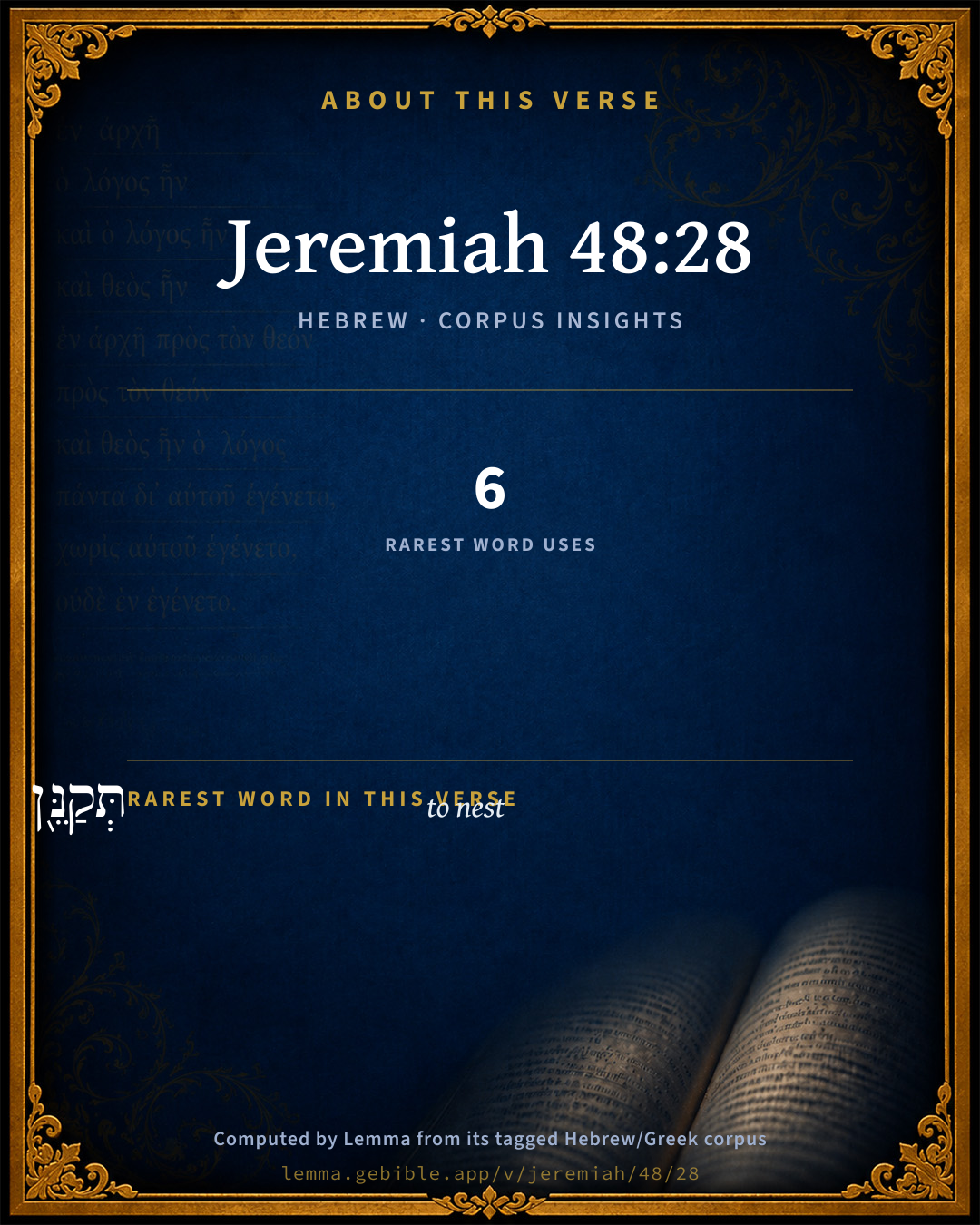
תְּקַנֵּ֖ן
qânan
H7077
“to nest”
Verb, Piel, Imperfect, 3rd Person, Feminine, Singular
Part of Speech
Verb
Stem
Piel
Form
Imperfect
Person
3rd Person
Gender
Feminine
Number
Singular
Full BDB Definition

Origin: a primitive root

TWOT: 2042

to make a nest - (Piel) to make a nest - (Pual) to be nested
  1. עִזְב֤וּ ʻâzab H5800 “leave” Verb, Qal, Imperative, 2nd Person, Masculine, Plural
  2. עָרִים֙ ʻîyr H5892 “cities” Noun, Common, Feminine, Plural, Absolute
  3. וְשִׁכְנ֣וּ shâkan H7931 “and · dwell” Conjunction + Verb, Qal, Imperative, 2nd Person, Masculine, Plural
  4. בַּסֶּ֔לַע çelaʻ H5553 “in/at the · rock” Preposition, Determined + Noun, Common, Masculine, Singular, Absolute
  5. יֹשְׁבֵ֖י yâshab H3427 “dwelling” Verb, Qal, Participle Active, Masculine, Plural, Construct
  6. מוֹאָ֑ב Môwʼâb H4124 “Moab” Noun, Proper
  7. וִֽהְי֣וּ hâyâh H1961 “and · be” Conjunction + Verb, Qal, Imperative, 2nd Person, Masculine, Plural
  8. כְיוֹנָ֔ה yôwnâh H3123 “like/as · dove” Preposition + Noun, Common, Feminine, Singular, Absolute
  9. בְּעֶבְרֵ֥י ʻêber H5676 “in/at · sides of” Preposition + Noun, Common, Masculine, Plural, Construct
  10. פִי peh H6310 “mouth of” Noun, Common, Masculine, Singular, Construct
  11. פָֽחַת pachath H6354 “pit” Noun, Common, Masculine, Singular, Absolute

About this verse

These counts appear in no published source. They are computed here, from the morphology-tagged text and Lemma’s own curated glosses. What Lemma adds →

12
words
12
distinct lemmas
Prophets
section

Notable vocabulary

The rarest word here is תְּקַנֵּ֖ן to nest H7077 — appearing just 6 times in the whole Hebrew Bible.

Shared distinctive vocabulary

תְּקַנֵּ֖ן to nest H7077 occurs in 5 verses of the Hebrew Bible. Also found in:

Grammatical profile

  • 5 verbs
  • 7 nouns

Verb forms

  • עִזְב֤וּ Qal · Imperative
  • וְשִׁכְנ֣וּ Qal · Imperative
  • יֹשְׁבֵ֖י Qal · Participle Active
  • וִֽהְי֣וּ Qal · Imperative
  • תְּקַנֵּ֖ן Piel · Imperfect

Cross-references

8

Topical passages linked to Jeremiah 48:28 in the Treasury of Scripture Knowledge — connected by theme and wording, ordered by reader-vote popularity; previews shown in the World English Bible.

  • Judges 6:2 The hand of Midian prevailed against Israel; and because of Midian the children of Israel made them the dens which are in the mountains, and the caves, and the strongholds.
  • Psalms 55:6–7 I said, "Oh that I had wings like a dove! Then I would fly away, and be at rest.
  • Song of Solomon 2:14 My dove in the clefts of the rock, In the hiding places of the mountainside, Let me see your face. Let me hear your voice; For your voice is sweet, and your face is lovely.
  • Isaiah 2:19 Men shall go into the caves of the rocks, And into the holes of the earth, From before the terror of Yahweh, And from the glory of his majesty, When he arises to shake the earth mightily.
  • Jeremiah 48:9 Give wings to Moab, that she may fly and get her away: and her cities shall become a desolation, without any to dwell therein.
  • Jeremiah 49:16 As for your terror, the pride of your heart has deceived you, O you who dwell in the clefts of the rock, who hold the height of the hill: though you should make your nest as high as the eagle, I will bring you down from there, says Yahweh.
  • 1 Samuel 13:6 When the men of Israel saw that they were in a strait (for the people were distressed), then the people did hide themselves in caves, and in thickets, and in rocks, and in coverts, and in pits.
  • Obadiah 1:3–4 The pride of your heart has deceived you, you who dwell in the clefts of the rock, whose habitation is high, who says in his heart, 'Who will bring me down to the ground?'

Cross-references courtesy of OpenBible.info (CC BY 4.0).

Hebrew and Greek witnesses Masoretic Hebrew ↔ Greek Septuagint

The same verse in the two great witnesses to the Old Testament, shown verse-for-verse.

These are two independent witnesses, not word-aligned to each other, and the Septuagint is shown in lemma (dictionary) form.

Hebrew Jeremiah 48:28 Masoretic · Westminster Leningrad Codex

עִזְב֤וּ עָרִים֙ וְשִׁכְנ֣וּ בַּסֶּ֔לַע יֹשְׁבֵ֖י מוֹאָ֑ב וִֽהְי֣וּ כְיוֹנָ֔ה תְּקַנֵּ֖ן בְּעֶבְרֵ֥י פִי פָֽחַת

You inhabitants of Moab, leave the cities, and dwell in the rock; and be like the dove that makes her nest over the mouth of the abyss.

World English Bible · Public Domain

Greek LXX Structure differs

In the Septuagint, Jeremiah is about an eighth shorter than the Hebrew and arranges its material differently — the Oracles Against the Nations (Hebrew chapters 46–51) appear in the middle of the Greek book, after 25:13. Because the chapter and verse boundaries do not line up, a verse-for-verse comparison with the Hebrew is not shown.

A verse-for-verse comparison isn’t shown here because the chapters and verses don’t line up. Switch to the LXX edition with the MT / LXX toggle above to read the Greek directly.

Hebrew: Westminster Leningrad Codex (CC BY 4.0). Greek: Septuagint (public domain); English from a public-domain English Septuagint. How the Septuagint differs from the Hebrew →

Targum (Aramaic paraphrase)

1

The Targum is the ancient Jewish Aramaic paraphrase of the Hebrew Scriptures — an interpretive translation, not the Hebrew text itself. Onkelos (literal) and Pseudo-Jonathan (expansive) render the Torah, and Jonathan the Prophets. Coverage is partial: where no permissively-licensed English translation exists for a verse, only the Aramaic is shown. This is verse-level text, not a word-by-word alignment to the Hebrew.

  1. Targum Jonathan Prophets (Joshua–Malachi)
    שְׁבָקוּ קִרְוַיָא וּשְׁרוֹ בְכֵיפָא יַתְבֵי מוֹאָב וַהֲווֹ כְיוֹנָה דְשַׁבְקָא פוּם שׁוֹבְכָא וְנָחֲתָא וְשַׁרְיָא בְּאַרְעִית גוּבָא:

    (no public-domain English translation for this verse)

    Targum Jonathan — Aramaic: “Mikraot Gedolot” (public domain). English: “Sefaria Community Translation” (CC0 1.0 (public-domain dedication)); “London "Chaldee Paraphrase," 1871” (public domain). Text via Sefaria.

Commentary

Notes on Jeremiah 48:28 from classic Christian and Jewish commentators (each source and its license shown beneath its notes). The classic Christian expositions comment on the surrounding passage and are grouped to its opening verse, so a note may address several verses; the Jewish commentaries on the Tanakh (Rashi and others) are per-verse, so they appear only where the commentator wrote on this verse.

Lemma curates 59 commentaries, every one of them public domain or Creative Commons licensed, each selected and text-cleaned for this edition rather than reprinted as found. About our sources →

Trapp's Complete Commentary

John Trapp

Jer 48:28 O ye that dwell in Moab, leave the cities, and dwell in the rock, and be like the dove [that] maketh her nest in the sides of the hole’s mouth.

Ver. 28. And be like the dove.] That is glad to creep in at any cranny of the craggy rock, to be hid from the hawk.

John Trapp, A Commentary or Exposition upon All the Books of the Old and New Testament (1647–1656) — public domain. Text from a community e-Sword module.

The Biblical Illustrator

Joseph S. Exell

Jer_48:28

Dwell in the rock, and be like the dove.

Dove and rock

I. God shows much compassion not only to friends but to foes.

1. It is for Moab--guilty, apostate, persecuting Moab--that God expresses all this compassionate concern.

2. The New Testament is filled with warnings, invitations, and promises, addressed to those who are farthest off from God, intermingled with signal instances of the conversion of hardened transgressors.

II. God would have us forsake false refuges and avail ourselves of the true. The wild doves and pigeons of the East delight in cool and inaccessible places. They build their nests in cliffs and caverns, overhanging fearful precipices, where man cannot tread. Learn the importance of shunning false confidences, and of resting our hope of salvation where alone it can be safe. God would have human weakness rely on almighty strength; human ignorance on almighty wisdom; human sinfulness on almighty mercy. The finite needs the Infinite; the sinner, the Saviour.

III. Contemptuous neglect of warnings and mercies aggravates final consequences. This was the case with Moab.

1. We may not presume on Gods mercy and forbearance. The longer the judgment delays, the heavier its weight of woe.

2. Despair is to be banished. The atonement is all-sufficient.

3. Delay must be avoided. Gods voice is always To-day; Satans. To-morrow. 4, We must not be satisfied with our own safety, but aim at leading others to flee as doves to the Rock. (Homiletic Magazine.)

The Biblical Illustrator, edited by Joseph S. Exell (c. 1880s–1900s) — public domain. Text from a community e-Sword module.

Joseph Benson's Commentary

Jer 48:28. Ye that dwell in Moab, leave the cities — The walls of which will not be sufficient to defend you from the sword of the enemy. And dwell in the rock — Hide yourselves in the rocks and caverns of your country. And be like the dove that maketh her nest in the sides of the hole’s mouth — That is, on the edge of the precipice, as Blaney interprets the expression, or the brink of destruction. The Moabites are here, therefore, “exhorted to retire for safety to those places where the apprehensions of danger would secure them from the enemy’s pursuit. That doves build in the clefts, or natural hollows of rocks, see Son 2:14. Dr. Shaw, in his Travle, p. 162, fol., mentions a city on the African coast, called Hamanet, from the number of wild pigeons that are bred in the cliffs of the adjacent mountains.”

Joseph Benson's Commentary on the Old and New Testaments (1811–1818) — public domain. Text from a community e-Sword module.

Jamieson, Fausset & Brown

Robert Jamieson, A. R. Fausset & David Brown

Doves often have their nests in the "sides" of caverns. No longer shalt thou have cities to shelter thee: thou shalt have to flee for shelter to caves and deserts (Psa 55:6, Psa 55:8; Sol 2:14).

Jamieson, Fausset & Brown — Commentary Critical and Explanatory on the Whole Bible (1871) — public domain (CC PDM 1.0). Text via the HelloAO Bible API.

Adam Clarke's Commentary

Verse 28. Dwell in the rock] Go to the most inaccessible places in the mountains.

The hole's mouth.] And into the most secret eaves and holes of the earth.

Adam Clarke's Commentary on the Bible (1810–1826) — public domain. Text from a community e-Sword/MySword module.

John Calvin's Commentaries

Here Jeremiah denounces exile on the Moabites; as though he had said, that such would be the desolation of their land, that they would be forced as wanderers to flee here and there. That he bids them to leave their cities, this is not done in the same way as when God commands his people what is right; but he only shews that he was armed with the sword of God, not only to speak with the mouth, but also to perform what he foretells; for the execution ought not to be separated from the prophecies, for the hand of God is joined with his mouth. When, therefore, he announces anything by his servants, the fulfillment also, as it has been stated, is included.

This is the import of the words, Leave the cities, and dwell among the rocks; that is, Hide yourselves in lurking-places, for no habitable land will afford you rest, or be a convenient place to flee to. And they shall be, he says, like a dove which makes a nest in remote places beyond the clefts of the rocks, or stones. He means the most deserted places. It is the same as though he had said, that it would not be simply an exile that God would allot to the Moabites, but that they would be taken away to regions unknown, and deserted by men. It follows —

John Calvin's Commentaries (1540-1563) — public domain. Text from the Calvin Translation Society English edition (1840s-50s) via the Christian Classics Ethereal Library (ccel.org). Calvin's coverage is partial (roughly two-thirds of the Bible); uncommented books and verses are honest gaps, never fabricated. The 19th-century editor's footnotes and remarks are omitted so the notes are faithfully Calvin's own voice.

Ellicott's Commentary for English Readers

(28) O ye that dwell in Moab . . .—The general thought is the same as in Jer_48:6; Jer_48:9, but is more vivid as being more specific. The Moabites are to leave their cities and take refuge in the caves, always in Palestine the asylum of fugitives (1Sa_13:6; 2Sa_17:9), as the wild dove flies to “the clefts of the rock” (Song Son_2:14).

A Bible Commentary for English Readers, edited by Charles John Ellicott (1878–1897) — public domain. Text from a community e-Sword module.

The Cambridge Bible for Schools and Colleges

gen. ed. J. J. S. Perowne

28. dwell in the rock] See on Jer_4:29.

in the sides of the hole’s mouth] The expression is peculiar and probably corrupt, but the figure is plain. See Tristram, Nat. Hist. of the Bible, p. 215, for mention of the many fissures in the rocky sides of the defiles in Palestine. Cp. Ca. Jer_2:14.

The Cambridge Bible for Schools and Colleges (gen. ed. J. J. S. Perowne; Cambridge University Press, 1878–1918) — public domain. Text from a community e-Sword module.

John Gill's Exposition

We have heard the pride of Moab,.... Israel, and all the nations round about, had heard of this, and seen or heard of many instances of it; the thing was notorious; according to Kimchi, it is the prophet that here speaks in the name of the nations; but it seems best to understand it of the Lord himself, as appears from the Jer 48:30; and who here speaks in the plural number, because of the plurality of persons in the Godhead; as he afterwards does in the singular number, to denote the unity of the divine essence:

(he is exceeding proud) his loftiness, and his arrogancy, and his pride, and the haughtiness of his heart; a heap of words to express the same thing; suggesting that the instances of his pride were many, and that it was exceeding great indeed: these many words were little enough; and indeed words were wanting fully to declare it. The same was observed in Isaiah's time, and in much the same language; only more words are here used, to show that his pride was increased since that time; see Isa 16:6.

John Gill's Exposition of the Whole Bible (1746–1763) — public domain (CC PDM 1.0). Text via the HelloAO Bible API.

Albert Barnes' Notes on the Bible

Dwell in the rock - See Jer 4:29. The sole chance of escape is refuge in inaccessible fastnesses.

In the sides ... - On the further side “of the mouth of the pit.” The wild rock pigeon invariably selects deep ravines for its nesting and roosting.

Albert Barnes' Notes on the Bible (1834–1885) — public domain. Text from a community e-Sword/MySword module.

Haydock's Catholic Bible Commentary

Place. Seek for shelter in the caverns and highest mountains. (Haydock)

George Leo Haydock (1774–1849), Haydock's Catholic Family Bible and Commentary, 1859 edition — public domain. Excludes Psalms (Douay-Rheims chapter numbering differs from Protestant) and Deuterocanonical books (Catholic canon only).

Matthew Poole's English Annotations

Still the prophet speaks of the Moabites as a people whose armies were routed, and calls to them to leave their houses in cities, not promising themselves any security, either to or from their houses, or from the walls of their cities, but to get them to rocks, which are naturally fortified, and from whence (if from any place) security might be promised. And he commends to them the natural sagacity of a dove, which being a feeble creature, and not able to encounter a hawk or eagle, makes herself a nest in the sides of some rock where she may be at safety.

Matthew Poole's English Annotations on the Holy Bible (1683–1685) — public domain. Text from a community e-Sword/MySword module.

Whedon's Commentary on the Bible

Daniel D. Whedon

28. Leave the cities, etc. — Leave the cities and take refuge in the inaccessible rocks.

The sides — Literally, the farther sides. “The wild rock pigeon invariably selects deep ravines for its nesting and roosting places.”

— Tristram.

Daniel D. Whedon (gen. ed.), Commentary on the Old and New Testaments (1874–1909) — public domain. Text from a community e-Sword module.

The Pulpit Commentary

Dwell in the rook. Jeremiah probably thinks of the rocky defiles of the Amen, so splendidly adapted for fugitives (see Consul Wetzstein"s excursus to the third edition of Delitzsch"s "Jesaja;" he speaks of perpendicular walls of rock). Like the dove (i.e. the wild dove); comp. "Iliad," 21:493; "AEneid," 5:213.

The Pulpit Commentary (1880–1919), ed. H.D.M. Spence-Jones & Joseph S. Exell — public domain. Text from a community e-Sword module.

John Wesley's Explanatory Notes

O ye - Still the prophet speaks of the Moabites, as a people whose armies were routed, and calls to them to leave their houses in cities, not promising themselves any security, either to or from their houses, or from the walls of the cities, but to get them to rocks, which are naturally fortified, and from whence (if from any place) security may be promised.

John Wesley, Explanatory Notes Upon the Whole Bible (1754–1765) — public domain. Text via the GEBible commentary corpus.

Keil & Delitzsch

C. F. Keil & F. Delitzsch

A transition is now made from figurative to literal language, and Moab is summoned to leave the cities and take refuge in inaccessible rocks, because he will not be able to offer resistance to the enemy; cf. Jer 48:6 and Jer 48:9. "Like a dove that builds its nest over deep crevices." The reference is to wild pigeons, which occur in large numbers in Palestine, and make their nests in the clefts of high rocks (Sol 2:14) even at the present day, e.g., in the wilderness of Engedi; cf. Robinson's Palestine, ii. 203. בּעברי , lit., "on the other side of the mouth of the deep pit," or of the abyss, i.e., over the yawning hollows. בּעברי is a poetic form for בּעבר, as in Isa 7:20. The humiliation of Moab finds its justification in what is brought out in Jer 48:29., his boundless pride and hatred against Israel.

Keil & Delitzsch — Biblical Commentary on the Old Testament (1861–1891) — public domain (CC PDM 1.0). Text via the HelloAO Bible API. (Old Testament only.)

unfoldingWord translationNotes

Door43 World Missions Community

cliffs

A cliff is a steep side of a mountain.

Become like a dove ... in the rocks

This simile emphasizes the people should leave their cities and live in the rocky cliffs to hide from their enemies. (See: Simile)

the mouth of a hole in the rocks

Here "mouth of a hole" is an idiom that means the entrance to a cave. AT: "the entrance to caves" or "an opening in the rocks" (See: Idiom)

We have heard

Here "We" refers generally to all the people in the surrounding area.

arrogance ... haughtiness ... pride ... self-glory ... conceit in his heart

All of these words have similar meanings. They are used together to emphasize the extreme pride of the people of Moab.

the conceit in his heart

Here "heart" represents a person's inner being. AT: "his conceit" (See: Metonymy)

translationWords

Moab

dove

arrogant

heart

unfoldingWord translationNotes — © Distant Shores Media and the Door43 World Missions Community, licensed CC BY-SA 4.0. Source: git.door43.org/Door43/en_tn.

Rashi

Rabbi Shlomo Yitzchaki (Rashi)

in the sides of the mouth of a pit The place where the water passes under the high embankments of the bank of a wadi, and when the wadi is diminished, the pit is found to be empty, and the dove nests in one of the sides of the pit. And when the wadi increases, it inundates the nest and she wanders from there. So I heard, but Jonathan did not render in that manner, [but:] Be like a dove, that leaves the opening of the dovecote and goes down and rests at the bottom of a pit.

Rashi on the Tanakh — English translations: “The Judaica Press complete Tanach with Rashi, translated by A. J. Rosenberg” (CC BY 4.0); “Pentateuch with Rashi's commentary by M. Rosenbaum and A.M. Silbermann, 1929-1934” (public domain); “The Metsudah Tanach series, Lakewood, N.J” (CC BY 4.0); and “The Book of Joshua, Metsudah Publications, 1997” (CC BY 4.0). Text via Sefaria.

Lesson kit

Teaching starters — assembled from the data on this page, not authored interpretation. Every prompt links to the verse data it draws on. Edit before teaching.

Jeremiah, in the Prophets, opens this verse with 12 words (12 distinct Hebrew lemmas). Its most distinctive word is qânan (“to nest”). A historical commentator’s framing appears above. Read the whole chapter for the surrounding context.

Discussion questions

  1. How does “to nest” (qânan) shape what this verse is saying?
  2. How does Psalms 104:17, which shares the word «to nest», read alongside this verse?
  3. These translations render this verse differently; the difference is in the English rendering, not the original. What questions does that raise?
  4. «עִזְב֤וּ» is a Qal Imperative verb. How does that grammatical form shape the action described?
  5. Compare how Trapp's Complete Commentary and The Biblical Illustrator read this verse. Where do they agree or differ?

Things to notice

Reading settings

Reading text

Shown beneath each verse's original-language words.

Old Testament
Old Testament edition

Read the OT as the Masoretic Hebrew (MT) or the Greek Septuagint (LXX).

English shown for the Greek Septuagint (in the Hebrew ↔ Greek comparison).

Comparing translations? Open the Compare panel on any verse page to stack up to four side by side.