2 Samuel 15:16

Hebrew (Westminster Leningrad Codex) 2 Samuel 15:16 appears in the Hebrew Old Testament. The text above is from the Westminster Leningrad Codex. Each word links to its Strong’s number, a concise gloss, and parsing drawn from the Open Scriptures Hebrew Bible morphology. Click any word for its full Brown-Driver-Briggs (BDB) entry.
Download image
Cite this verse

2 Samuel 15:16 (World English Bible). Public Domain. Lemma interlinear Bible study tool, https://lemma.gebible.app/v/2-samuel/15/16.

Show BibTeX & RIS
BibTeX
RIS
English Translation
The king went forth, and all his household after him. The king left ten women, who were concubines, to keep the house.
World English Bible · Public Domain
Download a study sheet

One document with this verse’s original text, its word-by-word gloss line, the meaning frame, cross-references with their text, attributed commentary, and full source and license credits — printable, and it pastes into notes with its structure intact.

This verse Autodidact and up

Study sheet (.html) Plain text (.txt)

A passage Seminary Student

Up to 50 verses in one chapter. A passage sheet keeps up to 6 commentary sources and 12 cross-references per verse, in the order this page ranks them, and says so on the sheet whenever that leaves anything out. Ask for a single verse and you get the Autodidact verse sheet above.

Everything on this page stays free to read, with no account — the sheet is a download of what is already on screen, not access to it.

Want to remove ads? Support Godless Engineer
Compare translations 3

The same verse in 3 English versions, stacked beneath the original-language interlinear above. Click any original word for its lexicon entry.

Each is an independent rendering of the whole verse — the interlinear is not word-aligned to these translations.

Highlighted words mark where these versions differ — a whole-verse word diff, not a word-by-word alignment.

  • World English Bible Public Domain
    The king went forth, and all his household after him. The king left ten women, who were concubines, to keep the house.
  • King James Version Public Domain
    And the king went forth, and all his household after him. And the king left ten women, which were concubines, to keep the house.
  • unfoldingWord Literal Text CC BY-SA 4.0
    And the king went out, and all of his house at his feet. And the king left ten women, concubines, to keep the house.

unfoldingWord Literal Text — © unfoldingWord, licensed CC BY-SA 4.0. Word-aligned USFM3 via Door43 (git.door43.org/unfoldingWord/en_ult).

Versions to compare (up to 4)

3 of 4 selected

Show all 18 translations

Every available English version of this verse, each an independent rendering of the whole verse.

  • World English Bible Public Domain
    The king went forth, and all his household after him. The king left ten women, who were concubines, to keep the house.
  • Berean Standard Bible Public Domain
    Then the king set out, and his entire household followed him. But he left behind ten concubines to take care of the palace.
  • Majority Standard Bible Public Domain
    Then the king set out, and his entire household followed him. But he left behind ten concubines to take care of the palace.
  • King James Version Public Domain
    And the king went forth, and all his household after him. And the king left ten women, which were concubines, to keep the house.
  • American Standard Version (1901) Public Domain
    And the king went forth, and all his household after him. And the king left ten women, that were concubines, to keep the house.
  • Revised Version (1885) Public Domain
    And the king went forth, and all his household after him, And the king left ten women, which were concubines, to keep the house.
  • Geneva Bible (1599) Public Domain
    So the King departed and all his houshold after him, and the King left ten concubines to keepe the house.
  • Douay-Rheims (1899) Public Domain
    And the king went forth, and all his household on foot: and the king left ten women his concubines to keep the house:
  • Young's Literal Translation Public Domain
    And the king goeth out, and all his household at his feet, and the king leaveth ten women -- concubines -- to keep the house.
  • Literal Standard Version CC BY-SA 4.0
    And the king goes out, and all his household at his feet, and the king leaves ten women—concubines—to keep the house.
  • Unlocked Literal Bible CC BY-SA 4.0
    The king left and all his family after him, but the king left ten women, who were concubines, to keep the palace.
  • unfoldingWord Literal Text CC BY-SA 4.0
    And the king went out, and all of his house at his feet. And the king left ten women, concubines, to keep the house.
  • Darby Bible Public Domain
    And the king went forth, and all his household after him, and the king left ten women, concubines, to keep the house.
  • World Messianic Bible Public Domain
    The king went out, and all his household after him. The king left ten women, who were concubines, to keep the house.
  • Webster's Bible Public Domain
    And the king went forth, and all his household after him. And the king left ten women who were concubines to keep the house.
  • Free Bible Version CC BY-SA 4.0
    The king set off with his whole household following him, but he left behind ten concubines to look after the palace.
  • Bible in Basic English Public Domain
    So the king went out, taking with him all the people of his house, but for ten of his women, who were to take care of the house.
  • JPS Tanakh (1917) Public Domain
    And the king went forth, and all his household after him. And the king left ten women, that were concubines, to keep the house.

Literal Standard Version (2020), Covenant Press — licensed CC BY-SA 4.0. Text via the HelloAO Bible API (eBible.org). Unlocked Literal Bible (unfoldingWord) — licensed CC BY-SA 4.0. Text via the HelloAO Bible API (eBible.org). unfoldingWord Literal Text — © unfoldingWord, licensed CC BY-SA 4.0. Word-aligned USFM3 via Door43 (git.door43.org/unfoldingWord/en_ult). Free Bible Version, Dr. Jonathan Gallagher — licensed CC BY-SA 4.0. Text via the HelloAO Bible API (eBible.org).

Word by word

More ways to search: Search by grammar → Find every occurrence → Compare this word →

Practice this passage: Drill this verse → Learn its vocabulary →

פִּֽלַגְשִׁ֖ים
pîylegesh
H6370
“concubines”
Noun, Common, Feminine, Plural, Absolute
Part of Speech
Noun
Type
Common
Gender
Feminine
Number
Plural
State
Absolute
Full BDB Definition

Origin: of uncertain derivation

TWOT: 1770

concubine, paramour - concubine - paramour
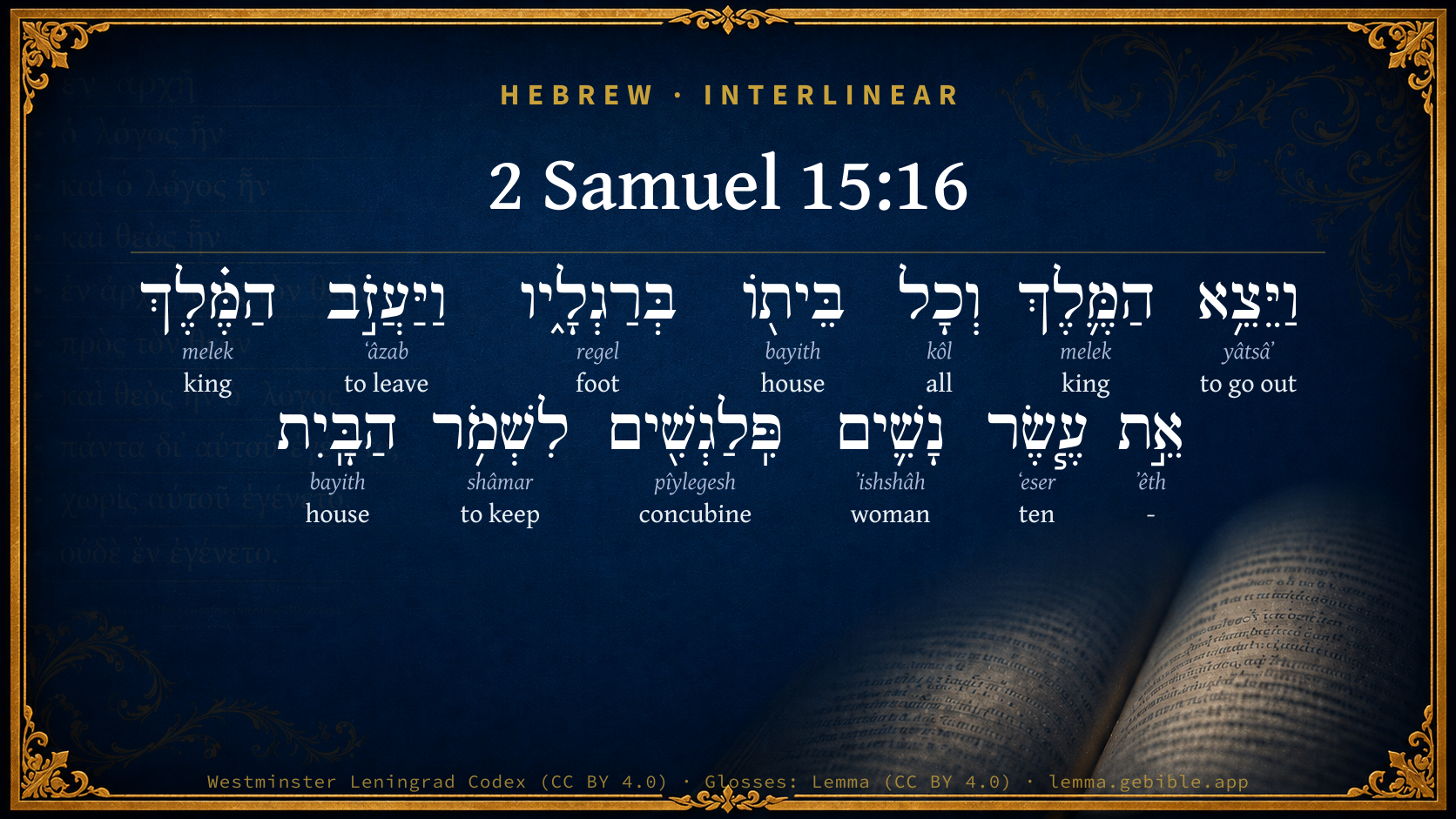
  1. וַיֵּצֵ֥א yâtsâʼ H3318 “and · to go out” Conjunction + Verb, Qal, Sequential Imperfect, 3rd Person, Masculine, Singular
  2. הַמֶּ֛לֶךְ melek H4428 “the · king” Particle, Definite Article + Noun, Common, Masculine, Singular, Absolute
  3. וְכָל kôl H3605 “and · all of” Conjunction + Noun, Common, Masculine, Singular, Construct
  4. בֵּית֖וֹ bayith H1004 “house · his” Noun, Common, Masculine, Singular, Construct + Suffix, Personal, 3rd Person, Masculine, Singular
  5. בְּרַגְלָ֑יו regel H7272 “in/at · feet · his” Preposition + Noun, Common, Feminine, Dual, Construct + Suffix, Personal, 3rd Person, Masculine, Singular
  6. וַיַּעֲזֹ֣ב ʻâzab H5800 “and · to leave” Conjunction + Verb, Qal, Sequential Imperfect, 3rd Person, Masculine, Singular
  7. הַמֶּ֗לֶךְ melek H4428 “the · king” Particle, Definite Article + Noun, Common, Masculine, Singular, Absolute
  8. אֵ֣ת ʼêth H853 “-” Particle, Direct Object
  9. עֶ֧שֶׂר ʻeser H6235 “ten” Adjective, Cardinal number, Feminine, Singular, Absolute
  10. נָשִׁ֛ים ʼishshâh H802 “women” Noun, Common, Feminine, Plural, Absolute
  11. לִשְׁמֹ֥ר shâmar H8104 “to keep” Preposition + Verb, Qal, Infinitive Construct
  12. הַבָּֽיִת bayith H1004 “the · house” Particle, Definite Article + Noun, Common, Masculine, Singular, Absolute

About this verse

These counts appear in no published source. They are computed here, from the morphology-tagged text and Lemma’s own curated glosses. What Lemma adds →

13
words
11
distinct lemmas
Historical
section

Shared distinctive vocabulary

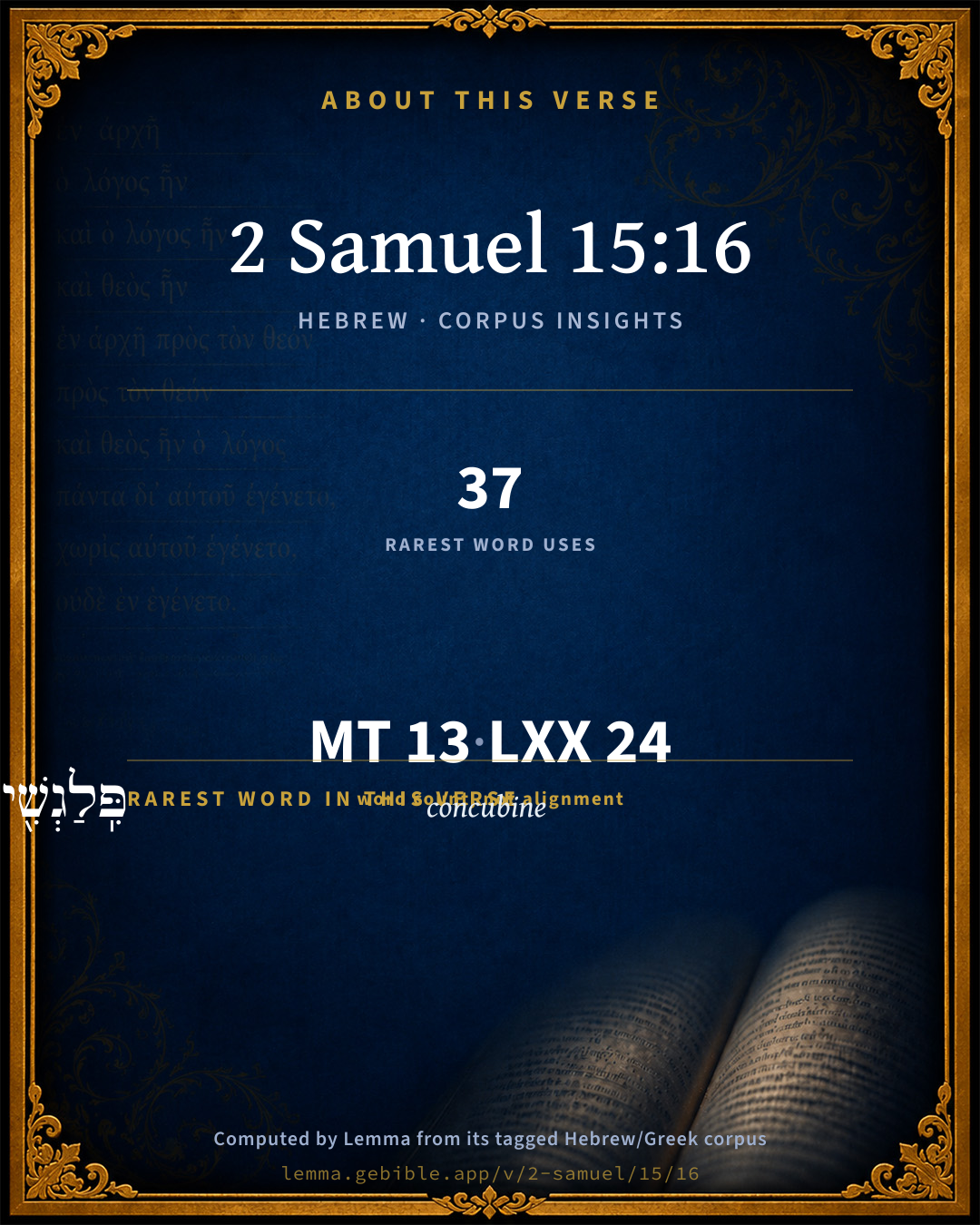
פִּֽלַגְשִׁ֖ים concubine H6370 occurs in 35 verses of the Hebrew Bible. Also found in:

Grammatical profile

  • 3 verbs
  • 8 nouns
  • 1 adjective
  • 1 particle

Verb forms

  • וַיֵּצֵ֥א Qal · Sequential Imperfect
  • וַיַּעֲזֹ֣ב Qal · Sequential Imperfect
  • לִשְׁמֹ֥ר Qal · Infinitive Construct

Repetition

Words recur within this verse — often emphatic in Hebrew:

  • הַמֶּ֛לֶךְ king H4428 ×2
  • בֵּית֖וֹ house H1004 ×2

Hebrew & Septuagint length

In English translation the verse runs 22 words from the Hebrew and 24 from the Septuagint (LXX English) — closely comparable.

A rough comparison of the two English renderings, which tokenize alike — not a word-level alignment.

Word counts can differ between the Hebrew and the Greek without any difference in meaning — e.g. the Hebrew direct-object marker אֵת has no separate Greek word, and Greek often adds the article ὁ.

In the original languages it is 13 Hebrew tokens and 24 Greek tokens — but the two are counted differently (Hebrew bundles its prefixes and suffixes into one token; the Greek is in lemma form), so that isn’t a like-for-like length.

Cross-references

8

Topical passages linked to 2 Samuel 15:16 in the Treasury of Scripture Knowledge — connected by theme and wording, ordered by reader-vote popularity; previews shown in the World English Bible.

  • 2 Samuel 16:21–22 Ahithophel said to Absalom, Go in to your father's concubines, that he has left to keep the house; and all Israel will hear that you are abhorred of your father: then will the hands of all who are with you be strong.
  • 2 Samuel 20:3 David came to his house at Jerusalem; and the king took the ten women his concubines, whom he had left to keep the house, and put them in custody, and provided them with sustenance, but didn't go in to them. So they were shut up to the day of their death, living in widowhood.
  • Psalms 3:1 Yahweh, how my adversaries have increased! Many are those who rise up against me.
  • Romans 12:2 Don't be conformed to this world, but be transformed by the renewing of your mind, so that you may prove what is the good, well-pleasing, and perfect will of God.
  • Judges 4:10 Barak called Zebulun and Naphtali together to Kedesh; and there went up ten thousand men at his feet: and Deborah went up with him.
  • 1 Samuel 25:27 Now this present which your servant has brought to my lord, let it be given to the young men who follow my lord.
  • 1 Samuel 25:42 Abigail hurried, and arose, and rode on a donkey, with five ladies of hers who followed her; and she went after the messengers of David, and became his wife.
  • 2 Samuel 12:11 This is what Yahweh says: 'Behold, I will raise up evil against you out of your own house; and I will take your wives before your eyes, and give them to your neighbor, and he will lie with your wives in the sight of this sun.

Cross-references courtesy of OpenBible.info (CC BY 4.0).

Hebrew and Greek witnesses Masoretic Hebrew ↔ Greek Septuagint

The same verse in the two great witnesses to the Old Testament, shown verse-for-verse.

These are two independent witnesses, not word-aligned to each other, and the Septuagint is shown in lemma (dictionary) form.

Hebrew 2 Samuel 15:16 Masoretic · Westminster Leningrad Codex

וַיֵּצֵ֥א הַמֶּ֛לֶךְ וְכָל בֵּית֖וֹ בְּרַגְלָ֑יו וַיַּעֲזֹ֣ב הַמֶּ֗לֶךְ אֵ֣ת עֶ֧שֶׂר נָשִׁ֛ים פִּֽלַגְשִׁ֖ים לִשְׁמֹ֥ר הַבָּֽיִת

The king went forth, and all his household after him. The king left ten women, who were concubines, to keep the house.

World English Bible · Public Domain

Greek LXX 2 Samuel 15:16 Septuagint · lemma form

καί ἐκἔρχομαι ὁ βασιλεύς καί πᾶς ὁ οἶκος αὐτός ὁ πούς αὐτός καί ἀποἵημι ὁ βασιλεύς δέκα γυνή ὁ παλλακή αὐτός φυλάσσω ὁ οἶκος

And the king and all his house went out on foot: and the king left ten women of his concubines to keep the house.

LXX2012 (modern English Septuagint) · Public Domain

Hebrew: Westminster Leningrad Codex (CC BY 4.0). Greek: Septuagint (public domain); English from LXX2012 (modern English Septuagint) (Public Domain). How the Septuagint differs from the Hebrew →

Targum (Aramaic paraphrase)

1

The Targum is the ancient Jewish Aramaic paraphrase of the Hebrew Scriptures — an interpretive translation, not the Hebrew text itself. Onkelos (literal) and Pseudo-Jonathan (expansive) render the Torah, and Jonathan the Prophets. Coverage is partial: where no permissively-licensed English translation exists for a verse, only the Aramaic is shown. This is verse-level text, not a word-by-word alignment to the Hebrew.

  1. Targum Jonathan Prophets (Joshua–Malachi)
    וּנְפַק מַלְכָּא וְכָל אֱנַשׁ בֵּיתֵיהּ דִי עִמֵיהּ וּשְׁבַק מַלְכָּא יַת עֲשַׂר נְשִׁין לְחֵינָן לְמִטַר בֵּיתָא:

    (no public-domain English translation for this verse)

    Targum Jonathan — Aramaic: “Mikraot Gedolot” (public domain). English: “Sefaria Community Translation” (CC0 1.0 (public-domain dedication)); “London "Chaldee Paraphrase," 1871” (public domain). Text via Sefaria.

Commentary

Notes on 2 Samuel 15:16 from classic Christian and Jewish commentators (each source and its license shown beneath its notes). The classic Christian expositions comment on the surrounding passage and are grouped to its opening verse, so a note may address several verses; the Jewish commentaries on the Tanakh (Rashi and others) are per-verse, so they appear only where the commentator wrote on this verse.

Lemma curates 59 commentaries, every one of them public domain or Creative Commons licensed, each selected and text-cleaned for this edition rather than reprinted as found. About our sources →

Trapp's Complete Commentary

John Trapp

2Sa 15:16 And the king went forth, and all his household after him. And the king left ten women, [which were] concubines, to keep the house.

Ver. 16. And all his household after him.] Heb., At his feet, or, On his feet. {a} He stayed not so long till a mule could be made ready for him. See 2Sa 15:30. Fuga fuit pedestris et lugubris.

And the king left ten women.] As hoping that they would not hurt those weak women: but God had a further hand in it, for the fulfilling of that threat in 2Sa 12:11.

{a} Egressus est pedibus.

John Trapp, A Commentary or Exposition upon All the Books of the Old and New Testament (1647–1656) — public domain. Text from a community e-Sword module.

Joseph Benson's Commentary

2Sa 15:16. The king went forth, and all his household after him — Or, as the Hebrew, ברגליו, berag-laiv, rather means, on foot: which the king probably chose to do, that he might humble himself under the hand of God; might encourage his adherents in this hard and comfortless march; and might move compassion in his people toward him. The king left ten women — Supposing that their sex and quality, and especially their relation to him, being his concubines, would be a sufficient protection to them, and gain them some respect, or, at least, safety from his son. What became of his wives is not here related; but it is probable they went along with him, to take care of him; as the other women were left to take care of the house.

2Sa 15:17-18, The king went forth, and all the people after him — That is, all those of Jerusalem who were well affected to him. And tarried in a place that was far off — At a good distance from the city, where, it is likely, he put the people, that had come out in a confused state, into good order, and waited to see what other friends would join him. And all his servants passed on beside him — His household servants, or body-guards, marched probably on both hands of him. And all the Gittites, six hundred men — These marched in the front of his little army; but who they were it is hard to say; for we read nothing of them before. Some take them to have been proselytes, born in Gath of the Philistines, and think they came with Ittai to David, being attracted by the fame of his piety and happy success. Others take them to have been Jews, who had fled to David in his exile, when he was at Gath, and accompanied him ever after, not only in the time of Saul’s persecution, but after he came to the crown of Israel and Judah.

Joseph Benson's Commentary on the Old and New Testaments (1811–1818) — public domain. Text from a community e-Sword module.

Geneva Bible (1599)

Geneva Bible translators

Hebrew, at his feet.

Geneva Bible (1599) marginal notes — public domain. Text via Bolls.life.

The Cambridge Bible for Schools and Colleges

gen. ed. J. J. S. Perowne

16. And the king went forth] “It was apparently early on the morning of the day after he had received the news of the rebellion that the king left the city of Jerusalem. There is no single day in the Jewish history of which so elaborate an account remains as that which describes this memorable flight. There is none, we may add, that combines so many of David’s characteristics—his patience, his high-spirited religion, his generosity, his calculation: we miss only his daring courage. Was it crushed, for the moment, by the weight of parental grief, or of bitter remorse?” Stanley’s Lect. II. 97. Who we may ask, was the eyewitness who has preserved the picture of the scene with such minute and life-like detail? May it not have been the prophet Nathan?

The Cambridge Bible for Schools and Colleges (gen. ed. J. J. S. Perowne; Cambridge University Press, 1878–1918) — public domain. Text from a community e-Sword module.

John Gill's Exposition

And the king went forth,.... Which determined the case:

and all his household after him family and his court; they followed his example, and attended him in his flight:

and the king left ten women, which were concubines, to keep the house; not to defend it, which they were unable to do, but to look after the household goods and furniture, that they were not damaged by the conspirators; though one would think they could be of little service, and may wonder what he should leave them behind for; but this seems to be ordered by the overruling providence of God, to bring about what was threatened him, Sa2 12:11; and it is much he had not thought of it; but it was hid from his eyes, that it might be fulfilled.

John Gill's Exposition of the Whole Bible (1746–1763) — public domain (CC PDM 1.0). Text via the HelloAO Bible API.

Haydock's Catholic Bible Commentary

Concubines. That is, wives of an inferior degree, (Challoner; Genesis xxv.; Worthington) who might perhaps have some influence to pacify the rioters.

George Leo Haydock (1774–1849), Haydock's Catholic Family Bible and Commentary, 1859 edition — public domain. Excludes Psalms (Douay-Rheims chapter numbering differs from Protestant) and Deuterocanonical books (Catholic canon only).

Matthew Poole's English Annotations

After him, or, on foot, by comparing 2Sa 15:30, which the king chose to do rather than to ride; partly, to humble himself under the hand of God; partly, to encourage his companions in this hard and comfortless march; and partly, to move compassion in his people towards him.

The king left ten women; for he supposed that their sex would protect them even among barbarians, and their relation to David would gain them some respect, and, at least, safety from his son. But it seems he did not now actually consider that clause of the threatening concerning his wives, (God diverting his mind to other things,) or he thought that would be accomplished some other way, conceiving that Absalom would abhor the thoughts of such incestuous converse, especially with persons which were now grown in years.

Matthew Poole's English Annotations on the Holy Bible (1683–1685) — public domain. Text from a community e-Sword/MySword module.

Whedon's Commentary on the Bible

Daniel D. Whedon

16. After him — Hebrew, as margin, at his feet; that is, in his train. Compare Jdg_4:10, and references.

Daniel D. Whedon (gen. ed.), Commentary on the Old and New Testaments (1874–1909) — public domain. Text from a community e-Sword module.

John Wesley's Explanatory Notes

After him - Or, on foot, which the king chose to do, to humble himself under the hand of God; to encourage his companions in this hard and comfortless march; and to move compassion in his people towards him. Concubines - For he supposed that their sex would protect them, and their relation to David would gain them some respect, or at least, safety from his son.

John Wesley, Explanatory Notes Upon the Whole Bible (1754–1765) — public domain. Text via the GEBible commentary corpus.

unfoldingWord translationNotes

Door43 World Missions Community

to keep the palace

Here the word "keep" means to care for. AT: "to care for the palace" (See: Idiom)

at the last house

This refers to the last house they would come to when leaving the city. AT: "at the last house as they were leaving the city" (See: Assumed Knowledge and Implicit Information)

Kerethites ... Pelethites

Translate the names of these people groups the same as you did in 2 Samuel 8:18.

Gittites

Translate the name of this people group the same as you did in 2 Samuel 6:10.

six hundred men

"600 men" (See: Numbers)

translationWords

family

concubine

palace

people group

Gath

unfoldingWord translationNotes — © Distant Shores Media and the Door43 World Missions Community, licensed CC BY-SA 4.0. Source: git.door43.org/Door43/en_tn.

Lesson kit

Teaching starters — assembled from the data on this page, not authored interpretation. Every prompt links to the verse data it draws on. Edit before teaching.

2 Samuel, in the Historical, opens this verse with 13 words (11 distinct Hebrew lemmas). Its most distinctive word is pîylegesh (“concubine”). A historical commentator’s framing appears above. Read the whole chapter for the surrounding context.

Discussion questions

  1. What does “concubine” (pîylegesh) contribute to the verse as a whole?
  2. Genesis 22:24 shares the word «concubine» with this verse. How do the two illuminate each other?
  3. “king” occurs 2× in this one verse. What is the effect of the repetition?
  4. These translations render this verse differently. What is at stake in choosing one wording over another?
  5. The verb «וַיֵּצֵ֥א» is Qal Sequential Imperfect. How does its form color the action?
  6. Reading how Trapp's Complete Commentary and Joseph Benson's Commentary read this verse, where do the two commentators agree and where do they part?

Things to notice

Reading settings

Reading text

Shown beneath each verse's original-language words.

Old Testament
Old Testament edition

Read the OT as the Masoretic Hebrew (MT) or the Greek Septuagint (LXX).

English shown for the Greek Septuagint (in the Hebrew ↔ Greek comparison).

Comparing translations? Open the Compare panel on any verse page to stack up to four side by side.