1 Chronicles 16:37

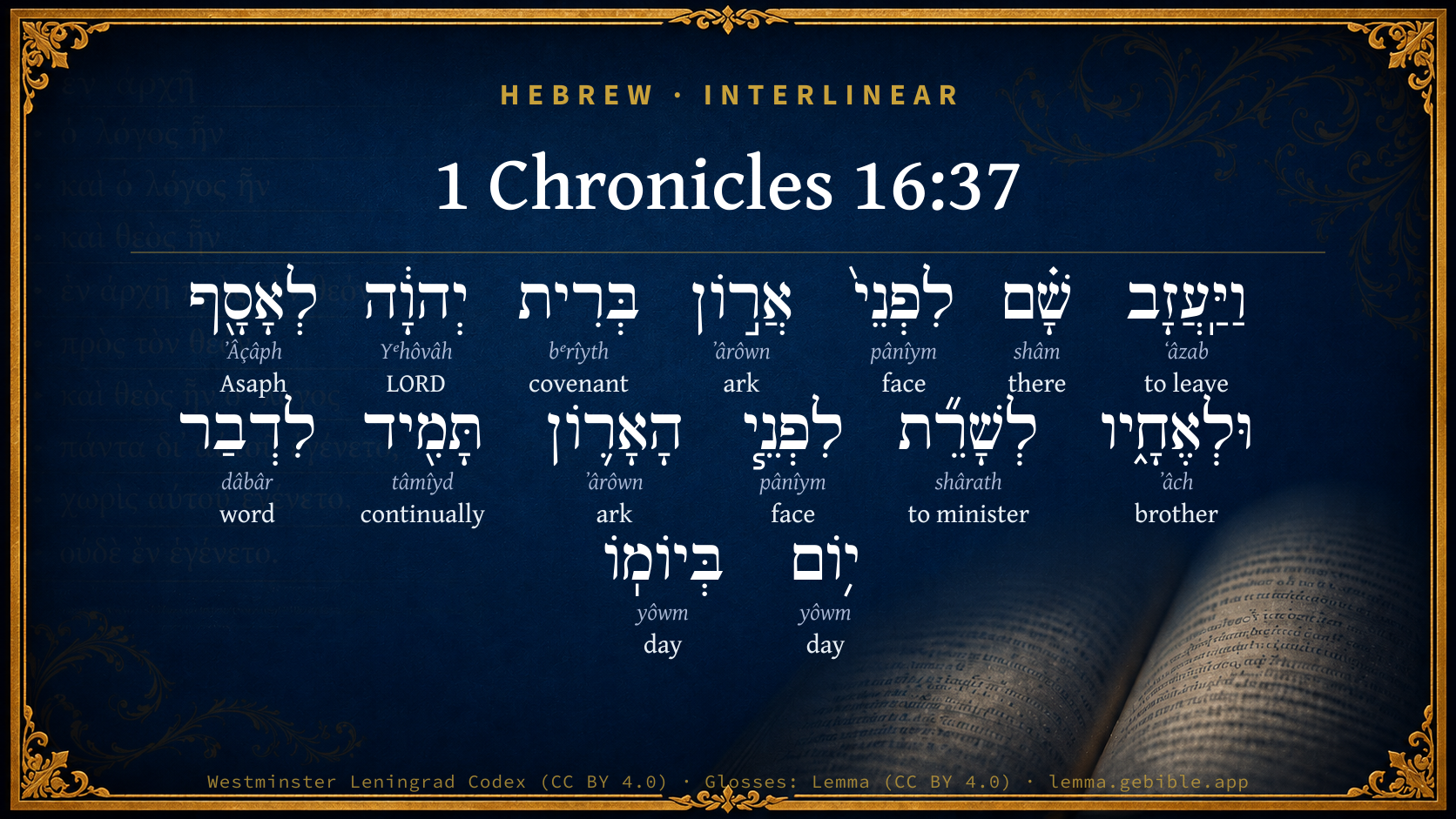
Hebrew (Westminster Leningrad Codex) 1 Chronicles 16:37 appears in the Hebrew Old Testament. The text above is from the Westminster Leningrad Codex. Each word links to its Strong’s number, a concise gloss, and parsing drawn from the Open Scriptures Hebrew Bible morphology. Click any word for its full Brown-Driver-Briggs (BDB) entry.
Download image
Cite this verse

1 Chronicles 16:37 (World English Bible). Public Domain. Lemma interlinear Bible study tool, https://lemma.gebible.app/v/1-chronicles/16/37.

Show BibTeX & RIS
BibTeX
RIS
English Translation
So he left there, before the ark of the covenant of Yahweh, Asaph and his brothers, to minister before the ark continually, as every day's work required;
World English Bible · Public Domain
Download a study sheet

One document with this verse’s original text, its word-by-word gloss line, the meaning frame, cross-references with their text, attributed commentary, and full source and license credits — printable, and it pastes into notes with its structure intact.

This verse Autodidact and up

Study sheet (.html) Plain text (.txt)

A passage Seminary Student

Up to 50 verses in one chapter. A passage sheet keeps up to 6 commentary sources and 12 cross-references per verse, in the order this page ranks them, and says so on the sheet whenever that leaves anything out. Ask for a single verse and you get the Autodidact verse sheet above.

Everything on this page stays free to read, with no account — the sheet is a download of what is already on screen, not access to it.

Want to remove ads? Support Godless Engineer
Compare translations 3

The same verse in 3 English versions, stacked beneath the original-language interlinear above. Click any original word for its lexicon entry.

Each is an independent rendering of the whole verse — the interlinear is not word-aligned to these translations.

Highlighted words mark where these versions differ — a whole-verse word diff, not a word-by-word alignment.

  • World English Bible Public Domain
    So he left there, before the ark of the covenant of Yahweh, Asaph and his brothers, to minister before the ark continually, as every day's work required;
  • King James Version Public Domain
    So he left there before the ark of the covenant of the LORD Asaph and his brethren, to minister before the ark continually, as every day's work required:
  • unfoldingWord Literal Text CC BY-SA 4.0
    And he left Asaph and his brothers there to the face of the Box of the Covenant of Yahweh to minister to the face of the Box continually, according to the matter of a day in its day,

unfoldingWord Literal Text — © unfoldingWord, licensed CC BY-SA 4.0. Word-aligned USFM3 via Door43 (git.door43.org/unfoldingWord/en_ult).

Versions to compare (up to 4)

3 of 4 selected

Show all 18 translations

Every available English version of this verse, each an independent rendering of the whole verse.

  • World English Bible Public Domain
    So he left there, before the ark of the covenant of Yahweh, Asaph and his brothers, to minister before the ark continually, as every day's work required;
  • Berean Standard Bible Public Domain
    So David left Asaph and his brothers there before the ark of the covenant of the LORD, to minister there regularly according to the daily requirements,
  • Majority Standard Bible Public Domain
    So David left Asaph and his associates there before the ark of the covenant of the LORD, to minister there regularly according to the daily requirements,
  • King James Version Public Domain
    So he left there before the ark of the covenant of the LORD Asaph and his brethren, to minister before the ark continually, as every day's work required:
  • American Standard Version (1901) Public Domain
    So he left there, before the ark of the covenant of Jehovah, Asaph and his brethren, to minister before the ark continually, as every day's work required;
  • Revised Version (1885) Public Domain
    So he left there, before the ark of the covenant of the LORD, Asaph and his brethren, to minister before the ark continually, as every day’s work required:
  • Geneva Bible (1599) Public Domain
    Then he left there before the Arke of the Lordes couenant Asaph and his brethren to minister continually before the Arke, that which was to be done euery day:
  • Douay-Rheims (1899) Public Domain
    So he left there before the ark of the covenant of the Lord, Asaph and his brethren to minister in the presence of the ark continually day by day, and in their courses.
  • Young's Literal Translation Public Domain
    And he leaveth there before the ark of the covenant of Jehovah, for Asaph and for his brethren, to minister before the ark continually, according to the matter of a day in its day,
  • Literal Standard Version CC BY-SA 4.0
    And he leaves there [those] of Asaph and of his brothers, before the Ark of the Covenant of YHWH, to minister before the Ark continually, according to the matter of a day in its day;
  • Unlocked Literal Bible CC BY-SA 4.0
    So David left Asaph and his brothers there before the ark of the covenant of Yahweh, to serve continually before the ark, as every day's work required.
  • unfoldingWord Literal Text CC BY-SA 4.0
    And he left Asaph and his brothers there to the face of the Box of the Covenant of Yahweh to minister to the face of the Box continually, according to the matter of a day in its day,
  • Darby Bible Public Domain
    And he left there, before the ark of the covenant of Jehovah, Asaph and his brethren, to do the service before the ark continually, as every day's duty required;
  • World Messianic Bible Public Domain
    So he left Asaph and his brothers there before the ark of the LORD’s covenant, to minister before the ark continually, as every day’s work required;
  • Webster's Bible Public Domain
    So he left there before the ark of the covenant of the LORD Asaph and his brethren, to minister before the ark continually, as every day's work required:
  • Free Bible Version CC BY-SA 4.0
    Then David made sure Asaph and his brothers would minister continually before the Ark of the Lord's Agreement, performing whatever services were needed every day,
  • Bible in Basic English Public Domain
    So he made Asaph and his brothers keep their places there before the ark of the agreement of the Lord, to do whatever had to be done before the ark at all times day by day:
  • JPS Tanakh (1917) Public Domain
    So he left there, before the ark of the covenant of the LORD, Asaph and his brethren, to minister before the ark continually, as every day's work required;

Literal Standard Version (2020), Covenant Press — licensed CC BY-SA 4.0. Text via the HelloAO Bible API (eBible.org). Unlocked Literal Bible (unfoldingWord) — licensed CC BY-SA 4.0. Text via the HelloAO Bible API (eBible.org). unfoldingWord Literal Text — © unfoldingWord, licensed CC BY-SA 4.0. Word-aligned USFM3 via Door43 (git.door43.org/unfoldingWord/en_ult). Free Bible Version, Dr. Jonathan Gallagher — licensed CC BY-SA 4.0. Text via the HelloAO Bible API (eBible.org).

Word by word

More ways to search: Search by grammar → Find every occurrence → Compare this word →

Practice this passage: Drill this verse → Learn its vocabulary →

לְאָסָ֖ף
ʼÂçâph
H623
“to/for · Asaph”
Preposition + Noun, Proper
Part of Speech
Preposition + Noun
Type
Proper
Full BDB Definition

Origin: from H622

TWOT: None

Asaph = "gatherer" - the father of Hezekiah's secretary - a son of Berechiah, chief Levite musician under David - a Persian officer over the royal forest
  1. וַיַּֽעֲזָב ʻâzab H5800 “and · to leave” Conjunction + Verb, Qal, Sequential Imperfect, 3rd Person, Masculine, Singular
  2. שָׁ֗ם shâm H8033 “there” Adverb
  3. לִפְנֵי֙ pânîym H6440 “to/for · face(s) of” Preposition + Noun, Common, Both, Plural, Construct
  4. אֲר֣וֹן ʼârôwn H727 “ark of” Noun, Common, Both, Singular, Construct
  5. בְּרִית bᵉrîyth H1285 “covenant” Noun, Common, Feminine, Singular, Absolute
  6. יְהוָ֔ה Yᵉhôvâh H3068 “LORD” Noun, Proper
  7. וּלְאֶחָ֑יו ʼâch H251 “and · to/for · brothers · his” Conjunction + Preposition + Noun, Common, Masculine, Plural, Construct + Suffix, Personal, 3rd Person, Masculine, Singular
  8. לְשָׁרֵ֞ת shârath H8334 “to minister” Preposition + Verb, Piel, Infinitive Construct
  9. לִפְנֵ֧י pânîym H6440 “to/for · face(s) of” Preposition + Noun, Common, Both, Plural, Construct
  10. הָאָר֛וֹן ʼârôwn H727 “the · ark” Particle, Definite Article + Noun, Common, Both, Singular, Absolute
  11. תָּמִ֖יד tâmîyd H8548 “continually” Noun, Common, Masculine, Singular, Absolute
  12. לִדְבַר dâbâr H1697 “to/for · word of” Preposition + Noun, Common, Masculine, Singular, Construct
  13. י֥וֹם yôwm H3117 “day” Noun, Common, Masculine, Singular, Absolute
  14. בְּיוֹמֽוֹ yôwm H3117 “in/at · day · his” Preposition + Noun, Common, Masculine, Singular, Construct + Suffix, Personal, 3rd Person, Masculine, Singular

About this verse

These counts appear in no published source. They are computed here, from the morphology-tagged text and Lemma’s own curated glosses. What Lemma adds →

15
words
12
distinct lemmas
Historical
section

Shared distinctive vocabulary

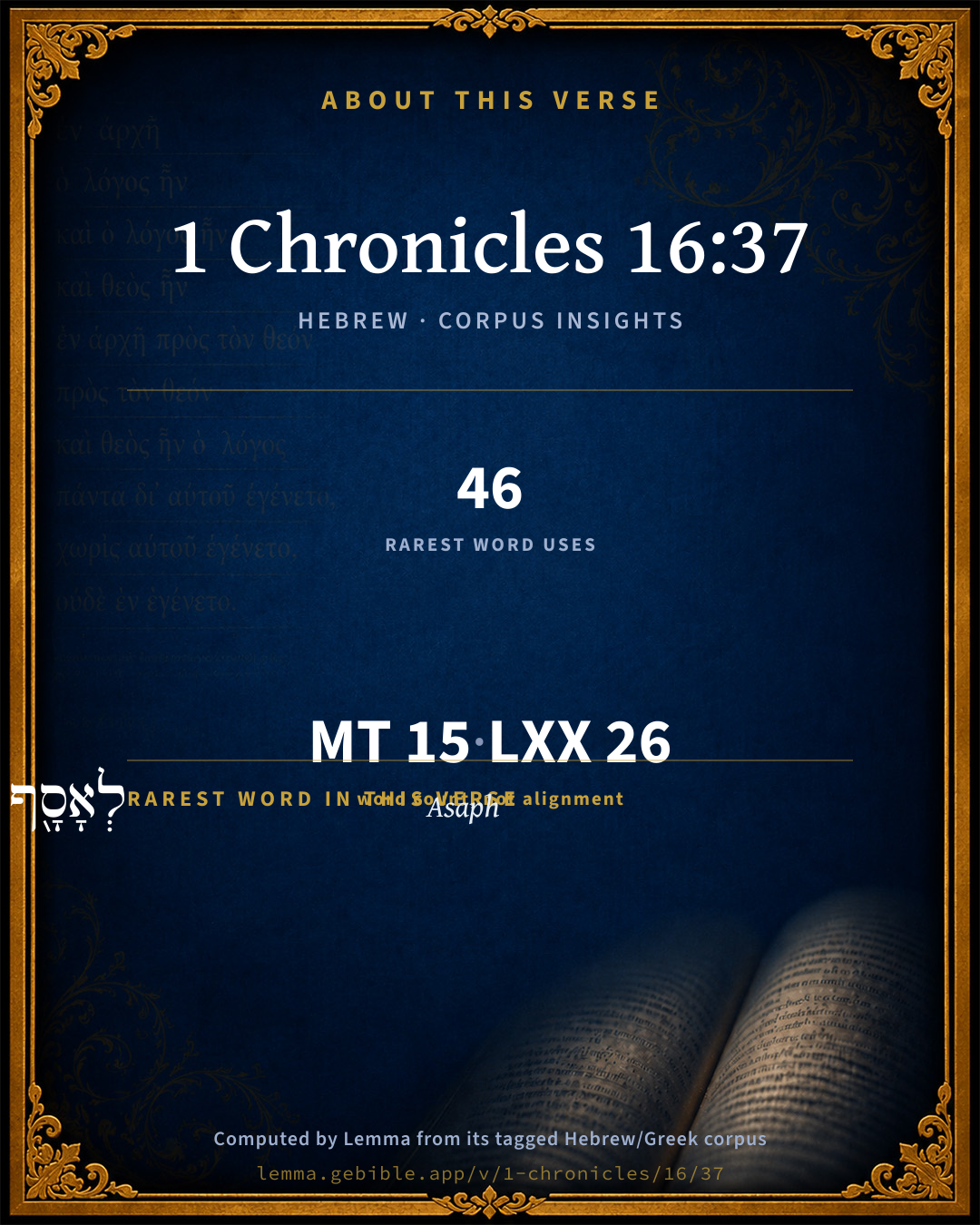
לְאָסָ֖ף Asaph H623 occurs in 41 verses of the Hebrew Bible. Also found in:

Grammatical profile

  • 2 verbs
  • 12 nouns
  • 1 adverb

Verb forms

  • וַיַּֽעֲזָב Qal · Sequential Imperfect
  • לְשָׁרֵ֞ת Piel · Infinitive Construct

Repetition

Words recur within this verse — often emphatic in Hebrew:

  • לִפְנֵי֙ face H6440 ×2
  • אֲר֣וֹן ark H727 ×2
  • י֥וֹם day H3117 ×2

Hebrew & Septuagint length

In English translation the verse runs 27 words from the Hebrew and 34 from the Septuagint (LXX English) — closely comparable.

A rough comparison of the two English renderings, which tokenize alike — not a word-level alignment.

Word counts can differ between the Hebrew and the Greek without any difference in meaning — e.g. the Hebrew direct-object marker אֵת has no separate Greek word, and Greek often adds the article ὁ.

In the original languages it is 15 Hebrew tokens and 26 Greek tokens — but the two are counted differently (Hebrew bundles its prefixes and suffixes into one token; the Greek is in lemma form), so that isn’t a like-for-like length.

Cross-references

5

Topical passages linked to 1 Chronicles 16:37 in the Treasury of Scripture Knowledge — connected by theme and wording, ordered by reader-vote popularity; previews shown in the World English Bible.

  • 2 Chronicles 8:14 He appointed, according to the ordinance of David his father, the divisions of the priests to their service, and the Levites to their offices, to praise, and to minister before the priests, as the duty of every day required; the doorkeepers also by their divisions at every gate: for so had David the man of God commanded.
  • Ezra 3:4 They kept the feast of tents, as it is written, and [offered] the daily burnt offerings by number, according to the ordinance, as the duty of every day required;
  • 1 Chronicles 15:17–24 So the Levites appointed Heman the son of Joel; and of his brothers, Asaph the son of Berechiah; and of the sons of Merari their brothers, Ethan the son of Kushaiah;
  • 1 Chronicles 16:4–6 He appointed certain of the Levites to minister before the ark of Yahweh, and to celebrate and to thank and praise Yahweh, the God of Israel:
  • 1 Chronicles 25:1–6 Moreover, David and the captains of the host set apart for the service certain of the sons of Asaph, and of Heman, and of Jeduthun, who should prophesy with harps, with psalteries, and with cymbals: and the number of those who did the work according to their service was:

Cross-references courtesy of OpenBible.info (CC BY 4.0).

Hebrew and Greek witnesses Masoretic Hebrew ↔ Greek Septuagint

The same verse in the two great witnesses to the Old Testament, shown verse-for-verse.

These are two independent witnesses, not word-aligned to each other, and the Septuagint is shown in lemma (dictionary) form.

Hebrew 1 Chronicles 16:37 Masoretic · Westminster Leningrad Codex

וַיַּֽעֲזָב שָׁ֗ם לִפְנֵי֙ אֲר֣וֹן בְּרִית יְהוָ֔ה לְאָסָ֖ף וּלְאֶחָ֑יו לְשָׁרֵ֞ת לִפְנֵ֧י הָאָר֛וֹן תָּמִ֖יד לִדְבַר י֥וֹם בְּיוֹמֽוֹ

So he left there, before the ark of the covenant of Yahweh, Asaph and his brothers, to minister before the ark continually, as every day's work required;

World English Bible · Public Domain

Greek LXX 1 Chronicles 16:37 Septuagint · lemma form

καί καταλείπω ἐκεῖ ἔναντι ὁ κιβωτός διαθήκη κύριος ὁ ασαφ καί ὁ ἀδελφός αὐτός ὁ λειτουργέω ἐναντίον ὁ κιβωτός διά πᾶς ὁ ὁ ἡμέρα εἰς ἡμέρα

And they left there Asaph and his brethren before the ark of the covenant of the Lord, to minister before the ark continually, according to the service of each day: from day to day.

LXX2012 (modern English Septuagint) · Public Domain

On this verse, Ellicott's Commentary for English Readers discusses the Septuagint’s reading. Read the note in Commentary ↓

Hebrew: Westminster Leningrad Codex (CC BY 4.0). Greek: Septuagint (public domain); English from LXX2012 (modern English Septuagint) (Public Domain). How the Septuagint differs from the Hebrew →

Commentary

Notes on 1 Chronicles 16:37 from classic Christian and Jewish commentators (each source and its license shown beneath its notes). The classic Christian expositions comment on the surrounding passage and are grouped to its opening verse, so a note may address several verses; the Jewish commentaries on the Tanakh (Rashi and others) are per-verse, so they appear only where the commentator wrote on this verse.

Lemma curates 59 commentaries, every one of them public domain or Creative Commons licensed, each selected and text-cleaned for this edition rather than reprinted as found. About our sources →

Matthew Henry's Commentary

The worship of God is not only to be the work of a solemn day now and then, brought in to grace a triumph; but it ought to be the work of every day. David therefore settles it here for a constancy, puts it into a method, which he obliged those that officiated to observe in their respective posts. In the tabernacle of Moses, and afterwards in the temple of Solomon, the ark and the altar were together; but, ever since Eli's time, they had been separated, and still continued so till the temple was built. I cannot conceive what reason there was why David, who knew the law and was zealous for it, did not either bring the ark to Gibeon, where the tabernacle and the altar were, or bring them to Mount Zion, where the ark was. Perhaps the curtains and hangings of Moses's tabernacle were so worn with time and weather that they were not fit to be removed, nor fit to be a shelter for the ark; and yet he would not make all new, but only a tent for the ark, because the time was at hand when the temple should be built. Whatever was the reason, all David's time they were asunder, but he took care that neither of them should be neglected. 1. At Jerusalem, where the ark was, Asaph and his brethren were appointed to attend, to minister before the ark continually, with songs of praise, as every day's work required, Ch1 16:37. No sacrifices were offered there, nor incense burnt, because the altars were not there: but David's prayers were directed as incense, and the lifting up of his hands as the evening sacrifice (Psa 141:2), so early did spiritual worship take place of ceremonial. 2. Yet the ceremonial worship, being of divine institution, must by no means be omitted; and therefore at Gibeon were the altars where the priests attended, for their work was to sacrifice and burn incense, which they did continually, morning and evening, according to the law of Moses, Ch1 16:39, Ch1 16:40. These must be kept up because, however in their own nature they were inferior to the moral services of prayer and praise, yet, as they were types of the mediation of Christ, they had a great deal of honour put upon them, and the observance of them was of great consequence. Here Zadok attended, to preside in the service of the altar; as (it is probable) Abiathar settled at Jerusalem, to attend the ark, because he had the breast-plate of judgment, which must be consulted before the ark: this is the reason why we read in David's time both Zadok and Abiathar were the priests (Sa2 8:17; Sa2 20:25), one where the altar was and the other where the ark was. At Gibeon, where the altars were, David also appointed singers to give thanks to the Lord, and the burden of all their songs must be, For his mercy endureth for ever, Ch1 16:41. They did it with musical instruments of God, such instruments as were appointed and appropriated to this service, not such as they used on other occasions. Between common mirth and holy joy there is a vast difference, and the limits and distances between them must be carefully observed and kept up. Matters being thus settled, and the affairs of religion put into a happy channel, (1.) The people were satisfied, and went home pleased. (2.) David returned to bless his house, resolving to keep up family worship still, which public worship must not supersede.

Matthew Henry's Commentary on the Whole Bible (1708–1710) — public domain (CC PDM 1.0). Text via the HelloAO Bible API.

Ellicott's Commentary for English Readers

(37-42) Resumption and conclusion of the narrative suspended at 1Ch_16:7.

(37) So (and) he left there.—Were the above ode interposed by the chronicler himself, he might better have written, “And David left.”

As every day’s work required.—Literally, for a day’s business in its own day—i.e., to perform the services appointed for each day. (Comp. Exo_5:13.)

(38) And Obed-edom with (and) their brethren.—The pronoun their shows that a word or words have fallen out. It is simplest to supply “Hosah,” and render: And (he left there) Obed-edom and Hosah and their brethren, sixty-eight persons. The construction, however, is altered from that of 1Ch_16:37 : “Asaph and his brethren.” (Comp. 1Ch_16:39.)

Obed-edom also the son of Jeduthun.—This repetition is tautologous, but hardly obscure. 1Ch_26:8 assigns sixty-two members to the house of Obed-edom.

Jeduthun.—Not the Merarite minstrel (1Ch_6:44, Ethan). Obed-edom was a Korhite, i.e., a Kohathite (1Ch_26:1-4).

(39) The narrative now passes from the tent on Zion to the Mosaic tabernacle at Gibeon. The establishment of the Ark in its new abode was the inauguration of a new national sanctuary. But the old one at Gibeon was not therefore abandoned. On the contrary, David either instituted or formally recognised the priesthood of Zadok therein.

And Zadok.—The name is preceded in the Hebrew by the sign of the accusative case, and therefore depends on the verb he left (1Ch_16:37).

The priest.—Par excellence—i.e., the High Priest (1Sa_1:9; 1Sa_2:11; 2Ki_11:9; 2Ki_11:15).

In the high place.—See 1Ki_3:3-4.

(40) Continually morning and evening.—The Tamid, or regular burnt offering of a lamb at dawn and sunset, with its food offering and drink offering, as prescribed in Exo_29:38, sqq., and Num_28:3, sqq.

And to do.—Literally, and for everything that is written, viz., all the other prescribed sacrifices and duties of the priests. Nothing is here said of similar duties of the priests before the Ark on Zion. But it ought not to be argued from this omission that in the chronicler’s opinion only choral services took place there. If, as we have supposed, Abiathar was attached to David’s sacred tent, sacrifice must have been offered there as well as at Gibeon. (Comp. 1Ch_18:16. ) The present account says nothing of this, because the writer is mainly interested in the service of song. (See 1Ki_8:1-4.)

(41) The narrative returns to its principal topic—the Levitical minstrels.

And with them (Zadok and his brethren) Heman and Jeduthun.—These two masters of song ministered in the tabernacle at Gibeon, as their colleague Asaph did in the tent on Zion.

Who were expressed (enrolled) by name.—1Ch_12:31. Their names are not given here, but they may be partially included in the list of 1Ch_15:19-24. Asaph’s corps has been individually specified at 1Ch_16:5, perhaps as the more important body.

To give thanks to the Lord.—In describing the chief function of the choirs stationed at Gibeon, the chronicler repeats the liturgical formula of 1Ch_16:34; probably with an allusion to odes like Psalms 136, in which these words constitute a continual refrain.

(42) And with them Heman and Jeduthun.—The last verse began with the same words, a fact which renders them suspicious here. The LXX., Syriac, and Arabic omit the proper names.

With trumpets . . . with musical instruments.—The prepositions are wanting in the Hebrew text, which might be rendered thus: “And with them [viz., Heman and Jeduthun] were clarions and cymbals for persons playing aloud [comp. 1Ch_16:5], and instruments of sacred music.” From 1Ch_15:9, compared with 1Ch_16:5, it appears that the three conductors (Asaph, Heman, and Jeduthun) played cymbals only, to accent the time: and from 1Ch_15:24 and 1Ch_16:6, we know that the clarions were blown by priests. Omitting as spurious the names of the two leaders, who are not likely to have had the custody of the various instruments of their choirs, the meaning of the verse is simply that the Levitical minstrels were provided with proper instruments to accompany their singing.

Musical instruments of God.—Literally, instruments of song of God—i.e., of sacred music. Harps and lutes are meant.

Sons of Jeduthun.—See 1Ch_16:38. Obed-edom, son of Jeduthun, was a warder before the Ark. Thus the warders of both sanctuaries belonged to the same clan.

A Bible Commentary for English Readers, edited by Charles John Ellicott (1878–1897) — public domain. Text from a community e-Sword module.

Trapp's Complete Commentary

John Trapp

1Ch 16:37 So he left there before the ark of the covenant of the LORD Asaph and his brethren, to minister before the ark continually, as every day’s work required:

Ver. 37. As every day’s work required.] Or, To do every day what he did on one day: for we must continue thankful.

John Trapp, A Commentary or Exposition upon All the Books of the Old and New Testament (1647–1656) — public domain. Text from a community e-Sword module.

The Biblical Illustrator

Joseph S. Exell

1Ch_16:37

As every days work required.

Daily service

That was the law. Not as yesterdays work required, not as to-morrows work might require, but as every days work required within its own twelve hours or twenty-four. That was order. The men had been singing. A musical man cannot be disorderly; he would refute his own song, he would annihilate his own music. As every days work required--morning by morning; now much, now more; now not quite so much; now a little variety; but every day had its duty; every morning had its opportunity. That is the secret of success. For want of knowing such a secret and applying it many men are without bread to-day. As every days work required. There is only one time--Now. Now is the accepted time, now is the day of salvation. Now is Gods great opportunity given to us all. Yesterday is gone, to-morrow is unborn, to-day is now, and the golden portal rolls back to let us into the larger liberty. Things are not to be done at any time. That is where so many people go into confusion. To so many people there is no regular time; that is the reason of failure, that is the leak. They were going to do this, but they forgot. What I a man forgetting? He was going to do this at ten oclock, but he was busy at that moment, and now he will do it in the afternoon. Never ask if you can do this to-morrow; no man has a right to promise you that liberty. The great secret of successful life is discipline, promptitude, military obedience--now! altogether! the best I can; as every day requires. That was the way that Jesus Christ lived. In that apparently coldly ethical doctrine there is a great evangelical gospel; the Son of God is hidden in that disciplinary prose: I must work the works of Him that sent Me: are there not twelve hours in the day? I must work while the light lasts; the night cometh wherein no man can work: I must not postpone Mondays duties to be done in Tuesdays light. How is it possible for you to do so much? we say to this great king of labour, and that great leader of civilisation; and he makes answer, Only by doing the days work within the day. There are a great many persons who have out-of-the-way places in which they store things to be attended to some time; the fact being that there is no peace in that household, no music, no deep content; there is always something tugging at the conscience and reminding the memory of the arrears. Never have any arrears. What does a well-spent day mean? It means Sabbath every night, satisfaction; it is finished, it is enough; I have told my tale, I have woven my thread, there is nothing more to be done to-day; then comes the sleep of the labouring man, and that is sweet. The lazy man cannot sleep, he can only snore. Only he who works, works for God, with God, in the spirit of Christ, can sleep, and God will make up all that is due to him whilst he is sleeping. Secondly, let us enlarge the meaning of the word day. The term day is one of the most flexible terms in Holy Scripture, in poetry, and in general experience. In six days the Lord made heaven and earth. I have no doubt of it; but I do not know what day means. We speak of our day: does it mean from eight oclock in the morning until eight oclock in the evening? Is the word day there a term of clock-time, or does it relate to centuries, eras, epochs? We say, Our little systems have their day; does that mean a chronometer day, or a larger and variable period? Evidently it means the latter. So the text may be expanded without a change of word. As every days work required--as the time needed, as the exigency demanded, as the epoch called for, as the century required. You are fully aware that every day, in the larger sense of age, epoch, or era, has its own peculiar revelation and its own peculiar truth and special and even unique duty and obligation. We cannot go back upon the centuries and fit the expired aeons into the framework of the immediate day in which we are breathing. The apostle did not hesitate to speak of the present truth, the truth of this particular day, with all its thrill and pulse and feverishness; the present truth, precisely adapted and suited to the immediate intellectual and spiritual condition of the times. We read of men who fell asleep after serving their generation--and having served his generation, he fell on sleep. And he serves the next generation best who serves the present generation well. Your influence will not be cut off, it will run on when you are no longer visible; it will be a memory, an inspiration, an enthusiasm, an ever-recurring poem, lifting lifes prose into nobler music. We must catch the very spirit and genius of the time; our question should be, What will the people hear? Not in any grovelling or degrading sense, but, What is the supreme necessity of the human heart just at this hot moment? What is it, then, that covers and sanctifies all days?--the little day of twenty-four hours or twelve, and the great day of long centuries and piled millenniums? That permanent and all-sovereign quantity or force is Jesus Christ. It is said of Him, He is the same yesterday, to-day, and for ever. He describes Himself as He that is and was and is to come--Alpha, new as the dawn; Omega, venerable as the sunset of millenniums. He abides in the Church, He is ever on the throne, He gives the order of the day, He has a message for every morning. If we could lay hold of that great truth we should have a united Church at once. So much for working on the broader scale; so much for working within day, meaning century, age, epoch. We are not all working in the same way or all doing precisely the same kind of work. If the Church would but believe this she might have summer all the year round. We will compare one man with another; it would seem as if there were no escape from this lunacy. We think that unless a man shall begin where we expect him to begin, and continue as we expect him to continue, and conclude as we expect he will conclude, that such man is wrong. Never forget that that man could criticise you if he thought it worth while to stoop so low. Day--day--day--in its usual sense it means so short a space of time. Take short views of life. Mayhap I am speaking to some one who is worrying himself about the day after to-morrow. Where is that day? Who has seen it? What will it be like? Who told you about it? What rights have you in it? To-day is thy limitation. He who works well to-day shall have holiday to-morrow--holiday in the sense of renewed strength, increased vigour, and power to deal with the problems and handle the difficulties of life. You are wondering who will live in your house two years after you are dead. Why should you trouble yourself about two years after? You will not be there to see, why trouble about it now? To-morrow is with God; to-morrow is lingering by the lakes of heaven; to-morrow has not yet left the eternal throne. Why fret and worry and tear thyself about to-morrow? It may be the brightest day that ever shone upon thee; and if thou wouldst make it so, to-day be up and doing, and to-morrow thou shalt have joy in thy Lord. (J. Parker, D. D.)

The Biblical Illustrator, edited by Joseph S. Exell (c. 1880s–1900s) — public domain. Text from a community e-Sword module.

Joseph Benson's Commentary

1Ch 16:37. He left there before the ark — Asaph and his brethren — He appointed them their work and station there. Indeed, no incense was burned there, nor sacrifices offered, because the altars were not there; but David’s prayers were directed as incense, and the lifting up of his hands as an evening sacrifice. So early did spiritual worship take the place of ceremonial.

Joseph Benson's Commentary on the Old and New Testaments (1811–1818) — public domain. Text from a community e-Sword module.

Jamieson, Fausset & Brown

Robert Jamieson, A. R. Fausset & David Brown

So he left there before the ark of the covenant of the Lord Asaph and his brethren, &c.--The sequel of the chapter describes the appointment of the sacred musicians and their respective duties.

Jamieson, Fausset & Brown — Commentary Critical and Explanatory on the Whole Bible (1871) — public domain (CC PDM 1.0). Text via the HelloAO Bible API.

The Cambridge Bible for Schools and Colleges

gen. ed. J. J. S. Perowne

37–43. The Service before the Ark and the Service at Gibeon

As Zadok alone is mentioned in 1Ch_16:39 as “before the tabernacle,” Abiathar (Ahimelech) the other highpriest may have been in charge of the ark. Cp. 1Ch_15:11, note.

The Deuteronomic law that there should be one sanctuary only was not yet recognised even by kings of a religious reputation. In 1 Kings 3. Solomon is said to have sacrificed at Gibeon (1Ch_16:4) and before the ark at Jerusalem (1Ch_16:15).

The Cambridge Bible for Schools and Colleges (gen. ed. J. J. S. Perowne; Cambridge University Press, 1878–1918) — public domain. Text from a community e-Sword module.

John Gill's Exposition

And Zadok the priest, and his brethren the priests,.... These he left, having appointed them

to be before the tabernacle of the Lord, in the high place that was at Gibeon; namely, the tabernacle of Moses, which was removed from Nob thither in the days of Saul, and continued there to the times of Solomon, Ch1 21:28.

John Gill's Exposition of the Whole Bible (1746–1763) — public domain (CC PDM 1.0). Text via the HelloAO Bible API.

Matthew Poole's English Annotations

i.e. He appointed them their work and station there.

Matthew Poole's English Annotations on the Holy Bible (1683–1685) — public domain. Text from a community e-Sword/MySword module.

The Pulpit Commentary

Vers. 37-43. These verses give the now new-ordained distribution of priests and Levites, to minister and to attend to the service of praise before the ark. And the first of them may be considered to mark an important step in advance in the crystallizing of the world"s ecclesiastical institutions. Asaph and his brethren of song are left there before the ark of the covenant to minister before the ark continually, as every day"s work required. A permanent local ministry and choir are thus established, with a fixity of place on Zion, and regularity of time that had been hitherto unattainable.

The Pulpit Commentary (1880–1919), ed. H.D.M. Spence-Jones & Joseph S. Exell — public domain. Text from a community e-Sword module.

John Wesley's Explanatory Notes

He left - He appointed them their work and station there. Indeed no incense was burnt there, nor sacrifices offered, because the altars were not there. But David's prayers were directed as incense, and the lifting up of his hands as an evening sacrifice. So early did spiritual worship take place of ceremonial.

John Wesley, Explanatory Notes Upon the Whole Bible (1754–1765) — public domain. Text via the GEBible commentary corpus.

Keil & Delitzsch

C. F. Keil & F. Delitzsch

And Zadok the priest, and his brethren the priests,.... These he left, having appointed them

to be before the tabernacle of the Lord, in the high place that was at Gibeon; namely, the tabernacle of Moses, which was removed from Nob thither in the days of Saul, and continued there to the times of Solomon, Ch1 21:28.

Keil & Delitzsch — Biblical Commentary on the Old Testament (1861–1891) — public domain (CC PDM 1.0). Text via the HelloAO Bible API. (Old Testament only.)

Scofield Reference Notes

C. I. Scofield

It will be understood that the ancient tabernacle was now divided; the ark was brought into "Zion." (See Scofield "1Ch 11:5").

The Scofield Reference Bible (1917 edition), notes by C. I. Scofield — public domain. Text from a community e-Sword module.

Kretzmann's Popular Commentary

Paul E. Kretzmann

The Ministers of the Sanctuary Appointed

v. 37. So he left there before the Ark of the Covenant of the Lord, in the Tabernacle at Jerusalem, Asaph and his brethren to minister before the ark continually, as every day’s work required, according to the arrangement which David made about the services;

v. 38. and Obededom with their brethren, threescore and eight; Obed-edom also, the son of Jeduthun, and Hosah to be porters, keepers of the door, in charge of the proper opening and closing;

v. 39. and Zadok, the priest, and his brethren, the priests, before the Tabernacle of the Lord in the high place that was at Gibeon, which remained a sanctuary until the time of Solomon,

v. 40. to offer burnt offerings unto the Lord upon the altar of the burnt offering, which remained at Gibeon, continually morning and evening, as the Law required, and to do according to all that is written in the Law of the Lord which He commanded Israel, Numbers 28;

v. 41. and with them Heman and Jeduthun, and the rest that were chosen, who were expressed by name, 1Ch 15:17-21, to give thanks to the Lord, because His mercy endureth forever;

v. 42. and with them Heman and Jeduthun with trumpets and cymbals for those that should make a sound, that is, for loud sounding, to give signals that might be heard even at a distance, and with musical instruments of God. And the sons of Jeduthun were porters, they were appointed to guard the entrance of the Tabernacle at Gibeon.

v. 43. And all the people, the festival being ended, departed, every man to his house. And David returned to bless his house, as he had before blessed the assembled congregation in the name of Jehovah. By means of this carefully ordered division of the work the services of the Lord were always edifying and interesting -a fine example to the believers of the New Testament as well.

Paul E. Kretzmann, Popular Commentary of the Bible (1921–1924) — public domain. Text from a community e-Sword module.

unfoldingWord translationNotes

Door43 World Missions Community

his brothers

"his relatives"

as every day's work required

The implied information is that they were to perform the daily duties that were given in the law of Yahweh. AT: "as was required every day by the law" (See: Assumed Knowledge and Implicit Information)

Obed Edom ... Jeduthun ... Hosah

These were the names of men. (See: How to Translate Names)

sixty-eight relatives

"68 relatives" (See: Numbers)

to serve before the tabernacle

"to serve at the tabernacle"

translationWords

David

Asaph

ark of the covenant

gate

Zadok

priest

servant

tabernacle

high place

Gibeon

unfoldingWord translationNotes — © Distant Shores Media and the Door43 World Missions Community, licensed CC BY-SA 4.0. Source: git.door43.org/Door43/en_tn.

Rashi

Rabbi Shlomo Yitzchaki (Rashi)

to serve before the Ark continually with song.

as every day’s work required evening and morning.

Rashi on the Tanakh — English translations: “The Judaica Press complete Tanach with Rashi, translated by A. J. Rosenberg” (CC BY 4.0); “Pentateuch with Rashi's commentary by M. Rosenbaum and A.M. Silbermann, 1929-1934” (public domain); “The Metsudah Tanach series, Lakewood, N.J” (CC BY 4.0); and “The Book of Joshua, Metsudah Publications, 1997” (CC BY 4.0). Text via Sefaria.

Lesson kit

Teaching starters — assembled from the data on this page, not authored interpretation. Every prompt links to the verse data it draws on. Edit before teaching.

1 Chronicles, in the Historical, opens this verse with 15 words (12 distinct Hebrew lemmas). Its most distinctive word is ʼÂçâph (“Asaph”). A historical commentator’s framing appears above. Read the whole chapter for the surrounding context.

Discussion questions

  1. How does “Asaph” (ʼÂçâph) shape what this verse is saying?
  2. 2 Kings 18:18 shares the word «Asaph» with this verse. How do the two illuminate each other?
  3. “face” occurs 2× in this one verse. What is the effect of the repetition?
  4. The translations on this page render this verse differently — a whole-verse word diff, not a word-by-word alignment. What might account for the different wordings?
  5. The verb «וַיַּֽעֲזָב» is Qal Sequential Imperfect. How does its form color the action?
  6. Reading how Matthew Henry's Commentary and Ellicott's Commentary for English Readers read this verse, where do the two commentators agree and where do they part?

Things to notice

Reading settings

Reading text

Shown beneath each verse's original-language words.

Old Testament
Old Testament edition

Read the OT as the Masoretic Hebrew (MT) or the Greek Septuagint (LXX).

English shown for the Greek Septuagint (in the Hebrew ↔ Greek comparison).

Comparing translations? Open the Compare panel on any verse page to stack up to four side by side.