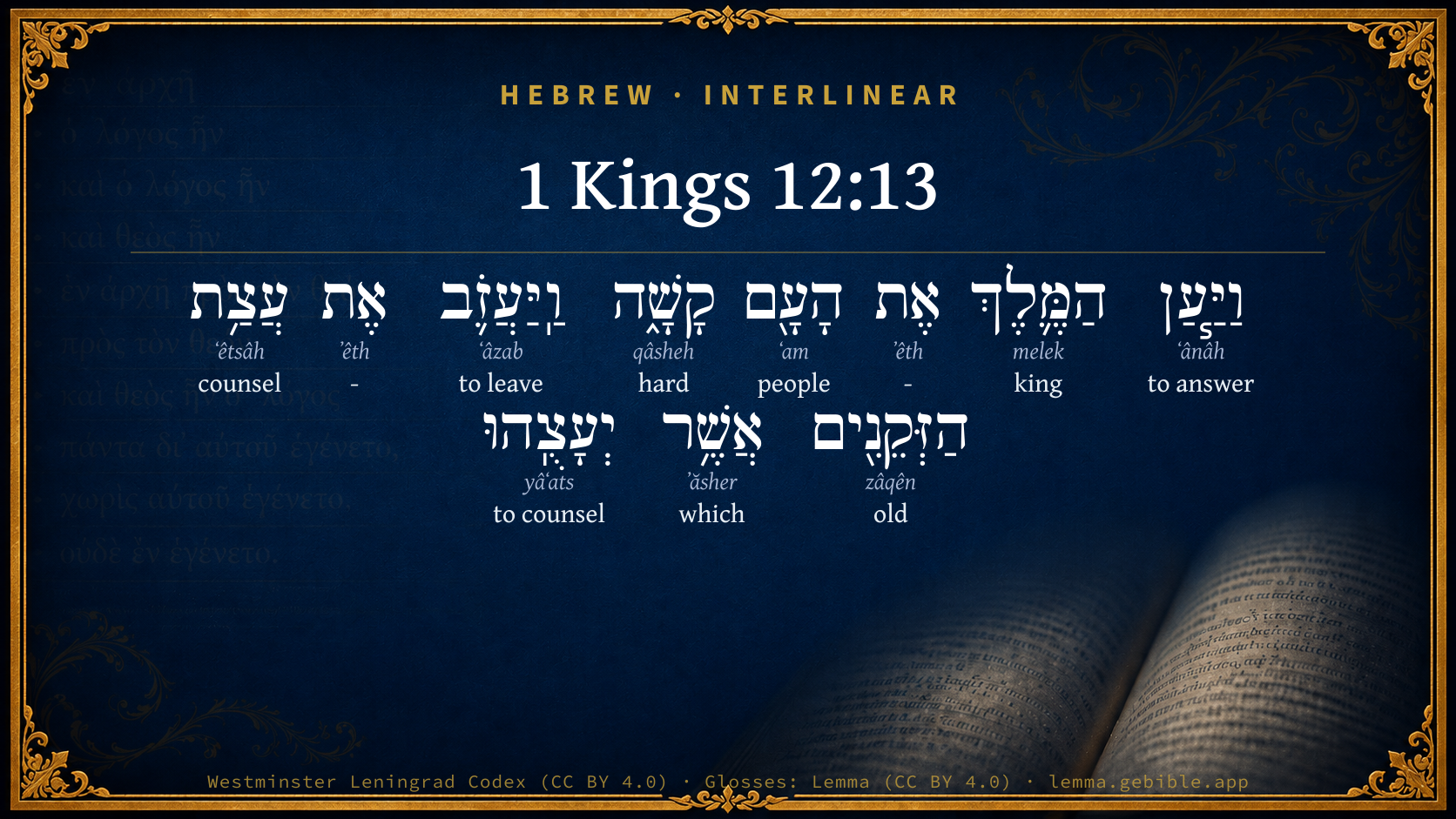
1 Kings 12:13

Hebrew (Westminster Leningrad Codex) 1 Kings 12:13 appears in the Hebrew Old Testament. The text above is from the Westminster Leningrad Codex. Each word links to its Strong’s number, a concise gloss, and parsing drawn from the Open Scriptures Hebrew Bible morphology. Click any word for its full Brown-Driver-Briggs (BDB) entry.
Download image
Cite this verse

1 Kings 12:13 (World English Bible). Public Domain. Lemma interlinear Bible study tool, https://lemma.gebible.app/v/1-kings/12/13.

Show BibTeX & RIS
BibTeX
RIS
English Translation
The king answered the people roughly, and forsook the counsel of the old men which they had given him,
World English Bible · Public Domain
Download a study sheet

One document with this verse’s original text, its word-by-word gloss line, the meaning frame, cross-references with their text, attributed commentary, and full source and license credits — printable, and it pastes into notes with its structure intact.

This verse Autodidact and up

Study sheet (.html) Plain text (.txt)

A passage Seminary Student

Up to 50 verses in one chapter. A passage sheet keeps up to 6 commentary sources and 12 cross-references per verse, in the order this page ranks them, and says so on the sheet whenever that leaves anything out. Ask for a single verse and you get the Autodidact verse sheet above.

Everything on this page stays free to read, with no account — the sheet is a download of what is already on screen, not access to it.

Want to remove ads? Support Godless Engineer
Compare translations 3

The same verse in 3 English versions, stacked beneath the original-language interlinear above. Click any original word for its lexicon entry.

Each is an independent rendering of the whole verse — the interlinear is not word-aligned to these translations.

Highlighted words mark where these versions differ — a whole-verse word diff, not a word-by-word alignment.

  • World English Bible Public Domain
    The king answered the people roughly, and forsook the counsel of the old men which they had given him,
  • King James Version Public Domain
    And the king answered the people roughly, and forsook the old men's counsel that they gave him;
  • unfoldingWord Literal Text CC BY-SA 4.0
    And the king answered the people harshly, and he forsook the counsel of the elders that they had counseled him.

unfoldingWord Literal Text — © unfoldingWord, licensed CC BY-SA 4.0. Word-aligned USFM3 via Door43 (git.door43.org/unfoldingWord/en_ult).

Versions to compare (up to 4)

3 of 4 selected

Show all 18 translations

Every available English version of this verse, each an independent rendering of the whole verse.

  • World English Bible Public Domain
    The king answered the people roughly, and forsook the counsel of the old men which they had given him,
  • Berean Standard Bible Public Domain
    And the king answered the people harshly. He rejected the advice of the elders
  • Majority Standard Bible Public Domain
    And the king answered the people harshly. He rejected the advice of the elders
  • King James Version Public Domain
    And the king answered the people roughly, and forsook the old men's counsel that they gave him;
  • American Standard Version (1901) Public Domain
    And the king answered the people roughly, and forsook the counsel of the old men which they had given him,
  • Revised Version (1885) Public Domain
    And the king answered the people roughly, and forsook the counsel of the old men which they had given him;
  • Geneva Bible (1599) Public Domain
    And the king answered the people sharpely, and left the old mens counsell that they gaue him,
  • Douay-Rheims (1899) Public Domain
    And the king answered the people roughly, leaving the counsel of the old men, which they had given him,
  • Young's Literal Translation Public Domain
    And the king answereth the people sharply, and forsaketh the counsel of the elders which they counselled him,
  • Literal Standard Version CC BY-SA 4.0
    And the king answers the people sharply, and forsakes the counsel of the elderly which they counseled him,
  • Unlocked Literal Bible CC BY-SA 4.0
    The king answered the people roughly and ignored the advice of the old men that they had given him.
  • unfoldingWord Literal Text CC BY-SA 4.0
    And the king answered the people harshly, and he forsook the counsel of the elders that they had counseled him.
  • Darby Bible Public Domain
    And the king answered the people roughly, and forsook the advice of the old men which they had given him;
  • World Messianic Bible Public Domain
    The king answered the people roughly, and abandoned the counsel of the old men which they had given him,
  • Webster's Bible Public Domain
    And the king answered the people roughly, and forsook the old men's counsel that they gave him;
  • Free Bible Version CC BY-SA 4.0
    The king answered the people sharply. Dismissing the advice of the elders,
  • Bible in Basic English Public Domain
    And the king gave them a rough answer, giving no attention to the suggestion of the old men;
  • JPS Tanakh (1917) Public Domain
    And the king answered the people roughly, and forsook the counsel of the old men which they had given him;

Literal Standard Version (2020), Covenant Press — licensed CC BY-SA 4.0. Text via the HelloAO Bible API (eBible.org). Unlocked Literal Bible (unfoldingWord) — licensed CC BY-SA 4.0. Text via the HelloAO Bible API (eBible.org). unfoldingWord Literal Text — © unfoldingWord, licensed CC BY-SA 4.0. Word-aligned USFM3 via Door43 (git.door43.org/unfoldingWord/en_ult). Free Bible Version, Dr. Jonathan Gallagher — licensed CC BY-SA 4.0. Text via the HelloAO Bible API (eBible.org).

Word by word

More ways to search: Search by grammar → Find every occurrence → Compare this word →

Practice this passage: Drill this verse → Learn its vocabulary →

קָשָׁ֑ה
qâsheh
H7186
“hard”
Adjective, Adjective, Feminine, Singular, Absolute
Part of Speech
Adjective
Type
Adjective
Gender
Feminine
Number
Singular
State
Absolute
Full BDB Definition

Origin: from H7185

TWOT: 2085a

hard, cruel, severe, obstinate - hard, difficult - severe - fierce, intense, vehement - stubborn, stiff of neck, stiff-necked - rigorous (of battle)
  1. וַיַּ֧עַן ʻânâh H6030 “and · to answer” Conjunction + Verb, Qal, Sequential Imperfect, 3rd Person, Masculine, Singular
  2. הַמֶּ֛לֶךְ melek H4428 “the · king” Particle, Definite Article + Noun, Common, Masculine, Singular, Absolute
  3. אֶת ʼêth H853 “-” Particle, Direct Object
  4. הָעָ֖ם ʻam H5971 “the · people” Particle, Definite Article + Noun, Common, Masculine, Singular, Absolute
  5. וַֽיַּעֲזֹ֛ב ʻâzab H5800 “and · to leave” Conjunction + Verb, Qal, Sequential Imperfect, 3rd Person, Masculine, Singular
  6. אֶת ʼêth H853 “-” Particle, Direct Object
  7. עֲצַ֥ת ʻêtsâh H6098 “counsel of” Noun, Common, Feminine, Singular, Construct
  8. הַזְּקֵנִ֖ים zâqên H2205 “the · old” Particle, Definite Article + Adjective, Adjective, Masculine, Plural, Absolute
  9. אֲשֶׁ֥ר ʼăsher H834 “which” Particle, Relative
  10. יְעָצֻֽהוּ yâʻats H3289 “to counsel · him” Verb, Qal, Perfect, 3rd Person, Common, Plural + Suffix, Personal, 3rd Person, Masculine, Singular

About this verse

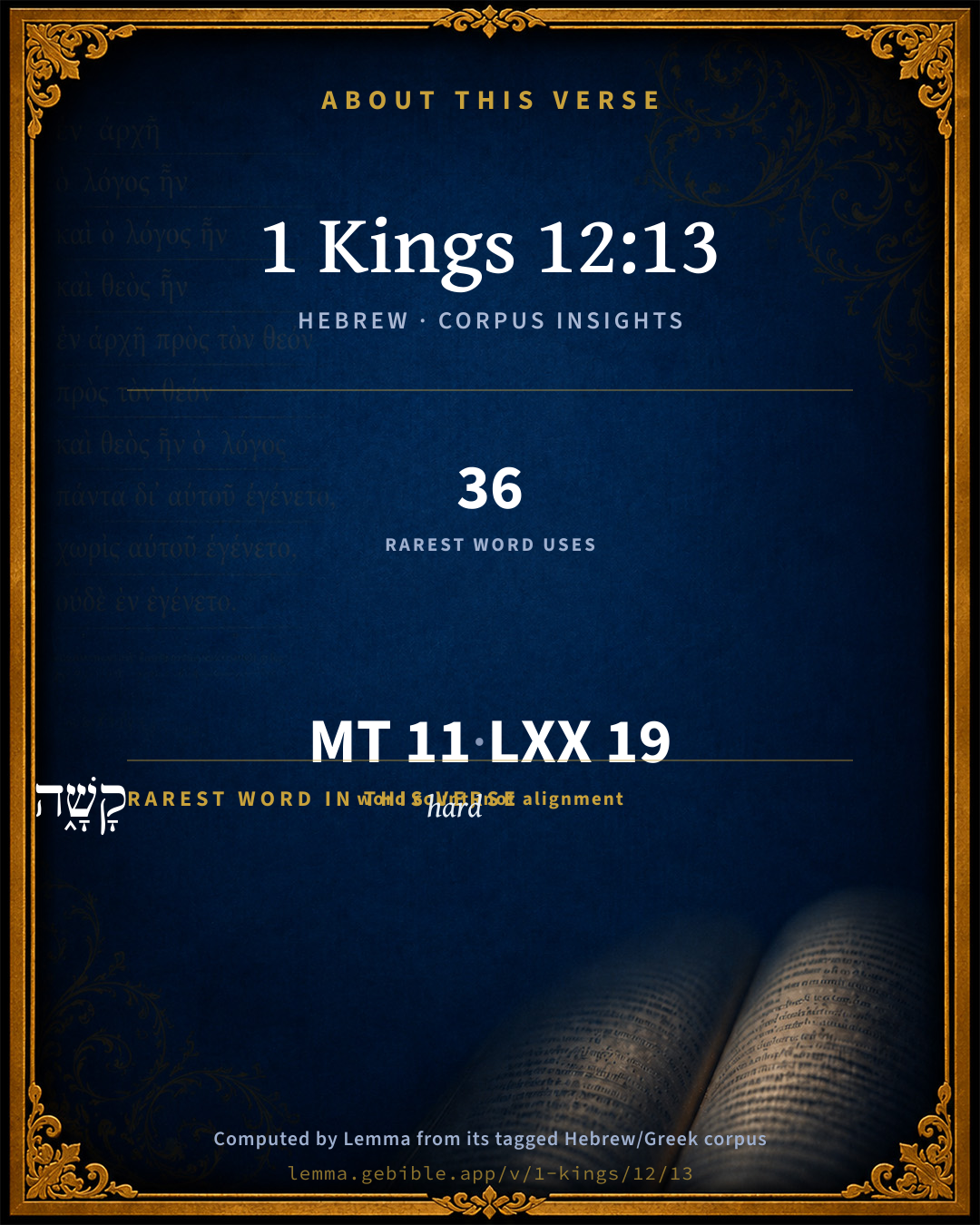
These counts appear in no published source. They are computed here, from the morphology-tagged text and Lemma’s own curated glosses. What Lemma adds →

11
words
10
distinct lemmas
Historical
section

Shared distinctive vocabulary

קָשָׁ֑ה hard H7186 occurs in 36 verses of the Hebrew Bible. Also found in:

Grammatical profile

  • 3 verbs
  • 3 nouns
  • 2 adjectives
  • 3 particles

Verb forms

  • וַיַּ֧עַן Qal · Sequential Imperfect
  • וַֽיַּעֲזֹ֛ב Qal · Sequential Imperfect
  • יְעָצֻֽהוּ Qal · Perfect

Hebrew & Septuagint length

In English translation the verse runs 19 words from the Hebrew and 20 from the Septuagint (LXX English) — closely comparable.

A rough comparison of the two English renderings, which tokenize alike — not a word-level alignment.

Word counts can differ between the Hebrew and the Greek without any difference in meaning — e.g. the Hebrew direct-object marker אֵת has no separate Greek word, and Greek often adds the article ὁ.

In the original languages it is 11 Hebrew tokens and 19 Greek tokens — but the two are counted differently (Hebrew bundles its prefixes and suffixes into one token; the Greek is in lemma form), so that isn’t a like-for-like length.

Cross-references

18

Topical passages linked to 1 Kings 12:13 in the Treasury of Scripture Knowledge — connected by theme and wording, ordered by reader-vote popularity; previews shown in the World English Bible.

  • Proverbs 10:11 The mouth of the righteous is a spring of life, But violence covers the mouth of the wicked.
  • Proverbs 10:32 The lips of the righteous know what is acceptable, But the mouth of the wicked is perverse.
  • Proverbs 13:20 One who walks with wise men grows wise, But a companion of fools suffers harm.
  • Proverbs 18:23 The poor plead for mercy, But the rich answer harshly.
  • Ecclesiastes 10:12 The words of a wise man's mouth are gracious; but a fool is swallowed by his own lips.
  • James 3:17 But the wisdom that is from above is first pure, then peaceful, gentle, reasonable, full of mercy and good fruits, without partiality, and without hypocrisy.
  • Genesis 16:6 But Abram said to Sarai, "Behold, your maid is in your hand. Do to her whatever is good in your eyes." Sarai dealt harshly with her, and she fled from her face.
  • Genesis 42:7 Joseph saw his brothers, and he recognized them, but acted like a stranger to them, and spoke roughly with them. He said to them, "Where did you come from?" They said, "From the land of Canaan to buy food."
  • Genesis 42:30 "The man, the lord of the land, spoke roughly with us, and took us for spies of the country.
  • Exodus 5:2 Pharaoh said, "Who is Yahweh, that I should listen to his voice to let Israel go? I don't know Yahweh, and moreover I will not let Israel go."
  • Exodus 10:28 Pharaoh said to him, "Get away from me! Be careful to see my face no more; for in the day you see my face you shall die!"
  • Judges 12:1–6 The men of Ephraim were gathered together, and passed northward; and they said to Jephthah, Why did you pass over to fight against the children of Ammon, and didn't call us to go with you? we will burn your house on you with fire.
  • 1 Samuel 20:10 Then said David to Jonathan, Who shall tell me if perchance your father answer you roughly?
  • 1 Samuel 20:30–31 Then Saul's anger was kindled against Jonathan, and he said to him, You son of a perverse rebellious woman, don't I know that you have chosen the son of Jesse to your own shame, and to the shame of your mother's nakedness?
  • 1 Samuel 25:10–11 Nabal answered David's servants, and said, Who is David? and who is the son of Jesse? there are many servants now-a-days who break away every man from his master.
  • 2 Samuel 19:43 The men of Israel answered the men of Judah, and said, We have ten parts in the king, and we have also more [right] in David than you: why then did you despise us, that our advice should not be first had in bringing back our king? The words of the men of Judah were fiercer than the words of the men of Israel.
  • 1 Kings 20:6–11 but I will send my servants to you tomorrow about this time, and they shall search your house, and the houses of your servants; and it shall be, that whatever is pleasant in your eyes, they shall put it in their hand, and take it away.
  • Proverbs 15:1 A gentle answer turns away wrath, But a harsh word stirs up anger.

Cross-references courtesy of OpenBible.info (CC BY 4.0).

Hebrew and Greek witnesses Masoretic Hebrew ↔ Greek Septuagint

The same verse in the two great witnesses to the Old Testament, shown verse-for-verse.

These are two independent witnesses, not word-aligned to each other, and the Septuagint is shown in lemma (dictionary) form.

Hebrew 1 Kings 12:13 Masoretic · Westminster Leningrad Codex

וַיַּ֧עַן הַמֶּ֛לֶךְ אֶת הָעָ֖ם קָשָׁ֑ה וַֽיַּעֲזֹ֛ב אֶת עֲצַ֥ת הַזְּקֵנִ֖ים אֲשֶׁ֥ר יְעָצֻֽהוּ

The king answered the people roughly, and forsook the counsel of the old men which they had given him,

World English Bible · Public Domain

Greek LXX 1 Kings 12:13 Septuagint · lemma form

καί ἀποκρίνω ὁ βασιλεύς πρός ὁ λαός σκληρός καί ἐν καταλείπω ροβοαμ ὁ βουλή ὁ πρεσβύτερος ὅς συνβουλεύω αὐτός

And the king answered the people harshly; and Roboam forsook the counsel of the old men which they counselled him.

LXX2012 (modern English Septuagint) · Public Domain

Hebrew: Westminster Leningrad Codex (CC BY 4.0). Greek: Septuagint (public domain); English from LXX2012 (modern English Septuagint) (Public Domain). How the Septuagint differs from the Hebrew →

Targum (Aramaic paraphrase)

1

The Targum is the ancient Jewish Aramaic paraphrase of the Hebrew Scriptures — an interpretive translation, not the Hebrew text itself. Onkelos (literal) and Pseudo-Jonathan (expansive) render the Torah, and Jonathan the Prophets. Coverage is partial: where no permissively-licensed English translation exists for a verse, only the Aramaic is shown. This is verse-level text, not a word-by-word alignment to the Hebrew.

  1. Targum Jonathan Prophets (Joshua–Malachi)
    וְאָתִיב מַלְכָּא יַת עַמָא פִּתְגַם קָשֵׁי וּשְׁבַק יַת מִלְכָּא דְסָבַיָא דִי מְלַכוּהִי:

    (no public-domain English translation for this verse)

    Targum Jonathan — Aramaic: “Mikraot Gedolot” (public domain). English: “Sefaria Community Translation” (CC0 1.0 (public-domain dedication)); “London "Chaldee Paraphrase," 1871” (public domain). Text via Sefaria.

Commentary

Notes on 1 Kings 12:13 from classic Christian and Jewish commentators (each source and its license shown beneath its notes). The classic Christian expositions comment on the surrounding passage and are grouped to its opening verse, so a note may address several verses; the Jewish commentaries on the Tanakh (Rashi and others) are per-verse, so they appear only where the commentator wrote on this verse.

Lemma curates 59 commentaries, every one of them public domain or Creative Commons licensed, each selected and text-cleaned for this edition rather than reprinted as found. About our sources →

Trapp's Complete Commentary

John Trapp

1Ki 12:13 And the king answered the people roughly, and forsook the old men’s counsel that they gave him;

Ver. 13. And the king answered the people roughly.] But to his great loss; for he lost those ten tribes with a churlish breath, whom he would, and might not, recover with blood: being so much more wilful than his father, as less wise; all head and no heart.

John Trapp, A Commentary or Exposition upon All the Books of the Old and New Testament (1647–1656) — public domain. Text from a community e-Sword module.

Joseph Benson's Commentary

1Ki 12:13-15. The king answered the people roughly — He affected to be haughty and imperious, and fancied he could carry all before him with a high hand, and therefore would rather run the risk of losing them, than deny himself so far as to give them good words. Thus many ruin themselves by consulting their humour more than their interest. For the cause was from the Lord — Who, having determined, in punishment of Solomon’s idolatries and criminal pleasures, to take the greater part of the kingdom away from his son, did not restrain Rehoboam from following the dictates of his own imperious temper, and ambitious views; but gave him up to the foolish and fatal mistake of answering the people according to the advice of his young and hot-headed counsellors, whereby their affections were alienated from him, and he lost more than half of his empire. Thus God, in his adorable providence, serves his own wise and righteous purposes, by the imprudences and iniquities of men, and snares sinners in the work of their own hands. They that lose the kingdom of heaven, throw it away as Rehoboam did his, by their own wilfulness and folly. Reader, take care that this be not thy case.

Joseph Benson's Commentary on the Old and New Testaments (1811–1818) — public domain. Text from a community e-Sword module.

John Gill's Exposition

And spake to them after the counsel of the young men,.... And in the very language in which they gave it:

saying, my father made your yoke heavy, and I will add to your yoke; my father also chastised you with whips, but I will chastise you with scorpions; see Gill on Kg1 12:11.

John Gill's Exposition of the Whole Bible (1746–1763) — public domain (CC PDM 1.0). Text via the HelloAO Bible API.

The Pulpit Commentary

And the king answered the people the omission of Jeroboam"s name, though perhaps it cannot he pressed in argument, is noticeable roughly, and forsook the old men"s counsel that they gave him.

Vers. 13-15.

Judicial Infatuation.

It is impossible to read this history of the great rebellion, even at the present day, without a certain feeling of sadness. We see here a young prince, heir to one of the greatest empires of antiquity, the inheritor of an illustrious and unequalled name, with all the advantages which the glory and greatness of his father could give him, reaping the benefits of a long peace, his coffers full of money, his cities filled with all manner of store, his fleets ploughing the sea, his army guarding his frontier; we see him wantonly flinging these singular advantages away from him, and absolutely courting his own destruction and the dismemberment of his kingdom. We see a position which has had but few, if any, parallels recklessly sacrificed for the lack of a few conciliatory words. It needed but the slenderest modicum of common sense and all would have gone well. He had but to stoop for one day in order to conquer forever (ver. 7). But no; we hear him instead hurling opprobrious words at the spokesmen of the ten tribes, and forthwith the land is ablaze with insurrection. He madly talks of the might of his little finger, of whips and scorpions, and from that hour his kingdom is divided; the holy people are ranged under hostile banners, and the way is opened for the schism in the Church. We talk sometimes of men who dance on the edge of a volcano, and we have read of Nero fiddling while Rome was burning, but it may be questioned whether history affords a more pitiable instance of folly and infatuation than this. And it was such infatuation that we can hardly resist the conclusion that it was, somehow, retributive and judicial. "Who would not have looked any whither for the cause of this evil, rather than to heaven? Yet the holy God challenges it to Himself" (Bp. Hall). "The cause was from the Lord.

It is well that we should understand, however, that this gross infatuation was only one out of many factors which produced the disruption. The division of the kingdom the first act in the long drama of retribution for the sin of Solomon was to a large extent the natural result of the rule and policy of Solomon. No doubt of all the causes of revolt the prophecy of Ahijah was the most influential. It was that "beginning" which, as Aristotle sagely remarks, is often the larger half. Possibly but for that, Israel"s "winter of discontent" would have been "made glorious by the summer sun" of the accession of a young prince. Probably but for that, Jeroboam would never have "lifted up his hand against the king." But we must not shut our eyes to the fact that the people had had a "heavy yoke" to hear. Rehoboam himself confessed to this (ver. 14). It is idle to say that their demands betray a foregone conclusion to revolt. The contrary is distinctly implied in verses 4, 7. Nor is it the fact that the rebellion was wholly due to the jealousy of Ephraim, for that proud tribe had readily acquiesced in the supremacy of Judah during the reign of David. Indeed, the rebellion is almost inexplicable, except on the supposition that, the people had suffered real hardships, and carried heavy burdens during Solomon s reign. Men do not soon forget the glories of such an empire as his, and do not wantonly tear it asunder, and reduce it to impotence, unless they have had substantial grievances. But in this case, so many were their grounds of disaffection that, remembering that Jeroboam, who no doubt appeared to them in the light of a champion and tribune of the people, was in reserve, should they need his services, it only needed the infatuation of Rehoboam to kindle the smouldering embers of discontent into a flame.

And when we see in this inconceivable infatuation the immediate cause of the disruption, we must still remember how it was that Rehoboam came to be capable of such egregious folly. Are we to suppose that he was expressly blinded for the occasion? Is it implied that, like Saul, an evil spirit from the Lord troubled him, or that, like Ahab, he was the victim of heaven-sent delusions? Is it not rather enough to believe that he was simply left to himself, to be the sport of his own folly and pride? His infatuation would still be judicial, if we saw in it, not the strange perversity of a moment, but the spontaneous outcome of his birth and education. Indeed, in that case, it would be still more conspicuously the just and appropriate retribution for his father"s sin. It was because of Solomon"s foreign wives, and the idolatries which, with his sanction, they practised, that Solomon"s empire was to be torn from his son. (1Ki_11:33) And now we find that the dismemberment of this empire was brought about by the son of one of these strange women the child of an unregenerate Ammonitess. It has been said that "every great man is the son of his mother." The same remark might be made of every great fool. It was probably because Naamah was what she was that Rehoboam was what he was. "The two worst men in my parish," said a clergyman, "are what their mothers have made them." We could not expect much character, not to speak of wisdom, in Solomon"s mistresses, who were chosen for their charms, and whoso cloistered life, amid the intrigues, and follies, and pettinesses of the harem, did not fit them to be the mothers of kings. What knowledge of the world or of men, what honour, what common sense could we hope to find in one brought up under such influences? The hearing of Rehoboam is precisely the bearing we should expect as the result of the training of an Eastern harem. It appears, consequently, that we may justly regard his infatuation as judicial, not so much in the sense of being inspired for the moment, but as being the natural consequence of his parents" folly and sin. But let us now consider what shape this same infatuation took: let us separate it into its constituent parts, that we may the better understand Rehoboam"s character, and see the workings of his mind. Observe

I HIS ENTIRE UNCONSCIOUSNESS OF DANGER. There were not wanting, to those who could read the signs of the times, many indications of peril. It was a "significant hint" that Shechem had been selected for his coronation; that the tribes insisted on a conference; that instead of acclamations he was met with stipulations. It was a presage of danger that their first words to Solomon"s son, to David"s grandson, were of a "heavy yoke" and a grievous burden. It was still more ominous that Jeroboam had already raised the standard of revolt, and that this arch rebel according to the received text, but see on vers. 3, 20 was present among the malcontents. Even if he had not at that time been recalled from Egypt, still Rehoboam knew full well that he was there, and ready to rebel again if opportunity offered. All these were mutterings of the coming storm, and no one who was not a fool could have failed to perceive their import.

II HIS VACILLATION AND IRRESOLUTION. Bishop Hall observes that his stipulating top three days in which to consider their demand was the only word he spoke which argued wisdom. Matthew Henry, on the other hand, thinks that it was "impolitic to take time to consider," and it may well be doubted whether this was not really a false and dangerous move. Had he bluntly refused all concessions and laid hands on the ringleaders, it is very probable that such a display of energy would have quelled the spirit of insurrection. Or had he graciously and instantly promised a redress of their grievances, he would have preserved his crown. But this delay was dangerous. It set them a-thinking what they would do in case of a refusal. A Fabian policy has saved some states, no doubt; but how many has it destroyed? And if, as has been suggested (on ver. 5), the object of the three days" delay was that he might summon his young companions to his side, its unwisdom is still more apparent.

III HIS PRIDE AND OBSTINACY. It was pride, not mental incapacity, led him to reject the counsel of the old men and seek for further advice. It was because it went against the grain to be a "servant," even for one day. That they should have presumed to ask concessions, or to parley with him at all, was an offence in his eyes. It is easy to read his vexation between the lines. With his high-flown notions of Divine right, with the characteristic contempt of an autocrat for the masses, it was mortifying to find his subjects bandying words with him. We may be pretty sure that, had the old men advised "whips of scorpions," etc., we should have heard of no further consultation. The pride of Solomon and the pretensions of Naamah reappear in their son.

IV HIS FOLLY. This, which is conspicuous all the way through, is especially manifest in

(1) his turning to the young men for advice, and

(2) in his taking it in preference to that of the old men.

We might also instance the threats to which he stooped, and the mission of Adoram, but these come more appropriately under

V HIS INSOLENCE AND DEFIANCE. Had he wished to provoke a rebellion, he could not have taken more effectual means to secure the end. "I will add to your yoke." "I will chastise you with scorpions." What cry could he possibly expect in return, except a war cry, such as he presently heard? If he had meant to punish, he should surely have held his tongue and used his hands. To boast of what he would do is like the Chinese warrior, who thinks to disperse his enemies by a ferocious shout. And to send Adoram, not to make overtures of peace Rehoboam"s folly would hardly go so far as to select him for such a mission but, as it would seem, to collect tribute or to make a show of his authority, why, if he had designed to make the breach irreparable, and to stamp out the last faint hope of reconciliation, he could not have done more. It was the act of a spoilt child, it was the coming out in the flesh of what was bred in the bone.

Amongst the lessons this history teaches are these:

(1) The sins of the fathers are visited upon the children, and that by the operation of so called natural laws.

(2) That God uses the folly, as well as the wrath, of man to praise Him.

(3) That if a fool be brayed in a mortar with a pestle, yet will not his foolishness depart from him,

(4) That the mother has the marring or the making of her child in her hands.

(5) That,

A pebble in the streamlet"s source, Hath turned the course of many a river; A dewdrop on the baby plant, Hath warped the giant oak forever.

HOMILIES BY A. ROWLAND Vers. 13, 14.

Rehoboam"s Folly.

Such madness is scarcely credible in the son of Solomon. These two kings present a remarkable contrast. Solomon at twenty years of age is the wisest man of his times, Rehoboam his son, at forty, is unfit to rule himself or his people. Wisdom is not by descent, but is the gift of God. Describe the scene in the chapter: the visit of Rehoboam to Shechem, probably with a view to conciliate the ten tribes; the complaint of the people; the two councils of the king; the maddening effect of his reply. The study of small and foolish men is advantageous, as well as the study of the great and wise, that by their follies we may be warned. Rehoboam"s faults he on the surface, as would be natural in so shallow a character as his, A careful study of the chapter reveals to us the following.

I REHOBOAM"S FEEBLENESS OF CHARACTER. We should expect of one who succeeded to the throne in the prime of his life some clear notions of the policy he would pursue. Brought up in a court to which the rulers of other peoples came, (1Ki_10:24) over which the wisest king of that age ruled, he was rich in natural advantages. He could also have discovered for himself the condition of the people, their causes of complaint, etc. Had he given himself to such thought he would have been prepared for prompt and resolute action on his accession. Instead of this he seems helpless; turns now to these and now to those for counsel, and has not even enough wisdom to weigh the value of advice when it is given. "Unstable as water, thou shalt not excel," is a law of far-reaching application. Amongst the virtues we should inculcate in our children is that of sober self-reliance. It may be fostered in the home with safety and advantage. Trust a child with something which he is free to use or abuse, in order to test him, and develop in him this grace. Probably Rehoboam had been brought up in the harem, and so had the heart of a child, with the years of a man. All gifts must be exercised to increase their value. "A double-minded man is unstable in all his ways," and an example of this lies before us.

II REHOBOAM"S CONTEMPT OF EXPERIENCE. He consulted the old advisers of Solomon, it is true, but clearly for the look of the thing only. Directly after speaking with "the responsible ministers of the crown," he turned to the courtiers, who were far less able to advise in such a crisis. Job says, "With the ancients is wisdom; and in length of days understanding." This is not always true. A man may be old without being wise, he may go through many experiences without being experienced. Still, other things being equal, a long study of affairs gives knowledge and discretion. It would clearly be so, with men chosen by the wise Solomon. Besides, those who have already won their honours are more disinterested than those who are ambitiously seeking to win them; and those whose reputations are high are more careful to guard themselves against folly than those who have no reputation to lose. Found on such principles the duties of submission to authority, of reverence to age, etc., which are the essentials of a happy home and of a peaceful society.

III REHOBOAM"S RESORT TO THE FOOLISH. The answer of the young men showed their folly. That such a spirit should exist is a proof that in the later years of Solomon the people about him had sadly deteriorated.

(1) These were the boon companions of Rehoboam, and knowing his haughty temper they flattered him to the top of his bent.

(2) They were courtiers brought up amid the luxuries of the splendid reign just ended, and knew little or nothing of the condition of the people. For these and other reasons they were of all others the most unfit to give counsel in this crisis. Give examples from history of kings ruined by their favourites. We should always suspect those who gratify our vanity, or seek to further our lower pleasures. Show the evils which arise, especially to weak characters, from foolish associates. "He that walketh with wise men shall be wise, but a companion of fools shall be destroyed." "Forsake the foolish, and live." "Blessed is he that walketh not in the counsel of the ungodly, nor standeth in the way of sinners, nor sitteth in the seat of the scornful.

IV REHOBOAM"S BOASTFULNESS OF HIS POWER. "My little finger shall be thicker than my father"s loins." A proverbial expression to denote that his power was greater than his father"s. Such bragging is no sign of courage. At the first outbreak of rebellion, this boaster "made speed to get him up to his chariot, to flee to Jerusalem." A strong character expresses itself not in great words, but in great deeds. The boastful Peter fails, the silent John stands firm. The Pharisee is rejected, the publican justified. "He that humbleth himself shall be exalted, and he that exalteth himself shall be abased.

V REHOBOAM"S ABUSE OF HIS AUTHORITY. "My father made your yoke heavy, and I will add to your yoke," etc. This was not the speech of one who felt himself to be a shepherd of God"s flock, but of one who assumed despotic authority. This was never permitted to a king of Israel, nor is it intended by God that any man should thus rule. It would be an evil to the ruler himself as well as to his people. Least of all is it to be tolerated in the Christian Church. The highest in ecclesiastical office are forbidden to be "lords over God"s heritage," but are to be "examples to the flock." Christ said, "The kings of the Gentiles exercise lordship over them but ye shall not be so". (Luk_22:24-29)

VI REHOBOAM"S NEGLECT OF PRAYER. How differently he began his reign from his father! Solomon went first to God; Rehoboam went hither and thither for counsel, but never turned to God at all. How often we act thus in our temporal perplexities, in our theological difficulties, etc. How sadly we forget the words, "If any of you lack wisdom let him ask of God," etc.. (Jam_1:5-8) Throw the lurid light of this story on Proverbs 1., and make personal application of the warning given there. A.R.

The Pulpit Commentary (1880–1919), ed. H.D.M. Spence-Jones & Joseph S. Exell — public domain. Text from a community e-Sword module.

Lesson kit

Teaching starters — assembled from the data on this page, not authored interpretation. Every prompt links to the verse data it draws on. Edit before teaching.

1 Kings, in the Historical, opens this verse with 11 words (10 distinct Hebrew lemmas). Its most distinctive word is qâsheh (“hard”). A historical commentator’s framing appears above. Read the whole chapter for the surrounding context.

Discussion questions

  1. The word qâsheh carries the sense “hard.” How does it shape the verse?
  2. Genesis 42:7 shares the word «hard» with this verse. How do the two illuminate each other?
  3. These translations render this verse differently; the difference is in the English rendering, not the original. What questions does that raise?
  4. The verb «וַיַּ֧עַן» is Qal Sequential Imperfect. How does its form color the action?
  5. Reading how Trapp's Complete Commentary and Joseph Benson's Commentary read this verse, where do the two commentators agree and where do they part?

Things to notice

Reading settings

Reading text

Shown beneath each verse's original-language words.

Old Testament
Old Testament edition

Read the OT as the Masoretic Hebrew (MT) or the Greek Septuagint (LXX).

English shown for the Greek Septuagint (in the Hebrew ↔ Greek comparison).

Comparing translations? Open the Compare panel on any verse page to stack up to four side by side.