Jeremiah 9:13

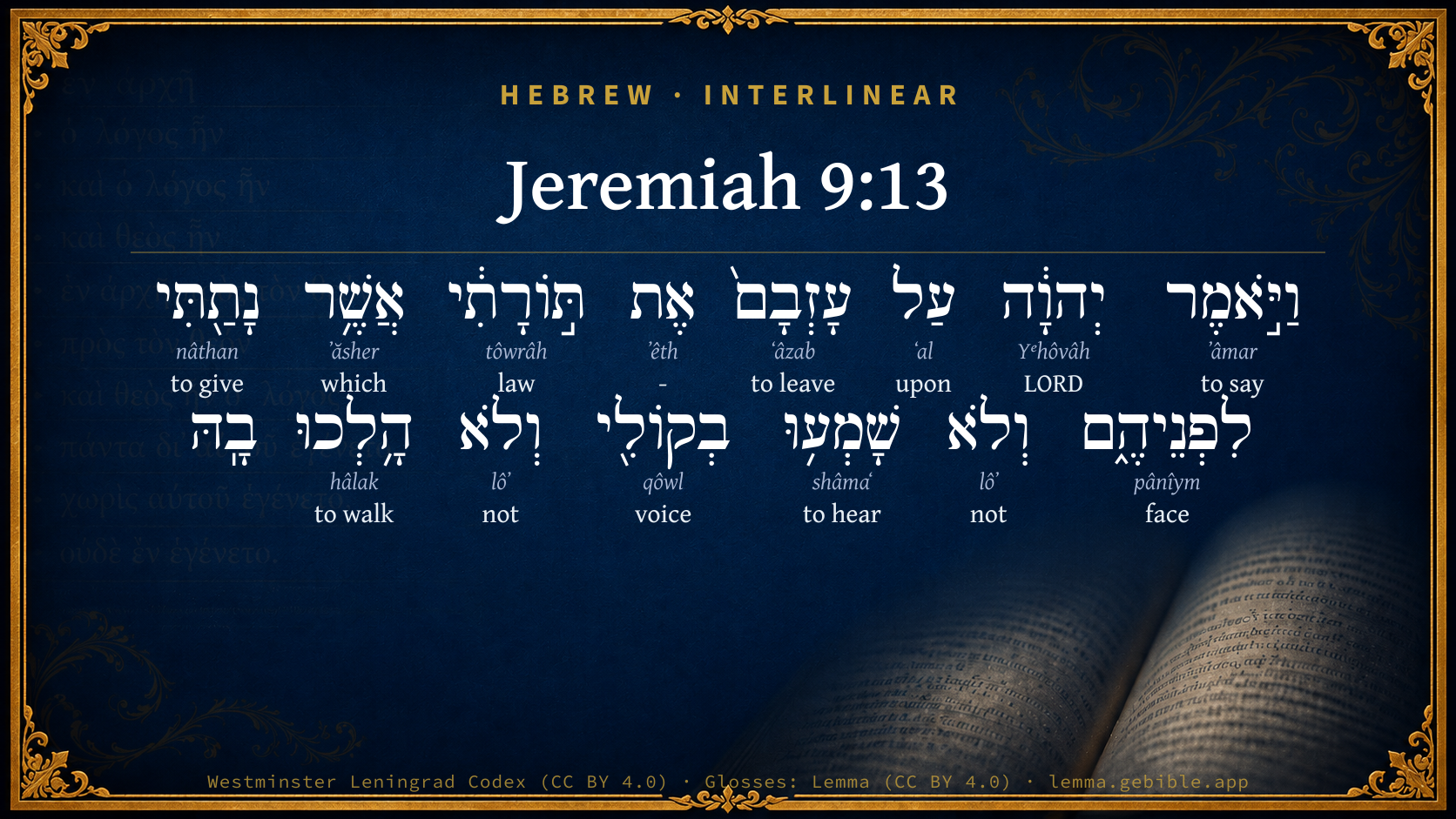
Hebrew (Westminster Leningrad Codex) Jeremiah 9:13 appears in the Hebrew Old Testament. The text above is from the Westminster Leningrad Codex. Each word links to its Strong’s number, a concise gloss, and parsing drawn from the Open Scriptures Hebrew Bible morphology. Click any word for its full Brown-Driver-Briggs (BDB) entry.
Download image
Cite this verse

Jeremiah 9:13 (World English Bible). Public Domain. Lemma interlinear Bible study tool, https://lemma.gebible.app/v/jeremiah/9/13.

Show BibTeX & RIS
BibTeX
RIS
English Translation
Yahweh says, Because they have forsaken my law which I set before them, and have not obeyed my voice, neither walked therein,
World English Bible · Public Domain
Download a study sheet

One document with this verse’s original text, its word-by-word gloss line, the meaning frame, cross-references with their text, attributed commentary, and full source and license credits — printable, and it pastes into notes with its structure intact.

This verse Autodidact and up

Study sheet (.html) Plain text (.txt)

A passage Seminary Student

Up to 50 verses in one chapter. A passage sheet keeps up to 6 commentary sources and 12 cross-references per verse, in the order this page ranks them, and says so on the sheet whenever that leaves anything out. Ask for a single verse and you get the Autodidact verse sheet above.

Everything on this page stays free to read, with no account — the sheet is a download of what is already on screen, not access to it.

Want to remove ads? Support Godless Engineer
Compare translations 3

The same verse in 3 English versions, stacked beneath the original-language interlinear above. Click any original word for its lexicon entry.

Each is an independent rendering of the whole verse — the interlinear is not word-aligned to these translations.

Highlighted words mark where these versions differ — a whole-verse word diff, not a word-by-word alignment.

  • World English Bible Public Domain
    Yahweh says, Because they have forsaken my law which I set before them, and have not obeyed my voice, neither walked therein,
  • King James Version Public Domain
    And the LORD saith, Because they have forsaken my law which I set before them, and have not obeyed my voice, neither walked therein;
  • unfoldingWord Literal Text CC BY-SA 4.0
    And Yahweh said, “Because of their forsaking my law that I set before the face of them, and they do not listen to my voice and they do not walk in it.

unfoldingWord Literal Text — © unfoldingWord, licensed CC BY-SA 4.0. Word-aligned USFM3 via Door43 (git.door43.org/unfoldingWord/en_ult).

Versions to compare (up to 4)

3 of 4 selected

Show all 18 translations

Every available English version of this verse, each an independent rendering of the whole verse.

  • World English Bible Public Domain
    Yahweh says, Because they have forsaken my law which I set before them, and have not obeyed my voice, neither walked therein,
  • Berean Standard Bible Public Domain
    And the LORD answered, “It is because they have forsaken My law, which I set before them; they have not walked in it or obeyed My voice.
  • Majority Standard Bible Public Domain
    And the LORD answered, “It is because they have forsaken My law, which I set before them; they have not walked in it or obeyed My voice.
  • King James Version Public Domain
    And the LORD saith, Because they have forsaken my law which I set before them, and have not obeyed my voice, neither walked therein;
  • American Standard Version (1901) Public Domain
    And Jehovah saith, Because they have forsaken my law which I set before them, and have not obeyed my voice, neither walked therein,
  • Revised Version (1885) Public Domain
    And the LORD saith, Because they have forsaken my law which I set before them, and have not obeyed my voice, neither walked therein;
  • Geneva Bible (1599) Public Domain
    And the Lord sayeth, Because they haue forsaken my Lawe, which I set before them, and haue not obeyed my voice, neither walked thereafter,
  • Douay-Rheims (1899) Public Domain
    And the Lord said: Because they have forsaken my law, which I gave them, and have not heard my voice, and have not walked in it.
  • Young's Literal Translation Public Domain
    And Jehovah saith: Because of their forsaking My law that I set before them, And they have not hearkened to My voice nor walked in it,
  • Literal Standard Version CC BY-SA 4.0
    And YHWH says: “Because of their forsaking My law that I set before them, || And they have not listened to My voice nor walked in it,
  • Unlocked Literal Bible CC BY-SA 4.0
    Yahweh says, “It is because they have abandoned my law that I set before them, because they do not listen to my voice or walk by it.
  • unfoldingWord Literal Text CC BY-SA 4.0
    And Yahweh said, “Because of their forsaking my law that I set before the face of them, and they do not listen to my voice and they do not walk in it.
  • Darby Bible Public Domain
    And Jehovah saith, Because they have forsaken my law which I set before them, and have not hearkened unto my voice, nor walked in it,
  • World Messianic Bible Public Domain
    The LORD says, “Because they have forsaken my law which I set before them, and have not obeyed my voice or walked in my ways,
  • Webster's Bible Public Domain
    And the LORD saith, Because they have forsaken my law which I set before them, and have not obeyed my voice, neither walked therein;
  • Free Bible Version CC BY-SA 4.0
    The Lord replied, It's because they have given up keeping my laws that I placed before them. They haven't followed them; they haven't done what I told them.
  • Bible in Basic English Public Domain
    And the Lord said, Because they have given up my law which I put before them, giving no attention to my voice and not being guided by it;
  • JPS Tanakh (1917) Public Domain
    (9-12) And the LORD saith: Because they have forsaken My law which I set before them, and have not hearkened to My voice, neither walked therein;

Literal Standard Version (2020), Covenant Press — licensed CC BY-SA 4.0. Text via the HelloAO Bible API (eBible.org). Unlocked Literal Bible (unfoldingWord) — licensed CC BY-SA 4.0. Text via the HelloAO Bible API (eBible.org). unfoldingWord Literal Text — © unfoldingWord, licensed CC BY-SA 4.0. Word-aligned USFM3 via Door43 (git.door43.org/unfoldingWord/en_ult). Free Bible Version, Dr. Jonathan Gallagher — licensed CC BY-SA 4.0. Text via the HelloAO Bible API (eBible.org).

Word by word

More ways to search: Search by grammar → Find every occurrence → Compare this word →

Practice this passage: Drill this verse → Learn its vocabulary →

עָזְבָם֙
ʻâzab
H5800
“to leave · them”
Verb, Qal, Infinitive Construct + Suffix, Personal, 3rd Person, Masculine, Plural
Part of Speech
Verb
Stem
Qal
Form
Infinitive Construct
Full BDB Definition

Origin: a primitive root

TWOT: 1594 , 1595

to leave, loose, forsake - (Qal) to leave - to depart from, leave behind, leave, let alone - to leave, abandon, forsake, neglect, apostatise - to let loose, set free, let go, free - (Niphal) - to be left to - to be forsaken - (Pual) to be deserted - to restore, repair - (Qal) to repair
  1. וַיֹּ֣אמֶר ʼâmar H559 “and · to say” Conjunction + Verb, Qal, Sequential Imperfect, 3rd Person, Masculine, Singular
  2. יְהוָ֔ה Yᵉhôvâh H3068 “LORD” Noun, Proper
  3. עַל ʻal H5921 “upon” Preposition
  4. אֶת ʼêth H853 “-” Particle, Direct Object
  5. תּ֣וֹרָתִ֔י tôwrâh H8451 “law · my” Noun, Common, Feminine, Singular, Construct + Suffix, Personal, 1st Person, Common, Singular
  6. אֲשֶׁ֥ר ʼăsher H834 “which” Particle, Relative
  7. נָתַ֖תִּי nâthan H5414 “to give” Verb, Qal, Perfect, 1st Person, Common, Singular
  8. לִפְנֵיהֶ֑ם pânîym H6440 “to/for · face(s) · their” Preposition + Noun, Common, Both, Plural, Construct + Suffix, Personal, 3rd Person, Masculine, Plural
  9. וְלֹא lôʼ H3808 “and · not” Conjunction + Particle, Negative
  10. שָׁמְע֥וּ shâmaʻ H8085 “to hear” Verb, Qal, Perfect, 3rd Person, Common, Plural
  11. בְקוֹלִ֖י qôwl H6963 “in/at · voice · my” Preposition + Noun, Common, Masculine, Singular, Construct + Suffix, Personal, 1st Person, Common, Singular
  12. וְלֹא lôʼ H3808 “and · not” Conjunction + Particle, Negative
  13. הָ֥לְכוּ hâlak H1980 “to walk” Verb, Qal, Perfect, 3rd Person, Common, Plural

About this verse

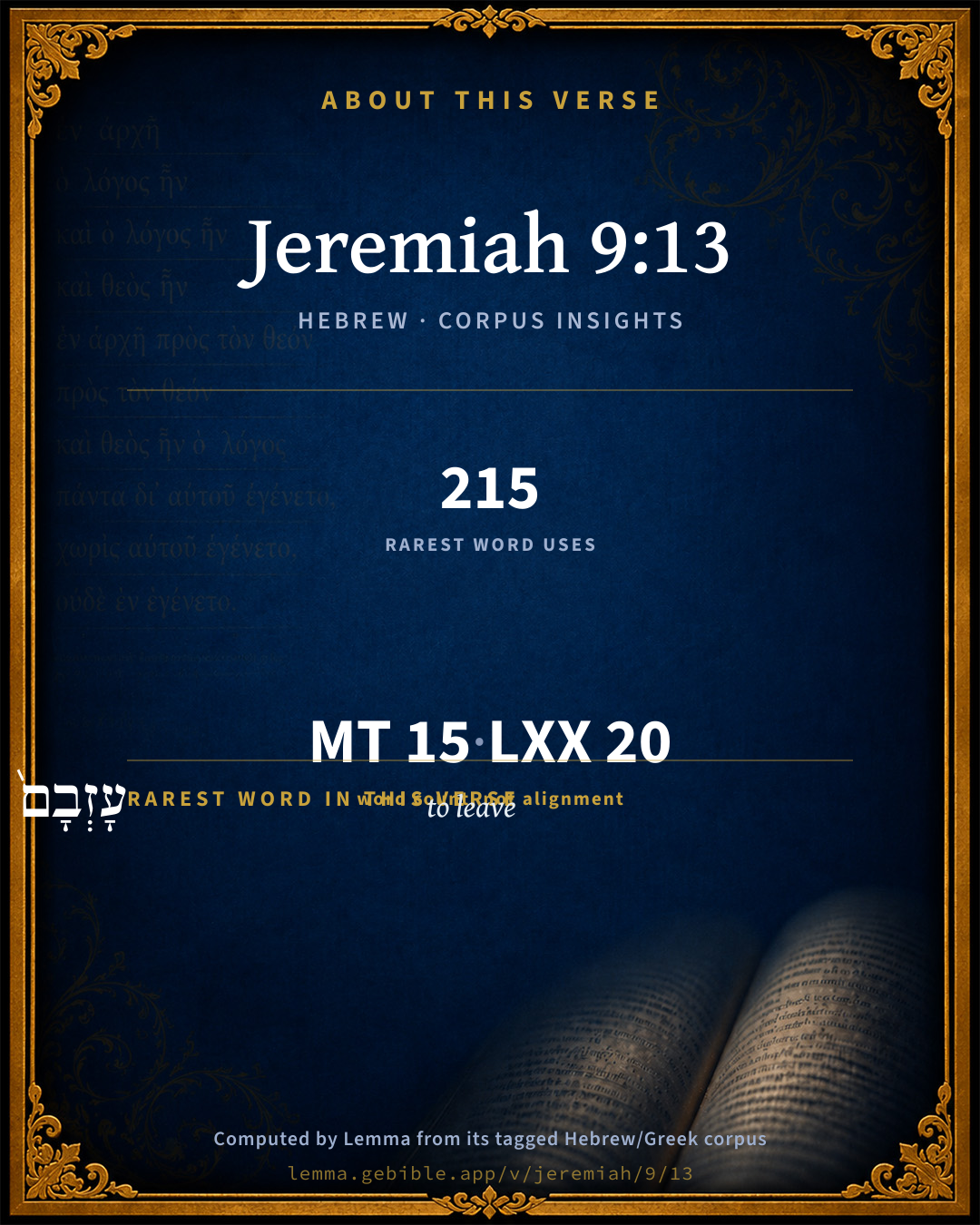
These counts appear in no published source. They are computed here, from the morphology-tagged text and Lemma’s own curated glosses. What Lemma adds →

15
words
13
distinct lemmas
Prophets
section

Grammatical profile

  • 5 verbs
  • 4 nouns
  • 2 prepositions
  • 4 particles

Verb forms

  • וַיֹּ֣אמֶר Qal · Sequential Imperfect
  • עָזְבָם֙ Qal · Infinitive Construct
  • נָתַ֖תִּי Qal · Perfect
  • שָׁמְע֥וּ Qal · Perfect
  • הָ֥לְכוּ Qal · Perfect

Repetition

A word recurs within this verse — often emphatic in Hebrew:

  • וְלֹא not H3808 ×2

Hebrew & Septuagint length

In the original languages it is 15 Hebrew tokens and 20 Greek tokens — but the two are counted differently (Hebrew bundles its prefixes and suffixes into one token; the Greek is in lemma form), so that isn’t a like-for-like length.

Cross-references

8

Topical passages linked to Jeremiah 9:13 in the Treasury of Scripture Knowledge — connected by theme and wording, ordered by reader-vote popularity; previews shown in the World English Bible.

  • 2 Chronicles 7:19 But if you turn away, and forsake my statutes and my commandments which I have set before you, and shall go and serve other gods, and worship them;
  • Jeremiah 22:9 Then they shall answer, Because they forsook the covenant of Yahweh their God, and worshiped other gods, and served them.
  • Ezra 9:10 Now, our God, what shall we say after this? for we have forsaken your commandments,
  • Deuteronomy 31:16–17 Yahweh said to Moses, Behold, you shall sleep with your fathers; and this people will rise up, and play the prostitute after the strange gods of the land, where they go to be among them, and will forsake me, and break my covenant which I have made with them.
  • Psalms 89:30–32 If his children forsake my law, And don't walk in my ordinances;
  • Psalms 119:53 Indignation has taken hold on me, Because of the wicked who forsake your law.
  • Proverbs 28:4 Those who forsake the law praise the wicked; But those who keep the law contend with them.
  • Zephaniah 3:1–6 Woe to her who is rebellious and polluted, the oppressing city!

Cross-references courtesy of OpenBible.info (CC BY 4.0).

Hebrew and Greek witnesses Masoretic Hebrew ↔ Greek Septuagint

The same verse in the two great witnesses to the Old Testament, shown verse-for-verse.

These are two independent witnesses, not word-aligned to each other, and the Septuagint is shown in lemma (dictionary) form.

Hebrew Jeremiah 9:13 Masoretic · Westminster Leningrad Codex

וַיֹּ֣אמֶר יְהוָ֔ה עַל עָזְבָם֙ אֶת תּ֣וֹרָתִ֔י אֲשֶׁ֥ר נָתַ֖תִּי לִפְנֵיהֶ֑ם וְלֹא שָׁמְע֥וּ בְקוֹלִ֖י וְלֹא הָ֥לְכוּ בָֽהּ

Yahweh says, Because they have forsaken my law which I set before them, and have not obeyed my voice, neither walked therein,

World English Bible · Public Domain

Greek LXX Structure differs

In the Septuagint, Jeremiah is about an eighth shorter than the Hebrew and arranges its material differently — the Oracles Against the Nations (Hebrew chapters 46–51) appear in the middle of the Greek book, after 25:13. Because the chapter and verse boundaries do not line up, a verse-for-verse comparison with the Hebrew is not shown.

A verse-for-verse comparison isn’t shown here because the chapters and verses don’t line up. Switch to the LXX edition with the MT / LXX toggle above to read the Greek directly.

On this verse, John Gill's Exposition discusses the Septuagint’s reading. Read the note in Commentary ↓

Hebrew: Westminster Leningrad Codex (CC BY 4.0). Greek: Septuagint (public domain); English from a public-domain English Septuagint. How the Septuagint differs from the Hebrew →

Targum (Aramaic paraphrase)

1

The Targum is the ancient Jewish Aramaic paraphrase of the Hebrew Scriptures — an interpretive translation, not the Hebrew text itself. Onkelos (literal) and Pseudo-Jonathan (expansive) render the Torah, and Jonathan the Prophets. Coverage is partial: where no permissively-licensed English translation exists for a verse, only the Aramaic is shown. This is verse-level text, not a word-by-word alignment to the Hebrew.

  1. Targum Jonathan Prophets (Joshua–Malachi)
    וַאֲזַלוּ בָּתַר הִרְהוּר לִבְּהוֹן וּבָתַר בַּעֲלַיָא דְאַלֵיפִינוּן אֲבַהָתְהוֹן:

    (no public-domain English translation for this verse)

    Targum Jonathan — Aramaic: “Mikraot Gedolot” (public domain). English: “Sefaria Community Translation” (CC0 1.0 (public-domain dedication)); “London "Chaldee Paraphrase," 1871” (public domain). Text via Sefaria.

Commentary

Notes on Jeremiah 9:13 from classic Christian and Jewish commentators (each source and its license shown beneath its notes). The classic Christian expositions comment on the surrounding passage and are grouped to its opening verse, so a note may address several verses; the Jewish commentaries on the Tanakh (Rashi and others) are per-verse, so they appear only where the commentator wrote on this verse.

Lemma curates 59 commentaries, every one of them public domain or Creative Commons licensed, each selected and text-cleaned for this edition rather than reprinted as found. About our sources →

Trapp's Complete Commentary

John Trapp

Jer 9:13 And the LORD saith, Because they have forsaken my law which I set before them, and have not obeyed my voice, neither walked therein;

Ver. 13. And the Lord saith.] Or, Therefore the Lord saith, q.d., Because neither yourselves know, nor have any else to tell you, the true cause of your calamities; hear it from God’s own mouth.

John Trapp, A Commentary or Exposition upon All the Books of the Old and New Testament (1647–1656) — public domain. Text from a community e-Sword module.

The Biblical Illustrator

Joseph S. Exell

Jer_9:13-16

Because they have forsaken My law . . . give them water of gall to drink.

The wages of sin

A quaint preacher, addressing miners, drew a picture of two mines. He represented payday at one of the mines, and described the long line of men coming to the cashiers desk to receive their wages. Presently some men came up whom the cashier did not know. Where have you been working? he asked. We were working in the other pit, they answered. Then that is the place to go for your money. No, they said, we like your pay best; we are tired, and we want rest, and we want peace and plenty. At the pit where we have been working they are treating us cruelly, and we get no pay, but blows and hard words. Wont you pay us? But the cashier says, No; you chose to work in the other pit, and you must take the wages they pay; you cannot work for one employer and get your wages from another. That was fair, was it not? the preacher asked. His hearers answered that it was. Then, said he, dont you serve the devil unless you want his wages.

The Biblical Illustrator, edited by Joseph S. Exell (c. 1880s–1900s) — public domain. Text from a community e-Sword module.

Tyndale Open Study Notes

Tyndale Open Resources

9:13-14 The Lord answered the questions (9:12) by repeating what he had said before. The people caused the destruction of city, towns, and land. They rejected the Lord’s covenant instructions and deliberately disobeyed his commands. They became dedicated idol worshipers because their ancestors taught them to worship images of Baal, the Canaanite god of storm and fertility.

Tyndale Open Study Notes — © Tyndale Open Resources, licensed CC BY-SA 4.0. Text via the HelloAO Bible API.

Jamieson, Fausset & Brown

Robert Jamieson, A. R. Fausset & David Brown

Answer to the "for what the land perisheth" (Jer 9:12).

Jamieson, Fausset & Brown — Commentary Critical and Explanatory on the Whole Bible (1871) — public domain (CC PDM 1.0). Text via the HelloAO Bible API.

John Calvin's Commentaries

Jeremiah now confirms what I have stated, and more fully explains it, — that though no teacher or a disciple was found in the land, yet there was sufficient power in God’s word alone, and that his judgment depended not on the will or the perceptions of men. After having then complained that all were foolish, and that there were no prophets to reprove their security and indifference, he adds, Thus saith Jehovah Here he sets God in opposition to all men, to the king and his courtiers, as well as to the common people. Who then is a wise man? as though He looked around him; and there was no man who considered. he was then in suspense; and afterwards he said, “There is no prophet to rouse them from their usual stupor.” He remained still in suspense; and then he turned to God and said, “But Jehovah has spoken;” that is, “Be it, that they are like brute beasts, though they arrogate to themselves great wisdom; nevertheless God speaks, and we ought to be satisfied. We ought then to be silent, and to make no stir; though no one approves, though no one attends to God speaking, there is yet sufficient authority and power in his voice alone.” We now then more fully understand the Prophet’s design: He had said that all men were stupid, and that there was no prophet; and now, on the other hand, he shews that God was not silent nor asleep.

Thus saith Jehovah, Because this people have forsaken my law, etc. He shews that the cause of all evils was a departure from God’s law. No one was willing to confess this, and all the prophets were silent; yet Jeremiah says here, that the cause was to be asked of God why he so grievously afflicted the people. But he takes as granted what was most true, that God was not without reason displeased with the chosen people. It hence then follows, that they were apost, ates, and had forsaken the law: God would not have otherwise so severely punished them. Though then no one perceived the cause of their evils, though no one shewed it, yet God himself ought to have been attended to, who said, that they had forsaken the law

He then adds, Which l have set before their face. Here he takes away every pretense for ignorance; for they might have objected and said, that the doctrine of the law was obscure, and that they were deceived through want of knowledge. The Prophet anticipates this objection by saying, that the law was set before them; that is, that they were abundantly taught what was right, what pleased God; so that they now in vain and even falsely pleaded ignorance; for they went astray wilfully by closing their eyes against clear light., For this is what he means by saying that the law was set before their face: and it is what Moses often repeats,

“Behold, I have set before thee,” (Deuteronomy 11:32, and elsewhere:)

and this he said, that the people might not seek for themselves vain excuses for ignorance, as they were wont to do.

But while we are not to overlook this circumstance, we may yet hence learn this general truth, — that the law of God is not so obscure but that we may learn from it what is right. When, therefore, Moses is quoted, and the prophets are added as interpreters, there is no ground for us to evade, or to make the excuse, that the truth is too hidden or profound; for the law is set before our face, that, the will of God may be made known to us. Whosoever then can read and hear what God has revealed once to the world by Moses and the prophets is inexcusable; for we are taught here, and in other places, that it is a mere perverseness in all who hear the law, when they do not obey: I have set the law, he says, before their face

And he adds, And they have not hearkened to my voice, and have not walked in it He defines what it is not to hearken to his voice: for even hypocrites pretend to hear, and nod with their ears like asses; but as they obey not God when he speaks, it is evident that they are deaf. Hence He says that they walked not in his voice, that is, that they obeyed not his voice. He hence concludes that they were deaf; for their life ought to have testified that they had heard the voice of God speaking to them.

John Calvin's Commentaries (1540-1563) — public domain. Text from the Calvin Translation Society English edition (1840s-50s) via the Christian Classics Ethereal Library (ccel.org). Calvin's coverage is partial (roughly two-thirds of the Bible); uncommented books and verses are honest gaps, never fabricated. The 19th-century editor's footnotes and remarks are omitted so the notes are faithfully Calvin's own voice.

The Cambridge Bible for Schools and Colleges

gen. ed. J. J. S. Perowne

13. I set before them] See e.g. Deu_4:8; Deu_4:44.

The Cambridge Bible for Schools and Colleges (gen. ed. J. J. S. Perowne; Cambridge University Press, 1878–1918) — public domain. Text from a community e-Sword module.

John Gill's Exposition

And the Lord saith,.... The Septuagint version adds, "to me"; there being no wise and understanding man, nor prophet (b), to take up this affair, and open the cause of it, therefore the Lord undertakes it himself: the question was put to them, but they not answering it, the Lord does it,

because they have forsaken my law, which I set before them; in a plain and easy manner, so as to be readily understood; yet this they attended not unto, but forsook it, neglected it, and cast it behind their backs. Kimchi's note on the phrase, "before them", is,

"not in heaven is it, nor beyond the sea is it;''

see Deu 30:11,

and have not obeyed my voice; in the law, and by the prophets:

neither walked therein: according to it, as the Lord directed; they neither hearkened to the voice of the Lord, nor did as they were instructed by it.

(b) Vid. T. Nedarim, fol. 81. 1. & Bava Metzia fol. 85. 1, 2.

John Gill's Exposition of the Whole Bible (1746–1763) — public domain (CC PDM 1.0). Text via the HelloAO Bible API.

Matthew Poole's English Annotations

Either this and the next verse refer to the former, viz. because there are none can give the reason why the land perisheth, therefore God will; or else they refer to Jer 9:15,16, as showing the causes of those judgments threatened; for either of the references do not alter the sense: see Jer 5:19; this verse contains negative reasons.

They have forsaken my law; he chargeth them with their apostacy, and refusing to obey his precepts, and conform their conversation to them.

Which I set before them: lest they should plead they were obscure and hard to be understood, therefore he tells them he had made it plain to them, they could not be ignorant of it, except it were out of wilfulness and obstinacy: the like expression Deu 11:32.

Matthew Poole's English Annotations on the Holy Bible (1683–1685) — public domain. Text from a community e-Sword/MySword module.

The Pulpit Commentary

There is no answer, for the wise men are ashamed; (Jer_8:9) so Jehovah himself takes up his speech. My law which I set before them; not in reference to the publication of the Law on Sinai, but, as Keil rightly points out, to the oral exhibition of the Torah by the prophets. Neither walked therein; viz. in the Law. (On the precise contents of the term here rendered "Law," see note on Jer_8:8)

The Pulpit Commentary (1880–1919), ed. H.D.M. Spence-Jones & Joseph S. Exell — public domain. Text from a community e-Sword module.

unfoldingWord translationNotes

Door43 World Missions Community

General Information:

Yahweh continues speaking about the people of Judah.

It is because

"These things will happen because"

they have abandoned my law

Yahweh speaks of the people not obeying his law as if it were something that they had walked away from. AT: "they have rejected my law" (See: Metaphor)

they do not listen to my voice

Here Yahweh's "voice" represents what he says. AT: "they do not pay attention to the things I tell them" (See: Metonymy)

or walk by it

Here "walk" is an idiom for "live." AT: "or live the way I tell them to live" (See: Idiom)

they have walked by their stubborn hearts

Here the people's "stubborn hearts" represent their stubborn desires and stubborn will. Also, here "walked" represents living. AT: "they have been stubborn and lived the way they want to live" (See: Metonymy and Idiom)

have followed the Baals

"have worshiped the Baals"

translationWords

law

voice

walk

stiff-necked

heart

Baal

ancestor

unfoldingWord translationNotes — © Distant Shores Media and the Door43 World Missions Community, licensed CC BY-SA 4.0. Source: git.door43.org/Door43/en_tn.

Lesson kit

Teaching starters — assembled from the data on this page, not authored interpretation. Every prompt links to the verse data it draws on. Edit before teaching.

Jeremiah, in the Prophets, opens this verse with 15 words (13 distinct Hebrew lemmas). Its most distinctive word is ʻâzab (“to leave”). A historical commentator’s framing appears above. Read the whole chapter for the surrounding context.

Discussion questions

  1. The word ʻâzab carries the sense “to leave.” How does it shape the verse?
  2. 2 Chronicles 7:19 shares this passage’s theme. How do the two illuminate each other?
  3. “not” occurs 2× in this one verse. What is the effect of the repetition?
  4. These translations render this verse differently; the difference is in the English rendering, not the original. What questions does that raise?
  5. The verb «וַיֹּ֣אמֶר» is Qal Sequential Imperfect. How does its form color the action?
  6. Reading how Trapp's Complete Commentary and The Biblical Illustrator read this verse, where do the two commentators agree and where do they part?

Things to notice

Reading settings

Reading text

Shown beneath each verse's original-language words.

Old Testament
Old Testament edition

Read the OT as the Masoretic Hebrew (MT) or the Greek Septuagint (LXX).

English shown for the Greek Septuagint (in the Hebrew ↔ Greek comparison).

Comparing translations? Open the Compare panel on any verse page to stack up to four side by side.