
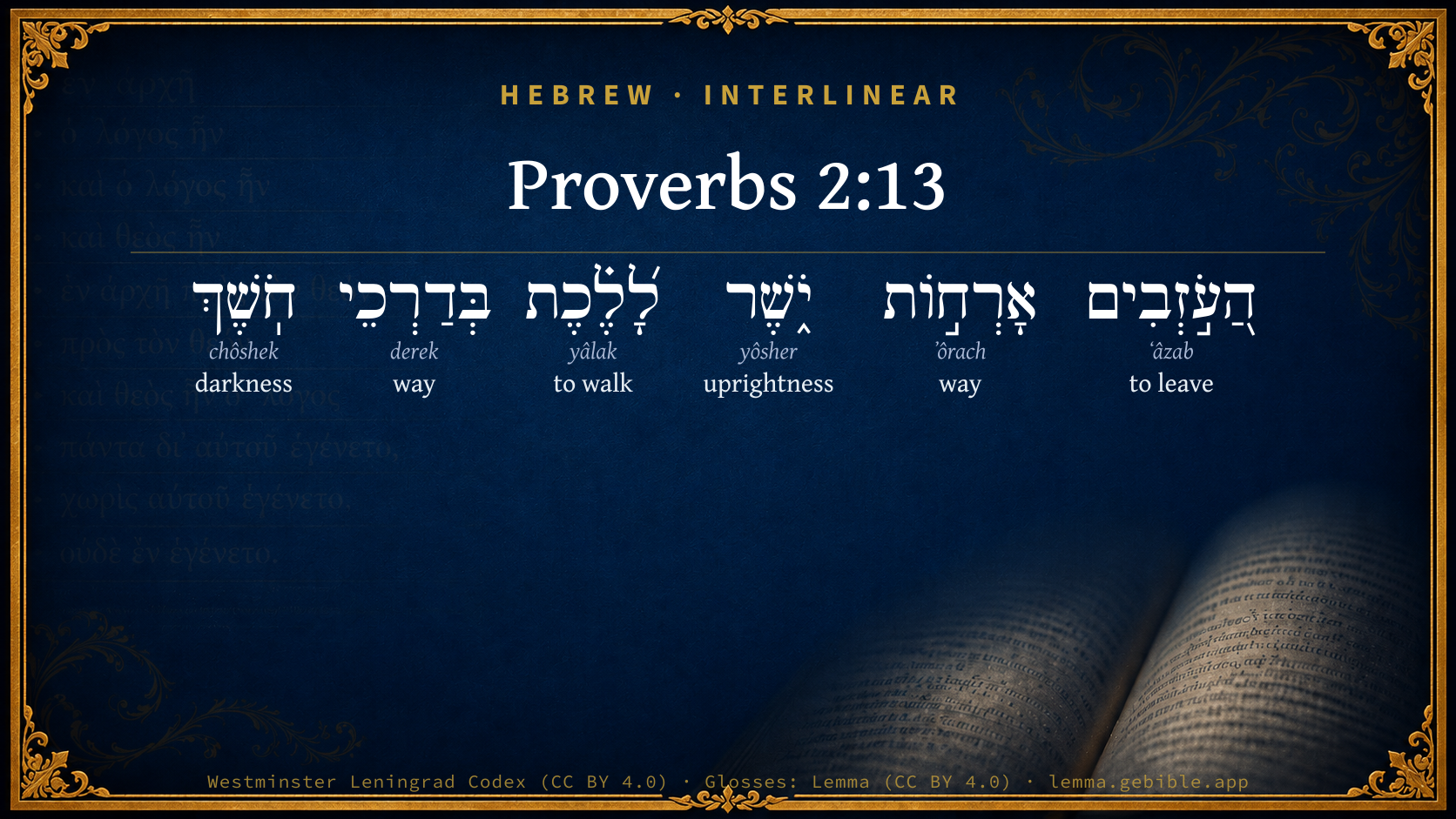
Proverbs 2:13

Hebrew (Westminster Leningrad Codex) Proverbs 2:13 appears in the Hebrew Old Testament. The text above is from the Westminster Leningrad Codex. Each word links to its Strong’s number, a concise gloss, and parsing drawn from the Open Scriptures Hebrew Bible morphology. Click any word for its full Brown-Driver-Briggs (BDB) entry.
Download image
Cite this verse

Proverbs 2:13 (World English Bible). Public Domain. Lemma interlinear Bible study tool, https://lemma.gebible.app/v/proverbs/2/13.

Show BibTeX & RIS
BibTeX
RIS
English Translation
Who forsake the paths of uprightness, To walk in the ways of darkness;
World English Bible · Public Domain
Download a study sheet

One document with this verse’s original text, its word-by-word gloss line, the meaning frame, cross-references with their text, attributed commentary, and full source and license credits — printable, and it pastes into notes with its structure intact.

This verse Autodidact and up

Study sheet (.html) Plain text (.txt)

A passage Seminary Student

Up to 50 verses in one chapter. A passage sheet keeps up to 6 commentary sources and 12 cross-references per verse, in the order this page ranks them, and says so on the sheet whenever that leaves anything out. Ask for a single verse and you get the Autodidact verse sheet above.

Everything on this page stays free to read, with no account — the sheet is a download of what is already on screen, not access to it.

Want to remove ads? Support Godless Engineer
Compare translations 3

The same verse in 3 English versions, stacked beneath the original-language interlinear above. Click any original word for its lexicon entry.

Each is an independent rendering of the whole verse — the interlinear is not word-aligned to these translations.

Highlighted words mark where these versions differ — a whole-verse word diff, not a word-by-word alignment.

  • World English Bible Public Domain
    Who forsake the paths of uprightness, To walk in the ways of darkness;
  • King James Version Public Domain
    Who leave the paths of uprightness, to walk in the ways of darkness;
  • unfoldingWord Literal Text CC BY-SA 4.0
    the ones who forsake the paths of straightness to walk in the ways of darkness,

unfoldingWord Literal Text — © unfoldingWord, licensed CC BY-SA 4.0. Word-aligned USFM3 via Door43 (git.door43.org/unfoldingWord/en_ult).

Versions to compare (up to 4)

3 of 4 selected

Show all 18 translations

Every available English version of this verse, each an independent rendering of the whole verse.

  • World English Bible Public Domain
    Who forsake the paths of uprightness, To walk in the ways of darkness;
  • Berean Standard Bible Public Domain
    from those who leave the straight paths to walk in the ways of darkness,
  • Majority Standard Bible Public Domain
    from those who leave the straight paths to walk in the ways of darkness,
  • King James Version Public Domain
    Who leave the paths of uprightness, to walk in the ways of darkness;
  • American Standard Version (1901) Public Domain
    Who forsake the paths of uprightness, To walk in the ways of darkness;
  • Revised Version (1885) Public Domain
    Who forsake the paths of uprightness, to walk in the ways of darkness;
  • Geneva Bible (1599) Public Domain
    And from them that leaue the wayes of righteousnes to walke in the wayes of darkenes:
  • Douay-Rheims (1899) Public Domain
    Who leave the right way, and walk by dark ways:
  • Young's Literal Translation Public Domain
    Who are forsaking paths of uprightness, To walk in ways of darkness,
  • Literal Standard Version CC BY-SA 4.0
    Who are forsaking paths of uprightness, || To walk in ways of darkness,
  • Unlocked Literal Bible CC BY-SA 4.0
    who abandon the right paths and walk in the ways of darkness.
  • unfoldingWord Literal Text CC BY-SA 4.0
    the ones who forsake the paths of straightness to walk in the ways of darkness,
  • Darby Bible Public Domain
    [from those] who leave the paths of uprightness, to walk in the ways of darkness;
  • World Messianic Bible Public Domain
    who forsake the paths of uprightness, to walk in the ways of darkness,
  • Webster's Bible Public Domain
    Who leave the paths of uprightness, to walk in the ways of darkness;
  • Free Bible Version CC BY-SA 4.0
    who turn away from following what is right to walk down paths of darkness.
  • Bible in Basic English Public Domain
    Who give up the way of righteousness, to go by dark roads;
  • JPS Tanakh (1917) Public Domain
    Who leave the paths of uprightness, to walk in the ways of darkness;

Literal Standard Version (2020), Covenant Press — licensed CC BY-SA 4.0. Text via the HelloAO Bible API (eBible.org). Unlocked Literal Bible (unfoldingWord) — licensed CC BY-SA 4.0. Text via the HelloAO Bible API (eBible.org). unfoldingWord Literal Text — © unfoldingWord, licensed CC BY-SA 4.0. Word-aligned USFM3 via Door43 (git.door43.org/unfoldingWord/en_ult). Free Bible Version, Dr. Jonathan Gallagher — licensed CC BY-SA 4.0. Text via the HelloAO Bible API (eBible.org).

Word by word

More ways to search: Search by grammar → Find every occurrence → Compare this word →

Practice this passage: Drill this verse → Learn its vocabulary →

About this verse

These counts appear in no published source. They are computed here, from the morphology-tagged text and Lemma’s own curated glosses. What Lemma adds →

6
words
6
distinct lemmas
Wisdom
section

Notable vocabulary

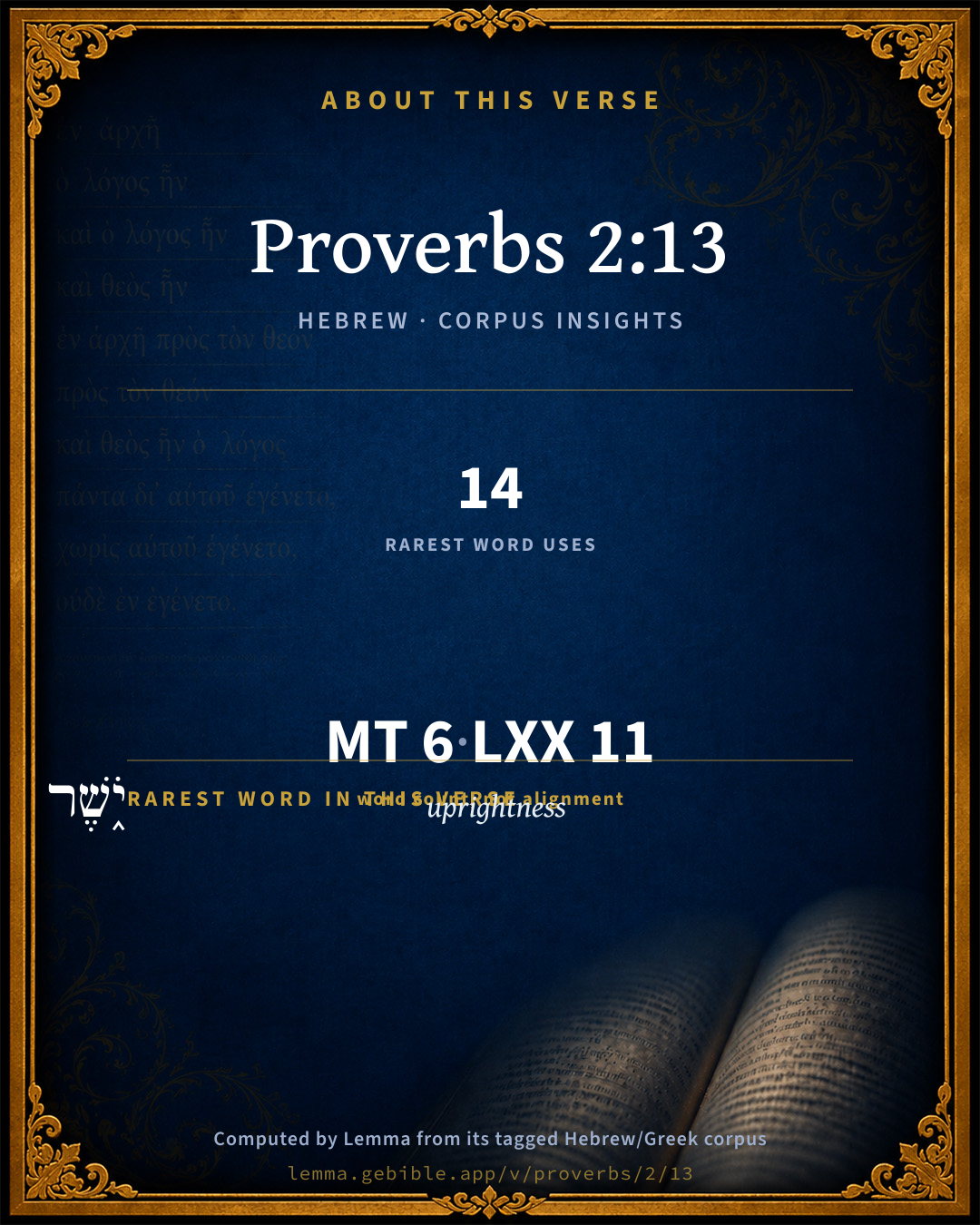
The rarest word here is יֹ֑שֶׁר uprightness H3476 — appearing just 14 times in the whole Hebrew Bible.

Shared distinctive vocabulary

יֹ֑שֶׁר uprightness H3476 occurs in 14 verses of the Hebrew Bible. Also found in:

Grammatical profile

  • 2 verbs
  • 4 nouns

Verb forms

  • הַ֭עֹ֣זְבִים Qal · Participle Active
  • לָ֝לֶ֗כֶת Qal · Infinitive Construct

Hebrew & Septuagint length

In English translation the verse runs 13 words from the Hebrew and 13 from the Septuagint (LXX English) — the same length.

A rough comparison of the two English renderings, which tokenize alike — not a word-level alignment.

Word counts can differ between the Hebrew and the Greek without any difference in meaning — e.g. the Hebrew direct-object marker אֵת has no separate Greek word, and Greek often adds the article ὁ.

In the original languages it is 6 Hebrew tokens and 11 Greek tokens — but the two are counted differently (Hebrew bundles its prefixes and suffixes into one token; the Greek is in lemma form), so that isn’t a like-for-like length.

Cross-references

20

Topical passages linked to Proverbs 2:13 in the Treasury of Scripture Knowledge — connected by theme and wording, ordered by reader-vote popularity; previews shown in the World English Bible.

  • John 3:19–20 This is the judgment, that the light has come into the world, and men loved the darkness rather than the light; for their works were evil.
  • Proverbs 4:19 The way of the wicked is like darkness. They don't know what they stumble over.
  • Proverbs 21:16 The man who wanders out of the way of understanding Shall rest in the assembly of the dead.
  • 2 Peter 2:20–22 For if, after they have escaped the defilement of the world through the knowledge of the Lord and Savior Jesus Christ, they are again entangled therein and overcome, the last state has become worse with them than the first.
  • 1 John 2:19 They went out from us, but they didn't belong to us; for if they had belonged to us, they would have continued with us. But they left, that they might be revealed that none of them belong to us.
  • Psalms 14:3 They have all gone aside. They have together become corrupt. There is none who does good, no, not one.
  • Psalms 36:3 The words of his mouth are iniquity and deceit. He has ceased to be wise and to do good.
  • Psalms 82:5 They don't know, neither do they understand. They walk back and forth in darkness. All the foundations of the earth are shaken.
  • Ezekiel 18:26 When the righteous man turns away from his righteousness, and commits iniquity, and dies therein; in his iniquity that he has done shall he die.
  • Ezekiel 33:12–13 You, son of man, tell the children of your people, The righteousness of the righteous shall not deliver him in the day of his disobedience; and as for the wickedness of the wicked, he shall not fall thereby in the day that he turns from his wickedness; neither shall he who is righteous be able to live thereby in the day that he sins.
  • Zephaniah 1:6 those who have turned back from following Yahweh, and those who haven't sought Yahweh nor inquired after him.
  • Matthew 12:43–45 But the unclean spirit, when he is gone out of the man, passes through waterless places, seeking rest, and doesn't find it.
  • John 1:6 There came a man, sent from God, whose name was John.
  • John 2:9–11 When the ruler of the feast tasted the water now become wine, and didn't know where it came from (but the servants who had drawn the water knew), the ruler of the feast called the bridegroom,
  • John 12:35 Jesus therefore said to them, "Yet a little while the light is with you. Walk while you have the light, that darkness doesn't overtake you. He who walks in the darkness doesn't know where he is going.
  • 1 Thessalonians 5:5–7 You are all children of light, and children of the day. We don't belong to the night, nor to darkness,
  • 2 Timothy 4:10 for Demas left me, having loved this present world, and went to Thessalonica; Crescens to Galatia, and Titus to Dalmatia.
  • Hebrews 6:4–6 For concerning those who were once enlightened and tasted of the heavenly gift, and were made partakers of the Holy Spirit,
  • Job 24:13–16 "These are of those who rebel against the light; They don't know the ways of it, Nor abide in the paths of it.
  • Romans 1:21 Because, knowing God, they didn't glorify him as God, neither gave thanks, but became vain in their reasoning, and their senseless heart was darkened.

Cross-references courtesy of OpenBible.info (CC BY 4.0).

Hebrew and Greek witnesses Masoretic Hebrew ↔ Greek Septuagint

The same verse in the two great witnesses to the Old Testament, shown verse-for-verse.

These are two independent witnesses, not word-aligned to each other, and the Septuagint is shown in lemma (dictionary) form.

Hebrew Proverbs 2:13 Masoretic · Westminster Leningrad Codex

הַ֭עֹ֣זְבִים אָרְח֣וֹת יֹ֑שֶׁר לָ֝לֶ֗כֶת בְּדַרְכֵי חֹֽשֶׁךְ

Who forsake the paths of uprightness, To walk in the ways of darkness;

World English Bible · Public Domain

Greek LXX Proverbs 2:13 Septuagint · lemma form

ὦ ὁ ἐν καταλείπω ὁδός εὐθύς ὁ πορεύομαι ἐν ὁδός σκότος

Alas for those who forsake right paths, to walk in ways of darkness;

LXX2012 (modern English Septuagint) · Public Domain

On this verse, The Pulpit Commentary discusses the Septuagint’s reading. Read the note in Commentary ↓

Hebrew: Westminster Leningrad Codex (CC BY 4.0). Greek: Septuagint (public domain); English from LXX2012 (modern English Septuagint) (Public Domain). How the Septuagint differs from the Hebrew →

Commentary

Notes on Proverbs 2:13 from classic Christian and Jewish commentators (each source and its license shown beneath its notes). The classic Christian expositions comment on the surrounding passage and are grouped to its opening verse, so a note may address several verses; the Jewish commentaries on the Tanakh (Rashi and others) are per-verse, so they appear only where the commentator wrote on this verse.

Lemma curates 59 commentaries, every one of them public domain or Creative Commons licensed, each selected and text-cleaned for this edition rather than reprinted as found. About our sources →

Trapp's Complete Commentary

John Trapp

Pro 2:13 Who leave the paths of uprightness, to walk in the ways of darkness;

Ver. 13. To walk in the ways of darkness.] As thieves, drunkards, dicers, and our other solifugae, that abuse even gospel light; that put not light under a bushel, but under a dunghill; that, when they have walked themselves weary in these byways, highways to hell, sit down "in darkness, and in the shadow of death," {Luk 1:79} which posture imports, (1). Continuance there; (2). Content, as well paid of their seat. These "hate the light because their ways are evil." {Joh 3:20} The light stands in the light of their wicked ways, as the angel did in Balaam’s way to his sin.

John Trapp, A Commentary or Exposition upon All the Books of the Old and New Testament (1647–1656) — public domain. Text from a community e-Sword module.

Geneva Bible (1599)

Geneva Bible translators

That is, the word of God, which is the only light, to follow their own fantasies which are darkness.

Geneva Bible (1599) marginal notes — public domain. Text via Bolls.life.

Jamieson, Fausset & Brown

Robert Jamieson, A. R. Fausset & David Brown

paths of uprightness--or, "plainness."

walk--habitually act;

Jamieson, Fausset & Brown — Commentary Critical and Explanatory on the Whole Bible (1871) — public domain (CC PDM 1.0). Text via the HelloAO Bible API.

John Gill's Exposition

Who leave the paths of uprightness,.... Or "righteousness", or the "right and plain ways" (u); which the light of nature and the law of God, and especially the Gospel of Christ, direct to; and in which they have been trained up, having had a religious education; for it supposes them to have been externally in these ways, since they are said to leave them; for though persons do not easily and ordinarily leave the ways they have been brought up in, yet sometimes they do; and there are instances of it, and such generally are the worst of men;

to walk in the ways of darkness: sin, ignorance, and infidelity; in which they that walk know not where they are, nor whither they are a going, and which must be very uncomfortable as well as dangerous; in which only works of darkness are done, and which lead to blackness of darkness, the darkness of hell; a miserable choice, a sad change this! So Schultens renders it, "ways of horrid darkness".

(u) "semitas rectas", Mercerus; "itinera recta", Piscator; "itinera planissima", Schultens.

John Gill's Exposition of the Whole Bible (1746–1763) — public domain (CC PDM 1.0). Text via the HelloAO Bible API.

Matthew Poole's English Annotations

The paths of uprightness; the way of God’s precepts.

Of darkness, i.e. of sin, which is oft called darkness, as Rom 13:12, &c.; Eph 5:11, because it comes from darkness, ignorance, and error, and loves darkness and hates light, and leads to utter darkness.

Matthew Poole's English Annotations on the Holy Bible (1683–1685) — public domain. Text from a community e-Sword/MySword module.

Whedon's Commentary on the Bible

Daniel D. Whedon

13-15. Who leave the paths of uprightness — A description of these evil men, needing no comment. Delighting in the frowardness, the wickedness of the wicked, is one of their worst features. Comp. Psa_50:17-18; Rom_1:32.

Daniel D. Whedon (gen. ed.), Commentary on the Old and New Testaments (1874–1909) — public domain. Text from a community e-Sword module.

The Pulpit Commentary

Who leave the paths of uprightness. Between vers. 13 and 15 the teacher proceeds to give a more detailed description of those who speak perversely. Who leave (, haoz"vim); literally, forsaking, but the present participle has the force of the preterite, as appears from the context. The men alluded to have already forsaken or deserted the paths of uprightness (see previous note on the word "man." The paths of uprightness (tvy twOjra , ar"khoth yosher); the same as the "right paths" of ch. 4:11. The strict meaning of the Hebrew word translated "uprightness" is "straightness," and hence it stands opposed to "perverseness" in the previous verse. Uprightness is integrity, rectitude, honest dealing. The LXX translators represent the forsaking of the paths of uprightness as a consequence resulting from walking in the ways of darkness, "O ye who have left the right ways by departing tou poreuesbai , equivalent to abeundo into the ways of darkness." Again, the ways of darkness ( ykerd, dar"chey kkoshek) are opposed to the "paths of uprightness" which rejoice in the light. Darkness includes the two ideas of

(1) ignorance and error, (Isa_9:2 Eph_5:8) and

(2) evil deeds.

To walk in the ways of darkness, then, is to persist in a course of wilful ignorance, to reject deliberately the light of knowledge, and to work wickedness, by performing "the works of darkness (ta erga tou skutouv )," which St. Paul exhorted the Church at Rome to east away, (Rom_13:12) and by having fellowship with "the unfruitful works of darkness (ta erga ta akarpa tou skotouv )," against which the same apostle warned the Ephesians. (Eph_5:11) They are ways of darkness, because they endeavour to hide themselves from God (Isa_29:15) and from man. (Job_24:15 Job_38:13, Job_38:15) In their tendency and end they lead to the blackness of darkness forever. In Scripture darkness is associated with evil, just as light is with uprightness. (see Joh_3:19, Joh_3:20) The same association of ideas is discoverable in the dualism of the Persian system, as formulated by Zoroaster Ormuzd, the good principle, presides over the kingdom of light, while Ahriman, the principle of evil, is the ruler of the kingdom of darkness.

The Pulpit Commentary (1880–1919), ed. H.D.M. Spence-Jones & Joseph S. Exell — public domain. Text from a community e-Sword module.

John Wesley's Explanatory Notes

Darkness - Of sin.

John Wesley, Explanatory Notes Upon the Whole Bible (1754–1765) — public domain. Text via the GEBible commentary corpus.

Lesson kit

Teaching starters — assembled from the data on this page, not authored interpretation. Every prompt links to the verse data it draws on. Edit before teaching.

Proverbs, in the Wisdom, opens this verse with 6 words (6 distinct Hebrew lemmas). Its most distinctive word is yôsher (“uprightness”). A historical commentator’s framing appears above. Read the whole chapter for the surrounding context.

Discussion questions

  1. What does “uprightness” (yôsher) contribute to the verse as a whole?
  2. How does Deuteronomy 9:5, which shares the word «uprightness», read alongside this verse?
  3. These translations render this verse differently. What is at stake in choosing one wording over another?
  4. «הַ֭עֹ֣זְבִים» is a Qal Participle Active verb. How does that grammatical form shape the action described?
  5. Compare how Trapp's Complete Commentary and Geneva Bible (1599) read this verse. Where do they agree or differ?

Things to notice

Reading settings

Reading text

Shown beneath each verse's original-language words.

Old Testament
Old Testament edition

Read the OT as the Masoretic Hebrew (MT) or the Greek Septuagint (LXX).

English shown for the Greek Septuagint (in the Hebrew ↔ Greek comparison).

Comparing translations? Open the Compare panel on any verse page to stack up to four side by side.