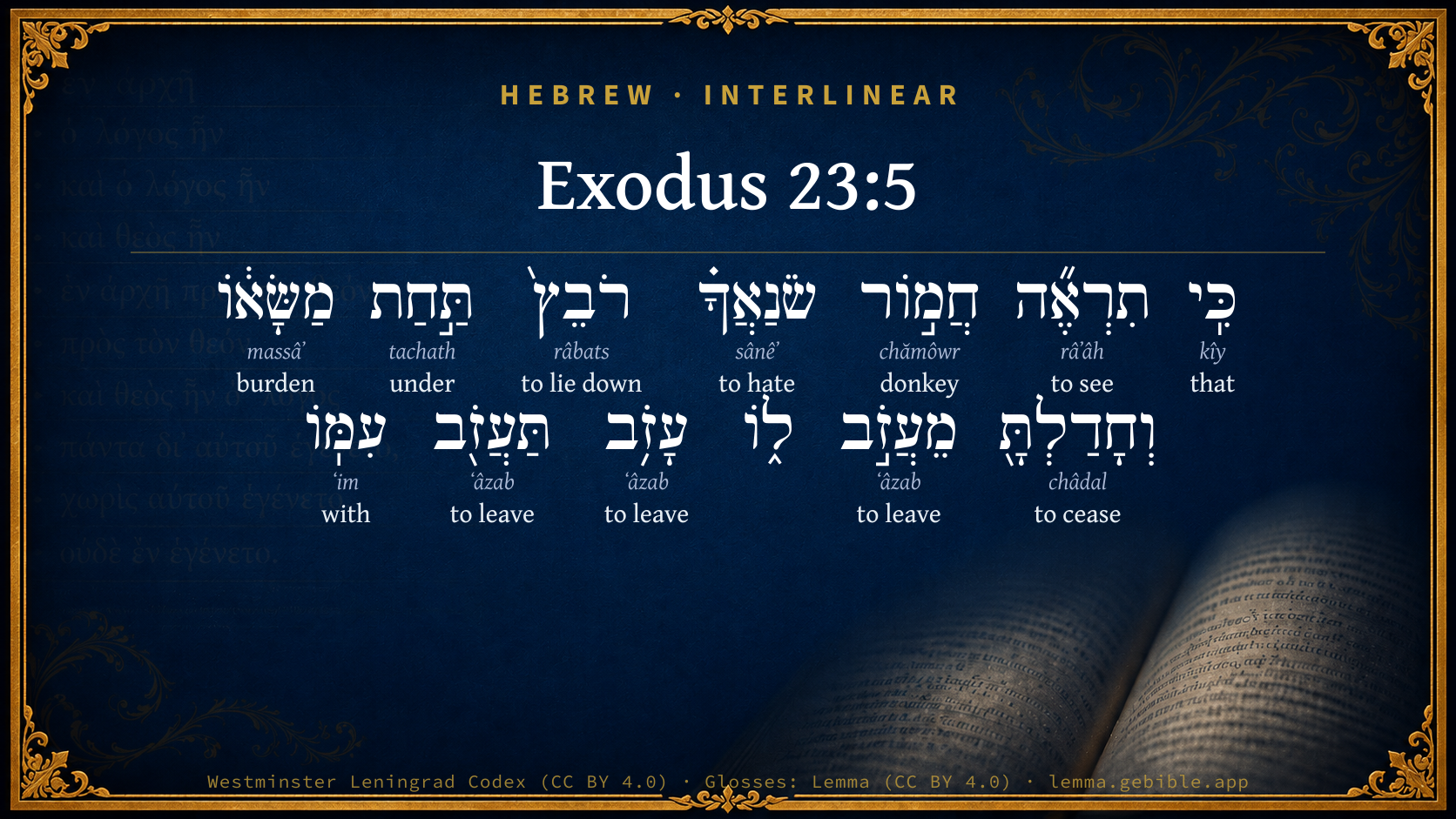
Exodus 23:5

Hebrew (Westminster Leningrad Codex) Exodus 23:5 appears in the Hebrew Old Testament. The text above is from the Westminster Leningrad Codex. Each word links to its Strong’s number, a concise gloss, and parsing drawn from the Open Scriptures Hebrew Bible morphology. Click any word for its full Brown-Driver-Briggs (BDB) entry.
Download image
Cite this verse

Exodus 23:5 (World English Bible). Public Domain. Lemma interlinear Bible study tool, https://lemma.gebible.app/v/exodus/23/5.

Show BibTeX & RIS
BibTeX
RIS
English Translation
If you see the donkey of him who hates you fallen down under his burden, don't leave him, you shall surely help him with it.
World English Bible · Public Domain
Highlights
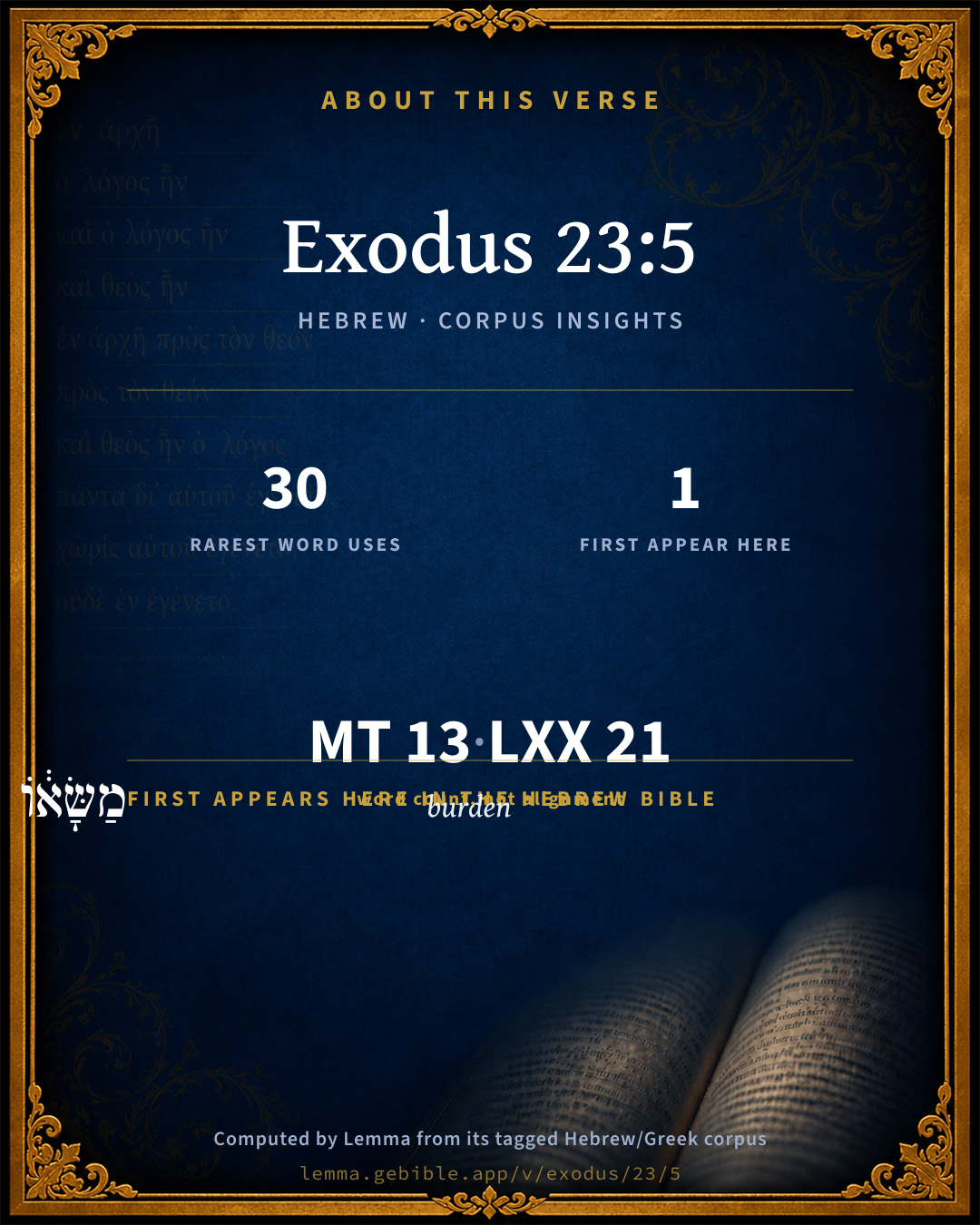
  • 1 first appearance in the Hebrew Bible
Full analysis ↓
Download a study sheet

One document with this verse’s original text, its word-by-word gloss line, the meaning frame, cross-references with their text, attributed commentary, and full source and license credits — printable, and it pastes into notes with its structure intact.

This verse Autodidact and up

Study sheet (.html) Plain text (.txt)

A passage Seminary Student

Up to 50 verses in one chapter. A passage sheet keeps up to 6 commentary sources and 12 cross-references per verse, in the order this page ranks them, and says so on the sheet whenever that leaves anything out. Ask for a single verse and you get the Autodidact verse sheet above.

Everything on this page stays free to read, with no account — the sheet is a download of what is already on screen, not access to it.

Want to remove ads? Support Godless Engineer
Compare translations 3

The same verse in 3 English versions, stacked beneath the original-language interlinear above. Click any original word for its lexicon entry.

Each is an independent rendering of the whole verse — the interlinear is not word-aligned to these translations.

Highlighted words mark where these versions differ — a whole-verse word diff, not a word-by-word alignment.

  • World English Bible Public Domain
    If you see the donkey of him who hates you fallen down under his burden, don't leave him, you shall surely help him with it.
  • King James Version Public Domain
    If thou see the ass of him that hateth thee lying under his burden, and wouldest forbear to help him, thou shalt surely help with him.
  • unfoldingWord Literal Text CC BY-SA 4.0
    If you see the donkey of someone who hates you fallen to the ground under its load, you shall refrain from leaving him. You shall surely release it with him.

unfoldingWord Literal Text — © unfoldingWord, licensed CC BY-SA 4.0. Word-aligned USFM3 via Door43 (git.door43.org/unfoldingWord/en_ult).

Versions to compare (up to 4)

3 of 4 selected

Show all 18 translations

Every available English version of this verse, each an independent rendering of the whole verse.

  • World English Bible Public Domain
    If you see the donkey of him who hates you fallen down under his burden, don't leave him, you shall surely help him with it.
  • Berean Standard Bible Public Domain
    If you see the donkey of one who hates you fallen under its load, do not leave it there; you must help him with it.
  • Majority Standard Bible Public Domain
    If you see the donkey of one who hates you fallen under its load, do not leave it there; you must help him with it.
  • King James Version Public Domain
    If thou see the ass of him that hateth thee lying under his burden, and wouldest forbear to help him, thou shalt surely help with him.
  • American Standard Version (1901) Public Domain
    If thou see the ass of him that hateth thee lying under his burden, thou shalt forbear to leave him, thou shalt surely release `it' with him.
  • Revised Version (1885) Public Domain
    If thou see the ass of him that hateth thee lying under his burden, and wouldest forbear to help him, thou shalt surely help with him.
  • Geneva Bible (1599) Public Domain
    If thou see thine enemies asse lying vnder his burden, wilt thou cease to helpe him? thou shalt helpe him vp againe with it.
  • Douay-Rheims (1899) Public Domain
    If thou see the ass of him that hateth thee lie underneath his burden, thou shalt not pass by, but shalt lift him up with him.
  • Young's Literal Translation Public Domain
    when thou seest the ass of him who is hating thee crouching under its burden, then thou hast ceased from leaving `it' to it -- thou dost certainly leave `it' with him.
  • Literal Standard Version CC BY-SA 4.0
    when you see the donkey of him who is hating you crouching under its burden, then you have ceased from leaving [it] to it—you certainly leave [it] with him.
  • Unlocked Literal Bible CC BY-SA 4.0
    If you see the donkey of someone who hates you fallen to the ground under its load, you must not leave that person. You must surely help him with his donkey.
  • unfoldingWord Literal Text CC BY-SA 4.0
    If you see the donkey of someone who hates you fallen to the ground under its load, you shall refrain from leaving him. You shall surely release it with him.
  • Darby Bible Public Domain
    If thou see the ass of him that hateth thee lying under its burden, beware of leaving [it] to him: thou shalt certainly loosen [it] with him.
  • World Messianic Bible Public Domain
    If you see the donkey of him who hates you fallen down under his burden, don’t leave him. You shall surely help him with it.
  • Webster's Bible Public Domain
    If thou shalt see the ass of him that hateth thee lying under his burden, and wouldest forbear to help him, thou shalt surely help with him.
  • Free Bible Version CC BY-SA 4.0
    If you see the donkey of someone who hates you that has fallen under its load, don't just leave it there. You must stop and help.
  • Bible in Basic English Public Domain
    If you see the ass of one who has no love for you bent down to the earth under the weight which is put on it, you are to come to its help, even against your desire.
  • JPS Tanakh (1917) Public Domain
    If thou see the ass of him that hateth thee lying under its burden, thou shalt forbear to pass by him; thou shalt surely release it with him.

Literal Standard Version (2020), Covenant Press — licensed CC BY-SA 4.0. Text via the HelloAO Bible API (eBible.org). Unlocked Literal Bible (unfoldingWord) — licensed CC BY-SA 4.0. Text via the HelloAO Bible API (eBible.org). unfoldingWord Literal Text — © unfoldingWord, licensed CC BY-SA 4.0. Word-aligned USFM3 via Door43 (git.door43.org/unfoldingWord/en_ult). Free Bible Version, Dr. Jonathan Gallagher — licensed CC BY-SA 4.0. Text via the HelloAO Bible API (eBible.org).

Word by word

More ways to search: Search by grammar → Find every occurrence → Compare this word →

Practice this passage: Drill this verse → Learn its vocabulary →

רֹבֵץ֙
râbats
H7257
“lying down”
Verb, Qal, Participle Active, Masculine, Singular, Absolute
Part of Speech
Verb
Stem
Qal
Form
Participle Active
Gender
Masculine
Number
Singular
State
Absolute
Full BDB Definition

Origin: a primitive root

TWOT: 2109

to stretch oneself out, lie down, lie stretched out - (Qal) to lie down, lie - (Hiphil) to cause to lie down - laying (stones)
  1. כִּֽי kîy H3588 “that” Conjunction
  2. תִרְאֶ֞ה râʼâh H7200 “to see” Verb, Qal, Imperfect, 2nd Person, Masculine, Singular
  3. חֲמ֣וֹר chămôwr H2543 “donkey of” Noun, Common, Both, Singular, Construct
  4. שֹׂנַאֲךָ֗ sânêʼ H8130 “hating · you” Verb, Qal, Participle Active, Masculine, Singular, Construct + Suffix, Personal, 2nd Person, Masculine, Singular
  5. תַּ֣חַת tachath H8478 “under” Preposition
  6. מַשָּׂא֔וֹ massâʼ H4853 “burden · his” Noun, Common, Masculine, Singular, Construct + Suffix, Personal, 3rd Person, Masculine, Singular
  7. וְחָדַלְתָּ֖ châdal H2308 “and · to cease” Conjunction + Verb, Qal, Perfect, 2nd Person, Masculine, Singular
  8. מֵעֲזֹ֣ב ʻâzab H5800 “from · to leave” Preposition + Verb, Qal, Infinitive Construct
  9. עָזֹ֥ב ʻâzab H5800 “to leave” Verb, Qal, Infinitive Absolute
  10. תַּעֲזֹ֖ב ʻâzab H5800 “to leave” Verb, Qal, Imperfect, 2nd Person, Masculine, Singular
  11. עִמּֽוֹ ʻim H5973 “with · him” Preposition + Suffix, Personal, 3rd Person, Masculine, Singular

About this verse

These counts appear in no published source. They are computed here, from the morphology-tagged text and Lemma’s own curated glosses. What Lemma adds →

13
words
10
distinct lemmas
Pentateuch
section

First appearance in Scripture

This word makes its first canonical appearance in the Hebrew Bible here:

  • מַשָּׂא֔וֹ burden H4853

Shared distinctive vocabulary

רֹבֵץ֙ to lie down H7257 occurs in 30 verses of the Hebrew Bible. Also found in:

Grammatical profile

  • 7 verbs
  • 2 nouns
  • 3 prepositions
  • 1 conjunction

Verb forms

  • תִרְאֶ֞ה Qal · Imperfect
  • שֹׂנַאֲךָ֗ Qal · Participle Active
  • רֹבֵץ֙ Qal · Participle Active
  • וְחָדַלְתָּ֖ Qal · Perfect
  • מֵעֲזֹ֣ב Qal · Infinitive Construct
  • עָזֹ֥ב Qal · Infinitive Absolute
  • תַּעֲזֹ֖ב Qal · Imperfect

Repetition

A word recurs within this verse — often emphatic in Hebrew:

  • מֵעֲזֹ֣ב to leave H5800 ×3

Hebrew & Septuagint length

In English translation the verse runs 25 words from the Hebrew and 25 from the Septuagint (LXX English) — the same length.

A rough comparison of the two English renderings, which tokenize alike — not a word-level alignment.

Word counts can differ between the Hebrew and the Greek without any difference in meaning — e.g. the Hebrew direct-object marker אֵת has no separate Greek word, and Greek often adds the article ὁ.

In the original languages it is 13 Hebrew tokens and 21 Greek tokens — but the two are counted differently (Hebrew bundles its prefixes and suffixes into one token; the Greek is in lemma form), so that isn’t a like-for-like length.

Cross-references

1

Topical passages linked to Exodus 23:5 in the Treasury of Scripture Knowledge — connected by theme and wording, ordered by reader-vote popularity; previews shown in the World English Bible.

  • Deuteronomy 22:4 You shall not see your brother's donkey or his ox fallen down by the way, and hide yourself from them: you shall surely help him to lift them up again.

Cross-references courtesy of OpenBible.info (CC BY 4.0).

Hebrew and Greek witnesses Masoretic Hebrew ↔ Greek Septuagint

The same verse in the two great witnesses to the Old Testament, shown verse-for-verse.

These are two independent witnesses, not word-aligned to each other, and the Septuagint is shown in lemma (dictionary) form.

Hebrew Exodus 23:5 Masoretic · Westminster Leningrad Codex

כִּֽי תִרְאֶ֞ה חֲמ֣וֹר שֹׂנַאֲךָ֗ רֹבֵץ֙ תַּ֣חַת מַשָּׂא֔וֹ וְחָדַלְתָּ֖ מֵעֲזֹ֣ב ל֑וֹ עָזֹ֥ב תַּעֲזֹ֖ב עִמּֽוֹ

If you see the donkey of him who hates you fallen down under his burden, don't leave him, you shall surely help him with it.

World English Bible · Public Domain

Greek LXX Exodus 23:5 Septuagint · lemma form

ἐάν δέ ὁράω ὁ ὑποζύγιον ὁ ἐχθρός σύ πίπτω ὑπό ὁ γόμος αὐτός οὐ παραἔρχομαι αὐτός ἀλλά συνἐγείρω αὐτός μετά αὐτός

And if you see your enemy's ass fallen under its burden, you shall not pass by it, but shall help to raise it with him.

LXX2012 (modern English Septuagint) · Public Domain

Hebrew: Westminster Leningrad Codex (CC BY 4.0). Greek: Septuagint (public domain); English from LXX2012 (modern English Septuagint) (Public Domain). How the Septuagint differs from the Hebrew →

Targum (Aramaic paraphrase)

2

The Targum is the ancient Jewish Aramaic paraphrase of the Hebrew Scriptures — an interpretive translation, not the Hebrew text itself. Onkelos (literal) and Pseudo-Jonathan (expansive) render the Torah, and Jonathan the Prophets. Coverage is partial: where no permissively-licensed English translation exists for a verse, only the Aramaic is shown. This is verse-level text, not a word-by-word alignment to the Hebrew.

  1. Targum Onkelos Torah (Genesis–Deuteronomy)
    אֲרֵי תֶחֱזֵי חֲמָרָא דְסָנְאָךְ רְבִיעַ תְּחוֹת טוֹעֲנֵיהּ וְתִתִּמְנַע מִלְמִשְׁבַּק לֵהּ מִשְׁבַּק תִּשְׁבּוֹק מָא דִבְלִבָּךְ עֲלוֹהִי וּתְפָרֵק עִמֵהּ:

    (no public-domain English translation for this verse)

    Targum Onkelos — Aramaic: “Onkelos Genesis” (public domain); “Onkelos Exodus” (public domain); “Onkelos Leviticus” (public domain); “Onkelos Numbers” (public domain); “Onkelos Deuteronomy” (public domain). English: “Sefaria Community Translation” (CC0 1.0 (public-domain dedication)); “J.W. Etheridge. The Targums of Onkelos and Jonathan Ben Uzziel on the Pentateuch. London: Longmans, Green, 1862” (public domain). Text via Sefaria.

  2. Targum Pseudo-Jonathan Torah (Genesis–Deuteronomy)
    אִין תֶּחֱמֵי חַמְרָא דְסַנְאָךְ דְּאַנְתְּ סָנֵי לֵיהּ עַל חוֹבָתָא דְאַנְתְּ יְדַע בֵּיהּ בִּלְחוֹדָךְ רְבִיעַ תְּחוֹת טוֹנֵיהּ וְתִמְנוֹעַ לְנַפְשָׁךְ מִלְמִקְרוֹב לֵיהּ מִשְׁבּוֹק תִּשְׁבּוֹק בְּהַהִיא שַׁעְתָּא יַת סָנָא דִבְלִבָּךְ עֲלוֹי וְתִפְרוֹק וְתִטְעוֹן עִמֵּיהּ

    If thou seest the ass of thy enemy whom thou dislikest on account of the wickedness which thou only knowest to be in him, lying under his burden, and thou wouldst refrain thyself from going near him, thou shalt relinquish at once the dislike of thy heart against (thy enemy), and release and take care of the ass (or, charge thyself with him).

    Targum Pseudo-Jonathan — Aramaic: “Targum Jonathan on Genesis” (public domain); “Targum Jonathan on Exodus” (public domain); “Targum Jonathan on Leviticus” (public domain); “Targum Jonathan on Numbers” (public domain); “Targum Jonathan on Deuteronomy” (public domain). English: “The Targum of Jonathan ben Uzziel, trans. J. W. Etheridge, London, 1862” (public domain). Text via Sefaria.

Commentary

Notes on Exodus 23:5 from classic Christian and Jewish commentators (each source and its license shown beneath its notes). The classic Christian expositions comment on the surrounding passage and are grouped to its opening verse, so a note may address several verses; the Jewish commentaries on the Tanakh (Rashi and others) are per-verse, so they appear only where the commentator wrote on this verse.

Lemma curates 59 commentaries, every one of them public domain or Creative Commons licensed, each selected and text-cleaned for this edition rather than reprinted as found. About our sources →

Trapp's Complete Commentary

John Trapp

Exo 23:5 If thou see the ass of him that hateth thee lying under his burden, and wouldest forbear to help him, thou shalt surely help with him.

Ver. 5. Thou shalt surely help with him.] So the Spirit helps with us; or lifts over against us. {ουναντιλαμβανεται, Rom 8:26} He looks ut acti agamus.

John Trapp, A Commentary or Exposition upon All the Books of the Old and New Testament (1647–1656) — public domain. Text from a community e-Sword module.

Joseph Benson's Commentary

Exo 23:5. And wouldest forbear to help him — The duty inculcated in this verse is inculcated also Deu 22:4, although not in the same words in the original. And the intention of both verses is plain, but the marginal reading here shows that there is some difficulty in the Hebrew text in this place. The precept, however, evidently means, whatever controversy thou hast with him that hates thee, it shall not hinder thee from succouring him or his in any distress.

Joseph Benson's Commentary on the Old and New Testaments (1811–1818) — public domain. Text from a community e-Sword module.

Geneva Bible (1599)

Geneva Bible translators

If God command to help up our enemy’s ass under his burden, will he suffer us to cast down our brethren with heavy burdens?

Geneva Bible (1599) marginal notes — public domain. Text via Bolls.life.

Ellicott's Commentary for English Readers

(5) If thou see the ass of him that hateth thee . . . —The sense is clear, but the words are greatly disputed. If a man sees his enemy’s ass prostrate under its burthen, he is to help to raise it up. In this case he owes a double duty—(1) to his enemy, and (2) to the suffering animal. Geddes’ emendation of ’azar for ’azab, in all the three places where the verb occurs, is the simplest and best of those suggested. The passage would then run: “If thou see the ass of him that hateth thee lying under his burthen, and wouldest forbear to help it, thou shalt surely help with him”—i.e., the owner.

A Bible Commentary for English Readers, edited by Charles John Ellicott (1878–1897) — public domain. Text from a community e-Sword module.

The Cambridge Bible for Schools and Colleges

gen. ed. J. J. S. Perowne

5. and wouldest forbear, &c.] This rend. (= AV.) of the existing text is quite impossible: ‘âzab means to leave, forsake, &c., but never to ‘help.’ That of the marg. is much preferable: for the uncommon sense let loose or release, cf. Deu_32:36, Job_10:1. Ges., Di., Keil under, thou shalt forbear to leave (it) to him (alone); thou shalt surely release (it) with him; the objection to this is that ‘âzab is taken in a efferent sense in the two parts of the verse; Ges., however, supposed e play to be intentional. The difficulty could be removed by reading in the last clause, with Bochart, Bä., thou shalt surely help with him (עזר תעזר for עזב תעזב). The rend. thou shalt forbear is perfectly grammatical: but it is in favour of RVm. that nearly everywhere else in these laws (e.g. v. 4) the apodosis after ki is introduced by a bare impf. Deu_22:4 has, ‘thou shalt surely lift (them) up with him.’

The Cambridge Bible for Schools and Colleges (gen. ed. J. J. S. Perowne; Cambridge University Press, 1878–1918) — public domain. Text from a community e-Sword module.

John Gill's Exposition

If thou see the ass of him that hateth thee lying under his burden,.... Fallen down, and such a burden upon him that he cannot rise up again, but lies under it, and the owner of it is not able of himself to raise it up again:

and wouldst forbear to help him; show an inclination to pass on without giving him any assistance to get up his beast again; or "wouldst thou forbear to help him?" (w) as Jarchi, and others, read with an interrogation, could it be in thine heart to forbear helping him? couldest thou go on, and take no notice of him and his case, and not join him in endeavouring to get up his beast again, that he may proceed its his journey? canst thou be so cruel and hardhearted, though he is thine enemy? but if thou art, know this:

thou shalt surely help with him; to get up his ass again: hence the Jewish canon runs thus (x),"if an ass is unloaded and loaded four or five times, a man is bound, i.e. to help, as it is said, "in helping thou shalt help"; if he (the owner) goes away, and sets himself down, seeing the command is upon thee, if it is thy will and pleasure to unload, unload, he is free; for it is said, with him; if he is an old man, or sick, he is bound, the command of the law is to unload, but not to load.''The words may be rendered, "in leaving thou shalt leave with him" (y); either leave or forsake thine enmity to help him, as Onkelos; or leave thy business, thou art about, to lend him an hand to raise up his beast again.

(w) "num desines sublevare eum?" some in Vatablus; "cessabis auxitiari ei?" Drusius; "desines auxiliari ei?" Pagninus. (x) Misn. Bava Metzia, c. 2. sect. 10. (y) "Deserendo deseres cum eo", Montanus; so Ainsworth.

John Gill's Exposition of the Whole Bible (1746–1763) — public domain (CC PDM 1.0). Text via the HelloAO Bible API.

Matthew Poole's English Annotations

This translation depends upon this supposition, that the Hebrew verb azab, which is thrice used in this verse, signifies not only to leave, but also to help, or erect, or lift up, or strengthen, or restore; which signification of the verb may be proved,

1. From that use of it, Neh 3:8 4:2.

2. From the parallel place, Deu 22:4, where instead of this verb azab is hakim, which is properly to erect or lift up. But if the verb did signify only to leave, it may be thus rendered according to the Hebrew words, then, or therefore, or surely (for all these ways the Hebrew particle vau is used) thou shalt forbear to leave it, to wit, the ass groaning under his burden, or the lifting up of the ass and burden, to him alone; but if thou wilt be leaving, I will appoint thee a better object for it, thou shalt surely leave or lay aside what thou hast against him, i.e. whatsoever controversy thou hast with him, that shall not hinder thee from succouring him or his in any distress.

The Hebrew preposition in, doth oft signify against, as Gen 26:20; Psa 85:4; 94:16; Hos 9:8. And it is a concise or short way of speaking, which is very common in the Hebrew language, against him, for what thou hast against him. Or thus, and wouldest forbear to leave, to wit, thy business which thou art going about, for him, i.e. for the sake of him who is thy enemy, as the Hebrew preposition tamed is oft used, as Exo 14:25; Num 25:13; Jos 10:14, &c.; thou shalt repress those malicious desires, and thou shalt surely leave it to be, or to tarry, or to help with him to lift up the ass. So there is only an ellipsis of the verb, which is most common in the Hebrew tongue.

Matthew Poole's English Annotations on the Holy Bible (1683–1685) — public domain. Text from a community e-Sword/MySword module.

The Pulpit Commentary

If thou see the ass of him that hateth thee, etc. The general meaning of the passage is clear assistance is to be given to the fallen ass of an enemy but the exact sense of both the second and third clauses is doubtful. Many renderings have been suggested; but it is not clear that any one of them is an improvement on the Authorised Version. Thou shalt surely help with him. The joint participation in an act of mercy towards a fallen beast would bring the enemies into friendly contact, and soften their feelings towards each other.

Vers. 5, 6. The duties which men owe to their enemies.

These duties may be considered as they were revealed to men.

1. Under the law: and

2. Under the gospel.

I UNDER THE LAW. Men were required to protect the interests of their enemies, when they could do so without loss to themselves. For instance

1. They were not to cut down fruit trees in an enemy"s country. (Deu_20:19, Deu_20:20)

1. They were not to remove a neighbour"s landmark, even though he mightbe an enemy.

2. They were to hasten after an enemy"s ox or ass if they saw it goingastray, to catch it, and bring it back to him.

3. They were to approach him, if they saw his ass fallen under the weightof its load, and to help him to raise it up.

4. If he were suffering from hunger or thirst, they were to give him breadto eat and water to drink. (Pro_25:21)

5. They were to refrain from rejoicing over his misadventures. (ib, Exo_24:17)

II UNDER THE GOSPEL. Men are required under the Gospel to do all this, and much more.

1. They are to "love their enemies". (Mat_5:44)

2. To do good to them in every way feed them, (Rom_12:20) bless them, pray for them (ib,), be patient towards them, (1Th_5:14) seek to convert them from the error of their, (Jam_5:20) save them (ib,). Christ set the example of praying for his enemies upon the cross God set the example of loving his enemies when he gave his Son to suffer death for them the Holy Spirit sets the example of patience towards his enemies, when he strives with them. We have to forgive our enemies day by day their trespasses against us to pray and work for their conversion to seek to overcome their evil with our good. In temporal matters, it is our business to be most careful that we do them no injury, by misrepresentation, by disparagement, by unfair criticism, by lies, even by "faint praise." We are to "love" them; or, if poor human nature finds this too hard, we are to act as if we loved them, and then ultimately love will come.

The Pulpit Commentary (1880–1919), ed. H.D.M. Spence-Jones & Joseph S. Exell — public domain. Text from a community e-Sword module.

Rashi

Rabbi Shlomo Yitzchaki (Rashi)

כי תראה חמור שנאך וגו׳ IF THOU SEE THE ASS OF HIM THAT HATETH THEE etc. — כי here has the meaning of “possibly”, “perhaps”, which is one of the four meanings which the word כי serves to express. The sense of the verse is accordingly the following: Can you possibly see his ass crouching beneath his burden and forbear to help him? (The Hebrew word בתמיה in Rashi means “Say this in the intonation of a question”, and is nothing more than our question mark).

עזב תעזב עמו — The root עזב has here the meaning of “helping”. It has a similar meaning in, (Deuteronomy 32:36) “assisted and helped (עזוב)”. Similar also is, (Nehemiah 3:8) “ויעזבו Jerusalem up to the wall” — i. e. they filled it up with earth in order to help and to support the strength of the wall. A similar use of כי is, (Deuteronomy 7:17, 18) כי תאמר בלבבך רבים הגוים האלה וגו׳ which means “Canst thou possibly (כי) speak thus? לא תירא מהם, Do not be afraid of them and speak thus”. Our Rabbis expounded it in a Halachic sense as follows: … כי תראה וחדלת “If thou seest etc. …וחדלת” — there are occasions when you may forbear and there are occasions when you must help. How so? If it is an old man who sees the ass in this condition and it is not compatible with his dignity to intervene, then וחדלת “thou mayest forbear” holds good; or if the animal belongs to a heathen and its burden to an Israelite then, also, וחדלת may be applied (cf. Mekhilta).

עזב תעזב עמו THOU SHALT SURELY HELP HIM — to unload the burden (Mekhilta). Onkelos also translates it in this sense: מלמשקל ליה which means, [Thou shalt not keep back] from taking the load from off it.

Rashi on the Tanakh — English translations: “The Judaica Press complete Tanach with Rashi, translated by A. J. Rosenberg” (CC BY 4.0); “Pentateuch with Rashi's commentary by M. Rosenbaum and A.M. Silbermann, 1929-1934” (public domain); “The Metsudah Tanach series, Lakewood, N.J” (CC BY 4.0); and “The Book of Joshua, Metsudah Publications, 1997” (CC BY 4.0). Text via Sefaria.

Lesson kit

Teaching starters — assembled from the data on this page, not authored interpretation. Every prompt links to the verse data it draws on. Edit before teaching.

Exodus, in the Pentateuch, opens this verse with 13 words (10 distinct Hebrew lemmas). Its most distinctive word is râbats (“to lie down”). A historical commentator’s framing appears above. Read the whole chapter for the surrounding context.

Discussion questions

  1. The word râbats carries the sense “to lie down.” How does it shape the verse?
  2. The word “burden” first appears here in Scripture. What is being introduced at this debut?
  3. Genesis 4:7 shares the word «to lie down» with this verse. How do the two illuminate each other?
  4. “to leave” occurs 3× in this one verse. What is the effect of the repetition?
  5. The translations on this page render this verse differently — a whole-verse word diff, not a word-by-word alignment. What might account for the different wordings?
  6. The verb «תִרְאֶ֞ה» is Qal Imperfect. How does its form color the action?
  7. Reading how Trapp's Complete Commentary and Joseph Benson's Commentary read this verse, where do the two commentators agree and where do they part?

Things to notice

Reading settings

Reading text

Shown beneath each verse's original-language words.

Old Testament
Old Testament edition

Read the OT as the Masoretic Hebrew (MT) or the Greek Septuagint (LXX).

English shown for the Greek Septuagint (in the Hebrew ↔ Greek comparison).

Comparing translations? Open the Compare panel on any verse page to stack up to four side by side.