Job 18:4

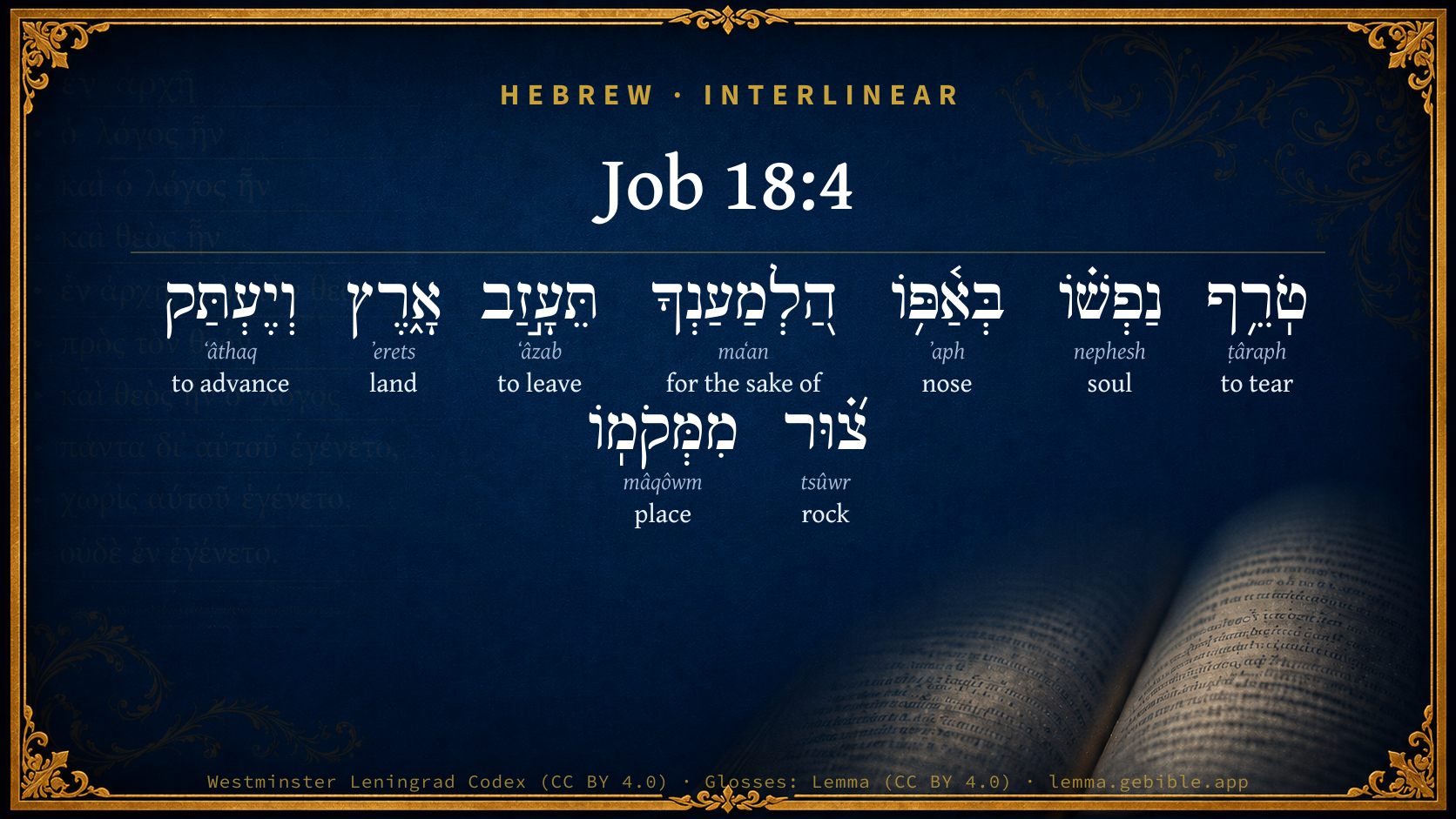
Hebrew (Westminster Leningrad Codex) Job 18:4 appears in the Hebrew Old Testament. The text above is from the Westminster Leningrad Codex. Each word links to its Strong’s number, a concise gloss, and parsing drawn from the Open Scriptures Hebrew Bible morphology. Click any word for its full Brown-Driver-Briggs (BDB) entry.
Download image
Cite this verse

Job 18:4 (World English Bible). Public Domain. Lemma interlinear Bible study tool, https://lemma.gebible.app/v/job/18/4.

Show BibTeX & RIS
BibTeX
RIS
English Translation
You who tear yourself in your anger, Shall the earth be forsaken for you? Or shall the rock be removed out of its place?
World English Bible · Public Domain
Download a study sheet

One document with this verse’s original text, its word-by-word gloss line, the meaning frame, cross-references with their text, attributed commentary, and full source and license credits — printable, and it pastes into notes with its structure intact.

This verse Autodidact and up

Study sheet (.html) Plain text (.txt)

A passage Seminary Student

Up to 50 verses in one chapter. A passage sheet keeps up to 6 commentary sources and 12 cross-references per verse, in the order this page ranks them, and says so on the sheet whenever that leaves anything out. Ask for a single verse and you get the Autodidact verse sheet above.

Everything on this page stays free to read, with no account — the sheet is a download of what is already on screen, not access to it.

Want to remove ads? Support Godless Engineer
Compare translations 3

The same verse in 3 English versions, stacked beneath the original-language interlinear above. Click any original word for its lexicon entry.

Each is an independent rendering of the whole verse — the interlinear is not word-aligned to these translations.

Highlighted words mark where these versions differ — a whole-verse word diff, not a word-by-word alignment.

  • World English Bible Public Domain
    You who tear yourself in your anger, Shall the earth be forsaken for you? Or shall the rock be removed out of its place?
  • King James Version Public Domain
    He teareth himself in his anger: shall the earth be forsaken for thee? and shall the rock be removed out of his place?
  • unfoldingWord Literal Text CC BY-SA 4.0
    The one tearing himself in his nose— will the earth be forsaken for your sake, or will the rock move from its place?

unfoldingWord Literal Text — © unfoldingWord, licensed CC BY-SA 4.0. Word-aligned USFM3 via Door43 (git.door43.org/unfoldingWord/en_ult).

Versions to compare (up to 4)

3 of 4 selected

Show all 18 translations

Every available English version of this verse, each an independent rendering of the whole verse.

  • World English Bible Public Domain
    You who tear yourself in your anger, Shall the earth be forsaken for you? Or shall the rock be removed out of its place?
  • Berean Standard Bible Public Domain
    You who tear yourself in anger—should the earth be forsaken on your account, or the rocks be moved from their place?
  • Majority Standard Bible Public Domain
    You who tear yourself in anger—should the earth be forsaken on your account, or the rocks be moved from their place?
  • King James Version Public Domain
    He teareth himself in his anger: shall the earth be forsaken for thee? and shall the rock be removed out of his place?
  • American Standard Version (1901) Public Domain
    Thou that tearest thyself in thine anger, Shall the earth be forsaken for thee? Or shall the rock be removed out of its place?
  • Revised Version (1885) Public Domain
    Thou that tearest thyself in thine anger, shall the earth be forsaken for thee? or shall the rock be removed out of its place?
  • Geneva Bible (1599) Public Domain
    Thou art as one that teareth his soule in his anger. Shall the earth bee forsaken for thy sake? or the rocke remoued out of his place?
  • Douay-Rheims (1899) Public Domain
    Thou that destroyest thy soul in thy fury, shall the earth be forsaken for thee, and shall rocks be removed out of their place?
  • Young's Literal Translation Public Domain
    (He is tearing himself in his anger.) For thy sake is earth forsaken? And removed is a rock from its place?
  • Literal Standard Version CC BY-SA 4.0
    He is tearing himself in his anger. Is earth forsaken for your sake? And is a rock removed from its place?
  • Unlocked Literal Bible CC BY-SA 4.0
    You who tear at yourself in your anger, should the earth be forsaken for you or should the rocks be removed out of their places?
  • unfoldingWord Literal Text CC BY-SA 4.0
    The one tearing himself in his nose— will the earth be forsaken for your sake, or will the rock move from its place?
  • Darby Bible Public Domain
    Thou that tearest thyself in thine anger, shall the earth be forsaken for thee? and shall the rock be removed out of its place?
  • World Messianic Bible Public Domain
    You who tear yourself in your anger, will the earth be forsaken for you? Or will the rock be removed out of its place?
  • Webster's Bible Public Domain
    He teareth himself in his anger: shall the earth be forsaken for thee? and shall the rock be removed out of its place?
  • Free Bible Version CC BY-SA 4.0
    You tear yourself apart with your anger. Do you think the earth has to be abandoned, or the mountains moved, just because of you?
  • Bible in Basic English Public Domain
    But come back, now, come: you who are wounding yourself in your passion, will the earth be given up because of you, or a rock be moved out of its place?
  • JPS Tanakh (1917) Public Domain
    Thou that tearest thyself in thine anger, shall the earth be forsaken for thee? Or shall the rock be removed out of its place?

Literal Standard Version (2020), Covenant Press — licensed CC BY-SA 4.0. Text via the HelloAO Bible API (eBible.org). Unlocked Literal Bible (unfoldingWord) — licensed CC BY-SA 4.0. Text via the HelloAO Bible API (eBible.org). unfoldingWord Literal Text — © unfoldingWord, licensed CC BY-SA 4.0. Word-aligned USFM3 via Door43 (git.door43.org/unfoldingWord/en_ult). Free Bible Version, Dr. Jonathan Gallagher — licensed CC BY-SA 4.0. Text via the HelloAO Bible API (eBible.org).

Word by word

More ways to search: Search by grammar → Find every occurrence → Compare this word →

Practice this passage: Drill this verse → Learn its vocabulary →

וְיֶעְתַּק
ʻâthaq
H6275
“and · to advance”
Conjunction + Verb, Qal, Imperfect, 3rd Person, Masculine, Singular
Part of Speech
Conjunction + Verb
Stem
Qal
Form
Imperfect
Person
3rd Person
Gender
Masculine
Number
Singular
Full BDB Definition

Origin: a primitive root

TWOT: 1721

to move, proceed, advance, move on, become old, be removed - (Qal) - to move - to advance (in years), grow old and weak - (Hiphil) - to move forward, proceed, move on - to remove - to transcribe
  1. טֹֽרֵ֥ף ṭâraph H2963 “tearing” Verb, Qal, Participle Active, Masculine, Singular, Absolute
  2. נַפְשׁ֗וֹ nephesh H5315 “soul · his” Noun, Common, Both, Singular, Construct + Suffix, Personal, 3rd Person, Masculine, Singular
  3. בְּאַ֫פּ֥וֹ ʼaph H639 “in/at · nose · his” Preposition + Noun, Common, Masculine, Singular, Construct + Suffix, Personal, 3rd Person, Masculine, Singular
  4. הַ֭לְמַעַנְךָ maʻan H4616 “for the sake of · you” Particle, Interrogative + Preposition + Suffix, Personal, 2nd Person, Masculine, Singular
  5. תֵּעָ֣זַב ʻâzab H5800 “to leave” Verb, Niphal, Imperfect, 3rd Person, Feminine, Singular
  6. אָ֑רֶץ ʼerets H776 “land” Noun, Common, Both, Singular, Absolute
  7. צ֝֗וּר tsûwr H6697 “rock” Noun, Common, Masculine, Singular, Absolute
  8. מִמְּקֹמֽוֹ mâqôwm H4725 “from · place · his” Preposition + Noun, Common, Masculine, Singular, Construct + Suffix, Personal, 3rd Person, Masculine, Singular

About this verse

These counts appear in no published source. They are computed here, from the morphology-tagged text and Lemma’s own curated glosses. What Lemma adds →

9
words
9
distinct lemmas
Wisdom
section

Notable vocabulary

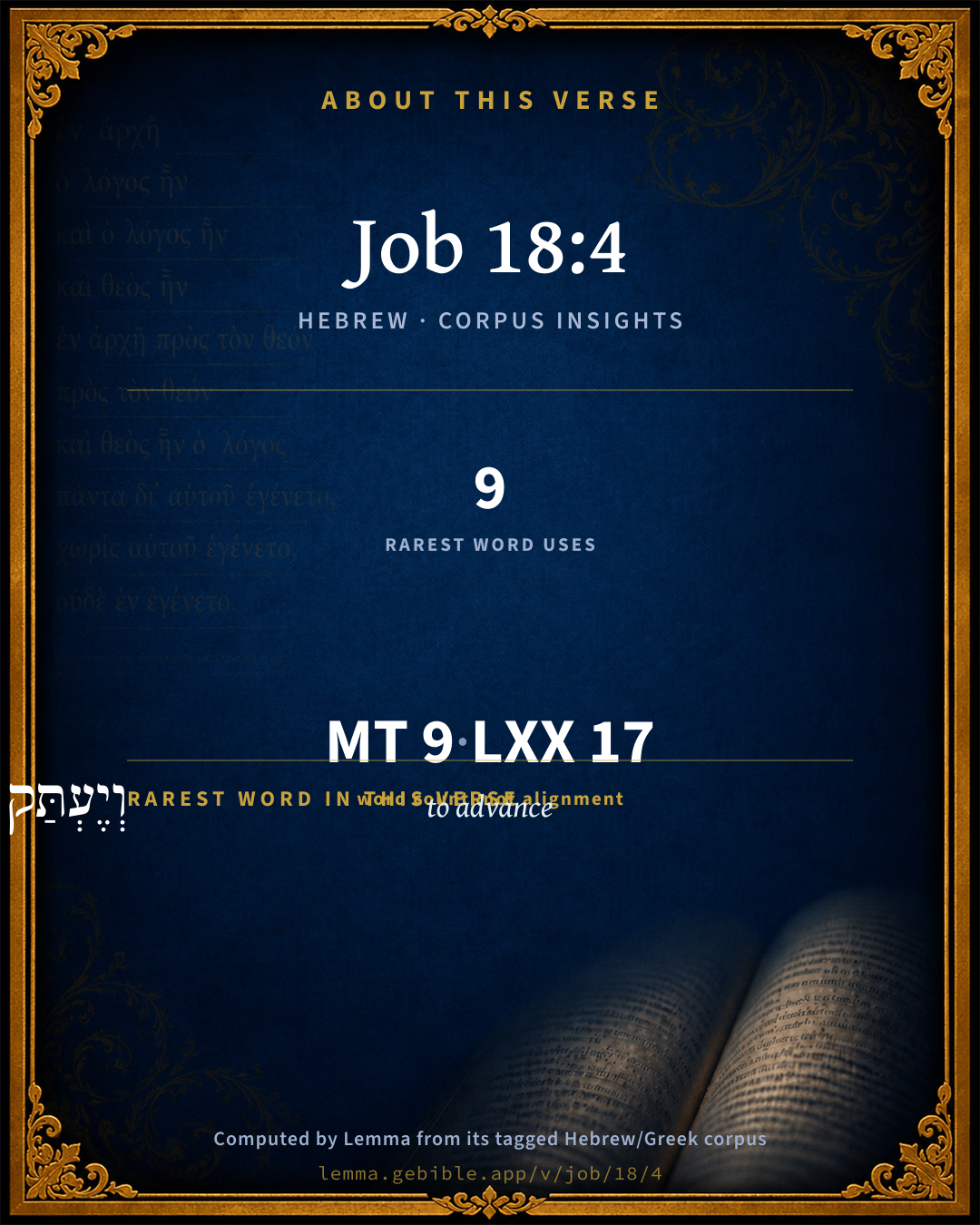
The rarest word here is וְיֶעְתַּק to advance H6275 — appearing just 9 times in the whole Hebrew Bible.

Shared distinctive vocabulary

וְיֶעְתַּק to advance H6275 occurs in 9 verses of the Hebrew Bible. Also found in:

Grammatical profile

  • 3 verbs
  • 5 nouns
  • 1 preposition

Verb forms

  • טֹֽרֵ֥ף Qal · Participle Active
  • תֵּעָ֣זַב Niphal · Imperfect
  • וְיֶעְתַּק Qal · Imperfect

Hebrew & Septuagint length

In English translation the verse runs 24 words from the Hebrew and 26 from the Septuagint (LXX English) — closely comparable.

A rough comparison of the two English renderings, which tokenize alike — not a word-level alignment.

Word counts can differ between the Hebrew and the Greek without any difference in meaning — e.g. the Hebrew direct-object marker אֵת has no separate Greek word, and Greek often adds the article ὁ.

In the original languages it is 9 Hebrew tokens and 17 Greek tokens — but the two are counted differently (Hebrew bundles its prefixes and suffixes into one token; the Greek is in lemma form), so that isn’t a like-for-like length.

Cross-references

11

Topical passages linked to Job 18:4 in the Treasury of Scripture Knowledge — connected by theme and wording, ordered by reader-vote popularity; previews shown in the World English Bible.

  • Job 14:18 "But the mountain falling comes to nothing; The rock is removed out of its place;
  • Job 16:9 He has torn me in his wrath, and persecuted me; He has gnashed on me with his teeth: My adversary sharpens his eyes on me.
  • Job 5:2 For resentment kills the foolish man, And jealousy kills the simple.
  • Job 13:14 Why should I take my flesh in my teeth, And put my life in my hand?
  • Job 40:8 Will you even annul my judgment? Will you condemn me, that you may be justified?
  • Isaiah 54:10 For the mountains may depart, and the hills be removed; but my loving kindness shall not depart from you, neither shall my covenant of peace be removed, says Yahweh who has mercy on you.
  • Ezekiel 9:9 Then said he to me, The iniquity of the house of Israel and Judah is exceeding great, and the land is full of blood, and the city full of wrestling [of judgment]: for they say, Yahweh has forsaken the land, and Yahweh doesn't see.
  • Jonah 4:9 God said to Jonah, "Is it right for you to be angry about the vine?" He said, "I am right to be angry, even to death."
  • Matthew 24:35 Heaven and earth will pass away, but my words will not pass away.
  • Mark 9:18 and wherever it seizes him, it throws him down, and he foams at the mouth, and grinds his teeth, and wastes away. I asked your disciples to cast it out, and they weren't able."
  • Luke 9:39 Behold, a spirit takes him, he suddenly cries out, and it convulses him so that he foams, and it hardly departs from him, bruising him severely.

Cross-references courtesy of OpenBible.info (CC BY 4.0).

Hebrew and Greek witnesses Masoretic Hebrew ↔ Greek Septuagint

The same verse in the two great witnesses to the Old Testament, shown verse-for-verse.

These are two independent witnesses, not word-aligned to each other, and the Septuagint is shown in lemma (dictionary) form.

Hebrew Job 18:4 Masoretic · Westminster Leningrad Codex

טֹֽרֵ֥ף נַפְשׁ֗וֹ בְּאַ֫פּ֥וֹ הַ֭לְמַעַנְךָ תֵּעָ֣זַב אָ֑רֶץ וְיֶעְתַּק צ֝֗וּר מִמְּקֹמֽוֹ

You who tear yourself in your anger, Shall the earth be forsaken for you? Or shall the rock be removed out of its place?

World English Bible · Public Domain

Greek LXX Job 18:4 Septuagint · lemma form

χράομαι σύ ὀργή τίς γάρ ἐάν σύ ἀποθνήσκω ἀοίκητος ὁ ὑπό οὐρανός ἤ καταστρέφω ὄρος ἐκ θεμέλιον

Anger has possessed you: for what if you should die; would the earth under heaven be desolate? or shall the mountains be overthrown from their foundations?

LXX2012 (modern English Septuagint) · Public Domain

On this verse, Keil & Delitzsch discusses the Septuagint’s reading. Read the note in Commentary ↓

Hebrew: Westminster Leningrad Codex (CC BY 4.0). Greek: Septuagint (public domain); English from LXX2012 (modern English Septuagint) (Public Domain). How the Septuagint differs from the Hebrew →

Commentary

Notes on Job 18:4 from classic Christian and Jewish commentators (each source and its license shown beneath its notes). The classic Christian expositions comment on the surrounding passage and are grouped to its opening verse, so a note may address several verses; the Jewish commentaries on the Tanakh (Rashi and others) are per-verse, so they appear only where the commentator wrote on this verse.

Lemma curates 59 commentaries, every one of them public domain or Creative Commons licensed, each selected and text-cleaned for this edition rather than reprinted as found. About our sources →

Trapp's Complete Commentary

John Trapp

Job 18:4 He teareth himself in his anger: shall the earth be forsaken for thee? and shall the rock be removed out of his place?

Ver. 4. He teareth himself in his anger] Here he chargeth Job with desperate madness, as if through extreme impatience he fell foul upon his own flesh, as did that demoniac in the Gospel, Bajazet, the Great Turk, in his iron cage, Pope Boniface VIII, when clapped up close prisoner in St Angelo; and as they say the tiger doth, when he heareth a drum struck up, he teareth his own flesh with his teeth; or as all ravenous beasts tear in pieces the prey which they have taken. Many read the text thus, O the man which teareth his soul in his anger; or, O thou which tearest thyself, &c. The moralist describeth an angry man forcibly held by his friends, biting his own lips, rending his clothes, and dashing himself against the pillars, Labia mordet, caput quassat, vestimenta scindit, et se in columnas impingit (Senec.). Such a one Bildad maketh Job to be, horn-mad, or mankind, as we say; and he takes occasion, likely, from those words of his, Job 13:14. But love would have thought no evil. Bildad herein sinned against the law of love, as likewise he doth much more in the following vehement interrogation, charging Job with insolent boldness against God.

Shall the earth be forsaken for thee?] Shall God cast off the care of his earthly kingdom to gratify thee, and to make good thine assertion, that good men may suffer, and bad men go unpunished? Never think it; thou mayest sooner expect him to overturn the whole world for thy sake, and put everything out of that order he hath decreed and made it in, than cease to be just in punishing the wicked. The course of justice is as firmly settled as the course of nature is. Fiat iustitia, pereat mundus. Of Fabricius it was said, that the sun might as easily be turned out of his track as he out of his path of justice; much more may it be so said of Almighty God, the rock that cannot be removed, though he varieth the manner, the means, the times and seasons of executing justice, as seemeth best unto his heavenly wisdom.

John Trapp, A Commentary or Exposition upon All the Books of the Old and New Testament (1647–1656) — public domain. Text from a community e-Sword module.

The Biblical Illustrator

Joseph S. Exell

Job_18:4

Shall the earth be forsaken for thee?

The folly of discontent

Some of Jobs friends said to him, Shall the earth be forsaken for thee, and shall the rock be removed out of its place? So I may say to every discontented, impatient heart, What! shall the providence of God change its course for thee? Dost thou think it such a weak thing that, because it does not please thee, it must alter its course? Be thou content, or not content, the providence of God will go on. When you are in a ship at sea that has all her sails spread with a full gale of wind, and swiftly sailing, can you make it still by running up and down in the ship? No more can you make the providence of God change its course with your fretting; it will go on with power, do what thou canst. (J. Burroughs.)

The Biblical Illustrator, edited by Joseph S. Exell (c. 1880s–1900s) — public domain. Text from a community e-Sword module.

Keil & Delitzsch

C. F. Keil & F. Delitzsch

4 Thou art he who teareth himself in his anger:

Shall the earth become desolate for thy sake,

And a rock remove from its place?

5 Notwithstanding, the light of the wicked shall be put out,

And the glow of his fire shineth not;

6 The light becometh dark in his tent,

And his lamp above him is extinguished;

7 His vigorous steps are straitened,

And his own counsel casteth him down.

The meaning of the strophe is this: Dost thou imagine that, by thy vehement conduct, by which thou art become enraged against thyself, thou canst effect any change in the established divine order of the world? It is a divine law, that sufferings are the punishment of sin; thou canst no more alter this, than that at thy command, or for thy sake, the earth, which is appointed to be the habitation of man (Isa 45:18), will become desolate (tê‛âzab with the tone drawn back, according to Ges. 29, 3, b, Arab. with similar signification in intrans. Kal t‛azibu), or a rock remove from its place (on יעתּק, vid., Job 14:18). Bildad here lays to Job's charge what Job, in Job 16:9, has said of God's anger, that it tears him: he himself tears himself in his rage at the inevitable lot under which he ought penitently to bow. The address, Job 18:4, as apud Arabes ubique fere (Schult.), is put objectively (not: Oh thou, who); comp. what is said on כּלּם, Job 17:10, which is influenced by the same syntactic custom. The lxx transl. Job 18:4: Why! will Hades be tenantless if thou diest (ἐὰν σὺ ἀποθάνῃς)? after which Rosenm. explains: tu caus h. e. te cadente. But that ought to be הבמוּתך. The peopling of the earth is only an example of the arrangements of divine omnipotence and wisdom, the continuance of which is exalted over the human power of volition, and does not in the least yield to human self-will, as (Job 18:4) the rock is an example, and at the same time an emblem, of what God has fixed and rendered immoveable. That of which he here treats as fixed by God is the law of retribution. However much Job may rage, this law is and remains the unavoidable power that rules over the evil-doer.

Job 18:5

גּם is here equivalent to nevertheless, or prop. even, ὅμως, as e.g., Psa 129:2 (Ew. 354, a). The light of the evil-doer goes out, and the comfortable brightness and warmth which the blaze (שׁביב, only here as a Hebr. word; according to Raschi and others, tincelle, a spark; but according to lxx, Theod., Syr., Jer., a flame; Targ. the brightness of light) of his fire in his dwelling throws out, comes to an end. In one word, as the praet. חשׁך implies, the light in his tent is changed into darkness; and his lamp above him, i.e., the lamp hanging from the covering of his tent (Job 29:3, comp. Job 21:17), goes out. When misfortune breaks in upon him, the Arab says: ed-dahru attfaa es-sirâgi, fate has put out my lamp; this figure of the decline of prosperity receives here a fourfold application. The figure of straitening one's steps is just as Arabic as it is biblical; צעדי אונו, the steps of his strength (און synon. of כּח, Job 40:16) become narrow (comp. Pro 4:12, Arab. takâssarat), by the wide space which he could pass over with a self-confident feeling of power becoming more and more contracted; and the purpose formed selfishly and without any recognition of God, the success of which he considered infallible, becomes his overthrow.

Keil & Delitzsch — Biblical Commentary on the Old Testament (1861–1891) — public domain (CC PDM 1.0). Text via the HelloAO Bible API. (Old Testament only.)

Geneva Bible (1599)

Geneva Bible translators

Shall God change the order of nature for thy sake, by dealing with thee otherwise than he doth with all men?

That is, like a madman.

Geneva Bible (1599) marginal notes — public domain. Text via Bolls.life.

Jamieson, Fausset & Brown

Robert Jamieson, A. R. Fausset & David Brown

Rather, turning to Job, "thou that tearest thyself in anger" (Job 5:2).

be forsaken?--become desolate. He alludes here to Job's words as to the "rock," crumbling away (Job 14:18-19); but in a different application. He says bitterly "for thee." Wert thou not punished as thou art, and as thou art unwilling to bear, the eternal order of the universe would be disturbed and the earth become desolate through unavenged wickedness [UMBREIT]. Bildad takes it for granted Job is a great sinner (Job 8:3-6; Isa 24:5-6). "Shall that which stands fast as a rock be removed for your special accommodation?"

Jamieson, Fausset & Brown — Commentary Critical and Explanatory on the Whole Bible (1871) — public domain (CC PDM 1.0). Text via the HelloAO Bible API.

Adam Clarke's Commentary

Verse 4. He teareth himself in his anger] Literally, Rending his own soul in his anger; as if he had said, Thou art a madman: thy fury has such a sway over thee that thou eatest thy own flesh. While thou treatest us as beasts, we see thee to be a furious maniac, destroying thy own life.

Shall the earth be forsaken for thee?] To say the least, afflictions are the common lot of men. Must God work a miracle in providence, in order to exempt thee from the operation of natural causes? Dost thou wish to engross all the attention and care of providence to thyself alone? What pride and insolence!

Adam Clarke's Commentary on the Bible (1810–1826) — public domain. Text from a community e-Sword/MySword module.

Ellicott's Commentary for English Readers

(4) He teareth himself in his anger.—As Eliphaz had charged Job (Job_15:4) with the evil tendencies of his speeches, so Bildad here compares him to a maniac, and assumes that the effect of his teaching will be to banish God from the earth, and remove the strength and hope of man. The last clause is a direct quotation from Job in Job_14:18; it looks, therefore, very much like a wilful perversion of Job’s words, for it is clear that he used them very differently. Even if there were no intentional misrepresentation Bildad applies Job’s words to his own purposes. The drift of his question is, “Can you expect the course of God’s providence to be altered for you? On the contrary, the retribution that awaits the wicked is sure and swift; for verily (Job_18:5) the light of the wicked shall be put out.”

A Bible Commentary for English Readers, edited by Charles John Ellicott (1878–1897) — public domain. Text from a community e-Sword module.

The Cambridge Bible for Schools and Colleges

gen. ed. J. J. S. Perowne

4. The first clause must be rendered in English,

Thou who tearest thyself in thine anger.

The Heb. uses in preference the objective form, One who teareth himself in his anger, shall the earth be forsaken for thee? See on ch. Job_12:4. The words refer to ch. Job_16:9—it is not God who tears him, it is Job who tears himself in his insensate passion, cf. ch. Job_5:2.

shall the earth be forsaken] i. e. depopulated and made a wilderness, where no man dwells; Lev_26:43; Isa_6:12; Isa_7:16. The desolation of the earth, which God has not created a waste but made to be inhabited (Isa_45:18), and the removal of the fixed rock from its place, are figures which mean, overturning the fixed moral order of the universe established by God. Bildad asks if the current of the moral order of the world is to be interrupted or turned back for Job’s sake, that he may escape the imputation of wickedness, or the penalty of it, and that his principles may be accepted? cf. ch. Job_16:18.

The Cambridge Bible for Schools and Colleges (gen. ed. J. J. S. Perowne; Cambridge University Press, 1878–1918) — public domain. Text from a community e-Sword module.

John Gill's Exposition

Yea, the light of the wicked shall be put out,.... Or "nevertheless" (m); notwithstanding all this disregard and inattention to us, and contempt of us, and all the rage, and wrath, and pride, and haughtiness discovered, as if the laws of nature, and stated methods of Providence, must all give way to justify a man in such circumstances as show him to be wicked; this will certainly be his case, his "light shall be put out"; meaning not the light of his eyes, or his corporeal light, which sometimes has been the case of wicked men, as was of the Sodomites, since this, through accident, or old age, is common to good and bad then; but rather moral light, the light of nature, with which every man is enlightened that comes into the world; by which he can discern things natural and civil, and in some degree things moral and religious, though in a very dim manner; and which, when it is abused, may be taken away, and men be given up to judicial blindness, and to a reprobate mind, a mind void of sense and judgment. Cocceius thinks light of doctrine may be intended, speculative and notional light and knowledge of divine things, as of God, and his perfections, which may be more clearly discerned by revelation than by the light of nature; and of Christ, his person, offices, and grace; and of the Gospel, and each of the doctrines of it, which men may be enlightened into, and yet be wicked men, as Balsam, and others; which knowledge may be lost, and light put out, as in the man that had but one talent, and neglected it, and in the idle shepherd, Mat 25:29; to which may be added the light of joy, or a flash of natural affections that sometimes is to be observed in hypocritical persons, or notional professors, which in time is lost, and comes to nothing, as in Herod and the stony ground hearers, Mar 6:20; but as for the true spiritual light, and experimental knowledge, that can never be lost or put out, but shines more and more unto the perfect day: but it seems best by "light" here to understand outward prosperity, for as darkness is often put for adversity, so light for prosperity in civil things, see Est 8:16; but then, though this in wicked men is often put out, and they are reduced to distressed circumstances, yet not always; and it sometimes is the case of good men, and was the case of Job, which Bildad had his eye upon, see Job 29:2;

and the spark of his fire shall not shine; all his carnal reasonings, the effects of the light of nature, and all his schemes, especially religious ones built upon them, shall all come to nothing, and be of no effect or use unto him, see Isa 50:11; or the sense is, that he shall be reduced to so low a condition in things civil, that he shall have no light nor heat, nor joy and comfort, in this sense; no, not so much as a spark of outward happiness shall be left him.

(m) "attamen, nihilominus", Cocceius, Schultens; so the Targum.

John Gill's Exposition of the Whole Bible (1746–1763) — public domain (CC PDM 1.0). Text via the HelloAO Bible API.

Albert Barnes' Notes on the Bible

He teareth himself - More correctly, “thou that tearest thyself in anger!” It is not an affirmation about Job, but it is a direct address to him. The meaning is, that he was in the paryoxysms of a violent rage; he acted like a madman.

Shall the earth be forsaken for thee? - A reproof of his pride and arrogance. “Shall everything be made to give way for you? Are you the only man in the world and of so much importance, that the earth is to be made vacant for you to dwell in? Are the interests of all others to be sacrificed for you, and is everything else to give place for you? Are all the laws of God’s government to be made to yield rather than that you should be punished?” Similar modes of expression to denote the insignificance of anyone who is proud and arrogant, are still used among the Arabs. “Since Muhammed died, the Imams govern.” “The world will not suffer loss on your account.” “The world is not dependent on anyone man.” T. Hunt, in Lowth’s Lectures on Hebrew Poetry. Rosenmuller’s Morgenland, in lec.

And shall the rock be removed out of his place? - “Shall the most firm and immutable things give way for your special accommodation? Shall the most important and settled principles of the divine administration be made to bend on your account?” These were not the principles and feelings of Job; and great injustice was done to him by this supposition. He was disposed to be submissive in the main to the divine arrangement. But this will describe the feelings of many a man of pride, who supposes that the divine arrangements should be made to bend for his special accommodation, and that the great, eternal principles of justice and right should give way rather than that he should be dealt with as common sinners are, and rather than that he should be cast into hell. Such people wish a special place of salvation for themselves. They are too proud to be saved as others are. They complain in their hearts that they are made to suffer, to lose their property, to be sick, to die - as others do. They would wish to be treated with special mercy, and to have special enactments in their favor, and would have the eternal laws of right made to bend for their special accommodation Such is the pride of the human heart!

Albert Barnes' Notes on the Bible (1834–1885) — public domain. Text from a community e-Sword/MySword module.

Haydock's Catholic Bible Commentary

Thou. Hebrew, "He teareth his soul in his fury!" (Haydock) --- This is spoken with an air of contempt, as if Job were mad, chap. xiii. 14. (Calmet) --- Place. We should expect to see such effects, as soon as we would allow that God punishes thee, without thy being guilty. Hitherto he has treated the wicked only with such rigour. Still thou wouldst assert that thou art a singular example of an innocent man under oppression! (Calmet)

George Leo Haydock (1774–1849), Haydock's Catholic Family Bible and Commentary, 1859 edition — public domain. Excludes Psalms (Douay-Rheims chapter numbering differs from Protestant) and Deuterocanonical books (Catholic canon only).

Matthew Poole's English Annotations

He teareth himself, i.e. Job, of whom he speaks in the third person for the second, as Job 12:4; 16:7; Oba 1:3. Or, O thou that tearest thyself! Thou complainest of us for vexing thee with our speeches, when in truth thou art thy own greatest tormenter by thy own impatience and rage.

Shall the earth be forsaken, to wit, by God? Shall God give over the government of the earth, and men, and things in it, and suffer all things to fall out by chance, and promiscuously to good and bad men, without any regard to his truth, or wisdom, or justice? Shall God forbear to rule the world righteously, as he hath hitherto done, in favouring good men, and destroying the wicked?

For thee, i.e. for thy sake; or to prevent thy complaints and clamours.

Shall the rock be removed out of his place? shall the counsels of God, which are more firm and unmovable than rocks, and the whole course of his providence, be altered to comply with thy fancies or humours?

Matthew Poole's English Annotations on the Holy Bible (1683–1685) — public domain. Text from a community e-Sword/MySword module.

Whedon's Commentary on the Bible

Daniel D. Whedon

4. He (meaning Job) teareth himself — Of a terrible nondescript wild beast, “the strongest of all others,” Diodorus Siculus, (iii, ch. 2,) says, “if he fall into a pit, or be taken any other way by snares or gins laid for him, he chokes and stifles himself with his unruly rage.”

Shall the earth, etc. — When the Orientals would reprove the pride or arrogance of any person, it is common to taunt him with such apothegms as, “What though Mohammed were dead! his imaums (ministers) conducted the affairs of the nation; the universe shall not fall for his sake. The world does not subsist for one man alone.” — LOWTH, Lec. 34.

Forsaken for thee — In the sense of being depopulated. Lev_26:43.

The rock be removed, etc. —A literal citation from Job_14:18. Art thou of so much consequence that the most stable things of nature shall move because of thee? Or, for love of thee shall the foundations of the moral world be upheaved? Such must be Job’s expectations if he deny the unfailing connexion of sin and retribution. If so, Job must be one of heaven’s fondlings. The sneer of Pope as to “the loose mountain,” etc., is a reproduction of Bildad.

Daniel D. Whedon (gen. ed.), Commentary on the Old and New Testaments (1874–1909) — public domain. Text from a community e-Sword module.

The Pulpit Commentary

He teareth himself in his anger. The Hebrew idiom, which allows of rapid transitions from the second to the third person, and vice versa, cannot be transferred without harshness to our modern speech. Our Revisers have given the true force of the original by discarding the third person, and translating, "Thou that tearest thyself in thine anger." There is probably an allusion to Job_16:9, where Job had represented God as "tearing him in his wrath." Bildad says it is not God who tests him he tears himself. Shall the earth be forsaken for thee? i.e. "Shall the course of the world be altered to meet thy wishes, to suit thy case?" Job had wished for all manner of impossible things. (Job_3:3-6 Job_9:32-35 Job_13:21, 22 16:21 17:3) Bildad"s reproach is thus not wholly unjust. But he makes no allowance for the wild utter-shoes of one who is half distraught. And shall the rock be removed out of his place? Shall that which is most solid and firm give way, and alter its nature?

HOMILIES BY W.F. ADENEY Ver. 4. The individual need and the universal order.

Bildad accuses Job of being unreasonable in expecting that the universal order should bend to suit a man"s individual need. He suggests a common difficulty in regard to the harmony between the particular and the general in the dispensations of Providence.

I THE INDIVIDUAL MAN IS TEMPTED TO THINK SUPREMELY OF HIS OWN NEED. We are all naturally self-centred, and trouble magnifies our sense of personality and peculiarity. Thus it comes about that each person is inclined to feel his own wants as of paramount importance, and to expect that the whole order of things must shape itself to meet his requirements. If that is not the case, and the world goes on in its large way, treating him as but a unit among the millions, a drop in the ocean of humanity, he feels himself slighted and wronged. A more reasonable view of the whole of God"s world and its interests should remove this foolish notion; but it can only be conquered when its moral character is attacked, and selfishness is made to give place to love.

II GOD GOVERNS THE WORLD FOR THE GOOD OF THE WHOLE CREATION. We cannot judge of it till we can take a large and fair view of the wide field. The shadow which makes a corner look gloomy by itself is necessary for the completion of the whole picture. God-is not partial, selecting one for favour and neglecting a multitude. He is not like the aristocratic Roman, who looked down with scornful indifference on the ignoble plebs. There is nothing so democratic as nature. Here all alike are under exactly the same laws. As the great ship ploughs her way through the ocean, though children are crying and women are ill, the watch calls out his cheery word, "All"s well!" for the vessel is going right in spite of these individual distresses.

III THE GENERAL CONSTITUTION OF THE WORLD CANNOT BE UPSET TO SUIT INDIVIDUAL NEEDS. Should the earth be depopulated for the sake of one man"s convenience? That is Bildad"s extravagant way of putting the thought; but the extravagance is only a magnifying of an idea which is foolish even within the smallest dimensions. That a man should ever expect a rock to move out of his path is absurd. As the massive rock will not stir, and as the traveller must either climb over it or go round it, so the course of nature generally will not budge before man"s will. He may dash himself against it, but the results will only be bruises and pain. As God has made all things well, and as the laws of nature make for life and welfare, it is a matter of profound thankfulness that foolish, selfish men cannot set them aside.

IV THE INDIVIDUAL MAN IS HELPED THROUGH THE GENERAL COURSE OF THE WHOLE WORLD. There is a special providence. God does not deal with masses, but with men. The very hairs of our head are all numbered. It is in accordance with God"s perfect mind that he should so govern the whole that the result should be good for each. We have to learn to take our places in the great family of God with humility and sympathy for our brethren. Then we shall see that the rules of the household, which cannot be set aside to suit our whims and capricious fancies, are really good for us. It is better the rock should not be carried away. We are trained and strengthened by having to overcome the difficulty. Finally, it is in accordance with these principles that through his atonement which magnifies the Law and makes it honourable Christ brings a salvation for each soul which does not disarrange the general course of God"s government of the universe. W.F.A.

The Pulpit Commentary (1880–1919), ed. H.D.M. Spence-Jones & Joseph S. Exell — public domain. Text from a community e-Sword module.

John Wesley's Explanatory Notes

He - Job. Thou art thy own tormentor. Forsaken - Shall God give over the government of the earth for thy sake, to prevent thy complaints and clamours? Shall the counsels of God, which are more immoveable than rocks, and the whole course of his providence be altered to comply with thy humours?

John Wesley, Explanatory Notes Upon the Whole Bible (1754–1765) — public domain. Text via the GEBible commentary corpus.

Rashi

Rabbi Shlomo Yitzchaki (Rashi)

One who destroys his soul He turns to Job, “To you I say, the one who destroys his soul in his anger and in his wrath.”

for your sake For the sake of your innocence shall the earth be abandoned by its standard of justice?

and shall the Rock be removed The Creator. from His place From His knowledge and from His nature.

Rashi on the Tanakh — English translations: “The Judaica Press complete Tanach with Rashi, translated by A. J. Rosenberg” (CC BY 4.0); “Pentateuch with Rashi's commentary by M. Rosenbaum and A.M. Silbermann, 1929-1934” (public domain); “The Metsudah Tanach series, Lakewood, N.J” (CC BY 4.0); and “The Book of Joshua, Metsudah Publications, 1997” (CC BY 4.0). Text via Sefaria.

Lesson kit

Teaching starters — assembled from the data on this page, not authored interpretation. Every prompt links to the verse data it draws on. Edit before teaching.

Job, in the Wisdom, opens this verse with 9 words (9 distinct Hebrew lemmas). Its most distinctive word is ʻâthaq (“to advance”). A historical commentator’s framing appears above. Read the whole chapter for the surrounding context.

Discussion questions

  1. The word ʻâthaq carries the sense “to advance.” How does it shape the verse?
  2. Genesis 12:8 shares the word «to advance» with this verse. How do the two illuminate each other?
  3. The translations on this page render this verse differently — a whole-verse word diff, not a word-by-word alignment. What might account for the different wordings?
  4. The verb «טֹֽרֵ֥ף» is Qal Participle Active. How does its form color the action?
  5. Reading how Trapp's Complete Commentary and The Biblical Illustrator read this verse, where do the two commentators agree and where do they part?

Things to notice

Reading settings

Reading text

Shown beneath each verse's original-language words.

Old Testament
Old Testament edition

Read the OT as the Masoretic Hebrew (MT) or the Greek Septuagint (LXX).

English shown for the Greek Septuagint (in the Hebrew ↔ Greek comparison).

Comparing translations? Open the Compare panel on any verse page to stack up to four side by side.