
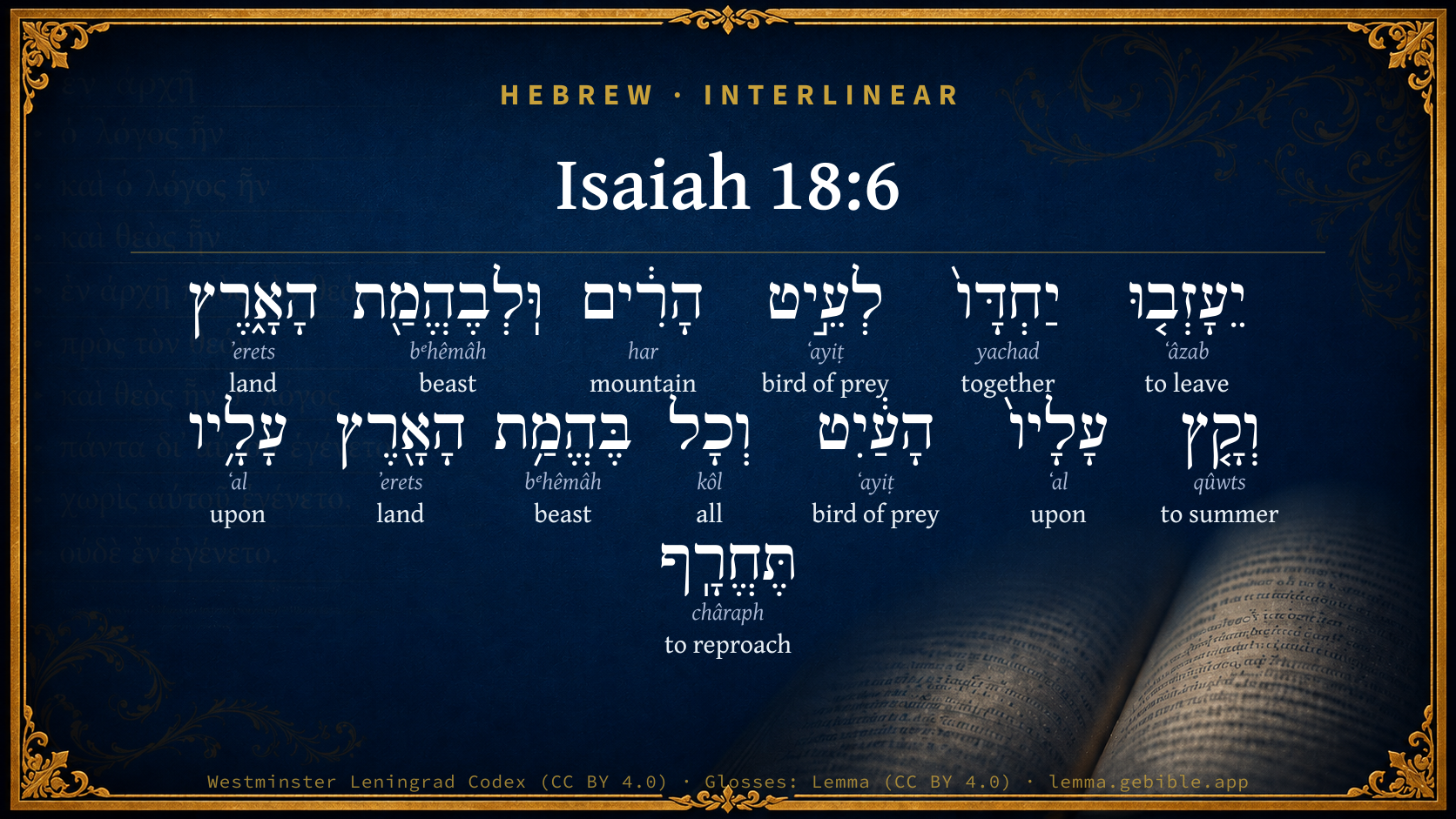
Isaiah 18:6

Hebrew (Westminster Leningrad Codex) Isaiah 18:6 appears in the Hebrew Old Testament. The text above is from the Westminster Leningrad Codex. Each word links to its Strong’s number, a concise gloss, and parsing drawn from the Open Scriptures Hebrew Bible morphology. Click any word for its full Brown-Driver-Briggs (BDB) entry.
Download image
Cite this verse

Isaiah 18:6 (World English Bible). Public Domain. Lemma interlinear Bible study tool, https://lemma.gebible.app/v/isaiah/18/6.

Show BibTeX & RIS
BibTeX
RIS
English Translation
They shall be left together to the ravenous birds of the mountains, and to the animals of the earth; and the ravenous birds shall summer on them, and all the animals of the earth shall winter on them.
World English Bible · Public Domain
Highlights
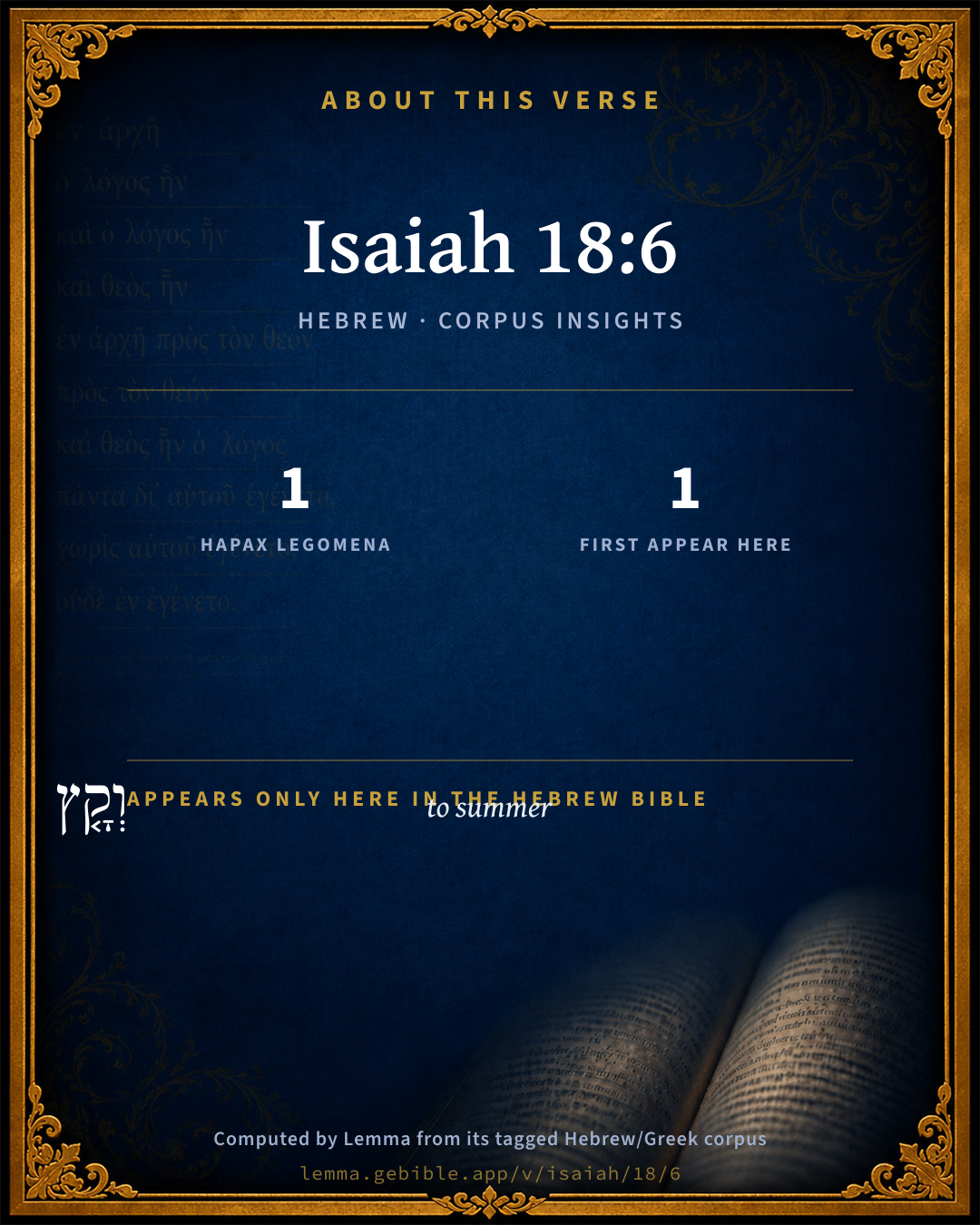
  • 1 hapax legomenon — only here in the Hebrew Bible
  • 1 first appearance in the Hebrew Bible
Full analysis ↓
Download a study sheet

One document with this verse’s original text, its word-by-word gloss line, the meaning frame, cross-references with their text, attributed commentary, and full source and license credits — printable, and it pastes into notes with its structure intact.

This verse Autodidact and up

Study sheet (.html) Plain text (.txt)

A passage Seminary Student

Up to 50 verses in one chapter. A passage sheet keeps up to 6 commentary sources and 12 cross-references per verse, in the order this page ranks them, and says so on the sheet whenever that leaves anything out. Ask for a single verse and you get the Autodidact verse sheet above.

Everything on this page stays free to read, with no account — the sheet is a download of what is already on screen, not access to it.

Want to remove ads? Support Godless Engineer
Compare translations 3

The same verse in 3 English versions, stacked beneath the original-language interlinear above. Click any original word for its lexicon entry.

Each is an independent rendering of the whole verse — the interlinear is not word-aligned to these translations.

Highlighted words mark where these versions differ — a whole-verse word diff, not a word-by-word alignment.

  • World English Bible Public Domain
    They shall be left together to the ravenous birds of the mountains, and to the animals of the earth; and the ravenous birds shall summer on them, and all the animals of the earth shall winter on them.
  • King James Version Public Domain
    They shall be left together unto the fowls of the mountains, and to the beasts of the earth: and the fowls shall summer upon them, and all the beasts of the earth shall winter upon them.
  • unfoldingWord Literal Text CC BY-SA 4.0
    They will be left together for the bird of the mountains and for the beast of the earth. And the bird will summer on them, and every beast of the earth will winter on them.

unfoldingWord Literal Text — © unfoldingWord, licensed CC BY-SA 4.0. Word-aligned USFM3 via Door43 (git.door43.org/unfoldingWord/en_ult).

Versions to compare (up to 4)

3 of 4 selected

Show all 18 translations

Every available English version of this verse, each an independent rendering of the whole verse.

  • World English Bible Public Domain
    They shall be left together to the ravenous birds of the mountains, and to the animals of the earth; and the ravenous birds shall summer on them, and all the animals of the earth shall winter on them.
  • Berean Standard Bible Public Domain
    They will all be left to the mountain birds of prey, and to the beasts of the land. The birds will feed on them in summer, and all the wild animals in winter.
  • Majority Standard Bible Public Domain
    They will all be left to the mountain birds of prey, and to the beasts of the land. The birds will feed on them in summer, and all the wild animals in winter.
  • King James Version Public Domain
    They shall be left together unto the fowls of the mountains, and to the beasts of the earth: and the fowls shall summer upon them, and all the beasts of the earth shall winter upon them.
  • American Standard Version (1901) Public Domain
    They shall be left together unto the ravenous birds of the mountains, and to the beasts of the earth; and the ravenous birds shall summer upon them, and all the beasts of the earth shall winter upon them.
  • Revised Version (1885) Public Domain
    They shall be left together unto the ravenous birds of the mountains, and to the beasts of the earth: and the ravenous birds shall summer upon them, and all the beasts of the earth shall winter upon them.
  • Geneva Bible (1599) Public Domain
    They shall be left together vnto the foules of the mountaines, and to the beastes of the earth: for the foule shall sommer vpon it, and euery beast of the earth shall winter vpon it.
  • Douay-Rheims (1899) Public Domain
    And they shall be left together to the birds of the mountains, and the beasts of the earth: and the fowls shall be upon them all the summer, and all the beasts of the earth shall winter upon them.
  • Young's Literal Translation Public Domain
    They are left together to the ravenous fowl of the mountains, And to the beast of the earth, And summered on them hath the ravenous fowl, And every beast of the earth wintereth on them.
  • Literal Standard Version CC BY-SA 4.0
    They are left together to the ravenous bird of the mountains, || And to the beast of the earth, || And the ravenous bird has summered on them, || And every beast of the earth winters on them.
  • Unlocked Literal Bible CC BY-SA 4.0
    They will be left together for the birds of the mountains and for the animals of the earth. The birds will summer on them, and all the animals of the earth will winter on them.”
  • unfoldingWord Literal Text CC BY-SA 4.0
    They will be left together for the bird of the mountains and for the beast of the earth. And the bird will summer on them, and every beast of the earth will winter on them.
  • Darby Bible Public Domain
    They shall be left together unto the mountain birds of prey, and to the beasts of the earth; and the birds of prey shall summer upon them, and all the beasts of the earth shall winter upon them.
  • World Messianic Bible Public Domain
    They will be left together for the ravenous birds of the mountains, and for the animals of the earth. The ravenous birds will eat them in the summer, and all the animals of the earth will eat them in the winter.
  • Webster's Bible Public Domain
    They shall be left together to the fowls of the mountains, and to the beasts of the earth: and the fowls shall summer upon them, and all the beasts of the earth shall winter upon them.
  • Free Bible Version CC BY-SA 4.0
    They will all be left as carrion for the birds of prey of the mountains, and for the wild animals. The birds will eat them in summer, and all the wild animals in winter.
  • Bible in Basic English Public Domain
    They will be for the birds of the mountains, and for the beasts of the earth: the birds will come down on them in the summer, and the beasts of the earth in the winter.
  • JPS Tanakh (1917) Public Domain
    They shall be left together unto the ravenous birds of the mountains, and to the beasts of the earth; and the ravenous birds shall summer upon them, and all the beasts of the earth shall winter upon them.

Literal Standard Version (2020), Covenant Press — licensed CC BY-SA 4.0. Text via the HelloAO Bible API (eBible.org). Unlocked Literal Bible (unfoldingWord) — licensed CC BY-SA 4.0. Text via the HelloAO Bible API (eBible.org). unfoldingWord Literal Text — © unfoldingWord, licensed CC BY-SA 4.0. Word-aligned USFM3 via Door43 (git.door43.org/unfoldingWord/en_ult). Free Bible Version, Dr. Jonathan Gallagher — licensed CC BY-SA 4.0. Text via the HelloAO Bible API (eBible.org).

Word by word

More ways to search: Search by grammar → Find every occurrence → Compare this word →

Practice this passage: Drill this verse → Learn its vocabulary →

וְקָ֤ץ
qûwts
H6972
“and · to summer”
Conjunction + Verb, Qal, Sequential Perfect, 3rd Person, Masculine, Singular
Part of Speech
Conjunction + Verb
Stem
Qal
Form
Sequential Perfect
Person
3rd Person
Gender
Masculine
Number
Singular
Full BDB Definition

Origin: a primitive root

TWOT: None

(Qal) to spend the summer
  1. יֵעָזְב֤וּ ʻâzab H5800 “to leave” Verb, Niphal, Imperfect, 3rd Person, Masculine, Plural
  2. יַחְדָּו֙ yachad H3162 “together” Adverb
  3. לְעֵ֣יט ʻayiṭ H5861 “to/for · bird of prey of” Preposition + Noun, Common, Masculine, Singular, Construct
  4. הָרִ֔ים har H2022 “mountains” Noun, Common, Masculine, Plural, Absolute
  5. וּֽלְבֶהֱמַ֖ת bᵉhêmâh H929 “and · to/for · beast of” Conjunction + Preposition + Noun, Common, Feminine, Singular, Construct
  6. הָאָ֑רֶץ ʼerets H776 “the · land” Particle, Definite Article + Noun, Common, Both, Singular, Absolute
  7. עָלָיו֙ ʻal H5921 “upon · him” Preposition + Suffix, Personal, 3rd Person, Masculine, Singular
  8. הָעַ֔יִט ʻayiṭ H5861 “the · bird of prey” Particle, Definite Article + Noun, Common, Masculine, Singular, Absolute
  9. וְכָל kôl H3605 “and · all of” Conjunction + Noun, Common, Masculine, Singular, Construct
  10. בֶּהֱמַ֥ת bᵉhêmâh H929 “beast of” Noun, Common, Feminine, Singular, Construct
  11. הָאָ֖רֶץ ʼerets H776 “the · land” Particle, Definite Article + Noun, Common, Both, Singular, Absolute
  12. עָלָ֥יו ʻal H5921 “upon · him” Preposition + Suffix, Personal, 3rd Person, Masculine, Singular
  13. תֶּחֱרָֽף châraph H2778 “to reproach” Verb, Qal, Imperfect, 3rd Person, Feminine, Singular

About this verse

These counts appear in no published source. They are computed here, from the morphology-tagged text and Lemma’s own curated glosses. What Lemma adds →

14
words
10
distinct lemmas
Prophets
section

Notable vocabulary

1 hapax legomenon — a word that appears only here in the entire Hebrew Bible:

  • וְקָ֤ץ to summer H6972

First appearance in Scripture

This word makes its first canonical appearance in the Hebrew Bible here:

  • וְקָ֤ץ to summer H6972

Shared distinctive vocabulary

לְעֵ֣יט bird of prey H5861 occurs in 6 verses of the Hebrew Bible. Also found in:

Grammatical profile

  • 3 verbs
  • 8 nouns
  • 2 prepositions
  • 1 adverb

Verb forms

  • יֵעָזְב֤וּ Niphal · Imperfect
  • וְקָ֤ץ Qal · Sequential Perfect
  • תֶּחֱרָֽף Qal · Imperfect

Repetition

Words recur within this verse — often emphatic in Hebrew:

  • לְעֵ֣יט bird of prey H5861 ×2
  • וּֽלְבֶהֱמַ֖ת beast H929 ×2
  • הָאָ֑רֶץ land H776 ×2
  • עָלָיו֙ upon H5921 ×2

Hebrew & Septuagint length

In English translation the verse runs 38 words from the Hebrew and 42 from the Septuagint (LXX English) — closely comparable.

A rough comparison of the two English renderings, which tokenize alike — not a word-level alignment.

Word counts can differ between the Hebrew and the Greek without any difference in meaning — e.g. the Hebrew direct-object marker אֵת has no separate Greek word, and Greek often adds the article ὁ.

Cross-references

8

Topical passages linked to Isaiah 18:6 in the Treasury of Scripture Knowledge — connected by theme and wording, ordered by reader-vote popularity; previews shown in the World English Bible.

  • Jeremiah 7:33 The dead bodies of this people shall be food for the birds of the sky, and for the animals of the earth; and none shall frighten them away.
  • Ezekiel 32:4–6 I will leave you on the land, I will cast you forth on the open field, and will cause all the birds of the sky to settle on you, and I will satisfy the animals of the whole earth with you.
  • Ezekiel 39:17–20 You, son of man, thus says the Lord Yahweh: Speak to the birds of every sort, and to every animal of the field, Assemble yourselves, and come; gather yourselves on every side to my sacrifice that I do sacrifice for you, even a great sacrifice on the mountains of Israel, that you may eat flesh and drink blood.
  • Isaiah 14:19 But you are cast forth away from your tomb like an abominable branch, clothed with the slain, who are thrust through with the sword, who go down to the stones of the pit; as a dead body trodden under foot.
  • Isaiah 34:1–7 Come near, you nations, to hear; and listen, you peoples: let the earth hear, and the fullness of it; the world, and all things that come forth from it.
  • Isaiah 56:9 All you animals of the field, come to devour, [yes], all you animals in the forest.
  • Jeremiah 15:3 I will appoint over them four kinds, says Yahweh: the sword to kill, and the dogs to tear, and the birds of the sky, and the animals of the earth, to devour and to destroy.
  • Revelation 19:17–18 I saw an angel standing in the sun. He cried with a loud voice, saying to all the birds that fly in the sky, "Come! Be gathered together to the great supper of God,

Cross-references courtesy of OpenBible.info (CC BY 4.0).

Hebrew and Greek witnesses Masoretic Hebrew ↔ Greek Septuagint

The same verse in the two great witnesses to the Old Testament, shown verse-for-verse.

These are two independent witnesses, not word-aligned to each other, and the Septuagint is shown in lemma (dictionary) form.

Hebrew Isaiah 18:6 Masoretic · Westminster Leningrad Codex

יֵעָזְב֤וּ יַחְדָּו֙ לְעֵ֣יט הָרִ֔ים וּֽלְבֶהֱמַ֖ת הָאָ֑רֶץ וְקָ֤ץ עָלָיו֙ הָעַ֔יִט וְכָל בֶּהֱמַ֥ת הָאָ֖רֶץ עָלָ֥יו תֶּחֱרָֽף

They shall be left together to the ravenous birds of the mountains, and to the animals of the earth; and the ravenous birds shall summer on them, and all the animals of the earth shall winter on them.

World English Bible · Public Domain

Greek LXX Isaiah 18:6 Septuagint · lemma form

καί καταλείπω ἅμα ὁ πετεινόν ὁ οὐρανός καί ὁ θηρίον ὁ γῆ καί συνἄγω ἐπί αὐτός ὁ πετεινόν ὁ οὐρανός καί πᾶς ὁ θηρίον ὁ γῆ ἐπί αὐτός ἥκω

And he shall leave them together to the birds of the sky, and to the wild beasts of the earth: and the fowls of the sky shall be gathered upon them, and all the beasts of the land shall come upon him.

LXX2012 (modern English Septuagint) · Public Domain

Hebrew: Westminster Leningrad Codex (CC BY 4.0). Greek: Septuagint (public domain); English from LXX2012 (modern English Septuagint) (Public Domain). How the Septuagint differs from the Hebrew →

Targum (Aramaic paraphrase)

1

The Targum is the ancient Jewish Aramaic paraphrase of the Hebrew Scriptures — an interpretive translation, not the Hebrew text itself. Onkelos (literal) and Pseudo-Jonathan (expansive) render the Torah, and Jonathan the Prophets. Coverage is partial: where no permissively-licensed English translation exists for a verse, only the Aramaic is shown. This is verse-level text, not a word-by-word alignment to the Hebrew.

  1. Targum Jonathan Prophets (Joshua–Malachi)
    יִשְׁתַּבְּקוּן כַּחֲדָא לְעוֹפָא דְטוּרַיָא וְלִבְעִירָא דְאַרְעָא בְּקַיְטָא יְהֵי שָׁרֵי עֲלוֹהִי כָּל עוֹפָא דִשְׁמַיָא וְכָל בְּעִירָא דְאַרְעָא עֲלוֹהִי יַעַבְּרוּן סִתְוָא:

    They shall be left together unto the fowl of the mountains, and to the beasts of the earth: all the fowls of the heavens shall dwell upon them in the summer, and all the beasts of the earth shall winter upon them.

    Targum Jonathan — Aramaic: “Mikraot Gedolot” (public domain). English: “Sefaria Community Translation” (CC0 1.0 (public-domain dedication)); “London "Chaldee Paraphrase," 1871” (public domain). Text via Sefaria.

Commentary

Notes on Isaiah 18:6 from classic Christian and Jewish commentators (each source and its license shown beneath its notes). The classic Christian expositions comment on the surrounding passage and are grouped to its opening verse, so a note may address several verses; the Jewish commentaries on the Tanakh (Rashi and others) are per-verse, so they appear only where the commentator wrote on this verse.

Lemma curates 59 commentaries, every one of them public domain or Creative Commons licensed, each selected and text-cleaned for this edition rather than reprinted as found. About our sources →

Trapp's Complete Commentary

John Trapp

Isa 18:6 They shall be left together unto the fowls of the mountains, and to the beasts of the earth: and the fowls shall summer upon them, and all the beasts of the earth shall winter upon them.

Ver. 6. They shall be left together.] They, that is, the Assyrians slain by the angel. {as Psa 79:2 Isa 37:36}

The fowls shall summer upon them.] Both birds and beasts of prey shall have enough to feed upon the whole year about.

John Trapp, A Commentary or Exposition upon All the Books of the Old and New Testament (1647–1656) — public domain. Text from a community e-Sword module.

Geneva Bible (1599)

Geneva Bible translators

Not only men shall contemn them, but the brute beasts.

Geneva Bible (1599) marginal notes — public domain. Text via Bolls.life.

Jamieson, Fausset & Brown

Robert Jamieson, A. R. Fausset & David Brown

birds . . . beasts--transition from the image "sprigs," "branches," to the thing meant: the Assyrian soldiers and leaders shall be the prey of birds and beasts, the whole year through, "winter" and "summer," so numerous shall be their carcasses. HORSLEY translates the Hebrew which is singular: "upon it," not "upon them"; the "it" refers to God's "dwelling-place" (Isa 18:4) in the Holy Land, which Antichrist ("the bird of prey" with the "beasts," his rebel hosts) is to possess himself of, and where he is to perish.

Jamieson, Fausset & Brown — Commentary Critical and Explanatory on the Whole Bible (1871) — public domain (CC PDM 1.0). Text via the HelloAO Bible API.

Ellicott's Commentary for English Readers

(6) They shall be left together unto the fowls of the mountains . . .—The figure and the reality are strangely blended. The grapes of that vintage cut off by those pruning-hooks are none other than the carcases of the host of the Assyrians left unburied, to be devoured by the dogs and vultures.

A Bible Commentary for English Readers, edited by Charles John Ellicott (1878–1897) — public domain. Text from a community e-Sword module.

The Cambridge Bible for Schools and Colleges

gen. ed. J. J. S. Perowne

6. The figure is now abandoned; instead of the “sprigs and branches” of the vine, we have the dead bodies of the Assyrian soldiers left as carrion for unclean beasts and birds, summer … winter] a whole year. The idea is amplified, with somewhat gruesome details, in Eze_39:11 ff.; cf. also Jer_7:33; 1Sa_17:46; 2Sa_21:10.

The Cambridge Bible for Schools and Colleges (gen. ed. J. J. S. Perowne; Cambridge University Press, 1878–1918) — public domain. Text from a community e-Sword module.

John Gill's Exposition

They shall be left, together unto the fowls of the mountains, and to the beasts of the earth,.... That is, both sprigs and branches; with the fruit of them, which being unripe, are disregarded by men, but fed upon by birds and beasts; the fruits by the former, and the tender sprigs and green branches by the latter; signifying the destruction of the Ethiopians or Egyptians, and that the princes and the people should fall together, and lie unburied, and become a prey to birds and beasts; or the destruction of the Assyrian army slain by the angel, as Aben Ezra and others; though some interpret it of the army of Gog and Magog, as before observed; see Eze 39:17,

and the fowls shall summer upon them, and all the beasts of the earth shall winter upon them; not that the one should feed upon them in the summer time, and the other in the winter; the fowls in the summer time, when they fly in large flocks, and the beasts in the winter, when they go together in great numbers, as Kimchi; but the sense is, that the carnage should be so great, there would be sufficient for them both, all the year long.

John Gill's Exposition of the Whole Bible (1746–1763) — public domain (CC PDM 1.0). Text via the HelloAO Bible API.

Albert Barnes' Notes on the Bible

They shall be left together - The figure here is dropped, and the literal narration is resumed. The sense is, that the army shall be slain and left unburied. Perhaps the “branches and twigs” in the previous verse denoted military leaders, and the captains of the armies, which are now represented as becoming food for beasts of the field and for birds of prey.

To the fowls of the mountains - Their dead bodies shall be unburied, and shall be a prey to the birds that prey upon flesh.

And to the beasts of the earth - The wild animals: the beasts of the forest.

And the fowls shall summer upon them - Shall pass the summer, that is, they shall continue to be unburied. “And the beasts of the earth shall winter upon them.” They shall be unburied through the winter; probably indicating that they would furnish food for the fowls and the wild beasts for a long time. On the multitude of carcasses these animals will find nourishment for a whole year, that is, they will spend the summer and the winter with them. When this was fulfilled, it is, perhaps, not possible to tell, as we are so little acquainted with the circumstances of the people in relation to whom it was spoken. If it related, as I suppose, to the people of Nubia or Ethiopia forming an alliance with the Assyrians for the purpose of invading Judea, it was fulfilled probably when Sennacherib and his assembled hosts were destroyed. Whenever it was fulfilled, it is quite evident that the design of the prophecy was to give comfort to the Jews, alarmed and agitated as they were at the prospect of the preparations which were made, by the assurance that those plans would fail, and all the efforts of their enemies be foiled and disconcerted.

Albert Barnes' Notes on the Bible (1834–1885) — public domain. Text from a community e-Sword/MySword module.

Haydock's Catholic Bible Commentary

Them. Their bodies shall lie unburied.

George Leo Haydock (1774–1849), Haydock's Catholic Family Bible and Commentary, 1859 edition — public domain. Excludes Psalms (Douay-Rheims chapter numbering differs from Protestant) and Deuterocanonical books (Catholic canon only).

Matthew Poole's English Annotations

The sprigs and branches being cut down and thrown upon the ground, with the unripe grapes upon them, they shall lie upon the earth neglected by men, as being unripe, and unfit for their use, so that either birds or beasts may shelter themselves with them, or feed on them, both summer and winter. You are not to understand that the summer is appropriated to the fowls, and the winter to the beasts; but this is only an elegancy of the Hebrew language to use such distributions, of which we have many instances in prophetical writings.

Matthew Poole's English Annotations on the Holy Bible (1683–1685) — public domain. Text from a community e-Sword/MySword module.

Whedon's Commentary on the Bible

Daniel D. Whedon

6. They… be left — The branches cut off for the fowls and beasts represent the carcasses of the enemy laid prostrate on the field, as the Assyrians were arrested in their march against Egypt. Both Judah is saved, and Egypt and Ethiopia are relieved from the dreaded foe. This is the message the Ethiopian ambassadors of Isa_18:2 were summoned to send off to their country. The message relates to the destruction of the enemy, and said destruction was a marked wonder, worthy to be known at the farthest places of the earth. For the enemy just ready to pounce upon the Egyptians, and with them upon Judah also, was itself pounced upon by the Almighty One. This event is the ensign on the mountains, and the trumpet sound (Isa_18:3) to which the prophet invites Ethiopia’s attention. The mustering of their hosts in self-defence is not now necessary. God has come to their defence, but chiefly in behalf of his people in Judah.

Daniel D. Whedon (gen. ed.), Commentary on the Old and New Testaments (1874–1909) — public domain. Text from a community e-Sword module.

The Pulpit Commentary

They shall be left together unto the fowls. At length imagery is dropped. The vine is shown to be an army, slaughtered all "together," and left a prey to kites and vultures, jackals and hyaenas. Shall summer... shall winter . They will furnish food to the beasts and birds of prey for the remainder of the year.

The Pulpit Commentary (1880–1919), ed. H.D.M. Spence-Jones & Joseph S. Exell — public domain. Text from a community e-Sword module.

John Wesley's Explanatory Notes

Thy - The branches being cut down and thrown upon the ground, with the unripe grapes upon them. Left - They shall lie upon the earth, so that either birds or beasts may shelter themselves with them, or feed on them, both summer and winter.

John Wesley, Explanatory Notes Upon the Whole Bible (1754–1765) — public domain. Text via the GEBible commentary corpus.

J. A. Alexander on Isaiah

Joseph Addison Alexander

“They shall be left together to the wild bird of the mountains and to the wild beasts of the earth (or land), and the wild bird shall summer thereon, and every wild beast of the earth (or land) thereon shall winter.” It is commonly supposed that there is here a transition from the figure of a vineyard to that of a dead body, the branches cut off and thrown away being suddenly transformed into carcasses devoured by beasts and birds. For a like combination, see above, Isa 14:19. But this interpretation, though perhaps the most natural, is not absolutely necessary. As the act of devouring is not expressly mentioned, the reference may be, not to the carnivorous habits of the animals, but to their wild and solitary life. In that case the sense would be that the amputated branches, and the desolated vineyard itself, shall furnish lairs and nests for beasts and birds which commonly frequent the wildest solitudes, implying abandonment and utter desolation. The only reason for preferring this interpretation is that it precludes the necessity of assuming a mixed metaphor, or an abrupt exchange of one for another, both which, however, are too common in Isaiah to excite surprise. On either supposition, the general meaning of the verse is obvious. The form of the last clause is idiomatic, the birds being said to spend the summer and the beasts the winter, not with reference to any real difference in their habits, but for the purpose of expressing the idea, that beasts and birds shall occupy the spot throughout the year. According to the common explanation of the verse as referring to dead bodies, it is a hyperbolical description of their multitude, as furnishing repast for a whole year to the beasts and birds of prey.

Joseph Addison Alexander, The Prophecies of Isaiah (1846–1847; New York: Scribner, 1870–1878) — public domain. Text from a community e-Sword module.

unfoldingWord translationNotes

Door43 World Missions Community

They will be left together

God seems to change from telling the parable to speaking more directly about the nation. This can be stated clearly. AT: "Those who are killed will be left together" or "Like branches that are cut off and thrown away, the bodies of those who are killed will be left on the ground" (See: Parables)

The birds will summer on them

"The birds will eat them during the summer." The word "birds" refers to birds that eat the flesh of dead bodies.

all the animals of the earth

"all kinds of wild animals"

will winter on them

"will eat them in the winter"

a people tall and smooth ... a people feared far and near ... a nation strong and trampling down, whose land the rivers divide

These phrases all describe the people of one nation. See how you translated these phrases in Isaiah 18:2.

a people tall and smooth

"a people who are tall and have smooth skin"

a people feared far and near

The words "far" and "near" are used together to mean "everywhere." AT: "a people who are feared everywhere" or "a people that everyone in the earth fears" (See: Merism)

a nation strong and trampling down

Trampling down represents conquering other nations. AT: "a nation that is strong and conquers other nations" (See: Metonymy)

to the place of the name of Yahweh of hosts, to Mount Zion

The word "name" refers to Yahweh. AT: "to Mount Zion, where Yahweh of hosts dwells" (See: Metonymy)

translationWords

tribute

Yahweh of hosts

people group

fear

nation

name

Zion

unfoldingWord translationNotes — © Distant Shores Media and the Door43 World Missions Community, licensed CC BY-SA 4.0. Source: git.door43.org/Door43/en_tn.

Rashi

Rabbi Shlomo Yitzchaki (Rashi)

They shall be left [i.e.,] their corpses.

to the birds of the mountains Heb. לְעֵיט הָרִים, to the birds of the mountains.

shall spend the summer upon them All the days of the summer.

shall spend the winter All the days of the winter. From there they deduced that the judgment of Gog in the future shall be twelve months.

Rashi on the Tanakh — English translations: “The Judaica Press complete Tanach with Rashi, translated by A. J. Rosenberg” (CC BY 4.0); “Pentateuch with Rashi's commentary by M. Rosenbaum and A.M. Silbermann, 1929-1934” (public domain); “The Metsudah Tanach series, Lakewood, N.J” (CC BY 4.0); and “The Book of Joshua, Metsudah Publications, 1997” (CC BY 4.0). Text via Sefaria.

Ibn Ezra

Rabbi Abraham ibn Ezra

They will be left, etc. The host of Assyria, having been destroyed through the angel, will be left, etc.

לעיט To the fowl (comp. Gen. 15:11); its forms are like those of שֵׁשׁ (Est. 1:6), and שַׁיִשׁ (1 Chron. 29:2), marble.

וקץ And shall summer. Comp. קיץ summer (Gen. 8:22).

תחרף Shall winter. Comp. הֹרֶף winter (Gen. 8:22).—The beasts will remain there to eat the corpses of the killed.

Ibn Ezra on the Tanakh — English translations: “Sefaria Community Translation” (CC0 1.0 (public-domain dedication)); “Yalkut, Sifsei Chachomim Chumash, Metsudah Publications, 2009” (CC BY 4.0); and “Commentary of Ibn Ezra on Isaiah - trans. by M. Friedlander, 1873” (public domain). Text via Sefaria.

Lesson kit

Teaching starters — assembled from the data on this page, not authored interpretation. Every prompt links to the verse data it draws on. Edit before teaching.

Isaiah, in the Prophets, opens this verse with 14 words (10 distinct Hebrew lemmas). Its most distinctive word is qûwts (“to summer”). A historical commentator’s framing appears above. Read the whole chapter for the surrounding context.

Discussion questions

  1. The word qûwts carries the sense “to summer.” How does it shape the verse?
  2. This verse holds 1 word here found nowhere else in the Hebrew Bible. What might the rare word draw attention to?
  3. The word “to summer” first appears here in Scripture. What is being introduced at this debut?
  4. Genesis 15:11 shares the word «bird of prey» with this verse. How do the two illuminate each other?
  5. “bird of prey” occurs 2× in this one verse. What is the effect of the repetition?
  6. These translations render this verse differently. What is at stake in choosing one wording over another?
  7. The verb «יֵעָזְב֤וּ» is Niphal Imperfect. How does its form color the action?
  8. Reading how Trapp's Complete Commentary and Geneva Bible (1599) read this verse, where do the two commentators agree and where do they part?

Things to notice

  • 1 word in this verse appears nowhere else in the Hebrew Bible.
  • 1 word makes its first canonical appearance in Scripture here.
  • These translations choose different wording for 12 words in this verse.
  • “bird of prey” occurs 2× in this single verse.
  • 10 distinct Hebrew lemmas span 14 words in this verse.

Reading settings

Reading text

Shown beneath each verse's original-language words.

Old Testament
Old Testament edition

Read the OT as the Masoretic Hebrew (MT) or the Greek Septuagint (LXX).

English shown for the Greek Septuagint (in the Hebrew ↔ Greek comparison).

Comparing translations? Open the Compare panel on any verse page to stack up to four side by side.