Genesis 39:12

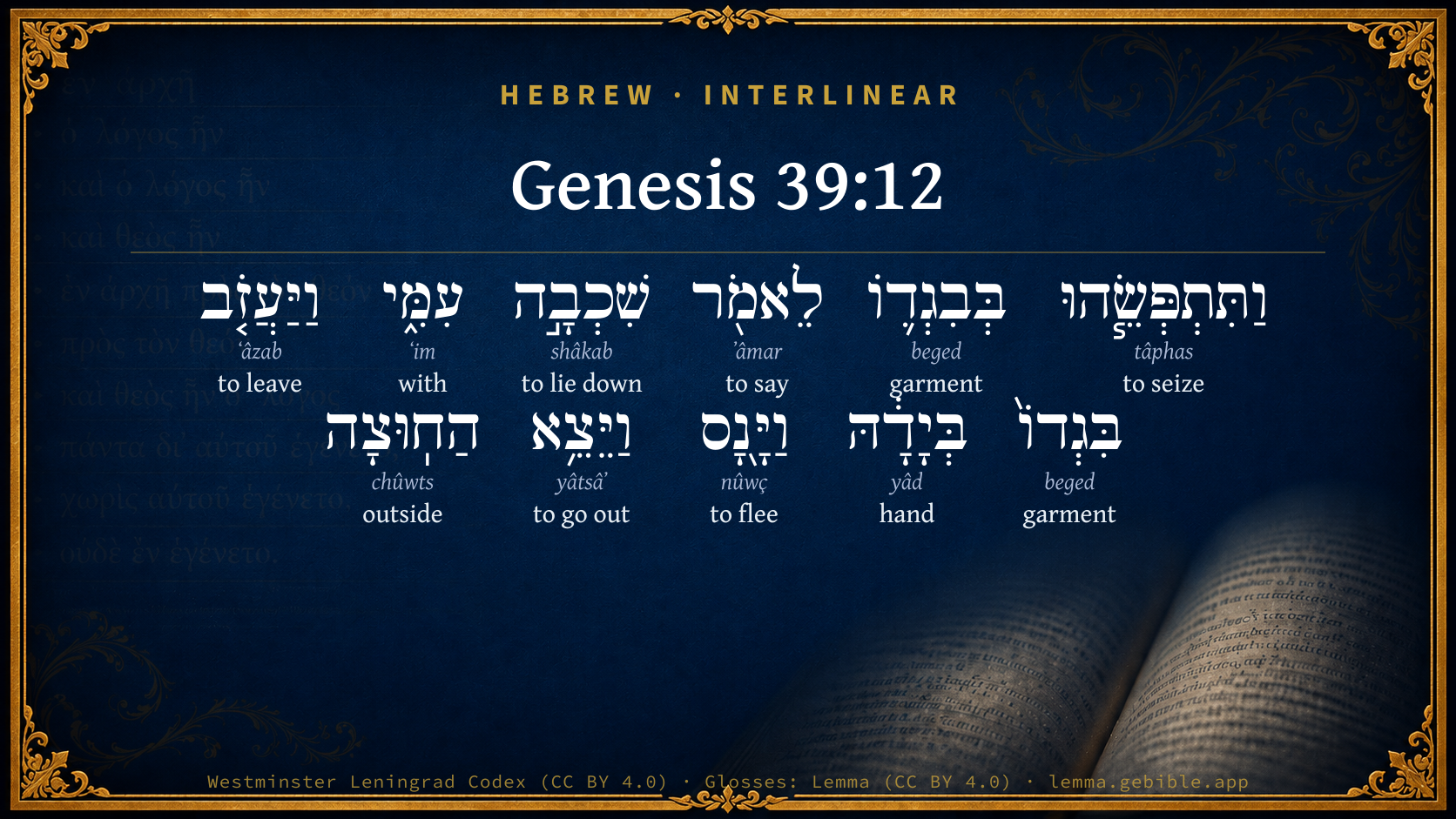
Hebrew (Westminster Leningrad Codex) Genesis 39:12 appears in the Hebrew Old Testament. The text above is from the Westminster Leningrad Codex. Each word links to its Strong’s number, a concise gloss, and parsing drawn from the Open Scriptures Hebrew Bible morphology. Click any word for its full Brown-Driver-Briggs (BDB) entry.
Download image
Cite this verse

Genesis 39:12 (World English Bible). Public Domain. Lemma interlinear Bible study tool, https://lemma.gebible.app/v/genesis/39/12.

Show BibTeX & RIS
BibTeX
RIS
English Translation
She caught him by his garment, saying, "Lie with me!" He left his garment in her hand, and ran outside.
World English Bible · Public Domain
Download a study sheet

One document with this verse’s original text, its word-by-word gloss line, the meaning frame, cross-references with their text, attributed commentary, and full source and license credits — printable, and it pastes into notes with its structure intact.

This verse Autodidact and up

Study sheet (.html) Plain text (.txt)

A passage Seminary Student

Up to 50 verses in one chapter. A passage sheet keeps up to 6 commentary sources and 12 cross-references per verse, in the order this page ranks them, and says so on the sheet whenever that leaves anything out. Ask for a single verse and you get the Autodidact verse sheet above.

Everything on this page stays free to read, with no account — the sheet is a download of what is already on screen, not access to it.

Want to remove ads? Support Godless Engineer
Compare translations 3

The same verse in 3 English versions, stacked beneath the original-language interlinear above. Click any original word for its lexicon entry.

Each is an independent rendering of the whole verse — the interlinear is not word-aligned to these translations.

Highlighted words mark where these versions differ — a whole-verse word diff, not a word-by-word alignment.

  • World English Bible Public Domain
    She caught him by his garment, saying, "Lie with me!" He left his garment in her hand, and ran outside.
  • King James Version Public Domain
    And she caught him by his garment, saying, Lie with me: and he left his garment in her hand, and fled, and got him out.
  • unfoldingWord Literal Text CC BY-SA 4.0
    So she caught him by his garment, saying, “Lie with me!” But he left his garment in her hand and fled and went outside.

unfoldingWord Literal Text — © unfoldingWord, licensed CC BY-SA 4.0. Word-aligned USFM3 via Door43 (git.door43.org/unfoldingWord/en_ult).

Versions to compare (up to 4)

3 of 4 selected

Show all 18 translations

Every available English version of this verse, each an independent rendering of the whole verse.

  • World English Bible Public Domain
    She caught him by his garment, saying, "Lie with me!" He left his garment in her hand, and ran outside.
  • Berean Standard Bible Public Domain
    She grabbed Joseph by his cloak and said, “Sleep with me!” But leaving his cloak in her hand, he escaped and ran outside.
  • Majority Standard Bible Public Domain
    She grabbed Joseph by his cloak and said, “Sleep with me!” But leaving his cloak in her hand, he escaped and ran outside.
  • King James Version Public Domain
    And she caught him by his garment, saying, Lie with me: and he left his garment in her hand, and fled, and got him out.
  • American Standard Version (1901) Public Domain
    And she caught him by his garment, saying, Lie with me: and he left his garment in her hand, and fled, and got him out.
  • Revised Version (1885) Public Domain
    And she caught him by his garment, saying, Lie with me: and he left his garment in her hand, and fled, and got him out.
  • Geneva Bible (1599) Public Domain
    Therefore she caught him by his garmet, saying, Sleepe with me: but he left his garment in her hand and fled, and got him out.
  • Douay-Rheims (1899) Public Domain
    With such words as these day by day, both the woman was importunate with the young man, and he refused the adultery.
  • Young's Literal Translation Public Domain
    and she catcheth him by his garment, saying, `Lie with me;' and he leaveth his garment in her hand, and fleeth, and goeth without.
  • Literal Standard Version CC BY-SA 4.0
    and she catches him by his garment, saying, “Lie with me”; and he leaves his garment in her hand, and flees, and goes outside.
  • Unlocked Literal Bible CC BY-SA 4.0
    She caught him by his clothes and said, “Sleep with me.” He left his clothing in her hand, fled, and went outside.
  • unfoldingWord Literal Text CC BY-SA 4.0
    So she caught him by his garment, saying, “Lie with me!” But he left his garment in her hand and fled and went outside.
  • Darby Bible Public Domain
    Then she caught him by his garment, saying, Lie with me! But he left his garment in her hand, and fled and ran out.
  • World Messianic Bible Public Domain
    She caught him by his garment, saying, “Lie with me!” He left his garment in her hand, and ran outside.
  • Webster's Bible Public Domain
    And she caught him by his garment, saying, Lie with me: and he left his garment in her hand, and fled, and went out.
  • Free Bible Version CC BY-SA 4.0
    She grabbed him by his clothing, and demanded, “Sleep with me!” But leaving his clothing in her hand, he ran out of the house.
  • Bible in Basic English Public Domain
    And pulling at his coat, she said, Come to my bed; but slipping out of his coat, he went running away.
  • JPS Tanakh (1917) Public Domain
    that she caught him by his garment, saying: 'Lie with me.' And he left his garment in her hand, and fled, and got him out.

Literal Standard Version (2020), Covenant Press — licensed CC BY-SA 4.0. Text via the HelloAO Bible API (eBible.org). Unlocked Literal Bible (unfoldingWord) — licensed CC BY-SA 4.0. Text via the HelloAO Bible API (eBible.org). unfoldingWord Literal Text — © unfoldingWord, licensed CC BY-SA 4.0. Word-aligned USFM3 via Door43 (git.door43.org/unfoldingWord/en_ult). Free Bible Version, Dr. Jonathan Gallagher — licensed CC BY-SA 4.0. Text via the HelloAO Bible API (eBible.org).

Word by word

More ways to search: Search by grammar → Find every occurrence → Compare this word →

Practice this passage: Drill this verse → Learn its vocabulary →

וַתִּתְפְּשֵׂ֧הוּ
tâphas
H8610
“and · to seize · him”
Conjunction + Verb, Qal, Sequential Imperfect, 3rd Person, Feminine, Singular + Suffix, Personal, 3rd Person, Masculine, Singular
Part of Speech
Conjunction + Verb
Stem
Qal
Form
Sequential Imperfect
Person
3rd Person
Gender
Feminine
Number
Singular
Full BDB Definition

Origin: a primitive root

TWOT: 2538

to catch, handle, lay hold, take hold of, seize, wield - (Qal) - to lay hold of, seize, arrest, catch - to grasp (in order to) wield, wield, use skilfully - (Niphal) to be seized, be arrested, be caught, be taken, captured - (Piel) to catch, grasp (with the hands)
  1. בְּבִגְד֛וֹ beged H899 “in/at · garment · his” Preposition + Noun, Common, Masculine, Singular, Construct + Suffix, Personal, 3rd Person, Masculine, Singular
  2. לֵאמֹ֖ר ʼâmar H559 “to say” Preposition + Verb, Qal, Infinitive Construct
  3. שִׁכְבָ֣ה shâkab H7901 “lie down” Verb, Qal, Imperative, 2nd Person, Masculine, Singular + Suffix, h
  4. עִמִּ֑י ʻim H5973 “with · me” Preposition + Suffix, Personal, 1st Person, Common, Singular
  5. וַיַּעֲזֹ֤ב ʻâzab H5800 “and · to leave” Conjunction + Verb, Qal, Sequential Imperfect, 3rd Person, Masculine, Singular
  6. בִּגְדוֹ֙ beged H899 “garment · his” Noun, Common, Masculine, Singular, Construct + Suffix, Personal, 3rd Person, Masculine, Singular
  7. בְּיָדָ֔הּ yâd H3027 “in/at · hand · her” Preposition + Noun, Common, Both, Singular, Construct + Suffix, Personal, 3rd Person, Feminine, Singular
  8. וַיָּ֖נָס nûwç H5127 “and · to flee” Conjunction + Verb, Qal, Sequential Imperfect, 3rd Person, Masculine, Singular
  9. וַיֵּצֵ֥א yâtsâʼ H3318 “and · to go out” Conjunction + Verb, Qal, Sequential Imperfect, 3rd Person, Masculine, Singular
  10. הַחֽוּצָה chûwts H2351 “the · outside · toward” Particle, Definite Article + Noun, Common, Masculine, Singular, Absolute + Suffix, Demonstrative

About this verse

These counts appear in no published source. They are computed here, from the morphology-tagged text and Lemma’s own curated glosses. What Lemma adds →

11
words
10
distinct lemmas
Pentateuch
section

Grammatical profile

  • 6 verbs
  • 4 nouns
  • 1 preposition

Verb forms

  • וַתִּתְפְּשֵׂ֧הוּ Qal · Sequential Imperfect
  • לֵאמֹ֖ר Qal · Infinitive Construct
  • שִׁכְבָ֣ה Qal · Imperative
  • וַיַּעֲזֹ֤ב Qal · Sequential Imperfect
  • וַיָּ֖נָס Qal · Sequential Imperfect
  • וַיֵּצֵ֥א Qal · Sequential Imperfect

Repetition

A word recurs within this verse — often emphatic in Hebrew:

  • בְּבִגְד֛וֹ garment H899 ×2

Hebrew & Septuagint length

In English translation the verse runs 20 words from the Hebrew and 27 from the Septuagint (LXX English) — closely comparable.

A rough comparison of the two English renderings, which tokenize alike — not a word-level alignment.

Word counts can differ between the Hebrew and the Greek without any difference in meaning — e.g. the Hebrew direct-object marker אֵת has no separate Greek word, and Greek often adds the article ὁ.

Cross-references

13

Topical passages linked to Genesis 39:12 in the Treasury of Scripture Knowledge — connected by theme and wording, ordered by reader-vote popularity; previews shown in the World English Bible.

  • 2 Timothy 2:22 Flee from youthful lusts; but pursue righteousness, faith, love, and peace with those who call on the Lord out of a pure heart.
  • Proverbs 7:13–27 So she caught him, and kissed him. With an impudent face she said to him:
  • Proverbs 5:8 Remove your way far from her. Don't come near the door of her house,
  • Proverbs 6:5 Free yourself, like a gazelle from the hand of the hunter, Like a bird from the snare of the fowler.
  • Ecclesiastes 7:26 I find more bitter than death the woman whose heart is snares and traps, whose hands are chains. Whoever pleases God shall escape from her; but the sinner will be ensnared by her.
  • 1 Peter 2:11 Beloved, I beg you as foreigners and pilgrims, to abstain from fleshly lusts, which war against the soul;
  • Genesis 39:8 But he refused, and said to his master's wife, "Behold, my master doesn't know what is with me in the house, and he has put all that he has into my hand.
  • Genesis 39:10 It happened that as she spoke to Joseph day by day, that he didn't listen to her, to lie by her, or to be with her.
  • Mark 14:51–52 A certain young man followed him, having a linen cloth thrown around himself, over his naked body. The young men grabbed him,
  • 1 Corinthians 15:33 Don't be deceived! "Evil companionships corrupt good morals."
  • Proverbs 1:15 My son, don't walk in the way with them. Keep your foot from their path,
  • Ezekiel 16:30–31 How weak is your heart, says the Lord Yahweh, seeing you do all these things, the work of an impudent prostitute;
  • 1 Samuel 15:27 As Samuel turned about to go away, [Saul] laid hold on the skirt of his robe, and it tore.

Cross-references courtesy of OpenBible.info (CC BY 4.0).

Hebrew and Greek witnesses Masoretic Hebrew ↔ Greek Septuagint

The same verse in the two great witnesses to the Old Testament, shown verse-for-verse.

These are two independent witnesses, not word-aligned to each other, and the Septuagint is shown in lemma (dictionary) form.

Hebrew Genesis 39:12 Masoretic · Westminster Leningrad Codex

וַתִּתְפְּשֵׂ֧הוּ בְּבִגְד֛וֹ לֵאמֹ֖ר שִׁכְבָ֣ה עִמִּ֑י וַיַּעֲזֹ֤ב בִּגְדוֹ֙ בְּיָדָ֔הּ וַיָּ֖נָס וַיֵּצֵ֥א הַחֽוּצָה

She caught him by his garment, saying, "Lie with me!" He left his garment in her hand, and ran outside.

World English Bible · Public Domain

Greek LXX Genesis 39:12 Septuagint · lemma form

καί ἐπισπάω αὐτός ὁ ἱμάτιον λέγω κοιμάω μετά ἐγώ καί καταλείπω ὁ ἱμάτιον αὐτός ἐν ὁ χείρ αὐτός φεύγω καί ἐκἔρχομαι ἔξω

And she caught hold of him by his clothes, and said, Lie with me; and having left his clothes in her hands, he fled, and went forth.

LXX2012 (modern English Septuagint) · Public Domain

Hebrew: Westminster Leningrad Codex (CC BY 4.0). Greek: Septuagint (public domain); English from LXX2012 (modern English Septuagint) (Public Domain). How the Septuagint differs from the Hebrew →

Targum (Aramaic paraphrase)

2

The Targum is the ancient Jewish Aramaic paraphrase of the Hebrew Scriptures — an interpretive translation, not the Hebrew text itself. Onkelos (literal) and Pseudo-Jonathan (expansive) render the Torah, and Jonathan the Prophets. Coverage is partial: where no permissively-licensed English translation exists for a verse, only the Aramaic is shown. This is verse-level text, not a word-by-word alignment to the Hebrew.

  1. Targum Onkelos Torah (Genesis–Deuteronomy)
    וַאֲחִדְתֵּהּ בִּלְבוּשֵׁהּ לְמֵימַר שְׁכוּב עִמִּי וְשָׁבְקֵהּ לִלְבוּשֵׁהּ בִּידַהּ וַעֲרַק וּנְפַק לְשׁוּקָא

    (no public-domain English translation for this verse)

    Targum Onkelos — Aramaic: “Onkelos Genesis” (public domain); “Onkelos Exodus” (public domain); “Onkelos Leviticus” (public domain); “Onkelos Numbers” (public domain); “Onkelos Deuteronomy” (public domain). English: “Sefaria Community Translation” (CC0 1.0 (public-domain dedication)); “J.W. Etheridge. The Targums of Onkelos and Jonathan Ben Uzziel on the Pentateuch. London: Longmans, Green, 1862” (public domain). Text via Sefaria.

  2. Targum Pseudo-Jonathan Torah (Genesis–Deuteronomy)
    וְאַחַדְתֵּיהּ בִּלְבוּשֵׁיהּ לְמֵימַר שְׁכוּב עִמִי וְשַׁבְקֵיהּ לִלְבוּשֵׁיהּ בִּידָהּ וְאָפַק לְשׁוּקָא

    that she caught him by his garment, saying, Lie with me: and he left his garment in her hand, and went forth into the street.

    Targum Pseudo-Jonathan — Aramaic: “Targum Jonathan on Genesis” (public domain); “Targum Jonathan on Exodus” (public domain); “Targum Jonathan on Leviticus” (public domain); “Targum Jonathan on Numbers” (public domain); “Targum Jonathan on Deuteronomy” (public domain). English: “The Targum of Jonathan ben Uzziel, trans. J. W. Etheridge, London, 1862” (public domain). Text via Sefaria.

Commentary

Notes on Genesis 39:12 from classic Christian and Jewish commentators (each source and its license shown beneath its notes). The classic Christian expositions comment on the surrounding passage and are grouped to its opening verse, so a note may address several verses; the Jewish commentaries on the Tanakh (Rashi and others) are per-verse, so they appear only where the commentator wrote on this verse.

Lemma curates 59 commentaries, every one of them public domain or Creative Commons licensed, each selected and text-cleaned for this edition rather than reprinted as found. About our sources →

Trapp's Complete Commentary

John Trapp

Gen 39:12 And she caught him by his garment, saying, Lie with me: and he left his garment in her hand, and fled, and got him out.

Ver. 12. And she caught him by his garment.] By wanton touches and dalliance, mental adultery is oft committed. He that "toucheth his neighbour’s wife, shall not be innocent," saith Solomon. {Pro 6:29} This is the offensive "right hand," that must be "cut off." {Mat 5:30} The harlot "caught the silly simple, and kissed him; and with an impudent face said unto him; - "{ Pro 7:13} "till a dart struck through his liver": {Pro 7:23} cogit amare iecur.

And he left his garment in her hand.] This second time is Joseph stript of his garment; before, in the violence of envy, now of lust; before, of necessity, now of choice; before, to deceive his father, now his master. Infamy and other misery he was sure to suffer, but that must not drive from duty. {2Co 6:8} The Church "comes from the wilderness," that is, through troubles and afflictions, "leaning on her beloved"; {Son 8:5} choosing rather to suffer than to sin. The good heart goes in a right line to God, and will not fetch a compass, but strikes through all troubles and hazards to get to him. It will not break the hedge of ally commandment, to avoid any piece of foul way. The primitive Christians chose rather to be thrown to lions without, than left to lusts within: Ad leonem mayis quam lenonem, saith Tertullian. I had rather go to hell pure from sin, saith Anselm, than to heaven polluted with that filth. {a} I will rather leap into a bonfire, saith another of the fathers, than wilfully commit wickedness against God. {b} Of the mouse of Armenia they write, that she will rather die than be defiled with any filth. Insomuch as if her hole be besmeared with dirt, she will rather choose to be taken than to be polluted. Such are, or ought to be, the servants of God; "unspotted of the world," {Jas 1:27} "undefiled in the way." {Psa 119:1}

{a} Mallem purus a peccato et innocens gehennam intrare, &c.

{b} Potius in ardentem rogum insiluero quam ullum peccatum in Deum commisero. - Pintus, in Dan.

John Trapp, A Commentary or Exposition upon All the Books of the Old and New Testament (1647–1656) — public domain. Text from a community e-Sword module.

John Gill's Exposition

And she caught him by his garment, saying, lie with me,.... It is very probable that before this time, as soon as ever she began to speak to him, he got away as fast as he could, and would not hear her; wherefore she now laid hold on his garment, in order to detain him, that she might have time to parley with him, and so prevail:

and he left his garment in her hand, and fled, and got him out; it was his outward loose garment she laid hold on, out of which he slipped himself, and so got clear of her, and ran away, and got out of the house as fast as he could: this he did, because he would not struggle with his mistress for his garment, which no doubt by his strength he could have got from her; and partly lest he should by handling of her have carnal desires excited in him, and so be overcome with her temptation.

John Gill's Exposition of the Whole Bible (1746–1763) — public domain (CC PDM 1.0). Text via the HelloAO Bible API.

Haydock's Catholic Bible Commentary

Out. He could easily have wrested it from her. But he would not do any thing that might seem disrespectful, nor claim what her impure hands had touched. (Menochius)

George Leo Haydock (1774–1849), Haydock's Catholic Family Bible and Commentary, 1859 edition — public domain. Excludes Psalms (Douay-Rheims chapter numbering differs from Protestant) and Deuterocanonical books (Catholic canon only).

Matthew Poole's English Annotations

He left his garment in her hand, which he would not strive to get from her, partly, for reverence to his mistress; partly, in detestation of her wickedness, whereby even his garment might seem to be infected; and partly, to put himself and her out of the danger of further temptation.

Matthew Poole's English Annotations on the Holy Bible (1683–1685) — public domain. Text from a community e-Sword/MySword module.

John Wesley's Explanatory Notes

When she laid hold on him, he left his garment in her hand - He would not stay to parley with the temptation, but flew out from it with the utmost abhorrence, he left his garment as one escaping for his life.

John Wesley, Explanatory Notes Upon the Whole Bible (1754–1765) — public domain. Text via the GEBible commentary corpus.

Ramban (Nachmanides)

Rabbi Moshe ben Nachman (Ramban / Nachmanides)

AND HE LEFT HIS GARMENT IN HER HAND. Out of respect for his mistress he did not wish to take the garment from her hand with his superior strength, and he removed it from upon himself, as it was a garment which one wears as a robe and headdress. But when she saw that he left his garment in her hands she feared lest he expose her to the people of the household or his master, and so she preceded him to them, saying that he had removed his garment to lie with her, but “when he saw that I screamed he fled in confusion.” This is the meaning of the verse, And it came to pass, when she saw that he had left his garment in her hand. This is also why she did not say, “And he left his garment in my hand,” but she instead told the men of her house and her husband, And he left his garment ‘etzli’ (with me). (with me) indicates that he himself had removed his garment, as explained above.

Ramban (Nachmanides) on the Tanakh — English translation: “Commentary on the Torah by Ramban (Nachmanides). Translated and annotated by Charles B. Chavel. New York, Shilo Pub. House, 1971-1976” (CC BY 4.0). Text via Sefaria.

Sforno

Rabbi Ovadia Sforno

And fled. So that he would not be overcome by desire.

And he went outside. As soon as he left the room he slowed down so that no one would ask questions. She, however, assumed that he continued running and that people would soon know what happened; therefore she called to the men of the household.

Sforno on the Tanakh — English translation: “Yalkut, Sifsei Chachomim Chumash, Metsudah Publications, 2009” (CC BY 4.0). Text via Sefaria.

Lesson kit

Teaching starters — assembled from the data on this page, not authored interpretation. Every prompt links to the verse data it draws on. Edit before teaching.

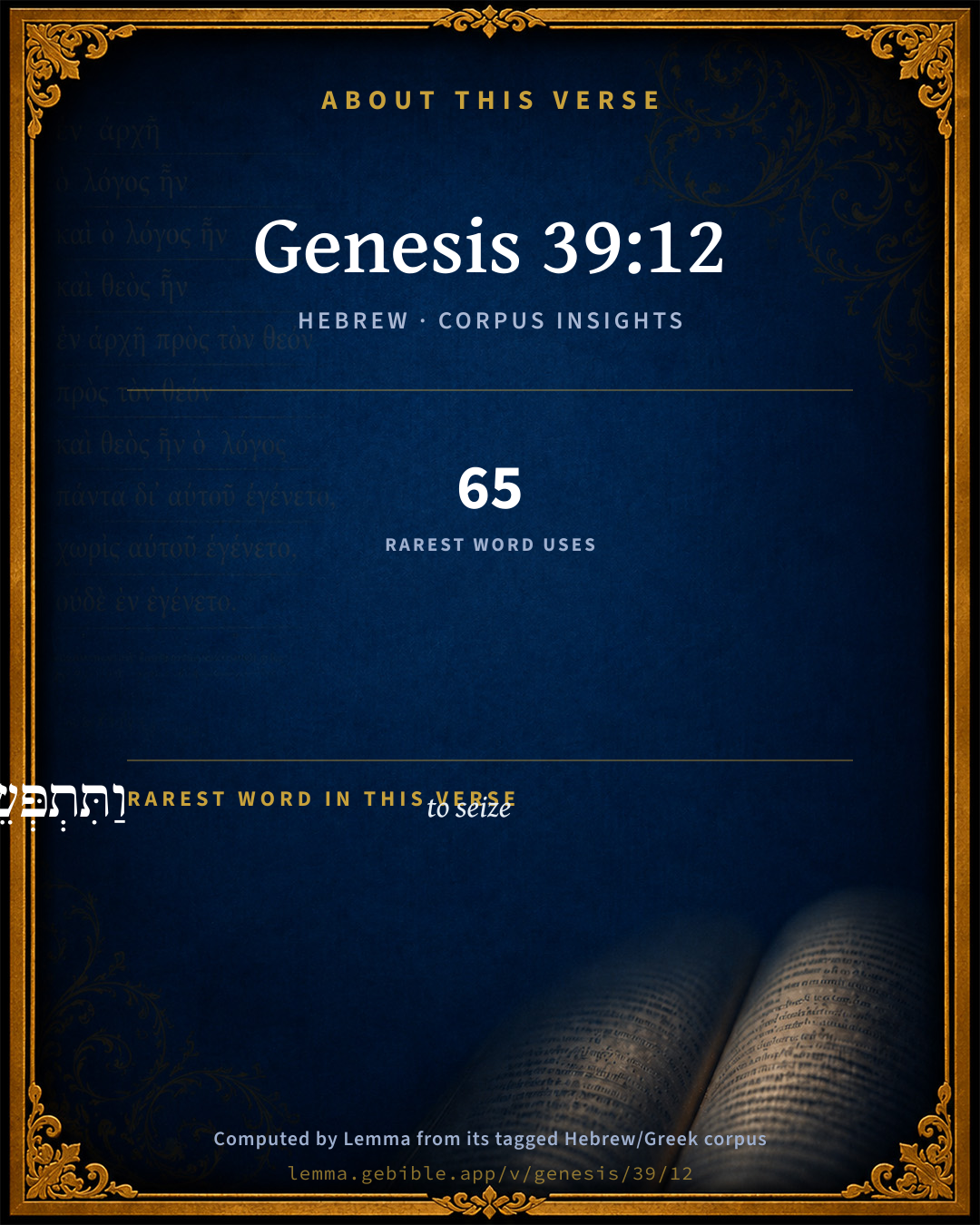
Genesis, in the Pentateuch, opens this verse with 11 words (10 distinct Hebrew lemmas). Its most distinctive word is tâphas (“to seize”). A historical commentator’s framing appears above. Read the whole chapter for the surrounding context.

Discussion questions

  1. The word tâphas carries the sense “to seize.” How does it shape the verse?
  2. How does 2 Timothy 2:22, which shares this passage’s theme, read alongside this verse?
  3. What does the repetition of “garment” (2× in this one verse) do in this verse?
  4. The translations on this page render this verse differently — a whole-verse word diff, not a word-by-word alignment. What might account for the different wordings?
  5. «וַתִּתְפְּשֵׂ֧הוּ» is a Qal Sequential Imperfect verb. How does that grammatical form shape the action described?
  6. Compare how Trapp's Complete Commentary and John Gill's Exposition read this verse. Where do they agree or differ?

Things to notice

Reading settings

Reading text

Shown beneath each verse's original-language words.

Old Testament
Old Testament edition

Read the OT as the Masoretic Hebrew (MT) or the Greek Septuagint (LXX).

English shown for the Greek Septuagint (in the Hebrew ↔ Greek comparison).

Comparing translations? Open the Compare panel on any verse page to stack up to four side by side.