
2 Kings 22:17

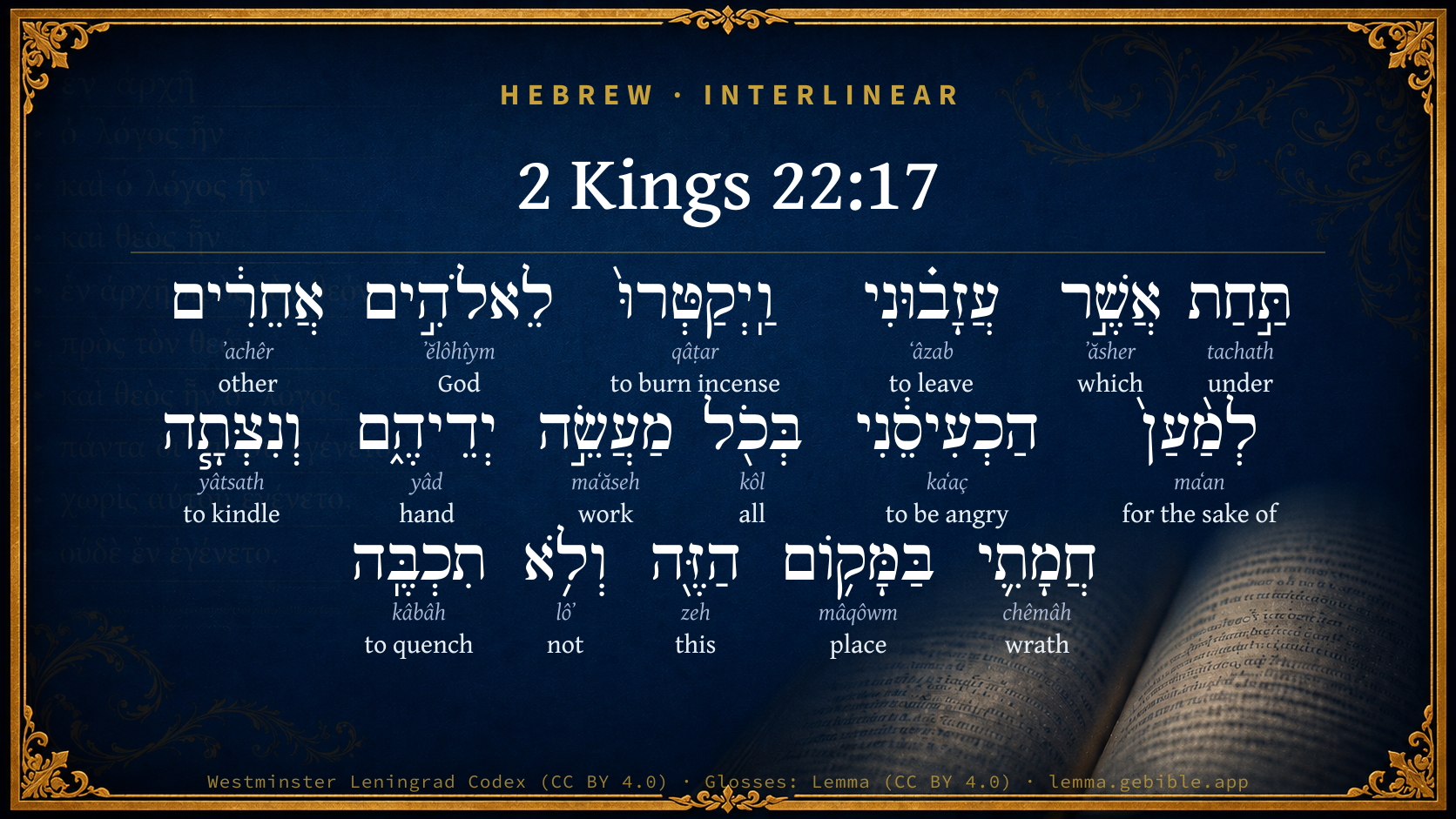
Hebrew (Westminster Leningrad Codex) 2 Kings 22:17 appears in the Hebrew Old Testament. The text above is from the Westminster Leningrad Codex. Each word links to its Strong’s number, a concise gloss, and parsing drawn from the Open Scriptures Hebrew Bible morphology. Click any word for its full Brown-Driver-Briggs (BDB) entry.
Download image
Cite this verse

2 Kings 22:17 (World English Bible). Public Domain. Lemma interlinear Bible study tool, https://lemma.gebible.app/v/2-kings/22/17.

Show BibTeX & RIS
BibTeX
RIS
English Translation
Because they have forsaken me, and have burned incense to other gods, that they might provoke me to anger with all the work of their hands, therefore my wrath shall be kindled against this place, and it shall not be quenched.
World English Bible · Public Domain
Download a study sheet

One document with this verse’s original text, its word-by-word gloss line, the meaning frame, cross-references with their text, attributed commentary, and full source and license credits — printable, and it pastes into notes with its structure intact.

This verse Autodidact and up

Study sheet (.html) Plain text (.txt)

A passage Seminary Student

Up to 50 verses in one chapter. A passage sheet keeps up to 6 commentary sources and 12 cross-references per verse, in the order this page ranks them, and says so on the sheet whenever that leaves anything out. Ask for a single verse and you get the Autodidact verse sheet above.

Everything on this page stays free to read, with no account — the sheet is a download of what is already on screen, not access to it.

Want to remove ads? Support Godless Engineer
Compare translations 3

The same verse in 3 English versions, stacked beneath the original-language interlinear above. Click any original word for its lexicon entry.

Each is an independent rendering of the whole verse — the interlinear is not word-aligned to these translations.

Highlighted words mark where these versions differ — a whole-verse word diff, not a word-by-word alignment.

  • World English Bible Public Domain
    Because they have forsaken me, and have burned incense to other gods, that they might provoke me to anger with all the work of their hands, therefore my wrath shall be kindled against this place, and it shall not be quenched.
  • King James Version Public Domain
    Because they have forsaken me, and have burned incense unto other gods, that they might provoke me to anger with all the works of their hands; therefore my wrath shall be kindled against this place, and shall not be quenched.
  • unfoldingWord Literal Text CC BY-SA 4.0
    because they abandoned me and burned incense to other gods, so that they made me angry by all of the works of their hands. So my heat is kindled against this place, and it will not extinguish.’”’

unfoldingWord Literal Text — © unfoldingWord, licensed CC BY-SA 4.0. Word-aligned USFM3 via Door43 (git.door43.org/unfoldingWord/en_ult).

Versions to compare (up to 4)

3 of 4 selected

Show all 18 translations

Every available English version of this verse, each an independent rendering of the whole verse.

  • World English Bible Public Domain
    Because they have forsaken me, and have burned incense to other gods, that they might provoke me to anger with all the work of their hands, therefore my wrath shall be kindled against this place, and it shall not be quenched.
  • Berean Standard Bible Public Domain
    because they have forsaken Me and burned incense to other gods, that they might provoke Me to anger with all the works of their hands. My wrath will be kindled against this place and will not be quenched.’
  • Majority Standard Bible Public Domain
    because they have forsaken Me and burned incense to other gods, that they might provoke Me to anger with all the works of their hands. My wrath will be kindled against this place and will not be quenched.’
  • King James Version Public Domain
    Because they have forsaken me, and have burned incense unto other gods, that they might provoke me to anger with all the works of their hands; therefore my wrath shall be kindled against this place, and shall not be quenched.
  • American Standard Version (1901) Public Domain
    Because they have forsaken me, and have burned incense unto other gods, that they might provoke me to anger with all the work of their hands, therefore my wrath shall be kindled against this place, and it shall not be quenched.
  • Revised Version (1885) Public Domain
    Because they have forsaken me, and have burned incense unto other gods, that they might provoke me to anger with all the work of their hands; therefore my wrath shall be kindled against this place, and it shall not be quenched.
  • Geneva Bible (1599) Public Domain
    Because they haue forsaken mee, and haue burnt incense vnto other gods, to anger me with all ye works of their hands: my wrath also shalbe kindled against this place and shall not be queched:
  • Douay-Rheims (1899) Public Domain
    Because they have forsaken me, and have sacrificed to strange gods, provoking me by all the works of their hands: therefore my indignation shall be kindled against this place, and shall not be quenched.
  • Young's Literal Translation Public Domain
    because that they have forsaken Me, and make perfume to other gods, so as to provoke Me to anger with every work of their hands, and My wrath hath been kindled against this place, and it is not quenched.
  • Literal Standard Version CC BY-SA 4.0
    because that they have forsaken Me, and make incense to other gods, so as to provoke Me to anger with every work of their hands, and My wrath has been kindled against this place, and it is not quenched.
  • Unlocked Literal Bible CC BY-SA 4.0
    Because they have forsaken me and have burned incense to other gods, so that they might provoke me to anger with all the deeds they have committed—therefore my anger has been kindled against this place, and it will not be extinguished.'”
  • unfoldingWord Literal Text CC BY-SA 4.0
    because they abandoned me and burned incense to other gods, so that they made me angry by all of the works of their hands. So my heat is kindled against this place, and it will not extinguish.’”’
  • Darby Bible Public Domain
    Because they have forsaken me, and have burned incense unto other gods, that they might provoke me to anger with all the work of their hands, therefore my fury is kindled against this place, and shall not be quenched.
  • World Messianic Bible Public Domain
    Because they have forsaken me and have burned incense to other gods, that they might provoke me to anger with all the work of their hands, therefore my wrath shall be kindled against this place, and it will not be quenched.’”
  • Webster's Bible Public Domain
    Because they have forsaken me, and have burned incense to other gods, that they might provoke me to anger with all the works of their hands; therefore my wrath shall be kindled against this place and shall not be quenched.
  • Free Bible Version CC BY-SA 4.0
    They have abandoned me and offered sacrifices to other gods, making me angry by everything they've done. My anger will be poured out upon this place and will not be stopped.
  • Bible in Basic English Public Domain
    Because they have given me up, burning offerings to other gods and moving me to wrath by all the work of their hands; so my wrath will be on fire against this place, and will not be put out.
  • JPS Tanakh (1917) Public Domain
    because they have forsaken Me, and have offered unto other gods, that they might provoke Me with all the work of their hands; therefore My wrath shall be kindled against this place, and it shall not be quenched.

Literal Standard Version (2020), Covenant Press — licensed CC BY-SA 4.0. Text via the HelloAO Bible API (eBible.org). Unlocked Literal Bible (unfoldingWord) — licensed CC BY-SA 4.0. Text via the HelloAO Bible API (eBible.org). unfoldingWord Literal Text — © unfoldingWord, licensed CC BY-SA 4.0. Word-aligned USFM3 via Door43 (git.door43.org/unfoldingWord/en_ult). Free Bible Version, Dr. Jonathan Gallagher — licensed CC BY-SA 4.0. Text via the HelloAO Bible API (eBible.org).

Word by word

More ways to search: Search by grammar → Find every occurrence → Compare this word →

Practice this passage: Drill this verse → Learn its vocabulary →

תִכְבֶּֽה
kâbâh
H3518
“to quench”
Verb, Qal, Imperfect, 3rd Person, Feminine, Singular
Part of Speech
Verb
Stem
Qal
Form
Imperfect
Person
3rd Person
Gender
Feminine
Number
Singular
Full BDB Definition

Origin: a primitive root

TWOT: 944

to quench, put out, be put out, be quenched, be extinguished - (Qal) to be quenched, be extinguished - (Piel) to quench, extinguish
  1. תַּ֣חַת tachath H8478 “under” Preposition
  2. אֲשֶׁ֣ר ʼăsher H834 “which” Particle, Relative
  3. עֲזָב֗וּנִי ʻâzab H5800 “to leave · me” Verb, Qal, Perfect, 3rd Person, Common, Plural + Suffix, Personal, 1st Person, Common, Singular
  4. וַֽיְקַטְּרוּ֙ qâṭar H6999 “and · to burn incense” Conjunction + Verb, Piel, Sequential Imperfect, 3rd Person, Masculine, Plural
  5. לֵאלֹהִ֣ים ʼĕlôhîym H430 “to/for · God(s)” Preposition + Noun, Common, Masculine, Plural, Absolute
  6. אֲחֵרִ֔ים ʼachêr H312 “other” Adjective, Adjective, Masculine, Plural, Absolute
  7. לְמַ֨עַן֙ maʻan H4616 “for the sake of” Preposition
  8. הַכְעִיסֵ֔נִי kaʻaç H3707 “to be angry · me” Verb, Hiphil, Infinitive Construct + Suffix, Personal, 1st Person, Common, Singular
  9. בְּכֹ֖ל kôl H3605 “in/at · all of” Preposition + Noun, Common, Masculine, Singular, Construct
  10. מַעֲשֵׂ֣ה maʻăseh H4639 “work of” Noun, Common, Masculine, Singular, Construct
  11. יְדֵיהֶ֑ם yâd H3027 “hands · their” Noun, Common, Both, Dual, Construct + Suffix, Personal, 3rd Person, Masculine, Plural
  12. וְנִצְּתָ֧ה yâtsath H3341 “and · to kindle” Conjunction + Verb, Niphal, Sequential Perfect, 3rd Person, Feminine, Singular
  13. חֲמָתִ֛י chêmâh H2534 “wrath · my” Noun, Common, Feminine, Singular, Construct + Suffix, Personal, 1st Person, Common, Singular
  14. בַּמָּק֥וֹם mâqôwm H4725 “in/at the · place” Preposition, Determined + Noun, Common, Masculine, Singular, Absolute
  15. הַזֶּ֖ה zeh H2088 “the · this” Particle, Definite Article + Pronoun, Demonstrative, Masculine, Singular
  16. וְלֹ֥א lôʼ H3808 “and · not” Conjunction + Particle, Negative

About this verse

These counts appear in no published source. They are computed here, from the morphology-tagged text and Lemma’s own curated glosses. What Lemma adds →

17
words
17
distinct lemmas
Historical
section

Notable vocabulary

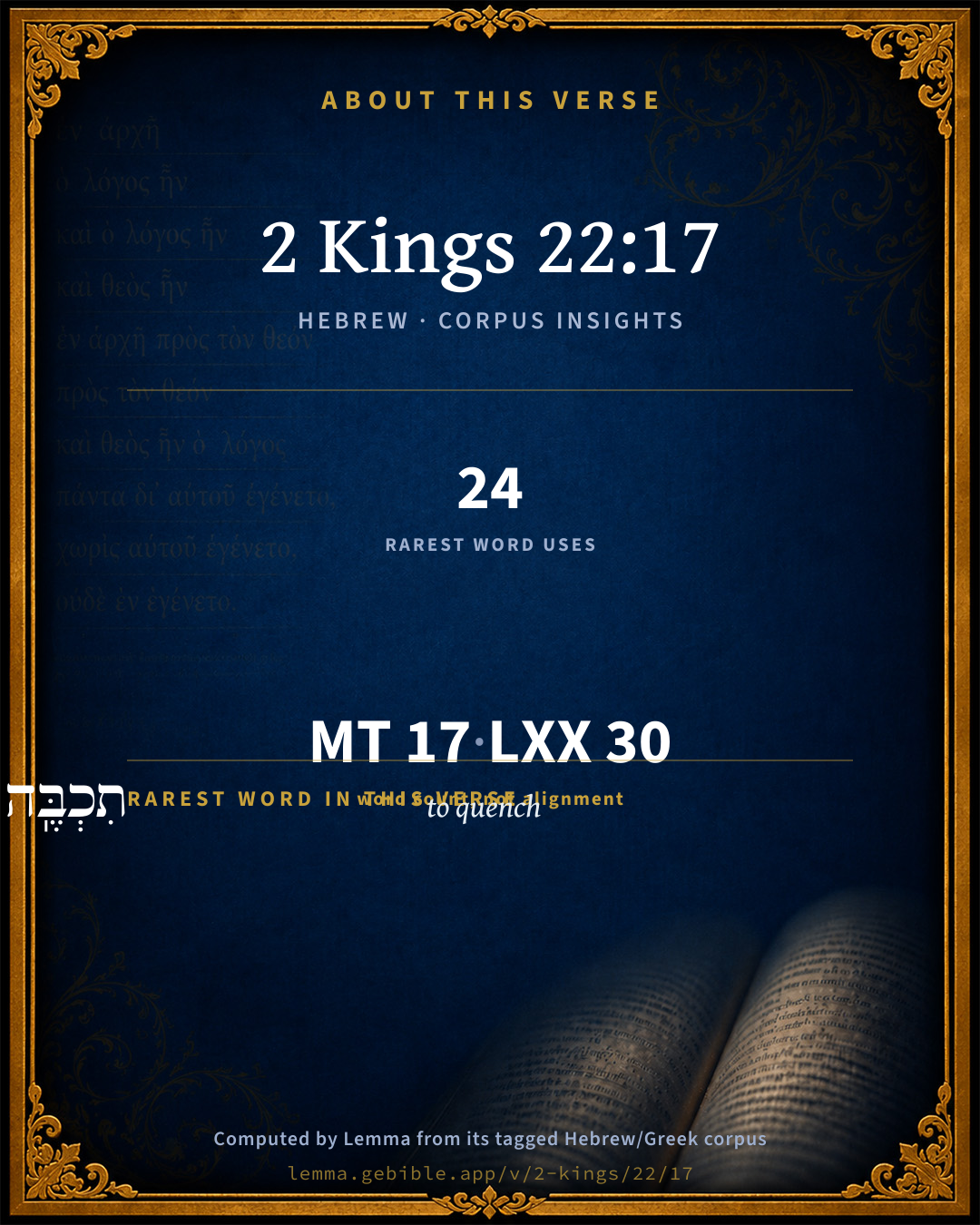
The rarest word here is תִכְבֶּֽה to quench H3518 — appearing just 24 times in the whole Hebrew Bible.

Shared distinctive vocabulary

תִכְבֶּֽה to quench H3518 occurs in 24 verses of the Hebrew Bible. Also found in:

Grammatical profile

  • 5 verbs
  • 6 nouns
  • 1 adjective
  • 1 pronoun
  • 2 prepositions
  • 2 particles

Verb forms

  • עֲזָב֗וּנִי Qal · Perfect
  • וַֽיְקַטְּרוּ֙ Piel · Sequential Imperfect
  • הַכְעִיסֵ֔נִי Hiphil · Infinitive Construct
  • וְנִצְּתָ֧ה Niphal · Sequential Perfect
  • תִכְבֶּֽה Qal · Imperfect

Hebrew & Septuagint length

In English translation the verse runs 41 words from the Hebrew and 36 from the Septuagint (LXX English) — closely comparable.

A rough comparison of the two English renderings, which tokenize alike — not a word-level alignment.

Word counts can differ between the Hebrew and the Greek without any difference in meaning — e.g. the Hebrew direct-object marker אֵת has no separate Greek word, and Greek often adds the article ὁ.

In the original languages it is 17 Hebrew tokens and 30 Greek tokens — but the two are counted differently (Hebrew bundles its prefixes and suffixes into one token; the Greek is in lemma form), so that isn’t a like-for-like length.

Cross-references

26

Topical passages linked to 2 Kings 22:17 in the Treasury of Scripture Knowledge — connected by theme and wording, ordered by reader-vote popularity; previews shown in the World English Bible.

  • 2 Kings 21:22 and he forsook Yahweh, the God of his fathers, and didn't walk in the way of Yahweh.
  • Exodus 32:34 Now go, lead the people to the place of which I have spoken to you. Behold, my angel shall go before you. Nevertheless in the day when I punish, I will punish them for their sin."
  • Deuteronomy 29:24–28 even all the nations shall say, Why has Yahweh done thus to this land? what means the heat of this great anger?
  • Deuteronomy 32:15–19 But Jeshurun grew fat, and kicked: You have grown fat, you are grown thick, you are become sleek; Then he forsook God who made him, Lightly esteemed the Rock of his salvation.
  • Deuteronomy 32:22 For a fire is kindled in my anger, Burns to the lowest Sheol, Devours the earth with its increase, Sets on fire the foundations of the mountains.
  • Judges 2:12–14 and they forsook Yahweh, the God of their fathers, who brought them out of the land of Egypt, and followed other gods, of the gods of the peoples who were round about them, and bowed themselves down to them: and they provoked Yahweh to anger.
  • Judges 3:7–8 The children of Israel did that which was evil in the sight of Yahweh, and forgot Yahweh their God, and served the Baals and the Asheroth.
  • Judges 10:6–7 The children of Israel again did that which was evil in the sight of Yahweh, and served the Baals, and the Ashtaroth, and the gods of Syria, and the gods of Sidon, and the gods of Moab, and the gods of the children of Ammon, and the gods of the Philistines; and they forsook Yahweh, and didn't serve him.
  • Judges 10:10–14 The children of Israel cried to Yahweh, saying, We have sinned against you, even because we have forsaken our God, and have served the Baals.
  • 1 Kings 9:6–9 But if you shall turn away from following me, you or your children, and not keep my commandments and my statutes which I have set before you, but shall go and serve other gods, and worship them;
  • 2 Chronicles 36:16 but they mocked the messengers of God, and despised his words, and scoffed at his prophets, until the wrath of Yahweh arose against his people, until there was no remedy.
  • Nehemiah 9:26–27 Nevertheless they were disobedient, and rebelled against you, and cast your law behind their back, and killed your prophets that testified against them to turn them again to you, and they committed awful blasphemies.
  • Psalms 106:35–42 But mixed themselves with the nations, And learned their works.
  • Psalms 115:4–8 Their idols are silver and gold, The work of men's hands.
  • Isaiah 2:8–9 Their land also is full of idols. They worship the work of their own hands, That which their own fingers have made.
  • Isaiah 33:14 The sinners in Zion are afraid; trembling has seized the godless ones: Who among us can dwell with the devouring fire? who among us can dwell with everlasting burning?
  • Isaiah 44:17–20 The residue of it he makes a god, even his engraved image; he falls down to it and worships, and prays to it, and says, Deliver me; for you are my god.
  • Isaiah 46:5–8 To whom will you liken me, and make me equal, and compare me, that we may be like?
  • Jeremiah 2:11–13 Has a nation changed [its] gods, which yet are no gods? but my people have changed their glory for that which does not profit.
  • Jeremiah 2:27–28 who tell a stock, You are my father; and to a stone, You have brought me forth: for they have turned their back to me, and not their face; but in the time of their trouble they will say, Arise, and save us.
  • Jeremiah 7:20 Therefore thus says the Lord Yahweh: Behold, my anger and my wrath shall be poured out on this place, on man, and on animal, and on the trees of the field, and on the fruit of the ground; and it shall burn, and shall not be quenched.
  • Jeremiah 17:27 But if you will not listen to me to make the Sabbath day holy, and not to bear a burden and enter in at the gates of Jerusalem on the Sabbath day; then will I kindle a fire in the gates of it, and it shall devour the palaces of Jerusalem, and it shall not be quenched.
  • Ezekiel 20:47–48 and tell the forest of the South, Hear the word of Yahweh: Thus says the Lord Yahweh, Behold, I will kindle a fire in you, and it shall devour every green tree in you, and every dry tree: the flaming flame shall not be quenched, and all faces from the south to the north shall be burnt thereby.
  • Micah 5:13 I will cut off your engraved images and your pillars out of your midst; And you shall no more worship the work of your hands.
  • Zephaniah 1:18 Neither their silver nor their gold will be able to deliver them in the day of Yahweh's wrath, but the whole land will be devoured by the fire of his jealousy; for he will make an end, yes, a terrible end, of all those who dwell in the land.
  • 1 Thessalonians 2:16 forbidding us to speak to the Gentiles that they may be saved; to fill up their sins always. But wrath has come on them to the uttermost.

Cross-references courtesy of OpenBible.info (CC BY 4.0).

Hebrew and Greek witnesses Masoretic Hebrew ↔ Greek Septuagint

The same verse in the two great witnesses to the Old Testament, shown verse-for-verse.

These are two independent witnesses, not word-aligned to each other, and the Septuagint is shown in lemma (dictionary) form.

Hebrew 2 Kings 22:17 Masoretic · Westminster Leningrad Codex

תַּ֣חַת אֲשֶׁ֣ר עֲזָב֗וּנִי וַֽיְקַטְּרוּ֙ לֵאלֹהִ֣ים אֲחֵרִ֔ים לְמַ֨עַן֙ הַכְעִיסֵ֔נִי בְּכֹ֖ל מַעֲשֵׂ֣ה יְדֵיהֶ֑ם וְנִצְּתָ֧ה חֲמָתִ֛י בַּמָּק֥וֹם הַזֶּ֖ה וְלֹ֥א תִכְבֶּֽה

Because they have forsaken me, and have burned incense to other gods, that they might provoke me to anger with all the work of their hands, therefore my wrath shall be kindled against this place, and it shall not be quenched.

World English Bible · Public Domain

Greek LXX 2 Kings 22:17 Septuagint · lemma form

ἀντί ὅς ἐν καταλείπω ἐγώ καί θυμιάζω θεός ἕτερος ὅπως παραὀργίζω ἐγώ ἐν ὁ ἔργον ὁ χείρ αὐτός καί ἐκκαίω ὁ θυμός ἐγώ ἐν ὁ τόπος οὗτος καί οὐ σβέννυμι

because they have forsaken me, and burnt incense to other gods, that they might provoke me with the works of their hands: therefore my wrath shall burn forth against this place, and shall not be quenched.

LXX2012 (modern English Septuagint) · Public Domain

Hebrew: Westminster Leningrad Codex (CC BY 4.0). Greek: Septuagint (public domain); English from LXX2012 (modern English Septuagint) (Public Domain). How the Septuagint differs from the Hebrew →

Targum (Aramaic paraphrase)

1

The Targum is the ancient Jewish Aramaic paraphrase of the Hebrew Scriptures — an interpretive translation, not the Hebrew text itself. Onkelos (literal) and Pseudo-Jonathan (expansive) render the Torah, and Jonathan the Prophets. Coverage is partial: where no permissively-licensed English translation exists for a verse, only the Aramaic is shown. This is verse-level text, not a word-by-word alignment to the Hebrew.

  1. Targum Jonathan Prophets (Joshua–Malachi)
    חֲלַף דִשְׁבַקוּ פוּלְחָנִי וַאֲסִיקוּ בוּסְמִין לְטַעֲוַת עַמְמַיָא בְּדִיל לְאַרְגָזָא קֳדָמַי בְּכָל עוֹבְדֵי יְדֵיהוֹן וְיִדְלַק רוּגְזִי בְּאַתְרָא הָדֵין וְלָא יִטְפֵי:

    (no public-domain English translation for this verse)

    Targum Jonathan — Aramaic: “Mikraot Gedolot” (public domain). English: “Sefaria Community Translation” (CC0 1.0 (public-domain dedication)); “London "Chaldee Paraphrase," 1871” (public domain). Text via Sefaria.

Commentary

Notes on 2 Kings 22:17 from classic Christian and Jewish commentators (each source and its license shown beneath its notes). The classic Christian expositions comment on the surrounding passage and are grouped to its opening verse, so a note may address several verses; the Jewish commentaries on the Tanakh (Rashi and others) are per-verse, so they appear only where the commentator wrote on this verse.

Lemma curates 59 commentaries, every one of them public domain or Creative Commons licensed, each selected and text-cleaned for this edition rather than reprinted as found. About our sources →

Trapp's Complete Commentary

John Trapp

2Ki 22:17 Because they have forsaken me, and have burned incense unto other gods, that they might provoke me to anger with all the works of their hands; therefore my wrath shall be kindled against this place, and shall not be quenched.

Ver. 17. Because they have forsaken me.] The reformation they make being but feigned and forced: as appeared by their revolt to idolatry and blood-guiltiness, presently after good Josiah’s death. {2Ki 24:3}

John Trapp, A Commentary or Exposition upon All the Books of the Old and New Testament (1647–1656) — public domain. Text from a community e-Sword module.

Joseph Benson's Commentary

2Ki 22:17. Because they have forsaken me — The God of their fathers, and the only living and true God. And burned incense to other gods — Imaginary beings of their own devising, or the works of their hands —

Gods which they themselves have made. To provoke me to anger — As if they designed this, and worshipped these vanities for no other end but to provoke me; for in so doing they said, in effect, there is as much reason and propriety in worshipping the stock of a tree, as in worshipping Jehovah: and to worship these works of our hands, will be of as much service to us as to worship the author and end of all things! Therefore my wrath shall be kindled against this place — And what is hell itself but the fire of God’s wrath kindled against sinners? Observe the degree and duration of it. It is so kindled, that it shall not be quenched. The decree is gone forth, and it is now too late to think of preventing it; for the iniquity of Jerusalem shall not be purged by sacrifice or offering. Thus hell is unquenchable fire.

Joseph Benson's Commentary on the Old and New Testaments (1811–1818) — public domain. Text from a community e-Sword module.

Geneva Bible (1599)

Geneva Bible translators

The [works] of man’s hand here signify all that man inventeth beside the word of God, which are abominable in God’s service.

Geneva Bible (1599) marginal notes — public domain. Text via Bolls.life.

Adam Clarke's Commentary

Verse 17. My wrath shall be kindled] The decree is gone forth; Jerusalem shall be delivered into the hands of its enemies; the people will revolt more and more; towards them longsuffering is useless; the wrath of God is kindled, and shall not be quenched. This was a dreadful message.

Adam Clarke's Commentary on the Bible (1810–1826) — public domain. Text from a community e-Sword/MySword module.

Ellicott's Commentary for English Readers

(17) With all the works (work) of their hands.—With the idols they have made. See 1Ki_16:7, where the same phrase occurs. (Comp. also Isa_44:9-17; Psa_115:4 seq.).

Shall not be quenched.—Comp. Jer_4:4; Amo_5:6; Isa_1:31.

A Bible Commentary for English Readers, edited by Charles John Ellicott (1878–1897) — public domain. Text from a community e-Sword module.

The Cambridge Bible for Schools and Colleges

gen. ed. J. J. S. Perowne

17. works] R.V. work] of their hands] The Hebrew has the singular.

my wrath shall be kindled against this place and [R.V. adds it] shall not be quenched] The king in verse 13 used the expression ‘wrath of the Lord’. And the same expression is found in Lev_26:28, (though there both A.V. and R.V. have ‘fury’). The language of that book must have been present to the mind of both Josiah and Huldah.

The Cambridge Bible for Schools and Colleges (gen. ed. J. J. S. Perowne; Cambridge University Press, 1878–1918) — public domain. Text from a community e-Sword module.

John Gill's Exposition

Because they have forsaken me,.... My worship, as the Targum; his word and ordinances:

and have burnt incense unto other gods; to Baal, to the host of heaven, and other Heathen deities:

that they might provoke me to anger with all the works of their hands: their idols of wood, stone, gold, and silver, which their hands had made, to worship; than which nothing was more provoking to God:

therefore my wrath shall be kindled against this place, and shall not be quenched; the decree for the destruction of Jerusalem was gone forth, and not to be called back; the execution of it could not be stopped or hindered by cries, prayers, entreaties, or otherwise; this wrath of God was an emblem of the unquenchable fire of hell, Mat 3:12.

John Gill's Exposition of the Whole Bible (1746–1763) — public domain (CC PDM 1.0). Text via the HelloAO Bible API.

Albert Barnes' Notes on the Bible

Have burned incense - In the marginal reference the corresponding phrase is: “have served other gods, and worshipped them.” Its alteration to “have bnrned incense” points to the fact that the favorite existing idolatry was burning incense on the housetops to Baal Jer 19:13; Jer 32:29 and to the host of heaven 2Ki 21:3.

Albert Barnes' Notes on the Bible (1834–1885) — public domain. Text from a community e-Sword/MySword module.

Matthew Poole's English Annotations

The works of their hands; gods made with hands. This she adds to aggravate their folly and contempt of God, in preferring such vain and idle things before him.

Matthew Poole's English Annotations on the Holy Bible (1683–1685) — public domain. Text from a community e-Sword/MySword module.

The Pulpit Commentary

Because they have forsaken me. This was the gist of their offence, the thing that was unpardonable. Against this were all the chief warnings in the Law (Deu_12:19 Deu_29:25-28 Deu_31:16, 17 32:15, etc.) and the prophets (Jud_1:10:13; 1Sa_8:8 1Sa_12:9; 1Ki_9:9 1Ki_11:33 1Ki_18:18; Isa_1:4 Isa_65:11; Jer_1:16 Jer_2:13, etc) It was not merely that they broke the commandments, but they turned from God altogether, and "cast him behind their back." And have burned incense unto other gods (comp. 2Ki_23:5; and see also, Jer_1:18 Jer_7:9 Jer_11:13 Jer_44:19, etc.) that they might provoke me to anger with all the works of their hands; i.e. "with the idols that they have made for themselves" (Keil). (comp. 1Ki_16:7) Therefore my wrath shall be kindled against this placei.e. against Jerusalemand shall not be quenched. Here lies the whole point of the answer. God"s threatenings against nations are for the most part conditional, and may be escaped, or at least their fulfillment may be deferred indefinitely, by repentance, as we learn from the example of Nineveh. (Jon_3:1-10) But if a nation persists long in evil-doing, there comes a time when the sentence can be no longer averted. A real repentance has become impossible, and a mock one does but provoke God the more. For such a state of things there is "no remedy", (2Ch_36:16) and this was the state of things reached by the Jews. God"s anger against them could not be quenched.

The Pulpit Commentary (1880–1919), ed. H.D.M. Spence-Jones & Joseph S. Exell — public domain. Text from a community e-Sword module.

John Wesley's Explanatory Notes

The works - Gods made with hands.

John Wesley, Explanatory Notes Upon the Whole Bible (1754–1765) — public domain. Text via the GEBible commentary corpus.

unfoldingWord translationNotes

Door43 World Missions Community

General Information:

The message Yahweh sent to King Josiah through Huldah, the prophetess, continues.

my anger has been kindled against this place, and it will not be extinguished

Yahweh's anger is spoken of as if it were a fire that was lit. AT: "my anger against this place is like a fire that cannot be put out" (See: Metaphor)

this place

Here "place" represents the people who live in Jerusalem and Judah. AT: "these people" (See: Metonymy)

About the words that you heard

Here "words" represents the message that Huldah just spoke. AT: "About the message that you heard" (See: Metonymy)

because your heart was tender

Here "heart" represents a person's inner being. Feeling sorry is spoken of as if the heart were tender. AT: "because you felt sorry" or "because you repented" (See: Metonymy and Metaphor)

that they would become a desolation and a curse

The abstract nouns "desolation" and "curse" can be stated as an adjective and a verb. AT: "that I would make the land desolate and would curse them" (See: Abstract Nouns)

torn your clothes

This is a symbolic action that indicates intense grief or sadness. (See: Symbolic Action)

this is Yahweh's declaration

Yahweh speaks of himself by name to express the certainty of what he is declaring. See how you translated this in 2 Kings 19:33. AT: "this is what Yahweh has declared" or "this is what I, Yahweh, have declared" (See: First, Second, or Third Person)

translationWords

forsake

incense

false god

anger

works

will of God

heart

humble

desolate

curse

unfoldingWord translationNotes — © Distant Shores Media and the Door43 World Missions Community, licensed CC BY-SA 4.0. Source: git.door43.org/Door43/en_tn.

Lesson kit

Teaching starters — assembled from the data on this page, not authored interpretation. Every prompt links to the verse data it draws on. Edit before teaching.

2 Kings, in the Historical, opens this verse with 17 words (17 distinct Hebrew lemmas). Its most distinctive word is kâbâh (“to quench”). A historical commentator’s framing appears above. Read the whole chapter for the surrounding context.

Discussion questions

  1. How does “to quench” (kâbâh) shape what this verse is saying?
  2. Leviticus 6:12 shares the word «to quench» with this verse. How do the two illuminate each other?
  3. These translations render this verse differently; the difference is in the English rendering, not the original. What questions does that raise?
  4. The verb «עֲזָב֗וּנִי» is Qal Perfect. How does its form color the action?
  5. Reading how Trapp's Complete Commentary and Joseph Benson's Commentary read this verse, where do the two commentators agree and where do they part?

Things to notice

Reading settings

Reading text

Shown beneath each verse's original-language words.

Old Testament
Old Testament edition

Read the OT as the Masoretic Hebrew (MT) or the Greek Septuagint (LXX).

English shown for the Greek Septuagint (in the Hebrew ↔ Greek comparison).

Comparing translations? Open the Compare panel on any verse page to stack up to four side by side.