
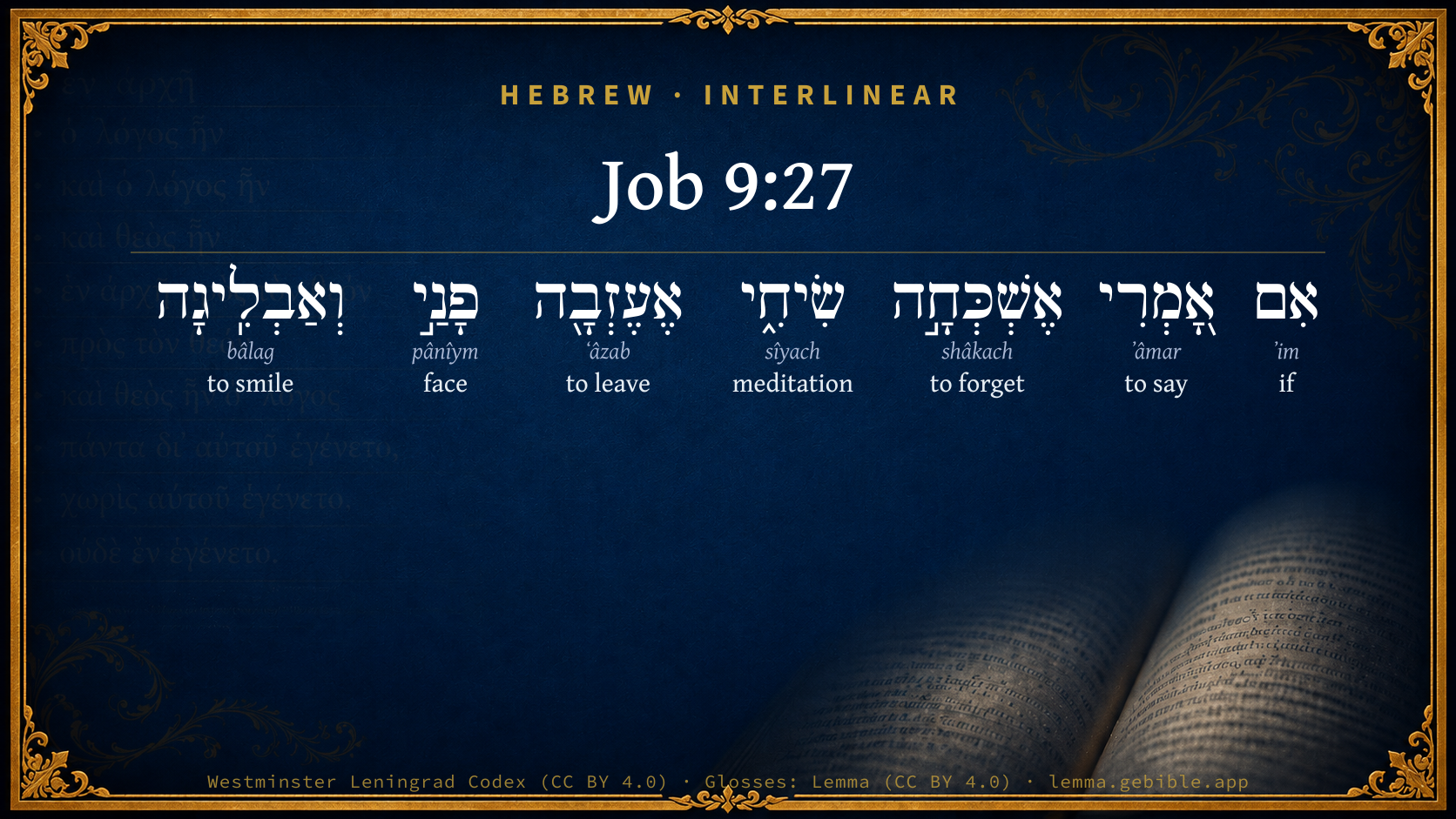
Job 9:27

Hebrew (Westminster Leningrad Codex) Job 9:27 appears in the Hebrew Old Testament. The text above is from the Westminster Leningrad Codex. Each word links to its Strong’s number, a concise gloss, and parsing drawn from the Open Scriptures Hebrew Bible morphology. Click any word for its full Brown-Driver-Briggs (BDB) entry.
Download image
Cite this verse

Job 9:27 (World English Bible). Public Domain. Lemma interlinear Bible study tool, https://lemma.gebible.app/v/job/9/27.

Show BibTeX & RIS
BibTeX
RIS
English Translation
If I say, 'I will forget my complaint, I will put off my sad face, and cheer up;'
World English Bible · Public Domain
Highlights
  • 1 first appearance in the Hebrew Bible
Full analysis ↓
Download a study sheet

One document with this verse’s original text, its word-by-word gloss line, the meaning frame, cross-references with their text, attributed commentary, and full source and license credits — printable, and it pastes into notes with its structure intact.

This verse Autodidact and up

Study sheet (.html) Plain text (.txt)

A passage Seminary Student

Up to 50 verses in one chapter. A passage sheet keeps up to 6 commentary sources and 12 cross-references per verse, in the order this page ranks them, and says so on the sheet whenever that leaves anything out. Ask for a single verse and you get the Autodidact verse sheet above.

Everything on this page stays free to read, with no account — the sheet is a download of what is already on screen, not access to it.

Want to remove ads? Support Godless Engineer
Compare translations 3

The same verse in 3 English versions, stacked beneath the original-language interlinear above. Click any original word for its lexicon entry.

Each is an independent rendering of the whole verse — the interlinear is not word-aligned to these translations.

Highlighted words mark where these versions differ — a whole-verse word diff, not a word-by-word alignment.

  • World English Bible Public Domain
    If I say, 'I will forget my complaint, I will put off my sad face, and cheer up;'
  • King James Version Public Domain
    If I say, I will forget my complaint, I will leave off my heaviness, and comfort myself:
  • unfoldingWord Literal Text CC BY-SA 4.0
    If I said, ‘Let me forget my complaint, let me change my face, let me be cheerful,’

unfoldingWord Literal Text — © unfoldingWord, licensed CC BY-SA 4.0. Word-aligned USFM3 via Door43 (git.door43.org/unfoldingWord/en_ult).

Versions to compare (up to 4)

3 of 4 selected

Show all 18 translations

Every available English version of this verse, each an independent rendering of the whole verse.

  • World English Bible Public Domain
    If I say, 'I will forget my complaint, I will put off my sad face, and cheer up;'
  • Berean Standard Bible Public Domain
    If I were to say, ‘I will forget my complaint and change my expression and smile,’
  • Majority Standard Bible Public Domain
    If I were to say, ‘I will forget my complaint and change my expression and smile,’
  • King James Version Public Domain
    If I say, I will forget my complaint, I will leave off my heaviness, and comfort myself:
  • American Standard Version (1901) Public Domain
    If I say, I will forget my complaint, I will put off my `sad' countenance, and be of good cheer;
  • Revised Version (1885) Public Domain
    If I say, I will forget my complaint, I will put off my sad countenance, and be of good cheer:
  • Geneva Bible (1599) Public Domain
    If I say, I wil forget my complaynt, I will cease from my wrath, and comfort mee,
  • Douay-Rheims (1899) Public Domain
    If I say: I will not speak so: I change my face, and am tormented with sorrow.
  • Young's Literal Translation Public Domain
    Though I say, `I forget my talking, I forsake my corner, and I brighten up!'
  • Literal Standard Version CC BY-SA 4.0
    Though I say, I forget my talking, || I forsake my corner, and I brighten up!
  • Unlocked Literal Bible CC BY-SA 4.0
    If I said that I would forget about my complaints, that I would take off my sad face and be happy,
  • unfoldingWord Literal Text CC BY-SA 4.0
    If I said, ‘Let me forget my complaint, let me change my face, let me be cheerful,’
  • Darby Bible Public Domain
    If I say, I will forget my complaint, I will leave off my [sad] countenance, and brighten up,
  • World Messianic Bible Public Domain
    If I say, ‘I will forget my complaint, I will put off my sad face, and cheer up,’
  • Webster's Bible Public Domain
    If I say, I will forget my complaint, I will leave off my heaviness, and comfort myself:
  • Free Bible Version CC BY-SA 4.0
    If I said to myself, ‘I will forget my complaints; I will stop crying and be happy,’
  • Bible in Basic English Public Domain
    If I say, I will put my grief out of mind, I will let my face be sad no longer and I will be bright;
  • JPS Tanakh (1917) Public Domain
    If I say: 'I will forget my complaint, I will put off my sad countenance, and be of good cheer',

Literal Standard Version (2020), Covenant Press — licensed CC BY-SA 4.0. Text via the HelloAO Bible API (eBible.org). Unlocked Literal Bible (unfoldingWord) — licensed CC BY-SA 4.0. Text via the HelloAO Bible API (eBible.org). unfoldingWord Literal Text — © unfoldingWord, licensed CC BY-SA 4.0. Word-aligned USFM3 via Door43 (git.door43.org/unfoldingWord/en_ult). Free Bible Version, Dr. Jonathan Gallagher — licensed CC BY-SA 4.0. Text via the HelloAO Bible API (eBible.org).

Word by word

More ways to search: Search by grammar → Find every occurrence → Compare this word →

Practice this passage: Drill this verse → Learn its vocabulary →

About this verse

These counts appear in no published source. They are computed here, from the morphology-tagged text and Lemma’s own curated glosses. What Lemma adds →

7
words
7
distinct lemmas
Wisdom
section

Notable vocabulary

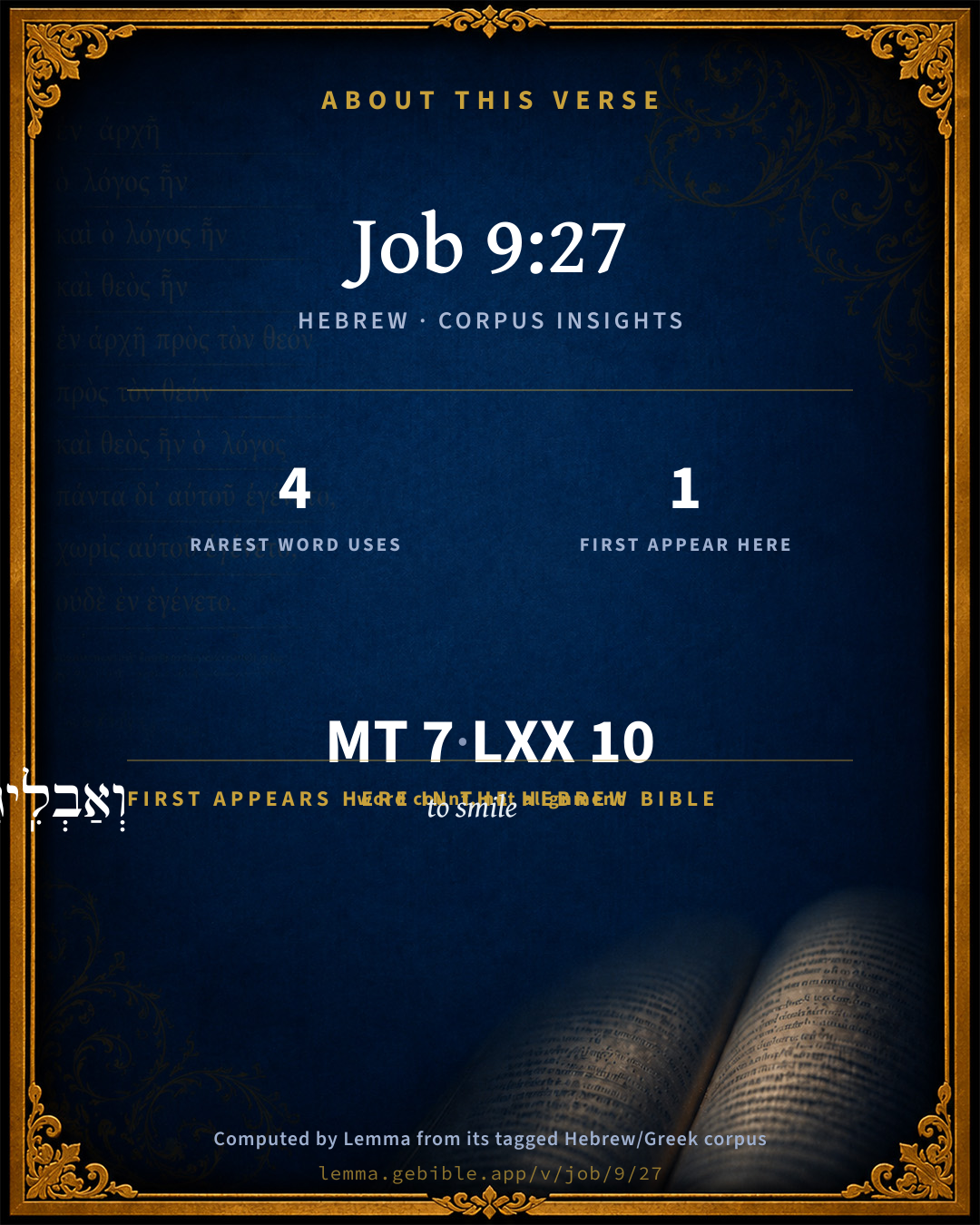
The rarest word here is וְאַבְלִֽיגָה to smile H1082 — appearing just 4 times in the whole Hebrew Bible.

First appearance in Scripture

This word makes its first canonical appearance in the Hebrew Bible here:

  • וְאַבְלִֽיגָה to smile H1082

Shared distinctive vocabulary

וְאַבְלִֽיגָה to smile H1082 occurs in 4 verses of the Hebrew Bible. Also found in:

Grammatical profile

  • 4 verbs
  • 2 nouns
  • 1 conjunction

Verb forms

  • אָ֭מְרִי Qal · Infinitive Construct
  • אֶשְׁכְּחָ֣ה Qal · Cohortative
  • אֶעֶזְבָ֖ה Qal · Cohortative
  • וְאַבְלִֽיגָה Hiphil · Cohortative

Hebrew & Septuagint length

In English translation the verse runs 18 words from the Hebrew and 18 from the Septuagint (LXX English) — the same length.

A rough comparison of the two English renderings, which tokenize alike — not a word-level alignment.

Word counts can differ between the Hebrew and the Greek without any difference in meaning — e.g. the Hebrew direct-object marker אֵת has no separate Greek word, and Greek often adds the article ὁ.

In the original languages it is 7 Hebrew tokens and 10 Greek tokens — but the two are counted differently (Hebrew bundles its prefixes and suffixes into one token; the Greek is in lemma form), so that isn’t a like-for-like length.

Cross-references

4

Topical passages linked to Job 9:27 in the Treasury of Scripture Knowledge — connected by theme and wording, ordered by reader-vote popularity; previews shown in the World English Bible.

  • Job 7:13 When I say, 'My bed shall comfort me, My couch shall ease my complaint;'
  • Job 7:11 "Therefore I will not keep silent. I will speak in the anguish of my spirit. I will complain in the bitterness of my soul.
  • Psalms 77:2–3 In the day of my trouble I sought the Lord. My hand was stretched out in the night, and didn't get tired. My soul refused to be comforted.
  • Jeremiah 8:18 Oh that I could comfort myself against sorrow! my heart is faint within me.

Cross-references courtesy of OpenBible.info (CC BY 4.0).

Hebrew and Greek witnesses Masoretic Hebrew ↔ Greek Septuagint

The same verse in the two great witnesses to the Old Testament, shown verse-for-verse.

These are two independent witnesses, not word-aligned to each other, and the Septuagint is shown in lemma (dictionary) form.

Hebrew Job 9:27 Masoretic · Westminster Leningrad Codex

אִם אָ֭מְרִי אֶשְׁכְּחָ֣ה שִׂיחִ֑י אֶעֶזְבָ֖ה פָנַ֣י וְאַבְלִֽיגָה

If I say, 'I will forget my complaint, I will put off my sad face, and cheer up;'

World English Bible · Public Domain

Greek LXX Job 9:27 Septuagint · lemma form

ἐάν τε γάρ εἶπον ἐπιλανθάνω λαλέω συνκύπτω ὁ πρόσωπον στενάζω

And if I should say, I will forget to speak, I will bow down my face and groan;

LXX2012 (modern English Septuagint) · Public Domain

Hebrew: Westminster Leningrad Codex (CC BY 4.0). Greek: Septuagint (public domain); English from LXX2012 (modern English Septuagint) (Public Domain). How the Septuagint differs from the Hebrew →

Commentary

Notes on Job 9:27 from classic Christian and Jewish commentators (each source and its license shown beneath its notes). The classic Christian expositions comment on the surrounding passage and are grouped to its opening verse, so a note may address several verses; the Jewish commentaries on the Tanakh (Rashi and others) are per-verse, so they appear only where the commentator wrote on this verse.

Lemma curates 59 commentaries, every one of them public domain or Creative Commons licensed, each selected and text-cleaned for this edition rather than reprinted as found. About our sources →

Trapp's Complete Commentary

John Trapp

Job 9:27 If I say, I will forget my complaint, I will leave off my heaviness, and comfort [myself]:

Ver. 27. If I say, I will forget my complaint] And suffer in silence, as thou, Bildad, hast advised me, Job 8:2. Sorrows are not so easily forgotten; Lam 3:19, "Remembering mine affliction and my misery, the wormwood and the gall." The Stoics boasting of their indolence, or ability to bear afflictions without making moan or complaining, when it came to their own turn, found by experience that they had spoken more trimly than truly; and therefore one Dionysius, surnamed Mεταθεμενος, or the Flincher, left for this reason from the Stoics to the Peripatetics.

I will leave off my heaviness] Heb. My face, viz. the sourness that used to sit upon it, as 1Sa 1:18. The Pharisees were vultuosi tetrici inamaeni, Mat 6:16, of a sad and sour countenance, grim and ghastly; they affected to look like Sycthians, as the word signifieth, that they might seem great tasters, when as inwardly they were merry and pleasant. Job’s case was far different; his heart was heavy as lead; nevertheless, to give content to his friends, he would endeavour to look lightsomely, but found a very hard task of it.

And comfort myself] Heb. Strengthen, viz. so as not to make moan, but bite in my pain. Invalidum omne natura querulum, the weaker anything is the more apt it is to complain; and, on the contrary, some men’s flesh will presently rankle and fester, if but razed with a pin only: so some men’s spirits, they are ever whining.

John Trapp, A Commentary or Exposition upon All the Books of the Old and New Testament (1647–1656) — public domain. Text from a community e-Sword module.

The Biblical Illustrator

Joseph S. Exell

Job_9:27-35

If I say, I will forget my complaint.

Concerning Jobs sufferings

I. As too great to render any efforts of self-consolation effective. Three things are suggested.

1. A valuable power of mind. The power to alleviate sufferings. If I say, I will forget my complaint. Herein is the implied power. All have it. It is a remedial force that kind heaven has put within us. If he cannot quench the flame, he can cool it; if he cannot roll off the load, he by his own thoughts can make it comparatively light. He can go into a circle of ideas so engrossing and delectable as to experience transports of rapture in the dungeon or in the flames. What is pain but a mental sensation? And wherever that mental sensation may burn, its fires can be quenched in the river of noble thoughts and lofty aspirations.

2. A natural tendency of mind. What is it? The exertion of this mitigating power within us under suffering; an effort to forget the complaint, to leave off the heaviness, to comfort. Who under suffering does not essay this?

3. A sad defect in mind. I am afraid of all my sorrows; I know that Thou wilt not hold me innocent. Why did his mental efforts at self-consolation fail? Simply because he had not the inner sense of innocence. Though he always maintained that he was innocent of the sin of hypocrisy with which his friends charged him, he always felt that before the Holy he was guilty, and herein was the failure of his mind to mitigate his pain. He regards his sufferings--

II. As too deserved to justify any hope of relief.

1. He feels that no self-cleansing would serve him before God. If I be wicked,--or, as it should be, I am wicked,--why then labour I in vain? If I wash myself with snow water, and make my hands never so clean; yet shalt Thou plunge me in the ditch, and mine own clothes shall abhor me.

2. He feels that there is no one to act as umpire between him and his Maker. Neither is there any daysman betwixt us, that might lay his hand upon us both.

3. He feels that his afflictions were directly from God, and until they were removed there was no hope for him. Let Him take His rod away from me, and let not His fear terrify me; then would I speak, and not fear Him: but it is not so with me. (Homilist.)

The Biblical Illustrator, edited by Joseph S. Exell (c. 1880s–1900s) — public domain. Text from a community e-Sword module.

Joseph Benson's Commentary

Job 9:27-28. If I say, I will forget my complaints, &c. — If I resolve within myself that I will cease complaining, and endeavour to take comfort. I am afraid of all my sorrows — Or, of my pains and griefs: I find all such endeavours vain; for if my griefs be suspended for a time, yet my fears continue. I know that thou wilt not hold me innocent — I plainly perceive that thou, O God, (to whom he makes a sudden address, as he does also Job 9:31,) wilt not clear my innocence by removing those afflictions which make them judge me guilty of some great crime. Words proceeding from despair and impatience.

Joseph Benson's Commentary on the Old and New Testaments (1811–1818) — public domain. Text from a community e-Sword module.

Geneva Bible (1599)

Geneva Bible translators

I think not to fall into these afflictions, but my sorrows bring me to these manifold infirmities, and my conscience condemneth me.

Geneva Bible (1599) marginal notes — public domain. Text via Bolls.life.

Adam Clarke's Commentary

Verse 27. I will forget my complaint] I will forsake or forego my complaining. I will leave off my heaviness. VULGATE, I will change my countenance - force myself to smile, and endeavour to assume the appearance of comfort.

Adam Clarke's Commentary on the Bible (1810–1826) — public domain. Text from a community e-Sword/MySword module.

The Cambridge Bible for Schools and Colleges

gen. ed. J. J. S. Perowne

27. my complaint] i. e. as always, my complaining, ch. Job_7:13.

my heaviness] lit. my faces, my sad mien, 1Sa_1:18.

comfort myself] lit. brighten up, ch. Job_10:20; Psa_39:13. The word in Arab, (balija) means to have a space clear of hair between the eyebrows, hence to have an open, bright countenance. A certain woman described the Prophet (Mohammed) as ablaju’lwajhi, bright in countenance. Then the word came to mean also to be bright, of the dawn or the day.

The Cambridge Bible for Schools and Colleges (gen. ed. J. J. S. Perowne; Cambridge University Press, 1878–1918) — public domain. Text from a community e-Sword module.

John Gill's Exposition

I am afraid of all my sorrows,.... That they would return upon him, and surround him, and overwhelm him, so that he should not be able to stand up against them, or under them; that they would increase and continue with him, and so he should never be released from them:

I know that thou wilt not hold me innocent: a sudden apostrophe to God as near him; the meaning is not, that he was confident that God would not justify him but condemn him in a spiritual sense; Job did not despair of his everlasting salvation, he knew and believed in his living Redeemer; he knew he should be acquitted and justified by his righteousness, and not be condemned with the world; but he was certain of this, as he thought that God would neither "cleanse" (k) him, as some render the word, from the worms his flesh was clad with, and from the filthy boils and ulcers he was covered with; nor clear him so as that he should appear to be innocent in the sight and judgment of his friends; but go on to treat him as if he was a guilty person, by continuing his afflictions on him, even unto death; he had no hope of being freed from them, and so of being cleared from the imputation of his friends, who judged of him by his outward circumstances.

(k) "quod non mundabis me", Montanus, Bolducius, Beza.

John Gill's Exposition of the Whole Bible (1746–1763) — public domain (CC PDM 1.0). Text via the HelloAO Bible API.

Albert Barnes' Notes on the Bible

If I say, I will forget my complaint - If I resolve that I will leave off complaining, and will be more cheerful, I find it all in vain. My fears and sorrows return, and all my efforts to be cheerful are ineffectual

I will leave off my heaviness - The word rendered “my heaviness” here (פני pânam) denotes literally “my face;” and the reference is to the sad and sorrowful countenance which he had. “If I should lay that aside, and endeavor to be cheerful.”

And comfort myself - The word rendered comfort here (בלג bâlag) in Arabic means to be bright, to shine forth; and it would here be better rendered by “brighten up.” We have the same expression still when we say to one who is sad and melancholy, “brighten up; be cheerful.” The meaning is, that Job endeavored to appear pleasant and cheerful, but it was in vain. His sorrows pressed heavily on him, and weighed down his spirits in spite of himself, and made him sad.

Albert Barnes' Notes on the Bible (1834–1885) — public domain. Text from a community e-Sword/MySword module.

Haydock's Catholic Bible Commentary

Sorrow. I cannot entirely repress it. (Calmet) --- The more I strive, (Haydock) the greater is my pain. (Menochius)

George Leo Haydock (1774–1849), Haydock's Catholic Family Bible and Commentary, 1859 edition — public domain. Excludes Psalms (Douay-Rheims chapter numbering differs from Protestant) and Deuterocanonical books (Catholic canon only).

Matthew Poole's English Annotations

If I say; if I resolve within myself.

I will forget my complaints; I will cease complaining.

My heaviness, Heb. mine anger; wherewith Job was charged by his friends, Job 18:4; my angry expressions. And comfort myself; I will endeavour to take comfort.

Matthew Poole's English Annotations on the Holy Bible (1683–1685) — public domain. Text from a community e-Sword/MySword module.

Whedon's Commentary on the Bible

Daniel D. Whedon

27. Heaviness, etc. — Literally, Face, dark looks.

Comfort myself — Look cheerful. The original expresses the brightening up of the countenance by an exquisite metaphor taken from the lighting up of the sky when the clouds are lifted. Psa_39:13.

Daniel D. Whedon (gen. ed.), Commentary on the Old and New Testaments (1874–1909) — public domain. Text from a community e-Sword module.

The Pulpit Commentary

If I say, I will forget my complaint. (comp. above, Job_7:13) Job represents himself as sometimes, for a moment, imagining that he might put aside his load of sorrow by not thinking of it. He tries, and says to himself, "I will forget," etc.; but in vain. The whole mass of his sufferings seems to rise up against him, and make even momentary forgetfulness impossible. I will leave off my heaviness; or, my black looks. And comfort myself. (comp. Job_10:20 and Psa_39:13, where the same verb is rendered "recover strength

The Pulpit Commentary (1880–1919), ed. H.D.M. Spence-Jones & Joseph S. Exell — public domain. Text from a community e-Sword module.

unfoldingWord translationNotes

Door43 World Missions Community

I would forget about my complaints

The abstract noun "complaint" can be translated as the verb "complain." AT: "I would stop complaining" or "I would stop complaining against God" (See: Abstract Nouns)

my complaints

It can be stated clearly whom Job was complaining against. AT: "my complaints against God" (See: Assumed Knowledge and Implicit Information)

I would take off my sad face and be happy

Job's sad face is spoken of here as if it was something that could be removed. AT: "I would stop looking unhappy and smile" (See: Metaphor)

I would be afraid of all my sorrows

Verses 28 and 29 express the consequences if Job does what he says in verse 27. This can be expressed by adding the word "then." AT: "Then I would be afraid of all my sorrows" (See: Connecting Words)

of all my sorrows

The abstract noun "sorrows" can be expressed as a verb. AT: "of everything that hurts me" (See: Abstract Nouns)

I will be condemned

"I will be accused and punished." This can be stated in active form. AT: "God will condemn me" (See: Active or Passive)

why, then, should I try in vain?

Job uses this question to emphasize that he does not think it is of any use trying to get God's attention. The implied information about what Job is trying can be made explicit. AT: "It is of no use to try to get God's attention." (See: Rhetorical Question and Assumed Knowledge and Implicit Information)

translationWords

face

fear

innocent

condemn

vain

unfoldingWord translationNotes — © Distant Shores Media and the Door43 World Missions Community, licensed CC BY-SA 4.0. Source: git.door43.org/Door43/en_tn.

Rashi

Rabbi Shlomo Yitzchaki (Rashi)

my speech The words of my pain.

my anger Heb. פני, lit. my face.

and [I will] restrain myself Heb. ואבליגה, I will strengthen myself, like (Amos 5:9), “Who strengthens (המבליג) the robbed upon the strong.”

Rashi on the Tanakh — English translations: “The Judaica Press complete Tanach with Rashi, translated by A. J. Rosenberg” (CC BY 4.0); “Pentateuch with Rashi's commentary by M. Rosenbaum and A.M. Silbermann, 1929-1934” (public domain); “The Metsudah Tanach series, Lakewood, N.J” (CC BY 4.0); and “The Book of Joshua, Metsudah Publications, 1997” (CC BY 4.0). Text via Sefaria.

Lesson kit

Teaching starters — assembled from the data on this page, not authored interpretation. Every prompt links to the verse data it draws on. Edit before teaching.

Job, in the Wisdom, opens this verse with 7 words (7 distinct Hebrew lemmas). Its most distinctive word is bâlag (“to smile”). A historical commentator’s framing appears above. Read the whole chapter for the surrounding context.

Discussion questions

  1. What does “to smile” (bâlag) contribute to the verse as a whole?
  2. This is the first place “to smile” appears in Scripture (first appears here). What does its debut here establish?
  3. How does Job 10:20, which shares the word «to smile», read alongside this verse?
  4. These translations render this verse differently; the difference is in the English rendering, not the original. What questions does that raise?
  5. «אָ֭מְרִי» is a Qal Infinitive Construct verb. How does that grammatical form shape the action described?
  6. Compare how Trapp's Complete Commentary and The Biblical Illustrator read this verse. Where do they agree or differ?

Things to notice

Reading settings

Reading text

Shown beneath each verse's original-language words.

Old Testament
Old Testament edition

Read the OT as the Masoretic Hebrew (MT) or the Greek Septuagint (LXX).

English shown for the Greek Septuagint (in the Hebrew ↔ Greek comparison).

Comparing translations? Open the Compare panel on any verse page to stack up to four side by side.