
Psalms 38:10

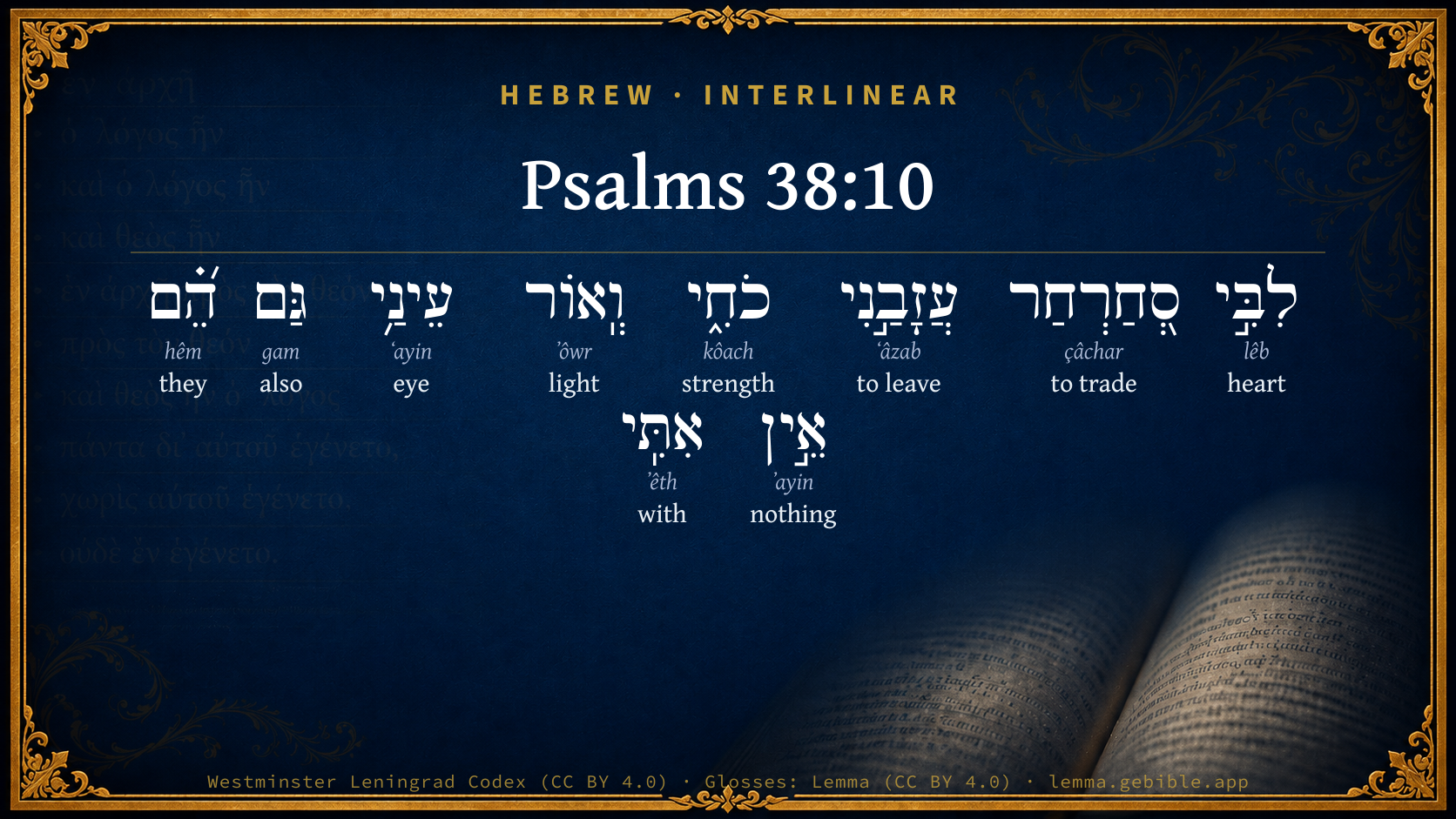
Hebrew (Westminster Leningrad Codex) Psalms 38:10 appears in the Hebrew Old Testament. The text above is from the Westminster Leningrad Codex. Each word links to its Strong’s number, a concise gloss, and parsing drawn from the Open Scriptures Hebrew Bible morphology. Click any word for its full Brown-Driver-Briggs (BDB) entry.
Download image
Cite this verse

Psalms 38:10 (World English Bible). Public Domain. Lemma interlinear Bible study tool, https://lemma.gebible.app/v/psalms/38/10.

Show BibTeX & RIS
BibTeX
RIS
English Translation
My heart throbs. My strength fails me. As for the light of my eyes, it has also left me.
World English Bible · Public Domain
Download a study sheet

One document with this verse’s original text, its word-by-word gloss line, the meaning frame, cross-references with their text, attributed commentary, and full source and license credits — printable, and it pastes into notes with its structure intact.

This verse Autodidact and up

Study sheet (.html) Plain text (.txt)

A passage Seminary Student

Up to 50 verses in one chapter. A passage sheet keeps up to 6 commentary sources and 12 cross-references per verse, in the order this page ranks them, and says so on the sheet whenever that leaves anything out. Ask for a single verse and you get the Autodidact verse sheet above.

Everything on this page stays free to read, with no account — the sheet is a download of what is already on screen, not access to it.

Want to remove ads? Support Godless Engineer
Compare translations 3

The same verse in 3 English versions, stacked beneath the original-language interlinear above. Click any original word for its lexicon entry.

Each is an independent rendering of the whole verse — the interlinear is not word-aligned to these translations.

Highlighted words mark where these versions differ — a whole-verse word diff, not a word-by-word alignment.

  • World English Bible Public Domain
    My heart throbs. My strength fails me. As for the light of my eyes, it has also left me.
  • King James Version Public Domain
    My heart panteth, my strength faileth me: as for the light of mine eyes, it also is gone from me.
  • unfoldingWord Literal Text CC BY-SA 4.0
    My heart pounds; my strength has left me, and the light of my eyes—even they not with me.

unfoldingWord Literal Text — © unfoldingWord, licensed CC BY-SA 4.0. Word-aligned USFM3 via Door43 (git.door43.org/unfoldingWord/en_ult).

Versions to compare (up to 4)

3 of 4 selected

Show all 18 translations

Every available English version of this verse, each an independent rendering of the whole verse.

  • World English Bible Public Domain
    My heart throbs. My strength fails me. As for the light of my eyes, it has also left me.
  • Berean Standard Bible Public Domain
    My heart pounds, my strength fails, and even the light of my eyes has faded.
  • Majority Standard Bible Public Domain
    My heart pounds, my strength fails, and even the light of my eyes has faded.
  • King James Version Public Domain
    My heart panteth, my strength faileth me: as for the light of mine eyes, it also is gone from me.
  • American Standard Version (1901) Public Domain
    My heart throbbeth, my strength faileth me: As for the light of mine eyes, it also is gone from me.
  • Revised Version (1885) Public Domain
    My heart throbbeth, my strength faileth me: as for the light of mine eyes, it also is gone from me.
  • Geneva Bible (1599) Public Domain
    Mine heart panteth: my strength faileth me, and the light of mine eyes, euen they are not mine owne.
  • Douay-Rheims (1899) Public Domain
    Lord, all my desire is before thee, and my groaning is not hidden from thee.
  • Young's Literal Translation Public Domain
    My heart `is' panting, my power hath forsaken me, And the light of mine eyes, Even they are not with me.
  • Literal Standard Version CC BY-SA 4.0
    My heart [is] panting, my power has forsaken me, || And the light of my eyes, || Even they are not with me.
  • Unlocked Literal Bible CC BY-SA 4.0
    My heart pounds, my strength fades, and my eyesight dims.
  • unfoldingWord Literal Text CC BY-SA 4.0
    My heart pounds; my strength has left me, and the light of my eyes—even they not with me.
  • Darby Bible Public Domain
    My heart throbbeth, my strength hath left me; and the light of mine eyes, it also is no more with me.
  • World Messianic Bible Public Domain
    My heart throbs. My strength fails me. As for the light of my eyes, it has also left me.
  • Webster's Bible Public Domain
    \\38:9\\Lord, all my desire is before thee; and my groaning is not hid from thee.
  • Free Bible Version CC BY-SA 4.0
    My heart is racing, leaving me with no strength; my eyesight is failing.
  • Bible in Basic English Public Domain
    My heart goes out in pain, my strength is wasting away; as for the light of my eyes, it is gone from me.
  • JPS Tanakh (1917) Public Domain
    (38-11) My heart fluttereth, my strength faileth me; as for the light of mine eyes, it also is gone from me.

Literal Standard Version (2020), Covenant Press — licensed CC BY-SA 4.0. Text via the HelloAO Bible API (eBible.org). Unlocked Literal Bible (unfoldingWord) — licensed CC BY-SA 4.0. Text via the HelloAO Bible API (eBible.org). unfoldingWord Literal Text — © unfoldingWord, licensed CC BY-SA 4.0. Word-aligned USFM3 via Door43 (git.door43.org/unfoldingWord/en_ult). Free Bible Version, Dr. Jonathan Gallagher — licensed CC BY-SA 4.0. Text via the HelloAO Bible API (eBible.org).

Word by word

More ways to search: Search by grammar → Find every occurrence → Compare this word →

Practice this passage: Drill this verse → Learn its vocabulary →

סְ֭חַרְחַר
çâchar
H5503
“to trade”
Verb, Pealal, Perfect, 3rd Person, Masculine, Singular
Part of Speech
Verb
Stem
Pealal
Form
Perfect
Person
3rd Person
Gender
Masculine
Number
Singular
Full BDB Definition

Origin: a primitive root

TWOT: 1486

to go around, go about, travel about in, go about in trade - (Qal) - to go about to and fro (in business) - trader, trafficker (participle) - (Pilpel) to palpitate
  1. לִבִּ֣י lêb H3820 “heart · my” Noun, Common, Masculine, Singular, Construct + Suffix, Personal, 1st Person, Common, Singular
  2. עֲזָבַ֣נִי ʻâzab H5800 “to leave · me” Verb, Qal, Perfect, 3rd Person, Masculine, Singular + Suffix, Personal, 1st Person, Common, Singular
  3. כֹחִ֑י kôach H3581 “strength · my” Noun, Common, Masculine, Singular, Construct + Suffix, Personal, 1st Person, Common, Singular
  4. וְֽאוֹר ʼôwr H216 “and · light of” Conjunction + Noun, Common, Both, Singular, Construct
  5. עֵינַ֥י ʻayin H5869 “eyes · my” Noun, Common, Both, Dual, Construct + Suffix, Personal, 1st Person, Common, Singular
  6. גַּם gam H1571 “also” Particle, Accusative
  7. הֵ֝֗ם hêm H1992 “they” Pronoun, Personal, 3rd Person, Masculine, Plural
  8. אֵ֣ין ʼayin H369 “nothing” Particle, Negative
  9. אִתִּֽי ʼêth H854 “with · me” Preposition + Suffix, Personal, 1st Person, Common, Singular

About this verse

These counts appear in no published source. They are computed here, from the morphology-tagged text and Lemma’s own curated glosses. What Lemma adds →

10
words
10
distinct lemmas
Wisdom
section

Notable vocabulary

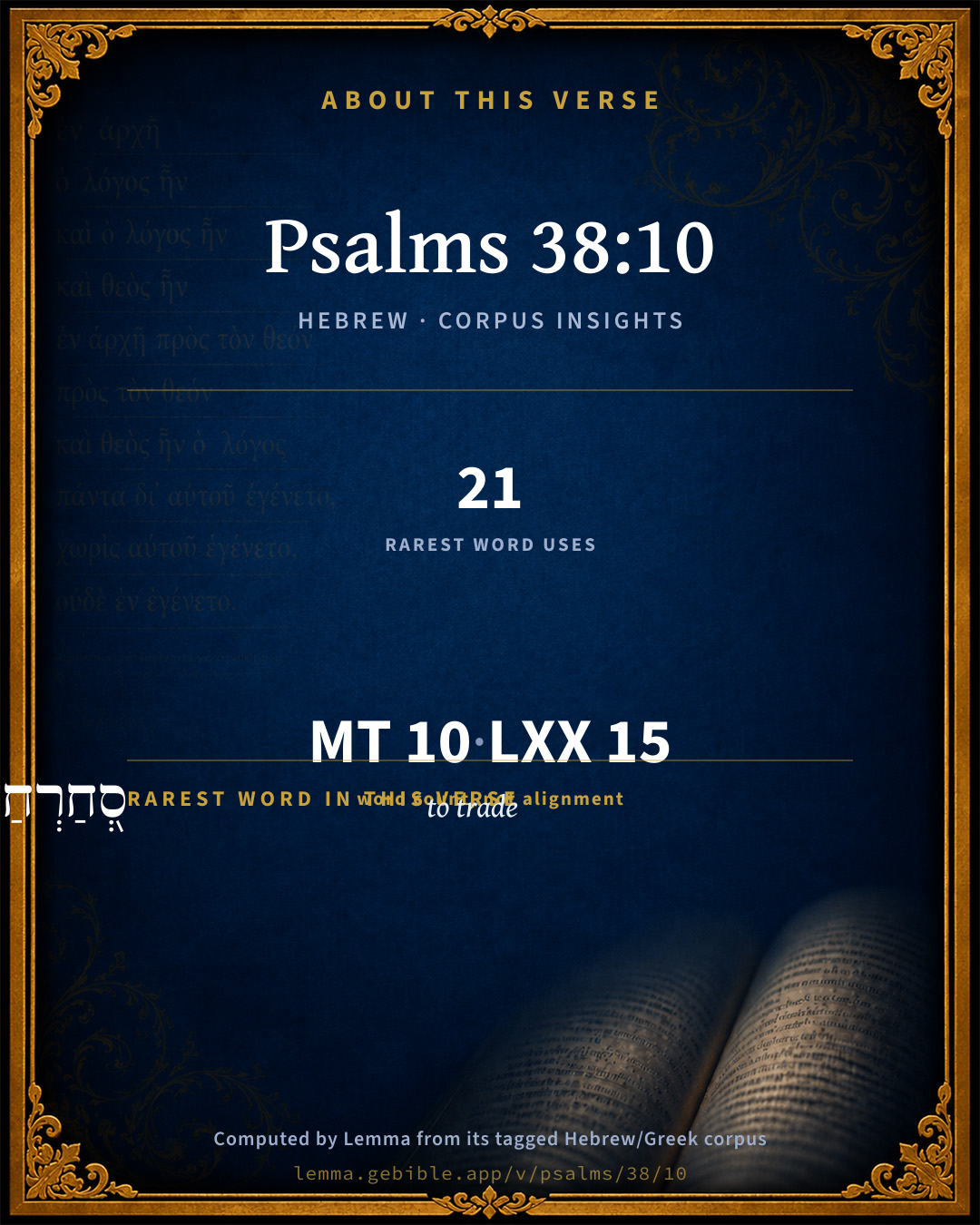
The rarest word here is סְ֭חַרְחַר to trade H5503 — appearing just 21 times in the whole Hebrew Bible.

Shared distinctive vocabulary

סְ֭חַרְחַר to trade H5503 occurs in 20 verses of the Hebrew Bible. Also found in:

Grammatical profile

  • 2 verbs
  • 4 nouns
  • 1 pronoun
  • 1 preposition
  • 2 particles

Verb forms

  • סְ֭חַרְחַר Pealal · Perfect
  • עֲזָבַ֣נִי Qal · Perfect

Hebrew & Septuagint length

In English translation the verse runs 19 words from the Hebrew and 19 from the Septuagint (LXX English) — the same length.

A rough comparison of the two English renderings, which tokenize alike — not a word-level alignment.

Word counts can differ between the Hebrew and the Greek without any difference in meaning — e.g. the Hebrew direct-object marker אֵת has no separate Greek word, and Greek often adds the article ὁ.

In the original languages it is 10 Hebrew tokens and 15 Greek tokens — but the two are counted differently (Hebrew bundles its prefixes and suffixes into one token; the Greek is in lemma form), so that isn’t a like-for-like length.

Cross-references

12

Topical passages linked to Psalms 38:10 in the Treasury of Scripture Knowledge — connected by theme and wording, ordered by reader-vote popularity; previews shown in the World English Bible.

  • Psalms 6:7 My eye wastes away because of grief; It grows old because of all my adversaries.
  • Psalms 88:9 My eyes are dim from grief. I have called on you daily, Yahweh. I have spread out my hands to you.
  • Psalms 69:3 I am weary with my crying. My throat is dry. My eyes fail, looking for my God.
  • Psalms 119:123 My eyes fail looking for your salvation, For your righteous word.
  • Lamentations 5:16–17 The crown is fallen from our head: Woe to us! for we have sinned.
  • 1 Samuel 14:27–29 But Jonathan didn't hear when his father charged the people with the oath: therefore he put forth the end of the rod who was in his hand, and dipped it in the honeycomb, and put his hand to his mouth; and his eyes were enlightened.
  • Psalms 31:10 For my life is spent with sorrow, My years with sighing. My strength fails because of my iniquity. My bones are wasted away.
  • Psalms 42:1 As the deer pants for the water brooks, So my soul pants after you, God.
  • Psalms 119:81–83 My soul faints for your salvation. I hope in your word.
  • Psalms 143:4–7 Therefore my spirit is overwhelmed within me. My heart within me is desolate.
  • Isaiah 21:4 My heart flutters, horror has frightened me; the twilight that I desired has been turned into trembling to me.
  • Lamentations 2:11 My eyes do fail with tears, my heart is troubled; My liver is poured on the earth, because of the destruction of the daughter of my people, Because the young children and the infants swoon in the streets of the city.

Cross-references courtesy of OpenBible.info (CC BY 4.0).

Hebrew and Greek witnesses Masoretic Hebrew ↔ Greek Septuagint

The same verse in the two great witnesses to the Old Testament, shown verse-for-verse.

You’re reading Greek Psalm 37 (Hebrew Psalm 38). The Septuagint counts the superscription, so verse numbers can differ from the Hebrew — chapter-level alignment, not verse-by-verse. Numbering follows Rahlfs.

These are two independent witnesses, not word-aligned to each other, and the Septuagint is shown in lemma (dictionary) form.

Hebrew Psalms 38:10 Masoretic · Westminster Leningrad Codex

לִבִּ֣י סְ֭חַרְחַר עֲזָבַ֣נִי כֹחִ֑י וְֽאוֹר עֵינַ֥י גַּם הֵ֝֗ם אֵ֣ין אִתִּֽי

My heart throbs. My strength fails me. As for the light of my eyes, it has also left me.

World English Bible · Public Domain

Greek LXX Greek Psalm 37:10 Septuagint · lemma form

κύριος ἐναντίον σύ πᾶς ὁ ἐπιθυμία ἐγώ καί ὁ στεναγμός ἐγώ ἀπό σύ οὐ κρύπτω

My heart is troubled, my strength has failed me; and the light of my eyes is not with me.

LXX2012 (modern English Septuagint) · Public Domain

Hebrew: Westminster Leningrad Codex (CC BY 4.0). Greek: Septuagint (public domain); English from LXX2012 (modern English Septuagint) (Public Domain). How the Septuagint differs from the Hebrew →

Commentary

Notes on Psalms 38:10 from classic Christian and Jewish commentators (each source and its license shown beneath its notes). The classic Christian expositions comment on the surrounding passage and are grouped to its opening verse, so a note may address several verses; the Jewish commentaries on the Tanakh (Rashi and others) are per-verse, so they appear only where the commentator wrote on this verse.

Lemma curates 59 commentaries, every one of them public domain or Creative Commons licensed, each selected and text-cleaned for this edition rather than reprinted as found. About our sources →

John Gill's Exposition

My lovers and my friends stand aloof from my sore,.... As if it was a plague sore, lest they should be infected with it; or because they could not bear the stench of his wounds, and the loathsomeness of his disease, or to see him in his agonies, and hear his roaring and his groans, Psa 38:2; or as taking his case to be desperate, as if he was just dying, and no help could be given him, Psa 38:10; If it was the leprosy, as some Jewish writers have affirmed, the word translated "sore", being used for the plague of the leprosy, they were obliged by the ceremonial law to keep at a distance from him: but this rather seems to be voluntary, and to proceed from neglect and contempt. These "lovers" and "friends" were such for whom David had had an affection, and had been friendly to, and therefore it was ungrateful in them to act the part they did; and such who had pretended love and friendship to him in his health and prosperity, but now had deserted him, which is a common case; see Job 19:13. Afflictions try men's friends; and as that is a time when friendly visits are most wanting and most useful, so it is an aggravation of the affliction, and makes it the heavier when such are denied;

and my kinsmen stand afar off; that were near to him by the ties of nature or friendship.

John Gill's Exposition of the Whole Bible (1746–1763) — public domain (CC PDM 1.0). Text via the HelloAO Bible API.

Trapp's Complete Commentary

John Trapp

Psa 38:10 My heart panteth, my strength faileth me: as for the light of mine eyes, it also is gone from me.

Ver. 10. My heart panteth] Heb. runneth about, or is tossed to and fro, circuivit cor meum, inordinate movetur, et non quiescit, saith Aben Ezra. The Hebrew word signifieth such a kind of motion as that of merchants, who run up and down from one country to another. Also the two last radicals are doubled; to note that it is more than an ordinary stirring and motion of the spirit, because it is not come to its rest. All earthly things to the soul are but as the air to the stone; can give it no stay till it come to God, the centre. As the circle is the most perfect figure, because it beginneth and endeth, the points do meet together, as (mathematicians give the reason) the last point meeteth in the first, from whence it came. So shall we never come to perfection or satisfaction (saith the reverend man) till our souls come to God, till God make the circle meet, &c. The wicked walk the round from one creature to another, Psa 12:8, but they come not at God; and hence they are so dissatisfied. Return to thy rest (Heb. rests), saith David to his soul, that is, to God, to whom he here maketh his moan. Miser animus in varias subinde partes abreptus me deserit.

As for the light of mine eyes] That lumen ami cum of mine eyes is almost quite benighted.

John Trapp, A Commentary or Exposition upon All the Books of the Old and New Testament (1647–1656) — public domain. Text from a community e-Sword module.

J. A. Alexander on Psalms

Joseph Addison Alexander

11. (Psa 38:10). My heart pants (or palpitates); my strength has left (or failed) me; and the light of my eyes—even they are not with me. Here begins his second complaint or compassionate description of his sufferings, in which those arising from the conduct of others are made prominent. In this introductory verse, however, he describes the effect upon his own feelings, before proceeding to declare the cause. The palpitation of the heart, denoting violent agitation, is combined with loss of strength and,that dimness of the eyes, so often mentioned as a sign of extreme weakness. See above, on Psa 13:4 (3), and compare Psa 6:8 (7), Psa 31:10 (9), Psa 40:13 (12). The last clause admits of two grammatical constructions. 1. "My strength has failed me, and (so has) the light of my eyes; even they are not with me." 2. "(As to) the light of my eyes, even they are not with me." The first agrees best with our idiom, and the last with the masoretic interpunction, which separates the light of my eyes from the preceding verb and noun by a pause accent.—Even they, literally, they too.—"Not only is my strength gone, but my eye-sight likewise, but my very eyes."—Not with me, not in my possession, not at my command, gone from me. For a similar expression, see above, on Psa 12:5 (4).—The preterites in the first clause represent the palpitation and debility as something of long standing, or at least as fully experienced already.

Joseph Addison Alexander, The Psalms Translated and Explained (1850) — public domain. Text from a community e-Sword module.

Geneva Bible (1599)

Geneva Bible translators

Hebrew, runneth about, or, is tossed to and fro, meaning, that he was destitute of all help and counsel.

My sight faileth me for very sorrow.

Geneva Bible (1599) marginal notes — public domain. Text via Bolls.life.

Jamieson, Fausset & Brown

Robert Jamieson, A. R. Fausset & David Brown

My heart panteth--as if barely surviving.

light . . . from me--utter exhaustion (Psa 6:7; Psa 13:3).

Jamieson, Fausset & Brown — Commentary Critical and Explanatory on the Whole Bible (1871) — public domain (CC PDM 1.0). Text via the HelloAO Bible API.

Adam Clarke's Commentary

Verse 10. My heart panteth] סחרחר secharchar, flutters, palpitates, through fear and alarm.

My strength faileth] Not being able to take nourishment.

The light of mine eyes - is gone] I can scarcely discern any thing through the general decay of my health and vigour, particularly affecting my sight.

Adam Clarke's Commentary on the Bible (1810–1826) — public domain. Text from a community e-Sword/MySword module.

John Calvin's Commentaries

10 My heart hath turned round The verb which David here uses signifies to travel or wander hither and thither; but here it is taken for the agitation or disquietude which distress of heart engenders when we know not what to do. According as men are disquieted in mind, so do they turn themselves on all sides, and so their heart may be said to turn round, or to run to and fro. But since faith, when it has once brought us into obedience to God, holds our minds fixed on his word, it might here be asked by way of objection, How it is that the heart of David was so affected by disquietude and trouble? To this I answer, That although he continued to walk in the ways of God, while he was sustained by the promises of God, yet he was not altogether exempted from human infirmity. And, indeed, it will always happen, that as soon as we fall into some danger, our flesh will suggest to us various shifts and devices, and lead us into many errors in search of counsel; so that even the most confident would fail and go astray, unless he laid upon himself the same restraint by which David was preserved and kept in subjection, namely, by keeping all his thoughts shut up within the limits of God’s word. Nay, even in the prayers which we offer up when our minds are at ease, we experience too well how easily our minds are carried away, and wander after vain and frivolous thoughts, and how difficult it is to keep them uninterruptedly attentive and fixed with the same degree of intensity upon the object of our desire. If this happen when we are not exercised by any severe trial, what will be the case when we are agitated by violent storms and tempests which threaten a thousand deaths, and when there is no way to escape them? It is, therefore, no great wonder if they carried away the heart of David, so that it was subject to various emotions amidst such tempestuous agitations. He adds, that his strength had failed him, as if he had compared himself to a dead man. What he adds concerning the light of his eyes some understand as if he had said, that he was so much oppressed with despair on all sides, that no counsel or foresight was left to him. The more simple meaning, however, is, that the light of life was taken away from him, because in it the energy of the soul principally shows itself.

John Calvin's Commentaries (1540-1563) — public domain. Text from the Calvin Translation Society English edition (1840s-50s) via the Christian Classics Ethereal Library (ccel.org). Calvin's coverage is partial (roughly two-thirds of the Bible); uncommented books and verses are honest gaps, never fabricated. The 19th-century editor's footnotes and remarks are omitted so the notes are faithfully Calvin's own voice.

Ellicott's Commentary for English Readers

(10) Panteth.—Better, palpitates. The Hebrew word, like palpitate, expresses the beating of the heart, by its sound, secharchar.

A Bible Commentary for English Readers, edited by Charles John Ellicott (1878–1897) — public domain. Text from a community e-Sword module.

The Cambridge Bible for Schools and Colleges

gen. ed. J. J. S. Perowne

10. panteth] R.V. excellently, throbbeth.

as for the light of mine eyes &c.] His eyes are dim and dull with weakness and weeping. Cp. Psa_6:7; Psa_13:3, note; Psa_31:9; Job_17:7; Lam_2:11.

The Cambridge Bible for Schools and Colleges (gen. ed. J. J. S. Perowne; Cambridge University Press, 1878–1918) — public domain. Text from a community e-Sword module.

Albert Barnes' Notes on the Bible

My heart panteth - The word rendered “panteth,” in its original form, means properly to go about; to travel around; and then, to travel around as a merchant or pedlar, or for purposes of traffic: Gen 23:16; Gen 37:28; Gen 42:34. Applied to the heart, as it is here, it means to move about rapidly; to palpitate; to beat quick. It is an expression of pain and distress, indicated by a rapid beating of the heart.

My strength faileth me - It is rapidly failing. He regarded himself as rapidly approaching death.

As for the light of mine eyes - My vision; my sight.

It also is gone from me - Margin, as in Hebrew: “is not with me.” This is usually an indication of approaching death; and it would seem from all these symptoms that he appeared to be drawing near to the end of life. Compare Psa 13:3; Psa 6:7; Psa 31:9.

Albert Barnes' Notes on the Bible (1834–1885) — public domain. Text from a community e-Sword/MySword module.

Matthew Poole's English Annotations

Panteth; or, goes round; wanders hither and thither, as the word signifies; is perplexed and tossed with many and various thoughts, not knowing what to do, nor whither to go. Mine eyes are grown dim; either through grief and tears, as Psa 6:7; or through weakness, as 1Sa 14:28,29.

Matthew Poole's English Annotations on the Holy Bible (1683–1685) — public domain. Text from a community e-Sword/MySword module.

The Treasury of David

Charles H. Spurgeon

Ver. 10. My heart panteth. Here begins another tale of woe. He was so dreadfully pained by the unkindness of friends, that his heart was in a state of perpetual palpitation. Sharp and quick were the beatings of his heart; he was like a hunted roe, filled with distressing alarms, and ready to fly out of itself with fear. The soul seeks sympathy in sorrow, and if it finds none, its sorrowful heart throbs are incessant. My strength faileth me. What with disease and distraction, he was weakened and ready to expire. A sense of sin, and a clear perception that none can help us in our distress, are enough to bring a man to death's door, especially if there be none to speak a gentle word, and point the broken spirit to the beloved Physician. As for the light of mine eyes, it also is gone from me. Sweet light departed from his bodily eye, and consolation vanished from his soul. Those who were the very light of his eyes forsook him. Hope, the last lamp of night, was ready to go out. What a plight was the poor convict in! Yet here, we have some of us been; and here should we have perished had not infinite mercy interposed. Now, as we remember the lovingkindness of the Lord, we see how good it was for us to find our own strength fail us, since it drove us to the strong for strength; and how right it was that our light should all be quenched, that the Lord's light should be all in all to us.

Ver. 10. My heart panteth. The verb which David here uses signifies to travel or wander hither and thither, but here it is taken for the agitation or disquietude which distress of heart engenders when we know not what to do. According as men are disquieted in mind, so do they turn themselves on all sides; and so their heart may be said to turn round, or to run to and fro. John Calvin.

None.

Psalms 38:11*

Charles H. Spurgeon's The Treasury of David (1869–1885) — public domain. Psalms only. Text from a community e-Sword/MySword module.

Whedon's Commentary on the Bible

Daniel D. Whedon

10. My heart panteth—Palpitates violently, as in high fever-heat.

Light of mine eyes… is gone—The failing of sight by the force of sorrow and by exhaustion is complained of by Job_17:7. In this extremity David commits his cause to God only.

Daniel D. Whedon (gen. ed.), Commentary on the Old and New Testaments (1874–1909) — public domain. Text from a community e-Sword module.

The Pulpit Commentary

My heart panteth. This verse, which reverts to the bodily sufferings, seems a little out of place. But Hebrew poetry is not logical, and cares little for exact arrangement. Three more bodily troubles are noticed, of which this is the first the heart "pants," i.e. throbs, or palpitates violently. My strength faileth me. The strength suddenly fails. As for the light of mine eyes, it also is gone from me. The sight swims, and is swallowed up in darkness. (comp. Job_17:7)

The Pulpit Commentary (1880–1919), ed. H.D.M. Spence-Jones & Joseph S. Exell — public domain. Text from a community e-Sword module.

Rashi

Rabbi Shlomo Yitzchaki (Rashi)

all my desire You know my needs.

Rashi on the Tanakh — English translations: “The Judaica Press complete Tanach with Rashi, translated by A. J. Rosenberg” (CC BY 4.0); “Pentateuch with Rashi's commentary by M. Rosenbaum and A.M. Silbermann, 1929-1934” (public domain); “The Metsudah Tanach series, Lakewood, N.J” (CC BY 4.0); and “The Book of Joshua, Metsudah Publications, 1997” (CC BY 4.0). Text via Sefaria.

Lesson kit

Teaching starters — assembled from the data on this page, not authored interpretation. Every prompt links to the verse data it draws on. Edit before teaching.

Psalms, in the Wisdom, opens this verse with 10 words (10 distinct Hebrew lemmas). Its most distinctive word is çâchar (“to trade”). A historical commentator’s framing appears above. Read the whole chapter for the surrounding context.

Discussion questions

  1. How does “to trade” (çâchar) shape what this verse is saying?
  2. Genesis 23:16 shares the word «to trade» with this verse. How do the two illuminate each other?
  3. These translations render this verse differently. What is at stake in choosing one wording over another?
  4. The verb «סְ֭חַרְחַר» is Pealal Perfect. How does its form color the action?
  5. Reading how John Gill's Exposition and Trapp's Complete Commentary read this verse, where do the two commentators agree and where do they part?

Things to notice

Reading settings

Reading text

Shown beneath each verse's original-language words.

Old Testament
Old Testament edition

Read the OT as the Masoretic Hebrew (MT) or the Greek Septuagint (LXX).

English shown for the Greek Septuagint (in the Hebrew ↔ Greek comparison).

Comparing translations? Open the Compare panel on any verse page to stack up to four side by side.