Psalms 71:18

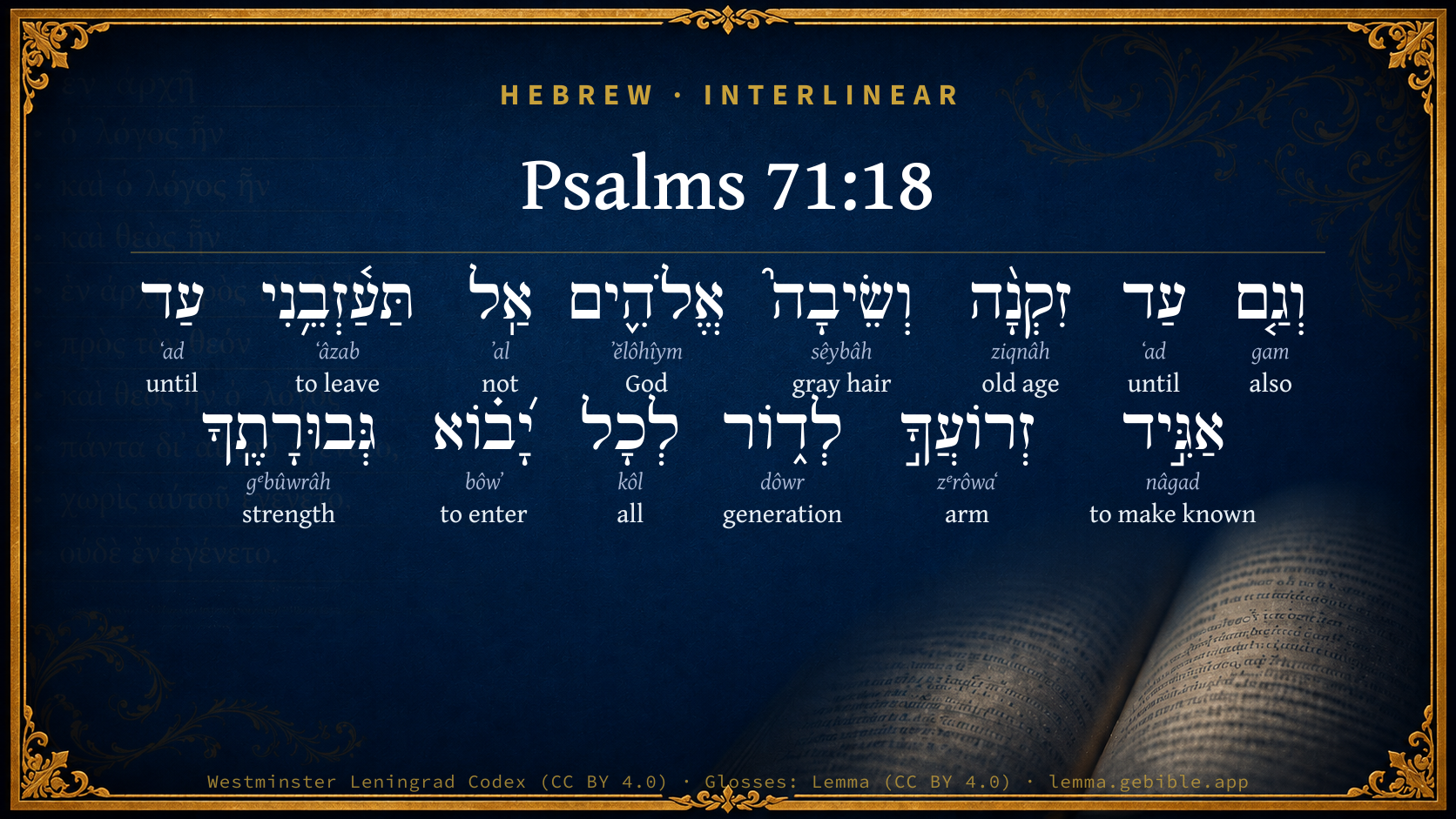
Hebrew (Westminster Leningrad Codex) Psalms 71:18 appears in the Hebrew Old Testament. The text above is from the Westminster Leningrad Codex. Each word links to its Strong’s number, a concise gloss, and parsing drawn from the Open Scriptures Hebrew Bible morphology. Click any word for its full Brown-Driver-Briggs (BDB) entry.
Download image
Cite this verse

Psalms 71:18 (World English Bible). Public Domain. Lemma interlinear Bible study tool, https://lemma.gebible.app/v/psalms/71/18.

Show BibTeX & RIS
BibTeX
RIS
English Translation
Yes, even when I am old and gray-haired, God, don't forsake me, Until I have declared your strength to the next generation, Your might to everyone who is to come.
World English Bible · Public Domain
Download a study sheet

One document with this verse’s original text, its word-by-word gloss line, the meaning frame, cross-references with their text, attributed commentary, and full source and license credits — printable, and it pastes into notes with its structure intact.

This verse Autodidact and up

Study sheet (.html) Plain text (.txt)

A passage Seminary Student

Up to 50 verses in one chapter. A passage sheet keeps up to 6 commentary sources and 12 cross-references per verse, in the order this page ranks them, and says so on the sheet whenever that leaves anything out. Ask for a single verse and you get the Autodidact verse sheet above.

Everything on this page stays free to read, with no account — the sheet is a download of what is already on screen, not access to it.

Want to remove ads? Support Godless Engineer
Compare translations 3

The same verse in 3 English versions, stacked beneath the original-language interlinear above. Click any original word for its lexicon entry.

Each is an independent rendering of the whole verse — the interlinear is not word-aligned to these translations.

Highlighted words mark where these versions differ — a whole-verse word diff, not a word-by-word alignment.

  • World English Bible Public Domain
    Yes, even when I am old and gray-haired, God, don't forsake me, Until I have declared your strength to the next generation, Your might to everyone who is to come.
  • King James Version Public Domain
    Now also when I am old and greyheaded, O God, forsake me not; until I have shewed thy strength unto this generation, and thy power to every one that is to come.
  • unfoldingWord Literal Text CC BY-SA 4.0
    And also until old age and gray hair, God, do not forsake me, until I declare your arm to a generation, your might to everyone will come.

unfoldingWord Literal Text — © unfoldingWord, licensed CC BY-SA 4.0. Word-aligned USFM3 via Door43 (git.door43.org/unfoldingWord/en_ult).

Versions to compare (up to 4)

3 of 4 selected

Show all 18 translations

Every available English version of this verse, each an independent rendering of the whole verse.

  • World English Bible Public Domain
    Yes, even when I am old and gray-haired, God, don't forsake me, Until I have declared your strength to the next generation, Your might to everyone who is to come.
  • Berean Standard Bible Public Domain
    Even when I am old and gray, do not forsake me, O God, until I proclaim Your power to the next generation, Your might to all who are to come.
  • Majority Standard Bible Public Domain
    Even when I am old and gray, do not forsake me, O God, until I proclaim Your power to the next generation, Your might to all who are to come.
  • King James Version Public Domain
    Now also when I am old and greyheaded, O God, forsake me not; until I have shewed thy strength unto this generation, and thy power to every one that is to come.
  • American Standard Version (1901) Public Domain
    Yea, even when I am old and grayheaded, O God, forsake me not, Until I have declared thy strength unto `the next' generation, Thy might to every one that is to come.
  • Revised Version (1885) Public Domain
    Yea, even when I am old and grayheaded, O God, forsake me not; until I have declared thy strength unto the next generation, thy might to every one that is to come.
  • Geneva Bible (1599) Public Domain
    Yea, euen vnto mine olde age and graie head, O God: forsake me not, vntill I haue declared thine arme vnto this generation, and thy power to all them, that shall come.
  • Douay-Rheims (1899) Public Domain
    And unto old age and grey hairs: O God, forsake me not, Until I shew forth thy arm to all the generation that is to come: Thy power,
  • Young's Literal Translation Public Domain
    And also unto old age and grey hairs, O God, forsake me not, Till I declare Thy strength to a generation, To every one that cometh Thy might.
  • Literal Standard Version CC BY-SA 4.0
    And also to old age and grey hairs, || O God, do not forsake me, || Until I declare Your strength to a generation, || Your might to everyone that comes.
  • Unlocked Literal Bible CC BY-SA 4.0
    Indeed, even when I am old and gray-headed, God, do not forsake me, as I have been declaring your strength to the next generation, your power to everyone who is to come.
  • unfoldingWord Literal Text CC BY-SA 4.0
    And also until old age and gray hair, God, do not forsake me, until I declare your arm to a generation, your might to everyone will come.
  • Darby Bible Public Domain
    Now also, when I am old and greyheaded, O God, forsake me not, until I have proclaimed thine arm unto [this] generation, thy might to every one that is to come.
  • World Messianic Bible Public Domain
    Yes, even when I am old and gray-haired, God, don’t forsake me, until I have declared your strength to the next generation, your might to everyone who is to come.
  • Webster's Bible Public Domain
    Now also when I am old and gray-headed, O God, forsake me not; until I have shown thy strength to this generation, and thy power to every one that is to come.
  • Free Bible Version CC BY-SA 4.0
    Even though I'm old and gray, please don't abandon me, God. Let me tell the new generation about your power. Let me explain to all who are to come the great things you do.
  • Bible in Basic English Public Domain
    Now when I am old and grey-headed, O God, give me not up; till I have made clear your strength to this generation, and your power to all those to come.
  • JPS Tanakh (1917) Public Domain
    And even unto old age and hoary hairs, O God, forsake me not; until I have declared Thy strength unto the next generation, Thy might to every one that is to come.

Literal Standard Version (2020), Covenant Press — licensed CC BY-SA 4.0. Text via the HelloAO Bible API (eBible.org). Unlocked Literal Bible (unfoldingWord) — licensed CC BY-SA 4.0. Text via the HelloAO Bible API (eBible.org). unfoldingWord Literal Text — © unfoldingWord, licensed CC BY-SA 4.0. Word-aligned USFM3 via Door43 (git.door43.org/unfoldingWord/en_ult). Free Bible Version, Dr. Jonathan Gallagher — licensed CC BY-SA 4.0. Text via the HelloAO Bible API (eBible.org).

Word by word

More ways to search: Search by grammar → Find every occurrence → Compare this word →

Practice this passage: Drill this verse → Learn its vocabulary →

זִקְנָ֨ה
ziqnâh
H2209
“old age”
Noun, Common, Feminine, Singular, Absolute
Part of Speech
Noun
Type
Common
Gender
Feminine
Number
Singular
State
Absolute
Full BDB Definition

Origin: from H2205

TWOT: 574d

old age
  1. וְגַ֤ם gam H1571 “and · also” Conjunction + Particle, Accusative
  2. עַד ʻad H5704 “until” Preposition
  3. וְשֵׂיבָה֮ sêybâh H7872 “and · gray hair” Conjunction + Noun, Common, Feminine, Singular, Absolute
  4. אֱלֹהִ֪ים ʼĕlôhîym H430 “God(s)” Noun, Common, Masculine, Plural, Absolute
  5. אַֽל ʼal H408 “not” Particle, Negative
  6. תַּעַ֫זְבֵ֥נִי ʻâzab H5800 “to leave · me” Verb, Qal, Jussive, 2nd Person, Masculine, Singular + Suffix, Personal, 1st Person, Common, Singular
  7. עַד ʻad H5704 “until” Preposition
  8. אַגִּ֣יד nâgad H5046 “to make known” Verb, Hiphil, Imperfect, 1st Person, Common, Singular
  9. זְרוֹעֲךָ֣ zᵉrôwaʻ H2220 “arm · your” Noun, Common, Both, Singular, Construct + Suffix, Personal, 2nd Person, Masculine, Singular
  10. לְד֑וֹר dôwr H1755 “to/for · generation” Preposition + Noun, Common, Masculine, Singular, Absolute
  11. לְכָל kôl H3605 “to/for · all of” Preposition + Noun, Common, Masculine, Singular, Construct
  12. יָ֝ב֗וֹא bôwʼ H935 “to enter” Verb, Qal, Imperfect, 3rd Person, Masculine, Singular
  13. גְּבוּרָתֶֽךָ gᵉbûwrâh H1369 “strength · your” Noun, Common, Feminine, Singular, Construct + Suffix, Personal, 2nd Person, Masculine, Singular

About this verse

These counts appear in no published source. They are computed here, from the morphology-tagged text and Lemma’s own curated glosses. What Lemma adds →

14
words
13
distinct lemmas
Wisdom
section

Notable vocabulary

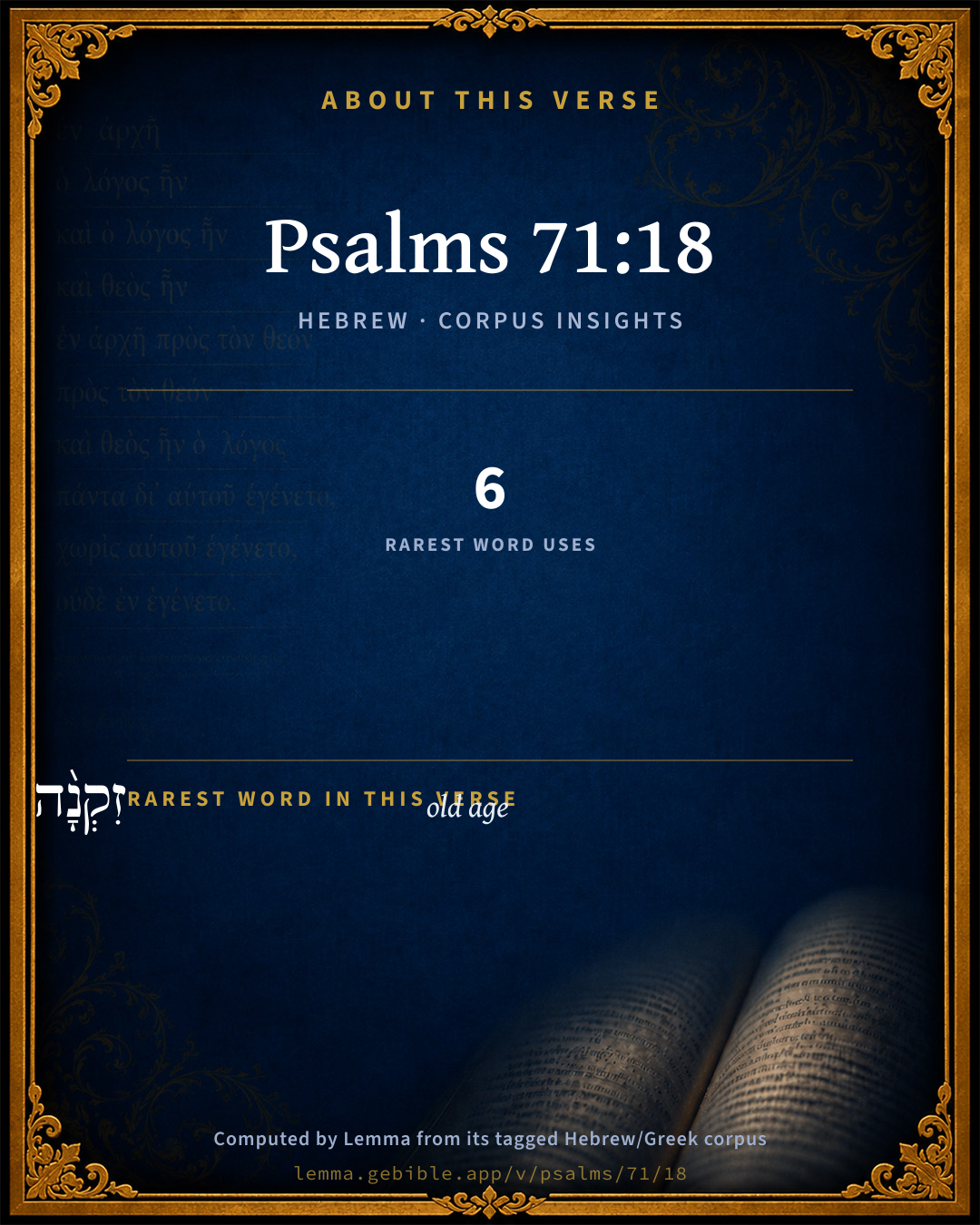
The rarest word here is זִקְנָ֨ה old age H2209 — appearing just 6 times in the whole Hebrew Bible.

Shared distinctive vocabulary

זִקְנָ֨ה old age H2209 occurs in 6 verses of the Hebrew Bible. Also found in:

Grammatical profile

  • 3 verbs
  • 7 nouns
  • 2 prepositions
  • 2 particles

Verb forms

  • תַּעַ֫זְבֵ֥נִי Qal · Jussive
  • אַגִּ֣יד Hiphil · Imperfect
  • יָ֝ב֗וֹא Qal · Imperfect

Repetition

A word recurs within this verse — often emphatic in Hebrew:

Hebrew & Septuagint length

In English translation the verse runs 30 words from the Hebrew and 29 from the Septuagint (LXX English) — closely comparable.

A rough comparison of the two English renderings, which tokenize alike — not a word-level alignment.

Word counts can differ between the Hebrew and the Greek without any difference in meaning — e.g. the Hebrew direct-object marker אֵת has no separate Greek word, and Greek often adds the article ὁ.

Cross-references

15

Topical passages linked to Psalms 71:18 in the Treasury of Scripture Knowledge — connected by theme and wording, ordered by reader-vote popularity; previews shown in the World English Bible.

  • Isaiah 46:4 and even to old age I am he, and even to gray hairs will I carry you. I have made, and I will bear; yes, I will carry, and will deliver.
  • Psalms 71:9 Don't reject me in my old age. Don't forsake me when my strength fails.
  • Psalms 78:4 We will not hide them from their children, Telling to the generation to come the praises of Yahweh, His strength, and his wondrous works that he has done.
  • Psalms 145:4–5 One generation will commend your works to another, And will declare your mighty acts.
  • Psalms 78:6 That the generation to come might know, even the children who should be born; Who should arise and tell their children,
  • Exodus 13:14–17 It shall be, when your son asks you in time to come, saying, 'What is this?' that you shall tell him, 'By strength of hand Yahweh brought us out from Egypt, from the house of bondage;
  • Psalms 22:31 They shall come and shall declare his righteousness to a people that shall be born, For he has done it.
  • 1 Samuel 4:18 It happened, when he made mention of the ark of God, that [Eli] fell from off his seat backward by the side of the gate; and his neck broke, and he died: for he was an old man, and heavy. He had judged Israel forty years.
  • Isaiah 51:9 Awake, awake, put on strength, arm of Yahweh; awake, as in the days of old, the generations of ancient times. Isn't it you who did cut Rahab in pieces, who pierced the monster?
  • Exodus 13:8 You shall tell your son in that day, saying, 'It is because of that which Yahweh did for me when I came forth out of Egypt.'
  • Genesis 27:1 It happened, that when Isaac was old, and his eyes were dim, so that he could not see, he called Esau his elder son, and said to him, "My son?" He said to him, "Here I am."
  • 1 Samuel 4:15 Now Eli was ninety-eight years old; and his eyes were set, so that he could not see.
  • Isaiah 53:1 Who has believed our message? and to whom has the arm of Yahweh been revealed?
  • Acts 13:36 For David, after he had in his own generation served the counsel of God, fell asleep, and was laid with his fathers, and saw decay.
  • 1 Chronicles 29:10–30 Therefore David blessed Yahweh before all the assembly; and David said, You are blessed, Yahweh, the God of Israel our father, forever and ever.

Cross-references courtesy of OpenBible.info (CC BY 4.0).

Hebrew and Greek witnesses Masoretic Hebrew ↔ Greek Septuagint

The same verse in the two great witnesses to the Old Testament, shown verse-for-verse.

You’re reading Greek Psalm 70 (Hebrew Psalm 71). The Septuagint counts the superscription, so verse numbers can differ from the Hebrew — chapter-level alignment, not verse-by-verse. Numbering follows Rahlfs.

These are two independent witnesses, not word-aligned to each other, and the Septuagint is shown in lemma (dictionary) form.

Hebrew Psalms 71:18 Masoretic · Westminster Leningrad Codex

וְגַ֤ם עַד זִקְנָ֨ה וְשֵׂיבָה֮ אֱלֹהִ֪ים אַֽל תַּעַ֫זְבֵ֥נִי עַד אַגִּ֣יד זְרוֹעֲךָ֣ לְד֑וֹר לְכָל יָ֝ב֗וֹא גְּבוּרָתֶֽךָ

Yes, even when I am old and gray-haired, God, don't forsake me, Until I have declared your strength to the next generation, Your might to everyone who is to come.

World English Bible · Public Domain

Greek LXX Greek Psalm 70:18 Septuagint · lemma form

καί ἕως γῆρας καί πρεσβεῖον ὁ θεός μή ἐν καταλείπω ἐγώ ἕως ἄν ἀποἀγγέλλω ὁ βραχίων σύ πᾶς ὁ γενεά ὁ ἔρχομαι ὁ δυναστεία σύ καί ὁ δικαιοσύνη σύ

even until I am old and advanced in years. O God, forsake me not; until I shall have declared your arm to all the generation that is to come:

LXX2012 (modern English Septuagint) · Public Domain

On this verse, The Cambridge Bible for Schools and Colleges discusses the Septuagint’s reading. Read the note in Commentary ↓

Hebrew: Westminster Leningrad Codex (CC BY 4.0). Greek: Septuagint (public domain); English from LXX2012 (modern English Septuagint) (Public Domain). How the Septuagint differs from the Hebrew →

Commentary

Notes on Psalms 71:18 from classic Christian and Jewish commentators (each source and its license shown beneath its notes). The classic Christian expositions comment on the surrounding passage and are grouped to its opening verse, so a note may address several verses; the Jewish commentaries on the Tanakh (Rashi and others) are per-verse, so they appear only where the commentator wrote on this verse.

Lemma curates 59 commentaries, every one of them public domain or Creative Commons licensed, each selected and text-cleaned for this edition rather than reprinted as found. About our sources →

Trapp's Complete Commentary

John Trapp

Psa 71:18 Now also when I am old and grayheaded, O God, forsake me not; until I have shewed thy strength unto [this] generation, [and] thy power to every one [that] is to come.

Ver. 18. Now also when I am old and gray headed] Now, that the plum tree is full of blooms, the map of age is figured in my forehead, the calendar of death appeareth in the furrows of my face; let me do nothing to spot my white head. Let me, with the sun, give greatest glimpse at the going down, and, with the rose, retain my sweetness, though I have lost my colour. See Psa 71:9.

And thy power to every one that is to come] Mirus fervor Davidis in celebranda bonitate Dei, saith Vatablus here. David would propagate God’s praise to all posterity.

John Trapp, A Commentary or Exposition upon All the Books of the Old and New Testament (1647–1656) — public domain. Text from a community e-Sword module.

Joseph Benson's Commentary

Psa 71:18. Now also when I am old, &c., forsake me not — Do not abandon the care of me when I need it most: but continue the same kindness to me in my declining years which I experienced when I was a youth. Those that have been taught of God from their youth, and have made it the business of their lives to honour him, may be sure he will not leave them when they are old and gray-headed, will not leave them helpless and comfortless, but will make the evil days of old age their best days, and such as they shall have reason to say they have pleasure in. Until I have showed thy strength — By my own experience of its being exerted in fresh instances in my behalf; unto this generation — To which I owe peculiar duties, and which I desire to serve according to thy will, Act 13:36; and thy power to every one that is to come — To all future generations, by leaving my observations upon it on record for their benefit. Thus, as David acknowledges that “it was the God of Israel who taught him, as a warrior, to conquer, and as a psalmist, to declare the wondrous works of his great benefactor; so he requests to be preserved in his old age, until, by completing his victories, and his Psalms composed to celebrate them, he had showed the strength and power of God,” not only to his cotemporaries, “but to all that should arise in after times, and chant those divine hymns in the assemblies of the faithful, throughout all ages.” In like manner, “if St. Paul wish to have his life continued on earth, it is only that he may edify the church and glorify God. Otherwise it is far better, says he, to depart and be with Christ.” — Horne. In imitation of these, and such like excellent examples, as long as we live we ought to be endeavouring to glorify God, and edify one another; and those that have had the largest and longest experience of the goodness of God to them, should improve their experience for the good of their friends. And it is a debt which the old disciples of Christ owe to the succeeding generations, to leave behind them a solemn testimony to the power, and pleasure, and advantage of religion, and the truth of God’s promises.

Joseph Benson's Commentary on the Old and New Testaments (1811–1818) — public domain. Text from a community e-Sword module.

J. A. Alexander on Psalms

Joseph Addison Alexander

Psa 71:18. And also (or even) unto old age and hoary hairs, 0 God, forsake me not, till I declare thine arm, i.e. the exertion of thy power, to the (next) generation, (and) to every one that is to come thy power. The last clause determines the sense of the indefinite expression, a generation. See above, on Psa 22:30. With the phrase thy arm, compare Psa 44:3.

Joseph Addison Alexander, The Psalms Translated and Explained (1850) — public domain. Text from a community e-Sword module.

Geneva Bible (1599)

Geneva Bible translators

He desireth that as he hath begun, he would so continue his benefits, that his liberality may have perfect praise.

Geneva Bible (1599) marginal notes — public domain. Text via Bolls.life.

Adam Clarke's Commentary

Verse 18. Old and grey-headed] In the ninth verse Ps 71:9 he mentioned the circumstance of old age; here he repeats it, with the addition of hoary-headedness, which, humanly speaking, was calculated to make a deeper impression in his favour. Though all these things are well known to God, and he needs not our information, yet he is pleased to say, "Come now, and let us reason together." And when his children plead and reason with him, they are acting precisely as he has commanded.

Adam Clarke's Commentary on the Bible (1810–1826) — public domain. Text from a community e-Sword/MySword module.

Ellicott's Commentary for English Readers

(18) Now also when.—Literally, yea, even to old age and grey hairs. Psa_129:1 shows that this may be a national as well as an individual prayer.

Thy strength.—Literally, thine arm, the symbol of power. (Comp. Isa_52:10; Isa_53:1, &c)

Unto this generation.—Literally, to a generation, explained by the next clause to mean, to the coming generation.

A Bible Commentary for English Readers, edited by Charles John Ellicott (1878–1897) — public domain. Text from a community e-Sword module.

The Cambridge Bible for Schools and Colleges

gen. ed. J. J. S. Perowne

18. Now also when I am old and grayheaded] Better, And even when I am old and grayheaded: lit. and even unto old age and gray hairs. Cp. 1Sa_12:2; Isa_46:4.

until &c.] Better with R.V.,

Until I have declared thy strength unto (the next) generation,

Thy might unto every one that is to come.

Thy strength, lit., thine arm, implies more than power; it suggests “thoughts of guidance, support, protection, government, chastisement, conflict, victory.” (Kay). Cp. Psa_77:15; Isa_53:1. &c. It is more natural to supply the next (R.V.) than this with generation. But generation needs some qualification; and the Syr. (with which the LXX nearly agrees) may be right in reading, until I have declared thy strength, and thy might to the generation to come. Cp. Psa_22:30-31, and the note there.

The Cambridge Bible for Schools and Colleges (gen. ed. J. J. S. Perowne; Cambridge University Press, 1878–1918) — public domain. Text from a community e-Sword module.

John Gill's Exposition

Now also, when I am old and grayheaded, O God, forsake me not,.... A repetition of his request, Psa 71:9; with a reason annexed to it, suggested in the following words:

until I have showed thy strength unto this generation; or, "thine arm" (e); which sometimes the Messiah, Isa 53:1; who is the power of by whom he made the worlds, and in whom all things consist; and who has wrought out the salvation people; and is the arm on which they lean, and they are upheld. And the psalmist may be thought to desire that he might be continued a little longer, and be favoured with the presence of God, and the influences of his Spirit and grace; that he might show forth in prophecy, both by word and writing, to the men of the then present age, more things concerning the person, office, and grace of Christ; his sufferings, death, resurrection from the dead, and session at the right hand of God; things which are spoken of in the book of Psalms. Sometimes the arm of the Lord denotes his power and strength, Psa 44:3; and so it may be taken here; and the next clause seems to be an explanation of it:

and thy power; or "even thy power",

to everyone that is to come; that is, to come into the world, that is to be born into it; namely, the power of God, not only in creating all things out of nothing, and supporting what is made; but in the redemption of men, in the conversion of sinners, and in the preservation of the saints, and in enabling them to hold on and out unto the end: and which is shown forth by the psalmist in what he has committed to writing; and which continue, and will continue, to the end of the world, for the instruction of those that come into it; see Psa 22:31.

(e) "brachium tuum", V. L. Pagninus, Montanus, Tigurine version, Junius & Tremellius, Piscator, &c.

John Gill's Exposition of the Whole Bible (1746–1763) — public domain (CC PDM 1.0). Text via the HelloAO Bible API.

Albert Barnes' Notes on the Bible

Now also when I am old and grey-headed - Margin, “unto old age and grey hairs.” This does not necessarily mean that he was then actually old and grey-headed, but it would imply that he was approaching that period, or that he had it in prospect. The time of youth was past, and he was approaching old age. The literal rendering would be, “And also unto old age and grey hairs, do not forsake me.” This is the prayer of one who had been favored in youth, and in all his former course of life, and who now asked that God would continue his mercy, and not forsake him when the infirmities of age drew on.

Forsake me not - Still keep me alive. Give me health, and strength, and ability to set forth thy praise, and to make known thy truth. See the notes at Psa 71:9.

Until I have showed thy strength - Margin, as in Hebrew, “thine arm.” The arm is the instrument by which we execute a purpose, and it thus becomes a symbol of strength.

Unto this generation - literally, “to a generation.” The reference is to the generation then living; that is, the generation which had come on the stage since he had reached manhood - the generation - the new generation - which one who is approaching old age sees engaged in the active scenes of life, cultivating the fields, filling the offices, constructing the bridges and roads, manning the ships, occupying the dwellings, instead of those with whom he was formerly associated, and who are now in their graves. His own generation - the companions of his own early years - had passed away. He had lived to speak to a new generation, and he was desirous that they should start on the journey of life with the advantage of his experience, as of one that had gone before. Each generation “may” thus enter on life with all the accumulated wisdom of the past; that is, as wise as those had become who had themselves had the experience, and treasured up results from the observations, of a long life.

Society thus makes progress. One generation becomes wiser and better than the one which went before it, and the experience of all ages thus accumulates as the world advances, enabling a future age to act on the results of all the wisdom of the past. Man thus differs from the inferior creation. The animals, governed by instinct alone, make no progress. Compare the notes at Psa 49:13. They profit neither by the wisdom, nor the follies of the past. The first robin built its nest of the same materials, and with as much art, as the robin does now; the first stock of bees constructed their cells with as nice and accurate adaptations, with mathematical precision as complete, as a swarm of bees will do now. Neither the bird nor the bee has learned anything by experience, by study, or by observation - nor lays up, to transmit to future generations of birds or bees, the results of its own sagacity or observation.

Not so with man. The result of the experiences of one generation goes into the general experience of the world, and becomes its capital; a new thought, or a new invention struck out by some splendid genius, becomes the common property of the race; and society, as it rolls on, gathers up all these results, as the Ganges or the Mississippi, rolling on to the ocean, gathers into one mighty volume all the waters that flow in a thousand streams, and all that come from rivulets and fountains, however remote. It is this which makes the life of “a man” so valuable in this world; this which makes it so desirable for a man, even when approaching old age, yet to live a little longer, for, as the fruit of his experience, his observation, his ripe wisdom, his acquired knowledge, he may yet suggest something, by writing or otherwise, which may add to the intelligence of the world; some principle which may be elaborated and perfected by the coming age.

And thy power - Thy greatness; majesty; glory.

To every one that is to come - To all future generations. That I may state truths which may benefit future ages. He who suggests one truth which the world was not in possession of before, is a benefactor to mankind, and will not have lived in vain, for that truth will do something to set the race forward, and to make the world better and happier. It is not a vain thing, then, for a man to live; and every one should endeavor “so” to live that the world may not be the worse - or may not go backward - by his living in it, but that it may be the wiser and the better: not merely so that it may keep on the same level, but that it may rise to a higher level, and start off on a new career.

Albert Barnes' Notes on the Bible (1834–1885) — public domain. Text from a community e-Sword/MySword module.

Matthew Poole's English Annotations

Thy strength; either,

1. This further act or instance of thy strength. Or rather,

2. Thy great power, which will more eminently appear in this than it hath done in former deliverances, as my danger is now greater, because this is a civil war, and the generality of mine own people are engaged against me, and my forces are very inconsiderable to theirs, and without thy help my case is desperate.

To every one that is to come, i.e. to all succeeding generations, to whom I will leave a lasting monument of this glorious example of all-sufficiency, such as this Psalm is.

Matthew Poole's English Annotations on the Holy Bible (1683–1685) — public domain. Text from a community e-Sword/MySword module.

The Treasury of David

Charles H. Spurgeon

Ver. 18. Now also when I am old and grey headed, O God, forsake me not. There is something touching in the sight of hair whitened with the snows of many a winter: the old and faithful soldier receives consideration from his king, the venerable servant is beloved by his master. When our infirmities multiply, we may, with confidence, expect enlarged privileges in the world of grace, to make up for our narrowing range in the field of nature. Nothing shall make God forsake those who have not forsaken him. Our fear is lest he should do so; but his promise kisses that fear into silence.

Until I have shewed thy strength unto this generation. He desired to continue his testimony and complete it; he had respect to the young men and little children about him, and knowing the vast importance of training them in the fear of God, he longed to make them all acquainted with the power of God to support his people, that they also might be led to walk by faith. He had leaned on the almighty arm, and could speak experimentally of its all sufficiency, and longed to do so ere life came to a close.

And thy power to every one that is to come. He would leave a record for unborn ages to read. He thought the Lord's power to be so worthy of praise, that he would make the ages ring with it till time should be no more. For this cause believers live, and they should take care to labour zealously for the accomplishment of this their most proper and necessary work. Blessed are they who begin in youth to proclaim the name of the Lord, and cease not until their last hour brings their last word for their divine Master.

Ver. 18. Now also when I am old and grayheaded, O God, forsake me not. God exalts pardoning grace to some more, and sanctifying grace to others; he is the God of grace. Those ships that have been in long voyages at sea, three or four years out, have gone through hot climates and cold, passed the equinoctial line again and again, and have run through many a difficulty, and great storms, and yet have been kept alive at sea, as they speak, when these shall meet one another at sea near the haven, how will they congratulate? And old disciples should do so, that God hath kept grace alive in their souls. And I would ask you how many thousand ships have you seen cast away before your eyes? How many that have made "shipwreck of faith and a good conscience, "as the apostle speaks? This and that profession, that has run into this and that error damnable, or false opinions and teaching, though all of smaller moment; others that have struck upon quicksands of worldly preferments, and many split upon rocks, and yet you have been kept. This should move you to bless this your God, the God of grace, the more. Come, let me knock at your hearts; are none of you old professors, like old hollow oaks, who stand in the woods among professors still, and keep their stand of profession still, and go to ordinances, etc.; but the "rain they drink in, "as the apostle's word is, serves to no other end but to rot them. "These are nigh unto cursing." Or, have you green fruits still growing on you, as quickly and lively affections to God and Christ, and faith and love, as at the first, and more abounding? O bless God you are so near the haven, and lift up your hearts, your redemption draws near; and, withal, raise your confidence, that that God of grace, who hath called you into his eternal glory, will keep you for it, and possess you of it shortly. Thomas Goodwin.

Ver. 18. Forsake me not; until, etc. Apostasy in old age is fearful. He that climbs almost to the top of a tower, then slipping back, hath the greater fall. The patient almost recovered, is more deadly sick by a relapse. There were stars struck from heaven by the dragon's tail (Re 12:4); they had better never have perched so high. The place where the Israelites fell into that great folly with the daughters of Moab, was in the plain, within the prospect of the Holy Land; they saw their inheritance, and yet fell short of it. So wretched is it for old men to fall near to their very entry of heaven, as old Eli in his indulgence (1 Samuel 2); old Judah in his incest (Genesis 38); old David with Bathsheba; old Asa trusting in the physicians more than in God (2Ch 16:12); and old Solomon built the high places. Some have walked like cherubs in the midst of the stones of fire, yet have been cast as profane out of God's mountain. Eze 28:14, 16. Thus the seaman passeth all the main, and suffers wreck in the haven. The corn often promises a plenteous harvest in the blade, and shrinks in the ear. You have seen trees loaden with blossoms, yet, in the season of expectation, no fruit. A comedy that holds well many scenes, and goes lamely off in the last act, finds no applause. Remember Lot's wife (Lu 17:32): think on that pillar of salt, that it may season thee. Thomas Adams.

Ver. 18. Until I have shewed thy strength unto this generation, etc. Are there better preachers of the works of God to be found than hoary parents in the circle of their children; or grandparents in that of their grandchildren? Augustus F. Tholuck.

Ver. 18.

With years oppressed, with sorrows worn,

Dejected, harassed, sick, forlorn,

To thee, O God, I pray;

To thee my withered hands arise,

To thee I lift these failing eyes:

Oh, cast me not away!

Thy mercy heard my infant prayer;

Thy love, with all a mother's care,

Sustained my childish days:

Thy goodness watched my ripening youth,

And formed my heart to love thy truth,

And filled my lips with praise.

O Saviour! has thy grace declined?

Can years affect the Eternal Mind,

Or time its love destroy?

A thousand ages pass thy sight,

And all their long and weary flight

Is gone like yesterday.

Then, even in age and grief, thy name

Shall still my languid heart inflame,

And bow my faltering knee:

Oh, yet this bosom feels the fire,

This trembling hand and drooping lyre,

Have yet a strain for thee!

Yes, broken, tuneless still, O Lord,

This voice, transported, shall record

Thy goodness tried so long;

Till, sinking slow, with calm decay,

Its feeble murmurs melt away,

Into a seraph's song. Sir Robert Grant.

Ver. 18. The peculiar testimony of pious old age, what it is based upon, to whom it should be directed, and what we may hope from it.

Psalms 71:19*

Charles H. Spurgeon's The Treasury of David (1869–1885) — public domain. Psalms only. Text from a community e-Sword/MySword module.

Whedon's Commentary on the Bible

Daniel D. Whedon

18. Now also when I am old—A beautifully touching appeal! With age come conscious helplessness and dependence; how precious are God’s mercies then! See on Psa_71:9; also, Gen_28:15; Deu_31:6; Deu_31:8; Psa_37:25.

Until I have showed thy strength—Literally, showed thy arm, the symbol of executive strength. Psa_98:1; Isa_52:10. The motive of all the writer’s desire for deliverance was, that he might glorify God by publishing his wonderful works. Compare, “Christ shall be magnified in my body.” Php_1:20.

This generation—Literally, a generation; but the next line determines it to mean the coming generation: “To all that shall come:” parallel to “they shall come,” that is, the seed, or generation of the righteous, (Psa_22:30-31,) as if he should say, “the on-coming generation.” Psa_22:30-31

Daniel D. Whedon (gen. ed.), Commentary on the Old and New Testaments (1874–1909) — public domain. Text from a community e-Sword module.

The Pulpit Commentary

Now also when! am old and greyheaded, O God, forsake me not. Surely, then, thou wilt not forsake me when my youth has fled, and my time of weakness and decay has arrived, so that I need thee all the more. At the time of Adonijah"s rebellion, David was "old and stricken in years" (1Ki_1:1) nearly, if not quite, seventy years of age. (2Sa_5:4) Until I have showed thy strength (literally, thine own) unto this generation, and thy power to every one that is to come. The psalmist calls on God to sustain him in his old age, not for his own sake, but that he may impress on the rising generation God"s might and marvellous acts.

The Pulpit Commentary (1880–1919), ed. H.D.M. Spence-Jones & Joseph S. Exell — public domain. Text from a community e-Sword module.

Rashi

Rabbi Shlomo Yitzchaki (Rashi)

to everyone who comes Your might To everyone who approaches me, I will tell of Your might.

Rashi on the Tanakh — English translations: “The Judaica Press complete Tanach with Rashi, translated by A. J. Rosenberg” (CC BY 4.0); “Pentateuch with Rashi's commentary by M. Rosenbaum and A.M. Silbermann, 1929-1934” (public domain); “The Metsudah Tanach series, Lakewood, N.J” (CC BY 4.0); and “The Book of Joshua, Metsudah Publications, 1997” (CC BY 4.0). Text via Sefaria.

Lesson kit

Teaching starters — assembled from the data on this page, not authored interpretation. Every prompt links to the verse data it draws on. Edit before teaching.

Psalms, in the Wisdom, opens this verse with 14 words (13 distinct Hebrew lemmas). Its most distinctive word is ziqnâh (“old age”). A historical commentator’s framing appears above. Read the whole chapter for the surrounding context.

Discussion questions

  1. What does “old age” (ziqnâh) contribute to the verse as a whole?
  2. How does Genesis 24:36, which shares the word «old age», read alongside this verse?
  3. What does the repetition of “until” (2× in this one verse) do in this verse?
  4. These translations render this verse differently. What is at stake in choosing one wording over another?
  5. «תַּעַ֫זְבֵ֥נִי» is a Qal Jussive verb. How does that grammatical form shape the action described?
  6. Compare how Trapp's Complete Commentary and Joseph Benson's Commentary read this verse. Where do they agree or differ?

Things to notice

Reading settings

Reading text

Shown beneath each verse's original-language words.

Old Testament
Old Testament edition

Read the OT as the Masoretic Hebrew (MT) or the Greek Septuagint (LXX).

English shown for the Greek Septuagint (in the Hebrew ↔ Greek comparison).

Comparing translations? Open the Compare panel on any verse page to stack up to four side by side.