

Proverbs 15:10

Hebrew (Westminster Leningrad Codex) Proverbs 15:10 appears in the Hebrew Old Testament. The text above is from the Westminster Leningrad Codex. Each word links to its Strong’s number, a concise gloss, and parsing drawn from the Open Scriptures Hebrew Bible morphology. Click any word for its full Brown-Driver-Briggs (BDB) entry.
Download image
Cite this verse

Proverbs 15:10 (World English Bible). Public Domain. Lemma interlinear Bible study tool, https://lemma.gebible.app/v/proverbs/15/10.

Show BibTeX & RIS
BibTeX
RIS
English Translation
There is stern discipline for one who forsakes the way: Whoever hates reproof shall die.
World English Bible · Public Domain
Download a study sheet

One document with this verse’s original text, its word-by-word gloss line, the meaning frame, cross-references with their text, attributed commentary, and full source and license credits — printable, and it pastes into notes with its structure intact.

This verse Autodidact and up

Study sheet (.html) Plain text (.txt)

A passage Seminary Student

Up to 50 verses in one chapter. A passage sheet keeps up to 6 commentary sources and 12 cross-references per verse, in the order this page ranks them, and says so on the sheet whenever that leaves anything out. Ask for a single verse and you get the Autodidact verse sheet above.

Everything on this page stays free to read, with no account — the sheet is a download of what is already on screen, not access to it.

Want to remove ads? Support Godless Engineer
Compare translations 3

The same verse in 3 English versions, stacked beneath the original-language interlinear above. Click any original word for its lexicon entry.

Each is an independent rendering of the whole verse — the interlinear is not word-aligned to these translations.

Highlighted words mark where these versions differ — a whole-verse word diff, not a word-by-word alignment.

  • World English Bible Public Domain
    There is stern discipline for one who forsakes the way: Whoever hates reproof shall die.
  • King James Version Public Domain
    Correction is grievous unto him that forsaketh the way: and he that hateth reproof shall die.
  • unfoldingWord Literal Text CC BY-SA 4.0
    Severe discipline for one who forsakes the path; one who hates rebuke will die.

unfoldingWord Literal Text — © unfoldingWord, licensed CC BY-SA 4.0. Word-aligned USFM3 via Door43 (git.door43.org/unfoldingWord/en_ult).

Versions to compare (up to 4)

3 of 4 selected

Show all 18 translations

Every available English version of this verse, each an independent rendering of the whole verse.

  • World English Bible Public Domain
    There is stern discipline for one who forsakes the way: Whoever hates reproof shall die.
  • Berean Standard Bible Public Domain
    Discipline is harsh for him who leaves the path; he who hates correction will die.
  • Majority Standard Bible Public Domain
    Discipline is harsh for him who leaves the path; he who hates correction will die.
  • King James Version Public Domain
    Correction is grievous unto him that forsaketh the way: and he that hateth reproof shall die.
  • American Standard Version (1901) Public Domain
    There is grievous correction for him that forsaketh the way; `And' he that hateth reproof shall die.
  • Revised Version (1885) Public Domain
    There is grievous correction for him that forsaketh the way: and he that hateth reproof shall die.
  • Geneva Bible (1599) Public Domain
    Instruction is euill to him that forsaketh the way, and he that hateth correction, shall die.
  • Douay-Rheims (1899) Public Domain
    Instruction is grievous to him that forsaketh the way of life: he that hateth reproof shall die.
  • Young's Literal Translation Public Domain
    Chastisement `is' grievous to him who is forsaking the path, Whoso is hating reproof dieth.
  • Literal Standard Version CC BY-SA 4.0
    Discipline [is] grievous to him who is forsaking the path, || Whoever is hating reproof dies.
  • Unlocked Literal Bible CC BY-SA 4.0
    Harsh discipline awaits anyone who forsakes the way and he who hates correction will die.
  • unfoldingWord Literal Text CC BY-SA 4.0
    Severe discipline for one who forsakes the path; one who hates rebuke will die.
  • Darby Bible Public Domain
    Grievous correction is for him that forsaketh the path; he that hateth reproof shall die.
  • World Messianic Bible Public Domain
    There is stern discipline for one who forsakes the way. Whoever hates reproof shall die.
  • Webster's Bible Public Domain
    Correction is grievous to him that forsaketh the way: and he that hateth reproof shall die.
  • Free Bible Version CC BY-SA 4.0
    If you leave the right path you will be severely disciplined; anyone who hates correction will die.
  • Bible in Basic English Public Domain
    There is bitter punishment for him who is turned from the way; and death will be the fate of the hater of teaching.
  • JPS Tanakh (1917) Public Domain
    There is grievous correction for him that forsaketh the way; and he that hateth reproof shall die.

Literal Standard Version (2020), Covenant Press — licensed CC BY-SA 4.0. Text via the HelloAO Bible API (eBible.org). Unlocked Literal Bible (unfoldingWord) — licensed CC BY-SA 4.0. Text via the HelloAO Bible API (eBible.org). unfoldingWord Literal Text — © unfoldingWord, licensed CC BY-SA 4.0. Word-aligned USFM3 via Door43 (git.door43.org/unfoldingWord/en_ult). Free Bible Version, Dr. Jonathan Gallagher — licensed CC BY-SA 4.0. Text via the HelloAO Bible API (eBible.org).

Word by word

More ways to search: Search by grammar → Find every occurrence → Compare this word →

Practice this passage: Drill this verse → Learn its vocabulary →

About this verse

These counts appear in no published source. They are computed here, from the morphology-tagged text and Lemma’s own curated glosses. What Lemma adds →

7
words
7
distinct lemmas
Wisdom
section

Shared distinctive vocabulary

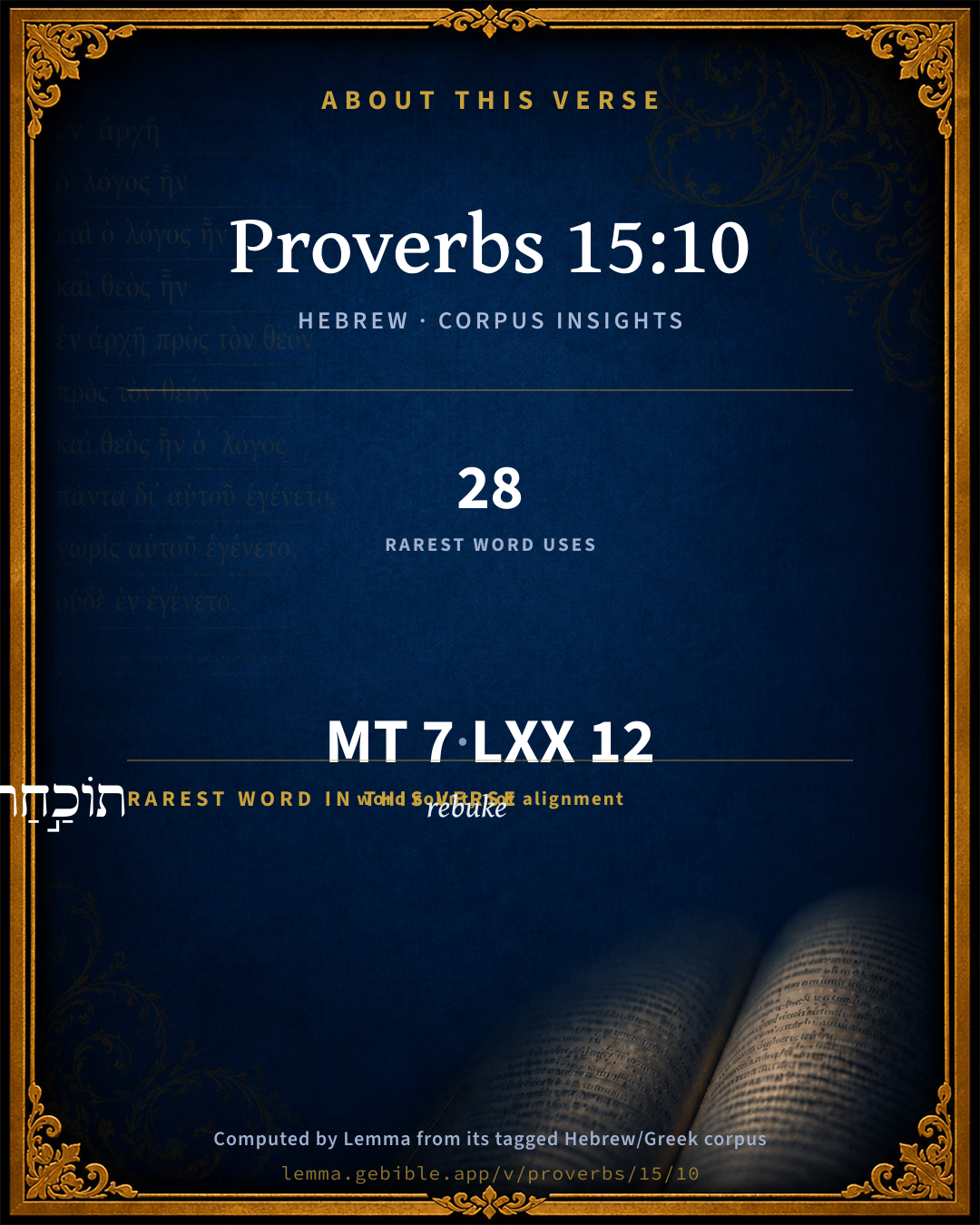
תוֹכַ֣חַת rebuke H8433 occurs in 28 verses of the Hebrew Bible. Also found in:

Grammatical profile

  • 3 verbs
  • 3 nouns
  • 1 adjective

Verb forms

  • לְעֹזֵ֣ב Qal · Participle Active
  • שׂוֹנֵ֖א Qal · Participle Active
  • יָמֽוּת Qal · Imperfect

Hebrew & Septuagint length

In English translation the verse runs 15 words from the Hebrew and 19 from the Septuagint (LXX English) — closely comparable.

A rough comparison of the two English renderings, which tokenize alike — not a word-level alignment.

Word counts can differ between the Hebrew and the Greek without any difference in meaning — e.g. the Hebrew direct-object marker אֵת has no separate Greek word, and Greek often adds the article ὁ.

In the original languages it is 7 Hebrew tokens and 12 Greek tokens — but the two are counted differently (Hebrew bundles its prefixes and suffixes into one token; the Greek is in lemma form), so that isn’t a like-for-like length.

Cross-references

13

Topical passages linked to Proverbs 15:10 in the Treasury of Scripture Knowledge — connected by theme and wording, ordered by reader-vote popularity; previews shown in the World English Bible.

  • Proverbs 12:1 Whoever loves correction loves knowledge, But he who hates reproof is stupid.
  • Proverbs 13:1 A wise son listens to his father's instruction, But a scoffer doesn't listen to rebuke.
  • John 3:20 For everyone who does evil hates the light, and doesn't come to the light, lest his works would be exposed.
  • Proverbs 10:17 He is in the way of life who heeds correction, But he who forsakes reproof leads others astray.
  • John 7:7 The world can't hate you, but it hates me, because I testify about it, that its works are evil.
  • 1 Kings 18:17 It happened, when Ahab saw Elijah, that Ahab said to him, Is it you, you troubler of Israel?
  • 1 Kings 21:20 Ahab said to Elijah, Have you found me, my enemy? He answered, I have found you, because you have sold yourself to do that which is evil in the sight of Yahweh.
  • 1 Kings 22:8 The king of Israel said to Jehoshaphat, there is yet one man by whom we may inquire of Yahweh, Micaiah the son of Imlah: but I hate him; for he does not prophesy good concerning me, but evil. Jehoshaphat said, "Don't let the king say so."
  • Proverbs 1:30 They wanted none of my counsel. They despised all my reproof.
  • Proverbs 5:12 And say, "How I have hated instruction, And my heart despised reproof;
  • Ezekiel 24:13–14 In your filthiness is lewdness: because I have cleansed you and you weren't cleansed, you shall not be cleansed from your filthiness any more, until I have caused my wrath toward you to rest.
  • Proverbs 23:35 "They hit me, and I was not hurt; They beat me, and I don't feel it! When will I wake up? I can do it again. I can find another."
  • Isaiah 1:5–6 Why should you be beaten more, That you revolt more and more? The whole head is sick, And the whole heart faint.

Cross-references courtesy of OpenBible.info (CC BY 4.0).

Hebrew and Greek witnesses Masoretic Hebrew ↔ Greek Septuagint

The same verse in the two great witnesses to the Old Testament, shown verse-for-verse.

These are two independent witnesses, not word-aligned to each other, and the Septuagint is shown in lemma (dictionary) form.

Hebrew Proverbs 15:10 Masoretic · Westminster Leningrad Codex

מוּסָ֣ר רָ֭ע לְעֹזֵ֣ב אֹ֑רַח שׂוֹנֵ֖א תוֹכַ֣חַת יָמֽוּת

There is stern discipline for one who forsakes the way: Whoever hates reproof shall die.

World English Bible · Public Domain

Greek LXX Proverbs 15:10 Septuagint · lemma form

παιδεία ἄκακος γνωρίζω ὑπό ὁ παραἵημι ὁ δέ μισέω ἔλεγχος τελευτάω αἰσχρῶς

The instruction of the simple is known by them that pass by; but they that hate reproofs die disgracefully.

LXX2012 (modern English Septuagint) · Public Domain

On this verse, Trapp's Complete Commentary discusses the Septuagint’s reading. Read the note in Commentary ↓

Hebrew: Westminster Leningrad Codex (CC BY 4.0). Greek: Septuagint (public domain); English from LXX2012 (modern English Septuagint) (Public Domain). How the Septuagint differs from the Hebrew →

Commentary

Notes on Proverbs 15:10 from classic Christian and Jewish commentators (each source and its license shown beneath its notes). The classic Christian expositions comment on the surrounding passage and are grouped to its opening verse, so a note may address several verses; the Jewish commentaries on the Tanakh (Rashi and others) are per-verse, so they appear only where the commentator wrote on this verse.

Lemma curates 59 commentaries, every one of them public domain or Creative Commons licensed, each selected and text-cleaned for this edition rather than reprinted as found. About our sources →

Trapp's Complete Commentary

John Trapp

Pro 15:10 Correction [is] grievous unto him that forsaketh the way: [and] he that hateth reproof shall die.

Ver. 10. Correction is grievous unto him that forsaketh the way.] He pleaseth himself in his outstrays, and would not be reduced; he is in love with his own ruin, and takes long strides towards hell, which is now but a little afore him. And if any man seek to save him, "with fear pulling him out of the fire," {Jdg 1:23} he flies in his face. This is as great madness as if they whom our Saviour had healed or raised should have raged and railed at him for so doing.

And he that hateth reproof shall die.] He that is embittered by rebukes, and not bettered by chastisements, shall die, τελευτωσιν αιχρως, say the Septuagint - shall ‘die shamefully’; yea, shall die eternally, as the next verse shows; shall be swallowed up by hell and destruction, which even now gapes for him. They that will not obey that sweet command, "Come unto me all ye that labour and are heavy laden," shall one day have no other voice to obey but that terrible discedite, "Go ye cursed into everlasting flames."

John Trapp, A Commentary or Exposition upon All the Books of the Old and New Testament (1647–1656) — public domain. Text from a community e-Sword module.

Joseph Benson's Commentary

Pro 15:10-12. Correction is grievous unto him that forsaketh the way — God’s way, emphatically called the way here, as also Psa 119:1, and elsewhere. He abhors reproof, because it is a reproach to him, and because it strikes at the sin which he loves. And he that hateth reproof shall die — That is, shall be destroyed, both here and for ever; which is a more grievous thing than a harsh reproof. A scorner loveth not — That is, hateth and avoideth; (more being understood than expressed;) one that reproveth him — That tells him of his faults, warns him of his danger: and advises him to reform his conduct; neither will he go unto the wise — That is, the godly: he will not seek their company and conversation, as his duty and interest oblige him to do, because he knows they will make conscience of reproving him.

Joseph Benson's Commentary on the Old and New Testaments (1811–1818) — public domain. Text from a community e-Sword module.

The Preacher's Complete Homiletical Commentary

Joseph S. Exell (gen. ed.)

CRITICAL NOTES.—

Pro_15:10. Correction is grievous, or, “there is grievous correction.” Miller reads, “Discipline is an evil to him.”

MAIN HOMILETICS OF Pro_15:10

OUT OF THE WAY

I. There is a pre-ordained way for man to walk in.

1. Nature suggests this. Everything there speaks of law and order.

2. Conscience suggests it.

3. Revelation declares it. (On this subject see Homiletics on chap. Pro_12:28; Pro_13:13-14; pages 291 and 313.)

II. A man may break loose from this God-ordained path. That he can do this is his glory; that he does do it is his shame. A convict is compelled to keep to a certain path, he is obliged to conform to a routine laid down for him by another. His outward life is governed by no will of his own, all his acts are prescribed by an authority which he cannot resist. But God will not keep men in the way in which He desires them to walk by such means. He did not so fence about the angels in heaven. They were “free to fall,” and so are we. God treats His creatures as free men, not as prisoners. They have power to choose whom they will serve; they are free to choose the way in which they will walk. All the force that is exerted over them is the force of moral suasion.

III. The correction that follows this forsaking of the way is intended to punish and to reclaim. In all well-ordered human governments, and in all well-governed families, the main intention of punishment (except in the case of capital punishment) is improvement of character. This ought to be the chief aim of all human correction. It is the main intention in all the chastisements of God in this world. There is no retribution which comes to man in this world which will not, if accepted in a right spirit, become a means of restoring him to the forsaken path; therefore

IV. To hate reproof is to shut out all possibility of moral restoration. A man who will not be reproved denies the imperfection of his nature. Every imperfect being must need correction, and for man to rebel against the chastisement of God is to pass sentence of death upon himself. (On this subject see Homiletics on chapters Pro_3:11-12; Pro_12:1; Pro_13:18; pages 247, 323, etc.)

OUTLINES AND SUGGESTIVE COMMENTS

We would always look hopefully at a sinner under correction. For, surely, so long as the physician administers the medicine, there is no ground for despondency.… This costly teaching brings us on wonderfully. Lord! let me know the smart of Thy rod rather than the eclipse of Thy love.—Bridges.

There are three sorts of passengers that go out of the way. He that mistaketh the way, he that forsaketh his way, and he that loveth to be out of the way. Many miss the way who never were in it, or, being in the way, were missed from it, and these, oftentimes, are glad to be corrected and brought into the way. He forsaketh the way who at first is set in it, and seeing how to go on aright, yet willingly departeth from it: to such an one correction is grievous, and he suffereth it with trouble, but yet many times he is reduced by it. He loveth to be out of the way who hateth reproof, and of his amendment there is little hope.… The force of the verse is, that the suffering of correction is grievous, but that the hating of reproof is most pernicious.—Jermin.

Of all sinners, reproofs are worse resented by apostates.—Henry.

“Discipline is an evil to him who forsakes the path.” (See rendering in Critical Notes.) In our common version this idea is not brought out. It is a very grave one. Men not converted, but steadily “forsaking the path of holiness,” are injured by “discipline.” In “hating reproof” they go through the very soul-action which we mean when we say, “they die.” Each “hating” emotion kills them. And this is the very philosophy of the letter-killing (2Co_3:6); not that it is poison in itself, but that the gospel awakens opposition, which, on its part, corrupts the mind.—Miller.

The Preacher's Complete Homiletical Commentary (gen. ed. Joseph S. Exell; Funk & Wagnalls, c. 1892) — public domain (pre-1929). A full-Bible homiletical/sermon-outline anthology covering 65 of 66 books (2 John is absent from the source module). Text from a community e-Sword module.

Geneva Bible (1599)

Geneva Bible translators

He that swerveth from the word of God, cannot abide to be admonished.

Geneva Bible (1599) marginal notes — public domain. Text via Bolls.life.

Matthew Henry's Commentary

This shows that those who cannot bear to be corrected must expect to be destroyed. 1. It is common for those who have known the way of righteousness, but have forsaken it, to reckon it a great affront to be reproved and admonished. They are very uneasy at reproof; they cannot, they will not, bear it; nay, because they hate to be reformed, they hate to be reproved, and hate those who deal faithfully and kindly with them. Of all sinners, reproofs are worst resented by apostates. 2. It is certain that those who will not be reproved will be ruined: He that hates reproof, and hardens his heart against it, is joined to his idols; let him alone. He shall die, and perish for ever, in his sins, since he would not be parted from his sins. Ch2 25:15, I know that God has determined to destroy thee, because thou couldst not bear to be reproved; see also Pro 29:1.

Matthew Henry's Commentary on the Whole Bible (1708–1710) — public domain (CC PDM 1.0). Text via the HelloAO Bible API.

Jamieson, Fausset & Brown

Robert Jamieson, A. R. Fausset & David Brown

(Compare Pro 10:17).

the way--that in which God would have him to go (Pro 2:13; Psa 119:1).

Jamieson, Fausset & Brown — Commentary Critical and Explanatory on the Whole Bible (1871) — public domain (CC PDM 1.0). Text via the HelloAO Bible API.

Ellicott's Commentary for English Readers

(10) Correction is grievous.—Rather, There is a grievous correction for him that forsaketh the (right) way; first of all, punishment for the sake of “correction” (Lev_26:14, sqq.), and then, lastly, in the case of obstinate hatred of “reproof,” death (Ibid. Pro_15:33).

A Bible Commentary for English Readers, edited by Charles John Ellicott (1878–1897) — public domain. Text from a community e-Sword module.

The Cambridge Bible for Schools and Colleges

gen. ed. J. J. S. Perowne

10. Correction is grievous unto] Rather, There is grievous correction for, as R.V.

The Cambridge Bible for Schools and Colleges (gen. ed. J. J. S. Perowne; Cambridge University Press, 1878–1918) — public domain. Text from a community e-Sword module.

John Gill's Exposition

Correction is grievous unto him that forsaketh the way,.... The right way, the way of God; the way of his commandments: the Vulgate Latin version is, "the way of life"; the same with the way of righteousness, which apostates, having known and walked in, turn aside from; see Pe2 2:15. And such deserve severe correction, the chastisement of a cruel one, correction in wrath and hot displeasure; which, when they have, is very disagreeable to them; they behave under it like a bullock unaccustomed to the yoke, and yet they are but dealt righteously with. Or the words may be rendered, "he has had bad discipline" or "instruction (z) that forsakes the way"; due care has not been taken of him; he has not been properly instructed, nor seasonably corrected; had he, he would not easily have departed from the way in which he should go; see Pro 22:6. The Targum is,

"the discipline of an evil man causes his way to err;''

or him to err from his way;

and he that hateth reproof shall die; that hates the reproof of parents, masters, and ministers of the word; as he may be said to do that neglects and rejects it, and does not act agreeably to it: and such a man, dying in impenitence and without faith in Christ, dies in his sins; and sometimes shamefully, or a shameful death, as the Septuagint and Arabic versions, or an untimely one; as well as dies the second death, an eternal one.

(z) "fuit illi mala disciplina, vel castigatio", Baynus.

John Gill's Exposition of the Whole Bible (1746–1763) — public domain (CC PDM 1.0). Text via the HelloAO Bible API.

Albert Barnes' Notes on the Bible

Better, There is a grievous correction, i. e., nothing less than death, to him that forsaketh the way.

Albert Barnes' Notes on the Bible (1834–1885) — public domain. Text from a community e-Sword/MySword module.

Haydock's Catholic Bible Commentary

Instruction. Hebrew, "a heavy punishment." (Haydock) --- The mind which gives way to vice, must have embraced some false doctrine.

George Leo Haydock (1774–1849), Haydock's Catholic Family Bible and Commentary, 1859 edition — public domain. Excludes Psalms (Douay-Rheims chapter numbering differs from Protestant) and Deuterocanonical books (Catholic canon only).

Matthew Poole's English Annotations

Correction is grievous; he hateth reproof, because it is a reproach to him, and because it strikes at that sin which he loveth.

The way; God’s way, emphatically called the way here, as also Psa 119:1; 139:24; Pro 2:13.

Shall die, i.e. be destroyed, both here and, for ever; which is a more grievous thing than a harsh reproof.

Matthew Poole's English Annotations on the Holy Bible (1683–1685) — public domain. Text from a community e-Sword/MySword module.

Whedon's Commentary on the Bible

Daniel D. Whedon

10. Correction — Musar, restraint, discipline. (See on Pro_1:2 for this word.)

Is grievous — Or, evil; that is, it seems evil to him that forsaketh the way, the way by eminence, the right way, the way of virtue and peace. Compare 1Ki_18:17; 1Ki_21:20. But many of the best critics prefer to translate, substantially. There is a sharp correction for him that forsakes the way; so Zockler, Stuart, Conant, Noyes, Speaker’s Commentary. etc.

He that hateth reproof shall die — Prematurely; may be expected to come to a bad end. Such is probably the spirit of the proverb; but whether something beyond this life be not implied is a question worthy of consideration. It is probable that Solomon and his contemporaries had more correct ideas of a future life than we credit them with. It did not come within the plan of this book to draw motives of actions largely from the life beyond: yet a future state of rewards and punishments may nevertheless be implied in such passages as the above. Compare Rom_8:13.

Daniel D. Whedon (gen. ed.), Commentary on the Old and New Testaments (1874–1909) — public domain. Text from a community e-Sword module.

The Pulpit Commentary

Correction is grievous unto him that forsaketh the way. The verse is climacteric, and the first clause is better translated, There is a grievous correction for him that forsaketh the way; then the second clause denotes what that correction is: he that hateth reproofi.e. he that forsaketh the wayshall die. "The way" is the path of goodness and righteousness. (Pro_2:13) "The way of life." the Vulgate calls it; see Pro_10:17, "He that hateth reproof is in the way of sinners." The Authorized Version is quite allowable, and is supported in some degree by the Vulgate, Doctrina mala deserenti viam vitae. The sinner is annoyed by discipline, correction, or true teaching, because they curb the indulgence of his passions, make him uneasy in conscience, and force him to look to future issues. Septuagint, "The instruction of the guileless (akakou ) is known by passers-by; but they who hate reproofs die shamefully." The Syriac adopts the same rendering; but it is a question whether the word ought not to be kakou . Menander says O mh dareietai . "Man unchastised learns naught.

The principle of judgment.

I IT IS NEVER CAUSELESS.

II THE CONNECTION OF CAUSE AND EFFECT IS OFTEN MYSTERIOUS. Hence we should be slow to trace the judgment of God upon sinners.

III SOME SINS THAT FORETELL JUDGMENT.

1. Desertion of duty; forsaking of God"s ways; travelling in paths we know to be crooked or unclean.

2. Indifference to rebuke. For even in error, if we will heed the timely warning and correct the discovered fault, judgment may be averted. If not, there is no way of avoiding the law of doom. The soul that sinneth shall and "must die. J.

The Pulpit Commentary (1880–1919), ed. H.D.M. Spence-Jones & Joseph S. Exell — public domain. Text from a community e-Sword module.

Bridges on Proverbs

Charles Bridges

But is it not also "grievous for the present" to the child of God? He knows his need of it, kisses the rod, bows his will, and reaps a fruitful blessing. (Heb 12:11 .) But grievous indeed is it to him that forsaketh the way. He is humbled by force, not in spirit. He kicks at it, and, like an untractable child under the rod, only increases his own chastisement. There is no surer step to ruin than this hatred of reproof.†1 How do "the spots of God’s children" (2Ch 16:10 ) here warn us — "Cease ye from man!" (Isa 2:22 .)

But correction turns back him, who had forsaken the way. Then it is grievous no more. Had not Manasseh more cause to bless God for his fetters than for his crown, for his dungeon than for his palace?†2 "This man was born there." We would always look hopefully at a sinner under correction. For surely so long as the physician administers the medicine, there is no ground for despondency.

Child of God! Dost not thou still need the correction, to perfect thee for more difficult and refined obedience? This costly teaching brings us on wonderfully. The Lord teach thee, when the thorn is in the flesh, to pray for grace in the heart! (2Co 12:7 .) Seek thy Father’s favor, more than thine own ease. Desire the sanctifying, rather than the removal, of his rod. Mock him not by the empty ceremonial of repentance. But in true penitence look up to thy smiter to be thy healer (Hos 6:1 ); yet not till his correction has fully accomplished his gracious work. Lord! let me know the smart of thy rod, rather than the eclipse of thy love. Shew me thy love; then do with me what thou wilt.

Footnotes:

†1 Pro 1:30; Pro 5:11-12, Pro 5:23 ; Pro 29:1 : Pharoah, Exo 10:24-29 : Ahab, 1Ki 18:17 ; 1Ki 21:20 ; 1Ki 22:8, 1Ki 22:37 : Amaziah, 2Ch 25:15-16, 2Ch 25:27 : Ahaz, 2Ch 28:22-23 : the Jews, 2Ch 36:15-17 . Jer 6:16-19 .

†2 2Ch 33:11-13 . Compare David, Psa 119:67, Psa 119:71 : Ephraim, Jer 31:18-20 : the Prodigal, Luk 15:12-20 .

Charles Bridges, An Exposition of the Book of Proverbs (1846) — public domain. Text from a community e-Sword module.

Kretzmann's Popular Commentary

Paul E. Kretzmann

v. 10. Correction is grievous unto him that forsaketh the way, that is, a sharp punishment will strike him who leaves the path pointed out by the will of the Lord; and he that hateth reproof, namely, the rebuke of God’s Word, shall die, for death is the wages of sin.

Paul E. Kretzmann, Popular Commentary of the Bible (1921–1924) — public domain. Text from a community e-Sword module.

Rashi

Rabbi Shlomo Yitzchaki (Rashi)

Harsh discipline will come to him who forsakes the way Harsh suffering is ready for him who transgresses the way of the Holy One, blessed be He.

Rashi on the Tanakh — English translations: “The Judaica Press complete Tanach with Rashi, translated by A. J. Rosenberg” (CC BY 4.0); “Pentateuch with Rashi's commentary by M. Rosenbaum and A.M. Silbermann, 1929-1934” (public domain); “The Metsudah Tanach series, Lakewood, N.J” (CC BY 4.0); and “The Book of Joshua, Metsudah Publications, 1997” (CC BY 4.0). Text via Sefaria.

Lesson kit

Teaching starters — assembled from the data on this page, not authored interpretation. Every prompt links to the verse data it draws on. Edit before teaching.

Proverbs, in the Wisdom, opens this verse with 7 words (7 distinct Hebrew lemmas). Its most distinctive word is tôwkêchâh (“rebuke”). A historical commentator’s framing appears above. Read the whole chapter for the surrounding context.

Discussion questions

  1. How does “rebuke” (tôwkêchâh) shape what this verse is saying?
  2. 2 Kings 19:3 shares the word «rebuke» with this verse. How do the two illuminate each other?
  3. These translations render this verse differently. What is at stake in choosing one wording over another?
  4. The verb «לְעֹזֵ֣ב» is Qal Participle Active. How does its form color the action?
  5. Reading how Trapp's Complete Commentary and Joseph Benson's Commentary read this verse, where do the two commentators agree and where do they part?

Things to notice

Reading settings

Reading text

Shown beneath each verse's original-language words.

Old Testament
Old Testament edition

Read the OT as the Masoretic Hebrew (MT) or the Greek Septuagint (LXX).

English shown for the Greek Septuagint (in the Hebrew ↔ Greek comparison).

Comparing translations? Open the Compare panel on any verse page to stack up to four side by side.