
Psalms 37:33

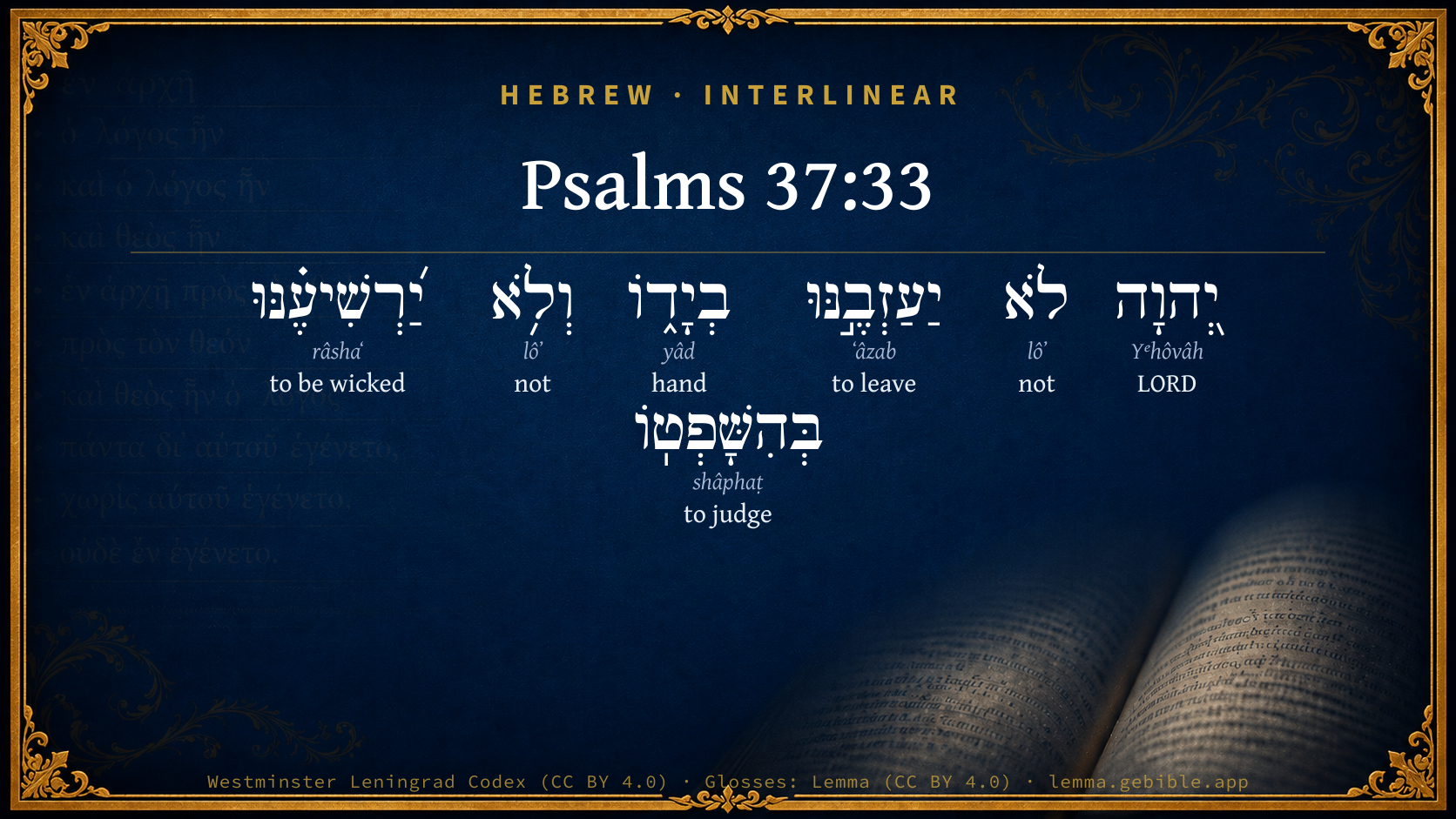
Hebrew (Westminster Leningrad Codex) Psalms 37:33 appears in the Hebrew Old Testament. The text above is from the Westminster Leningrad Codex. Each word links to its Strong’s number, a concise gloss, and parsing drawn from the Open Scriptures Hebrew Bible morphology. Click any word for its full Brown-Driver-Briggs (BDB) entry.
Download image
Cite this verse

Psalms 37:33 (World English Bible). Public Domain. Lemma interlinear Bible study tool, https://lemma.gebible.app/v/psalms/37/33.

Show BibTeX & RIS
BibTeX
RIS
English Translation
Yahweh will not leave him in his hand, Nor condemn him when he is judged.
World English Bible · Public Domain
Download a study sheet

One document with this verse’s original text, its word-by-word gloss line, the meaning frame, cross-references with their text, attributed commentary, and full source and license credits — printable, and it pastes into notes with its structure intact.

This verse Autodidact and up

Study sheet (.html) Plain text (.txt)

A passage Seminary Student

Up to 50 verses in one chapter. A passage sheet keeps up to 6 commentary sources and 12 cross-references per verse, in the order this page ranks them, and says so on the sheet whenever that leaves anything out. Ask for a single verse and you get the Autodidact verse sheet above.

Everything on this page stays free to read, with no account — the sheet is a download of what is already on screen, not access to it.

Want to remove ads? Support Godless Engineer
Compare translations 3

The same verse in 3 English versions, stacked beneath the original-language interlinear above. Click any original word for its lexicon entry.

Each is an independent rendering of the whole verse — the interlinear is not word-aligned to these translations.

Highlighted words mark where these versions differ — a whole-verse word diff, not a word-by-word alignment.

  • World English Bible Public Domain
    Yahweh will not leave him in his hand, Nor condemn him when he is judged.
  • King James Version Public Domain
    The LORD will not leave him in his hand, nor condemn him when he is judged.
  • unfoldingWord Literal Text CC BY-SA 4.0
    Yahweh will not abandon him into his hand, and will not condemn him when he is judged.

unfoldingWord Literal Text — © unfoldingWord, licensed CC BY-SA 4.0. Word-aligned USFM3 via Door43 (git.door43.org/unfoldingWord/en_ult).

Versions to compare (up to 4)

3 of 4 selected

Show all 18 translations

Every available English version of this verse, each an independent rendering of the whole verse.

  • World English Bible Public Domain
    Yahweh will not leave him in his hand, Nor condemn him when he is judged.
  • Berean Standard Bible Public Domain
    the LORD will not leave them in their power or let them be condemned under judgment.
  • Majority Standard Bible Public Domain
    the LORD will not leave them in their power or let them be condemned under judgment.
  • King James Version Public Domain
    The LORD will not leave him in his hand, nor condemn him when he is judged.
  • American Standard Version (1901) Public Domain
    Jehovah will not leave him in his hand, Nor condemn him when he is judged.
  • Revised Version (1885) Public Domain
    The LORD will not leave him in his hand, nor condemn him when he is judged.
  • Geneva Bible (1599) Public Domain
    But the Lord wil not leaue him in his hand, nor condemne him, when he is iudged.
  • Douay-Rheims (1899) Public Domain
    But the Lord will not leave in his hands; nor condemn him when he shall be judged.
  • Young's Literal Translation Public Domain
    Jehovah doth not leave him in his hand, Nor condemn him in his being judged.
  • Literal Standard Version CC BY-SA 4.0
    YHWH does not leave him in his hand, || Nor condemn him in his being judged.
  • Unlocked Literal Bible CC BY-SA 4.0
    Yahweh will not abandon him into the evil person's hand or condemn him when he is judged.
  • unfoldingWord Literal Text CC BY-SA 4.0
    Yahweh will not abandon him into his hand, and will not condemn him when he is judged.
  • Darby Bible Public Domain
    Jehovah will not leave him in his hand, nor condemn him when he is judged.
  • World Messianic Bible Public Domain
    The LORD will not leave him in his hand, nor condemn him when he is judged.
  • Webster's Bible Public Domain
    The LORD will not leave him in his hand, nor condemn him when he is judged.
  • Free Bible Version CC BY-SA 4.0
    But the Lord will not let them fall into the hands of the wicked, and he will not let those who do good be condemned when they are put on trial.
  • Bible in Basic English Public Domain
    The Lord will not give him into their hands, or be against him when he is judged.
  • JPS Tanakh (1917) Public Domain
    The LORD will not leave him in his hand, nor suffer him to be condemned when he is judged.

Literal Standard Version (2020), Covenant Press — licensed CC BY-SA 4.0. Text via the HelloAO Bible API (eBible.org). Unlocked Literal Bible (unfoldingWord) — licensed CC BY-SA 4.0. Text via the HelloAO Bible API (eBible.org). unfoldingWord Literal Text — © unfoldingWord, licensed CC BY-SA 4.0. Word-aligned USFM3 via Door43 (git.door43.org/unfoldingWord/en_ult). Free Bible Version, Dr. Jonathan Gallagher — licensed CC BY-SA 4.0. Text via the HelloAO Bible API (eBible.org).

Word by word

More ways to search: Search by grammar → Find every occurrence → Compare this word →

Practice this passage: Drill this verse → Learn its vocabulary →

יַ֝רְשִׁיעֶ֗נּוּ
râshaʻ
H7561
“to be wicked · him”
Verb, Hiphil, Imperfect, 3rd Person, Masculine, Singular + Suffix, Personal, 3rd Person, Masculine, Singular
Part of Speech
Verb
Stem
Hiphil
Form
Imperfect
Person
3rd Person
Gender
Masculine
Number
Singular
Full BDB Definition

Origin: a primitive root

TWOT: 2222

to be wicked, act wickedly - (Qal) - to be wicked, act wickedly - to be guilty, be condemned - (Hiphil) - to condemn as guilty (in civil relations) - to condemn as guilty (in ethical or religious relations) - to act wickedly (in ethics and religion)
  1. יְ֭הוָה Yᵉhôvâh H3068 “LORD” Noun, Proper
  2. לֹא lôʼ H3808 “not” Particle, Negative
  3. יַעַזְבֶ֣נּוּ ʻâzab H5800 “to leave · him” Verb, Qal, Imperfect, 3rd Person, Masculine, Singular + Suffix, Personal, 3rd Person, Masculine, Singular
  4. בְיָד֑וֹ yâd H3027 “in/at · hand · his” Preposition + Noun, Common, Both, Singular, Construct + Suffix, Personal, 3rd Person, Masculine, Singular
  5. וְלֹ֥א lôʼ H3808 “and · not” Conjunction + Particle, Negative
  6. בְּהִשָּׁפְטֽוֹ shâphaṭ H8199 “in/at · to judge · him” Preposition + Verb, Niphal, Infinitive Construct + Suffix, Personal, 3rd Person, Masculine, Singular

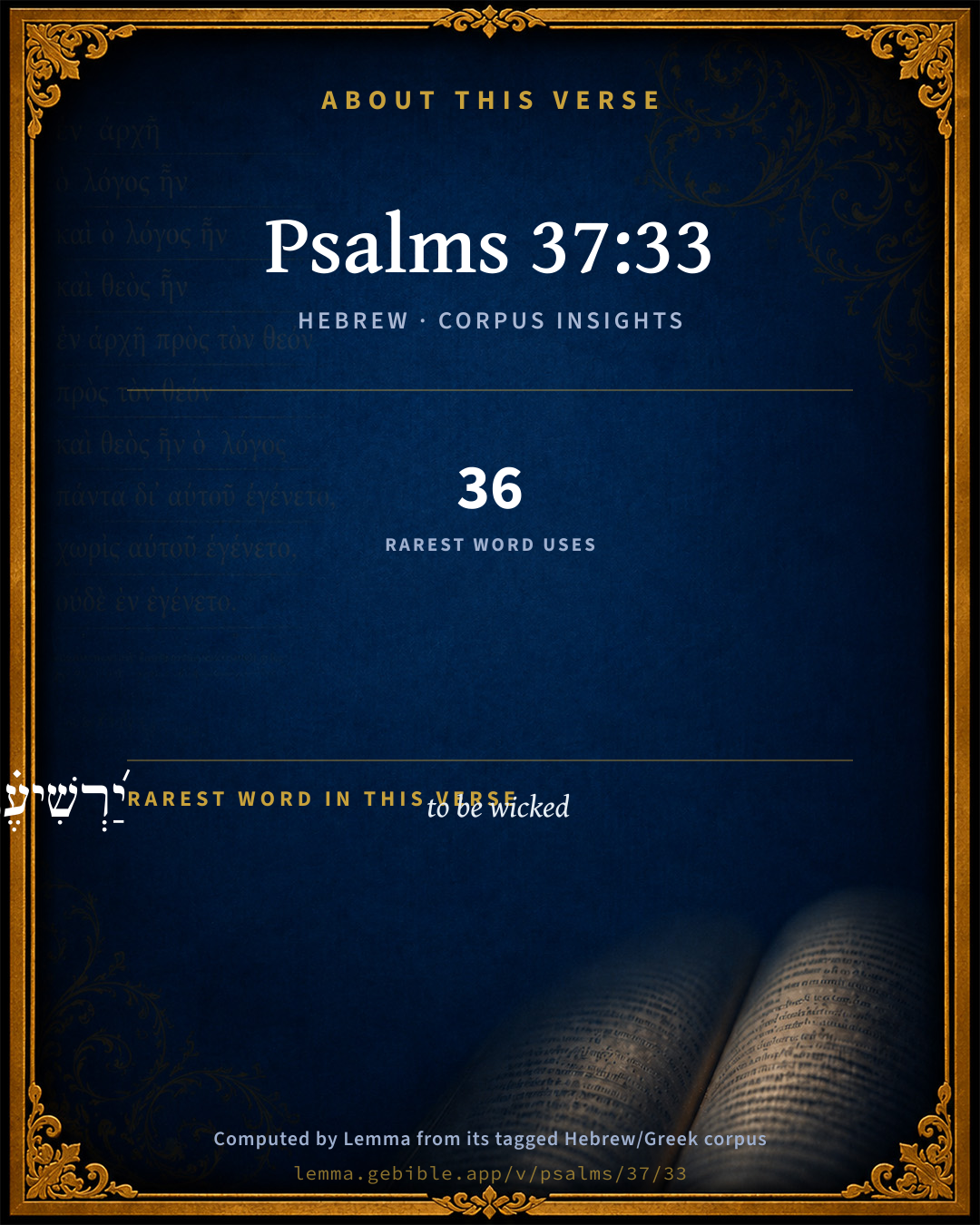
About this verse

These counts appear in no published source. They are computed here, from the morphology-tagged text and Lemma’s own curated glosses. What Lemma adds →

7
words
6
distinct lemmas
Wisdom
section

Shared distinctive vocabulary

יַ֝רְשִׁיעֶ֗נּוּ to be wicked H7561 occurs in 35 verses of the Hebrew Bible. Also found in:

Grammatical profile

  • 3 verbs
  • 2 nouns
  • 2 particles

Verb forms

  • יַעַזְבֶ֣נּוּ Qal · Imperfect
  • יַ֝רְשִׁיעֶ֗נּוּ Hiphil · Imperfect
  • בְּהִשָּׁפְטֽוֹ Niphal · Infinitive Construct

Repetition

A word recurs within this verse — often emphatic in Hebrew:

Hebrew & Septuagint length

In English translation the verse runs 15 words from the Hebrew and 20 from the Septuagint (LXX English) — closely comparable.

A rough comparison of the two English renderings, which tokenize alike — not a word-level alignment.

Word counts can differ between the Hebrew and the Greek without any difference in meaning — e.g. the Hebrew direct-object marker אֵת has no separate Greek word, and Greek often adds the article ὁ.

Cross-references

8

Topical passages linked to Psalms 37:33 in the Treasury of Scripture Knowledge — connected by theme and wording, ordered by reader-vote popularity; previews shown in the World English Bible.

  • Psalms 109:31 For he will stand at the right hand of the needy, To save him from those who judge his soul.
  • Romans 8:1 There is therefore now no condemnation to those who are in Christ Jesus, who don't walk according to the flesh, but according to the Spirit.
  • 2 Peter 2:9 the Lord knows how to deliver the godly out of temptation and to keep the unrighteous under punishment for the day of judgment;
  • Romans 8:33–34 Who could bring a charge against God's chosen ones? It is God who justifies.
  • Psalms 31:7–8 I will be glad and rejoice in your loving kindness, For you have seen my affliction. You have known my soul in adversities.
  • 2 Timothy 4:17 But the Lord stood by me, and strengthened me, that through me the message might be fully proclaimed, and that all the Gentiles might hear; and I was delivered out of the mouth of the lion.
  • Psalms 124:6–7 Blessed be Yahweh, Who has not given us as a prey to their teeth.
  • 1 Samuel 23:26–28 Saul went on this side of the mountain, and David and his men on that side of the mountain: and David made haste to get away for fear of Saul; for Saul and his men compassed David and his men round about to take them.

Cross-references courtesy of OpenBible.info (CC BY 4.0).

Hebrew and Greek witnesses Masoretic Hebrew ↔ Greek Septuagint

The same verse in the two great witnesses to the Old Testament, shown verse-for-verse.

You’re reading Greek Psalm 36 (Hebrew Psalm 37). The Septuagint counts the superscription, so verse numbers can differ from the Hebrew — chapter-level alignment, not verse-by-verse. Numbering follows Rahlfs.

These are two independent witnesses, not word-aligned to each other, and the Septuagint is shown in lemma (dictionary) form.

Hebrew Psalms 37:33 Masoretic · Westminster Leningrad Codex

יְ֭הוָה לֹא יַעַזְבֶ֣נּוּ בְיָד֑וֹ וְלֹ֥א יַ֝רְשִׁיעֶ֗נּוּ בְּהִשָּׁפְטֽוֹ

Yahweh will not leave him in his hand, Nor condemn him when he is judged.

World English Bible · Public Domain

Greek LXX Greek Psalm 36:33 Septuagint · lemma form

ὁ δέ κύριος οὐ μή ἐν καταλείπω αὐτός εἰς ὁ χείρ αὐτός οὐδέ μή καταδικάζω αὐτός ὅταν κρίνω αὐτός

But the Lord will not leave him in his hands, nor by any means condemn him when he is judged.

LXX2012 (modern English Septuagint) · Public Domain

Hebrew: Westminster Leningrad Codex (CC BY 4.0). Greek: Septuagint (public domain); English from LXX2012 (modern English Septuagint) (Public Domain). How the Septuagint differs from the Hebrew →

Commentary

Notes on Psalms 37:33 from classic Christian and Jewish commentators (each source and its license shown beneath its notes). The classic Christian expositions comment on the surrounding passage and are grouped to its opening verse, so a note may address several verses; the Jewish commentaries on the Tanakh (Rashi and others) are per-verse, so they appear only where the commentator wrote on this verse.

Lemma curates 59 commentaries, every one of them public domain or Creative Commons licensed, each selected and text-cleaned for this edition rather than reprinted as found. About our sources →

Trapp's Complete Commentary

John Trapp

Psa 37:33 The LORD will not leave him in his hand, nor condemn him when he is judged.

Ver. 33. The Lord will not leave him in his hand] For he knoweth how to deliver his, 2Pe 3:9, as that apostle could say by good experience, Act 13:50, when he was inter saxum et sacrum, as they say.

Nor condemn him, when he is judged] Heb. Condemn him for wicked; but clear and acquit him when falsely accused, yea, when wrongfully condemned.

John Trapp, A Commentary or Exposition upon All the Books of the Old and New Testament (1647–1656) — public domain. Text from a community e-Sword module.

J. A. Alexander on Psalms

Joseph Addison Alexander

33. (Psa 37:33) Jehovah will not leave him in his hand, will not abandon the righteous to the power of the wicked, and will not make him guilty, a forensic term of the Mosaic Law, meaning to regard or treat as guilty, to condemn (Exo 22:8-9, Deut. x25:1), in his being judged, when he is tried. The image here presented may be that of a judicial process between the righteous and the wicked at the bar of God, who will not and cannot condemn the innocent.

Joseph Addison Alexander, The Psalms Translated and Explained (1850) — public domain. Text from a community e-Sword module.

Geneva Bible (1599)

Geneva Bible translators

For though it be sometime so expedient both for God’s glory and their salvation, yet he will approve their cause, and revenge their wrong.

Geneva Bible (1599) marginal notes — public domain. Text via Bolls.life.

The Cambridge Bible for Schools and Colleges

gen. ed. J. J. S. Perowne

33. will not leave him] Lit. will not forsake him, as in Psa_37:28, and leave him in the hand, i.e. power, of the wicked.

nor condemn him &c.] Will not suffer him to be unjustly condemned. The explanation, that though men may condemn him unjustly, God the supreme judge will acquit him, does not satisfy the context. The Psalmist looks for a temporal deliverance.

The Cambridge Bible for Schools and Colleges (gen. ed. J. J. S. Perowne; Cambridge University Press, 1878–1918) — public domain. Text from a community e-Sword module.

John Gill's Exposition

Wait on the Lord,.... In the way of his appointments and ordinances; where may be learned the design of his providences, and of the prosperity of the wicked, and their end, Psa 73:16; and in a providential way, for the performance of his promises, in which he never fails; and patiently bear whatever he is pleased to lay upon them; waiting for a deliverance out of every affliction, which will be in his own time. The Chaldee paraphrase

"trust in the word of the Lord;''

and keep his way: which he has pointed out in his word, and has directed his people to walk in; though tempted by Satan to turn aside to the right hand or the left; though wicked men reproach, persecute, and seek to pervert it; and though a narrow and rough way, yet keep constantly in it, in which there are both pleasure and profit; good comes of it, and in it peace is had, and the presence of God enjoyed;

and he shall exalt thee to inherit the land: that is, shall raise out of a low and uncomfortable situation of life to a more comfortable one; or however, hereafter, to dwell in the new heavens and new earth, to reign with Christ upon his throne, and to enjoy the eternal inheritance;

when the wicked are cut off; as in Psa 37:9;

thou shall see it; with joy and pleasure; not as exulting: in the destruction of the wicked, simply considered; but as the glory of divine justice is displayed therein; see Psa 52:5.

John Gill's Exposition of the Whole Bible (1746–1763) — public domain (CC PDM 1.0). Text via the HelloAO Bible API.

Albert Barnes' Notes on the Bible

The Lord will not leave him in his hand - Compare 2Pe 2:9. That is, He will rescue him out of the hand of the wicked; he will not leave him, so that the wicked shall accomplish his purpose. The psalmist here undoubtedly means to refer mainly to what will occur in the present life - to the fact that God will interpose to deliver the righteous from the evil designs of the wicked, as he interposes to save his people from famine and want. The meaning is not that this will universally occur, for that would not be true; but that this is the general course of things; this is the tendency and bearing of the divine interpositions and the divine arrangements. Those interpositions and arrangements are, on the whole, favorable to virtue, and favorable to those who love and serve God; so much so that it is an advantage even in the present life to serve God. But this will be absolutely and universally true in the future world. The righteous will be wholly and forever placed beyond the reach of the wicked.

Nor condemn him when he is judged - literally, He will not regard or hold him to be guilty when he is judged. He will regard and treat him as a righteous man. This may refer either

(a) to a case where a judgment is pronounced on a good man “by his fellow-men,” by which he is condemned or adjudged to be guilty - meaning that God will not so regard and treat him; or

(b) to the final judgment, when the cause comes “before God” - meaning that then he will regard and treat him as righteous.

Both of these are true; but it seems probable that the former is particularly referred to here. DeWette understands it in the latter sense; Rosenmuller in the former. Rosenmuller remarks that the idea is, that the wicked, when he is not permitted to assail the righteous by violence, makes his appeal to the courts, and seeks to secure his condemnation there, but that God will not permit this. As he has saved him from violence, so he will interpose and save him from an unrighteous condemnation in the courts. This seems to me to be the true idea. Of course, this is to be understood only in a “general” sense, or as marking the “general” course of things under the divine administration. On this subject, compare Dr. Taylor’s Lectures on Moral Government; vol. i., pp. 252-262. See also Butler’s Analogy, passim.

Albert Barnes' Notes on the Bible (1834–1885) — public domain. Text from a community e-Sword/MySword module.

Matthew Poole's English Annotations

Not leave him in his hand, i.e. not give him up to his power and rage.

Nor condemn him, i.e. nor give his consent to the sentence of condemnation, which the wicked have pronounced against him, but will justify him, and vindicate his innocency and deliver him; for such negatives do oft imply the contrary affirmatives; as God’s not holding a man guiltless commonly implies that he will severely punish him.

Matthew Poole's English Annotations on the Holy Bible (1683–1685) — public domain. Text from a community e-Sword/MySword module.

The Treasury of David

Charles H. Spurgeon

Ver. 33. The Lord will not leave him in his hand. God often appears to deliver his servants, and when he does not do so in this life as to their bodies, he gives their souls such joy and peace that they triumphantly rise beyond their tormentors' power. We may be in the enemy's hand for awhile, as Job was, but we cannot be left there. Nor condemn him when he is judged. Time shall reverse the verdict of haste, or else eternity shall clear away the condemnation of time. In due season just men will be justified. Temporary injustices are tolerated, in the order of Providence, for purposes most wise; but the bitter shall not always be called sweet, nor light for ever be traduced as darkness; the right shall appear in due season; the fictitious and pretentious shall be unmasked, and the real and true shall be revealed. If we have done faithfully, we may appeal from the petty sessions of society to the solemn assize of the great day.

Charles H. Spurgeon's The Treasury of David (1869–1885) — public domain. Psalms only. Text from a community e-Sword/MySword module.

The Pulpit Commentary

The Lord will not leave him in his hand. God, as a general rule, does not allow the wicked man to work his will upon the righteous. He interposes one cheek or another, and saves the righteous man from destruction. Nor condemn him when he is judged; i.e. nor will he allow him to be condemned when the wicked man brings an accusation against him, and seeks to have him sentenced to death by an ignorant or unjust judge. These promises are not universal nor absolute, since many good men have been assassinated by their enemies, as Abel by Cain; and many have been wrongfully condemned to death and executed, as Naboth at the instigation of Jezebel.

The Pulpit Commentary (1880–1919), ed. H.D.M. Spence-Jones & Joseph S. Exell — public domain. Text from a community e-Sword module.

Lesson kit

Teaching starters — assembled from the data on this page, not authored interpretation. Every prompt links to the verse data it draws on. Edit before teaching.

Psalms, in the Wisdom, opens this verse with 7 words (6 distinct Hebrew lemmas). Its most distinctive word is râshaʻ (“to be wicked”). A historical commentator’s framing appears above. Read the whole chapter for the surrounding context.

Discussion questions

  1. What does “to be wicked” (râshaʻ) contribute to the verse as a whole?
  2. Exodus 22:9 shares the word «to be wicked» with this verse. How do the two illuminate each other?
  3. “not” occurs 2× in this one verse. What is the effect of the repetition?
  4. The translations on this page render this verse differently — a whole-verse word diff, not a word-by-word alignment. What might account for the different wordings?
  5. The verb «יַעַזְבֶ֣נּוּ» is Qal Imperfect. How does its form color the action?
  6. Reading how Trapp's Complete Commentary and J. A. Alexander on Psalms read this verse, where do the two commentators agree and where do they part?

Things to notice

Reading settings

Reading text

Shown beneath each verse's original-language words.

Old Testament
Old Testament edition

Read the OT as the Masoretic Hebrew (MT) or the Greek Septuagint (LXX).

English shown for the Greek Septuagint (in the Hebrew ↔ Greek comparison).

Comparing translations? Open the Compare panel on any verse page to stack up to four side by side.