
2 Kings 2:6

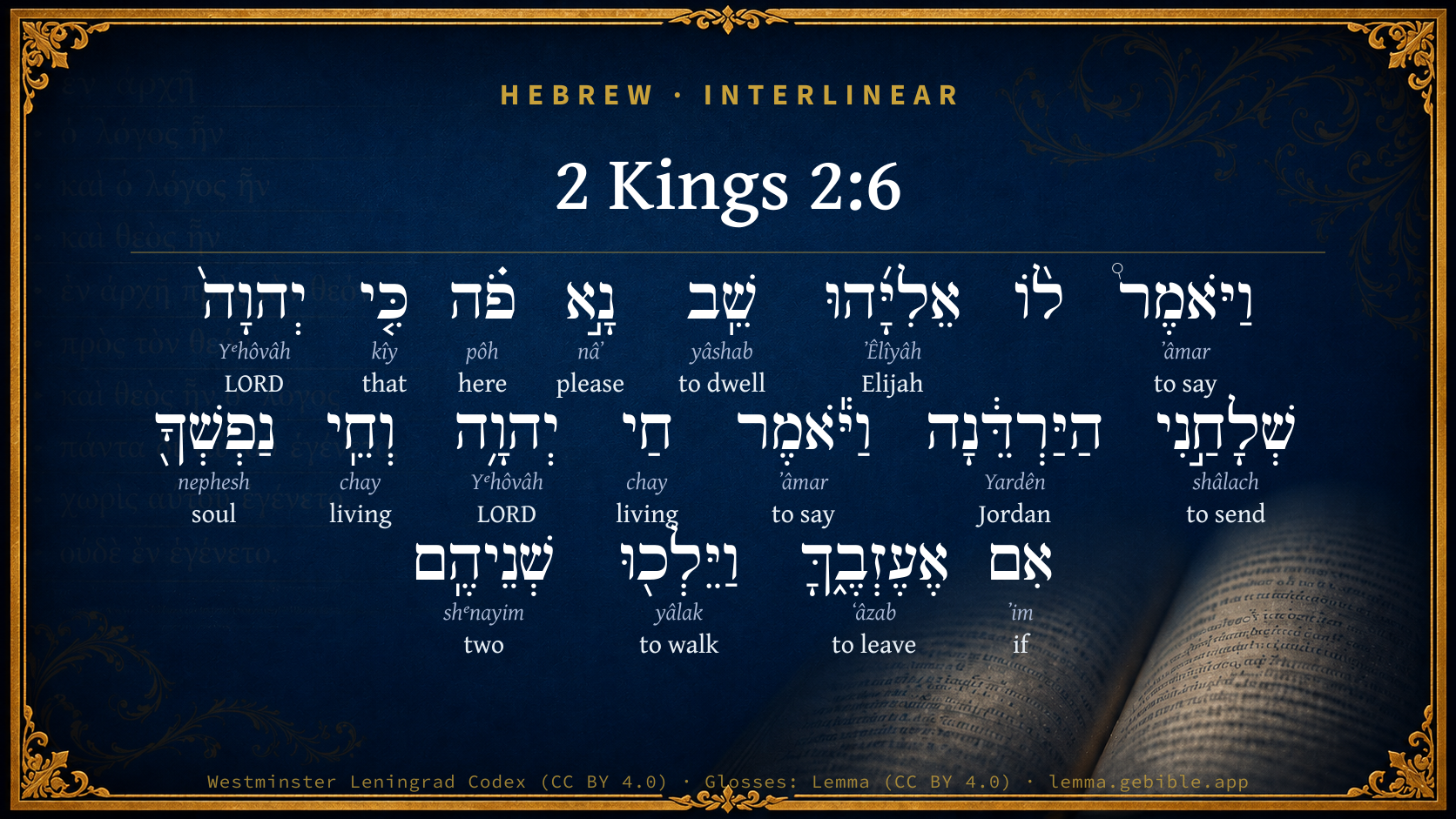
Hebrew (Westminster Leningrad Codex) 2 Kings 2:6 appears in the Hebrew Old Testament. The text above is from the Westminster Leningrad Codex. Each word links to its Strong’s number, a concise gloss, and parsing drawn from the Open Scriptures Hebrew Bible morphology. Click any word for its full Brown-Driver-Briggs (BDB) entry.
Download image
Cite this verse

2 Kings 2:6 (World English Bible). Public Domain. Lemma interlinear Bible study tool, https://lemma.gebible.app/v/2-kings/2/6.

Show BibTeX & RIS
BibTeX
RIS
English Translation
Elijah said to him, "Please wait here, for Yahweh has sent me to the Jordan." He said, "As Yahweh lives, and as your soul lives, I will not leave you." They two went on.
World English Bible · Public Domain
Download a study sheet

One document with this verse’s original text, its word-by-word gloss line, the meaning frame, cross-references with their text, attributed commentary, and full source and license credits — printable, and it pastes into notes with its structure intact.

This verse Autodidact and up

Study sheet (.html) Plain text (.txt)

A passage Seminary Student

Up to 50 verses in one chapter. A passage sheet keeps up to 6 commentary sources and 12 cross-references per verse, in the order this page ranks them, and says so on the sheet whenever that leaves anything out. Ask for a single verse and you get the Autodidact verse sheet above.

Everything on this page stays free to read, with no account — the sheet is a download of what is already on screen, not access to it.

Want to remove ads? Support Godless Engineer
Compare translations 3

The same verse in 3 English versions, stacked beneath the original-language interlinear above. Click any original word for its lexicon entry.

Each is an independent rendering of the whole verse — the interlinear is not word-aligned to these translations.

Highlighted words mark where these versions differ — a whole-verse word diff, not a word-by-word alignment.

  • World English Bible Public Domain
    Elijah said to him, "Please wait here, for Yahweh has sent me to the Jordan." He said, "As Yahweh lives, and as your soul lives, I will not leave you." They two went on.
  • King James Version Public Domain
    And Elijah said unto him, Tarry, I pray thee, here; for the LORD hath sent me to Jordan. And he said, As the LORD liveth, and as thy soul liveth, I will not leave thee. And they two went on.
  • unfoldingWord Literal Text CC BY-SA 4.0
    And Elijah said to him, “Stay here, please, because Yahweh has sent me to the Jordan.” And he said, “The life of Yahweh, and the life of your soul, if I should leave you.” And the two of them went on.

unfoldingWord Literal Text — © unfoldingWord, licensed CC BY-SA 4.0. Word-aligned USFM3 via Door43 (git.door43.org/unfoldingWord/en_ult).

Versions to compare (up to 4)

3 of 4 selected

Show all 18 translations

Every available English version of this verse, each an independent rendering of the whole verse.

  • World English Bible Public Domain
    Elijah said to him, "Please wait here, for Yahweh has sent me to the Jordan." He said, "As Yahweh lives, and as your soul lives, I will not leave you." They two went on.
  • Berean Standard Bible Public Domain
    And Elijah said to Elisha, “Please stay here, for the LORD has sent me on to the Jordan.” But Elisha replied, “As surely as the LORD lives and as you yourself live, I will not leave you.” So the two of them went on.
  • Majority Standard Bible Public Domain
    And Elijah said to Elisha, “Please stay here, for the LORD has sent me on to the Jordan.” But Elisha replied, “As surely as the LORD lives and as you yourself live, I will not leave you.” So the two of them went on.
  • King James Version Public Domain
    And Elijah said unto him, Tarry, I pray thee, here; for the LORD hath sent me to Jordan. And he said, As the LORD liveth, and as thy soul liveth, I will not leave thee. And they two went on.
  • American Standard Version (1901) Public Domain
    And Elijah said unto him, Tarry here, I pray thee; for Jehovah hath sent me to the Jordan. And he said, As Jehovah liveth, and as thy soul liveth, I will not leave thee. And they two went on.
  • Revised Version (1885) Public Domain
    And Elijah said unto him, Tarry here, I pray thee; for the LORD hath sent me to Jordan. And he said, As the LORD liveth, and as thy soul liveth, I will not leave thee. And they two went on.
  • Geneva Bible (1599) Public Domain
    Moreouer Eliiah saide vnto him, Tarie, I pray thee, here: for the Lord hath sent me to Iorden. But he saide, As the Lord liueth, and as thy soule liueth, I will not leaue thee. So they went both together.
  • Douay-Rheims (1899) Public Domain
    And Elias said to him: Stay here, because the Lord hath sent me as far as the Jordan. And he said: As the Lord liveth, and as thy soul liveth, I will not leave thee; and they two went on together,
  • Young's Literal Translation Public Domain
    And Elijah saith to him, `Abide, I pray thee, here, for Jehovah hath sent me to the Jordan;' and he saith, `Jehovah liveth, and thy soul liveth, if I leave thee;' and they go on both of them,
  • Literal Standard Version CC BY-SA 4.0
    And Elijah says to him, “Please abide here, for YHWH has sent me to the Jordan”; and he says, “YHWH lives, and your soul lives, if I leave you”; and both of them go on—
  • Unlocked Literal Bible CC BY-SA 4.0
    Then Elijah said to him, “Stay here, please, for Yahweh has sent me to the Jordan.” Elisha replied, “As Yahweh lives, and as you live, I will not leave you.” So the two went on.
  • unfoldingWord Literal Text CC BY-SA 4.0
    And Elijah said to him, “Stay here, please, because Yahweh has sent me to the Jordan.” And he said, “The life of Yahweh, and the life of your soul, if I should leave you.” And the two of them went on.
  • Darby Bible Public Domain
    And Elijah said to him, Abide here, I pray thee; for Jehovah has sent me to the Jordan. And he said, As Jehovah liveth, and as thy soul liveth, I will not leave thee! And they two went on.
  • World Messianic Bible Public Domain
    Elijah said to him, “Please wait here, for the LORD has sent me to the Jordan.” He said, “As the LORD lives, and as your soul lives, I will not leave you.” Then they both went on.
  • Webster's Bible Public Domain
    And Elijah said to him, Tarry here, I pray thee; for the LORD hath sent me to Jordan. And he said, As the LORD liveth, and as thy soul liveth, I will not leave thee. And they two went on.
  • Free Bible Version CC BY-SA 4.0
    Then Elijah said to him, “Please stay here, Elisha, for the Lord has sent me to the Jordan.” He replied, “As the Lord lives, and as you live, I will not leave you.” So they traveled on together.
  • Bible in Basic English Public Domain
    Then Elijah said to him, Come no farther, for the Lord has sent me to Jordan. But he said, As the Lord is living and as your soul is living, I will not be parted from you. So they went on together.
  • JPS Tanakh (1917) Public Domain
    And Elijah said unto him: 'Tarry here, I pray thee; for the LORD hath sent me to the Jordan.' And he said: 'As the LORD liveth, and as thy soul liveth, I will not leave thee.' And they two went on.

Literal Standard Version (2020), Covenant Press — licensed CC BY-SA 4.0. Text via the HelloAO Bible API (eBible.org). Unlocked Literal Bible (unfoldingWord) — licensed CC BY-SA 4.0. Text via the HelloAO Bible API (eBible.org). unfoldingWord Literal Text — © unfoldingWord, licensed CC BY-SA 4.0. Word-aligned USFM3 via Door43 (git.door43.org/unfoldingWord/en_ult). Free Bible Version, Dr. Jonathan Gallagher — licensed CC BY-SA 4.0. Text via the HelloAO Bible API (eBible.org).

Word by word

More ways to search: Search by grammar → Find every occurrence → Compare this word →

Practice this passage: Drill this verse → Learn its vocabulary →

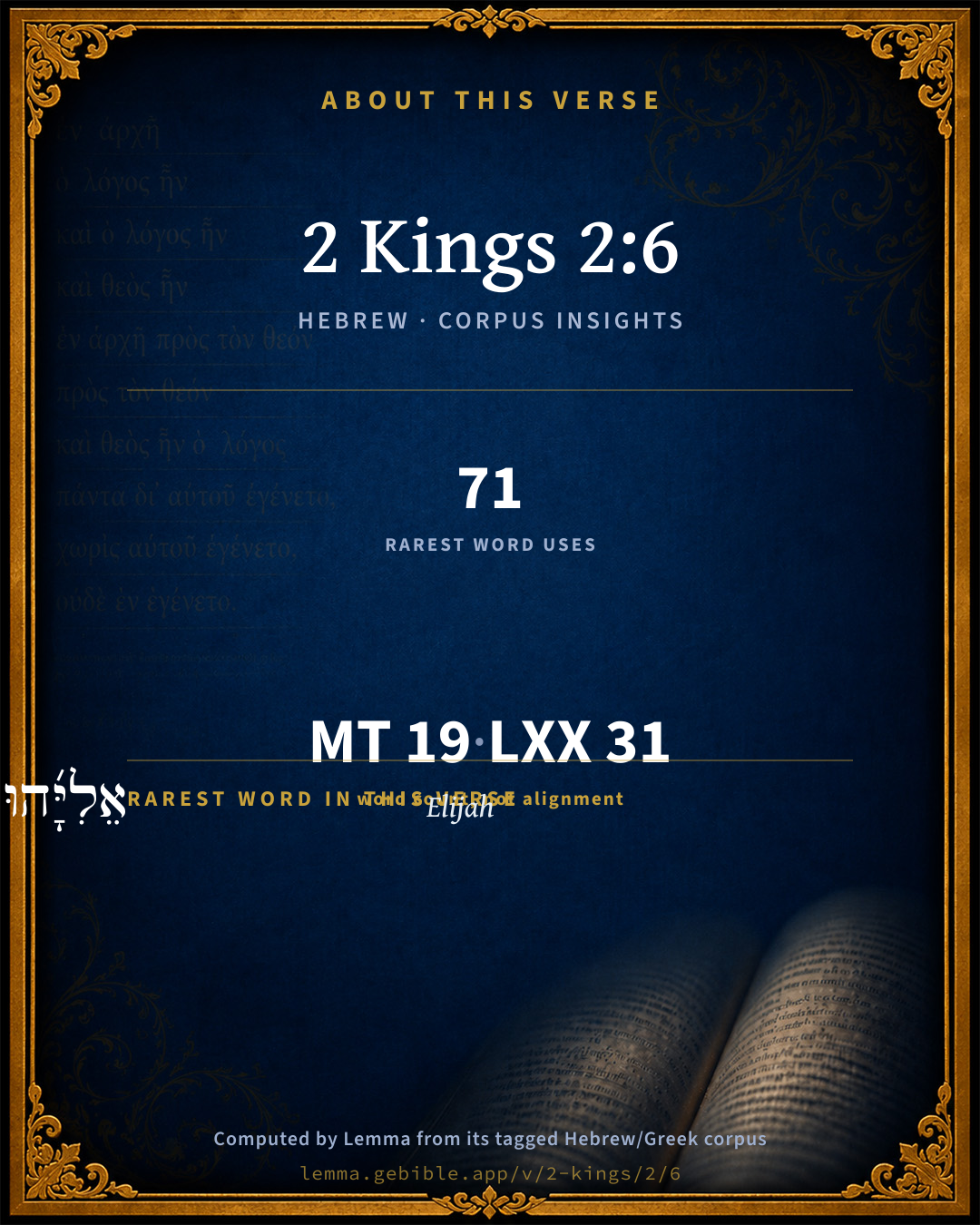
אֵלִיָּ֜הוּ
ʼÊlîyâh
H452
“Elijah”
Noun, Proper
Part of Speech
Noun
Type
Proper
Full BDB Definition

Origin: from H410 and H3050

TWOT: None

Elijah or Eliah = "my God is Jehovah" or " Yah(u) is God" - the great prophet of the reign of Ahab - Benjamite son of Jeroham - a son of Elam with foreign wife during exile - a son of Harim, and priest, with foreign wife during exile
  1. וַיֹּאמֶר֩ ʼâmar H559 “and · to say” Conjunction + Verb, Qal, Sequential Imperfect, 3rd Person, Masculine, Singular
  2. שֵֽׁב yâshab H3427 “dwell” Verb, Qal, Imperative, 2nd Person, Masculine, Singular
  3. נָ֣א nâʼ H4994 “please” Particle, Exhortation
  4. פֹ֗ה pôh H6311 “here” Adverb
  5. כִּ֤י kîy H3588 “that” Conjunction
  6. יְהוָה֙ Yᵉhôvâh H3068 “LORD” Noun, Proper
  7. שְׁלָחַ֣נִי shâlach H7971 “to send · me” Verb, Qal, Perfect, 3rd Person, Masculine, Singular + Suffix, Personal, 1st Person, Common, Singular
  8. הַיַּרְדֵּ֔נָה Yardên H3383 “the · Jordan · toward” Particle, Definite Article + Noun, Proper + Suffix, Demonstrative
  9. וַיֹּ֕אמֶר ʼâmar H559 “and · to say” Conjunction + Verb, Qal, Sequential Imperfect, 3rd Person, Masculine, Singular
  10. חַי chay H2416 “living” Adjective, Adjective, Masculine, Singular, Absolute
  11. יְהוָ֥ה Yᵉhôvâh H3068 “LORD” Noun, Proper
  12. וְחֵֽי chay H2416 “and · living” Conjunction + Adjective, Adjective, Masculine, Singular, Absolute
  13. נַפְשְׁךָ֖ nephesh H5315 “soul · your” Noun, Common, Both, Singular, Construct + Suffix, Personal, 2nd Person, Masculine, Singular
  14. אִם ʼim H518 “if” Conjunction
  15. אֶעֶזְבֶ֑ךָּ ʻâzab H5800 “to leave · you” Verb, Qal, Imperfect, 1st Person, Common, Singular + Suffix, Personal, 2nd Person, Masculine, Singular
  16. וַיֵּלְכ֖וּ yâlak H3212 “and · to walk” Conjunction + Verb, Qal, Sequential Imperfect, 3rd Person, Masculine, Plural
  17. שְׁנֵיהֶֽם shᵉnayim H8147 “two · their” Adjective, Cardinal number, Masculine, Dual, Construct + Suffix, Personal, 3rd Person, Masculine, Plural

About this verse

These counts appear in no published source. They are computed here, from the morphology-tagged text and Lemma’s own curated glosses. What Lemma adds →

19
words
15
distinct lemmas
Historical
section

Grammatical profile

  • 6 verbs
  • 5 nouns
  • 3 adjectives
  • 1 preposition
  • 2 conjunctions
  • 1 adverb
  • 1 particle

Verb forms

  • וַיֹּאמֶר֩ Qal · Sequential Imperfect
  • שֵֽׁב Qal · Imperative
  • שְׁלָחַ֣נִי Qal · Perfect
  • וַיֹּ֕אמֶר Qal · Sequential Imperfect
  • אֶעֶזְבֶ֑ךָּ Qal · Imperfect
  • וַיֵּלְכ֖וּ Qal · Sequential Imperfect

Repetition

Words recur within this verse — often emphatic in Hebrew:

  • וַיֹּאמֶר֩ to say H559 ×2
  • יְהוָה֙ LORD H3068 ×2
  • חַי living H2416 ×2

Hebrew & Septuagint length

In English translation the verse runs 34 words from the Hebrew and 39 from the Septuagint (LXX English) — closely comparable.

A rough comparison of the two English renderings, which tokenize alike — not a word-level alignment.

Word counts can differ between the Hebrew and the Greek without any difference in meaning — e.g. the Hebrew direct-object marker אֵת has no separate Greek word, and Greek often adds the article ὁ.

In the original languages it is 19 Hebrew tokens and 31 Greek tokens — but the two are counted differently (Hebrew bundles its prefixes and suffixes into one token; the Greek is in lemma form), so that isn’t a like-for-like length.

Cross-references

2

Topical passages linked to 2 Kings 2:6 in the Treasury of Scripture Knowledge — connected by theme and wording, ordered by reader-vote popularity; previews shown in the World English Bible.

  • 2 Kings 2:2 Elijah said to Elisha, Please wait here, for Yahweh has sent me as far as Bethel. Elisha said, As Yahweh lives, and as your soul lives, I will not leave you. So they went down to Bethel.
  • Joshua 3:15 and when those who bore the ark were come to the Jordan, and the feet of the priests who bore the ark were dipped in the brink of the water (for the Jordan overflows all its banks all the time of harvest),

Cross-references courtesy of OpenBible.info (CC BY 4.0).

Hebrew and Greek witnesses Masoretic Hebrew ↔ Greek Septuagint

The same verse in the two great witnesses to the Old Testament, shown verse-for-verse.

These are two independent witnesses, not word-aligned to each other, and the Septuagint is shown in lemma (dictionary) form.

Hebrew 2 Kings 2:6 Masoretic · Westminster Leningrad Codex

וַיֹּאמֶר֩ ל֨וֹ אֵלִיָּ֜הוּ שֵֽׁב נָ֣א פֹ֗ה כִּ֤י יְהוָה֙ שְׁלָחַ֣נִי הַיַּרְדֵּ֔נָה וַיֹּ֕אמֶר חַי יְהוָ֥ה וְחֵֽי נַפְשְׁךָ֖ אִם אֶעֶזְבֶ֑ךָּ וַיֵּלְכ֖וּ שְׁנֵיהֶֽם

Elijah said to him, "Please wait here, for Yahweh has sent me to the Jordan." He said, "As Yahweh lives, and as your soul lives, I will not leave you." They two went on.

World English Bible · Public Domain

Greek LXX 2 Kings 2:6 Septuagint · lemma form

καί εἶπον αὐτός ηλιου καταἧμαι δή ὧδε ὅτι κύριος ἀποστέλλω ἐγώ ἕως ὁ ἰορδάνης καί εἶπον ελισαιε ζάω κύριος καί ζάω ὁ ψυχή σύ εἰ ἐν καταλείπω σύ καί πορεύομαι ἀμφότεροι

And Eliu said to him, Stay here, I pray you, for the Lord has sent me to Jordan. And Elisaie said, As the Lord lives and your soul lives, I will not leave you: and they both went on.

LXX2012 (modern English Septuagint) · Public Domain

On this verse, Ellicott's Commentary for English Readers discusses the Septuagint’s reading. Read the note in Commentary ↓

Hebrew: Westminster Leningrad Codex (CC BY 4.0). Greek: Septuagint (public domain); English from LXX2012 (modern English Septuagint) (Public Domain). How the Septuagint differs from the Hebrew →

Targum (Aramaic paraphrase)

1

The Targum is the ancient Jewish Aramaic paraphrase of the Hebrew Scriptures — an interpretive translation, not the Hebrew text itself. Onkelos (literal) and Pseudo-Jonathan (expansive) render the Torah, and Jonathan the Prophets. Coverage is partial: where no permissively-licensed English translation exists for a verse, only the Aramaic is shown. This is verse-level text, not a word-by-word alignment to the Hebrew.

  1. Targum Jonathan Prophets (Joshua–Malachi)
    וַאֲמַר לֵיהּ אֵלִיָהוּ תּוּב כְּעַן הָכָא אֲרֵי יְיָ שַׁלְחֵנִי עַד יַרְדְנָא וַאֲמַר קַיָם הוּא יְיָ וְחַי נַפְשָׁךְ אִם אֶשְׁבְּקִינָךְ וַאֲזַלוּ תַּרְוֵיהוֹן:

    (no public-domain English translation for this verse)

    Targum Jonathan — Aramaic: “Mikraot Gedolot” (public domain). English: “Sefaria Community Translation” (CC0 1.0 (public-domain dedication)); “London "Chaldee Paraphrase," 1871” (public domain). Text via Sefaria.

Commentary

Notes on 2 Kings 2:6 from classic Christian and Jewish commentators (each source and its license shown beneath its notes). The classic Christian expositions comment on the surrounding passage and are grouped to its opening verse, so a note may address several verses; the Jewish commentaries on the Tanakh (Rashi and others) are per-verse, so they appear only where the commentator wrote on this verse.

Lemma curates 59 commentaries, every one of them public domain or Creative Commons licensed, each selected and text-cleaned for this edition rather than reprinted as found. About our sources →

Trapp's Complete Commentary

John Trapp

2Ki 2:6 And Elijah said unto him, Tarry, I pray thee, here; for the LORD hath sent me to Jordan. And he said, [As] the LORD liveth, and [as] thy soul liveth, I will not leave thee. And they two went on.

Ver. 6. Tarry, I pray thee, here.] This is a third motion, for trial haply of his love and constancy. See the like, Joh 21:17.

John Trapp, A Commentary or Exposition upon All the Books of the Old and New Testament (1647–1656) — public domain. Text from a community e-Sword module.

Ellicott's Commentary for English Readers

(6) Said unto him.—Syriac adds, “unto Elisha;” Arabic, as 2Ki_2:4, and so three MSS.

And he said.—LXX., “and Elisha said”—an improvement.

“Not only Elisha, the intimate companion and future successor of Elijah, but all the disciples of the different ‘schools of the prophets,’ have the presentiment of the loss which threatens them. The Spirit has warned them all; they communicate their fears, but Elisha forbids them to give free course to their sorrow. A respectful silence, a resignation not exempt from foreboding, suits this condition of things. Elisha clings to his master, as though he could keep him back; the disciples follow them with their eyes. The monotony of the successive scenes adds to the solemn effect of the total description” (Reuss).

A Bible Commentary for English Readers, edited by Charles John Ellicott (1878–1897) — public domain. Text from a community e-Sword module.

The Cambridge Bible for Schools and Colleges

gen. ed. J. J. S. Perowne

6. to Jordan] The journey tends across the river to that part of the country whither Elijah had at first fled for fear of Ahab. In that same land of Gilead, which was Elijah’s birthplace (1Ki_17:1) and whither we find the prophet’s first flight directed (1Ki_17:2-3), is to be the scene of his assumption into heaven.

they two went on] It was felt by the whole prophetic band that none but the faithful minister could presume to go as Elijah’s companion at such a moment. They watched the departing master and servant, standing only afar off, if perchance they might be allowed to witness something more of the approaching separation.

The Cambridge Bible for Schools and Colleges (gen. ed. J. J. S. Perowne; Cambridge University Press, 1878–1918) — public domain. Text from a community e-Sword module.

John Gill's Exposition

And fifty men of the sons of the prophets went, and stood to view afar off,.... To have a view, if they could, of the assumption of Elijah to heaven, and be witnesses of it:

and they two stood by Jordan; on the banks of it, even Elijah and Elisha.

John Gill's Exposition of the Whole Bible (1746–1763) — public domain (CC PDM 1.0). Text via the HelloAO Bible API.

Haydock's Catholic Bible Commentary

Thee. Elias had tried the constancy of his disciple three times, as Christ required of St. Peter a triple confession of love, John xxi. 17. (Haydock) --- Humility might also prompt the prophet to desire to be alone. (Salien)

George Leo Haydock (1774–1849), Haydock's Catholic Family Bible and Commentary, 1859 edition — public domain. Excludes Psalms (Douay-Rheims chapter numbering differs from Protestant) and Deuterocanonical books (Catholic canon only).

The Pulpit Commentary

And Elijah said unto him, Tarry, I pray thee, here; for the Lord hath sent me to Jordan. Elijah makes a third effort to detach his follower from him, or a third trial of his fidelity. He is ordered, not to a town, where his follower might find lodging and refreshment and companionship, but into the open country to the Jordan. And then, who can say whither? Will it not be best for Elisha to leave him now, and not continue a wandering which threatens to be endless? But the follower is staunch; nothing daunts him; and he makes the same reply as before. And he said, As the Lord liveth, and as thy soul liveth, I will not leave thee. And they two went on.

The Pulpit Commentary (1880–1919), ed. H.D.M. Spence-Jones & Joseph S. Exell — public domain. Text from a community e-Sword module.

Lesson kit

Teaching starters — assembled from the data on this page, not authored interpretation. Every prompt links to the verse data it draws on. Edit before teaching.

2 Kings, in the Historical, opens this verse with 19 words (15 distinct Hebrew lemmas). Its most distinctive word is ʼÊlîyâh (“Elijah”). A historical commentator’s framing appears above. Read the whole chapter for the surrounding context.

Discussion questions

  1. How does “Elijah” (ʼÊlîyâh) shape what this verse is saying?
  2. 2 Kings 2:2 shares this passage’s theme. How do the two illuminate each other?
  3. “to say” occurs 2× in this one verse. What is the effect of the repetition?
  4. The translations on this page render this verse differently — a whole-verse word diff, not a word-by-word alignment. What might account for the different wordings?
  5. The verb «וַיֹּאמֶר֩» is Qal Sequential Imperfect. How does its form color the action?
  6. Reading how Trapp's Complete Commentary and Ellicott's Commentary for English Readers read this verse, where do the two commentators agree and where do they part?

Things to notice

Reading settings

Reading text

Shown beneath each verse's original-language words.

Old Testament
Old Testament edition

Read the OT as the Masoretic Hebrew (MT) or the Greek Septuagint (LXX).

English shown for the Greek Septuagint (in the Hebrew ↔ Greek comparison).

Comparing translations? Open the Compare panel on any verse page to stack up to four side by side.