
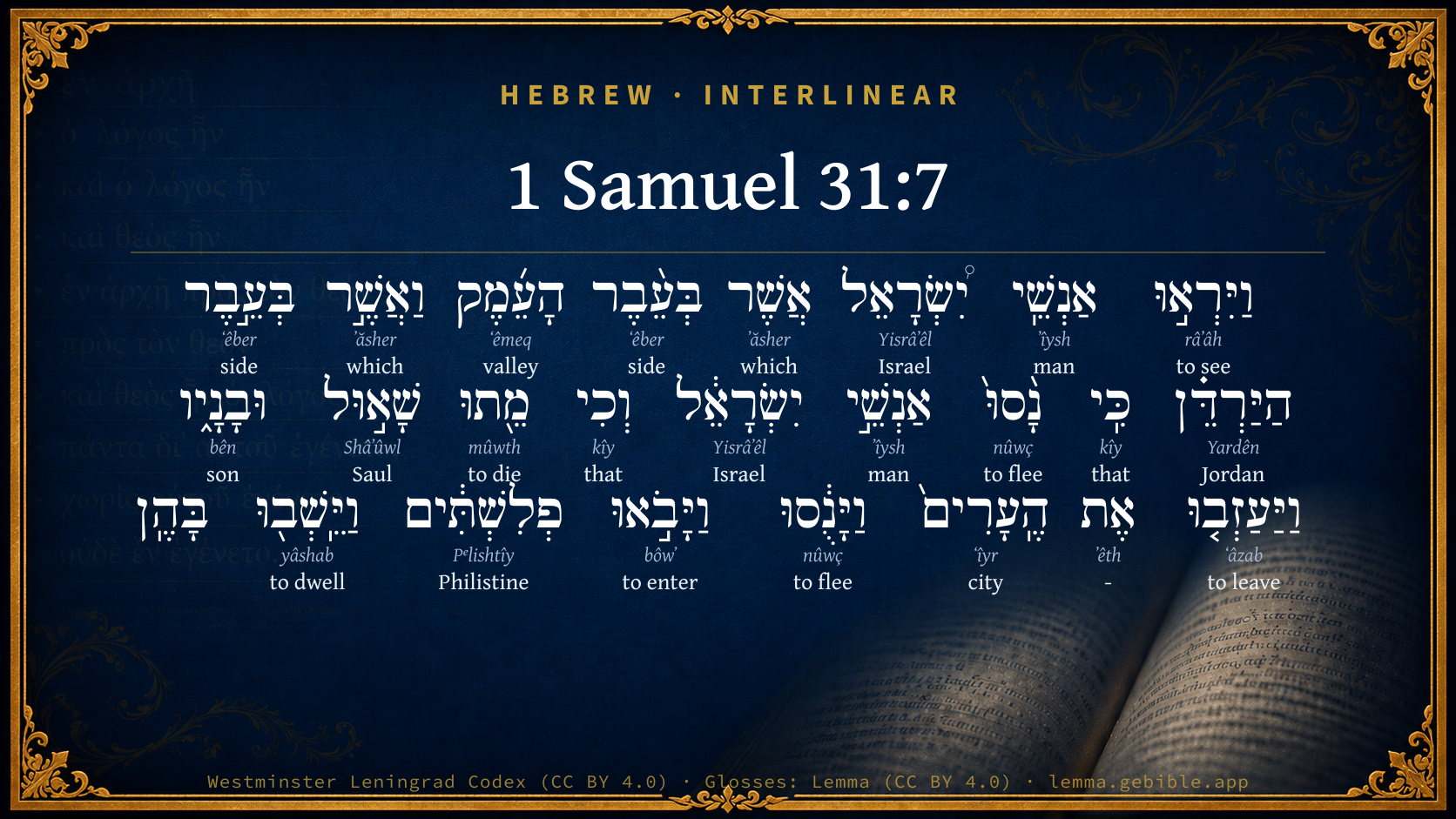
1 Samuel 31:7

Hebrew (Westminster Leningrad Codex) 1 Samuel 31:7 appears in the Hebrew Old Testament. The text above is from the Westminster Leningrad Codex. Each word links to its Strong’s number, a concise gloss, and parsing drawn from the Open Scriptures Hebrew Bible morphology. Click any word for its full Brown-Driver-Briggs (BDB) entry.
Download image
Cite this verse

1 Samuel 31:7 (World English Bible). Public Domain. Lemma interlinear Bible study tool, https://lemma.gebible.app/v/1-samuel/31/7.

Show BibTeX & RIS
BibTeX
RIS
English Translation
When the men of Israel who were on the other side of the valley, and those who were beyond the Jordan, saw that the men of Israel fled, and that Saul and his sons were dead, they forsook the cities, and fled; and the Philistines came and lived in them.
World English Bible · Public Domain
Download a study sheet

One document with this verse’s original text, its word-by-word gloss line, the meaning frame, cross-references with their text, attributed commentary, and full source and license credits — printable, and it pastes into notes with its structure intact.

This verse Autodidact and up

Study sheet (.html) Plain text (.txt)

A passage Seminary Student

Up to 50 verses in one chapter. A passage sheet keeps up to 6 commentary sources and 12 cross-references per verse, in the order this page ranks them, and says so on the sheet whenever that leaves anything out. Ask for a single verse and you get the Autodidact verse sheet above.

Everything on this page stays free to read, with no account — the sheet is a download of what is already on screen, not access to it.

Want to remove ads? Support Godless Engineer
Compare translations 3

The same verse in 3 English versions, stacked beneath the original-language interlinear above. Click any original word for its lexicon entry.

Each is an independent rendering of the whole verse — the interlinear is not word-aligned to these translations.

Highlighted words mark where these versions differ — a whole-verse word diff, not a word-by-word alignment.

  • World English Bible Public Domain
    When the men of Israel who were on the other side of the valley, and those who were beyond the Jordan, saw that the men of Israel fled, and that Saul and his sons were dead, they forsook the cities, and fled; and the Philistines came and lived in them.
  • King James Version Public Domain
    And when the men of Israel that were on the other side of the valley, and they that were on the other side Jordan, saw that the men of Israel fled, and that Saul and his sons were dead, they forsook the cities, and fled; and the Philistines came and dwelt in them.
  • unfoldingWord Literal Text CC BY-SA 4.0
    And the men of Israel who on the other side of the valley and who on the other side of the Jordan saw that the men of Israel had fled and that Saul and his sons had died. And they abandoned their cities and fled. And the Philistines came and dwelled in them.

unfoldingWord Literal Text — © unfoldingWord, licensed CC BY-SA 4.0. Word-aligned USFM3 via Door43 (git.door43.org/unfoldingWord/en_ult).

Versions to compare (up to 4)

3 of 4 selected

Show all 18 translations

Every available English version of this verse, each an independent rendering of the whole verse.

  • World English Bible Public Domain
    When the men of Israel who were on the other side of the valley, and those who were beyond the Jordan, saw that the men of Israel fled, and that Saul and his sons were dead, they forsook the cities, and fled; and the Philistines came and lived in them.
  • Berean Standard Bible Public Domain
    When the Israelites along the valley and those on the other side of the Jordan saw that the army of Israel had fled and that Saul and his sons had died, they abandoned their cities and ran away. So the Philistines came and occupied their cities.
  • Majority Standard Bible Public Domain
    When the Israelites along the valley and those on the other side of the Jordan saw that the army of Israel had fled and that Saul and his sons had died, they abandoned their cities and ran away. So the Philistines came and occupied their cities.
  • King James Version Public Domain
    And when the men of Israel that were on the other side of the valley, and they that were on the other side Jordan, saw that the men of Israel fled, and that Saul and his sons were dead, they forsook the cities, and fled; and the Philistines came and dwelt in them.
  • American Standard Version (1901) Public Domain
    And when the men of Israel that were on the other side of the valley, and they that were beyond the Jordan, saw that the men of Israel fled, and that Saul and his sons were dead, they forsook the cities, and fled; and the Philistines came and dwelt in them.
  • Revised Version (1885) Public Domain
    And when the men of Israel that were on the other side of the valley, and they that were beyond Jordan, saw that the men of Israel fled, and that Saul and his sons were dead, they forsook the cities, and fled; and the Philistines came and dwelt in them.
  • Geneva Bible (1599) Public Domain
    And when the men of Israel that were on the other side of the valley, and they of the other side Iorden saw that the men of Israel were put to flight, and that Saul and his sonnes were dead, then they left the cities, and ran away: and the Philistims came and dwelt in them.
  • Douay-Rheims (1899) Public Domain
    And the men of Israel, that were beyond the valley, and beyond the Jordan, seeing that the Israelites were fled, and that Saul was dead, and his sons, forsook their cities, and fled: and the Philistines came, and dwelt there.
  • Young's Literal Translation Public Domain
    And they see -- the men of Israel, who `are' beyond the valley, and who `are' beyond the Jordan -- that the men of Israel have fled, and that Saul and his sons have died, and they forsake the cities and flee, and Philistines come in, and dwell in them.
  • Literal Standard Version CC BY-SA 4.0
    And they see—the men of Israel, who [are] beyond the valley, and who [are] beyond the Jordan—that the men of Israel have fled, and that Saul and his sons have died, and they forsake the cities and flee, and Philistines come in, and dwell in them.
  • Unlocked Literal Bible CC BY-SA 4.0
    When the men of Israel who were on the other side of the valley, and those beyond the Jordan, saw that the men of Israel had fled, and that Saul and his sons were dead, they abandoned their cities and fled, and the Philistines came and lived in them.
  • unfoldingWord Literal Text CC BY-SA 4.0
    And the men of Israel who on the other side of the valley and who on the other side of the Jordan saw that the men of Israel had fled and that Saul and his sons had died. And they abandoned their cities and fled. And the Philistines came and dwelled in them.
  • Darby Bible Public Domain
    And when the men of Israel that were on this side of the valley, and [they] that were on this side of the Jordan, saw that the men of Israel fled, and that Saul and his sons were dead, they forsook the cities and fled; and the Philistines came and dwelt in them.
  • World Messianic Bible Public Domain
    When the men of Israel who were on the other side of the valley, and those who were beyond the Jordan, saw that the men of Israel fled and that Saul and his sons were dead, they abandoned the cities and fled; and the Philistines came and lived in them.
  • Webster's Bible Public Domain
    And when the men of Israel that were on the other side of the valley, and they that were on the other side of Jordan, saw that the men of Israel fled, and that Saul and his sons were dead, they forsook the cities, and fled; and the Philistines came and dwelt in them.
  • Free Bible Version CC BY-SA 4.0
    When the Israelites who lived along the valley and those on the other side of the Jordan realized that the Israelite army had run away, and that Saul and his sons had died, they abandoned their cities and they also ran away. So the Philistines came and took them over.
  • Bible in Basic English Public Domain
    And when the men of Israel across the valley and on the other side of Jordan saw that the army of Israel was in flight and that Saul and his sons were dead, they came out of their towns and went in flight; and the Philistines came and took them for themselves.
  • JPS Tanakh (1917) Public Domain
    And when the men of Israel that were on the other side of the valley, and they that were beyond the Jordan, saw that the men of Israel fled, and that Saul and his sons were dead, they forsook the cities, and fled; and the Philistines came and dwelt in them.

Literal Standard Version (2020), Covenant Press — licensed CC BY-SA 4.0. Text via the HelloAO Bible API (eBible.org). Unlocked Literal Bible (unfoldingWord) — licensed CC BY-SA 4.0. Text via the HelloAO Bible API (eBible.org). unfoldingWord Literal Text — © unfoldingWord, licensed CC BY-SA 4.0. Word-aligned USFM3 via Door43 (git.door43.org/unfoldingWord/en_ult). Free Bible Version, Dr. Jonathan Gallagher — licensed CC BY-SA 4.0. Text via the HelloAO Bible API (eBible.org).

Word by word

More ways to search: Search by grammar → Find every occurrence → Compare this word →

Practice this passage: Drill this verse → Learn its vocabulary →

הָעֵ֜מֶק
ʻêmeq
H6010
“the · valley”
Particle, Definite Article + Noun, Common, Masculine, Singular, Absolute
Part of Speech
Particle + Noun
Type
Common
Gender
Masculine
Number
Singular
State
Absolute
Full BDB Definition

Origin: from H6009

TWOT: 1644a

valley, vale, lowland, open country
  1. וַיִּרְא֣וּ râʼâh H7200 “and · to see” Conjunction + Verb, Qal, Sequential Imperfect, 3rd Person, Masculine, Plural
  2. אַנְשֵֽׁי ʼîysh H376 “men of” Noun, Common, Masculine, Plural, Construct
  3. יִ֠שְׂרָאֵל Yisrâʼêl H3478 “Israel” Noun, Proper
  4. אֲשֶׁר ʼăsher H834 “which” Particle, Relative
  5. בְּעֵ֨בֶר ʻêber H5676 “in/at · side of” Preposition + Noun, Common, Masculine, Singular, Construct
  6. וַאֲשֶׁ֣ר ʼăsher H834 “and · which” Conjunction + Particle, Relative
  7. בְּעֵ֣בֶר ʻêber H5676 “in/at · side of” Preposition + Noun, Common, Masculine, Singular, Construct
  8. הַיַּרְדֵּ֗ן Yardên H3383 “the · Jordan” Particle, Definite Article + Noun, Proper
  9. כִּֽי kîy H3588 “that” Conjunction
  10. נָ֨סוּ֙ nûwç H5127 “to flee” Verb, Qal, Perfect, 3rd Person, Common, Plural
  11. אַנְשֵׁ֣י ʼîysh H376 “men of” Noun, Common, Masculine, Plural, Construct
  12. יִשְׂרָאֵ֔ל Yisrâʼêl H3478 “Israel” Noun, Proper
  13. וְכִי kîy H3588 “and · that” Conjunction + Conjunction
  14. מֵ֖תוּ mûwth H4191 “to die” Verb, Qal, Perfect, 3rd Person, Common, Plural
  15. שָׁא֣וּל Shâʼûwl H7586 “Saul” Noun, Proper
  16. וּבָנָ֑יו bên H1121 “and · sons · his” Conjunction + Noun, Common, Masculine, Plural, Construct + Suffix, Personal, 3rd Person, Masculine, Singular
  17. וַיַּעַזְב֤וּ ʻâzab H5800 “and · to leave” Conjunction + Verb, Qal, Sequential Imperfect, 3rd Person, Masculine, Plural
  18. אֶת ʼêth H853 “-” Particle, Direct Object
  19. הֶֽעָרִים֙ ʻîyr H5892 “the · cities” Particle, Definite Article + Noun, Common, Feminine, Plural, Absolute
  20. וַיָּנֻ֔סוּ nûwç H5127 “and · to flee” Conjunction + Verb, Qal, Sequential Imperfect, 3rd Person, Masculine, Plural
  21. וַיָּבֹ֣אוּ bôwʼ H935 “and · to enter” Conjunction + Verb, Qal, Sequential Imperfect, 3rd Person, Masculine, Plural
  22. פְלִשְׁתִּ֔ים Pᵉlishtîy H6430 “Philistines” Noun, Gentilic, Masculine, Plural, Absolute
  23. וַיֵּֽשְׁב֖וּ yâshab H3427 “and · to dwell” Conjunction + Verb, Qal, Sequential Imperfect, 3rd Person, Masculine, Plural

About this verse

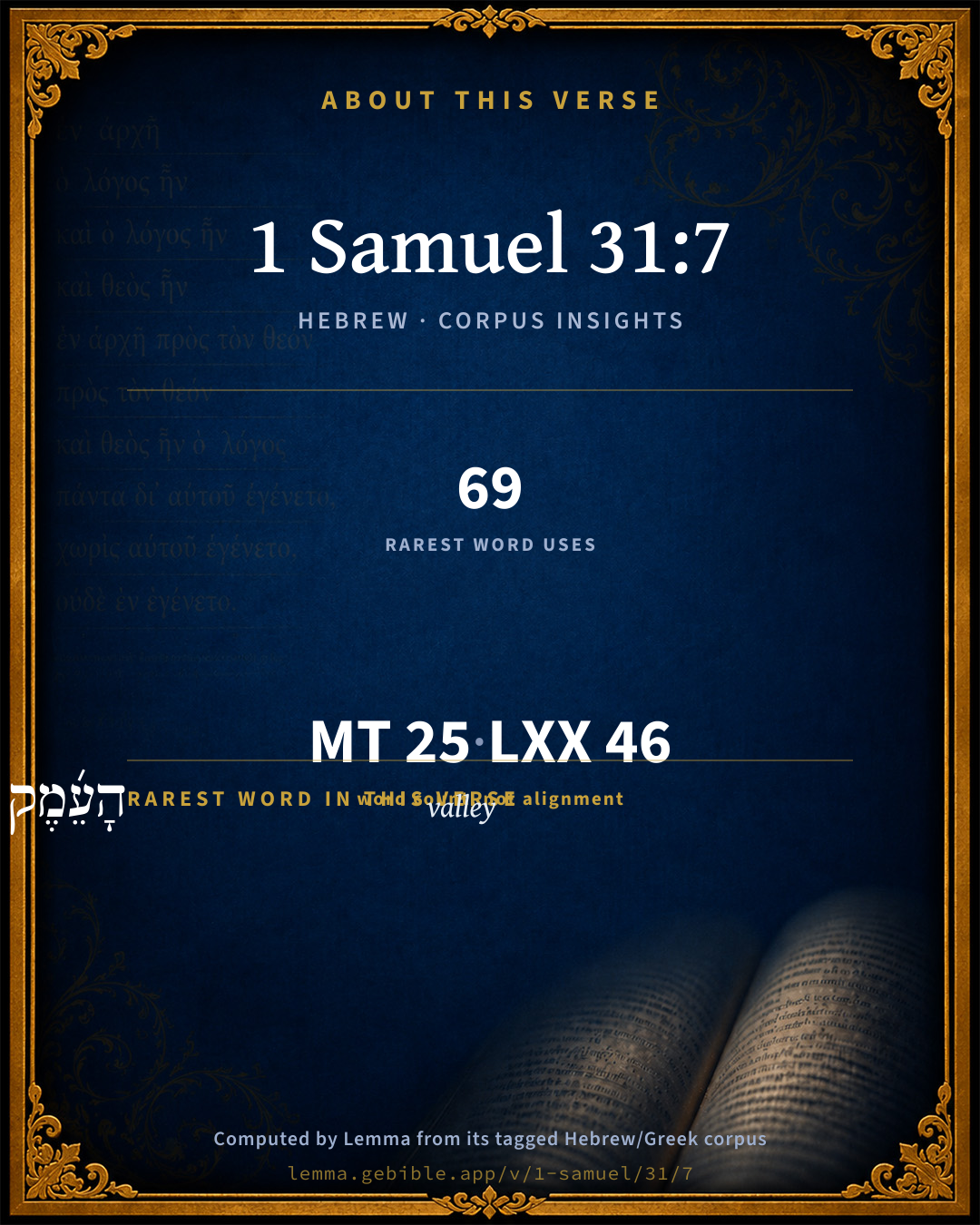
These counts appear in no published source. They are computed here, from the morphology-tagged text and Lemma’s own curated glosses. What Lemma adds →

25
words
18
distinct lemmas
Historical
section

Grammatical profile

  • 7 verbs
  • 12 nouns
  • 1 preposition
  • 2 conjunctions
  • 3 particles

Verb forms

  • וַיִּרְא֣וּ Qal · Sequential Imperfect
  • נָ֨סוּ֙ Qal · Perfect
  • מֵ֖תוּ Qal · Perfect
  • וַיַּעַזְב֤וּ Qal · Sequential Imperfect
  • וַיָּנֻ֔סוּ Qal · Sequential Imperfect
  • וַיָּבֹ֣אוּ Qal · Sequential Imperfect
  • וַיֵּֽשְׁב֖וּ Qal · Sequential Imperfect

Repetition

Words recur within this verse — often emphatic in Hebrew:

  • אַנְשֵֽׁי man H376 ×2
  • יִ֠שְׂרָאֵל Israel H3478 ×2
  • בְּעֵ֨בֶר side H5676 ×2
  • נָ֨סוּ֙ to flee H5127 ×2
  • אֲשֶׁר which H834 ×2
  • כִּֽי that H3588 ×2

Hebrew & Septuagint length

In English translation the verse runs 50 words from the Hebrew and 48 from the Septuagint (LXX English) — closely comparable.

A rough comparison of the two English renderings, which tokenize alike — not a word-level alignment.

Word counts can differ between the Hebrew and the Greek without any difference in meaning — e.g. the Hebrew direct-object marker אֵת has no separate Greek word, and Greek often adds the article ὁ.

In the original languages it is 25 Hebrew tokens and 46 Greek tokens — but the two are counted differently (Hebrew bundles its prefixes and suffixes into one token; the Greek is in lemma form), so that isn’t a like-for-like length.

Cross-references

5

Topical passages linked to 1 Samuel 31:7 in the Treasury of Scripture Knowledge — connected by theme and wording, ordered by reader-vote popularity; previews shown in the World English Bible.

  • Leviticus 26:32 I will bring the land into desolation; and your enemies that dwell therein will be astonished at it.
  • Leviticus 26:36 "'As for those of you who are left, I will send a faintness into their hearts in the lands of their enemies: and the sound of a driven leaf will put them to flight; and they shall flee, as one flees from the sword; and they will fall when no one pursues.
  • Deuteronomy 28:33 The fruit of your ground, and all your labors, shall a nation which you don't know eat up; and you shall be only oppressed and crushed always;
  • Judges 6:2 The hand of Midian prevailed against Israel; and because of Midian the children of Israel made them the dens which are in the mountains, and the caves, and the strongholds.
  • 1 Samuel 13:6 When the men of Israel saw that they were in a strait (for the people were distressed), then the people did hide themselves in caves, and in thickets, and in rocks, and in coverts, and in pits.

Cross-references courtesy of OpenBible.info (CC BY 4.0).

Hebrew and Greek witnesses Masoretic Hebrew ↔ Greek Septuagint

The same verse in the two great witnesses to the Old Testament, shown verse-for-verse.

These are two independent witnesses, not word-aligned to each other, and the Septuagint is shown in lemma (dictionary) form.

Hebrew 1 Samuel 31:7 Masoretic · Westminster Leningrad Codex

וַיִּרְא֣וּ אַנְשֵֽׁי יִ֠שְׂרָאֵל אֲשֶׁר בְּעֵ֨בֶר הָעֵ֜מֶק וַאֲשֶׁ֣ר בְּעֵ֣בֶר הַיַּרְדֵּ֗ן כִּֽי נָ֨סוּ֙ אַנְשֵׁ֣י יִשְׂרָאֵ֔ל וְכִי מֵ֖תוּ שָׁא֣וּל וּבָנָ֑יו וַיַּעַזְב֤וּ אֶת הֶֽעָרִים֙ וַיָּנֻ֔סוּ וַיָּבֹ֣אוּ פְלִשְׁתִּ֔ים וַיֵּֽשְׁב֖וּ בָּהֶֽן

When the men of Israel who were on the other side of the valley, and those who were beyond the Jordan, saw that the men of Israel fled, and that Saul and his sons were dead, they forsook the cities, and fled; and the Philistines came and lived in them.

World English Bible · Public Domain

Greek LXX 1 Samuel 31:7 Septuagint · lemma form

καί ὁράω ὁ ἀνήρ ἰσραήλ ὁ ἐν ὁ πέραν ὁ κοιλάς καί ὁ ἐν ὁ πέραν ὁ ἰορδάνης ὅτι φεύγω ὁ ἀνήρ ἰσραήλ καί ὅτι θνήσκω σαούλ καί ὁ υἱός αὐτός καί καταλείπω ὁ πόλις αὐτός καί φεύγω καί ἔρχομαι ὁ ἀλλόφυλος καί καταοἰκέω ἐν αὐτός

And the men of Israel who were on the other side of the valley, and those beyond Jordan, saw that the men of Israel fled, and that Saul and his sons were dead; and they leave their cities and flee: and the Philistines come and dwell in them.

LXX2012 (modern English Septuagint) · Public Domain

Hebrew: Westminster Leningrad Codex (CC BY 4.0). Greek: Septuagint (public domain); English from LXX2012 (modern English Septuagint) (Public Domain). How the Septuagint differs from the Hebrew →

Targum (Aramaic paraphrase)

1

The Targum is the ancient Jewish Aramaic paraphrase of the Hebrew Scriptures — an interpretive translation, not the Hebrew text itself. Onkelos (literal) and Pseudo-Jonathan (expansive) render the Torah, and Jonathan the Prophets. Coverage is partial: where no permissively-licensed English translation exists for a verse, only the Aramaic is shown. This is verse-level text, not a word-by-word alignment to the Hebrew.

  1. Targum Jonathan Prophets (Joshua–Malachi)
    וַחֲזוֹ אֱנָשֵׁי יִשְׂרָאֵל דִבְּעִבְרָא דְמֵישְׁרָא וְדִבְּעִבְרָא דְיַרְדְנָא אֲרֵי אַפִיכוּ אֱנָשֵׁי יִשְׂרָאֵל וַאֲרֵי מִיתוּ שָׁאוּל וּבְנוֹהִי וּשְׁבָקוּ יַת קִרְוַיָא וְאַפִּיכוּ וַאֲתוֹ פְלִשְׁתָּאֵי וִיתִיבוּ בְהוֹן:

    (no public-domain English translation for this verse)

    Targum Jonathan — Aramaic: “Mikraot Gedolot” (public domain). English: “Sefaria Community Translation” (CC0 1.0 (public-domain dedication)); “London "Chaldee Paraphrase," 1871” (public domain). Text via Sefaria.

Commentary

Notes on 1 Samuel 31:7 from classic Christian and Jewish commentators (each source and its license shown beneath its notes). The classic Christian expositions comment on the surrounding passage and are grouped to its opening verse, so a note may address several verses; the Jewish commentaries on the Tanakh (Rashi and others) are per-verse, so they appear only where the commentator wrote on this verse.

Lemma curates 59 commentaries, every one of them public domain or Creative Commons licensed, each selected and text-cleaned for this edition rather than reprinted as found. About our sources →

Trapp's Complete Commentary

John Trapp

1Sa 31:7 And when the men of Israel that [were] on the other side of the valley, and [they] that [were] on the other side Jordan, saw that the men of Israel fled, and that Saul and his sons were dead, they forsook the cities, and fled; and the Philistines came and dwelt in them.

Ver. 7. That were on the other side of the valley,] i.e., On both sides of the place where the battle was fought.

And the Philistines came and dwelt in them.] They were not like Hannibal, of whom it is said that he knew how to get a victory, but not how to use it. These pursued the victory; and having slain Saul, they might have overrun the land, but that God raised up David to put a stop to their proceedings, and at length to subdue them to his dominion.

John Trapp, A Commentary or Exposition upon All the Books of the Old and New Testament (1647–1656) — public domain. Text from a community e-Sword module.

Joseph Benson's Commentary

1Sa 31:7-10. They on the other side Jordan — Or, rather, on this side Jordan; for the Hebrew word signifies either side. And there was no occasion for those beyond Jordan to flee. Saul and his three sons — “The Scripture,” as Mr. Henry well observes, “makes no mention of the souls of Saul and his sons, what became of them after they were dead; secret things belong not to us.” They cut off his head — As the Israelites did by Goliath, and fastened it in the temple of Dagon, 1Ch 10:10. In the house of their idols — To give them the glory of this victory. And by this respect shown to their pretended deities, how do they shame those who give not the honour of their achievements to the living God! They fastened his body to the wall of Beth-shan — To expose it, as we do the bodies of great malefactors, to public shame and reproach. And thus, as appears by 1Sa 31:12, they did with the bodies of his sons.

Joseph Benson's Commentary on the Old and New Testaments (1811–1818) — public domain. Text from a community e-Sword module.

Geneva Bible (1599)

Geneva Bible translators

Near to Gilboa.

The Tribes of Reuben and Gad, and half the tribe of Manasseh.

Geneva Bible (1599) marginal notes — public domain. Text via Bolls.life.

Jamieson, Fausset & Brown

Robert Jamieson, A. R. Fausset & David Brown

the men of Israel that were on the other side of the valley--probably the valley of Jezreel--the largest and southernmost of the valleys that run between Little Hermon and the ridges of the Gilboa range direct into the Jordan valley. It was very natural for the people in the towns and villages there to take fright and flee, for had they waited the arrival of the victors, they must, according to the war usages of the time, have been deprived either of their liberty or their lives.

Jamieson, Fausset & Brown — Commentary Critical and Explanatory on the Whole Bible (1871) — public domain (CC PDM 1.0). Text via the HelloAO Bible API.

Adam Clarke's Commentary

Verse 7. The men of Israel that were on the other side of the valley] They appear to have been panic-struck, and therefore fled as far as they could out of the reach of the Philistines. As the Philistines possessed Beth-shan, situated near to Jordan, the people on the other side of that river, fearing for their safety, fled also.

Adam Clarke's Commentary on the Bible (1810–1826) — public domain. Text from a community e-Sword/MySword module.

Ellicott's Commentary for English Readers

(7) On the other side of the valley.—The words “on the other side of the valley” denote the country opposite to the battle-field in the valley of Jezreel, on which the writer supposes himself to be standing, the land occupied especially by the tribes of Issachar, Zabulon, and Napthali. The expression “on the other side of Jordan,” is the usual phrase for the country east of the River Jordan. It is highly probable that the alarm caused by the great defeat of their king caused many of the dwellers in the smaller cities and villages to the east of Jordan hastily to abandon their houses rather than be exposed to the insolence and demands of the invading army. Still the Philistine army in this direction could not have penetrated very far, as shortly after Gilboa we hear of Abner rallying the friends of the house of Saul round the Prince Ishbosheth, whom he proclaimed king at Mahanaim, a town some twenty miles east of the river. The country to the south of the plain of Jezreel does not appear to have been overrun by the victorious army. The presence of David in that part no doubt insured its immunity from invasion.

A Bible Commentary for English Readers, edited by Charles John Ellicott (1878–1897) — public domain. Text from a community e-Sword module.

The Cambridge Bible for Schools and Colleges

gen. ed. J. J. S. Perowne

7. on the other side of the valley] On the side of the valley (êmek, see on 1Sa_6:13) or plain of Jezreel opposite to the battle-field. The district to the north is meant, in which the tribes of Issachar, Zebulun and Naphtali dwelt. 1Ch_10:7 however reads simply “in the valley,” and perhaps the phrase only means “on the side of the valley.” See next note.

on the other side Jordan] This is the usual sense of the Hebrew words. The panic spread even to the eastern side of the Jordan. But possibly the phrase here means “on the side of the Jordan,” i.e. in the district between the battle-field and the river; which agrees better with the account of the exploit of the Jabeshites, and the establishment of Ishbosheth’s kingdom at Mahanaim. The greater part of the north of Canaan was thus occupied by the Philistines. Note that this clause is omitted in 1Ch_10:7.

The Cambridge Bible for Schools and Colleges (gen. ed. J. J. S. Perowne; Cambridge University Press, 1878–1918) — public domain. Text from a community e-Sword module.

John Gill's Exposition

And which the men of Israel that were on the other side of the valley,.... The valley of Jezreel; of which See Gill on Hos 1:5,

and they that were on the other side Jordan; or rather "on that side"; for the phrase will bear to be rendered either way, and so may mean that side of Jordan on which the battle was fought; for as for the other side, or that beyond it, the Israelites there could not be in such fear of the Philistines, nor do we ever read of their inhabiting any cities there; though as the phrase is used of the valley, as well as of the river, it may be rendered "about the valley, and about Jordan" (g), and so describes such that dwelt near to each of them:

saw that the men of Israel fled, and that Saul and his sons were dead; that is, had information and intelligence of those facts, for it is not to be supposed they saw them with their eyes:

they forsook, the cities, and fled; fearing they should be put to the sword, or carried captive:

and the Philistines came and dwelt them; having nothing more to do than to come and take possession.

(g) "circa convellem illiam--circa Jordanem", Junius & Tremellius, Picator; so Noldius, p. 295. No. 936.

John Gill's Exposition of the Whole Bible (1746–1763) — public domain (CC PDM 1.0). Text via the HelloAO Bible API.

Albert Barnes' Notes on the Bible

The men on the other side of the valley - This must mean to the north of the plain of Jezreel, and would comprise the tribe of Naphtali, and Zabulon, and probably Issachar. But the text of 1Ch 10:7 has “that were in the valley,” limiting the statement to the inhabitants of the plain of Jezreel.

On the other side Jordan - This phrase most commonly means on the east of Jordan, the speaker being supposed to be on the west side. But it is also used of the west of Jordan, as here, if the text be sound.

The Philistines ... dwelt in them - One of the principal cities, Beth-shan, fell into their power at once 1Sa 31:10.

Albert Barnes' Notes on the Bible (1834–1885) — public domain. Text from a community e-Sword/MySword module.

Haydock's Catholic Bible Commentary

Beyond, or about "the passage" or fords of the Jordan, as the Hebrew means. (Menochius) --- The Philistines did not pursue after them, as God set bounds to their ambition. It might otherwise have proved very fatal to his people, who were now so much divided and terrified. In the parallel passage, in Chronicles, it is only said, When the men....that dwelt in the plains (of Jezrahel) saw this, they fled, 1 Paralipomenon x. 7. The Philistines seized the abandoned cities, particularly Bethsan, (ver. 10.; Haydock) which had been retained by the Chanaanites in the days of the judges, and which David took back, Judges i. 27., and 3 Kings iv. 12.

George Leo Haydock (1774–1849), Haydock's Catholic Family Bible and Commentary, 1859 edition — public domain. Excludes Psalms (Douay-Rheims chapter numbering differs from Protestant) and Deuterocanonical books (Catholic canon only).

Matthew Poole's English Annotations

Of the valley, to wit, the valley of Jezreel, where the battle was fought.

On the other side Jordan; or rather, on this side Jordan; for these were in the most danger; and the Hebrew preposition is indifferently used for on this side, or for beyond.

Matthew Poole's English Annotations on the Holy Bible (1683–1685) — public domain. Text from a community e-Sword/MySword module.

Whedon's Commentary on the Bible

Daniel D. Whedon

7. The men of Israel that were on the other side of the valley — The inhabitants on the opposite side of the great Plain of Jezreel; that is, on the western side of the plain, opposite to the mountains of Gilboa.

On the other side Jordan — The western side of Jordan, opposite to Jabesh-Gilead. Thus the entire northern part of the land of Israel fell under the dominion of the Philistines.

Philistines came and dwelt in them — This speedy occupation by the Philistines of the conquered and depopulated cities of Israel, shows their strong purpose to hold henceforth in close subjection the country whose people had been to them so irrepressible a foe. But Abner seems to have recovered these cities to the kingdom of Saul, (2Sa_2:8-10,) and subsequently David utterly subdued the Philistines. 2Sa_8:1.

Daniel D. Whedon (gen. ed.), Commentary on the Old and New Testaments (1874–1909) — public domain. Text from a community e-Sword module.

The Pulpit Commentary

POLITICAL RESULT OF THE BATTLE (ver. 7).

The men of Israel. The term is here applied to non-combatants, while in ver. 1 it meant those following Saul in arms. On the other side of the valley. Ie. of Jezreel, and so all the Israelites inhabiting the tribes of Issachar, Zabulon, and Naphthali, and the region generally to the north. In 1Ch_10:7 this flight is confined to the inhabitants of the valley, one of the most fertile districts of Palestine; but probably the statement made here, that a very large extent of country was the prize of victory, is the more correct. On the other side Jordan. This phrase constantly means the eastern side of the Jordan, nor need we doubt but that the people living near it abandoned their homes and fled; for the river would form but a slight protection for them in this northerly part of its course. Still the conquests on the eastern bank of the Jordan must have been confined to a small district near the lake of Tiberias, as Abner was able to place Ishbosheth as king at Mahanaim, a town about twenty miles to the east of the river, and not far from Jabez-Gilead. South of Jezreel the Philistines made no conquests, and thus Ephraim, Benjamin, and Judah remained free, and of course Gilead, and the most part of the region beyond Jordan. (see 2Sa_2:8-11)

Vers. 7-13.

The final issues of life a criterion of worth.

The facts are

1. The defeat of Saul is followed by the general flight of the men of Israelfrom the neigbbouring cities, and the occupation of these by the Philistines.

2. The bodies of Saul and of his sons being found, the Philistines strip theking"s of his armour, publish the fact in the houses of idols, and dishonour him on the wall of Beth-shan.

3. The men of Jabesh-Gilead, hearing of this, rescue the bodies and bury them at Jabesh amidst much mourning. The historian closes the narrative concerning Saul"s reign by a reference to the immediate result of the defeat on the adjacent cities, and to the barbarous treatment of Saul"s body. The people who had demanded a king, and who were proud of his powerful bodily presence, were now to learn in saddest form how much better it is to wait the time of God, and to trust rather to righteousness of national life than to physical force and martial display. The people and the king were at fault, and the judgment falls on both. We here see

I THAT LIFE"S WORTH IS TESTED BY ITS FINAL RESULT. The public life of Saul at one time promised well for himself and Israel. Every aid which wise advice and holy influence could render had been freely bestowed by Samuel, the man of God, and the promise of Divine help was given on condition of obedience to the Divine voice. Although troubles came in consequence of disobedience, and thus indicated that his life was proving a failure, there were doubtless men so blind to the signs of the times as to refer the troubles to accidents and unforeseen circumstances, and to hope still that there would be a turn in the tide of affairs which would insure a prosperous reign. But the panic which came on Israel on Saul"s death and the occupation of cities by the detested Philistine must have made clear to the most prejudiced that his public career was disastrous and unrighteous. The issue of a monarch"s reign should be the moral and material elevation of the people, the improved administration of law, the greater security of life and property, a prevalence of the blessings of internal peace and freedom from foreign oppression, and a higher degree of national influence. The reverse of this was the outcome of Saul"s life. By thus looking at the result of life"s labours we may form an estimate of the worth of monarchs, statesmen, merchants, and professed Christians. Have men blessed their fellow creatures with permanent good? Is the great enemy, sin, more in occupation of country, home, and the soul at the end than at the beginning? The day is coming when every man"s work will be tried of "what sort it is". (1Co_3:13) Can we face that test? Will the end be better than the beginning? Dare some men try to answer this question in relation to their spiritual condition and the spiritual effect of their personal influence.

II THAT THE APPARENT TRIUMPH OF THE WICKED IS ONE OF THE SADDEST CONSEQUENCES OF THE SINS OF GOD"S PEOPLE. The triumph of the "uncircumcised" was complete when, stripping the body of Israel"s king, they carried his head in savage delight to the house of Dagon, (1Ch_10:10) nailed his corpse to the wall of Beth-shan, and proclaimed their victory in honour of their gods. It was this result following on the death of Saul and defeat of Israel that seemed to be an occasion of so much sorrow and dread to David. (2Sa_1:20) The fond hopes cherished by the pious on the solemn day of repentance and consecration at Mizpeh and Ebenezer (1Sa_7:9-12) were now rudely destroyed. Heathenism gloried in its strength; while Israel, smitten with fear, mourned in bitterness of soul. Ignorance, barbarity, idolatry took a new lease of power, and Jehovah"s name was dishonoured in the eyes of the nations. The death of a king is comparatively a small matter, the wasting sweep of war over fair fields and flourishing cities is a material calamity; but for irreligion to flourish, debasing religious rites to manifest all their vileness, and the cause of purity, truth, and righteousness to be made.to suffer even apparent defeat, this was the most fearful consequence of Saul"s unhappy reign. All actions in public and private individuals are to be judged by their bearing on the honour of God"s name and the extension of the kingdom of Christ. Does a monarch"s or a statesman"s policy give greater scope for whatever is alien to the supremacy of Christ in heart, conduct, and home? If so it is very criminal. Does our private life give occasion for the enemies of the cross to blaspheme? He who so lives and dies as to strengthen the hold of ignorance, superstition, immorality, and anti-Christian principles on the world is the enemy of his country and of God. When men professedly in the Church of God, as Saul was in Israel, so become unfaithful to their privileges as to give an apparent triumph to the irreligious and profane, they, in whatever degree this is true, perpetrate an injury, the spiritual issues of which are beyond all calculation.

III THAT THE MOST TERRIBLE TRIALS MAY GIVE RISE TO OCCASIONAL DEEDS OF HEROISM. Various were the effects of Saul"s death on Israel. On all there must have come that inexpressible anguish which in some degree David sought to express in his beautiful "song of the bow". (2Sa_1:18-27) But there were faithful men who could not yield to inaction while God"s name was being dishonoured and Israel, in the person of the king, covered with ignominy. The men of Jabesh-Gilead had not forgotten the day when, in the prime of his strength, and bidding fair to defend his country in the fear of God, Saul had come to their rescue and had aroused the patriotism of the nation. (1Sa_11:4-11) To them he was more than king; he was hero and friend, and doubtless their children had used his name as a household word. And now dead, forsaken, mutilated, the tall, majestic form exposed to heathen scorn should they suffer it? Never! "All the valiant men arose." With setpurpose, at risk of life, they bring away the mangled remains, and sorrowfully lay them low in the place that witnessed his early heroism. Thus do we see how misfortune, sorrow, and death call forth the nobler qualities of men, and bring to light hidden sympathies and secret friends. There was some hope for Israel yet. The terrible disasters of life stir up the energies of the faithful few, and though they cannot at once redeem all that others have lost, they can reassert the supremacy of love and the nobler sentiments of life, and so pave the way for a better order of things. Men in Israel revived a little from despair when they heard of this heroism and affection. Was there not a darker night and more complete apparent defeat of Israel"s high purpose in the world when another and more sacred body was exposed "a spectacle to angels and to men"? Then also one was found who dared to identify his reputation and all that was dear with respect and love for that holy body. Joseph of Arimathea was morally more heroic than the men of Jabesh-Gilead. In similar ways the disasters of life have drawn forth the heroism of many who could not endure to see the "uncircumcised" triumph. Thus light shines forth in darkness, assuring us that in the long conflict with evil the morning of an endless day full of the joy of the ransomed will dawn on the sorrowful earth.

General lessons:

1. To form a just estimate of our life we should not regard our personalenjoyments as pain. but have chief respect to the ultimate effect of it on our home and country.

2. Wicked men find encouragement to believe in their false principles whenmen professing opposite principles are untrue to them.

3. We ought to consider how much of the power of irreligious principlesand practices over men is due to our want of consistency.

4. It will be blessed for us and our survivors if friends are able to commitour body to the grave with affection and gratitude unalloyed with painful memories.

Vers. 7-10. (GILBOA.)

The chastisement of Israel.

The thunderstorm of which they were long ago warned (1Sa_12:18, 1Sa_12:25) had now burst upon the people of Israel. Since the capture of the ark they had not experienced so great a calamity, and in it the fatal results of their demand for a king were made manifest. Although the demand was evil, it contained an element of good, and was complied with by God in judgment mingled with mercy. "As no people can show a visible theocracy, so no monarchy can be accused, simply as such, of usurping the Divine prerogative. But still the transaction does involve a moral lesson, which lies at the foundation of all sound policy, condemning the abandonment of principle on the plea of expediency, and pointing by the example of Israel the doom of every nation that seeks safety and power in a course known to be wrong" (P. Smith, "Ancient History"). They had their own way, yet the purpose of God was not defeated, but accomplished less directly, and in such a manner as to convince them of the folly of their devices, and exhibit his overruling wisdom and power. Whilst they pursued their course under a king "according to the will of man," their Divine King was preparing "a man after his own heart to be captain over his people". (1Sa_13:14, Act_12:22) When the end came David stood ready to occupy the throne, and, after a brief period of conflict and confusion, the whole nation, taught by experience, gladly received him as its ruler. This is the theocratic "argument" of the greater portion of the Book. In the terrible defeat of Israel we see

I THEIR IDOL BROKEN IN PIECES. "So Saul died," etc. "The men of Israel fled, and Saul and his sons were dead," etc. (vers. 6, 7). Men are apt to imagine that something else beyond what God has ordained is necessary to their welfare, to be impatient of his time, to attach an undue value to the expedients which in their imperfect knowledge and sinful desires they devise, to set their hearts upon earthly and visible objects, and depend upon them rather than upon "him who is invisible." This tendency finds expression in many ways, and embodies itself in many forms. And although God may permit such idols to continue for a time, he always overthrows them. When Israel made an idol of the ark it was given into the hands of the Philistines, and when they made an idol of "a king" (1Sa_8:5) he was slain. Their hope in him was bitterly disappointed, and inasmuch as he yeas (according to Divine prescience, though not by absolute necessity nor without personal guilt) a representation and reflection of their sin (worldliness, formalism, self-will), they were severely punished in him and by his instrumentality. How little did they gain, how much did they lose, by having their own way! "I gave thee a king in mine anger, and took him away in my wrath". (Hos_13:11) "Cease ye from man," etc.

II THEIR CITIES FORSAKEN. "And when the men of Israel that were by the side of the plain" (west of the central branch of the valley of Jezreel, "opposite to the place of conflict, which the writer assumed as his standpoint Keil), "and by the side of the Jordan" (east of the plain, between Gilboa and the Jordan), "saw that the men of Israel" (who were engaged in the battle) "fled," etc. "they forsook the cities; and the Philistines came" (from that time onward) "and dwelt in them" (so that the whole of the northern part of the land fell into their hands). Instead of overcoming their enemies, they were overcome by them, driven from their homes, reduced to the most abject condition, and without any prospect of regaining by their own strength their lost possessions. "Your country is desolate," etc.. (Isa_1:7) The peaceful government of Samuel gave them prosperity; (1Sa_7:13, 1Sa_7:14) but the warlike rule of Saul, which they preferred, ended in their overthrow. "Sore distressed," like him (1Sa_28:15) whither should they turn for help? Men are deprived of all hope in themselves that they may "set their hope in God.

III THEIR ENEMIES TRIUMPHANT. "And it came to pass on the morrow" (after the battle, which ended at nightfall) "when the Philistines came," etc. "And they cut off his head (as in the case of Goliath of Gath, and afterwards deposited it in the temple of Dagon, in Ashdod, (1Ch_10:10; 1Sa_5:1) and sent (messengers bearing his head and armour) into the land of the Philistines round about, to proclaim the good tidings in their idol temples (to their idols) and among the people. (2Sa_1:20) And they put his armour in the house of Ashtaroth (in Askelon), and they fastened his body to the wall of Bethshan". (Jud 1:27) It has been remarked of the Philistines that "so implacable was their enmity to the Israelites, that one would be almost tempted to think that they bad been created on purpose to be a thorn in their sides" (Russell, "Connection," History of the Philistines). Their victory was the victory of their gods; the defeat of Israel the dishonour of Jehovah. Rather than sanction sin in his people, God not only suffers them to be overthrown by their enemies, but even his own name to be for a while despised and "blasphemed among the heathen." But the triumph of the wicked is short. (2Sa_5:17-25)

IV THEIR TRUE STRENGTH UNDESTROYED. It consisted in the presence and power of their Divine and invisible King; his benevolent and unchangeable purpose concerning them; (1Sa_12:22) his faithful, praying, obedient subjects in their midst, who had been long looking to David as his chosen "servant," and were now rallying round him daily until his following became "a great host like the host of God". (1Ch_12:22) There was an "Israel after the flesh" (constituting the State), and there was an Israel "after the spirit" (constituting the Church); and in the latter lay "the power of an endless life." Judgment might sweep over the nation like a destroying hailstorm, and leave it like a tree bereft of all its leaves, and even "cut it down" to the ground. But its true life would be spared, would be tried and purified by affliction, and become a source of renewed power and greater glory. "As a teil tree, and as an oak, whose substance is in them, when they cast their leaves: so the holy seed shall be the substance thereof". (Isa_6:13 Isa_1:9 Isa_65:8)

Observations:

1. That which is wrongly desired as an instrument of good becomes when obtained an instrument of evil.

2. Men may have their own Way apparently in opposition to the way ofGod, but his purpose does not change, and he knows how to carry it into effect.

3. The people who sanction the sins of their rulers justly share theirpunishment.

4. When the people of God expect to prevail against their enemies byadopting their sinful policy, (1Sa_8:20) they are certain to be ultimately defeated.

5. The suffering and humiliation that follow sin are the most effectualmeans of its correction.

6. The hope of a nation in the day of trouble lies in its praying, believing,godly men.

7. God overrules all things, including the sins and sorrows of his people,for the establishment of his kingdom upon earth. D. (1Sa_2:10)

The Pulpit Commentary (1880–1919), ed. H.D.M. Spence-Jones & Joseph S. Exell — public domain. Text from a community e-Sword module.

Kretzmann's Popular Commentary

Paul E. Kretzmann

Burial of Saul at Jabesh-Gilead. —

v. 7. And when the men of Israel that were on the other side of the valley, in the hill-country toward the north and northeast, and they that were on the other side Jordan, apparently such as had not been mustered in the army, saw that the men of Israel fled, and that Saul and his sons were dead, they forsook the cities, for fear that they could not hold them anyway, and fled; and the Philistines, eventually, at the end of the campaign, came and dwelt in them.

v. 8. And it came to pass on the morrow, when the Philistines came to strip the slain, to take their garments, jewelry, and weapons as booty, that they found Saul and his three sons fallen in Mount Gilboa.

v. 9. And they cut off his, Saul’s, head, and stripped off his armor, and sent into the land of the Philistines round about, evidently using these grim trophies to announce their victory, to publish it in the house of their idols and among the people, for they ascribed their victory to their idols.

v. 10. And they put his armor in the house of Ashtaroth, their chief female goddess, whose largest temple was at Askelon; and they fastened his body to the wall of Beth-shan, a city in the valley of the Jordan which had been occupied by the Philistines as a result of the battle.

v. 11. And when the inhabitants of Jabesh-gilead, the city in the country east of Jordan which had been saved from the Ammonites by Saul’s timely intervention, 1 Samuel 11, heard of that which the Philistines had done to Saul;

v. 12. all the valiant men arose, and went all night, and took the body of Saul and the bodies of his sons from the wall of Beth-shan, under cover of night, and came to Jabesh, and burned them there, their mutilation probably rendering them unfit for burial.

v. 13. And they took their bones, the charred remains after the flesh had burned off, and buried them under a tree, a well-known tamarisk, at Jabesh, and fasted seven days, in deep mourning over the death of their benefactor, a touching and rare example of gratitude. Saul, although rejected by God, had been in fact king of Israel until his death. We also should honor those in authority, even if they are godless rascals, for the sake of the office given to them by God, which makes them His representatives.

Paul E. Kretzmann, Popular Commentary of the Bible (1921–1924) — public domain. Text from a community e-Sword module.

unfoldingWord translationNotes

Door43 World Missions Community

lived in them

lived in the cities the men of Israel had left

strip the dead

take the armor and weapons off the dead Israelites' bodies

Mount Gilboa

a mountain range overlooking the Valley of Jezreel in northern Israel, south of Nazareth (See: How to Translate Names)

translationWords

Israel

Jordan River

Saul (OT)

die

Philistines

life

unfoldingWord translationNotes — © Distant Shores Media and the Door43 World Missions Community, licensed CC BY-SA 4.0. Source: git.door43.org/Door43/en_tn.

Lesson kit

Teaching starters — assembled from the data on this page, not authored interpretation. Every prompt links to the verse data it draws on. Edit before teaching.

1 Samuel, in the Historical, opens this verse with 25 words (18 distinct Hebrew lemmas). Its most distinctive word is ʻêmeq (“valley”). A historical commentator’s framing appears above. Read the whole chapter for the surrounding context.

Discussion questions

  1. The word ʻêmeq carries the sense “valley.” How does it shape the verse?
  2. How does Leviticus 26:32, which shares this passage’s theme, read alongside this verse?
  3. What does the repetition of “man” (2× in this one verse) do in this verse?
  4. The translations on this page render this verse differently — a whole-verse word diff, not a word-by-word alignment. What might account for the different wordings?
  5. «וַיִּרְא֣וּ» is a Qal Sequential Imperfect verb. How does that grammatical form shape the action described?
  6. Compare how Trapp's Complete Commentary and Joseph Benson's Commentary read this verse. Where do they agree or differ?

Things to notice

Reading settings

Reading text

Shown beneath each verse's original-language words.

Old Testament
Old Testament edition

Read the OT as the Masoretic Hebrew (MT) or the Greek Septuagint (LXX).

English shown for the Greek Septuagint (in the Hebrew ↔ Greek comparison).

Comparing translations? Open the Compare panel on any verse page to stack up to four side by side.