
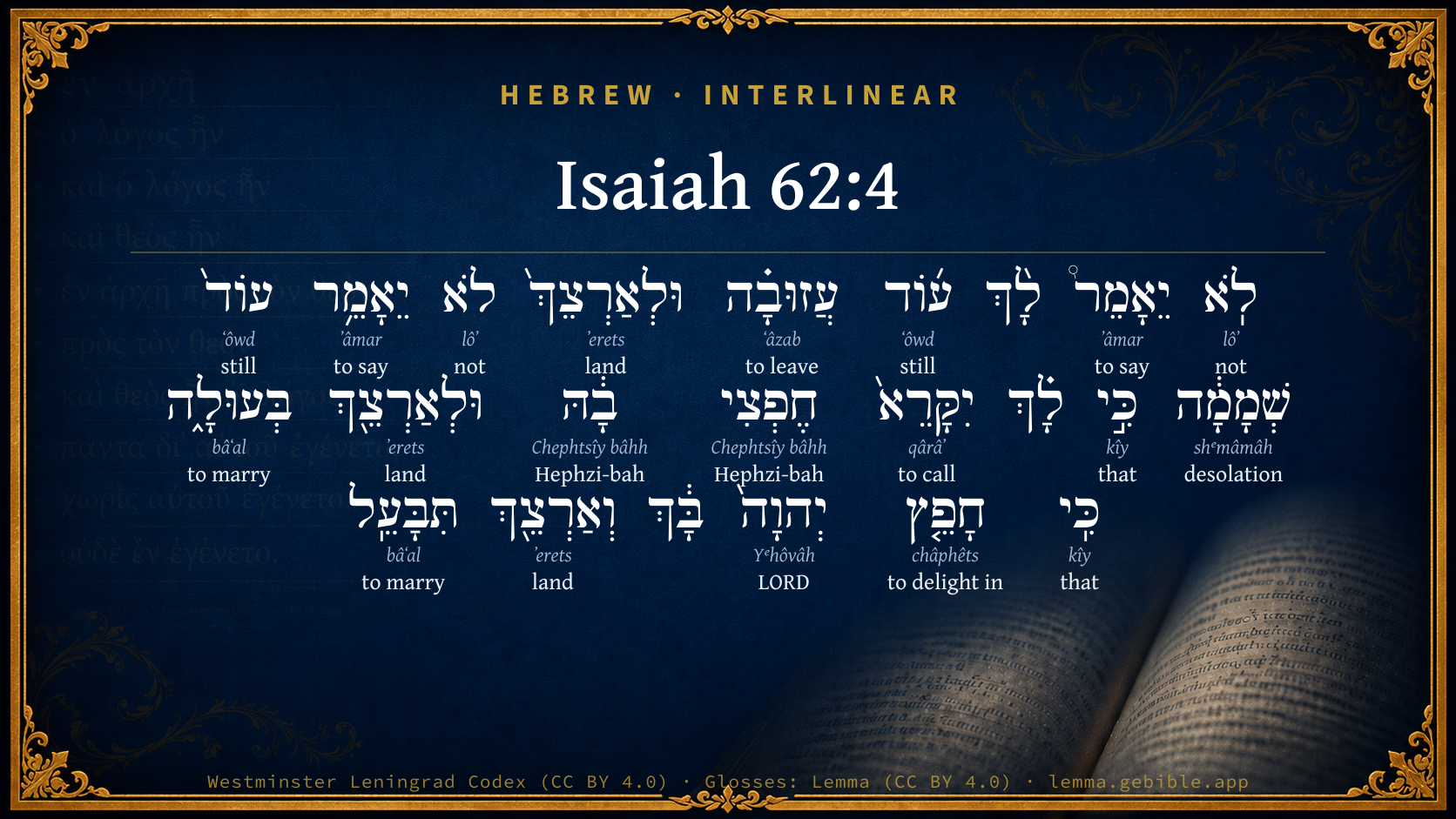
Isaiah 62:4

Hebrew (Westminster Leningrad Codex) Isaiah 62:4 appears in the Hebrew Old Testament. The text above is from the Westminster Leningrad Codex. Each word links to its Strong’s number, a concise gloss, and parsing drawn from the Open Scriptures Hebrew Bible morphology. Click any word for its full Brown-Driver-Briggs (BDB) entry.
Download image
Cite this verse

Isaiah 62:4 (World English Bible). Public Domain. Lemma interlinear Bible study tool, https://lemma.gebible.app/v/isaiah/62/4.

Show BibTeX & RIS
BibTeX
RIS
English Translation
You shall no more be termed Forsaken; neither shall your land any more be termed Desolate: but you shall be called Hephzibah, and your land Beulah; for Yahweh delights in you, and your land shall be married.
World English Bible · Public Domain
Download a study sheet

One document with this verse’s original text, its word-by-word gloss line, the meaning frame, cross-references with their text, attributed commentary, and full source and license credits — printable, and it pastes into notes with its structure intact.

This verse Autodidact and up

Study sheet (.html) Plain text (.txt)

A passage Seminary Student

Up to 50 verses in one chapter. A passage sheet keeps up to 6 commentary sources and 12 cross-references per verse, in the order this page ranks them, and says so on the sheet whenever that leaves anything out. Ask for a single verse and you get the Autodidact verse sheet above.

Everything on this page stays free to read, with no account — the sheet is a download of what is already on screen, not access to it.

Want to remove ads? Support Godless Engineer
Compare translations 3

The same verse in 3 English versions, stacked beneath the original-language interlinear above. Click any original word for its lexicon entry.

Each is an independent rendering of the whole verse — the interlinear is not word-aligned to these translations.

Highlighted words mark where these versions differ — a whole-verse word diff, not a word-by-word alignment.

  • World English Bible Public Domain
    You shall no more be termed Forsaken; neither shall your land any more be termed Desolate: but you shall be called Hephzibah, and your land Beulah; for Yahweh delights in you, and your land shall be married.
  • King James Version Public Domain
    Thou shalt no more be termed Forsaken; neither shall thy land any more be termed Desolate: but thou shalt be called Hephzibah, and thy land Beulah: for the LORD delighteth in thee, and thy land shall be married.
  • unfoldingWord Literal Text CC BY-SA 4.0
    It will no longer be said of you, “Abandoned,” and of your land, it will no longer be said, “Devastation,” for it will be called to you, “My Delight in Her,” and to your land, “Married,” for Yahweh delights in you, and your land will be married.

unfoldingWord Literal Text — © unfoldingWord, licensed CC BY-SA 4.0. Word-aligned USFM3 via Door43 (git.door43.org/unfoldingWord/en_ult).

Versions to compare (up to 4)

3 of 4 selected

Show all 18 translations

Every available English version of this verse, each an independent rendering of the whole verse.

  • World English Bible Public Domain
    You shall no more be termed Forsaken; neither shall your land any more be termed Desolate: but you shall be called Hephzibah, and your land Beulah; for Yahweh delights in you, and your land shall be married.
  • Berean Standard Bible Public Domain
    No longer will you be called Forsaken, nor your land named Desolate; but you will be called Hephzibah, and your land Beulah; for the LORD will take delight in you, and your land will be His bride.
  • Majority Standard Bible Public Domain
    No longer will you be called Forsaken, nor your land named Desolate; but you will be called Hephzibah, and your land Beulah; for the LORD will take delight in you, and your land will be His bride.
  • King James Version Public Domain
    Thou shalt no more be termed Forsaken; neither shall thy land any more be termed Desolate: but thou shalt be called Hephzibah, and thy land Beulah: for the LORD delighteth in thee, and thy land shall be married.
  • American Standard Version (1901) Public Domain
    Thou shalt no more be termed Forsaken; neither shall thy land any more be termed Desolate: but thou shalt be called Hephzi-bah, and thy land Beulah; for Jehovah delighteth in thee, and thy land shall be married.
  • Revised Version (1885) Public Domain
    Thou shalt no more be termed Forsaken; neither shall thy land any more be termed Desolate: but thou shalt be called Hephzi-bah, and thy land Beulah: for the LORD delighteth in thee, and thy land shall be married.
  • Geneva Bible (1599) Public Domain
    It shall no more be sayd vnto thee, Forsaken, neither shall it be said any more to thy land, Desolate, but thou shalt be called Hephzi-bah, and thy land Beulah: for the Lord deliteth in thee, and thy land shall haue an husband.
  • Douay-Rheims (1899) Public Domain
    Thou shalt no more be called Forsaken: and thy land shall no more be called Desolate: but thou shalt be called My pleasure in her, and thy land inhabited. Because the Lord hath been well pleased with thee: and thy land shall be inhabited.
  • Young's Literal Translation Public Domain
    It is not said of thee any more, `Forsaken!' And of thy land it is not said any more, `Desolate,' For to thee is cried, `My delight `is' in her,' And to thy land, `Married,' For Jehovah hath delighted in thee, And thy land is married.
  • Literal Standard Version CC BY-SA 4.0
    It is not said of you anymore, “Forsaken!” And of your land it is not said anymore, “Desolate,” || For to you is cried, “My delight [is] in her,” || And to your land, “Married,” || For YHWH has delighted in you, || And your land is married.
  • Unlocked Literal Bible CC BY-SA 4.0
    It will no more be said of you, “Abandoned”; nor of your land any longer will it be said, “Desolate.” Indeed, you will be called “My delight is in her,” and your land “Married,” for Yahweh delights in you, and your land will be married.
  • unfoldingWord Literal Text CC BY-SA 4.0
    It will no longer be said of you, “Abandoned,” and of your land, it will no longer be said, “Devastation,” for it will be called to you, “My Delight in Her,” and to your land, “Married,” for Yahweh delights in you, and your land will be married.
  • Darby Bible Public Domain
    Thou shalt no more be termed, Forsaken; neither shall thy land any more be termed, Desolate: but thou shalt be called, My delight is in her, and thy land, Married; for Jehovah delighteth in thee, and thy land shall be married.
  • World Messianic Bible Public Domain
    You will not be called Forsaken any more, nor will your land be called Desolate any more; but you will be called Hephzibah, and your land Beulah; for the LORD delights in you, and your land will be married.
  • Webster's Bible Public Domain
    Thou shalt no more be termed Forsaken; neither shall thy land any more be termed Desolate: but thou shalt be called Hephzi-bah, and thy land Beulah: for the LORD delighteth in thee, and thy land shall be married.
  • Free Bible Version CC BY-SA 4.0
    You won't be called Abandoned anymore; your land won't be called Desolate. Instead you will be called She Makes Me Happy, and your land will be called Married, because you make the Lord happy, and your land will be married.
  • Bible in Basic English Public Domain
    You will not now be named, She who is given up; and your land will no longer be named, The waste land: but you will have the name, My pleasure is in her, and your land will be named, Married: for the Lord has pleasure in you, and your land will be married.
  • JPS Tanakh (1917) Public Domain
    Thou shalt no more be termed Forsaken, neither shall thy land any more be termed Desolate; but thou shalt be called, My delight is in her, and thy land, Espoused; for the LORD delighteth in thee, and thy land shall be espoused.

Literal Standard Version (2020), Covenant Press — licensed CC BY-SA 4.0. Text via the HelloAO Bible API (eBible.org). Unlocked Literal Bible (unfoldingWord) — licensed CC BY-SA 4.0. Text via the HelloAO Bible API (eBible.org). unfoldingWord Literal Text — © unfoldingWord, licensed CC BY-SA 4.0. Word-aligned USFM3 via Door43 (git.door43.org/unfoldingWord/en_ult). Free Bible Version, Dr. Jonathan Gallagher — licensed CC BY-SA 4.0. Text via the HelloAO Bible API (eBible.org).

Word by word

More ways to search: Search by grammar → Find every occurrence → Compare this word →

Practice this passage: Drill this verse → Learn its vocabulary →

חֶפְצִי
Chephtsîy bâhh
H2657
“Hephzi-bah”
Noun, Proper
Part of Speech
Noun
Type
Proper
Full BDB Definition

Origin: from H2656 with suffixes

TWOT: None

Hephzi-bah = "my delight is in her" - the queen of King Hezekiah and mother of Manasseh - a name for Jesusalem (figuratively)
  1. לֹֽא lôʼ H3808 “not” Particle, Negative
  2. יֵאָמֵר֩ ʼâmar H559 “to say” Verb, Niphal, Imperfect, 3rd Person, Masculine, Singular
  3. ע֜וֹד ʻôwd H5750 “still” Adverb
  4. עֲזוּבָ֗ה ʻâzab H5800 “left” Verb, Qal, Participle Passive, Feminine, Singular, Absolute
  5. וּלְאַרְצֵךְ֙ ʼerets H776 “and · to/for · land · your” Conjunction + Preposition + Noun, Common, Both, Singular, Construct + Suffix, Personal, 2nd Person, Feminine, Singular
  6. לֹא lôʼ H3808 “not” Particle, Negative
  7. יֵאָמֵ֥ר ʼâmar H559 “to say” Verb, Niphal, Imperfect, 3rd Person, Masculine, Singular
  8. עוֹד֙ ʻôwd H5750 “still” Adverb
  9. שְׁמָמָ֔ה shᵉmâmâh H8077 “desolation” Noun, Common, Feminine, Singular, Absolute
  10. כִּ֣י kîy H3588 “that” Conjunction
  11. יִקָּרֵא֙ qârâʼ H7121 “to call” Verb, Niphal, Imperfect, 3rd Person, Masculine, Singular
  12. בָ֔הּ Chephtsîy bâhh H2657 “Hephzi-bah” Noun, Proper
  13. וּלְאַרְצֵ֖ךְ ʼerets H776 “and · to/for · land · her” Conjunction + Preposition + Noun, Common, Both, Singular, Construct + Suffix, Personal, 3rd Person, Feminine, Singular
  14. בְּעוּלָ֑ה bâʻal H1166 “married” Verb, Qal, Participle Passive, Feminine, Singular, Absolute
  15. כִּֽי kîy H3588 “that” Conjunction
  16. חָפֵ֤ץ châphêts H2654 “to delight in” Verb, Qal, Perfect, 3rd Person, Masculine, Singular
  17. יְהוָה֙ Yᵉhôvâh H3068 “LORD” Noun, Proper
  18. וְאַרְצֵ֖ךְ ʼerets H776 “and · land · your” Conjunction + Noun, Common, Both, Singular, Construct + Suffix, Personal, 2nd Person, Feminine, Singular
  19. תִּבָּעֵֽל bâʻal H1166 “to marry” Verb, Niphal, Imperfect, 3rd Person, Feminine, Singular

About this verse

These counts appear in no published source. They are computed here, from the morphology-tagged text and Lemma’s own curated glosses. What Lemma adds →

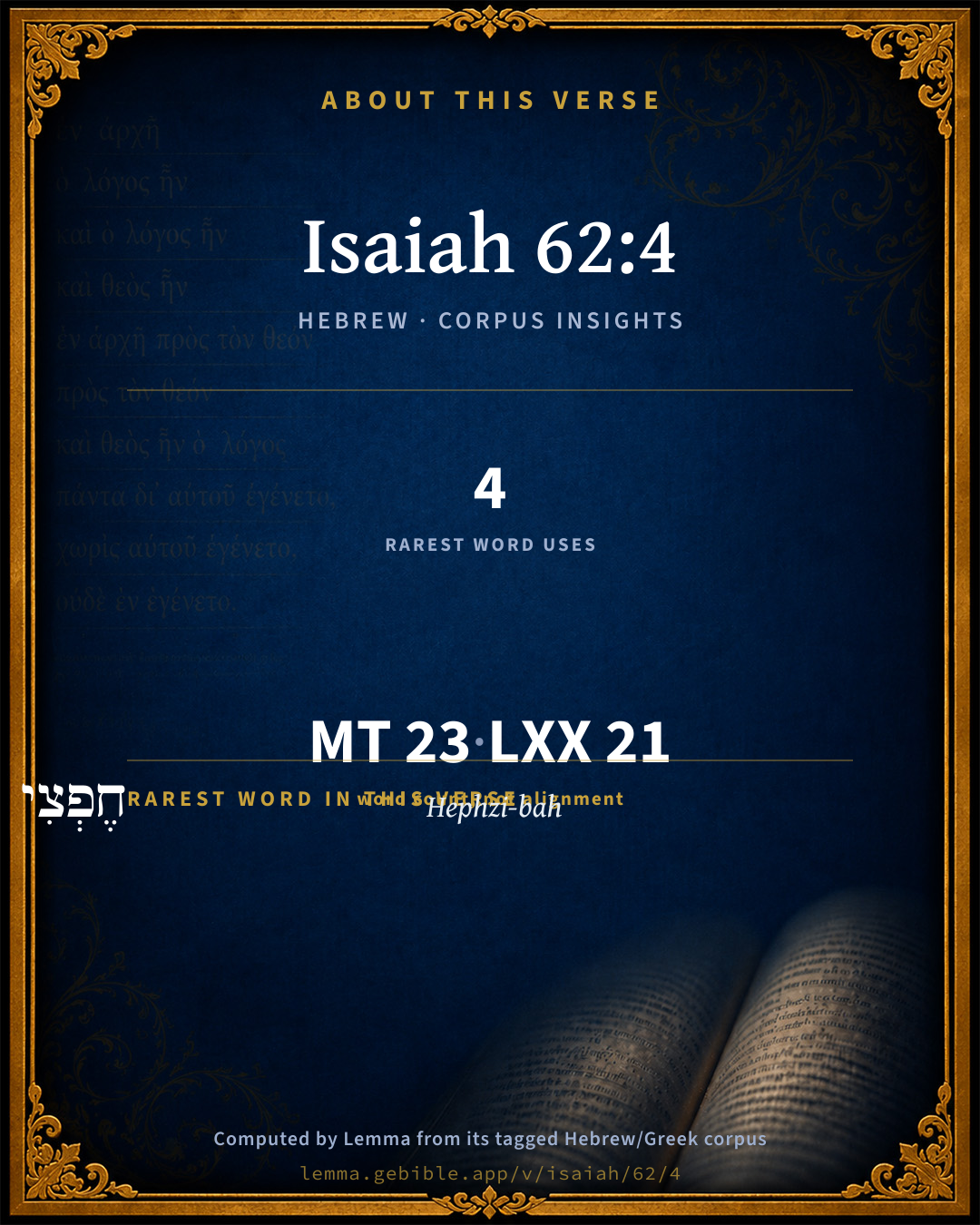
23
words
12
distinct lemmas
Prophets
section

Notable vocabulary

The rarest word here is חֶפְצִי Hephzi-bah H2657 — appearing just 4 times in the whole Hebrew Bible.

Shared distinctive vocabulary

חֶפְצִי Hephzi-bah H2657 occurs in 2 verses of the Hebrew Bible. Also found in:

Grammatical profile

  • 7 verbs
  • 7 nouns
  • 3 prepositions
  • 2 conjunctions
  • 2 adverbs
  • 2 particles

Verb forms

  • יֵאָמֵר֩ Niphal · Imperfect
  • עֲזוּבָ֗ה Qal · Participle Passive
  • יֵאָמֵ֥ר Niphal · Imperfect
  • יִקָּרֵא֙ Niphal · Imperfect
  • בְּעוּלָ֑ה Qal · Participle Passive
  • חָפֵ֤ץ Qal · Perfect
  • תִּבָּעֵֽל Niphal · Imperfect

Repetition

Words recur within this verse — often emphatic in Hebrew:

  • וּלְאַרְצֵךְ֙ land H776 ×3
  • יֵאָמֵר֩ to say H559 ×2
  • ע֜וֹד still H5750 ×2
  • חֶפְצִי Hephzi-bah H2657 ×2
  • בְּעוּלָ֑ה to marry H1166 ×2
  • לֹֽא not H3808 ×2
  • כִּ֣י that H3588 ×2

Hebrew & Septuagint length

In English translation the verse runs 37 words from the Hebrew and 42 from the Septuagint (LXX English) — closely comparable.

A rough comparison of the two English renderings, which tokenize alike — not a word-level alignment.

Word counts can differ between the Hebrew and the Greek without any difference in meaning — e.g. the Hebrew direct-object marker אֵת has no separate Greek word, and Greek often adds the article ὁ.

In the original languages it is 23 Hebrew tokens and 21 Greek tokens — but the two are counted differently (Hebrew bundles its prefixes and suffixes into one token; the Greek is in lemma form), so that isn’t a like-for-like length.

Cross-references

22

Topical passages linked to Isaiah 62:4 in the Treasury of Scripture Knowledge — connected by theme and wording, ordered by reader-vote popularity; previews shown in the World English Bible.

  • Zephaniah 3:17 Yahweh, your God, is in the midst of you, a mighty one who will save. He will rejoice over you with joy. He will rest in his love. He will rejoice over you with singing.
  • Hosea 2:19–20 I will betroth you to me forever. Yes, I will betroth you to me in righteousness, in justice, in loving kindness, and in compassion.
  • Isaiah 62:12 They shall call them The holy people, The redeemed of Yahweh: and you shall be called Sought out, A city not forsaken.
  • Isaiah 54:5–7 For your Maker is your husband; Yahweh of Hosts is his name: and the Holy One of Israel is your Redeemer; the God of the whole earth shall he be called.
  • Jeremiah 32:41 Yes, I will rejoice over them to do them good, and I will plant them in this land assuredly with my whole heart and with my whole soul.
  • Isaiah 61:10 I will greatly rejoice in Yahweh, my soul shall be joyful in my God; for he has clothed me with the garments of salvation, he has covered me with the robe of righteousness, as a bridegroom decks himself with a garland, and as a bride adorns herself with her jewels.
  • 1 Peter 2:10 who in time past were no people, but now are God's people, who had not obtained mercy, but now have obtained mercy.
  • Psalms 149:4 For Yahweh takes pleasure in his people. He crowns the humble with salvation.
  • Isaiah 54:1 Sing, barren, you who didn't bear; break forth into singing, and cry aloud, you who did not travail with child: for more are the children of the desolate than the children of the married wife, says Yahweh.
  • Isaiah 60:15 Whereas you have been forsaken and hated, so that no man passed through you, I will make you an eternal excellency, a joy of many generations.
  • Jeremiah 3:14 Return, backsliding children, says Yahweh; for I am a husband to you: and I will take you one of a city, and two of a family, and I will bring you to Zion:
  • Isaiah 62:5 For as a young man marries a virgin, so shall your sons marry you; and as the bridegroom rejoices over the bride, so shall your God rejoice over you.
  • 2 Corinthians 11:2 For I am jealous over you with a godly jealousy. For I married you to one husband, that I might present you as a pure virgin to Christ.
  • Ephesians 5:25–27 Husbands, love your wives, even as Christ also loved the assembly, and gave himself up for it;
  • Revelation 21:2 I saw the holy city, New Jerusalem, coming down out of heaven from God, made ready like a bride adorned for her husband.
  • Isaiah 32:14–15 For the palace shall be forsaken; the populous city shall be deserted; the hill and the watch-tower shall be for dens forever, a joy of wild donkeys, a pasture of flocks;
  • Isaiah 49:14 But Zion said, Yahweh has forsaken me, and the Lord has forgotten me.
  • Revelation 21:9–10 One of the seven angels who had the seven bowls, who were loaded with the seven last plagues came, and he spoke with me, saying, "Come here. I will show you the wife, the Lamb's bride."
  • Romans 9:25–27 As he says also in Hosea, "I will call them 'my people,' which were not my people; And her 'beloved,' who was not beloved."
  • Hosea 1:9–10 He said, "Call his name Lo-Ammi; for you are not my people, and I will not be yours.
  • Hebrews 13:5 Be free from the love of money, content with such things as you have, for he has said, "I will in no way leave you, neither will I in any way forsake you."
  • John 3:29 He who has the bride is the bridegroom; but the friend of the bridegroom, who stands and hears him, rejoices greatly because of the bridegroom's voice. This, my joy, therefore is made full.

Cross-references courtesy of OpenBible.info (CC BY 4.0).

Hebrew and Greek witnesses Masoretic Hebrew ↔ Greek Septuagint

The same verse in the two great witnesses to the Old Testament, shown verse-for-verse.

These are two independent witnesses, not word-aligned to each other, and the Septuagint is shown in lemma (dictionary) form.

Hebrew Isaiah 62:4 Masoretic · Westminster Leningrad Codex

לֹֽא יֵאָמֵר֩ לָ֨ךְ ע֜וֹד עֲזוּבָ֗ה וּלְאַרְצֵךְ֙ לֹא יֵאָמֵ֥ר עוֹד֙ שְׁמָמָ֔ה כִּ֣י לָ֗ךְ יִקָּרֵא֙ חֶפְצִי בָ֔הּ וּלְאַרְצֵ֖ךְ בְּעוּלָ֑ה כִּֽי חָפֵ֤ץ יְהוָה֙ בָּ֔ךְ וְאַרְצֵ֖ךְ תִּבָּעֵֽל

You shall no more be termed Forsaken; neither shall your land any more be termed Desolate: but you shall be called Hephzibah, and your land Beulah; for Yahweh delights in you, and your land shall be married.

World English Bible · Public Domain

Greek LXX Isaiah 62:4 Septuagint · lemma form

καί οὐκέτι καλέω καταλείπω καί ὁ γῆ σύ οὐ καλέω ἔρημος σύ γάρ καλέω θέλημα ἐμός καί ὁ γῆ σύ οἰκέω

And you shall no more be called Forsaken; and your land shall no more be called Desert: for you shall be called My Pleasure, and your land Inhabited: for the Lord has taken pleasure in you, and your land shall be inhabited.

LXX2012 (modern English Septuagint) · Public Domain

On this verse, Joseph Benson's Commentary discusses the Septuagint’s reading. Read the note in Commentary ↓

Hebrew: Westminster Leningrad Codex (CC BY 4.0). Greek: Septuagint (public domain); English from LXX2012 (modern English Septuagint) (Public Domain). How the Septuagint differs from the Hebrew →

Targum (Aramaic paraphrase)

1

The Targum is the ancient Jewish Aramaic paraphrase of the Hebrew Scriptures — an interpretive translation, not the Hebrew text itself. Onkelos (literal) and Pseudo-Jonathan (expansive) render the Torah, and Jonathan the Prophets. Coverage is partial: where no permissively-licensed English translation exists for a verse, only the Aramaic is shown. This is verse-level text, not a word-by-word alignment to the Hebrew.

  1. Targum Jonathan Prophets (Joshua–Malachi)
    לָא יִתְאֲמַר לִיךְ עוֹד שְׁבִיקָא וּלְאַרְעִיךְ לָא יִתְאֲמַר עוֹד צַדְיָא אֲרֵי לִיךְ יִתְקְרֵי עָבְדֵי רְעוּתִי בָה וּלְאַרְעִיךְ יָתְבָא אֲרֵי תְהֵי רַעֲוָא מִן קֳדָם יְיָ בִיךְ וְאַרְעֵיךְ תִּתְיַתָב:

    Thou shalt no more be termed Forsaken; neither shall thy land any more be termed Desolate: but thou shalt be called Aběday Rěoothee Bahh, and thy land Inhabited: for the Lord shall delight in thee, and thy land shall be inhabited.

    Targum Jonathan — Aramaic: “Mikraot Gedolot” (public domain). English: “Sefaria Community Translation” (CC0 1.0 (public-domain dedication)); “London "Chaldee Paraphrase," 1871” (public domain). Text via Sefaria.

Commentary

Notes on Isaiah 62:4 from classic Christian and Jewish commentators (each source and its license shown beneath its notes). The classic Christian expositions comment on the surrounding passage and are grouped to its opening verse, so a note may address several verses; the Jewish commentaries on the Tanakh (Rashi and others) are per-verse, so they appear only where the commentator wrote on this verse.

Lemma curates 59 commentaries, every one of them public domain or Creative Commons licensed, each selected and text-cleaned for this edition rather than reprinted as found. About our sources →

Trapp's Complete Commentary

John Trapp

Isa 62:4 Thou shalt no more be termed Forsaken; neither shall thy land any more be termed Desolate: but thou shalt be called Hephzibah, and thy land Beulah: for the LORD delighteth in thee, and thy land shall be married.

Ver. 4. But thou shalt be called Hephzibah,] i.e., My delight is in her; as if Christ should say to his Church, {as Jdg 14:3} Tu mihi sola places, {a} Thou art mine only joy. The Lord taketh pleasure in them that fear him. {Psa 147:11} Let us reciprocate, {b} love the Lord Jesus Christ in sincerity; not only with a love of desire, {as Psa 42:1; Psa 42:3} but also of delight and complacency, solacing ourselves in the fruition of him, {as Psa 16:5-6} and of his people, these "excellent ones of the earth" who were David’s Hephzibam, {Isa 62:3} in whom was "all his delight."

{a} Ovid. De Arte Am.

{b} Redamemus ergo sponsum.

John Trapp, A Commentary or Exposition upon All the Books of the Old and New Testament (1647–1656) — public domain. Text from a community e-Sword module.

The Biblical Illustrator

Joseph S. Exell

Isa_62:4

Thou shalt no more be termed Forsaken

A joyful change of condition

No more shall it be called to thee (shalt thou be called) Azubah (Forsaken), and thy land shall no more be called Shemamah (Desolate); but thou shalt be called Hephzibah (My delight is in her), and thy land Beulah (Married), for Jehovah delights in thee, and thy land shall be married.

The joyful change of condition is expressed in the prophets favourite manner, by significant names. The common version not only mars the beauty of the passage, but renders it in some degree unintelligible to the English reader, by translating the first two names and retaining the others in their Hebrew dress. It is obvious that all four should be treated alike, i.e that all the Hebrew forms should be retained, or none. Henderson prefers the latter method, on the ground ,that the names are merely symbolical, and will, never be employed as proper names. It is probable, however, that they were all familiar to the Jews as female names in real life. This we know to have been the ease with two of them (1Ki_22:42; 2Ki_21:1). It is better, therefore, to retain the Hebrew forms, in order to give them an air of reality as proper names, and at the same time to render them intelligible by translation. In the last clause there is reference to the primary meaning of the verb, viz that of owning or possessing; and as the inhabitants of towns are sometimes called in Hebrew their possessors, its use here would suggest, as at least one meaning of the promise, thy land shall be inhabited, and so it is translated in the Targum. (J. A. Alexander.)

Spiritual espousal

I invite your attention to some reflections on the Scriptural use of marriage, as a type of the mystical union betwixt Christ and His Church. This tender, beautiful image implies--

I. CHOICE. In all nations there has been the instinctive rule that the initiative choice is not with the bride, but with the bridegroom. Its spiritual parallel is in the declaration of Jesus to His disciples, Ye has not chosen Me, but I have chosen you. I am jealous over you, said Paul, with godly jealousy, for I have espoused you to one husband, that I may present you as a chaste virgin to Christ. At the same time all are bound, because all are invited, to seek the Lord while He may be found, to choose this day whom ye serve; then the farther element in the marriage symbol will be verified.

II. DEVOTION. You will love Him because He first loved you. It is often observed in ordinary married life, how the mutual love of husband and wife enables them to bear, not only without bitterness or mutual recriminations, but with a greater clinging to, and confidence in each other, the trials, sorrows, and burdens of life. Love lightens the load, when each one, for the others sake, cheerfully takes his or her share. The love of Christ endears Him to the believer, and the believer to Him.

III. INSEPARABLE UNION. Earthly ties of man and wife are liable to many incidents of severance. Necessities of particular callings in life sometimes separate them, lands and seas asunder. Guilt, aversion, insanity, disease and death, often dissolve the union, which once bid fair to be firmly riveted till death them should part. The believers union with Christ is liable to no such disastrous issues. Not that this consolatory doctrine dispenses with the necessity of a faithful, obedient, and devout course of effort to maintain the unity of the Spirit in the bond of peace and in righteousness of life. The Divine idea of marriage is a united family, basing its bond of union on the unity of its parentage. For this cause shall a man leave his father and mother, etc. True spiritual union with Christ involves an ascendency of affection. If any man love father or mother more than Me, etc. In a deep sense it may be said of Christ and His disciple, They twain are one Spirit. (J. B. Owen, M. A.)

Thy land shall be married

Thy land shall be married,

Thy land shall be married, i.e it shall become fruitful again and be replenished.

1. Her sons shall heartily espouse the land of their nativity, and the interests of it, which they had for a long time neglected, as despairing ever to have any comfortable enjoyment of it. Thy sons shall marry thee, i.e they shall live with thee, and take delight in thee. When they were in Babylon, they seemed to have espoused that land, for they were appointed to settle, and to seek the peace of it (Jer_29:5-7); but now they shall again marry their own land, as a young man marrieth a virgin that he takes great delight in, is extremely fond of, and is likely to have many children by. It bodes well to a land when its own natives and inhabitants are pleased with it, prefer it before other lands; when its princes marry their country, and resolve to take their lot with it.

2. Which is much better, her God shall betroth her to Himself in righteousness (Hos_2:19-20). (M. Henry.)

Monopoly and communism

I propose to name some of the suitors who are claiming the hand of this Republic.

1. There is a greedy, all-grasping monster who comes in as suitor seeking the hand of this Republic, and that monster is known by the name of Monopoly. His sceptre is made out of the iron of the rail-track and the wire of telegraphy. He does everything for his own advantage and for the robbery of the people. Such monopolies imply an infinite acreage of wretchedness. Great monopolies in any land imply great privation.

2. Another suitor claiming the hand of this Republic is Nihilism. He owns nothing but a knife for universal blood-letting and a nitro-glycerine bomb for universal explosion. He believes in no God, no government, no heaven, and no hell, except what he can make on earth. He slew the Czar of Russia, killed Abraham Lincoln, and would put to death every king and president on earth, if he had the power. (T. De W. Talmage, D. D.)

The Biblical Illustrator, edited by Joseph S. Exell (c. 1880s–1900s) — public domain. Text from a community e-Sword module.

Joseph Benson's Commentary

Isa 62:4-5. Thou shalt no more be termed Forsaken — As a woman forsaken by her husband. Neither shall thy land be termed Desolate — Neither shall thy places of worship be empty, and thine ordinances of service be unfrequented. He alludes to the desolation of Judah during the Babylonish captivity. But thou shalt be called Hephzibah — My delight is in her; a new name, agreeing with her new condition; and thy land, Beulah — Married, agreeing to her new relation. Whereas she was in a desolate condition, she shall now be as a woman well married, to the great improvement of her state. And thy land shall be married — Thou shalt see the increase of thy children again in the land, as the fruit of thy married condition, who, by reason of thy being forsaken of thy husband, were, in a manner, wasted and decayed: and this refers to the great enlargement of the church in the gospel days. Or, thy land shall be possessed, as הבעל

may be properly rendered, and so the expression answers to desolate. Thou shalt be no more desolate, but possessed. For as a young man marrieth a virgin — In whom he takes great delight, and whom he exceedingly loves; so shall thy sons marry thee — That is, they shall live with thee, and take great delight in thee. For, as Lowth justly observes, “the word marry is not to be taken strictly, for it would be improper to say that children married their mother.” Thus the LXX., ουτω κατοικησουσιν οι υιοισου, so shall thy sons dwell with thee. Bishop Lowth, however, instead of sons, renders בניןthy builder, or creator, altering or disregarding the Hebrew points. This emendation, it most be acknowledged, would clear the prophet of the impropriety of using a similitude, which implies that Jerusalem was guilty of incest in marrying her sons; and at the same time would add not only grace but force to the whole verse, which, so altered, runs thus: For, as a young man marrieth a virgin, so shall thy Creator marry thee. And as the bridegroom, &c. — The former interpretation, however, which has the sanction of the LXX., and which the present pointing of the Hebrew requires, seems preferable. In the first clause, As a young man marrieth a virgin, Sir John Chardin, in his MS. note on the place, considers the prophet as expressing himself according to the custom of the East, which was, and is, “for youths, that were never married, always to marry virgins; and widowers, however young, to marry widows.” See Harmer’s Observ., 43. p. 482.

Joseph Benson's Commentary on the Old and New Testaments (1811–1818) — public domain. Text from a community e-Sword module.

Tyndale Open Study Notes

Tyndale Open Resources

62:4 The Forsaken City: In the Exile, the Lord abandoned his people to the judgment they deserved (54:7). • The Bride of God: The people will be “married” to the Lord—an appropriate image for the close covenant relationship (54:5; Hos 1–3).

Tyndale Open Study Notes — © Tyndale Open Resources, licensed CC BY-SA 4.0. Text via the HelloAO Bible API.

Geneva Bible (1599)

Geneva Bible translators

Thou shalt no more be contemned as a woman forsaken of her husband.

Or, my delight in her.

Or, married.

That it may be replenished with children.

Geneva Bible (1599) marginal notes — public domain. Text via Bolls.life.

Jamieson, Fausset & Brown

Robert Jamieson, A. R. Fausset & David Brown

be termed--be "forsaken," so as that that term could be applicable to thee.

Hephzi-bah-- (Kg2 21:1), the name of Hezekiah's wife, a type of Jerusalem, as Hezekiah was of Messiah (Isa 32:1): "my delight is in her."

Beulah--"Thou art married." See the same contrast of Zion's past and future state under the same figure (Isa 54:4-6; Rev 21:2, Rev 21:4).

land . . . married--to Jehovah as its Lord and Husband: implying not only ownership, but protection on the part of the Owner [HORSLEY].

Jamieson, Fausset & Brown — Commentary Critical and Explanatory on the Whole Bible (1871) — public domain (CC PDM 1.0). Text via the HelloAO Bible API.

Adam Clarke's Commentary

Verse 4. Thy land Beulah] בעולה beulah, married. In the prophets, a desolate land is represented under the notion of a widow; an inhabited land, under that of a married woman, who has both a husband and children.

Adam Clarke's Commentary on the Bible (1810–1826) — public domain. Text from a community e-Sword/MySword module.

Ellicott's Commentary for English Readers

(4) Thou shalt no more be termed Forsaken . . .—The change of name is here partially indicated, and probably finds its starting-point in the marriage of Hezekiah with Hephzi-bah (2Ki_21:1), which, on the assumption of Isaiah’s authorship of these chapters, would be fresh in the prophet’s memory. It would be entirely after his manner to see in the bride’s name, as in those of his own sons, an omen of the future. The fact that the Hebrew word for Forsaken (Azubah) had been borne by a previous queen, the mother of Jehoshaphat (1Ki_22:42), confirms the view here taken. “Hephzi-bah” means “my delight is in her;” and “Beulah,” “married.”

A Bible Commentary for English Readers, edited by Charles John Ellicott (1878–1897) — public domain. Text from a community e-Sword module.

The Cambridge Bible for Schools and Colleges

gen. ed. J. J. S. Perowne

4, 5. The reunion of Zion with her Husband and her children. Cf. ch. Isa_49:14 ff., Isa_54:1 f., 4 ff.

Forsaken] Hebr. ‘ãsûbâh; found as a proper name in 1Ki_22:42. Similarly Hephzi-bah (= “delight in her”) is the actual name of the mother of Manasseh (2Ki_21:1).

Beulah] (bĕ‘ûlâh) i.e. “married,” see ch. Isa_54:1.

The Cambridge Bible for Schools and Colleges (gen. ed. J. J. S. Perowne; Cambridge University Press, 1878–1918) — public domain. Text from a community e-Sword module.

John Gill's Exposition

Thou shall no more be termed Forsaken,.... That is, of the Lord her God, as she had seemed to be to others, and thought to be so by herself, Isa 49:14, not having so much of his gracious presence as is desirable; sensible communion with him being withheld; the word and ordinances not owned and blessed, or very little; and few souls converted; and the interest of Christ, labouring under many difficulties and discouragements, under the reproaches and persecutions of men, and so looked as if forsaken of God; but in the latter day all these complaints shall be removed; and the presence of God will be very manifest in his churches, and among his people; and they will appear to be his care and charge; see Isa 60:15,

neither shall thy land any more be termed Desolate; as the Gentile world was before the preaching of the Gospel in it; and as the land of Israel now is, and the Jewish people are, having rejected the Messiah, and continuing in impenitence and unbelief; and as the church of Christ is, when the word and ordinances are neglected, or little success attends them; but now more shall be the children of the desolate than of the married wife; many souls shall be born again in Zion, and many sons and daughters brought there, and brought up there, and therefore shall not be called desolate, Isa 49:19,

but thou shalt be called Hephzibah, and thy land Beulah; the former of these was the name of Hezekiah's mother, Kg2 21:1 and a fit name for the church of Christ, who is pleasant to him for delights, Sol 7:6 and the latter well agrees with her being married to Christ. The meaning of these names is explained in the next clause; or the reason of their being given:

for the Lord delighteth in thee, and thy land is married; the former explains "Hephzibah", which signifies "my delight is in her"; Christ delighted in his church from everlasting, as they were the objects of his own and his Father's love; as chosen in him, and given to him as his spouse and bride, Pro 8:31 and he delights in them in time, as clothed with his righteousness, washed in his blood, and adorned with the graces of his Spirit; he delights in their company, to hear their voice, and see their countenance; they are the excellent in the earth, in whom is all his delight, Psa 16:2, and he will delight in them hereafter, in the spiritual reign, when he will glorify and beautify them, and make them an eternal excellency, Isa 60:7, and in the personal reign, when they shall be as a bride adorned for her husband, and his tabernacle shall be among them, and he will reign with them, and they with him; during which time he will be presenting them to himself, and delighting in them, as a glorious church, without spot or wrinkle, or any such thing, Rev 21:2 and in heaven to all eternity. The latter clause explains "Beulah", which signifies "married", as the church secretly was to Christ from all eternity; in the latter day the espousals of her to him will be more open and manifest; then the marriage of the Lamb will be come, and it will more clearly appear that she is in such a state, by the numerous converts in her, or sons and daughters that will be born in her to Christ, both of Jews and Gentiles, Rev 19:7.

John Gill's Exposition of the Whole Bible (1746–1763) — public domain (CC PDM 1.0). Text via the HelloAO Bible API.

Albert Barnes' Notes on the Bible

Thou shalt no more be termed Forsaken - That is, thou shalt be no more so forsaken as to make such an I appellation proper. This refers to the new name which the prophet says Isa 62:2 will be conferred on her.

Neither shall thy land - Thy country shall no more be so wasted that the term desolation (שׁממה shemâmâh, Greek ἔρημος erēmos) shall be properly applied to it.

But thou shalt be called Hepzi-bah - Margin, as Hebrew, ‘My delight is in her.’ The idea is, that Yahweh would show her such favor, and he would have so much pleasure in his people, that this name of endearment would be appropriately given to her. The Septuagint renders this, Θέλημα ἐμὸν Thelēma emon - ‘My will,’ or my delight. The sense is, that Jerusalem would be eminently the object of his delight.

And thy land Beulah - Margin, as Hebrew, ‘Married;’ or rather, ‘thou art married.’ The Septuagint renders it, Οἰκουμένη Oikoumenē - ‘Inhabited.’ Lowth renders it, ‘The wedded matron.’ The figure is taken from a female who had been divorced, and whose appropriate name was Forsaken.’ God says here that the appropriate name henceforward would not be the Forsaken, but the married one - the one favored and blessed of God (see the notes at Isa. 1. 1). Language like this is common in the East. ‘A sovereign is spoken of as married to his dominions; they mutually depend on each other. When a king takes possessions from another, he is said to be married to them’ - (Roberts).

Thy land shall be married - See the notes at Isa 54:4-6, where this figure is extended to greater length. By a similar figure the church is represented as the beautiful bride of the Lamb of God Rev 21:9; Rev 19:7.

Albert Barnes' Notes on the Bible (1834–1885) — public domain. Text from a community e-Sword/MySword module.

Haydock's Catholic Bible Commentary

Forsaken. Yet the synagogue was again rejected, at the death of Christ. The promises naturally relate to his Church. (Calmet) --- Inhabited. Protestants retain the Hebrew words Chephtsi-bah, "my delight in her," and Beulah, (marginal note) "married." (Haydock)

George Leo Haydock (1774–1849), Haydock's Catholic Family Bible and Commentary, 1859 edition — public domain. Excludes Psalms (Douay-Rheims chapter numbering differs from Protestant) and Deuterocanonical books (Catholic canon only).

Matthew Poole's English Annotations

Thou shalt no more be termed Forsaken; as a woman forsaken by her husband, contemptible, and of low esteem.

Neither shall thy land, i.e. the inhabitants of the land, a metonymy of the subject,

any more be termed Desolate; though it be now almost void of inhabitants, it shall be impeopled again.

Thou shalt be called, i.e. be, as you have frequently had such instances.

Hephzi-bah; My delight is in her; a new name, agreeing with her new condition.

Beulah;

Married, agreeing to her new relation; she shall be as one well married, to the great improvement of her state, Jer 3:14; Hos 2:18-20.

Thy land shall be married; thou shalt see the increase of thy children again in thy land, as the fruit of thy married condition, which by reason of thy being forsaken of thy husband were in a manner wasted and decayed; and this refers to the great enlargement of the church in the gospel days. Or rather, shall be possessed, as the word baal properly signifies; and so it answers to desolate, Thou shalt be no more desolate, but possessed; and this helps to solve a difficulty in the next verse, which otherwise may seem an impropriety, that the sons would marry the mother.

Matthew Poole's English Annotations on the Holy Bible (1683–1685) — public domain. Text from a community e-Sword/MySword module.

Whedon's Commentary on the Bible

Daniel D. Whedon

4, 5. Thou shalt no more be termed Forsaken — Messiah and his Zion are concreted. “Thou” refers to both in one. No more shall the terms, Forsaken and Desolate be thy reproachful name. But thy new name shall be,

Hephzi-bah — “My-delight-in-her,” (Hebrew.) For Jehovah does have delight in thee.

And thy land — Thy home.

Beulah — And this means, Happily-married one, with a home springing with joy to its possessor. This idea of possession in the words marrying a land, helps one to understand the sentence so shall thy sons marry thee; that is, shall possess thee. Wife, children, and servants, in Hebrew law, and in ruling ideas in the early ages, (Mozley,) were held in absolute possession by the chief, or head, of the family. So in the tender social sense, a young man always possesses, when he marries, his bride. As is the joy of such possession, so shall God have joy in Zion, is the thought here.

Daniel D. Whedon (gen. ed.), Commentary on the Old and New Testaments (1874–1909) — public domain. Text from a community e-Sword module.

The Pulpit Commentary

Thou shalt no more be termed Forsaken. Judah had believed herself" forsaken" of God, (Isa_49:14) and had actually been, in a certain sense, forsaken "for a small moment". (Isa_54:7) Herenemies, it would seem, had gone so far as to give her the name in derision. Neither shall thy land ... be termed Desolate. Judaea had not only been desolated by the Babylonian invaders under Nebucbarlnezzar, but had remained "desolate" during the whole period of the Captivity. (Isa_32:13, 14 49:19, etc.) It had come to be spoken of as Sh"marnah, "a desolation". (see Jer_34:22 Jer_44:2, 6 Eze_33:29 Eze_36:34) Now all should be altered. As Ezekiel prophesied, "The land that was desolate is become like the garden of Eden; and the waste and desolate and ruined cities are become fenced and are inhabited". (Eze_36:35) Thou shalt be called Hephzi-bah; i.e. "my delight is in her." Hephzi-bah was the name of Hezekiah"s queen, Manasseh"s mother. (2Ki_21:1) And thy land Beulah. Beulah, or rather Be"ulah, means "married". (comp. Isa_54:1) Judaea would be "married" to her sons, or her people, when they quitted Babylon and once more took possession of her. The Hebrew verb toe "to marry" (as a man marries) means literally "to be lord over.

HOMILIES BY W.M. STATHAM Ver. 4. Fellowship with God.

"Thou shalt no more be termed Forsaken." Mistaken we may be our judgment is so weak, our hearts so worldly but not forsaken. It is a beautiful word, and it is enough. God will not condescend to explain all his ways to men; but he is a Father, and the Father will never forsake his child. Isaiah is called the evangelical prophet, and he is so; he heralds the kingdom of Christ, describes the nature of the kingdom, under a King who shall reign in righteousness, and gives us the pathetic picture of his sorrows. In one word, as a prophet of the Redeemer, he describes the theophany, the appearance or manifestation of God himself; the great coming age of Immanuel, "God with us." Wars are prophesied of, even after the advent of Christ tribulations and shaking of nations. Much has to be overturned; but amid all there is the pathway of the true King. Jesus comes, and comes to reign. Much is transient here. It is declared so to be. Man is said to be a pilgrim, and yet utters a cry of wonder that he cannot make earth a home. Riches are said to have wings, and then man is surprised that they flee away. Life is said to be like the grass, and then man is staggered that it is cut down. Friends turn false or fickle, and then man is surprised that evil hearts act in evil ways. Nature has her seasons, and then man marvels at the analogue of life which has its night as well as its day. On the one hand man scoffs at and scorns the Bible, and on the other refuses to see how full of realism and truth all its moral revelations are. It is equally true on its restful side. It tells us that amidst all we have a Father in heaven, whose will is wise and just, whose heart is kind and true and good.

It assures us in that coming of Christ, to which all the ages looked forward, that God "remembers us in our low estate, for his mercy eudureth for ever," and that, though often mistaken, we shall never be termed Forsaken.

I THIS IS A DIVINE REPLY. A reply to what? Why, to Zion"s utterance Isa_49:14, "The Lord hath forsaken me." Not, mark you, that there have been no Divine footprints in the past, no Divine provision and protection in Zion"s yesterday; but now he hath forsaken us. Study life, especially what is called religious life, and you will find that this is always the foolish cry of the Church. It will live in the past. It will not believe that there are prophets and righteous men to-day. It will decorate the sepulchres of the fathers. It did so in Isaiah"s time; it does so now. It glorifies the days of Wickliffe and Luther, of Whitefield and Wesley, forgetful that God is the living God, and his voice is heard, his hand outstretched, his purpose working now. I know nothing in which the human mind is so fatally biased as in this backward looking and longing, whilst he is still nigh us in our breath and in our heart. Forsaken? No, there are prophets of truth still; heralds of mercy still; national seers still, who search the very heart of nations. Wherever the Spirit of Christ is, there he is. There are wars, vices, wrongs, still; but their time is not so easy as it was not so easy, indeed, as in some past ages which we glorify. The Spirit of Christ is becoming more and more the test of good and evil, of wisdom and unwisdom, of the real and the false, of the righteous and unrighteous. There is a light shining to-day that no breakers can put out, no wild storms of passion extinguish. "The Light that lighteth every man that cometh into the world" is here. Christ"s arm is not shortened; more worn and weary spirits lean on it than ever. Christ"s mercy is not exhausted; his forgiveness is still the good cheer of millions of hearts. His revelations of immortality have not faded through the lapse of years. He alone has given to the world its all-covering sky. We feel that whilst we still believe in him and cleave to him, the prophetic words are real and true, "Thou shalt no more be termed Forsaken.

II A DIVINE HARMONY. The words do not stand alone. They are not merely a beautiful text, or an isolated flower, or a separate jewel. We have to take the moral strain of a book to see into the mind and meaning of the plan. We do not interpret Mendelssohn or Mozart by separate passages, neither should we so treat Isaiah. He is evidently the prophet of a golden age, no matter whether there are ten hands visible in the work or one. We test truth by its voice, not by its mere speaker. All prophets were not to be listened to and obeyed simply because they were prophets. "I have seen also in the prophets of Jerusalem a horrible thing: they commit adultery, and walk in lies: they strengthen also the hands of evil-doers... Thus saith the Lord of hosts, Hearken not unto the words of the prophets that prophesy unto you: they make you vain: they speak a vision of their own heart, and not out of the mouth of the Lord"; (Jer_23:14, Jer_23:16) and again, "Let not your prophets deceive you"; (Jer_29:8) and again, "Mine hand shall be upon the prophets that see vanity, and that divine lies"; (Eze_13:9) "Thus saith the Lord God: Woe unto the foolish prophets O Israel, thy prophets are like foxes". (Eze_13:3, Eze_13:4) Yes; there was a moral test then; an instinct which revealed the true prophet, as it reveals the true Saviour. Our Lord rested all on this: "If ye were of the truth, ye would hear my voice:" "My sheep hear my voice." A remarkable instance of this moral test is given us in Eze_13:22. The people were to set their faces against the prophets. Why? "Because with lies ye have made the heart of the righteous sad, whom I have not made sad; and strengthened the hands of the wicked, that he should not return from his wicked way, by promising him life." That which was against righteousness and assisted evil was not to be believed. Why will men be so afraid of this test? Why do they seek to rest authority on the authors and writers of books, and not rest it, as God does, and ever did, and only could, on the truth itself? It was Isaiah"s way, it was our Lord"s way, it was St. Paul"s way. "Commending ourselves to every man"s conscience in the sight of God." I thus come to my word "harmony." It is harmonious with all within us. Isaiah is a prophet of righteousness, of Divine forbearance, of Divine forgiveness, of Divine pity, of Divine ministry, of Divine sacrifice. If asked Is this a God to be trusted, worshipped, loved? the whole inward being exclaims, "Amen, and amen.

III A DIVINE CONSOLATION. It is really part of the "comfort ye" strain, as that reaches to the depths of our being. Not forsaken. The same Isaiah is here. We feel sin. Israel felt it. We cannot by any philosophy of heredity escape from the consciousness of personal guilt. Alone the flame burns. At night the thorn pierces through the pillow. Are we left to bear the great sorrow unpitied and unaided? Out of Zion the Deliverer shall come. "Comfort ye, comfort ye my people, saith your God." We feel social evils; we are hurt by unrighteousness, galled and wounded by selfishness. Amid all, fierce wars seem again and again to stir the mad passions of humanity. What thought can light our gloom, can give strength to our hopes? Only this King shall reign in righteousness." If there be no hope for the supremacy of the Christ, all is lost, for beside him there is no Saviour. But are there not signs that a better spirit is abroad? I think so. Men are sighing for a Prince of peace, and with the sigh there is a sob too, "O Lord, how long?" We feel our own solitude. We seem to be forsaken. Change comes. Fortune is turned to misfortune, health to sickness. But there are restful hours in all Christian hearts. Say what men" will of the mysteries, let them ponder the facts; there is a touch of Christ, there is a tender sense of an encircling arm, there is a consciousness of the good Shepherd"s care and love. We want to bring home the music of this promise to weary hearts. If we want to exercise more influence than philosophers and moralists, we must have a better message. When Ulysses passed by the island of the syrens, the classic story tells us that, to save himself from their snares, he bound himself with mighty thongs to the masts, and secured his sailors" safety by filling their ears with wax, that they might not be bewitched. But when the sweet singer, when Orpheus, voyaged by the same syren island, he bound himself to no mast. He started a sweeter, nobler music than the syrens could ever reach, and so sailed by in triumph. If we are to win men and keep men men who have been charmed with the syren voices of the world all the week our melody must be one that comes down from heaven; the music of forgiveness and mercy, of grace and help, of God"s love, and God"s care, and God"s everlasting throne. We are in him that is true, in him of whom all prophecy is full, who was the Spirit of it all. In life with all its mysteries, and in death with all its leave-takings. We shall never be termed "Forsaken. W.M.S.

The Bunyan figure of the Beulah-land.

Hephzi-bah was the wife of Hezekiah, and mother of Manasseh. Very uncertain tradition says she was a daughter of the Prophet Isaiah. The name means, "My delight is in her," and Dr. C. Geikie says, "Her name, whether given at her marriage or earlier, wakes a thought of old-world tenderness and poetry. Was it a fond reminiscence of one he had loved and respected, when Isaiah tells us that Jehovah will make Zion, after her long desolation, once more his Hephzi-bah?" The word "Beulah" means "married," and the figure rests upon the Eastern notion of the desolate condition of a maiden or a widow, and the happy satisfied state of the married woman, who has husband and home. A "married" land is one watched over, tended, cared for, and loved. Bunyan uses the name to represent the "waiting time" of old age, or of frailty, in which God"s people tarry awhile ere they pass over the river. If somewhat fanciful, his picture is both beautiful and suggestive. "Now I saw in my dream, that by this time the pilgrims were got over the Enchanted Ground, and entering into the country of Beulah; ... whose air was very sweet and pleasant; the way lying directly through it, they solaced themselves there for a season. Yea, here they heard continually the singing of birds, and, saw every day the flowers appear in the earth, and heard the voice of the turtle in the land. In this country the sun shineth night and day: wherefore this was beyond the Valley of the Shadow of Death, and also out of the reach of Giant Despair; neither could they from this place so much as see Doubting Castle. Here they were within sight of the city they were going to: also here met them some of the inhabitants thereof; for in this land the shining ones commonly walked, because it was upon the borders of heaven. In this land also the contract between the Bride and the Bridegroom was renewed; yea, here "as the bridegroom rejoiceth over the bride, so doth thy God rejoice over thee." Here they had no want of corn and wine; for in this place they met with abundance of what they had sought for in all their pilgrimages." This passage is taken from the first part of the "Pilgrim"s Progress," but a similar passage at the close of the second part should be examined. The following divisions may serve as guides in the spiritualizing of this Beulah-figure.

I BEULAH-LAND REPRESENTS TIMES OF PEACE AFTER CONFLICT WITH SIN. Such times come in various parts of our life, and are times of refreshing.

II BEULAH-LAND REPRESENTS TIMES OF COMFORT AND REST AFTER DIVINE CHASTISEMENTS. God is very tender over the healing of his smitten ones, and gives seasons when the very heavens drop balm.

III BEULAH-LAND REPRESENTS TIMES OF WAITING WHEN EARTH"S TOIL IS ENDED. The beautiful time of holy old age, full of sweet memories and patient trust. R.T.

The Pulpit Commentary (1880–1919), ed. H.D.M. Spence-Jones & Joseph S. Exell — public domain. Text from a community e-Sword module.

John Wesley's Explanatory Notes

Forsaken - As a woman forsaken by her husband. Thy land - The inhabitants of the land. Hephzi-bah - My delight is in her; a new name agreeing with her new condition. Beulah - Married; agreeing to her new relation. Married - Thou shalt see the increase of thy children again in the land, as the fruit of thy married condition, which by reason of thy being forsaken of thy husband, were in a manner wasted and decayed: and this refers to the great enlargement of the church in the gospel days.

John Wesley, Explanatory Notes Upon the Whole Bible (1754–1765) — public domain. Text via the GEBible commentary corpus.

Keil & Delitzsch

C. F. Keil & F. Delitzsch

Zion will be once more the beloved of God, and her home the bride of her children. "Men will no more call thee 'Forsaken one;' and thy land they will no more call 'Desert:' but men will name thee 'My delight in her,' and thy home 'Married one:' for Jehovah hath delight in thee, and thy land is married. For the young man marrieth the maiden, thy children will marry thee; and as the bridegroom rejoiceth in the bride, thy God will rejoice in thee." The prophecy mentions new names, which will now take the place of the old ones; but these names indicate what Zion appears to be, not her true nature which is brought to the light. In the explanatory clause לך stands at the head, because the name of Zion is given first in distinction from the name of her land. Zion has hitherto been called ‛ăzūbhâh, forsaken by Jehovah, who formerly loved her; but she now receives instead the name of chephtsı̄-bhâh (really the name of a woman, viz., the wife of Hezekiah, and mother of Manasseh, Kg2 21:1), for she is now the object of true affection on the part of Jehovah. With the rejoicing of a bridegroom in his bride (the accusative is used here in the same sense as in גדלה שׂמחה שׂמח; Ges. 138, 1) will her God rejoice in her, turning to her again with a love as strong and deep as the first love of a bridal pair. And the land of Zion's abode, the fatherland of her children, was hitherto called shemâmâh; it was turned into a desert by the heathen, and the connection that existed between it and the children of the land was severed; but now it shall be called be‛ūlâh, for it will be newly married. A young man marries a virgin, thy children will marry thee: the figure and the fact are placed side by side in the form of an emblematical proverb, the particle of comparison being omitted (see Herzog's Cyclopaedia, xiv 696, and Ges. 155, 2, h). The church in its relation to Jehovah is a weak but beloved woman, which has Him for its Lord and Husband (Isa 54:5); but in relation to her home she is the totality of those who are lords or possessors (ba‛alē, Sa2 6:2) of the land, and who call the land their own as it were by right of marriage. Out of the loving relation in which the church stands to its God, there flows its relation of authority over every earthly thing of which it stands in need. In some MSS there is a break here.

Keil & Delitzsch — Biblical Commentary on the Old Testament (1861–1891) — public domain (CC PDM 1.0). Text via the HelloAO Bible API. (Old Testament only.)

J. A. Alexander on Isaiah

Joseph Addison Alexander

“No more shall it be called to thee (shalt thou be called) Azubah (Forsaken), and thy land shall no more be called Shemamah (Desolate); but thou shalt be called Hephzibah (My delight is in her), and thy land Beulah (Married), for Jehovah delights in thee, and thy land shall be married.” The joyful change of condition is further expressed, in the Prophet’s favorite manner, by significant names. The common version not only mars the beauty of the passage, but renders it in some degree unintelligible to the English reader, by translating the first two names and retaining the others in their Hebrew dress. It is obvious that all four should be treated alike, (i.e., that all the Hebrew forms should be retained or none). It is probable that they were all familiar to the Jews as female names in real life. This we know to have been the case with two of them: the mother of Jehoshaphat was named Azubah (1Ki 22:42), and Manasseh’s mother Hephzibah (2Ki 21:1). It is better therefore to retain the Hebrew forms, in order to give them an air of reality as proper names, and at the same time to render them intelligible by translation. In the last clause there is reference to the primary meaning of the verb, viz. that of owning or possessing; and as the inhabitants of towns are sometimes called in Hebrew their possessors, ba‘alim, a noun derived from this very verb (Jos 24:11; Jdg 9:2; 2Sa 21:12 compared with 2Sa 2:4), its use here would suggest, as at least one meaning of the promise, ‘thy land shall be inhabited.’

Joseph Addison Alexander, The Prophecies of Isaiah (1846–1847; New York: Scribner, 1870–1878) — public domain. Text from a community e-Sword module.

Scofield Reference Notes

C. I. Scofield

Hephzibah

i.e. My delight is in her.

The Scofield Reference Bible (1917 edition), notes by C. I. Scofield — public domain. Text from a community e-Sword module.

Rashi

Rabbi Shlomo Yitzchaki (Rashi)

“inhabited” Heb. בְּעוּלָה, [lit. possessed,] inhabited.

Rashi on the Tanakh — English translations: “The Judaica Press complete Tanach with Rashi, translated by A. J. Rosenberg” (CC BY 4.0); “Pentateuch with Rashi's commentary by M. Rosenbaum and A.M. Silbermann, 1929-1934” (public domain); “The Metsudah Tanach series, Lakewood, N.J” (CC BY 4.0); and “The Book of Joshua, Metsudah Publications, 1997” (CC BY 4.0). Text via Sefaria.

Ibn Ezra

Rabbi Abraham ibn Ezra

Thou shalt no more be termed forsaken, etc. This verse shows that the words For Zion’s sake, etc. are spoken by the Lord; the expression I will not rest, etc. must be taken in a figurative sense.

חפצי בה My delight is in it. These are two separate words.

Shalt be married. The next verse explains the meaning thereof.

Ibn Ezra on the Tanakh — English translations: “Sefaria Community Translation” (CC0 1.0 (public-domain dedication)); “Yalkut, Sifsei Chachomim Chumash, Metsudah Publications, 2009” (CC BY 4.0); and “Commentary of Ibn Ezra on Isaiah - trans. by M. Friedlander, 1873” (public domain). Text via Sefaria.

Lesson kit

Teaching starters — assembled from the data on this page, not authored interpretation. Every prompt links to the verse data it draws on. Edit before teaching.

Isaiah, in the Prophets, opens this verse with 23 words (12 distinct Hebrew lemmas). Its most distinctive word is Chephtsîy bâhh (“Hephzi-bah”). A historical commentator’s framing appears above. Read the whole chapter for the surrounding context.

Discussion questions

  1. How does “Hephzi-bah” (Chephtsîy bâhh) shape what this verse is saying?
  2. How does 2 Kings 21:1, which shares the word «Hephzi-bah», read alongside this verse?
  3. What does the repetition of “land” (3× in this one verse) do in this verse?
  4. These translations render this verse differently. What is at stake in choosing one wording over another?
  5. «יֵאָמֵר֩» is a Niphal Imperfect verb. How does that grammatical form shape the action described?
  6. Compare how Trapp's Complete Commentary and The Biblical Illustrator read this verse. Where do they agree or differ?

Things to notice

Reading settings

Reading text

Shown beneath each verse's original-language words.

Old Testament
Old Testament edition

Read the OT as the Masoretic Hebrew (MT) or the Greek Septuagint (LXX).

English shown for the Greek Septuagint (in the Hebrew ↔ Greek comparison).

Comparing translations? Open the Compare panel on any verse page to stack up to four side by side.