Jeremiah 22:9

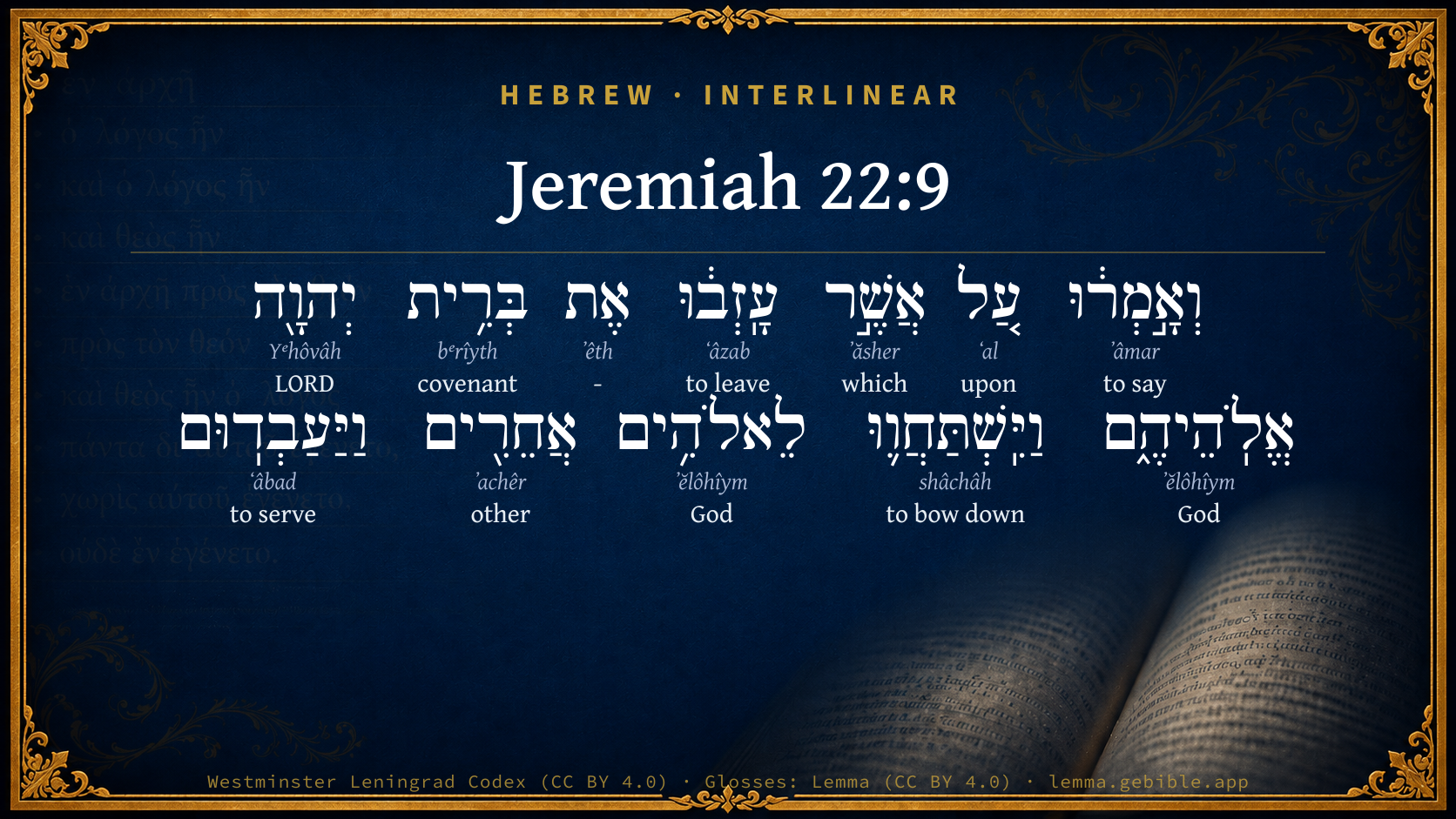
Hebrew (Westminster Leningrad Codex) Jeremiah 22:9 appears in the Hebrew Old Testament. The text above is from the Westminster Leningrad Codex. Each word links to its Strong’s number, a concise gloss, and parsing drawn from the Open Scriptures Hebrew Bible morphology. Click any word for its full Brown-Driver-Briggs (BDB) entry.
Download image
Cite this verse

Jeremiah 22:9 (World English Bible). Public Domain. Lemma interlinear Bible study tool, https://lemma.gebible.app/v/jeremiah/22/9.

Show BibTeX & RIS
BibTeX
RIS
English Translation
Then they shall answer, Because they forsook the covenant of Yahweh their God, and worshiped other gods, and served them.
World English Bible · Public Domain
Download a study sheet

One document with this verse’s original text, its word-by-word gloss line, the meaning frame, cross-references with their text, attributed commentary, and full source and license credits — printable, and it pastes into notes with its structure intact.

This verse Autodidact and up

Study sheet (.html) Plain text (.txt)

A passage Seminary Student

Up to 50 verses in one chapter. A passage sheet keeps up to 6 commentary sources and 12 cross-references per verse, in the order this page ranks them, and says so on the sheet whenever that leaves anything out. Ask for a single verse and you get the Autodidact verse sheet above.

Everything on this page stays free to read, with no account — the sheet is a download of what is already on screen, not access to it.

Want to remove ads? Support Godless Engineer
Compare translations 3

The same verse in 3 English versions, stacked beneath the original-language interlinear above. Click any original word for its lexicon entry.

Each is an independent rendering of the whole verse — the interlinear is not word-aligned to these translations.

Highlighted words mark where these versions differ — a whole-verse word diff, not a word-by-word alignment.

  • World English Bible Public Domain
    Then they shall answer, Because they forsook the covenant of Yahweh their God, and worshiped other gods, and served them.
  • King James Version Public Domain
    Then they shall answer, Because they have forsaken the covenant of the LORD their God, and worshipped other gods, and served them.
  • unfoldingWord Literal Text CC BY-SA 4.0
    And they will say, ‘On account of the fact that they abandoned the covenant of Yahweh their God and bowed down to other gods and served them.’”

unfoldingWord Literal Text — © unfoldingWord, licensed CC BY-SA 4.0. Word-aligned USFM3 via Door43 (git.door43.org/unfoldingWord/en_ult).

Versions to compare (up to 4)

3 of 4 selected

Show all 18 translations

Every available English version of this verse, each an independent rendering of the whole verse.

  • World English Bible Public Domain
    Then they shall answer, Because they forsook the covenant of Yahweh their God, and worshiped other gods, and served them.
  • Berean Standard Bible Public Domain
    Then people will reply, ‘Because they have forsaken the covenant of the LORD their God and have worshiped and served other gods.’”
  • Majority Standard Bible Public Domain
    Then people will reply, ‘Because they have forsaken the covenant of the LORD their God and have worshiped and served other gods.’”
  • King James Version Public Domain
    Then they shall answer, Because they have forsaken the covenant of the LORD their God, and worshipped other gods, and served them.
  • American Standard Version (1901) Public Domain
    Then they shall answer, Because they forsook the covenant of Jehovah their God, and worshipped other gods, and served them.
  • Revised Version (1885) Public Domain
    Then they shall answer, Because they forsook the covenant of the LORD their God, and worshipped other gods, and served them.
  • Geneva Bible (1599) Public Domain
    Then shall they answere, Because they haue forsaken the couenant of the Lord their God, and worshipped other gods, and serued them.
  • Douay-Rheims (1899) Public Domain
    And they shall answer: Because they have forsaken the covenant of the Lord their God, and have adored strange gods, and served them.
  • Young's Literal Translation Public Domain
    And they have said, `Because that they have forsaken The covenant of Jehovah their God, And bow themselves to other gods, and serve them.'
  • Literal Standard Version CC BY-SA 4.0
    And they have said, “Because that they have forsaken || The covenant of their God YHWH, || And bow themselves to other gods, and serve them.”
  • Unlocked Literal Bible CC BY-SA 4.0
    Then the other will answer, “Because they abandoned the covenant of Yahweh their God and bowed down to other gods and worshiped them.”
  • unfoldingWord Literal Text CC BY-SA 4.0
    And they will say, ‘On account of the fact that they abandoned the covenant of Yahweh their God and bowed down to other gods and served them.’”
  • Darby Bible Public Domain
    And they shall say, Because they have forsaken the covenant of Jehovah their God, and worshipped other gods, and served them.
  • World Messianic Bible Public Domain
    Then they will answer, ‘Because they abandoned the covenant of the LORD their God, worshiped other gods, and served them.’”
  • Webster's Bible Public Domain
    Then they shall answer, Because they have forsaken the covenant of the LORD their God, and worshiped other gods, and served them.
  • Free Bible Version CC BY-SA 4.0
    People will answer, “Because they broke the agreement of the Lord their God. They went and worshiped other gods.”
  • Bible in Basic English Public Domain
    And they will say, Because they gave up the agreement of the Lord their God, and became worshippers and servants of other gods.
  • JPS Tanakh (1917) Public Domain
    Then they shall answer: 'Because they forsook the covenant of the LORD their God, and worshipped other gods, and served them.'

Literal Standard Version (2020), Covenant Press — licensed CC BY-SA 4.0. Text via the HelloAO Bible API (eBible.org). Unlocked Literal Bible (unfoldingWord) — licensed CC BY-SA 4.0. Text via the HelloAO Bible API (eBible.org). unfoldingWord Literal Text — © unfoldingWord, licensed CC BY-SA 4.0. Word-aligned USFM3 via Door43 (git.door43.org/unfoldingWord/en_ult). Free Bible Version, Dr. Jonathan Gallagher — licensed CC BY-SA 4.0. Text via the HelloAO Bible API (eBible.org).

Word by word

More ways to search: Search by grammar → Find every occurrence → Compare this word →

Practice this passage: Drill this verse → Learn its vocabulary →

אֲחֵרִ֖ים
ʼachêr
H312
“other”
Adjective, Adjective, Masculine, Plural, Absolute
Part of Speech
Adjective
Type
Adjective
Gender
Masculine
Number
Plural
State
Absolute
Full BDB Definition

Origin: from H309

TWOT: 68a

another, other, following - following, further - other, different
  1. וְאָ֣מְר֔וּ ʼâmar H559 “and · to say” Conjunction + Verb, Qal, Sequential Perfect, 3rd Person, Common, Plural
  2. עַ֚ל ʻal H5921 “upon” Preposition
  3. אֲשֶׁ֣ר ʼăsher H834 “which” Particle, Relative
  4. עָֽזְב֔וּ ʻâzab H5800 “to leave” Verb, Qal, Perfect, 3rd Person, Common, Plural
  5. אֶת ʼêth H853 “-” Particle, Direct Object
  6. בְּרִ֥ית bᵉrîyth H1285 “covenant of” Noun, Common, Feminine, Singular, Construct
  7. יְהוָ֖ה Yᵉhôvâh H3068 “LORD” Noun, Proper
  8. אֱלֹֽהֵיהֶ֑ם ʼĕlôhîym H430 “God(s) · their” Noun, Common, Masculine, Plural, Construct + Suffix, Personal, 3rd Person, Masculine, Plural
  9. וַיִּֽשְׁתַּחֲו֛וּ shâchâh H7812 “and · to bow down” Conjunction + Verb, Hithpael, Sequential Imperfect, 3rd Person, Masculine, Plural
  10. לֵאלֹהִ֥ים ʼĕlôhîym H430 “to/for · God(s)” Preposition + Noun, Common, Masculine, Plural, Absolute
  11. וַיַּעַבְדֽוּם ʻâbad H5647 “and · to serve · them” Conjunction + Verb, Qal, Sequential Imperfect, 3rd Person, Masculine, Plural + Suffix, Personal, 3rd Person, Masculine, Plural

About this verse

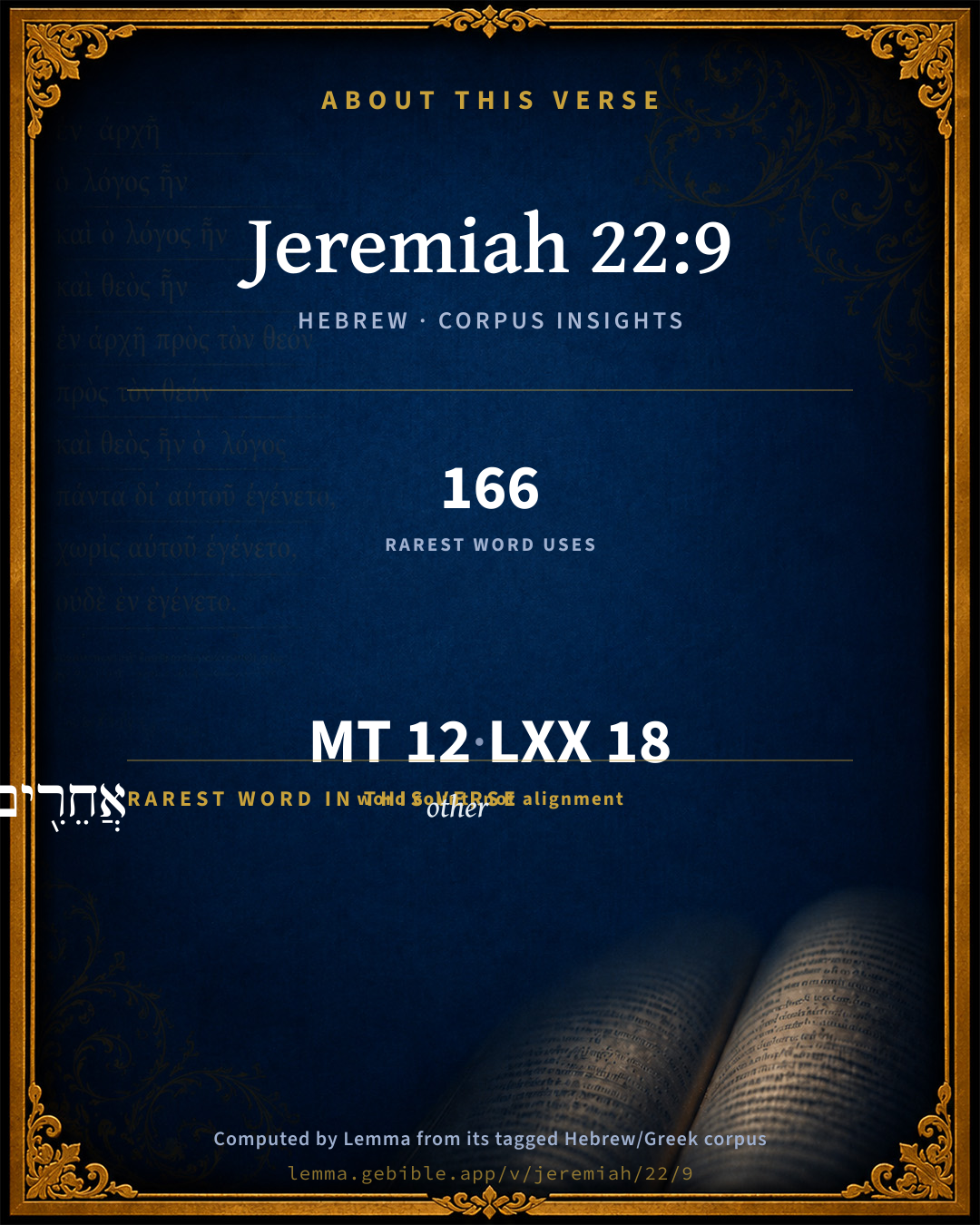
These counts appear in no published source. They are computed here, from the morphology-tagged text and Lemma’s own curated glosses. What Lemma adds →

12
words
11
distinct lemmas
Prophets
section

Grammatical profile

  • 4 verbs
  • 4 nouns
  • 1 adjective
  • 1 preposition
  • 2 particles

Verb forms

  • וְאָ֣מְר֔וּ Qal · Sequential Perfect
  • עָֽזְב֔וּ Qal · Perfect
  • וַיִּֽשְׁתַּחֲו֛וּ Hithpael · Sequential Imperfect
  • וַיַּעַבְדֽוּם Qal · Sequential Imperfect

Repetition

A word recurs within this verse — often emphatic in Hebrew:

  • אֱלֹֽהֵיהֶ֑ם God H430 ×2

Hebrew & Septuagint length

In the original languages it is 12 Hebrew tokens and 18 Greek tokens — but the two are counted differently (Hebrew bundles its prefixes and suffixes into one token; the Greek is in lemma form), so that isn’t a like-for-like length.

Cross-references

6

Topical passages linked to Jeremiah 22:9 in the Treasury of Scripture Knowledge — connected by theme and wording, ordered by reader-vote popularity; previews shown in the World English Bible.

  • 2 Kings 22:17 Because they have forsaken me, and have burned incense to other gods, that they might provoke me to anger with all the work of their hands, therefore my wrath shall be kindled against this place, and it shall not be quenched.
  • 2 Chronicles 34:25 Because they have forsaken me, and have burned incense to other gods, that they might provoke me to anger with all the works of their hands; therefore is my wrath poured out on this place, and it shall not be quenched.
  • Deuteronomy 29:25–28 Then men shall say, Because they forsook the covenant of Yahweh, the God of their fathers, which he made with them when he brought them forth out of the land of Egypt,
  • Jeremiah 2:17–19 Haven't you procured this to yourself, in that you have forsaken Yahweh your God, when he led you by the way?
  • Jeremiah 40:2–3 The captain of the guard took Jeremiah, and said to him, Yahweh your God pronounced this evil on this place;
  • Jeremiah 50:7 All who found them have devoured them; and their adversaries said, We are not guilty, because they have sinned against Yahweh, the habitation of righteousness, even Yahweh, the hope of their fathers.

Cross-references courtesy of OpenBible.info (CC BY 4.0).

Hebrew and Greek witnesses Masoretic Hebrew ↔ Greek Septuagint

The same verse in the two great witnesses to the Old Testament, shown verse-for-verse.

These are two independent witnesses, not word-aligned to each other, and the Septuagint is shown in lemma (dictionary) form.

Hebrew Jeremiah 22:9 Masoretic · Westminster Leningrad Codex

וְאָ֣מְר֔וּ עַ֚ל אֲשֶׁ֣ר עָֽזְב֔וּ אֶת בְּרִ֥ית יְהוָ֖ה אֱלֹֽהֵיהֶ֑ם וַיִּֽשְׁתַּחֲו֛וּ לֵאלֹהִ֥ים אֲחֵרִ֖ים וַיַּעַבְדֽוּם

Then they shall answer, Because they forsook the covenant of Yahweh their God, and worshiped other gods, and served them.

World English Bible · Public Domain

Greek LXX Structure differs

In the Septuagint, Jeremiah is about an eighth shorter than the Hebrew and arranges its material differently — the Oracles Against the Nations (Hebrew chapters 46–51) appear in the middle of the Greek book, after 25:13. Because the chapter and verse boundaries do not line up, a verse-for-verse comparison with the Hebrew is not shown.

A verse-for-verse comparison isn’t shown here because the chapters and verses don’t line up. Switch to the LXX edition with the MT / LXX toggle above to read the Greek directly.

Hebrew: Westminster Leningrad Codex (CC BY 4.0). Greek: Septuagint (public domain); English from a public-domain English Septuagint. How the Septuagint differs from the Hebrew →

Targum (Aramaic paraphrase)

1

The Targum is the ancient Jewish Aramaic paraphrase of the Hebrew Scriptures — an interpretive translation, not the Hebrew text itself. Onkelos (literal) and Pseudo-Jonathan (expansive) render the Torah, and Jonathan the Prophets. Coverage is partial: where no permissively-licensed English translation exists for a verse, only the Aramaic is shown. This is verse-level text, not a word-by-word alignment to the Hebrew.

  1. Targum Jonathan Prophets (Joshua–Malachi)
    וְיֵימְרוּן עַל דִשְׁבָקוּ יַת קְיָמָא דַייָ אֱלָהָהוֹן וּסְגִידוּ לְטַעֲוַת פַלְחֵי כּוֹכְבַיָא וּפַלְחוּנוּן:

    (no public-domain English translation for this verse)

    Targum Jonathan — Aramaic: “Mikraot Gedolot” (public domain). English: “Sefaria Community Translation” (CC0 1.0 (public-domain dedication)); “London "Chaldee Paraphrase," 1871” (public domain). Text via Sefaria.

Commentary

Notes on Jeremiah 22:9 from classic Christian and Jewish commentators (each source and its license shown beneath its notes). The classic Christian expositions comment on the surrounding passage and are grouped to its opening verse, so a note may address several verses; the Jewish commentaries on the Tanakh (Rashi and others) are per-verse, so they appear only where the commentator wrote on this verse.

Lemma curates 59 commentaries, every one of them public domain or Creative Commons licensed, each selected and text-cleaned for this edition rather than reprinted as found. About our sources →

Trapp's Complete Commentary

John Trapp

Jer 22:9 Then they shall answer, Because they have forsaken the covenant of the LORD their God, and worshipped other gods, and served them.

Ver. 9. Because they have forsaken the covenant &c.] In promptu causa est. Heinous sins brings hideous plagues. Ingentia beneficia, flagitia, supplicia. {a}

{a} Magdeburg.

John Trapp, A Commentary or Exposition upon All the Books of the Old and New Testament (1647–1656) — public domain. Text from a community e-Sword module.

The Expositor's Bible

CHAPTER XXVIII

PERSISTENT APOSTASY

"They have forsaken the covenant of Jehovah their God, and worshipped other gods, and served them."- Jer_22:9

"Every one that walketh in the stubbornness of his heart."- Jer_23:17

THE previous chapter has been intentionally confined, as far as possible, to Jeremiahs teaching upon the moral condition of Judah. Religion, in the narrower sense, was kept in the background, and mainly referred to as a social and political influence. In the same way the priests and prophets were mentioned chiefly as classes of notables-estates of the realm. This method corresponds with a stage in the process of Revelation; it is that of the older prophets. Hosea, as a native of the Northern Kingdom, may have had a fuller experience and clearer understanding of religious corruption than his contemporaries in Judah. But, in spite of the stress that he lays upon idolatry and the various corruptions of worship, many sections of his book simply deal with social evils. We are not explicitly told why the prophet was "a fool" and "a snare of a fowler," but the immediate context refers to the abominable immorality of Gibeah. {Hos_9:7-9 : cf. Jdg_19:22} The priests are not reproached with incorrect ritual, but with conspiracy to murder. {Hos_6:9} In Amos, the land is not so much punished on account of corrupt worship, as the sanctuaries are destroyed because the people are given over to murder, oppression, and every form of vice. In Isaiah again the main stress is constantly upon international policies and public and private morality. (Isaiah 40-46, is excluded from this statement.) For instance, none of the woes in Isa_5:8-24 are directed against idolatry or corrupt worship, and in Jer_28:7 the charge brought against Ephraim does not refer to ecclesiastical matters; they have erred through strong drink.

In Jeremiahs treatment, of the ruin of Judah, he insists, as Hosea had done as regards Israel, on the fatal consequences of apostasy from Jehovah to other gods. This very phrase "other gods" is one of Jeremiahs favourite expressions, and in the writings of the other prophets only occurs in Hos_3:1. On the other hand, references to idols are extremely rare in Jeremiah. These facts suggest a special difficulty in discussing the apostasy of Judah. The Jews often combined the worship of other gods with that of Jehovah. According to the analogy of other nations, it was quite possible to worship Baal and Ashtaroth, and the whole heathen Pantheon, without intending to show any special disrespect to the national Deity. Even devout worshippers, who confined their adorations to the one true God, sometimes thought they did honour to Him by introducing into His services the images and all the paraphernalia of the splendid cults of the great heathen empires. It is not always easy to determine whether statements about idolatry imply formal apostasy from Jehovah, or merely a debased worship. When the early Mohammedans spoke with lofty contempt of image worshippers, they were referring to the Eastern Christians; the iconoclast heretics denounced the idolatry of the Orthodox Church, and the Covenanters used similar terms as to prelacy. Ignorant modern Jews are sometimes taught that Christians worship idols.

Hence when we read of the Jews, "They set their abominations in the house which is called by My name, to defile it," we are not to understand that the Temple was transferred from Jehovah to some other deities, but that the corrupt practices and symbols of heathen worship were combined with the Mosaic ritual. Even the high places of Baal, in the Valley of Ben-Hinnom, where children were passed through the fire unto Moloch, professed to offer an opportunity of supreme devotion to the God of Israel. Baal and Melech, Lord and King, had in ancient times been amongst His titles; and when they became associated with the more heathenish modes of worship, their misguided devotees still claimed that they were doing homage to the national Deity. The inhuman sacrifices to Moloch were offered in obedience to sacred tradition and Divine oracles, which were supposed to emanate from Jehovah. In three different places, Jeremiah explicitly and emphatically denies that Jehovah had required or sanctioned these sacrifices: "I commanded them not, neither came it into My mind, that they should do this abomination, to cause Judah to sin." The Pentateuch preserves an ancient ordinance which the Moloch worshippers probably interpreted in support of their unholy rites, and Jeremiahs protests are partly directed against the misinterpretation of the command "the firstborn of thy sons shalt thou give Me." The immediate context also commanded that the firstlings of sheep and oxen should be given to Jehovah. The beasts were killed; must it not be intended that the children should be killed too? A similar blind literalism has been responsible for many of the follies and crimes perpetrated in the name of Christ. The Church is apt to justify its most flagrant enormities by appealing to a misused and misinterpreted Old Testament. "Thou shalt not suffer a witch to live" and "Cursed be Canaan" have been proof texts for witch hunting and negro slavery; and the Book of Joshua has been regarded as a Divine charter, authorising the unrestrained indulgence of the passion for revenge and blood.

When it was thus necessary to put on record reiterated denials that inhuman rites of Baal and Moloch were a divinely sanctioned adoration of Jehovah, we can understand that the Baal worship constantly referred to by Hosea, Jeremiah, and Zephaniah was not generally understood to be apostasy. The worship of "other gods," "the sun, the moon, and all the host of heaven," {Jer_7:2} and of the "Queen of Heaven," would be more difficult to explain as mere syncretism, but the assimilation of Jewish worship to heathen ritual and the confusion of the Divine Name with the titles of heathen deities masked the transition from the religion of Moses and Isaiah to utter apostasy.

Such assimilation and confusion perplexed and baffled the prophets. Social and moral wrongdoing were easily exposed and denounced; and the evils thus brought to light were obvious symptoms of serious spiritual disease. The Divine Spirit taught the prophets that sin was often most rampant in those who professed the greatest devotion to Jehovah and were most punctual and munificent in the discharge of external religious duties. When the prophecy in Isaiah 1 was uttered it almost seemed as if the whole system of Mosaic ritual would have to be sacrificed, in order to preserve the religion of Jehovah. But the further development of the disease suggested a less heroic remedy. The passion for external rites did not confine itself to the traditional forms of ancient Israelite worship. The practices of unspiritual and immoral ritualism were associated specially with the names of Baal and Moloch and with the adoration of the host of heaven; and the departure from the true worship became obvious when the deities of foreign nations were openly worshipped.

Jeremiah clearly and constantly insisted on the distinction between the true and the corrupt worship. The worship paid to Baal and Moloch was altogether unacceptable to Jehovah. These and other objects of adoration were not to be regarded as forms, titles, or manifestations of the one God, but were "other gods," distinct and opposed in nature and attributes; in serving them the Jews were forsaking Him. So far from recognising such rites as homage paid to Jehovah, Jeremiah follows Hosea in calling them "backsliding," {Jer_2:19, etc.} a falling away from true loyalty. When they addressed themselves to their idols, even if they consecrated them in the Temple and to the glory of the Most High, they were not really looking to Him in reverent supplication, but with impious profanity were turning their backs upon Him: "They have turned unto Me the back, and not the face." {Jer_32:33, etc.} These proceedings were a violation of the covenant between Jehovah and Israel. {Jer_22:9; Jer_11:10; Jer_31:32, and Hos_6:7; Hos_8:1}

The same anxiety to discriminate the true religion from spurious imitations and adulterations underlies the stress which Jeremiah lays upon the Divine Name. His favourite formula, "Jehovah Sabaoth is His name"; {Jer_10:16 cf. Amo_4:13} may be borrowed from Amos, or may be an ancient liturgical sentence; in any case, its use would be a convenient protest against the doctrine that Jehovah could be worshipped under the names of and after the manner of Baal and Moloch. When Jehovah speaks of the people forgetting "My name," He does not mean either that the people would forget all about Him, or would cease to use the name Jehovah; but that they would forget the character and attributes, the purposes and ordinances, which were properly expressed by His Name. The prophets who "prophesy lies in My name" "cause My people to forget My name." Baal and Moloch had sunk into fit titles for a god who could be worshipped with cruel, obscene, and idolatrous rites, but the religion of Revelation had been forever associated with the one sacred Name, when. "Elohim said unto Moses, Thou shalt say unto the Israelites: Jehovah, the God of your fathers, the God of Abraham, the God of Isaac, and the God of Jacob, hath sent me unto you: this is My name forever, and this is My memorial unto all generations." All religious life and practice inconsistent with this Revelation given through Moses and the prophets-all such worship, even if offered to beings which, as Jehovah, sat in the Temple of Jehovah, professing to be Jehovah-were nevertheless service and obedience paid to other and false gods. Jeremiahs mission was to hammer these truths into dull and unwilling minds.

His work seems to have been successful. Ezekiel, who is in a measure his disciple, drops the phrase "other gods," and mentions "idols" very frequently. Argument and explanation were no longer necessary to show that idolatry was sin against Jehovah; the word "idol" could be freely used and universally understood as indicating what was wholly alien to the religion of Israel. Jeremiah was too anxious to convince the Jews that all syncretism was apostasy to distinguish it carefully from the avowed neglect of Jehovah for other gods. It is not even clear that such neglect existed in his day. In chapter 44 we have one detailed account of false worship to the Queen of Heaven. It was offered by the Jewish refugees in Egypt; shortly before, these refugees had unanimously entreated Jeremiah to pray for them to Jehovah, and had promised to obey His commands. The punishment of their false worship was that they should no longer be permitted to name the Holy Name. Clearly, therefore, they had supposed that offering incense to the Queen of Heaven was not inconsistent with worshipping Jehovah. We need not dwell on a distinction which is largely ignored by Jeremiah; the apostasy of Judah was real and widespread, it matters little how far the delinquents ventured to throw off the cloak of orthodox profession. The most lapsed masses in a Christian country do not utterly break their connection with the Church; they consider themselves legitimate recipients of its alms, and dimly contemplate as a vague and distant possibility the reformation of their life and character through Christianity. So the blindest worshippers of stocks and stones claimed a vested interest in the national Deity, and in the time of their trouble they turned to Jehovah with the appeal "Arise and save us." {Jer_2:27}

Jeremiah also dwells on the deliberate and persistent character of the apostasy of Judah. Nations have often experienced a sort of satanic revival when the fountains of the nether deep seemed broken up, and flood tides of evil influence swept all before them. Such, in a measure, was the reaction from the Puritan Commonwealth, when so much of English society lapsed into reckless dissipation. Such too was the carnival of wickedness into which the First French Republic was plunged in the Reign of Terror. But these periods were transient, and the domination of lust and cruelty soon broke down before the reassertion of an outraged national conscience. But we noticed, in the previous chapter, that Israel and Judah alike steadily failed to attain the high social ideal of the Mosaic dispensation. Naturally, this continuous failure is associated with persistent apostasy from the religious teaching of the Mosaic and prophetic Revelation. Exodus, Deuteronomy, and the Chronicler agree with Jeremiah that the Israelites were a stiff-necked people; {Jer_27:23 : cf. Exo_32:9, etc. Deu_9:6; 2Ch_30:8} and, in the Chroniclers time at any rate, Israel had played a part in the world long enough for its character to be accurately ascertained; and subsequent history has shown that, for good or for evil, the Jews have never lacked tenacity. Syncretism, the tendency to adulterate true teaching and worship with elements from heathen sources, had been all along a morbid affection of Israelite religion. The Pentateuch and the historical books are full of rebukes of the Israelite passion for idolatry, which must for the most part be understood as introduced into or associated with the worship of Jehovah. Jeremiah constantly refers to "the stubbornness of their evil heart": "they have walked after the stubbornness of their own heart and after the Baalim." This stubbornness was shown in their resistance to all the means which Jehovah employed to wean them from their sin. Again and again, in our book, Jehovah speaks of Himself as "rising up early" to speak to the Jews, to teach them, to send prophets to them, to solemnly adjure them to submit themselves to Him: but they would not hearken either to Jehovah or to His prophets, they would not accept His teaching or obey His commands, they made themselves stiff necked and would not bow to His will. He had subjected them to the discipline of affliction, instruction had become correction; Jehovah had wounded them "with the wound of an enemy, with the chastisement of a cruel one"; but as they had been deaf to exhortation, so they were proof against chastisement-"they refused to receive correction." Only the ruin of the state and the captivity of the people could purge out this evil leaven.

Apostasy from the Mosaic and prophetic religion was naturally accompanied by social corruption. It has recently been maintained that the universal instinct which inclines man to be religious is not necessarily moral, and that it is the distinguishing note of the true faith, or of religion proper, that it enlists this somewhat neutral instinct in the cause of a pure morality. The Phoenician and Syrian cults, with which Israel was most closely in contact, sufficiently illustrated the combination of fanatical religious feeling with gross impurity. On the other hand, the teaching of Revelation to Israel consistently inculcated a high morality and an unselfish benevolence. The prophets vehemently affirmed the worthlessness of religious observances by men who oppressed the poor and helpless. Apostasy from Jehovah to Baal and Moloch involved the same moral lapse as a change from loyal service to Christ to a pietistic antinomianism. Widespread apostasy meant general social corruption. The most insidious form of apostasy was that specially denounced by Jeremiah, in which the authority of Jehovah was more or less explicitly claimed for practices and principles which defied His law. The Reformer loves a clear issue, and it was more difficult to come to close quarters with the enemy when both sides professed to be fighting in the Kings name. Moreover the syncretism which still recognised Jehovah was able without any violent revolution to control the established institutions and orders of the state-palace and temple, king and princes, priests and prophets. For a moment the Reformation of Josiah, and the covenant entered into by the king and people to observe the law as laid down in the newly discovered Book of Deuteronomy, seemed to have raised Judah from its low estate. But the defeat and death of Josiah and the deposition of Jehoahaz followed, to discredit Jeremiah and his friends. In the consequent reaction it seemed as if the religion of Jehovah and the life of His people had become hopelessly corrupt.

We are too much accustomed to think of the idolatry of Israel as something openly and avowedly distinct from and opposed to the worship of Jehovah. Modern Christians often suppose that the true worshipper and the ancient idolater were as contrasted as a pious Englishman and a devotee of one of the hideous images seen on missionary platforms; or, at any rate, that they were as easily distinguishable as a native Indian evangelist from his unconverted fellow countrymen.

This mistake deprives us of the most instructive lessons to be derived from the record. The sin which Jeremiah denounced is by no means outside Christian experience; it is much nearer to us than conversion to Buddhism-it is possible to the Church in every stage of its history. The missionary finds that the lives of his converts continually threaten to revert to a nominal profession which cloaks the immorality and superstition of their old heathenism. The Church of the Roman Empire gave the sanction of Christs name and authority to many of the most unchristian features of Judaism and Paganism; once more the rites of strange gods were associated with the worship of Jehovah and a new Queen of Heaven was honoured with unlimited incense. The Reformed Churches in their turn, after the first "kindness of their youth," the first "love of their espousals," have often fallen into the very abuses against which their great leaders protested; they have given way to the ritualistic spirit, have put the Church in the place of Christ, and have claimed for human formulae the authority that can only belong to the inspired Word of God. They have immolated their victims to the Baals and Molochs of creeds and confessions, and thought that they were doing honour to Jehovah thereby.

Moreover we have still to contend like Jeremiah with the continual struggle of corrupt human nature to indulge in the luxury of religious sentiment and emotion without submitting to the moral demands of Christ. The Church suffers far less by losing the allegiance of the lapsed masses than it does by those who associate with the service of Christ those malignant and selfish vices which are often canonised as Respectability and Convention.

William Robertson Nicoll, ed., The Expositor's Bible (London: Hodder & Stoughton, 1887–1910) — public domain. 65 of 66 books (1 Corinthians is not separately keyed, as that volume carries no machine-parseable verse references); section-level commentary keyed to the opening verse. Introductory and overview sections not keyed to a specific passage are excluded.

Jamieson, Fausset & Brown

Robert Jamieson, A. R. Fausset & David Brown

(Kg2 22:17).

Jamieson, Fausset & Brown — Commentary Critical and Explanatory on the Whole Bible (1871) — public domain (CC PDM 1.0). Text via the HelloAO Bible API.

John Calvin's Commentaries

He afterwards adds, that there would be not only a spirit of inquiry among the nations, but that every one would become spontaneously a judge of the whole people: they shall answer, he says, because they have forsaken the covenant of Jehovah their God Now, when Jeremiah declares that all the nations would become the judges of the people, he no doubt intended to condemn the false confidence in which they proudly indulged. At the same time, he says, “they have forsaken the covenant of Jehovah their God,” in order that he might take away the plea of ignorance. For they had not only deprived the eternal God of his own right and authority, but they had become doubly wicked, because God had made himself familiarly known to them. As, then, true religion had been fully revealed to them in the Law, hence their perverseness and wicked and base ingratitude appeared, for they had rejected God thus made known to them, and they bowed down before foreign gods and served them. I only touch here on these points, for they have been elsewhere explained. It follows, —

John Calvin's Commentaries (1540-1563) — public domain. Text from the Calvin Translation Society English edition (1840s-50s) via the Christian Classics Ethereal Library (ccel.org). Calvin's coverage is partial (roughly two-thirds of the Bible); uncommented books and verses are honest gaps, never fabricated. The 19th-century editor's footnotes and remarks are omitted so the notes are faithfully Calvin's own voice.

John Gill's Exposition

Then they shall answer,.... Or, "it shall be answered" (e); by some in company, acquainted with the history of this people:

because they have forsaken the covenant of the Lord their God; the Lord was the God of these people; he chose them for his peculiar people, and distinguished them by his favours from others; a covenant was made with them, in which many good things were promised them upon their obedience; this was kept by him, but forsaken and broken by them; they forsook their covenant God, his law and his worship; and that was the cause of their ruin:

and worshipped other gods, and served them; the idols of the people, as the Targum; they left the true God, who had done great and good things for them, and worshipped those who were only gods by name, and not by nature; and served stocks and stones, the vanities of the Gentiles, who could not bestow one good thing on them; such were their stupidity and ingratitude, and therefore very justly given up to destruction. This seems to refer, as Cocceius thinks, not to the first destruction of the city by Nebuchadnezzar, when it had not so clear and full an accomplishment; but to the second destruction of it by the Romans, and the times following that; when the Gospel being preached among the Gentiles, they had a better understanding of the true God, and of his covenant, and of the vanity of idolatry, and of the state of the Jewish nation, and the religion of it, and of the true causes of their ruin.

(e) "respondebitur", Gataker; "dicetur", Piscator.

John Gill's Exposition of the Whole Bible (1746–1763) — public domain (CC PDM 1.0). Text via the HelloAO Bible API.

Matthew Poole's English Annotations

Some shall answer them, or they shall answer one another, Surely it is because they have broken the Divine law, which the Israelites made a covenant, Exo 19:8; 24:3,7; Deu 5:27, upon which account their sinning was an apostacy, and a forsaking their covenant. Their sinning was not of an ordinary nature, but by idolatry, worshipping images and idols, which indeed were no gods but only in the opinion of those nations that worshipped them.

Matthew Poole's English Annotations on the Holy Bible (1683–1685) — public domain. Text from a community e-Sword/MySword module.

Lesson kit

Teaching starters — assembled from the data on this page, not authored interpretation. Every prompt links to the verse data it draws on. Edit before teaching.

Jeremiah, in the Prophets, opens this verse with 12 words (11 distinct Hebrew lemmas). Its most distinctive word is ʼachêr (“other”). A historical commentator’s framing appears above. Read the whole chapter for the surrounding context.

Discussion questions

  1. How does “other” (ʼachêr) shape what this verse is saying?
  2. 2 Kings 22:17 shares this passage’s theme. How do the two illuminate each other?
  3. “God” occurs 2× in this one verse. What is the effect of the repetition?
  4. These translations render this verse differently. What is at stake in choosing one wording over another?
  5. The verb «וְאָ֣מְר֔וּ» is Qal Sequential Perfect. How does its form color the action?
  6. Reading how Trapp's Complete Commentary and The Expositor's Bible read this verse, where do the two commentators agree and where do they part?

Things to notice

Reading settings

Reading text

Shown beneath each verse's original-language words.

Old Testament
Old Testament edition

Read the OT as the Masoretic Hebrew (MT) or the Greek Septuagint (LXX).

English shown for the Greek Septuagint (in the Hebrew ↔ Greek comparison).

Comparing translations? Open the Compare panel on any verse page to stack up to four side by side.