Jeremiah 25:38

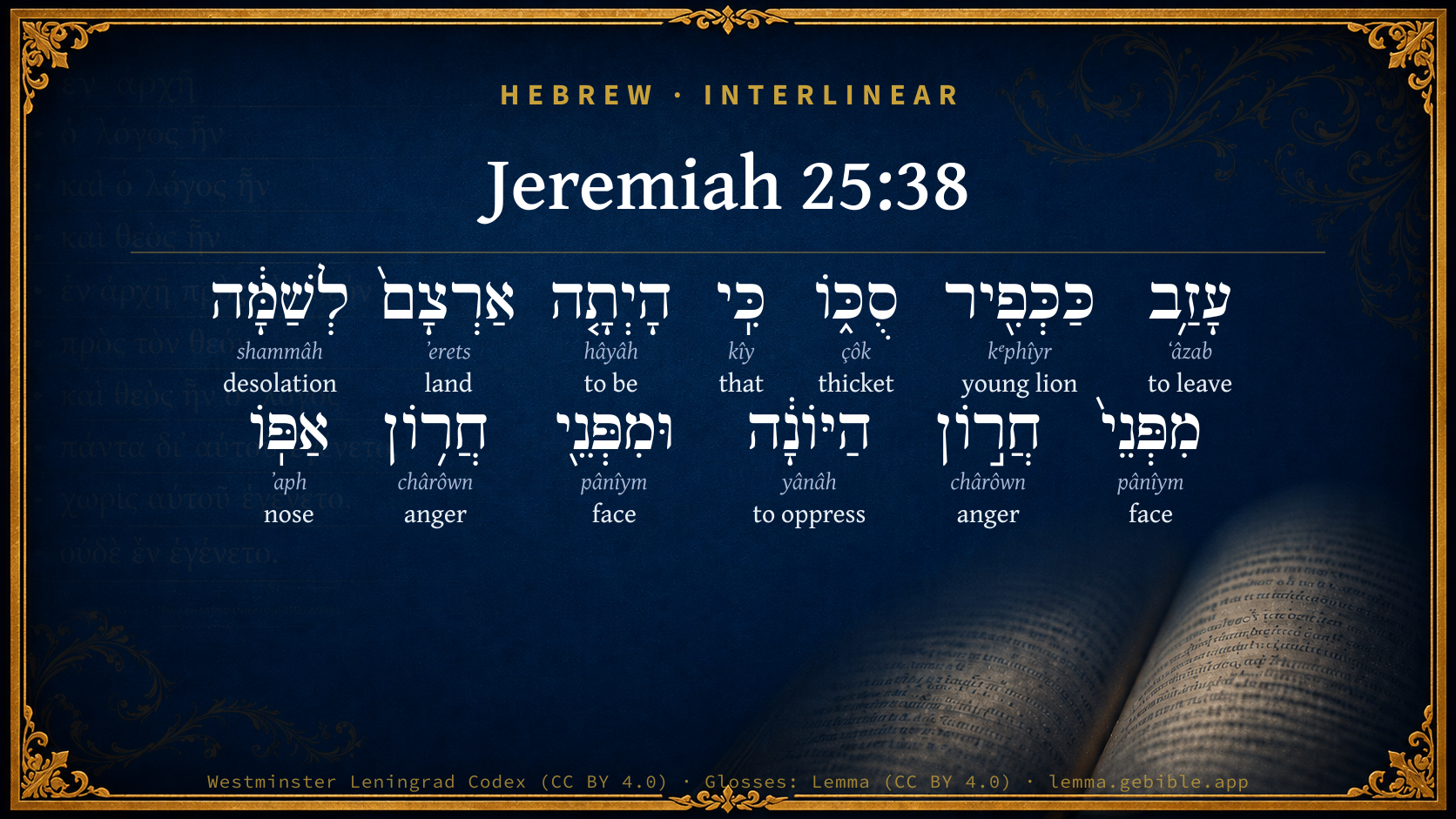
Hebrew (Westminster Leningrad Codex) Jeremiah 25:38 appears in the Hebrew Old Testament. The text above is from the Westminster Leningrad Codex. Each word links to its Strong’s number, a concise gloss, and parsing drawn from the Open Scriptures Hebrew Bible morphology. Click any word for its full Brown-Driver-Briggs (BDB) entry.
Download image
Cite this verse

Jeremiah 25:38 (World English Bible). Public Domain. Lemma interlinear Bible study tool, https://lemma.gebible.app/v/jeremiah/25/38.

Show BibTeX & RIS
BibTeX
RIS
English Translation
He has left his covert, as the lion; for their land is become an astonishment because of the fierceness of the oppressing [sword], and because of his fierce anger.
World English Bible · Public Domain
Download a study sheet

One document with this verse’s original text, its word-by-word gloss line, the meaning frame, cross-references with their text, attributed commentary, and full source and license credits — printable, and it pastes into notes with its structure intact.

This verse Autodidact and up

Study sheet (.html) Plain text (.txt)

A passage Seminary Student

Up to 50 verses in one chapter. A passage sheet keeps up to 6 commentary sources and 12 cross-references per verse, in the order this page ranks them, and says so on the sheet whenever that leaves anything out. Ask for a single verse and you get the Autodidact verse sheet above.

Everything on this page stays free to read, with no account — the sheet is a download of what is already on screen, not access to it.

Want to remove ads? Support Godless Engineer
Compare translations 3

The same verse in 3 English versions, stacked beneath the original-language interlinear above. Click any original word for its lexicon entry.

Each is an independent rendering of the whole verse — the interlinear is not word-aligned to these translations.

Highlighted words mark where these versions differ — a whole-verse word diff, not a word-by-word alignment.

  • World English Bible Public Domain
    He has left his covert, as the lion; for their land is become an astonishment because of the fierceness of the oppressing [sword], and because of his fierce anger.
  • King James Version Public Domain
    He hath forsaken his covert, as the lion: for their land is desolate because of the fierceness of the oppressor, and because of his fierce anger.
  • unfoldingWord Literal Text CC BY-SA 4.0
    He has left his lair like the young lion, for their land has become a desolation, from the face of the burning of the oppressor and from the face of the burning of his nose.”

unfoldingWord Literal Text — © unfoldingWord, licensed CC BY-SA 4.0. Word-aligned USFM3 via Door43 (git.door43.org/unfoldingWord/en_ult).

Versions to compare (up to 4)

3 of 4 selected

Show all 18 translations

Every available English version of this verse, each an independent rendering of the whole verse.

  • World English Bible Public Domain
    He has left his covert, as the lion; for their land is become an astonishment because of the fierceness of the oppressing [sword], and because of his fierce anger.
  • Berean Standard Bible Public Domain
    He has left His den like a lion, for their land has been made a desolation by the sword of the oppressor, and because of the fierce anger of the LORD.
  • Majority Standard Bible Public Domain
    He has left His den like a lion, for their land has been made a desolation by the sword of the oppressor, and because of the fierce anger of the LORD.
  • King James Version Public Domain
    He hath forsaken his covert, as the lion: for their land is desolate because of the fierceness of the oppressor, and because of his fierce anger.
  • American Standard Version (1901) Public Domain
    He hath left his covert, as the lion; for their land is become an astonishment because of the fierceness of the oppressing `sword', and because of his fierce anger.
  • Revised Version (1885) Public Domain
    He hath forsaken his covert, as the lion: for their land is become an astonishment because of the fierceness of the oppressing sword, and because of his fierce anger.
  • Geneva Bible (1599) Public Domain
    He hath forsaken his couert, as the lyon: for their land is waste, because of the wrath of the oppressor, and because of ye wrath of his indignatio.
  • Douay-Rheims (1899) Public Domain
    He has forsaken his covert as the lion, for the land is laid waste because of the wrath of the dove, and because of the fierce anger of the Lord.
  • Young's Literal Translation Public Domain
    He hath forsaken, as a young lion, His covert, Surely their land hath become a desolation, Because of the oppressing fierceness, And because of the fierceness of His anger!
  • Literal Standard Version CC BY-SA 4.0
    He has forsaken His covert as a young lion, || Surely their land has become a desolation, || Because of the oppressing fierceness, || And because of the fierceness of His anger!”
  • Unlocked Literal Bible CC BY-SA 4.0
    Like a young lion, he has left his den, for their land will become a horror because of the oppressor's anger, because of his angry wrath.'”
  • unfoldingWord Literal Text CC BY-SA 4.0
    He has left his lair like the young lion, for their land has become a desolation, from the face of the burning of the oppressor and from the face of the burning of his nose.”
  • Darby Bible Public Domain
    He hath forsaken his covert as a young lion; for their land is a desolation because of the fierceness of the oppressor, and because of his fierce anger.
  • World Messianic Bible Public Domain
    He has left his covert, as the lion; for their land has become an astonishment because of the fierceness of the oppression, and because of his fierce anger.
  • Webster's Bible Public Domain
    He hath forsaken his covert, as the lion: for their land is desolate because of the fierceness of the oppressor, and because of his fierce anger.
  • Free Bible Version CC BY-SA 4.0
    The Lord has left his den like a lion, because their country has been devastated by the invading armies, and because of the Lord's fierce anger.
  • Bible in Basic English Public Domain
    The lion has come out of his secret place, for the land has become a waste because of the cruel sword, and because of the heat of his wrath.
  • JPS Tanakh (1917) Public Domain
    He hath forsaken His covert, as the lion; for their land is become a waste because of the fierceness of the oppressing sword, and because of His fierce anger.

Literal Standard Version (2020), Covenant Press — licensed CC BY-SA 4.0. Text via the HelloAO Bible API (eBible.org). Unlocked Literal Bible (unfoldingWord) — licensed CC BY-SA 4.0. Text via the HelloAO Bible API (eBible.org). unfoldingWord Literal Text — © unfoldingWord, licensed CC BY-SA 4.0. Word-aligned USFM3 via Door43 (git.door43.org/unfoldingWord/en_ult). Free Bible Version, Dr. Jonathan Gallagher — licensed CC BY-SA 4.0. Text via the HelloAO Bible API (eBible.org).

Word by word

More ways to search: Search by grammar → Find every occurrence → Compare this word →

Practice this passage: Drill this verse → Learn its vocabulary →

סֻכּ֑וֹ
çôk
H5520
“thicket · his”
Noun, Common, Masculine, Singular, Construct + Suffix, Personal, 3rd Person, Masculine, Singular
Part of Speech
Noun
Type
Common
Gender
Masculine
Number
Singular
State
Construct
Full BDB Definition

Origin: from H5526

TWOT: 1492d

thicket, lair, covert, booth
  1. עָזַ֥ב ʻâzab H5800 “to leave” Verb, Qal, Perfect, 3rd Person, Masculine, Singular
  2. כַּכְּפִ֖יר kᵉphîyr H3715 “like/as the · young lion” Preposition, Determined + Noun, Common, Masculine, Singular, Absolute
  3. כִּֽי kîy H3588 “that” Conjunction
  4. הָיְתָ֤ה hâyâh H1961 “to be” Verb, Qal, Perfect, 3rd Person, Feminine, Singular
  5. אַרְצָם֙ ʼerets H776 “land · their” Noun, Common, Both, Singular, Construct + Suffix, Personal, 3rd Person, Masculine, Plural
  6. לְשַׁמָּ֔ה shammâh H8047 “to/for · desolation” Preposition + Noun, Common, Feminine, Singular, Absolute
  7. מִפְּנֵי֙ pânîym H6440 “from · face(s) of” Preposition + Noun, Common, Both, Plural, Construct
  8. חֲר֣וֹן chârôwn H2740 “anger of” Noun, Common, Masculine, Singular, Construct
  9. הַיּוֹנָ֔ה yânâh H3238 “the · oppressing” Particle, Definite Article + Verb, Qal, Participle Active, Feminine, Singular, Absolute
  10. וּמִפְּנֵ֖י pânîym H6440 “and · from · face(s) of” Conjunction + Preposition + Noun, Common, Both, Plural, Construct
  11. חֲר֥וֹן chârôwn H2740 “anger of” Noun, Common, Masculine, Singular, Construct
  12. אַפּֽוֹ ʼaph H639 “nose · his” Noun, Common, Masculine, Singular, Construct + Suffix, Personal, 3rd Person, Masculine, Singular

About this verse

These counts appear in no published source. They are computed here, from the morphology-tagged text and Lemma’s own curated glosses. What Lemma adds →

13
words
11
distinct lemmas
Prophets
section

Notable vocabulary

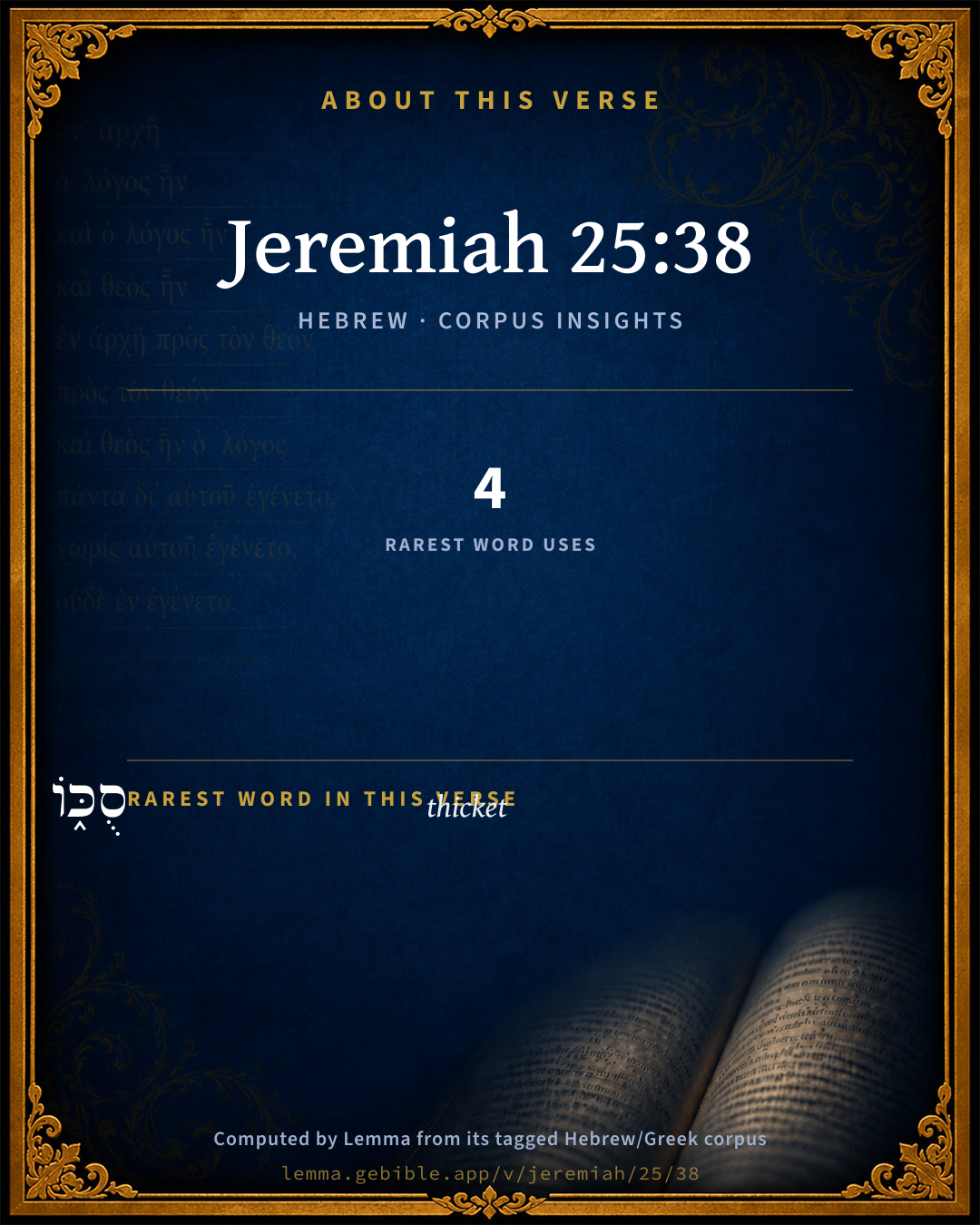
The rarest word here is סֻכּ֑וֹ thicket H5520 — appearing just 4 times in the whole Hebrew Bible.

Shared distinctive vocabulary

סֻכּ֑וֹ thicket H5520 occurs in 4 verses of the Hebrew Bible. Also found in:

Grammatical profile

  • 3 verbs
  • 9 nouns
  • 1 conjunction

Verb forms

  • עָזַ֥ב Qal · Perfect
  • הָיְתָ֤ה Qal · Perfect
  • הַיּוֹנָ֔ה Qal · Participle Active

Repetition

Words recur within this verse — often emphatic in Hebrew:

  • מִפְּנֵי֙ face H6440 ×2
  • חֲר֣וֹן anger H2740 ×2

Cross-references

10

Topical passages linked to Jeremiah 25:38 in the Treasury of Scripture Knowledge — connected by theme and wording, ordered by reader-vote popularity; previews shown in the World English Bible.

  • Jeremiah 4:7 A lion is gone up from his thicket, and a destroyer of nations; he is on his way, he is gone forth from his place, to make your land desolate, that your cities be laid waste, without inhabitant.
  • Jeremiah 5:6 Therefore a lion out of the forest shall kill them, a wolf of the evenings shall destroy them, a leopard shall watch against their cities; everyone who goes out there shall be torn in pieces; because their transgressions are many, [and] their backsliding is increased.
  • Hosea 5:14 For I will be to Ephraim like a lion, And like a young lion to the house of Judah. I myself will tear in pieces and go away. I will carry off, and there will be no one to deliver.
  • Hosea 13:7–8 Therefore am I to them like a lion; Like a leopard I will lurk by the path.
  • Psalms 76:2 His tent is also in Salem; His dwelling place in Zion.
  • Jeremiah 49:19 Behold, he shall come up like a lion from the pride of the Jordan against the strong habitation: for I will suddenly make them run away from it; and whoever is chosen, him will I appoint over it: for who is like me? and who will appoint me a time? and who is the shepherd who will stand before me?
  • Jeremiah 50:44 Behold, [the enemy] shall come up like a lion from the pride of the Jordan against the strong habitation: for I will suddenly make them run away from it; and whoever is chosen, him will I appoint over it: for who is like me? and who will appoint me a time? and who is the shepherd who can stand before me?
  • Hosea 11:10 They will walk after Yahweh, Who will roar like a lion; For he will roar, and the children will come trembling from the west.
  • Amos 8:8 Won't the land tremble for this, And everyone mourn who dwells in it? Yes, it will rise up wholly like the River; And it will be stirred up and sink again, like the River of Egypt.
  • Zechariah 2:3 Behold, the angel who talked with me went forth, and another angel went out to meet him,

Cross-references courtesy of OpenBible.info (CC BY 4.0).

Hebrew and Greek witnesses Masoretic Hebrew ↔ Greek Septuagint

The same verse in the two great witnesses to the Old Testament, shown verse-for-verse.

These are two independent witnesses, not word-aligned to each other, and the Septuagint is shown in lemma (dictionary) form.

Hebrew Jeremiah 25:38 Masoretic · Westminster Leningrad Codex

עָזַ֥ב כַּכְּפִ֖יר סֻכּ֑וֹ כִּֽי הָיְתָ֤ה אַרְצָם֙ לְשַׁמָּ֔ה מִפְּנֵי֙ חֲר֣וֹן הַיּוֹנָ֔ה וּמִפְּנֵ֖י חֲר֥וֹן אַפּֽוֹ

He has left his covert, as the lion; for their land is become an astonishment because of the fierceness of the oppressing [sword], and because of his fierce anger.

World English Bible · Public Domain

Greek LXX Structure differs

In the Septuagint, Jeremiah is about an eighth shorter than the Hebrew and arranges its material differently — the Oracles Against the Nations (Hebrew chapters 46–51) appear in the middle of the Greek book, after 25:13. Because the chapter and verse boundaries do not line up, a verse-for-verse comparison with the Hebrew is not shown.

A verse-for-verse comparison isn’t shown here because the chapters and verses don’t line up. Switch to the LXX edition with the MT / LXX toggle above to read the Greek directly.

On this verse, Tyndale Open Study Notes discusses the Septuagint’s reading. Read the note in Commentary ↓

Hebrew: Westminster Leningrad Codex (CC BY 4.0). Greek: Septuagint (public domain); English from a public-domain English Septuagint. How the Septuagint differs from the Hebrew →

Targum (Aramaic paraphrase)

1

The Targum is the ancient Jewish Aramaic paraphrase of the Hebrew Scriptures — an interpretive translation, not the Hebrew text itself. Onkelos (literal) and Pseudo-Jonathan (expansive) render the Torah, and Jonathan the Prophets. Coverage is partial: where no permissively-licensed English translation exists for a verse, only the Aramaic is shown. This is verse-level text, not a word-by-word alignment to the Hebrew.

  1. Targum Jonathan Prophets (Joshua–Malachi)
    גְלָא מַלְכָּא מִכְּרַכֵּיהּ אֲרֵי הֲוַת אַרְעֲהוֹן לְצָדוּ מִן קֳדָם חֶרֶב סַנְאָה דְהִיא כַּחֲמַר מְרַוְיָא וּמִן קֳדָם תְּקוֹף רוּגְזֵיהּ:

    (no public-domain English translation for this verse)

    Targum Jonathan — Aramaic: “Mikraot Gedolot” (public domain). English: “Sefaria Community Translation” (CC0 1.0 (public-domain dedication)); “London "Chaldee Paraphrase," 1871” (public domain). Text via Sefaria.

Commentary

Notes on Jeremiah 25:38 from classic Christian and Jewish commentators (each source and its license shown beneath its notes). The classic Christian expositions comment on the surrounding passage and are grouped to its opening verse, so a note may address several verses; the Jewish commentaries on the Tanakh (Rashi and others) are per-verse, so they appear only where the commentator wrote on this verse.

Lemma curates 59 commentaries, every one of them public domain or Creative Commons licensed, each selected and text-cleaned for this edition rather than reprinted as found. About our sources →

Trapp's Complete Commentary

John Trapp

Jer 25:38 He hath forsaken his covert, as the lion: for their land is desolate because of the fierceness of the oppressor, and because of his fierce anger.

Ver. 38. He hath forsaken his covert, as a lion.] God hath, or, as some will, Nebuchadnezzar hath. He is come out of Babylon his den, to range about for prey. Ut in praeda involet.

Because of the fierceness of the oppressor.] Of the dove, say some, who also tell us that the Chaldees had in their standard this picture of a dove. But of that there is no such certainty.

John Trapp, A Commentary or Exposition upon All the Books of the Old and New Testament (1647–1656) — public domain. Text from a community e-Sword module.

Tyndale Open Study Notes

Tyndale Open Resources

25:38 Following this verse, the Greek translation of the Old Testament (the Septuagint) attaches chs 46–51, which deal primarily with the nations listed in ch 25.

Tyndale Open Study Notes — © Tyndale Open Resources, licensed CC BY-SA 4.0. Text via the HelloAO Bible API.

Jamieson, Fausset & Brown

Robert Jamieson, A. R. Fausset & David Brown

his covert--the temple, where heretofore, like a lion, as its defender, by the mere terror of His voice He warded off the foe; but now He leaves it a prey to the Gentiles [CALVIN].

fierceness of . . . oppressor--rather, as the Hebrew, for "oppressor" is an adjective feminine, the word "sword" is understood, which, in Jer 46:16; Jer 50:16, is expressed (indeed, some manuscripts and the Septuagint read "sword" instead of "fierceness" here; probably interpolated from Jer 46:16), "the oppressing sword." The Hebrew for "oppressing" means also a "dove": there may be, therefore, a covert allusion to the Chaldean standard bearing a dove on it, in honor of Semiramis, the first queen, said in popular superstition to have been nourished by doves when exposed at birth, and at death to have been transformed into a dove. Her name may come from a root referring to the cooing of a dove. That bird was held sacred to the goddess Venus. Vulgate so translates "the anger of the dove."

his . . . anger--If the anger of Nebuchadnezzar cannot be evaded, how much less that of God (compare Jer 25:37)!

The prophecies which gave the offense were those given in detail in the seventh, eighth, and ninth chapters (compare Jer 26:6 here with Jer 7:12, Jer 7:14); and summarily referred to here [MAURER], probably pronounced at one of the great feasts (that of tabernacles, according to USSHER; for the inhabitants of "all the cities of Judah" are represented as present, Jer 26:2). See on Jer 7:1.

Next: Jeremiah Chapter 26

Jamieson, Fausset & Brown — Commentary Critical and Explanatory on the Whole Bible (1871) — public domain (CC PDM 1.0). Text via the HelloAO Bible API.

Adam Clarke's Commentary

Verse 38. As the lion] Leaving the banks of Jordan when overflowed, and coming with ravening fierceness to the champaign country.

Adam Clarke's Commentary on the Bible (1810–1826) — public domain. Text from a community e-Sword/MySword module.

John Calvin's Commentaries

The Prophet in the last verse reminds us, that the Jews in vain trusted in God’s protection, for he would forsake his own Temple as well as the city. It was as it were a common saying among them,

“He has said, This is my rest for ever.” (Psalm 132:14.)

But hypocrites did not consider that he could still stand faithful to his promises, though he did not suffer them to go unpunished. They could not therefore connect these two things together, — that God would be always mindful of his covenant, — and that still he would be the judge of his Church.

This is the reason why the Prophet now says, that God would forsake as a lion his tabernacle Some give this explanation, that he would go forth for a short time, as hungry lions are wont to do; but this is too far-fetched. I therefore have no doubt that God sets forth his power under the character of a lion; for the Jews would have been feared by all their enemies, had not God changed as it were his station. But as they had expelled him by their vices, so that he had no more an habitation among them, hence it was that they became exposed to the plunder of all nations. The import of the passage then is, that as long as God dwelt in the Temple he was like a lion, so that by his roaring alone he kept at a distance all nations and defended the children of Abraham; but that now, though he had not changed his nature, nor was there anything taken away or diminished as to his power, yet the Jews would not be safe, for he would forsake them.

And the reason is added, which clearly confirms what has been said, For their land (he refers to the Jews) shall be desolate But whence this desolation to Judea, except that it was deprived of God’s protection? For had God defended it, he could have repelled all enemies by a nod only. But as he had departed, hence it was that they found an easy access, and that the land was thus reduced to a waste.

It is added, on account of the indignation of the oppressor. Some render the last word “dove,” but not correctly. They yet have devised a refined meaning, that God is called a dove because of his kindness and meekness, though his wrath is excited, for he is forced to put on the character of another through the perverseness of men, when he sees that he can do nothing by his benevolence towards them. But this is a far-fetched speculation. The verb ינה, inc, means to oppress, to take by force; and as it is most frequently taken in a bad sense, I prefer to apply it here to enemies rather than to God himself. There are many indeed who explain it of God, but I cannot embrace their view; for Jeremiah joins together two clauses, that God would forsake his Temple, as when a lion departs from his covert, and also that enemies would come and find the place naked and empty; in short, he intimates that they would be exposed to the will and plunder of their enemies, because they would be at that time destitute of God’s aid. And as he had before spoken of the indignation of God’s wrath, so now he ascribes the same to their enemies, and justly so, for they were to execute his judgments; what properly belongs to God is ascribed to them, because they were to be his ministers.

John Calvin's Commentaries (1540-1563) — public domain. Text from the Calvin Translation Society English edition (1840s-50s) via the Christian Classics Ethereal Library (ccel.org). Calvin's coverage is partial (roughly two-thirds of the Bible); uncommented books and verses are honest gaps, never fabricated. The 19th-century editor's footnotes and remarks are omitted so the notes are faithfully Calvin's own voice.

Ellicott's Commentary for English Readers

(38) He hath forsaken his covert . . .—The image of Jer_25:30 is reproduced. The thunder of Jehovah’s wrath is as the roaring of the lion (Amo_3:8). He is as the lion leaving its hiding-place in the forest, and going forth to do its work of vengeance.

Because of the fierceness of the oppressor.—A slight alteration, adopted by many commentators, gives “because of the sword of oppression,” as in Jer_46:16; Jer_50:16. The word for “oppressor” or “oppression” also means “dove,” and is so taken by the Vulg., a facie iræ columbæ, and it has been stated that this bird was blazoned on the standards of the Babylonians (Diod. Sic. ii. 4), and so had become a symbol of their power. In Jer_46:16; Jer_50:16 the LXX., which here gives “the great sword,” reads “the Greek sword,” as though the Hebrew word (Iona) meant Javan or Ionia. That meaning is, of course, out of the question here. On the whole there seems no reason for altering the English version, though the precise combination of words is an unusual one.

A Bible Commentary for English Readers, edited by Charles John Ellicott (1878–1897) — public domain. Text from a community e-Sword module.

The Cambridge Bible for Schools and Colleges

gen. ed. J. J. S. Perowne

38. He hath forsaken his covert] a repetition of the figure with which the section opened. As the lion seeks other shelter, when that which he has dwelt in hitherto is destroyed, so Jehovah forsakes his land now that it has become desolate. But perhaps we should omit “as,” and read “the lion leaves his covert,” i.e. the very jungle is cleared away in devastation. The future fate of Judah is spoken of as already accomplished.

the fierceness of the oppressing sword] Observe the italics in text. Owing to the word rendered “oppressing” being scarcely found elsewhere except as an adjective in the expression “oppressing sword” (Jer_46:16 and Jer_50:16), a reading which by a slight alteration of the Hebrew for “fierceness” (supported by LXX) we obtain here, we may safely adopt it, discarding “the fierceness of.” The Vulg. renders the Hebrew word above referred to in its more ordinary sense of a dove, i.e. Nebuchadnezzar, in reference to the Jewish belief that his standards bore that device.

and because of his fierce anger] This clause is not found in LXX, but is wanted for parallelism, and so very possibly to be retained.

The Cambridge Bible for Schools and Colleges (gen. ed. J. J. S. Perowne; Cambridge University Press, 1878–1918) — public domain. Text from a community e-Sword module.

Albert Barnes' Notes on the Bible

Yahweh has risen up, like a lion that leaves its covert, eager for prey, that He may execute judgment upon the wicked.

Albert Barnes' Notes on the Bible (1834–1885) — public domain. Text from a community e-Sword/MySword module.

Haydock's Catholic Bible Commentary

The dove. This is commonly understood of Nabuchodonosor, whose military standard, they say, was a dove. But the Hebrew word Jonah, which is here rendered a dove, may also signify a waster or oppressor, which name better agrees to that unmerciful prince; or by comparison, as a dove’s flight is the swiftest, so would their destruction come upon them. (Challoner) --- Septuagint, "waste or impassible before the great sword,["] chap iv. 7. (Haydock) --- While God, like a lion, protected his people, none durst invade them. (Menochius) --- What is said respecting the Babylonian standards is very dubious, (Grotius; Calmet) as the same expression is applied to the Persians, (chap. l. 16.; Menochius) though it may there also be understood of the Chaldeans. (Haydock) --- God is like a dove, yet terrible. (Worthington)

George Leo Haydock (1774–1849), Haydock's Catholic Family Bible and Commentary, 1859 edition — public domain. Excludes Psalms (Douay-Rheims chapter numbering differs from Protestant) and Deuterocanonical books (Catholic canon only).

Matthew Poole's English Annotations

God had before compared himself to a lion, Jer 25:30; here he declares himself to be about to move like a lion, who when he goeth out to seek his prey, leaveth his covert: see Jer 50:44. The effects of this rising up of God out of his covert is the desolation of the land through the fierceness of the enemy, caused from the fierce anger of God now ready to be poured out upon this people.

Matthew Poole's English Annotations on the Holy Bible (1683–1685) — public domain. Text from a community e-Sword/MySword module.

Whedon's Commentary on the Bible

Daniel D. Whedon

38. Forsaken his covert — Here the prophet returns to his original figure of a fierce and terrible lion stalking forth for his prey.

Daniel D. Whedon (gen. ed.), Commentary on the Old and New Testaments (1874–1909) — public domain. Text from a community e-Sword module.

The Pulpit Commentary

Close of the prophecy with a fuller enunciation of the thought with which the paragraph was introduced. He hath forsaken; comp. ver. 30, and notice the impressive non-mention of the subject. (as Jer_4:13, etc.) Their land; i.e. that of tile shepherds. The fierceness of the oppressor. A various reading, supported by some manuscripts, the Septuagint and the Targum, and accepted by Ewald, Hitzig, and Graf, and is the oppressing sword. (so Jer_46:16) The text reading is very difficult to defend, and the punctuation itself is really more in favor of the variant than of the received text.

The Pulpit Commentary (1880–1919), ed. H.D.M. Spence-Jones & Joseph S. Exell — public domain. Text from a community e-Sword module.

John Wesley's Explanatory Notes

Because - The effects of this rising up of God out of his covert is the desolation of the land through the fierceness of the enemy, caused by the fierce anger of God.

John Wesley, Explanatory Notes Upon the Whole Bible (1754–1765) — public domain. Text via the GEBible commentary corpus.

Rashi

Rabbi Shlomo Yitzchaki (Rashi)

He has left his hut like a young lion The king has gone in exile from his city like a young lion that leaves his hut.

because of the wrath of the oppressing sword drunk from wine. So did Jonathan translate. Another explanation: It is an expression of oppression (אוֹנָאָה).

Rashi on the Tanakh — English translations: “The Judaica Press complete Tanach with Rashi, translated by A. J. Rosenberg” (CC BY 4.0); “Pentateuch with Rashi's commentary by M. Rosenbaum and A.M. Silbermann, 1929-1934” (public domain); “The Metsudah Tanach series, Lakewood, N.J” (CC BY 4.0); and “The Book of Joshua, Metsudah Publications, 1997” (CC BY 4.0). Text via Sefaria.

Lesson kit

Teaching starters — assembled from the data on this page, not authored interpretation. Every prompt links to the verse data it draws on. Edit before teaching.

Jeremiah, in the Prophets, opens this verse with 13 words (11 distinct Hebrew lemmas). Its most distinctive word is çôk (“thicket”). A historical commentator’s framing appears above. Read the whole chapter for the surrounding context.

Discussion questions

  1. How does “thicket” (çôk) shape what this verse is saying?
  2. How does Psalms 10:9, which shares the word «thicket», read alongside this verse?
  3. What does the repetition of “face” (2× in this one verse) do in this verse?
  4. These translations render this verse differently. What is at stake in choosing one wording over another?
  5. «עָזַ֥ב» is a Qal Perfect verb. How does that grammatical form shape the action described?
  6. Compare how Trapp's Complete Commentary and Tyndale Open Study Notes read this verse. Where do they agree or differ?

Things to notice

Reading settings

Reading text

Shown beneath each verse's original-language words.

Old Testament
Old Testament edition

Read the OT as the Masoretic Hebrew (MT) or the Greek Septuagint (LXX).

English shown for the Greek Septuagint (in the Hebrew ↔ Greek comparison).

Comparing translations? Open the Compare panel on any verse page to stack up to four side by side.