
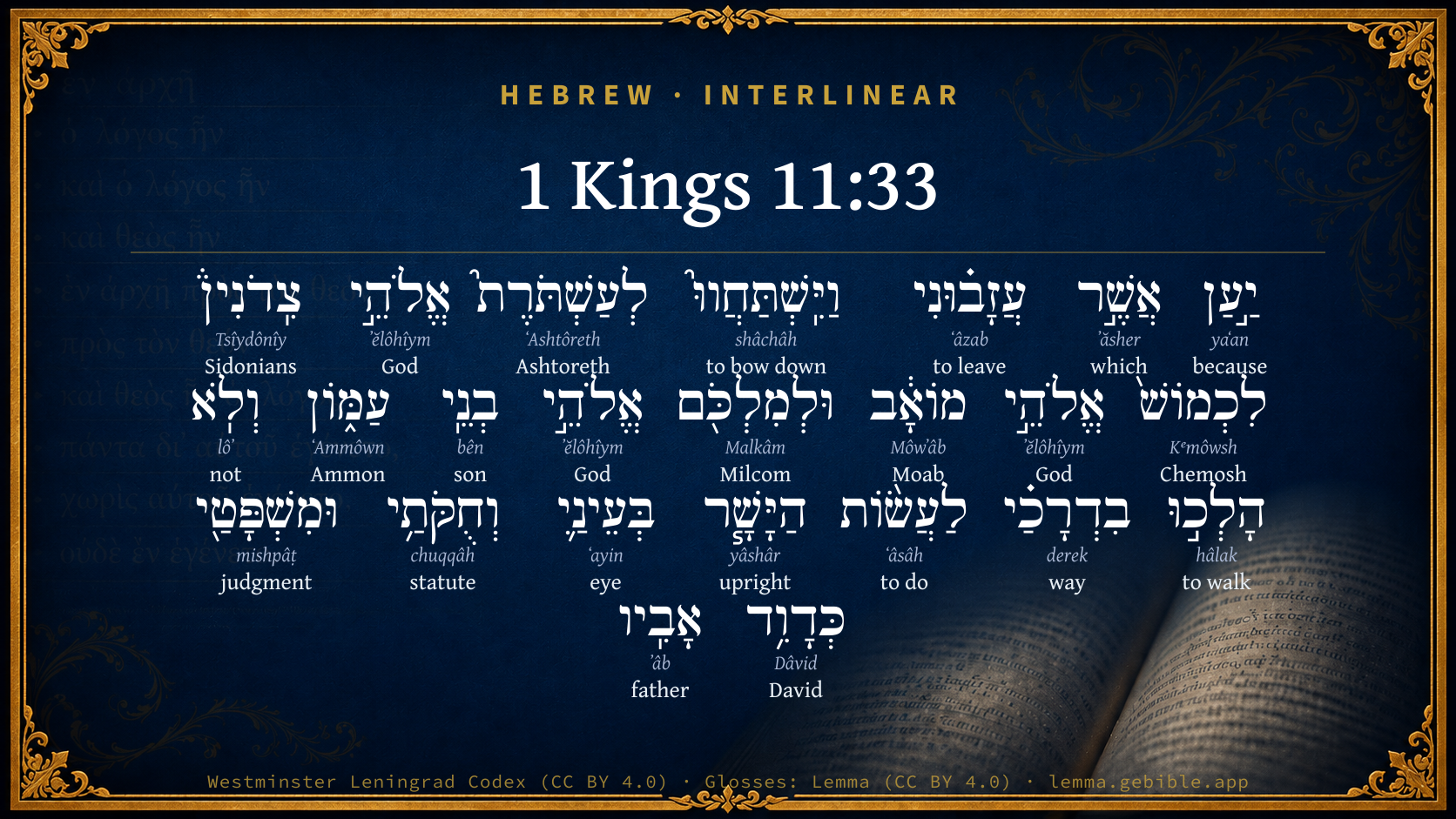
1 Kings 11:33

Hebrew (Westminster Leningrad Codex) 1 Kings 11:33 appears in the Hebrew Old Testament. The text above is from the Westminster Leningrad Codex. Each word links to its Strong’s number, a concise gloss, and parsing drawn from the Open Scriptures Hebrew Bible morphology. Click any word for its full Brown-Driver-Briggs (BDB) entry.
Download image
Cite this verse

1 Kings 11:33 (World English Bible). Public Domain. Lemma interlinear Bible study tool, https://lemma.gebible.app/v/1-kings/11/33.

Show BibTeX & RIS
BibTeX
RIS
English Translation
because that they have forsaken me, and have worshiped Ashtoreth the goddess of the Sidonians, Chemosh the god of Moab, and Milcom the god of the children of Ammon; and they have not walked in my ways, to do that which is right in my eyes, and [to keep] my statutes and my ordinances, as did David his father.
World English Bible · Public Domain
Download a study sheet

One document with this verse’s original text, its word-by-word gloss line, the meaning frame, cross-references with their text, attributed commentary, and full source and license credits — printable, and it pastes into notes with its structure intact.

This verse Autodidact and up

Study sheet (.html) Plain text (.txt)

A passage Seminary Student

Up to 50 verses in one chapter. A passage sheet keeps up to 6 commentary sources and 12 cross-references per verse, in the order this page ranks them, and says so on the sheet whenever that leaves anything out. Ask for a single verse and you get the Autodidact verse sheet above.

Everything on this page stays free to read, with no account — the sheet is a download of what is already on screen, not access to it.

Want to remove ads? Support Godless Engineer
Compare translations 3

The same verse in 3 English versions, stacked beneath the original-language interlinear above. Click any original word for its lexicon entry.

Each is an independent rendering of the whole verse — the interlinear is not word-aligned to these translations.

Highlighted words mark where these versions differ — a whole-verse word diff, not a word-by-word alignment.

  • World English Bible Public Domain
    because that they have forsaken me, and have worshiped Ashtoreth the goddess of the Sidonians, Chemosh the god of Moab, and Milcom the god of the children of Ammon; and they have not walked in my ways, to do that which is right in my eyes, and [to keep] my statutes and my ordinances, as did David his father.
  • King James Version Public Domain
    Because that they have forsaken me, and have worshipped Ashtoreth the goddess of the Zidonians, Chemosh the god of the Moabites, and Milcom the god of the children of Ammon, and have not walked in my ways, to do that which is right in mine eyes, and to keep my statutes and my judgments, as did David his father.
  • unfoldingWord Literal Text CC BY-SA 4.0
    For they have forsaken me, and they have bowed down to Ashtoreth, the goddess of the Sidonians, to Chemosh, the god of Moab, and to Milcom, the god of the sons of Ammon. And they do not walk in my ways, to do right in my eyes, or my statutes or my judgments, like David his father.

unfoldingWord Literal Text — © unfoldingWord, licensed CC BY-SA 4.0. Word-aligned USFM3 via Door43 (git.door43.org/unfoldingWord/en_ult).

Versions to compare (up to 4)

3 of 4 selected

Show all 18 translations

Every available English version of this verse, each an independent rendering of the whole verse.

  • World English Bible Public Domain
    because that they have forsaken me, and have worshiped Ashtoreth the goddess of the Sidonians, Chemosh the god of Moab, and Milcom the god of the children of Ammon; and they have not walked in my ways, to do that which is right in my eyes, and [to keep] my statutes and my ordinances, as did David his father.
  • Berean Standard Bible Public Domain
    For they have forsaken Me to worship Ashtoreth the goddess of the Sidonians, Chemosh the god of the Moabites, and Milcom the god of the Ammonites. They have not walked in My ways, nor done what is right in My eyes, nor kept My statutes and judgments, as Solomon’s father David did.
  • Majority Standard Bible Public Domain
    For they have forsaken Me to worship Ashtoreth the goddess of the Sidonians, Chemosh the god of the Moabites, and Milcom the god of the Ammonites. They have not walked in My ways, nor done what is right in My eyes, nor kept My statutes and judgments, as Solomon’s father David did.
  • King James Version Public Domain
    Because that they have forsaken me, and have worshipped Ashtoreth the goddess of the Zidonians, Chemosh the god of the Moabites, and Milcom the god of the children of Ammon, and have not walked in my ways, to do that which is right in mine eyes, and to keep my statutes and my judgments, as did David his father.
  • American Standard Version (1901) Public Domain
    because that they have forsaken me, and have worshipped Ashtoreth the goddess of the Sidonians, Chemosh the god of Moab, and Milcom the god of the children of Ammon; and they have not walked in my ways, to do that which is right in mine eyes, and `to keep' my statutes and mine ordinances, as did David his father.
  • Revised Version (1885) Public Domain
    because that they have forsaken me, and have worshipped Ashtoreth the goddess of the Zidonians, Chemosh the god of Moab, and Milcom the god of the children of Ammon; and they have not walked in my ways, to do that which is right in mine eyes, and to keep my statutes and my judgments, as did David his father.
  • Geneva Bible (1599) Public Domain
    Because they haue forsaken me, and haue worshipped Ashtaroth the god of the Zidonians, and Chemosh the god of the Moabites, and Milcom the god of the Ammonites, and haue not walked in my wayes (to do right in mine eyes, and my statutes, and my lawes) as did Dauid his father.
  • Douay-Rheims (1899) Public Domain
    Because he hath forsaken me, and hath adored Astarthe the goddess of the Sidonians, and Chamos the god of Moab, and Moloch the god of the children of Ammon: and hath not walked in my ways, to do justice before me, and to keep my precepts, and judgments as did David his father.
  • Young's Literal Translation Public Domain
    `Because they have forsaken Me, and bow themselves to Ashtoreth, god`dess' of the Zidonians, to Chemosh god of Moab, and to Milcom god of the sons of Ammon, and have not walked in My ways, to do that which `is' right in Mine eyes, and My statutes and My judgments, like David his father.
  • Literal Standard Version CC BY-SA 4.0
    because they have forsaken Me, and bow themselves to Ashtoreth, goddess of the Zidonians, to Chemosh god of Moab, and to Milcom god of the sons of Ammon, and have not walked in My ways, to do that which [is] right in My eyes, and My statutes and My judgments, like his father David.
  • Unlocked Literal Bible CC BY-SA 4.0
    because they have forsaken me and have worshiped Ashtoreth the goddess of the Sidonians, Chemosh the god of Moab, and Molech the god of the people of Ammon. They have not walked in my ways, to do what is right in my eyes, and to keep my statutes and my decrees, as did David his father.
  • unfoldingWord Literal Text CC BY-SA 4.0
    For they have forsaken me, and they have bowed down to Ashtoreth, the goddess of the Sidonians, to Chemosh, the god of Moab, and to Milcom, the god of the sons of Ammon. And they do not walk in my ways, to do right in my eyes, or my statutes or my judgments, like David his father.
  • Darby Bible Public Domain
    because they have forsaken me, and have worshipped Ashtoreth the goddess of the Zidonians, Chemosh the god of the Moabites, and Milcom the god of the children of Ammon, and have not walked in my ways, to do that which is right in my sight, and my statutes and mine ordinances, as David his father.
  • World Messianic Bible Public Domain
    because they have forsaken me, and have worshiped Ashtoreth the goddess of the Sidonians, Chemosh the god of Moab, and Milcom the god of the children of Ammon. They have not walked in my ways, to do that which is right in my eyes, and to keep my statutes and my ordinances, as David his father did.
  • Webster's Bible Public Domain
    Because they have forsaken me, and have worshiped Ashtoreth the goddess of the Zidonians, Chemosh the god of the Moabites, and Milcom the god of the children of Ammon, and have not walked in my ways, to do that which is right in my eyes, and to keep my statutes and my judgments, as did David his father.
  • Free Bible Version CC BY-SA 4.0
    This is because they have abandoned me and bowed down in worship of Ashtoreth, goddess of the Sidonians, Chemosh, god of the Moabites, and Molech, god of the Ammonites. They have not followed my ways; they have not done what is right in my sight; they have not kept my commandments and laws as David, Solomon's father, did.
  • Bible in Basic English Public Domain
    Because they are turned away from me to the worship of Ashtoreth, the goddess of the Zidonians, and Chemosh, the god of Moab, and Milcom, the god of the Ammonites; they have not been walking in my ways or doing what is right in my eyes or keeping my laws and my decisions as his father David did.
  • JPS Tanakh (1917) Public Domain
    because that they have forsaken Me, and have worshipped Ashtoreth the goddess of the Zidonians, Chemosh the god of Moab, and Milcom the god of the children of Ammon; and they have not walked in My ways, to do that which is right in Mine eyes, and to keep My statutes and Mine ordinances, as did David his father.

Literal Standard Version (2020), Covenant Press — licensed CC BY-SA 4.0. Text via the HelloAO Bible API (eBible.org). Unlocked Literal Bible (unfoldingWord) — licensed CC BY-SA 4.0. Text via the HelloAO Bible API (eBible.org). unfoldingWord Literal Text — © unfoldingWord, licensed CC BY-SA 4.0. Word-aligned USFM3 via Door43 (git.door43.org/unfoldingWord/en_ult). Free Bible Version, Dr. Jonathan Gallagher — licensed CC BY-SA 4.0. Text via the HelloAO Bible API (eBible.org).

Word by word

More ways to search: Search by grammar → Find every occurrence → Compare this word →

Practice this passage: Drill this verse → Learn its vocabulary →

לְעַשְׁתֹּרֶת֮
ʻAshtôreth
H6253
“to/for · Ashtoreth”
Preposition + Noun, Proper
Part of Speech
Preposition + Noun
Type
Proper
Full BDB Definition

Origin: probably for H6251

TWOT: 1718

Ashtoreth = "star" - the principal female deity of the Phoenicians worshipped in war and fertility - also 'Ishtar' of Assyria and 'Astarte' by the Greeks and Romans
  1. יַ֣עַן yaʻan H3282 “because” Conjunction
  2. אֲשֶׁ֣ר ʼăsher H834 “which” Particle, Relative
  3. עֲזָב֗וּנִי ʻâzab H5800 “to leave · me” Verb, Qal, Perfect, 3rd Person, Common, Plural + Suffix, Personal, 1st Person, Common, Singular
  4. וַיִּֽשְׁתַּחֲווּ֮ shâchâh H7812 “and · to bow down” Conjunction + Verb, Hithpael, Sequential Imperfect, 3rd Person, Masculine, Plural
  5. אֱלֹהֵ֣י ʼĕlôhîym H430 “God(s) of” Noun, Common, Masculine, Plural, Construct
  6. צִֽדֹנִין֒ Tsîydônîy H6722 “Sidonians” Noun, Gentilic, Masculine, Singular, Absolute
  7. לִכְמוֹשׁ֙ Kᵉmôwsh H3645 “to/for · Chemosh” Preposition + Noun, Proper
  8. אֱלֹהֵ֣י ʼĕlôhîym H430 “God(s) of” Noun, Common, Masculine, Plural, Construct
  9. מוֹאָ֔ב Môwʼâb H4124 “Moab” Noun, Proper
  10. וּלְמִלְכֹּ֖ם Malkâm H4445 “and · to/for · Milcom” Conjunction + Preposition + Noun, Proper
  11. אֱלֹהֵ֣י ʼĕlôhîym H430 “God(s) of” Noun, Common, Masculine, Plural, Construct
  12. בְנֵֽי bên H1121 “sons of” Noun, Common, Masculine, Plural, Construct
  13. עַמּ֑וֹן ʻAmmôwn H5983 “Ammon” Noun, Proper
  14. וְלֹֽא lôʼ H3808 “and · not” Conjunction + Particle, Negative
  15. הָלְכ֣וּ hâlak H1980 “to walk” Verb, Qal, Perfect, 3rd Person, Common, Plural
  16. בִדְרָכַ֗י derek H1870 “in/at · ways · my” Preposition + Noun, Common, Both, Plural, Construct + Suffix, Personal, 1st Person, Common, Singular
  17. לַעֲשׂ֨וֹת ʻâsâh H6213 “to do” Preposition + Verb, Qal, Infinitive Construct
  18. הַיָּשָׁ֧ר yâshâr H3477 “the · upright” Particle, Definite Article + Adjective, Adjective, Masculine, Singular, Absolute
  19. בְּעֵינַ֛י ʻayin H5869 “in/at · eyes · my” Preposition + Noun, Common, Both, Dual, Construct + Suffix, Personal, 1st Person, Common, Singular
  20. וְחֻקֹּתַ֥י chuqqâh H2708 “and · statutes · my” Conjunction + Noun, Common, Both, Plural, Construct + Suffix, Personal, 1st Person, Common, Singular
  21. וּמִשְׁפָּטַ֖י mishpâṭ H4941 “and · judgments · my” Conjunction + Noun, Common, Masculine, Plural, Construct + Suffix, Personal, 1st Person, Common, Singular
  22. כְּדָוִ֥ד Dâvid H1732 “like/as · David” Preposition + Noun, Proper
  23. אָבִֽיו ʼâb H1 “father · his” Noun, Common, Masculine, Singular, Construct + Suffix, Personal, 3rd Person, Masculine, Singular

About this verse

These counts appear in no published source. They are computed here, from the morphology-tagged text and Lemma’s own curated glosses. What Lemma adds →

24
words
22
distinct lemmas
Historical
section

Notable vocabulary

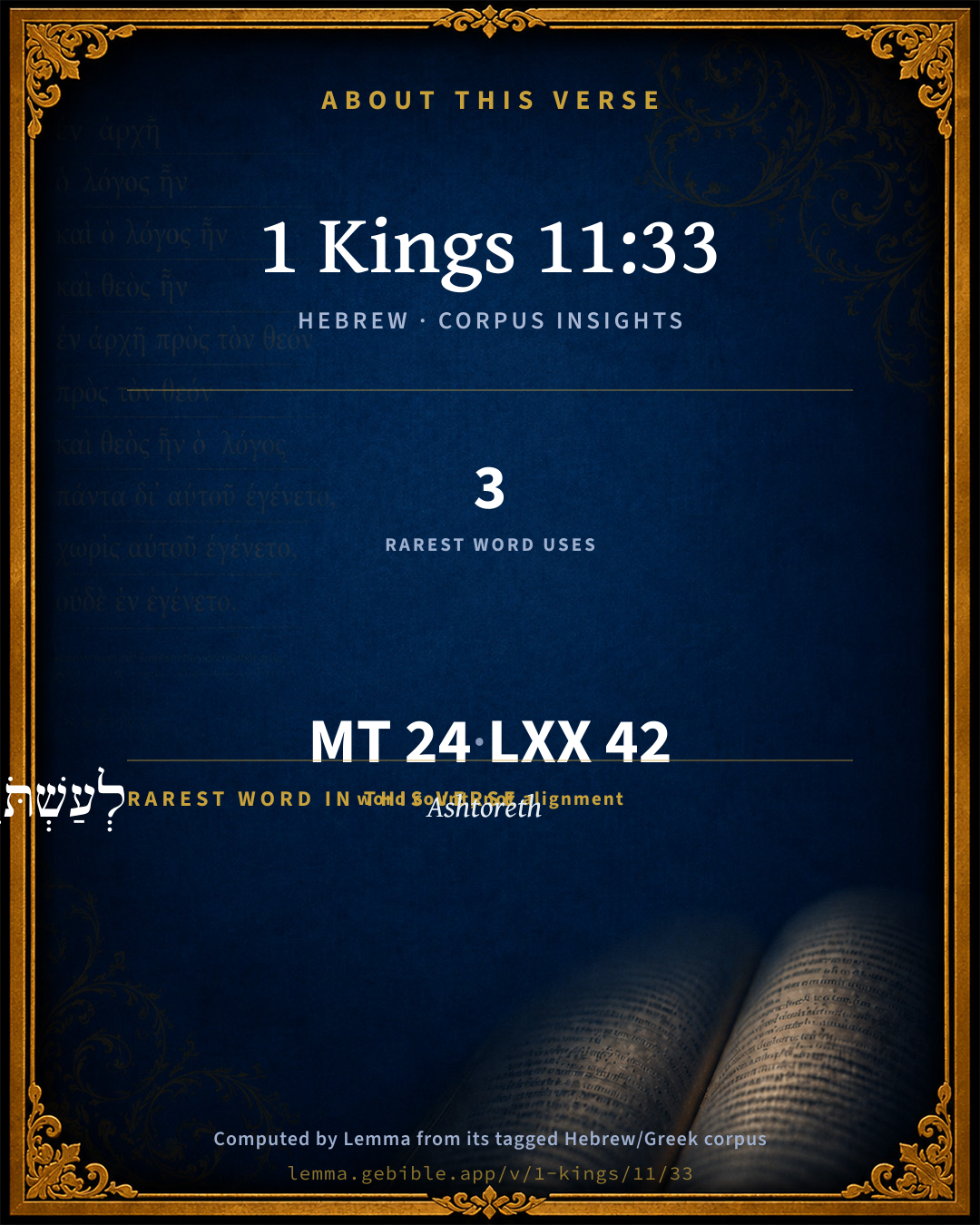
The rarest word here is לְעַשְׁתֹּרֶת֮ Ashtoreth H6253 — appearing just 3 times in the whole Hebrew Bible.

Shared distinctive vocabulary

לְעַשְׁתֹּרֶת֮ Ashtoreth H6253 occurs in 3 verses of the Hebrew Bible. Also found in:

Grammatical profile

  • 4 verbs
  • 16 nouns
  • 1 adjective
  • 1 conjunction
  • 2 particles

Verb forms

  • עֲזָב֗וּנִי Qal · Perfect
  • וַיִּֽשְׁתַּחֲווּ֮ Hithpael · Sequential Imperfect
  • הָלְכ֣וּ Qal · Perfect
  • לַעֲשׂ֨וֹת Qal · Infinitive Construct

Repetition

A word recurs within this verse — often emphatic in Hebrew:

  • אֱלֹהֵ֣י God H430 ×3

Hebrew & Septuagint length

In English translation the verse runs 59 words from the Hebrew and 53 from the Septuagint (LXX English) — closely comparable.

A rough comparison of the two English renderings, which tokenize alike — not a word-level alignment.

Word counts can differ between the Hebrew and the Greek without any difference in meaning — e.g. the Hebrew direct-object marker אֵת has no separate Greek word, and Greek often adds the article ὁ.

In the original languages it is 24 Hebrew tokens and 42 Greek tokens — but the two are counted differently (Hebrew bundles its prefixes and suffixes into one token; the Greek is in lemma form), so that isn’t a like-for-like length.

Cross-references

9

Topical passages linked to 1 Kings 11:33 in the Treasury of Scripture Knowledge — connected by theme and wording, ordered by reader-vote popularity; previews shown in the World English Bible.

  • 1 Kings 11:5–7 For Solomon went after Ashtoreth the goddess of the Sidonians, and after Milcom the abomination of the Ammonites.
  • 1 Kings 11:9 Yahweh was angry with Solomon, because his heart was turned away from Yahweh, the God of Israel, who had appeared to him twice,
  • 1 Kings 3:14 If you will walk in my ways, to keep my statutes and my commandments, as your father David did walk, then I will lengthen your days.
  • 1 Kings 6:12–13 Concerning this house which you are building, if you will walk in my statutes, and execute my ordinances, and keep all my commandments to walk in them; then will I establish my word with you, which I spoke to David your father.
  • 1 Kings 9:5–7 then I will establish the throne of your kingdom over Israel forever, according as I promised to David your father, saying, There shall not fail you a man on the throne of Israel.
  • 1 Chronicles 28:9 You, Solomon my son, know the God of your father, and serve him with a perfect heart and with a willing mind; for Yahweh searches all hearts, and understands all the imaginations of the thoughts: if you seek him, he will be found of you; but if you forsake him, he will cast you off forever.
  • 2 Chronicles 15:2 and he went out to meet Asa, and said to him, Hear you me, Asa, and all Judah and Benjamin: Yahweh is with you, while you are with him; and if you seek him, he will be found of you; but if you forsake him, he will forsake you.
  • Jeremiah 2:13 For my people have committed two evils: they have forsaken me, the spring of living waters, and hewed them out cisterns, broken cisterns, that can hold no water.
  • Hosea 4:17 Ephraim is joined to idols. Leave him alone!

Cross-references courtesy of OpenBible.info (CC BY 4.0).

Hebrew and Greek witnesses Masoretic Hebrew ↔ Greek Septuagint

The same verse in the two great witnesses to the Old Testament, shown verse-for-verse.

These are two independent witnesses, not word-aligned to each other, and the Septuagint is shown in lemma (dictionary) form.

Hebrew 1 Kings 11:33 Masoretic · Westminster Leningrad Codex

יַ֣עַן אֲשֶׁ֣ר עֲזָב֗וּנִי וַיִּֽשְׁתַּחֲווּ֮ לְעַשְׁתֹּרֶת֮ אֱלֹהֵ֣י צִֽדֹנִין֒ לִכְמוֹשׁ֙ אֱלֹהֵ֣י מוֹאָ֔ב וּלְמִלְכֹּ֖ם אֱלֹהֵ֣י בְנֵֽי עַמּ֑וֹן וְלֹֽא הָלְכ֣וּ בִדְרָכַ֗י לַעֲשׂ֨וֹת הַיָּשָׁ֧ר בְּעֵינַ֛י וְחֻקֹּתַ֥י וּמִשְׁפָּטַ֖י כְּדָוִ֥ד אָבִֽיו

because that they have forsaken me, and have worshiped Ashtoreth the goddess of the Sidonians, Chemosh the god of Moab, and Milcom the god of the children of Ammon; and they have not walked in my ways, to do that which is right in my eyes, and [to keep] my statutes and my ordinances, as did David his father.

World English Bible · Public Domain

Greek LXX 1 Kings 11:33 Septuagint · lemma form

ἀντί ὅς καταλείπω ἐγώ καί ποιέω ὁ ἀστάρτη βδέλυγμα σιδώνιος καί ὁ χαμως καί ὁ εἴδωλον μωαβ καί ὁ βασιλεύς αὐτός προσόχθισμα υἱός αμμων καί οὐ πορεύομαι ἐν ὁ ὁδός ἐγώ ὁ ποιέω ὁ εὐθής ἐνώπιον ἐγώ ὡς δαυίδ ὁ πατήρ αὐτός

Because he forsook me, and sacrificed to Astarte the abomination of the Sidonians, and to Chamos, and to the idols of Moab, and to their king the abomination of the children of Ammon, and he walked not in my ways, to do that which was right before me, as David his father did.

LXX2012 (modern English Septuagint) · Public Domain

On this verse, The Cambridge Bible for Schools and Colleges discusses the Septuagint’s reading. Read the note in Commentary ↓

Hebrew: Westminster Leningrad Codex (CC BY 4.0). Greek: Septuagint (public domain); English from LXX2012 (modern English Septuagint) (Public Domain). How the Septuagint differs from the Hebrew →

Targum (Aramaic paraphrase)

1

The Targum is the ancient Jewish Aramaic paraphrase of the Hebrew Scriptures — an interpretive translation, not the Hebrew text itself. Onkelos (literal) and Pseudo-Jonathan (expansive) render the Torah, and Jonathan the Prophets. Coverage is partial: where no permissively-licensed English translation exists for a verse, only the Aramaic is shown. This is verse-level text, not a word-by-word alignment to the Hebrew.

  1. Targum Jonathan Prophets (Joshua–Malachi)
    חֲלַף דִשְׁבַקוּ פוּלְחָנִי וּסְגִידוּ לְעַשְׁתּוֹרֶת טַעֲוַת צִדוֹנָאֵי וְלִכְמוֹשׁ טַעֲוַת מוֹאֲבָאֵי וּלְמִלְכּוֹם טַעֲוַת בְנֵי עַמוֹן וְלָא הֲלִיכוּ בְּאוֹרְחָן דְתַקְנָן קֳדָמַי לְמֶעְבַּד דְכָשַׁר קֳדָמַי וּקְיָמַי וְדִינַי כְּדָוִד אֲבוּהִי:

    (no public-domain English translation for this verse)

    Targum Jonathan — Aramaic: “Mikraot Gedolot” (public domain). English: “Sefaria Community Translation” (CC0 1.0 (public-domain dedication)); “London "Chaldee Paraphrase," 1871” (public domain). Text via Sefaria.

Commentary

Notes on 1 Kings 11:33 from classic Christian and Jewish commentators (each source and its license shown beneath its notes). The classic Christian expositions comment on the surrounding passage and are grouped to its opening verse, so a note may address several verses; the Jewish commentaries on the Tanakh (Rashi and others) are per-verse, so they appear only where the commentator wrote on this verse.

Lemma curates 59 commentaries, every one of them public domain or Creative Commons licensed, each selected and text-cleaned for this edition rather than reprinted as found. About our sources →

Trapp's Complete Commentary

John Trapp

1Ki 11:33 Because that they have forsaken me, and have worshipped Ashtoreth the goddess of the Zidonians, Chemosh the god of the Moabites, and Milcom the god of the children of Ammon, and have not walked in my ways, to do [that which is] right in mine eyes, and [to keep] my statutes and my judgments, as [did] David his father.

Ver. 33. Because that they have forsaken me.] Not Solomon only, but the people also by his example; for Magnates sunt magnetes; and in people, as in a beast, the body followeth the head.

John Trapp, A Commentary or Exposition upon All the Books of the Old and New Testament (1647–1656) — public domain. Text from a community e-Sword module.

Geneva Bible (1599)

Geneva Bible translators

Or, to do that, that pleaseth me.

Geneva Bible (1599) marginal notes — public domain. Text via Bolls.life.

The Cambridge Bible for Schools and Colleges

gen. ed. J. J. S. Perowne

33. they have forsaken] The examples of men in high place are infectious. Solomon’s idolatry had led away others, and involved the nation in the sin of the king. The LXX. and other versions however have the verb in the singular.

and to keep my statutes] The verb which in the previous clause is rendered ‘to do’, can in Hebrew be joined with all the nouns that follow (cf. Deu_6:24; Deu_16:12; Deu_17:19; 1Ch_22:13). The English however requires a different verb with ‘statutes.’ Hence ‘to keep’ is inserted in italics, though the Hebrew construction is quite complete.

The Cambridge Bible for Schools and Colleges (gen. ed. J. J. S. Perowne; Cambridge University Press, 1878–1918) — public domain. Text from a community e-Sword module.

John Gill's Exposition

But I will take the kingdom out of his son's hand,.... All but the tribes of Judah and Benjamin:

and will give it unto thee, even ten tribes: signified by ten pieces of the rent garment he had given him, Kg1 11:31.

John Gill's Exposition of the Whole Bible (1746–1763) — public domain (CC PDM 1.0). Text via the HelloAO Bible API.

Matthew Poole's English Annotations

They have forsaken me, i.e. the king, and his concubines, and people, who easily followed his example, but were not at all excused by it.

Matthew Poole's English Annotations on the Holy Bible (1683–1685) — public domain. Text from a community e-Sword/MySword module.

The Pulpit Commentary

Because that they The LXX has the singular throughout, and so have all the translations, except the Chaldee. But the plural is to be retained, the import being that Solomon was not alone in his idolatrous leanings; or it may turn our thoughts to the actual idolaters his wives whose guilt he shared. The singular looks as if an alteration had been made to bring the words into harmony with the context, and especially with the concluding words of this verse, "David his father." have forsaken me, and have worshipped Ashtoreth the goddess of the Zidonians yndx a Chaldee form. But many MSS. read , Chemosh the god of the Moabites, and Milcom the LXX has "their king the abomination," etc., kai tw basilei aujtwn. See note on ver. 5, the god of the children of Ammon, and have not walked in my ways, to do that which is right in mine eyes, and to keep my statutes and my Judgments, as did David his father.

The Pulpit Commentary (1880–1919), ed. H.D.M. Spence-Jones & Joseph S. Exell — public domain. Text from a community e-Sword module.

Lesson kit

Teaching starters — assembled from the data on this page, not authored interpretation. Every prompt links to the verse data it draws on. Edit before teaching.

1 Kings, in the Historical, opens this verse with 24 words (22 distinct Hebrew lemmas). Its most distinctive word is ʻAshtôreth (“Ashtoreth”). A historical commentator’s framing appears above. Read the whole chapter for the surrounding context.

Discussion questions

  1. What does “Ashtoreth” (ʻAshtôreth) contribute to the verse as a whole?
  2. How does 1 Kings 11:5, which shares the word «Ashtoreth», read alongside this verse?
  3. What does the repetition of “God” (3× in this one verse) do in this verse?
  4. These translations render this verse differently; the difference is in the English rendering, not the original. What questions does that raise?
  5. «עֲזָב֗וּנִי» is a Qal Perfect verb. How does that grammatical form shape the action described?
  6. Compare how Trapp's Complete Commentary and Geneva Bible (1599) read this verse. Where do they agree or differ?

Things to notice

Reading settings

Reading text

Shown beneath each verse's original-language words.

Old Testament
Old Testament edition

Read the OT as the Masoretic Hebrew (MT) or the Greek Septuagint (LXX).

English shown for the Greek Septuagint (in the Hebrew ↔ Greek comparison).

Comparing translations? Open the Compare panel on any verse page to stack up to four side by side.