
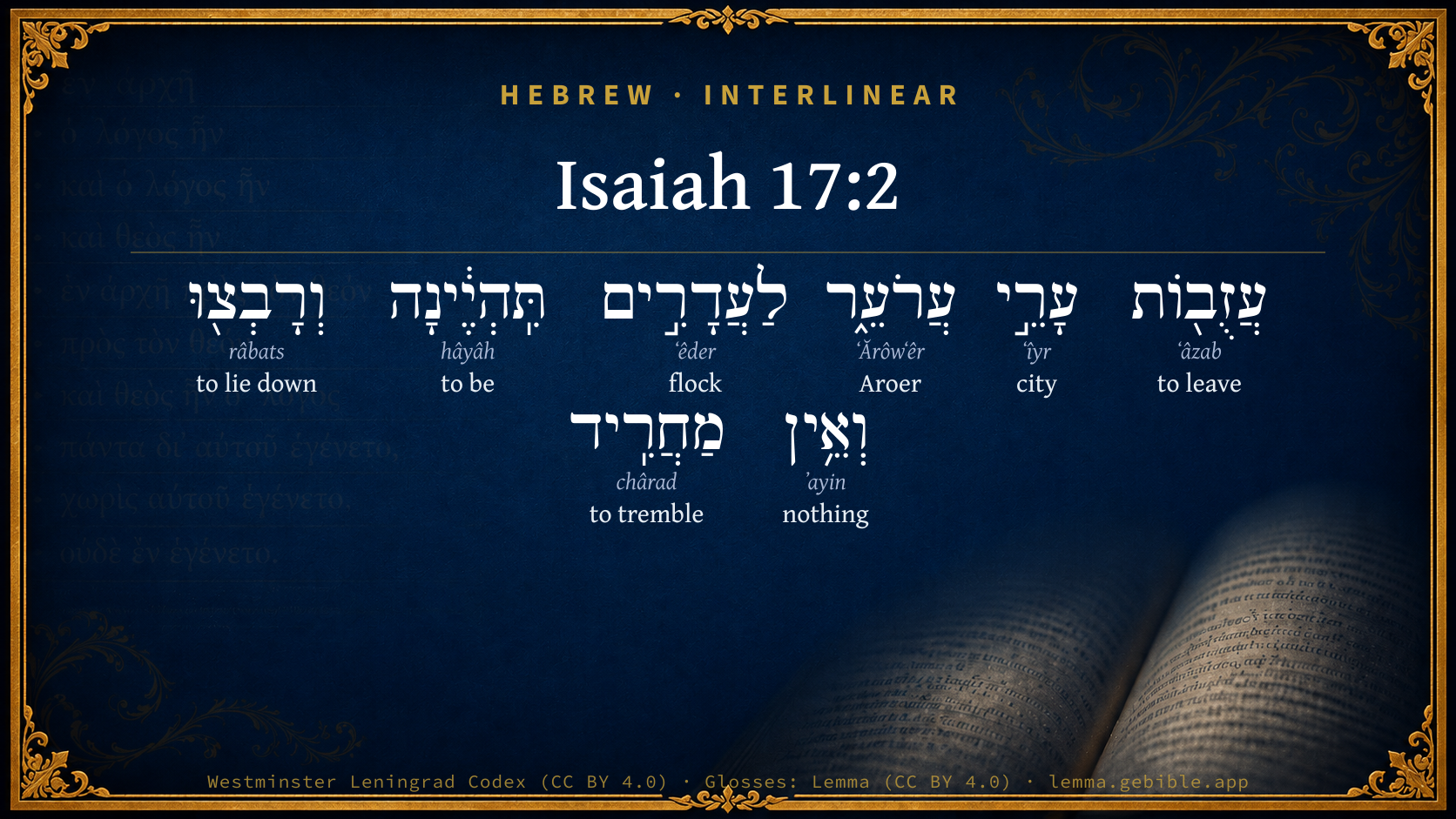
Isaiah 17:2

Hebrew (Westminster Leningrad Codex) Isaiah 17:2 appears in the Hebrew Old Testament. The text above is from the Westminster Leningrad Codex. Each word links to its Strong’s number, a concise gloss, and parsing drawn from the Open Scriptures Hebrew Bible morphology. Click any word for its full Brown-Driver-Briggs (BDB) entry.
Download image
Cite this verse

Isaiah 17:2 (World English Bible). Public Domain. Lemma interlinear Bible study tool, https://lemma.gebible.app/v/isaiah/17/2.

Show BibTeX & RIS
BibTeX
RIS
English Translation
The cities of Aroer are forsaken; they shall be for flocks, which shall lie down, and none shall make them afraid.
World English Bible · Public Domain
Download a study sheet

One document with this verse’s original text, its word-by-word gloss line, the meaning frame, cross-references with their text, attributed commentary, and full source and license credits — printable, and it pastes into notes with its structure intact.

This verse Autodidact and up

Study sheet (.html) Plain text (.txt)

A passage Seminary Student

Up to 50 verses in one chapter. A passage sheet keeps up to 6 commentary sources and 12 cross-references per verse, in the order this page ranks them, and says so on the sheet whenever that leaves anything out. Ask for a single verse and you get the Autodidact verse sheet above.

Everything on this page stays free to read, with no account — the sheet is a download of what is already on screen, not access to it.

Want to remove ads? Support Godless Engineer
Compare translations 3

The same verse in 3 English versions, stacked beneath the original-language interlinear above. Click any original word for its lexicon entry.

Each is an independent rendering of the whole verse — the interlinear is not word-aligned to these translations.

Highlighted words mark where these versions differ — a whole-verse word diff, not a word-by-word alignment.

  • World English Bible Public Domain
    The cities of Aroer are forsaken; they shall be for flocks, which shall lie down, and none shall make them afraid.
  • King James Version Public Domain
    The cities of Aroer are forsaken: they shall be for flocks, which shall lie down, and none shall make them afraid.
  • unfoldingWord Literal Text CC BY-SA 4.0
    The cities of Aroer will be abandoned; they will be for flocks, and they will lie down, and no one will make tremble.

unfoldingWord Literal Text — © unfoldingWord, licensed CC BY-SA 4.0. Word-aligned USFM3 via Door43 (git.door43.org/unfoldingWord/en_ult).

Versions to compare (up to 4)

3 of 4 selected

Show all 18 translations

Every available English version of this verse, each an independent rendering of the whole verse.

  • World English Bible Public Domain
    The cities of Aroer are forsaken; they shall be for flocks, which shall lie down, and none shall make them afraid.
  • Berean Standard Bible Public Domain
    The cities of Aroer are forsaken; they will be left to the flocks, which will lie down with no one to fear.
  • Majority Standard Bible Public Domain
    The cities of Aroer are forsaken; they will be left to the flocks, which will lie down with no one to fear.
  • King James Version Public Domain
    The cities of Aroer are forsaken: they shall be for flocks, which shall lie down, and none shall make them afraid.
  • American Standard Version (1901) Public Domain
    The cities of Aroer are forsaken; they shall be for flocks, which shall lie down, and none shall make them afraid.
  • Revised Version (1885) Public Domain
    The cities of Aroer are forsaken: they shall be for flocks, which shall lie down, and none shall make them afraid.
  • Geneva Bible (1599) Public Domain
    The cities of Aroer shall be forsaken: they shall be for the flockes: for they shall lye there, and none shall make them afraide.
  • Douay-Rheims (1899) Public Domain
    The cities of Aroer shall be left for flocks, and they shall rest there, and there shall be none to make them afraid.
  • Young's Literal Translation Public Domain
    Forsaken are the cities of Aroer, For droves they are, and they have lain down, And there is none troubling.
  • Literal Standard Version CC BY-SA 4.0
    The cities of Aroer are forsaken, || They are for droves, and they have lain down, || And there is none troubling.
  • Unlocked Literal Bible CC BY-SA 4.0
    The cities of Aroer will be abandoned. They will be places for flocks to lie down, and no one will frighten them.
  • unfoldingWord Literal Text CC BY-SA 4.0
    The cities of Aroer will be abandoned; they will be for flocks, and they will lie down, and no one will make tremble.
  • Darby Bible Public Domain
    The cities of Aroer are forsaken: they shall be for flocks; and they shall lie down and there shall be none to make them afraid.
  • World Messianic Bible Public Domain
    The cities of Aroer are forsaken. They will be for flocks, which shall lie down, and no one shall make them afraid.
  • Webster's Bible Public Domain
    The cities of Aroer are forsaken: they shall be for flocks, which shall lie down, and none shall make them afraid.
  • Free Bible Version CC BY-SA 4.0
    The towns of Aroer will be abandoned. Flocks will live in the streets and rest there, because there won't be anyone to chase them away.
  • Bible in Basic English Public Domain
    Her towns are unpeopled for ever; there the flocks take their rest in peace, without fear.
  • JPS Tanakh (1917) Public Domain
    The cities of Aroer are forsaken; they shall be for flocks, which shall lie down, and none shall make them afraid.

Literal Standard Version (2020), Covenant Press — licensed CC BY-SA 4.0. Text via the HelloAO Bible API (eBible.org). Unlocked Literal Bible (unfoldingWord) — licensed CC BY-SA 4.0. Text via the HelloAO Bible API (eBible.org). unfoldingWord Literal Text — © unfoldingWord, licensed CC BY-SA 4.0. Word-aligned USFM3 via Door43 (git.door43.org/unfoldingWord/en_ult). Free Bible Version, Dr. Jonathan Gallagher — licensed CC BY-SA 4.0. Text via the HelloAO Bible API (eBible.org).

Word by word

More ways to search: Search by grammar → Find every occurrence → Compare this word →

Practice this passage: Drill this verse → Learn its vocabulary →

About this verse

These counts appear in no published source. They are computed here, from the morphology-tagged text and Lemma’s own curated glosses. What Lemma adds →

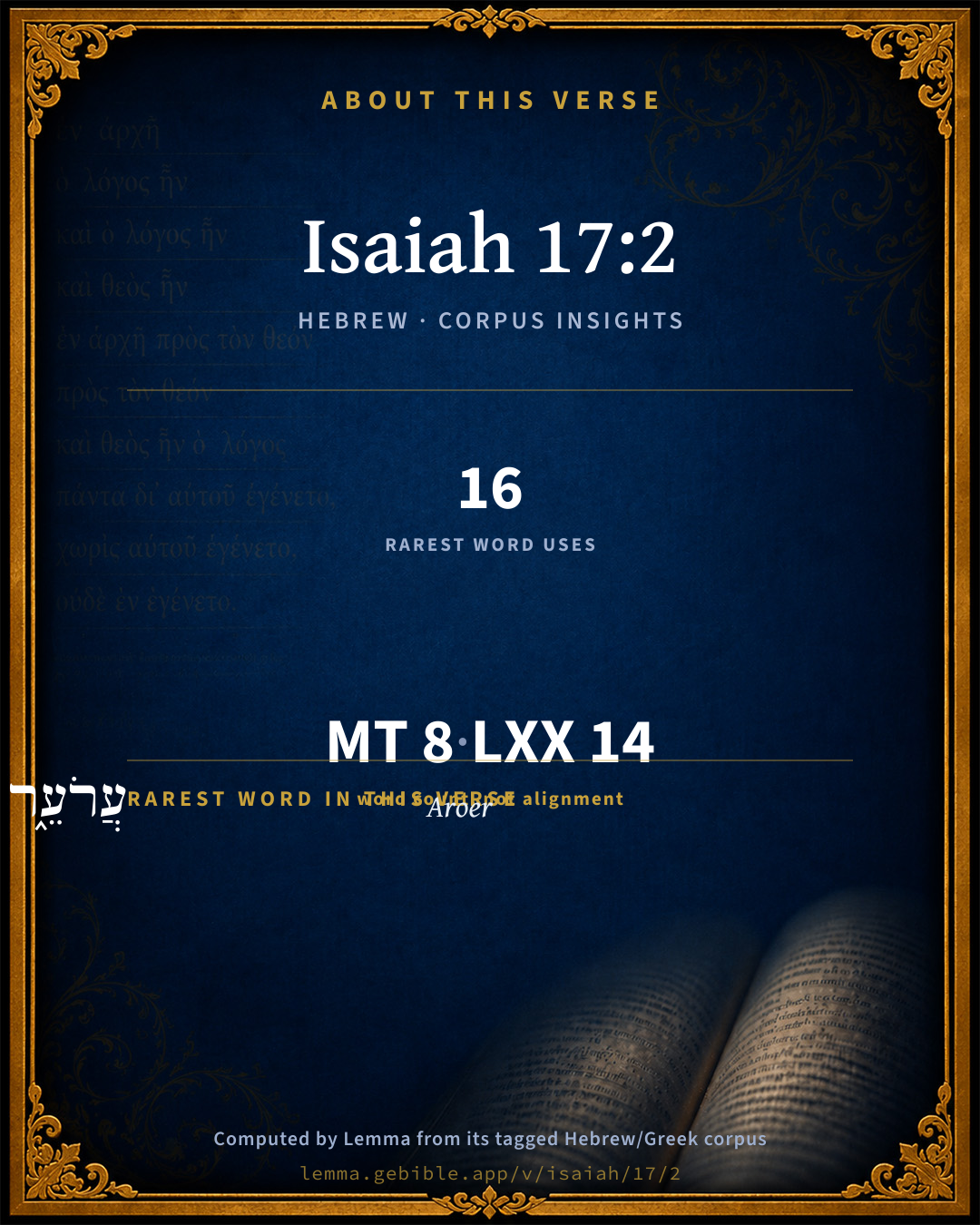
8
words
8
distinct lemmas
Prophets
section

Notable vocabulary

The rarest word here is עֲרֹעֵ֑ר Aroer H6177 — appearing just 16 times in the whole Hebrew Bible.

Shared distinctive vocabulary

עֲרֹעֵ֑ר Aroer H6177 occurs in 16 verses of the Hebrew Bible. Also found in:

Grammatical profile

  • 4 verbs
  • 3 nouns
  • 1 particle

Verb forms

  • עֲזֻב֖וֹת Qal · Participle Passive
  • תִּֽהְיֶ֔ינָה Qal · Imperfect
  • וְרָבְצ֖וּ Qal · Sequential Perfect
  • מַחֲרִֽיד Hiphil · Participle Active

Hebrew & Septuagint length

In English translation the verse runs 21 words from the Hebrew and 20 from the Septuagint (LXX English) — closely comparable.

A rough comparison of the two English renderings, which tokenize alike — not a word-level alignment.

Word counts can differ between the Hebrew and the Greek without any difference in meaning — e.g. the Hebrew direct-object marker אֵת has no separate Greek word, and Greek often adds the article ὁ.

In the original languages it is 8 Hebrew tokens and 14 Greek tokens — but the two are counted differently (Hebrew bundles its prefixes and suffixes into one token; the Greek is in lemma form), so that isn’t a like-for-like length.

Cross-references

12

Topical passages linked to Isaiah 17:2 in the Treasury of Scripture Knowledge — connected by theme and wording, ordered by reader-vote popularity; previews shown in the World English Bible.

  • Jeremiah 7:33 The dead bodies of this people shall be food for the birds of the sky, and for the animals of the earth; and none shall frighten them away.
  • Ezekiel 25:5 I will make Rabbah a stable for camels, and the children of Ammon a couching-place for flocks: and you shall know that I am Yahweh.
  • Numbers 32:34 The children of Gad built Dibon, and Ataroth, and Aroer,
  • Deuteronomy 2:36 From Aroer, which is on the edge of the valley of the Arnon, and [from] the city that is in the valley, even to Gilead, there was not a city too high for us; Yahweh our God delivered up all before us:
  • Micah 4:4 But they will sit every man under his vine and under his fig tree; And no one will make them afraid: For the mouth of Yahweh of Hosts has spoken.
  • Zephaniah 2:6 The sea coast will be pastures, with cottages for shepherds and folds for flocks.
  • Deuteronomy 3:12 This land we took in possession at that time: from Aroer, which is by the valley of the Arnon, and half the hill-country of Gilead, and the cities of it, gave I to the Reubenites and to the Gadites:
  • Jeremiah 48:19 Inhabitant of Aroer, stand by the way, and watch: ask him who flees, and her who escapes; say, What has been done?
  • Joshua 13:16 Their border was from Aroer, that is on the edge of the valley of the Arnon, and the city that is in the middle of the valley, and all the plain by Medeba;
  • Isaiah 5:17 Then the lambs will graze as in their pasture, And strangers will eat the ruins of the rich.
  • Isaiah 7:21 It shall happen in that day that a man shall keep alive a young cow, and two sheep;
  • Isaiah 7:23–25 It will happen in that day that every place where there were a thousand vines at a thousand silver shekels, shall be for briers and thorns.

Cross-references courtesy of OpenBible.info (CC BY 4.0).

Hebrew and Greek witnesses Masoretic Hebrew ↔ Greek Septuagint

The same verse in the two great witnesses to the Old Testament, shown verse-for-verse.

These are two independent witnesses, not word-aligned to each other, and the Septuagint is shown in lemma (dictionary) form.

Hebrew Isaiah 17:2 Masoretic · Westminster Leningrad Codex

עֲזֻב֖וֹת עָרֵ֣י עֲרֹעֵ֑ר לַעֲדָרִ֣ים תִּֽהְיֶ֔ינָה וְרָבְצ֖וּ וְאֵ֥ין מַחֲרִֽיד

The cities of Aroer are forsaken; they shall be for flocks, which shall lie down, and none shall make them afraid.

World English Bible · Public Domain

Greek LXX Isaiah 17:2 Septuagint · lemma form

καταλείπω εἰς ὁ αἰών εἰς κοίτη ποίμνιον καί ἀνάπαυσις καί οὐ εἰμί ὁ διώκω

abandoned for ever, to be a fold and resting-place for flocks, and there shall be none to go after them.

LXX2012 (modern English Septuagint) · Public Domain

On this verse, Joseph Benson's Commentary discusses the Septuagint’s reading. Read the note in Commentary ↓

Hebrew: Westminster Leningrad Codex (CC BY 4.0). Greek: Septuagint (public domain); English from LXX2012 (modern English Septuagint) (Public Domain). How the Septuagint differs from the Hebrew →

Targum (Aramaic paraphrase)

1

The Targum is the ancient Jewish Aramaic paraphrase of the Hebrew Scriptures — an interpretive translation, not the Hebrew text itself. Onkelos (literal) and Pseudo-Jonathan (expansive) render the Torah, and Jonathan the Prophets. Coverage is partial: where no permissively-licensed English translation exists for a verse, only the Aramaic is shown. This is verse-level text, not a word-by-word alignment to the Hebrew.

  1. Targum Jonathan Prophets (Joshua–Malachi)
    שְׁבִיקַן קִרְוֵיהוֹן חֲרָבוּ לְבֵית מִשְׁרֵי עֶדְרִין דְעָן יְהוֹן וְיִשְׁרוֹן וְלֵית דְמָנִיד:

    Their cities are deserted, they are laid waste; they shall be for dwelling-places for flocks of sheep; they shall lie down, and none shall make them to move away.

    Targum Jonathan — Aramaic: “Mikraot Gedolot” (public domain). English: “Sefaria Community Translation” (CC0 1.0 (public-domain dedication)); “London "Chaldee Paraphrase," 1871” (public domain). Text via Sefaria.

Commentary

Notes on Isaiah 17:2 from classic Christian and Jewish commentators (each source and its license shown beneath its notes). The classic Christian expositions comment on the surrounding passage and are grouped to its opening verse, so a note may address several verses; the Jewish commentaries on the Tanakh (Rashi and others) are per-verse, so they appear only where the commentator wrote on this verse.

Lemma curates 59 commentaries, every one of them public domain or Creative Commons licensed, each selected and text-cleaned for this edition rather than reprinted as found. About our sources →

Trapp's Complete Commentary

John Trapp

Isa 17:2 The cities of Aroer [are] forsaken: they shall be for flocks, which shall lie down, and none shall make [them] afraid.

Ver. 2. The cities of Aroer are forsaken,] i.e., The country beyond Jordan {Deu 2:36} is desolated and depopulated - the Gadites and the Reubenites being also, together with the Syrians, carried captive by Tiglathpileser. {1Ch 5:26}

John Trapp, A Commentary or Exposition upon All the Books of the Old and New Testament (1647–1656) — public domain. Text from a community e-Sword module.

Joseph Benson's Commentary

Isa 17:2. The cities of Aroer are forsaken — “What has Aroer,” says Bishop Lowth, “on the river Arnon, (see Deu 2:36,) to do with Damascus?” He therefore follows the LXX., (who, he supposes, for

ערער, Aroer, read עדי עד, εις τον αιωνα,) and renders the clause, The cities are deserted for ever. Grotius, however, thinks the present reading of the Hebrew text is right, and that this Aroer was a tract of ground in Syria, (a valley, say some, which lay between the mountains of Libanus and Anti-Libanus,) and not that Aroer which was on the confines of Moab and Ammon, and part of the possession of the Reubenites and Gadites. But as Tiglath-pileser carried the Reubenites and Gadites into captivity, (see 1Ch 5:26,) and made the country, which they had possessed, desolate, why may not the very Aroer, which was on the confines of Moab, be meant, and mentioned here, as Ephraim is in the next verse, as being confederate with Syria against Judah? And none shall make them afraid — Because the land shall be desolate, and destitute of men who might disturb them.

Joseph Benson's Commentary on the Old and New Testaments (1811–1818) — public domain. Text from a community e-Sword module.

Tyndale Open Study Notes

Tyndale Open Resources

17:2 The towns of Aroer were east of the Dead Sea (see 2 Kgs 10:32-33). • Flocks will graze in the streets: The city would be useless for any other purpose.

Tyndale Open Study Notes — © Tyndale Open Resources, licensed CC BY-SA 4.0. Text via the HelloAO Bible API.

Geneva Bible (1599)

Geneva Bible translators

It was a country of Syria by the river Arnon.

Geneva Bible (1599) marginal notes — public domain. Text via Bolls.life.

Jamieson, Fausset & Brown

Robert Jamieson, A. R. Fausset & David Brown

cities of Aroer--that is, the cities round Aroer, and under its jurisdiction [GESENIUS]. So "cities with their villages" (Jos 15:44); "Heshbon and all her cities" (Jos 13:17). Aroer was near Rabbahammon, at the river of Gad, an arm of the Jabbok (Sa2 24:5), founded by the Gadites (Num 32:34).

for flocks-- (Isa 5:17).

Jamieson, Fausset & Brown — Commentary Critical and Explanatory on the Whole Bible (1871) — public domain (CC PDM 1.0). Text via the HelloAO Bible API.

Adam Clarke's Commentary

Verse 2. The cities of Aroer are forsaken - "The cities are deserted for ever"] What has Aroer on the river Arnon to do with Damascus? and if there be another Aroer on the northern border of the tribe of Gad, as Reland seems to think there might be, this is not much more to the purpose. Besides, the cities of Aroer, if Aroer itself is a city, makes no good sense. The Septuagint, for ערער aroer, read עדי עד adey ad, εις τον αιωνα, for ever, or for a long duration. The Chaldee takes the word for a verb from ערה arah, translating it חרבו cherebu, devastabuntur, "they shall be wasted." The Syriac read עדועיר adoeir. So that the reading is very doubtful. I follow the Septuagint as making the plainest sense.

Adam Clarke's Commentary on the Bible (1810–1826) — public domain. Text from a community e-Sword/MySword module.

The Cambridge Bible for Schools and Colleges

gen. ed. J. J. S. Perowne

2. The cities of Aroer] Hardly, “the (two) cities Aroer” (gen. of appos.), as a name for the trans-Jordanic territory. If Aroer be really a proper name, the phrase must be explained by the analogy of Jos_13:17 “the daughter cities of A.” But where was Aroer? The best-known town of the name, that on the Arnon (Num_32:34; Deu_2:36, &c.), is much too far south and belonged to Moab. There seems to have been another in Ammon (Jos_13:25), but it too is outside the territory of Damascus and can scarcely have been important enough to give its name to a district. We must either assume an unknown Aroer in Syria, or take the word in an appellative sense (“the ruined cities are forsaken”) or else adopt the text of the LXX., which reads “(Damascus shall be) deserted for ever” (omitting “cities”).

shall be for flocks … afraid] cf. Isa_5:17, Isa_32:14, and Zep_3:13; Job_11:19.

The Cambridge Bible for Schools and Colleges (gen. ed. J. J. S. Perowne; Cambridge University Press, 1878–1918) — public domain. Text from a community e-Sword module.

John Gill's Exposition

The cities of Aroer are forsaken,.... The inhabitants of them being slain, or carried captive, or obliged to flee. Aroer was a city by the river Arnon, on the borders of Moab and Ammon, Deu 2:36, Deu 3:12, it was originally in the hands of the Amorites, and sometimes in the hands of the Moabites and Ammonites: it was given by Moses to the Reubenites and, Gadites, from whom it was taken by the Syrians, and in whose possession it seems to have been at this time; see Kg2 10:33 though Jarchi thinks it was now in the hands of Pekah king of Israel, and said to be forsaken, because the Reubenites and Gadites were now carried captive. Jerom (m) says it was seen in his time, upon the top of the mountain. Here it seems to designs a country of this name, in which were many cities. Grotius thinks it was a tract of land in Syria, the same with the Aveira of Ptolemy (n). Vitringa is of opinion that Damascus itself is meant, which was a double city, like that divided by the river Chrysorrhoas, as this was by Arnon.

They shall be for flocks which shall lie down; instead of houses, there should be sheepcotes and shepherds' tents, and instead of men, sheep; and where streets were, grass would grow, and flocks feed and lie down; which is expressive of the utter desolation of these cities, or this tract of ground:

and none shall make them afraid; the flocks of sheep, timorous creatures, easily frightened; but so great should be the depopulation now, there would be no man upon the spot, or any pass by, to give them any disturbance.

(m) De locis. Heb. fol. 87. 1. (n) Geograph. l. 5. c. 15.

John Gill's Exposition of the Whole Bible (1746–1763) — public domain (CC PDM 1.0). Text via the HelloAO Bible API.

Albert Barnes' Notes on the Bible

The cities of Aroer - By “Aroer” here seems to be meant a tract or region of country pertaining to Damascus, in which were situated several cities. Grotius supposes that it was a tract of country in Syria which is called by Ptolemy “Aueira” - Αὔειρα Aueira. Vitringa supposes that one part of Damascus is meant by this, as Damascus was divided by the river in the same manner that Babylon was. There were several cities of the name of “Aroer.” One was on the river Arnon in the land of Moab Deu 2:36; Deu 3:12; Jos 12:3. Burckhardt found this city under the name of Aroer. There was another city of this name further north, over against Rabbath-Ammon Jos 13:25. There was a third city of this name in the tribe of Judah 1Sa 30:28. Of the city of Araayr which Burckhardt visited, nothing is now remarkable but its entire desolation. Gesenius supposes (“Commentary in loc.”) that the phrase ‘the cities of Aroer’ means the cities round about Aroer, and that were connected with it, similar to the phrase ‘daughters of a city.’ This city he supposes was near the river Arnon, within the limits of Moab, and that the prediction here was fufilled by Tiglath-pileser, when he carried away the inhabitants of Galilee, Gilead, and other places mentioned in 2Ki 15:29. There can be no doubt that it was under the jurisdiction of Damascus.

Are forsaken - Are desolate, and the inhabitants have fled.

They shall be for flocks ... - (See the note at Isa 5:17.)

Albert Barnes' Notes on the Bible (1834–1885) — public domain. Text from a community e-Sword/MySword module.

Haydock's Catholic Bible Commentary

Aroer. Chaldean, "abandoned, shall be folds for sheep." Septuagint, "left for ever a resting place for flocks and herds, and none shall pursue." The tribes on the east of the Jordan shall be led captive, as well as those on the west, Ephraim, &c. (Haydock)

George Leo Haydock (1774–1849), Haydock's Catholic Family Bible and Commentary, 1859 edition — public domain. Excludes Psalms (Douay-Rheims chapter numbering differs from Protestant) and Deuterocanonical books (Catholic canon only).

Matthew Poole's English Annotations

The cities of Aroer; of that part of Syria called Aroer, from a great city of that name; of which see Deu 2:36; 3:12. These cities were possessed by the Reubenites and Gadites, whom Tiglath-pileser carried into captivity, 1Ch 5:26. These he mentions here, as he doth Ephraim in the next verse, because they were confederate with Syria against Judah.

None shall make them afraid, because the land shall be desolate, and destitute of men who might disturb them.

Matthew Poole's English Annotations on the Holy Bible (1683–1685) — public domain. Text from a community e-Sword/MySword module.

Whedon's Commentary on the Bible

Daniel D. Whedon

2. Cities of Aroer — Cities round about “Aroer,” and under its jurisdiction. (Gesenius.) Aroer was a small territory not far south from Damascus. There were, however, two trans-Jordanic cities of this name — one in Moab, another near Rabbah-Ammon; the latter at this time may have been subject to Syria, captured from Israel.

Flocks — Peacefully lying down amid abandoned ruins; a telling reproach, but at the same time a fine picture.

Daniel D. Whedon (gen. ed.), Commentary on the Old and New Testaments (1874–1909) — public domain. Text from a community e-Sword module.

The Pulpit Commentary

The cities of Aroer are forsaken. That the Aroer of this passage cannot be either that on the Arnon, or that facing Rabbath-Ammon, (Jos_13:25) has long been perceived and recognized (see Mr. Grove"s article on "Aroer" in the "Dict. of the Bible," vol. 1. p. 115). It is evidently a city of the same name lying much further towards the north. Arid it is a city of far greater importance, having "cities" dependent on it. Now, Sargon"s annals tell us of a "Gal"gar," a name well expressing the Hebrew rr, which was united in a league with Damascus, Samaria, Arpad, and Simyra, in the second year of Sargon, and was the scene of a great battle and a great destruction. Sargon besieged it, took it, and reduced it to ashes ("Records of the Past," 50. s.e.). There is every reason to recognize the "Aroer" of this verse in the "Gargar" of Sargon"s inscriptions. They shall be for flocks. (comp. Isa_5:17 Isa_7:25) It marked the very extreme of desolation, that cattle should be pastured on the sites of cities. None shall make them afraid; i.e. "there shall be no inhabitants to make any objection."

The Pulpit Commentary (1880–1919), ed. H.D.M. Spence-Jones & Joseph S. Exell — public domain. Text from a community e-Sword module.

John Wesley's Explanatory Notes

Aroer - Of that part of Syria, called Aroer, from a great city of that name. These cities were possessed by the Reubenites and Gadites, whom Tiglath-pilneser carried into captivity, 1 Chron. v, 26. These he mentions here, as he doth Ephraim in the next verse, because they were confederate with Syria against Judah. Afraid - Because the land shall be desolate, and destitute of men who might disturb them.

John Wesley, Explanatory Notes Upon the Whole Bible (1754–1765) — public domain. Text via the GEBible commentary corpus.

J. A. Alexander on Isaiah

Joseph Addison Alexander

“Forsaken (are) the cities of Aroer; for flocks shall they be, and they shall lie down, and there shall be no making (them) afraid.” There are three Aroers distinctly mentioned in the Bible; one in the territory of Judah (1Sa 30:28), one at the southern extremity of the land of Israel east of Jordan (Jos 12:2; Jos 13:16), and a third further north near to Rabbah (Jos 13:25; Num 32:34). It is now commonly agreed that the place meant is the northern Aroer east of Jordan, and that its cities are the towns around it and perhaps dependent on it. An analogous expression is the cities of Heshbon (Jos 13:17). At all times, it is probable, the boundaries between these adjacent states were fluctuating and uncertain. This accounts for the fact that the same place is spoken of at different times as belonging to Israel, to Moab, to Ammon, and to Syria. ‘Forsaken’ probably means emptied of their people and left desolate. There is then a specific reference to deportation and exile.

Joseph Addison Alexander, The Prophecies of Isaiah (1846–1847; New York: Scribner, 1870–1878) — public domain. Text from a community e-Sword module.

Rashi

Rabbi Shlomo Yitzchaki (Rashi)

The cities of Aroer are abandoned Jonathan renders this as an expression of destruction. Comp. (Jer. 51:58) “shall be destroyed (עַרְעֵר תִּתְעַרְעַר), and he explained it in reference to the cities of Aram, i. e., Jonathan renders it: Their cities are abandoned, they are destroyed. The Midrash Aggadah (introduction to Lam. Rabbah 10 [with variations], Yalkut Machin) asks in amazement, since Aroer was [part] of Eretz Israel, as it is said (Num. 32:34): “and Aroer.” He is dealing with Damascus and he announces matters concerning Aroer? But, since in Damascus there were streets as numerous as the days of the solar year, and in each one was a pagan deity, which they would worship one day in the year, and the Israelites made them all into one group and worshipped all of them every day, he, therefore, mentioned the downfall of Aroer juxtaposed to Damascus. I explain it, however, according to the simple meaning of the verse, as follows: Since Rezin and Pekah son of Remaliah joined together, and the prophet prophesying about the downfall of Damascus, and saying, “Behold, Damascus shall be removed from [being] a city,” and the cities of Aroer which belonged to Pekah were already abandoned, for the Reubenites and the Gadites had already been exiled, and they were always given to the flocks of sheep, and the sheep of Moab would lie there undisturbed, he continues to say that the kingdom of Pekah shall continue to be gradually terminated, and that Samaria, too, shall be captured in the days of Hoshea, and then (v. 3) And a fortress shall cease from Ephraim and a kingdom from Damascusfor Rezin shall be killed.

Rashi on the Tanakh — English translations: “The Judaica Press complete Tanach with Rashi, translated by A. J. Rosenberg” (CC BY 4.0); “Pentateuch with Rashi's commentary by M. Rosenbaum and A.M. Silbermann, 1929-1934” (public domain); “The Metsudah Tanach series, Lakewood, N.J” (CC BY 4.0); and “The Book of Joshua, Metsudah Publications, 1997” (CC BY 4.0). Text via Sefaria.

Ibn Ezra

Rabbi Abraham ibn Ezra

The cities, etc. This was caused by the king of Assyria.

Ibn Ezra on the Tanakh — English translations: “Sefaria Community Translation” (CC0 1.0 (public-domain dedication)); “Yalkut, Sifsei Chachomim Chumash, Metsudah Publications, 2009” (CC BY 4.0); and “Commentary of Ibn Ezra on Isaiah - trans. by M. Friedlander, 1873” (public domain). Text via Sefaria.

Lesson kit

Teaching starters — assembled from the data on this page, not authored interpretation. Every prompt links to the verse data it draws on. Edit before teaching.

Isaiah, in the Prophets, opens this verse with 8 words (8 distinct Hebrew lemmas). Its most distinctive word is ʻĂrôwʻêr (“Aroer”). A historical commentator’s framing appears above. Read the whole chapter for the surrounding context.

Discussion questions

  1. How does “Aroer” (ʻĂrôwʻêr) shape what this verse is saying?
  2. How does Numbers 32:34, which shares the word «Aroer», read alongside this verse?
  3. The translations on this page render this verse differently — a whole-verse word diff, not a word-by-word alignment. What might account for the different wordings?
  4. «עֲזֻב֖וֹת» is a Qal Participle Passive verb. How does that grammatical form shape the action described?
  5. Compare how Trapp's Complete Commentary and Joseph Benson's Commentary read this verse. Where do they agree or differ?

Things to notice

Reading settings

Reading text

Shown beneath each verse's original-language words.

Old Testament
Old Testament edition

Read the OT as the Masoretic Hebrew (MT) or the Greek Septuagint (LXX).

English shown for the Greek Septuagint (in the Hebrew ↔ Greek comparison).

Comparing translations? Open the Compare panel on any verse page to stack up to four side by side.