Isaiah 60:15

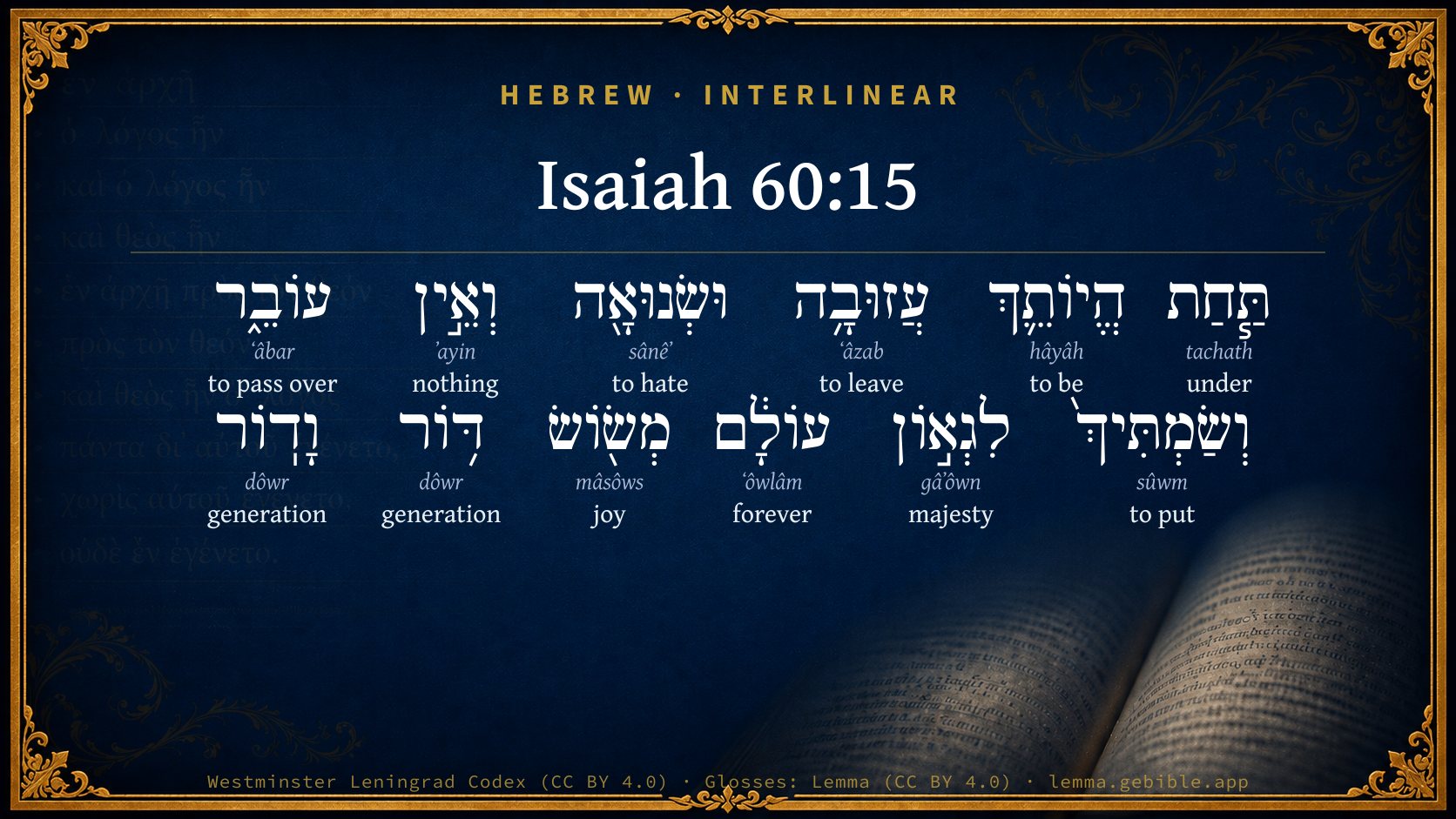
Hebrew (Westminster Leningrad Codex) Isaiah 60:15 appears in the Hebrew Old Testament. The text above is from the Westminster Leningrad Codex. Each word links to its Strong’s number, a concise gloss, and parsing drawn from the Open Scriptures Hebrew Bible morphology. Click any word for its full Brown-Driver-Briggs (BDB) entry.
Download image
Cite this verse

Isaiah 60:15 (World English Bible). Public Domain. Lemma interlinear Bible study tool, https://lemma.gebible.app/v/isaiah/60/15.

Show BibTeX & RIS
BibTeX
RIS
English Translation
Whereas you have been forsaken and hated, so that no man passed through you, I will make you an eternal excellency, a joy of many generations.
World English Bible · Public Domain
Download a study sheet

One document with this verse’s original text, its word-by-word gloss line, the meaning frame, cross-references with their text, attributed commentary, and full source and license credits — printable, and it pastes into notes with its structure intact.

This verse Autodidact and up

Study sheet (.html) Plain text (.txt)

A passage Seminary Student

Up to 50 verses in one chapter. A passage sheet keeps up to 6 commentary sources and 12 cross-references per verse, in the order this page ranks them, and says so on the sheet whenever that leaves anything out. Ask for a single verse and you get the Autodidact verse sheet above.

Everything on this page stays free to read, with no account — the sheet is a download of what is already on screen, not access to it.

Want to remove ads? Support Godless Engineer
Compare translations 3

The same verse in 3 English versions, stacked beneath the original-language interlinear above. Click any original word for its lexicon entry.

Each is an independent rendering of the whole verse — the interlinear is not word-aligned to these translations.

Highlighted words mark where these versions differ — a whole-verse word diff, not a word-by-word alignment.

  • World English Bible Public Domain
    Whereas you have been forsaken and hated, so that no man passed through you, I will make you an eternal excellency, a joy of many generations.
  • King James Version Public Domain
    Whereas thou has been forsaken and hated, so that no man went through thee, I will make thee an eternal excellency, a joy of many generations.
  • unfoldingWord Literal Text CC BY-SA 4.0
    Instead of you being abandoned and hated, with no one passing through, I will make you a pride of forever, a joy of generation and generation.

unfoldingWord Literal Text — © unfoldingWord, licensed CC BY-SA 4.0. Word-aligned USFM3 via Door43 (git.door43.org/unfoldingWord/en_ult).

Versions to compare (up to 4)

3 of 4 selected

Show all 18 translations

Every available English version of this verse, each an independent rendering of the whole verse.

  • World English Bible Public Domain
    Whereas you have been forsaken and hated, so that no man passed through you, I will make you an eternal excellency, a joy of many generations.
  • Berean Standard Bible Public Domain
    Whereas you have been forsaken and despised, with no one passing through, I will make you an everlasting pride, a joy from age to age.
  • Majority Standard Bible Public Domain
    Whereas you have been forsaken and despised, with no one passing through, I will make you an everlasting pride, a joy from age to age.
  • King James Version Public Domain
    Whereas thou has been forsaken and hated, so that no man went through thee, I will make thee an eternal excellency, a joy of many generations.
  • American Standard Version (1901) Public Domain
    Whereas thou hast been forsaken and hated, so that no man passed through thee, I will make thee an eternal excellency, a joy of many generations.
  • Revised Version (1885) Public Domain
    Whereas thou hast been forsaken and hated, so that no man passed through thee, I will make thee an eternal excellency, a joy of many generations.
  • Geneva Bible (1599) Public Domain
    Where as thou hast bene forsaken and hated: so that no man went by thee, I will make thee an eternall glorie, and a ioye from generation to generation.
  • Douay-Rheims (1899) Public Domain
    Because thou wast forsaken, and hated, and there was none that passed through thee, I will make thee to be an everlasting glory, a joy unto generation and generation:
  • Young's Literal Translation Public Domain
    Instead of thy being forsaken and hated, And none passing through, I have made thee for an excellency age-during, A joy of generation and generation.
  • Literal Standard Version CC BY-SA 4.0
    Instead of your being forsaken and hated, || And none passing through, || I have made you for a continuous excellence, || A joy of generation and generation.
  • Unlocked Literal Bible CC BY-SA 4.0
    Instead of you remaining abandoned and hated, with no one passing through you, I will make you a thing of pride forever, a joy from generation to generation.
  • unfoldingWord Literal Text CC BY-SA 4.0
    Instead of you being abandoned and hated, with no one passing through, I will make you a pride of forever, a joy of generation and generation.
  • Darby Bible Public Domain
    Instead of thy being forsaken and hated, so that no one went through [thee], I will make thee an eternal excellency, a joy from generation to generation.
  • World Messianic Bible Public Domain
    “Whereas you have been forsaken and hated, so that no one passed through you, I will make you an eternal excellency, a joy of many generations.
  • Webster's Bible Public Domain
    Whereas thou hast been forsaken and hated, so that no man went through thee, I will make thee an eternal excellence, a joy of many generations.
  • Free Bible Version CC BY-SA 4.0
    Once you were abandoned and despised, somewhere people didn't go, but now I will make you a place to be proud of forever, a joy to every generation.
  • Bible in Basic English Public Domain
    And though you were turned away from, and hated, and had no helper, I will make you a pride for ever, a joy from generation to generation.
  • JPS Tanakh (1917) Public Domain
    Whereas thou hast been forsaken and hated, so that no man passed through thee, I will make thee an eternal excellency, a joy of many generations.

Literal Standard Version (2020), Covenant Press — licensed CC BY-SA 4.0. Text via the HelloAO Bible API (eBible.org). Unlocked Literal Bible (unfoldingWord) — licensed CC BY-SA 4.0. Text via the HelloAO Bible API (eBible.org). unfoldingWord Literal Text — © unfoldingWord, licensed CC BY-SA 4.0. Word-aligned USFM3 via Door43 (git.door43.org/unfoldingWord/en_ult). Free Bible Version, Dr. Jonathan Gallagher — licensed CC BY-SA 4.0. Text via the HelloAO Bible API (eBible.org).

Word by word

More ways to search: Search by grammar → Find every occurrence → Compare this word →

Practice this passage: Drill this verse → Learn its vocabulary →

מְשׂ֖וֹשׂ
mâsôws
H4885
“joy of”
Noun, Common, Masculine, Singular, Construct
Part of Speech
Noun
Type
Common
Gender
Masculine
Number
Singular
State
Construct
Full BDB Definition

Origin: from H7797

TWOT: 2246b

exultation, joy, rejoicing
  1. תַּ֧חַת tachath H8478 “under” Preposition
  2. הֱיוֹתֵ֛ךְ hâyâh H1961 “to be · you” Verb, Qal, Infinitive Construct + Suffix, Personal, 2nd Person, Feminine, Singular
  3. עֲזוּבָ֥ה ʻâzab H5800 “left” Verb, Qal, Participle Passive, Feminine, Singular, Absolute
  4. וּשְׂנוּאָ֖ה sânêʼ H8130 “and · hated” Conjunction + Verb, Qal, Participle Passive, Feminine, Singular, Absolute
  5. וְאֵ֣ין ʼayin H369 “and · nothing” Conjunction + Particle, Negative
  6. עוֹבֵ֑ר ʻâbar H5674 “passing over” Verb, Qal, Participle Active, Masculine, Singular, Absolute
  7. וְשַׂמְתִּיךְ֙ sûwm H7760 “and · to put · you” Conjunction + Verb, Qal, Sequential Perfect, 1st Person, Common, Singular + Suffix, Personal, 2nd Person, Feminine, Singular
  8. לִגְא֣וֹן gâʼôwn H1347 “to/for · majesty of” Preposition + Noun, Common, Masculine, Singular, Construct
  9. עוֹלָ֔ם ʻôwlâm H5769 “forever” Noun, Common, Masculine, Singular, Absolute
  10. דּ֥וֹר dôwr H1755 “generation” Noun, Common, Masculine, Singular, Absolute
  11. וָדֽוֹר dôwr H1755 “and · generation” Conjunction + Noun, Common, Masculine, Singular, Absolute

About this verse

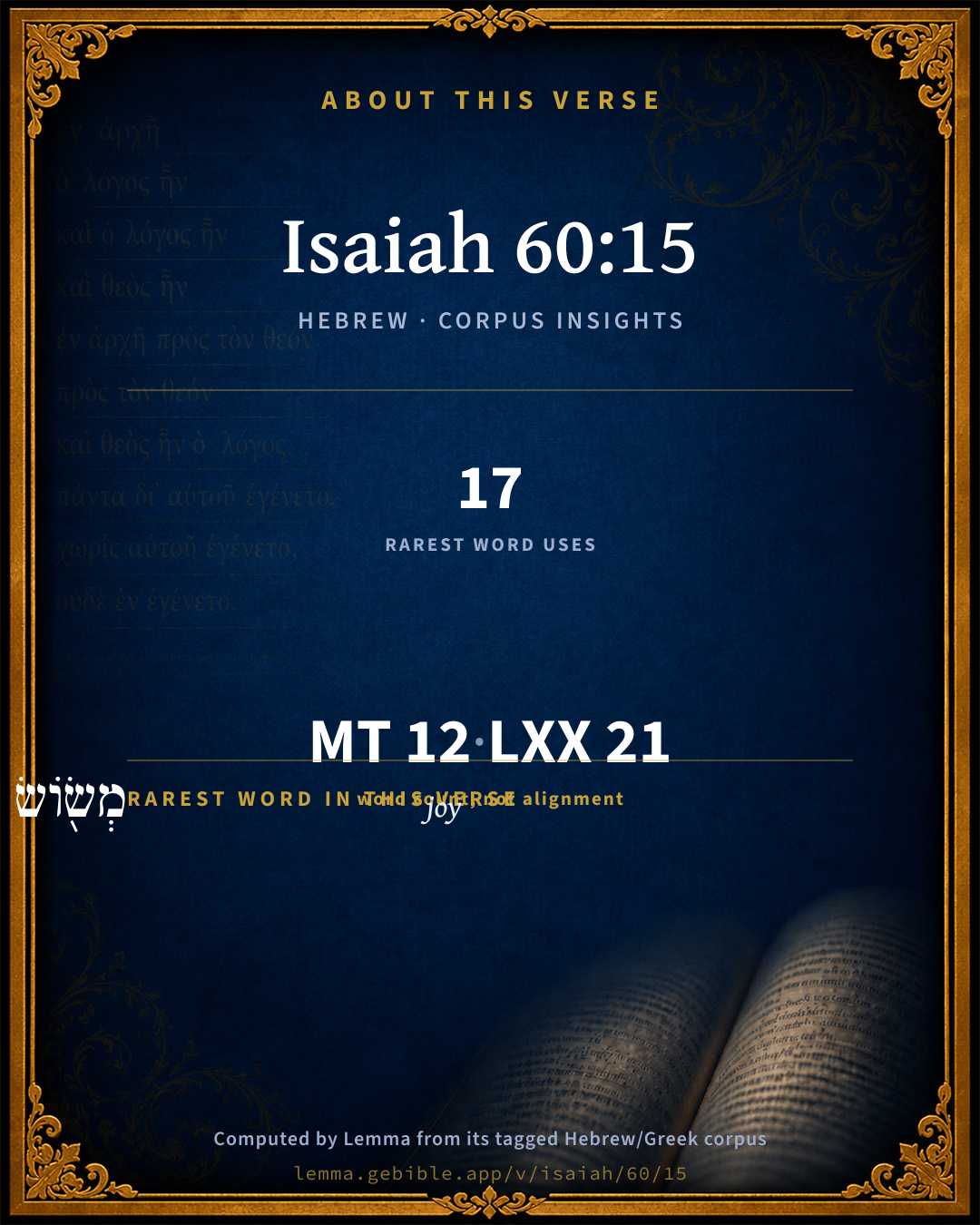
These counts appear in no published source. They are computed here, from the morphology-tagged text and Lemma’s own curated glosses. What Lemma adds →

12
words
11
distinct lemmas
Prophets
section

Notable vocabulary

The rarest word here is מְשׂ֖וֹשׂ joy H4885 — appearing just 17 times in the whole Hebrew Bible.

Shared distinctive vocabulary

מְשׂ֖וֹשׂ joy H4885 occurs in 16 verses of the Hebrew Bible. Also found in:

Grammatical profile

  • 5 verbs
  • 5 nouns
  • 1 preposition
  • 1 particle

Verb forms

  • הֱיוֹתֵ֛ךְ Qal · Infinitive Construct
  • עֲזוּבָ֥ה Qal · Participle Passive
  • וּשְׂנוּאָ֖ה Qal · Participle Passive
  • עוֹבֵ֑ר Qal · Participle Active
  • וְשַׂמְתִּיךְ֙ Qal · Sequential Perfect

Repetition

A word recurs within this verse — often emphatic in Hebrew:

  • דּ֥וֹר generation H1755 ×2

Hebrew & Septuagint length

In English translation the verse runs 26 words from the Hebrew and 25 from the Septuagint (LXX English) — closely comparable.

A rough comparison of the two English renderings, which tokenize alike — not a word-level alignment.

Word counts can differ between the Hebrew and the Greek without any difference in meaning — e.g. the Hebrew direct-object marker אֵת has no separate Greek word, and Greek often adds the article ὁ.

In the original languages it is 12 Hebrew tokens and 21 Greek tokens — but the two are counted differently (Hebrew bundles its prefixes and suffixes into one token; the Greek is in lemma form), so that isn’t a like-for-like length.

Cross-references

14

Topical passages linked to Isaiah 60:15 in the Treasury of Scripture Knowledge — connected by theme and wording, ordered by reader-vote popularity; previews shown in the World English Bible.

  • Isaiah 61:7 Instead of your shame [you shall have] double; and instead of dishonor they shall rejoice in their portion: therefore in their land they shall possess double; everlasting joy shall be to them.
  • Jeremiah 30:17 For I will restore health to you, and I will heal you of your wounds, says Yahweh; because they have called you an outcast, [saying], It is Zion, whom no man seeks after.
  • Isaiah 49:14–23 But Zion said, Yahweh has forsaken me, and the Lord has forgotten me.
  • Isaiah 35:10 and the ransomed of Yahweh shall return, and come with singing to Zion; and everlasting joy shall be on their heads: they shall obtain gladness and joy, and sorrow and sighing shall flee away.
  • Jeremiah 33:11 the voice of joy and the voice of gladness, the voice of the bridegroom and the voice of the bride, the voice of those who say, Give thanks to Yahweh of Hosts, for Yahweh is good, for his loving kindness endures forever; [and of them] who bring [sacrifices of] thanksgiving into the house of Yahweh. For I will cause the captivity of the land to return as at the first, says Yahweh.
  • Isaiah 4:2 In that day, Yahweh's branch will be beautiful and glorious, and the fruit of the land will be the beauty and glory of the survivors of Israel.
  • Isaiah 6:12 And Yahweh has removed men far away, And the forsaken places are many in the midst of the land.
  • Isaiah 54:6–14 For Yahweh has called you as a wife forsaken and grieved in spirit, even a wife of youth, when she is cast off, says your God.
  • Revelation 11:15–17 The seventh angel sounded, and great voices in heaven followed, saying, "The kingdom of the world has become the Kingdom of our Lord, and of his Christ. He will reign forever and ever!"
  • Isaiah 65:18 But be you glad and rejoice forever in that which I create; for, behold, I create Jerusalem a rejoicing, and her people a joy.
  • Revelation 11:2 Leave out the court which is outside of the temple, and don't measure it, for it has been given to the gentiles. They will tread the holy city under foot for forty-two months.
  • Lamentations 1:1–2 How does the city sit solitary, that was full of people! She has become as a widow, who was great among the nations! She who was a princess among the provinces is become tributary!
  • Isaiah 1:7–9 Your country is desolate. Your cities are burned with fire. Strangers devour your land in your presence, And it is desolate, As overthrown by strangers.
  • Psalms 78:60–61 So that he forsook the tent of Shiloh, The tent which he placed among men;

Cross-references courtesy of OpenBible.info (CC BY 4.0).

Hebrew and Greek witnesses Masoretic Hebrew ↔ Greek Septuagint

The same verse in the two great witnesses to the Old Testament, shown verse-for-verse.

These are two independent witnesses, not word-aligned to each other, and the Septuagint is shown in lemma (dictionary) form.

Hebrew Isaiah 60:15 Masoretic · Westminster Leningrad Codex

תַּ֧חַת הֱיוֹתֵ֛ךְ עֲזוּבָ֥ה וּשְׂנוּאָ֖ה וְאֵ֣ין עוֹבֵ֑ר וְשַׂמְתִּיךְ֙ לִגְא֣וֹן עוֹלָ֔ם מְשׂ֖וֹשׂ דּ֥וֹר וָדֽוֹר

Whereas you have been forsaken and hated, so that no man passed through you, I will make you an eternal excellency, a joy of many generations.

World English Bible · Public Domain

Greek LXX Isaiah 60:15 Septuagint · lemma form

διά ὁ γίγνομαι σύ ἐν καταλείπω καί μισέω καί οὐ εἰμί ὁ βοηθέω καί τίθημι σύ ἀγαλλίαμα αἰώνιος εὐφροσύνη γενεά γενεά

Because you have become desolate and hated, and there was no helper, therefore I will make you a perpetual gladness, a joy of many generations.

LXX2012 (modern English Septuagint) · Public Domain

Hebrew: Westminster Leningrad Codex (CC BY 4.0). Greek: Septuagint (public domain); English from LXX2012 (modern English Septuagint) (Public Domain). How the Septuagint differs from the Hebrew →

Targum (Aramaic paraphrase)

1

The Targum is the ancient Jewish Aramaic paraphrase of the Hebrew Scriptures — an interpretive translation, not the Hebrew text itself. Onkelos (literal) and Pseudo-Jonathan (expansive) render the Torah, and Jonathan the Prophets. Coverage is partial: where no permissively-licensed English translation exists for a verse, only the Aramaic is shown. This is verse-level text, not a word-by-word alignment to the Hebrew.

  1. Targum Jonathan Prophets (Joshua–Malachi)
    חֲלַף דַהֲוֵית שְׁבִיקָא וּמְטַלְטְלָא וְלֵית דְעָדֵי וַאֲשַׁוִינָךְ לִיקַר עֲלַם בֵית דִיץ דָר וְדָר:

    Whereas thou hast been forsaken, and an outcast, so that none went through thee, I will make thee an eternal glory, the house of joy for generation and generation.

    Targum Jonathan — Aramaic: “Mikraot Gedolot” (public domain). English: “Sefaria Community Translation” (CC0 1.0 (public-domain dedication)); “London "Chaldee Paraphrase," 1871” (public domain). Text via Sefaria.

Commentary

Notes on Isaiah 60:15 from classic Christian and Jewish commentators (each source and its license shown beneath its notes). The classic Christian expositions comment on the surrounding passage and are grouped to its opening verse, so a note may address several verses; the Jewish commentaries on the Tanakh (Rashi and others) are per-verse, so they appear only where the commentator wrote on this verse.

Lemma curates 59 commentaries, every one of them public domain or Creative Commons licensed, each selected and text-cleaned for this edition rather than reprinted as found. About our sources →

Matthew Henry's Commentary

The happy and glorious state of the church is here further foretold, referring principally and ultimately to the Christian church and the spiritual peace of that, but under the type of that little gleam of outward peace which the Jews sometimes enjoyed after their return out of captivity. This is here spoken of,

I. As compared with what it had been. This made her peace and honour the more pleasant, that her condition had been much otherwise.

1. She had been despised, but now she should be honoured, Isa 60:15, Isa 60:16. Jerusalem had been forsaken and hated, abandoned by her friends, abhorred by her enemies; no man went through that desolate city, but declined it as a rueful spectacle; it was an astonishment and a hissing. But now it shall be made an eternal excellency, being reformed from idolatry and having recovered the tokens of God's favour, and it shall be the joy of good people for many generations. Yet considering how short Jerusalem's excellency was, and how short it came of the vast compass of this promise, we must look for the full accomplishment of it in the perpetual excellencies of the gospel church, far exceeding those of the Old Testament church, and the glorious privileges and advantages of the Christian religion, which are indeed the joy of many generations. Two things are here spoken of as her excellency and joy, in opposition to her having been forsaken and hated: - (1.) She shall find herself countenanced by her neighbours. The nations, and their kings, that are brought to embrace Christianity, shall lay themselves out for the good of the church, and maintain its interests with the tenderness and affection that the nurse shows to the child at her breasts (Isa 60:16): "Thou shalt suck the milk of the Gentiles, not suck their blood (that is not the spirit of the gospel); thou shalt suck the breast of kings, who shall be to thee as nursing fathers." (2.) She shall find herself countenanced by her God: "Thou shalt know that I the Lord am thy Saviour and thy Redeemer, shalt know it by experience; for such a salvation, such a redemption, shall be wrought out for thee as plainly discovers itself to be the work of the Lord, the work of a mighty one, for it is a great salvation, of the Mighty One of Jacob, for it secures the welfare of all those that are Israelites indeed." They before knew the Lord to be their God; now they know him to be their Saviour, their Redeemer. Their Holy One now appears their Mighty One.

2. She had been impoverished, but now she shall be enriched, and every thing shall be changed for the better with her, Isa 60:17. When those who were raised out of the dust are set among princes, instead of brass money in their purses they have bold, and instead of iron vessels in their houses they have silver ones, and other improvements agreeable: so much shall the spiritual glory of the New Testament church exceed the external pomp and splendour of the Jewish economy, which had no glory in comparison with that which quite excels it, Co2 3:10. When we had baptism in the room of circumcision, the Lord's supper in the room of the passover, and a gospel ministry in the room of a Levitical priesthood, we had gold instead of brass. Sin turned gold into brass when Rehoboam made brazen shields instead of the golden ones he had pawned; but God's favour, when that returns, will turn brass again into gold.

3. She had been oppressed by her own princes, which was sadly complained of, not only as her sin, but as her misery (Isa 59:14); but now all the grievances of that kind shall be redressed (Isa 60:17): "I will make thy officers peace; men of peace shall be made officers, and shall be indeed justices, not patrons of injustice, and justices of peace, not instruments of trouble and vexation. They shall be peace, that is, they shall sincerely seek thy welfare and by their means thou shalt enjoy good." They shall be peace, for they shall be righteousness; and then the peace is as a river, when the righteousness is as the waves of the sea. Even exactors, whose business it is to demand the public tribute, though they be exact, must not be exacting, but must be just to the subject as well as to the prince, and, according to the instructions John Baptist gave to the publicans must exact no more than is appointed them, Luk 3:13.

4. She had been insulted by her neighbours, invaded, spoiled, and plundered; but now it shall be so no more (Isa 60:18): "Violence shall no more be heard in thy land; neither the threats and triumphs of those that do violence nor the outcries and complaints of those that suffer violence shall again be heard, but every man shall peaceably enjoy his own. There shall be no wasting nor destruction, either of persons of possessions, any where within thy borders; but thy walls shall be called salvation (they shall be safe, and means of safety to thee) and thy gates shall be praise, praise to thee (every one shall commend thee for the good condition they are kept in), and praise to thy God, who strengthens the bars of thy gates," Psa 147:13. When God's salvation is upon the walls it is fit that his praises should be in the gates, the places of concourse.

II. As completed in what it shall be. It should seem that in the close of this chapter we are directed to look further yet, as far forward as to the glory and happiness of heaven, under the type and figure of the flourishing state of the church on earth, which yet was never such as to come any thing near to what is here foretold; and several of the images and expressions here made use of we find in the description of the new Jerusalem, Rev 21:23; Rev 22:5. As the prophets sometimes insensibly pass from the blessings of the Jewish church to the spiritual blessings of the Christian church, which are eternal, so sometimes they rise from the church militant to the church triumphant, where, and where only, all the promised peace, and joy, and honour will be in perfection. 1. God shall be all in all in the happiness here promised; so he is always to true believers (Isa 60:19): The sun and the moon shall be no more thy light. God's people, when they enjoy his favour, and walk in the light of his countenance, make little account of sun and moon, and the other lights of this world, but could walk comfortably in the light of the Lord though they should withdraw their shining. In heaven there shall be no occasion for sun or moon, for it is the inheritance of the saints in light, such light as will swallow up the light of the sun as easily as the sun does that of a candle. "Idolaters worshipped the sun and moon (which some have thought the most ancient and plausible idolatry); but these shall be no more thy light, shall no more be idolized, but the Lord shall be to thee a constant light, both day and night, in the night of adversity as well as in the day of prosperity." Those that make God their only light shall have him their all-sufficient light, their sun and shield. Thy God shall be thy glory. Note, God is the glory of those whose God he is and will be so to eternity. It is their glory that they have him for their God, and they glory in it; it is to them instead of beauty. God's people are, upon this account, an honourable people, that they have an interest in God as their sin covenant. 2. The happiness here promised shall know no change, period, or allay (Isa 60:20): "Thy sun shall no more go down, but it shall be eternal day, eternal sunshine, with thee; that shall not be thy sun which is sometimes eclipsed, often clouded, and, though it shine ever so bright, ever so warm, will certainly set and leave thee in the dark, in the cold, in a few hours; but he shall be a sun, a fountain of light to thee, who is himself the Father of all lights, with whom there is no variableness, nor shadow of turning," Jam 1:17. We read of the sun's standing still once, and not hasting to go down for the space of a day, and it was a glorious day, never was the like; but what was that to the day that shall never have a night? Or, if it had, it should be a light night; for neither shall thy moon withdraw itself; it shall never wane, shall never change, but be always at the full. The comforts and joys that are in heaven, the glories provided for the soul, as the light of the sun, and those prepared for the glorified body too, as the light of the moon, shall never know the least cessation or interruption; how should they when the Lord shall himself be thy everlasting light - a light which never wastes nor can ever be extinguished? And the days of thy mourning shall be ended, so as never to return; for all tears shall be wiped away, and the fountains of them, sin and affliction, dried up, so that sorrow and sighing shall flee away for ever. 3. Those that are entitled to this happiness, being duly prepared and qualified for it, shall never be put out of the possession of it (Isa 60:21): Thy people, that shall inhabit this New Jerusalem, shall all be righteous, all justified by the righteousness of the Messiah, all sanctified by his Spirit; all that people, that Jerusalem, must be righteous, must have that holiness without which no man shall see the Lord. They are all righteous, for we know that the unrighteous shall not inherit the kingdom of God. There are no people on earth that are all righteous; there is a mixture of some bad in the best societies on this side heaven; but there are no mixtures there. They shall be all righteous, that is, they shall be entirely righteous; as there shall be none corrupt among them, so there shall be no corruption in them; the spirits of just men shall there be made perfect. And they shall be all the righteous together who shall replenish the New Jerusalem; it is called the congregation of the righteous, Psa 1:5. And, because they are all righteous, therefore they shall inherit the land for ever, for nothing but sin can turn them out of it. The perfection of the saints' holiness secures the perpetuity of their happiness. 4. The glory of the church shall redound to the honour of the church's God: "They shall appear to be the branch of my planting, the work of my hands, and I will own them as such." It was by the grace of God that they were designed to this happiness; they are the branch of his planting, or of his plantations; he broke them off from the wild olive and grafted them into the good olive, transplanted them out of the field, when they were as tender branches, into his nursery, that, being now planted in his garden on earth, they might shortly be removed to his paradise in heaven. It was by his grace likewise that they were prepared and fitted for this happiness; they are the work of his hands (Eph 2:10), are wrought to the self-same thing, Co2 5:5. It is a work of time, and, when it shall be finished, will appear a work of wonder; and God will be glorified, who began it, and carried it on; for the Lord Jesus will then be admired in all those that believe. God will glorify himself in glorifying his chosen. 5. They will appear the more glorious, and God will be the more glorified in them, if we compare what they are with what they were, the happiness they have arrived at with the smallness of their beginnings (Isa 60:22): "A little one shall become a thousand and a small one a strong nation." The captives that returned out of Babylon strangely multiplied, and became a strong nation. The Christian church was a little one, a very small one at first - the number of their names was once but 120; yet it became a thousand. The stone cut out of the mountain without hands swelled so as to fill the earth. The triumphant church, and every glorified saint, will be a thousand out of a little one, a strong nation out of a small one. The grace and peace of the saints were at first like a grain of mustard-seed, but they increase and multiply, and make a little one to become a thousand, the weak to be as David. When they come to heaven, and look back upon the smallness of their beginning, they will wonder how they got thither. And so wonderful is all this promise that it needed the ratification with which it is closed: I the Lord will hasten it in his time - all that is here said relating to the Jewish and Christian church, to the militant and triumphant church, and to every particular believer. (1.) It may seem too difficult to be brought about, and therefore may be despaired of; but the God of almighty power has undertaken it: "I the Lord will do it, who can do it, and who have determined to do it." It will be done by him whose power is irresistible and his purposes unalterable. (2.) It may seem to be delayed and put off so long that we are out of hopes of it; but, as the Lord will do it, so he will hasten it, will do it with all convenient speed; though much time may pass before it is done, no time shall be lost; he will hasten it in its time, in the proper time, in the season wherein it will be beautiful; he will do it in the time appointed by his wisdom, though not in the time prescribed by our folly. And this is really hastening it; for, though it seem to tarry, it does not tarry if it come in God's time, for we are sure that that is the best time, which he that believes will patiently wait for.

Matthew Henry's Commentary on the Whole Bible (1708–1710) — public domain (CC PDM 1.0). Text via the HelloAO Bible API.

Trapp's Complete Commentary

John Trapp

Isa 60:15 Whereas thou hast been forsaken and hated, so that no man went through [thee], I will make thee an eternal excellency, a joy of many generations.

Ver. 15. Whereas thou hast been forsaken and hated.] The primitive Christians suffered Odio humani generis, saith Tacitus, {a} through the general hatred conceived against them; and non tam crimen quam nomen puniebatur, saith another, their very name was odious.

I will make thee an eternal excellency.] Here in part, but hereafter in all perfection. God so favoured the first orthodox Christian emperors, ut cum illorum pietate, Dei liberalitas certare videretur, That God’s liberality might seem to strive with their piety.

{a} Lib. xv.

John Trapp, A Commentary or Exposition upon All the Books of the Old and New Testament (1647–1656) — public domain. Text from a community e-Sword module.

Joseph Benson's Commentary

Isa 60:15. Whereas thou hast been forsaken — Both of God, as to outward appearance, and man; and hated — Either slighted and neglected, or suffering actual miseries and slaughters; so that no man went through thee — Thy streets were left desolate and thou wast in a manner depopulated. The state of the Christian Church, during the dark and persecuting ages of Popery, is here described, in language borrowed from Jerusalem lying in desolation. I will make thee an eternal excellency — Being reformed from idolatry and other superstitions and abominations, and thy members being enlightened with the truth, and regenerated by the grace of God, and thereby rendered wise and holy, thou shalt be blessed and exalted with continual tokens of the divine favour, and made a lasting and increasing blessing in the world. The Hebrew, לגאון עולם, is literally, for a lifting up, or, an exaltation, continually, or, for ever. A joy of many generations — Hebrew, Of generation and generation. The meaning is, that the church’s prosperity and happiness should be the rejoicing and comfort of many succeeding ages, or the matter of their great and continual rejoicing. Bishop Lowth translates this clause, I will make thee an everlasting boast, a subject of joy for perpetual generations. It cannot be said of the Jewish nation, since this was uttered, that it has in any degree answered these characters. For after their restoration to their own land, they were first in subjection to the Persians, afterward to the Macedonians, the successors of Alexander the Great; whose yoke they had scarcely shaken off, when they fell under the power of the Romans, who treated them with great severity, and at last destroyed them, together with their city of Jerusalem, almost to an entire extirpation. So that we are compelled to look for the accomplishment of this prophecy in the Christian Church, the perpetual excellences of which far exceed those of the Jewish, and in the glorious privileges and blessings of the religion of Christ, which are indeed, and will be, the joy of many generations.

Joseph Benson's Commentary on the Old and New Testaments (1811–1818) — public domain. Text from a community e-Sword module.

Keil & Delitzsch

C. F. Keil & F. Delitzsch

The fourth turn (Isa 60:15-18) describes the glorification of Zion through the growth and stability of its community both without and within. A glorious change takes place in the church, not only in itself, but also in the judgment of the nations. "Whereas thou wast forsaken, and hated, and no one walked through thee, I make thee now into eternal splendour, a rapture from generation to generation. And thou suckest the milk of nations, and the breast of kings thou wilt suck, and learn that I Jehovah am thy Saviour and thy Redeemer, the Mighty One of Jacob." Of the two ideas of a church (the mother of Israel) and a city (Metropolis) involved in the term Zion, the former prevails in Isa 60:15, the latter in Isa 60:16. For although עזוּבה and שׂנוּאה are equally applicable to a city and a church (Isa 54:6, Isa 54:11), the expression "no one walked through thee" applies only to the desolate city as she lay in ruins (see Isa 34:10). The fusion of the two ideas in Isa 60:15 is similar to Isa 49:21. Jerusalem will now become thoroughly a splendour, and in fact an eternal splendour, a rapture of successive generations so long as the history of this world continues. The nations and their kings give up their own vital energy to the church, just as a mother or nurse gives the milk of her breasts to a child; and the church has thereby rich food for a prosperous growth, and a constant supply of fresh material for grateful joy. We cannot for a moment think of enriching by means of conquest, as Hitzig does; the sucking is that of a child, not of a vampyre. We should expect melâkhōth (Isa 49:23) instead of melâkhı̄m (kings); but by שׁד (as in Isa 56:11 for שׁדי) the natural character of what is promised is intentionally spiritualized. The figure proves itself to be only a figure, and requires an ideal interpretation. The church sees in all this the gracious superintendence of her God; she learns from experience that Jehovah is her Saviour, that He is her Redeemer, He the Mighty One of Jacob, who has conquered for her, and now causes her to triumph (אני כּי with munach yethib, as in Isa 49:26, which passage is repeated almost verbatim here, and Isa 61:8).

Keil & Delitzsch — Biblical Commentary on the Old Testament (1861–1891) — public domain (CC PDM 1.0). Text via the HelloAO Bible API. (Old Testament only.)

Tyndale Open Study Notes

Tyndale Open Resources

60:15 beautiful forever, a joy to all generations: This would be radical change from the conditions of the Exile in Babylon. Fulfillments of this prophecy include the Jews’ restoration from exile, the coming of Jesus Christ, and the inclusion of the Gentiles in the church. The final fulfillment awaits the glorious second coming of Jesus Christ, which will usher in the new Jerusalem.

Tyndale Open Study Notes — © Tyndale Open Resources, licensed CC BY-SA 4.0. Text via the HelloAO Bible API.

Jamieson, Fausset & Brown

Robert Jamieson, A. R. Fausset & David Brown

forsaken-- (Psa 78:60-61).

no man went through thee--Thy land was so desolate that no traveller, or caravan, passed through thee; true only of Israel, not true of the Church (Lam 1:4).

excellency--glory, that is, for ever honored.

Jamieson, Fausset & Brown — Commentary Critical and Explanatory on the Whole Bible (1871) — public domain (CC PDM 1.0). Text via the HelloAO Bible API.

Ellicott's Commentary for English Readers

(15) Whereas thou hast been forsaken . . .—The figure of the daughter of Zion, who had been as a forsaken and slighted wife (comp. Isa_62:4), mingles with the literal picture of a city in ruins, abandoned and unvisited.

A Bible Commentary for English Readers, edited by Charles John Ellicott (1878–1897) — public domain. Text from a community e-Sword module.

The Cambridge Bible for Schools and Colleges

gen. ed. J. J. S. Perowne

15. Instead of thy being forsaken and hated] Cf. ch. Isa_49:14; Isa_49:21, Isa_54:6; Isa_54:11.

so that no man went through thee] with none passing by (or through).

15, 16. Instead of being shunned and hated by all nations, Zion shall become the joy of the whole earth, her wants being abundantly supplied from the best that the nations can bestow.

The Cambridge Bible for Schools and Colleges (gen. ed. J. J. S. Perowne; Cambridge University Press, 1878–1918) — public domain. Text from a community e-Sword module.

John Gill's Exposition

Whereas thou hast been forsaken,.... Seemingly forsaken of God; thought to be so by herself, which was matter of complaint; and by her enemies, which to them was matter of joy; the Lord not appearing for her immediate relief, and for her deliverance out of the hands of her persecutors:

and hated: of all men, of wicked and profane sinners, and of carnal professors, and especially of the antichristian party:

so that no man went through thee; very few passengers in Zion's ways; few asked the way to her, or joined themselves in fellowship and worship with her. Jacob was small; the number of converts exceeding few:

I will make thee an eternal excellency; the saints are the excellent in the earth, in the esteem of God and Christ; they, are their jewels and peculiar treasure, having the excellent graces of the Spirit of God in them; and the excellent robe of Christ's righteousness on them; an excellent knowledge of divine and spiritual things; an excellent spirit of love and unity; and an excellent order and discipline maintained among them; as well as excellent truths preached, and ordinances administered to them; all which shall continue, being made clearly to appear to be their case:

the joy of many generations; of age and age (e); or, as the Targum,

"the house of joy of generation and generation;''

that is, the church will be the joy of God and Christ, of the saints, and of the whole world, age after age, for a long period of time: see Isa 65:18 there seems to be some respect to Psa 48:2.

(e) "generationis et generationis", Vatablus, Pagninas, Montanus; "cujusque generationis", Vitringa.

John Gill's Exposition of the Whole Bible (1746–1763) — public domain (CC PDM 1.0). Text via the HelloAO Bible API.

Albert Barnes' Notes on the Bible

Whereas thou hast been forsaken - Hebrew, ‘Instead of (תחת tachath) thy being forsaken,’ that is, thy subsequent prosperity shall come in the place of thy being formerly forsaken. The forsaking here refers to the various calamities, persecutions, and trials, which she had been called to endure.

So that no man went through thee - When the country was desolate and abandoned, so that no caravan passed from one part of it to another, or made it a thoroughfare in going to other lands (compare Lam 1:4; see the notes at Isa 34:10).

I will make thee an eternal excellency - Lowth, ‘An everlasting boast.’ Noyes, ‘Glory.’ I will make you forever honored or exalted, so that you shall no more be desolate and abased.

A joy of many generations - A subject of joy from generation to generation; that is, one age after another.

Albert Barnes' Notes on the Bible (1834–1885) — public domain. Text from a community e-Sword/MySword module.

Matthew Poole's English Annotations

Forsaken, both of God, i.e. as to outward appearance; and of her inhabitants, being upon the matter depopulated.

Hated; either slighted and neglected, or suffering actual miseries and slaughters: thus was she dealt with, Lam 1:2.

No man went through thee; thy streets were left desolate. An eternal excellency: the abstract is put here for the concrete, whereby the Hebrews were wont to express the superlative degree; and in this happy estate we find the church, Zec 2. per tot. Zec 9:9, &c.; which refers to the coming of Christ; and it is said to be eternal, i.e. for a great while; it being an hyperbolical expression, frequent with the Hebrews, who express a long time by eternity.

A joy of many generations; the church’s happiness should be, the rejoicing and comfort of succeeding generations; she would be the matter of their great rejoicing; a metonymy of the object.

Matthew Poole's English Annotations on the Holy Bible (1683–1685) — public domain. Text from a community e-Sword/MySword module.

Whedon's Commentary on the Bible

Daniel D. Whedon

15. Whereas thou hast been forsaken — This is said under the figure of an abandoned wife; but the meaning would be clearer if read, “Instead of thy being a forsaken and hated holy city, so that no one would pass through thee” — so that travellers and caravans did pass altogether by — I will exalt thee to be the eternal city — a position of growth in importance and honour, and which shall never cease to exist as such.

Daniel D. Whedon (gen. ed.), Commentary on the Old and New Testaments (1874–1909) — public domain. Text from a community e-Sword module.

The Pulpit Commentary

Vers. 15-18. The fourth stanza, Zion"s prosperity.

Thou hast been forsaken and hated. (comp. Isa_54:7 Isa_62:4) Zion has been a wife repudiated for her adulteries, "forsaken" by her husband, and the object of his just "hate." So that no man went through thee. The mixed metaphor is awkward, but readily intelligible. Zion is at once a city and a wife. As a wife, she is "hated and forsaken," as a city, no man goes through her. An eternal excellency. (comp. Isa_59:21, and see the Homiletics on the passage)

Vers. 15-22. The favour of Jehovah to his people.

Zion is again imagined as the bride of Jehovah. No more is she to be "hated," i.e. neglected, (Gen_29:31 Deu_21:15) like one less beloved. No more are her streets to be deserted of passengers. She is to be made an "everlasting pride, the delight of successive generations." The kings of the earth are to be tender over her, and she is to be enriched by the resources of the nations.

I JEHOVAH THE SAVIOUR AND THE RULER. (Repeated from Isa_49:26) Happy the people whose God is Jehovah, the "Hero of Jacob"! Every image of temporal riches and prosperity, such as the gold of Solomon"s palace, or the silver common as stones, and the cedars as sycamores, (1Ki_10:21, 1Ki_10:27) may but faintly shadow forth the splendour of the city under the true and eternal King. Better still, the politics will be those of peace. By a figure of speech, peace itself and righteousness are said to govern the city. And so spiritual shall be the sources of its strength, "it shall need no walls nor gates; for Jehovah shall be a constant source of salvation, and of a renown which shall keep all foes at a distance". (Isa_26:1 Isa_33:21) Nothing less than righteousness prevailing in every department of Church and state can satisfy that ideal which has been revealed to us, and which our souls thirst to see realized. Violence is to cease. "The pure gospel of the Redeemer has never originated a single war of invasion, nor produced a scene of bloodshed or prompted to strife. Let us look forward to a time when the mad passions of kings and nations will be subdued, and wars only be known among the sad and disgraceful records of the past.

II THE ETERNAL SPLENDOUR OF THE CITY OF GOD. Jehovah himself, and material luminaries, shall enlighten it. (Isa_30:26; cf. Rev_21:23 Rev_22:5) All the wonders of the natural world must pale and turn lustreless before the effulgence of moral beauty. The glory of the Church is its great Head his Name, attributes, laws, and protecting care. Not so much wealth, talent, numbers, influence, but the character of her sovereign Lord, is her boast. The Church shall enjoy a perpetual existence, living through all changes and surviving all revolutions. Discipline and sorrow shall one day have done their work, and the people shall "all be righteous." They will possess the land, will inherit all that God has done for its welfare, will enter into all his plans and purposes, enjoy the fruit of his agelong spiritual husbandry. And from this state of things fresh lustre will ever be reflected upon his holy Name. There would be immense increase by accessions from the Gentile world. Nor will there be unnecessary delay. The lesson is to wait, pray, and toil until the day dawn till, "Crowned with light, imperial Salem rise, Exalt her towering head, and lift her eyes!

"He that shall come will come, and will not tarry". (Heb_10:37) These inspired visions have deep relation to the truth; if they he not translated into fact in our time, we may be translated to the sphere where they are realities. J.

A promise to Israel.

"I will make thee an eternal excellency, a joy of many generations." God"s estimate of honour is the only real and permanent one. Nations have sought other excellences. The Egyptians excelled in architecture; the Greeks in art and beauty; the Romans in government and military prowess. The Jew was to excel in righteousness and religion.

I GOD"S IDEAL IS IMMORTAL. "An eternal excellency.

1. Military empire passes from kingdom to kingdom.

2. Taste changes alike in art and architecture. But the moral law is eternal.

II THE CONTRAST IS COMPLETE. The "forsaken shall have arise among them One who shall fulfil the words of the sixteenth verse, "Thou shalt know that I the Lord am thy Saviour and thy Redeemer, the Mighty One of Jacob." The "hated" shall find and feel the tender love of God; for (ver. 10) "In my favour have I had mercy on thee." Scorn and contumely, what are they when the heart glows with the love of God, and the character wins his everlasting favour? W.M.S.

The Pulpit Commentary (1880–1919), ed. H.D.M. Spence-Jones & Joseph S. Exell — public domain. Text from a community e-Sword module.

John Wesley's Explanatory Notes

Forsaken - Both of God and of her inhabitants. No man went - Thy streets were left desolate.

John Wesley, Explanatory Notes Upon the Whole Bible (1754–1765) — public domain. Text via the GEBible commentary corpus.

J. A. Alexander on Isaiah

Joseph Addison Alexander

“Instead of thy being forsaken and hated and with none passing (through thee), I will place thee for a boast of perpetuity, a joy of age and age (i.e., forever).” The first word may express either simply a change of condition (whereas), or the reason of the change (because), or the further idea of equitable compensation. The ‘and’ at the beginning of the second clause in Hebrew is commonly regarded as the sign of the apodosis, and as such cannot be expressed in English.

Joseph Addison Alexander, The Prophecies of Isaiah (1846–1847; New York: Scribner, 1870–1878) — public domain. Text from a community e-Sword module.

unfoldingWord translationNotes

Door43 World Missions Community

General Information:

Yahweh continues speaking to the people of Israel.

with no one passing through you

"with everyone avoiding your land" or "with all the foreigners avoiding your land"

You will also drink the milk of the nations, and will nurse at the breast of kings

This refers to the wealth and plenty that will be drained from foreign nations. Both clauses repeat the same idea for emphasis. (See: Metaphor and Parallelism)

Redeemer

See how you translated this in Isaiah 41:14.

the Mighty One of Jacob

See how you translated this in Isaiah 49:26.

translationWords

proud

eternity

joy

generation

nation

king

Yahweh

Savior

redeem

might

Jacob

unfoldingWord translationNotes — © Distant Shores Media and the Door43 World Missions Community, licensed CC BY-SA 4.0. Source: git.door43.org/Door43/en_tn.

Ibn Ezra

Rabbi Abraham ibn Ezra

Thou hast been forsaken. When in a state of ruin.

A rejoicing of many generations. A rejoicing, which shall never cease.

Ibn Ezra on the Tanakh — English translations: “Sefaria Community Translation” (CC0 1.0 (public-domain dedication)); “Yalkut, Sifsei Chachomim Chumash, Metsudah Publications, 2009” (CC BY 4.0); and “Commentary of Ibn Ezra on Isaiah - trans. by M. Friedlander, 1873” (public domain). Text via Sefaria.

Lesson kit

Teaching starters — assembled from the data on this page, not authored interpretation. Every prompt links to the verse data it draws on. Edit before teaching.

Isaiah, in the Prophets, opens this verse with 12 words (11 distinct Hebrew lemmas). Its most distinctive word is mâsôws (“joy”). A historical commentator’s framing appears above. Read the whole chapter for the surrounding context.

Discussion questions

  1. The word mâsôws carries the sense “joy.” How does it shape the verse?
  2. How does Job 8:19, which shares the word «joy», read alongside this verse?
  3. What does the repetition of “generation” (2× in this one verse) do in this verse?
  4. These translations render this verse differently; the difference is in the English rendering, not the original. What questions does that raise?
  5. «הֱיוֹתֵ֛ךְ» is a Qal Infinitive Construct verb. How does that grammatical form shape the action described?
  6. Compare how Matthew Henry's Commentary and Trapp's Complete Commentary read this verse. Where do they agree or differ?

Things to notice

Reading settings

Reading text

Shown beneath each verse's original-language words.

Old Testament
Old Testament edition

Read the OT as the Masoretic Hebrew (MT) or the Greek Septuagint (LXX).

English shown for the Greek Septuagint (in the Hebrew ↔ Greek comparison).

Comparing translations? Open the Compare panel on any verse page to stack up to four side by side.