
2 Chronicles 34:25

Hebrew (Westminster Leningrad Codex) 2 Chronicles 34:25 appears in the Hebrew Old Testament. The text above is from the Westminster Leningrad Codex. Each word links to its Strong’s number, a concise gloss, and parsing drawn from the Open Scriptures Hebrew Bible morphology. Click any word for its full Brown-Driver-Briggs (BDB) entry.
Download image
Cite this verse

2 Chronicles 34:25 (World English Bible). Public Domain. Lemma interlinear Bible study tool, https://lemma.gebible.app/v/2-chronicles/34/25.

Show BibTeX & RIS
BibTeX
RIS
English Translation
Because they have forsaken me, and have burned incense to other gods, that they might provoke me to anger with all the works of their hands; therefore is my wrath poured out on this place, and it shall not be quenched.
World English Bible · Public Domain
Download a study sheet

One document with this verse’s original text, its word-by-word gloss line, the meaning frame, cross-references with their text, attributed commentary, and full source and license credits — printable, and it pastes into notes with its structure intact.

This verse Autodidact and up

Study sheet (.html) Plain text (.txt)

A passage Seminary Student

Up to 50 verses in one chapter. A passage sheet keeps up to 6 commentary sources and 12 cross-references per verse, in the order this page ranks them, and says so on the sheet whenever that leaves anything out. Ask for a single verse and you get the Autodidact verse sheet above.

Everything on this page stays free to read, with no account — the sheet is a download of what is already on screen, not access to it.

Want to remove ads? Support Godless Engineer
Compare translations 3

The same verse in 3 English versions, stacked beneath the original-language interlinear above. Click any original word for its lexicon entry.

Each is an independent rendering of the whole verse — the interlinear is not word-aligned to these translations.

Highlighted words mark where these versions differ — a whole-verse word diff, not a word-by-word alignment.

  • World English Bible Public Domain
    Because they have forsaken me, and have burned incense to other gods, that they might provoke me to anger with all the works of their hands; therefore is my wrath poured out on this place, and it shall not be quenched.
  • King James Version Public Domain
    Because they have forsaken me, and have burned incense unto other gods, that they might provoke me to anger with all the works of their hands; therefore my wrath shall be poured out upon this place, and shall not be quenched.
  • unfoldingWord Literal Text CC BY-SA 4.0
    because they abandoned me and burned incense to other gods in order to provoke me to anger in all the works of their hands. And my rage will pour out on this place, and it will not be quenched.’

unfoldingWord Literal Text — © unfoldingWord, licensed CC BY-SA 4.0. Word-aligned USFM3 via Door43 (git.door43.org/unfoldingWord/en_ult).

Versions to compare (up to 4)

3 of 4 selected

Show all 18 translations

Every available English version of this verse, each an independent rendering of the whole verse.

  • World English Bible Public Domain
    Because they have forsaken me, and have burned incense to other gods, that they might provoke me to anger with all the works of their hands; therefore is my wrath poured out on this place, and it shall not be quenched.
  • Berean Standard Bible Public Domain
    because they have forsaken Me and burned incense to other gods, that they might provoke Me to anger with all the works of their hands. My wrath will be poured out upon this place and will not be quenched.’
  • Majority Standard Bible Public Domain
    because they have forsaken Me and burned incense to other gods, that they might provoke Me to anger with all the works of their hands. My wrath will be poured out upon this place and will not be quenched.’
  • King James Version Public Domain
    Because they have forsaken me, and have burned incense unto other gods, that they might provoke me to anger with all the works of their hands; therefore my wrath shall be poured out upon this place, and shall not be quenched.
  • American Standard Version (1901) Public Domain
    Because they have forsaken me, and have burned incense unto other gods, that they might provoke me to anger with all the works of their hands; therefore is my wrath poured out upon this place, and it shall not be quenched.
  • Revised Version (1885) Public Domain
    Because they have forsaken me, and have burned incense unto other gods, that they might provoke me to anger with all the works of their hands; therefore is my wrath poured out upon this place, and it shall not be quenched.
  • Geneva Bible (1599) Public Domain
    Because they haue forsaken me, and burnt incense vnto other gods, to anger mee with al the workes of their hands, therefore shall my wrath fall vpon this place, and shall not be quenched.
  • Douay-Rheims (1899) Public Domain
    Because they have forsaken me, and have sacrificed to strange gods, to provoke me to wrath with all the works of their hands, therefore my wrath shall fall upon this place, and shall not be quenched.
  • Young's Literal Translation Public Domain
    because that they have forsaken Me, and make perfume to other gods, so as to provoke Me with all the works of their hands, and poured out is My fury upon this place, and it is not quenched.
  • Literal Standard Version CC BY-SA 4.0
    because that they have forsaken Me, and make incense to other gods, so as to provoke Me with all the works of their hands, and My fury is poured out on this place, and it is not quenched.
  • Unlocked Literal Bible CC BY-SA 4.0
    This will happen because they have forsaken me and have burned incense to other gods, and they have provoked me to anger by all that their hands have made, therefore, my anger will be poured out on this place, and it will not be extinguished.'
  • unfoldingWord Literal Text CC BY-SA 4.0
    because they abandoned me and burned incense to other gods in order to provoke me to anger in all the works of their hands. And my rage will pour out on this place, and it will not be quenched.’
  • Darby Bible Public Domain
    Because they have forsaken me, and have burned incense unto other gods, that they might provoke me to anger with all the works of their hands; therefore my fury shall be poured out upon this place, and shall not be quenched.
  • World Messianic Bible Public Domain
    Because they have forsaken me, and have burned incense to other gods, that they might provoke me to anger with all the works of their hands, therefore my wrath is poured out on this place, and it will not be quenched.’”’
  • Webster's Bible Public Domain
    Because they have forsaken me, and have burned incense to other gods, that they might provoke me to anger with all the works of their hands; therefore my wrath shall be poured out upon this place, and shall not be quenched.
  • Free Bible Version CC BY-SA 4.0
    They have abandoned me and offered sacrifices to other gods, making me angry by everything they've done. My anger will be poured out upon this place and will not be stopped.
  • Bible in Basic English Public Domain
    Because they have given me up, burning offerings to other gods and moving me to wrath by all the works of their hands; so my wrath is let loose on this place and will not be put out.
  • JPS Tanakh (1917) Public Domain
    because they have forsaken Me, and have offered unto other gods, that they might provoke Me with all the works of their hands; therefore is My wrath poured out upon this place, and it shall not be quenched.

Literal Standard Version (2020), Covenant Press — licensed CC BY-SA 4.0. Text via the HelloAO Bible API (eBible.org). Unlocked Literal Bible (unfoldingWord) — licensed CC BY-SA 4.0. Text via the HelloAO Bible API (eBible.org). unfoldingWord Literal Text — © unfoldingWord, licensed CC BY-SA 4.0. Word-aligned USFM3 via Door43 (git.door43.org/unfoldingWord/en_ult). Free Bible Version, Dr. Jonathan Gallagher — licensed CC BY-SA 4.0. Text via the HelloAO Bible API (eBible.org).

Word by word

More ways to search: Search by grammar → Find every occurrence → Compare this word →

Practice this passage: Drill this verse → Learn its vocabulary →

וְתִתַּ֧ךְ
nâthak
H5413
“and · to pour out”
Conjunction + Verb, Qal, Imperfect, 3rd Person, Feminine, Singular
Part of Speech
Conjunction + Verb
Stem
Qal
Form
Imperfect
Person
3rd Person
Gender
Feminine
Number
Singular
Full BDB Definition

Origin: a primitive root

TWOT: 1442

to pour out or forth, drop (or rain), be poured, be poured out, be melted, be molten - (Qal) to pour forth - (Niphal) to be poured, be poured out - (Hiphil) to pour out, melt - (Hophal) to be melted
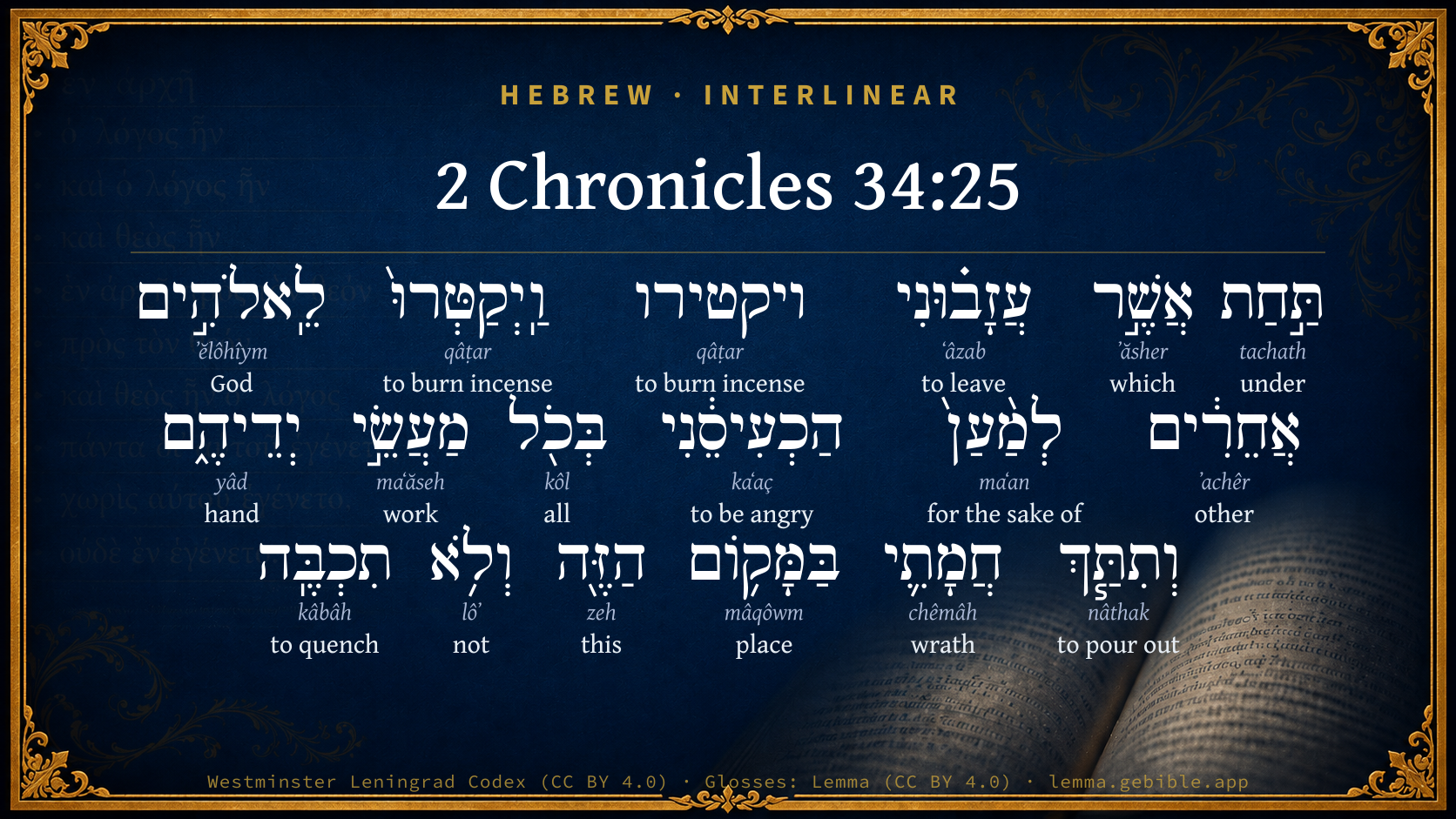
  1. תַּ֣חַת tachath H8478 “under” Preposition
  2. אֲשֶׁ֣ר ʼăsher H834 “which” Particle, Relative
  3. עֲזָב֗וּנִי ʻâzab H5800 “to leave · me” Verb, Qal, Perfect, 3rd Person, Common, Plural + Suffix, Personal, 1st Person, Common, Singular
  4. ויקטירו qâṭar H6999 “and · to burn incense” Conjunction + Verb, Hiphil, Sequential Imperfect, 3rd Person, Masculine, Plural
  5. וַֽיְקַטְּרוּ֙ qâṭar H6999 “and · to burn incense” Conjunction + Verb, Piel, Sequential Imperfect, 3rd Person, Masculine, Plural
  6. לֵֽאלֹהִ֣ים ʼĕlôhîym H430 “to/for · God(s)” Preposition + Noun, Common, Masculine, Plural, Absolute
  7. אֲחֵרִ֔ים ʼachêr H312 “other” Adjective, Adjective, Masculine, Plural, Absolute
  8. לְמַ֨עַן֙ maʻan H4616 “for the sake of” Preposition
  9. הַכְעִיסֵ֔נִי kaʻaç H3707 “to be angry · me” Verb, Hiphil, Infinitive Construct + Suffix, Personal, 1st Person, Common, Singular
  10. בְּכֹ֖ל kôl H3605 “in/at · all of” Preposition + Noun, Common, Masculine, Singular, Construct
  11. מַעֲשֵׂ֣י maʻăseh H4639 “works of” Noun, Common, Masculine, Plural, Construct
  12. יְדֵיהֶ֑ם yâd H3027 “hands · their” Noun, Common, Both, Dual, Construct + Suffix, Personal, 3rd Person, Masculine, Plural
  13. חֲמָתִ֛י chêmâh H2534 “wrath · my” Noun, Common, Feminine, Singular, Construct + Suffix, Personal, 1st Person, Common, Singular
  14. בַּמָּק֥וֹם mâqôwm H4725 “in/at the · place” Preposition, Determined + Noun, Common, Masculine, Singular, Absolute
  15. הַזֶּ֖ה zeh H2088 “the · this” Particle, Definite Article + Pronoun, Demonstrative, Masculine, Singular
  16. וְלֹ֥א lôʼ H3808 “and · not” Conjunction + Particle, Negative
  17. תִכְבֶּֽה kâbâh H3518 “to quench” Verb, Qal, Imperfect, 3rd Person, Feminine, Singular

About this verse

These counts appear in no published source. They are computed here, from the morphology-tagged text and Lemma’s own curated glosses. What Lemma adds →

18
words
17
distinct lemmas
Historical
section

Notable vocabulary

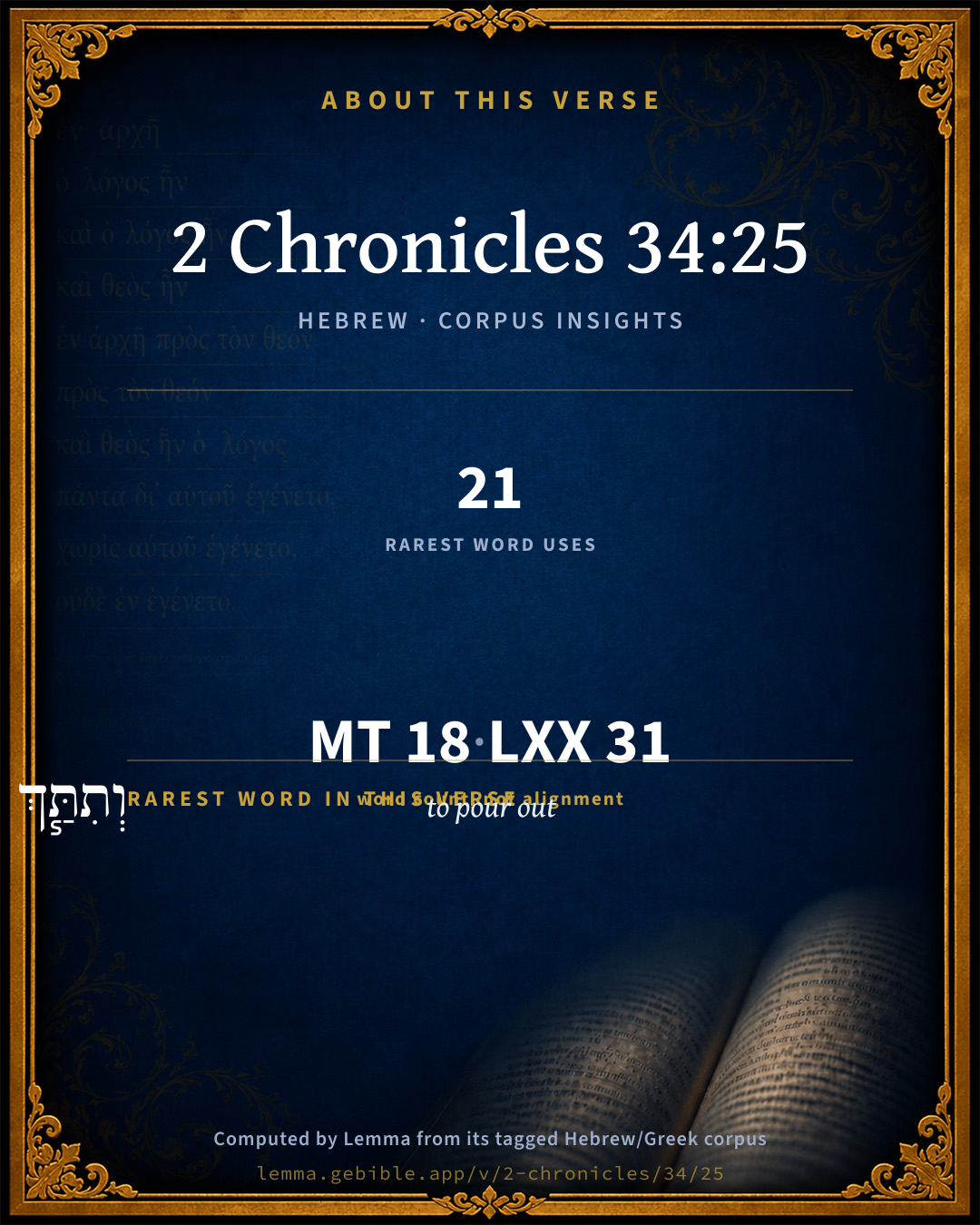
The rarest word here is וְתִתַּ֧ךְ to pour out H5413 — appearing just 21 times in the whole Hebrew Bible.

Shared distinctive vocabulary

וְתִתַּ֧ךְ to pour out H5413 occurs in 19 verses of the Hebrew Bible. Also found in:

Grammatical profile

  • 6 verbs
  • 6 nouns
  • 1 adjective
  • 1 pronoun
  • 2 prepositions
  • 2 particles

Verb forms

  • עֲזָב֗וּנִי Qal · Perfect
  • ויקטירו Hiphil · Sequential Imperfect
  • וַֽיְקַטְּרוּ֙ Piel · Sequential Imperfect
  • הַכְעִיסֵ֔נִי Hiphil · Infinitive Construct
  • וְתִתַּ֧ךְ Qal · Imperfect
  • תִכְבֶּֽה Qal · Imperfect

Repetition

A word recurs within this verse — often emphatic in Hebrew:

  • ויקטירו to burn incense H6999 ×2

Hebrew & Septuagint length

In English translation the verse runs 41 words from the Hebrew and 37 from the Septuagint (LXX English) — closely comparable.

A rough comparison of the two English renderings, which tokenize alike — not a word-level alignment.

Word counts can differ between the Hebrew and the Greek without any difference in meaning — e.g. the Hebrew direct-object marker אֵת has no separate Greek word, and Greek often adds the article ὁ.

In the original languages it is 18 Hebrew tokens and 31 Greek tokens — but the two are counted differently (Hebrew bundles its prefixes and suffixes into one token; the Greek is in lemma form), so that isn’t a like-for-like length.

Cross-references

16

Topical passages linked to 2 Chronicles 34:25 in the Treasury of Scripture Knowledge — connected by theme and wording, ordered by reader-vote popularity; previews shown in the World English Bible.

  • Jeremiah 7:20 Therefore thus says the Lord Yahweh: Behold, my anger and my wrath shall be poured out on this place, on man, and on animal, and on the trees of the field, and on the fruit of the ground; and it shall burn, and shall not be quenched.
  • Nahum 1:6 Who can stand before his indignation? Who can endure the fierceness of his anger? His wrath is poured out like fire, and the rocks are broken apart by him.
  • Mark 9:43–48 If your hand causes you to stumble, cut it off. It is better for you to enter into life maimed, rather than having your two hands to go into Gehenna, into the unquenchable fire,
  • 2 Kings 22:17 Because they have forsaken me, and have burned incense to other gods, that they might provoke me to anger with all the work of their hands, therefore my wrath shall be kindled against this place, and it shall not be quenched.
  • 2 Kings 24:3–4 Surely at the commandment of Yahweh came this on Judah, to remove them out of his sight, for the sins of Manasseh, according to all that he did,
  • 2 Chronicles 12:2 It happened in the fifth year of king Rehoboam, that Shishak king of Egypt came up against Jerusalem, because they had trespassed against Yahweh,
  • 2 Chronicles 15:2 and he went out to meet Asa, and said to him, Hear you me, Asa, and all Judah and Benjamin: Yahweh is with you, while you are with him; and if you seek him, he will be found of you; but if you forsake him, he will forsake you.
  • 2 Chronicles 33:3–9 For he built again the high places which Hezekiah his father had broken down; and he reared up altars for the Baals, and made Asheroth, and worshiped all the host of the sky, and served them.
  • Isaiah 2:8–9 Their land also is full of idols. They worship the work of their own hands, That which their own fingers have made.
  • Isaiah 42:25 Therefore he poured on him the fierceness of his anger, and the strength of battle; and it set him on fire round about, yet he didn't know; and it burned him, yet he didn't lay it to heart.
  • Jeremiah 4:4 Circumcise yourselves to Yahweh, and take away the foreskins of your heart, you men of Judah and inhabitants of Jerusalem; lest my wrath go forth like fire, and burn so that none can quench it, because of the evil of your doings.
  • Jeremiah 15:1–4 Then said Yahweh to me, Though Moses and Samuel stood before me, yet my mind would not be toward this people: cast them out of my sight, and let them go forth.
  • Lamentations 2:4 He has bent his bow like an enemy, he has stood with his right hand as an adversary, Has killed all that were pleasant to the eye: In the tent of the daughter of Zion he has poured out his wrath like fire.
  • Lamentations 4:11 Yahweh has accomplished his wrath, he has poured out his fierce anger; He has kindled a fire in Zion, which has devoured the foundations of it.
  • Ezekiel 20:48 All flesh shall see that I, Yahweh, have kindled it; it shall not be quenched.
  • Revelation 14:10–11 he also will drink of the wine of the wrath of God, which is prepared unmixed in the cup of his anger. He will be tormented with fire and sulfur in the presence of the holy angels, and in the presence of the Lamb.

Cross-references courtesy of OpenBible.info (CC BY 4.0).

Hebrew and Greek witnesses Masoretic Hebrew ↔ Greek Septuagint

The same verse in the two great witnesses to the Old Testament, shown verse-for-verse.

These are two independent witnesses, not word-aligned to each other, and the Septuagint is shown in lemma (dictionary) form.

Hebrew 2 Chronicles 34:25 Masoretic · Westminster Leningrad Codex

תַּ֣חַת אֲשֶׁ֣ר עֲזָב֗וּנִי ויקטירו וַֽיְקַטְּרוּ֙ לֵֽאלֹהִ֣ים אֲחֵרִ֔ים לְמַ֨עַן֙ הַכְעִיסֵ֔נִי בְּכֹ֖ל מַעֲשֵׂ֣י יְדֵיהֶ֑ם וְתִתַּ֧ךְ חֲמָתִ֛י בַּמָּק֥וֹם הַזֶּ֖ה וְלֹ֥א תִכְבֶּֽה

Because they have forsaken me, and have burned incense to other gods, that they might provoke me to anger with all the works of their hands; therefore is my wrath poured out on this place, and it shall not be quenched.

World English Bible · Public Domain

Greek LXX 2 Chronicles 34:25 Septuagint · lemma form

ἀντί ὅς ἐν καταλείπω ἐγώ καί θυμιάω θεός ἀλλότριος ἵνα παραὀργίζω ἐγώ ἐν πᾶς ὁ ἔργον ὁ χείρ αὐτός καί ἐκκαίω ὁ θυμός ἐγώ ἐν ὁ τόπος οὗτος καί οὐ σβέννυμι

because they have forsaken me, and burnt incense to strange gods, that they might provoke me by all the works of their hands; and my wrath is kindled against this place, and it shall not be quenched.

LXX2012 (modern English Septuagint) · Public Domain

On this verse, Ellicott's Commentary for English Readers discusses the Septuagint’s reading. Read the note in Commentary ↓

Hebrew: Westminster Leningrad Codex (CC BY 4.0). Greek: Septuagint (public domain); English from LXX2012 (modern English Septuagint) (Public Domain). How the Septuagint differs from the Hebrew →

Commentary

Notes on 2 Chronicles 34:25 from classic Christian and Jewish commentators (each source and its license shown beneath its notes). The classic Christian expositions comment on the surrounding passage and are grouped to its opening verse, so a note may address several verses; the Jewish commentaries on the Tanakh (Rashi and others) are per-verse, so they appear only where the commentator wrote on this verse.

Lemma curates 59 commentaries, every one of them public domain or Creative Commons licensed, each selected and text-cleaned for this edition rather than reprinted as found. About our sources →

Geneva Bible (1599)

Geneva Bible translators

This she speaketh in contempt of the idolaters, who contrary to reason and nature make that a god, which they have made and framed with their own hands.

Geneva Bible (1599) marginal notes — public domain. Text via Bolls.life.

Ellicott's Commentary for English Readers

(25) Works.—“Work” (Kings), and some MSS. and the Syriac version here.

Poured out.—“Shall be kindled” (Kings), which agrees better with “shall not be quenched.” (See 2Ch_34:21 for the same alteration. The LXX. here has (ἐξεκαύθη) “was kindled.”

Burned incense.—Hiphil, which is much commoner in the chronicle than piel, the form in Kings (the forms piel and hiphil of this word qatar are about equally used in Kings.)

A Bible Commentary for English Readers, edited by Charles John Ellicott (1878–1897) — public domain. Text from a community e-Sword module.

The Cambridge Bible for Schools and Colleges

gen. ed. J. J. S. Perowne

25. therefore my wrath shall be poured out] R.V. therefore is my wrath poured out (agreeing with 2Ch_34:21). Some of its effects were already manifest.

The Cambridge Bible for Schools and Colleges (gen. ed. J. J. S. Perowne; Cambridge University Press, 1878–1918) — public domain. Text from a community e-Sword module.

Haydock's Catholic Bible Commentary

CHAPTER XXXIV.

George Leo Haydock (1774–1849), Haydock's Catholic Family Bible and Commentary, 1859 edition — public domain. Excludes Psalms (Douay-Rheims chapter numbering differs from Protestant) and Deuterocanonical books (Catholic canon only).

The Pulpit Commentary

Poured out. So here again, as above (ver. 21). Yet our Septuagint has "kindled;" and also the parallel in the Hebrew. The word "quenched," which immediately follows, suits the word "kindled," and what with the testimony of the Septuagint, both here and in ver. 21, and the Hebrew in both passages of the parallel, suggests that "poured" is the substitution, by some mishap, of a copyist a mishap, for instance, that might result from the copyist writing from the speech of some one, and not from his own inspection. Exactly similar mistakes may often be seen in our maps, where the spelling and misspelling of the name of some place seem only to be accounted for by the same supposition. The catastrophe now foretold befell the nation manifestly in the reigns of the succeeding sovereigns, whose days were emphatically both few and evil, viz. the two sons of Josiah, Jehoahaz and Eliakim, whose name was changed to Jehoiakim; and the two sons of this latter, Jehoiachin and Zedekiah. (according to 2Ki_24:17, the same with Mattaniah, and son of Josiah)

The Pulpit Commentary (1880–1919), ed. H.D.M. Spence-Jones & Joseph S. Exell — public domain. Text from a community e-Sword module.

Lesson kit

Teaching starters — assembled from the data on this page, not authored interpretation. Every prompt links to the verse data it draws on. Edit before teaching.

2 Chronicles, in the Historical, opens this verse with 18 words (17 distinct Hebrew lemmas). Its most distinctive word is nâthak (“to pour out”). A historical commentator’s framing appears above. Read the whole chapter for the surrounding context.

Discussion questions

  1. How does “to pour out” (nâthak) shape what this verse is saying?
  2. Exodus 9:33 shares the word «to pour out» with this verse. How do the two illuminate each other?
  3. “to burn incense” occurs 2× in this one verse. What is the effect of the repetition?
  4. These translations render this verse differently. What is at stake in choosing one wording over another?
  5. The verb «עֲזָב֗וּנִי» is Qal Perfect. How does its form color the action?
  6. Reading how Geneva Bible (1599) and Ellicott's Commentary for English Readers read this verse, where do the two commentators agree and where do they part?

Things to notice

Reading settings

Reading text

Shown beneath each verse's original-language words.

Old Testament
Old Testament edition

Read the OT as the Masoretic Hebrew (MT) or the Greek Septuagint (LXX).

English shown for the Greek Septuagint (in the Hebrew ↔ Greek comparison).

Comparing translations? Open the Compare panel on any verse page to stack up to four side by side.