
Jeremiah 49:25

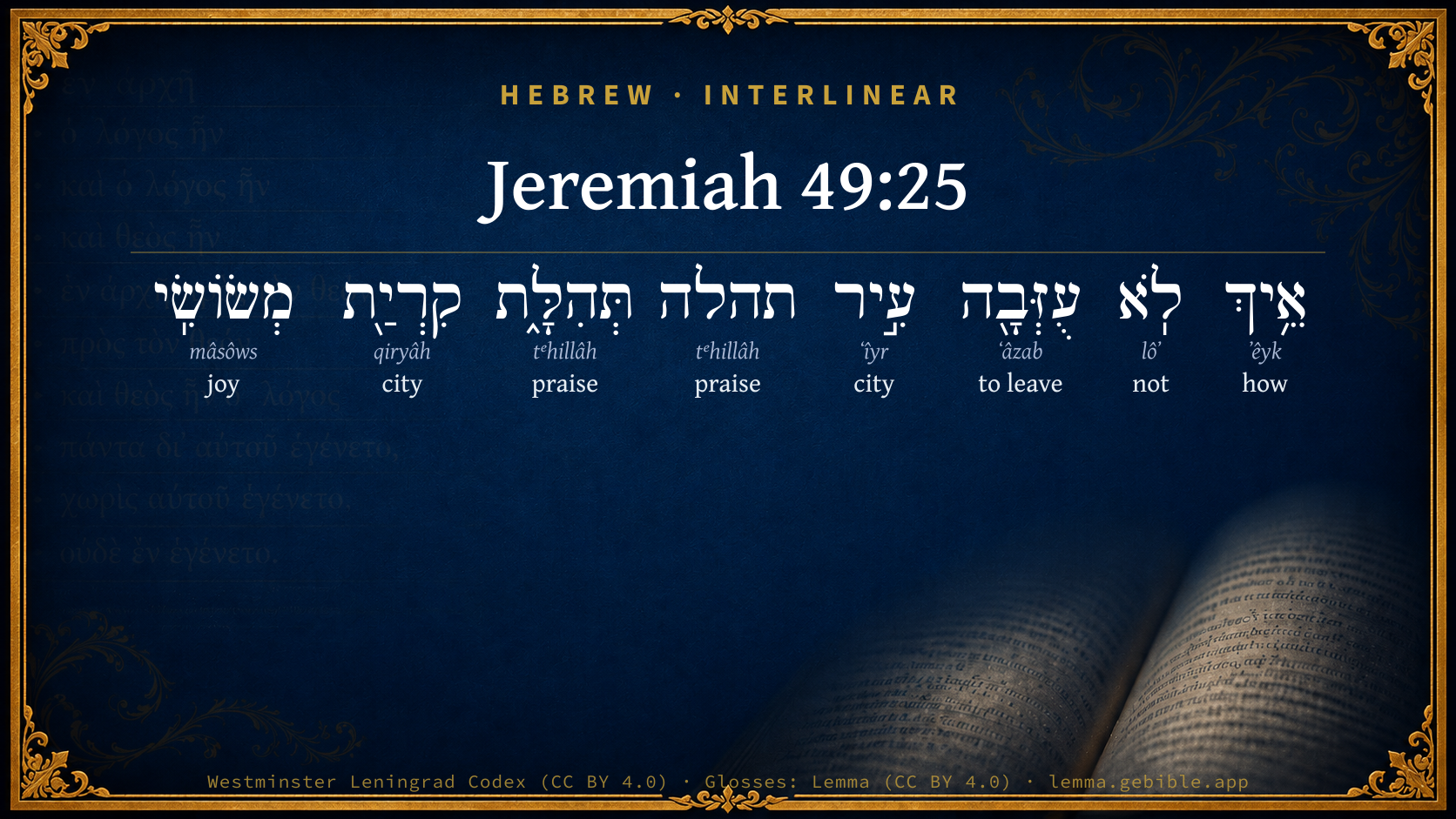
Hebrew (Westminster Leningrad Codex) Jeremiah 49:25 appears in the Hebrew Old Testament. The text above is from the Westminster Leningrad Codex. Each word links to its Strong’s number, a concise gloss, and parsing drawn from the Open Scriptures Hebrew Bible morphology. Click any word for its full Brown-Driver-Briggs (BDB) entry.
Download image
Cite this verse

Jeremiah 49:25 (World English Bible). Public Domain. Lemma interlinear Bible study tool, https://lemma.gebible.app/v/jeremiah/49/25.

Show BibTeX & RIS
BibTeX
RIS
English Translation
How is the city of praise not forsaken, the city of my joy?
World English Bible · Public Domain
Download a study sheet

One document with this verse’s original text, its word-by-word gloss line, the meaning frame, cross-references with their text, attributed commentary, and full source and license credits — printable, and it pastes into notes with its structure intact.

This verse Autodidact and up

Study sheet (.html) Plain text (.txt)

A passage Seminary Student

Up to 50 verses in one chapter. A passage sheet keeps up to 6 commentary sources and 12 cross-references per verse, in the order this page ranks them, and says so on the sheet whenever that leaves anything out. Ask for a single verse and you get the Autodidact verse sheet above.

Everything on this page stays free to read, with no account — the sheet is a download of what is already on screen, not access to it.

Want to remove ads? Support Godless Engineer
Compare translations 3

The same verse in 3 English versions, stacked beneath the original-language interlinear above. Click any original word for its lexicon entry.

Each is an independent rendering of the whole verse — the interlinear is not word-aligned to these translations.

Highlighted words mark where these versions differ — a whole-verse word diff, not a word-by-word alignment.

  • World English Bible Public Domain
    How is the city of praise not forsaken, the city of my joy?
  • King James Version Public Domain
    How is the city of praise not left, the city of my joy!
  • unfoldingWord Literal Text CC BY-SA 4.0
    How has the city of praise not been forsaken, the town of my joy?

unfoldingWord Literal Text — © unfoldingWord, licensed CC BY-SA 4.0. Word-aligned USFM3 via Door43 (git.door43.org/unfoldingWord/en_ult).

Versions to compare (up to 4)

3 of 4 selected

Show all 18 translations

Every available English version of this verse, each an independent rendering of the whole verse.

  • World English Bible Public Domain
    How is the city of praise not forsaken, the city of my joy?
  • Berean Standard Bible Public Domain
    How is the city of praise not forsaken, the town that brings Me joy?
  • Majority Standard Bible Public Domain
    How is the city of praise not forsaken, the town that brings Me joy?
  • King James Version Public Domain
    How is the city of praise not left, the city of my joy!
  • American Standard Version (1901) Public Domain
    How is the city of praise not forsaken, the city of my joy?
  • Revised Version (1885) Public Domain
    How is the city of praise not forsaken, the city of my joy?
  • Geneva Bible (1599) Public Domain
    How is the glorious citie not reserued, the citie of my ioy?
  • Douay-Rheims (1899) Public Domain
    How have they forsaken the city of renown, the city of joy!
  • Young's Literal Translation Public Domain
    How is it not left -- the city of praise, The city of my joy!
  • Literal Standard Version CC BY-SA 4.0
    How it is not left—the city of praise, || The city of My joy!
  • Unlocked Literal Bible CC BY-SA 4.0
    How has the city of praise not been forsaken, the town of my joy?
  • unfoldingWord Literal Text CC BY-SA 4.0
    How has the city of praise not been forsaken, the town of my joy?
  • Darby Bible Public Domain
    How is not the town of praise forsaken, the city of my joy!
  • World Messianic Bible Public Domain
    How is the city of praise not forsaken, the city of my joy?
  • Webster's Bible Public Domain
    How is the city of praise not left, the city of my joy!
  • Free Bible Version CC BY-SA 4.0
    Why isn't the city that is praised deserted, the city that made me happy?
  • Bible in Basic English Public Domain
    How has the town of praise been wasted, the place of joy!
  • JPS Tanakh (1917) Public Domain
    'How is the city of praise left unrepaired, the city of my joy?'

Literal Standard Version (2020), Covenant Press — licensed CC BY-SA 4.0. Text via the HelloAO Bible API (eBible.org). Unlocked Literal Bible (unfoldingWord) — licensed CC BY-SA 4.0. Text via the HelloAO Bible API (eBible.org). unfoldingWord Literal Text — © unfoldingWord, licensed CC BY-SA 4.0. Word-aligned USFM3 via Door43 (git.door43.org/unfoldingWord/en_ult). Free Bible Version, Dr. Jonathan Gallagher — licensed CC BY-SA 4.0. Text via the HelloAO Bible API (eBible.org).

Word by word

More ways to search: Search by grammar → Find every occurrence → Compare this word →

Practice this passage: Drill this verse → Learn its vocabulary →

About this verse

These counts appear in no published source. They are computed here, from the morphology-tagged text and Lemma’s own curated glosses. What Lemma adds →

8
words
7
distinct lemmas
Prophets
section

Notable vocabulary

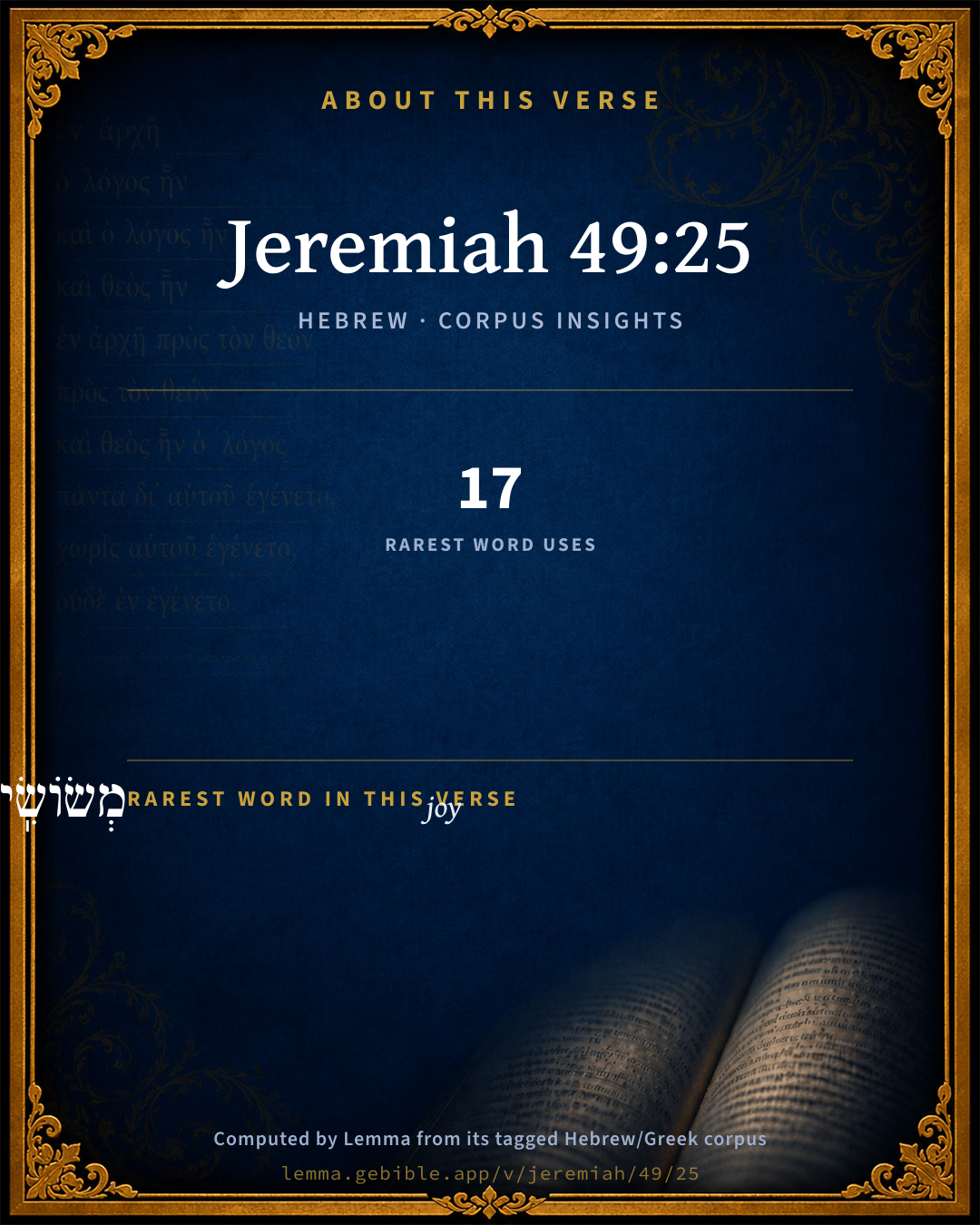
The rarest word here is מְשׂוֹשִֽׂי joy H4885 — appearing just 17 times in the whole Hebrew Bible.

Shared distinctive vocabulary

מְשׂוֹשִֽׂי joy H4885 occurs in 16 verses of the Hebrew Bible. Also found in:

Grammatical profile

  • 1 verb
  • 5 nouns
  • 2 particles

Verb forms

  • עֻזְּבָ֖ה Qal Passive · Perfect

Repetition

A word recurs within this verse — often emphatic in Hebrew:

  • תהלה praise H8416 ×2

Cross-references

10

Topical passages linked to Jeremiah 49:25 in the Treasury of Scripture Knowledge — connected by theme and wording, ordered by reader-vote popularity; previews shown in the World English Bible.

  • Jeremiah 33:9 [This city] shall be to me for a name of joy, for a praise and for a glory, before all the nations of the earth, which shall hear all the good that I do to them, and shall fear and tremble for all the good and for all the peace that I procure to it.
  • Jeremiah 51:41 How is Sheshach taken! and the praise of the whole earth seized! how is Babylon become a desolation among the nations!
  • Psalms 37:35–36 I have seen the wicked in great power, Spreading himself like a green tree in its native soil.
  • Isaiah 1:26 I will restore your judges as at the first, And your counselors as at the beginning. Afterward you shall be called 'The city of righteousness, A faithful town.'
  • Isaiah 14:4–6 that you shall take up this parable against the king of Babylon, and say, How has the oppressor ceased! the golden city ceased!
  • Jeremiah 48:2 The praise of Moab is no more; in Heshbon they have devised evil against her: Come, and let us cut her off from being a nation. You also, Madmen, shall be brought to silence: the sword shall pursue you.
  • Jeremiah 48:39 How is it broken down! [how] do they wail! how has Moab turned the back with shame! so shall Moab become a derision and a terror to all who are round about him.
  • Daniel 4:30 The king spoke and said, Is not this great Babylon, which I have built for the royal dwelling-place, by the might of my power and for the glory of my majesty?
  • Revelation 18:10 standing far away for the fear of her torment, saying, 'Woe, woe, the great city, Babylon, the strong city! For your judgment has come in one hour.'
  • Revelation 18:16–19 saying, 'Woe, woe, the great city, she who was dressed in fine linen, purple, and scarlet, and decked with gold and precious stones and pearls!

Cross-references courtesy of OpenBible.info (CC BY 4.0).

Hebrew and Greek witnesses Masoretic Hebrew ↔ Greek Septuagint

The same verse in the two great witnesses to the Old Testament, shown verse-for-verse.

These are two independent witnesses, not word-aligned to each other, and the Septuagint is shown in lemma (dictionary) form.

Hebrew Jeremiah 49:25 Masoretic · Westminster Leningrad Codex

אֵ֥יךְ לֹֽא עֻזְּבָ֖ה עִ֣יר תהלה תְּהִלָּ֑ת קִרְיַ֖ת מְשׂוֹשִֽׂי

How is the city of praise not forsaken, the city of my joy?

World English Bible · Public Domain

Greek LXX Structure differs

In the Septuagint, Jeremiah is about an eighth shorter than the Hebrew and arranges its material differently — the Oracles Against the Nations (Hebrew chapters 46–51) appear in the middle of the Greek book, after 25:13. Because the chapter and verse boundaries do not line up, a verse-for-verse comparison with the Hebrew is not shown.

A verse-for-verse comparison isn’t shown here because the chapters and verses don’t line up. Switch to the LXX edition with the MT / LXX toggle above to read the Greek directly.

On this verse, Haydock's Catholic Bible Commentary discusses the Septuagint’s reading. Read the note in Commentary ↓

Hebrew: Westminster Leningrad Codex (CC BY 4.0). Greek: Septuagint (public domain); English from a public-domain English Septuagint. How the Septuagint differs from the Hebrew →

Targum (Aramaic paraphrase)

1

The Targum is the ancient Jewish Aramaic paraphrase of the Hebrew Scriptures — an interpretive translation, not the Hebrew text itself. Onkelos (literal) and Pseudo-Jonathan (expansive) render the Torah, and Jonathan the Prophets. Coverage is partial: where no permissively-licensed English translation exists for a verse, only the Aramaic is shown. This is verse-level text, not a word-by-word alignment to the Hebrew.

  1. Targum Jonathan Prophets (Joshua–Malachi)
    אֵיכְדֵין לָא אִשְׁתְּבִיקַת קַרְתָּא מְשַׁבַּחְתָּא כְּרַכָּא חֲדָאָה:

    (no public-domain English translation for this verse)

    Targum Jonathan — Aramaic: “Mikraot Gedolot” (public domain). English: “Sefaria Community Translation” (CC0 1.0 (public-domain dedication)); “London "Chaldee Paraphrase," 1871” (public domain). Text via Sefaria.

Commentary

Notes on Jeremiah 49:25 from classic Christian and Jewish commentators (each source and its license shown beneath its notes). The classic Christian expositions comment on the surrounding passage and are grouped to its opening verse, so a note may address several verses; the Jewish commentaries on the Tanakh (Rashi and others) are per-verse, so they appear only where the commentator wrote on this verse.

Lemma curates 59 commentaries, every one of them public domain or Creative Commons licensed, each selected and text-cleaned for this edition rather than reprinted as found. About our sources →

Trapp's Complete Commentary

John Trapp

Jer 49:25 How is the city of praise not left, the city of my joy!

Ver. 25. How is the city of praise not left?] Why is so praiseworthy and renowned a city so demolished? See Jer 49:23. Cause enough there was, because it was a valley of vanity, {Amo 1:3-5} and Comus, Venus, and Bacchus there made their dividend, and shared their devotes.

John Trapp, A Commentary or Exposition upon All the Books of the Old and New Testament (1647–1656) — public domain. Text from a community e-Sword module.

Tyndale Open Study Notes

Tyndale Open Resources

49:25 Damascus had a long history of power and glory at the hub of major trade routes. Its people enjoyed prosperity and joy, but they would lose these pleasures when they were forsaken by the Lord.

Tyndale Open Study Notes — © Tyndale Open Resources, licensed CC BY-SA 4.0. Text via the HelloAO Bible API.

Geneva Bible (1599)

Geneva Bible translators

He speaketh this in the person of the king and of them of the country, who shall wonder to see Damascus the chief city destroyed.

Geneva Bible (1599) marginal notes — public domain. Text via Bolls.life.

Jamieson, Fausset & Brown

Robert Jamieson, A. R. Fausset & David Brown

city of praise--The prophet, in the person of a citizen of Damascus deploring its calamity, calls it "the city of praise," that is, celebrated with praises everywhere for its beauty (Jer 33:9; Jer 51:41). "How is it possible that such a city has not been left whole--has not been spared by the foe?" Compare left, Luk 17:35-36. So Israel "left" standing some of the Canaanite cities (Jos 11:13).

of my joy--that is, in which I delighted.

Jamieson, Fausset & Brown — Commentary Critical and Explanatory on the Whole Bible (1871) — public domain (CC PDM 1.0). Text via the HelloAO Bible API.

Adam Clarke's Commentary

Verse 25. How is the city of praise not left] Damascus is so ruined that she can no more be called a praiseworthy or happy city.

Adam Clarke's Commentary on the Bible (1810–1826) — public domain. Text from a community e-Sword/MySword module.

John Calvin's Commentaries

Some think “my” to be redundant, and therefore render it “the city of joy;” but they seem to be induced by no good reason; for they think it absurd that it should be called a city of joy to the Prophet, since he ought not to have regarded Damascus with any love or kindness. But the prophets, we know, do not always speak according to their own feelings, but assume the persons of others. We might then fitly read the words as they are, the city of my joy! Besides, Jeremiah very cuttingly exults over Damascus, when he thus expresses his wonder at its destruction: “How can this be,” he says, “that the city of praise, that is, a celebrated city, and the city of my joy, that is, a spectacle so noble as to cause joy to all, — how can it be that this city should not be left, that is, should not be spared?” For by “left” he does not mean forsaken by its inhabitants, or reduced to solitude; for by “left” he means untouched or safe.

But we must ever bear in mind what we have often stated, that the prophets, when they thus speak in astonishment, do not adopt an elevated style as rhetoricians do, to show their eloquence, but have always a regard to what is profitable. It was necessary powerfully to impress the minds of men, when the Prophet spoke of the ruin of so great a city. Then this astonishment includes what they call an anticipation; for it obviated a doubt which might have prevented credit from being given to this prophecy. This might have immediately occurred to every one, “How can it be that Damascus is to perish?” Then the Prophet anticipates this, and shews, that though this was contrary to the judgment commonly formed, yet, as the Lord had so decreed, the destruction of that city was certain. We now then perceive the design of the Prophet. It afterwards follows, —

John Calvin's Commentaries (1540-1563) — public domain. Text from the Calvin Translation Society English edition (1840s-50s) via the Christian Classics Ethereal Library (ccel.org). Calvin's coverage is partial (roughly two-thirds of the Bible); uncommented books and verses are honest gaps, never fabricated. The 19th-century editor's footnotes and remarks are omitted so the notes are faithfully Calvin's own voice.

Ellicott's Commentary for English Readers

(25) How is the city of praise not left . . . !—The exclamation, half scornful, half ironical, points to the fact that the inhabitants of Damascus had tried in vain to flee (Jer_49:24). The city so fair and glorious, with its rivers Abana and Pharphar (2Ki_5:12), had not been “left,” would not be empty when it was taken. The people would perish with it. Her young warriors and her veterans should be cut off within the walls.

A Bible Commentary for English Readers, edited by Charles John Ellicott (1878–1897) — public domain. Text from a community e-Sword module.

The Cambridge Bible for Schools and Colleges

gen. ed. J. J. S. Perowne

25. not forsaken] The negative quite reverses the sense we should expect. Accordingly Du. and Co., emending the MT., render respectively, “Woe to her!” and “Woe to me!” continuing, “For the city of praise is forsaken.”

the city of my joy] We should probably, with several Versions, omit the pronoun, and so put the words in the mouth of the prophet, and not of an inhabitant of the doomed city.

The Cambridge Bible for Schools and Colleges (gen. ed. J. J. S. Perowne; Cambridge University Press, 1878–1918) — public domain. Text from a community e-Sword module.

John Gill's Exposition

How is the city of praise not left,.... The city of Damascus, famous for its antiquity, its wealth and riches, strength and power; and with the Heathens for its devotion and superstition. So Julian (i) the emperor calls it,

"the truly city of Jupiter; the eye of the whole east; Damascus the holy and the greatest;''

but more especially for its delightful and pleasant situation. Benjamin Tudelensis (k) says it was, in his time,

"a very great and beautiful city, surrounded with a wall; and the country about it was full of gardens and orchards, fifteen miles' walk on every side of it; and no city in the whole world appeared with such plenty of fruit as that did.''

Monsieur Thevenot (l) relates, that

"the city of Damascus is in the middle of a spacious plain, surrounded with hills, but all distant from the town, almost out of sight; those on the north side are the nearest, on which side it hath a great many gardens, full of trees, and most fruit trees; these gardens take up the ground from the hill of the forty martyrs, even to the town; so that at a distance it seems to be a forest.''

Mr. Maundrell (m) tells us, that the Turks relate this story of their prophet Mahomet, that,

"coming near Damascus, he took his station at a high precipice, in order to view it; and considering the ravishing beauty and delightfulness of it, he would not tempt his frailty by entering into it; but instantly departed with this reflection on it, that there was but one paradise designed for men, and for his part he was resolved not take his in this world;''

and, adds the same traveller,

"you have indeed from the precipice the most perfect prospect of Damascus; and certainly no place in the world can promise the beholder at a distance greater voluptuousness. It is situate in an even plain of so great extent, that you can but just discern the mountains that compass it on the farther side. In its length it extends near two miles, and is encompassed with gardens, extending no less, according to common estimation, than thirty miles round; which makes it look like a noble city in a vast wood.''

Strabo (n) says of this city, that it is worthy of praise, and almost the most famous city of all near Persia. The sense of it either is, how is it that so famous a city was not spared by the enemy, that they did not leave it untouched, but destroyed and demolished it? or how is it that it was not fortified by the inhabitants of it; that a parapet was not built about the wall all around, to strengthen it, and keep out the enemy? This sense, as well as the former, is mentioned both by Jarchi and Kimchi, who direct to Nah 3:8, for the confirmation of this sense of the word:

the city of my joy! these are either the words of the prophet, who had a great regard to the city of Damascus as ancient, well built, and opulent city, and lamented its destruction; or rather of the king of it, as Jarchi; or of the inhabitants of it, who said this to one another as they fled; so Kimchi: but there is no necessity of rendering it "my joy", only "joy"; for the "jod" affixed may not be considered as a pronoun, but as a paragogic, or a Syriac termination, which is common; though some interpret this of the city of Jerusalem, and as spoken by the Lord, or by the prophet in his name, upbraiding the Syrians for their hatred to it, and disturbance they gave it; and which is now mentioned as one cause and reason of their ruin; see Amo 1:3.

(i) Opera, par. 2. Ep. 24. p. 145. (k) Itinerarium, p. 54, 55. (l) Travels, par. 2. B. 1. p. I9. (m) Journey from Aleppo to Jerusalem, p. 121, 122. Ed. 7. (n) Geograph. l. 16. p. 520.

John Gill's Exposition of the Whole Bible (1746–1763) — public domain (CC PDM 1.0). Text via the HelloAO Bible API.

Albert Barnes' Notes on the Bible

An exclamation of sorrow wrung from the prophet at the thought of the people of Damascus remaining to be slaughtered. The words my joy express the prophet’s own sympathy. The praise of Damascus for beauty has been universal from the days of Naaman 2Ki 5:12, to those of recent travelers.

Albert Barnes' Notes on the Bible (1834–1885) — public domain. Text from a community e-Sword/MySword module.

Haydock's Catholic Bible Commentary

They. Hebrew, Septuagint, and Chaldean add, "not." Why have they not spared this beautiful city? or, why have not its citizens given it up, to prevent its entire demolition?

George Leo Haydock (1774–1849), Haydock's Catholic Family Bible and Commentary, 1859 edition — public domain. Excludes Psalms (Douay-Rheims chapter numbering differs from Protestant) and Deuterocanonical books (Catholic canon only).

Matthew Poole's English Annotations

It is called

the city of praise, because it was a city so much praised, a city of great renown, which the prophet seeing like to be destroyed, lamenteth either in the person of the king of Syria, or of the Syrian inhabitants, wondering that the conquerors should not spare so famous and renowned a city, in which so many did rejoice.

Matthew Poole's English Annotations on the Holy Bible (1683–1685) — public domain. Text from a community e-Sword/MySword module.

The Pulpit Commentary

Hew is the city of praise not left, etc.! A difficult passage. The construction, indeed, is plain. "How is not," etc. I can only mean "How is it that the city of praise is not," etc.? (comp. 2Sa_1:14) The difficulty lies in the word rendered "left." The ordinary meaning of the verb, when applied to cities, is certainly "to leave without inhabitants;" e.g. Jer_4:29 Isa_7:16 Isa_32:14. This, however, does not suit the context, which shows that "the daughter of Damascus" personified is the speaker, so that ver. 25 ought rather to mean, "How is it that the city of praise is not, "is not forsaken?" Either, then, we must suppose that "not" has been inserted by mistake a too arbitrary step, seeing that there is no negative in the context to account for the insertion (the case is different, therefore, from Job_21:30 Job_27:15, where such an insertion is at any rate justifiable); or else we must give uzzebhah the sense of "let go free". (Exo_23:5 Deu_32:36 Job_10:1) It is the obstinate incredulity of love which refuses to admit the possibility of the destruction of the loved object. The city of praise. The city which is my "praise," or boast. Few cities, in fact, have had so long and brilliant an existence as Damascus.

The Pulpit Commentary (1880–1919), ed. H.D.M. Spence-Jones & Joseph S. Exell — public domain. Text from a community e-Sword module.

John Wesley's Explanatory Notes

Of my joy - A city of great renown. The king of Syria is here supposed to speak.

John Wesley, Explanatory Notes Upon the Whole Bible (1754–1765) — public domain. Text via the GEBible commentary corpus.

Rashi

Rabbi Shlomo Yitzchaki (Rashi)

“How was...not fortified” It was not filled with earth around its wall to strengthen the wall. Cf. “And they fortified (ויעזבוּ) Jerusalem up to the wall” (Neh. 3:8). It can also be interpreted: Why was it not forsaken by this evil, that the evil should not come upon it?

the city of my joy So shall her king mourn over her.

Rashi on the Tanakh — English translations: “The Judaica Press complete Tanach with Rashi, translated by A. J. Rosenberg” (CC BY 4.0); “Pentateuch with Rashi's commentary by M. Rosenbaum and A.M. Silbermann, 1929-1934” (public domain); “The Metsudah Tanach series, Lakewood, N.J” (CC BY 4.0); and “The Book of Joshua, Metsudah Publications, 1997” (CC BY 4.0). Text via Sefaria.

Lesson kit

Teaching starters — assembled from the data on this page, not authored interpretation. Every prompt links to the verse data it draws on. Edit before teaching.

Jeremiah, in the Prophets, opens this verse with 8 words (7 distinct Hebrew lemmas). Its most distinctive word is mâsôws (“joy”). A historical commentator’s framing appears above. Read the whole chapter for the surrounding context.

Discussion questions

  1. The word mâsôws carries the sense “joy.” How does it shape the verse?
  2. How does Job 8:19, which shares the word «joy», read alongside this verse?
  3. What does the repetition of “praise” (2× in this one verse) do in this verse?
  4. These translations render this verse differently; the difference is in the English rendering, not the original. What questions does that raise?
  5. «עֻזְּבָ֖ה» is a Qal Passive Perfect verb. How does that grammatical form shape the action described?
  6. Compare how Trapp's Complete Commentary and Tyndale Open Study Notes read this verse. Where do they agree or differ?

Things to notice

  • These translations choose different wording for 5 words in this verse.
  • “praise” occurs 2× in this single verse.
  • 7 distinct Hebrew lemmas span 8 words in this verse.

Reading settings

Reading text

Shown beneath each verse's original-language words.

Old Testament
Old Testament edition

Read the OT as the Masoretic Hebrew (MT) or the Greek Septuagint (LXX).

English shown for the Greek Septuagint (in the Hebrew ↔ Greek comparison).

Comparing translations? Open the Compare panel on any verse page to stack up to four side by side.