
1 Kings 12:8

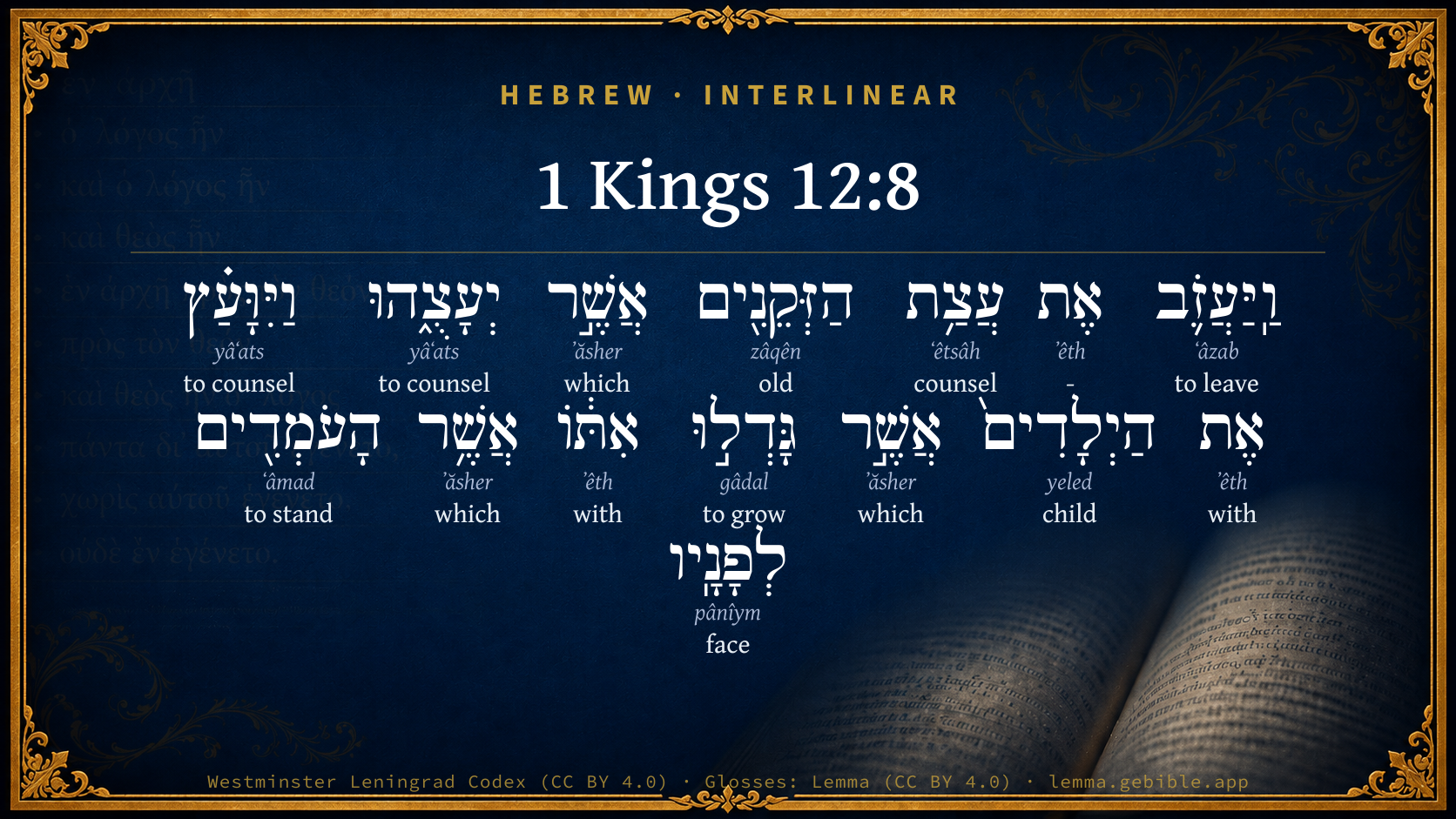
Hebrew (Westminster Leningrad Codex) 1 Kings 12:8 appears in the Hebrew Old Testament. The text above is from the Westminster Leningrad Codex. Each word links to its Strong’s number, a concise gloss, and parsing drawn from the Open Scriptures Hebrew Bible morphology. Click any word for its full Brown-Driver-Briggs (BDB) entry.
Download image
Cite this verse

1 Kings 12:8 (World English Bible). Public Domain. Lemma interlinear Bible study tool, https://lemma.gebible.app/v/1-kings/12/8.

Show BibTeX & RIS
BibTeX
RIS
English Translation
But he forsook the counsel of the old men which they had given him, and took counsel with the young men who had grown up with him, who stood before him.
World English Bible · Public Domain
Download a study sheet

One document with this verse’s original text, its word-by-word gloss line, the meaning frame, cross-references with their text, attributed commentary, and full source and license credits — printable, and it pastes into notes with its structure intact.

This verse Autodidact and up

Study sheet (.html) Plain text (.txt)

A passage Seminary Student

Up to 50 verses in one chapter. A passage sheet keeps up to 6 commentary sources and 12 cross-references per verse, in the order this page ranks them, and says so on the sheet whenever that leaves anything out. Ask for a single verse and you get the Autodidact verse sheet above.

Everything on this page stays free to read, with no account — the sheet is a download of what is already on screen, not access to it.

Want to remove ads? Support Godless Engineer
Compare translations 3

The same verse in 3 English versions, stacked beneath the original-language interlinear above. Click any original word for its lexicon entry.

Each is an independent rendering of the whole verse — the interlinear is not word-aligned to these translations.

Highlighted words mark where these versions differ — a whole-verse word diff, not a word-by-word alignment.

  • World English Bible Public Domain
    But he forsook the counsel of the old men which they had given him, and took counsel with the young men who had grown up with him, who stood before him.
  • King James Version Public Domain
    But he forsook the counsel of the old men, which they had given him, and consulted with the young men that were grown up with him, and which stood before him:
  • unfoldingWord Literal Text CC BY-SA 4.0
    But he forsook the counsel of the elders that they had counseled him, and he consulted with the young men who had grown up with him who were standing to his face.

unfoldingWord Literal Text — © unfoldingWord, licensed CC BY-SA 4.0. Word-aligned USFM3 via Door43 (git.door43.org/unfoldingWord/en_ult).

Versions to compare (up to 4)

3 of 4 selected

Show all 18 translations

Every available English version of this verse, each an independent rendering of the whole verse.

  • World English Bible Public Domain
    But he forsook the counsel of the old men which they had given him, and took counsel with the young men who had grown up with him, who stood before him.
  • Berean Standard Bible Public Domain
    But Rehoboam rejected the advice of the elders; instead, he consulted the young men who had grown up with him and served him.
  • Majority Standard Bible Public Domain
    But Rehoboam rejected the advice of the elders; instead, he consulted the young men who had grown up with him and served him.
  • King James Version Public Domain
    But he forsook the counsel of the old men, which they had given him, and consulted with the young men that were grown up with him, and which stood before him:
  • American Standard Version (1901) Public Domain
    But he forsook the counsel of the old men which they had given him, and took counsel with the young men that were grown up with him, that stood before him.
  • Revised Version (1885) Public Domain
    But he forsook the counsel of the old men which they had given him, and took counsel with the young men that were grown up with him, that stood before him.
  • Geneva Bible (1599) Public Domain
    But he forsooke the counsell that the olde men had giuen him, and asked counsell of the yong men that had bene brought vp with him, and waited on him.
  • Douay-Rheims (1899) Public Domain
    But he left the counsel of the old men, which they had given him, and consulted with the young men, that had been brought up with him, and stood before him.
  • Young's Literal Translation Public Domain
    And he forsaketh the counsel of the elders which they counselled him, and consulteth with the lads who have grown up with him, who are standing before him;
  • Literal Standard Version CC BY-SA 4.0
    And he forsakes the counsel of the elderly which they counseled him, and consults with the boys who have grown up with him, who are standing before him;
  • Unlocked Literal Bible CC BY-SA 4.0
    But Rehoboam ignored the advice that the old men had given him and he consulted with the young men who had grown up with him and stood before him.
  • unfoldingWord Literal Text CC BY-SA 4.0
    But he forsook the counsel of the elders that they had counseled him, and he consulted with the young men who had grown up with him who were standing to his face.
  • Darby Bible Public Domain
    But he forsook the advice of the old men which they had given him, and consulted with the young men, who had grown up with him, that stood before him.
  • World Messianic Bible Public Domain
    But he abandoned the counsel of the old men which they had given him, and took counsel with the young men who had grown up with him, who stood before him.
  • Webster's Bible Public Domain
    But he forsook the counsel of the old men, which they had given him, and consulted with the young men that had grown up with him, and who stood before him:
  • Free Bible Version CC BY-SA 4.0
    But Rehoboam dismissed the advice of the elders. Instead he consulted the young men he had grown up with, and who were close to him.
  • Bible in Basic English Public Domain
    But he gave no attention to the opinion of the old men, and went to the young men of his generation who were waiting before him:
  • JPS Tanakh (1917) Public Domain
    But he forsook the counsel of the old men which they had given him, and took counsel with the young men that were grown up with him, that stood before him.

Literal Standard Version (2020), Covenant Press — licensed CC BY-SA 4.0. Text via the HelloAO Bible API (eBible.org). Unlocked Literal Bible (unfoldingWord) — licensed CC BY-SA 4.0. Text via the HelloAO Bible API (eBible.org). unfoldingWord Literal Text — © unfoldingWord, licensed CC BY-SA 4.0. Word-aligned USFM3 via Door43 (git.door43.org/unfoldingWord/en_ult). Free Bible Version, Dr. Jonathan Gallagher — licensed CC BY-SA 4.0. Text via the HelloAO Bible API (eBible.org).

Word by word

More ways to search: Search by grammar → Find every occurrence → Compare this word →

Practice this passage: Drill this verse → Learn its vocabulary →

יְעָצֻ֑הוּ
yâʻats
H3289
“to counsel · him”
Verb, Qal, Perfect, 3rd Person, Common, Plural + Suffix, Personal, 3rd Person, Masculine, Singular
Part of Speech
Verb
Stem
Qal
Form
Perfect
Person
3rd Person
Gender
Common
Number
Plural
Full BDB Definition

Origin: a primitive root

TWOT: 887

to advise, consult, give counsel, counsel, purpose, devise, plan - (Qal) - to advise, counsel, give counsel, consult - counsellor (participle) - (Niphal) to consult together, exchange counsel, deliberate, counsel together - (Hithpael) to conspire
  1. וַֽיַּעֲזֹ֛ב ʻâzab H5800 “and · to leave” Conjunction + Verb, Qal, Sequential Imperfect, 3rd Person, Masculine, Singular
  2. אֶת ʼêth H853 “-” Particle, Direct Object
  3. עֲצַ֥ת ʻêtsâh H6098 “counsel of” Noun, Common, Feminine, Singular, Construct
  4. הַזְּקֵנִ֖ים zâqên H2205 “the · old” Particle, Definite Article + Adjective, Adjective, Masculine, Plural, Absolute
  5. אֲשֶׁ֣ר ʼăsher H834 “which” Particle, Relative
  6. וַיִּוָּעַ֗ץ yâʻats H3289 “and · to counsel” Conjunction + Verb, Niphal, Sequential Imperfect, 3rd Person, Masculine, Singular
  7. אֶת ʼêth H854 “with” Preposition
  8. הַיְלָדִים֙ yeled H3206 “the · children” Particle, Definite Article + Noun, Common, Masculine, Plural, Absolute
  9. אֲשֶׁ֣ר ʼăsher H834 “which” Particle, Relative
  10. גָּדְל֣וּ gâdal H1431 “to grow” Verb, Qal, Perfect, 3rd Person, Common, Plural
  11. אִתּ֔וֹ ʼêth H854 “with · him” Preposition + Suffix, Personal, 3rd Person, Masculine, Singular
  12. אֲשֶׁ֥ר ʼăsher H834 “which” Particle, Relative
  13. הָעֹמְדִ֖ים ʻâmad H5975 “the · standing” Particle, Definite Article + Verb, Qal, Participle Active, Masculine, Plural, Absolute
  14. לְפָנָֽיו pânîym H6440 “to/for · face(s) · his” Preposition + Noun, Common, Both, Plural, Construct + Suffix, Personal, 3rd Person, Masculine, Singular

About this verse

These counts appear in no published source. They are computed here, from the morphology-tagged text and Lemma’s own curated glosses. What Lemma adds →

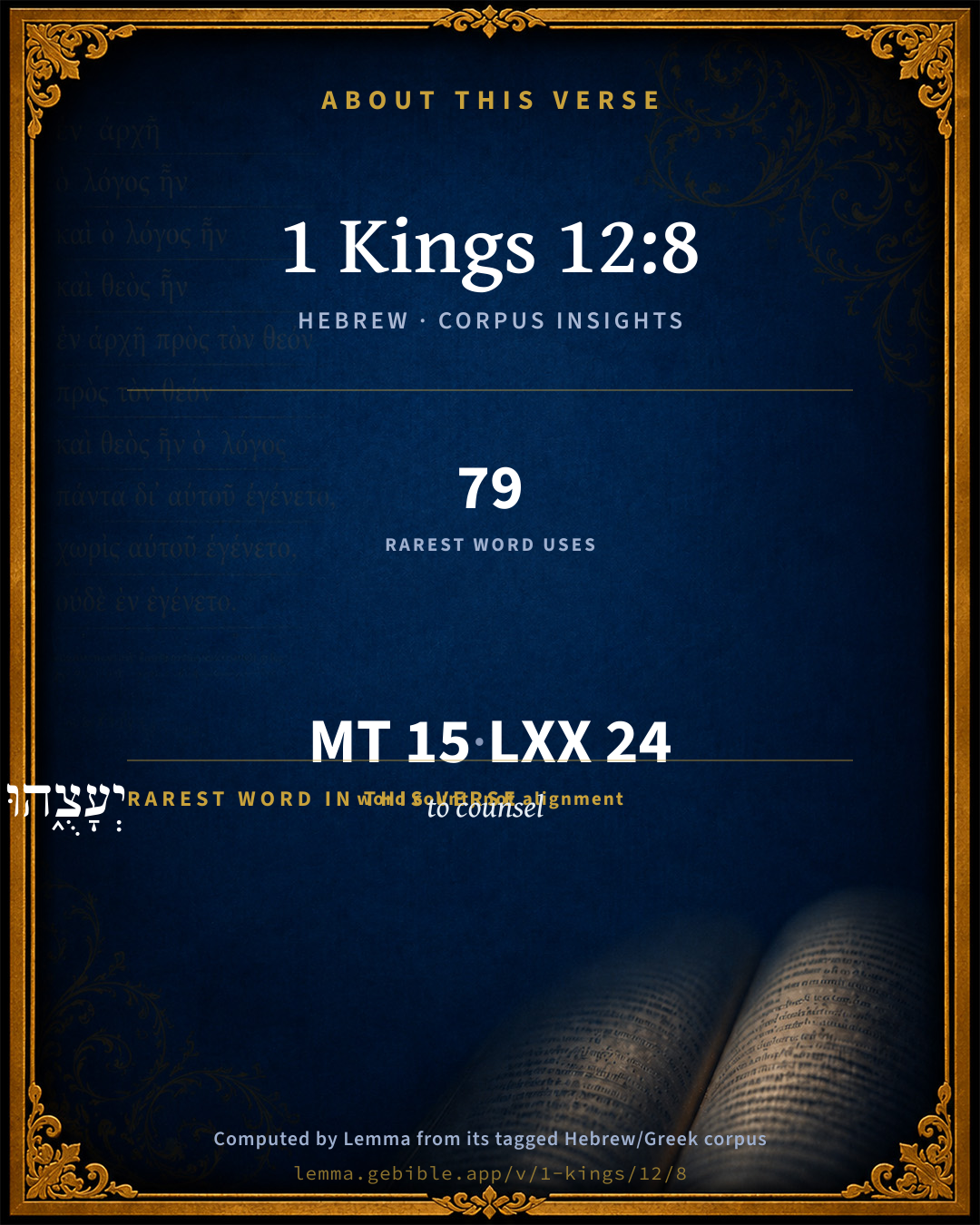
15
words
11
distinct lemmas
Historical
section

Grammatical profile

  • 5 verbs
  • 3 nouns
  • 1 adjective
  • 2 prepositions
  • 4 particles

Verb forms

  • וַֽיַּעֲזֹ֛ב Qal · Sequential Imperfect
  • יְעָצֻ֑הוּ Qal · Perfect
  • וַיִּוָּעַ֗ץ Niphal · Sequential Imperfect
  • גָּדְל֣וּ Qal · Perfect
  • הָעֹמְדִ֖ים Qal · Participle Active

Repetition

Words recur within this verse — often emphatic in Hebrew:

  • יְעָצֻ֑הוּ to counsel H3289 ×2
  • אֲשֶׁ֣ר which H834 ×3
  • אֶת with H854 ×2

Hebrew & Septuagint length

In English translation the verse runs 31 words from the Hebrew and 30 from the Septuagint (LXX English) — closely comparable.

A rough comparison of the two English renderings, which tokenize alike — not a word-level alignment.

Word counts can differ between the Hebrew and the Greek without any difference in meaning — e.g. the Hebrew direct-object marker אֵת has no separate Greek word, and Greek often adds the article ὁ.

In the original languages it is 15 Hebrew tokens and 24 Greek tokens — but the two are counted differently (Hebrew bundles its prefixes and suffixes into one token; the Greek is in lemma form), so that isn’t a like-for-like length.

Cross-references

8

Topical passages linked to 1 Kings 12:8 in the Treasury of Scripture Knowledge — connected by theme and wording, ordered by reader-vote popularity; previews shown in the World English Bible.

  • Proverbs 19:20 Listen to counsel and receive instruction, That you may be wise in your latter end.
  • 2 Chronicles 10:8 But he forsook the counsel of the old men which they had given him, and took counsel with the young men who had grown up with him, who stood before him.
  • 2 Chronicles 25:15–16 Therefore the anger of Yahweh was kindled against Amaziah, and he sent to him a prophet, who said to him, Why have you sought after the gods of the people, which have not delivered their own people out of your hand?
  • Proverbs 1:2–5 To know wisdom and instruction; To discern the words of understanding;
  • Proverbs 1:25 But you have ignored all my counsel, And wanted none of my reproof;
  • Proverbs 1:30 They wanted none of my counsel. They despised all my reproof.
  • Proverbs 25:12 As an ear-ring of gold, and an ornament of fine gold, So is a wise reprover to an obedient ear.
  • Ecclesiastes 10:2–3 A wise man's heart is at his right hand, but a fool's heart at his left.

Cross-references courtesy of OpenBible.info (CC BY 4.0).

Hebrew and Greek witnesses Masoretic Hebrew ↔ Greek Septuagint

The same verse in the two great witnesses to the Old Testament, shown verse-for-verse.

These are two independent witnesses, not word-aligned to each other, and the Septuagint is shown in lemma (dictionary) form.

Hebrew 1 Kings 12:8 Masoretic · Westminster Leningrad Codex

וַֽיַּעֲזֹ֛ב אֶת עֲצַ֥ת הַזְּקֵנִ֖ים אֲשֶׁ֣ר יְעָצֻ֑הוּ וַיִּוָּעַ֗ץ אֶת הַיְלָדִים֙ אֲשֶׁ֣ר גָּדְל֣וּ אִתּ֔וֹ אֲשֶׁ֥ר הָעֹמְדִ֖ים לְפָנָֽיו

But he forsook the counsel of the old men which they had given him, and took counsel with the young men who had grown up with him, who stood before him.

World English Bible · Public Domain

Greek LXX 1 Kings 12:8 Septuagint · lemma form

καί ἐν καταλείπω ὁ βουλή ὁ πρεσβύτερος ὅς συνβουλεύω αὐτός καί συνβουλεύω μετά ὁ παιδάριον ὁ ἐκτρέφω μετά αὐτός ὁ παραἵστημι πρό πρόσωπον αὐτός

But he forsook the counsel of the old men which they gave him, and consulted with the young men who were brought up with him, who stood in his presence.

LXX2012 (modern English Septuagint) · Public Domain

Hebrew: Westminster Leningrad Codex (CC BY 4.0). Greek: Septuagint (public domain); English from LXX2012 (modern English Septuagint) (Public Domain). How the Septuagint differs from the Hebrew →

Targum (Aramaic paraphrase)

1

The Targum is the ancient Jewish Aramaic paraphrase of the Hebrew Scriptures — an interpretive translation, not the Hebrew text itself. Onkelos (literal) and Pseudo-Jonathan (expansive) render the Torah, and Jonathan the Prophets. Coverage is partial: where no permissively-licensed English translation exists for a verse, only the Aramaic is shown. This is verse-level text, not a word-by-word alignment to the Hebrew.

  1. Targum Jonathan Prophets (Joshua–Malachi)
    וּשְׁבַק יַת מַלְכָּא דְסָבַיָא דִי מַלְכוּהִי וְאִתְמְלִיךְ בְּיַנְקַיָא דִרְבִיאוּ עִמֵיהּ דִמְשַׁמְשִׁין קֳדָמוֹהִי:

    (no public-domain English translation for this verse)

    Targum Jonathan — Aramaic: “Mikraot Gedolot” (public domain). English: “Sefaria Community Translation” (CC0 1.0 (public-domain dedication)); “London "Chaldee Paraphrase," 1871” (public domain). Text via Sefaria.

Commentary

Notes on 1 Kings 12:8 from classic Christian and Jewish commentators (each source and its license shown beneath its notes). The classic Christian expositions comment on the surrounding passage and are grouped to its opening verse, so a note may address several verses; the Jewish commentaries on the Tanakh (Rashi and others) are per-verse, so they appear only where the commentator wrote on this verse.

Lemma curates 59 commentaries, every one of them public domain or Creative Commons licensed, each selected and text-cleaned for this edition rather than reprinted as found. About our sources →

Trapp's Complete Commentary

John Trapp

1Ki 12:8 But he forsook the counsel of the old men, which they had given him, and consulted with the young men that were grown up with him, [and] which stood before him:

Ver. 8. But he forsook the counsel of the old men.] With whom he consulted only for fashion’s sake - as Xerxes did when he went against Greece, {a} - resolved beforehand to stand upon his pantofles, and not at all to stoop to the people. He had those about him, doubtless, that would tell him - as some court parasites did our king John, when he had yielded to the requests of his barons for the subjects’ liberty {b} - that now he was "a king without a kingdom, a lord without a dominion, and a subject to his subjects."

And consulted with the young men.] So did our king Richard II, to his utter ruin. So did Xerxes despise the grave counsel of his uncle Artabanus; and was wholly led by young Mardonius, to the loss of all. {c} The like is reported of Dionysius, king of Sicily; Croesus, king of Lydia; Nero, emperor of Rome; {d} James, that reigned in Scotland in Edward IV’s time; {e} and Lautrer, of whom it is reported that he lost the kingdom of Naples from the French king his master, and all that he had in Italy, because he would not ask nor follow the advice of them that were wiser than himself. {f}

{a} Val. Max.

{b} Daniel.

{c} Herodot., lib. vii.

{d} Sueton.

{e} Daniel.

{f} Sir R. Berk., Sum. Bon.

John Trapp, A Commentary or Exposition upon All the Books of the Old and New Testament (1647–1656) — public domain. Text from a community e-Sword module.

Joseph Benson's Commentary

1Ki 12:8. But he forsook the counsel of the old men — Judging it unworthy of his majesty and authority, and likely to encourage the people in their insolent demands; and, being proud and vain, he scorned to condescend to them and court them in this way, but would have obedience paid to him as to an absolute monarch; and consulted with the young men — So called compared with the old men, otherwise, as they had grown up with him, they must have been near forty years old. They were, however, men who were unexperienced, and who understood not the humour of the people they had to do with. This is frequently the fault of new kings: to show their power, and gratify their dependants, they frequently change their counsellors and put in new officers; not considering who are wisest and worthiest, but who have been their companions.

Joseph Benson's Commentary on the Old and New Testaments (1811–1818) — public domain. Text from a community e-Sword module.

Tyndale Open Study Notes

Tyndale Open Resources

12:8-10 young men: Rehoboam’s appointed contemporaries took a hard line and advised the opposite of the older men.

Tyndale Open Study Notes — © Tyndale Open Resources, licensed CC BY-SA 4.0. Text via the HelloAO Bible API.

The Cambridge Bible for Schools and Colleges

gen. ed. J. J. S. Perowne

8. young men that were grown up with him] i.e. Who were about the same age. It is not needful to suppose that they had been educated with him from their youth up. They now being his contemporaries were chosen to ‘stand before him,’ to be his privy counsellors. This office the older men had held under Solomon (see 1Ki_12:6).

The Cambridge Bible for Schools and Colleges (gen. ed. J. J. S. Perowne; Cambridge University Press, 1878–1918) — public domain. Text from a community e-Sword module.

John Gill's Exposition

But he forsook the counsel of the old men, which they had given him,.... He did not rightly relish it, nor cordially receive it; it did not suit with his haughty temper, he could not brook it, to stoop to his people; he thought it a lessening of his dignity to do anything that looked like courting their favour; and therefore determined not to take the advice given him by the old men, but to seek for other:

and consulted with the men, that were grown up with him, and which stood before him; the sons of nobles, with whom he had his education, and who were his companions from his youth upwards, and who were now officers in his court, and of his privy council, being his favourites, and those he consulted on this occasion; and though they are called young men, as they were in comparison of the old men, yet since they were contemporary with Rehoboam, who was now forty one years of age, they must be about forty, or not much under, and at an age to be wiser than they appeared to be.

John Gill's Exposition of the Whole Bible (1746–1763) — public domain (CC PDM 1.0). Text via the HelloAO Bible API.

Albert Barnes' Notes on the Bible

The age of Rehoboam at his accession is an interesting and difficult question. According to the formal statement of the present text of 1Ki 14:21; 2Ch 12:13, he had reached the mature age of 41 years, and would therefore be unable to plead youth as an excuse for his conduct. The general narrative, however, seems to assume that he was quite a young man (compare 2Ch 13:7). Perhaps the best way of removing the whole difficulty would be to read in the above text “twenty-one” for “forty-one.” The corruption is one which might easily take place, if letters were used for numerals.

Albert Barnes' Notes on the Bible (1834–1885) — public domain. Text from a community e-Sword/MySword module.

Haydock's Catholic Bible Commentary

Him. They were young, compared with the former, though they might be 40 years old. (Menochius) --- It was frequently the custom in the eastern courts, to educate young noblemen along with the heir to the crown. Such formed the captains of Alexander, (1 Machabees i. 7,) and the warriors of Sesostris, whose father ordered all the male children who were born on the same day in his dominions, to be brought to court, to be educated with his son. (Diodorus i.) --- The Persian nobility were brought up at the gate of the prince, that they might learn temperance and the art of governing. (Xenophon, Cyrop. i.) --- The endeavours of Solomon were frustrated by the evil disposition of his son, and of those about his person.

George Leo Haydock (1774–1849), Haydock's Catholic Family Bible and Commentary, 1859 edition — public domain. Excludes Psalms (Douay-Rheims chapter numbering differs from Protestant) and Deuterocanonical books (Catholic canon only).

Matthew Poole's English Annotations

He forsook the counsel of the old men; judging it unworthy of his majesty and authority, and likely to encourage and increase the people in their insolent demands. The young men; so called comparatively to the old men; otherwise they were near forty years old, as the following words imply.

That were grown up with him; which is added as the reason of his inclination to their counsels, because his daily converse with them, and the likeness of their age and humour to his, had engaged his affections to them, and that bribed his judgment, as it commonly doth.

Matthew Poole's English Annotations on the Holy Bible (1683–1685) — public domain. Text from a community e-Sword/MySword module.

Whedon's Commentary on the Bible

Daniel D. Whedon

8. The young men that were grown up with him — Probably sons of Solomon’s chief officers, who had been trained at the royal court, and were designed to be the officers of the succeeding king. Though called ילדים, youths, they may have been, like Rehoboam, forty or more years old.

Daniel D. Whedon (gen. ed.), Commentary on the Old and New Testaments (1874–1909) — public domain. Text from a community e-Sword module.

The Pulpit Commentary

But he forsook the counsel of the old men which they had given Heb. counselled him "We can easily imagine that their proposal was not very agreeable to the rash and imperious young king, in whose veins Ammonite blood flowed" (Bahr), and consulted with the young men see on ver. 1. "The very change argues weakness.. Green wood is ever shrinking" (Hall) that were grown up with him possibly his companions in the harem, and which stood before him i.e. , as his courtiers and counsellors (of. ver. 6). The old men were the counsellors of Solomon; the young men alone are spoken of as the ministers of Rehoboam.

The Pulpit Commentary (1880–1919), ed. H.D.M. Spence-Jones & Joseph S. Exell — public domain. Text from a community e-Sword module.

John Wesley's Explanatory Notes

Young men - So called, comparatively to the old men: otherwise they were near forty years old.

John Wesley, Explanatory Notes Upon the Whole Bible (1754–1765) — public domain. Text via the GEBible commentary corpus.

unfoldingWord translationNotes

Door43 World Missions Community

Lighten the yoke that your father put on us

To "lighten the yoke" is a metaphor to represent lifting of the burden. AT: "Do not treat us as cruelly as your father did" or "Do not force us to work as hard as your father did" (See: Metaphor)

translationWords

Rehoboam

unfoldingWord translationNotes — © Distant Shores Media and the Door43 World Missions Community, licensed CC BY-SA 4.0. Source: git.door43.org/Door43/en_tn.

Lesson kit

Teaching starters — assembled from the data on this page, not authored interpretation. Every prompt links to the verse data it draws on. Edit before teaching.

1 Kings, in the Historical, opens this verse with 15 words (11 distinct Hebrew lemmas). Its most distinctive word is yâʻats (“to counsel”). A historical commentator’s framing appears above. Read the whole chapter for the surrounding context.

Discussion questions

  1. The word yâʻats carries the sense “to counsel.” How does it shape the verse?
  2. Proverbs 19:20 shares this passage’s theme. How do the two illuminate each other?
  3. “to counsel” occurs 2× in this one verse. What is the effect of the repetition?
  4. These translations render this verse differently. What is at stake in choosing one wording over another?
  5. The verb «וַֽיַּעֲזֹ֛ב» is Qal Sequential Imperfect. How does its form color the action?
  6. Reading how Trapp's Complete Commentary and Joseph Benson's Commentary read this verse, where do the two commentators agree and where do they part?

Things to notice

Reading settings

Reading text

Shown beneath each verse's original-language words.

Old Testament
Old Testament edition

Read the OT as the Masoretic Hebrew (MT) or the Greek Septuagint (LXX).

English shown for the Greek Septuagint (in the Hebrew ↔ Greek comparison).

Comparing translations? Open the Compare panel on any verse page to stack up to four side by side.