
Jeremiah 9:19

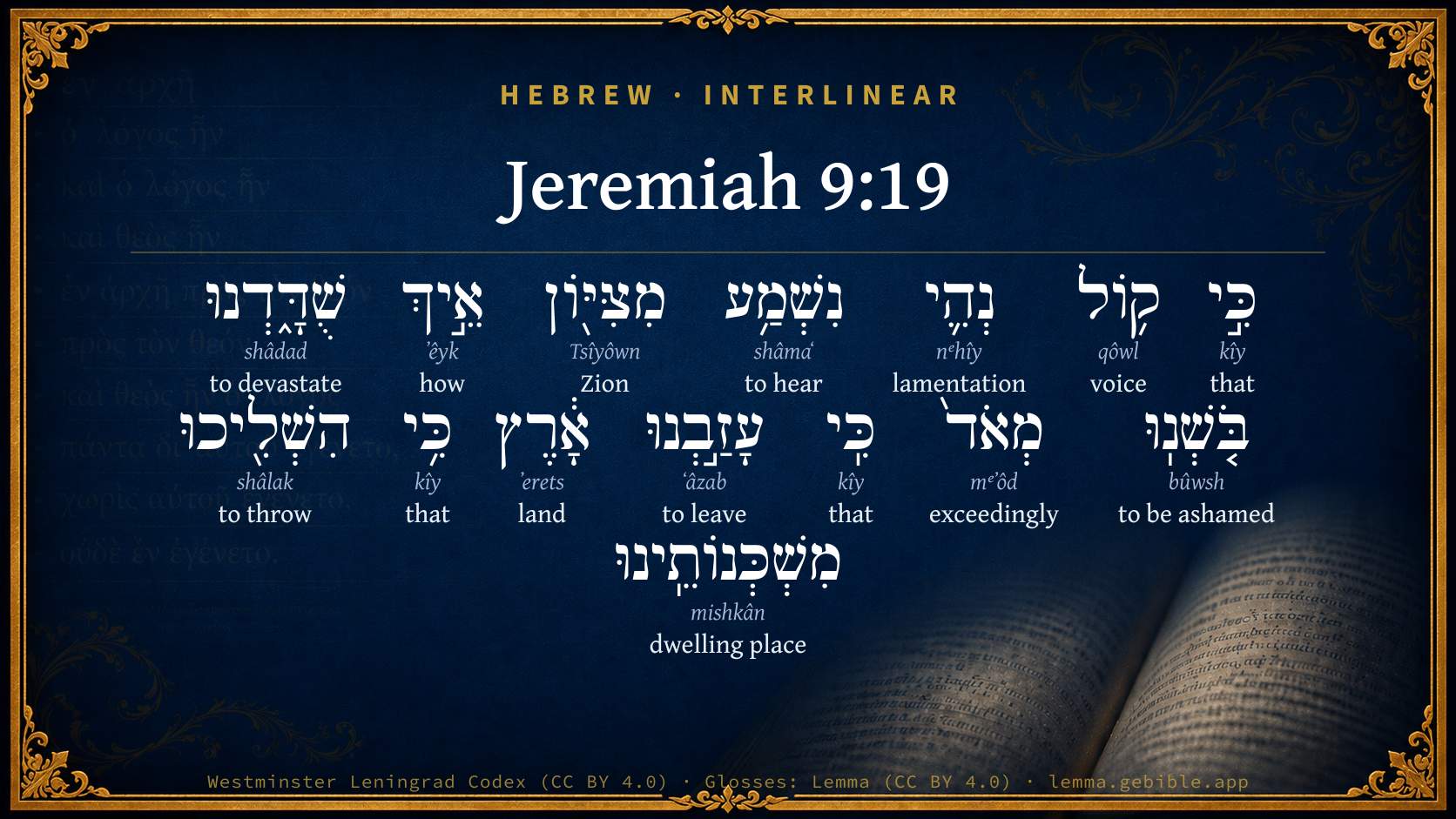
Hebrew (Westminster Leningrad Codex) Jeremiah 9:19 appears in the Hebrew Old Testament. The text above is from the Westminster Leningrad Codex. Each word links to its Strong’s number, a concise gloss, and parsing drawn from the Open Scriptures Hebrew Bible morphology. Click any word for its full Brown-Driver-Briggs (BDB) entry.
Download image
Cite this verse

Jeremiah 9:19 (World English Bible). Public Domain. Lemma interlinear Bible study tool, https://lemma.gebible.app/v/jeremiah/9/19.

Show BibTeX & RIS
BibTeX
RIS
English Translation
For a voice of wailing is heard out of Zion, How are we ruined! we are greatly confounded, because we have forsaken the land, because they have cast down our dwellings.
World English Bible · Public Domain
Download a study sheet

One document with this verse’s original text, its word-by-word gloss line, the meaning frame, cross-references with their text, attributed commentary, and full source and license credits — printable, and it pastes into notes with its structure intact.

This verse Autodidact and up

Study sheet (.html) Plain text (.txt)

A passage Seminary Student

Up to 50 verses in one chapter. A passage sheet keeps up to 6 commentary sources and 12 cross-references per verse, in the order this page ranks them, and says so on the sheet whenever that leaves anything out. Ask for a single verse and you get the Autodidact verse sheet above.

Everything on this page stays free to read, with no account — the sheet is a download of what is already on screen, not access to it.

Want to remove ads? Support Godless Engineer
Compare translations 3

The same verse in 3 English versions, stacked beneath the original-language interlinear above. Click any original word for its lexicon entry.

Each is an independent rendering of the whole verse — the interlinear is not word-aligned to these translations.

Highlighted words mark where these versions differ — a whole-verse word diff, not a word-by-word alignment.

  • World English Bible Public Domain
    For a voice of wailing is heard out of Zion, How are we ruined! we are greatly confounded, because we have forsaken the land, because they have cast down our dwellings.
  • King James Version Public Domain
    For a voice of wailing is heard out of Zion, How are we spoiled! we are greatly confounded, because we have forsaken the land, because our dwellings have cast us out.
  • unfoldingWord Literal Text CC BY-SA 4.0
    For the sound of wailing is heard from Zion, ‘How we are devastated. We are greatly ashamed, because we have left the land because they have cast down our dwellings.’”

unfoldingWord Literal Text — © unfoldingWord, licensed CC BY-SA 4.0. Word-aligned USFM3 via Door43 (git.door43.org/unfoldingWord/en_ult).

Versions to compare (up to 4)

3 of 4 selected

Show all 18 translations

Every available English version of this verse, each an independent rendering of the whole verse.

  • World English Bible Public Domain
    For a voice of wailing is heard out of Zion, How are we ruined! we are greatly confounded, because we have forsaken the land, because they have cast down our dwellings.
  • Berean Standard Bible Public Domain
    For the sound of wailing is heard from Zion: ‘How devastated we are! How great is our shame! For we have abandoned the land because our dwellings have been torn down.’”
  • Majority Standard Bible Public Domain
    For the sound of wailing is heard from Zion: ‘How devastated we are! How great is our shame! For we have abandoned the land because our dwellings have been torn down.’”
  • King James Version Public Domain
    For a voice of wailing is heard out of Zion, How are we spoiled! we are greatly confounded, because we have forsaken the land, because our dwellings have cast us out.
  • American Standard Version (1901) Public Domain
    For a voice of wailing is heard out of Zion, How are we ruined! we are greatly confounded, because we have forsaken the land, because they have cast down our dwellings.
  • Revised Version (1885) Public Domain
    For a voice of wailing is heard out of Zion, How are we spoiled! we are greatly confounded, because we have forsaken the land, because they have cast down our dwellings.
  • Geneva Bible (1599) Public Domain
    For a lamentable noyse is heard out of Zion, Howe are we destroyed, and vtterly confounded, for we haue forsaken the land, and our dwellings haue cast vs out.
  • Douay-Rheims (1899) Public Domain
    For a voice of wailing is heard out of Sion: How are we wasted and greatly confounded? because we have left the land, because our dwellings are cast down.
  • Young's Literal Translation Public Domain
    For -- a voice of wailing is heard from Zion: How have we been spoiled! We have been greatly ashamed, Because we have forsaken the land, Because they have cast down our tabernacles.
  • Literal Standard Version CC BY-SA 4.0
    For a voice of wailing is heard from Zion: How we have been spoiled! We have been greatly ashamed, || Because we have forsaken the land, || Because they have cast down our dwelling places.”
  • Unlocked Literal Bible CC BY-SA 4.0
    For the sound of wailing is heard in Zion, 'How we are devastated. We are greatly ashamed, for we have abandoned the land since they tore down our houses.'
  • unfoldingWord Literal Text CC BY-SA 4.0
    For the sound of wailing is heard from Zion, ‘How we are devastated. We are greatly ashamed, because we have left the land because they have cast down our dwellings.’”
  • Darby Bible Public Domain
    For a voice of wailing is heard out of Zion, How are we spoiled, sorely put to shame! For we have forsaken the land, for they have cast down our dwellings.
  • World Messianic Bible Public Domain
    For a voice of wailing is heard out of Zion, ‘How we are ruined! We are greatly confounded because we have forsaken the land, because they have cast down our dwellings.’”
  • Webster's Bible Public Domain
    For a voice of wailing is heard out of Zion, How are we laid waste! we are greatly confounded, because we have forsaken the land, because our dwellings have cast us out.
  • Free Bible Version CC BY-SA 4.0
    The sound of weeping comes from Zion, “We're completely devastated! We're totally ashamed, because we've had to abandon our country, because our houses have been demolished.”
  • Bible in Basic English Public Domain
    For a sound of weeping goes up from Zion, a cry, How has destruction come on us? we are overcome with shame because we have gone away from our land; he has sent us out from our house.
  • JPS Tanakh (1917) Public Domain
    (9-18) For a voice of wailing is heard out of Zion: 'How are we undone! We are greatly confounded, because we have forsaken the land, because our dwellings have cast us out.'

Literal Standard Version (2020), Covenant Press — licensed CC BY-SA 4.0. Text via the HelloAO Bible API (eBible.org). Unlocked Literal Bible (unfoldingWord) — licensed CC BY-SA 4.0. Text via the HelloAO Bible API (eBible.org). unfoldingWord Literal Text — © unfoldingWord, licensed CC BY-SA 4.0. Word-aligned USFM3 via Door43 (git.door43.org/unfoldingWord/en_ult). Free Bible Version, Dr. Jonathan Gallagher — licensed CC BY-SA 4.0. Text via the HelloAO Bible API (eBible.org).

Word by word

More ways to search: Search by grammar → Find every occurrence → Compare this word →

Practice this passage: Drill this verse → Learn its vocabulary →

נְהִ֛י
nᵉhîy
H5092
“lamentation”
Noun, Common, Masculine, Singular, Absolute
Part of Speech
Noun
Type
Common
Gender
Masculine
Number
Singular
State
Absolute
Full BDB Definition

Origin: from H5091

TWOT: 1311a

wailing, lamentation, mourning song - wailing - mourning song
  1. כִּ֣י kîy H3588 “that” Conjunction
  2. ק֥וֹל qôwl H6963 “voice of” Noun, Common, Masculine, Singular, Construct
  3. נִשְׁמַ֥ע shâmaʻ H8085 “to hear” Verb, Niphal, Perfect, 3rd Person, Masculine, Singular
  4. מִצִּיּ֖וֹן Tsîyôwn H6726 “from · Zion” Preposition + Noun, Proper
  5. אֵ֣יךְ ʼêyk H349 “how” Particle, Interrogative
  6. שֻׁדָּ֑דְנוּ shâdad H7703 “to devastate” Verb, Pual, Perfect, 1st Person, Common, Plural
  7. בֹּ֤שְׁנֽוּ bûwsh H954 “to be ashamed” Verb, Qal, Perfect, 1st Person, Common, Plural
  8. מְאֹד֙ mᵉʼôd H3966 “exceedingly” Adverb
  9. כִּֽי kîy H3588 “that” Conjunction
  10. עָזַ֣בְנוּ ʻâzab H5800 “to leave” Verb, Qal, Perfect, 1st Person, Common, Plural
  11. אָ֔רֶץ ʼerets H776 “land” Noun, Common, Both, Singular, Absolute
  12. כִּ֥י kîy H3588 “that” Conjunction
  13. הִשְׁלִ֖יכוּ shâlak H7993 “to throw” Verb, Hiphil, Perfect, 3rd Person, Common, Plural
  14. מִשְׁכְּנוֹתֵֽינוּ mishkân H4908 “dwelling places · our” Noun, Common, Masculine, Plural, Construct + Suffix, Personal, 1st Person, Common, Plural

About this verse

These counts appear in no published source. They are computed here, from the morphology-tagged text and Lemma’s own curated glosses. What Lemma adds →

15
words
13
distinct lemmas
Prophets
section

Notable vocabulary

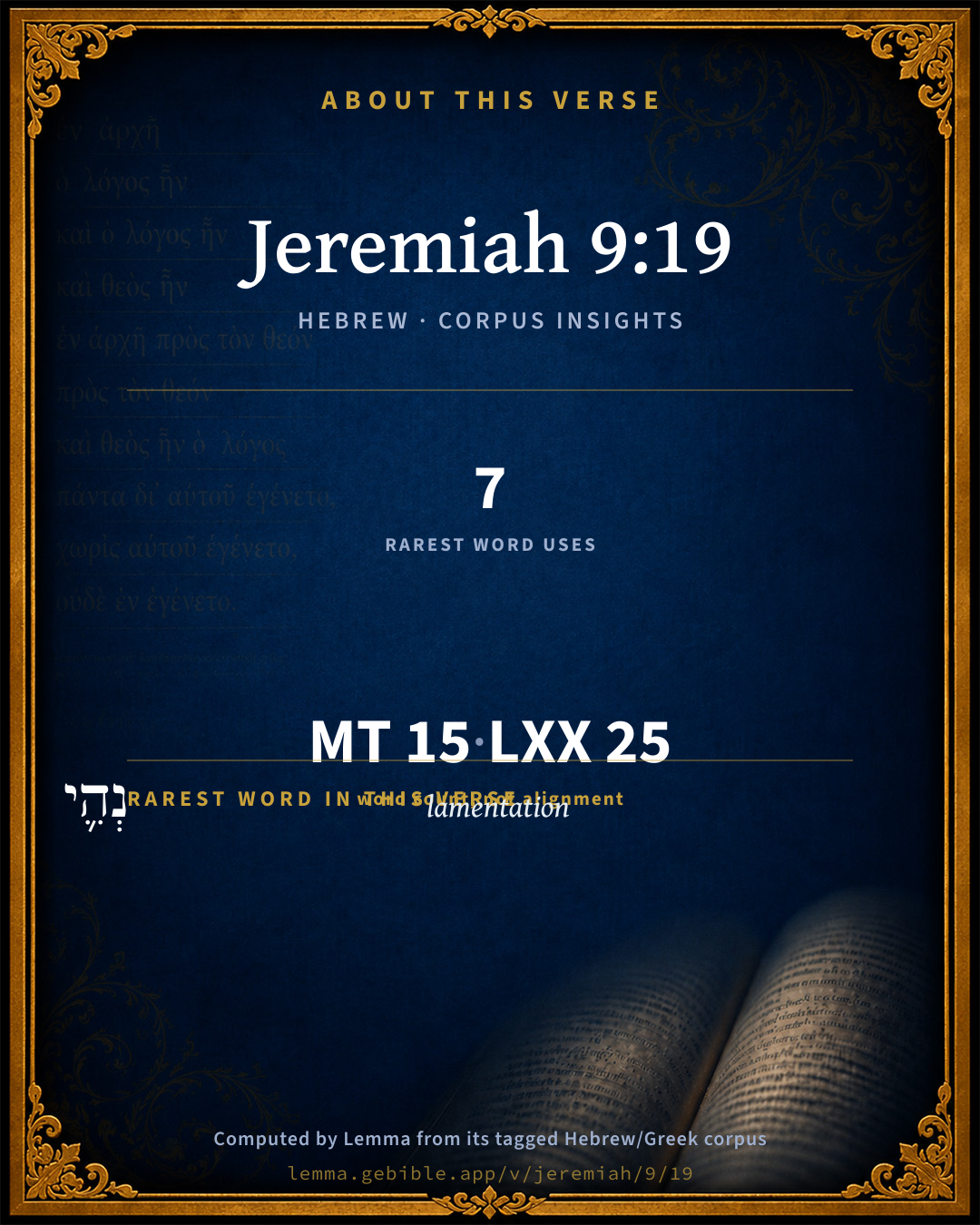
The rarest word here is נְהִ֛י lamentation H5092 — appearing just 7 times in the whole Hebrew Bible.

Shared distinctive vocabulary

נְהִ֛י lamentation H5092 occurs in 7 verses of the Hebrew Bible. Also found in:

Grammatical profile

  • 5 verbs
  • 5 nouns
  • 3 conjunctions
  • 1 adverb
  • 1 particle

Verb forms

  • נִשְׁמַ֥ע Niphal · Perfect
  • שֻׁדָּ֑דְנוּ Pual · Perfect
  • בֹּ֤שְׁנֽוּ Qal · Perfect
  • עָזַ֣בְנוּ Qal · Perfect
  • הִשְׁלִ֖יכוּ Hiphil · Perfect

Repetition

A word recurs within this verse — often emphatic in Hebrew:

  • כִּ֣י that H3588 ×3

Hebrew & Septuagint length

In the original languages it is 15 Hebrew tokens and 25 Greek tokens — but the two are counted differently (Hebrew bundles its prefixes and suffixes into one token; the Greek is in lemma form), so that isn’t a like-for-like length.

Cross-references

14

Topical passages linked to Jeremiah 9:19 in the Treasury of Scripture Knowledge — connected by theme and wording, ordered by reader-vote popularity; previews shown in the World English Bible.

  • Jeremiah 4:13 Behold, he shall come up as clouds, and his chariots [shall be] as the whirlwind: his horses are swifter than eagles. Woe to us! for we are ruined.
  • Deuteronomy 28:29 and you shall grope at noonday, as the blind gropes in darkness, and you shall not prosper in your ways: and you shall be only oppressed and robbed always, and there shall be none to save you.
  • Ezekiel 7:16–18 But those of those who escape shall escape, and shall be on the mountains like doves of the valleys, all of them moaning, every one in his iniquity.
  • Leviticus 18:25 The land was defiled: therefore I punished its iniquity, and the land vomitted out her inhabitants.
  • Leviticus 18:28 that the land not vomit you out also, when you defile it, as it vomited out the nation that was before you.
  • Leviticus 20:22 "'You shall therefore keep all my statutes, and all my ordinances, and do them; that the land, where I am bringing you to dwell, may not vomit you out.
  • Jeremiah 2:14 Is Israel a servant? is he a home-born [slave]? why is he become a prey?
  • Jeremiah 4:20 Destruction on destruction is cried; for the whole land is laid waste: suddenly are my tents destroyed, [and] my curtains in a moment.
  • Jeremiah 4:30–31 You, when you are made desolate, what will you do? Though you clothe yourself with scarlet, though you deck you with ornaments of gold, though you enlarge your eyes with paint, in vain do you make yourself beautiful; [your] lovers despise you, they seek your life.
  • Lamentations 4:15 Depart you, they cried to them, Unclean! depart, depart, don't touch! When they fled away and wandered, men said among the nations, They shall no more sojourn [here].
  • Lamentations 5:2 Our inheritance is turned to strangers, Our houses to aliens.
  • Micah 1:8–9 For this I will lament and wail; I will go stripped and naked; I will howl like the jackals, And moan like the daughters of owls.
  • Micah 2:4 In that day they will take up a parable against you, And lament with a doleful lamentation, saying, 'We are utterly ruined! My people's possession is divided up. Indeed he takes it from me and assigns our fields to traitors!'"
  • Micah 2:10 Arise, and depart! For this is not your resting place, Because of uncleanness that destroys, Even with a grievous destruction.

Cross-references courtesy of OpenBible.info (CC BY 4.0).

Hebrew and Greek witnesses Masoretic Hebrew ↔ Greek Septuagint

The same verse in the two great witnesses to the Old Testament, shown verse-for-verse.

These are two independent witnesses, not word-aligned to each other, and the Septuagint is shown in lemma (dictionary) form.

Hebrew Jeremiah 9:19 Masoretic · Westminster Leningrad Codex

כִּ֣י ק֥וֹל נְהִ֛י נִשְׁמַ֥ע מִצִּיּ֖וֹן אֵ֣יךְ שֻׁדָּ֑דְנוּ בֹּ֤שְׁנֽוּ מְאֹד֙ כִּֽי עָזַ֣בְנוּ אָ֔רֶץ כִּ֥י הִשְׁלִ֖יכוּ מִשְׁכְּנוֹתֵֽינוּ

For a voice of wailing is heard out of Zion, How are we ruined! we are greatly confounded, because we have forsaken the land, because they have cast down our dwellings.

World English Bible · Public Domain

Greek LXX Structure differs

In the Septuagint, Jeremiah is about an eighth shorter than the Hebrew and arranges its material differently — the Oracles Against the Nations (Hebrew chapters 46–51) appear in the middle of the Greek book, after 25:13. Because the chapter and verse boundaries do not line up, a verse-for-verse comparison with the Hebrew is not shown.

A verse-for-verse comparison isn’t shown here because the chapters and verses don’t line up. Switch to the LXX edition with the MT / LXX toggle above to read the Greek directly.

Hebrew: Westminster Leningrad Codex (CC BY 4.0). Greek: Septuagint (public domain); English from a public-domain English Septuagint. How the Septuagint differs from the Hebrew →

Targum (Aramaic paraphrase)

1

The Targum is the ancient Jewish Aramaic paraphrase of the Hebrew Scriptures — an interpretive translation, not the Hebrew text itself. Onkelos (literal) and Pseudo-Jonathan (expansive) render the Torah, and Jonathan the Prophets. Coverage is partial: where no permissively-licensed English translation exists for a verse, only the Aramaic is shown. This is verse-level text, not a word-by-word alignment to the Hebrew.

  1. Targum Jonathan Prophets (Joshua–Malachi)
    אֲרֵי שְׁמַעָא נְשַׁיָא פִּתְגָמָא דַייָ וּתְצֵית אוּדְנֵיכוֹן לְמִלֵי נְבִיוֹהִי וְאַלִיפְנָא לִבְנָתֵיכוֹן אִלְיָא וְאִתְּתָא לַחֲבֶרְתָּהּ עִנוּיָא:

    (no public-domain English translation for this verse)

    Targum Jonathan — Aramaic: “Mikraot Gedolot” (public domain). English: “Sefaria Community Translation” (CC0 1.0 (public-domain dedication)); “London "Chaldee Paraphrase," 1871” (public domain). Text via Sefaria.

Commentary

Notes on Jeremiah 9:19 from classic Christian and Jewish commentators (each source and its license shown beneath its notes). The classic Christian expositions comment on the surrounding passage and are grouped to its opening verse, so a note may address several verses; the Jewish commentaries on the Tanakh (Rashi and others) are per-verse, so they appear only where the commentator wrote on this verse.

Lemma curates 59 commentaries, every one of them public domain or Creative Commons licensed, each selected and text-cleaned for this edition rather than reprinted as found. About our sources →

Trapp's Complete Commentary

John Trapp

Jer 9:19 For a voice of wailing is heard out of Zion, How are we spoiled! we are greatly confounded, because we have forsaken the land, because our dwellings have cast [us] out.

Ver. 19. For a voice of wailing is heard out of Zion, How are we spoiled!] {a} Quis tragoediam aptius et magis graphice depingeret? What tragedy was ever set forth, and in more lively expressions?

{a} Ponit formulam threnodiae.

John Trapp, A Commentary or Exposition upon All the Books of the Old and New Testament (1647–1656) — public domain. Text from a community e-Sword module.

Geneva Bible (1599)

Geneva Bible translators

As though they were weary of us, because of our iniquities, Lev. 18:28 and 20:22.

Geneva Bible (1599) marginal notes — public domain. Text via Bolls.life.

Jamieson, Fausset & Brown

Robert Jamieson, A. R. Fausset & David Brown

The cry of "the mourning women."

spoiled--laid waste.

dwellings cast us out--fulfilling Lev 18:28; Lev 20:22. CALVIN translates, "The enemy have cast down our habitations."

Jamieson, Fausset & Brown — Commentary Critical and Explanatory on the Whole Bible (1871) — public domain (CC PDM 1.0). Text via the HelloAO Bible API.

John Calvin's Commentaries

We have said before, that when Jeremiah addressed the people in these words, they were still in a tolerably good condition, so that the king had confidence in his own resources; and his counsellors also thought that some aid would come to them from Egypt, and the people were likewise deceived. But the Prophet speaks of future events and points out as by the finger the evils which were as yet concealed from the view; for he could not otherwise teach with any authority, as he had to do with men of iron hearts. As then he saw that his teaching had no effect, and was wholly disregarded by men so slothful, he felt it necessary to form his style so as to touch their feelings.

On this account he says, that a voice was heard, a voice of wailing from Sion; where yet all exulted with joy. Then he adds, How have we been destroyed! and made greatly ashamed! The Jews thought this a fable, until they found by experience that they had been extremely hard and obstinate: but this really happened. Though they were then indulging in their pleasures, he yet proclaims lamentations to them, as though they were already destroyed: A voice, he says, has been heard, as though the Jews were bewailing the calamity, respecting which they thought the Prophet was fabling, for no danger was yet apparent.

But in order, as I have said, to condemn the hardness of their hearts, he represents them in another character, as bewailing their ruinous condition, and saying, We have left the land; in which however they thought their dwelling would be perpetual; for they boasted that they could never be excluded, as it had been declared,

“This is my rest for ever, here will I dwell, for I have chosen it.” (Psalm 132:14.)

As then God had testified that it would be a quiet habitation to his people, they thought that they were fortified by a triple wall and rampart, and that the city was altogether unassailable. But Jeremiah represents them as saying, that they had left their own land, that is, that they had been drawn and driven into exile. Then he adds, because they have cast us out This seems to refer to their enemies who had cast them out, that is, pulled down their dwellings. Some take dwellings to be the nominative case to the verb, “Our dwellings have cast us out.” But the first meaning reads better: I therefore consider the sense to be simply this, — that they were cast out and that their houses were destroyed by their enemies. It follows —

John Calvin's Commentaries (1540-1563) — public domain. Text from the Calvin Translation Society English edition (1840s-50s) via the Christian Classics Ethereal Library (ccel.org). Calvin's coverage is partial (roughly two-thirds of the Bible); uncommented books and verses are honest gaps, never fabricated. The 19th-century editor's footnotes and remarks are omitted so the notes are faithfully Calvin's own voice.

Ellicott's Commentary for English Readers

(19) We have forsaken.—Better, we have left. The English version suggests a voluntary abandonment, which is not involved in the Hebrew.

A Bible Commentary for English Readers, edited by Charles John Ellicott (1878–1897) — public domain. Text from a community e-Sword module.

The Cambridge Bible for Schools and Colleges

gen. ed. J. J. S. Perowne

19. Co. considers that the v. is a gloss as breaking the connexion between the summons to the wailers and the words which they are bidden to use.

have forsaken] a prophetic perfect, meaning must forsake. Exile is regarded as inevitable.

The Cambridge Bible for Schools and Colleges (gen. ed. J. J. S. Perowne; Cambridge University Press, 1878–1918) — public domain. Text from a community e-Sword module.

John Gill's Exposition

For a voice of wailing is heard out of Zion,.... Out of the fortress of Zion, out of the city of Jerusalem, which was thought to be inexpugnable, and could never be taken; but now a voice is heard out of that, deploring the desolation of it:

how are we spoiled? our houses destroyed, and we plundered of our substance:

we are greatly confounded: filled with shame, on account of their vain confidence; thinking their city would never be taken, and they were safe in it:

because we have forsaken the land; the land of Judea, being obliged to it, the enemy carrying them captive into other countries:

because our dwellings have cast us out; not suffering us to continue there any longer, as being unworthy of them; or enemies have cast down our habitations to the earth, as Jarchi; and so the Targum, "for our palaces are desolate"; the principal buildings in Jerusalem, as well as the houses of the common people, were thrown down to the ground, or burnt with fire, and particularly the temple; so that the whole was in a most ruinous condition, and a fit subject of a mournful song.

John Gill's Exposition of the Whole Bible (1746–1763) — public domain (CC PDM 1.0). Text via the HelloAO Bible API.

Matthew Poole's English Annotations

Is heard out of Zion, i.e. Jerusalem, spoken in the present tense, after the prophetical style, being a frequent way of the prophet’s expressing the certainty of a thing. How are we spoiled! how great is our misery! or, how come we to be in such a desolate condition? possibly expressions of the artificial mourners, or rather their real sense of it, now it is all too late.

We are greatly confounded: whether this be the complaint of the country people forced to flee from their habitation to Jerusalem for shelter, or of Jerusalem itself, that could expect no less, it filled them with great consternation, that they who thought their houses should have continued for ever, because of God’s promise, Psa 132:10, &c., must now forsake them, Lev 18:25; either their persons carried out into captivity, or have them utterly demolished by the enemy.

Matthew Poole's English Annotations on the Holy Bible (1683–1685) — public domain. Text from a community e-Sword/MySword module.

The Pulpit Commentary

Forsaken; rather, left. Our dwellings have cast us out; rather, they hare cast down our dwellings.

The Pulpit Commentary (1880–1919), ed. H.D.M. Spence-Jones & Joseph S. Exell — public domain. Text from a community e-Sword module.

unfoldingWord translationNotes

Door43 World Missions Community

General Information:

Here Yahweh is saying what the people of Judah will say when he destroys the land.

For the sound of wailing is heard in Zion

This refers to the people of Zion wailing loudly and can be stated in active form. AT: "The people of Zion are crying loudly, saying" (See: Active or Passive)

How we are devastated

Yahweh tells what the people of Judah will say when the land is destroyed. AT: "We are very upset" (See: Idiom)

We are greatly ashamed, for we have abandoned the land since they tore down our houses

"Our shame is great, because enemies destroyed our houses and we had to leave the land of Israel"

hear Yahweh's word; pay attention to the messages that come from his mouth

These two phrases mean the same thing and emphasize the command to listen to what Yahweh says. In the second phrase Yahweh's "mouth" is a metonym for himself. AT: "listen to what Yahweh says. Pay attention to his words" (See: Parallelism and Metonymy)

each neighbor woman a funeral song

The understood verb may be supplied. AT: "teach each neighbor woman a funeral song" (See: Ellipsis)

translationWords

Zion

shame

word of God

mourn

unfoldingWord translationNotes — © Distant Shores Media and the Door43 World Missions Community, licensed CC BY-SA 4.0. Source: git.door43.org/Door43/en_tn.

Lesson kit

Teaching starters — assembled from the data on this page, not authored interpretation. Every prompt links to the verse data it draws on. Edit before teaching.

Jeremiah, in the Prophets, opens this verse with 15 words (13 distinct Hebrew lemmas). Its most distinctive word is nᵉhîy (“lamentation”). A historical commentator’s framing appears above. Read the whole chapter for the surrounding context.

Discussion questions

  1. The word nᵉhîy carries the sense “lamentation.” How does it shape the verse?
  2. Jeremiah 9:10 shares the word «lamentation» with this verse. How do the two illuminate each other?
  3. “that” occurs 3× in this one verse. What is the effect of the repetition?
  4. The translations on this page render this verse differently — a whole-verse word diff, not a word-by-word alignment. What might account for the different wordings?
  5. The verb «נִשְׁמַ֥ע» is Niphal Perfect. How does its form color the action?
  6. Reading how Trapp's Complete Commentary and Geneva Bible (1599) read this verse, where do the two commentators agree and where do they part?

Things to notice

Reading settings

Reading text

Shown beneath each verse's original-language words.

Old Testament
Old Testament edition

Read the OT as the Masoretic Hebrew (MT) or the Greek Septuagint (LXX).

English shown for the Greek Septuagint (in the Hebrew ↔ Greek comparison).

Comparing translations? Open the Compare panel on any verse page to stack up to four side by side.