

Isaiah 58:2

Hebrew (Westminster Leningrad Codex) Isaiah 58:2 appears in the Hebrew Old Testament. The text above is from the Westminster Leningrad Codex. Each word links to its Strong’s number, a concise gloss, and parsing drawn from the Open Scriptures Hebrew Bible morphology. Click any word for its full Brown-Driver-Briggs (BDB) entry.
Download image
Cite this verse

Isaiah 58:2 (World English Bible). Public Domain. Lemma interlinear Bible study tool, https://lemma.gebible.app/v/isaiah/58/2.

Show BibTeX & RIS
BibTeX
RIS
English Translation
Yet they seek me daily, and delight to know my ways: as a nation that did righteousness, and didn't forsake the ordinance of their God, they ask of me righteous judgments; they delight to draw near to God.
World English Bible · Public Domain
Download a study sheet

One document with this verse’s original text, its word-by-word gloss line, the meaning frame, cross-references with their text, attributed commentary, and full source and license credits — printable, and it pastes into notes with its structure intact.

This verse Autodidact and up

Study sheet (.html) Plain text (.txt)

A passage Seminary Student

Up to 50 verses in one chapter. A passage sheet keeps up to 6 commentary sources and 12 cross-references per verse, in the order this page ranks them, and says so on the sheet whenever that leaves anything out. Ask for a single verse and you get the Autodidact verse sheet above.

Everything on this page stays free to read, with no account — the sheet is a download of what is already on screen, not access to it.

Want to remove ads? Support Godless Engineer
Compare translations 3

The same verse in 3 English versions, stacked beneath the original-language interlinear above. Click any original word for its lexicon entry.

Each is an independent rendering of the whole verse — the interlinear is not word-aligned to these translations.

Highlighted words mark where these versions differ — a whole-verse word diff, not a word-by-word alignment.

  • World English Bible Public Domain
    Yet they seek me daily, and delight to know my ways: as a nation that did righteousness, and didn't forsake the ordinance of their God, they ask of me righteous judgments; they delight to draw near to God.
  • King James Version Public Domain
    Yet they seek me daily, and delight to know my ways, as a nation that did righteousness, and forsook not the ordinance of their God: they ask of me the ordinances of justice; they take delight in approaching to God.
  • unfoldingWord Literal Text CC BY-SA 4.0
    Yet day, day they seek me, and they delight in the knowledge of my ways, like a nation that has done righteousness and has not abandoned the judgment of its God. They ask me judgments of righteousness; they delight in the approach of God.

unfoldingWord Literal Text — © unfoldingWord, licensed CC BY-SA 4.0. Word-aligned USFM3 via Door43 (git.door43.org/unfoldingWord/en_ult).

Versions to compare (up to 4)

3 of 4 selected

Show all 18 translations

Every available English version of this verse, each an independent rendering of the whole verse.

  • World English Bible Public Domain
    Yet they seek me daily, and delight to know my ways: as a nation that did righteousness, and didn't forsake the ordinance of their God, they ask of me righteous judgments; they delight to draw near to God.
  • Berean Standard Bible Public Domain
    For day after day they seek Me and delight to know My ways, like a nation that does what is right and does not forsake the justice of their God. They ask Me for righteous judgments; they delight in the nearness of God.”
  • Majority Standard Bible Public Domain
    For day after day they seek Me and delight to know My ways, like a nation that does what is right and does not forsake the justice of their God. They ask Me for righteous judgments; they delight in the nearness of God.”
  • King James Version Public Domain
    Yet they seek me daily, and delight to know my ways, as a nation that did righteousness, and forsook not the ordinance of their God: they ask of me the ordinances of justice; they take delight in approaching to God.
  • American Standard Version (1901) Public Domain
    Yet they seek me daily, and delight to know my ways: as a nation that did righteousness, and forsook not the ordinance of their God, they ask of me righteous judgments; they delight to draw near unto God.
  • Revised Version (1885) Public Domain
    Yet they seek me daily, and delight to know my ways: as a nation that did righteousness and forsook not the ordinance of their God, they ask of me righteous ordinances, they delight to draw near unto God.
  • Geneva Bible (1599) Public Domain
    Yet they seeke me dayly, and will knowe my wayes, euen as a nation that did righteously, and had not forsaken the statutes of their God: they aske of me the ordinances of iustice: they wil drawe neere vnto God, saying,
  • Douay-Rheims (1899) Public Domain
    For they seek me from day to day, sad desire to know my ways, as a nation that hath done justice, and hath not forsaken the judgment of their God: they ask of me the judgments of justice: they are willing to approach to God.
  • Young's Literal Translation Public Domain
    Seeing -- Me day by day they seek, And the knowledge of My ways they desire, As a nation that righteousness hath done, And the judgment of its God hath not forsaken, They ask of me judgments of righteousness, The drawing near of God they desire:
  • Literal Standard Version CC BY-SA 4.0
    They seek Me day by day, || And they desire the knowledge of My ways, || As a nation that has done righteousness, || And has not forsaken the judgment of its God, || They ask of Me judgments of righteousness, || They desire the drawing near of God:
  • Unlocked Literal Bible CC BY-SA 4.0
    Yet they seek me daily and delight in the knowledge of my ways, like a nation that practiced righteousness and did not abandon the law of their God. They ask me for righteous judgments; they take pleasure in the thought of God coming near.
  • unfoldingWord Literal Text CC BY-SA 4.0
    Yet day, day they seek me, and they delight in the knowledge of my ways, like a nation that has done righteousness and has not abandoned the judgment of its God. They ask me judgments of righteousness; they delight in the approach of God.
  • Darby Bible Public Domain
    Yet they seek me daily, and delight to know my ways, as a nation that doeth righteousness, and hath not forsaken the ordinance of their God; they ask of me the ordinances of righteousness, they take delight in approaching to God:
  • World Messianic Bible Public Domain
    Yet they seek me daily, and delight to know my ways. As a nation that did righteousness, and didn’t forsake the ordinance of their God, they ask of me righteous judgments. They delight to draw near to God.
  • Webster's Bible Public Domain
    Yet they seek me daily, and delight to know my ways, as a nation that did righteousness, and forsook not the ordinance of their God: they ask of me the ordinances of justice; they take delight in approaching to God.
  • Free Bible Version CC BY-SA 4.0
    Every day they come to me, pleased to know my ways as if they were a nation that does what is right and follows the laws of their God! They ask me to treat them right; they like to be close to their God.
  • Bible in Basic English Public Domain
    Though they make prayer to me every day, and take pleasure in the knowledge of my ways: like a nation which has done righteousness, and has not given up the rules of their God, they make requests to me for the right orders, it is their delight to come near to God.
  • JPS Tanakh (1917) Public Domain
    Yet they seek Me daily, and delight to know My ways; as a nation that did righteousness, and forsook not the ordinance of their God, they ask of Me righteous ordinances, they delight to draw near unto God.

Literal Standard Version (2020), Covenant Press — licensed CC BY-SA 4.0. Text via the HelloAO Bible API (eBible.org). Unlocked Literal Bible (unfoldingWord) — licensed CC BY-SA 4.0. Text via the HelloAO Bible API (eBible.org). unfoldingWord Literal Text — © unfoldingWord, licensed CC BY-SA 4.0. Word-aligned USFM3 via Door43 (git.door43.org/unfoldingWord/en_ult). Free Bible Version, Dr. Jonathan Gallagher — licensed CC BY-SA 4.0. Text via the HelloAO Bible API (eBible.org).

Word by word

More ways to search: Search by grammar → Find every occurrence → Compare this word →

Practice this passage: Drill this verse → Learn its vocabulary →

קִרְבַ֥ת
qᵉrâbâh
H7132
“approach of”
Noun, Common, Feminine, Singular, Construct
Part of Speech
Noun
Type
Common
Gender
Feminine
Number
Singular
State
Construct
Full BDB Definition

Origin: from H7126

TWOT: 2065c

an approach, a drawing near
  1. וְאוֹתִ֗י ʼêth H853 “and · - · me” Conjunction + Particle, Direct Object + Suffix, Personal, 1st Person, Common, Singular
  2. י֥וֹם yôwm H3117 “day” Noun, Common, Masculine, Singular, Absolute
  3. יוֹם֙ yôwm H3117 “day” Noun, Common, Masculine, Singular, Absolute
  4. יִדְרֹשׁ֔וּן dârash H1875 “to seek” Verb, Qal, Imperfect, 3rd Person, Masculine, Plural + Suffix, n
  5. וְדַ֥עַת daʻath H1847 “and · knowledge of” Conjunction + Noun, Common, Feminine, Singular, Construct
  6. דְּרָכַ֖י derek H1870 “ways · my” Noun, Common, Both, Plural, Construct + Suffix, Personal, 1st Person, Common, Singular
  7. יֶחְפָּצ֑וּן châphêts H2654 “to delight in” Verb, Qal, Imperfect, 3rd Person, Masculine, Plural + Suffix, n
  8. כְּג֞וֹי gôwy H1471 “like/as · nation” Preposition + Noun, Common, Masculine, Singular, Absolute
  9. אֲשֶׁר ʼăsher H834 “which” Particle, Relative
  10. צְדָקָ֣ה tsᵉdâqâh H6666 “righteousness” Noun, Common, Feminine, Singular, Absolute
  11. עָשָׂ֗ה ʻâsâh H6213 “to do” Verb, Qal, Perfect, 3rd Person, Masculine, Singular
  12. וּמִשְׁפַּ֤ט mishpâṭ H4941 “and · judgment of” Conjunction + Noun, Common, Masculine, Singular, Construct
  13. אֱלֹהָיו֙ ʼĕlôhîym H430 “God(s) · his” Noun, Common, Masculine, Plural, Construct + Suffix, Personal, 3rd Person, Masculine, Singular
  14. לֹ֣א lôʼ H3808 “not” Particle, Negative
  15. עָזָ֔ב ʻâzab H5800 “to leave” Verb, Qal, Perfect, 3rd Person, Masculine, Singular
  16. יִשְׁאָל֨וּנִי֙ shâʼal H7592 “to ask · me” Verb, Qal, Imperfect, 3rd Person, Masculine, Plural + Suffix, Personal, 1st Person, Common, Singular
  17. מִשְׁפְּטֵי mishpâṭ H4941 “judgments of” Noun, Common, Masculine, Plural, Construct
  18. צֶ֔דֶק tsedeq H6664 “righteousness” Noun, Common, Masculine, Singular, Absolute
  19. אֱלֹהִ֖ים ʼĕlôhîym H430 “God(s)” Noun, Common, Masculine, Plural, Absolute
  20. יֶחְפָּצֽוּן châphêts H2654 “to delight in” Verb, Qal, Imperfect, 3rd Person, Masculine, Plural + Suffix, n

About this verse

These counts appear in no published source. They are computed here, from the morphology-tagged text and Lemma’s own curated glosses. What Lemma adds →

21
words
17
distinct lemmas
Prophets
section

Notable vocabulary

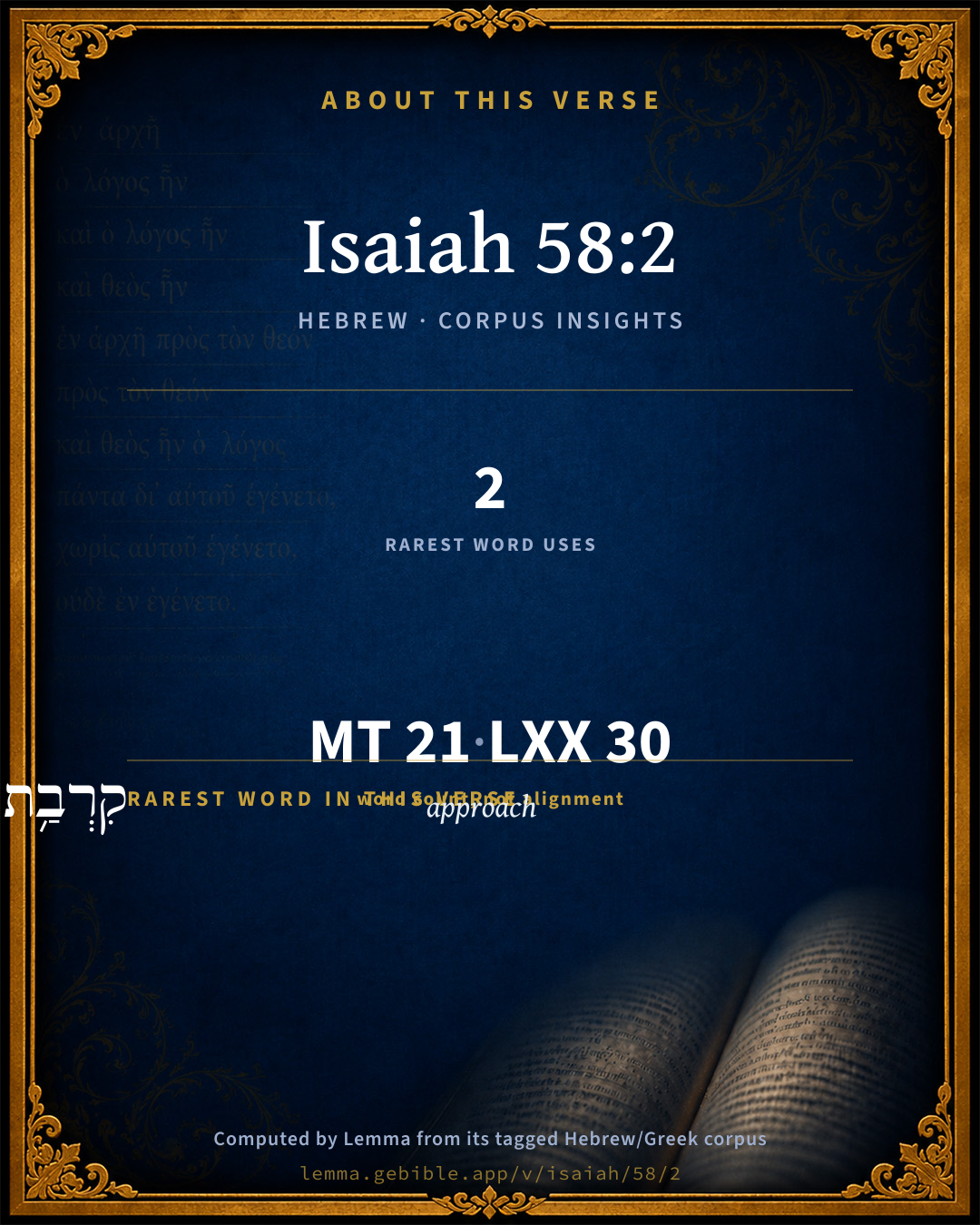
The rarest word here is קִרְבַ֥ת approach H7132 — appearing just 2 times in the whole Hebrew Bible.

Shared distinctive vocabulary

קִרְבַ֥ת approach H7132 occurs in 2 verses of the Hebrew Bible. Also found in:

Grammatical profile

  • 6 verbs
  • 12 nouns
  • 3 particles

Verb forms

  • יִדְרֹשׁ֔וּן Qal · Imperfect
  • יֶחְפָּצ֑וּן Qal · Imperfect
  • עָשָׂ֗ה Qal · Perfect
  • עָזָ֔ב Qal · Perfect
  • יִשְׁאָל֨וּנִי֙ Qal · Imperfect
  • יֶחְפָּצֽוּן Qal · Imperfect

Repetition

Words recur within this verse — often emphatic in Hebrew:

  • י֥וֹם day H3117 ×2
  • יֶחְפָּצ֑וּן to delight in H2654 ×2
  • וּמִשְׁפַּ֤ט judgment H4941 ×2
  • אֱלֹהָיו֙ God H430 ×2

Hebrew & Septuagint length

In English translation the verse runs 38 words from the Hebrew and 42 from the Septuagint (LXX English) — closely comparable.

A rough comparison of the two English renderings, which tokenize alike — not a word-level alignment.

Word counts can differ between the Hebrew and the Greek without any difference in meaning — e.g. the Hebrew direct-object marker אֵת has no separate Greek word, and Greek often adds the article ὁ.

In the original languages it is 21 Hebrew tokens and 30 Greek tokens — but the two are counted differently (Hebrew bundles its prefixes and suffixes into one token; the Greek is in lemma form), so that isn’t a like-for-like length.

Cross-references

19

Topical passages linked to Isaiah 58:2 in the Treasury of Scripture Knowledge — connected by theme and wording, ordered by reader-vote popularity; previews shown in the World English Bible.

  • Titus 1:16 They profess that they know God, but by their works they deny him, being abominable, disobedient, and unfit for any good work.
  • Isaiah 29:13 The Lord said, Because this people draw near [to me], and with their mouth and with their lips to honor me, but have removed their heart far from me, and their fear of me is a commandment of men which has been taught [them];
  • Matthew 15:7–9 You hypocrites! Well did Isaiah prophesy of you, saying,
  • Mark 4:16–17 These in like manner are those who are sown on the rocky places, who, when they have heard the word, immediately receive it with joy.
  • James 1:21–22 Therefore, putting away all filthiness and overflowing of wickedness, receive with humility the implanted word, which is able to save your souls.
  • 1 Peter 2:1–2 Putting away therefore all wickedness, all deceit, hypocrisies, envies, and all evil speaking,
  • 1 Samuel 15:21–25 But the people took of the spoil, sheep and oxen, the chief of the devoted things, to sacrifice to Yahweh your God in Gilgal.
  • Ezekiel 33:30–33 As for you, son of man, the children of your people talk of you by the walls and in the doors of the houses, and speak one to another, everyone to his brother, saying, Please come and hear what is the word that comes forth from Yahweh.
  • Mark 12:14 When they had come, they asked him, "Teacher, we know that you are honest, and don't defer to anyone; for you aren't partial to anyone, but truly teach the way of God. Is it lawful to pay taxes to Caesar, or not?
  • Hebrews 6:4–6 For concerning those who were once enlightened and tasted of the heavenly gift, and were made partakers of the Holy Spirit,
  • Deuteronomy 5:28–29 Yahweh heard the voice of your words, when you spoke to me; and Yahweh said to me, I have heard the voice of the words of this people, which they have spoken to you: they have well said all that they have spoken.
  • Proverbs 15:8 The sacrifice made by the wicked is an abomination to Yahweh, But the prayer of the upright is his delight.
  • Isaiah 1:11–15 "What are the multitude of your sacrifices to me?," says Yahweh. "I have had enough of the burnt offerings of rams, And the fat of fed animals. I don't delight in the blood of bulls, Or of lambs, Or of male goats.
  • Isaiah 48:1–2 Hear you this, house of Jacob, who are called by the name of Israel, and are come forth out of the waters of Judah; who swear by the name of Yahweh, and make mention of the God of Israel, but not in truth, nor in righteousness
  • Jeremiah 42:2 and said to Jeremiah the prophet, Let, we pray you, our supplication be presented before you, and pray for us to Yahweh your God, even for all this remnant; for we are left but a few of many, as your eyes do see us:
  • Jeremiah 42:20 For you have dealt deceitfully against your own souls; for you sent me to Yahweh your God, saying, Pray for us to Yahweh our God; and according to all that Yahweh our God shall say, so declare to us, and we will do it:
  • Mark 6:20 for Herod feared John, knowing that he was a righteous and holy man, and kept him safe. When he heard him, he did many things, and he heard him gladly.
  • John 5:35 He was the burning and shining lamp, and you were willing to rejoice for a while in his light.
  • James 4:8 Draw near to God, and he will draw near to you. Cleanse your hands, you sinners; and purify your hearts, you double-minded.

Cross-references courtesy of OpenBible.info (CC BY 4.0).

Hebrew and Greek witnesses Masoretic Hebrew ↔ Greek Septuagint

The same verse in the two great witnesses to the Old Testament, shown verse-for-verse.

These are two independent witnesses, not word-aligned to each other, and the Septuagint is shown in lemma (dictionary) form.

Hebrew Isaiah 58:2 Masoretic · Westminster Leningrad Codex

וְאוֹתִ֗י י֥וֹם יוֹם֙ יִדְרֹשׁ֔וּן וְדַ֥עַת דְּרָכַ֖י יֶחְפָּצ֑וּן כְּג֞וֹי אֲשֶׁר צְדָקָ֣ה עָשָׂ֗ה וּמִשְׁפַּ֤ט אֱלֹהָיו֙ לֹ֣א עָזָ֔ב יִשְׁאָל֨וּנִי֙ מִשְׁפְּטֵי צֶ֔דֶק קִרְבַ֥ת אֱלֹהִ֖ים יֶחְפָּצֽוּן

Yet they seek me daily, and delight to know my ways: as a nation that did righteousness, and didn't forsake the ordinance of their God, they ask of me righteous judgments; they delight to draw near to God.

World English Bible · Public Domain

Greek LXX Isaiah 58:2 Septuagint · lemma form

ἐγώ ἡμέρα ἐκ ἡμέρα ζητέω καί γιγνώσκω ἐγώ ὁ ὁδός ἐπιθυμόω ὡς λαός δικαιοσύνη ποιέω καί κρίσις θεός αὐτός μή καταλείπω αἰτέω ἐγώ νῦν κρίσις δίκαιος καί ἐγγίζω θεός ἐπιθυμόω

They seek me day by day, and desire to know my ways, as a people that had done righteousness, and had not forsaken the judgment of their God: they now ask of me righteous judgment, and desire to draw near to God,

LXX2012 (modern English Septuagint) · Public Domain

On this verse, The Pulpit Commentary discusses the Septuagint’s reading. Read the note in Commentary ↓

Hebrew: Westminster Leningrad Codex (CC BY 4.0). Greek: Septuagint (public domain); English from LXX2012 (modern English Septuagint) (Public Domain). How the Septuagint differs from the Hebrew →

Targum (Aramaic paraphrase)

1

The Targum is the ancient Jewish Aramaic paraphrase of the Hebrew Scriptures — an interpretive translation, not the Hebrew text itself. Onkelos (literal) and Pseudo-Jonathan (expansive) render the Torah, and Jonathan the Prophets. Coverage is partial: where no permissively-licensed English translation exists for a verse, only the Aramaic is shown. This is verse-level text, not a word-by-word alignment to the Hebrew.

  1. Targum Jonathan Prophets (Joshua–Malachi)
    וְקָדָמַי יוֹם יוֹם אוּלְפַן תָּבְעִין כְּאִלוּ לְמֵידַע אוֹרְחָן דְתַקְנָן קֳדָמַי צָבָן כְּעַמָא דְזָכוּ עֲבַד וּמִדִין אֱלָהֵהּ לָא אִתְרַחֵק שַׁאֲלִין מִן קֳדָמַי דִין וּקְשׁוֹט כְּאִלוּ לְאִתְקְרָבָא לִדְחַלְתָּא דַייָ צָבָן:

    And they seek daily instruction from me, as if to know the ways which are right before me, finding delight in my presence as a people that doeth righteousness, and have not forsaken the judgment of their God: they ask of me judgment and truth, as if they delighted to draw nigh to the fear of the Lord.

    Targum Jonathan — Aramaic: “Mikraot Gedolot” (public domain). English: “Sefaria Community Translation” (CC0 1.0 (public-domain dedication)); “London "Chaldee Paraphrase," 1871” (public domain). Text via Sefaria.

Commentary

Notes on Isaiah 58:2 from classic Christian and Jewish commentators (each source and its license shown beneath its notes). The classic Christian expositions comment on the surrounding passage and are grouped to its opening verse, so a note may address several verses; the Jewish commentaries on the Tanakh (Rashi and others) are per-verse, so they appear only where the commentator wrote on this verse.

Lemma curates 59 commentaries, every one of them public domain or Creative Commons licensed, each selected and text-cleaned for this edition rather than reprinted as found. About our sources →

Trapp's Complete Commentary

John Trapp

Isa 58:2 Yet they seek me daily, and delight to know my ways, as a nation that did righteousness, and forsook not the ordinance of their God: they ask of me the ordinances of justice; they take delight in approaching to God.

Ver. 2. Yet they seek me daily.] In pretence at least; and this, their dissembled sanctity, double iniquity, is one of those great transgressions of theirs, against which thou must declaim, yea, proclaim hell fire, in case they amend it not.

And delight to know my ways.] They seem to do so, by frequenting mine ordinances, and attending to my priests, whose lips preserve and present knowledge.

As a nation that did righteousness.] But it is but as a nation that did it; they had but a "form of knowledge," {Rom 2:20} and a "form of godliness." {2Ti 3:5} Eiusdem farinae nobiscum sunt religiosi quidam in speciem, saith Oecolampadius: the Church is still full of such hypocrites, that only act religion, play devotion, wherein they may outdo better men, for the external part of religion and pretence of zeal, as the Pharisees in the Gospel fasted more than the disciples, wansing their visages, and weakening their constitutions with much abstinence. The sorcerers of Egypt seemed to do as much as Moses; so do these as much or more than sound Christians. The apostles were as deceivers, and yet true, {2Co 6:8} but these are as true, and yet deceivers.

They ask of me the ordinances of justice.] As not willing to deviate; but they are ever learning, yet never come to the knowledge of the truth.

And take delight in approaching to God.] Which yet no hypocrite can do from the heart; {Job 27:10} for God is light and holiness, and therefore hated by the blind and foul hypocrite, {Joh 3:20} all whose devotions are effects rather of art and parts than of the heart and grace; hence God abhorreth them, for he "desireth truth in the inward parts." {Psa 51:6}

John Trapp, A Commentary or Exposition upon All the Books of the Old and New Testament (1647–1656) — public domain. Text from a community e-Sword module.

The Biblical Illustrator

Joseph S. Exell

Isa_58:2

Yet they seek Me daily

Hypocitical religion

When the prophet went about to show them their transgressions, they pleaded they could see no transgressions they were guilty of; for they were diligent in attending Gods worship, and what more would he have of them?

Now,

1. He owns the matter of fact to be true. As far as hypocrites do that which is good, they shall not be denied the praise of it; let them make their best of it. It is owned that they have the form of godliness.

(1) They go to church, and observe their hours of prayer. They seek Me daily.

(2) They love to hear good preaching. They delight to know My ways, as Herod, who heard John gladly, and the stony ground, that received the seed of the Word with joy; it is to them as a lovely song (Eze_33:32).

(3) They seem to take a great pleasure in the exercises of religion, and to be in their element when they are at their devotions. They delight in approaching to God, not for His sake to whom they approach, but for the sake of some pleasing circumstance--the company or the festival

(4) They are inquisitive concerning their duty, and seem desirous only to know it, making no question,, but that then they should do it. They ask of Me the ordinances of justice, the rules of piety in the worship of God, the rules of equity in their dealings with men, both which are ordinances of justice.

(5) They appear to the eyes of the world as if they made conscience of doing their duty. They are as a nation that did righteousness and forsook not the ordinances of their God. But,

2. He intimates that this was so far from being a cover or excuse for their sin, that really it was an aggravation of it. Show them their sins that they go on in, notwithstanding their knowledge of good and evil, sin and duty, and the convictions of their consciences concerning it. (M. Henry.)

Religious, but unsaved

Men may go a great way towards heaven, and yet come short; nay, may go to hell with a good reputation. (M. Henry.)

Two great problems

The prophet and the world may be considered as engaged in two opposite problems. The problem which the world is ever seeking to discover is to find out what is the least religion they may have, and yet be saved; the problem which the prophet is here endeavoring to solve, is what is the most religion you may have, and yet be lost. (D. Moore, M. A.)

Forms of religion

There are four distinct forms of Gospel service, all of which, if accompanied by right affections towards God, afford just and scriptural evidence of an accepted or reconciled state. These four forms of service are--the habit of daily prayer, a love for the preached Word, an open profession of Christ, and an apparent earnestness in inquiring after the ways and will of God. These, however, are not in themselves decisive tests of spiritual character; causes may operate to induce these outward observances, wholly distinct from the love of God in its governing and ruling power. Education may prompt a man to acts of daily worship; by local sympathies, or by the power of fashion, a man may be induced to make a religious profession; and he may with much apparent earnestness be inquiring which is the way to life eternal, when he has a secret mental reservation to keep the joys, the comforts, and the forbidden delights of the present world. (M. Henry.)

Formalism

I. WHY MEN GO SO FAR.

1. It is a sentiment of moral uneasiness which makes the formalist of every grade and character.

2. But in estimating the causes which induce men to go certain lengths in a religious life, we should not entirely omit the expectation of a considerable degree of credit in the world; a secret pride at being numbered among the people of God--an indefinite notion of outward prosperity as usually following on a bold religious profession.

II. WHY IT IS THAT THEY WILL NOT GO FURTHER, For this I shall assign two reasons.

1. Defective knowledge--an imperfect acquaintance with the way of salvation. Men know not the end of Christs work, they know not the jealousy with which He regards any interference with that work.

2. Defective obedience--they stop short of some form of Gospel requirement with which they should comply.

III. APPLY SOME TESTS OF SPIRITUAL SINCERITY. (M. Henry.)

The Biblical Illustrator, edited by Joseph S. Exell (c. 1880s–1900s) — public domain. Text from a community e-Sword module.

Joseph Benson's Commentary

Isa 58:2. Yet they seek me daily — They cover all their wickedness with a profession of religion, from time to time resorting to my house, pretending to ask counsel of me, and to desire and seek my favour and blessing. And delight to know my ways — That is, either, 1st, They seem to delight to know them, men being often said in Scripture to be or do that which they seem or profess to be or do: or, 2d, They really delight; for there are many men who take some pleasure in knowing God’s will and word, and yet do not conform their lives to them. As a nation that did righteousness — As if they really were a righteous people; and forsook not the ordinance, &c. — As if they were not guilty of any apostacy from God, or neglect of, or disobedience to, his precepts. They ask of me the ordinances of justice — As if they desired and resolved to observe them. They delight — In appearance or reality; in approaching unto God — In coming to my temple to pray to me, receive instruction, or offer sacrifices.

Joseph Benson's Commentary on the Old and New Testaments (1811–1818) — public domain. Text from a community e-Sword module.

The Preacher's Complete Homiletical Commentary

Joseph S. Exell (gen. ed.)

FORMALISM

Isa_58:2. Yet they seek Me daily, and delight to know My ways, &c.

One of the most wicked things that Machiavel ever said was this: “Religion itself should not be cared for, but only the appearance of it; the credit of it is a help; the reality and use is a cumber.” Such notions are from beneath; they smell of the pit; for if there is anything about which the Scripture speaks expressly, it is the sin and uselessness of mere formalism. The Jews were especially liable to this evil. They so rested in the outward observances of the law as to lose its spirit. They were indifferent to the practical forms of godliness, without which religion is but a name and a form. In this chapter we read that they sought God, &c.; and all the time there were grievous sins which they were living in the daily practice of, and of which they were content to be ignorant. As a consequence, they were without the special manifestation of the Divine favour, and were ever ready to upbraid God for unfaithfulness. But God requires “truth in the inward parts.” The passage suggests—

I. THE RATIONALE OF FORMALISM.

A form of religion includes—

1. Theoretical religious knowledge. Attach high importance to a well-digested system of truth, but remember you may subscribe to every article of the Christian faith with a sincere and hearty ascent, and yet be destitute of spiritual religion, &c. A creed however scriptural is not vital religion.

2. The practice of moral duties. These are not to be disparaged, but morality is not the love of God.

3. Frequent attendance on religious ordinances. Very devout and regular, earnest in self-sacrifices, fastings, and self-mortifications (Isa_58:1-7). It is the very essence of formalism to set the outward institution above the inward truths, to be punctilious in going the round of ceremonial observances while neglectful of those spiritual sacrifices with which God is well pleased—to substitute means in the room of ends [1734] It is much easier to observe the forms of religion, than it is to bring the heart under its all-controlling influence (Isa_1:10-15; Eze_33:30-33; Mat_15:8).

[1734] The tendency to turn Christianity into a religion of ceremonial is running with an unusually powerful current to-day. We are all more interested in art, and think that we know more about it than our fathers did. The eye and the ear are more educated than they used to be, and a society as “æsthetic” and “musical,” as much English society is becoming, will like an ornate ritual. So, apart altogether from doctrinal grounds, much in the condition of to-day works towards ritual and religion. Nonconformist services are less plain; some go from their ranks because they dislike the “bald” worship in the chapel, and prefer the more elaborate forms of the Anglican Church, which in its turn is for the same reason left by others who find their tastes gratified by the complete thing, as it is to be enjoyed full-blown in the Roman Catholic communion. We freely admit that the Puritan reaction was possibly too severe, and that a little more colour and form might with advantage have been retained. But enlisting the senses as the allies of the spirit in worship it risky work. They are very apt to fight for their own hand when they once begin, and the history of all symbolic and ceremonial worship shows that the experiment is much more likely to end in sensualising religion than in spiritualising sense. The theory that such aids make a ladder by which the soul may ascend to God is perilously apt to be confuted by experience, which finds that the soul never gets above the steps of the ladder. The gratification of taste, and the excitation of æsthetic sensibility, which is the result of such aids to worship, is not worship, however it may be mistaken as such. All ceremonial is in danger of becoming opaque instead of becoming transparent, as it was meant to be, and of detaining mind and eye instead of letting them pass on and up to God. Stained glass is lovely, and white windows are “barn-like,” and “starved,” and “bare;” but perhaps, if the object is to get light and to see the sun, these solemn purples and glowing yellows are rather in the way. I, for my part, believe that of the two extremes a Quakers’ meeting is nearer the ideal of Christian worship than High Mass; and so far as my feeble voice can reach, I would urge as eminently a lesson for the day Paul’s great principle, that a Christianity making much of forms and ceremonies is a distinct retrogression and a distinct descent. You are men in Christ; do not go back to the picture-book A B C of symbol and ceremony, which was fit for babes. You have been brought into the inner sanctuary of worship in spirit; do not decline to the beggarly elements of outward forms.—Dr. Maclaren, in “Expositor.”

4. Membership in the Church. In the Church, but not “in Christ.” The day is coming when union with the Church will not be worth the paper on which it is written, if there is no real spiritual union with Christ.

5. Party zeal and external philanthropy. The piety of Israel at this time seems to have been anything but inactive: it was very busy. Indeed it would seem that they were divided into religious parties or factions, some professing to be more orthodox than others. There was a rivalry, therefore, in their devotion; one tried to excel the other, and the competition ran so high that they began to “smite each other with the fist.” Formalism is ever full of denominational zeal. Much is said, and done, and given for man in this age of philanthropy, in the spirit of partisanship.

6. Sanctimonious solemnity (Isa_58:5). If men are in deep sorrow it is natural for them to droop their heads. In the east men wore sackcloth, as we do crape, to indicate their grief. But with the formalist all this is pretence—theatrical sadness and gloom. True religion is joy inspiring, and ever manifests itself in cheerfulness and sunshine. But the mere formalist cannot be happy, hence he robes himself in garbs of sadness, and produces the impression that religion is characteristically grave, &c. Such sanctimoniousness has done untold damage.

What is the character of your religion? Is it formal or spiritual, conventional or Christly—form or heart?

II. THE DEFICIENCIES OF FORMALISM.

1. It tends to form and foster intolerance. “The people of the Lord, the people of the Lord are we.” In the name of religion men have committed and still commit some of the greatest enormities on which the sun ever shone.

2. It fails to yield the solid happiness found in spiritual religion. It is impossible in the nature of things. True religion is an inward principle (1Sa_16:7; Rom_2:28; 1Co_7:19; Gal_5:6; Gal_6:15). A painted fire cannot warm, a painted banquet cannot satisfy hunger, and a formal religion cannot bring peace to the soul.

3. It is directly opposed to the spirit and precepts of the Gospel.

4. It is injurious to its possessor and to others (Isa_58:1). It warps the judgment, it deadens the conscience, it hardens the heart, it awakens false hopes, and it will put to shame at the last day. Its influence upon others is most pernicious and destructive. It misrepresents religion, &c. Let every minister cry aloud, spare not, lift up his voice like a “trumpet” against this common foe, this bane of Christendom.

5. It is an insult to Almighty God. If this formalism were so odious to God under the law—a religion full of ceremonies, certainly it will be much more odious under the Gospel—a religion of much more simplicity, and requiring so much the greater sincerity (Eze_33:21; Mat_15:8, and others). He peers into the heart, He sees the sham, and abhors the sacrifice, where the heart is not found.—A. Tucker.

The Preacher's Complete Homiletical Commentary (gen. ed. Joseph S. Exell; Funk & Wagnalls, c. 1892) — public domain (pre-1929). A full-Bible homiletical/sermon-outline anthology covering 65 of 66 books (2 John is absent from the source module). Text from a community e-Sword module.

Tyndale Open Study Notes

Tyndale Open Resources

58:2 they act so pious (literally they seek me): They may have been truly committed to a religious form, but they failed to truly meet God in their religious activities.

Tyndale Open Study Notes — © Tyndale Open Resources, licensed CC BY-SA 4.0. Text via the HelloAO Bible API.

Geneva Bible (1599)

Geneva Bible translators

They will seem to worship me and have outward holiness.

Geneva Bible (1599) marginal notes — public domain. Text via Bolls.life.

Jamieson, Fausset & Brown

Robert Jamieson, A. R. Fausset & David Brown

Put the stop at "ways"; and connect "as a nation that," &c. with what follows; "As a nation that did righteousness," thus answers to, "they ask of Me just judgments" (that is, as a matter of justice due to them, salvation to themselves, and destruction to their enemies); and "forsook not the ordinance of their God," answers to "they desire the drawing near of God" (that God would draw near to exercise those "just judgments" in behalf of them, and against their enemies) [MAURER]. So JEROME, "In the confidence, as it were, of a good conscience, they demand a just judgment, in the language of the saints: Judge me, O Lord, for I have walked in mine integrity." So in Mal 2:17, they affect to be scandalized at the impunity of the wicked, and impugn God's justice [HORSLEY]. Thus, "seek Me daily, and desire (English Version not so well, 'delight') to know My ways," refers to their requiring to know why God delayed so long in helping them. English Version gives a good, though different sense; namely, dispelling the delusion that God would be satisfied with outward observances, while the spirit of the law, was violated and the heart unchanged (Isa 58:3-14; Eze 33:31-32; compare Joh 18:28), scrupulosity side by side with murder. The prophets were the commentators on the law, as their Magna Charta, in its inward spirit and not the mere letter.

Jamieson, Fausset & Brown — Commentary Critical and Explanatory on the Whole Bible (1871) — public domain (CC PDM 1.0). Text via the HelloAO Bible API.

Ellicott's Commentary for English Readers

(2) Yet they seek me daily . . .—The “seeking” is that of those who come, like the elders in Eze_20:1, to “enquire” of Jehovah, and looking for an oracle from Him. The words point to the incongruous union, possible in the reign of Manasseh, but hardly possible after the exile, of this formal recognition of Jehovah with an apostate life. Every phrase rings in the tone of an incisive irony,, describing each element of a true devotion which the people did not possess.

A Bible Commentary for English Readers, edited by Charles John Ellicott (1878–1897) — public domain. Text from a community e-Sword module.

The Cambridge Bible for Schools and Colleges

gen. ed. J. J. S. Perowne

2. The people indeed are zealous in the performance of their external religious duties, and imagine that this suffices to put them in a right relation to God. They are ostensibly as eager to know the divine will as if they were in reality, and not merely in profession, a people that practised righteousness. A somewhat strained interpretation has been put upon the verse by many modern commentators, who suppose that it refers to the people’s desire for a speedy manifestation of Jehovah’s righteousness in their favour. This feeling was no doubt in their minds, but it is not expressed here (see below).

they seek me] i.e. enquire of me,—the word used of consulting an oracle.

ordinances of justice] not “righteous judgements” on the enemies and oppressors of Israel, but ordinances of righteousness, i.e. directions as to how righteousness is to be achieved.

they take delight in approaching to God] R.V. they delight to draw near to God. Cf. ch. Isa_29:13; Psa_73:28. To render “in the approach of God (to judgement)” is arbitrary, and unsuited to the verb “delight.”

The Cambridge Bible for Schools and Colleges (gen. ed. J. J. S. Perowne; Cambridge University Press, 1878–1918) — public domain. Text from a community e-Sword module.

John Gill's Exposition

Yet they seek me daily,.... Which may be considered as an acknowledgment of their external piety; or as a caution to the prophet not to be imposed upon by outward appearances; or as a reason why they should be rebuked sharply: they sought the Lord, either by prayer, or in the ministry of the word; they sought doctrine, as the Targum; they sought him, and that every day, or, however, every Lord's day; and yet they did not seek him with that diligence and intenseness of spirit, with their whole hearts, cordially and sincerely, as they ought to have done; they sought themselves, and the honour of men, rather than the Lord and his glory:

and delight to know my ways; not only his ways of creation and providence, but of grace; and also the ways which he prescribes and directs his people to walk in; not that they had a real delight in them, or in the knowledge of them, or such a delight as truly gracious souls have when they have the presence of God in them; are assisted by his Spirit; have their hearts enlarged with his love; find food for their souls, and have fellowship with the saints; but this delight was only seeming, and at most only in the knowledge and theory of these ways, but not in the practice of them; see Eze 33:31,

as a nation that did righteousness: in general appeared to be outwardly righteous; had a form of godliness, and name to live, and yet dead, and so destitute of any works of true righteousness, at best only going about to establish a righteousness of their own:

and forsook not the ordinance of their God; the ordinance of assembling together in general; any of the ordinances of God in particular; hearing, reading, singing, praying, especially the ordinance of the supper, constantly attended to by them; see Luk 13:26,

they ask of me the ordinances of justice; not of justice between man and man, but of righteousness and religion with respect to God; they ask what are the ordinances of the Gospel, and the rules of worship and discipline, and whether there are any they are ignorant of; suggesting they were desirous of being instructed in them, and of complying with them:

they take delight in approaching to God; there is no right approaching God but through Christ, and gracious souls take a real delight in this way; but the approaching here is only in an external manner, by the performance of outward duties; and the delight is not in God, and communion with him; but in the service, performed as a work of their own, in which they trust, and in what they expect as the reward of it.

John Gill's Exposition of the Whole Bible (1746–1763) — public domain (CC PDM 1.0). Text via the HelloAO Bible API.

Albert Barnes' Notes on the Bible

Yet they seek me daily - The whole description here is appropriate to the character of formalists and hypocrites; and the idea is, that public worship by sacrifice was celebrated daily in the temple, and was not intermitted. It is not improbable also that they kept up the regular daily service in their dwellings.

And delight to know my ways - Probably this means, they profess to delight to know the ways of God; that is, his commands, truths, and requirements. A hypocrite has no real delight in the service of God, or in his truth, but it is true at the same time that there may be a great deal of professed interest in religion. There may be a great deal of busy and bustling solicitude about the order of religious services; the external organization of the church; the ranks of the clergy; and the claims of a liturgy. There may be much pleasure in theological discussion; in the metaphysics of theology; in the defense of what is deemed orthodoxy. There may be much pleasure in the mere music of devotion. There may be pleasure in the voice of a preacher, and in the power of his arguments. And there may be much pleasure in the advancement of the denomination to which we are attached; the conversion of people not from sin, but from a side opposite to us; and not to holiness and to God, but to our party and denomination. True delight in religion is in religion itself; in the service of God as such, and because it is holy. It is not mere pleasure in creeds, and liturgies, and theological discussions, and in the triumph of our cause, nor even in the triumph of Christianity as a mere party measure; but it is delight in God as he is, in his holy service, and in his truth.

As a nation that did righteousness - As a people would do who really loved the ways of righteousness.

They ask of me the ordinances of justice - Their priests and prophets consult about the laws and institutions of religion, as if they were really afraid of violating the divine commands. At the same time that they are full of oppression, strife, and wickedness, they are scrupulously careful about violating any of the commands pertaining to the rites of religion. The same people were subsequently so conscientious that they did not dare to enter the judgment-hall of Pilate lest they should disqualify themselves from partaking of the Passover, at the same time that they were meditating the death of their own Messiah, and were actually engaged in a plot to secure his crucifixion! Joh 19:28. It is often the case that hypocrites are most scrupulous and conscientious about forms just as they are meditating some plan of enormous guilt, and accomplishing some scheme of deep depravity.

They take delight in approaching to God - There is a pleasure which even a hypocrite has in the services of religion, and we should not conclude that because we find pleasure in prayer and praise, that therefore we are truly pious. Our pleasure may arise from a great many other sources than any just views of God or of his truth, or an evidence that we have that we are his friends.

Albert Barnes' Notes on the Bible (1834–1885) — public domain. Text from a community e-Sword/MySword module.

Haydock's Catholic Bible Commentary

Approach, and contend with God, scrutinizing his conduct, (Proverbs xxv. 27.) and doing good for the sake of applause and self-interest.

George Leo Haydock (1774–1849), Haydock's Catholic Family Bible and Commentary, 1859 edition — public domain. Excludes Psalms (Douay-Rheims chapter numbering differs from Protestant) and Deuterocanonical books (Catholic canon only).

Matthew Poole's English Annotations

They seek me daily; they cover all their wickedness with a profession of religion, from time to time resorting to my house, pretending to ask counsel of me, and to desire and seek my favour and blessing.

Delight to know my ways: either,

1. They seem to delight in it; for men are oft said in Scripture to be or do that which they seem or profess to be or do; as Mat 13:12, that which he hath, is thus explained in Luk 8:18, that which he seemeth to have; and Rom 7:9, I was alive, i.e. I falsely thought myself to be alive. See also Phi 3:9. Or,

2. They really delight; for this is evident, that there are many men who take some pleasure in the knowing of God’s will and word, and yet do not conform their lives to it.

As a nation that did righteousness; as if they were a righteous and godly people.

And forsook not the ordinance of their God; as if they were not guilty of any apostacy from God, or neglect of or disobedience to God’s precepts.

They ask of me the ordinances of justice; as if they desired and resolved to observe them.

They take delight, of which see the second note upon this verse,

in approaching to God; in coming to my temple to hear my word, and to offer sacrifices.

Matthew Poole's English Annotations on the Holy Bible (1683–1685) — public domain. Text from a community e-Sword/MySword module.

The Pulpit Commentary

They seek me daily, and delight to know my ways. (compare the picture drawn in Isa_1:11-15) We have there exactly the same representation of a people honouring God with their lips, but whose hearts are far from him zealous in all the outward forms of religion, even making "many prayers", (Isa_1:15) but yet altogether an offence to God. They are not conscious hypocrites quite the reverse; they are bent on "doing righteousness," on not forsaking God"s ordinance, on continually "approaching" him; but they are wholly without a proper sense of what religion is they make it a matter of outward observance, and do not understand that it consists in the devotion of the heart. That did righteousness, and forsook not; rather, that hath done righteousness, and hath not forsaken. The righteousness is, of course, forensic legal righteousness-the offering of the appointed sacrifices, the abstaining from unclean meats, the avoidance of external defilement, the payment of vows, the observance of the one appointed fast, and the like. They ask of me the ordinances of justice. Either "they claim at God"s hands righteous judgments on their enemies" (Delitzsch); or "they demand of God a fidelity to his covenant engagements correspondent to their own (assumed) fidelity to theirs." They take delight in approaching to God. So the LXX, the Vulgate, Calvin, Vitringa, and Kay. Others prefer to render, "they desire the approach of God" (Knobel, Delitzsch, Cheyne); i.e. they desire that he will come to help them against their foes.

HOMILIES BY W.M. STATHAM Ver. 2. Delight in God.

"Yet they seek me daily, and delight to know my ways." Religion is little if it is not delight in God. This is its true touchstone. It is what we love that constitutes an abiding test. If we do not feel at heart the blessedness of religion, we may discover that we are only seeking it for selfish safety, or for the world"s approval of a respectable name.

I THE DAILY ORISON. We seek that which we desire; and how ingenious is love in finding words of communication and opportunities of intercourse of heart with heart! A look may carry with it prosperity and hope. Prayer is not in words, nor, let us remember, is it in thoughts; it is what we desire that we really pray for. Our wishes are our supplications. What your heart is eager after is the devotion that God sees. "Search me, O God, and know my heart; try me, and know my thoughts." "They seek me daily." Communion with God is not a cry in danger, or a beseechment in hours of special anxiety and necessity; it is an Enoch-like life a "walk with God.

II THE DELIGHTFUL KNOWLEDGE. "Delight to know my ways.

1. That they may follow God.

2. That they may see God in everything.

3. That they may please God.

4. That they may be prepared to live in him and with him for ever. W.M.S.

Practical godliness.

"As a nation that did righteousness." No word occurs oftener in the Bible than this word "righteousness." It is the granite foundations of God"s government. "Shall not the Judge of all the earth do right?" And it is this which is the salt of a nation. "Righteousness exalteth a nation." There may be much sentimentality in human beings without the cardinal virtues; but, wanting these, all else is meretricious and hollow.

I THE GLORY OF ISRAEL. They were not a large nation, nor were they in the strict sense a military people. But they had this high vantage-ground of influence the God-given laws of Sinai, and the prophets of the Lord of hosts to counsel and reprove them. But their glory was not simply that they had the Law, or knew the Law, but that they did righteousness. And this was their true guerdon. Whilst they so lived they were safe, honoured, and happy. Their fall was from within. The armies of Rome only overthrew them because the nation"s heart was corrupt. The rotten fruit drops the storm only expedites its fall.

II THE GLORY OF ANY NATION. This, and this alone, is glory. Not vast fleets and imposing armies, not a full exchequer and extensive colonies, but righteousness.

1. Equity in jurisprudence.

2. Honour in trade.

3. Justice to all and for all.

4. Purity in morals, or a right government of the passions.

5. Fairness to all other nations. W.M.S.

HOMILIES BY R. TUCK Ver. 2. The offence of merely external religiousness.

"And yet me they consult daily, and to know my ways they desire: as a nation that hath done righteousness, and hath not forsaken the Law of God, they ask of me judgments of righteousness" (Cheyne). "The words point, to the incongruous union, possible in the reign of Manasseh, but hardly possible after the exile, of the formal recognition of Jehovah with an apostate life. Every phrase rings in the tone of an incisive irony, describing each element of a true devotion which the people did not possess" (Dean Plumptre). External worship is insufficient, a change of heart is needed; God asks what we have, and what we can do, only because through these things hearts can find expression.

I CEREMONIES AND SYMBOLS ARE GOOD. Within due limits. We cannot conceive the sort of religion that may suit angels or pure spirits. Perhaps it has no ritual. But our religion must be that of spirits working through human bodies, and therefore it must have form. For man God instituted or recognized sacrifices. For some men he appointed Judaism. Heart-feeling may be strengthened by expression, but capacity of feeling may be exhausted by expression. There is a measure of truth in the saying that, for many persons, religions truth needs to be set in the picture-teaching of ceremonial. They are not wise who refuse to see value in organization and ordinances.

II OBEDIENCE AND HEART-SERVICE ARE BETTER. Because the thing expressed must be better than the expression. Ceremony can have no moral value apart from the heart and the will. (see Psa_40:6-8 Psa_51:16,pr Psa 15:8 Isa_1:11, 12-16 66:3 Jer_7:22, 23 Hos_6:6 Amo_5:21-24 Mic_6:6-8) We should not be able to conceive of God as a moral Being, if we were not sure that he puts obedience first; a father does; a king even does.

III TRUE HEARTS ENDEAVOUR WISELY TO BLEND BOTH. They find out the practical value of well-ordered and well-kept religious habits. Three things occupy serious attention.

1. How to get good religious habits formed.

2. How to keep the forms instinct with life.

3. How to keep the forms within wise limitations.

Every man finds out that the "seen" is constantly endeavouring so to satisfy him that he shall cease to care for the "unseen.

IV IF WE CANNOT HAVE BOTH, WE MUST SACRIFICE THE FORM, NOT THE SPIRIT. There are times when it seems as if one must be sacrificed. The tone of an age may give extraordinary force to ceremonial; e.g. an age of decayed religion, such as the time of Christ; an aesthetic age such as ours is. Now it has become our duty to limit ceremonial to the efficient expression of spiritual life and feeling. R.T.

The Pulpit Commentary (1880–1919), ed. H.D.M. Spence-Jones & Joseph S. Exell — public domain. Text from a community e-Sword module.

John Wesley's Explanatory Notes

Yet - They cover all their wickedness with a profession of religion. Delight - There are many men who take some pleasure in knowing God's will and word, and yet do not conform their lives to it. As - As if they were a righteous people. Forsook - As if they were not guilty of any apostacy from God, or disobedience to God's precepts. Ask - As if they resolved to observe them. In approaching - In coming to my temple to hear my word, and to offer sacrifices.

John Wesley, Explanatory Notes Upon the Whole Bible (1754–1765) — public domain. Text via the GEBible commentary corpus.

J. A. Alexander on Isaiah

Joseph Addison Alexander

“And me day (by) day they will seek, and the knowledge of my ways they will delight in (or desire), like a nation which has done right and the judgment of its God has not forsaken; they will ask of me righteous judgments, the approach to God (or of God) they will delight in (or desire).” The older writers understand this as a description of hypocrisy, as practiced in a formal seeking (i.e., worshipping) of God and a professed desire to know His ways (i.e., the doctrines and duties of the true religion), the external appearance of a just and godly people, who delight in nothing more than in drawing near to God (i.e., in worship and communion with him). But all the later German writers put a very different sense upon the passage They apply it not to hypocritical formality, but to a discontented and incredulous impatience of delay in the fulfillment of God’s promises. According to this view of the matter, ‘seeking God daily’ means importunate solicitation; ‘delight in the knowledge of His ways’ is eager curiosity to know His providential plans and purposes; the ‘judgments of righteousness’ which they demand are either saving judgments for themselves or destroying judgments for their enemies; ‘the approach’ which they desire is not their own approach to God but His approach to them for their deliverance; and the words like a nation etc. are descriptive not of a simulated piety, but of a self-righteous belief that by their outward services they had acquired a meritorious claim to the divine interposition in their favor. It is somewhat remarkable that a sentence of such length should without violence admit of two interpretations so entirely different, and the wonder is enhanced by the fact that both the senses may be reconciled with the ensuing context. The only arguments which seem to be decisive in favor of the first, are its superior simplicity and the greater readiness with which it is suggested to most readers by the language of the text itself, together with the fact that it precludes the necessity of limiting the words to the Babylonish exile, for which limitation there is no ground either in the text or context.

Joseph Addison Alexander, The Prophecies of Isaiah (1846–1847; New York: Scribner, 1870–1878) — public domain. Text from a community e-Sword module.

Rashi

Rabbi Shlomo Yitzchaki (Rashi)

Yet they seek Me daily Like the matter that is stated (Ps. 78:36): “And they beguiled Him with their mouth.”

and they wish to know My ways They wish to ask instructions of the wise men as if they wished to fulfill them.

like a nation that performed righteousness, etc. In this manner they constantly ask Me ordinances of righteousness, but they do not intend to fulfill them, and when they fast and are not answered, they say, “Why have we fasted, and You did not see?” But I say, “Behold, on the day of your fast you pursue business,” all the affairs of your necessities you toil to pursue, even robbery and violence.

Rashi on the Tanakh — English translations: “The Judaica Press complete Tanach with Rashi, translated by A. J. Rosenberg” (CC BY 4.0); “Pentateuch with Rashi's commentary by M. Rosenbaum and A.M. Silbermann, 1929-1934” (public domain); “The Metsudah Tanach series, Lakewood, N.J” (CC BY 4.0); and “The Book of Joshua, Metsudah Publications, 1997” (CC BY 4.0). Text via Sefaria.

Ibn Ezra

Rabbi Abraham ibn Ezra

Yet they seek me daily with their words and thoughts.

They wish to know my ways. They express their wish in words, namely, They ask of me for themselves the ordinance of justice, and are desirous to be near me.

Ibn Ezra on the Tanakh — English translations: “Sefaria Community Translation” (CC0 1.0 (public-domain dedication)); “Yalkut, Sifsei Chachomim Chumash, Metsudah Publications, 2009” (CC BY 4.0); and “Commentary of Ibn Ezra on Isaiah - trans. by M. Friedlander, 1873” (public domain). Text via Sefaria.

Lesson kit

Teaching starters — assembled from the data on this page, not authored interpretation. Every prompt links to the verse data it draws on. Edit before teaching.

Isaiah, in the Prophets, opens this verse with 21 words (17 distinct Hebrew lemmas). Its most distinctive word is qᵉrâbâh (“approach”). A historical commentator’s framing appears above. Read the whole chapter for the surrounding context.

Discussion questions

  1. How does “approach” (qᵉrâbâh) shape what this verse is saying?
  2. Psalms 73:28 shares the word «approach» with this verse. How do the two illuminate each other?
  3. “day” occurs 2× in this one verse. What is the effect of the repetition?
  4. These translations render this verse differently. What is at stake in choosing one wording over another?
  5. The verb «יִדְרֹשׁ֔וּן» is Qal Imperfect. How does its form color the action?
  6. Reading how Trapp's Complete Commentary and The Biblical Illustrator read this verse, where do the two commentators agree and where do they part?

Things to notice

Reading settings

Reading text

Shown beneath each verse's original-language words.

Old Testament
Old Testament edition

Read the OT as the Masoretic Hebrew (MT) or the Greek Septuagint (LXX).

English shown for the Greek Septuagint (in the Hebrew ↔ Greek comparison).

Comparing translations? Open the Compare panel on any verse page to stack up to four side by side.