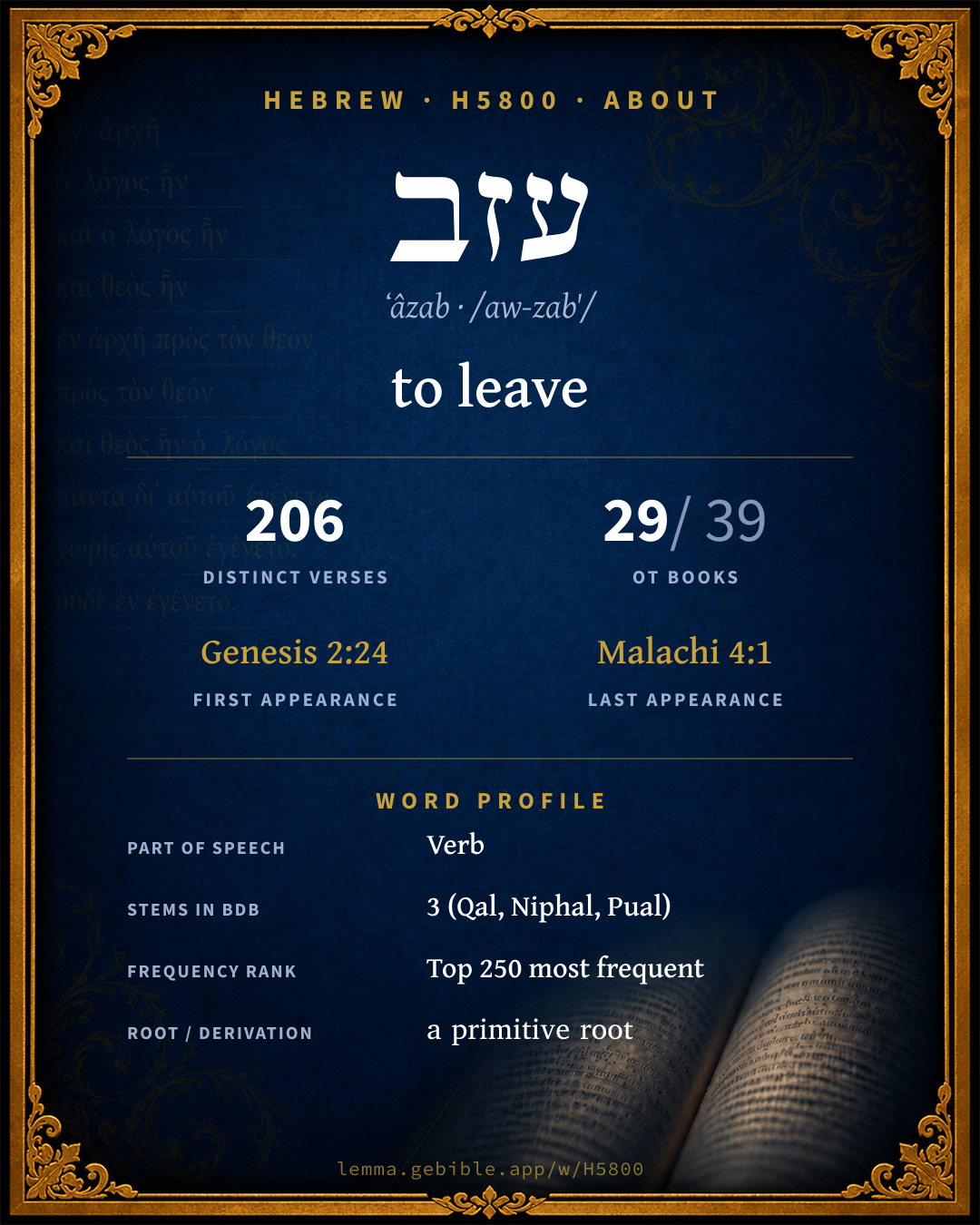
עָזַב
to leave
also: loose, forsake fuller range ↓
Full lexicon entry — Brown-Driver-Briggs (BDB)
From Brown-Driver-Briggs (BDB)
Where this word appears
See every Qal verb in the Hebrew Bible →
Grammar key — what these labels mean
Part of speech
- Verb
- An action or state-of-being word.
Stem
- Qal
- The basic, simple active stem — the plain form of the verb (“he wrote”). Here: ‘leave’
- Niphal
- Usually the simple passive or reflexive of the Qal (“he was written”). Here: ‘be left to’
- Pual
- The passive counterpart of the Piel.
- Qal Passive
- An archaic passive of the Qal, preserved in a few forms.
Form
- Perfect
- A completed action or state — Hebrew marks aspect (completeness) more than strict tense (“he wrote”).
- Sequential Imperfect
- An imperfect with prefixed waw — the standard past-narrative form (waw-consecutive imperfect).
- Imperfect
- An incomplete, ongoing, or future action (“he will / would write”).
- Jussive
- A third- or second-person volitional form expressing wish or command (“let him write”).
- Participle Passive
- A verbal adjective expressing action received (“written”).
- Participle Active
- A verbal adjective expressing ongoing or characteristic action (“writing / one who writes”).
- Infinitive Construct
- A bound verbal noun, frequently with prepositions (“to write / in writing”).
- Sequential Perfect
- A perfect with prefixed waw continuing a preceding imperfect or command (waw-consecutive perfect).
- Cohortative
- A first-person volitional form expressing wish or resolve (“let me / let us write”).
- Imperative
- A direct command (“write!”).
- Infinitive Absolute
- An unbound verbal noun, often intensifying or standing in for a finite verb.
State
- Absolute
- The independent form of a noun, not bound to a following word.
- Construct
- A noun bound to a following noun in a possessive / “of” relationship (the construct chain).
Person
- 3rd Person
- The one spoken about (“he / she / it / they”).
- 2nd Person
- The one addressed (“you”).
- 1st Person
- The speaker (“I / we”).
Gender
- Common
- Either gender — not distinguished for this form.
- Masculine
- Grammatically masculine.
- Feminine
- Grammatically feminine.
Number
- Plural
- More than one (in Hebrew, generally three or more).
- Singular
- One.
Every verse where H5800 appears in the Book of Leviticus — 3 distinct verses. Click any verse to open its interlinear word-by-word view. Verse text shown in the World English Bible for context — . Each verse’s Hebrew form is shown with its reference; the English is not keyword-highlighted, since the data carries no word-level English alignment. Use “Compare translations” on any verse to read it across multiple English versions. This concordance covers the Hebrew Bible; Septuagint (Greek Old Testament) occurrences are not indexed here.
Leviticus
- Leviticus 19:10 תַּעֲזֹ֣ב Qal impf 2ms You shall not glean your vineyard, neither shall you gather the fallen grapes of your vineyard; you shall leave them for the poor and for the foreigner. I am Yahweh your God.
- Leviticus 23:22 תַּעֲזֹ֣ב Qal impf 2ms "'When you reap the harvest of your land, you shall not wholly reap into the corners of your field, neither shall you gather the gleanings of your harvest: you shall leave them for the poor, and for the foreigner. I am Yahweh your God.'"
- Leviticus 26:43 תֵּעָזֵ֨ב Niphal impf 3fs The land also will be left by them, and will enjoy its sabbaths while it lies desolate without them: and they will accept the punishment of their iniquity; because, even because they rejected my ordinances, and their soul abhorred my statutes.
About this entry
At a glance — auto-summarized from this page’s data, not written by a person. Every figure links to its source below. This summary describes the numbers; it doesn’t interpret them.
“to leave” is the headline sense of the Hebrew verb עזב (ʻâzab). Older and newer Bibles part ways — “forsake” in the King James Version, “abandoned” (unfoldingWord Literal Text) in modern versions. See the renderings breakdown. It turns up in 206 verses across 29 books, a common footprint. Its earliest occurrence is Genesis 2:24. The verb spans 3 stems, from Qal to Niphal. See the sense tree, 206-verse concordance, and the renderings breakdown below.
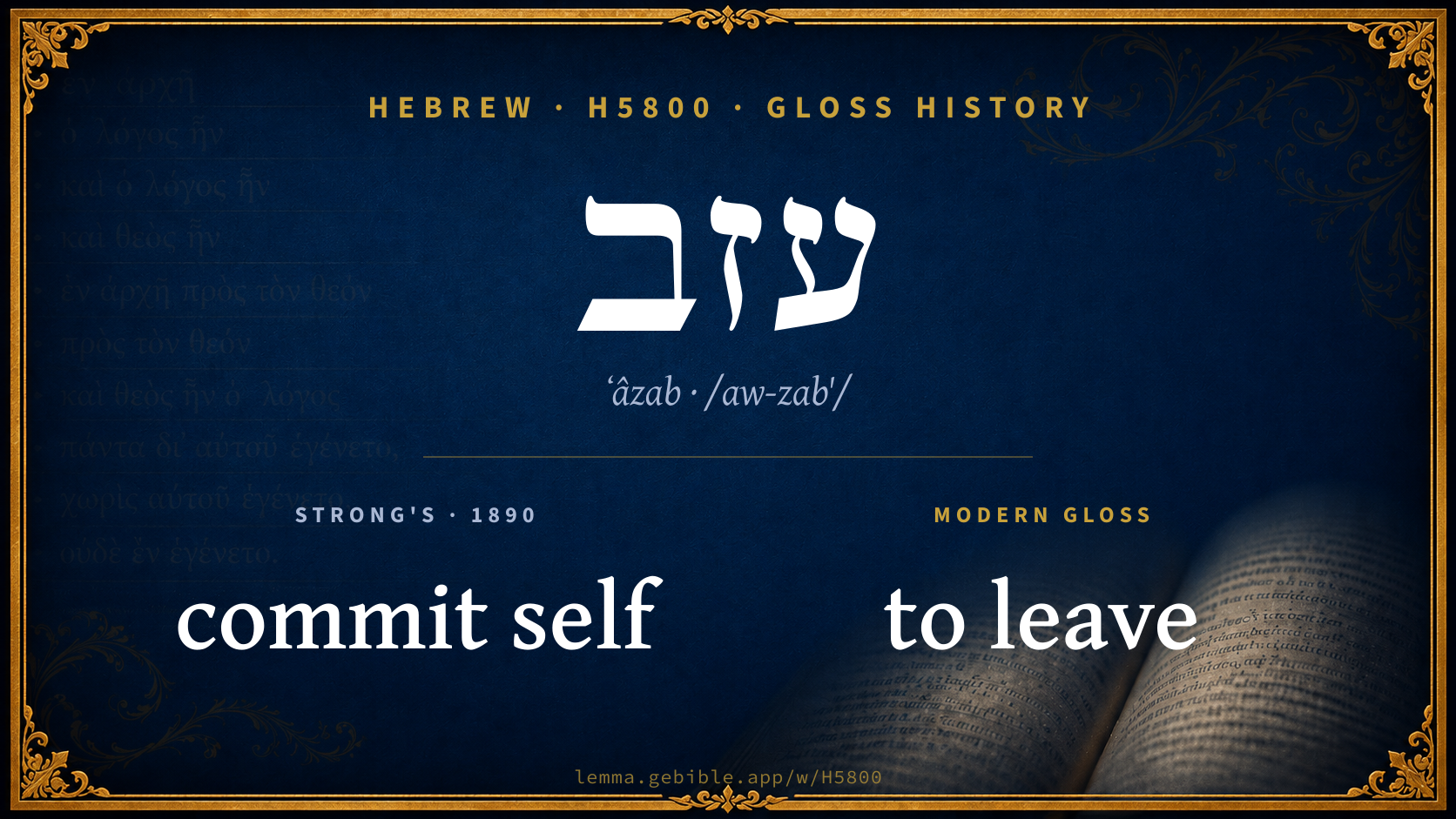
Gloss history
Strong's 1890 vs modern scholarship
About this word
Strong's H5800 catalogs a Hebrew word from the Hebrew Old Testament.
These counts are not copied from any lexicon or concordance. They are computed here, from the morphology-tagged Hebrew Old Testament. What Lemma adds →
- 206
- distinct verses
- The word appears in 206 distinct verses.
- 29 / 39
- OT books
- The word appears in 29 of 39 Old Testament books.
- #223
- by frequency
- Top 250 most frequent Hebrew words (rank 223 of 8,640 Hebrew words by occurrence).
View all 206 occurrences in the concordance →
By section of the Old Testament
By traditional corpus
Conventional, traditional groupings — biblical authorship is debated, so this is a traditional corpus grouping, not an authorship claim. Each share is this word’s portion of its verses in that division of the Hebrew canon. Each figure is a share of the word’s 206 distinct verses.
- Prophets (Nevi'im) 96 verses · 47%
- Writings (Ketuvim) 84 verses · 41%
- Torah (Pentateuch) 26 verses · 13%
How translations render this word
Counts come from each version’s own published word-to-Strong’s tagging or interlinear alignment — an approximate guide to how each version renders this word, not a word-level alignment the data otherwise carries. Because each total is that version’s own tagged count, the per-version totals vary from one another and need not match the appearance or distinct-verse counts above. These counts may also differ from a printed concordance because Lemma counts each distinctly tagged rendering and does not collapse phrase taggings into a single head-word total. This is a fixed set of word-tagged versions (KJV, ASV, BSB, ULT) and does not change with the reading translation you choose elsewhere. Each version’s license is shown beside its name below (and on Sources).
BDB lists this Strong’s number as 2 distinct words (homographs). Each count above pools all of them and is not split by sense — see the Senses section below. A low-frequency rendering may belong to a different one of those words, not the primary meaning.
- King James Version†: Forsake 23×, Left 15×, They have forsaken 10×
- American Standard Version†: Forsake 17×, Leave 10×, They forsook 10×
- Berean Standard Bible†: Forsake 14×, Forsaken 10×, Abandon 7×
- unfoldingWord Literal Text†: Abandoned 13×, They abandoned 11×, Do 9×
King James Version Public Domain
Renders H5800 across 215† tagged occurrences — most commonly:
Plus other, less common renderings. Plus 68 renderings that appear only once — usually multi-word phrases or single function words the recovered tagging swept in, not distinct renderings.
American Standard Version Public Domain
Renders H5800 across 214† tagged occurrences — most commonly:
Plus other, less common renderings. Plus 91 renderings that appear only once — usually multi-word phrases or single function words the recovered tagging swept in, not distinct renderings.
Berean Standard Bible Public Domain
Renders H5800 across 214† tagged occurrences — most commonly:
Plus other, less common renderings. Plus 80 renderings that appear only once — usually multi-word phrases or single function words the recovered tagging swept in, not distinct renderings. Not rendered by a distinct English word in 1 further occurrence.
unfoldingWord Literal Text CC BY-SA 4.0
Renders H5800 across 263† tagged occurrences — most commonly:
Plus other, less common renderings. Plus 86 renderings that appear only once — usually multi-word phrases or single function words the recovered tagging swept in, not distinct renderings.
26 senses and sub-senses in the full BDB
Hebrew verbs can shift meaning by stem (binyan): Qal is the basic action, Niphal is often passive or reflexive, Piel often intensifies or makes it factitive, and Hiphil is typically causative. The senses below are grouped under the stem BDB assigns to each. This entry also uses Pual (the passive of Piel).
What do BDB’s symbols mean?
BDB uses these scholarly abbreviations:
| Symbol | Meaning |
|---|---|
| 𝔊 | the Septuagint (the ancient Greek translation, LXX) |
| 𝔙 | the Vulgate (the Latin translation) |
| 𝔖 | the Syriac version (the Peshitta) |
| 𝔗 | the Targum (the Aramaic translation) |
| ψ | the Psalms |
| √ | root (the underlying root or stem) |
| ‖ | parallel passage (a synonymous or contrasted parallel) |
| † | the dagger: every passage where the word occurs is cited |
The 26 senses and sub-senses the full Brown-Driver-Briggs lexicon distinguishes for this word, in lexicon order (not ranked by frequency), with BDB’s own verbatim wording and sub-sense lettering. Shown in Hebrew script with BDB’s own scholarly abbreviations. The condensed entry is in the Lexicon Entry tab. See also the Forms in the corpus table below.
עזב I leave, forsake, loose (NH id. (rare)
Qal
- Pf. 3 ms. ע׳ Gn 24:27 +, sf. עֲזָבַנִי Is 49:14 ψ 38:11; 3 fs. עָזָבָ֑ה Ez 23:8; 1 s. sf. עֲזַבְתִּיךְ Is 54:7; 2 fpl. עֲזַבְתֶּן Ex 2:20, etc.; Impf. 3 ms. יַעֲזֹב Is 55:7 +, יַעֲזָב־ Gn 2:24, sf. 1 s. וַיַּעַזְבֵנִי 1 S 30:13, etc.; Imv. עֲזֹב ψ 37:8, עָזְבָה Je 49:11, עִזְבוּ Je 48:28; Pr 9:6, etc.; Inf. abs. עָזוֹב Je 14:5, עָזֹב Ex 23:5; cstr. עֲזֹב Gn 44:22 +, sf. עָזְבֵךְ Je 2:17 +, etc.; Pt. act. עֹזֵב Pr 10:17 +, cstr. עֹזְבִי (Ges§ 90 l); f. cstr. עֹזֶבֶת Pr 2:17 etc.; pass. עָזוּב Dt 32:26 +, etc.;— e.g. Genesis 24:27
- 1. leave, c. acc. (on order of meanings cf. NöZMG xl (1886), 726);
- a. = depart from, acc. pers. Gn 44:22(×2) (J), 2 K 2:2, 4, 6; 4:30; Nu 10:31 (P), Ru 1:16 Je 9:1 (‖ הָלַךְ מֵאֵת); acc. loc. 1 K 8:6 Je 25:28 (י׳ as lion leaving lair); c. מִן loc. intrans. (strangely) Je 18:14 (of snow). e.g. Genesis 44:22
- b. leave behind, acc. pers. Ex 2:20 (J), 2 S 15:16 (+ inf.), Ez 24:21; acc. rei + בְּיַד Gn 39:12, 13, + אֶצְלִי v 15, 18 (all J); + ב loc. 50:8 (J); acc. pers. et rei Ex 9:21 (J). e.g. Exodus 2:20
- c. leave in the presence of (לִפְנֵי) 1 Ch 16:37 (ל of accus., cf. ל 3 b supr.), 2 Ch 28:14. e.g. 1 Chronicles 16:37
- d. leave in safety, וְאָ֫נָה תַעַזְבוּ כְּבוֹדְכֶם Is 10:3. e.g. Isaiah 10:3
- e. leave in a given condition, situation, ע׳ אֹתוֹ בְמַחֲלֻיִים 2 Ch 24:25 they left him in great suffering; c. adv. acc. Ez 23:29; a city פְּתוּחָה Jos 8:17. e.g. 2 Chronicles 24:25
- f. leave undisturbed, let alone Ru 2:16. e.g. Ruth 2:16
- g. leave unexercised, Gn 24:27 pregn. he hath not left his kindness and his faithfulness from (being) with (מֵעִם) my master; so ע׳ חַסְדּוֹ אֶת־ Ru 2:20 (both of י׳); ע׳ חֵמָה ψ 37:8 (‖ הֶרֶף מֵאַף). e.g. Genesis 24:27
- h. leave in the hand of, entrust to, acc. rei + בְּיַד Gn 39:6 (J), + אֶל־ Jb 39:11 (‖ בָּטַח בְּ), + עַל־ ψ 10:14 (acc. om., his cause).—So also poss. (c. לְ) Ne 3:34 (reading לֵאלֹהִים for MT לָהֶם), but text prob. otherwise corrupt. e.g. Genesis 39:6
- i. leave to (ל) one (unaided), וְחָדַלְתָּ֫ מֵעֲזֹב לוֹ Ex 23:5a (E) thou shalt refrain from leaving it (sc. the affair) to him; cf. תַּעֲזֹב לָאָרֶץ בֵּיצֶיהָ Jb 39:14 (of ostrich). e.g. Exodus 23:5
- j. leave over, remaining, acc. pers. Ju 2:21 (JE); acc. rei + לְ pers. Lv 19:10; 23:22 (H), Mal 3:19. k. leave = have nothing to do with Pr 9:6. e.g. Judges 2:21
- 2. leave, abandon, forsake:
- a. abandon, acc. rei: (1) land, house, city, tent, etc., 1 S 31:7 = 1 Ch 10:7; 2 K 7:7; Je 9:18; 48:28; 51:9; 2 Ch 11:14; Is 17:9 (+ מִפְּנֵי of enemy); pt. pass. of cities v 2 Je 4:29; Zp 2:4, cf. עֲזוּבָה Is 17:9 pt. = subst. = deserted region. (2) oxen 1 K 19:20; idol-images (+ שָׁם) 2 S 5:21 = 1 Ch 14:12; flock Zc 11:17; pt. pass. of eggs Is 10:14. e.g. 1 Samuel 31:7
- b. forsake, (1) human subj. and obj.: Gn 2:24 (J; a man his + parents), 1 S 30:13; Jos 22:3 (D), Je 49:11 ψ 27:10 (parent a child), Pr 2:17 (wife her husband, אַלּוּף), cf. אִשָּׁה עֲזוּבָה Is 54:6, and ע׳ of personif. Zion Is 60:15; 62:4. (2) an animal its young Je 14:5 (obj. om.). e.g. Genesis 2:24
- c. = neglect, Levite Dt 12:19; 14:27, poor Jb 20:19. e.g. Deuteronomy 12:19
- d. especially (1) fig. of forsaking God (י׳), apostatizing, Ju 10:10; Dt 28:20; 31:16 Je 1:16 + 38 times (often Je and later); + Jon 2:9 (obj. חַסְדָּם, i.e. God, v. חֶסֶד II); c. ל + inf. only אֶת־י׳ עָֽזְבוּ לִשְׁמֹר Ho 4:10 (Oort We Now doubt לִשְׁמֹר). (2) obj. י׳’s law, commands, covenant, etc., Dt 29:24; 1 K 19:10, 14 + 14 times; house of י׳ 2 Ch 24:18; Ne 10:40. †(3) forsake, fail to follow, obey advice, instruction, wisdom, reproof: 1 K 12:8, 13 = 2 Ch 10:8, 13; Pr 2:13; 4:2, 6; 10:17; 15:10; 27:10. †(4) but also of forsaking idols Ez 20:8, sins of various kinds 23:8 Is 55:7; Pr 28:13 (obj. om.; + מוֹדֶה confess); הַמַּשָּׁא usury Ne 5:10. e.g. Judges 10:10
- e. of God’s forsaking, abandoning men: Dt 31:17; Is 41:17; 49:14; 54:7; 2 Ch 12:5; Ezr 9:9 ψ 9:11; 22:2 + 8 times ψψ; + בְּיַד Ne 9:28; ψ 37:33; ψ 16:10 thou wilt not abandon my soul לִשְׁאוֹל; of temporary abandonment 2 Ch 32:31 (+ inf. of purpose); etc. (34 times in all); + Je 12:7 (י׳ abandoning his house). e.g. Deuteronomy 31:17
- f. of God’s leaving, i.e. ceasing to regard, the earth, thus giving impunity to crime, Ez 8:12; 9:9. e.g. Ezekiel 8:12
- g. of strength (כֹּחַ) forsaking one ψ 38:11, courage (לֵב) 40:13, kindness and faithfulness (חֶסֶד וֶאֱמֶת) Pr 3:3. e.g. Psalms 38:11
- 3. let loose, set free, let go עָזֹב תַּעֲזֹב עִמּוֹ Ex 23:5b (E) thou shalt by all means free it (sc. the beast) with him, (aid him to set it free; on sense, cf. Dt 22:4; DHM sub ii. עזב); עָצוּר וְעָזוּב shut up and freed, proverb. phr., = all classes of people Dt 32:36; 1 K 14:10; 21:21; 2 K 9:8; 14:26 (exact meaning dub.; prob. either = bond and free, or [v. RSSem i. 437, 2nd ed. 456] under taboo and free from it); let go Jb 20:13 (c. acc. of wickedness as morsel in mouth); let loose my complaint Jb 10:1 (עָלַי apud me, cf. עַל II 1 d); אֶעֶזְבָה פָנַי Jb 9:27 I will loosen, relax, my face, (cf. Thes De Me Stu Di BuhlLex Bu; > abandon my [gloomy] countenance AV RV SS BaeKau Du). e.g. Exodus 23:5
Niphal
- Pf. 3 ms. נֶעֱזַב Ne 13:11; 3 fs. נֶעֱזָבָ֑ה Is 62:12; Impf. 3 fs. תֵּעָזֵב Is 7:16; Lv 26:43, תֵּעָ֣זַב Jb 18:4; 3 mpl. יֵעָֽזְבוּ Is 18:6; Pt. נֶעֱזָב Is 27:10 ψ 37:25; fpl. נֶעֱזָבוֹת Ez 36:4;— e.g. Nehemiah 13:11
- 1. be left to (לְ), i.e. to the possession of, Is 18:6. e.g. Isaiah 18:6
- 2. be forsaken, of house of God Ne 13:11, a city Ez 36:4; Is 27:10 (‖ מְשֻׁלָּח), 62:12; the earth Jb 18:4, land Is 7:16; Lv 26:43 (+ מִן of exiles); of man ψ 37:25. e.g. Nehemiah 13:11
Pual
- (or Qal pass., v. Ges§ 52 e) be deserted, of city: Pf. 3 ms. הֲמוֹן עִיר עֻזָּ֑ב Is 32:14 (‖ נֻטָ֔שׁ); 3 fs. עֻזְּבָה Je 49:25. e.g. Isaiah 32:14
עזב II restore, repair (?) (cf. perhaps Sab. עדֿב restore, Sab Denkm90 DHMÖster. Monatsschr. f. d. Orient 1885, 226
Qal
- Impf. 3 mpl. וַּיַּעַזְבוּ Ne 3:8 and they repaired (?) Jerus. as far as the broad wall; > paved GuZPV viii (1885), 282 f., or from √ I. עזב (see views in Be Ryle). e.g. Nehemiah 3:8
Senses from the full Brown-Driver-Briggs lexicon (Brown, Driver, Briggs; Oxford 1906 — public domain), digitized via Sefaria, supplemented by the OpenScriptures HebrewLexicon (CC BY 4.0). Full attribution on Sources.
Word origin
I. vb. leave, forsake, loose (NH id. (rare); Arabic عَرَبَ be remote, absent, depart, Assyrian ezêbu, leave, Shaph. ušezib, rescue, cf. Biblical Aramaic שֵׁיזֵב;—Ethiopic ማዕሰብ widowed Di 973);—
II. vb. restore, repair (?) (cf. perhaps Sab. עדֿב restore, Sab Denkm90 DHMÖster. Monatsschr. f. d. Orient 1885, 226; also NH מַעֲזִיבָה restoration, erection LevyNHWB iii. 186, Arabic معزب building-stone KremerBeitr. ii. 18);—
— Brown-Driver-Briggs (Oxford 1906, public domain), digitized via Sefaria, supplemented by the OpenScriptures HebrewLexicon (CC BY 4.0). See Sources.
Origin: a primitive root
Jastrow Dictionary
A second Hebrew/Aramaic lexicon for comparison, covering Aramaic and post-biblical (Talmudic, Targumic, Midrashic) usage that the biblical-Hebrew BDB does not. Matched by lemma rather than by Strong’s number, so a lemma may carry more than one Jastrow headword (shown separately below), and the entries cover usage well beyond the Bible.
עָזַב
- (b. h.) [to cut off,]
- 1. to relieve an animal broken down under its load (v. פָּרַק), help to unload. Mekh. Mishp. s. 20 (ref. to Ex. XXIII, 5) פעמים שאתה חדל ופעמים שאתה עוֹזֵב at times you may abstain, at times you must help. Ib. פריקה מנין ת"ל עָזוֹב וכ׳ whence do we derive the duty of unloading? It says (Ex. l. c.), thou must release with him; B. Mets. 32ᵃ. Tanḥ. Mishp. 1 עֲזוֹב קימעה מכאן וכ׳ loosen (the load) here a little, raise there &c. e.g. Exodus 23:5
- 2. to leave, abandon. Sot. 12ᵃ; Ex. R. s. 1 (ref. to עזובה, I Chr. II, 18) עזובה … שהכל עֲזָבוּהָ Azubah is Miriam … for all (young men) left her alone (ignored her on account of her sickliness). Midr. Till. to Ps. X וציון אמרה עֶזָבַנִי וכ׳ and Zion said, he has forsaken and forgotten me. Midr. Till. to Ps. XCII מי שמורה … ועוֹזֵב וכ׳ he who confesses his sins and forsakes (them, Prov. XXVIII, 13); a. fr. e.g. 1 Chronicles 2:18
- to untie, release; to effect a divorce. Gitt. 32ᵇ גט זה … לא יַעֲזִיב this letter shall have no effect, shall not untie, shall not release, contrad. to אינו מַעֲזִיב does not release, v. יָעַל.
- to make worth abandoning, make abominable. Yalk. Hos. 527 (ref. to Is. I, 4) אל תיקרי עזבו אלא עִיזְּבוּ read not, ‘they have forsaken’, but, ‘they have made (me) worth abandoning (caused me to be cruel); Tanḥ. B’huck. 2 עוזבו אתי (read עיזבו אותי). Pesik. R. s. 31 (ref. to עזבני, Is. XLIX, 14) עִיזְּבַנִי he has made me contemptible. e.g. Isaiah 1:4
- to be forsaken. Lev. R. s. 35 (ref. to Ps. XXXVII, 25) נ׳ מיראתו וכ׳ forsaken of his fear of the Lord. e.g. Psalms 37:25
- to be abandoned, neglected, hated. Gen. R. s. 45 ומִתְעַזֶּבֶת, v. כָּעַר; Cant. R. to II, 14 ומתעבת, ed. Wil. מתעובת (corr. acc., or read: מְתוֹעֶבֶת, v. תָּעַב). Pesik. R. l. c. והיו … ומִתְעַזְּבוֹת בפניהם and they became abominable and hateful in their sight.
עֲזַב
- , to forsake.—Part. pass. עָזֵיב. Y. Kidd. I, 61ᵃ מצורע ע׳ ‘leper’ (II Sam. III, 29) means abandoned (lonely).—V. שְׁזֵיב. e.g. 2 Samuel 3:29
A Dictionary of the Targumim, the Talmud Babli and Yerushalmi, and the Midrashic Literature (Marcus Jastrow; London, Luzac, 1903) — Public Domain. Digitized via Sefaria. Digitized via Sefaria. Full attribution on Sources.
Forms in the corpus
The 172 distinct written forms H5800 takes in the Hebrew Bible, most frequent first — each parse links to that stem’s occurrences in the concordance. Hebrew forms include their vowel points and cantillation, so a single lemma takes many written forms.
The 60 most common forms are shown; 112 rarer forms follow in the full concordance.
Same root — word family
Other BDB entries built from the same root as H5800, grouped by Strong’s listed origin. These share a root / origin per the lexicon — not necessarily a shared meaning. Each links to that word’s own entry.
Derived from this word
Compare all same-root words → They share a root, not necessarily a meaning.
Septuagint verse parallels
This word appears in 181 verses that also exist in the Greek Old Testament (Septuagint), out of the 206 Hebrew verses it occurs in. You can read those verses in Greek by switching the Old Testament edition to the Septuagint.
Read these verses in the Septuagint
- Genesis 2:24
- Exodus 2:20
- Leviticus 19:10
- Numbers 10:31
- Deuteronomy 12:19
- Joshua 1:5
- Judges 2:12
- Ruth 1:16
- 1 Samuel 8:8
- 2 Samuel 5:21
- 1 Kings 8:57
- 2 Kings 2:2
This is a verse-level parallel only — the same verses exist in both the Hebrew and Greek Old Testaments. No word-level Hebrew↔Greek correspondence is claimed: the data carries no such alignment, so no Greek word is shown as this Hebrew word’s translation. Coverage is not total — the Septuagint omits the deuterocanon and renumbers the Psalms, so some Hebrew verses have no direct Greek parallel.