Deuteronomy 32:36

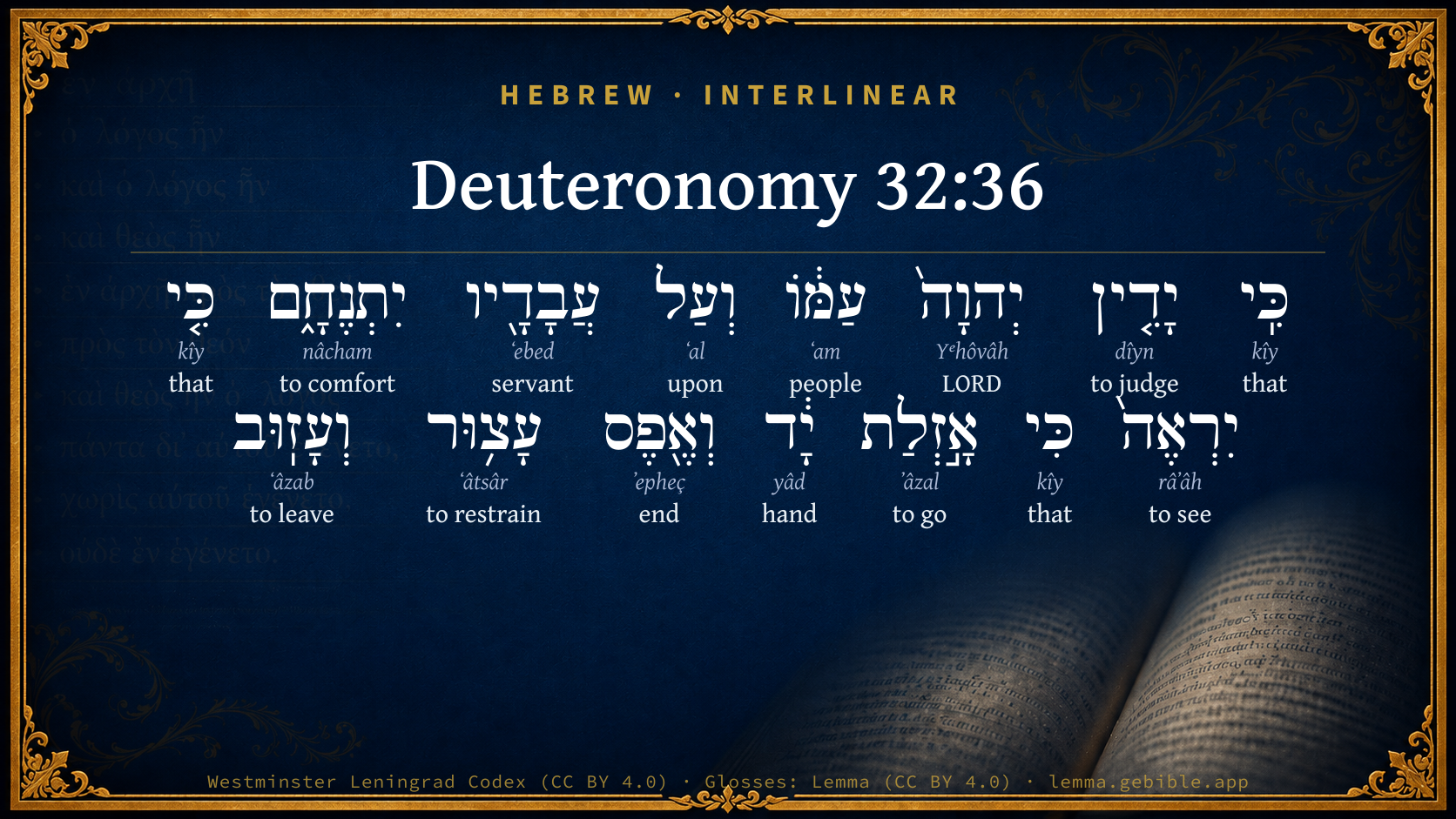
Hebrew (Westminster Leningrad Codex) Deuteronomy 32:36 appears in the Hebrew Old Testament. The text above is from the Westminster Leningrad Codex. Each word links to its Strong’s number, a concise gloss, and parsing drawn from the Open Scriptures Hebrew Bible morphology. Click any word for its full Brown-Driver-Briggs (BDB) entry.
Download image
Cite this verse

Deuteronomy 32:36 (World English Bible). Public Domain. Lemma interlinear Bible study tool, https://lemma.gebible.app/v/deuteronomy/32/36.

Show BibTeX & RIS
BibTeX
RIS
English Translation
For Yahweh will judge his people, Repent himself for his servants; When he sees that [their] power is gone, There is none [remaining], shut up or left at large.
World English Bible · Public Domain
Highlights
  • 1 first appearance in the Hebrew Bible
Full analysis ↓
Download a study sheet

One document with this verse’s original text, its word-by-word gloss line, the meaning frame, cross-references with their text, attributed commentary, and full source and license credits — printable, and it pastes into notes with its structure intact.

This verse Autodidact and up

Study sheet (.html) Plain text (.txt)

A passage Seminary Student

Up to 50 verses in one chapter. A passage sheet keeps up to 6 commentary sources and 12 cross-references per verse, in the order this page ranks them, and says so on the sheet whenever that leaves anything out. Ask for a single verse and you get the Autodidact verse sheet above.

Everything on this page stays free to read, with no account — the sheet is a download of what is already on screen, not access to it.

Want to remove ads? Support Godless Engineer
Compare translations 3

The same verse in 3 English versions, stacked beneath the original-language interlinear above. Click any original word for its lexicon entry.

Each is an independent rendering of the whole verse — the interlinear is not word-aligned to these translations.

Highlighted words mark where these versions differ — a whole-verse word diff, not a word-by-word alignment.

  • World English Bible Public Domain
    For Yahweh will judge his people, Repent himself for his servants; When he sees that [their] power is gone, There is none [remaining], shut up or left at large.
  • King James Version Public Domain
    For the LORD shall judge his people, and repent himself for his servants, when he seeth that their power is gone, and there is none shut up, or left.
  • unfoldingWord Literal Text CC BY-SA 4.0
    For Yahweh vindicates his people, and has compassion on his servants. For he will see that gone is hand, and there are none, kept back or let free.

unfoldingWord Literal Text — © unfoldingWord, licensed CC BY-SA 4.0. Word-aligned USFM3 via Door43 (git.door43.org/unfoldingWord/en_ult).

Versions to compare (up to 4)

3 of 4 selected

Show all 18 translations

Every available English version of this verse, each an independent rendering of the whole verse.

  • World English Bible Public Domain
    For Yahweh will judge his people, Repent himself for his servants; When he sees that [their] power is gone, There is none [remaining], shut up or left at large.
  • Berean Standard Bible Public Domain
    For the LORD will vindicate His people and have compassion on His servants when He sees that their strength is gone and no one remains, slave or free.
  • Majority Standard Bible Public Domain
    For the LORD will vindicate His people and have compassion on His servants when He sees that their strength is gone and no one remains, slave or free.
  • King James Version Public Domain
    For the LORD shall judge his people, and repent himself for his servants, when he seeth that their power is gone, and there is none shut up, or left.
  • American Standard Version (1901) Public Domain
    For Jehovah will judge his people, And repent himself for his servants; When he seeth that `their' power is gone, And there is none `remaining', shut up or left at large.
  • Revised Version (1885) Public Domain
    For the LORD shall judge his people, And repent himself for his servants; When he seeth that their power is gone, And there is none remaining, shut up or left at large.
  • Geneva Bible (1599) Public Domain
    For the Lord shall iudge his people, and repent towarde his seruants, when hee seeth that their power is gone, and none shut vp in holde nor left abroad.
  • Douay-Rheims (1899) Public Domain
    The Lord will judge his people, and will have mercy on his servants: he shall see that their hand is weakened, and that they who were shut up have also failed, and they that remained are consumed.
  • Young's Literal Translation Public Domain
    For Jehovah doth judge His people, And for His servants doth repent Himself. For He seeth -- the going away of power, And none is restrained and left.
  • Literal Standard Version CC BY-SA 4.0
    For YHWH judges His people, || And gives comfort over His servants. For He sees the going away of power, || And none is restrained and left.
  • Unlocked Literal Bible CC BY-SA 4.0
    For Yahweh will give justice to his people, and he will pity his servants. He will see that their power is gone, and no one remains, either slaves or free people.
  • unfoldingWord Literal Text CC BY-SA 4.0
    For Yahweh vindicates his people, and has compassion on his servants. For he will see that gone is hand, and there are none, kept back or let free.
  • Darby Bible Public Domain
    For Jehovah will judge his people, And shall repent in favour of his servants; When he seeth that power is gone, And there is none shut up or left.
  • World Messianic Bible Public Domain
    For the LORD will judge his people, and have compassion on his servants, when he sees that their power is gone, that there is no one remaining, shut up or left at large.
  • Webster's Bible Public Domain
    For the LORD shall judge his people, and repent for his servants: when he seeth that their power is gone, and there is none shut up, or left.
  • Free Bible Version CC BY-SA 4.0
    The Lord is going to vindicate his people; he will be merciful to his servants when he sees that they have no strength left, and that everyone is gone, whether slave or free.
  • Bible in Basic English Public Domain
    For the Lord will be judge of his people, he will have pity for his servants; when he sees that their power is gone, there is no one, shut up or free.
  • JPS Tanakh (1917) Public Domain
    For the LORD will judge His people, and repent Himself for His servants; when He seeth that their stay is gone, and there is none remaining, shut up or left at large.

Literal Standard Version (2020), Covenant Press — licensed CC BY-SA 4.0. Text via the HelloAO Bible API (eBible.org). Unlocked Literal Bible (unfoldingWord) — licensed CC BY-SA 4.0. Text via the HelloAO Bible API (eBible.org). unfoldingWord Literal Text — © unfoldingWord, licensed CC BY-SA 4.0. Word-aligned USFM3 via Door43 (git.door43.org/unfoldingWord/en_ult). Free Bible Version, Dr. Jonathan Gallagher — licensed CC BY-SA 4.0. Text via the HelloAO Bible API (eBible.org).

Word by word

More ways to search: Search by grammar → Find every occurrence → Compare this word →

Practice this passage: Drill this verse → Learn its vocabulary →

אָ֣זְלַת
ʼâzal
H235
“to go”
Verb, Qal, Perfect, 3rd Person, Feminine, Singular
Part of Speech
Verb
Stem
Qal
Form
Perfect
Person
3rd Person
Gender
Feminine
Number
Singular
Full BDB Definition

Origin: a primitive root

TWOT: 56

to go, to go away, to go about - (Qal) - to go away - to go about - to be used up, be exhausted, be gone, evaporated - (Pual) to go to and fro
  1. כִּֽי kîy H3588 “that” Conjunction
  2. יָדִ֤ין dîyn H1777 “to judge” Verb, Qal, Imperfect, 3rd Person, Masculine, Singular
  3. יְהוָה֙ Yᵉhôvâh H3068 “LORD” Noun, Proper
  4. עַמּ֔וֹ ʻam H5971 “people · his” Noun, Common, Masculine, Singular, Construct + Suffix, Personal, 3rd Person, Masculine, Singular
  5. וְעַל ʻal H5921 “and · upon” Conjunction + Preposition
  6. עֲבָדָ֖יו ʻebed H5650 “servants · his” Noun, Common, Masculine, Plural, Construct + Suffix, Personal, 3rd Person, Masculine, Singular
  7. יִתְנֶחָ֑ם nâcham H5162 “to comfort” Verb, Hithpael, Imperfect, 3rd Person, Masculine, Singular
  8. כִּ֤י kîy H3588 “that” Conjunction
  9. יִרְאֶה֙ râʼâh H7200 “to see” Verb, Qal, Imperfect, 3rd Person, Masculine, Singular
  10. כִּי kîy H3588 “that” Conjunction
  11. יָ֔ד yâd H3027 “hand” Noun, Common, Both, Singular, Absolute
  12. וְאֶ֖פֶס ʼepheç H657 “and · end” Conjunction + Noun, Common, Masculine, Singular, Absolute
  13. עָצ֥וּר ʻâtsâr H6113 “restrained” Verb, Qal, Participle Passive, Masculine, Singular, Absolute
  14. וְעָזֽוּב ʻâzab H5800 “and · left” Conjunction + Verb, Qal, Participle Passive, Masculine, Singular, Absolute

About this verse

These counts appear in no published source. They are computed here, from the morphology-tagged text and Lemma’s own curated glosses. What Lemma adds →

15
words
13
distinct lemmas
Pentateuch
section

Notable vocabulary

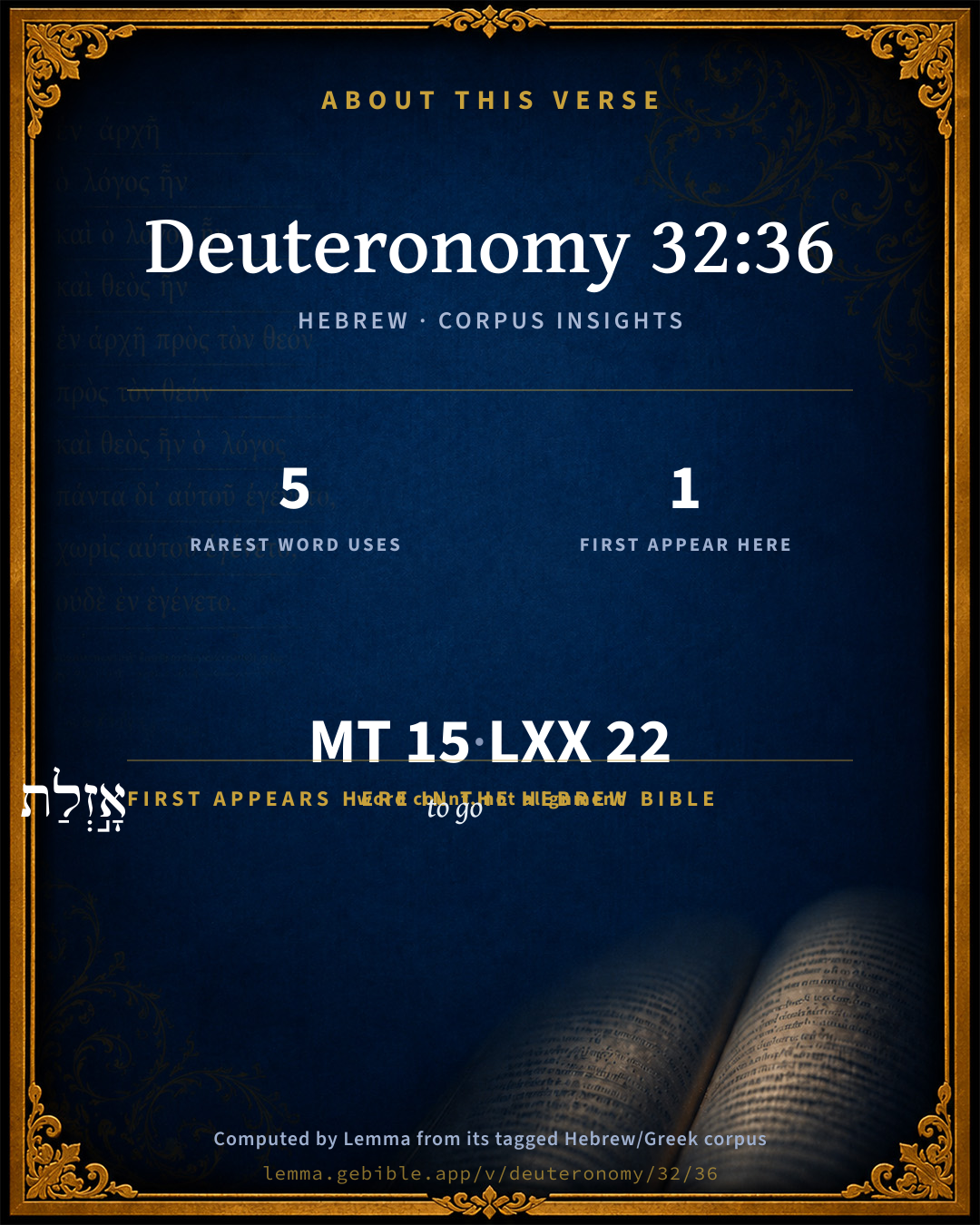
The rarest word here is אָ֣זְלַת to go H235 — appearing just 5 times in the whole Hebrew Bible.

First appearance in Scripture

This word makes its first canonical appearance in the Hebrew Bible here:

  • אָ֣זְלַת to go H235

Shared distinctive vocabulary

אָ֣זְלַת to go H235 occurs in 5 verses of the Hebrew Bible. Also found in:

Grammatical profile

  • 6 verbs
  • 5 nouns
  • 1 preposition
  • 3 conjunctions

Verb forms

  • יָדִ֤ין Qal · Imperfect
  • יִתְנֶחָ֑ם Hithpael · Imperfect
  • יִרְאֶה֙ Qal · Imperfect
  • אָ֣זְלַת Qal · Perfect
  • עָצ֥וּר Qal · Participle Passive
  • וְעָזֽוּב Qal · Participle Passive

Repetition

A word recurs within this verse — often emphatic in Hebrew:

  • כִּֽי that H3588 ×3

Hebrew & Septuagint length

In English translation the verse runs 29 words from the Hebrew and 32 from the Septuagint (LXX English) — closely comparable.

A rough comparison of the two English renderings, which tokenize alike — not a word-level alignment.

Word counts can differ between the Hebrew and the Greek without any difference in meaning — e.g. the Hebrew direct-object marker אֵת has no separate Greek word, and Greek often adds the article ὁ.

In the original languages it is 15 Hebrew tokens and 22 Greek tokens — but the two are counted differently (Hebrew bundles its prefixes and suffixes into one token; the Greek is in lemma form), so that isn’t a like-for-like length.

Cross-references

18

Topical passages linked to Deuteronomy 32:36 in the Treasury of Scripture Knowledge — connected by theme and wording, ordered by reader-vote popularity; previews shown in the World English Bible.

  • Psalms 135:14 For Yahweh will judge his people, And have compassion on his servants.
  • Psalms 106:45 He remembered for them his covenant, And repented according to the multitude of his loving kindnesses.
  • Deuteronomy 30:1–3 It shall happen, when all these things are come on you, the blessing and the curse, which I have set before you, and you shall call them to mind among all the nations, where Yahweh your God has driven you,
  • Judges 2:18 When Yahweh raised them up judges, then Yahweh was with the judge, and saved them out of the hand of their enemies all the days of the judge: for it repented Yahweh because of their groaning by reason of those who oppressed them and vexed them.
  • 1 Kings 14:10 therefore, behold, I will bring evil on the house of Jeroboam, and will cut off from Jeroboam every man-child, him who is shut up and him who is left at large in Israel, and will utterly sweep away the house of Jeroboam, as a man sweeps away dung, until it be all gone.
  • 2 Kings 14:26 For Yahweh saw the affliction of Israel, that it was very bitter; for there was none shut up nor left at large, neither was there any helper for Israel.
  • Judges 10:15–16 The children of Israel said to Yahweh, We have sinned: do you to us whatever seems good to you; only deliver us, we pray you, this day.
  • 1 Kings 21:21 Behold, I will bring evil on you, and will utterly sweep you away and will cut off from Ahab every man-child, and him who is shut up and him who is left at large in Israel:
  • 2 Kings 9:8 For the whole house of Ahab shall perish; and I will cut off from Ahab every man-child, and him who is shut up and him who is left at large in Israel.
  • Psalms 7:8 Yahweh administers judgment to the peoples. Judge me, Yahweh, according to my righteousness, And to my integrity that is in me.
  • Psalms 50:4 He calls to the heavens above, To the earth, that he may judge his people:
  • Psalms 90:13 Relent, Yahweh! How long? Have compassion on your servants!
  • Psalms 96:13 Before Yahweh; for he comes, For he comes to judge the earth. He will judge the world with righteousness, The peoples with his truth.
  • Jeremiah 31:20 Is Ephraim my dear son? is he a darling child? for as often as I speak against him, I do earnestly remember him still: therefore my heart yearns for him; I will surely have mercy on him, says Yahweh.
  • Joel 2:14 Who knows? He may turn and relent, And leave a blessing behind him, Even a meal offering and a drink offering to Yahweh, your God.
  • Amos 7:3 Yahweh relented concerning this. "It shall not be," says Yahweh.
  • Amos 7:6 Yahweh relented concerning this. "This also shall not be," says the Lord Yahweh.
  • Hebrews 10:30 For we know him who said, "Vengeance belongs to me," says the Lord, "I will repay." Again, "The Lord will judge his people."

Cross-references courtesy of OpenBible.info (CC BY 4.0).

Hebrew and Greek witnesses Masoretic Hebrew ↔ Greek Septuagint

The same verse in the two great witnesses to the Old Testament, shown verse-for-verse.

These are two independent witnesses, not word-aligned to each other, and the Septuagint is shown in lemma (dictionary) form.

Hebrew Deuteronomy 32:36 Masoretic · Westminster Leningrad Codex

כִּֽי יָדִ֤ין יְהוָה֙ עַמּ֔וֹ וְעַל עֲבָדָ֖יו יִתְנֶחָ֑ם כִּ֤י יִרְאֶה֙ כִּי אָ֣זְלַת יָ֔ד וְאֶ֖פֶס עָצ֥וּר וְעָזֽוּב

For Yahweh will judge his people, Repent himself for his servants; When he sees that [their] power is gone, There is none [remaining], shut up or left at large.

World English Bible · Public Domain

Greek LXX Deuteronomy 32:36 Septuagint · lemma form

ὅτι κρίνω κύριος ὁ λαός αὐτός καί ἐπί ὁ δοῦλος αὐτός παρακαλέω ὁράω γάρ παραλύω αὐτός καί ἐκλείπω ἐν ἐπαγωγή καί παραἵημι

For the Lord shall judge his people, and shall be comforted over his servants; for he saw that they were utterly weakened, and failed in the hostile invasion, and were become feeble:

LXX2012 (modern English Septuagint) · Public Domain

Hebrew: Westminster Leningrad Codex (CC BY 4.0). Greek: Septuagint (public domain); English from LXX2012 (modern English Septuagint) (Public Domain). How the Septuagint differs from the Hebrew →

Targum (Aramaic paraphrase)

2

The Targum is the ancient Jewish Aramaic paraphrase of the Hebrew Scriptures — an interpretive translation, not the Hebrew text itself. Onkelos (literal) and Pseudo-Jonathan (expansive) render the Torah, and Jonathan the Prophets. Coverage is partial: where no permissively-licensed English translation exists for a verse, only the Aramaic is shown. This is verse-level text, not a word-by-word alignment to the Hebrew.

  1. Targum Onkelos Torah (Genesis–Deuteronomy)
    אֲרֵי יְדִין יְיָ דִינָא דְעַמֵהּ וּפֻרְעֲנוּת עֲבְדוֹהִי צַדִיקַיָא יִתְפְרַע אֲרֵי גְלֵי קֳדָמוֹהִי דִבְעִדָן דְתִתְקֵף עֲלֵיהוֹן מָחַת סָנְאָה יְהוֹן מִטַלְטְלִין וּשְׁבִיקִין

    (no public-domain English translation for this verse)

    Targum Onkelos — Aramaic: “Onkelos Genesis” (public domain); “Onkelos Exodus” (public domain); “Onkelos Leviticus” (public domain); “Onkelos Numbers” (public domain); “Onkelos Deuteronomy” (public domain). English: “Sefaria Community Translation” (CC0 1.0 (public-domain dedication)); “J.W. Etheridge. The Targums of Onkelos and Jonathan Ben Uzziel on the Pentateuch. London: Longmans, Green, 1862” (public domain). Text via Sefaria.

  2. Targum Pseudo-Jonathan Torah (Genesis–Deuteronomy)
    אֲרוּם דָאִין מֵימְרָא דַיְיָ בִּרְחָמוֹן דִינָא דְעַמֵיהּ יִשְרָאֵל וְעַל בִּישָׁתָא דִגְזַר עַל עַבְדוֹהִי יְהֵי תָּהָן קֳדָמוֹי אֲרוּם גְלֵי קֳדָמוֹי דִבְעִידָן דִיחוֹבוּן וְתִתְקַף עֲלֵיהוֹן מָחַת סַנָאָה וְתִתְנַטֵל סָעִיד מִידֵיהוֹן וִיהוֹן פַּסְקִין מְהֵימְנַיָא מִדֵי עוֹבְדִין טָבִין וִיהוֹן מִיטַלְטְלִין וּשְׁבִיקִין

    For the Word of the Lord adjudgeth in His mercy the judgement of His people Israel, and for the evil He hath appointed upon His servants there shall be repentance before Him; for He knoweth that in the time when they have sinned the stroke of their enemies will be heavy upon them, and help have passed away from their hands, and the faithful will have failed with their good works and be scattered and forsaken.

    Targum Pseudo-Jonathan — Aramaic: “Targum Jonathan on Genesis” (public domain); “Targum Jonathan on Exodus” (public domain); “Targum Jonathan on Leviticus” (public domain); “Targum Jonathan on Numbers” (public domain); “Targum Jonathan on Deuteronomy” (public domain). English: “The Targum of Jonathan ben Uzziel, trans. J. W. Etheridge, London, 1862” (public domain). Text via Sefaria.

Commentary

Notes on Deuteronomy 32:36 from classic Christian and Jewish commentators (each source and its license shown beneath its notes). The classic Christian expositions comment on the surrounding passage and are grouped to its opening verse, so a note may address several verses; the Jewish commentaries on the Tanakh (Rashi and others) are per-verse, so they appear only where the commentator wrote on this verse.

Lemma curates 59 commentaries, every one of them public domain or Creative Commons licensed, each selected and text-cleaned for this edition rather than reprinted as found. About our sources →

Trapp's Complete Commentary

John Trapp

Deu 32:36 For the LORD shall judge his people, and repent himself for his servants, when he seeth that [their] power is gone, and [there is] none shut up, or left.

Ver. 36. And repent himself for his servants.] Thus God mingleth and allayeth the rigour of his justice with the vigour of his mercy.

John Trapp, A Commentary or Exposition upon All the Books of the Old and New Testament (1647–1656) — public domain. Text from a community e-Sword module.

The Biblical Illustrator

Joseph S. Exell

Deu_32:36

For the Lord shall judge His people.

Power for the powerless

I. The people whom Jehovah owns and claims as His people and His servants. God has a people peculiarly His own. You must be blind; indeed, when looking into your Bible, not to see that this fact is one of the most prominent things set forth in the Book of God. Moreover, this people, whom Jehovah calls His people and His servants, are held by Him as His especial property, as His own inheritance. The Lords portion is His people. What a portion! One might easily understand the Psalmist, and the prophet too, when they said, The Lord is my portion, saith my soul; and a blessed portion it is for a poor ruined sinner to have the covenant God as his portion. But reverse it, and see how God claims His people, and calls them His portion, as if they were worth something--as if they were of some value. I must not, however, overlook the second term employed in our text--servants. His servants ye are to whom ye obey. If, then, your life, your heart, your soul, and all your powers are wholly at the service of God; if that service is your delight, and you meet Him in it, surely you may come to the Conclusion that you belong to His servants. But there is another point: that His people and His servants essentially differ from all people beside. They were separated from among the nations, Gods people and Gods servants differ from the world in their life, in their language, and in their laws.

II. The exigencies to which they were reduced. They are said, in my text, to be seen by their own God as having lost all their power, and none shut up or left--a most affecting description of Gods chosen people under the ruined condition into which sin has brought them; and also of the extremity to which they are reduced in personal experience, before Gods deliverance appears on their behalf. What a marked description of mans ruin under the fall, and by actual sin!--so utterly undone as to have no power! God saw that their power was gone. When the poor sinner is first awakened by the grace of God, and begins to feel the importance of obtaining salvation, he does not believe that he has no power, but sets to immediately to put forth his power, determines upon reading much, hearing much, praying much, avoiding much that is evil, and doing much that is good. Moreover, in the language of my text, the people and servants of God are to be expelled from all false refuges, None shut up or left. There are exigencies in the believers experience with regard to things spiritual and to things providential that answer exactly to this description--none shut up or left--as regards experience, not a hope left; not a vestige of supposed strength--not a false refuge but will be swept away as a refuge of lies; not a helper left. Moreover, it may imply, in spiritual experience, no comfort shut up or left, no reserve, nothing to fall back upon, not a promise to cling to, not a sermon which he is supposed to have heard to profit, but rises up in judgment against him! What! none of his holier feelings? No, none of them. What, none of his earnest prayers and his believing confidence? No, none of them--none shut up or left. Now, whether as to the spiritual experience, or the providential experience of His people, He frequently, to show His wisdom, His grace, His power, His love and condescension, strips man of his all, that He Himself may become his all, and that Christ may be found to be all in all to him.

III. By the Lords judging His people I understand His judging for them; judging His enemies on account of their cruelty; judging for them so as to decide that they are His own--that the chastisement has been carried on long enough, and that their enemies shall then be punished, as in the preceding verse, To Me belongeth vengeance. This is what I understand by His judging His people. The other phrase, repent Himself for His servants, means an alteration, of course, in the events of Providence, and in His manner of dealing with His people; that He changes the order of things. From this we derive the spiritual truth, that however the Lord chastises His people, and however long the chastisement may continue, there will come a moment when the Lord will repent Himself, or change His course, and say, Their affliction is at an end, and I will not afflict or grieve My people any more. Then shall the froward Ephraim be spoken to as by the prophet, I have seen his ways, and I will heal him. God is a never-failing Deliverer to His people; and we will glance at a few things in which this is manifested. The first is, that His covenant faithfulness is called forth when His peoples faithlessness has arisen to its utmost height and been chastised. If you ask me what pertains to a Christian in himself, I should, for one, confess, after all the years I have known of the Lord, that one word, faithlessness, would mark all. If I am asked what constitutes the character and conduct of the Deity towards His Church and people in every age, amidst all their afflictions, and when they are reduced to the lowest ebb, I should say, Righteousness is the girdle of His loins, and faithfulness the girdle of His reins. One word more; entire deliverance is certain when God interferes. He who has delivered will deliver; and be assured, poor tried soul, whoever thou art, and in whichever of those exigencies thou art placed--be assured of this one thing, that if the Lord has begun to judge for you, has changed the course and order of His proceedings for you, has created a ray of hope and given you spiritual desires which you did not before possess, has communicated the ability to pour out your soul in pleading with Him, and to hang upon Him though it appears as it were by a thread, He will perfect your deliverance in due time. Every enemy shall be vanquished. Every difficulty shall disappear. (J. Irons.)

Mans extremity, Gods opportunity

To ungodly men the time of their fall is fatal; there is no rising again for them. They mount higher and higher upon the ladder of riches; but at last they can climb no higher, their feet slide, and all is over. This calamity hasteneth on (Deu_32:35). It is not so with three characters of whom we will now consider: they are judged in this world that they may not be condemned hereafter (1Co_11:32; Psa_37:24).

I. The Lords own Church.

1. A Church may be sorely tried--power gone, none left.

(1) By persecution.

(2) By removals, death, poverty.

(3) By the lack of a faithful ministry.

(4) By general falling off of members. Various circumstances may scatter a people--internal dissension, pestilent heresy, lack of spiritual life.

2. But it may then cry to God.

(1) If indeed His people, the covenant stands, and He will judge them.

(2) If still His servants, the bond holds on His side, and He will repent Himself for them.

(3) His eye is ever upon them, and their eye should be up to Him.

3. He will return and revive His own Church (Deu_32:39).

4. Meanwhile the trial is permitted--

(1) To find out His servants and drive out hypocrites (Isa_33:14).

(2) To test the faith of sincere saints, and to strengthen it.

(3) To manifest His own grace by supporting them under the trying times, and by visiting them with future blessing.

(4) To secure to Himself the glory when the happier days are granted.

II. The tried believer.

1. His power may be gone. Bodily health fails, prudence is baffled, skill is taken away, courage sinks, even spiritual force departs (Samuel 3:17, 18).

2. His earthly help may fail. A man without a friend moves the compassion of God.

3. He may be assailed by doubts and fears, and hardly know what to do with himself (Job_3:23-26).

4. His hope lies in the compassion of God: He has no pleasure in putting His people to grief (Mic_7:19).

5. Such sharp trials may be sent because--

(1) Nothing less would cure the evil hidden within.

(2) Nothing less might suffice to bring the whole heart to God alone.

(3) Nothing less might affect the believers future life.

(4) Nothing less might complete his experience, enlarge his acquaintance with the Word, and perfect his testimony for God.

III. The convinced sinner. He is cleaned out of all that wherein he prided himself.

1. His self-righteousness is gone.

2. His ability to perform acceptable works is gone.

3. His secret hopes which were shut up are now all dead and buried.

4. His proud romantic dreams are gone.

5. His worldly delights, his bold defiance, his unbelief, his big talk, his carelessness, his vain confidence, are all gone.

6. Nothing is left but the pity of God. When the tide has ebbed out to the very uttermost, it turns. The prodigal had spent all before he returned. Empty-handed sinners are welcome to the fulness of Christ. (C. H. Spurgeon.)

The Biblical Illustrator, edited by Joseph S. Exell (c. 1880s–1900s) — public domain. Text from a community e-Sword module.

Joseph Benson's Commentary

Deu 32:36. For the Lord, &c. — The Hebrew particle here rendered for, may properly be translated nevertheless, as it is Isa 9:1 : for here, it seems, a new paragraph begins; and having spoken of the dreadful calamity which would come upon his people, he now turns his discourse into a more comfortable strain, and begins to show that after God had sorely chastised them, he would have mercy upon them and turn their captivity. Judge his people — Shall plead their cause, shall protect and deliver them. Repent — Of the evils he hath brought upon them. None shut up — Either in their strong cities, or castles, or other hiding places, or in the enemy’s hands or prisons, whence there might be some hope or possibility of redemption; and none left, as the poor and contemptible people are neglected and usually left by the conquerors in the conquered land, but all seem to be cut off and destroyed.

Joseph Benson's Commentary on the Old and New Testaments (1811–1818) — public domain. Text from a community e-Sword module.

Tyndale Open Study Notes

Tyndale Open Resources

32:36 will change his mind about: When speaking of God, the Old Testament frequently uses figurative language (see study note on 8:2). Human beings cannot understand God’s mind (Isa 55:8), so God uses human language and gives himself human physical characteristics and feelings. Although the Bible frequently speaks of God’s eyes, arms, hands, and feet, he is invisible and has no body; these metaphors describe his activity. Similarly, when the Bible says that God fears (Deut 32:27) or changes his mind, it expresses how God’s actions appear to humans.

Tyndale Open Study Notes — © Tyndale Open Resources, licensed CC BY-SA 4.0. Text via the HelloAO Bible API.

Geneva Bible (1599)

Geneva Bible translators

When neither strong nor weak in a manner remain.

Or, change his mind.

Geneva Bible (1599) marginal notes — public domain. Text via Bolls.life.

Adam Clarke's Commentary

Verse 36. The Lord shall judge his people] He has an absolute right over them as their Creator, and authority to punish them for their rebellions as their Sovereign; yet he will repent himself - he will change his manner of conduct towards them, when he seeth that their power is gone - when they are entirely subjugated by their adversaries, so that their political power is entirely destroyed; and there is none shut up or left - not one strong place untaken, and not one family left, all being carried into captivity, or scattered into strange lands. Or, he will do justice to his people, and avenge them of their adversaries; see De 32:35.

Adam Clarke's Commentary on the Bible (1810–1826) — public domain. Text from a community e-Sword/MySword module.

Ellicott's Commentary for English Readers

(36) For the Lord shall judge His people.—Quoted in Heb_10:30, in connection with the previous verse. According to this view “shall judge” means “shall punish,” not “shall defend.”

And repent Himself for His servants.—Or, and will be comforted over His servants. Comp. Eze_5:13, “I will cause my fury to rest upon them, and I will be comforted;” and also Isa_1:24, &c.

None shut up, or left.—Comp. 1Ki_14:10; 1Ki_21:21; 2Ki_9:8, and especially Deu_14:26.

(37,38) He shall say,Where are their gods? . . . let them rise up and help you.—He did say so in Jdg_10:14.

A Bible Commentary for English Readers, edited by Charles John Ellicott (1878–1897) — public domain. Text from a community e-Sword module.

The Cambridge Bible for Schools and Colleges

gen. ed. J. J. S. Perowne

36 For the Lord shall judge for His people,

And relent for His servants’ sake,

When He sees that their grip is gone,

Nor fast nor free remaineth;

37 And shall say, Where be their gods

The rock whereon they refuged,

38 Which ate the fat of their sacrifice,

Drank the wine of their pouring?

Let them arise to your help,

Let them be a covert above you!

36. judge his people] As the parallel line shows, this means ‘will judge for his people.’

power] Lit. hand, i.e. hold or grip.

nor fast nor free] Heb. ‘aṣûr we ‘azûb, an alliterative phrase for the whole population. Whether it means in and out of prison, or under and free of taboo or ritual uncleanness, is doubtful.

The Cambridge Bible for Schools and Colleges (gen. ed. J. J. S. Perowne; Cambridge University Press, 1878–1918) — public domain. Text from a community e-Sword module.

John Gill's Exposition

And he shall say, where are their gods?.... Not the Lord shall say to Israel, upbraiding them with their idols and their idolatries; but, as the Targum of Jonathan,"the enemy shall say, where is the God of Israel?''and to the same purpose is, the Jerusalem Targum, and which is the sense of other Jewish writers (w); and the words may be rendered impersonally, and in the singular number, "and it shall be said, where is their God?" as it follows:

their rock in whom they trusted? that is, it shall be said to the people of God, when in the low estate before described, and which will make it still more distressing; it shall be said to them by their enemies in a sneering way, where is the Lord their God they boasted of, and the rock of salvation in whom they trusted? which agrees with other passages of Scripture, Psa 42:3. The persons insulted and upbraided are the Protestant witnesses at the time of their being slain; when "they that dwell upon the earth", the Papists, "shall rejoice over them", Rev 11:10; they are such who are true believers in the God and Father of Christ, as their God and Father in Christ, who of his own free grace has blessed them with all spiritual blessings in him; and who trust in Christ the rock alone for justification before God, for acceptance with him, and for their whole salvation; rejecting the Popish notion of justification by works, the doctrines of merit, and of works of supererogation, and the like; who now will be taunted at, and triumphed over, saying, where is the God of the Protestants they gloried in, as being on their side? and where is their rock on which they say the church is built, and not on Peter?

(w) Aben Ezra & R. Nehemiah in Jarchi in loc.

John Gill's Exposition of the Whole Bible (1746–1763) — public domain (CC PDM 1.0). Text via the HelloAO Bible API.

Haydock's Catholic Bible Commentary

People who have been guilty, that he may spare them, when they repent. (Menochius) --- "He will give judgment in favour of his people," &c. (Houbigant) --- Servants. He will not involve the innocent in the ruin of the rebellious. (Menochius) --- But, at the same time, he will have them to be convinced that their salvation came not from themselves. He will assist them when all human aid has proved abortive, (Haydock) and when they are reduced to the utmost distress. See Isaias xxxv. 3., and 3 Kings xxi. 21. Those who may have thought themselves secure in their sins, will not escape punishment. (Worthington)

George Leo Haydock (1774–1849), Haydock's Catholic Family Bible and Commentary, 1859 edition — public domain. Excludes Psalms (Douay-Rheims chapter numbering differs from Protestant) and Deuterocanonical books (Catholic canon only).

Matthew Poole's English Annotations

For, or, nevertheless, or, but yet, as the particle chi is sometimes used, as Job 5:7; Isa 9:1; 49:25. Having spoken of the dreadful calamity which would come upon his people, he now turns his discourse into a more comfortable strain, according to the usual method of the prophets, and here begins to show that after God had humbled and sorely chastised his people, yet at last he would have mercy upon them, and turn their captivity, as it here follows.

Shall judge his people, i.e. shall plead their cause, shall protect and deliver them, as that phrase is oft used. See Psa 7:8; 10:18; Isa 1:17; 11:4; Jer 5:28; 22:16.

Repent himself for his servants, i.e. repent of the evils he hath brought upon them, will change his course and carriage towards them.

None shut up, or left: none shut up, either in their strong cities or castles, or other hiding-places, or in the enemy’s hands or prisons, whence there might be some hope or possibility of redemption; and none left, as the poor and contemptible people are neglected and usually left by the conquerors in the conquered land, as 2Ki 25:12, but all seem to be cut off; and the people quite destroyed. So this phrase is used 1Ki 14:10; 21:21; 2Ki 9:8; 14:26.

Matthew Poole's English Annotations on the Holy Bible (1683–1685) — public domain. Text from a community e-Sword/MySword module.

Whedon's Commentary on the Bible

Daniel D. Whedon

36. For the Lord shall judge his people, and repent himself for his servants — Jehovah will judge — will administer justice to his people — and yet he will have compassion on them, for the expression rendered repent himself is better translated have compassion upon.

Daniel D. Whedon (gen. ed.), Commentary on the Old and New Testaments (1874–1909) — public domain. Text from a community e-Sword module.

The Pulpit Commentary

The Lord shall judge his people. (cf. Psa_135:14; 1Pe_4:17) And repent himself for his servants; rather, and have compassion upon his servants. And there is none shut up, or left . The words rendered "shut up or left" are a proverbial expression for "every one, men of all sorts" (cf. 1Ki_14:10 1Ki_21:21; 2Ki_9:8 2Ki_14:26) but how the words are to be rendered or explained is uncertain. Rosenm renders as in the Authorized Version; Gesenius has, "the shut up and the let go free, the bond and the flee;" so also Furst and De Wette; De Dieu, "married and single, conjugatus et coelebs," referring to the Arabic usage in support of his conclusion ("Animad. in Ver. Test.," p. 114), and this Keil approves. Ewald has "kept in (by legal impurity) or at large." The explanation of Gesenius and Furst seems best.

Vers. 36-43. Jehovah reigns; be glad!

This paragraph has about it a remarkably martial ring. It is not to be looked at as bald and literal prose. It is part of a song; it is laden with imagery, in which the God of Israel is set forth as a mighty Warrior, whose march none can hinder, whose inflictions none can withstand or evade. The style of the song was precisely appropriate to the age in which it was composed, and suited to the people in whose hearing it was addressed. The truths clothed in such Oriental garb are for all lands and for all time. For though there is an abundance of figure, yet not all is figurative. There are at least two phrases which are plain in their phraseology, and which furnish us with the key for the right interpretation of the others. One of these is found at the beginning of the passage, the other towards its close. The first is in ver. 36, The Lord shall judge his people." The other is in ver. 43, "Rejoice, O ye nations his people." The former assures us that all the various processes of judgment to which the seer"s eye looks forward are in the hands of God. The second calls upon the nations to rejoice therein. Between these two, the varied details in the paragraph fall naturally into place. Our Homily will, therefore, be mainly an answer to one inquiry, viz.

What materials for joy are here given us?

It is useless to bid any one to be glad unless a reason is given them why they should be so. A somewhat careful study of the paragraph in hand will show at least eight reasons for holy and grateful joy.

I It is matter for joy that God reserves in his own hands the judgment of his people (ver. 36). Where else could it safely be? Who else has the power, the wisdom, the justice, the kindness, the knowledge required? If the scepter of power were in any other hands, the guarantee of righteous administration would cease.

II We may rejoice that in his judging processes God will convince his people of the folly of relying on any but on himself (vers. 37, 38). The reason of the peculiar imagery in these verses every student knows. The underlying thought is clear. It may be a sharp, but it is a necessary discipline, that every prop should give way which would prevent us from leaning on God alone.

III We may rejoice in the severity with which a righteous God will deal with sin. Severity against sin is mercy towards the sinner (ver. 42). In the early conquest of Canaan, severity towards Aohan and his accomplices was mercy towards Israel. In the early Church, judgment on Ananias and Sapphira was mercy to the Church. In both cases the canker of dishonesty and hypocrisy needed to be cut out by a strong and firm hand.

IV We may rejoice that the ruling motive and the ultimate intent of God"s dealings are love and mercy (ver. 43). Beyond the blackest clouds Moses sees in the horizon light and glory. The twenty-eighth and twenty-ninth chapters of this book, with all their threatenings, are followed by the thirtieth, with all its promises. Wrath in the process, mercy as the product.

V Let us rejoice that in this law of recompense there is mercy in the educational process therein ensured. (see Psa_62:12) There is a wide difference between a fatherly correction and the infliction of a legal penalty. It is the former which God metes out towards his people. Their relation to him is one of grace, not of bare law.

VI Let us rejoice that mercy will regulate the mode, the time, and the result of the chastisement, The mode: "Their power is gone," i.e. their false props are destroyed. The time: "He will repent himself," i.e. he will not be wrath forever; when the infliction has answered its end, he will change his dealings. Though God never changes a plan, he may plan a change. The result: "He will be merciful unto his land," etc., i.e. he will be propitious. When his people are brought back from their wanderings, he will "cover" all their sin in eternal forgetfulness.

VII Let us rejoice in the clear and perfect discrimination which will mark all the Divine dealings with his people and with his adversaries; ver. 43, "vengeance mercy." Both form part of God"s governmental methods. How can it be otherwise in a world of sin? The perfections of Jehovah guarantee that neither will infringe on the other. Tenderness will never weaken vengeance. Vengeance will never lessen tenderness. God alone knows the absolutely perfect adjustment.

VIII Let us rejoice that the eye of the seer beholds brightness in the far distance. The gloom does but intervene; it does not cover the whole canopy of heaven, nor darken all the outlook. "Light is sown for the righteous." "Joy cometh in the morning" (ver. 43).

Let all these several particulars be woven together, and they will make one glorious pattern at the sight of which we may well shout aloud for joy.

Learn

1. In such a review of the methods and outcome of God"s providential dealings only those who are at peace with God through our Lord Jesus Christ are in a position to understand them. Enmity cannot understand love. And where men are "enemies in their mind by wicked works," they are certain to misunderstand God"s nature, and to misinterpret his ways. Man"s first duty is to repent of sin and obey God. Till he does this the mysteries of God will not be unveiled to him.

2. When we understand something of the redemption which is in Christ Jesus, then the true key to the interpretation of providence is in our hands. (Rom_8:34) Hence we can "rejoice in the Lord". (Psa_33:1; Php_3:1 4:4; Psa_97:1 Ps 96 Ps 98)

3. In proportion to the greatness of the love which furnishes the key for unlocking providential mysteries is the greatness of the sin which turns away from and finally rejects God. (See the use of this paragraph in Heb_10:30, Heb_10:31) However deep the gloom which Moses depicts, he sees a rim of golden glory in the horizon, as if another dispensation were to follow. But the writer of the Epistle to the Hebrews sees no after-light for those who turn away from Christ. "For if we sin willfully after we have received the knowledge of the truth, there remaineth no more sacrifice for sins, but a certain fearful looking for of judgment and fiery indignation, which shall devour the adversaries. It is a fearful thing to fall into the hands of the living God." The contest of the sinner with God must end in the guilty one"s ignominious and hopeless defeat; Amo_4:12, "Because I will do this unto thee, prepare to meet thy God, O Israel.

Vers. 36-43. The final revelation of God"s supremacy.

In this inspired song an epitome of the Bible Moses looks adown the long vista of history, and discerns what will be the outcome of the whole, viz. to establish on a safe basis the acknowledged supremacy of Jehovah. Truth shall eventually conquer, whatever be her present fortunes; and the supreme authority of Jehovah is a fundamental truth, which must in duo time effectually shine forth.

I HUMAN EXPERIENCE WILL ULTIMATELY CONFIRM THE VANITY AND FUTILITY OF IDOLATRY. Men will accept, at the close of a changeful and bitter experience, what they would not accept at the outset of their course, viz. that there is one God invisible, supreme, eternal. In the conscious pride of self-will, men will sound all the possible problems of life. They will not at first accept, with the docility of a childlike nature, the ipse dixit even of God himself. But when all trust in self and in created power has proved a failure; when all power is gone, and we lie on the battlefield, wounded and helpless; then we begin to give heed to the heavenly voice. Then the gentle message of God comes, with the charm of evening music, upon the ear yea, as an anodyne and a balm upon the bleeding heart. In a mood of self-despair, we clutch the hope of the gospel, viz. God manifest to man. God invites us to earnest and profound inquiry. He asks us to give a mature deliverance touching the power and helpfulness of the God whom we have long trusted; and the final experience of men, in all lands and ages, is uniform. "The gods who have not created the heavens and the earth shall perish!

II HUMAN EXPERIENCE ATTESTS THE SUPREMACY AND TRIUMPH OF JEHOVAH. "See now, that I, even I am he, and there is no god with me." The eye of man can clearly discern the fact the foundation-fact of all religion so soon as the veil of prejudice and sin is removed. The revelation is clear enough, if only the organ of mental vision be in healthful vigor. Without question, God is the sole Arbiter of life and death. No other deity has ever assumed an act of creation. The powers of evil have flourished the wand of a necromancer, and have pretended to effect sudden changes in the conditions of nature; but not one has ever pretended to create a star or to produce a single human life. God is still left upon the throne, as sole and undisputed Monarch.

Eternal existence is another prerogative of Jehovah. Where are now the gods of the heathen? Who now worships Jupiter, or Dagon, or Isis, or Moloch? Their names are historic only. They had a passing popularity, but it has long since vanished. But with solemn form of adjuration, the Most High lifts his hand and swears, "I live forever!" As in a court of justice men accept the testimony of a fellow-man, when that testimony is given under the sanction of a religious oath; so, in self-consistency, are we bound to accept the asseveration of the eternal God. In pity for his creatures, he also takes the form of oath, and since "he can swear by none greater, he swears by himself.

III THE ROYAL SUPREMACY OF JEHOVAH IS A GROUND FOR HUMAN JOY. Every perfection of God is suitable material for grateful praise. His power is a security for good men. All our interests are safe, being under the protection of such a Friend. His holiness also affords distinct ground for gladness. Because he is holy, we can cherish a confident hope that we shall be holy too. Hence we give thanks at the remembrance of his holiness." We rejoice to know that the scepter of the universe is in the hands of a God who is absolutely and incorruptibly just. We know that "the right" will not long be trodden underfoot of the oppressor. We are assured that the malice and craft of Satan shall not triumph. We heartily rejoice that Jehovah is King of all the earth; for "all things must now work together for good to them that love him.

Truth, crushed to earth, shall rise again; The eternal years of God are hers; But Error, wounded, writhes with pain, And dies amid her worshippers.

Most of all, we rejoice in his mercy. He will be merciful to his land and to his people." We are the very persons who need Divine mercy; for lack of that mercy we die. Not more urgently does the parched land need the liquid shower, than do we, who have so grossly sinned, need Jehovah"s mercy. Yet not more sure is the need than the supply. That mercy is made amply secure to all who desire it. As certainly as light streams from the natural sun, so freely and copiously does mercy stream forth from Jehovah"s heart. Therefore we do well to "rejoice and to be exceeding glad." For saith Jehovah, "I will pardon your unrighteousness, and your sins and your iniquities will I remember no more." God"s revelation closes with the theme of mercy. D.

The Pulpit Commentary (1880–1919), ed. H.D.M. Spence-Jones & Joseph S. Exell — public domain. Text from a community e-Sword module.

John Wesley's Explanatory Notes

For - Or, nevertheless, having spoken of the dreadful calamity which would come upon his people, he now turns his discourse into a more comfortable strain, and begins to shew that after God had sorely chastised his people, he would have mercy upon them and turn their captivity. Judge his people - Shall plead their cause, shall protect and deliver them. Repent - Of the evils he hath brought upon them. None shut up - Either in their strong cities or castles or other hiding places, or in the enemies hands or prisons, whence there might be some hope or possibility of redemption; and none left, as the poor and contemptible people are neglected and usually left by the conquerors in the conquered land, but all seem to be cut off and destroyed.

John Wesley, Explanatory Notes Upon the Whole Bible (1754–1765) — public domain. Text via the GEBible commentary corpus.

Scofield Reference Notes

C. I. Scofield

repent

(See Scofield "Zec 8:14").

The Scofield Reference Bible (1917 edition), notes by C. I. Scofield — public domain. Text from a community e-Sword module.

unfoldingWord translationNotes

Door43 World Missions Community

General Information:

Moses continues to speak a poetic song to the people of Israel. (See: Parallelism)

For Yahweh will give justice to his people

The abstract noun "justice" can be translated as an adjective or as an adverb. AT: "For Yahweh will do what is just for his people" or "For Yahweh will act justly towards his people" (See: Abstract Nouns)

he will pity his servants

"he will feel that he needs to help his servants"

translationWords

Yahweh

people of God

servant

power

free

unfoldingWord translationNotes — © Distant Shores Media and the Door43 World Missions Community, licensed CC BY-SA 4.0. Source: git.door43.org/Door43/en_tn.

Rashi

Rabbi Shlomo Yitzchaki (Rashi)

כי ידין ה' עמו — This means, when He will sentence them to all these sufferings that are mentioned concerning them. The phrase has the same meaning as (Job 36:31) “For by them ידין nations”, i.e. He will chastise the nations. — This word כי has not the meaning of “because”, giving the reason for the preceding statements, but it is an expression (a particle) beginning a new a statement, as (Leviticus 25:2) “When (וכי) ye will come into the land” (cf. Rashi on that passage). The meaning is: When these judgment will come upon them, and the Lord will bethink Himself concerning His servants to have mercy on them again.

יתנחם HE WILL REPENT — This is an expression for changing one’s mind whether for good or for evil.

כי יראה כי אזלת יד WHEN HE SEETH THAT THEIR POWER IS GOING ON — i.e. when He sees that the power of the enemies is constantly becoming exceedingly stronger over them,ואפס AND THERE IS NOT among them עצור ועזוב.

עצור is one who is saved by a עוצר (a “restrainer”) and ruler who would restrain them,

עזוב means one saved by an עוזב. Now an עוצר is a ruler who keeps the people in check that they should not march in scattered groups when they go into war against the enemy, maintenue in old French, (Engl = maintainer). Consequently עצור (the passive) is one who is saved through the restraint of the ruler. עזוב is one who is strengthened, as (Nehemiah 3:8) “and they fortified (ויעזבו) Jerusalem unto the broad wall”; (Jer. 49:25) “How is this city of praise not helped (עזובה)!”. In old French anforcede, (English = fortified).

Rashi on the Tanakh — English translations: “The Judaica Press complete Tanach with Rashi, translated by A. J. Rosenberg” (CC BY 4.0); “Pentateuch with Rashi's commentary by M. Rosenbaum and A.M. Silbermann, 1929-1934” (public domain); “The Metsudah Tanach series, Lakewood, N.J” (CC BY 4.0); and “The Book of Joshua, Metsudah Publications, 1997” (CC BY 4.0). Text via Sefaria.

Lesson kit

Teaching starters — assembled from the data on this page, not authored interpretation. Every prompt links to the verse data it draws on. Edit before teaching.

Deuteronomy, in the Pentateuch, opens this verse with 15 words (13 distinct Hebrew lemmas). Its most distinctive word is ʼâzal (“to go”). A historical commentator’s framing appears above. Read the whole chapter for the surrounding context.

Discussion questions

  1. What does “to go” (ʼâzal) contribute to the verse as a whole?
  2. This is the first place “to go” appears in Scripture (first appears here). What does its debut here establish?
  3. How does 1 Samuel 9:7, which shares the word «to go», read alongside this verse?
  4. What does the repetition of “that” (3× in this one verse) do in this verse?
  5. These translations render this verse differently. What is at stake in choosing one wording over another?
  6. «יָדִ֤ין» is a Qal Imperfect verb. How does that grammatical form shape the action described?
  7. Compare how Trapp's Complete Commentary and The Biblical Illustrator read this verse. Where do they agree or differ?

Things to notice

Reading settings

Reading text

Shown beneath each verse's original-language words.

Old Testament
Old Testament edition

Read the OT as the Masoretic Hebrew (MT) or the Greek Septuagint (LXX).

English shown for the Greek Septuagint (in the Hebrew ↔ Greek comparison).

Comparing translations? Open the Compare panel on any verse page to stack up to four side by side.