
Jeremiah 1:16

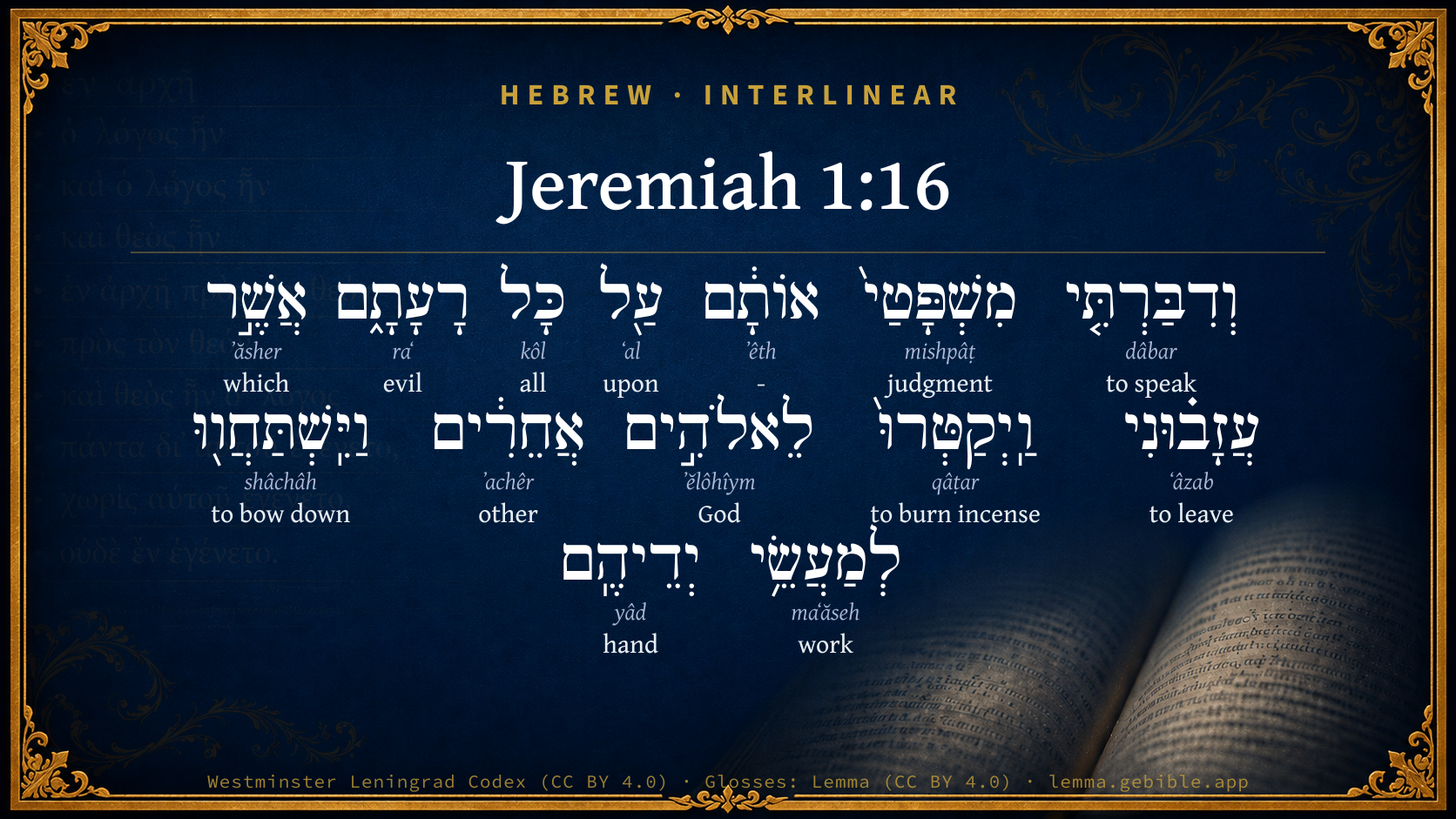
Hebrew (Westminster Leningrad Codex) Jeremiah 1:16 appears in the Hebrew Old Testament. The text above is from the Westminster Leningrad Codex. Each word links to its Strong’s number, a concise gloss, and parsing drawn from the Open Scriptures Hebrew Bible morphology. Click any word for its full Brown-Driver-Briggs (BDB) entry.
Download image
Cite this verse

Jeremiah 1:16 (World English Bible). Public Domain. Lemma interlinear Bible study tool, https://lemma.gebible.app/v/jeremiah/1/16.

Show BibTeX & RIS
BibTeX
RIS
English Translation
I will utter my judgments against them touching all their wickedness, in that they have forsaken me, and have burned incense to other gods, and worshiped the works of their own hands.
World English Bible · Public Domain
Download a study sheet

One document with this verse’s original text, its word-by-word gloss line, the meaning frame, cross-references with their text, attributed commentary, and full source and license credits — printable, and it pastes into notes with its structure intact.

This verse Autodidact and up

Study sheet (.html) Plain text (.txt)

A passage Seminary Student

Up to 50 verses in one chapter. A passage sheet keeps up to 6 commentary sources and 12 cross-references per verse, in the order this page ranks them, and says so on the sheet whenever that leaves anything out. Ask for a single verse and you get the Autodidact verse sheet above.

Everything on this page stays free to read, with no account — the sheet is a download of what is already on screen, not access to it.

Want to remove ads? Support Godless Engineer
Compare translations 3

The same verse in 3 English versions, stacked beneath the original-language interlinear above. Click any original word for its lexicon entry.

Each is an independent rendering of the whole verse — the interlinear is not word-aligned to these translations.

Highlighted words mark where these versions differ — a whole-verse word diff, not a word-by-word alignment.

  • World English Bible Public Domain
    I will utter my judgments against them touching all their wickedness, in that they have forsaken me, and have burned incense to other gods, and worshiped the works of their own hands.
  • King James Version Public Domain
    And I will utter my judgments against them touching all their wickedness, who have forsaken me, and have burned incense unto other gods, and worshipped the works of their own hands.
  • unfoldingWord Literal Text CC BY-SA 4.0
    And I shall speak my judgment them concerning all their evil in which they abandoned me and burned incense to other gods, and worshipped what they made with their own hands.

unfoldingWord Literal Text — © unfoldingWord, licensed CC BY-SA 4.0. Word-aligned USFM3 via Door43 (git.door43.org/unfoldingWord/en_ult).

Versions to compare (up to 4)

3 of 4 selected

Show all 18 translations

Every available English version of this verse, each an independent rendering of the whole verse.

  • World English Bible Public Domain
    I will utter my judgments against them touching all their wickedness, in that they have forsaken me, and have burned incense to other gods, and worshiped the works of their own hands.
  • Berean Standard Bible Public Domain
    I will pronounce My judgments against them for all their wickedness, because they have forsaken Me to burn incense to other gods and to worship the works of their own hands.
  • Majority Standard Bible Public Domain
    I will pronounce My judgments against them for all their wickedness, because they have forsaken Me, and they have burned incense to other gods and worshiped the works of their own hands.
  • King James Version Public Domain
    And I will utter my judgments against them touching all their wickedness, who have forsaken me, and have burned incense unto other gods, and worshipped the works of their own hands.
  • American Standard Version (1901) Public Domain
    And I will utter my judgments against them touching all their wickedness, in that they have forsaken me, and have burned incense unto other gods, and worshipped the works of their own hands.
  • Revised Version (1885) Public Domain
    And I will utter my judgments against them touching all their wickedness; in that they have forsaken me, and have burned incense unto other gods, and worshipped the works of their own hands.
  • Geneva Bible (1599) Public Domain
    And I will declare vnto them my iudgements touching all the wickednesse of them that haue forsaken me, and haue burnt incense vnto other gods, and worshipped the workes of their owne handes.
  • Douay-Rheims (1899) Public Domain
    And I will pronounce my judgements against them, touching all their wickedness, who have forsaken me, and have sacrificed to strange gods, and have adored the work of their own hands.
  • Young's Literal Translation Public Domain
    And I have spoken My judgments with them concerning all their evil, in that they have forsaken Me, and make perfume to other gods, and bow themselves to the works of their own hands.
  • Literal Standard Version CC BY-SA 4.0
    And I have spoken My judgments with them concerning all their evil, in that they have forsaken Me, and make incense to other gods, and bow themselves to the works of their own hands.
  • Unlocked Literal Bible CC BY-SA 4.0
    I will pronounce sentence against them for all their evil in forsaking me, in burning incense to other gods, and in worshiping what they made with their own hands.
  • unfoldingWord Literal Text CC BY-SA 4.0
    And I shall speak my judgment them concerning all their evil in which they abandoned me and burned incense to other gods, and worshipped what they made with their own hands.
  • Darby Bible Public Domain
    and I will pronounce my judgments against them for all their wickedness, in that they have forsaken me, and have burned incense unto other gods, and worshipped the works of their own hands.
  • World Messianic Bible Public Domain
    I will utter my judgments against them concerning all their wickedness, in that they have forsaken me, and have burned incense to other gods, and worshiped the works of their own hands.
  • Webster's Bible Public Domain
    And I will utter my judgments against them touching all their wickedness, who have forsaken me, and have burned incense to other gods, and worshiped the works of their own hands.
  • Free Bible Version CC BY-SA 4.0
    I will carry out my sentence against the inhabitants for all their wickedness, because they abandoned me to burn incense to pagan gods, to worship idols they themselves made.
  • Bible in Basic English Public Domain
    And I will give my decision against them on account of all their evil-doing; because they have given me up, burning perfumes to other gods and worshipping the works of their hands.
  • JPS Tanakh (1917) Public Domain
    And I will utter My judgments against them touching all their wickedness; in that they have forsaken me, and have offered unto other gods, and worshipped the work of their own hands.

Literal Standard Version (2020), Covenant Press — licensed CC BY-SA 4.0. Text via the HelloAO Bible API (eBible.org). Unlocked Literal Bible (unfoldingWord) — licensed CC BY-SA 4.0. Text via the HelloAO Bible API (eBible.org). unfoldingWord Literal Text — © unfoldingWord, licensed CC BY-SA 4.0. Word-aligned USFM3 via Door43 (git.door43.org/unfoldingWord/en_ult). Free Bible Version, Dr. Jonathan Gallagher — licensed CC BY-SA 4.0. Text via the HelloAO Bible API (eBible.org).

Word by word

More ways to search: Search by grammar → Find every occurrence → Compare this word →

Practice this passage: Drill this verse → Learn its vocabulary →

וַֽיְקַטְּרוּ֙
qâṭar
H6999
“and · to burn incense”
Conjunction + Verb, Piel, Sequential Imperfect, 3rd Person, Masculine, Plural
Part of Speech
Conjunction + Verb
Stem
Piel
Form
Sequential Imperfect
Person
3rd Person
Gender
Masculine
Number
Plural
Full BDB Definition

Origin: a primitive root [identical with H7000 through the idea of fumigation in a close place and perhaps thus driving out the occupants]

TWOT: 2011 , 2011e , 2011g

to sacrifice, burn incense, burn sacrifices, make sacrifices smoke (verb) - (Piel) - to make sacrifices smoke - to sacrifice - (Pual) to smoke a sacrifice - (Hiphil) - to make sacrifices smoke - to cause incense to smoke, offer incense - to make smoke upon - (Hophal) to be made to smoke - incense (noun masculine) - incense-altar (noun feminine)
  1. וְדִבַּרְתִּ֤י dâbar H1696 “and · to speak” Conjunction + Verb, Piel, Sequential Perfect, 1st Person, Common, Singular
  2. מִשְׁפָּטַי֙ mishpâṭ H4941 “judgments · my” Noun, Common, Masculine, Plural, Construct + Suffix, Personal, 1st Person, Common, Singular
  3. אוֹתָ֔ם ʼêth H853 “- · them” Particle, Direct Object + Suffix, Personal, 3rd Person, Masculine, Plural
  4. עַ֖ל ʻal H5921 “upon” Preposition
  5. כָּל kôl H3605 “all of” Noun, Common, Masculine, Singular, Construct
  6. רָעָתָ֑ם raʻ H7451 “evil · their” Noun, Common, Feminine, Singular, Construct + Suffix, Personal, 3rd Person, Masculine, Plural
  7. אֲשֶׁ֣ר ʼăsher H834 “which” Particle, Relative
  8. עֲזָב֗וּנִי ʻâzab H5800 “to leave · me” Verb, Qal, Perfect, 3rd Person, Common, Plural + Suffix, Personal, 1st Person, Common, Singular
  9. לֵאלֹהִ֣ים ʼĕlôhîym H430 “to/for · God(s)” Preposition + Noun, Common, Masculine, Plural, Absolute
  10. אֲחֵרִ֔ים ʼachêr H312 “other” Adjective, Adjective, Masculine, Plural, Absolute
  11. וַיִּֽשְׁתַּחֲו֖וּ shâchâh H7812 “and · to bow down” Conjunction + Verb, Hithpael, Sequential Imperfect, 3rd Person, Masculine, Plural
  12. לְמַעֲשֵׂ֥י maʻăseh H4639 “to/for · works of” Preposition + Noun, Common, Masculine, Plural, Construct
  13. יְדֵיהֶֽם yâd H3027 “hands · their” Noun, Common, Both, Dual, Construct + Suffix, Personal, 3rd Person, Masculine, Plural

About this verse

These counts appear in no published source. They are computed here, from the morphology-tagged text and Lemma’s own curated glosses. What Lemma adds →

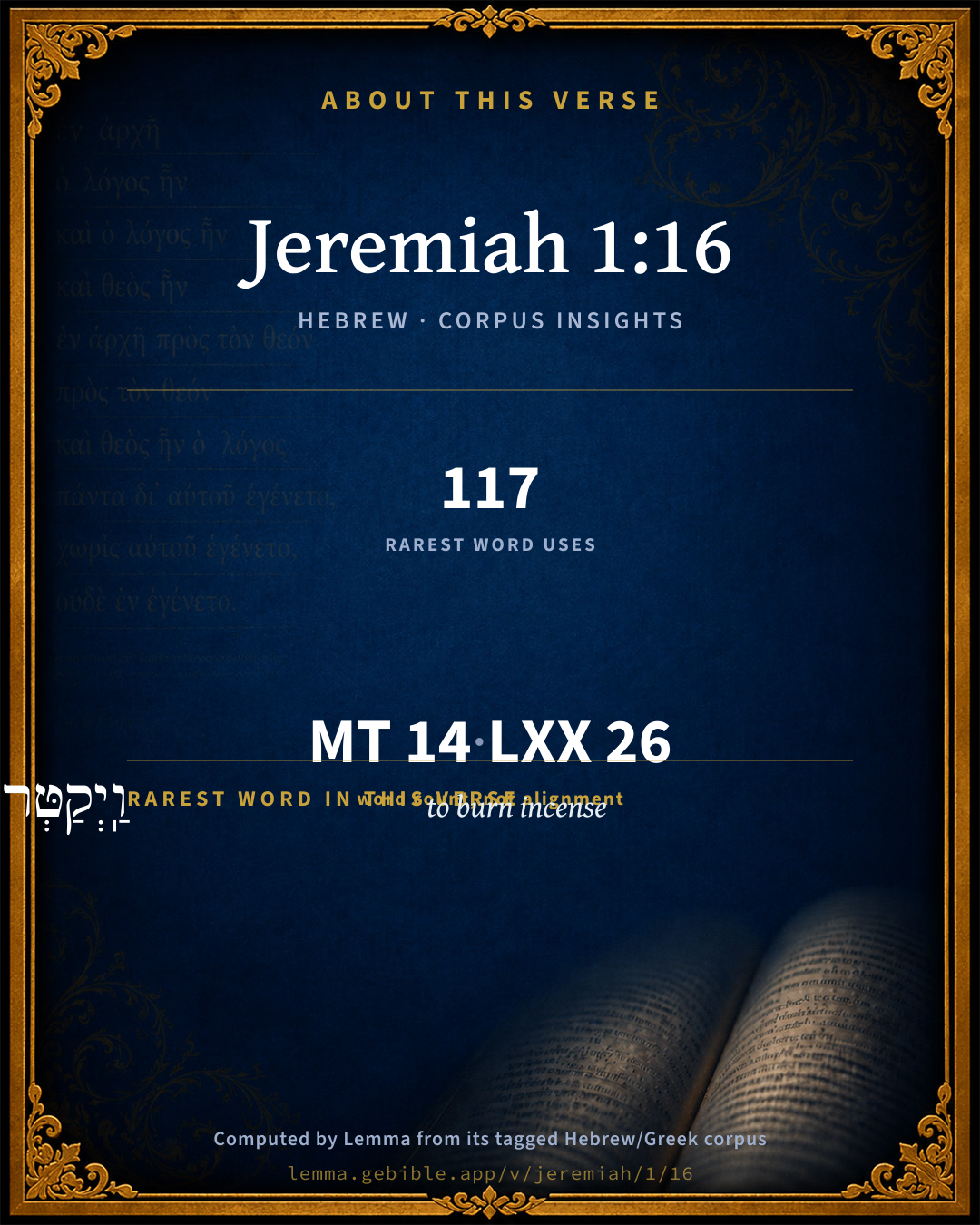
14
words
14
distinct lemmas
Prophets
section

Grammatical profile

  • 4 verbs
  • 6 nouns
  • 1 adjective
  • 1 preposition
  • 2 particles

Verb forms

  • וְדִבַּרְתִּ֤י Piel · Sequential Perfect
  • עֲזָב֗וּנִי Qal · Perfect
  • וַֽיְקַטְּרוּ֙ Piel · Sequential Imperfect
  • וַיִּֽשְׁתַּחֲו֖וּ Hithpael · Sequential Imperfect

Hebrew & Septuagint length

In the original languages it is 14 Hebrew tokens and 26 Greek tokens — but the two are counted differently (Hebrew bundles its prefixes and suffixes into one token; the Greek is in lemma form), so that isn’t a like-for-like length.

Cross-references

35

Topical passages linked to Jeremiah 1:16 in the Treasury of Scripture Knowledge — connected by theme and wording, ordered by reader-vote popularity; previews shown in the World English Bible.

  • Jeremiah 7:9 Will you steal, murder, and commit adultery, and swear falsely, and burn incense to Baal, and walk after other gods that you have not known,
  • Jeremiah 19:4 Because they have forsaken me, and have estranged this place, and have burned incense in it to other gods, that they didn't know, they and their fathers and the kings of Judah; and have filled this place with the blood of innocents,
  • Deuteronomy 28:20 Yahweh will send on you cursing, confusion, and rebuke, in all that you put your hand to do, until you are destroyed, and until you perish quickly; because of the evil of your doings, by which you have forsaken me.
  • Acts 7:41 They made a calf in those days, and brought a sacrifice to the idol, and rejoiced in the works of their hands.
  • Isaiah 2:8 Their land also is full of idols. They worship the work of their own hands, That which their own fingers have made.
  • Deuteronomy 31:16 Yahweh said to Moses, Behold, you shall sleep with your fathers; and this people will rise up, and play the prostitute after the strange gods of the land, where they go to be among them, and will forsake me, and break my covenant which I have made with them.
  • Joshua 24:20 If you forsake Yahweh, and serve foreign gods, then he will turn and do you evil, and consume you, after that he has done you good.
  • 2 Kings 22:17 Because they have forsaken me, and have burned incense to other gods, that they might provoke me to anger with all the work of their hands, therefore my wrath shall be kindled against this place, and it shall not be quenched.
  • Isaiah 37:19 and have cast their gods into the fire: for they were no gods, but the work of men's hands, wood and stone; therefore they have destroyed them.
  • Jeremiah 4:12 a full wind from these shall come for me: now will I also utter judgments against them.
  • Jeremiah 17:13 Yahweh, the hope of Israel, all who forsake you shall be disappointed. Those who depart from me shall be written in the earth, because they have forsaken Yahweh, the spring of living waters.
  • Jeremiah 44:17 But we will certainly perform every word that is gone forth out of our mouth, to burn incense to the queen of the sky, and to pour out drink-offerings to her, as we have done, we and our fathers, our kings and our princes, in the cities of Judah, and in the streets of Jerusalem; for then had we plenty of food, and were well, and saw no evil.
  • Hosea 8:6 For this is even from Israel! The workman made it, and it is no God; Indeed, the calf of Samaria shall be broken in pieces.
  • Hosea 11:2 They called to them, so they went from them. They sacrificed to the Baals, And burned incense to engraved images.
  • 2 Chronicles 7:19 But if you turn away, and forsake my statutes and my commandments which I have set before you, and shall go and serve other gods, and worship them;
  • 2 Chronicles 15:2 and he went out to meet Asa, and said to him, Hear you me, Asa, and all Judah and Benjamin: Yahweh is with you, while you are with him; and if you seek him, he will be found of you; but if you forsake him, he will forsake you.
  • 2 Chronicles 34:25 Because they have forsaken me, and have burned incense to other gods, that they might provoke me to anger with all the works of their hands; therefore is my wrath poured out on this place, and it shall not be quenched.
  • Isaiah 44:15 Then shall it be for a man to burn; and he takes of it, and warms himself; yes, he kindles it, and bakes bread: yes, he makes a god, and worships it; he makes it an engraved image, and falls down to it.
  • Isaiah 65:3 a people who provoke me to my face continually, sacrificing in gardens, and burning incense on bricks;
  • Jeremiah 2:13 For my people have committed two evils: they have forsaken me, the spring of living waters, and hewed them out cisterns, broken cisterns, that can hold no water.
  • Jeremiah 2:17 Haven't you procured this to yourself, in that you have forsaken Yahweh your God, when he led you by the way?
  • Jeremiah 4:28 For this shall the earth mourn, and the heavens above be black; because I have spoken it, I have purposed it, and I have not repented, neither will I turn back from it.
  • Jeremiah 5:9 Shall I not visit for these things? says Yahweh; and shall not my soul be avenged on such a nation as this?
  • Jeremiah 5:29 Shall I not visit for these things? says Yahweh; shall not my soul be avenged on such a nation as this?
  • Jeremiah 10:8–9 But they are together brutish and foolish: the instruction of idols! it is but a stock.
  • Jeremiah 10:15 They are vanity, a work of delusion: in the time of their visitation they shall perish.
  • Jeremiah 11:12 Then shall the cities of Judah and the inhabitants of Jerusalem go and cry to the gods to which they offer incense: but they will not save them at all in the time of their trouble.
  • Jeremiah 11:17 For Yahweh of Hosts, who planted you, has pronounced evil against you, because of the evil of the house of Israel and of the house of Judah, which they have worked for themselves in provoking me to anger by offering incense to Baal.
  • Jeremiah 15:6 You have rejected me, says Yahweh, you are gone backward: therefore have I stretched out my hand against you, and destroyed you; I am weary with repenting.
  • Jeremiah 16:11 Then shall you tell them, Because your fathers have forsaken me, says Yahweh, and have walked after other gods, and have served them, and have worshiped them, and have forsaken me, and have not kept my law;
  • Jeremiah 51:17 Every man is become brutish [and is] without knowledge; every goldsmith is disappointed by his image; for his molten image is falsehood, and there is no breath in them.
  • Ezekiel 8:9–11 He said to me, Go in, and see the wicked abominations that they do here.
  • Ezekiel 24:14 I, Yahweh, have spoken it: it shall happen, and I will do it: I will not go back, neither will I spare, neither will I repent; according to your ways, and according to your doings, shall they judge you, says the Lord Yahweh.
  • Matthew 23:35–36 that on you may come all the righteous blood shed on the earth, from the blood of righteous Abel to the blood of Zachariah son of Barachiah, whom you killed between the sanctuary and the altar.
  • Joel 2:11 Yahweh thunders his voice before his army; For his forces are very great; For he is strong who obeys his command; For the day of Yahweh is great and very awesome, And who can endure it?

Cross-references courtesy of OpenBible.info (CC BY 4.0).

Hebrew and Greek witnesses Masoretic Hebrew ↔ Greek Septuagint

The same verse in the two great witnesses to the Old Testament, shown verse-for-verse.

These are two independent witnesses, not word-aligned to each other, and the Septuagint is shown in lemma (dictionary) form.

Hebrew Jeremiah 1:16 Masoretic · Westminster Leningrad Codex

וְדִבַּרְתִּ֤י מִשְׁפָּטַי֙ אוֹתָ֔ם עַ֖ל כָּל רָעָתָ֑ם אֲשֶׁ֣ר עֲזָב֗וּנִי וַֽיְקַטְּרוּ֙ לֵאלֹהִ֣ים אֲחֵרִ֔ים וַיִּֽשְׁתַּחֲו֖וּ לְמַעֲשֵׂ֥י יְדֵיהֶֽם

I will utter my judgments against them touching all their wickedness, in that they have forsaken me, and have burned incense to other gods, and worshiped the works of their own hands.

World English Bible · Public Domain

Greek LXX Structure differs

In the Septuagint, Jeremiah is about an eighth shorter than the Hebrew and arranges its material differently — the Oracles Against the Nations (Hebrew chapters 46–51) appear in the middle of the Greek book, after 25:13. Because the chapter and verse boundaries do not line up, a verse-for-verse comparison with the Hebrew is not shown.

A verse-for-verse comparison isn’t shown here because the chapters and verses don’t line up. Switch to the LXX edition with the MT / LXX toggle above to read the Greek directly.

Hebrew: Westminster Leningrad Codex (CC BY 4.0). Greek: Septuagint (public domain); English from a public-domain English Septuagint. How the Septuagint differs from the Hebrew →

Targum (Aramaic paraphrase)

1

The Targum is the ancient Jewish Aramaic paraphrase of the Hebrew Scriptures — an interpretive translation, not the Hebrew text itself. Onkelos (literal) and Pseudo-Jonathan (expansive) render the Torah, and Jonathan the Prophets. Coverage is partial: where no permissively-licensed English translation exists for a verse, only the Aramaic is shown. This is verse-level text, not a word-by-word alignment to the Hebrew.

  1. Targum Jonathan Prophets (Joshua–Malachi)
    וַאֲמַלֵיל פּוּרְעֲנוּת דִינִי מִנְהוֹן עַל כָּל בִּשְׁתֵּיהוֹן דִשְׁבָקוּ פּוּלְחָנִי וְאַסִיקוּ בּוּסְמִין לְטַעֲוַת פַּלְחֵי כּוֹכְבַיָא וְאִשְׁתַּעְבְּדוּ לְעוֹבָדֵי יְדֵיהוֹן:

    (no public-domain English translation for this verse)

    Targum Jonathan — Aramaic: “Mikraot Gedolot” (public domain). English: “Sefaria Community Translation” (CC0 1.0 (public-domain dedication)); “London "Chaldee Paraphrase," 1871” (public domain). Text via Sefaria.

Commentary

Notes on Jeremiah 1:16 from classic Christian and Jewish commentators (each source and its license shown beneath its notes). The classic Christian expositions comment on the surrounding passage and are grouped to its opening verse, so a note may address several verses; the Jewish commentaries on the Tanakh (Rashi and others) are per-verse, so they appear only where the commentator wrote on this verse.

Lemma curates 59 commentaries, every one of them public domain or Creative Commons licensed, each selected and text-cleaned for this edition rather than reprinted as found. About our sources →

Trapp's Complete Commentary

John Trapp

Jer 1:16 And I will utter my judgments against them touching all their wickedness, who have forsaken me, and have burned incense unto other gods, and worshipped the works of their own hands.

Ver. 16. And I will utter my judgments against them,] sc., By those northern princes. But first by thee, and Zephaniah, and Huldah, &c., if haply they will repent, that I may repent of the evil. God therefore threateneth that he may not punish.

Who have forsaken me, and burnt incense.] These sins differ in degrees, and are all found among the Papists.

John Trapp, A Commentary or Exposition upon All the Books of the Old and New Testament (1647–1656) — public domain. Text from a community e-Sword module.

Geneva Bible (1599)

Geneva Bible translators

I will give them charge and power to execute my vengeance against the Idolaters which have forsaken me for their idols.

Geneva Bible (1599) marginal notes — public domain. Text via Bolls.life.

Jamieson, Fausset & Brown

Robert Jamieson, A. R. Fausset & David Brown

utter--pronounce. The judicial sentences, pronounced against the Jews by the invading princes, would be virtually the "judgments of God" (Isa 10:5).

works--idols.

Jamieson, Fausset & Brown — Commentary Critical and Explanatory on the Whole Bible (1871) — public domain (CC PDM 1.0). Text via the HelloAO Bible API.

Adam Clarke's Commentary

Verse 16. I will utter my judgments] God denounced his judgments: the conquest of their cities, and the destruction of the realm, were the facts to which these judgments referred; and these facts prove that the threatening was fulfilled.

Worshipped the works of their own hands.] Idolatry was the source of all their wickedness, and was the cause of their desolations. For למעשי lemaasey, the works, more than a hundred MSS. of Kennicott's and De Rossi's, with many editions, have למעשה lemaaseh, the work. Idolatry was their ONE great WORK, the business of their life, their trade.

Adam Clarke's Commentary on the Bible (1810–1826) — public domain. Text from a community e-Sword/MySword module.

John Calvin's Commentaries

God now assigns the reason why he had resolved to deal so severely with the Jews. It was necessary to teach them two things, — first, that the Chaldeans would not of themselves come upon them, but through God, who would gather and arm them; and secondly, that God Would not act in a cruel manner, nor forget his covenant, in becoming a rigid avenger, but that he would thus be angry, because there was extreme iniquity in the Jews, so that it was needful to distress and wholly to break them down, as moderate corrections had availed nothing. God, then, after having testified that he would be the leader in that war, now explains the reasons why he would chastise the Jews, and shews that his conduct towards them could not be ascribed to cruelty, inasmuch as that they had provoked him by their impious superstitions.

Hence he says, I will speak my judgments with them This is referred by many interpreters to the Chaldeans and Assyrians, as though God would prescribe to them what was to be decreed, as chief judges are wont to do to those who are under them: but this exposition is strained, and confuted by what follows, on account of their wickedness What, then, is to speak judgments? It is done, when God summons the wicked before his tribunal, and executes the office of a judge. And this mode of speaking is common in Scripture, according to what we read at the end of this book, — The king of Babylon spoke judgments with the King Zedekiah, (Jeremiah 52:9) that is, he dealt judicially with him, as we commonly say. So now God declares that he would be the judge of the people, as though he had said, that hitherto he had been silent, not that the sins of the people were not known, but because he had borne with them, in order to try whether there was any hope of repentance. But he says now that he would become their judge, as he had found by long experience that they were past remedy.

There is, then, to be understood a contrast between the forbearance of God, which he had long exercised while he dealt with the people, not as he might have justly done, but deferred his vengeance, and the time of vengeance which was now at hand; I will then speak my judgments with the Jews; that is, “I will now ascend my tribunal: I have hitherto abstained from exercising my right, and waited for them to return to me; but as there is no return, and I see that they are men wholly irreclaimable, and their disposition is so depraved that they continually add evils to evils, I will now begin to undertake mine office, the office of a judge.” But we must bear in mind, as I have already said, the design of God in this declaration; for it was his object to clear himself from every charge, and from all calumnies, inasmuch as even the worst of men usually clamor against his judgments when he chastises them. Hence he presented before them his own judgments, as though he had said, “They shall not be able to blame me for dealing with them in a severe and cruel manner; for however severe I may be, I shall yet be an equitable judge.” Hence he adds, on account of all their wickedness

He afterwards shews what kind of wickedness it was, They have forsaken me, and burnt incense to strange gods The Jews had, indeed, in various ways, provoked his vengeance; but he mentions here one kind of wickedness, because it was the very fountain of evils, — they had departed from the law and the pure worship of God; and yet he mentions generally all wickedness The word all is not here without meaning, “on account of all their wickedness:” for he intimates that they were not only in one way wicked, but that they had heaped together various sins. And then he adds, for they have forsaken me Here God introduces their defection; for it may be, as we daily see, that one offends in this thing, and another in that, and each one for different causes may expose himself to God’s judgment; but God shews here that the Jews were become so depraved, that there was nothing sound or pure in them: hence he charges them with all wickedness; and then he mentions their defection, they have forsaken me; as though he had said, “They have wholly denied me; I say not that one is a thief, another an adulterer, and another a drunkard; but they are all become apostates, they are all perjurers and violators of the covenant: thus I am wholly forsaken by them, and they are in every respect alienated from me.” We hence see how greatly the Prophet enhances the guilt of his own nation.

It is afterwards added, for the sake of illustration, that they burnt incense to strange gods They had fallen away from God, and joined themselves to idolatry. He also adds this, — that they bowed down before the works of their own hands The Prophet divests the Jews of every excuse, and more fully discovers their shame and baseness, — “they prostrated themselves before the works of their own hands.” Whenever Scripture uses these expressions, it intimates that there is extreme madness in those men, who worship in the place of God not only the sun and moon, and other created things, but also the idols which they form for themselves. For how is it that they worship their own idols, except that they have formed for them a nose, and hands, and ears? A log of wood no one worships; a piece of brass or of silver all disregard; no one thinks a stone to be God: but when a thing is sculptured and artificially formed by the hand of man, miserable and blind idolaters immediately prostrate themselves; — how is this? Because they have formed for their statues and pictures noses, eyes, and ears! hence they themselves have made gods. We now see the meaning of the Prophet, when he says, that the Jews bowed down before the works of their own hands But I pass over such things as these lightly, as ye must be well informed on the subject generally. It now follows —

John Calvin's Commentaries (1540-1563) — public domain. Text from the Calvin Translation Society English edition (1840s-50s) via the Christian Classics Ethereal Library (ccel.org). Calvin's coverage is partial (roughly two-thirds of the Bible); uncommented books and verses are honest gaps, never fabricated. The 19th-century editor's footnotes and remarks are omitted so the notes are faithfully Calvin's own voice.

Ellicott's Commentary for English Readers

(16) I will utter my judgments against them.—Here, again, we get a literal correspondence in the words of Jer_39:5, “he gave [or uttered] judgment upon him,” of Nebuchadnezzar’s sentence on Zedekiah. And yet the invaders in their sentence are to be but the ministers of a higher judgment than their own. In the words “my judgments” He recognises their work.

Who have forsaken.—The remainder of the verse gives, as it were, the formal enumeration of the crimes for which Judah was condemned: (1) Apostacy from the true God; (2) the transfer of adoration to other Gods, such as Baal, Ashtaroth, and the Queen of Heaven; sins against the First Commandment; (3) the worship of graven images; a sin against the Second. The sins were of long standing, but the words point specially to the proportions they had assumed in the reign of Manasseh (2Ch_33:1-7).

A Bible Commentary for English Readers, edited by Charles John Ellicott (1878–1897) — public domain. Text from a community e-Sword module.

The Cambridge Bible for Schools and Colleges

gen. ed. J. J. S. Perowne

16. I will utter my judgements against them] lit., I will speak my judgements with them. An almost identical phrase in the Hebrew occurs again in this book, when Nebuchadnezzar at Riblah “gave judgement upon Zedekiah,” mg. “spake judgements with him” (Jer_39:5); cp. Jer_4:12.

touching all their wickedness] This is defined in the three clauses that follow, (i) the forsaking of the true God, (ii) the sacrificing to other gods, (iii) the worshipping of images.

have burned incense] lit. have caused sacrifices to smoke. The Hebrew word does not necessarily involve the use of incense. See further on Jer_7:9.

The Cambridge Bible for Schools and Colleges (gen. ed. J. J. S. Perowne; Cambridge University Press, 1878–1918) — public domain. Text from a community e-Sword module.

John Gill's Exposition

And I will utter my judgments against them,.... Not against the kingdoms of the north, but against the people of the Jews. The sense is, that God would enter into judgment with this people, and pass sentence upon them, and execute it:

touching all their wickedness; or on account of all their sins and transgressions hereafter mentioned:

who have forsaken me. The Targum is, "who have forsaken my worship"; for to forsake the public worship of God, attendance on his word and ordinances, or to forsake the assembling of themselves together for such a purpose, is to forsake the Lord himself, the fountain of living waters; and this is to forsake their own mercies:

and have burnt incense to other gods; to the idols of the Gentile, as the Targum explains it; to Baal, to the queen of heaven, and to others:

and worshipped the works of their own hands: idols of gold, silver, brass, and wood, which their own hands formed and carved, and which argued great stupidity and ignorance.

John Gill's Exposition of the Whole Bible (1746–1763) — public domain (CC PDM 1.0). Text via the HelloAO Bible API.

Albert Barnes' Notes on the Bible

In accordance with the custom of law courts, the crimes of the guilty city are mentioned in the sentence. The charges brought against her are three: first, the desertion of the true God; next, the offering incense to false gods, and, lastly, the making obeisance to, or bowing down 2Ki 5:18 before images of human workmanship.

Albert Barnes' Notes on the Bible (1834–1885) — public domain. Text from a community e-Sword/MySword module.

Matthew Poole's English Annotations

I will utter my judgments; cause sentence to be passed according to my threatening. See Jer 39:5. Or, I will place my bounty and their unworthiness before them. Or, I will upbraid them with their ingratitude, rebellion, and breach of covenant, &c. I will speak with them by thee, Jeremiah, and others of my prophets. Who have forsaken me; either noting the persons against whom, or rather the cause for which, because they have forsaken me; the same particle being so used Jer 13:25, and elsewhere; or their sins whereby, as it is also expressed, Jer 16:11; 22:9.

Burnt incense unto other gods, i.e. worshipped strange gods; a synecdoche of the part for the whole.

The works of their own hands, i.e. their idolatrous images, expressed here by a periphrasis, Isa 2 8.

Matthew Poole's English Annotations on the Holy Bible (1683–1685) — public domain. Text from a community e-Sword/MySword module.

The Pulpit Commentary

I will utter my judgments; or, I will hold a court of justice upon them; literally, I will speak judgments with them. The expression is peculiar to Jeremiah, (comp. Jer_4:12 Jer_12:1 Jer_39:6 Jer_52:9) and includes both the examination of the accused, and the judicial sentence. (see Jer_39:5 Jer_52:9) All their wickedness, etc. Their "wickedness," i.e. their infidelity to Jehovah, showed itself in burning incense to "other gods," and bowing down to their images. "Burned incense" is, however, too narrow a sense. The root-meaning of the verb is to be fragrant, and the causative conjugations will strictly mean only "to make a sweet odor," whether by the offering of incense or by burnt offerings. (comp. Jer_11:12 2Ki_23:8, where a causative conjugation is used in the same wide sense here postulated; also Psa_66:15 and Isa_1:13, where the word usually rendered "incense" seems rather to mean "a sweet smoke The prophet says, "of other gods" (not "of false gods"), out of consideration for the ignorance of his hearers, to whom Baal and Moloch really were as gods; in fact, that expressive word (cf.) which Isaiah uses ten times to express the unreality of the other so-called gods, occurs only once, and then not in quite the same sense (see Jer_14:14) in Jeremiah. But the prophet"s own strict monotheism is proved by such passages as Jer_2:27 Jer_8:19 Jer_16:20.

The Pulpit Commentary (1880–1919), ed. H.D.M. Spence-Jones & Joseph S. Exell — public domain. Text from a community e-Sword module.

Keil & Delitzsch

C. F. Keil & F. Delitzsch

God holds judgment upon the inhabitants of Judah in this very way, viz., by bringing these nations and permitting them to set up their lordship before the gates of Jerusalem, and against all cities of Judah. The suffix in אותם refers to ישׁבי, Jer 1:14, and אותם stands by later usage for אתּם, as frequently in Jer.; cf. Ew. 264, b. 'דּבּר משׁפּטים את־פ, speak judgment, properly, have a lawsuit with one, an expression peculiar to Jeremiah - cf. Jer 4:12; Jer 12:1; Jer 39:5; Jer 52:9, and Kg2 25:6 - is in substance equivalent to נשׁפּט את, plead with one, cf. Jer 12:1 with Jer 2:35, Eze 20:35., and signifies not only remonstrating against wrong doing, but also the passing of condemnation, and so comprehends trial and sentencing; cf. Jer 39:5; Jer 42:9. "All their wickedness" is more exactly defined in the following relative clauses; it consists in their apostasy from God, and their worship of heathen gods and idols made by themselves; cf. Jer 19:4, Kg1 11:33, Kg2 22:17. קטּר, offer odours, cause to rise in smoke, used not of the burning of incense alone, but of all offerings upon the altar, bloody offerings and meat-offerings; hence frequently in parallelism with זבח; cf. Hos 4:13; Hos 11:2, etc. In the Pentateuch the Hiphil is used for this sense. Instead of the plural מעשׂי, many MSS give the singular מעשׂה as the ordinary expression for the productions of the hand, handiwork; cf. Jer 25:6-7, Jer 25:14; Jer 32:30; Kg2 22:17, etc.; but the plural too is found in Jer 44:8; Ch2 34:25, and is approved by these passages. The sense is no way affected by this variation.

Keil & Delitzsch — Biblical Commentary on the Old Testament (1861–1891) — public domain (CC PDM 1.0). Text via the HelloAO Bible API. (Old Testament only.)

Rashi

Rabbi Shlomo Yitzchaki (Rashi)

And I will utter My judgments against them I will debate with them, with Judah and Jerusalem.

Rashi on the Tanakh — English translations: “The Judaica Press complete Tanach with Rashi, translated by A. J. Rosenberg” (CC BY 4.0); “Pentateuch with Rashi's commentary by M. Rosenbaum and A.M. Silbermann, 1929-1934” (public domain); “The Metsudah Tanach series, Lakewood, N.J” (CC BY 4.0); and “The Book of Joshua, Metsudah Publications, 1997” (CC BY 4.0). Text via Sefaria.

Lesson kit

Teaching starters — assembled from the data on this page, not authored interpretation. Every prompt links to the verse data it draws on. Edit before teaching.

Jeremiah, in the Prophets, opens this verse with 14 words (14 distinct Hebrew lemmas). Its most distinctive word is qâṭar (“to burn incense”). A historical commentator’s framing appears above. Read the whole chapter for the surrounding context.

Discussion questions

  1. How does “to burn incense” (qâṭar) shape what this verse is saying?
  2. How does Jeremiah 7:9, which shares this passage’s theme, read alongside this verse?
  3. The translations on this page render this verse differently — a whole-verse word diff, not a word-by-word alignment. What might account for the different wordings?
  4. «וְדִבַּרְתִּ֤י» is a Piel Sequential Perfect verb. How does that grammatical form shape the action described?
  5. Compare how Trapp's Complete Commentary and Geneva Bible (1599) read this verse. Where do they agree or differ?

Things to notice

Reading settings

Reading text

Shown beneath each verse's original-language words.

Old Testament
Old Testament edition

Read the OT as the Masoretic Hebrew (MT) or the Greek Septuagint (LXX).

English shown for the Greek Septuagint (in the Hebrew ↔ Greek comparison).

Comparing translations? Open the Compare panel on any verse page to stack up to four side by side.