
Judges 2:12

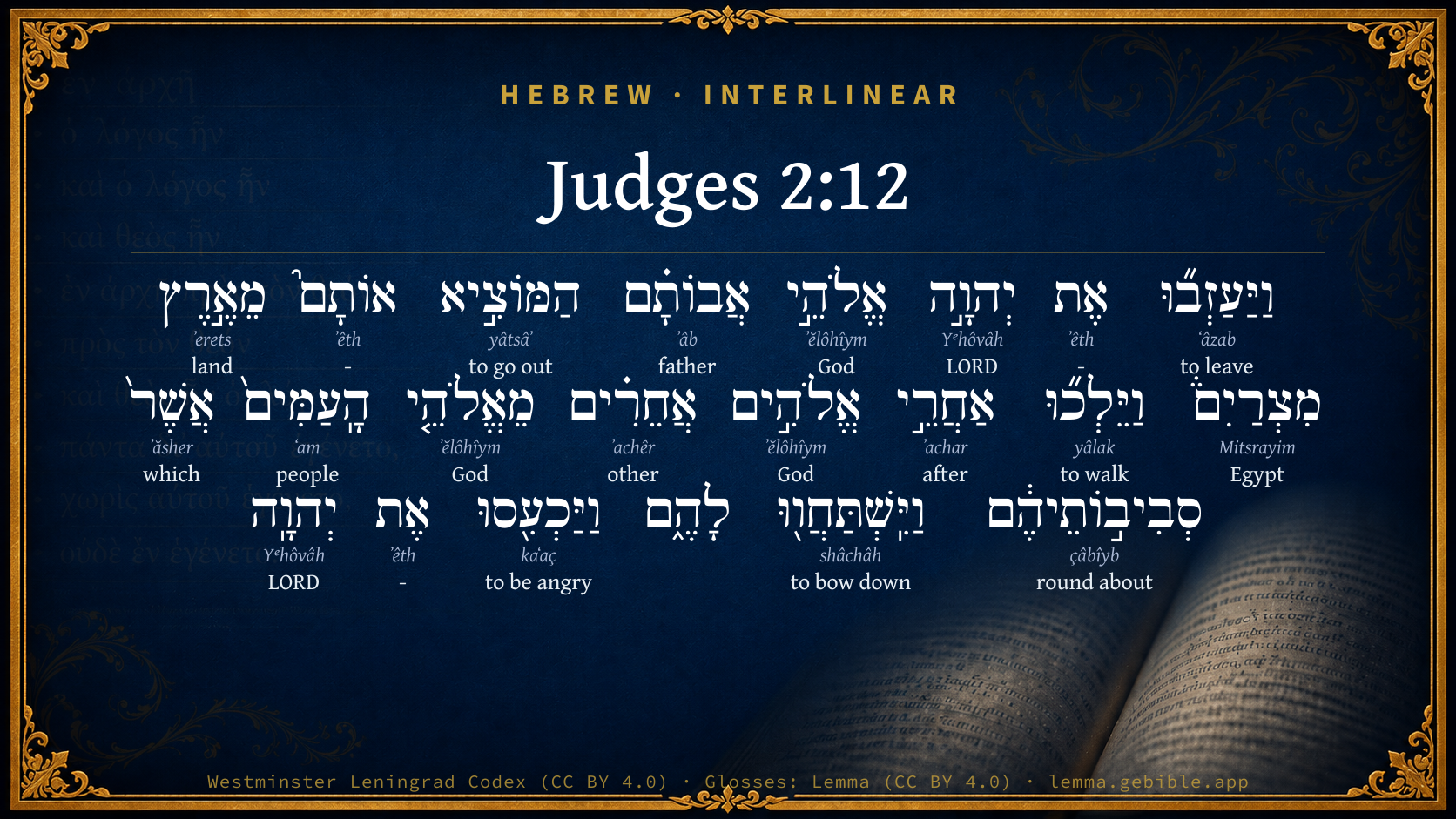
Hebrew (Westminster Leningrad Codex) Judges 2:12 appears in the Hebrew Old Testament. The text above is from the Westminster Leningrad Codex. Each word links to its Strong’s number, a concise gloss, and parsing drawn from the Open Scriptures Hebrew Bible morphology. Click any word for its full Brown-Driver-Briggs (BDB) entry.
Download image
Cite this verse

Judges 2:12 (World English Bible). Public Domain. Lemma interlinear Bible study tool, https://lemma.gebible.app/v/judges/2/12.

Show BibTeX & RIS
BibTeX
RIS
English Translation
and they forsook Yahweh, the God of their fathers, who brought them out of the land of Egypt, and followed other gods, of the gods of the peoples who were round about them, and bowed themselves down to them: and they provoked Yahweh to anger.
World English Bible · Public Domain
Download a study sheet

One document with this verse’s original text, its word-by-word gloss line, the meaning frame, cross-references with their text, attributed commentary, and full source and license credits — printable, and it pastes into notes with its structure intact.

This verse Autodidact and up

Study sheet (.html) Plain text (.txt)

A passage Seminary Student

Up to 50 verses in one chapter. A passage sheet keeps up to 6 commentary sources and 12 cross-references per verse, in the order this page ranks them, and says so on the sheet whenever that leaves anything out. Ask for a single verse and you get the Autodidact verse sheet above.

Everything on this page stays free to read, with no account — the sheet is a download of what is already on screen, not access to it.

Want to remove ads? Support Godless Engineer
Compare translations 3

The same verse in 3 English versions, stacked beneath the original-language interlinear above. Click any original word for its lexicon entry.

Each is an independent rendering of the whole verse — the interlinear is not word-aligned to these translations.

Highlighted words mark where these versions differ — a whole-verse word diff, not a word-by-word alignment.

  • World English Bible Public Domain
    and they forsook Yahweh, the God of their fathers, who brought them out of the land of Egypt, and followed other gods, of the gods of the peoples who were round about them, and bowed themselves down to them: and they provoked Yahweh to anger.
  • King James Version Public Domain
    And they forsook the LORD God of their fathers, which brought them out of the land of Egypt, and followed other gods, of the gods of the people that were round about them, and bowed themselves unto them, and provoked the LORD to anger.
  • unfoldingWord Literal Text CC BY-SA 4.0
    And they forsook Yahweh, the God of their fathers, the one having brought them out from the land of Egypt, and they went after other gods from the gods of the peoples who around them, and they bowed down to them. So they angered Yahweh.

unfoldingWord Literal Text — © unfoldingWord, licensed CC BY-SA 4.0. Word-aligned USFM3 via Door43 (git.door43.org/unfoldingWord/en_ult).

Versions to compare (up to 4)

3 of 4 selected

Show all 18 translations

Every available English version of this verse, each an independent rendering of the whole verse.

  • World English Bible Public Domain
    and they forsook Yahweh, the God of their fathers, who brought them out of the land of Egypt, and followed other gods, of the gods of the peoples who were round about them, and bowed themselves down to them: and they provoked Yahweh to anger.
  • Berean Standard Bible Public Domain
    Thus they forsook the LORD, the God of their fathers, who had brought them out of the land of Egypt, and they followed after various gods of the peoples around them. They bowed down to them and provoked the LORD to anger,
  • Majority Standard Bible Public Domain
    Thus they forsook the LORD, the God of their fathers, who had brought them out of the land of Egypt, and they followed after various gods of the peoples around them. They bowed down to them and provoked the LORD to anger,
  • King James Version Public Domain
    And they forsook the LORD God of their fathers, which brought them out of the land of Egypt, and followed other gods, of the gods of the people that were round about them, and bowed themselves unto them, and provoked the LORD to anger.
  • American Standard Version (1901) Public Domain
    and they forsook Jehovah, the God of their fathers, who brought them out of the land of Egypt, and followed other gods, of the gods of the peoples that were round about them, and bowed themselves down unto them: and they provoked Jehovah to anger.
  • Revised Version (1885) Public Domain
    and they forsook the LORD, the God of their fathers, which brought them out of the land of Egypt, and followed other gods, of the gods of the peoples that were round about them, and bowed themselves down unto them: and they provoked the LORD to anger.
  • Geneva Bible (1599) Public Domain
    And forsooke ye Lord God of their fathers, which brought them out of the lande of Egypt, and followed other gods, euen the gods of the people that were round about them, and bowed vnto them, and prouoked the Lord to anger.
  • Douay-Rheims (1899) Public Domain
    And they left the Lord the God of their fathers, who had brought them out of the land of Egypt: and they followed strange gods, and the gods of the people that dwelt round about them, and they adored them: and they provoked the Lord to anger.
  • Young's Literal Translation Public Domain
    and forsake Jehovah, God of their fathers, who bringeth them out from the land of Egypt, and go after other gods (of the gods of the peoples who `are' round about them), and bow themselves to them, and provoke Jehovah,
  • Literal Standard Version CC BY-SA 4.0
    and forsake YHWH, God of their fathers, who brings them out from the land of Egypt, and go after other gods (of the gods of the peoples who [are] around them), and bow themselves to them, and provoke YHWH,
  • Unlocked Literal Bible CC BY-SA 4.0
    They broke away from Yahweh, the God of their fathers, who had brought them out of the land of Egypt. They went after other gods, the very gods of the peoples who were around them, and they bowed down to them. They provoked Yahweh to anger because
  • unfoldingWord Literal Text CC BY-SA 4.0
    And they forsook Yahweh, the God of their fathers, the one having brought them out from the land of Egypt, and they went after other gods from the gods of the peoples who around them, and they bowed down to them. So they angered Yahweh.
  • Darby Bible Public Domain
    and they forsook the LORD, the God of their fathers, who had brought them out of the land of Egypt; they went after other gods, from among the gods of the peoples who were round about them, and bowed down to them; and they provoked the LORD to anger.
  • World Messianic Bible Public Domain
    They abandoned the LORD, the God of their fathers, who brought them out of the land of Egypt, and followed other gods, of the gods of the peoples who were around them, and bowed themselves down to them; and they provoked the LORD to anger.
  • Webster's Bible Public Domain
    And they forsook the LORD God of their fathers, who brought them out of the land of Egypt, and followed other gods, of the gods of the people that were around them, and bowed themselves to them, and provoked the LORD to anger.
  • Free Bible Version CC BY-SA 4.0
    They deserted the Lord, the God of their forefathers, who had led them out of Egypt. They followed other gods, bowing down in worship to the gods of the peoples around them, making the Lord angry.
  • Bible in Basic English Public Domain
    And they gave up the Lord, the God of their fathers, who had taken them out of the land of Egypt, and went after other gods, the gods of the peoples round about them, worshipping them and moving the Lord to wrath.
  • JPS Tanakh (1917) Public Domain
    And they forsook the LORD, the God of their fathers, who brought them out of the land of Egypt, and followed other gods, of the gods of the peoples that were round about them, and worshipped them; and they provoked the LORD.

Literal Standard Version (2020), Covenant Press — licensed CC BY-SA 4.0. Text via the HelloAO Bible API (eBible.org). Unlocked Literal Bible (unfoldingWord) — licensed CC BY-SA 4.0. Text via the HelloAO Bible API (eBible.org). unfoldingWord Literal Text — © unfoldingWord, licensed CC BY-SA 4.0. Word-aligned USFM3 via Door43 (git.door43.org/unfoldingWord/en_ult). Free Bible Version, Dr. Jonathan Gallagher — licensed CC BY-SA 4.0. Text via the HelloAO Bible API (eBible.org).

Word by word

More ways to search: Search by grammar → Find every occurrence → Compare this word →

Practice this passage: Drill this verse → Learn its vocabulary →

וַיַּכְעִ֖סוּ
kaʻaç
H3707
“and · to be angry”
Conjunction + Verb, Hiphil, Sequential Imperfect, 3rd Person, Masculine, Plural
Part of Speech
Conjunction + Verb
Stem
Hiphil
Form
Sequential Imperfect
Person
3rd Person
Gender
Masculine
Number
Plural
Full BDB Definition

Origin: a primitive root

TWOT: 1016

to be angry, be vexed, be indignant, be wroth, be grieved, provoke to anger and wrath - (Qal) - to be vexed, be indignant - to be angry - (Piel) to provoke to anger - (Hiphil) - to vex - to vex, provoke to anger
  1. וַיַּעַזְב֞וּ ʻâzab H5800 “and · to leave” Conjunction + Verb, Qal, Sequential Imperfect, 3rd Person, Masculine, Plural
  2. אֶת ʼêth H853 “-” Particle, Direct Object
  3. יְהוָ֣ה Yᵉhôvâh H3068 “LORD” Noun, Proper
  4. אֱלֹהֵ֣י ʼĕlôhîym H430 “God(s) of” Noun, Common, Masculine, Plural, Construct
  5. אֲבוֹתָ֗ם ʼâb H1 “fathers · their” Noun, Common, Masculine, Plural, Construct + Suffix, Personal, 3rd Person, Masculine, Plural
  6. הַמּוֹצִ֣יא yâtsâʼ H3318 “the · going out” Particle, Definite Article + Verb, Hiphil, Participle Active, Masculine, Singular, Absolute
  7. אוֹתָם֮ ʼêth H853 “- · them” Particle, Direct Object + Suffix, Personal, 3rd Person, Masculine, Plural
  8. מֵאֶ֣רֶץ ʼerets H776 “from · land of” Preposition + Noun, Common, Both, Singular, Construct
  9. מִצְרַיִם֒ Mitsrayim H4714 “Egypt” Noun, Proper
  10. וַיֵּלְכ֞וּ yâlak H3212 “and · to walk” Conjunction + Verb, Qal, Sequential Imperfect, 3rd Person, Masculine, Plural
  11. אַחֲרֵ֣י ʼachar H310 “after” Preposition
  12. אֱלֹהִ֣ים ʼĕlôhîym H430 “God(s)” Noun, Common, Masculine, Plural, Absolute
  13. אֲחֵרִ֗ים ʼachêr H312 “other” Adjective, Adjective, Masculine, Plural, Absolute
  14. מֵאֱלֹהֵ֤י ʼĕlôhîym H430 “from · God(s) of” Preposition + Noun, Common, Masculine, Plural, Construct
  15. הָֽעַמִּים֙ ʻam H5971 “the · peoples” Particle, Definite Article + Noun, Common, Masculine, Plural, Absolute
  16. אֲשֶׁר֙ ʼăsher H834 “which” Particle, Relative
  17. סְבִיב֣וֹתֵיהֶ֔ם çâbîyb H5439 “surroundings · their” Noun, Common, Both, Plural, Construct + Suffix, Personal, 3rd Person, Masculine, Plural
  18. וַיִּֽשְׁתַּחֲו֖וּ shâchâh H7812 “and · to bow down” Conjunction + Verb, Hithpael, Sequential Imperfect, 3rd Person, Masculine, Plural
  19. אֶת ʼêth H853 “-” Particle, Direct Object
  20. יְהוָֽה Yᵉhôvâh H3068 “LORD” Noun, Proper

About this verse

These counts appear in no published source. They are computed here, from the morphology-tagged text and Lemma’s own curated glosses. What Lemma adds →

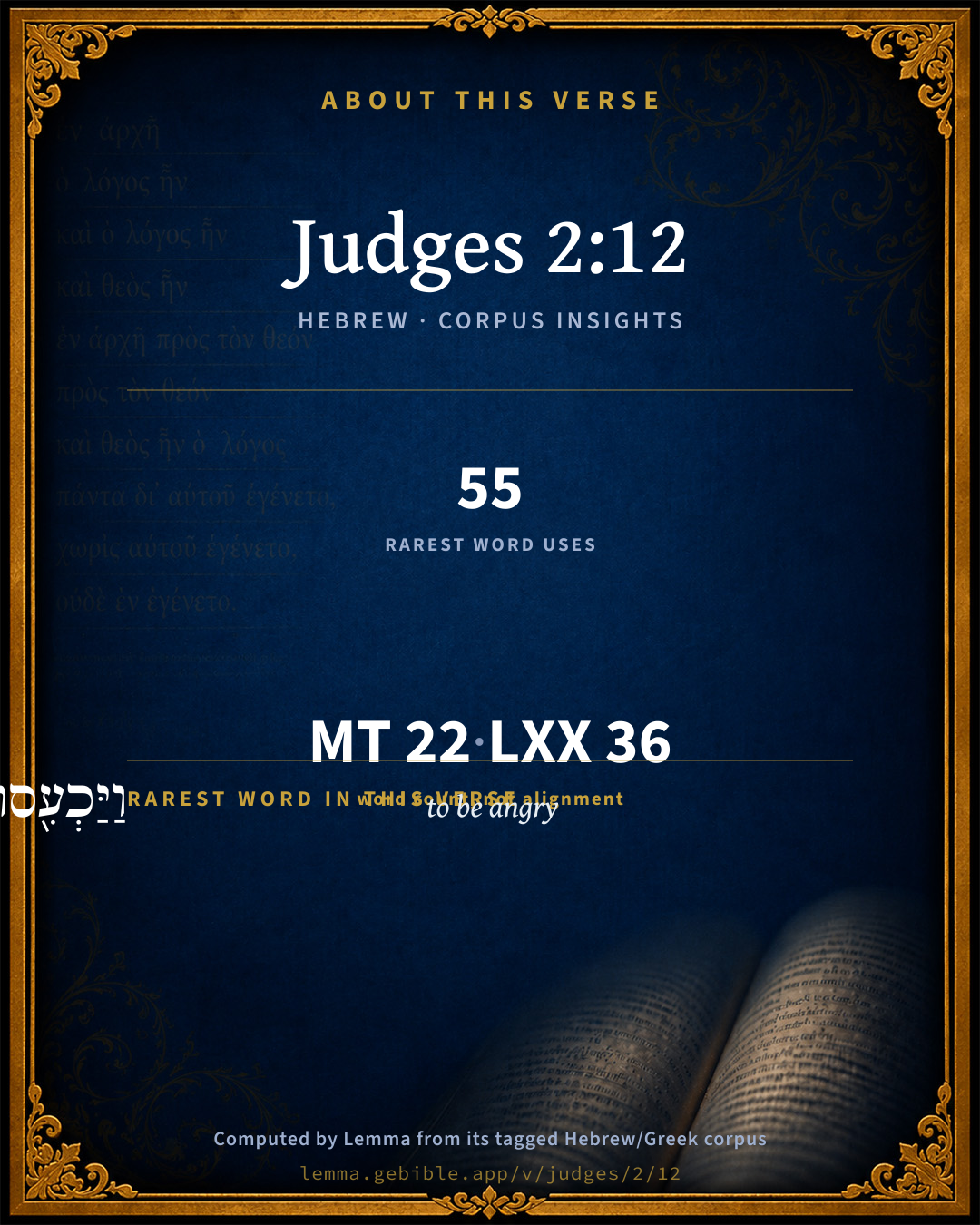
22
words
16
distinct lemmas
Historical
section

Shared distinctive vocabulary

וַיַּכְעִ֖סוּ to be angry H3707 occurs in 53 verses of the Hebrew Bible. Also found in:

Grammatical profile

  • 5 verbs
  • 10 nouns
  • 1 adjective
  • 2 prepositions
  • 4 particles

Verb forms

  • וַיַּעַזְב֞וּ Qal · Sequential Imperfect
  • הַמּוֹצִ֣יא Hiphil · Participle Active
  • וַיֵּלְכ֞וּ Qal · Sequential Imperfect
  • וַיִּֽשְׁתַּחֲו֖וּ Hithpael · Sequential Imperfect
  • וַיַּכְעִ֖סוּ Hiphil · Sequential Imperfect

Repetition

Words recur within this verse — often emphatic in Hebrew:

  • אֱלֹהֵ֣י God H430 ×3
  • יְהוָ֣ה LORD H3068 ×2

Hebrew & Septuagint length

In English translation the verse runs 45 words from the Hebrew and 36 from the Septuagint (LXX English) — closely comparable.

A rough comparison of the two English renderings, which tokenize alike — not a word-level alignment.

Word counts can differ between the Hebrew and the Greek without any difference in meaning — e.g. the Hebrew direct-object marker אֵת has no separate Greek word, and Greek often adds the article ὁ.

In the original languages it is 22 Hebrew tokens and 36 Greek tokens — but the two are counted differently (Hebrew bundles its prefixes and suffixes into one token; the Greek is in lemma form), so that isn’t a like-for-like length.

Cross-references

10

Topical passages linked to Judges 2:12 in the Treasury of Scripture Knowledge — connected by theme and wording, ordered by reader-vote popularity; previews shown in the World English Bible.

  • Exodus 20:5 you shall not bow yourself down to them, nor serve them, for I, Yahweh your God, am a jealous God, visiting the iniquity of the fathers on the children, on the third and on the fourth generation of those who hate me,
  • Deuteronomy 6:14–15 You shall not go after other gods, of the gods of the peoples who are round about you;
  • Deuteronomy 13:5 That prophet, or that dreamer of dreams, shall be put to death, because he has spoken rebellion against Yahweh your God, who brought you out of the land of Egypt, and redeemed you out of the house of bondage, to draw you aside out of the way which Yahweh your God commanded you to walk in. So shall you put away the evil from the midst of you.
  • Deuteronomy 29:25 Then men shall say, Because they forsook the covenant of Yahweh, the God of their fathers, which he made with them when he brought them forth out of the land of Egypt,
  • Deuteronomy 5:9 you shall not bow down yourself to them, nor serve them; for I, Yahweh, your God, am a jealous God, visiting the iniquity of the fathers on the children, and on the third and on the fourth generation of those who hate me;
  • Deuteronomy 29:18 lest there should be among you man, or woman, or family, or tribe, whose heart turns away this day from Yahweh our God, to go to serve the gods of those nations; lest there should be among you a root that bears gall and wormwood;
  • Deuteronomy 31:16–17 Yahweh said to Moses, Behold, you shall sleep with your fathers; and this people will rise up, and play the prostitute after the strange gods of the land, where they go to be among them, and will forsake me, and break my covenant which I have made with them.
  • Deuteronomy 32:15 But Jeshurun grew fat, and kicked: You have grown fat, you are grown thick, you are become sleek; Then he forsook God who made him, Lightly esteemed the Rock of his salvation.
  • Deuteronomy 33:17 The firstborn of his herd, majesty is his; His horns are the horns of the wild-ox: With them he shall push the peoples all of them, [even] the ends of the earth: They are the ten thousands of Ephraim, They are the thousands of Manasseh.
  • Judges 5:8 They chose new gods; Then was war in the gates: Was there a shield or spear seen Among forty thousand in Israel?

Cross-references courtesy of OpenBible.info (CC BY 4.0).

Hebrew and Greek witnesses Masoretic Hebrew ↔ Greek Septuagint

The same verse in the two great witnesses to the Old Testament, shown verse-for-verse.

These are two independent witnesses, not word-aligned to each other, and the Septuagint is shown in lemma (dictionary) form.

Hebrew Judges 2:12 Masoretic · Westminster Leningrad Codex

וַיַּעַזְב֞וּ אֶת יְהוָ֣ה אֱלֹהֵ֣י אֲבוֹתָ֗ם הַמּוֹצִ֣יא אוֹתָם֮ מֵאֶ֣רֶץ מִצְרַיִם֒ וַיֵּלְכ֞וּ אַחֲרֵ֣י אֱלֹהִ֣ים אֲחֵרִ֗ים מֵאֱלֹהֵ֤י הָֽעַמִּים֙ אֲשֶׁר֙ סְבִיב֣וֹתֵיהֶ֔ם וַיִּֽשְׁתַּחֲו֖וּ לָהֶ֑ם וַיַּכְעִ֖סוּ אֶת יְהוָֽה

and they forsook Yahweh, the God of their fathers, who brought them out of the land of Egypt, and followed other gods, of the gods of the peoples who were round about them, and bowed themselves down to them: and they provoked Yahweh to anger.

World English Bible · Public Domain

Greek LXX Judges 2:12 Septuagint · lemma form

καί ἐν καταλείπω ὁ κύριος ὁ θεός ὁ πατήρ αὐτός ὁ ἐκἄγω αὐτός ἐκ γῆ αἴγυπτος καί πορεύομαι ὀπίσω θεός ἕτερος ἀπό ὁ θεός ὁ ἔθνος ὁ περικύκλῳ αὐτός καί προςκυνέω αὐτός καί παραὀργίζω ὁ κύριος

And they forsook the Lord God of their fathers, who brought them out of the land of Egypt, and walked after other gods, of the gods of the nations round about them; and they worshipped them.

LXX2012 (modern English Septuagint) · Public Domain

Hebrew: Westminster Leningrad Codex (CC BY 4.0). Greek: Septuagint (public domain); English from LXX2012 (modern English Septuagint) (Public Domain). How the Septuagint differs from the Hebrew →

Targum (Aramaic paraphrase)

1

The Targum is the ancient Jewish Aramaic paraphrase of the Hebrew Scriptures — an interpretive translation, not the Hebrew text itself. Onkelos (literal) and Pseudo-Jonathan (expansive) render the Torah, and Jonathan the Prophets. Coverage is partial: where no permissively-licensed English translation exists for a verse, only the Aramaic is shown. This is verse-level text, not a word-by-word alignment to the Hebrew.

  1. Targum Jonathan Prophets (Joshua–Malachi)
    וּשְׁבַקוּ יַת פּוּלְחָנָא דַייָ אֱלָהָא דַאַבָהַתְהוֹן דְאַפֵּיק יַתְהוֹן מֵאַרְעָא דְמִצְרַיִם וּטְעוֹ בָּתַר טַעֲוַת עַמְמַיָא מִטַעֲוַת עַמְמַיָא דִי בְסַחֲרָנֵיהוֹן וּסְגִידוּ לָהֶן וְאַרְגִיזוּ קֳדָם יְיָ:

    (no public-domain English translation for this verse)

    Targum Jonathan — Aramaic: “Mikraot Gedolot” (public domain). English: “Sefaria Community Translation” (CC0 1.0 (public-domain dedication)); “London "Chaldee Paraphrase," 1871” (public domain). Text via Sefaria.

Commentary

Notes on Judges 2:12 from classic Christian and Jewish commentators (each source and its license shown beneath its notes). The classic Christian expositions comment on the surrounding passage and are grouped to its opening verse, so a note may address several verses; the Jewish commentaries on the Tanakh (Rashi and others) are per-verse, so they appear only where the commentator wrote on this verse.

Lemma curates 59 commentaries, every one of them public domain or Creative Commons licensed, each selected and text-cleaned for this edition rather than reprinted as found. About our sources →

Trapp's Complete Commentary

John Trapp

Jdg 2:12 And they forsook the LORD God of their fathers, which brought them out of the land of Egypt, and followed other gods, of the gods of the people that [were] round about them, and bowed themselves unto them, and provoked the LORD to anger.

Ver. 12. And they forsook.] By a detestable apostasy: such as heaven and earth had cause to he ashamed of. {Jer 2:12-13} There is a commendable apostasy, sc., when men fall off from a false religion to that which is true. Thus the Papists called Luther, as they do all of us, an apostate. Confitur se esse apostatam sed beatum et sanctum, qui fidem diabolo datam non servavit; he confessed himself an apostate, but a holy and blessed apostate; one that had fallen off from the devil; and should therefore have been sainted rather than stigmatised.

John Trapp, A Commentary or Exposition upon All the Books of the Old and New Testament (1647–1656) — public domain. Text from a community e-Sword module.

Adam Clarke's Commentary

Verse 12. Which brought them out of the land of Egypt] This was one of the highest aggravations of their offense; they forsook the God who brought them out of Egypt; a place in which they endured the most grievous oppression and were subjected to the most degrading servitude, from which they never could have rescued themselves; and they were delivered by such a signal display of the power, justice, and mercy of God, as should never have been forgotten, because the most stupendous that had ever been exhibited. They forsook HIM, and served idols as destitute of real being as of influence and power.

Adam Clarke's Commentary on the Bible (1810–1826) — public domain. Text from a community e-Sword/MySword module.

Ellicott's Commentary for English Readers

(12) Forsook the Lord God of their fathers.—(Deu_31:16-17.) It seems, however, that the sin of the Israelites was a breach rather of the second than of the first commandment. It was not so much a worshipping of other gods as a worshipping of Jehovah under false symbols adopted from the surrounding nations by a spurious syncretism. Similarly, the calf-worship of the northern tribes was originally intended to be an adoration of Jehovah, under the form of cherubic symbols, but naturally lapsed with dangerous facility into actual Baal-worship (Exo_32:5; 1Ki_22:6).

A Bible Commentary for English Readers, edited by Charles John Ellicott (1878–1897) — public domain. Text from a community e-Sword module.

The Cambridge Bible for Schools and Colleges

gen. ed. J. J. S. Perowne

12. Each phrase of this verse is characteristic of the Deuteronomic school; thus they forsook the Lord Jdg_10:6; Jdg_10:10; Jdg_10:13, Deu_28:20, frequently in the Dtc. parts of Kings and in Jeremiah, see also the next verse; the God of their fathers Deu_1:11; Deu_1:21; Deu_4:1; Deu_6:3; Deu_12:1 etc.; followed other gods Jdg_2:19, Deu_8:19; Deu_11:28; Deu_13:2 etc., Jer_7:6; Jer_11:10 etc.; the peoples round about them i.e. not the Canaanites remaining in the midst of Israel, but the nations outside its frontiers, Deu_6:14; Deu_13:8; provoked the Lord to anger Deu_4:25; Deu_9:18 etc., and often in Dtc. passages in Kings, and in Jerem.

which brought them out of the land of Egypt] Both in the Law (Exo_20:2; Deu_5:6) and in the Prophets (Amo_2:10; Hos_12:13; Hos_13:4; Mic_6:4), the appeal is to the Exodus, as the birth-day of Israel’s religious life, a signal manifestation of Jehovah’s special providence, which carried with it His claim on Israel’s allegiance.

The Cambridge Bible for Schools and Colleges (gen. ed. J. J. S. Perowne; Cambridge University Press, 1878–1918) — public domain. Text from a community e-Sword module.

John Gill's Exposition

And they forsook the Lord God of their fathers,.... The covenant God of their fathers, Abraham, Isaac, and Jacob, and of their more immediate ancestors; his worship they forsook, neglected his tabernacle, and the service of it:

which brought them out of the land of Egypt; out of wretched misery and bondage there, with an high hand, and outstretched arm; and led them through the wilderness, and provided for them there, and brought them into the land of Canaan, a land flowing with milk and honey; but all these mercies were forgotten by them:

and followed other gods, of the gods of the people that were round about them: the gods of the Canaanites and Phoenicians, of the Egyptians, and of the Moabites, Amorites, and Edomites, that were round about them, on the borders of them; instead of one God they worshipped many, even all in or about the land of Canaan; so much given were they to idolatry:

and bowed themselves unto them; giving them all religious worship and honour they were capable of:

and provoked the Lord to anger; nothing is more provoking to him than idolatry; he being a jealous God, and will not bear any rival in worship, nor his glory to be given to another, to a strange god.

John Gill's Exposition of the Whole Bible (1746–1763) — public domain (CC PDM 1.0). Text via the HelloAO Bible API.

Albert Barnes' Notes on the Bible

Provoked the Lord to anger - A frequent expression in connection with idolatry, especially in Deuteronomy, in the Books of the Kings, and in Jeremiah.

Albert Barnes' Notes on the Bible (1834–1885) — public domain. Text from a community e-Sword/MySword module.

Haydock's Catholic Bible Commentary

They followed strange gods. What is here said of the children of Israel, as to their falling so often into idolatry, is to be understood of a great part of them; but not so universally, as if the true worship of God was ever quite abolished among them: for the succession of the true church and religion was kept up all this time by the priest and Levites, at least in the house of God in Silo. (Challoner) --- At different times God raised up deliverers, who were taken from among his people, and no doubt abhorred the impiety of the multitude.

George Leo Haydock (1774–1849), Haydock's Catholic Family Bible and Commentary, 1859 edition — public domain. Excludes Psalms (Douay-Rheims chapter numbering differs from Protestant) and Deuterocanonical books (Catholic canon only).

The Pulpit Commentary

They forsook the Lord, etc. Here again there is a manifest allusion to Jos_24:16, Jos_24:17.

The Pulpit Commentary (1880–1919), ed. H.D.M. Spence-Jones & Joseph S. Exell — public domain. Text from a community e-Sword module.

Lesson kit

Teaching starters — assembled from the data on this page, not authored interpretation. Every prompt links to the verse data it draws on. Edit before teaching.

Judges, in the Historical, opens this verse with 22 words (16 distinct Hebrew lemmas). Its most distinctive word is kaʻaç (“to be angry”). A historical commentator’s framing appears above. Read the whole chapter for the surrounding context.

Discussion questions

  1. The word kaʻaç carries the sense “to be angry.” How does it shape the verse?
  2. How does Deuteronomy 4:25, which shares the word «to be angry», read alongside this verse?
  3. What does the repetition of “God” (3× in this one verse) do in this verse?
  4. These translations render this verse differently; the difference is in the English rendering, not the original. What questions does that raise?
  5. «וַיַּעַזְב֞וּ» is a Qal Sequential Imperfect verb. How does that grammatical form shape the action described?
  6. Compare how Trapp's Complete Commentary and Adam Clarke's Commentary read this verse. Where do they agree or differ?

Things to notice

Reading settings

Reading text

Shown beneath each verse's original-language words.

Old Testament
Old Testament edition

Read the OT as the Masoretic Hebrew (MT) or the Greek Septuagint (LXX).

English shown for the Greek Septuagint (in the Hebrew ↔ Greek comparison).

Comparing translations? Open the Compare panel on any verse page to stack up to four side by side.