
Psalms 94:14

Hebrew (Westminster Leningrad Codex) Psalms 94:14 appears in the Hebrew Old Testament. The text above is from the Westminster Leningrad Codex. Each word links to its Strong’s number, a concise gloss, and parsing drawn from the Open Scriptures Hebrew Bible morphology. Click any word for its full Brown-Driver-Briggs (BDB) entry.
Download image
Cite this verse

Psalms 94:14 (World English Bible). Public Domain. Lemma interlinear Bible study tool, https://lemma.gebible.app/v/psalms/94/14.

Show BibTeX & RIS
BibTeX
RIS
English Translation
For Yahweh won't reject his people, Neither will he forsake his inheritance.
World English Bible · Public Domain
Download a study sheet

One document with this verse’s original text, its word-by-word gloss line, the meaning frame, cross-references with their text, attributed commentary, and full source and license credits — printable, and it pastes into notes with its structure intact.

This verse Autodidact and up

Study sheet (.html) Plain text (.txt)

A passage Seminary Student

Up to 50 verses in one chapter. A passage sheet keeps up to 6 commentary sources and 12 cross-references per verse, in the order this page ranks them, and says so on the sheet whenever that leaves anything out. Ask for a single verse and you get the Autodidact verse sheet above.

Everything on this page stays free to read, with no account — the sheet is a download of what is already on screen, not access to it.

Want to remove ads? Support Godless Engineer
Compare translations 3

The same verse in 3 English versions, stacked beneath the original-language interlinear above. Click any original word for its lexicon entry.

Each is an independent rendering of the whole verse — the interlinear is not word-aligned to these translations.

Highlighted words mark where these versions differ — a whole-verse word diff, not a word-by-word alignment.

  • World English Bible Public Domain
    For Yahweh won't reject his people, Neither will he forsake his inheritance.
  • King James Version Public Domain
    For the LORD will not cast off his people, neither will he forsake his inheritance.
  • unfoldingWord Literal Text CC BY-SA 4.0
    For Yahweh will not forsake his people and he will not abandon his inheritance.

unfoldingWord Literal Text — © unfoldingWord, licensed CC BY-SA 4.0. Word-aligned USFM3 via Door43 (git.door43.org/unfoldingWord/en_ult).

Versions to compare (up to 4)

3 of 4 selected

Show all 18 translations

Every available English version of this verse, each an independent rendering of the whole verse.

  • World English Bible Public Domain
    For Yahweh won't reject his people, Neither will he forsake his inheritance.
  • Berean Standard Bible Public Domain
    For the LORD will not forsake His people; He will never abandon His heritage.
  • Majority Standard Bible Public Domain
    For the LORD will not forsake His people; He will never abandon His heritage.
  • King James Version Public Domain
    For the LORD will not cast off his people, neither will he forsake his inheritance.
  • American Standard Version (1901) Public Domain
    For Jehovah will not cast off his people, Neither will he forsake his inheritance.
  • Revised Version (1885) Public Domain
    For the LORD will not cast off his people, neither will he forsake his inheritance.
  • Geneva Bible (1599) Public Domain
    Surely the Lord will not faile his people, neither will he forsake his inheritance.
  • Douay-Rheims (1899) Public Domain
    For the Lord will not cast off his people: neither will he forsake his own inheritance.
  • Young's Literal Translation Public Domain
    For Jehovah leaveth not His people, And His inheritance forsaketh not.
  • Literal Standard Version CC BY-SA 4.0
    For YHWH does not leave His people, || And does not forsake His inheritance.
  • Unlocked Literal Bible CC BY-SA 4.0
    For Yahweh will not forsake his people or abandon his inheritance.
  • unfoldingWord Literal Text CC BY-SA 4.0
    For Yahweh will not forsake his people and he will not abandon his inheritance.
  • Darby Bible Public Domain
    For Jehovah will not cast off his people, neither will he forsake his inheritance;
  • World Messianic Bible Public Domain
    For the LORD won’t reject his people, neither will he forsake his inheritance.
  • Webster's Bible Public Domain
    For the LORD will not cast off his people, neither will he forsake his inheritance.
  • Free Bible Version CC BY-SA 4.0
    For the Lord will not give up on his people; he will not abandon his own.
  • Bible in Basic English Public Domain
    The Lord will not give up his people, or take away his support from his heritage;
  • JPS Tanakh (1917) Public Domain
    For the LORD will not cast off His people, neither will He forsake His inheritance.

Literal Standard Version (2020), Covenant Press — licensed CC BY-SA 4.0. Text via the HelloAO Bible API (eBible.org). Unlocked Literal Bible (unfoldingWord) — licensed CC BY-SA 4.0. Text via the HelloAO Bible API (eBible.org). unfoldingWord Literal Text — © unfoldingWord, licensed CC BY-SA 4.0. Word-aligned USFM3 via Door43 (git.door43.org/unfoldingWord/en_ult). Free Bible Version, Dr. Jonathan Gallagher — licensed CC BY-SA 4.0. Text via the HelloAO Bible API (eBible.org).

Word by word

More ways to search: Search by grammar → Find every occurrence → Compare this word →

Practice this passage: Drill this verse → Learn its vocabulary →

יִטֹּ֣שׁ
nâṭash
H5203
“to leave”
Verb, Qal, Imperfect, 3rd Person, Masculine, Singular
Part of Speech
Verb
Stem
Qal
Form
Imperfect
Person
3rd Person
Gender
Masculine
Number
Singular
Full BDB Definition

Origin: a primitive root

TWOT: 1357

to leave, permit, forsake, cast off or away, reject, suffer, join, spread out or abroad, be loosed, cease, abandon, quit, hang loose, cast down, make a raid, lie fallow, let fall, forgo, draw - (Qal) - to leave, let alone, lie fallow, entrust to - to forsake, abandon - to permit - (Niphal) - to be forsaken - to be loosened, be loose - to be let go, spread abroad - (Pual) to be abandoned, be deserted
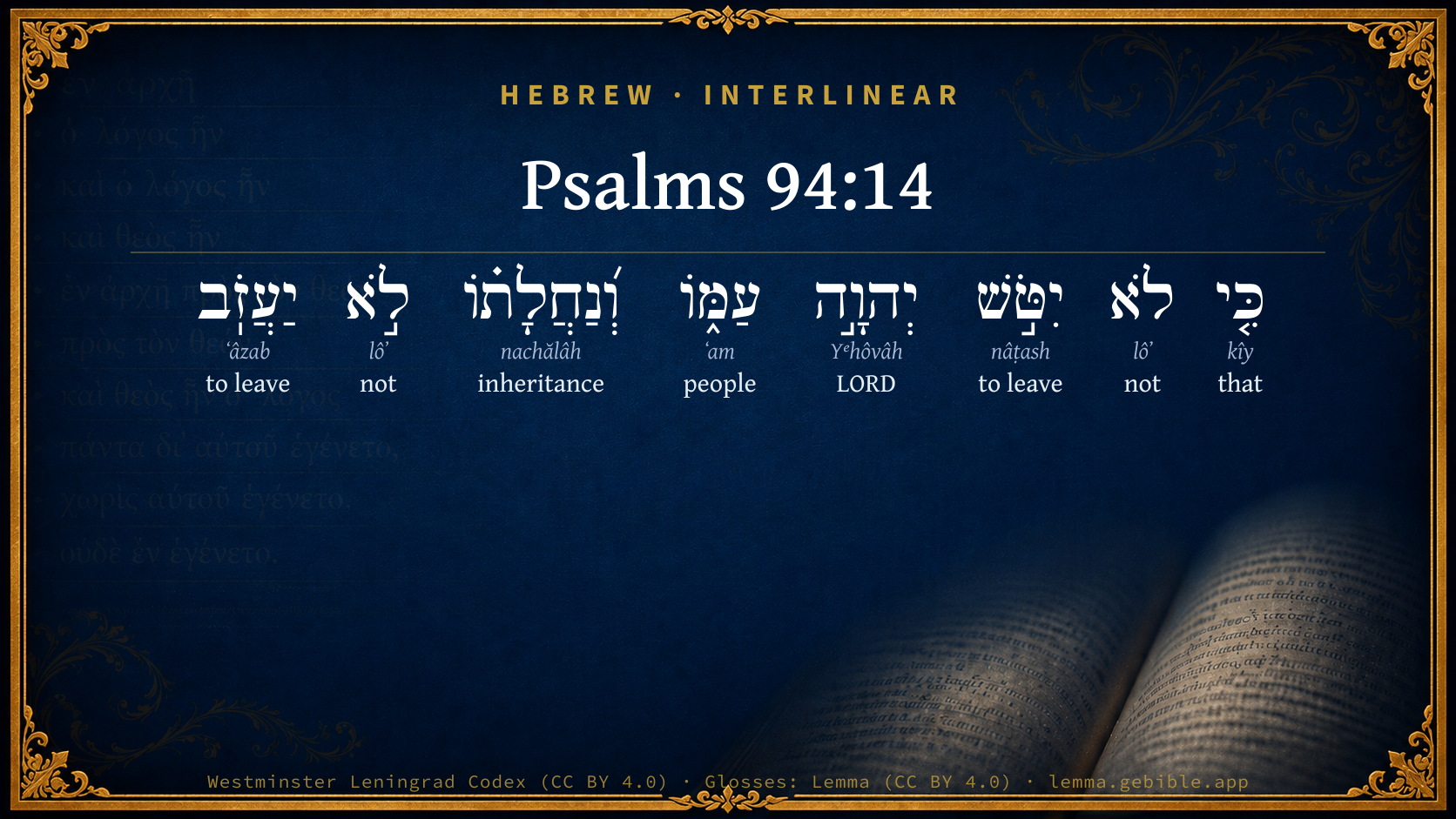
  1. כִּ֤י kîy H3588 “that” Conjunction
  2. לֹא lôʼ H3808 “not” Particle, Negative
  3. יְהוָ֣ה Yᵉhôvâh H3068 “LORD” Noun, Proper
  4. עַמּ֑וֹ ʻam H5971 “people · his” Noun, Common, Masculine, Singular, Construct + Suffix, Personal, 3rd Person, Masculine, Singular
  5. וְ֝נַחֲלָת֗וֹ nachălâh H5159 “and · inheritance · his” Conjunction + Noun, Common, Feminine, Singular, Construct + Suffix, Personal, 3rd Person, Masculine, Singular
  6. לֹ֣א lôʼ H3808 “not” Particle, Negative
  7. יַעֲזֹֽב ʻâzab H5800 “to leave” Verb, Qal, Imperfect, 3rd Person, Masculine, Singular

About this verse

These counts appear in no published source. They are computed here, from the morphology-tagged text and Lemma’s own curated glosses. What Lemma adds →

8
words
7
distinct lemmas
Wisdom
section

Shared distinctive vocabulary

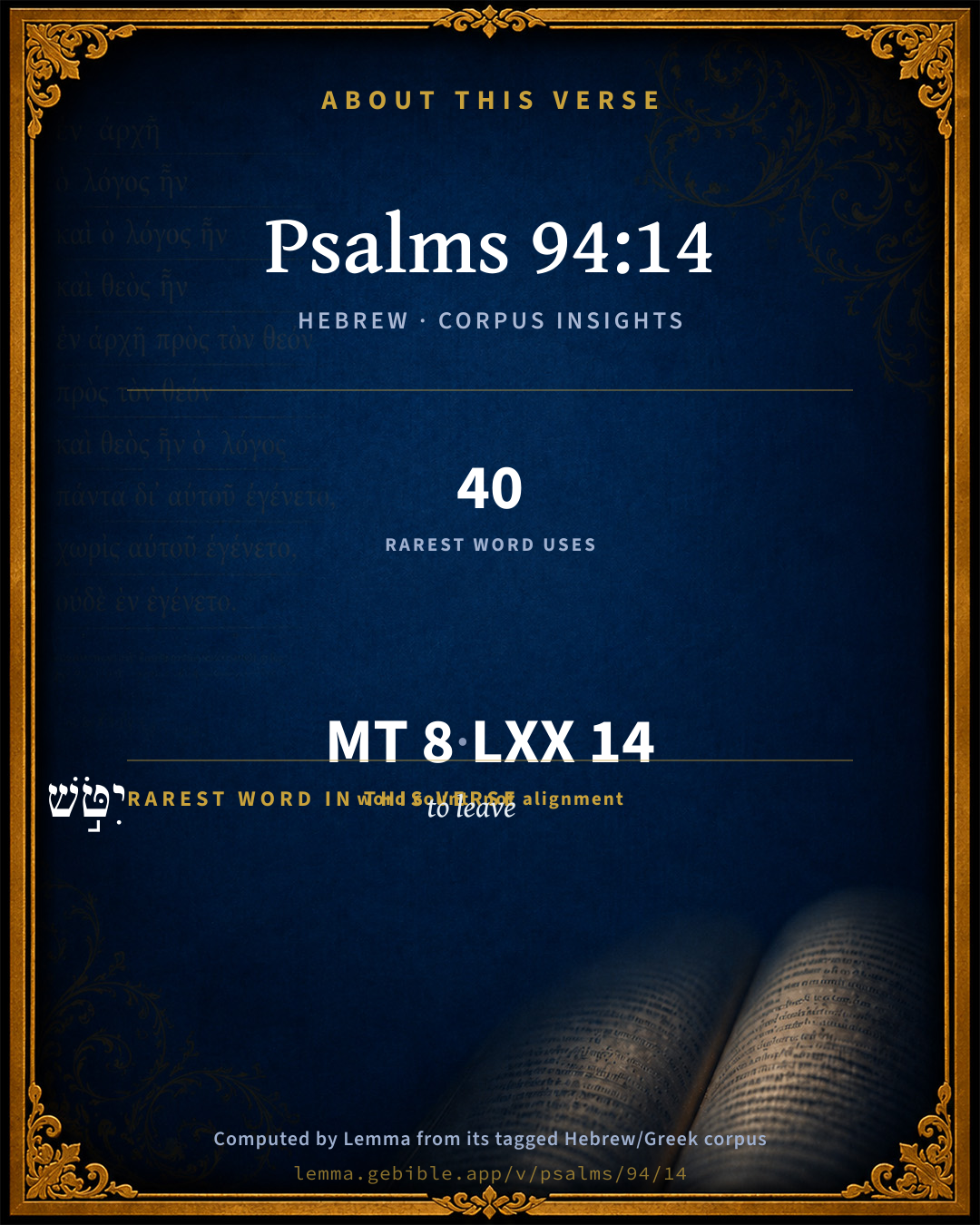
יִטֹּ֣שׁ to leave H5203 occurs in 39 verses of the Hebrew Bible. Also found in:

Grammatical profile

  • 2 verbs
  • 3 nouns
  • 1 conjunction
  • 2 particles

Verb forms

  • יִטֹּ֣שׁ Qal · Imperfect
  • יַעֲזֹֽב Qal · Imperfect

Repetition

A word recurs within this verse — often emphatic in Hebrew:

Hebrew & Septuagint length

In English translation the verse runs 12 words from the Hebrew and 15 from the Septuagint (LXX English) — closely comparable.

A rough comparison of the two English renderings, which tokenize alike — not a word-level alignment.

Word counts can differ between the Hebrew and the Greek without any difference in meaning — e.g. the Hebrew direct-object marker אֵת has no separate Greek word, and Greek often adds the article ὁ.

In the original languages it is 8 Hebrew tokens and 14 Greek tokens — but the two are counted differently (Hebrew bundles its prefixes and suffixes into one token; the Greek is in lemma form), so that isn’t a like-for-like length.

Cross-references

14

Topical passages linked to Psalms 94:14 in the Treasury of Scripture Knowledge — connected by theme and wording, ordered by reader-vote popularity; previews shown in the World English Bible.

  • 1 Samuel 12:22 For Yahweh will not forsake his people for his great name's sake, because it has pleased Yahweh to make you a people to himself.
  • Psalms 37:28 For Yahweh loves justice, And doesn't forsake his saints. They are preserved forever, But the children of the wicked shall be cut off.
  • Romans 11:1–2 I ask then, Did God reject his people? May it never be! For I also am an Israelite, a descendant of Abraham, of the tribe of Benjamin.
  • Deuteronomy 32:9 For Yahweh's portion is his people; Jacob is the lot of his inheritance.
  • John 10:27–31 My sheep hear my voice, and I know them, and they follow me.
  • Romans 8:30 Whom he predestined, those he also called. Whom he called, those he also justified. Whom he justified, those he also glorified.
  • Ephesians 1:18 having the eyes of your hearts enlightened, that you may know what is the hope of his calling, and what are the riches of the glory of his inheritance in the saints,
  • Hebrews 13:5 Be free from the love of money, content with such things as you have, for he has said, "I will in no way leave you, neither will I in any way forsake you."
  • Isaiah 49:14–15 But Zion said, Yahweh has forsaken me, and the Lord has forgotten me.
  • Jeremiah 32:39–40 and I will give them one heart and one way, that they may fear me forever, for the good of them, and of their children after them:
  • Romans 8:38–39 For I am persuaded, that neither death, nor life, nor angels, nor principalities, nor things present, nor things to come, nor powers,
  • Psalms 34:12 Who is someone who desires life, And loves many days, that he may see good?
  • Jeremiah 10:16 The portion of Jacob is not like these; for he is the former of all things; and Israel is the tribe of his inheritance: Yahweh of Hosts is his name.
  • Psalms 94:5 They break your people in pieces, Yahweh, And afflict your heritage.

Cross-references courtesy of OpenBible.info (CC BY 4.0).

Hebrew and Greek witnesses Masoretic Hebrew ↔ Greek Septuagint

The same verse in the two great witnesses to the Old Testament, shown verse-for-verse.

You’re reading Greek Psalm 93 (Hebrew Psalm 94). The Septuagint counts the superscription, so verse numbers can differ from the Hebrew — chapter-level alignment, not verse-by-verse. Numbering follows Rahlfs.

These are two independent witnesses, not word-aligned to each other, and the Septuagint is shown in lemma (dictionary) form.

Hebrew Psalms 94:14 Masoretic · Westminster Leningrad Codex

כִּ֤י לֹא יִטֹּ֣שׁ יְהוָ֣ה עַמּ֑וֹ וְ֝נַחֲלָת֗וֹ לֹ֣א יַעֲזֹֽב

For Yahweh won't reject his people, Neither will he forsake his inheritance.

World English Bible · Public Domain

Greek LXX Greek Psalm 93:14 Septuagint · lemma form

ὅτι οὐ ἀποὠθέω κύριος ὁ λαός αὐτός καί ὁ κληρονομία αὐτός οὐ ἐν καταλείπω

For the Lord will not cast off his people, neither will he forsake his inheritance;

LXX2012 (modern English Septuagint) · Public Domain

Hebrew: Westminster Leningrad Codex (CC BY 4.0). Greek: Septuagint (public domain); English from LXX2012 (modern English Septuagint) (Public Domain). How the Septuagint differs from the Hebrew →

Commentary

Notes on Psalms 94:14 from classic Christian and Jewish commentators (each source and its license shown beneath its notes). The classic Christian expositions comment on the surrounding passage and are grouped to its opening verse, so a note may address several verses; the Jewish commentaries on the Tanakh (Rashi and others) are per-verse, so they appear only where the commentator wrote on this verse.

Lemma curates 59 commentaries, every one of them public domain or Creative Commons licensed, each selected and text-cleaned for this edition rather than reprinted as found. About our sources →

Trapp's Complete Commentary

John Trapp

Psa 94:14 For the LORD will not cast off his people, neither will he forsake his inheritance.

Ver. 14. For the Lord will not cast off his people] Though he cast them into the furnace of affliction. The wicked he bringeth into misery, and there leaveth them to come off as they can, Eze 22:20; Eze 29:5. Not so the saints, Zec 13:9 Isa 43:2 Heb 13:5.

Nor forsake his inheritance] Because his. Patriam quivis amat, non quia pulchram, sed quia suam (Seneca). All love their own.

John Trapp, A Commentary or Exposition upon All the Books of the Old and New Testament (1647–1656) — public domain. Text from a community e-Sword module.

Joseph Benson's Commentary

Psa 94:14-15. The Lord will not cast off his people — Though he may for a time correct, yet he will not utterly destroy, his true and obedient people, as he will their enemies, but will, in due time, put an end to all their calamities. But judgment shall return unto righteousness — Although the world is now full of unrighteous judgments, and even God himself seems not to judge and administer things justly, because he suffers his people to be oppressed, and the wicked to triumph over them, yet the state of things will, at the proper season, be otherwise ordered; God will show himself to be a righteous judge, and will advance and establish justice in the earth, and especially among his people. And all the upright in heart shall follow it — Namely, just judgment restored; they will all approve of and imitate this justice of God in all their actions, whereas the wicked shall still do wickedly, as is said Dan 12:10, and in a land and state of uprightness will deal unjustly, and will not behold the majesty of the Lord, Isa 26:10. Or, as אחריו, acharaiv, may be rendered, shall go after, or follow HIM, namely, the Lord, whose act it is to bring judgment to justice. While the wicked forsake God, these will cleave to him, as being confident that, how much soever he may suffer them to be oppressed for a season, yet he will, in due time, plead their cause, and bring forth their righteousness.

Joseph Benson's Commentary on the Old and New Testaments (1811–1818) — public domain. Text from a community e-Sword module.

Whedon's Commentary on the Bible

Daniel D. Whedon

14. For the Lord will not cast off his people—Faith rises to the sublimest assurance in Psa_94:14-15

Daniel D. Whedon (gen. ed.), Commentary on the Old and New Testaments (1874–1909) — public domain. Text from a community e-Sword module.

J. A. Alexander on Psalms

Joseph Addison Alexander

14. (Psa 94:14) For Jehovah will not forsake his people, and his inheritance he will not leave. The reason why they are happy who confide in and obey the divine instructions is that God can never utterly forsake those who thus trust him, although he may leave them for a time when they leave him. See Deu 32:15, Jdg 6:13, Isa 2:6.

Joseph Addison Alexander, The Psalms Translated and Explained (1850) — public domain. Text from a community e-Sword module.

Tyndale Open Study Notes

Tyndale Open Resources

94:14 Even when it seems that he has, the Lord will not reject his people.

Tyndale Open Study Notes — © Tyndale Open Resources, licensed CC BY-SA 4.0. Text via the HelloAO Bible API.

Adam Clarke's Commentary

Verse 14. The Lord will not cast off his people] Though they are now suffering under a grievous and oppressive captivity, yet the Lord hath not utterly cast them off. They are his inheritance, and he will again restore them to their own land.

Adam Clarke's Commentary on the Bible (1810–1826) — public domain. Text from a community e-Sword/MySword module.

John Calvin's Commentaries

14 Surely Jehovah will not cast off his people He enforces the same truth which he had stated above in still clearer terms, denying it to be possible that God should cast off his people, whom he had chosen in a manner to be his inheritance. When assailed by afflictions, we should fly to this consideration, as a sanctuary of refuge, that we are God’s people, gratuitously adopted into his family, and that he must necessarily have a most intimate and tender regard for our safety, having promised to watch as carefully over his Church as if it were his own heritage. We are thus again taught that our patience will soon give way and fail, unless the tumult of carnal suggestions be allayed by a knowledge of the Divine favor shining in upon our souls.

John Calvin's Commentaries (1540-1563) — public domain. Text from the Calvin Translation Society English edition (1840s-50s) via the Christian Classics Ethereal Library (ccel.org). Calvin's coverage is partial (roughly two-thirds of the Bible); uncommented books and verses are honest gaps, never fabricated. The 19th-century editor's footnotes and remarks are omitted so the notes are faithfully Calvin's own voice.

The Cambridge Bible for Schools and Colleges

gen. ed. J. J. S. Perowne

14. That day will come, for Jehovah cannot finally abandon His persecuted people (Psa_94:5). Cp. 1Sa_12:22; Jer_12:7; Rom_11:1-2.

The Cambridge Bible for Schools and Colleges (gen. ed. J. J. S. Perowne; Cambridge University Press, 1878–1918) — public domain. Text from a community e-Sword module.

John Gill's Exposition

For the Lord will not cast off his people,.... The people whom he has foreknown, his chosen people, whether among Jews or Gentiles, Rom 11:1, his covenant people, whom he has given to Christ, and who are redeemed by his blood, and called by his Spirit and grace: these, though he may not arise immediately for their help; though he may withdraw his presence from them for a time, may afflict them, and suffer them to be afflicted by others, Psa 94:5, he will not cast them off, at least for ever, so as to be removed out of his sight, or off of his heart, or from his covenant, or out of the hands of his Son, or from being a part of his family, or so as to perish eternally; they are a people near and dear unto him; he takes pleasure in them, and will not eternally reject them; whoever casts them off, he will not:

neither will he forsake his inheritance; which he has chosen, and values and esteems as a goodly one; he will not give up his title to it, nor drop his claim upon it, nor relinquish his hold and use of it; he will not forsake his people for this reason, because they are his inheritance, as well as because he has promised that he will not: he may seem to forsake them, and they may think they are forsaken by him; but he will not forsake neither their persons in youth nor in old age, nor his work upon their hearts: the church, in the wilderness, and under the persecution of antichrist, might seem to be cast off and forsaken; yet is not, being nourished there for a time and times, and half a time, Rev 12:14, the note of Arama is,

"at the coming of the Messiah all this good shall be.''

John Gill's Exposition of the Whole Bible (1746–1763) — public domain (CC PDM 1.0). Text via the HelloAO Bible API.

Albert Barnes' Notes on the Bible

For the Lord will not cast off his people ... - He will interpose in their behalf though the wicked seem now to triumph. The certainty of this would give consolation; this would make the mind calm in the days of trouble. Compare 1Sa 12:22; 1Ki 6:13; Deu 31:6. See the notes at Rom 11:1-2.

Albert Barnes' Notes on the Bible (1834–1885) — public domain. Text from a community e-Sword/MySword module.

Matthew Poole's English Annotations

Though God may for a time correct his, people, yet he will not utterly destroy them, as he will their enemies, but will in his time put an end to all their calamities.

Matthew Poole's English Annotations on the Holy Bible (1683–1685) — public domain. Text from a community e-Sword/MySword module.

The Treasury of David

Charles H. Spurgeon

Ver. 14. For the LORD will not cast off his people. He may cast them down, but he never can cast them off. During fierce persecutions the saints have been apt to think that the Lord had left his own sheep, and given them over to the wolf; but it has never been so, nor shall it ever be, for the Lord will not withdraw his love,

neither will he forsake his inheritance. For a time he may leave his own with the design of benefiting them thereby, yet never can he utterly desert them.

"He may chasten and correct,

But he never can neglect;

May in faithfulness reprove,

But he never can cease to love."

Ver. 14.

1. Fear implied. That God will cast off, forsake, etc.

2. Fear denied. God will not cast offwill not forsake. G. R.

Ver. 14.

1. Display his bright doctrine on a dark background. What if the converse were true? Considerations that might lead us to apprehend it true.

2. Joyfully regard the glowing truth itself. The doctrine declared. The reasons hinted (His people. His inheritance). The confidence expressed. C.A.D.

Psalms 94:15*

Charles H. Spurgeon's The Treasury of David (1869–1885) — public domain. Psalms only. Text from a community e-Sword/MySword module.

The Pulpit Commentary

For the Lord will not cast off his people, neither will he forsake his inheritance. (comp. Deu_4:31 1Sa_12:22 1Ki_6:13 Isa_41:17) However long God"s chastisements continue (see ver. 3), the faithful may be sure that God has not forsaken, and never will forsake, them, since "he forsaketh not his saints, but they are preserved forever". (Psa_37:28) The promise is made equally to the faithful individuals ("his saints") and to faithful Churches ("his people," "his inheritance").

The Pulpit Commentary (1880–1919), ed. H.D.M. Spence-Jones & Joseph S. Exell — public domain. Text from a community e-Sword module.

unfoldingWord translationNotes

Door43 World Missions Community

his inheritance

"those whom he has chosen to be with him forever"

judgment will again be righteous

The psalmist speaks of those who judge as if they were the decisions they make. The abstract noun "judgment" can be translated with the verb "judge." AT: "judges will again judge righteously" or "judges will again make righteous decisions" (See: Metonymy and Abstract Nouns)

the upright in heart

The adjective phrase "upright in heart" can be translated as a noun phrase. AT: "those whose hearts are right with God" (See: Nominal Adjectives)

will follow it

"will want the judges to judge righteously"

Who will rise up to defend me against the evildoers? Who will stand up for me against the wicked?

This can be translated as a statement. AT: "No one will defend me against the evildoers. No one will help me fight against the wicked." (See: Rhetorical Question)

the wicked

The adjective "wicked" can be translated as a noun phrase. AT: "wicked people" (See: Nominal Adjectives)

translationWords

forsake

people of God

inherit

raise

evildoer

unfoldingWord translationNotes — © Distant Shores Media and the Door43 World Missions Community, licensed CC BY-SA 4.0. Source: git.door43.org/Door43/en_tn.

Lesson kit

Teaching starters — assembled from the data on this page, not authored interpretation. Every prompt links to the verse data it draws on. Edit before teaching.

Psalms, in the Wisdom, opens this verse with 8 words (7 distinct Hebrew lemmas). Its most distinctive word is nâṭash (“to leave”). A historical commentator’s framing appears above. Read the whole chapter for the surrounding context.

Discussion questions

  1. The word nâṭash carries the sense “to leave.” How does it shape the verse?
  2. Genesis 31:28 shares the word «to leave» with this verse. How do the two illuminate each other?
  3. “not” occurs 2× in this one verse. What is the effect of the repetition?
  4. These translations render this verse differently; the difference is in the English rendering, not the original. What questions does that raise?
  5. The verb «יִטֹּ֣שׁ» is Qal Imperfect. How does its form color the action?
  6. Reading how Trapp's Complete Commentary and Joseph Benson's Commentary read this verse, where do the two commentators agree and where do they part?

Things to notice

Reading settings

Reading text

Shown beneath each verse's original-language words.

Old Testament
Old Testament edition

Read the OT as the Masoretic Hebrew (MT) or the Greek Septuagint (LXX).

English shown for the Greek Septuagint (in the Hebrew ↔ Greek comparison).

Comparing translations? Open the Compare panel on any verse page to stack up to four side by side.